
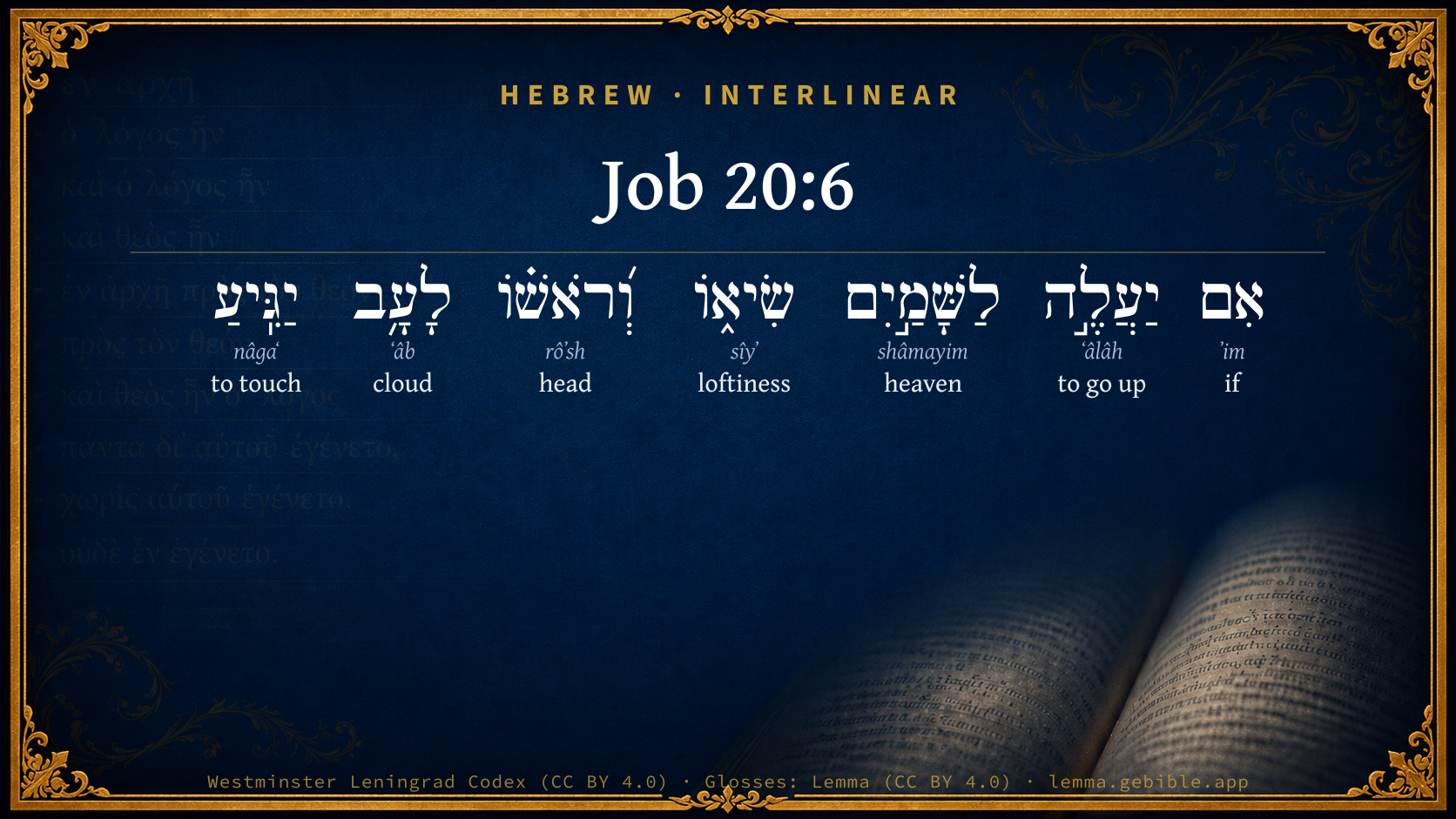
Job 20:6

Hebrew (Westminster Leningrad Codex) Job 20:6 appears in the Hebrew Old Testament. The text above is from the Westminster Leningrad Codex. Each word links to its Strong’s number, a concise gloss, and parsing drawn from the Open Scriptures Hebrew Bible morphology. Click any word for its full Brown-Driver-Briggs (BDB) entry.
Download image
Cite this verse

Job 20:6 (World English Bible). Public Domain. Lemma interlinear Bible study tool, https://lemma.gebible.app/v/job/20/6.

Show BibTeX & RIS
BibTeX
RIS
English Translation
Though his height mount up to the heavens, And his head reach to the clouds,
World English Bible · Public Domain
Highlights
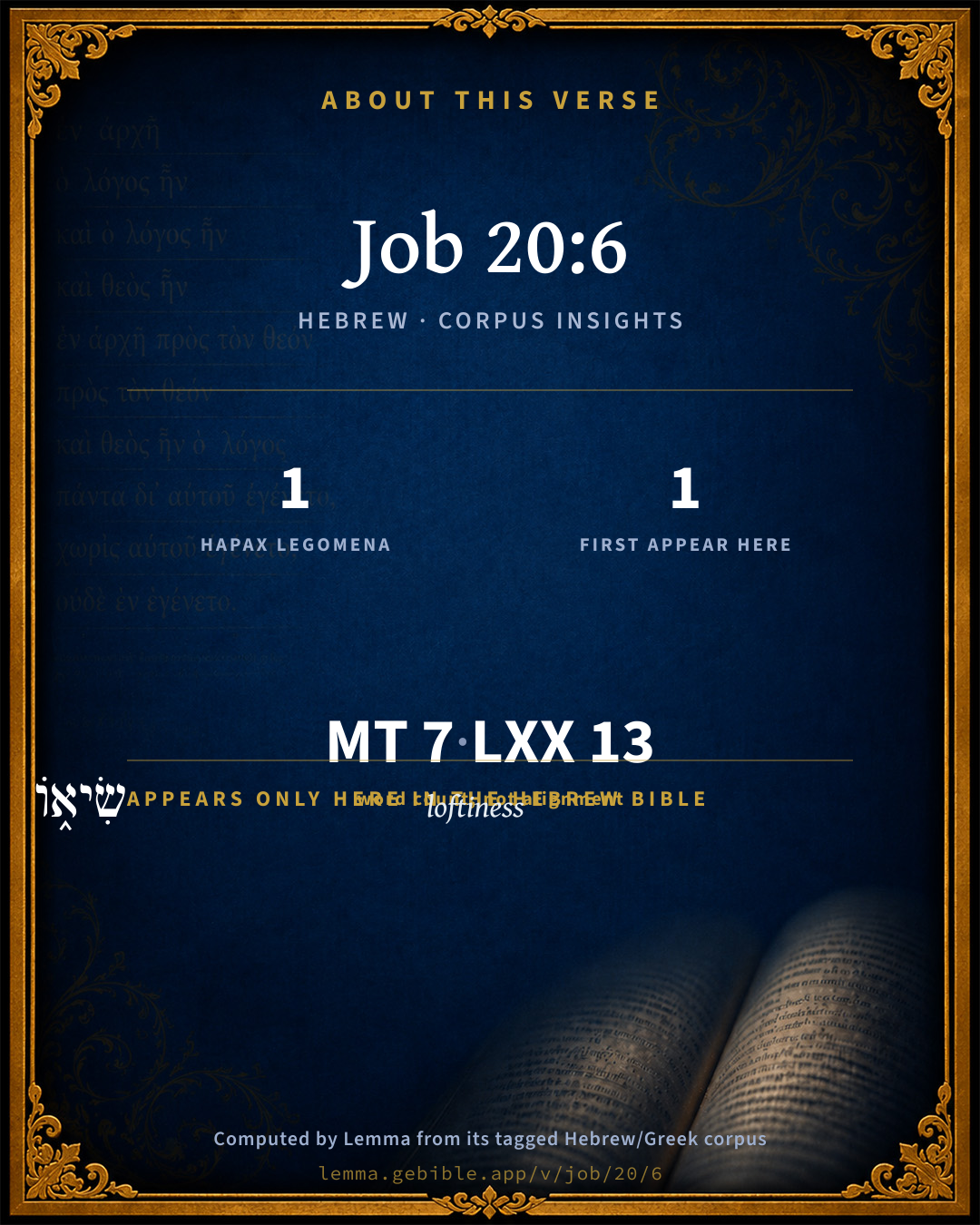
  • 1 hapax legomenon — only here in the Hebrew Bible
  • 1 first appearance in the Hebrew Bible
Full analysis ↓
Download a study sheet

One document with this verse’s original text, its word-by-word gloss line, the meaning frame, cross-references with their text, attributed commentary, and full source and license credits — printable, and it pastes into notes with its structure intact.

This verse Autodidact and up

Study sheet (.html) Plain text (.txt)

A passage Seminary Student

Up to 50 verses in one chapter. A passage sheet keeps up to 6 commentary sources and 12 cross-references per verse, in the order this page ranks them, and says so on the sheet whenever that leaves anything out. Ask for a single verse and you get the Autodidact verse sheet above.

Everything on this page stays free to read, with no account — the sheet is a download of what is already on screen, not access to it.

Want to remove ads? Support Godless Engineer
Compare translations 3

The same verse in 3 English versions, stacked beneath the original-language interlinear above. Click any original word for its lexicon entry.

Each is an independent rendering of the whole verse — the interlinear is not word-aligned to these translations.

Highlighted words mark where these versions differ — a whole-verse word diff, not a word-by-word alignment.

  • World English Bible Public Domain
    Though his height mount up to the heavens, And his head reach to the clouds,
  • King James Version Public Domain
    Though his excellency mount up to the heavens, and his head reach unto the clouds;
  • unfoldingWord Literal Text CC BY-SA 4.0
    Though his height rises to the skies and his head reaches to the cloud,

unfoldingWord Literal Text — © unfoldingWord, licensed CC BY-SA 4.0. Word-aligned USFM3 via Door43 (git.door43.org/unfoldingWord/en_ult).

Versions to compare (up to 4)

3 of 4 selected

Show all 18 translations

Every available English version of this verse, each an independent rendering of the whole verse.

  • World English Bible Public Domain
    Though his height mount up to the heavens, And his head reach to the clouds,
  • Berean Standard Bible Public Domain
    Though his arrogance reaches the heavens, and his head touches the clouds,
  • Majority Standard Bible Public Domain
    Though his arrogance reaches the heavens, and his head touches the clouds,
  • King James Version Public Domain
    Though his excellency mount up to the heavens, and his head reach unto the clouds;
  • American Standard Version (1901) Public Domain
    Though his height mount up to the heavens, And his head reach unto the clouds;
  • Revised Version (1885) Public Domain
    Though his excellency mount up to the heavens, and his head reach unto the clouds;
  • Geneva Bible (1599) Public Domain
    Though his excellencie mount vp to the heauen, and his head reache vnto the cloudes,
  • Douay-Rheims (1899) Public Domain
    If his pride mount up even to heaven, and his head touch the clouds:
  • Young's Literal Translation Public Domain
    Though his excellency go up to the heavens, And his head against a cloud he strike --
  • Literal Standard Version CC BY-SA 4.0
    Though his excellence goes up to the heavens, || He strikes his head against a cloud—
  • Unlocked Literal Bible CC BY-SA 4.0
    Though his height reaches up to the heavens, and his head reaches to the clouds,
  • unfoldingWord Literal Text CC BY-SA 4.0
    Though his height rises to the skies and his head reaches to the cloud,
  • Darby Bible Public Domain
    Though his height mount up to the heavens, and his head reach unto the clouds,
  • World Messianic Bible Public Domain
    Though his height mount up to the heavens, and his head reach to the clouds,
  • Webster's Bible Public Domain
    Though his excellence shall mount up to the heavens, and his head reach to the clouds;
  • Free Bible Version CC BY-SA 4.0
    Even though they are so tall they reach the heavens, even though their heads reach the clouds,
  • Bible in Basic English Public Domain
    Though he is lifted up to the heavens, and his head goes up to the clouds;
  • JPS Tanakh (1917) Public Domain
    Though his excellency mount up to the heavens, and his head reach unto the clouds;

Literal Standard Version (2020), Covenant Press — licensed CC BY-SA 4.0. Text via the HelloAO Bible API (eBible.org). Unlocked Literal Bible (unfoldingWord) — licensed CC BY-SA 4.0. Text via the HelloAO Bible API (eBible.org). unfoldingWord Literal Text — © unfoldingWord, licensed CC BY-SA 4.0. Word-aligned USFM3 via Door43 (git.door43.org/unfoldingWord/en_ult). Free Bible Version, Dr. Jonathan Gallagher — licensed CC BY-SA 4.0. Text via the HelloAO Bible API (eBible.org).

Word by word

More ways to search: Search by grammar → Find every occurrence → Compare this word →

Practice this passage: Drill this verse → Learn its vocabulary →

About this verse

These counts appear in no published source. They are computed here, from the morphology-tagged text and Lemma’s own curated glosses. What Lemma adds →

7
words
7
distinct lemmas
Wisdom
section

Notable vocabulary

1 hapax legomenon — a word that appears only here in the entire Hebrew Bible:

  • שִׂיא֑וֹ loftiness H7863

First appearance in Scripture

This word makes its first canonical appearance in the Hebrew Bible here:

  • שִׂיא֑וֹ loftiness H7863

Shared distinctive vocabulary

לָעָ֥ב cloud H5645 occurs in 32 verses of the Hebrew Bible. Also found in:

Grammatical profile

  • 2 verbs
  • 4 nouns
  • 1 conjunction

Verb forms

  • יַעֲלֶ֣ה Qal · Imperfect
  • יַגִּֽיעַ Hiphil · Imperfect

Hebrew & Septuagint length

In English translation the verse runs 15 words from the Hebrew and 14 from the Septuagint (LXX English) — closely comparable.

A rough comparison of the two English renderings, which tokenize alike — not a word-level alignment.

Word counts can differ between the Hebrew and the Greek without any difference in meaning — e.g. the Hebrew direct-object marker אֵת has no separate Greek word, and Greek often adds the article ὁ.

In the original languages it is 7 Hebrew tokens and 13 Greek tokens — but the two are counted differently (Hebrew bundles its prefixes and suffixes into one token; the Greek is in lemma form), so that isn’t a like-for-like length.

Cross-references

7

Topical passages linked to Job 20:6 in the Treasury of Scripture Knowledge — connected by theme and wording, ordered by reader-vote popularity; previews shown in the World English Bible.

  • Isaiah 14:13–14 You said in your heart, I will ascend into heaven, I will exalt my throne above the stars of God; and I will sit on the mountain of congregation, in the uttermost parts of the north;
  • Obadiah 1:3–4 The pride of your heart has deceived you, you who dwell in the clefts of the rock, whose habitation is high, who says in his heart, 'Who will bring me down to the ground?'
  • Genesis 11:4 They said, "Come, let's build us a city, and a tower, whose top reaches to the sky, and let's make us a name; lest we be scattered abroad on the surface of the whole earth."
  • Daniel 4:11 The tree grew, and was strong, and the height of it reached to the sky, and the sight of it to the end of all the earth.
  • Daniel 4:22 it is you, O king, that are grown and become strong; for your greatness is grown, and reaches to the sky, and your dominion to the end of the earth.
  • Amos 9:2 Though they dig into Sheol, there my hand will take them; and though they climb up to heaven, there I will bring them down.
  • Matthew 11:23 You, Capernaum, who are exalted to Heaven, you will go down to Hades. For if the mighty works had been done in Sodom which were done in you, it would have remained until this day.

Cross-references courtesy of OpenBible.info (CC BY 4.0).

Hebrew and Greek witnesses Masoretic Hebrew ↔ Greek Septuagint

The same verse in the two great witnesses to the Old Testament, shown verse-for-verse.

These are two independent witnesses, not word-aligned to each other, and the Septuagint is shown in lemma (dictionary) form.

Hebrew Job 20:6 Masoretic · Westminster Leningrad Codex

אִם יַעֲלֶ֣ה לַשָּׁמַ֣יִם שִׂיא֑וֹ וְ֝רֹאשׁ֗וֹ לָעָ֥ב יַגִּֽיעַ

Though his height mount up to the heavens, And his head reach to the clouds,

World English Bible · Public Domain

Greek LXX Job 20:6 Septuagint · lemma form

ἐάν ἀναβαίνω εἰς οὐρανός αὐτός ὁ δῶρον ὁ δέ θυσία αὐτός νέφος ἅπτομαι

although his gifts should go up to heaven, and his sacrifice reach the clouds.

LXX2012 (modern English Septuagint) · Public Domain

On this verse, Trapp's Complete Commentary discusses the Septuagint’s reading. Read the note in Commentary ↓

Hebrew: Westminster Leningrad Codex (CC BY 4.0). Greek: Septuagint (public domain); English from LXX2012 (modern English Septuagint) (Public Domain). How the Septuagint differs from the Hebrew →

Commentary

Notes on Job 20:6 from classic Christian and Jewish commentators (each source and its license shown beneath its notes). The classic Christian expositions comment on the surrounding passage and are grouped to its opening verse, so a note may address several verses; the Jewish commentaries on the Tanakh (Rashi and others) are per-verse, so they appear only where the commentator wrote on this verse.

Lemma curates 59 commentaries, every one of them public domain or Creative Commons licensed, each selected and text-cleaned for this edition rather than reprinted as found. About our sources →

Trapp's Complete Commentary

John Trapp

Job 20:6 Though his excellency mount up to the heavens, and his head reach unto the clouds;

Ver. 6. Though his excellency mount up to the heavens] Though he conceit himself, and would have others hold him to be, more than a man, and to accord him divine honour. If his pride ascend even up to heaven, so the Vulgate rendereth it. If his gifts ascend up to heaven, so the Septuagint: and indeed hypocrites are ever lifted up with their gifts, as some Corinthians were with their waxen wings, 1Co 8:1, being enriched in all utterance and knowledge, and coming behind others in no gift, 1Co 1:7, yet were they babes at best, and carnal, walking as men, 1Co 3:2-3; their religion was more in notion than in motion; they had the spiritual rickets, which, having grown big in the head, &c.; as the moon, they increased in light, but not in heat. In which respect, also, and for her external privileges, Capernaum is said to be lifted up to heaven, Mat 11:23; and the temporary, to taste of the heavenly gift, to partake of the powers of the world to come, Heb 6:4-5.

And his head reach unto the clouds] Aequalis astris gradior, saith he in the poet (Sen. in Thyest.), and Bibulus in Coelo est, saith the orator (Cic. ad Attic.). The heathen rhetoric is but dull stuff to that in this Book; and indeed in this one chapter. A hypocrite’s head is oft above the clouds of heaven when his heart is beneath the clods of earth; like the eagle, which, when he soareth highest of all, even out of sight almost, hath his eye all the while upon his prey below. Or like the apricot tree, which shoots up and leans upon the wall, but is fast rooted in the earth. This whole allusion may be unto a tree, like that of Nebuchadnezzar, whose height was great, and reached unto heaven, Dan 4:10-11; Dan 4:22. Or that of the Amorite, whose height was like the height of the cedars, and he was strong as the oaks, Amo 2:9.

John Trapp, A Commentary or Exposition upon All the Books of the Old and New Testament (1647–1656) — public domain. Text from a community e-Sword module.

Joseph Benson's Commentary

Job 20:6-9. Though his excellency mount up to the heavens — Though he be advanced to great dignity and authority in the world. He shall perish like his own dung — Which men cast away with contempt and abhorrence. They who have seen him — With admiration at his felicity; shall say, Where is he? — He is nowhere to be found; he is utterly gone and lost. He shall fly away as a dream — Which, for the present, affects the fancy, but hath nothing solid or permanent in it, for as soon as a man awakes all vanishes, and the remembrance of it is quickly lost. Neither shall his place any more behold him — That is, it shall not acknowledge or contain him. A figure called prosopopœia, as Job 7:10. Or, neither shall it (that is, the eye, last mentioned) behold him any more in his place.

Joseph Benson's Commentary on the Old and New Testaments (1811–1818) — public domain. Text from a community e-Sword module.

Whedon's Commentary on the Bible

Daniel D. Whedon

First strophe expands the aphorism just announced, (Job_20:4-5,) — Like a lofty tree, he may mount up to heaven, yet with ignominy, and, suddenly, shall he perish, and his wealth be swept away with him, (Job_20:6-11.)

6. Excellency — In the sense of height or exaltation.

Daniel D. Whedon (gen. ed.), Commentary on the Old and New Testaments (1874–1909) — public domain. Text from a community e-Sword module.

Geneva Bible (1599)

Geneva Bible translators

His purpose is to prove Job to be a wicked man, and an hypocrite, because God punished him, and changed his prosperity into adversity.

Geneva Bible (1599) marginal notes — public domain. Text via Bolls.life.

Jamieson, Fausset & Brown

Robert Jamieson, A. R. Fausset & David Brown

(Isa 14:13; Oba 1:3-4).

Jamieson, Fausset & Brown — Commentary Critical and Explanatory on the Whole Bible (1871) — public domain (CC PDM 1.0). Text via the HelloAO Bible API.

Adam Clarke's Commentary

Verse 6. Though his excellency mount up to the heavens] Probably referring to the original state of Adam, of whose fall he appears to have spoken, Job 20:4. He was created in the image of God; but by his sin against his Maker he fell into wretchedness, misery, death, and destruction.

Adam Clarke's Commentary on the Bible (1810–1826) — public domain. Text from a community e-Sword/MySword module.

The Cambridge Bible for Schools and Colleges

gen. ed. J. J. S. Perowne

6. his excellency] Or, his height, or rising up (Psa_89:9); cf. Isa_14:13-15, Obad. Job_20:4.

The Cambridge Bible for Schools and Colleges (gen. ed. J. J. S. Perowne; Cambridge University Press, 1878–1918) — public domain. Text from a community e-Sword module.

John Gill's Exposition

Though his excellency mount up to the heavens,.... Though, in worldly grandeur and glory, he should arrive to such a pitch as the Assyrian monarch was ambitious of, as to ascend into heaven, exalt his throne above the stars of God, and be like the Most High; or be comparable to such a tree, by which the greatness of Nebuchadnezzar's kingdom is expressed, the height whereof reached unto heaven, Isa 14:12;

and his head reach unto the clouds; being lifted up with pride, because of his greatness, and looking with contempt and scorn on others; the Septuagint version is, "if his gifts ascend up to heaven", &c. which well agrees with an hypocrite possessed of great gifts, and proud of them; as Capernaum was highly favoured with external things, as the presence of Christ, his ministry and miracles, and so said to be exalted unto heaven, yet, because of its impenitence and unbelief, should be brought down to hell, Mat 11:23.

John Gill's Exposition of the Whole Bible (1746–1763) — public domain (CC PDM 1.0). Text via the HelloAO Bible API.

Albert Barnes' Notes on the Bible

Though his excellency mount up to the heavens - Though he attain to the highest pitch of honor and prosperity. The Septuagint renders this, “Though his gifts should go up to heaven, and his sacrifice should touch the clouds;” a sentence conveying a true and a beautiful idea, but which is not a translation of the Hebrew. The phrases, to go up to heaven, and to touch the clouds, often occur to denote anything that is greatly exalted, or that is very high. Thus, in Virgil,

It clamor coelo.

So Horace,

Sublimi feriam sidera vertice.

And again,

Attingit solium Joyis.

Compare Gen 11:4, “Let us build us a tower whose top may reach unto heaven.” In Homer the expression not unfrequently occurs, τοῦ γὰρ κλέος οὐρανὸν ἵκει tou gar kleos ouranon hikei. In Seneca (Thyest. Act. v. ver. 1, 2,4,) similar expressions occur:

Aequalis astris gradior, et cunctos super

Altum superbo vertice attingens polum,

Dimitto superos: summa votorum attigi.

The “language” of Zophar would also well express the condition of many a hypocrite whose piety seems to be of the most exalted character, and who appears to have made most eminent attainments in religion. Such a man may “seem” to be a man of uncommon excellence. He may attract attention as having extraordinary sanctity. He may seem to have a remarkable spirit of prayer, and yet all may be false and hollow. Men who design to be hypocrites, aim usually to be “eminent” hypocrites; they who have true piety often, alas, aim at a much lower standard. A hypocrite cannot keep himself in countenance, or accomplish his purpose of imposing on the world, without the appearance of extraordinary devotedness to God; many a sincere believer is satisfied with much less of the appearance of religion. He is sincere and honest. He is conscious of true piety, and he attempts to impose on none. At the same time he makes no attempt scarcely “to be” what the hypocrite wishes “to appear” to be; and hence, the man that shall appear to be the most eminently devoted to God “may” be a hypocrite - yet usually not long. His zeal dies away, or he is suffered to fall into open sin, and to show that he had no true religion at heart.

Albert Barnes' Notes on the Bible (1834–1885) — public domain. Text from a community e-Sword/MySword module.

Haydock's Catholic Bible Commentary

Pride. Septuagint, "presents." (Haydock) --- Riches may be meant by pride. (Calmet)

George Leo Haydock (1774–1849), Haydock's Catholic Family Bible and Commentary, 1859 edition — public domain. Excludes Psalms (Douay-Rheims chapter numbering differs from Protestant) and Deuterocanonical books (Catholic canon only).

Matthew Poole's English Annotations

Though he be advanced to great dignity and authority in the world.

Matthew Poole's English Annotations on the Holy Bible (1683–1685) — public domain. Text from a community e-Sword/MySword module.

The Pulpit Commentary

Though his excellency mount up to the heavens. "Though he reach," i.e. , "the highest pitch of prosperity". (comp. Psa_73:9) And his head reach unto the clouds. (comp. Dan_4:22, "Thou, O king, art grown and become strong: and thy greatness is grown, and reacheth unto heaven

The Pulpit Commentary (1880–1919), ed. H.D.M. Spence-Jones & Joseph S. Exell — public domain. Text from a community e-Sword module.

John Wesley's Explanatory Notes

Though - Though he be advanced to great dignity and authority.

John Wesley, Explanatory Notes Upon the Whole Bible (1754–1765) — public domain. Text via the GEBible commentary corpus.

Keil & Delitzsch

C. F. Keil & F. Delitzsch

6 If his aspiration riseth to the heavens,

And he causeth his head to touch the clouds:

7 Like his dung he perisheth for ever;

Those who see him say: Where is he?

8 As a dream he flieth away, and they cannot find him;

And he is scared away as a vision of the night.

9 The eye hath seen him, and never again,

And his place beholdeth him no more.

10 His children must appease the poor,

And his hands give up his wealth.

11 His bones were full of youthful vigour;

Now it is laid down with him in the dust.

If the exaltation of the evil-doer rises to heaven, and he causes his head to reach to the clouds, i.e., to touch the clouds, he notwithstanding perishes like his own dung. We are here reminded of what Obadiah, Job 20:4, says of Edom, and Isaiah, Isa 14:13-15, says of the king of Babylon. שׂיא is equivalent to נשׂיא, like שׂוא, Psa 89:10 = נשׂוא; the first weak radical is cast away, as in כּילי = נכילי, fraudulentus, machinator, Isa 32:5, and according to Olsh. in שׁיבה = ישׁיבה, Sa2 19:33. הגּיע is to be understood as causative (at least this is the most natural) in the same manner as in Isa 25:12, and freq. It is unnecessary, with Ew., Hirz., and Hlgst., after Schultens, to transl. כגללו, Job 20:7, according to the Arab. jlâl (whence the name Gell-ed-dn): secundum majestatem suam, or with Reiske to read בגללו, in magnificentia sua, and it is very hazardous, since the Hebrew גלל has not the meaning of Arab. jll, illustrem esse. Even Schultens, in his Commentary, has retracted the explanation commended in his Animadv., and maintained the correctness of the translation, sicut stercus suum (Jer. sicut sterquilinium), which is also favoured by the similar figurative words in Kg1 14:10 : as one burneth up (not: brushes away) dung (הגּלל), probably cow-dung as fuel, until it is completely gone. גּללו (or גּללו with an audible Shev) may be derived from גּלל, but the analogy of צללו favours the primary form גּל (Ew. 255, b); on no account is it גּלל. The word is not low, as Eze 4:12, comp. Zep 1:17, shows, and the figure, though revolting, is still very expressive; and how the fulfilment is to be thought of may be seen from an example from Kg2 9:37, according to which, "as dung upon the face of the field shall it be, so that they cannot say: this is Jezebel."

(Note: In Arabic, gille (גּלּה) and gelle (גּלּה) is the usual and preferred fuel (hence used as synon. of hhattab) formed of the dung of cows, and not indeed yoke-oxen (baqar 'ammle), because they have more solid fodder, which produces no material for the gelle, but from cattle that pasture in the open fields (baqar bat.tle), which are almost entirely milking cows. This dung is collected by women and children in the spring from the pastures as perfectly dry cakes, which have the green colour of the grass. Every husbandman knows that this kind of dung - the product of a rapid, one might say merely half, digestion, even when fresh, but especially when dry - is perfectly free from smell. What is collected is brought in baskets to the forming or pressing place (mattba'a, מטבּעה), where it is crumbled, then with water made into a thick mass, and, having been mixed with chopped straw, is formed by the women with the hand into round cakes, about a span across, and three fingers thick. They resemble the tanners' tan-cakes, only they are not square. Since this compound has the form of a loaf it is called qurss (which also signifies a loaf of bread); and since a definite form is given to it by the hand, it is called ttabu' (טבּוּע), collective ttbbi', which צפוּעי (צפיעי), Eze 4:15, resembles in meaning; for ssaf', צפע (cogn. ssafhh, צפח), signifies to beat anything with the palm of the hand. First spread out, then later on piled up, the gelle lies the whole summer in the mattba'a. The domes (qubeb) are not formed until a month before the rainy season, i.e., a circular structure is built up of the cakes skilfully placed one upon another like bricks; it is made from six to eight yards high, gradually narrowed and finished with a vaulted dome, whence this structure has its name, qubbe (קבּה). Below it measures about eight or ten paces, it is always hollow, and is filled from beneath by means of an opening which serves as a door. The outside of the qubbe is plastered over with a thick solution of dung; and this coating, when once dried in the sun, entirely protects the building, which is both storehouse and store, against the winter rains. When they begin to use the fuel, they take from the inside first by means of the doorway, and afterwards (by which time the heavy rains are over) they use up the building itself, removing the upper part first by means of a ladder. By the summer the qubbe has disappeared. Many large households have three or four of these stores. Where walled-in courts are spacious, as is generally the case, they stand within; where not, outside. The communities bordering on the desert, and exposed to attacks from the Arabs, place them close round their villages, which gives them a peculiar appearance. When attacked, the herds are driven behind these buildings, and the peasants make their appearance between them with their javelins. Seetzen reckons the gelle among the seven characteristics of the district of Haurn (Basan).

It appears that Eze 4:12. - where the prophet is allowed the usual cow-dung, the flame of which has no smell whatever, and its ashes, which smoulder for a long time, are as clean as wood ashes, instead of the cakes (גּללי) of human dung - is to be explained according to this custom. My fellow-travellers have frequently roasted mushrooms (futtr) and truffles (faq', פּקע) in the early spring in the glowing ashes of the gelle. On the other hand, it would be an error to infer from this passage that the Semites made use of human dung for fuel; the Semites (including the Nomads) are the most scrupulously particular people respecting cleanliness. According to the above, Zep 1:17 may be explained: "their flesh shall become like dung," i.e., be burned or destroyed like dung. And also we understand the above passage in the book of Job, "as his heap of dung-cakes shall he be consumed away," exactly like Kg1 14:10 : "I will burn (take away) the remnant of the house of Jeroboam, as a man burneth the dung-cakes until they are consumed," The suff. in כּגללו refers to the habitation of the evil-doer, above whose grovelling joy the high dome of the dung-cakes rises, which, before one becomes aware of it, has disappeared; and throughout the description of the sudden destruction of the evil-doer, Kg1 14:8, Kg1 14:9, the reader must keep the figure of this dome and its disappearing before his mind. If it be objected that by such a rendering כּגלליו would be expected, Kg1 14:10 shows that גּלל (גּל) was also used as a collective, and the Arabic gelle is never used in any other way, which is the more remarkable, as one from the first regards its termination as the "Arab. t of unity." My attendants on my journey from Damascus (where there is no gelle, and consequently the word is not used) always took it so, and formed the plural gellt and the collective gilel, and were always laughed at and corrected: say Arab. aqrts jllt or tbb' jllt! - Wetzst.)

The continuation here, Job 20:7, is just the same: they who saw him (partic. of what is past, Ges. 134, 1) say: where is he? As a dream he flieth away, so that he is not found, and is scared away (ידּד Hoph., not ידּד Kal) as a vision of the night (חזּיון everywhere in the book of Job instead of חזון, from which it perhaps differs, as visum from visio), which one banishes on waking as a trick of his fancy (comp. Psa 73:20; Isa 29:7.). Eyes looked upon him (שׁזף only in the book of Job in this signification of a fixed scorching look, cogn. שׁדף, adurere, as is manifest from Sol 1:6), and do it no more; and his place (מקומו construed as fem., as Gen 18:24; Sa2 17:12, Cheth.) shall not henceforth regard him (שׁוּר, especially frequent in the book of Job, prop. to go about, cogn. תור, then to look about one). The futt. here everywhere describe what shall meet the evil-doer. Therefore Ewald's transl., "his fists smote down the weak," cannot be received. Moreover, חפניו, which must then be read instead of בּנין, does not occur elsewhere in this athletic signification; and it is quite unnecessary to derive ירצּוּ from a רצּה = רצּץ (to crush, to hurl to the ground), or to change it to ירצּוּ (Schnurrer) or ירצּצוּ (Olsh.); for although the thought, filios ejus vexabunt egeni (lxx according to the reading θλάσειαν, and Targ. according to the reading ירעעוּן), is not unsuitable for Job 20:10, a sense more natural in connection with the position of bnyw, and still more pleasing, is gained if רצּה is taken in the usual signification: to conciliate, appease, as the Targ. according to the reading ירעוּן (Peschito-word for ἀποκαταλλάσσειν), and Ges., Vaih., Schlottm., and others, after Aben-Ezra, Ralbag, Merc.: filii ejus placabunt tenues, quos scilicet eorum pater diripuerat, vel eo inopiae adigentur, ut pauperibus sese adjungere et ab illis inire gratiam cognantur. Its retributive relation to Job 20:19 is also retained by this rendering. The children of the unfeeling oppressor of the poor will be obliged, when the tyrant is dead, to conciliate the destitute; and his hands, by means of his children, will be obliged to give back his property, i.e., to those whom his covetousness had brought to beggary (און, exertion, strength, Job 18:7, then as hown, and synon. חיל, wealth, prob. from the radical meaning to breathe, which is differently applied in the Arabic aun, rest, and haun, lightness). Carey thinks that the description is retrospective: even he himself, in his lifetime, which, however, does not commend itself, since here it is throughout the deceased who is spoken of. As in Job 20:9, so now in Job 20:11 also, perf. and fut. interchange, the former of the past, the latter of the future. Jerome, by an amalgamation of two distinct radical significations, translates: ossa ejus implebuntur (it should be impleta erant) vitiis adolescentiae ejus, which is to be rejected, because עלוּם, Psa 90:8, is indeed intended of secret sin, but signifies generally that which is secret (veiled). On the contrary, עלוּמים, Job 33:25, certainly signifies adolescentia (Arab. gulûmat), and is accordingly, after lxx, Targ., and Syr., to be translated: his bones were full of youthful vigour. In Job 20:11, תּשׁכּב, as Job 14:19, can refer to the purely plural עצמותיו, but the predicate belonging to it would then be plur. in Job 20:11, and sing. in Job 20:11; on which account the reference to עלוּמו, which is in itself far more suitable, is to be preferred (Hirz., Schlottm.): his youthful vigour, on which he relied, lies with him in the dust (of the grave).

Keil & Delitzsch — Biblical Commentary on the Old Testament (1861–1891) — public domain (CC PDM 1.0). Text via the HelloAO Bible API. (Old Testament only.)

Kretzmann's Popular Commentary

Paul E. Kretzmann

Zophar Pictures the End of the Ungodly

v. 6. Though his excellency mount up to the heavens, that is, his ambitious plans, his exaltation in rank and power, and his head reach unto the clouds, the ungodly apparently gaining all that his heart desires;

v. 7. yet he shall perish forever like his own dung, spurned, falling into decay, and forgotten; they which have seen him shall say, Where is he? He will have disappeared so utterly and quickly that his vanishing will occasion surprise.

v. 8. He shall fly away as a dream and shall not be found, just as fleeting, just as perishable; yea, he shall be chased away as a vision of the night, scared away like a phantom before God’s mighty intervention.

v. 9. The eye also which saw him shall see him no more, even a careful scanning would yield no results, since God’s removal of the wicked would not leave a trace behind; neither shall his place any more behold him.

v. 10. His children shall seek to please the poor, that is, they will be obliged to do that by God’s judgment, God will compel them to pay out to them, and his hands shall restore their goods, through his children, who would be under compulsion to give back the wealth, the money, which he had taken from the poor by his wicked exactions.

v. 11. His bones are full of the sin of his youth, they were indeed full of the vigor of youth, which shall lie down with him in the dust, all the strength and vigor of his body will be laid in the grave.

v. 12. Though wickedness be sweet in his mouth, though he hide it under his tongue, holding evil in his mouth like a sweet-tasting morsel,

v. 13. though he spare it and forsake it not, sparing it to prolong his enjoyment of it, but keep it still within his mouth, retaining it against his palate, persisting in the lustful enjoyment of his wickedness,

v. 14. yet his meat in his bowels is turned, the food of wickedness which he finally swallows, it is the gall of asps within him, the venom of serpents in his intestines.

v. 15. He hath swallowed down riches, all the possessions which he gained by his wicked grasping, and he shall vomit them up again, unable to retain what he had so eagerly appropriated; God shall cast them out of his belly, administering an emetic to him, forcing him to disgorge his ill-gotten wealth.

v. 16. He shall suck the poison of asps, this will turn out to be the effect upon him; the viper’s tongue shall slay him, his punishment will come upon him as quickly as the striking of one of the very venomous serpents of the Arabian desert, whose sting is almost immediately fatal.

v. 17. He shall not see the rivers, the floods, the brooks of honey and butter, the wicked would get no opportunity to delight in, to enjoy, brooks, creeks, rivers of honey and cream, he would be given no opportunity to enjoy his prosperity.

v. 18. That which he labored for shall he restore, being obliged to give it back to those from whom he has wrested it, and shall not swallow it down, not enjoy it; according to his substance shall the restitution be, and he shall not rejoice therein, that is, in the same ratio as he heaped up his property by forbidden means his enjoyment in it would be diminished, he must lack the enjoyment which he had promised himself in them.

v. 19. Because he hath oppressed and hath forsaken the poor, first crushed and then abandoned the defenseless, because he hath violently taken away an house which he builded not, not being able to fit out and to arrange the houses which he gained by unjust means,

v. 20. surely he shall not feel quietness in his belly, rest in the seat of his gluttony and avarice, he shall not save of that which he desired, literally, "with his most valued treasure he shall not escape. " The allusion is probably to the fact that Job had been stripped of all he had.

v. 21. There shall none of his meat be left, literally, "there is nothing remaining to his food," that is, nothing escaped his greediness; therefore shall no man look for his goods, his ill-gotten prosperity will not endure.

v. 22. In the fullness of his sufficiency, while he has more than he needs for his actual wants, while he is surfeited with good things, he shall be in straits, poverty and distress will take hold on him; every hand of the wicked shall come upon him, the wretched people who were abused by him will inflict vengeance on him for the violence which they had suffered.

v. 23. When he is about to fill his belly, or, "That it may serve for the filling of his belly," that for once the wicked may have enough and more than enough, God shall cast the fury of His wrath upon him, as it glows with a white heat, and shall rain it upon him while he is eating, with his food, so that he consumes the fire of God’s wrath with every meal.

v. 24. He shall flee from the iron weapon, while the wicked flees from the iron armor, and the bow of steel shall strike him through, the arrow from a brass bow will pierce him.

v. 25. It is drawn and cometh out of the body, the wicked himself drawing the arrow of God out of his body, in order to save his life, if possible; yea, the glittering sword cometh out of his gall, for he himself removes the gleaming steel; terrors are upon him, as he realizes that his doom is upon him.

v. 26. All darkness shall be hid in his secret places, is saved up to strike that which he has hoarded, that is, every kind of calamity will descend upon the precious things which he fondly believed to be safe; a fire not blown shall consume him, that is, such a fire as requires no human agency to keep it alive, a supernatural fire; it shall go ill with him that is left in his tabernacle, the fire of God devouring that which still remains after former calamities have passed by.

v. 27. The heaven shall reveal his iniquity, they do so at all times, God Himself witnessing against him; and the earth shall rise up against him, all creation testifying the fact that he merits destruction.

v. 28. The increase of his house shall depart, all that he has garnered, and his goods shall flow away in the day of his wrath, when the divine wrath will descend upon him.

v. 29. This is the portion of a wicked man from God, that which is assigned to him, what he must finally expect, and the heritage appointed unto him by God. In the end the wicked has nothing but misery and wretchedness for his portion. In the entire discourse it is evident that Zophar has Job in mind and wants him to apply the statements to himself. The sneering insinuations in similar cases are intended to cut the victim to the quick.

Paul E. Kretzmann, Popular Commentary of the Bible (1921–1924) — public domain. Text from a community e-Sword module.

unfoldingWord translationNotes

Door43 World Missions Community

General Information:

Zophar continues speaking to Job.

Though his height reaches up to the heavens

"Though the wicked person's height reaches up to the heavens." The abstract noun "height" can be expressed with the adjective "tall." AT: "Though he is as tall as the heavens" (See: Abstract Nouns)

Though his height reaches up to the heavens

The wicked man's height represents either his reputation or his pride. Also, here "reaches up to the heavens" represents being very great. AT: "Though his reputation is great" or "Though his pride is great" (See: Metaphor)

his head reaches to the clouds

"and though his head is as high as the clouds." This also represents his reputation or pride being great. This means the same as the previous phrase. (See: Metaphor and Parallelism)

will perish permanently like his own feces

Feces mixes in with the ground and disappears. The reference to feces may also imply that the wicked person is worthless. AT: "will perish permanently like his feces, which completely disappears in the ground" (See: Simile)

will perish permanently like his own feces

If people are embarrassed about the word feces, translators may refer to something else that disappears completely. AT: "will disappear permanently like dust that the wind blows away" (See: Simile)

translationWords

heaven

perish

dung

unfoldingWord translationNotes — © Distant Shores Media and the Door43 World Missions Community, licensed CC BY-SA 4.0. Source: git.door43.org/Door43/en_tn.

Lesson kit

Teaching starters — assembled from the data on this page, not authored interpretation. Every prompt links to the verse data it draws on. Edit before teaching.

Job, in the Wisdom, opens this verse with 7 words (7 distinct Hebrew lemmas). Its most distinctive word is sîyʼ (“loftiness”). A historical commentator’s framing appears above. Read the whole chapter for the surrounding context.

Discussion questions

  1. How does “loftiness” (sîyʼ) shape what this verse is saying?
  2. 1 word here appears nowhere else in the Hebrew Bible. Why might the author reach for such rare wording?
  3. This is the first place “loftiness” appears in Scripture (first appears here). What does its debut here establish?
  4. How does Exodus 19:9, which shares the word «cloud», read alongside this verse?
  5. These translations render this verse differently. What is at stake in choosing one wording over another?
  6. «יַעֲלֶ֣ה» is a Qal Imperfect verb. How does that grammatical form shape the action described?
  7. Compare how Trapp's Complete Commentary and Joseph Benson's Commentary read this verse. Where do they agree or differ?

Things to notice

Reading settings

Reading text

Shown beneath each verse's original-language words.

Old Testament
Old Testament edition

Read the OT as the Masoretic Hebrew (MT) or the Greek Septuagint (LXX).

English shown for the Greek Septuagint (in the Hebrew ↔ Greek comparison).

Comparing translations? Open the Compare panel on any verse page to stack up to four side by side.