
Isaiah 16:8

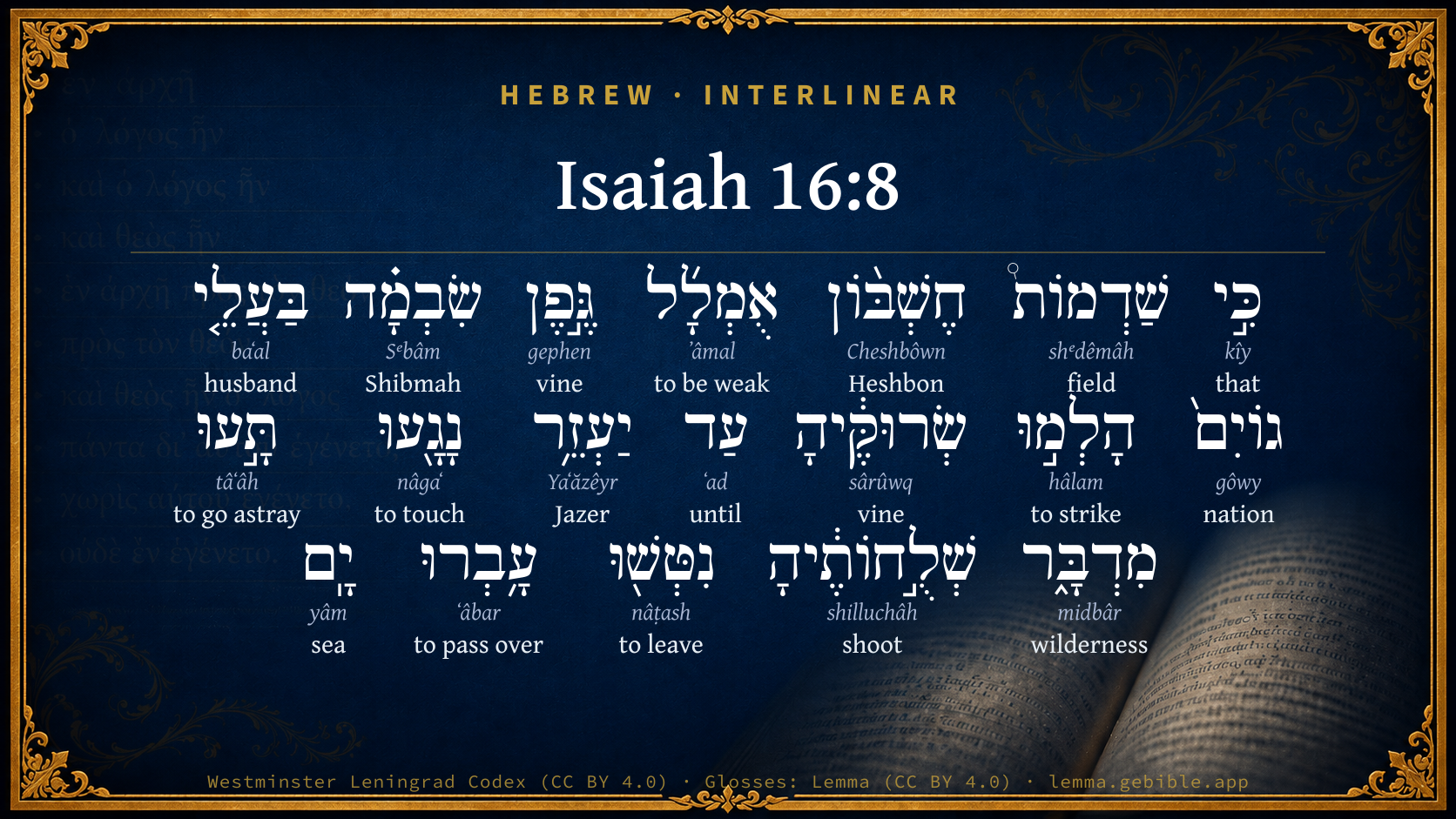
Hebrew (Westminster Leningrad Codex) Isaiah 16:8 appears in the Hebrew Old Testament. The text above is from the Westminster Leningrad Codex. Each word links to its Strong’s number, a concise gloss, and parsing drawn from the Open Scriptures Hebrew Bible morphology. Click any word for its full Brown-Driver-Briggs (BDB) entry.
Download image
Cite this verse

Isaiah 16:8 (World English Bible). Public Domain. Lemma interlinear Bible study tool, https://lemma.gebible.app/v/isaiah/16/8.

Show BibTeX & RIS
BibTeX
RIS
English Translation
For the fields of Heshbon languish, [and] the vine of Sibmah; the lords of the nations have broken down the choice branches of it, which reached even to Jazer, which wandered into the wilderness; its shoots were spread abroad, they passed over the sea.
World English Bible · Public Domain
Highlights
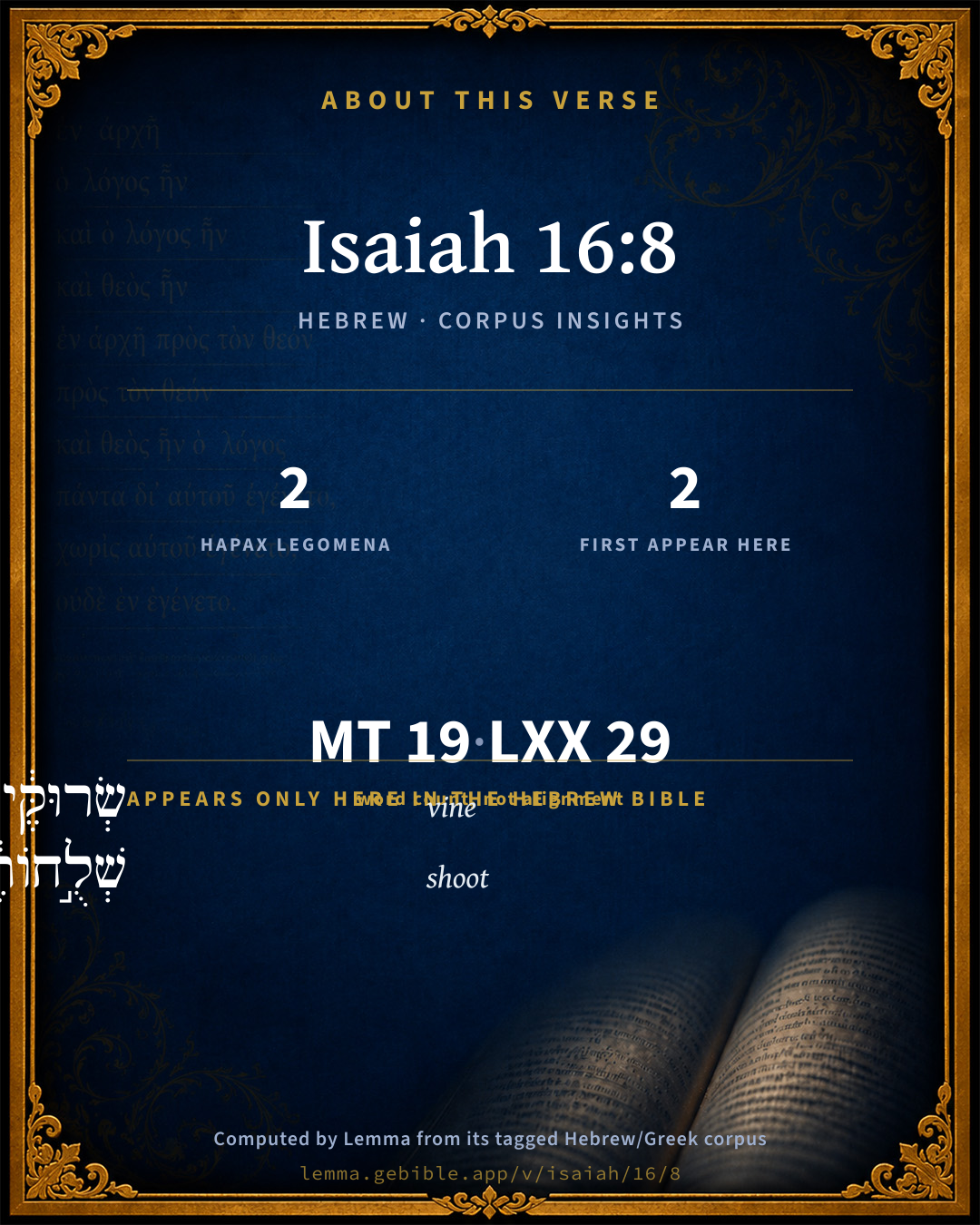
  • 2 hapax legomena — only here in the Hebrew Bible
  • 2 first appearances in the Hebrew Bible
Full analysis ↓
Download a study sheet

One document with this verse’s original text, its word-by-word gloss line, the meaning frame, cross-references with their text, attributed commentary, and full source and license credits — printable, and it pastes into notes with its structure intact.

This verse Autodidact and up

Study sheet (.html) Plain text (.txt)

A passage Seminary Student

Up to 50 verses in one chapter. A passage sheet keeps up to 6 commentary sources and 12 cross-references per verse, in the order this page ranks them, and says so on the sheet whenever that leaves anything out. Ask for a single verse and you get the Autodidact verse sheet above.

Everything on this page stays free to read, with no account — the sheet is a download of what is already on screen, not access to it.

Want to remove ads? Support Godless Engineer
Compare translations 3

The same verse in 3 English versions, stacked beneath the original-language interlinear above. Click any original word for its lexicon entry.

Each is an independent rendering of the whole verse — the interlinear is not word-aligned to these translations.

Highlighted words mark where these versions differ — a whole-verse word diff, not a word-by-word alignment.

  • World English Bible Public Domain
    For the fields of Heshbon languish, [and] the vine of Sibmah; the lords of the nations have broken down the choice branches of it, which reached even to Jazer, which wandered into the wilderness; its shoots were spread abroad, they passed over the sea.
  • King James Version Public Domain
    For the fields of Heshbon languish, and the vine of Sibmah: the lords of the heathen have broken down the principal plants thereof, they are come even unto Jazer, they wandered through the wilderness: her branches are stretched out, they are gone over the sea.
  • unfoldingWord Literal Text CC BY-SA 4.0
    For the fields of Heshbon are enfeebled, the vine of Sibmah. The lords of the nations have stomped its choice vines. They reached to Jazer, they wandered the wilderness; its shoots spread out, they passed on the sea.

unfoldingWord Literal Text — © unfoldingWord, licensed CC BY-SA 4.0. Word-aligned USFM3 via Door43 (git.door43.org/unfoldingWord/en_ult).

Versions to compare (up to 4)

3 of 4 selected

Show all 18 translations

Every available English version of this verse, each an independent rendering of the whole verse.

  • World English Bible Public Domain
    For the fields of Heshbon languish, [and] the vine of Sibmah; the lords of the nations have broken down the choice branches of it, which reached even to Jazer, which wandered into the wilderness; its shoots were spread abroad, they passed over the sea.
  • Berean Standard Bible Public Domain
    For the fields of Heshbon have withered, along with the grapevines of Sibmah. The rulers of the nations have trampled its choicest vines, which had reached as far as Jazer and spread toward the desert. Their shoots had spread out and passed over the sea.
  • Majority Standard Bible Public Domain
    For the fields of Heshbon have withered, along with the grapevines of Sibmah. The rulers of the nations have trampled its choicest vines, which had reached as far as Jazer and spread toward the desert. Their shoots had spread out and passed over the sea.
  • King James Version Public Domain
    For the fields of Heshbon languish, and the vine of Sibmah: the lords of the heathen have broken down the principal plants thereof, they are come even unto Jazer, they wandered through the wilderness: her branches are stretched out, they are gone over the sea.
  • American Standard Version (1901) Public Domain
    For the fields of Heshbon languish, `and' the vine of Sibmah; the lords of the nations have broken down the choice branches thereof, which reached even unto Jazer, which wandered into the wilderness; its shoots were spread abroad, they passed over the sea.
  • Revised Version (1885) Public Domain
    For the fields of Heshbon languish, and the vine of Sibmah; the lords of the nations have broken down the choice plants thereof; they reached even unto Jazer, they wandered into the wilderness; her branches were spread abroad, they passed over the sea.
  • Geneva Bible (1599) Public Domain
    For ye vineyards of Heshbon are cut downe, and the vine of Sibmah: the lordes of the heathen haue broken the principal vines thereof: they are come vnto Iaazer: they wandred in the wildernesse: her goodly branches stretched out them selues, and went ouer the sea.
  • Douay-Rheims (1899) Public Domain
    For the suburbs of Hesebon are desolate, and the lords of the nations have destroyed the vineyard of Sabama: the branches thereof have reached even to Jazer: they have wandered in the wilderness, the branches thereof are left, they are gone over the sea.
  • Young's Literal Translation Public Domain
    Because fields of Heshbon languish, The vine of Sibmah, Lords of nations did beat her choice vines, Unto Jazer they have come, They have wandered in a wilderness, Her plants have spread themselves, They have passed over a sea.
  • Literal Standard Version CC BY-SA 4.0
    Because fields of Heshbon languish, || The vine of Sibmah, || Lords of nations beat her choice vines, || They have come to Jazer, || They have wandered in a wilderness, || Her plants have spread themselves, || They have passed over a sea.
  • Unlocked Literal Bible CC BY-SA 4.0
    The fields of Heshbon have dried up as well as the vines of Sibmah. The rulers of the nations have trampled the choice vines that reached to Jazer and spread into the desert. Its shoots spread abroad; they went over to the sea.
  • unfoldingWord Literal Text CC BY-SA 4.0
    For the fields of Heshbon are enfeebled, the vine of Sibmah. The lords of the nations have stomped its choice vines. They reached to Jazer, they wandered the wilderness; its shoots spread out, they passed on the sea.
  • Darby Bible Public Domain
    For the fields of Heshbon languish, the vine of Sibmah; the lords of the nations have broken down its choice plants: they reached unto Jaazer, they wandered [through] the wilderness; its shoots stretched out, they went beyond the sea.
  • World Messianic Bible Public Domain
    For the fields of Heshbon languish with the vine of Sibmah. The lords of the nations have broken down its choice branches, which reached even to Jazer, which wandered into the wilderness. Its shoots were spread abroad. They passed over the sea.
  • Webster's Bible Public Domain
    For the fields of Heshbon languish, and the vine of Sibmah: the lords of the heathen have broken down her principal plants, they have come even to Jazer, they wandered through the wilderness: her branches are extended, they have gone over the sea.
  • Free Bible Version CC BY-SA 4.0
    Heshbon's fields have dried up, as have Sibmah's grapevines. The rulers of the nations have trampled down the vines that once branched out to Jazer and east towards the desert, and west as far as the sea.
  • Bible in Basic English Public Domain
    For the fields of Heshbon are waste, the vine of Sibmah is dead; the lords of nations were overcome by the produce of her vines; her vine-plants went as far as Jazer, and came even to the waste land; her branches were stretched out to the sea.
  • JPS Tanakh (1917) Public Domain
    For the fields of Heshbon languish, and the vine of Sibmah, whose choice plants did overcome the lords of nations; they reached even unto Jazer, they wandered into the wilderness; her branches were spread abroad, they passed over the sea.

Literal Standard Version (2020), Covenant Press — licensed CC BY-SA 4.0. Text via the HelloAO Bible API (eBible.org). Unlocked Literal Bible (unfoldingWord) — licensed CC BY-SA 4.0. Text via the HelloAO Bible API (eBible.org). unfoldingWord Literal Text — © unfoldingWord, licensed CC BY-SA 4.0. Word-aligned USFM3 via Door43 (git.door43.org/unfoldingWord/en_ult). Free Bible Version, Dr. Jonathan Gallagher — licensed CC BY-SA 4.0. Text via the HelloAO Bible API (eBible.org).

Word by word

More ways to search: Search by grammar → Find every occurrence → Compare this word →

Practice this passage: Drill this verse → Learn its vocabulary →

שְׂרוּקֶּ֔יהָ
sârûwq
H8291
“vine · her”
Adjective, Adjective, Masculine, Plural, Construct + Suffix, Personal, 3rd Person, Feminine, Singular
Part of Speech
Adjective
Type
Adjective
Gender
Masculine
Number
Plural
State
Construct
Full BDB Definition

Origin: pass part from the same as H8321

TWOT: 2294b

vine-tendrils or clusters
  1. כִּ֣י kîy H3588 “that” Conjunction
  2. שַׁדְמוֹת֩ shᵉdêmâh H7709 “fields of” Noun, Common, Feminine, Plural, Construct
  3. חֶשְׁבּ֨וֹן Cheshbôwn H2809 “Heshbon” Noun, Proper
  4. אֻמְלָ֜ל ʼâmal H535 “to be weak” Verb, Pulal, Perfect, 3rd Person, Masculine, Singular
  5. גֶּ֣פֶן gephen H1612 “vine of” Noun, Common, Both, Singular, Construct
  6. שִׂבְמָ֗ה Sᵉbâm H7643 “Shibmah” Noun, Proper
  7. בַּעֲלֵ֤י baʻal H1167 “husbands of” Noun, Common, Masculine, Plural, Construct
  8. גוֹיִם֙ gôwy H1471 “nations” Noun, Common, Masculine, Plural, Absolute
  9. הָלְמ֣וּ hâlam H1986 “to strike” Verb, Qal, Perfect, 3rd Person, Common, Plural
  10. עַד ʻad H5704 “until” Preposition
  11. יַעְזֵ֥ר Yaʻăzêyr H3270 “Jazer” Noun, Proper
  12. נָגָ֖עוּ nâgaʻ H5060 “to touch” Verb, Qal, Perfect, 3rd Person, Common, Plural
  13. תָּ֣עוּ tâʻâh H8582 “to go astray” Verb, Qal, Perfect, 3rd Person, Common, Plural
  14. מִדְבָּ֑ר midbâr H4057 “wilderness” Noun, Common, Masculine, Singular, Absolute
  15. שְׁלֻ֣חוֹתֶ֔יהָ shilluchâh H7976 “shoots · her” Noun, Common, Feminine, Plural, Construct + Suffix, Personal, 3rd Person, Feminine, Singular
  16. נִטְּשׁ֖וּ nâṭash H5203 “to leave” Verb, Niphal, Perfect, 3rd Person, Common, Plural
  17. עָ֥בְרוּ ʻâbar H5674 “to pass over” Verb, Qal, Perfect, 3rd Person, Common, Plural
  18. יָֽם yâm H3220 “sea” Noun, Common, Masculine, Singular, Absolute

About this verse

These counts appear in no published source. They are computed here, from the morphology-tagged text and Lemma’s own curated glosses. What Lemma adds →

19
words
19
distinct lemmas
Prophets
section

Notable vocabulary

2 hapax legomena — words that appear only here in the entire Hebrew Bible:

  • שְׂרוּקֶּ֔יהָ vine H8291
  • שְׁלֻ֣חוֹתֶ֔יהָ shoot H7976

First appearance in Scripture

These words make their first canonical appearance in the Hebrew Bible here:

  • שְׂרוּקֶּ֔יהָ vine H8291
  • שְׁלֻ֣חוֹתֶ֔יהָ shoot H7976

Shared distinctive vocabulary

שַׁדְמוֹת֩ field H7709 occurs in 6 verses of the Hebrew Bible. Also found in:

Grammatical profile

  • 6 verbs
  • 10 nouns
  • 1 adjective
  • 1 preposition
  • 1 conjunction

Verb forms

  • אֻמְלָ֜ל Pulal · Perfect
  • הָלְמ֣וּ Qal · Perfect
  • נָגָ֖עוּ Qal · Perfect
  • תָּ֣עוּ Qal · Perfect
  • נִטְּשׁ֖וּ Niphal · Perfect
  • עָ֥בְרוּ Qal · Perfect

Hebrew & Septuagint length

In English translation the verse runs 44 words from the Hebrew and 45 from the Septuagint (LXX English) — closely comparable.

A rough comparison of the two English renderings, which tokenize alike — not a word-level alignment.

Word counts can differ between the Hebrew and the Greek without any difference in meaning — e.g. the Hebrew direct-object marker אֵת has no separate Greek word, and Greek often adds the article ὁ.

In the original languages it is 19 Hebrew tokens and 29 Greek tokens — but the two are counted differently (Hebrew bundles its prefixes and suffixes into one token; the Greek is in lemma form), so that isn’t a like-for-like length.

Cross-references

11

Topical passages linked to Isaiah 16:8 in the Treasury of Scripture Knowledge — connected by theme and wording, ordered by reader-vote popularity; previews shown in the World English Bible.

  • Numbers 32:38 and Nebo, and Baal Meon, (their names being changed), and Sibmah: and they gave other names to the cities which they built.
  • Isaiah 15:4 Heshbon cries out, and Elealeh; their voice is heard even to Jahaz: therefore the armed men of Moab cry aloud; his soul trembles within him.
  • Numbers 32:3 Ataroth, and Dibon, and Jazer, and Nimrah, and Heshbon, and Elealeh, and Sebam, and Nebo, and Beon,
  • Joshua 13:19 and Kiriathaim, and Sibmah, and Zereth-shahar in the mount of the valley,
  • Joshua 13:25 Their border was Jazer, and all the cities of Gilead, and half the land of the children of Ammon, to Aroer that is before Rabbah;
  • 2 Samuel 1:21 You mountains of Gilboa, Let there be no dew nor rain on you, neither fields of offerings: For there the shield of the mighty was vilely cast away, The shield of Saul, not anointed with oil.
  • Isaiah 10:7 However he doesn't mean so, neither does his heart think so; but it is in his heart to destroy, and to cut off not a few nations.
  • Isaiah 16:9 Therefore I will weep with the weeping of Jazer for the vine of Sibmah; I will water you with my tears, Heshbon, and Elealeh: for on your summer fruits and on your harvest the [battle] shout is fallen.
  • Isaiah 24:7 The new wine mourns, the vine languishes, all the merry-hearted do sigh.
  • Jeremiah 27:6–7 Now have I given all these lands into the hand of Nebuchadnezzar the king of Babylon, my servant; and the animals of the field also have I given him to serve him.
  • Jeremiah 48:32 With more than the weeping of Jazer will I weep for you, vine of Sibmah: your branches passed over the sea, they reached even to the sea of Jazer: on your summer fruits and on your vintage the destroyer is fallen.

Cross-references courtesy of OpenBible.info (CC BY 4.0).

Hebrew and Greek witnesses Masoretic Hebrew ↔ Greek Septuagint

The same verse in the two great witnesses to the Old Testament, shown verse-for-verse.

These are two independent witnesses, not word-aligned to each other, and the Septuagint is shown in lemma (dictionary) form.

Hebrew Isaiah 16:8 Masoretic · Westminster Leningrad Codex

כִּ֣י שַׁדְמוֹת֩ חֶשְׁבּ֨וֹן אֻמְלָ֜ל גֶּ֣פֶן שִׂבְמָ֗ה בַּעֲלֵ֤י גוֹיִם֙ הָלְמ֣וּ שְׂרוּקֶּ֔יהָ עַד יַעְזֵ֥ר נָגָ֖עוּ תָּ֣עוּ מִדְבָּ֑ר שְׁלֻ֣חוֹתֶ֔יהָ נִטְּשׁ֖וּ עָ֥בְרוּ יָֽם

For the fields of Heshbon languish, [and] the vine of Sibmah; the lords of the nations have broken down the choice branches of it, which reached even to Jazer, which wandered into the wilderness; its shoots were spread abroad, they passed over the sea.

World English Bible · Public Domain

Greek LXX Isaiah 16:8 Septuagint · lemma form

ὁ πεδίον εσεβων πενθέω ἄμπελος σεβαμα καταπίνω ὁ ἔθνος καταπατέω ὁ ἄμπελος αὐτός ἕως ιαζηρ οὐ μή συνἅπτω πλανάω ὁ ἔρημος ὁ ἀποστέλλω ἐν καταλείπω διαβαίνω γάρ ὁ ἔρημος

The plains of Esebon shall mourn, the vine of Sebama: swallowing up the nations, trample you⌃ her vines, even to Jazer: you⌃ shall not come together; wander you⌃ in the desert: they that were sent are deserted, for they have gone over to the sea.

LXX2012 (modern English Septuagint) · Public Domain

On this verse, Adam Clarke's Commentary discusses the Septuagint’s reading. Read the note in Commentary ↓

Hebrew: Westminster Leningrad Codex (CC BY 4.0). Greek: Septuagint (public domain); English from LXX2012 (modern English Septuagint) (Public Domain). How the Septuagint differs from the Hebrew →

Targum (Aramaic paraphrase)

1

The Targum is the ancient Jewish Aramaic paraphrase of the Hebrew Scriptures — an interpretive translation, not the Hebrew text itself. Onkelos (literal) and Pseudo-Jonathan (expansive) render the Torah, and Jonathan the Prophets. Coverage is partial: where no permissively-licensed English translation exists for a verse, only the Aramaic is shown. This is verse-level text, not a word-by-word alignment to the Hebrew.

  1. Targum Jonathan Prophets (Joshua–Malachi)
    אֲרֵי אִתְבְּזִיזָא מַשִׁרְיַת חֶשְׁבּוֹן אִתְקַטְלָא סִיעַת שִׂבְמָה מַלְכֵי עַמְמַיָא קְטִילוּ שִׁלְטוֹנֵיהוֹן עַד יַעְזֵר מְטוֹ טָעוֹ לְמַדְבְּרָא מְטַלְטִלֵיהוֹן גָזוּ עֲבַרוּ יַמָא:

    Because the armies of Heshbon are spoiled, the multitude of Sebama are killed, the kings of the people have killed their rulers; they reached unto Jazer; they strayed to the desert; their outcasts passed by, they crossed the sea.

    Targum Jonathan — Aramaic: “Mikraot Gedolot” (public domain). English: “Sefaria Community Translation” (CC0 1.0 (public-domain dedication)); “London "Chaldee Paraphrase," 1871” (public domain). Text via Sefaria.

Commentary

Notes on Isaiah 16:8 from classic Christian and Jewish commentators (each source and its license shown beneath its notes). The classic Christian expositions comment on the surrounding passage and are grouped to its opening verse, so a note may address several verses; the Jewish commentaries on the Tanakh (Rashi and others) are per-verse, so they appear only where the commentator wrote on this verse.

Lemma curates 59 commentaries, every one of them public domain or Creative Commons licensed, each selected and text-cleaned for this edition rather than reprinted as found. About our sources →

Trapp's Complete Commentary

John Trapp

Isa 16:8 For the fields of Heshbon languish, [and] the vine of Sibmah: the lords of the heathen have broken down the principal plants thereof, they are come [even] unto Jazer, they wandered [through] the wilderness: her branches are stretched out, they are gone over the sea.

Ver. 8. For the fields of Heshbon languish.] As being decayed and destroyed; hence so great mourning in Moab. Their father and founder was begotten in wine, and themselves were likely great wine bibbers. Historians say that some of their cities were built by Bacchus. Fitly therefore are these drunken Moabites bereft of their vines, as those gluttonous Sodomites were of their victuals. {Gen 14:11} The drunkard’s motto is, Take away my liquor, and take away my life.

The lords of the heathen have broken down the principal plants thereof.] The great Turk causeth all the vines to be cut down wherever he cometh, because he read in the Koran that in every grape there dwelleth a devil.

John Trapp, A Commentary or Exposition upon All the Books of the Old and New Testament (1647–1656) — public domain. Text from a community e-Sword module.

Joseph Benson's Commentary

Isa 16:8-10. The fields of Heshbon languish — Either for want of rain, or, rather, because no men should be left to till and manure them. And the vine of Sibmah — These vines and those of Heshbon were greatly celebrated, and held in high repute with all the great men and princes of that and the neighbouring countries, and were propagated from thence, not only over all the country of Moab, but to the sea of Sodom; yea, scions of them, as is signified in the last clause of this verse, were sent even beyond the sea into foreign countries: but the prophet here foretels, that the lords of the heathen — That is, the Assyrians or Chaldeans, the great rulers of the eastern nations, would soon destroy them, and all other productions of the land; and then their shouting and singing for the vintage or harvest would utterly cease, as is expressed Isa 16:9-10.

Joseph Benson's Commentary on the Old and New Testaments (1811–1818) — public domain. Text from a community e-Sword module.

Tyndale Open Study Notes

Tyndale Open Resources

16:8 The vineyards at Sibmah were located by the Moabite city of Heshbon. • Moab was like a luxuriant vine that extends far and wide, but Israel’s beautiful vine reached to the ends of the earth (27:6). • The location of Jazer is unknown.

Tyndale Open Study Notes — © Tyndale Open Resources, licensed CC BY-SA 4.0. Text via the HelloAO Bible API.

Geneva Bible (1599)

Geneva Bible translators

Meaning, that the country of Moab was now destroyed, and all the precious things thereof were carried into the borders, yea into other countries, and over the sea.

That is, the Assyrians and other enemies.

Geneva Bible (1599) marginal notes — public domain. Text via Bolls.life.

Jamieson, Fausset & Brown

Robert Jamieson, A. R. Fausset & David Brown

fields--vine-fields (Deu 32:32).

vine of Sibmah--near Heshbon: namely, languishes.

lords of . . . heathen--The heathen princes, the Assyrians, &c., who invaded Moab, destroyed his vines. So Jeremiah in the parallel place (Jer 48:32-33). MAURER thinks the following words require rather the rendering, "Its (the vine of Sibmah) shoots (the wines got from them) overpowered (by its generous flavor and potency) the lords of the nations" (Gen 49:11-12, Gen 49:22).

come . . . Jazer--They (the vine shoots) reached even to Jazer, fifteen miles from Heshbon.

wandered--They overran in wild luxuriance the wilderness of Arabia, encompassing Moab.

the sea--the Dead Sea; or else some lake near Jazer now dry; in Jer 48:32 called "the sea of Jazer"; but see on Jer 48:32 (Psa 80:8-11).

Jamieson, Fausset & Brown — Commentary Critical and Explanatory on the Whole Bible (1871) — public domain (CC PDM 1.0). Text via the HelloAO Bible API.

Adam Clarke's Commentary

Verse 8. Languish - "Are put to shame"] Here the text of Jeremiah leaves us much at a loss, in a place that seems to be greatly corrupted. The Septuagint join the two last words of this verse with the beginning of the following. Their rendering is: και ουκ εντραπησῃ, τα πεδια Εσεβων. For אך ach they must have read al; otherwise, how came they by the negative, which seems not to belong to this place? Neither is it easy to make sense of the rest without a small alteration, by reading, instead of εντραπησῃ τα, εντραπησεται. In a word, the Arabic version taken from the Septuagint, plainly authorizes this reading of the Septuagint, and without the negative; and it is fully confirmed by MSS. Pachom. and I. D. II., which have both of them εντραπησεται πεδια Εσεβων, without the negative; which makes an excellent sense, and, I think, gives us the true reading of the Hebrew text; אך נכלמו שדמות חשבון ak nichlemu shadmoth cheshbon. They frequently render the verb נכלם nichlam by εντρεπομαι. And נכלמו nichlemu answers perfectly well to אמלל umlal, the parallel word in the next line. The MSS. vary in expressing the word נכאים nechaim, which gives no tolerable sense in this place; one reads נוכאים nochaim; two others בכאים bechaim; in another the כ caph is upon a rasure of two letters; and the Vulgate instead of it reads מכותם mecotham, plagas suas. - L.

For the men of Kirhares ye shall make a moan. For the fields of Heshbon are put to shame. This is Bp. Lowth's sense of the passage.

Her branches are stretched out - "Her branches extended themselves."] For נטשו nitteshu, a MS. has נגשו niggeshu; which may perhaps be right. Compare Jer 48:32, which has in this part of the sentence the synonymous word נגעו nagau.

The meaning of this verse is, that the wines of Sibmah and Heshbon were greatly celebrated, and in high repute with all the great men and princes of that and the neighbouring countries; who indulged themselves even to intemperance in the use of them. So that their vines were so much in request as not only to be propagated all over the country of Moab to the sea of Sodom, but to have scions of them sent even beyond the sea into foreign countries.

הלמו halemu, knocked down, demolished; that is overpowered, intoxicated. The drunkards of Ephraim are called by the prophet, Isa 28:1, הלומי יין halumey yayin, drinkers of wine. See Schultens on Pr 23:25. Grotius, speaking of the Mareotic wine, says of it,

Pharios quae fregit noxia reges. CYNEG. 312.

Adam Clarke's Commentary on the Bible (1810–1826) — public domain. Text from a community e-Sword/MySword module.

Ellicott's Commentary for English Readers

(8) The fields of Heshbon languish . . .—For Heshbon see Note on Isa_15:4. Sibmah appears as assigned to the tribe of Reuben, in Num_32:38, Jos_13:19, and in Jer_48:32 as famous for its vines. Jerome (Comm. in Esai. 5) speaks of it as about half a Roman mile from Heshbon, and as one of the strongest fortresses of Moab. It has not been identified by recent travellers. The names of the chief Moabite cities are brought together by Milton with a singular rhythmical majesty in Par. Lost, 1, 406-411.

The lords of the heathen . . .—The words admit of this rendering; but another version, equally admissible grammatically, is preferred by most recent critics. Its branches smote down the lords of the nations, i.e., the wine of Sibmah was so strong that it “overcame” the princes who drank of it (Isa_28:1; Jer_23:9). In the word for “lords” (baalim), we have a parallel to the “lords of the high places of Arnon,” in Num_21:28.

They are come even unto Jazer.—The pronoun may be referred either to the “branches of the vine,” or to the “lords of the heathen,” as destroyers. Adopting the former construction, we find in the words a description of the extent of the culture of the Sibmah vine. Northward it spread to Jazer on the Gilead frontier (Num_32:1; Num_32:3; 1Ch_26:31), rebuilt by the Gadites (Num_32:35), eastward to the wilderness, westward it crossed the Dead Sea, and re-appeared in the vine-clad slopes of Engedi (Son_1:14). In Jer_48:32, we have “the sea of Jazer.” See Note there.

A Bible Commentary for English Readers, edited by Charles John Ellicott (1878–1897) — public domain. Text from a community e-Sword module.

The Cambridge Bible for Schools and Colleges

gen. ed. J. J. S. Perowne

8. the fields] means here as in Deu_32:32 “vineyards.”

the vine of Sibmah] Sibmah, in the vicinity of Heshbon, must have been famous for a choice variety of vines, which are here described by a title resembling that used in ch. Isa_5:2 for the “choicest vine” of Jehovah’s vineyard.

the lords of the heathen … thereof] Better: whose choice grapes struck down (i.e. intoxicated) the lords of the nations. For the figure see ch. Isa_28:1. The wine of Sibmah was found on the tables of princes far and near, and its potent effects were well known.

The remainder of the verse celebrates the extensive cultivation of this variety of the vine on the east of the Jordan. The writer is not thinking of anything so prosaic as the export trade in the wine of Sibmah; he represents the whole vine culture of the district under the image of a single vine, which reached to Jazer in the north, strayed to the desert on the east, and passed to the (Dead) Sea on the west.

The Cambridge Bible for Schools and Colleges (gen. ed. J. J. S. Perowne; Cambridge University Press, 1878–1918) — public domain. Text from a community e-Sword module.

John Gill's Exposition

For the fields of Heshbon languish,.... Through drought; or because of the forage of the enemy, and their treading upon them; or because there were no men left to till and manure them. Of Heshbon See Gill on Isa 15:4. It seems to have been a place famous for fields and pastures, and to have been a very fruitful and well watered place; hence we read of the fish pools in Heshbon, Sol 7:4 though Aben Ezra and Kimchi think the word signifies vines, as they suppose it does in Deu 32:32,

and the vine of Sibmah; called Shebam and Shibmah, in Num 32:3 thought to be the Seba of Ptolemy (e); and seems to have been famous for vines and vineyards:

the lords of the Heathen have broken down the principal plants thereof; that is, the Chaldeans and their army, and commanders and principal officers of it, dealing with them as the Turks do with vines, wherever they meet with them, destroy them; though Jarchi and Kimchi interpret all this figuratively, both here and in the above clauses, of the inhabitants of these places, the multitude of the common people, and their princes, some being killed, and others carried captive; to which sense the Targum,

"because the armies of Heshbon are spoiled, the multitude of Sebama are killed, the kings of the people have killed their rulers:''

they are come even unto Jazer; meaning either the Chaldean army, or the Moabites, who had fled hither; or rather this is to be understood of the vines of Sibmah, expressing the excellency and large spread of them, which reached even to Jazer; which, as Jerom says (f), was fifteen miles from Heshbon, called Jaazer, Num 21:32,

they wandered through the wilderness; the wilderness of Moab, Deu 2:8 not the lords of the Heathen, nor the Moabites, but the vines and their branches, which crept along, and winded to and fro, as men wander about:

her branches are stretched out; that is, the branches of the vine Sibmah:

they are gone over the sea; the Dead Sea, called the sea of Jazer, Jer 48:32 or rather a lake near that city.

(e) Geograph. l. 5. c. 19. (f) De locis Hebraicis, fol. 92. G.

John Gill's Exposition of the Whole Bible (1746–1763) — public domain (CC PDM 1.0). Text via the HelloAO Bible API.

Albert Barnes' Notes on the Bible

For the fields of Heshbon - (See the note at Isa 15:4.)

Languish - They are parched up with drought. The ‘fields’ here evidently mean “vineyards,” for so the parallelism demands. So in Deu 32:32 :

Their vine is of the vine of Sodom,

And of the fields of Gomorrah.

And the vine of Sibmah - Sibmah, or Shibmah, was a city of Reuben Num 32:38; Jos 13:19. Jeremiah, in the parallel place Jer 48:32 speaks of the vine of Sibmah also. He also says that the enemies of Moab had taken Sibmah, and that the vine and wine had been destroyed Jer 48:33. There was no more certain mode of producing desolation in a land where grapes were extensively cultivated than to cut down the vines. The Turks constantly practice that in regard to their enemies, and the result is, that wide desolation comes upon the countries which they invade. At this time it is probable that Sibmah belonged to the Moabites. It is mentioned here as being distinguished for the luxuriant production of the grape. Seetzen still found the vine cultivated in that region. Jerome says, that between Sibmah and Heshbon there was scarcely a distance of five hundred paces, half a Roman mile.

The lords of the heathen - The princes of the pagan nations that had come to invade Moab. The words ‘have broken down’ (הלמוּ hâlemû) may be taken in either of two senses, either to beat, strike, or break down, as in our version; or “to be” beaten, or smitten with wine - that is, to become intoxicated - like the Greek οἰνοπλὴξ oinoplēx - “smitten with wine.” The former is doubtless the sense here.

The principal plants thereof - The chose vines of it - “her sorek” (שׂרוּקיה s'erûqehā). (See the notes at Isa 5:2.)

They are come - That is, the vines of Sibmah had spread or extended themselves even to Jazer, indicating their great luxuriance and fertility.” Jazer was a city at the foot of the mountains of Gilead which was given to Gad, and afterward to the Levites Jos 21:39. Jerome says it was about fifteen miles from Heshbon. Seetzen found the ruins of a city called Szar, and another place called Szir, from which a small stream (Nahar Szir) flows into the Jordan (Gesenius). That the shoots of the vine of Sibmah reached unto Jazer and the desert, is a beautiful poetic expression for the extensive spread and luxuriance of the vine in that region.

They wandered - The vines “wandered” in the desert. They found no twig or tree to which they could attach themselves, and they spread around in wild luxuriancy.

Through the wilderness - The wilderness or desert of Arabia, which encompassed Moab.

Her branches are stretched out - Are extended far, or are very luxuriant.

They are gone over the sea - Called in the parallel place in Jer 48:32, ‘the Sea of Jazer;’ probably some lake that had that name near the city of Jazer. It may “possibly” mean the Dead Sea, but that name is not elsewhere given to the Dead Sea in the Scriptures. It has been objected by some to this statement that modern travelers have not found any such place as the ‘Sea of Jazer;’ or any lake in the vicinity of Jazer. But we may observe -

(1) that Seetzen found a stream flowing into the Jordan near Jazer; and

(2) that it is possible that a pond or lake may have once there existed which may have been since, in the course of ages, filled with sand.

It is known, for example, that in the vicinity of Suez the ancient narrow gulf there, and the large inland sea made by the Bitter lakes, have been choked up by the sand of the desert. Seetzen also says that he saw some pools near the source of the stream called Nahar Szir (“river Szir”). Prof. Stuart. “Bib. Rep.” vol. vii. p. 158. The whole description of the vines of Sibmah is poetic; designed, not to be literally understood, but to denote their remarkable luxuriance and fertility. A similar description of a “vine” - though there used to denote the Jewish people - occurs in Psa 80:8-11 :

Thou hast brought a vine out of Egypt;

Thou hast cast out the heathen and planted it;

Thou preparedst room before it,

And didst cause it to take deep root,

And it filled the land.

The hills were covered with the shadow of it,

And the boughs thereof were like the goodly cedars.

She sent out her boughs unto the sea,

And her branches unto the river.

Albert Barnes' Notes on the Bible (1834–1885) — public domain. Text from a community e-Sword/MySword module.

Haydock's Catholic Bible Commentary

Lords. Princes of Jerusalem, (Lamentations i. 1.) or of Assyria. (Calmet) --- Sea. Of Sodom, even as far as Jazer, (Haydock) in the tribe of Ruben. (Calmet)

George Leo Haydock (1774–1849), Haydock's Catholic Family Bible and Commentary, 1859 edition — public domain. Excludes Psalms (Douay-Rheims chapter numbering differs from Protestant) and Deuterocanonical books (Catholic canon only).

Matthew Poole's English Annotations

The fields of Heshbon languish; either for want of rain, as Isa 15:6, or because there are no men left to till and manure them.

The lords of the heathen; the Assyrians or Chaldeans, the great rulers of the Eastern nations.

The principal plants; the choicest vines; under which one particular he seems to understand not only all other fruits and goods, but even their persons and choicest people.

They are come even unto Jazer; either,

1. The lords of the heathen are come as far as Jazer, which is the utmost border of Moab; or,

2. The people of Moab are going into captivity, and part of them are already gone as far as Jazer. Some understand this and the following clauses of the vines, which are here commended, to aggravate the loss and ruin of them, and render the words, which reached even unto Jazer, which vineyards were planted for many miles together, even as far as Jazer.

They wandered through the wilderness; others of the Moabites fled away for their lives, and wandered hither and thither in the wilderness of Moab; of which see Num 21:11; Deu 2:8.

Her branches, i.e. her people, called plants before. Are stretched out; or, are spread abroad, as this word signifies, Num 11:32; Jdg 15:9; 1Sa 30:16; are driven from their own homes, and dispersed into several countries.

Over the sea; over the Dead Sea, which was the border of Moab. They were forced to flee out of their own country to save their lives.

Matthew Poole's English Annotations on the Holy Bible (1683–1685) — public domain. Text from a community e-Sword/MySword module.

Whedon's Commentary on the Bible

Daniel D. Whedon

8. Fields of Heshbon — The region around Heshbon on the north, noted for choice vineyards.

Languish — Or, wither. The locality lies near to the former sites of Sodom and Gomorrah, on the plain north of the Dead Sea, not south as heretofore believed.

The vine of Sibmah — This place has not been identified. Jerome speaks of it as only about half a Roman mile from Hesh-bon. The why the vineyards stand withered is, the lords of the nations have broken off, or down, the principal plants thereof. Either Moab’s own masters, princes, or Assyrian warriors, were wantonly making havoc in the land: the action is the perpetual present of prophecy — proleptic.

They — The vine plants.

Come even unto Jazer — So luxuriant are they. The same wandered — or trailed — through the desert eastward.

They are gone over the sea — Westward, to the sea or pools of Jazer, or even to the Dead Sea. The fruitful, extending vine is a favourite symbol with Old Testament poets for a populous and luxuriant nation.

Daniel D. Whedon (gen. ed.), Commentary on the Old and New Testaments (1874–1909) — public domain. Text from a community e-Sword module.

The Pulpit Commentary

The fields of Heshbon (see the comment on Isa_15:4). The whole of the Mishor, or Belka, on the edge of which Hesbdn stands, is cultivable and capable of producing good crops. The Moabites stored water in reservoirs, (Ecc_7:4) and made their country a garden. The vine of Sib-mah. "Sibmah" is mentioned in Num_32:8 and Jos_13:19 among the towns of the Reubenites. According to Jerome ("Comment. in Esaiam"), it was less than half a mile distant from Heshbon. Jeremiah follows Isaiah in lamenting the destruction of its vines. (Jer_48:32) The lords of the heathen have broken down the principal plants thereof. "The lords of the heathen" are probably the Assyrians, who made a practice of destroying the fruit trees in an enemy"s country, for the mere purpose of doing mischief ("Ancient Monarchies," vol. 2. p. 84). It is wanton to discard this very satisfactory sense for the strange one that "the choice plants have broken down i.e., made drunk the lords of the heathen" (Cheyne). The rendering of the Authorized Version is supported by Gesenius, Ewald, Rosenm Meier, dud Dr. Kay. They are come even unto Jazer; rather, they (the vines)reached to Jazer; i.e. the vine of Sibmah was cultivated as far as Jazer. Jazer lay about twelve miles north of Heshben, in the territory of Gad. (Num_32:35) It is probably identified with Es Szir, which is in the required position, and retains a trace of the name (Seetzen," Reisen," vol. 1. pp. 397, 398). They wandered through the wilderness; rather, they strayed into the wilderness ; i.e. the cultivation was pushed eastward into the actual midbar, or desert. Her branches are stretched out; or, her offshoots are spread abroad; i.e. the young shoots or slips are taken by the cultivators and spread further and further. They are even carried across the Dead Sea, and planted on its western shore. Mr. Cheyne supposes the prophet to refer to the "vineyards of En-gedi" (song of Son_1:14).

The Pulpit Commentary (1880–1919), ed. H.D.M. Spence-Jones & Joseph S. Exell — public domain. Text from a community e-Sword module.

John Wesley's Explanatory Notes

The lords - The Assyrians or Chaldeans, the great rulers of the eastern nations. Plants - The choicest vines. Under which one particular he seems to understand, not only all other fruits and goods, but even their choicest people. They - The lords of the heathen are come as far as Jazer, which is the utmost border of Moab. Wandered - The Moabites fled for their lives, and wandered hither and thither in the wilderness of Moab. Branches - Her people, called plants before. Stretched - Driven from their own homes, and dispersed into several countries. The sea - Over the Dead-sea, which was the border of Moab. They were forced to flee out of their own country to save their lives.

John Wesley, Explanatory Notes Upon the Whole Bible (1754–1765) — public domain. Text via the GEBible commentary corpus.

J. A. Alexander on Isaiah

Joseph Addison Alexander

“For the fields of Heshbon are withered, the vine of Sibnah the lords of the nations broke down its choice plants, unto Jazer they reached, they strayed into (or through) the desert, its branches they were stretched out, they reached to (or over) the sea.” Sibmah is mentioned in Num 32:38; Jos 13:19, and in the former place joined with Nebo, which occurs above (Isa 15:2). It had been taken by the Amorites, but was probably again recovered. Eusebius speaks of it as a town of Gilead, and Jerome describes it as not more than half a mile from Heshbon. According to the English Version, it would seem to be the lords of the nations who came to Jazer, wandered through the wilderness, etc. All this, however, is really predicated of the vines, the luxuriant growth of which is the subject of the following clauses. It may either mean that the vines covered the shore and overhung the water, or that the luxuriant vineyards of Moab really extended beyond the northern point of the Dead Sea. In the parallel passage, Jer 48:32, we read of the sea of Jazer, which may have been a lake in its vicinity, or even a reservoir, such as Seetzen found there. The same traveler found an abundant growth of vines in the region here described, while at Salt (the ancient Ramoth) Burckhardt and Buckingham both speak, not only of the multitude of grapes, but of an active trade in raisins.

Joseph Addison Alexander, The Prophecies of Isaiah (1846–1847; New York: Scribner, 1870–1878) — public domain. Text from a community e-Sword module.

unfoldingWord translationNotes

Door43 World Missions Community

General Information:

This continues the prophecy about the people of Moab. God describes events that will happen in the future as if it happened in the past. (See: Isaiah 15:1-2)

Heshbon

Translate the name of this city as you did in Isaiah 15:4.

Sibmah ... Jazer

These are names of cities. (See: How to Translate Names)

The rulers of the nations have trampled the choice vines

The land of Moab was known for its vineyards. Here God describes the land of Moab as one large vineyard. This emphasizes that the rulers, which refers to the armies, completely destroyed everything in Moab. (See: Metaphor and Metonymy)

translationWords

vine

nation

desert

unfoldingWord translationNotes — © Distant Shores Media and the Door43 World Missions Community, licensed CC BY-SA 4.0. Source: git.door43.org/Door43/en_tn.

Rashi

Rabbi Shlomo Yitzchaki (Rashi)

grain fields Heb. שַׁדְמוֹת.

the vine of Sibmah We can deduce that Heshbon was a place of fields and Sibmah a place of vineyards. Now if you ask, All these are cities of the east side of the Jordan, and Israel took them from the hands of Sihon. Now when did they return to the hands of Moab? When Sennacherib exiled the Reubenites and the Gadites, the neighboring Moabites came and settled in them.

has become desolate Heb. אֻמְלָל, has become desolate.

its saplings its choice saplings.

they reached as far as Jazer The grain fields and the vine and the saplings mentioned here are merely an allegory. They represent camps, companies, and rulers [in the days of these peoples]. So did Jonathan paraphrase it.

they reached as far as Jazer they went into exile.

they strayed to the desert lit. they strayed the desert.

its tendrils its branches; and they are the symbol of its exiles.

spread out Heb. נִטְּשׁוּ, scattered. Comp. (Ezekiel 29:5) “And I will scatter you (וּנְטַשְׁתִּיךָ) in the desert”; (I Sam. 30: 16) “And behold, they were scattered (נְטוּשִׁים)”; (II Sam. 5:22) “And spread out (וַיִּנָּטְשׁוּ) in the valley of Rephaim.”

Rashi on the Tanakh — English translations: “The Judaica Press complete Tanach with Rashi, translated by A. J. Rosenberg” (CC BY 4.0); “Pentateuch with Rashi's commentary by M. Rosenbaum and A.M. Silbermann, 1929-1934” (public domain); “The Metsudah Tanach series, Lakewood, N.J” (CC BY 4.0); and “The Book of Joshua, Metsudah Publications, 1997” (CC BY 4.0). Text via Sefaria.

Ibn Ezra

Rabbi Abraham ibn Ezra

שדמות Vine trees. Comp. Deut. 32:32.

אמלל Languisheth. Each of them languisheth.

בעלי גוים The chief of nations. Comp. אדני יוסף the master of Joseph (Gen. 39:20). לבעליו to his owner (Ex. 21:34). The king of Assyria is meant by בעלי הגוים the chief of nations.

הלמו Have broken down. Root הלם to smite; comp. והלמה And she smote (Judg. 5:26).

They are come even unto Jazer. They are so long.

They wandered into the wilderness. They extended beyond the boundaries of the inhabited land.

שלוחתיה Her trees. Comp. שלחיך פרדס דמונים thy plants an orchard of pomegranates (Song 4:13).

נטשו They spread. Comp. נטושים spread (2 Sam. 30:16)

Ibn Ezra on the Tanakh — English translations: “Sefaria Community Translation” (CC0 1.0 (public-domain dedication)); “Yalkut, Sifsei Chachomim Chumash, Metsudah Publications, 2009” (CC BY 4.0); and “Commentary of Ibn Ezra on Isaiah - trans. by M. Friedlander, 1873” (public domain). Text via Sefaria.

Lesson kit

Teaching starters — assembled from the data on this page, not authored interpretation. Every prompt links to the verse data it draws on. Edit before teaching.

Isaiah, in the Prophets, opens this verse with 19 words (19 distinct Hebrew lemmas). Its most distinctive word is sârûwq (“vine”). A historical commentator’s framing appears above. Read the whole chapter for the surrounding context.

Discussion questions

  1. The word sârûwq carries the sense “vine.” How does it shape the verse?
  2. This verse holds 2 words here found nowhere else in the Hebrew Bible. What might the rare words draw attention to?
  3. 2 words here appear for the first time in Scripture. What is being introduced at this debut?
  4. Deuteronomy 32:32 shares the word «field» with this verse. How do the two illuminate each other?
  5. These translations render this verse differently. What is at stake in choosing one wording over another?
  6. The verb «אֻמְלָ֜ל» is Pulal Perfect. How does its form color the action?
  7. Reading how Trapp's Complete Commentary and Joseph Benson's Commentary read this verse, where do the two commentators agree and where do they part?

Things to notice

Reading settings

Reading text

Shown beneath each verse's original-language words.

Old Testament
Old Testament edition

Read the OT as the Masoretic Hebrew (MT) or the Greek Septuagint (LXX).

English shown for the Greek Septuagint (in the Hebrew ↔ Greek comparison).

Comparing translations? Open the Compare panel on any verse page to stack up to four side by side.