Jeremiah 1:9

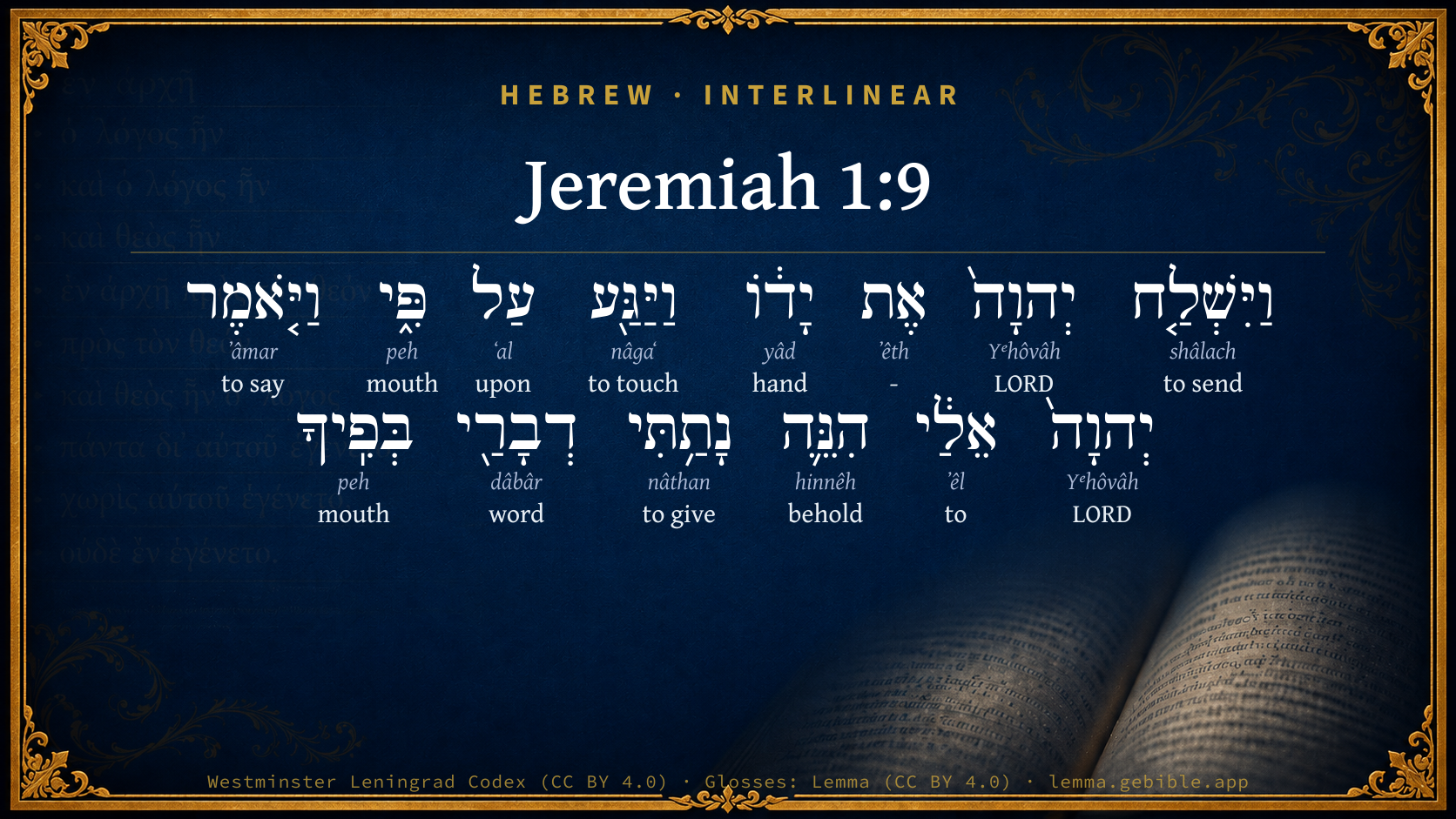
Hebrew (Westminster Leningrad Codex) Jeremiah 1:9 appears in the Hebrew Old Testament. The text above is from the Westminster Leningrad Codex. Each word links to its Strong’s number, a concise gloss, and parsing drawn from the Open Scriptures Hebrew Bible morphology. Click any word for its full Brown-Driver-Briggs (BDB) entry.
Download image
Cite this verse

Jeremiah 1:9 (World English Bible). Public Domain. Lemma interlinear Bible study tool, https://lemma.gebible.app/v/jeremiah/1/9.

Show BibTeX & RIS
BibTeX
RIS
English Translation
Then Yahweh put forth his hand, and touched my mouth; and Yahweh said to me, Behold, I have put my words in your mouth:
World English Bible · Public Domain
Download a study sheet

One document with this verse’s original text, its word-by-word gloss line, the meaning frame, cross-references with their text, attributed commentary, and full source and license credits — printable, and it pastes into notes with its structure intact.

This verse Autodidact and up

Study sheet (.html) Plain text (.txt)

A passage Seminary Student

Up to 50 verses in one chapter. A passage sheet keeps up to 6 commentary sources and 12 cross-references per verse, in the order this page ranks them, and says so on the sheet whenever that leaves anything out. Ask for a single verse and you get the Autodidact verse sheet above.

Everything on this page stays free to read, with no account — the sheet is a download of what is already on screen, not access to it.

Want to remove ads? Support Godless Engineer
Compare translations 3

The same verse in 3 English versions, stacked beneath the original-language interlinear above. Click any original word for its lexicon entry.

Each is an independent rendering of the whole verse — the interlinear is not word-aligned to these translations.

Highlighted words mark where these versions differ — a whole-verse word diff, not a word-by-word alignment.

  • World English Bible Public Domain
    Then Yahweh put forth his hand, and touched my mouth; and Yahweh said to me, Behold, I have put my words in your mouth:
  • King James Version Public Domain
    Then the LORD put forth his hand, and touched my mouth. And the LORD said unto me, Behold, I have put my words in thy mouth.
  • unfoldingWord Literal Text CC BY-SA 4.0
    Then Yahweh stretched out his hand and touched on my mouth. And Yahweh said to me, “Behold, I have placed my words in your mouth.

unfoldingWord Literal Text — © unfoldingWord, licensed CC BY-SA 4.0. Word-aligned USFM3 via Door43 (git.door43.org/unfoldingWord/en_ult).

Versions to compare (up to 4)

3 of 4 selected

Show all 18 translations

Every available English version of this verse, each an independent rendering of the whole verse.

  • World English Bible Public Domain
    Then Yahweh put forth his hand, and touched my mouth; and Yahweh said to me, Behold, I have put my words in your mouth:
  • Berean Standard Bible Public Domain
    Then the LORD reached out His hand, touched my mouth, and said to me: “Behold, I have put My words in your mouth.
  • Majority Standard Bible Public Domain
    Then the LORD reached out His hand, touched my mouth, and said to me: “Behold, I have put My words in your mouth.
  • King James Version Public Domain
    Then the LORD put forth his hand, and touched my mouth. And the LORD said unto me, Behold, I have put my words in thy mouth.
  • American Standard Version (1901) Public Domain
    Then Jehovah put forth his hand, and touched my mouth; and Jehovah said unto me, Behold, I have put my words in thy mouth:
  • Revised Version (1885) Public Domain
    Then the LORD put forth his hand, and touched my mouth; and the LORD said unto me, Behold, I have put my words in thy mouth:
  • Geneva Bible (1599) Public Domain
    Then the Lord stretched out his hand and touched my mouth, and the Lord said vnto me, Beholde, I haue put my wordes in thy mouth.
  • Douay-Rheims (1899) Public Domain
    And the Lord put forth his hand, and touched my mouth: and the Lord said to me: Behold I have given my words in thy mouth:
  • Young's Literal Translation Public Domain
    And Jehovah putteth forth His hand, and striketh against my mouth, and Jehovah saith unto me, `Lo, I have put my words in thy mouth.
  • Literal Standard Version CC BY-SA 4.0
    And YHWH puts forth His hand, and strikes against my mouth, and YHWH says to me, “Behold, I have put My words in your mouth.
  • Unlocked Literal Bible CC BY-SA 4.0
    Then Yahweh reached out with his hand, touched my mouth, and said to me, “Now, I have placed my word in your mouth.
  • unfoldingWord Literal Text CC BY-SA 4.0
    Then Yahweh stretched out his hand and touched on my mouth. And Yahweh said to me, “Behold, I have placed my words in your mouth.
  • Darby Bible Public Domain
    And Jehovah put forth his hand and touched my mouth; and Jehovah said unto me, Behold, I have put my words in thy mouth.
  • World Messianic Bible Public Domain
    Then the LORD stretched out his hand and touched my mouth. Then the LORD said to me, “Behold, I have put my words in your mouth.
  • Webster's Bible Public Domain
    Then the LORD put forth his hand, and touched my mouth. And the LORD said to me, Behold, I have put my words in thy mouth.
  • Free Bible Version CC BY-SA 4.0
    The Lord stretched out his hand, touched my mouth, and told me: “Look, I've put my words in your mouth.
  • Bible in Basic English Public Domain
    Then the Lord put out his hand, touching my mouth; and the Lord said to me, See, I have put my words in your mouth:
  • JPS Tanakh (1917) Public Domain
    Then the LORD put forth His hand, and touched my mouth; and the LORD said unto me: Behold, I have put My words in thy mouth;

Literal Standard Version (2020), Covenant Press — licensed CC BY-SA 4.0. Text via the HelloAO Bible API (eBible.org). Unlocked Literal Bible (unfoldingWord) — licensed CC BY-SA 4.0. Text via the HelloAO Bible API (eBible.org). unfoldingWord Literal Text — © unfoldingWord, licensed CC BY-SA 4.0. Word-aligned USFM3 via Door43 (git.door43.org/unfoldingWord/en_ult). Free Bible Version, Dr. Jonathan Gallagher — licensed CC BY-SA 4.0. Text via the HelloAO Bible API (eBible.org).

Word by word

More ways to search: Search by grammar → Find every occurrence → Compare this word →

Practice this passage: Drill this verse → Learn its vocabulary →

וַיַּגַּ֖ע
nâgaʻ
H5060
“and · to touch”
Conjunction + Verb, Hiphil, Sequential Imperfect, 3rd Person, Masculine, Singular
Part of Speech
Conjunction + Verb
Stem
Hiphil
Form
Sequential Imperfect
Person
3rd Person
Gender
Masculine
Number
Singular
Full BDB Definition

Origin: a primitive root

TWOT: 1293

to touch, reach, strike - (Qal) - to touch - to strike - to reach, extend to - to be stricken - stricken (participle) - (Niphal) to be stricken, be defeated - (Piel) to strike - (Pual) to be stricken (by disease) - (Hiphil) to cause to touch, reach, approach, arrive - to cause to touch, apply - to reach, extend, attain, arrive, come - to approach (of time) - to befall (of fate)
  1. וַיִּשְׁלַ֤ח shâlach H7971 “and · to send” Conjunction + Verb, Qal, Sequential Imperfect, 3rd Person, Masculine, Singular
  2. יְהוָה֙ Yᵉhôvâh H3068 “LORD” Noun, Proper
  3. אֶת ʼêth H853 “-” Particle, Direct Object
  4. יָד֔וֹ yâd H3027 “hand · his” Noun, Common, Both, Singular, Construct + Suffix, Personal, 3rd Person, Masculine, Singular
  5. עַל ʻal H5921 “upon” Preposition
  6. פִּ֑י peh H6310 “mouth · my” Noun, Common, Masculine, Singular, Construct + Suffix, Personal, 1st Person, Common, Singular
  7. וַיֹּ֤אמֶר ʼâmar H559 “and · to say” Conjunction + Verb, Qal, Sequential Imperfect, 3rd Person, Masculine, Singular
  8. יְהוָה֙ Yᵉhôvâh H3068 “LORD” Noun, Proper
  9. אֵלַ֔י ʼêl H413 “to · me” Preposition + Suffix, Personal, 1st Person, Common, Singular
  10. הִנֵּ֛ה hinnêh H2009 “behold” Particle, Demonstrative
  11. נָתַ֥תִּי nâthan H5414 “to give” Verb, Qal, Perfect, 1st Person, Common, Singular
  12. דְבָרַ֖י dâbâr H1697 “words · my” Noun, Common, Masculine, Plural, Construct + Suffix, Personal, 1st Person, Common, Singular
  13. בְּפִֽיךָ peh H6310 “in/at · mouth · your” Preposition + Noun, Common, Masculine, Singular, Construct + Suffix, Personal, 2nd Person, Masculine, Singular

About this verse

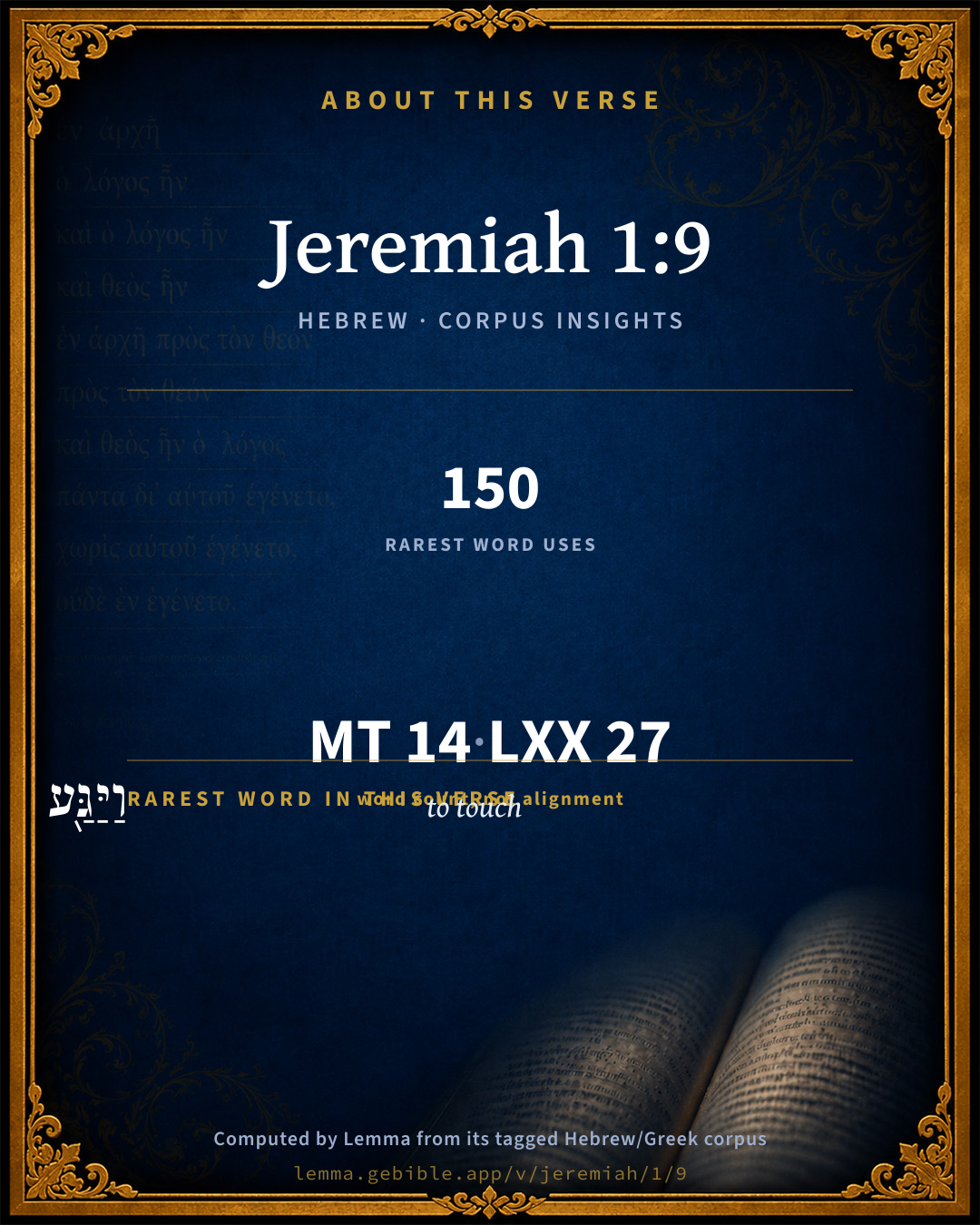
These counts appear in no published source. They are computed here, from the morphology-tagged text and Lemma’s own curated glosses. What Lemma adds →

14
words
12
distinct lemmas
Prophets
section

Grammatical profile

  • 4 verbs
  • 6 nouns
  • 2 prepositions
  • 2 particles

Verb forms

  • וַיִּשְׁלַ֤ח Qal · Sequential Imperfect
  • וַיַּגַּ֖ע Hiphil · Sequential Imperfect
  • וַיֹּ֤אמֶר Qal · Sequential Imperfect
  • נָתַ֥תִּי Qal · Perfect

Repetition

Words recur within this verse — often emphatic in Hebrew:

  • יְהוָה֙ LORD H3068 ×2
  • פִּ֑י mouth H6310 ×2

Hebrew & Septuagint length

In the original languages it is 14 Hebrew tokens and 27 Greek tokens — but the two are counted differently (Hebrew bundles its prefixes and suffixes into one token; the Greek is in lemma form), so that isn’t a like-for-like length.

Cross-references

11

Topical passages linked to Jeremiah 1:9 in the Treasury of Scripture Knowledge — connected by theme and wording, ordered by reader-vote popularity; previews shown in the World English Bible.

  • Luke 21:15 for I will give you a mouth and wisdom which all your adversaries will not be able to withstand or to contradict.
  • Exodus 4:11–12 Yahweh said to him, "Who made man's mouth? Or who makes one mute, or deaf, or seeing, or blind? Isn't it I, Yahweh?
  • Luke 12:12 for the Holy Spirit will teach you in that same hour what you must say."
  • Isaiah 51:16 I have put my words in your mouth, and have covered you in the shadow of my hand, that I may plant the heavens, and lay the foundations of the earth, and tell Zion, You are my people.
  • Isaiah 50:4 The Lord Yahweh has given me the tongue of those who are taught, that I may know how to sustain with words him who is weary: he wakens morning by morning, he wakens my ear to hear as those who are taught.
  • Matthew 10:19 But when they deliver you up, don't be anxious how or what you will say, for it will be given you in that hour what you will say.
  • Jeremiah 5:14 Therefore thus says Yahweh, the God of hosts, Because you speak this word, behold, I will make my words in your mouth fire, and this people wood, and it shall devour them.
  • Ezekiel 3:10 Moreover he said to me, Son of man, all my words that I shall speak to you receive in your heart, and hear with your ears.
  • Exodus 4:15–16 You shall speak to him, and put the words in his mouth. I will be with your mouth, and with his mouth, and will teach you what you shall do.
  • Isaiah 49:2 and he has made my mouth like a sharp sword; in the shadow of his hand has he hid me: and he has made me a polished shaft; in his quiver has he kept me close:
  • Isaiah 6:6–7 Then one of the seraphim flew to me, having a live coal in his hand, which he had taken with the tongs from off the altar.

Cross-references courtesy of OpenBible.info (CC BY 4.0).

Hebrew and Greek witnesses Masoretic Hebrew ↔ Greek Septuagint

The same verse in the two great witnesses to the Old Testament, shown verse-for-verse.

These are two independent witnesses, not word-aligned to each other, and the Septuagint is shown in lemma (dictionary) form.

Hebrew Jeremiah 1:9 Masoretic · Westminster Leningrad Codex

וַיִּשְׁלַ֤ח יְהוָה֙ אֶת יָד֔וֹ וַיַּגַּ֖ע עַל פִּ֑י וַיֹּ֤אמֶר יְהוָה֙ אֵלַ֔י הִנֵּ֛ה נָתַ֥תִּי דְבָרַ֖י בְּפִֽיךָ

Then Yahweh put forth his hand, and touched my mouth; and Yahweh said to me, Behold, I have put my words in your mouth:

World English Bible · Public Domain

Greek LXX Structure differs

In the Septuagint, Jeremiah is about an eighth shorter than the Hebrew and arranges its material differently — the Oracles Against the Nations (Hebrew chapters 46–51) appear in the middle of the Greek book, after 25:13. Because the chapter and verse boundaries do not line up, a verse-for-verse comparison with the Hebrew is not shown.

A verse-for-verse comparison isn’t shown here because the chapters and verses don’t line up. Switch to the LXX edition with the MT / LXX toggle above to read the Greek directly.

On this verse, Keil & Delitzsch discusses the Septuagint’s reading. Read the note in Commentary ↓

Hebrew: Westminster Leningrad Codex (CC BY 4.0). Greek: Septuagint (public domain); English from a public-domain English Septuagint. How the Septuagint differs from the Hebrew →

Targum (Aramaic paraphrase)

1

The Targum is the ancient Jewish Aramaic paraphrase of the Hebrew Scriptures — an interpretive translation, not the Hebrew text itself. Onkelos (literal) and Pseudo-Jonathan (expansive) render the Torah, and Jonathan the Prophets. Coverage is partial: where no permissively-licensed English translation exists for a verse, only the Aramaic is shown. This is verse-level text, not a word-by-word alignment to the Hebrew.

  1. Targum Jonathan Prophets (Joshua–Malachi)
    וּשְׁלַח יְיָ יַת פִּתְגָמֵי נְבוּאָתֵיהּ וְסַדַר בְּפוּמִי וַאֲמַר יְיָ לִי הָא שַׁוֵיתִי פִּתְגָמֵי נְבוּאָתִי בְּפוּמָךְ:

    (no public-domain English translation for this verse)

    Targum Jonathan — Aramaic: “Mikraot Gedolot” (public domain). English: “Sefaria Community Translation” (CC0 1.0 (public-domain dedication)); “London "Chaldee Paraphrase," 1871” (public domain). Text via Sefaria.

Commentary

Notes on Jeremiah 1:9 from classic Christian and Jewish commentators (each source and its license shown beneath its notes). The classic Christian expositions comment on the surrounding passage and are grouped to its opening verse, so a note may address several verses; the Jewish commentaries on the Tanakh (Rashi and others) are per-verse, so they appear only where the commentator wrote on this verse.

Lemma curates 59 commentaries, every one of them public domain or Creative Commons licensed, each selected and text-cleaned for this edition rather than reprinted as found. About our sources →

Trapp's Complete Commentary

John Trapp

Jer 1:9 Then the LORD put forth his hand, and touched my mouth. And the LORD said unto me, Behold, I have put my words in thy mouth.

Ver. 9. Then the Lord put forth his hand and touched my mouth.] This was a very great favour and a sweet settlement to the hesitating prophet. The like visible sign for confirmation was given to Isaiah; {Isa 6:7} to Ezekiel; {Eze 2:8; Eze 3:2-3} and to John the divine; {Rev 10:10} how much are we bound to God for his word and sacraments?

Behold, I have put my words in thy mouth.] And in thy mind also, together with good courage for the better uttering of them. Fear not, therefore, though thou be, as thou objectest, infantissimus et infirmissimus; but "go in this my might," and preach lustily.

John Trapp, A Commentary or Exposition upon All the Books of the Old and New Testament (1647–1656) — public domain. Text from a community e-Sword module.

The Biblical Illustrator

Joseph S. Exell

Jer_1:9

To whom the Word of the Lord came.

The Word of God

Words are often used in two ways--one specific, definite; the other general, figurative. Thus, when we use the word heart, we mean specifically that organ which pumps the blood throughout our being; on the other hand, we use it broadly as the seat of the affections and centre of highest being. So it is with the term word, Primarily, it stands for a written or spoken term composed of letters; then we enlarge its content and use it in the sense of a message, What word did our friend send? Then as the Psalmist used it, where the heavens have a word for us, a message. Then we go on until we come to find that any expression of God is called a Word of God. This is the use of word in the Bible. The Word of God is always an expression of Gods being.

I. There is a Word of God for us in nature. The very heavens have a Word of God for us. They tell us that an attribute of His is glory, majesty, far-reaching grandeur. Days and nights all speak of His glory and infinite resource. How many words of God come to us through Nature! How the writers of the Psalms saw it! How Jesus saw in Nature the Word of Gods care and watchfulness!

1. Thus honesty is a Word of God, written on all the face of Nature as an attribute. Nature tells us God is honest, true to Himself, to the laws He has made, to man. The foundation Principle of the physical universe is honesty. The stars swing true to their courses. Suns rise and set and do not deceive us. If we did not know this universe was run honestly, we would not dare enter a new day.

2. As we are reading, in these days, more and more deeply into Nature, we are hearing another great Word of God, namely, that God is a God of purpose. This is a great message. Many people think He is not a God of purpose, but that the universe is being run with no end in view. Nature is full of prophecy, life everywhere throbs with expectancy of greater being; God begins with the simplest and works towards the greatest, He starts with a cell of living matter, and ends with the wonderful human frame, He starts with a spark of life and ends with a spirit in His own image. The best lies before us, the golden age is yet to be. God has great destinies in view for the human soul.

II. There has been a distinctive Word of God spoken through prophets and statesmen who have been wrapped up in the progress of nations. We might see this in the history of any nation, of old or of today, but I will take Israel, because we are more familiar with its history and its prophets. One Word of God that came through Israel was justice. God was a just God. He was not like the gods of the Babylonians, fickle, full of whims, acting by impulse, but He was a God who weighed and considered; who looked at motives as well as deeds; who meted out rewards and punishments by desert. Another Word of God that came to Israel was that He was a shield and reward, a defender of His people. The Word of the Lord came unto Abram in a vision, saying, Fear not, Abram, I am thy shield and thy exceeding great reward. Ah, how well Israel learned that word in all her devious history! And how deeply impressed upon her was the word that God was a jealous God--jealous for the welfare of His people, a present help, a refuge, and a strength. Another word that came through Israel was that God was a patient, long-suffering God. The prophets Isaiah and Jeremiah were continually giving this Word of God. And every other nation through its people and prophets has some great Word of God to give to the world. For God is not dumb, and His prophets today are not deaf.

III. It is through life that God must speak His largest word, make the fullest revelation of His Being. It is life that speaks to life, heart that comforts heart. All the prophets of Israel saying that God is long-suffering will not move a man to see it so much as one soul here exhibiting the forbearance of God. Preachers may preach forever that God is love, and it will not have the force of one God-filled deed of love. So it is with all the attributes of God. They cannot be revealed in their great, Divine reality except as they are manifest in human life. So when the fulness of time had come God spoke to men through a human soul. Then was His true glory revealed, then His nature made manifest. It was when the word, the expression, the character of God became flesh and dwelt among us that we beheld His glory. Jesus is the living manifestation of the Word of God. Now I have seen Jesus I know God identifies Himself with men. For He has come into our humanity. I ask God what word He has for me in my sorrows and loneliness, and the answer comes to me in the life of Jesus that God is love. I see God living as love before me. I see His love going out to wretched men and women. I see Him serving as only love can serve. I see Him gathering to Himself outcasts and sinners, and recreating them in a new atmosphere of love. I see Him taking little children upon His knee and blessing them. I see Him suffering because He loved the world. What is the nature of God? In Jesus see how He is a Father. See how Jesus whole life was a living word speaking the Fatherhood of God. How does God treat sinful beings? Look how Jesus treated sinful women who came to Him, and see how God treats sinners. How does God feel over the sins of the world? See Jesus weeping over Jerusalem. Will God suffer to save men? See Jesus giving His rest, and strength, and life, that men may see to what ends God will go to save His children. Let us remember that it was because Jesus was one with the Father that He could be the medium of the Word of God. But when He said, I and the Father are one, He referred to a spiritual oneness. So wherever there is a soul today who is one with the Father, there you will find a living Word of God. There is a very striking scene in George Macdonalds Robert Falconer which shows how today a Word of God may come through life. Eric Ericson, a poor Scotch student, tramping on to Edinburgh, stops footsore and weary at the Boars Head, the inn kept by Letty Napier. After resting awhile, he starts to go on, although so footsore he can hardly walk. But Miss Letty makes him go up to a room and take off his shoes, and let her bathe his feet. He expostulates, for he has not a shilling in the world. But Miss Letty makes him stay three days and rest, while she ministers to him, and then starts him off to Edinburgh, a new man, and a couple of pieces in his pocket. Eric had been a sceptic, but as he walks with Robert he says, with the tears welling up in his eyes, If I only knew that God was as good as that woman, I should die content. Robert answers, But surely ye dinna think Gods nae as guid as she is? Surely Hes as guid as He can be. He is good, ye know. Eric answers, Oh, yes, they say so. And then they tell you something about Him that isnt good, and go on calling Him good all the same. But calling anybody good doesnt make him good, you know. Yes, poor Eric was right--calling Him good does not make Him good. But when Eric felt love in this godly woman it set him to thinking about the goodness in God. It was a living word from God straight to his heart. So, every time you do a deed of love, you are speaking a word of God. (F. Lynch.)

The call of Jeremiah

It is not to be expected that a superficial gaze will discern the special qualifications that attracted the Divine choice to Jeremiah. But that is no wonder. The instruments of the Divine purpose in all ages have not been such as man would have selected. There were several reasons why Jeremiah might have been passed over.

1. He was young. How young we do not know; but young enough for him to start back at the Divine proposal with the cry, Ah! Lord God! behold, I cannot speak; for I am a child. Without doubt, as a boy he had enjoyed peculiar advantages. God has often selected the young for posts of eminent service: Samuel and Timothy; Joseph and David; Daniel and John the Baptist.

2. He was naturally timid and sensitive. By nature he seemed cast in too delicate a mould to be able to combat the dangers and difficulties of his time. He reminds us of a denizen of the sea, accustomed to live within its shell, but suddenly deprived of its strong encasement, and thrown without covering on the sharp edges of the rocks. The bitter complaint of his afterlife was that his mother had brought him into a world of strife and contention. Many are moulded upon this type. They have the sensitiveness of a girl, and the nervous organism of a gazelle. They love the shallows, with their carpet of silver sand, rather than the strong billows that test a mans endurance. For them it is enough to run with footmen; they have no desire to contend with horses. Yet such, like Jeremiah, may play an heroic part on the worlds stage, if only they will let God lay down the iron of His might along the lines of their natural weakness. His strength is only made perfect in weakness. It is to those who have no might that He increaseth strength.

3. He specially shrank from the burden he was summoned to bear. His chosen theme would have been Gods mercy--the boundlessness of His compassion, the tenderness of His pity. But to be charged with a message of judgment; to announce the woeful day; to oppose every suggestion of heroic resistance; to charge home on the prophetic and the priestly orders, to each of which he belonged, and the anger of each of which he incurred, the crimes by which they were disgraced--this was the commission that was furthest from his choice (Jer_17:16).

4. He was conscious of his deficiency in speech. Like Moses, he could say, O my Lord, I am not eloquent, neither heretofore, nor since Thou hast spoken unto Thy servant: but I am slow of speech, and of a slow tongue. The best speakers for God are frequently they who are least gifted with human eloquence; for if that be richly present--the mighty power of moving men--there is an imminent peril of relying on it, and attributing the results to its magnetic spell. God cannot give His glory to another. He may not share His praise with man. He dare not expose His servants to the temptation of sacrificing to their own net or trusting their own ability. Do not, then, despair because of these apparent disqualifications. Notwithstanding all, the Word of the Lord shall come to thee; not for thy sake alone, but for those to whom thou shalt be sent. The one thing that God demands of thee is absolute consecration to His purpose, and willingness to go on any errand on which He may send thee. (F. B. Meyer, B. A.)

In the days of Josiah . . . also in the days of Jehoiakim.

Mutations of life

When one sea floweth, another ebbeth. When one star riseth, another setteth. When light is in Goshen, darkness is in Egypt. When Mordecai groweth into favour, Haman groweth out of favour. When Benjamin beginneth, Rachel endeth. Thus we are rising or setting, getting or spending, winning or losing, growing or fading, until we arrive at heaven or hell. (Henry Smith.)

The Biblical Illustrator, edited by Joseph S. Exell (c. 1880s–1900s) — public domain. Text from a community e-Sword module.

Joseph Benson's Commentary

Jer 1:9-10. Then the Lord put forth his hand, and touched my mouth — This appeared to the prophet to be done in his vision; whereby he was taught that the divine help should go along with him, that the gift of utterance should be bestowed upon him, and that he should be able to declare the divine commands in a proper spirit and manner: compare Isa 6:7; and Isa 51:16. Behold, I have put my words in thy mouth — By the seeing of this symbolical action in his vision, and the hearing of these words, Jeremiah could not but be assured that he should be able to speak in the proper language of a prophet, or with words becoming his office, and that he should have that firmness and boldness given him which were necessary for the purpose. Jeremiah does not indeed equal Isaiah in eloquence of speech, but he seems to have been no way inferior to him in firmness of mind. See, I have this day set thee over the nations — Namely, to speak to them in my name, for this is all that is meant here by being set over them. To root out and to pull down, &c. — In the style of Scripture the prophets are said to do what they declare shall be done; and therefore Jeremiah is here said to root out, &c., because he was authorized to make known the purposes of God, and because the events here mentioned would follow in consequence of his prophecies. See Isa 6:9; and Bishop Newton on the Prophecies, vol. 1.

Joseph Benson's Commentary on the Old and New Testaments (1811–1818) — public domain. Text from a community e-Sword module.

Keil & Delitzsch

C. F. Keil & F. Delitzsch

The Consecration. - Jer 1:9. "And Jahveh stretched forth His hand, and touched my mouth, and Jahveh said to me, Behold, I put my words into thy mouth. Jer 1:10. Behold, I set thee this day over the nations, and over the kingdoms, to root up and to ruin, to destroy and to demolish, to build and to plant." In order to assure him by overt act of His support, the Lord gives him a palpable pledge. He stretches out His hand and causes it to touch his mouth (cf. Isa 6:7); while, as explanation of this symbolical act, He adds: I have put my words in thy mouth. The hand is the instrument of making and doing; the touching of Jeremiah's mouth by the hand of God is consequently an emblematical token that God frames in his mouth what he is to speak. It is a tangible pledge of ἔμπνευσις, inspiratio, embodiment of that influence exercised on the human spirit, by means of which the holy men of God speak, being moved by the Holy Ghost, Pe2 1:21 (Nδgelsb.). The act is a real occurrence, taking place not indeed in the earthly, corporeal sphere, but experienced in spirit, and of the nature of ecstasy. By means of it God has consecrated him to be His prophet, and endowed him for the discharge of his duties; He may now entrust him with His commission to the peoples and kingdoms, and set him over them as His prophet who proclaims to them His word. The contents of this proclaiming are indicated in the following infinitive clauses. With the words of the Lord he is to destroy and to build up peoples and kingdoms. The word of God is a power that carries out His will, and accomplishes that whereto He sends it, Isa 55:10. Against this power nothing earthly can stand; it is a hammer that breaks rocks in pieces, Jer 23:29. What is here said of the word of Jahveh to be preached by Jeremiah is said of Jahveh Himself in Jer 31:28. Its power is to show itself in two ways, in destroying and in building up. The destroying is not set down as a mere preliminary, but is expressed by means of four different words, whereas the building is given only in two words, and these standing after the four; in order, doubtless, to indicate that the labours of Jeremiah should consist, in the first place and for the most part, in proclaiming judgment upon the nations. The assonant verbs נתשׁ and נתץ are joined to heighten the sense; for the same reason להרוס is added to להאביד, and in the antithesis לנטוע is joined with לבנות.

(Note: The lxx have omitted להרוסa, and hence Hitz. infers the spuriousness of this word. But in the parallel passage, Jer 31:28, the lxx have rendered all the four words by the one καθαιρεῖν; and Hitz. does not then pronounce the other three spurious.)

Keil & Delitzsch — Biblical Commentary on the Old Testament (1861–1891) — public domain (CC PDM 1.0). Text via the HelloAO Bible API. (Old Testament only.)

Tyndale Open Study Notes

Tyndale Open Resources

1:9 When God placed his words in Jeremiah’s mouth, he granted the prophet the status of an official royal messenger, including the ability to speak authoritatively in public.

Tyndale Open Study Notes — © Tyndale Open Resources, licensed CC BY-SA 4.0. Text via the HelloAO Bible API.

Geneva Bible (1599)

Geneva Bible translators

Which declareth that God maketh them meet, and assureth them, whom he calleth to set forth his glory: giving them all means necessary for the same, Exod. 4:12; Isa. 6:7.

Geneva Bible (1599) marginal notes — public domain. Text via Bolls.life.

Jamieson, Fausset & Brown

Robert Jamieson, A. R. Fausset & David Brown

touched my mouth--a symbolical act in supernatural vision, implying that God would give him utterance, notwithstanding his inability to speak (Jer 1:6). So Isaiah's lips were touched with a living coal (Isa 6:7; compare Eze 2:8-10; Dan 10:16).

Jamieson, Fausset & Brown — Commentary Critical and Explanatory on the Whole Bible (1871) — public domain (CC PDM 1.0). Text via the HelloAO Bible API.

John Calvin's Commentaries

Here Jeremiah speaks again of his calling, that his doctrine might not be despised, as though it proceeded from a private individual. He, therefore, testifies again, that he came not of himself, but was sent from above, and was invested with the authority of a prophet. For this purpose he says, that God’s words were put in his mouth.

This passage ought to be carefully observed; for Jeremiah briefly describes how a true call may be ascertained, when any one undertakes the office of a teacher in the Church: it is ascertained even by this when he brings nothing of his own, according to what Peter says in his first canonical epistle,

“Let him who speaks, speak as the oracles of God,” (1 Peter 4:11)

that is, let him not speak doubtingly, as though he introduced his own glosses; but let him boldly, and without hesitation, speak in the name of God. So also Jeremiah in this place, in order that he might demand to be heard, plainly declares that the words of God were put in his mouth. Let us, then, know, that whatever proceeds from the wit of man, ought to be disregarded; for God wills this honor to be conceded to him alone, as it was stated yesterday, to be heard in his own Church. It hence follows, that none ought to be acknowledged as God’s servants, that no prophets or teachers ought to be counted true and faithful, except those through whom God speaks, who invent nothing themselves, who teach not according to their own fancies, but faithfully deliver what God has committed to them.

A visible symbol was added, that there might be a stronger confirmation: but there is no reason to make this a general rule, as though it were necessary that the tongues of all teachers should be touched by the hand of God. There are here two things — the thing itself, and the external sign. As to the thing itself, a rule is prescribed to all God’s servants, that they bring not their own inventions, but simply deliver, as from hand to hand, what they have received from God. But it was a special thing as to Jeremiah, that God, by stretching out his hand, touched his mouth; it was, that he might openly shew that his mouth was consecrated to himself. It is therefore sufficient as to the ministers of the word, that their tongues be consecrated to God, so that they may not mix any of their own fictions with his pure doctrine. But it was God’s will, as to Jeremiah, to add also the visible signs of the thing itself, by extending his hand and touching his mouth.

John Calvin's Commentaries (1540-1563) — public domain. Text from the Calvin Translation Society English edition (1840s-50s) via the Christian Classics Ethereal Library (ccel.org). Calvin's coverage is partial (roughly two-thirds of the Bible); uncommented books and verses are honest gaps, never fabricated. The 19th-century editor's footnotes and remarks are omitted so the notes are faithfully Calvin's own voice.

Ellicott's Commentary for English Readers

(9) The Lord put forth his hand . . .—The symbolic act seems to imply something like a waking vision, like that of Isaiah (Isa_6:6), and the act itself reminds us of the “live coal” laid upon the prophet’s mouth, as there recorded. The “hand of the Lord,” as in Eze_3:14; Eze_8:1., and elsewhere, was the received symbol of the special influence of the Spirit of the Lord; and here, as in the case of Isaiah, the act implied the gift of new powers of thought and utterance. The words which a prophet speaks, like those which were to be spoken by the Apostles of Christ (Mat_10:20), are not his own words, but those put into his heart by the Spirit of the Father. So “the finger of God” in Luk_11:20 answers to “the Spirit of God” in Mat_12:28.

A Bible Commentary for English Readers, edited by Charles John Ellicott (1878–1897) — public domain. Text from a community e-Sword module.

The Cambridge Bible for Schools and Colleges

gen. ed. J. J. S. Perowne

9. touched] caused it to touch. An outward symbol of the gift of eloquence, which was being then and there bestowed. The same part of the verb (with a causative force) is used in the corresponding passage of Isaiah (Isa_6:7). On the other hand, in Daniel (Dan_10:16), where the object was merely to restore the power of articulate speech, the verb is “touched,” not “caused to touch.” The nature of God’s dealing with Ezekiel was distinct from either of these (Eze_2:8).

I have put, etc.] Cp. Deu_18:18.

The Cambridge Bible for Schools and Colleges (gen. ed. J. J. S. Perowne; Cambridge University Press, 1878–1918) — public domain. Text from a community e-Sword module.

John Gill's Exposition

Then the Lord put forth his hand,.... Who, according to Kimchi, was the Angel that appeared to the prophet, and spoke in the name of the Lord to him, and is called by his name; but rather it was the Son of God, the true Jehovah, who appeared in a human form he assumed for the present, and put forth his hand:

and touched my mouth; just as one of the seraphim touched the mouth and lips of the Prophet Isaiah with a live coal from the altar, Isa 6:6, by this symbol the prophet was inducted into his office; and it was suggested to him that his mouth was now sanctified to the Lord's use and service; and that what he should speak should not be his own words, but the words of the Lord; and so the Targum paraphrases it,

"and the Lord sent the words of his prophecy, and ordered them in my mouth;''

to which agrees what follows:

and the Lord said unto me, behold, I have put my words in thy mouth; which was signified by the preceding symbol; wherefore he might with great freedom and boldness deliver them out to others.

John Gill's Exposition of the Whole Bible (1746–1763) — public domain (CC PDM 1.0). Text via the HelloAO Bible API.

Albert Barnes' Notes on the Bible

Touched - “Made it touch.” This was the symbol of the bestowal of divine grace and help, by which that want of eloquence, which the prophet had pleaded as a disqualification, was removed.

Albert Barnes' Notes on the Bible (1834–1885) — public domain. Text from a community e-Sword/MySword module.

Haydock's Catholic Bible Commentary

Mouth; perhaps (Haydock) with a coal, by means of an angel, (Isaias vi. 5.) in a sort of dream. He found himself changed into a new man.

George Leo Haydock (1774–1849), Haydock's Catholic Family Bible and Commentary, 1859 edition — public domain. Excludes Psalms (Douay-Rheims chapter numbering differs from Protestant) and Deuterocanonical books (Catholic canon only).

Matthew Poole's English Annotations

Then the Lord put forth his hand: God having before excited the prophet to his work by command and promise, doth now in a vision establish and confirm him, either by the hand of an angel, Isa 6:6,7, or rather, by himself in some visible shape.

Touched, Heb. came upon, as the word is used, Jdg 20:41, hereby enabling him to speak; or, Thou shalt be my mouth to deliver my words; partly, to let Jeremiah understand that they were God’s words; and partly, to intimate that they should be effectual; and partly, that he should never be without them, but continually supplied. See the like kind of phrase Jer 5:14. And he adds,

Behold; q.d. Attend to what I am about to say; or, Look upon this outward sign, and let it assure thee of the thing signified.

Matthew Poole's English Annotations on the Holy Bible (1683–1685) — public domain. Text from a community e-Sword/MySword module.

Whedon's Commentary on the Bible

Daniel D. Whedon

9. And touched my mouth — A sign and symbol of inspiration, implying that God would reveal his power through Jeremiah’s utterances. But this symbolical act belongs not to the realm of sense, but to that of spirit. Other cases of touching the lips are those of Isa_6:6, symbolical of purification; and of Dan_10:16, symbolical of supernatural strengthening.

Daniel D. Whedon (gen. ed.), Commentary on the Old and New Testaments (1874–1909) — public domain. Text from a community e-Sword module.

The Pulpit Commentary

Touched my mouth; literally, caused (his hand) to touch my mouth. Jeremiah had said that he was unskilled in oratory; the Divine answer is that the words which he has to speak are not his own, but those of Jehovah. Two things are obvious:

1. The touching of the lips is not purely metaphorical, as in Psa_51:15; (comp. Psa_40:6) it represents a real experience.

2. This experience, however, can only have been a visionary one, analogous to that vouchsafed to Isaiah at the opening of his prophetic ministry. In the grand account given by Isaiah of his inaugural vision (which has evidently influenced the form of the vision of Jeremiah), we read of the same significant act on the part of one of the seraphim. It is the same act, certainly, but it symbolizes, not as here the communication of a prophetic message, (comp. Mat_10:19) but the purification of the lips. Does it not seem as if Isaiah had attained a deeper insight into the spiritual regeneration needed by the prophet than had been granted to Jeremiah? Another point in which Jeremiah"s account seems inferior to that of Isaiah is plastic power. Notice how Jeremiah dwells upon the meaning of the words; this is a reflective element which diminishes the poetic power of the narrative. A word may Be added to explain that "visionary" is not here used in opposition to "based on fact." That the two epithets are susceptible of combination is well shown in the vision described by Pere Gratry, in his "Souvenirs do ma Jeunesse" (pp. 102-105), the reality of which is not in the least impaired in the writer"s mind by its thoroughly inward character: "Dens teutes ces seines interieures, je n"imaginais rien... c"etaient de saisissantes et tres-energiques realites auxquelles je ne m"attendais nullement."

The Pulpit Commentary (1880–1919), ed. H.D.M. Spence-Jones & Joseph S. Exell — public domain. Text from a community e-Sword module.

John Wesley's Explanatory Notes

Then - God having excited the prophet by command and promise, now in a vision confirms him, either by the hand of an angel, or by himself in some visible shape.

John Wesley, Explanatory Notes Upon the Whole Bible (1754–1765) — public domain. Text via the GEBible commentary corpus.

unfoldingWord translationNotes

Door43 World Missions Community

Then Yahweh reached out with his hand, touched my mouth

Possible meanings are 1) this is a metaphor representing Yahweh giving Jeremiah special authority to speak. AT: "Then it was as though Yahweh touched my mouth" or 2) Jeremiah was seeing a vision and Yahweh actually did this as a symbolic act of giving Jeremiah authority to speak. AT: "Then Yahweh touched my mouth with his hand" (See: Metaphor and Symbolic Action)

I have placed my word in your mouth

This phrase represents giving Jeremiah his message. AT: "I have given you my message for you to speak to the people" or "I have enabled you to tell the people my message" (See: Metaphor)

I am appointing you ... to uproot and break down, to destroy and overthrow, to build and plant

Jeremiah would do these things to various nations by saying that they would happen.

to uproot and break down, to destroy and overthrow, to build and plant

He would uproot, break down, destroy and overthrow some nations, and he would build and plant other nations.

to uproot

God speaks of Jeremiah destroying the nations by what he says as if the nations were plants and he were to pull them up out of the ground. (See: Metaphor)

to destroy and overthrow

Jeremiah uses these words, which mean almost the same thing, to show that this will certainly happen. (See: Doublet)

to build and plant

God speaks of Jeremiah causing nations to become strong as if they were a building and he would build them, and as if they were plants and he would plant them. (See: Metaphor)

translationWords

hand

word

appoint

nation

kingdom

unfoldingWord translationNotes — © Distant Shores Media and the Door43 World Missions Community, licensed CC BY-SA 4.0. Source: git.door43.org/Door43/en_tn.

Rashi

Rabbi Shlomo Yitzchaki (Rashi)

And the Lord stretched forth His hand Every sending mentioned concerning a hand is an expression of stretching forth. Another explanation is like the Targum: And the Lord sent the words of His prophecy.

Rashi on the Tanakh — English translations: “The Judaica Press complete Tanach with Rashi, translated by A. J. Rosenberg” (CC BY 4.0); “Pentateuch with Rashi's commentary by M. Rosenbaum and A.M. Silbermann, 1929-1934” (public domain); “The Metsudah Tanach series, Lakewood, N.J” (CC BY 4.0); and “The Book of Joshua, Metsudah Publications, 1997” (CC BY 4.0). Text via Sefaria.

Lesson kit

Teaching starters — assembled from the data on this page, not authored interpretation. Every prompt links to the verse data it draws on. Edit before teaching.

Jeremiah, in the Prophets, opens this verse with 14 words (12 distinct Hebrew lemmas). Its most distinctive word is nâgaʻ (“to touch”). A historical commentator’s framing appears above. Read the whole chapter for the surrounding context.

Discussion questions

  1. The word nâgaʻ carries the sense “to touch.” How does it shape the verse?
  2. How does Luke 21:15, which shares this passage’s theme, read alongside this verse?
  3. What does the repetition of “LORD” (2× in this one verse) do in this verse?
  4. These translations render this verse differently. What is at stake in choosing one wording over another?
  5. «וַיִּשְׁלַ֤ח» is a Qal Sequential Imperfect verb. How does that grammatical form shape the action described?
  6. Compare how Trapp's Complete Commentary and The Biblical Illustrator read this verse. Where do they agree or differ?

Things to notice

Reading settings

Reading text

Shown beneath each verse's original-language words.

Old Testament
Old Testament edition

Read the OT as the Masoretic Hebrew (MT) or the Greek Septuagint (LXX).

English shown for the Greek Septuagint (in the Hebrew ↔ Greek comparison).

Comparing translations? Open the Compare panel on any verse page to stack up to four side by side.