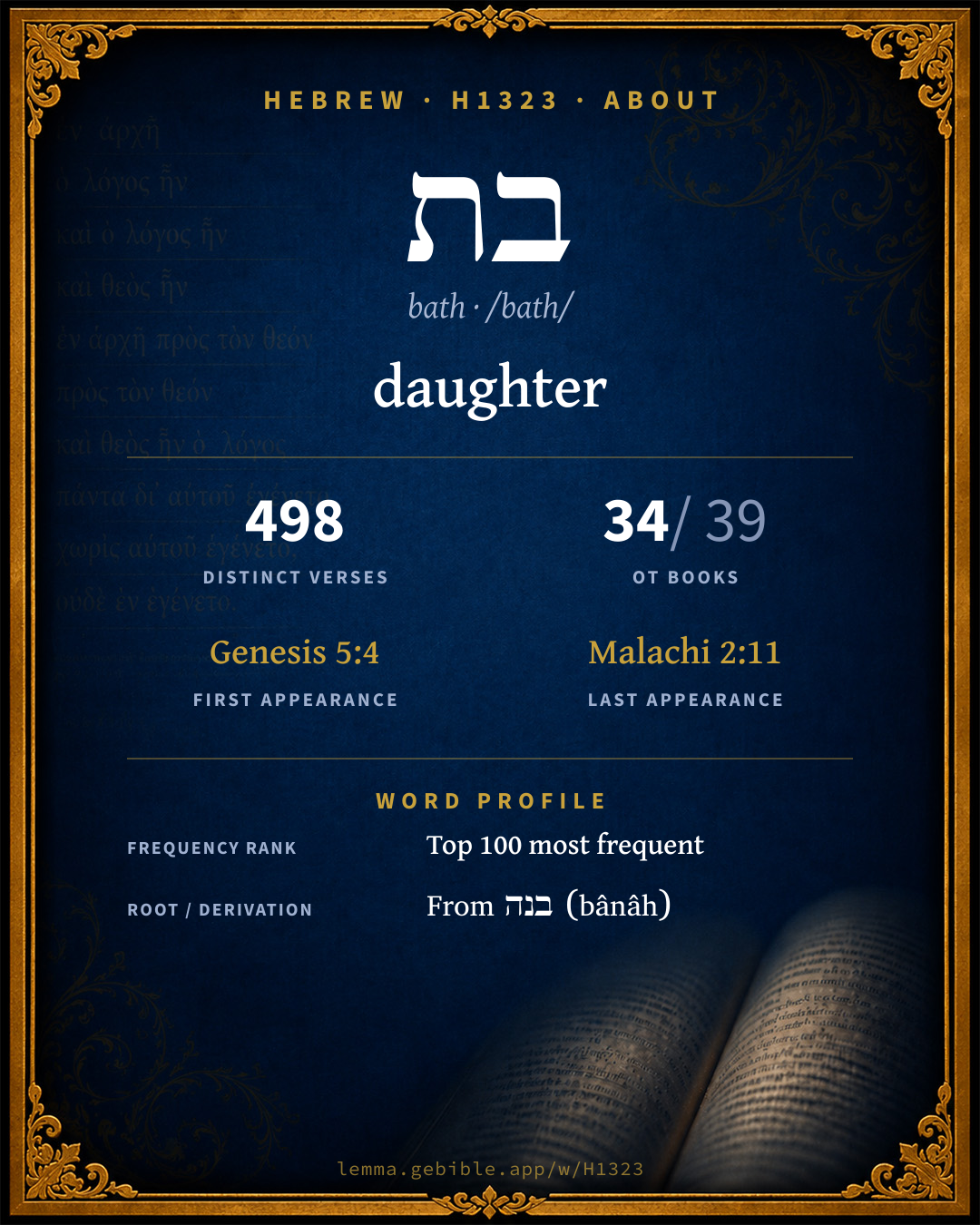
בַּת
daughter
‘daughter’ is one of 2 main senses fuller range ↓
Full lexicon entry — Brown-Driver-Briggs (BDB)
From Brown-Driver-Briggs (BDB)
Where this word appears
See every Construct-state word in the Hebrew Bible →
Grammar key — what these labels mean
Part of speech
- Noun
- A naming word — a person, place, thing, or idea.
Noun type
- Common
- A common noun — a general class of person, place, or thing (“king,” “city,” “water”), not a specific name.
- Proper
- A name of a specific person, place, or people (e.g. Abraham, Zion, Israel).
State
- Construct
- A noun bound to a following noun in a possessive / “of” relationship (the construct chain).
- Absolute
- The independent form of a noun, not bound to a following word.
Gender
- Feminine
- Grammatically feminine.
Number
- Singular
- One.
- Plural
- More than one (in Hebrew, generally three or more).
Every verse where H1323 appears in the Book of Genesis — 90 distinct verses. Click any verse to open its interlinear word-by-word view. Verse text shown in the World English Bible for context — . Each verse’s Hebrew form is shown with its reference; the English is not keyword-highlighted, since the data carries no word-level English alignment. Use “Compare translations” on any verse to read it across multiple English versions. This concordance covers the Hebrew Bible; Septuagint (Greek Old Testament) occurrences are not indexed here.
Genesis
- Genesis 5:4 וּ/בָנֽוֹת conj + n c fp The days of Adam after he became the father of Seth were eight hundred years, and he became the father of sons and daughters.
- Genesis 5:7 וּ/בָנֽוֹת conj + n c fp Seth lived after he became the father of Enosh eight hundred seven years, and became the father of sons and daughters.
- Genesis 5:10 וּ/בָנֽוֹת conj + n c fp Enosh lived after he became the father of Kenan, eight hundred fifteen years, and became the father of sons and daughters.
- Genesis 5:13 וּ/בָנֽוֹת conj + n c fp Kenan lived after he became the father of Mahalalel eight hundred forty years, and became the father of sons and daughters
- Genesis 5:16 וּ/בָנֽוֹת conj + n c fp Mahalalel lived after he became the father of Jared eight hundred thirty years, and became the father of sons and daughters.
- Genesis 5:19 וּ/בָנֽוֹת conj + n c fp Jared lived after he became the father of Enoch eight hundred years, and became the father of sons and daughters.
- Genesis 5:22 וּ/בָנֽוֹת conj + n c fp Enoch walked with God after he became the father of Methuselah three hundred years, and became the father of sons and daughters.
- Genesis 5:26 וּ/בָנֽוֹת conj + n c fp Methuselah lived after he became the father of Lamech seven hundred eighty-two years, and became the father of sons and daughters.
- Genesis 5:30 וּ/בָנֽוֹת conj + n c fp Lamech lived after he became the father of Noah five hundred ninety-five years, and became the father of sons and daughters.
- Genesis 6:1 וּ/בָנ֖וֹת conj + n c fp It happened, when men began to multiply on the surface of the ground, and daughters were born to them,
- Genesis 6:2 בְּנ֣וֹת n c fp cs that God's sons saw that men's daughters were beautiful, and they took for themselves wives of all that they chose.
- Genesis 6:4 בְּנ֣וֹת n c fp cs The Nephilim were in the earth in those days, and also after that, when God's sons came to men's daughters. They bore children to them: the same were the mighty men who were of old, men of renown.
- Genesis 11:11 וּ/בָנֽוֹת conj + n c fp Shem lived after he became the father of Arpachshad five hundred years, and became the father of sons and daughters.
- Genesis 11:13 וּ/בָנֽוֹת conj + n c fp Arpachshad lived after he became the father of Shelah four hundred three years, and became the father of sons and daughters.
- Genesis 11:15 וּ/בָנֽוֹת conj + n c fp and Shelah lived after he became the father of Eber four hundred three years, and became the father of sons and daughters.
- Genesis 11:17 וּ/בָנֽוֹת conj + n c fp Eber lived after he became the father of Peleg four hundred thirty years, and became the father of sons and daughters.
- Genesis 11:19 וּ/בָנֽוֹת conj + n c fp Peleg lived after he became the father of Reu two hundred nine years, and became the father of sons and daughters.
- Genesis 11:21 וּ/בָנֽוֹת conj + n c fp Reu lived after he became the father of Serug two hundred seven years, and became the father of sons and daughters.
- Genesis 11:23 וּ/בָנֽוֹת conj + n c fp Serug lived after he became the father of Nahor two hundred years, and became the father of sons and daughters.
- Genesis 11:25 וּ/בָנֽוֹת conj + n c fp Nahor lived after he became the father of Terah one hundred nineteen years, and became the father of sons and daughters.
- Genesis 11:29 בַּת n c fs cs Abram and Nahor took wives. The name of Abram's wife was Sarai, and the name of Nahor's wife, Milcah, the daughter of Haran who was also the father of Iscah.
- Genesis 17:17 הֲ/בַת ptcl inter + n c fs cs Then Abraham fell on his face, and laughed, and said in his heart, "Will a child be born to him who is one hundred years old? Will Sarah, who is ninety years old, give birth?"
- Genesis 19:8 בָנ֗וֹת n c fp See now, I have two virgin daughters. Please let me bring them out to you, and do you to them as is good in your eyes. Only don't do anything to these men, because they have come under the shadow of my roof."
- Genesis 19:12 וּ/בְנֹתֶ֔י/ךָ conj + n c fp cs + sfx pers 2ms The men said to Lot, "Do you have anybody else here? Sons-in-law, your sons, your daughters, and whoever you have in the city, bring them out of the place:
- Genesis 19:14 בְנֹתָ֗י/ו n c fp cs + sfx pers 3ms Lot went out, and spoke to his sons-in-law, who were pledged to marry his daughters, and said, "Get up! Get out of this place, for Yahweh will destroy the city." But he seemed to his sons-in-law to be joking.
- Genesis 19:15 בְנֹתֶ֨י/ךָ֙ n c fp cs + sfx pers 2ms When the morning arose, then the angels hurried Lot, saying, "Arise, take your wife, and your two daughters who are here, lest you be consumed in the iniquity of the city."
- Genesis 19:16 בְנֹתָ֔י/ו n c fp cs + sfx pers 3ms But he lingered; and the men laid hold on his hand, and on the hand of his wife, and on the hand of his two daughters, Yahweh being merciful to him; and they took him out, and set him outside of the city.
- Genesis 19:30 בְנֹתָי/ו֙ בְנֹתָֽי/ו n c fp cs + sfx pers 3ms n c fp cs + sfx pers 3ms Lot went up out of Zoar, and lived in the mountain, and his two daughters with him; for he was afraid to live in Zoar. He lived in a cave with his two daughters.
- Genesis 19:36 בְנֽוֹת n c fp cs Thus both of Lot's daughters were with child by their father.
- Genesis 20:12 בַת בַת n c fs cs n c fs cs Moreover she is indeed my sister, the daughter of my father, but not the daughter of my mother; and she became my wife.
- Genesis 24:3 מִ/בְּנוֹת֙ prep + n c fp cs I will make you swear by Yahweh, the God of heaven and the God of the earth, that you shall not take a wife for my son of the daughters of the Canaanites, among whom I live.
- Genesis 24:13 וּ/בְנוֹת֙ conj + n c fp cs Behold, I am standing by the spring of water. The daughters of the men of the city are coming out to draw water.
- Genesis 24:23 בַּת n c fs cs and said, "Whose daughter are you? Please tell me. Is there room in your father's house for us to lodge in?"
- Genesis 24:24 בַּת n c fs cs She said to him, "I am the daughter of Bethuel the son of Milcah, whom she bore to Nahor."
- Genesis 24:37 מִ/בְּנוֹת֙ prep + n c fp cs My master made me swear, saying, 'You shall not take a wife for my son of the daughters of the Canaanites, in whose land I live,
- Genesis 24:47 בַּת בַּת n c fs cs n c fs cs I asked her, and said, 'Whose daughter are you?' She said, 'The daughter of Bethuel, Nahor's son, whom Milcah bare to him.' I put the ring on her nose, and the bracelets on her hands.
- Genesis 24:48 בַּת n c fs cs I bowed my head, and worshiped Yahweh, and blessed Yahweh, the God of my master Abraham, who had led me in the right way to take my master's brother's daughter for his son.
- Genesis 25:20 בַּת n c fs cs Isaac was forty years old when he took Rebekah, the daughter of Bethuel the Syrian of Paddan Aram, the sister of Laban the Syrian, to be his wife.
- Genesis 26:34 בַּת בַּת n c fs cs n c fs cs When Esau was forty years old, he took as wife Judith, the daughter of Beeri the Hittite, and Basemath, the daughter of Elon the Hittite.
- Genesis 27:46 בְּנ֣וֹת מִ/בְּנֽוֹת מִ/בְּנ֣וֹת n c fp cs prep + n c fp cs prep + n c fp cs Rebekah said to Isaac, "I am weary of my life because of the daughters of Heth. If Jacob takes a wife of the daughters of Heth, such as these, of the daughters of the land, what good will my life do me?"
- Genesis 28:1 מִ/בְּנ֥וֹת prep + n c fp cs Isaac called Jacob, blessed him, and commanded him, "You shall not take a wife of the daughters of Canaan.
- Genesis 28:2 מִ/בְּנ֥וֹת prep + n c fp cs Arise, go to Paddan Aram, to the house of Bethuel your mother's father. Take a wife from there from the daughters of Laban, your mother's brother.
- Genesis 28:6 מִ/בְּנ֥וֹת prep + n c fp cs Now Esau saw that Isaac had blessed Jacob and sent him away to Paddan Aram, to take him a wife from there, and that as he blessed him he gave him a charge, saying, "You shall not take a wife of the daughters of Canaan,"
- Genesis 28:8 בְּנ֣וֹת n c fp cs Esau saw that the daughters of Canaan didn't please Isaac, his father.
- Genesis 28:9 בַּת n c fs cs Esau went to Ishmael, and took, besides the wives that he had, Mahalath the daughter of Ishmael, Abraham's son, the sister of Nebaioth, to be his wife.
- Genesis 29:6 בִּתּ֔/וֹ n c fs cs + sfx pers 3ms He said to them, "Is it well with him?" They said, "It is well. See, Rachel, his daughter, is coming with the sheep."
- Genesis 29:10 בַּת n c fs cs It happened, when Jacob saw Rachel the daughter of Laban, his mother's brother, and the sheep of Laban, his mother's brother, that Jacob went near, and rolled the stone from the well's mouth, and watered the flock of Laban his mother's brother.
- Genesis 29:16 בָנ֑וֹת n c fp Laban had two daughters. The name of the elder was Leah, and the name of the younger was Rachel.
- Genesis 29:18 בִּתְּ/ךָ֖ n c fs cs + sfx pers 2ms Jacob loved Rachel. He said, "I will serve you seven years for Rachel, your younger daughter."
- Genesis 29:23 בִתּ֔/וֹ n c fs cs + sfx pers 3ms It happened in the evening, that he took Leah his daughter, and brought her to him. He went in to her.
- Genesis 29:24 בִתּ֖/וֹ n c fs cs + sfx pers 3ms Laban gave Zilpah his handmaid to his daughter Leah for a handmaid.
- Genesis 29:28 בִּתּ֖/וֹ n c fs cs + sfx pers 3ms Jacob did so, and fulfilled her week. He gave him Rachel his daughter as wife.
- Genesis 29:29 בִּתּ֔/וֹ n c fs cs + sfx pers 3ms Laban gave to Rachel his daughter Bilhah, his handmaid, to be her handmaid.
- Genesis 30:13 בָּנ֑וֹת n c fp Leah said, "Happy am I, for the daughters will call me happy." She named him Asher.
- Genesis 30:21 בַּ֑ת n c fs Afterwards, she bore a daughter, and named her Dinah.
- Genesis 31:26 בְּנֹתַ֔/י n c fp cs + sfx pers 1cs Laban said to Jacob, "What have you done, that you have deceived me, and carried away my daughters like captives of the sword?
- Genesis 31:28 וְ/לִ/בְנֹתָ֑/י conj + prep + n c fp cs + sfx pers 1cs and didn't allow me to kiss my sons and my daughters? Now have you done foolishly.
- Genesis 31:31 בְּנוֹתֶ֖י/ךָ n c fp cs + sfx pers 2ms Jacob answered Laban, "Because I was afraid, for I said, 'Lest you should take your daughters from me by force.'
- Genesis 31:41 בְנֹתֶ֔י/ךָ n c fp cs + sfx pers 2ms These twenty years have I been in your house. I served you fourteen years for your two daughters, and six years for your flock, and you have changed my wages ten times.
- Genesis 31:43 הַ/בָּנ֨וֹת בְּנֹתַ֜/י וְ/לִ/בְנֹתַ֞/י ptcl def.art + n c fp n c fp cs + sfx pers 1cs conj + prep + n c fp cs + sfx pers 1cs Laban answered Jacob, "The daughters are my daughters, the children are my children, the flocks are my flocks, and all that you see is mine: and what can I do this day to these my daughters, or to their children whom they have borne?
- Genesis 31:50 בְּנֹתַ֗/י בְּנֹתַ֔/י n c fp cs + sfx pers 1cs n c fp cs + sfx pers 1cs If you will afflict my daughters, and if you will take wives besides my daughters, no man is with us; behold, God is witness between me and you."
- Genesis 31:55 וְ/לִ/בְנוֹתָ֖י/ו conj + prep + n c fp cs + sfx pers 3ms Early in the morning, Laban rose up, and kissed his sons and his daughters, and blessed them. Laban departed and returned to his place.
- Genesis 34:1 בַּת בִּ/בְנ֥וֹת n c fs cs prep + n c fp cs Dinah, the daughter of Leah, whom she bore to Jacob, went out to see the daughters of the land.
- Genesis 34:3 בַּֽת n c fs cs His soul joined to Dinah, the daughter of Jacob, and he loved the young lady, and spoke kindly to the young lady.
- Genesis 34:5 בִתּ֔/וֹ n c fs cs + sfx pers 3ms Now Jacob heard that he had defiled Dinah, his daughter; and his sons were with his cattle in the field. Jacob held his peace until they came.
- Genesis 34:7 בַּֽת n c fs cs The sons of Jacob came in from the field when they heard it. The men were grieved, and they were very angry, because he had done folly in Israel in lying with Jacob's daughter; which thing ought not to be done.
- Genesis 34:8 בְּ/בִתְּ/כֶ֔ם prep + n c fs cs + sfx pers 2mp Hamor talked with them, saying, "The soul of my son, Shechem, longs for your daughter. Please give her to him as a wife.
- Genesis 34:9 בְּנֹֽתֵי/כֶם֙ בְּנֹתֵ֖י/נוּ n c fp cs + sfx pers 2mp n c fp cs + sfx pers 1cp Make marriages with us. Give your daughters to us, and take our daughters for yourselves.
- Genesis 34:16 בְּנֹתֵ֨י/נוּ֙ בְּנֹתֵי/כֶ֖ם n c fp cs + sfx pers 1cp n c fp cs + sfx pers 2mp then will we give our daughters to you, and we will take your daughters to us, and we will dwell with you, and we will become one people.
- Genesis 34:17 בִּתֵּ֖/נוּ n c fs cs + sfx pers 1cp But if you will not listen to us, to be circumcised, then we will take our sister, and we will be gone."
- Genesis 34:19 בְּ/בַֽת prep + n c fs cs The young man didn't wait to do this thing, because he had delight in Jacob's daughter, and he was honored above all the house of his father.
- Genesis 34:21 בְּנֹתָ/ם֙ בְּנֹתֵ֖י/נוּ n c fp cs + sfx pers 3mp n c fp cs + sfx pers 1cp "These men are peaceful with us. Therefore let them live in the land and trade in it. For, behold, the land is large enough for them. Let us take their daughters to us for wives, and let us give them our daughters.
- Genesis 36:2 מִ/בְּנ֣וֹת בַּת בַּת בַּת prep + n c fp cs n c fs cs n c fs cs n c fs cs Esau took his wives from the daughters of Canaan: Adah the daughter of Elon, the Hittite; and Oholibamah the daughter of Anah, the daughter of Zibeon, the Hivite;
- Genesis 36:3 בַּת n c fs cs and Basemath, Ishmael's daughter, sister of Nebaioth.
- Genesis 36:6 בְּנֹתָי/ו֮ n c fp cs + sfx pers 3ms Esau took his wives, his sons, his daughters, and all the members of his household, with his cattle, all his animals, and all his possessions, which he had gathered in the land of Canaan, and went into a land away from his brother Jacob.
- Genesis 36:14 בַת בַּת n c fs cs n c fs cs These were the sons of Oholibamah, the daughter of Anah, the daughter of Zibeon, Esau's wife: she bore to Esau Jeush, Jalam, and Korah.
- Genesis 36:18 בַּת n c fs cs These are the sons of Oholibamah, Esau's wife: chief Jeush, chief Jalam, chief Korah: these are the chiefs who came of Oholibamah the daughter of Anah, Esau's wife.
- Genesis 36:25 בַּת n c fs cs These are the children of Anah: Dishon and Oholibamah, the daughter of Anah.
- Genesis 36:39 בַּת בַּ֖ת n c fs cs n c fs cs Baal Hanan the son of Achbor died, and Hadar reigned in his place. The name of his city was Pau. His wife's name was Mehetabel, the daughter of Matred, the daughter of Me-zahab.
- Genesis 37:35 בְּנֹתָ֜י/ו n c fp cs + sfx pers 3ms All his sons and all his daughters rose up to comfort him; but he refused to be comforted. He said, "For I will go down to Sheol to my son mourning." His father wept for him.
- Genesis 38:2 בַּת n c fs cs Judah saw there a daughter of a certain Canaanite whose name was Shua. He took her, and went in to her.
- Genesis 38:12 בַּת n c fs cs After many days, Shua's daughter, the wife of Judah, died. Judah was comforted, and went up to his sheep-shearers to Timnah, he and his friend Hirah, the Adullamite.
- Genesis 41:45 בַּת n c fs cs Pharaoh called Joseph's name Zaphenath-paneah; and he gave him Asenath, the daughter of Potiphera priest of On as a wife. Joseph went out over the land of Egypt.
- Genesis 41:50 בַּת n c fs cs To Joseph were born two sons before the year of famine came, whom Asenath, the daughter of Potiphera priest of On, bore to him.
- Genesis 46:7 בְּנֹתָ֛י/ו וּ/בְנ֥וֹת n c fp cs + sfx pers 3ms conj + n c fp cs his sons, and his sons' sons with him, his daughters, and his sons' daughters, and he brought all his seed with him into Egypt.
- Genesis 46:15 בִתּ֑/וֹ וּ/בְנוֹתָ֖י/ו n c fs cs + sfx pers 3ms conj + n c fp cs + sfx pers 3ms These are the sons of Leah, whom she bore to Jacob in Paddan Aram, with his daughter Dinah. All the souls of his sons and his daughters were thirty-three.
- Genesis 46:18 בִתּ֑/וֹ n c fs cs + sfx pers 3ms These are the sons of Zilpah, whom Laban gave to Leah, his daughter, and these she bore to Jacob, even sixteen souls.
- Genesis 46:20 בַּת n c fs cs To Joseph in the land of Egypt were born Manasseh and Ephraim, whom Asenath, the daughter of Potiphera, priest of On, bore to him.
- Genesis 46:25 בִּתּ֑/וֹ n c fs cs + sfx pers 3ms These are the sons of Bilhah, whom Laban gave to Rachel, his daughter, and these she bore to Jacob: all the souls were seven.
- Genesis 49:22 בָּנ֕וֹת n c fp "Joseph is a fruitful vine, A fruitful vine by a spring; His branches run over the wall.
About this entry
At a glance — auto-summarized from this page’s data, not written by a person. Every figure links to its source below. This summary describes the numbers; it doesn’t interpret them.
בת (bath) is a Hebrew word most often rendered “daughter.” It first appears in Genesis 5:4. It turns up in 498 verses across 34 books, a common footprint. It is not a single-sense word — see its full sense range. From the same root come בנה, אבן and בית. For the data behind this summary, explore the sense tree and the renderings breakdown below.
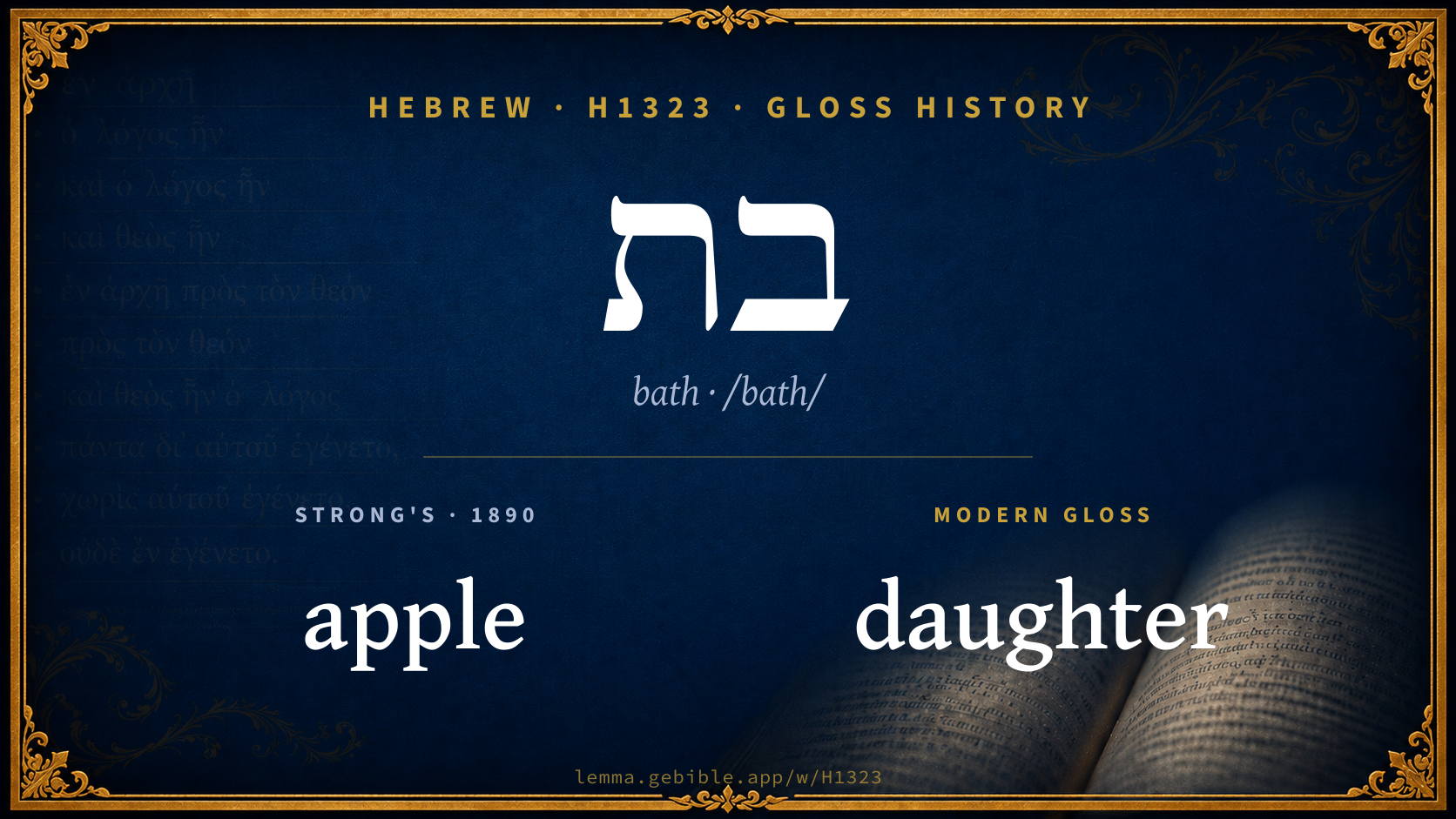
Gloss history
Strong's 1890 vs modern scholarship
About this word
Strong's H1323 catalogs a Hebrew word from the Hebrew Old Testament.
These counts are not copied from any lexicon or concordance. They are computed here, from the morphology-tagged Hebrew Old Testament. What Lemma adds →
- 498
- distinct verses
- The word appears in 498 distinct verses.
- 34 / 39
- OT books
- The word appears in 34 of 39 Old Testament books.
- #82
- by frequency
- Top 100 most frequent Hebrew words (rank 82 of 8,640 Hebrew words by occurrence).
View all 498 occurrences in the concordance →
By section of the Old Testament
By traditional corpus
Conventional, traditional groupings — biblical authorship is debated, so this is a traditional corpus grouping, not an authorship claim. Each share is this word’s portion of its verses in that division of the Hebrew canon. Each figure is a share of the word’s 498 distinct verses.
- Prophets (Nevi'im) 201 verses · 40%
- Torah (Pentateuch) 171 verses · 34%
- Writings (Ketuvim) 126 verses · 25%
How translations render this word
Counts come from each version’s own published word-to-Strong’s tagging or interlinear alignment — an approximate guide to how each version renders this word, not a word-level alignment the data otherwise carries. Because each total is that version’s own tagged count, the per-version totals vary from one another and need not match the appearance or distinct-verse counts above. These counts may also differ from a printed concordance because Lemma counts each distinctly tagged rendering and does not collapse phrase taggings into a single head-word total. This is a fixed set of word-tagged versions (KJV, ASV, BSB, ULT) and does not change with the reading translation you choose elsewhere. Each version’s license is shown beside its name below (and on Sources).
BDB lists this Strong’s number as 4 distinct words (homographs). Each count above pools all of them and is not split by sense — see the Senses section below. A low-frequency rendering may belong to a different one of those words, not the primary meaning.
- King James Version†: Daughter 250×, Daughters 205×, Towns 32×
- American Standard Version†: Daughter 196×, Daughters 180×, 's daughter 30×
- Berean Standard Bible†: Daughter 242×, Daughters 205×, Villages 19×
- unfoldingWord Literal Text†: Daughters 217×, Daughter of 167×, Daughter 90×
King James Version Public Domain
Renders H1323 across 588† tagged occurrences — most commonly:
Plus other, less common renderings. Plus 49 renderings that appear only once — usually multi-word phrases or single function words the recovered tagging swept in, not distinct renderings.
American Standard Version Public Domain
Renders H1323 across 587† tagged occurrences — most commonly:
Plus other, less common renderings. Plus 84 renderings that appear only once — usually multi-word phrases or single function words the recovered tagging swept in, not distinct renderings.
Berean Standard Bible Public Domain
Renders H1323 across 551† tagged occurrences — most commonly:
Plus other, less common renderings. Plus 47 renderings that appear only once — usually multi-word phrases or single function words the recovered tagging swept in, not distinct renderings. Not rendered by a distinct English word in 29 further occurrences.
unfoldingWord Literal Text CC BY-SA 4.0
Renders H1323 across 595† tagged occurrences — most commonly:
Plus other, less common renderings. Plus 28 renderings that appear only once — usually multi-word phrases or single function words the recovered tagging swept in, not distinct renderings.
18 senses and sub-senses in the full BDB
What do BDB’s symbols mean?
BDB uses these scholarly abbreviations:
| Symbol | Meaning |
|---|---|
| 𝔊 | the Septuagint (the ancient Greek translation, LXX) |
| 𝔙 | the Vulgate (the Latin translation) |
| 𝔖 | the Syriac version (the Peshitta) |
| 𝔗 | the Targum (the Aramaic translation) |
| ψ | the Psalms |
| √ | root (the underlying root or stem) |
| ‖ | parallel passage (a synonymous or contrasted parallel) |
| † | the dagger: every passage where the word occurs is cited |
The 18 senses and sub-senses the full Brown-Driver-Briggs lexicon distinguishes for this word, in lexicon order (not ranked by frequency), with BDB’s own verbatim wording and sub-sense lettering. Shown in Hebrew script with BDB’s own scholarly abbreviations. The condensed entry is in the Lexicon Entry tab. See also the Forms in the corpus table below.
בת I daughter (= בַּנְתְּ from בן
- 1. daughter, female child, born of a woman Gn 30:21; 34:1 Ex 1:16, 22; 21:4 Lv 12:6 Ho 1:6 cf. Gn 20:12 Lv 18:9 Dt 27:22 +; begotten by a man Gn 5:4, 7, 10; 11:11, 13, 15 cf. Gn 11:29; 19:8; 20:12; 28:2 Lv 19:9 Dt 27:22 +; often ‖ בֵּן son Gn 5:4, 7 + (v. בֵּן); cf. in allegory of Jehoash 2 K 14:9 = 2 Ch 25:18; note especially בְּנוֹת הָאָדָם i.e. human women Gn 6:2, 4; בִּתְּךָ הַקְּטַנָּה thy younger daughter Gn 29:18 (cf. הַצְּעִירָה v 26 opp. הַבְּכִירָה); בִּתִּי הַגְּדוֹלָה my eldest daughter 1 S 18:17; בַּת־(הַ)מֶּלֶךְ = princess 2 Ch 22:11 2 K 9:34 Dn 11:6 cf. 2 S 13:18 Je 41:10; 43:6 ψ 45:10; cf. as term of praise בַּת־נָדִיב Ct 7:2; in partic. e.g. Genesis 30:21
- a. girl called בִּתֵּנוּ by father and brothers Gn 34:17 cf. בִּתְּכֶם v 8. e.g. Genesis 34:17
- b. of adopted daughter Est 2:7, 15. e.g. Esther 2:7
- c. used in speaking to daughter-in-law Ru 1:11, 12, 13; 2:2, 8, 22; 3:1, 16, 18. e.g. Ruth 1:11
- d. בַּת־אָבִיו = sister Ez 22:11 (appos. אחותו); also half-sister Gn 20:12 בַּת־אָבִי אַךְ לֹא בַת־אִמִּי, cf. Lv 18:9 & v 11 בַּת־אֵשֶׁת אָבִיךָ, 20:17. e.g. Ezekiel 22:11
- e. בַּת־דֹּדוֹ = cousin Est 2:7. e.g. Esther 2:7
- f. used in kindly address, בִּתִּי Ru 3:10, 11 (Boaz to Ruth), cf. ψ 45:11; בְּנוֹתַי in mouth of י׳ Is 43:6 (‖ בָּנַי). e.g. Ruth 3:10
- g. בְּנוֹת בָּנָיו = granddaughters Gn 46:7 (P) cf. Lv 18:10 & v 17 (H); note also Gn 37:35, where בנותיו must include other than actual daughters. e.g. Genesis 46:7
- h. רִבְקָה בַּת־בְּתוּאֵל (as more precise designation) Gn 25:20 cf. 24:23, 24, 47(×2) also 26:34(×2); 29:10 +; note especially †בַּת־פַּרְעֹה (without personal name) Ex 2:5, 7, 8, 9, 10 cf. 1 K 3:1; 7:8; 9:24; 11:1 2 Ch 8:11; בַּת־אִישׁ כְּנַעֲנִי וּשְׁמוֹ שׁוּעַ Gn 38:2 cf. v 12 (but cf. 1 Ch 2:3 sub בַּת־שׁוּעַ n.pr.f. infr.) e.g. Genesis 25:20
- i. often pl. as designation of women of a particular city, land, or people: בְּנוֹת צִיּוֹן Is 3:16, 17; 4:4 Ct 3:11 cf. Is 49:22; 60:4 La 3:51; בְּנוֹת יְרוּשָׁלַם Ct 1:5; 2:7; 3:5, 10; 5:8, 16; 8:4; בְּנוֹת־שִׁילוֹ Ju 21:21(×2); בְּנוֹת רַבָּה Je 49:3; observe transitional phrase בְּנוֹת אַנְשֵׁי הָעִיר Gn 24:13; further בְּנוֹת כְּנָ֑עַן Gn 28:1, 6, 8; 36:2 (all P) cf. ב׳ הַכְּנַעֲנִי Gn 24:3, 37 (J); בְּנוֹת הָאָרֶץ Gn 27:46; 34:1 (both P); בְּנוֹת מוֹאָב Nu 25:1 Is 16:2 cf. Nu 21:29; ב׳ חֵת Gn 27:46(×2) (P); ב׳ פְּלִשְׁתִּים Ju 14:1, 2 2 S 1:20 ‖ ב׳ הָֽעֲרֵלִים v 20 (poet.); ב׳ יִשְׂרָאֵל Ju 11:40 1 S 1:24 (poet.); ב׳ יְהוּדָה ψ 48:12; 97:8; ב׳ מְנַשֶּׁה Jos 17:6; ב׳ דָּן 2 Ch 2:13; cf. בַּת־לֵוִי Ex 2:1 i.e. a woman of tribe of Levi; also ב׳ אַחֶיךָ Ju 14:3; ב׳ עַמֶּ֑ךָ Ez 13:7.—בַּת־צִיּוֹן etc. v. sub 3 infr. e.g. Isaiah 3:16
- 2. young women, women Gn 30:13 (J) Pr 31:29 Ct 2:2; 6:9; בָּנוֹת בֹּטְחוֹת Is 32:9; also בַּת הַנָּשִׁים Dn 11:17. e.g. Genesis 30:13
- 3. with name of city, land, or people, poet. personif. of that city or inhabitants, etc.: בַּת־צִיּוֹן Is 1:8; 10:32; 16:1; 62:11 Mi 1:13; 4:8, 10, 13 Je 4:13; 6:2, 23 Zp 3:14 Zc 2:14; 9:9 ψ 9:15 La 1:6; 2:1, 4; 4:22; even זִקְנֵי בת־ציון La 2:10; חוֹמַת ב׳ צ׳ v 8, 18; also בְּתוּלַת ב׳־צ׳ 2 K 19:21 = Is 37:22 La 2:13; שְׁבִיָּה ב׳־צ׳ Is 52:2; ב׳ יְרוּשָׁלַם 2 K 19:21 = Is 37:22 Mi 4:8 Zp 3:14 Zc 9:9 La 2:13, 15; cf. בַּת־פּוּצַי Zp 3:10 daughter of my dispersed ones; בַּת־צֹר ψ 45:13; ב׳ בָּבֶל Je 50:42; 51:23 ψ 137:8; בְּתוּלַת ב׳ בָּבֶל Is 47:1; v. further Zc 2:11; also of Tarshish Is 23:10, Sidon v 12 (+ בְּתוּלַת), Dibon Je 48:18 (+ יוֹשֶׁבֶת), Gallim Is 10:30; בְּתוּלַת ב׳־יְהוּדָה La 1:15; cf. מִבְצְרֵי בַּת יְהוּדָה 2:2; בַּת־עַמִּי daughter of my people Is 22:4 Je 4:11; 6:14, 26; 8:11, 19, 21, 22, 23; 9:6 La 3:48; 4:3, 6, 10, בְּחוּלַת ב׳ ע׳ Je 14:17; בַּת־מִצְרָ֑יִם Je 46:24; also 46:11 (+ בְּתוּלַת), v 19 (+ יוֹשֶׁבֶת); ב׳ אֱדוֹם La 4:21, 22; ב׳ כַּשְׂדִּים Is 47:1, 5; note הַבַּת הַשּׁוֹבֵבָ֑ה Je 31:22 (‖ בְּתוּלַת יִשְׂרָאֵל v 21) 49:4 (= Ammon); on בַּת־אֲשֻׁרִים Ez 27:6 v. sub אֲשֻׁרִים p. 81; less often in pl. בְּנוֹת הַגּוֹיִם Ez 32:16; ב׳ גּ׳ אַדִּרִם v 18 (these perhaps sub 1 i); בְּנוֹת פְּלִשְׁתִּים Ez 16:27 (in allegory); cf. also of Sodom, Samaria, Syria etc. v 44, 45, 46(×2), 53, 55(×2), 57(×2); 23:2. e.g. Isaiah 1:8
- 4. pl. = villages, after name of city, וּבְחֶשְׁבּוֹן וּבְכָל־בְּנֹתֶיהָ Nu 21:25 cf. v 32; 32:42 (E) Jos 15:45, 47(×2) (JE?) + v 28 𝔊 Di, 17:11 (6 times) v 16 (J) = Ju 1:27(×4); 11:26(×2) Je 49:2 + 17 times Ch + 6 times Ne 11:25–31. On 1 Ch 18:1 & its variation from ‖ 2 S 8:1 vid. We Dr e.g. Numbers 21:25
- 5. in phrases denoting character, quality, etc., בַּת־אֵל נֵכָר daughter of a strange god, i.e. idolatrous (woman or people) Mal 2:11; בַּת־גְּדוּד daughter of a troop, i.e. war-like city Mi 4:14; בְּנוֹת הַשִּׁיר Ec 12:4 the daughters of song, i.e. songs, melodious notes; בַּת־בְּלִיַּעַל 1 S 1:16 v. בְּלִיַּעַל sub בלה. e.g. Malachi 2:11
- 6. בַּת יַעֲנָה = ostrich Lv 11:16 = Dt 14:15; pl. בְּנוֹת יַעֲנָה Jb 30:29 Mi 1:8 Is 13:21; 34:13; 43:20 Je 50:39 (v. יַעֲנָה); בַּת־עַיִן pupil of the eye La 2:18 cf. Ethiopic ብንተ ዐይን v. also אִישׁוֹן. e.g. Leviticus 11:16
- 7. fig. לַעֲלוּקָה שְׁתֵּי בָנוֹת Pr 30:15 two daughters (i.e. Sheʾôl & the barren womb, cf. Comm.) e.g. Proverbs 30:15
- 8. of vine = branch בָּנוֹת צָֽעֲדָה עֲלֵי־שׁוּר Gn 49:22 cf. Di & v. sub בֵּן. e.g. Genesis 49:22
- 9. as n. relat. (all P), of age of woman בַּת־תִּשְׁעִים שָׁנָה Gn 17:17; of ewe-lamb בַּת־שְׁנָתָהּ Lv 14:10 Nu 6:14; of she-goat id. Nu 15:27. Cf. בֵּן. 9—ii. בַּת v. בתת p. 144. e.g. Genesis 17:17
בת II daughter v. sub בן.
בת III bath (a measure), בָּתָה, בַּתָּה v. בתת.
Senses from the full Brown-Driver-Briggs lexicon (Brown, Driver, Briggs; Oxford 1906 — public domain), digitized via Sefaria, supplemented by the OpenScriptures HebrewLexicon (CC BY 4.0). Full attribution on Sources.
Word origin
I. n.f. daughter (= בַּנְתְּ from בן; Ph. בת, MI בנת pl. maidens, Assyrian bintu WincklerSargon, Gloss., Arabic بِنْتٌ Sab. בת, בנת DHMZMG 1883, 391 CISiv. 1, No. 6. 21; Aramaic ܒܰܪܬ )—ב׳ abs. Ex 1:16 +; cstr. Gn 11:29 +; sf. בִּתִּי Dt 22:16 +; בִּתְּךָ Gn 29:18 +; בִּתֵּנוּ Gn 34:17 etc.; pl. בָּנוֹת Gn 5:4 +; cstr. בְּנוֹת Gn 6:2 +; sf. בְּנֹתַי Gn 31:26 +; בְּנוֹתֶיךָ Gn 19:12 +; בְּנֹתָם Gn 34:21; בְּנוֹתֵיהֶם Dt 12:31 +, etc.;—
II. daughter v. sub בן.
III. bath (a measure), בָּתָה, בַּתָּה v. בתת.
IV. n.m. Ez 45:14 (f. Is 5:10) bath (Thes al. from above √ in sense of define, measure; cf. τέμνω; LagOr. ii. 10 f. makes = בדת, = בד + fem. ת; cf. Syriac ܒܕ, instrument for pressing olives; cf. Epiphan. βάδος = ἐλαιοτριβεῖον; & βάδος also Hesych. JosAnt. viii, 2, 9 but ed. Niese βάτους, βάτος)—בּ׳ abs. Is 5:10 + 6 times; (בָּ֑ת Ez 45:11) cstr. Ez 45:10; pl. בַּתִּים 2 Ch 2:9(×2) + 3 times;—a liquid measure = אֵיפָה of dry measure, each being 1/10 חֹמֶר (q.v.) Ez 45:11(×2), 14(×2); also Is 5:10 1 K 7:26, 38 2 Ch 2:9(×2), 4:5 + Ez 45:14(×2) (4 times in this v., Co del. a & d). Ez 45:10 בַּת־צֶדֶק a righteous (right, accurate, full) bath (‖ אֵיפַת־צֶדֶק). The actual size of bath (= ephah) is appar. c. 40 litres (= Attic metretes cf. JosAnt. viii, 2, 9; = 39.39 lit. cf. Boeckh Metrol. Untersuch. 259 f.; v. also J. Brandis Münz- Mass- u. Gewichtswesen 29 f. Smith Dict. Bible, art. Weights & Measures RiHWB 934 f.).—i. בַּת v. sub בֵּן.
— Brown-Driver-Briggs (Oxford 1906, public domain), digitized via Sefaria, supplemented by the OpenScriptures HebrewLexicon (CC BY 4.0). See Sources.
Derived from בנה (bânâh) (H1129) — to build.
Jastrow Dictionary
A second Hebrew/Aramaic lexicon for comparison, covering Aramaic and post-biblical (Talmudic, Targumic, Midrashic) usage that the biblical-Hebrew BDB does not. Matched by lemma rather than by Strong’s number, so a lemma may carry more than one Jastrow headword (shown separately below), and the entries cover usage well beyond the Bible.
בַּת I
- daughter; maiden, girl; servant-girl (opp. שפחה slave). Gitt. 89ᵃ בת לא"א a daughter of Abraham our father, a Jewess. B. Bath. 109ᵃ בן וב׳ כי הדדי נינהו son and daughter are legally the same. Kidd. II, 3 בת או שפחה גדלת (Bab. ed. מגוד׳) a maid or a slave as hair-dresser; a. fr.—Pl. בָּנוֹת, constr. בְּנוֹת. Sabb. VI, 6 הבָּ׳ girls. Kidd. 64ᵃ בְּ׳ ישראל מקוה וכ׳ Israelitish daughters (married to a degraded priest, v. חָלָל) are a well of purification (means of restoration to priestly ranks); a. fr.—Also Ch. בַּת (v. בְּרַת). Targ. Deut. XV, 12.—Mostly in compounds. Targ. I Sam. I, 16 ב׳ רשעא (h. text בת בליעל); v. infra.—[Y. Keth. II, 26ᵈ bot., read: בתר איתתיה. Y. Gitt. IX, 50ᵈ top כבת יוני, read: כתב.]
- a. בְּנוֹת (v. בֵּן, בַּר): ב׳ אור fuel, fit for fuel. Sabb. 25ᵇ. בנות אזנים, v. אֹזֶן.—בת ארעא a sore on the foot, v. אַרְעָא. Sabb. 65ᵃ (Mish. צנים).—ב׳ מזגא חמרא Little Wine-Mixer, name of a clean bird. Ḥull. 63ᵃ top.—ב׳ מינא of the same class or size. Ab. Zar. 28ᵃ.—ב׳ מלך, ב׳ חורין King’s, Noblemen’s Daughter, name of a demon. Sabb. 109ᵃ. [ב׳ עין, Ex. R. s. 30, some ed., v. בָּבָה.]—בת עינא the hole in the millstone through which the grain passes. M. Kat. 10ᵃ (Ms. M. בית טינא).—בת קבריא a species of raven. Esth. R. to I, 4, v. גַּלְגֵּל.—ב׳ קול
- 1. echo, reverberating sound. Ex. R. s. 29, end. Cant. R. to I, 3 as the oil (when poured out) אין לו ב׳ קול gives forth no reverberating sound, so does Israel (suffer silently).
- 2. Bath-Kol, divine voice, a sort of substitute for prophecy. Yoma 9ᵇ; a. fr.—בְּנוֹת שֶׁבַע a species of figs, v. בְּרַת. Maasr. II, 8; a. fr.—ב׳ שׁוּחַ a species of white figs. Dem. I, 1; a. e.—ב׳ שקמה young sycamore-figs. Ib.; Ber. 40ᵇ, v. דּוּבְלָא.—בת תיהא the small bung-hole in the spicket, to be opened for examining the flavor of the wine. Ab. Zar. 66ᵇ.—[For other compounds, v. respective determinants.]—Chald. pl., v. בְּרַת.
בַּת II
- , adv. בְּבַת [daughter, product of], בב׳ ראש (= בב׳ זקירת ראש) headlong; בב׳ אחת (= בב׳ עשייה אחת, בב׳ כתיבה &c.), at once, simultaneously, suddenly. Yoma 38ᵇ נזקרים בב׳ ר׳ לאחוריהם (Ms. M. בב׳אחת) staggered backward with a sudden movement (enchanted with the beauty of the music); Cant. R. to III, 6 נסקרין וכ׳; Y. Shek. V, 48ᵈ bot. נזקרין לו בת ראש (read בב׳) rushed forward to him headlong (to congratulate him). Yoma 67ᵇ זוקרו בב׳ ר׳ Ar. a. Ms. Oxf. (ed. זורקו) he pushes the scapegoat down the precipice headlong. Succ. 14ᵇ כדי שיזדקר בה גדי בב׳ ר׳ (Ms. M. גדי ראשו בב׳ אחת …, read בב׳ ראשו) wide enough for a goat to leap through with one headlong rush. Erub. 16ᵃ כדי שלא יזד׳ הגדי בב׳ ר׳ (Ms. M. … שלא ירקד הגדי בב׳ א׳; Tosef. Kil. IV, 6 … שלא יכנס הגדי; Erub. l. c. bot. בב׳ א׳) less space than a goat would require &c.—Yoma 38ᵇ היה כותבה בב׳ א׳ would write a word of four letters (with four pens between his fingers) at a time. Pes. 86ᵇ who empties his goblet בב׳ א׳ in one draught. Num. R. s. 4 they did not drop the curtain בב׳ א׳ at once, opp. קימעא קימעא; a. fr.
בַּת III
- c. (b. h.) bath, a measure; v. בֵּיתָא II.
A Dictionary of the Targumim, the Talmud Babli and Yerushalmi, and the Midrashic Literature (Marcus Jastrow; London, Luzac, 1903) — Public Domain. Digitized via Sefaria. Digitized via Sefaria. Full attribution on Sources.
Forms in the corpus
The 243 distinct written forms H1323 takes in the Hebrew Bible, most frequent first — each parse links to that state’s occurrences in the concordance. Hebrew forms include their vowel points and cantillation, so a single lemma takes many written forms.
The 60 most common forms are shown; 183 rarer forms follow in the full concordance.
Same root — word family
Other BDB entries built from the same root as H1323, grouped by Strong’s listed origin. These share a root / origin per the lexicon — not necessarily a shared meaning. Each links to that word’s own entry.
Derives from
Shares the same root
- אבן ʼeben H68 stone
- בית bayith H1004 house
- בן bên H1121 son
- בנא bᵉnâʼ H1124 to build
- בניה binyâh H1140 building
- בנין binyân H1146 building
- מבנה mibneh H4011 building
- תבן teben H8401 stubble
- תבנית tabnîyth H8403 pattern
Proper names from this root
People and places named from this root — a name, not an additional meaning of the word.
- בנוי Binnûwy H1131 Binnui
- בני Bânîy H1137 Bani
- בני Bunnîy H1138 Bunni
- בניה Bᵉnâyâh H1141 Benaiah
- יבנאל Yabnᵉʼêl H2995 Jabneel
- יבנה Yabneh H2996 Jabneh
- יבניה Yibnᵉyâh H2997 Ibneiah
- יבניה Yibnîyâh H2998 Ibnijah
- מבני Mᵉbunnay H4012 Mebunnai
- בתיה Bithyâh H1332 Bithiah
- בת רבים Bath Rabbîym H1337 Bath-rabbim
- בתשבע Bath-Shebaʻ H1339 Bath-sheba
- בתשוע Bath-Shûwaʻ H1340 Bath-shua
Compare all same-root words → Showing 4 of 24 — not the complete family. 13 of the same-root words are proper names (people or places). They share a root, not necessarily a meaning.
Septuagint verse parallels
This word appears in 466 verses that also exist in the Greek Old Testament (Septuagint), out of the 498 Hebrew verses it occurs in. You can read those verses in Greek by switching the Old Testament edition to the Septuagint.
Read these verses in the Septuagint
- Genesis 5:4
- Exodus 1:16
- Leviticus 10:14
- Numbers 6:14
- Deuteronomy 5:14
- Joshua 7:24
- Judges 1:12
- Ruth 1:11
- 1 Samuel 1:4
- 2 Samuel 1:20
- 1 Kings 4:11
- 2 Kings 8:18
This is a verse-level parallel only — the same verses exist in both the Hebrew and Greek Old Testaments. No word-level Hebrew↔Greek correspondence is claimed: the data carries no such alignment, so no Greek word is shown as this Hebrew word’s translation. Coverage is not total — the Septuagint omits the deuterocanon and renumbers the Psalms, so some Hebrew verses have no direct Greek parallel.