
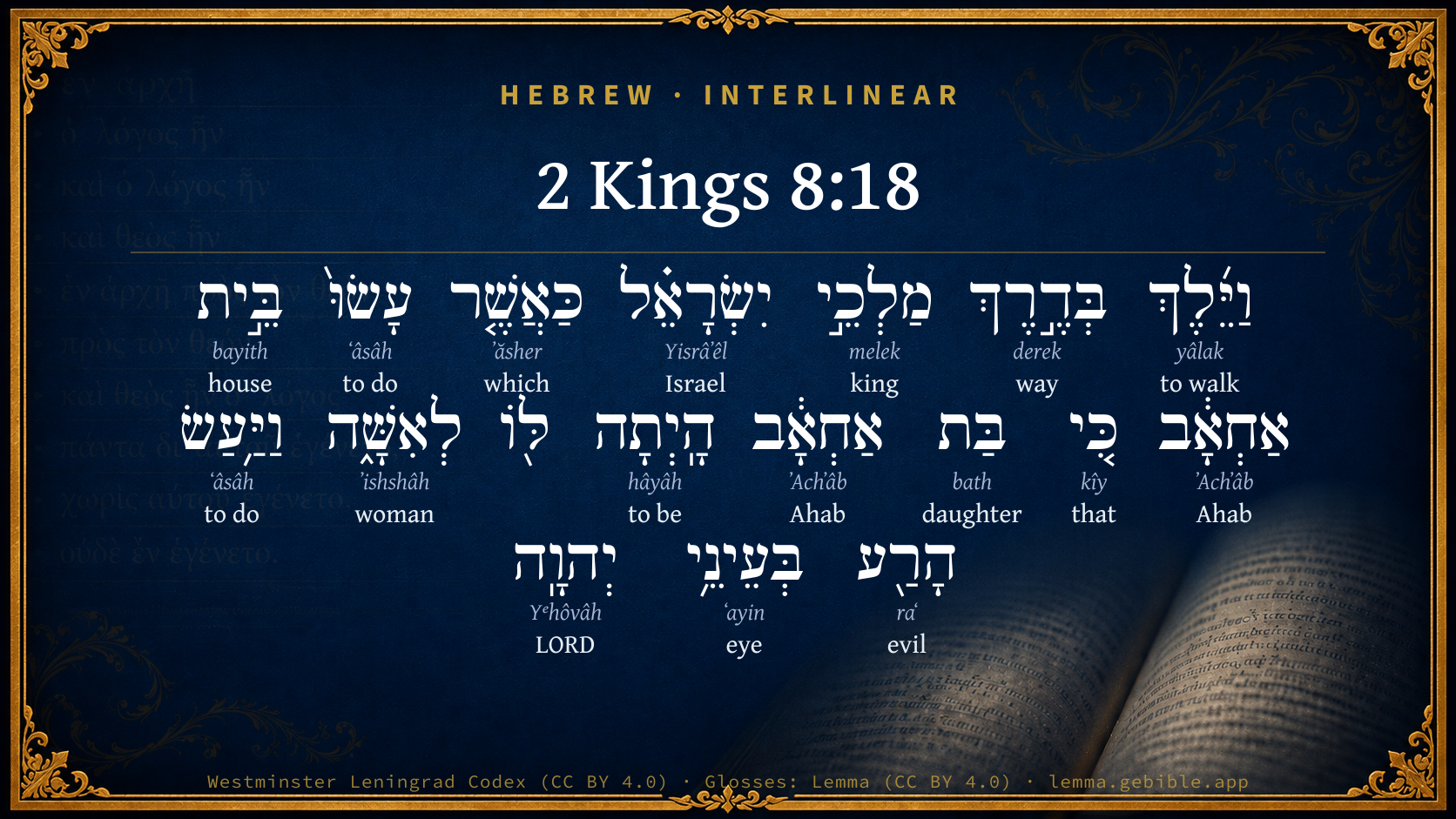
2 Kings 8:18

Hebrew (Westminster Leningrad Codex) 2 Kings 8:18 appears in the Hebrew Old Testament. The text above is from the Westminster Leningrad Codex. Each word links to its Strong’s number, a concise gloss, and parsing drawn from the Open Scriptures Hebrew Bible morphology. Click any word for its full Brown-Driver-Briggs (BDB) entry.
Download image
Cite this verse

2 Kings 8:18 (World English Bible). Public Domain. Lemma interlinear Bible study tool, https://lemma.gebible.app/v/2-kings/8/18.

Show BibTeX & RIS
BibTeX
RIS
English Translation
He walked in the way of the kings of Israel, as did the house of Ahab: for he had the daughter of Ahab as wife; and he did that which was evil in the sight of Yahweh.
World English Bible · Public Domain
Download a study sheet

One document with this verse’s original text, its word-by-word gloss line, the meaning frame, cross-references with their text, attributed commentary, and full source and license credits — printable, and it pastes into notes with its structure intact.

This verse Autodidact and up

Study sheet (.html) Plain text (.txt)

A passage Seminary Student

Up to 50 verses in one chapter. A passage sheet keeps up to 6 commentary sources and 12 cross-references per verse, in the order this page ranks them, and says so on the sheet whenever that leaves anything out. Ask for a single verse and you get the Autodidact verse sheet above.

Everything on this page stays free to read, with no account — the sheet is a download of what is already on screen, not access to it.

Want to remove ads? Support Godless Engineer
Compare translations 3

The same verse in 3 English versions, stacked beneath the original-language interlinear above. Click any original word for its lexicon entry.

Each is an independent rendering of the whole verse — the interlinear is not word-aligned to these translations.

Highlighted words mark where these versions differ — a whole-verse word diff, not a word-by-word alignment.

  • World English Bible Public Domain
    He walked in the way of the kings of Israel, as did the house of Ahab: for he had the daughter of Ahab as wife; and he did that which was evil in the sight of Yahweh.
  • King James Version Public Domain
    And he walked in the way of the kings of Israel, as did the house of Ahab: for the daughter of Ahab was his wife: and he did evil in the sight of the LORD.
  • unfoldingWord Literal Text CC BY-SA 4.0
    And he walked in the way of the kings of Israel, just as the house of Ahab did, for the daughter of Ahab was a wife to him. And he did evil in the eyes of Yahweh.

unfoldingWord Literal Text — © unfoldingWord, licensed CC BY-SA 4.0. Word-aligned USFM3 via Door43 (git.door43.org/unfoldingWord/en_ult).

Versions to compare (up to 4)

3 of 4 selected

Show all 18 translations

Every available English version of this verse, each an independent rendering of the whole verse.

  • World English Bible Public Domain
    He walked in the way of the kings of Israel, as did the house of Ahab: for he had the daughter of Ahab as wife; and he did that which was evil in the sight of Yahweh.
  • Berean Standard Bible Public Domain
    And Jehoram walked in the ways of the kings of Israel, just as the house of Ahab had done. For he married a daughter of Ahab and did evil in the sight of the LORD.
  • Majority Standard Bible Public Domain
    And Jehoram walked in the ways of the kings of Israel, just as the house of Ahab had done. For he married a daughter of Ahab and did evil in the sight of the LORD.
  • King James Version Public Domain
    And he walked in the way of the kings of Israel, as did the house of Ahab: for the daughter of Ahab was his wife: and he did evil in the sight of the LORD.
  • American Standard Version (1901) Public Domain
    And he walked in the way of the kings of Israel, as did the house of Ahab: for he had the daughter of Ahab to wife; and he did that which was evil in the sight of Jehovah.
  • Revised Version (1885) Public Domain
    And he walked in the way of the kings of Israel, as did the house of Ahab: for he had the daughter of Ahab to wife: and he did that which was evil in the sight of the LORD.
  • Geneva Bible (1599) Public Domain
    And hee walked in the wayes of the Kings of Israel, as did the house of Ahab: for the daughter of Ahab was his wife, and hee did euill in the sight of the Lord.
  • Douay-Rheims (1899) Public Domain
    And he walked in the ways of the kings of Israel, as the house of Achab had walked: for the daughter of Achab was his wife: and he did that which was evil in the sight of the Lord.
  • Young's Literal Translation Public Domain
    And he walketh in the way of the kings of Israel, as did the house of Ahab, for a daughter of Ahab was to him for a wife, and he doth the evil thing in the eyes of Jehovah,
  • Literal Standard Version CC BY-SA 4.0
    And he walks in the way of the kings of Israel, as the house of Ahab did, for a daughter of Ahab was to him for a wife, and he does evil in the eyes of YHWH,
  • Unlocked Literal Bible CC BY-SA 4.0
    Jehoram walked in the ways of the kings of Israel, as the house of Ahab was doing; for he had Ahab's daughter as his wife, and he did what was evil in Yahweh's sight.
  • unfoldingWord Literal Text CC BY-SA 4.0
    And he walked in the way of the kings of Israel, just as the house of Ahab did, for the daughter of Ahab was a wife to him. And he did evil in the eyes of Yahweh.
  • Darby Bible Public Domain
    And he walked in the way of the kings of Israel, as did the house of Ahab, for the daughter of Ahab was his wife; and he did evil in the sight of Jehovah.
  • World Messianic Bible Public Domain
    He walked in the way of the kings of Israel, as did Ahab’s house, for he married Ahab’s daughter. He did that which was evil in the LORD’s sight.
  • Webster's Bible Public Domain
    And he walked in the way of the kings of Israel, as did the house of Ahab: for the daughter of Ahab was his wife: and he did evil in the sight of the LORD.
  • Free Bible Version CC BY-SA 4.0
    Jehoram followed the ways of the kings of Israel, just as the house of Ahab had done, for he married a daughter of Ahab and did what was evil in the Lord's sight.
  • Bible in Basic English Public Domain
    He went in the ways of the kings of Israel, as the family of Ahab did: for the daughter of Ahab was his wife; and he did evil in the eyes of the Lord.
  • JPS Tanakh (1917) Public Domain
    And he walked in the way of the kings of Israel, as did the house of Ahab; for he had the daughter of Ahab to wife; and he did that which was evil in the sight of the LORD.

Literal Standard Version (2020), Covenant Press — licensed CC BY-SA 4.0. Text via the HelloAO Bible API (eBible.org). Unlocked Literal Bible (unfoldingWord) — licensed CC BY-SA 4.0. Text via the HelloAO Bible API (eBible.org). unfoldingWord Literal Text — © unfoldingWord, licensed CC BY-SA 4.0. Word-aligned USFM3 via Door43 (git.door43.org/unfoldingWord/en_ult). Free Bible Version, Dr. Jonathan Gallagher — licensed CC BY-SA 4.0. Text via the HelloAO Bible API (eBible.org).

Word by word

More ways to search: Search by grammar → Find every occurrence → Compare this word →

Practice this passage: Drill this verse → Learn its vocabulary →

אַחְאָ֔ב
ʼAchʼâb
H256
“Ahab”
Noun, Proper
Part of Speech
Noun
Type
Proper
Full BDB Definition

Origin: from H251 and H1

TWOT: pr n m

Ahab = "father's brother" once (by contraction) 'Echab ( Jer 29:22 ) - king of Israel, son of Omri, husband of Jezebel - false prophet executed by Nebuchadrezzar, time of Jeremiah
  1. וַיֵּ֜לֶךְ yâlak H3212 “and · to walk” Conjunction + Verb, Qal, Sequential Imperfect, 3rd Person, Masculine, Singular
  2. בְּדֶ֣רֶךְ derek H1870 “in/at · way of” Preposition + Noun, Common, Both, Singular, Construct
  3. מַלְכֵ֣י melek H4428 “kings of” Noun, Common, Masculine, Plural, Construct
  4. יִשְׂרָאֵ֗ל Yisrâʼêl H3478 “Israel” Noun, Proper
  5. כַּאֲשֶׁ֤ר ʼăsher H834 “like/as · which” Preposition + Particle, Relative
  6. עָשׂוּ֙ ʻâsâh H6213 “to do” Verb, Qal, Perfect, 3rd Person, Common, Plural
  7. בֵּ֣ית bayith H1004 “house of” Noun, Common, Masculine, Singular, Construct
  8. כִּ֚י kîy H3588 “that” Conjunction
  9. בַּת bath H1323 “daughter of” Noun, Common, Feminine, Singular, Construct
  10. אַחְאָ֔ב ʼAchʼâb H256 “Ahab” Noun, Proper
  11. הָֽיְתָה hâyâh H1961 “to be” Verb, Qal, Perfect, 3rd Person, Feminine, Singular
  12. לְאִשָּׁ֑ה ʼishshâh H802 “to/for · woman” Preposition + Noun, Common, Feminine, Singular, Absolute
  13. וַיַּ֥עַשׂ ʻâsâh H6213 “and · to do” Conjunction + Verb, Qal, Sequential Imperfect, 3rd Person, Masculine, Singular
  14. הָרַ֖ע raʻ H7451 “the · evil” Particle, Definite Article + Adjective, Adjective, Masculine, Singular, Absolute
  15. בְּעֵינֵ֥י ʻayin H5869 “in/at · eyes of” Preposition + Noun, Common, Both, Dual, Construct
  16. יְהוָֽה Yᵉhôvâh H3068 “LORD” Noun, Proper

About this verse

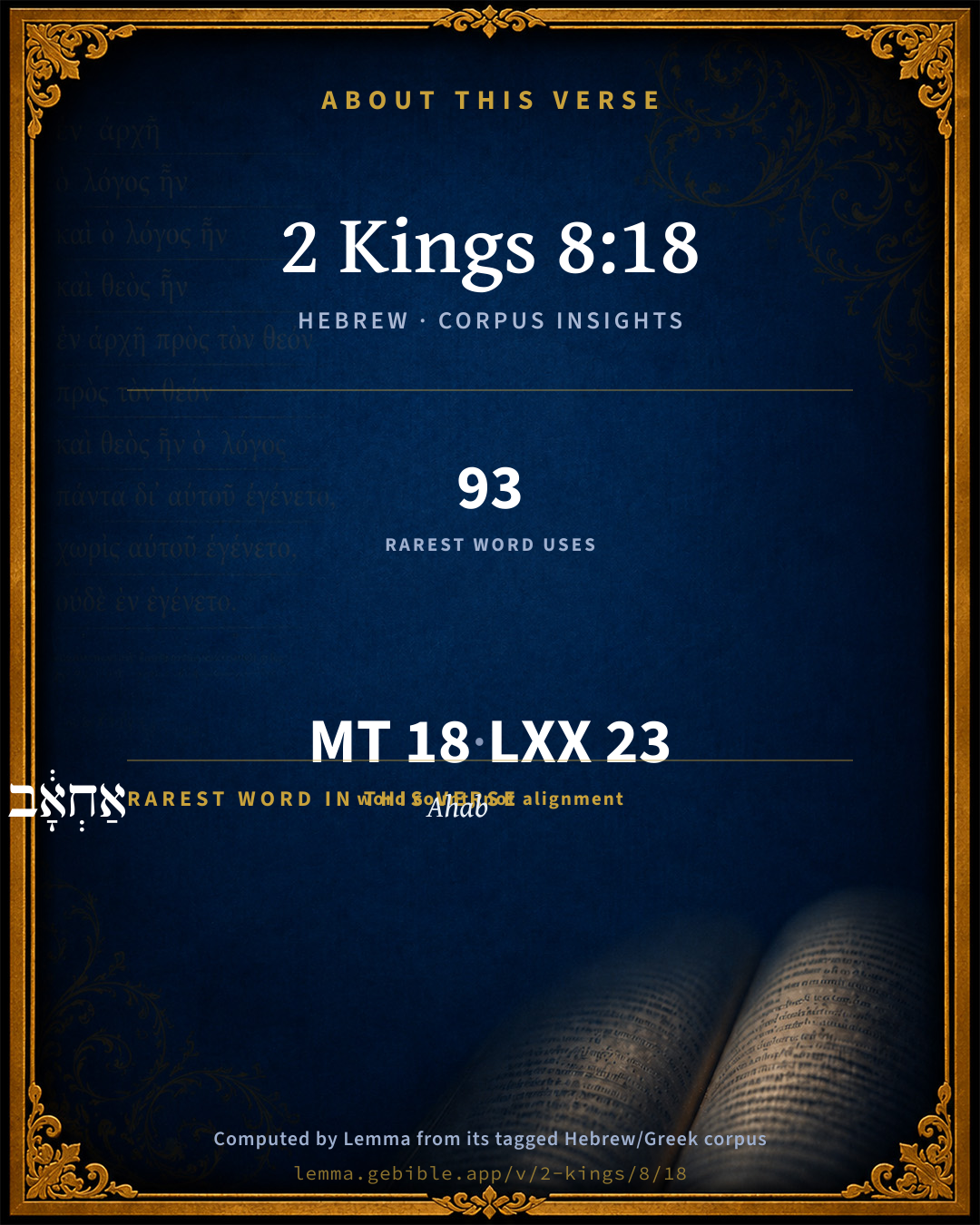
These counts appear in no published source. They are computed here, from the morphology-tagged text and Lemma’s own curated glosses. What Lemma adds →

18
words
15
distinct lemmas
Historical
section

Grammatical profile

  • 4 verbs
  • 10 nouns
  • 1 adjective
  • 1 preposition
  • 1 conjunction
  • 1 particle

Verb forms

  • וַיֵּ֜לֶךְ Qal · Sequential Imperfect
  • עָשׂוּ֙ Qal · Perfect
  • הָֽיְתָה Qal · Perfect
  • וַיַּ֥עַשׂ Qal · Sequential Imperfect

Repetition

Words recur within this verse — often emphatic in Hebrew:

  • עָשׂוּ֙ to do H6213 ×2
  • אַחְאָ֔ב Ahab H256 ×2

Hebrew & Septuagint length

In English translation the verse runs 37 words from the Hebrew and 38 from the Septuagint (LXX English) — closely comparable.

A rough comparison of the two English renderings, which tokenize alike — not a word-level alignment.

Word counts can differ between the Hebrew and the Greek without any difference in meaning — e.g. the Hebrew direct-object marker אֵת has no separate Greek word, and Greek often adds the article ὁ.

In the original languages it is 18 Hebrew tokens and 23 Greek tokens — but the two are counted differently (Hebrew bundles its prefixes and suffixes into one token; the Greek is in lemma form), so that isn’t a like-for-like length.

Cross-references

17

Topical passages linked to 2 Kings 8:18 in the Treasury of Scripture Knowledge — connected by theme and wording, ordered by reader-vote popularity; previews shown in the World English Bible.

  • 2 Kings 8:26 Twenty-two years old was Ahaziah when he began to reign; and he reigned one year in Jerusalem. His mother's name was Athaliah the daughter of Omri king of Israel.
  • Genesis 6:1–5 It happened, when men began to multiply on the surface of the ground, and daughters were born to them,
  • Deuteronomy 7:3–4 neither shall you make marriages with them; your daughter you shall not give to his son, nor his daughter shall you take to your son.
  • 1 Kings 11:1–5 Now king Solomon loved many foreign women, together with the daughter of Pharaoh, women of the Moabites, Ammonites, Edomites, Sidonians, and Hittites;
  • 1 Kings 21:25 (But there was none like Ahab, who did sell himself to do that which was evil in the sight of Yahweh, whom Jezebel his wife stirred up.
  • 1 Kings 22:52–53 He did that which was evil in the sight of Yahweh, and walked in the way of his father, and in the way of his mother, and in the way of Jeroboam the son of Nebat, in which he made Israel to sin.
  • 2 Kings 3:2–3 He did that which was evil in the sight of Yahweh, but not like his father, and like his mother; for he put away the pillar of Baal that his father had made.
  • 2 Kings 9:7–8 You shall strike the house of Ahab your master, that I may avenge the blood of my servants the prophets, and the blood of all the servants of Yahweh, at the hand of Jezebel.
  • 2 Kings 21:3 For he built again the high places which Hezekiah his father had destroyed; and he reared up altars for Baal, and made an Asherah, as did Ahab king of Israel, and worshiped all the host of the sky, and served them.
  • 2 Kings 21:13 I will stretch over Jerusalem the line of Samaria, and the plummet of the house of Ahab; and I will wipe Jerusalem as a man wipes a dish, wiping it and turning it upside down.
  • 2 Chronicles 18:1 Now Jehoshaphat had riches and honor in abundance; and he joined affinity with Ahab.
  • 2 Chronicles 19:2 Jehu the son of Hanani the seer went out to meet him, and said to king Jehoshaphat, Should you help the wicked, and love those who hate Yahweh? for this thing wrath is on you from before Yahweh.
  • 2 Chronicles 21:6 He walked in the way of the kings of Israel, as did the house of Ahab; for he had the daughter of Ahab as wife: and he did that which was evil in the sight of Yahweh.
  • 2 Chronicles 21:13 but have walked in the way of the kings of Israel, and have made Judah and the inhabitants of Jerusalem to play the prostitute, like as the house of Ahab did, and also have slain your brothers of your father's house, who were better than yourself:
  • 2 Chronicles 22:1–4 The inhabitants of Jerusalem made Ahaziah his youngest son king in his place; for the band of men who came with the Arabians to the camp had slain all the eldest. So Ahaziah the son of Jehoram king of Judah reigned.
  • Nehemiah 13:25–26 I contended with them, and cursed them, and struck certain of them, and plucked off their hair, and made them swear by God, [saying], You shall not give your daughters to their sons, nor take their daughters for your sons, or for yourselves.
  • Micah 6:16 For the statutes of Omri are kept, And all the works of the house of Ahab. You walk in their counsels, That I may make you a ruin, And her inhabitants a hissing; And you will bear the reproach of my people."

Cross-references courtesy of OpenBible.info (CC BY 4.0).

Hebrew and Greek witnesses Masoretic Hebrew ↔ Greek Septuagint

The same verse in the two great witnesses to the Old Testament, shown verse-for-verse.

These are two independent witnesses, not word-aligned to each other, and the Septuagint is shown in lemma (dictionary) form.

Hebrew 2 Kings 8:18 Masoretic · Westminster Leningrad Codex

וַיֵּ֜לֶךְ בְּדֶ֣רֶךְ מַלְכֵ֣י יִשְׂרָאֵ֗ל כַּאֲשֶׁ֤ר עָשׂוּ֙ בֵּ֣ית אַחְאָ֔ב כִּ֚י בַּת אַחְאָ֔ב הָֽיְתָה לּ֖וֹ לְאִשָּׁ֑ה וַיַּ֥עַשׂ הָרַ֖ע בְּעֵינֵ֥י יְהוָֽה

He walked in the way of the kings of Israel, as did the house of Ahab: for he had the daughter of Ahab as wife; and he did that which was evil in the sight of Yahweh.

World English Bible · Public Domain

Greek LXX 2 Kings 8:18 Septuagint · lemma form

καί πορεύομαι ἐν ὁδός βασιλεύς ἰσραήλ καθώς ποιέω οἶκος αχααβ ὅτι θυγάτηρ αχααβ εἰμί αὐτός εἰς γυνή καί ποιέω ὁ πονηρός ἐνώπιον κύριος

And he walked in the way of the kings of Israel, as did the house of Achaab; for the daughter of Achaab was his wife: and he did that which was evil in the sight of the Lord.

LXX2012 (modern English Septuagint) · Public Domain

Hebrew: Westminster Leningrad Codex (CC BY 4.0). Greek: Septuagint (public domain); English from LXX2012 (modern English Septuagint) (Public Domain). How the Septuagint differs from the Hebrew →

Targum (Aramaic paraphrase)

1

The Targum is the ancient Jewish Aramaic paraphrase of the Hebrew Scriptures — an interpretive translation, not the Hebrew text itself. Onkelos (literal) and Pseudo-Jonathan (expansive) render the Torah, and Jonathan the Prophets. Coverage is partial: where no permissively-licensed English translation exists for a verse, only the Aramaic is shown. This is verse-level text, not a word-by-word alignment to the Hebrew.

  1. Targum Jonathan Prophets (Joshua–Malachi)
    וַאֲזַל בְּאוֹרַח מַלְכֵי יִשְׂרָאֵל כְּמָא דַעֲבַדוּ בֵּית אַחְאָב אֲרֵי בַת אַחְאָב הֲוַת לֵיהּ לְאִיתּוּ וַעֲבַד דְבִישׁ קֳדָם יְיָ:

    (no public-domain English translation for this verse)

    Targum Jonathan — Aramaic: “Mikraot Gedolot” (public domain). English: “Sefaria Community Translation” (CC0 1.0 (public-domain dedication)); “London "Chaldee Paraphrase," 1871” (public domain). Text via Sefaria.

Commentary

Notes on 2 Kings 8:18 from classic Christian and Jewish commentators (each source and its license shown beneath its notes). The classic Christian expositions comment on the surrounding passage and are grouped to its opening verse, so a note may address several verses; the Jewish commentaries on the Tanakh (Rashi and others) are per-verse, so they appear only where the commentator wrote on this verse.

Lemma curates 59 commentaries, every one of them public domain or Creative Commons licensed, each selected and text-cleaned for this edition rather than reprinted as found. About our sources →

Trapp's Complete Commentary

John Trapp

2Ki 8:18 And he walked in the way of the kings of Israel, as did the house of Ahab: for the daughter of Ahab was his wife: and he did evil in the sight of the LORD.

Ver. 18. For the daughter of Ahab was his wife.] That wicked woman Athaliah, who drew him to her father’s courses.

John Trapp, A Commentary or Exposition upon All the Books of the Old and New Testament (1647–1656) — public domain. Text from a community e-Sword module.

Joseph Benson's Commentary

2Ki 8:18. And he walked in the way of the kings of Israel — That is, after his father’s death. For the daughter of Ahab — Namely, Athaliah, 2Ki 8:26; was his wife — By whom he was seduced from the religion of his pious father and grandfather. This unequal marriage, though Jehoshaphat possibly designed it as a means of uniting the two kingdoms under one head, is here and elsewhere noted, as the cause both of the great wickedness of his posterity, and of those sore calamities which befell them. No good could be reasonably expected from such a union. Those that are ill matched are already half ruined.

Joseph Benson's Commentary on the Old and New Testaments (1811–1818) — public domain. Text from a community e-Sword module.

Tyndale Open Study Notes

Tyndale Open Resources

8:18 evil in the Lord’s sight: Not only did Jehoram marry Ahab’s daughter Athaliah but he followed the example of the kings of Israel in worshiping idols. Some have suggested that Ps 45 was composed in honor of the marriage between Jehoram and Athaliah, which joined the royal houses of Judah and Israel (see Ps 45:12; Athaliah was the daughter of Jezebel, the princess of Tyre). While the marriage created temporary harmony between the kingdoms, it brought disastrous spiritual results. Under Athaliah’s influence, Jehoram instituted various false forms of worship (2 Chr 21:11), including worship of Baal (2 Kgs 11:17-18).

Tyndale Open Study Notes — © Tyndale Open Resources, licensed CC BY-SA 4.0. Text via the HelloAO Bible API.

Geneva Bible (1599)

Geneva Bible translators

The holy Ghost showeth hereby what danger it is to join with infidels.

Geneva Bible (1599) marginal notes — public domain. Text via Bolls.life.

Jamieson, Fausset & Brown

Robert Jamieson, A. R. Fausset & David Brown

daughter of Ahab--Athaliah, through whose influence Jehoram introduced the worship of Baal and many other evils into the kingdom of Judah (see 2Ch. 21:2-20). This apostasy would have led to the total extinction of the royal family in that kingdom, had it not been for the divine promise to David (Sa2 7:16). A national chastisement, however, was inflicted on Judah by the revolt of Edom, which, being hitherto governed by a tributary ruler (Kg2 3:9; Kg1 22:47), erected the standard of independence (Ch2 21:9).

Jamieson, Fausset & Brown — Commentary Critical and Explanatory on the Whole Bible (1871) — public domain (CC PDM 1.0). Text via the HelloAO Bible API.

Adam Clarke's Commentary

Verse 18. The daughter of Ahab was his wife] This was the infamous Athaliah; and through this marriage Jehoshaphat and Ahab were confederates; and this friendship was continued after Ahab's death.

Adam Clarke's Commentary on the Bible (1810–1826) — public domain. Text from a community e-Sword/MySword module.

Ellicott's Commentary for English Readers

(18) In the way of the kings of Israel.—This is further explained by the following clause, “As did the house of Ahab,” or rather, to wit, as the house of Ahab acted, i.e., Jehoram, as son-in-law of Ahab and Jezebel, lent his countenance to the cultus of the Tyrian Baal. Under the influence of his wife Athaliah, as it may be surmised, Jehoram slew his six brothers directly after his accession to the throne (2Ch_21:4). In this connection the remarks of Michaelis are interesting: “In the reign of Jehoram falls the building of Carthage; Dido, her husband Sichæus, her brother Pygmalion, king of Tyre, and murderer of Sichæus. By marriage Tyre brought its then prevalent spirit, and a vast amount of evil,into the two Israelitish kingdoms.” (The Syriac, Arabic, and Vulg. read “in the ways.”) The reason why the details added in Chronicles are here omitted is to be found in the studied brevity of the compiler in the case of less important characters.

A Bible Commentary for English Readers, edited by Charles John Ellicott (1878–1897) — public domain. Text from a community e-Sword module.

The Cambridge Bible for Schools and Colleges

gen. ed. J. J. S. Perowne

18. as did the house of Ahab] Jehoshaphat’s friendship and alliance with Ahab’s house brought the ways of Israel into the kingdom of Judah.

the daughter of Ahab] i.e. Athaliah, who, after the death of Ahaziah (2Ki_11:1), slew all the seed royal of Judah, with the exception of Joash, Ahaziah’s son, whom his aunt Jehosheba rescued.

The Cambridge Bible for Schools and Colleges (gen. ed. J. J. S. Perowne; Cambridge University Press, 1878–1918) — public domain. Text from a community e-Sword module.

John Gill's Exposition

And he walked in the way of the king's of Israel, as did the house of Ahab,.... Imitated them in idolatry:

for the daughter of Ahab was his wife; whose name was Athaliah, Kg2 8:26, and by her he was drawn into idolatrous practices; of such bad consequence are marriages with idolaters; it is very much that so good a king as Jehoshaphat his father was should contract such an affinity; he suffered for it in more instances than one:

and he did evil in the sight of the Lord; was guilty of idolatry, than which nothing was more displeasing to the Lord; for he made high places, and compelled his subjects to commit idolatry, Ch2 21:11.

John Gill's Exposition of the Whole Bible (1746–1763) — public domain (CC PDM 1.0). Text via the HelloAO Bible API.

Haydock's Catholic Bible Commentary

Achab, Athalia. She led her husband into all wickedness. (Tirinus) (2 Paralipomenon xxi.)

George Leo Haydock (1774–1849), Haydock's Catholic Family Bible and Commentary, 1859 edition — public domain. Excludes Psalms (Douay-Rheims chapter numbering differs from Protestant) and Deuterocanonical books (Catholic canon only).

Matthew Poole's English Annotations

He walked in the way of the kings of Israel, after his father’s death. The daughter of Ahab; Athaliah, 2Ki 8:26. This unequal marriage, though Jehoshaphat possibly designed it as a mean of uniting the two kingdoms under one head, and in the true religion, is here and elsewhere noted as the cause both of the great wickedness of his posterity, and of those sore calamities which befell them.

Matthew Poole's English Annotations on the Holy Bible (1683–1685) — public domain. Text from a community e-Sword/MySword module.

Whedon's Commentary on the Bible

Daniel D. Whedon

18. For — Introducing the reason or special cause why Jehoram walked in the way of the kings of Israel.

The daughter of Ahab was his wife — Her name was Athaliah. Compare 2Ki_8:26. This marriage was probably arranged and brought about by the parents of the parties, but it was the source of untold woes to the kingdom of Judah. It was the cause of Jehoram’s walking in the ways of the kings of Israel, just as Ahab’s marriage with Jezebel was instrumental in introducing Phenician idolatry into the northern kingdom. A comparison of ages given in 2Ki_8:17; 2Ki_8:26 shows that this marriage was consummated at an early age, for Joram’s youngest son, Ahaziah, was born when he was only eighteen years old, and he had other sons. See 2Ch_21:17.

Daniel D. Whedon (gen. ed.), Commentary on the Old and New Testaments (1874–1909) — public domain. Text from a community e-Sword module.

The Pulpit Commentary

And he walked in the way of the kings of Israel, as did the house of Ahab; i.e. he introduced into Judah the Baal and Astarte worship, which Ahab had introduced into Israel from Phoenicia. (On the nature of this worship, see the "Commentary on the First Book of Kings," p. 374.) The "house of Ahab" maintained and spread the Baal-worship,wherever it had influence. Ahaziah, the son of Ahab, championed it in Israel; (1Ki_22:53) Jehoram, his brother, allowed its continuance; (2Ki_10:18-28) Jehoram of Judah was induced by his wife, Athaliah, the daughter of Ahab, to countenance it in Judaea; Athaliah, when she usurped the throne upon the death of her son Ahaziah, made it the state religion in that country. "Evil communications corrupt good manners." The alliance of the two separated kingdoms, concluded between Jehoshaphat and Ahab, (1Ki_22:2-4) had no tangible result beyond the introduction into Judah of the licentious and debasing superstition which had previously overspread the sister country. For the daughter of Ahab was his wife. In ver. 26 Athaliah, the wife of Jehoram, is called "the daughter of Omri;" but by "daughter" in that place must be meant "descendant" or "granddaughter." Athaliah has been well called "a second Jezebel." And he did evil in the sight of the Lord. The wicked actions of Jehoram are recorded at some length in Chronicles. (2Ch_21:2-4, 2Ch_21:11-13) Shortly after his accession he put to death his six brothers Azariah, Jehiel, Zechariah, Ahaziah(?), Michael, and Shephatiah in order to "strengthen himself." At the same time, he caused many of the "princes of Israel" to be executed. Soon afterwards he "made high places in the mountains of Judah, and caused the inhabitants of Jerusalem to commit fornication" (i.e. to become idolaters), "and compelled Judah thereto." That the idolatry, which he introduced, was the Baal-worship is clear, both from the present passage and from 2Ch_21:13.

The Pulpit Commentary (1880–1919), ed. H.D.M. Spence-Jones & Joseph S. Exell — public domain. Text from a community e-Sword module.

John Wesley's Explanatory Notes

He walked - After his father's death. The daughter - Athaliah. This unequal marriage, though Jehoshaphat possibly designed it as a means of uniting the two kingdoms under one head, is here and elsewhere noted, as the cause both of the great wickedness of his posterity, and of those sore calamities which befel them. No good could be reasonably expected from such an union. Those that are ill matched are already half-ruined.

John Wesley, Explanatory Notes Upon the Whole Bible (1754–1765) — public domain. Text via the GEBible commentary corpus.

Keil & Delitzsch

C. F. Keil & F. Delitzsch

Joram had married a daughter of Ahab, namely Athaliah (Kg2 8:26), and walked in the ways of the house of Ahab, transplanting the worship of Baal into his kingdom. Immediately after the death of Jehoshaphat he murdered his brothers, apparently with no other object than to obtain possession of the treasures which his father had left them (Ch2 21:2-4). This wickedness of Joram would have been followed by the destruction of Judah, had not the Lord preserved a shoot to the royal house for David's sake. For ניר לו לתת see Kg1 11:36. The following word לבניו serves as an explanation of ניר לו, "a light with regard to his sons," i.e., by the fact that he kept sons (descendants) upon the throne.

Keil & Delitzsch — Biblical Commentary on the Old Testament (1861–1891) — public domain (CC PDM 1.0). Text via the HelloAO Bible API. (Old Testament only.)

unfoldingWord translationNotes

Door43 World Missions Community

Jehoram walked in the ways of the kings of Israel

Here "walking" is an idiom that refers to how he lived and reigned as king. At this time in history, the recent kings of Israel had been evil kings. The full meaning of this statement can be made clear. AT: "Jehoram was an evil king, just as other kings of Israel who ruled before him had been" (See: Idiom and Assumed Knowledge and Implicit Information)

as the house of Ahab was doing

Here the "house" of Ahab refers to the members of Ahab's family and his recent descendants. Ahab is Jehoram father-in-law. AT: "the same as the rest of the family of Ahab was doing" (See: Metonymy)

for he had Ahab's daughter as his wife

Jehoram had married king Ahab's daughter.

what was evil in Yahweh's sight

The sight of Yahweh represents Yahweh's judgment or evaluation. AT: "what was evil in Yahweh's judgment" or "what Yahweh considers to be evil" (See: Metaphor)

destroy Judah

Here "Judah" is a metonym for the people who live there. AT: "destroy the people of Judah" (See: Metonymy)

since he had told him that he would always give him descendants

"since Yahweh had told David that he would always give David descendants." This refers to Yahweh's promise to David that his descendants would always rule Judah. The full meaning of this statement can be made explicit. AT: "since he had told David that his descendants would always rule Judah" (See: Assumed Knowledge and Implicit Information)

translationWords

walk

house

David

descend

unfoldingWord translationNotes — © Distant Shores Media and the Door43 World Missions Community, licensed CC BY-SA 4.0. Source: git.door43.org/Door43/en_tn.

Lesson kit

Teaching starters — assembled from the data on this page, not authored interpretation. Every prompt links to the verse data it draws on. Edit before teaching.

2 Kings, in the Historical, opens this verse with 18 words (15 distinct Hebrew lemmas). Its most distinctive word is ʼAchʼâb (“Ahab”). A historical commentator’s framing appears above. Read the whole chapter for the surrounding context.

Discussion questions

  1. What does “Ahab” (ʼAchʼâb) contribute to the verse as a whole?
  2. How does 2 Kings 8:26, which shares this passage’s theme, read alongside this verse?
  3. What does the repetition of “to do” (2× in this one verse) do in this verse?
  4. The translations on this page render this verse differently — a whole-verse word diff, not a word-by-word alignment. What might account for the different wordings?
  5. «וַיֵּ֜לֶךְ» is a Qal Sequential Imperfect verb. How does that grammatical form shape the action described?
  6. Compare how Trapp's Complete Commentary and Joseph Benson's Commentary read this verse. Where do they agree or differ?

Things to notice

Reading settings

Reading text

Shown beneath each verse's original-language words.

Old Testament
Old Testament edition

Read the OT as the Masoretic Hebrew (MT) or the Greek Septuagint (LXX).

English shown for the Greek Septuagint (in the Hebrew ↔ Greek comparison).

Comparing translations? Open the Compare panel on any verse page to stack up to four side by side.