
Genesis 25:20

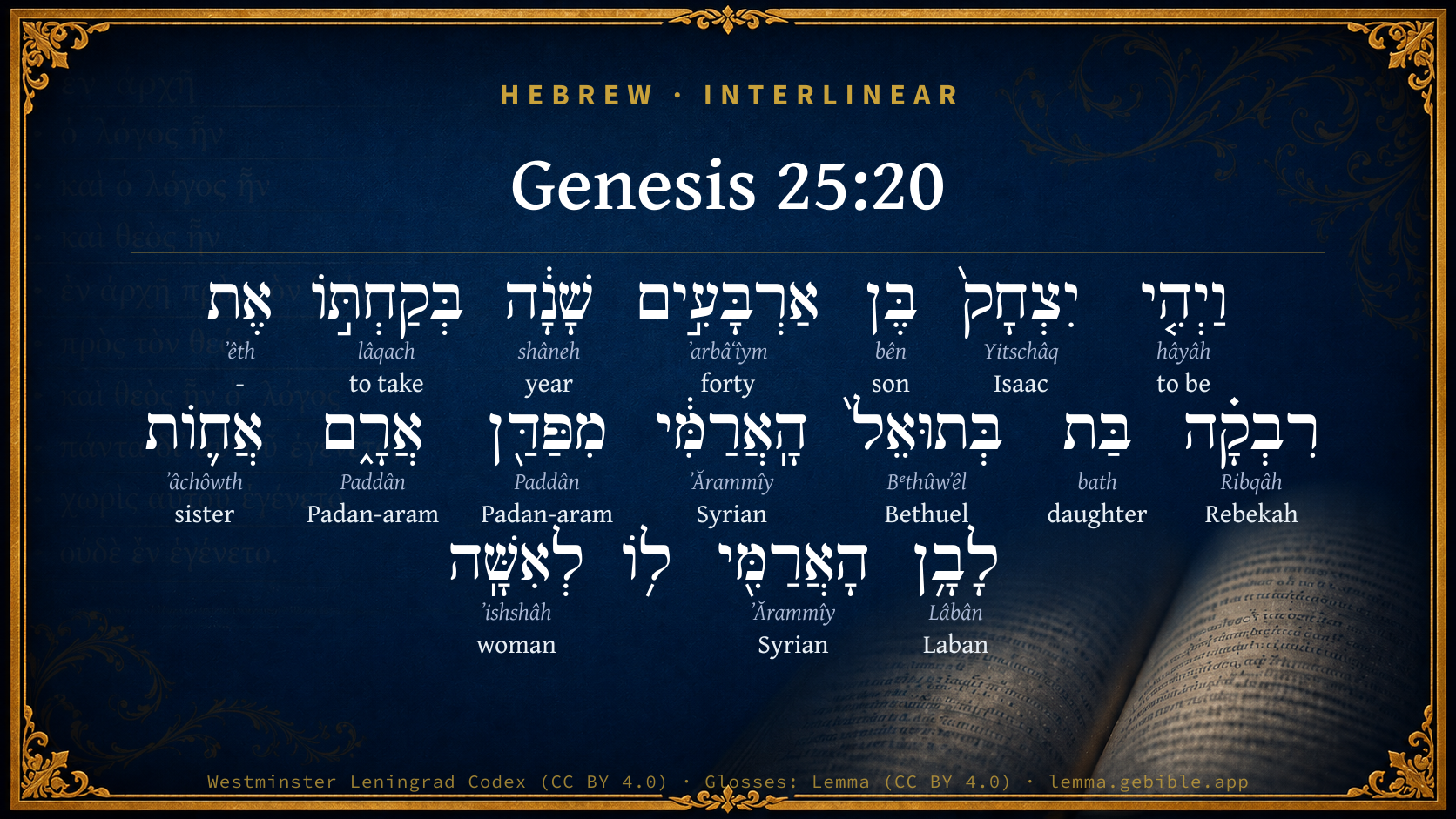
Hebrew (Westminster Leningrad Codex) Genesis 25:20 appears in the Hebrew Old Testament. The text above is from the Westminster Leningrad Codex. Each word links to its Strong’s number, a concise gloss, and parsing drawn from the Open Scriptures Hebrew Bible morphology. Click any word for its full Brown-Driver-Briggs (BDB) entry.
Download image
Cite this verse

Genesis 25:20 (World English Bible). Public Domain. Lemma interlinear Bible study tool, https://lemma.gebible.app/v/genesis/25/20.

Show BibTeX & RIS
BibTeX
RIS
English Translation
Isaac was forty years old when he took Rebekah, the daughter of Bethuel the Syrian of Paddan Aram, the sister of Laban the Syrian, to be his wife.
World English Bible · Public Domain
Highlights
  • 2 first appearances in the Hebrew Bible
Full analysis ↓
Download a study sheet

One document with this verse’s original text, its word-by-word gloss line, the meaning frame, cross-references with their text, attributed commentary, and full source and license credits — printable, and it pastes into notes with its structure intact.

This verse Autodidact and up

Study sheet (.html) Plain text (.txt)

A passage Seminary Student

Up to 50 verses in one chapter. A passage sheet keeps up to 6 commentary sources and 12 cross-references per verse, in the order this page ranks them, and says so on the sheet whenever that leaves anything out. Ask for a single verse and you get the Autodidact verse sheet above.

Everything on this page stays free to read, with no account — the sheet is a download of what is already on screen, not access to it.

Want to remove ads? Support Godless Engineer
Compare translations 3

The same verse in 3 English versions, stacked beneath the original-language interlinear above. Click any original word for its lexicon entry.

Each is an independent rendering of the whole verse — the interlinear is not word-aligned to these translations.

Highlighted words mark where these versions differ — a whole-verse word diff, not a word-by-word alignment.

  • World English Bible Public Domain
    Isaac was forty years old when he took Rebekah, the daughter of Bethuel the Syrian of Paddan Aram, the sister of Laban the Syrian, to be his wife.
  • King James Version Public Domain
    And Isaac was forty years old when he took Rebekah to wife, the daughter of Bethuel the Syrian of Padanaram, the sister to Laban the Syrian.
  • unfoldingWord Literal Text CC BY-SA 4.0
    then Isaac was a son of forty years when he took Rebekah for himself as a wife, the daughter of Bethuel the Aramean from Paddan Aram, the sister of Laban the Aramean.

unfoldingWord Literal Text — © unfoldingWord, licensed CC BY-SA 4.0. Word-aligned USFM3 via Door43 (git.door43.org/unfoldingWord/en_ult).

Versions to compare (up to 4)

3 of 4 selected

Show all 18 translations

Every available English version of this verse, each an independent rendering of the whole verse.

  • World English Bible Public Domain
    Isaac was forty years old when he took Rebekah, the daughter of Bethuel the Syrian of Paddan Aram, the sister of Laban the Syrian, to be his wife.
  • Berean Standard Bible Public Domain
    and Isaac was forty years old when he married Rebekah, the daughter of Bethuel the Aramean from Paddan-aram and the sister of Laban the Aramean.
  • Majority Standard Bible Public Domain
    and Isaac was forty years old when he married Rebekah, the daughter of Bethuel the Aramean from Paddan-aram and the sister of Laban the Aramean.
  • King James Version Public Domain
    And Isaac was forty years old when he took Rebekah to wife, the daughter of Bethuel the Syrian of Padanaram, the sister to Laban the Syrian.
  • American Standard Version (1901) Public Domain
    And Isaac was forty years old when he took Rebekah, the daughter of Bethuel the Syrian of Paddan-aram, the sister of Laban the Syrian, to be his wife.
  • Revised Version (1885) Public Domain
    and Isaac was forty years old when he took Rebekah, the daughter of Bethuel the Syrian of Paddan-aram, the sister of Laban the Syrian, to be his wife.
  • Geneva Bible (1599) Public Domain
    And Izhak was fourtie yeere olde, when he tooke Rebekah to wife, the daughter of Bethuel the Aramite of Padan Aram, and sister to Laban the Aramite.
  • Douay-Rheims (1899) Public Domain
    Who when he was forty years old, took to wife Rebecca the daughter of Bathuel the Syrian of Mesopotamia, sister to Laban.
  • Young's Literal Translation Public Domain
    and Isaac is a son of forty years in his taking Rebekah, daughter of Bethuel the Aramaean, from Padan-Aram, sister of Laban the Aramaean, to him for a wife.
  • Literal Standard Version CC BY-SA 4.0
    and Isaac is a son of forty years in his taking Rebekah, daughter of Bethuel the Aramean, from Padan-Aram, sister of Laban the Aramean, to him for a wife.
  • Unlocked Literal Bible CC BY-SA 4.0
    Isaac was forty years old when he took as his wife Rebekah, the daughter of Bethuel the Aramean of Paddan Aram, the sister of Laban the Aramean.
  • unfoldingWord Literal Text CC BY-SA 4.0
    then Isaac was a son of forty years when he took Rebekah for himself as a wife, the daughter of Bethuel the Aramean from Paddan Aram, the sister of Laban the Aramean.
  • Darby Bible Public Domain
    And Isaac was forty years old when he took Rebecca as wife, the daughter of Bethuel the Syrian of Padan-Aram, the sister of Laban the Syrian.
  • World Messianic Bible Public Domain
    Isaac was forty years old when he took Rebekah, the daughter of Bethuel the Syrian of Paddan Aram, the sister of Laban the Syrian, to be his wife.
  • Webster's Bible Public Domain
    And Isaac was forty years old when he took Rebekah to wife, the daughter of Bethuel the Syrian of Padan-aram, the sister to Laban the Syrian.
  • Free Bible Version CC BY-SA 4.0
    When Isaac was 40 he married Rebekah, the daughter of Bethuel the Aramean from Paddan-aram and the sister of Laban the Aramean.
  • Bible in Basic English Public Domain
    Isaac was forty years old when he took Rebekah, the daughter of Bethuel the Aramaean of Paddan-aram, and the sister of Laban the Aramaean, to be his wife.
  • JPS Tanakh (1917) Public Domain
    And Isaac was forty years old when he took Rebekah, the daughter of Bethuel the Aramean, of Paddan-aram, the sister of Laban the Aramean, to be his wife.

Literal Standard Version (2020), Covenant Press — licensed CC BY-SA 4.0. Text via the HelloAO Bible API (eBible.org). Unlocked Literal Bible (unfoldingWord) — licensed CC BY-SA 4.0. Text via the HelloAO Bible API (eBible.org). unfoldingWord Literal Text — © unfoldingWord, licensed CC BY-SA 4.0. Word-aligned USFM3 via Door43 (git.door43.org/unfoldingWord/en_ult). Free Bible Version, Dr. Jonathan Gallagher — licensed CC BY-SA 4.0. Text via the HelloAO Bible API (eBible.org).

Word by word

More ways to search: Search by grammar → Find every occurrence → Compare this word →

Practice this passage: Drill this verse → Learn its vocabulary →

בְּתוּאֵל֙
Bᵉthûwʼêl
H1328
“Bethuel”
Noun, Proper
Part of Speech
Noun
Type
Proper
Full BDB Definition

Origin: apparently from the same as H1326 and H410

TWOT: None

Bethuel = "God destroys" or " man of God" or " dweller in God" - nephew of Abraham, son of Nahor by Milcah, father of Rebekah (noun proper masculine) - a town of Simeon in the south (noun proper locative)
  1. וַיְהִ֤י hâyâh H1961 “and · to be” Conjunction + Verb, Qal, Sequential Imperfect, 3rd Person, Masculine, Singular
  2. יִצְחָק֙ Yitschâq H3327 “Isaac” Noun, Proper
  3. בֶּן bên H1121 “son of” Noun, Common, Masculine, Singular, Construct
  4. אַרְבָּעִ֣ים ʼarbâʻîym H705 “forty” Adjective, Cardinal number, Both, Plural, Absolute
  5. שָׁנָ֔ה shâneh H8141 “year” Noun, Common, Feminine, Singular, Absolute
  6. בְּקַחְתּ֣וֹ lâqach H3947 “in/at · to take · him” Preposition + Verb, Qal, Infinitive Construct + Suffix, Personal, 3rd Person, Masculine, Singular
  7. אֶת ʼêth H853 “-” Particle, Direct Object
  8. רִבְקָ֗ה Ribqâh H7259 “Rebekah” Noun, Proper
  9. בַּת bath H1323 “daughter of” Noun, Common, Feminine, Singular, Construct
  10. הָֽאֲרַמִּ֔י ʼĂrammîy H761 “the · Syrian” Particle, Definite Article + Noun, Gentilic, Masculine, Singular, Absolute
  11. מִפַּדַּ֖ן Paddân H6307 “from · Padan-aram” Preposition + Noun, Proper
  12. אֲרָ֑ם Paddân H6307 “Padan-aram” Noun, Proper
  13. אֲח֛וֹת ʼâchôwth H269 “sister of” Noun, Common, Feminine, Singular, Construct
  14. לָבָ֥ן Lâbân H3837 “Laban” Noun, Proper
  15. הָאֲרַמִּ֖י ʼĂrammîy H761 “the · Syrian” Particle, Definite Article + Noun, Gentilic, Masculine, Singular, Absolute
  16. לְאִשָּֽׁה ʼishshâh H802 “to/for · woman” Preposition + Noun, Common, Feminine, Singular, Absolute

About this verse

These counts appear in no published source. They are computed here, from the morphology-tagged text and Lemma’s own curated glosses. What Lemma adds →

18
words
15
distinct lemmas
Pentateuch
section

Notable vocabulary

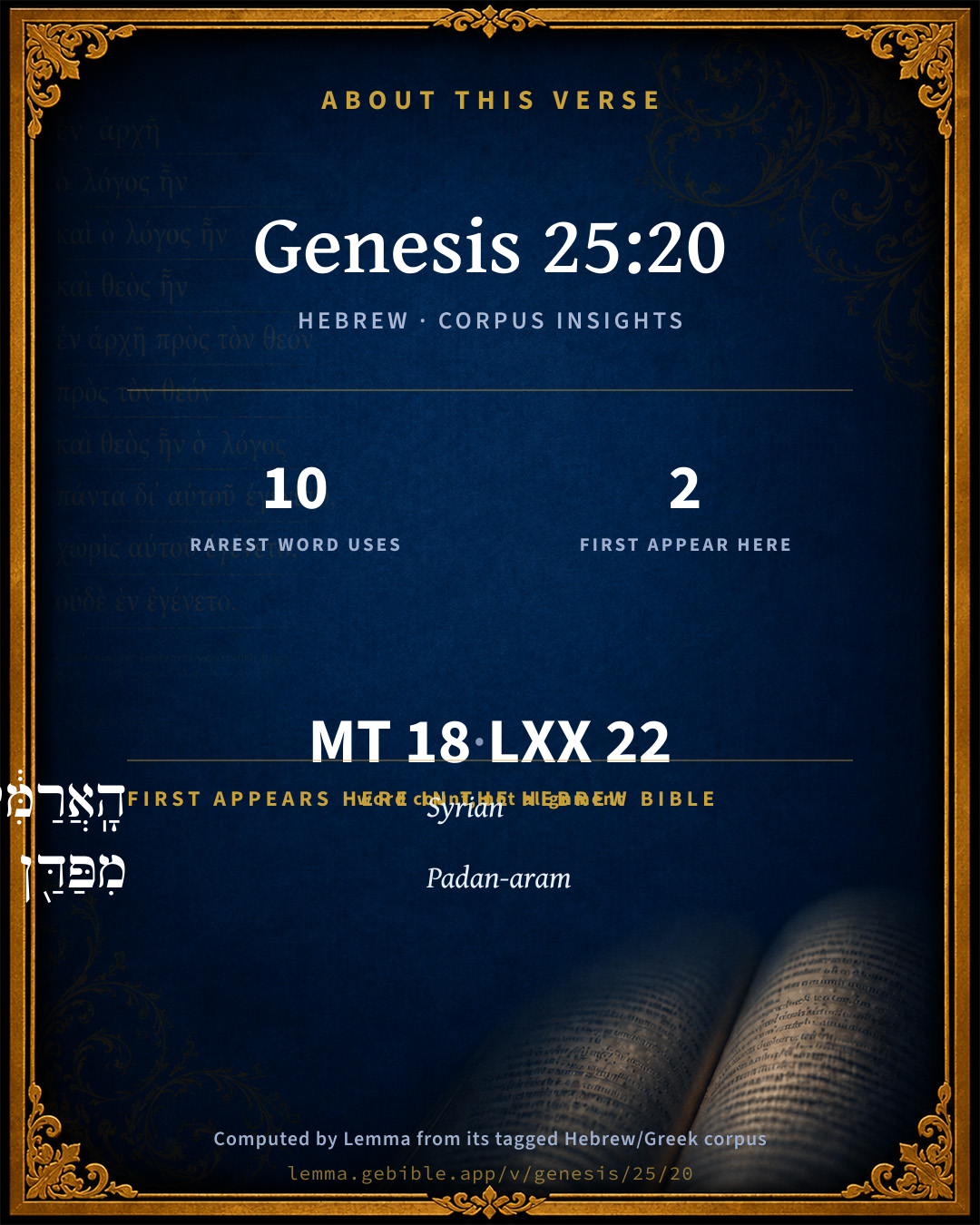
The rarest word here is בְּתוּאֵל֙ Bethuel H1328 — appearing just 10 times in the whole Hebrew Bible.

First appearance in Scripture

These words make their first canonical appearance in the Hebrew Bible here:

  • הָֽאֲרַמִּ֔י Syrian H761
  • מִפַּדַּ֖ן Padan-aram H6307

Shared distinctive vocabulary

בְּתוּאֵל֙ Bethuel H1328 occurs in 10 verses of the Hebrew Bible. Also found in:

Grammatical profile

  • 2 verbs
  • 13 nouns
  • 1 adjective
  • 1 preposition
  • 1 particle

Verb forms

  • וַיְהִ֤י Qal · Sequential Imperfect
  • בְּקַחְתּ֣וֹ Qal · Infinitive Construct

Repetition

Words recur within this verse — often emphatic in Hebrew:

  • הָֽאֲרַמִּ֔י Syrian H761 ×2
  • מִפַּדַּ֖ן Padan-aram H6307 ×2

Hebrew & Septuagint length

In English translation the verse runs 28 words from the Hebrew and 29 from the Septuagint (LXX English) — closely comparable.

A rough comparison of the two English renderings, which tokenize alike — not a word-level alignment.

Word counts can differ between the Hebrew and the Greek without any difference in meaning — e.g. the Hebrew direct-object marker אֵת has no separate Greek word, and Greek often adds the article ὁ.

In the original languages it is 18 Hebrew tokens and 22 Greek tokens — but the two are counted differently (Hebrew bundles its prefixes and suffixes into one token; the Greek is in lemma form), so that isn’t a like-for-like length.

Cross-references

10

Topical passages linked to Genesis 25:20 in the Treasury of Scripture Knowledge — connected by theme and wording, ordered by reader-vote popularity; previews shown in the World English Bible.

  • Genesis 24:29 Rebekah had a brother, and his name was Laban. Laban ran out to the man, to the spring.
  • Genesis 24:67 Isaac brought her into his mother Sarah's tent, and took Rebekah, and she became his wife. He loved her. Isaac was comforted after his mother's death.
  • Genesis 22:23 Bethuel became the father of Rebekah. These eight Milcah bore to Nahor, Abraham's brother.
  • Genesis 31:24 God came to Laban, the Syrian, in a dream of the night, and said to him, "Take heed to yourself that you don't speak to Jacob either good or bad."
  • Deuteronomy 26:5 You shall answer and say before Yahweh your God, A Syrian ready to perish was my father; and he went down into Egypt, and sojourned there, few in number; and he became there a nation, great, mighty, and populous.
  • Genesis 28:5–6 Isaac sent Jacob away. He went to Paddan Aram to Laban, son of Bethuel the Syrian, Rebekah's brother, Jacob's and Esau's mother.
  • Genesis 31:18 and he carried away all his cattle, and all his substance which he had gathered, the cattle of his getting, which he had gathered in Paddan Aram, to go to Isaac his father to the land of Canaan.
  • Genesis 31:20 Jacob deceived Laban the Syrian, in that he didn't tell him that he was running away.
  • Genesis 35:9 God appeared to Jacob again, when he came from Paddan Aram, and blessed him.
  • Luke 4:27 There were many lepers in Israel in the time of Elisha the prophet, yet not one of them was cleansed, except Naaman, the Syrian."

Cross-references courtesy of OpenBible.info (CC BY 4.0).

Hebrew and Greek witnesses Masoretic Hebrew ↔ Greek Septuagint

The same verse in the two great witnesses to the Old Testament, shown verse-for-verse.

These are two independent witnesses, not word-aligned to each other, and the Septuagint is shown in lemma (dictionary) form.

Hebrew Genesis 25:20 Masoretic · Westminster Leningrad Codex

וַיְהִ֤י יִצְחָק֙ בֶּן אַרְבָּעִ֣ים שָׁנָ֔ה בְּקַחְתּ֣וֹ אֶת רִבְקָ֗ה בַּת בְּתוּאֵל֙ הָֽאֲרַמִּ֔י מִפַּדַּ֖ן אֲרָ֑ם אֲח֛וֹת לָבָ֥ן הָאֲרַמִּ֖י ל֥וֹ לְאִשָּֽׁה

Isaac was forty years old when he took Rebekah, the daughter of Bethuel the Syrian of Paddan Aram, the sister of Laban the Syrian, to be his wife.

World English Bible · Public Domain

Greek LXX Genesis 25:20 Septuagint · lemma form

εἰμί δέ ισαακ ἔτος τεσσαράκοντα ὅτε λαμβάνω ὁ ρεβεκκα θυγάτηρ βαθουηλ ὁ σύρος ἐκ ὁ μεσοποταμία ἀδελφή λαβαν ὁ σύρος ἑαυτοῦ γυνή

Abraam begot Isaac. And Isaac was forty years old when he took as wife Rebecca, daughter of Bathuel the Syrian, out of Syrian Mesopotamia, sister of Laban the Syrian.

LXX2012 (modern English Septuagint) · Public Domain

On this verse, Matthew Poole's English Annotations discusses the Septuagint’s reading. Read the note in Commentary ↓

Hebrew: Westminster Leningrad Codex (CC BY 4.0). Greek: Septuagint (public domain); English from LXX2012 (modern English Septuagint) (Public Domain). How the Septuagint differs from the Hebrew →

Targum (Aramaic paraphrase)

2

The Targum is the ancient Jewish Aramaic paraphrase of the Hebrew Scriptures — an interpretive translation, not the Hebrew text itself. Onkelos (literal) and Pseudo-Jonathan (expansive) render the Torah, and Jonathan the Prophets. Coverage is partial: where no permissively-licensed English translation exists for a verse, only the Aramaic is shown. This is verse-level text, not a word-by-word alignment to the Hebrew.

  1. Targum Onkelos Torah (Genesis–Deuteronomy)
    וַהֲוָה יִצְחָק בַּר אַרְבְּעִין שְׁנִין כַּד נְסֵיב יָת רִבְקָה בַּת בְּתוּאֵל אֲרַמָּאָה מִפַּדַּן אֲרָם אֲחָתֵהּ דְלָבָן אֲרַמָּאָה לֵהּ לְאִנְתּוּ

    (no public-domain English translation for this verse)

    Targum Onkelos — Aramaic: “Onkelos Genesis” (public domain); “Onkelos Exodus” (public domain); “Onkelos Leviticus” (public domain); “Onkelos Numbers” (public domain); “Onkelos Deuteronomy” (public domain). English: “Sefaria Community Translation” (CC0 1.0 (public-domain dedication)); “J.W. Etheridge. The Targums of Onkelos and Jonathan Ben Uzziel on the Pentateuch. London: Longmans, Green, 1862” (public domain). Text via Sefaria.

  2. Targum Pseudo-Jonathan Torah (Genesis–Deuteronomy)
    וַהֲוָה יִצְחָק בַּר אַרְבְּעִין שְׁנִין בְּמִסְבֵיהּ יַת רִבְקָה בְּרַת בְּתוּאֵל אֲרָמָאָה דְמִן פַּדַן אֲרָם אַחְתֵיהּ דְלָבָן אֲרָמָאָה לֵיהּ לְאִנְתּוּ

    And Izhak was the son of forty years when he took Rivekah, the daughter of Bethuel the Aramite, who was of Padan Aram, the sister of Laban the Aramite, unto him for a wife.

    Targum Pseudo-Jonathan — Aramaic: “Targum Jonathan on Genesis” (public domain); “Targum Jonathan on Exodus” (public domain); “Targum Jonathan on Leviticus” (public domain); “Targum Jonathan on Numbers” (public domain); “Targum Jonathan on Deuteronomy” (public domain). English: “The Targum of Jonathan ben Uzziel, trans. J. W. Etheridge, London, 1862” (public domain). Text via Sefaria.

Commentary

Notes on Genesis 25:20 from classic Christian and Jewish commentators (each source and its license shown beneath its notes). The classic Christian expositions comment on the surrounding passage and are grouped to its opening verse, so a note may address several verses; the Jewish commentaries on the Tanakh (Rashi and others) are per-verse, so they appear only where the commentator wrote on this verse.

Lemma curates 59 commentaries, every one of them public domain or Creative Commons licensed, each selected and text-cleaned for this edition rather than reprinted as found. About our sources →

Trapp's Complete Commentary

John Trapp

Gen 25:20 And Isaac was forty years old when he took Rebekah to wife, the daughter of Bethuel the Syrian of Padanaram, the sister to Laban the Syrian.

Ver. 20. And Isaac was forty years old.] He was not overhasty to marry in the heat of his youth: but by hard labour, ardent prayers, and pious meditations, kept under his body, and brought it into subjection, as St Paul likewise did. {1Co 9:27} "We are not debtors to the flesh"; {Rom 8:12} we owe it nothing but stripes, nothing but the blue eye, that the apostle gave it.

John Trapp, A Commentary or Exposition upon All the Books of the Old and New Testament (1647–1656) — public domain. Text from a community e-Sword module.

Joseph Benson's Commentary

Gen 25:20. And Isaac was forty years old — Not much is related concerning Isaac, but what had reference to his father, while he lived, and to his sons afterward; for Isaac seems not to have been a man of action, nor to have been much tried, but to have spent his days in quietness and silence.

Joseph Benson's Commentary on the Old and New Testaments (1811–1818) — public domain. Text from a community e-Sword module.

Geneva Bible (1599)

Geneva Bible translators

Or, Syrian of Mesopotamia.

Geneva Bible (1599) marginal notes — public domain. Text via Bolls.life.

The Cambridge Bible for Schools and Colleges

gen. ed. J. J. S. Perowne

20. forty years old] P gives the age of Isaac at the time of his marriage with Rebekah, thirty-five years before Abraham’s death (Gen_25:8).

Bethuel] P makes no mention here of Bethuel’s being son of Nahor, the brother of Terah. The genealogy of J in Gen_22:22 is ignored.

the Syrian] Heb. Aramean, as in Gen_28:5. Aram is mentioned in Gen_10:22-23 (P), as the fifth of the sons of Shem.

Paddan-aram] This is the name given in the P narrative for the country described as Aram-naharaim by J. See note on Gen_24:10. Cf. Gen_28:2; Gen_28:5-7, Gen_31:18, Gen_35:9; Gen_35:26, Gen_46:15, Gen_48:7 (Paddan), all from P. The word Paddan is Aramaic, and means probably “the field,” modern Arabic feddân (= “acre”). In Assyrian padanu = “way” or “field,” like Haran (Gen_11:32). According to Hos_12:12, “Jacob fled into the field of Aram,” where “field” is the Heb. sâdeh, and denotes Haran, the country E. of Euphrates.

21–34 (J, E). This passage contains two short narratives, (1) the birth of Jacob and Esau (Gen_25:21-26), (2) the sale of Esau’s birthright (27–34).

The Cambridge Bible for Schools and Colleges (gen. ed. J. J. S. Perowne; Cambridge University Press, 1878–1918) — public domain. Text from a community e-Sword module.

John Gill's Exposition

And Isaac was forty years old when he took Rebekah to wife,.... Which was three years after the death of his mother; Isaac was born when she was ninety, and therefore must be thirty seven when she died. The Jews say Rebekah was but fourteen, though it is highly probable she was older; who is described as

the daughter of Bethuel the Syrian, of Padanaram; so called to distinguish it from other Arams, as Aram of Damascus, &c. this seems to be the same with Aram Naharaim, or Mesopotamia, which lay between the rivers Euphrates and Tigris; for Padan, as Jarchi observes from the Targum, signifies two; but rather, as he, and Aben Ezra, and others say, Padan in the Arabic language signifies a field; it here intends the field or country of Syria, as in Hos 12:12. Haran, in Syria or Mesopotamia, was the place where Bethuel and Laban lived, see Gen 28:5. Some traces of Padan in Mesopotamia are thought to be in the cities of Aphphadana and Aphadana, which are placed by Ptolemy (z) in that country. Moreover, Rebekah is also said to be

the sister to Laban the Syrian, the son of Bethuel, who are both called Syrians, because they now lived in Syria: otherwise they were originally Chaldees, being descended from Nahor the brother of Abraham, who both were of Ur of the Chaldees; so Jacob is called a Syrian, because he lived long in the same place, Deu 26:5.

(z) Geograph. l. 5. c. 18.

John Gill's Exposition of the Whole Bible (1746–1763) — public domain (CC PDM 1.0). Text via the HelloAO Bible API.

Matthew Poole's English Annotations

Bethuel the Syrian of Padan-aram; either of the country of Syria, as it is called, Hos 12:12; or rather, Padan of Syria; or, as the Septuagint and Chaldee render it, Mesopotamia of Syria. For that Parian is the proper name of a place, may be gathered from Gen 48:7, and it is so called from its situation between two rivers, for Padan signifies a pair or two.

1857

Matthew Poole's English Annotations on the Holy Bible (1683–1685) — public domain. Text from a community e-Sword/MySword module.

The Pulpit Commentary

And Isaac was forty years old when he took Rebekah to wife, the valuable chronological fact here stated for the first time proves that Isaac was married three years after his mother"s death (cf. Gen_23:1) the daughter of Bethuel the Syrian of Padan-aram, the sister to Laban the Syrian. (vide on Gen_22:23 Gen_24:29) Though a descendant of Arphaxad, (Gen_10:24) Bethuel is styled a Syrian, or Aramaean, from the country of his adoption. On Padanaram vide Gen_24:10.

The Pulpit Commentary (1880–1919), ed. H.D.M. Spence-Jones & Joseph S. Exell — public domain. Text from a community e-Sword module.

John Wesley's Explanatory Notes

And Isaac was forty years old - Not much is related concerning Isaac, but what had reference to his father, while he lived, and to his sons afterward; for Isaac seems not to have been a man of action, nor much tried, but to have spent his day, in quietness and silence.

John Wesley, Explanatory Notes Upon the Whole Bible (1754–1765) — public domain. Text via the GEBible commentary corpus.

Rashi

Rabbi Shlomo Yitzchaki (Rashi)

בן ארבעים שנה FORTY YEARS OLD — For when Abraham came from Mount Moriah he received the news that Rebecca was born (22:20). Isaac was then thirty-seven years old, because at that time Sarah died and from the birth of Isaac until the Binding — when Sarah died — there were 37 years since she was 90 years old when Isaac was born and 127 when she died, as it is said, (23:1) “And the life of Sarah was [one hundred and twenty seven years]” — thus Isaac was then 37 years old. At that period Rebecca was born and he waited until she was fit for marriage — 3 years — and then married her (Seder Olam).

בת בתואל מפדן ארם אחות לבן THE DAUGHTER OF BETHUEL THE SYRIAN OF PADAN-ARAM, THE SISTER TO LABAN —Has it not already been written that she was the daughter of Bethuel and sister of Laban of Padanaram? But we are told these facts once more to proclaim her praise — she was the daughter of a wicked man, sister of a wicked man, and her native place was one of wicked people, and yet she did not learn from their doings (Genesis Rabbah 63:4).

מפדן ארם FROM PADAN-ARAM — Because there were two Arams — Aram-Naharaim (Mesopotamia) and Aram-Zoba — it is called Padan-aram, (Padan meaning pair). It has the same meaning as צמד in the phrase צמד בקר (Samuel 11:7) which we know signifies a pair of oxen and which is translated in the Targum by פדן תורין a Padan of oxen, so that we see that Padan means a pair. Some, however, explain Padan-aram to be the same as (Hosea 12:13) “the field (country) of Aram”, because in the Arabic language a field is called Padan.

Rashi on the Tanakh — English translations: “The Judaica Press complete Tanach with Rashi, translated by A. J. Rosenberg” (CC BY 4.0); “Pentateuch with Rashi's commentary by M. Rosenbaum and A.M. Silbermann, 1929-1934” (public domain); “The Metsudah Tanach series, Lakewood, N.J” (CC BY 4.0); and “The Book of Joshua, Metsudah Publications, 1997” (CC BY 4.0). Text via Sefaria.

Radak

Rabbi David Kimhi (Radak)

ויהי יצחק, the verse tells us that G’d intervened benevolently in Yitzchok‘s life just as He had done in the life of his father; Rivkah too was barren, unable to conceive children unless through a miracle. The fact is proven when we consider that Yitzchok married her at 40 and until he was sixty he could not father a child. G’d had deliberately intervened in the bodies of our matriarchs in order to demonstrate to the nations of the world that He loved Avraham and Yitzchok and therefore He performed miracles to enable their wives to bear children for them. Our sages in Yevamot 64 conclude from the above that G’d so looked forward to the prayers of the patriarchs that He quasi provoked them into praying for the gift of children.

מפדן ארם, from the fields of Aram. Padan Aram is referred to as the field of Aram in Hoseah 12,13. Also in Arabic, the place is known as “the field of Padan.” Alternatively, according to Bab Kama 96, it is possible that the word פדן describes a pair of something, such as a pair of oxen being referred to in the Talmud as פדנא דתורי. There were two countries [according to our author. Ed.] both of which straddle the river Euphrates, one being Aram Tzova, the other Aram Naharayim. This is why each is described as if it were a pair. We know of other “Arams” that are “pairs,” such as ארם דמשק and ארם בית רחב, (Samuel II 10,6). Seeing these localities were each very close to the other they are referred to as if they were twin cities, pairs. It appears that פדן ארם was part of the land known as אור כשדים, whereas ארם נהרים was part of the region known as חרן.

אחות לבן הארמי, because the family was known through him and he conducted the affairs of that house, as we have explained at the time.

Radak on the Tanakh — English translations: “Sefaria Community Translation” (CC0 1.0 (public-domain dedication)); “Eliyahu Munk, HaChut Hameshulash” (CC BY 4.0); “Rabbi Mike Feuer, Jerusalem Anthology” (CC BY 4.0); and “R. David Kimhi on the first book of Psalms, Translated by R.G. Finch, London, 1919” (public domain). Text via Sefaria.

Lesson kit

Teaching starters — assembled from the data on this page, not authored interpretation. Every prompt links to the verse data it draws on. Edit before teaching.

Genesis, in the Pentateuch, opens this verse with 18 words (15 distinct Hebrew lemmas). Its most distinctive word is Bᵉthûwʼêl (“Bethuel”). A historical commentator’s framing appears above. Read the whole chapter for the surrounding context.

Discussion questions

  1. What does “Bethuel” (Bᵉthûwʼêl) contribute to the verse as a whole?
  2. 2 words make their first appearance in Scripture here. What does this debut establish?
  3. How does Genesis 22:22, which shares the word «Bethuel», read alongside this verse?
  4. What does the repetition of “Syrian” (2× in this one verse) do in this verse?
  5. These translations render this verse differently. What is at stake in choosing one wording over another?
  6. «וַיְהִ֤י» is a Qal Sequential Imperfect verb. How does that grammatical form shape the action described?
  7. Compare how Trapp's Complete Commentary and Joseph Benson's Commentary read this verse. Where do they agree or differ?

Things to notice

Reading settings

Reading text

Shown beneath each verse's original-language words.

Old Testament
Old Testament edition

Read the OT as the Masoretic Hebrew (MT) or the Greek Septuagint (LXX).

English shown for the Greek Septuagint (in the Hebrew ↔ Greek comparison).

Comparing translations? Open the Compare panel on any verse page to stack up to four side by side.