
2 Chronicles 28:18

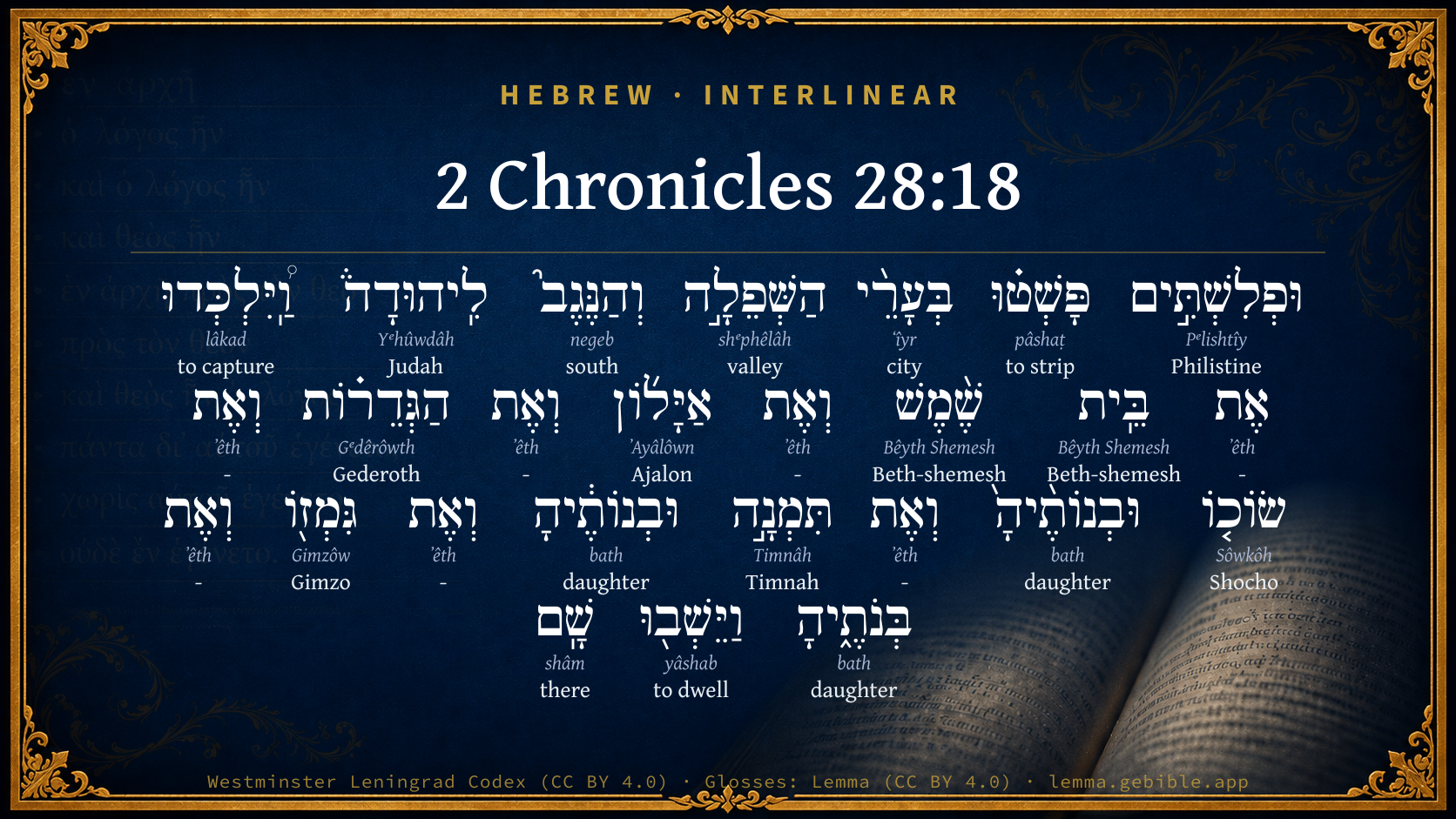
Hebrew (Westminster Leningrad Codex) 2 Chronicles 28:18 appears in the Hebrew Old Testament. The text above is from the Westminster Leningrad Codex. Each word links to its Strong’s number, a concise gloss, and parsing drawn from the Open Scriptures Hebrew Bible morphology. Click any word for its full Brown-Driver-Briggs (BDB) entry.
Download image
Cite this verse

2 Chronicles 28:18 (World English Bible). Public Domain. Lemma interlinear Bible study tool, https://lemma.gebible.app/v/2-chronicles/28/18.

Show BibTeX & RIS
BibTeX
RIS
English Translation
The Philistines also had invaded the cities of the lowland, and of the South of Judah, and had taken Beth-shemesh, and Aijalon, and Gederoth, and Soco with the towns of it, and Timnah with the towns of it, Gimzo also and the towns of it: and they lived there.
World English Bible · Public Domain
Highlights Full analysis ↓
Download a study sheet

One document with this verse’s original text, its word-by-word gloss line, the meaning frame, cross-references with their text, attributed commentary, and full source and license credits — printable, and it pastes into notes with its structure intact.

This verse Autodidact and up

Study sheet (.html) Plain text (.txt)

A passage Seminary Student

Up to 50 verses in one chapter. A passage sheet keeps up to 6 commentary sources and 12 cross-references per verse, in the order this page ranks them, and says so on the sheet whenever that leaves anything out. Ask for a single verse and you get the Autodidact verse sheet above.

Everything on this page stays free to read, with no account — the sheet is a download of what is already on screen, not access to it.

Want to remove ads? Support Godless Engineer
Compare translations 3

The same verse in 3 English versions, stacked beneath the original-language interlinear above. Click any original word for its lexicon entry.

Each is an independent rendering of the whole verse — the interlinear is not word-aligned to these translations.

Highlighted words mark where these versions differ — a whole-verse word diff, not a word-by-word alignment.

  • World English Bible Public Domain
    The Philistines also had invaded the cities of the lowland, and of the South of Judah, and had taken Beth-shemesh, and Aijalon, and Gederoth, and Soco with the towns of it, and Timnah with the towns of it, Gimzo also and the towns of it: and they lived there.
  • King James Version Public Domain
    The Philistines also had invaded the cities of the low country, and of the south of Judah, and had taken Bethshemesh, and Ajalon, and Gederoth, and Shocho with the villages thereof, and Timnah with the villages thereof, Gimzo also and the villages thereof: and they dwelt there.
  • unfoldingWord Literal Text CC BY-SA 4.0
    And the Philistines had raided among the cities of the lowlands and the Negev of Judah. And they captured Beth Shemesh, and Aijalon, and Gederoth, and Soko and its daughters, and Timnah and its daughters, and Gimzo and its daughters. And they dwelled there.

unfoldingWord Literal Text — © unfoldingWord, licensed CC BY-SA 4.0. Word-aligned USFM3 via Door43 (git.door43.org/unfoldingWord/en_ult).

Versions to compare (up to 4)

3 of 4 selected

Show all 18 translations

Every available English version of this verse, each an independent rendering of the whole verse.

  • World English Bible Public Domain
    The Philistines also had invaded the cities of the lowland, and of the South of Judah, and had taken Beth-shemesh, and Aijalon, and Gederoth, and Soco with the towns of it, and Timnah with the towns of it, Gimzo also and the towns of it: and they lived there.
  • Berean Standard Bible Public Domain
    The Philistines had also raided the cities of the foothills and the Negev of Judah, capturing and occupying Beth-shemesh, Aijalon, and Gederoth, as well as Soco, Timnah, and Gimzo with their villages.
  • Majority Standard Bible Public Domain
    The Philistines had also raided the cities of the foothills and the Negev of Judah, capturing and occupying Beth-shemesh, Aijalon, and Gederoth, as well as Soco, Timnah, and Gimzo with their villages.
  • King James Version Public Domain
    The Philistines also had invaded the cities of the low country, and of the south of Judah, and had taken Bethshemesh, and Ajalon, and Gederoth, and Shocho with the villages thereof, and Timnah with the villages thereof, Gimzo also and the villages thereof: and they dwelt there.
  • American Standard Version (1901) Public Domain
    The Philistines also had invaded the cities of the lowland, and of the South of Judah, and had taken Beth-shemesh, and Aijalon, and Gederoth, and Soco with the towns thereof, and Timnah with the towns thereof, Gimzo also and the towns thereof: and they dwelt there.
  • Revised Version (1885) Public Domain
    The Philistines also had invaded the cities of the lowland, and of the South of Judah, and had taken Beth-shemesh, and Aijalon, and Gederoth, and Soco with the towns thereof, and Timnah with the towns thereof, Gimzo also and the towns thereof: and they dwelt there.
  • Geneva Bible (1599) Public Domain
    The Philistims also inuaded the cities in the low countrey, and toward the South of Iudah, and tooke Bethshemesh, and Aialon, and Gederoth and Shocho, with the villages thereof, and Timnah, with her villages, and Gimzo, with her villages, and they dwelt there.
  • Douay-Rheims (1899) Public Domain
    The Philistines also spread themselves among the cities of the plains, and to the south of Juda: and they took Bethsames, and Aialon, and Gaderoth, and Socho, and Thamnan, and Gamzo, with their villages, and they dwelt in them.
  • Young's Literal Translation Public Domain
    And the Philistines have rushed against the cities of the low country, and of the south of Judah, and capture Beth-Shemesh, and Aijalon, and Gederoth, and Shocho and its villages, and Timnah and its villages, and Gimzo and its villages, and dwell there,
  • Literal Standard Version CC BY-SA 4.0
    And the Philistines have rushed against the cities of the low country, and of the south of Judah, and capture Beth-Shemesh, and Aijalon, and Gederoth, and Shocho and its villages, and Timnah and its villages, and Gimzo and its villages, and dwell there,
  • Unlocked Literal Bible CC BY-SA 4.0
    The Philistines also invaded the cities of the lowlands and of the Negev of Judah. They took Beth Shemesh, Aijalon, Gederoth, Soko with its villages, Timnah with its villages, and also Gimzo with its villages. They went to live in those places.
  • unfoldingWord Literal Text CC BY-SA 4.0
    And the Philistines had raided among the cities of the lowlands and the Negev of Judah. And they captured Beth Shemesh, and Aijalon, and Gederoth, and Soko and its daughters, and Timnah and its daughters, and Gimzo and its daughters. And they dwelled there.
  • Darby Bible Public Domain
    And the Philistines invaded the cities of the lowland, and of the south of Judah, and took Beth-shemesh, and Ajalon, and Gederoth, and Socho and its dependent villages, and Timnah and its dependent villages, and Guimzo and its dependent villages; and they dwelt there.
  • World Messianic Bible Public Domain
    The Philistines also had invaded the cities of the lowland and of the South of Judah, and had taken Beth Shemesh, Aijalon, Gederoth, Soco with its villages, Timnah with its villages, and also Gimzo and its villages; and they lived there.
  • Webster's Bible Public Domain
    The Philistines also had invaded the cities of the low country, and of the south of Judah, and had taken Beth-shemesh, and Ajalon, and Gederoth, and Shocho with its villages, and Timnah with its villages, Gimzo also and its villages: and they dwelt there.
  • Free Bible Version CC BY-SA 4.0
    while the Philistines had attacked the towns in the foothills and the Negev of Judah. They had captured and occupied Beth-shemesh, Aijalon, Gederoth, along with Soco, Timnah, and Gimzo and their villages.
  • Bible in Basic English Public Domain
    And the Philistines, forcing their way into the towns of the lowlands and the south of Judah, had taken Beth-shemesh and Aijalon and Gederoth and Soco, with their daughter-towns, as well as Timnah and Gimzo and their daughter-towns, and were living there.
  • JPS Tanakh (1917) Public Domain
    The Philistines also had invaded the cities of the Lowland, and of the South of Judah, and had taken Beth-shemesh, and Aijalon, and Gederoth, and Soco with the towns thereof, and Timnah with the towns thereof, Gimzo also and the towns thereof; and they dwelt there.

Literal Standard Version (2020), Covenant Press — licensed CC BY-SA 4.0. Text via the HelloAO Bible API (eBible.org). Unlocked Literal Bible (unfoldingWord) — licensed CC BY-SA 4.0. Text via the HelloAO Bible API (eBible.org). unfoldingWord Literal Text — © unfoldingWord, licensed CC BY-SA 4.0. Word-aligned USFM3 via Door43 (git.door43.org/unfoldingWord/en_ult). Free Bible Version, Dr. Jonathan Gallagher — licensed CC BY-SA 4.0. Text via the HelloAO Bible API (eBible.org).

Word by word

More ways to search: Search by grammar → Find every occurrence → Compare this word →

Practice this passage: Drill this verse → Learn its vocabulary →

גִּמְז֖וֹ
Gimzôw
H1579
“Gimzo”
Noun, Proper
Part of Speech
Noun
Type
Proper
Full BDB Definition

Origin: of uncertain derivation

TWOT: None

Gimzo = "fertile in sycamores" - a town in Judah south of the road between Jerusalem and Joppa which with its dependant villages was captured by the Philistines in the reign of Ahaz
  1. וּפְלִשְׁתִּ֣ים Pᵉlishtîy H6430 “and · Philistines” Conjunction + Noun, Gentilic, Masculine, Plural, Absolute
  2. פָּשְׁט֗וּ pâshaṭ H6584 “to strip” Verb, Qal, Perfect, 3rd Person, Common, Plural
  3. בְּעָרֵ֨י ʻîyr H5892 “in/at · cities of” Preposition + Noun, Common, Feminine, Plural, Construct
  4. הַשְּׁפֵלָ֣ה shᵉphêlâh H8219 “the · valley” Particle, Definite Article + Noun, Common, Feminine, Singular, Absolute
  5. וְהַנֶּגֶב֮ negeb H5045 “and · the · south” Conjunction + Particle, Definite Article + Noun, Common, Masculine, Singular, Absolute
  6. לִֽיהוּדָה֒ Yᵉhûwdâh H3063 “to/for · Judah” Preposition + Noun, Proper
  7. וַֽ֠יִּלְכְּדוּ lâkad H3920 “and · to capture” Conjunction + Verb, Qal, Sequential Imperfect, 3rd Person, Masculine, Plural
  8. אֶת ʼêth H853 “-” Particle, Direct Object
  9. בֵּֽית Bêyth Shemesh H1053 “Beth-shemesh” Noun, Proper
  10. שֶׁ֨מֶשׁ Bêyth Shemesh H1053 “Beth-shemesh” Noun, Proper
  11. וְאֶת ʼêth H853 “and · -” Conjunction + Particle, Direct Object
  12. אַיָּל֜וֹן ʼAyâlôwn H357 “Ajalon” Noun, Proper
  13. וְאֶת ʼêth H853 “and · -” Conjunction + Particle, Direct Object
  14. הַגְּדֵר֗וֹת Gᵉdêrôwth H1450 “the · Gederoth” Particle, Definite Article + Noun, Proper
  15. וְאֶת ʼêth H853 “and · -” Conjunction + Particle, Direct Object
  16. שׂוֹכ֤וֹ Sôwkôh H7755 “Shocho” Noun, Proper
  17. וּבְנוֹתֶ֨יהָ֙ bath H1323 “and · daughters · her” Conjunction + Noun, Common, Feminine, Plural, Construct + Suffix, Personal, 3rd Person, Feminine, Singular
  18. וְאֶת ʼêth H853 “and · -” Conjunction + Particle, Direct Object
  19. תִּמְנָ֣ה Timnâh H8553 “Timnah” Noun, Proper
  20. וּבְנוֹתֶ֔יהָ bath H1323 “and · daughters · her” Conjunction + Noun, Common, Feminine, Plural, Construct + Suffix, Personal, 3rd Person, Feminine, Singular
  21. וְאֶת ʼêth H853 “and · -” Conjunction + Particle, Direct Object
  22. וְאֶת ʼêth H853 “and · -” Conjunction + Particle, Direct Object
  23. בְּנֹתֶ֑יהָ bath H1323 “daughters · her” Noun, Common, Feminine, Plural, Construct + Suffix, Personal, 3rd Person, Feminine, Singular
  24. וַיֵּשְׁב֖וּ yâshab H3427 “and · to dwell” Conjunction + Verb, Qal, Sequential Imperfect, 3rd Person, Masculine, Plural
  25. שָֽׁם shâm H8033 “there” Adverb

About this verse

These counts appear in no published source. They are computed here, from the morphology-tagged text and Lemma’s own curated glosses. What Lemma adds →

26
words
17
distinct lemmas
Historical
section

Notable vocabulary

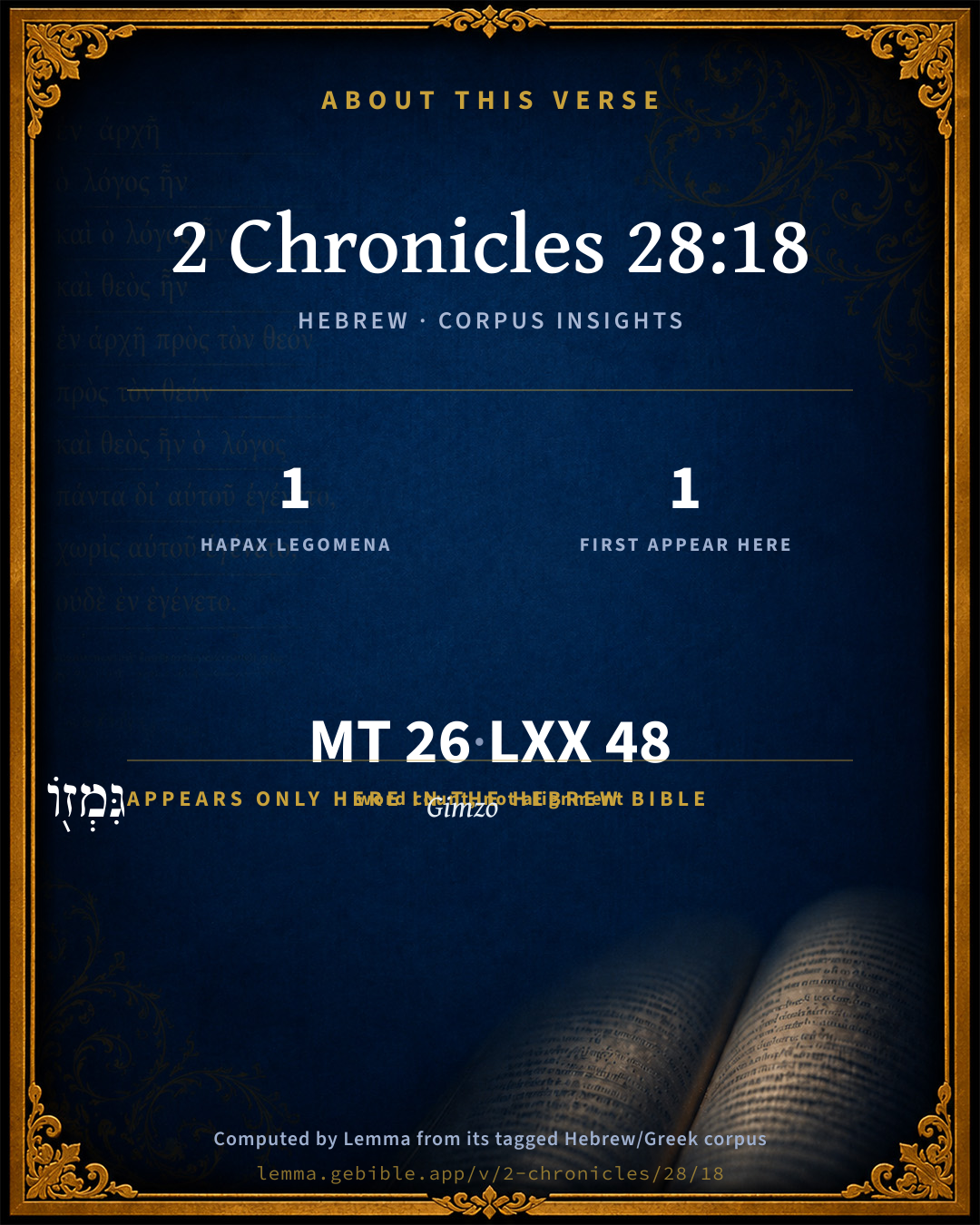
1 hapax legomenon — a word that appears only here in the entire Hebrew Bible:

  • גִּמְז֖וֹ Gimzo H1579

First appearance in Scripture

This word makes its first canonical appearance in the Hebrew Bible here:

  • גִּמְז֖וֹ Gimzo H1579

Shared distinctive vocabulary

הַגְּדֵר֗וֹת Gederoth H1450 occurs in 2 verses of the Hebrew Bible. Also found in:

Grammatical profile

  • 3 verbs
  • 15 nouns
  • 1 adverb
  • 7 particles

Verb forms

  • פָּשְׁט֗וּ Qal · Perfect
  • וַֽ֠יִּלְכְּדוּ Qal · Sequential Imperfect
  • וַיֵּשְׁב֖וּ Qal · Sequential Imperfect

Repetition

Words recur within this verse — often emphatic in Hebrew:

  • וּבְנוֹתֶ֨יהָ֙ daughter H1323 ×3
  • בֵּֽית Beth-shemesh H1053 ×2

Hebrew & Septuagint length

In English translation the verse runs 49 words from the Hebrew and 75 from the Septuagint (LXX English) — the Septuagint runs noticeably longer here. See the side-by-side →

A rough comparison of the two English renderings, which tokenize alike — not a word-level alignment.

Word counts can differ between the Hebrew and the Greek without any difference in meaning — e.g. the Hebrew direct-object marker אֵת has no separate Greek word, and Greek often adds the article ὁ.

In the original languages it is 26 Hebrew tokens and 48 Greek tokens — but the two are counted differently (Hebrew bundles its prefixes and suffixes into one token; the Greek is in lemma form), so that isn’t a like-for-like length.

Cross-references

8

Topical passages linked to 2 Chronicles 28:18 in the Treasury of Scripture Knowledge — connected by theme and wording, ordered by reader-vote popularity; previews shown in the World English Bible.

  • Ezekiel 16:57 before your wickedness was uncovered, as at the time of the reproach of the daughters of Syria, and of all who are round about her, the daughters of the Philistines, who do despite to you round about.
  • Ezekiel 16:27 See therefore, I have stretched out my hand over you, and have diminished your ordinary [food], and delivered you to the will of those who hate you, the daughters of the Philistines, who are ashamed of your lewd way.
  • Joshua 15:10 and the border turned about from Baalah westward to Mount Seir, and passed along to the side of Mount Jearim on the north (the same is Chesalon), and went down to Beth-shemesh, and passed along by Timnah;
  • Joshua 15:41 and Gederoth, Beth Dagon, and Naamah, and Makkedah; sixteen cities with their villages.
  • Joshua 15:48 In the hill-country, Shamir, and Jattir, and Socoh,
  • Judges 14:1 Samson went down to Timnah, and saw a woman in Timnah of the daughters of the Philistines.
  • 1 Samuel 6:9 Behold; if it goes up by the way of its own border to Beth-shemesh, then he has done us this great evil: but if not, then we shall know that it is not his hand that struck us; it was a chance that happened to us."
  • 2 Chronicles 11:10 and Zorah, and Aijalon, and Hebron, which are in Judah and in Benjamin, fortified cities.

Cross-references courtesy of OpenBible.info (CC BY 4.0).

Hebrew and Greek witnesses Masoretic Hebrew ↔ Greek Septuagint

The same verse in the two great witnesses to the Old Testament, shown verse-for-verse.

Here the Septuagint runs noticeably longer than the Hebrew — LXX2012 (modern English Septuagint) 75 words vs World English Bible 49. A rough length comparison of the two English translations, not a word-level alignment — read both below.

These are two independent witnesses, not word-aligned to each other, and the Septuagint is shown in lemma (dictionary) form.

Hebrew 2 Chronicles 28:18 Masoretic · Westminster Leningrad Codex

וּפְלִשְׁתִּ֣ים פָּשְׁט֗וּ בְּעָרֵ֨י הַשְּׁפֵלָ֣ה וְהַנֶּגֶב֮ לִֽיהוּדָה֒ וַֽ֠יִּלְכְּדוּ אֶת בֵּֽית שֶׁ֨מֶשׁ וְאֶת אַיָּל֜וֹן וְאֶת הַגְּדֵר֗וֹת וְאֶת שׂוֹכ֤וֹ וּבְנוֹתֶ֨יהָ֙ וְאֶת תִּמְנָ֣ה וּבְנוֹתֶ֔יהָ וְאֶת גִּמְז֖וֹ וְאֶת בְּנֹתֶ֑יהָ וַיֵּשְׁב֖וּ שָֽׁם

The Philistines also had invaded the cities of the lowland, and of the South of Judah, and had taken Beth-shemesh, and Aijalon, and Gederoth, and Soco with the towns of it, and Timnah with the towns of it, Gimzo also and the towns of it: and they lived there.

World English Bible · Public Domain

Greek LXX 2 Chronicles 28:18 Septuagint · lemma form

καί ὁ ἀλλόφυλος ἐπιτίθημι ἐπί ὁ πόλις ὁ πεδεινός καί ἀπό λίψ ὁ ἰουδά καί λαμβάνω ὁ βαιθσαμυς καί ὁ αιλων καί ὁ γαδηρωθ καί ὁ σωχω καί ὁ κώμη αὐτός καί ὁ θαμνα καί ὁ κώμη αὐτός καί ὁ γαμζω καί ὁ κώμη αὐτός καί καταοἰκέω ἐκεῖ

Also the Philistines had made an attack on the cities of the plain country, and the cities of the south of Juda, and taken Baethsamys, and the things in the house of the Lord, and the things in the house of the king, and of the princes: and they gave to the king Aelon, and Galero, and Socho and her villages, and Thamna and her villages, and Gamzo and her villages: and they lived there.

LXX2012 (modern English Septuagint) · Public Domain

Hebrew: Westminster Leningrad Codex (CC BY 4.0). Greek: Septuagint (public domain); English from LXX2012 (modern English Septuagint) (Public Domain). How the Septuagint differs from the Hebrew →

Commentary

Notes on 2 Chronicles 28:18 from classic Christian and Jewish commentators (each source and its license shown beneath its notes). The classic Christian expositions comment on the surrounding passage and are grouped to its opening verse, so a note may address several verses; the Jewish commentaries on the Tanakh (Rashi and others) are per-verse, so they appear only where the commentator wrote on this verse.

Lemma curates 59 commentaries, every one of them public domain or Creative Commons licensed, each selected and text-cleaned for this edition rather than reprinted as found. About our sources →

Trapp's Complete Commentary

John Trapp

2Ch 28:18 The Philistines also had invaded the cities of the low country, and of the south of Judah, and had taken Bethshemesh, and Ajalon, and Gederoth, and Shocho with the villages thereof, and Timnah with the villages thereof, Gimzo also and the villages thereof: and they dwelt there.

Ver. 18. The Philistines also.] For a punishment of Judah’s incorrigibleness. The Syrians before and the Philistines behind, &c. {Isa 9:12-13}

John Trapp, A Commentary or Exposition upon All the Books of the Old and New Testament (1647–1656) — public domain. Text from a community e-Sword module.

Jamieson, Fausset & Brown

Robert Jamieson, A. R. Fausset & David Brown

Gederoth--on the Philistine frontier (Jos 15:41).

Shocho--or Socoh (Jos 15:35), now Shuweikeh, a town in the Valley of Judah (see on Sa1 17:1).

Gimzo--now Jimza, a little east of Ludd (Lydda) [ROBINSON]. All these disasters, by which the "Lord brought Judah low," were because of Ahaz, king of Israel (Judah), see Ch2 21:2; Ch2 24:16; Ch2 28:27, who made Judah naked, and transgressed sore against the Lord.

Jamieson, Fausset & Brown — Commentary Critical and Explanatory on the Whole Bible (1871) — public domain (CC PDM 1.0). Text via the HelloAO Bible API.

Ellicott's Commentary for English Readers

(18) Invaded—i.e., “fell upon” (2Ch_25:13).

The low country.—The sheph̓̓çlah, or lowland of Judah, between the hill-country and the Mediterranean.

The south.—The Negeb, or southland of Judah, nearly co-extensive with the territory assigned to Simeon (2Sa_24:7).

Beth-shemesh.—See 1Ch_6:59.

Ajalon.—1Ch_6:69.

Gederoth.—In the lowland (Jos_15:41).

Shocho.—Rather, Socho (2Ch_11:7).

Timnah.—Now Tibna (Jos_15:10).

Gimzo.—Now Jimsu, between Lydda and Beth-horon (Robinson, iii. 271).

And the villages thereof.—And her daughters. (See Note on 1Ch_7:28, “and the towns thereof.”)

And they dwelt there.—Permanently occupied the country. (Comp. 1Ch_5:22. See also Isa_14:29-30.)

A Bible Commentary for English Readers, edited by Charles John Ellicott (1878–1897) — public domain. Text from a community e-Sword module.

The Cambridge Bible for Schools and Colleges

gen. ed. J. J. S. Perowne

18. had invaded] Rather, raided.

the low country] R.V. the lowland (Heb. Shephçlâh). Cp. 2Ch_1:15 (note).

Beth-shemesh] Cp. 1Ch_6:59 [44, Heb.], note.

Ajalon] R.V. Aijalon; cp. 2Ch_11:10.

Gederoth] Jos_15:41. Shocho] R.V. Soco; cp. 2Ch_11:7.

Timnah] Jos_15:10; Jdg_14:1 ff.

Gimzo] The modern Jimzu S.E. of Lydda, Bädeker, p. 18. The place is not mentioned elsewhere in the Old Testament.

The Cambridge Bible for Schools and Colleges (gen. ed. J. J. S. Perowne; Cambridge University Press, 1878–1918) — public domain. Text from a community e-Sword module.

John Gill's Exposition

And Tilgathpilneser king of Assyria came unto him,.... Not to Jerusalem, but to Damascus, where he made a diversion in his favour, and took that city, and where Ahaz met him, Kg2 16:9.

and distressed him, but strengthened him not; exhausted his treasures, and laid a tribute upon him, but did not help him against the Edomites and Philistines, or recover for him the cities they had taken from him; and, in taking Damascus, he served himself more than Ahaz, and paved the way for seizing upon the ten tribes.

John Gill's Exposition of the Whole Bible (1746–1763) — public domain (CC PDM 1.0). Text via the HelloAO Bible API.

Albert Barnes' Notes on the Bible

Philistia also, eager to retaliate the blows she had received from Uzziah 2Ch 26:6, seized her opportunity. Ajalon and Shocho were among the cities fortified by Rehoboam 2Ch 11:7, 2Ch 11:10; Beth-shemesh Jos 15:10 was famous as the scene of Amaziah’s defeat 2Ch 25:21. Gimzo, which is not elsewhere mentioned in Scripture has been probably identified with the modern Jimzu, a large village about 2 12 miles from Ludd (the ancient Lydda).

Albert Barnes' Notes on the Bible (1834–1885) — public domain. Text from a community e-Sword/MySword module.

Haydock's Catholic Bible Commentary

Gamzo. Syriac, "Garam," perhaps Gaza, (C.) or a city south of Juda. M.

George Leo Haydock (1774–1849), Haydock's Catholic Family Bible and Commentary, 1859 edition — public domain. Excludes Psalms (Douay-Rheims chapter numbering differs from Protestant) and Deuterocanonical books (Catholic canon only).

Matthew Poole's English Annotations

The low country; that part of Judah which was towards the sea, and towards the Philistines’ land.

The south of Judah; of which see Jos 15:21.

Matthew Poole's English Annotations on the Holy Bible (1683–1685) — public domain. Text from a community e-Sword/MySword module.

The Pulpit Commentary

The Philistines. These also had been subjugated again and again, and of late by Uzziah, (2Ch_26:6, 2Ch_26:7) work that was now undone. The exultant relief to the Philistines, short-lived though it was, is referred to elsewhere, as in the Book of Isaiah, (Isa_14:29, Isa_14:31) the Psalms. (Psa_60:8) Beth-shemesh. On the border of Judah (2Ch_25:23, and our note there; 1Ch_6:44) Ajalon, This was also on the border (1Ch_6:54; 2Ch_11:10) Gederoth. This was in the Shefelah. (Jos_15:41) Shocho; or, Socho, one of Rehoboam"s cities, near the Philistines, and therefore selected for fortification. (2Ch_11:7) Timnah. This bordered on Dan. (Jos_15:10) Gimzo. Not elsewhere mentioned, but well known in the modern village Jimzu, its site on what would have been the border of Dan. They dwelt there. This expression is, of course, designed to indicate that the Philistines obtained successfully some foothold.

The Pulpit Commentary (1880–1919), ed. H.D.M. Spence-Jones & Joseph S. Exell — public domain. Text from a community e-Sword module.

Rashi

Rabbi Shlomo Yitzchaki (Rashi)

And Philistines raided the cities of the lowlands and the southland which was opposite them, as it is written about the Philistines, (Zeph. 2:5): “the inhabitants of the seacoast.”

Rashi on the Tanakh — English translations: “The Judaica Press complete Tanach with Rashi, translated by A. J. Rosenberg” (CC BY 4.0); “Pentateuch with Rashi's commentary by M. Rosenbaum and A.M. Silbermann, 1929-1934” (public domain); “The Metsudah Tanach series, Lakewood, N.J” (CC BY 4.0); and “The Book of Joshua, Metsudah Publications, 1997” (CC BY 4.0). Text via Sefaria.

Lesson kit

Teaching starters — assembled from the data on this page, not authored interpretation. Every prompt links to the verse data it draws on. Edit before teaching.

2 Chronicles, in the Historical, opens this verse with 26 words (17 distinct Hebrew lemmas). Its most distinctive word is Gimzôw (“Gimzo”). The Greek Septuagint runs longer here. A historical commentator’s framing appears above. Read the whole chapter for the surrounding context.

Discussion questions

  1. The word Gimzôw carries the sense “Gimzo.” How does it shape the verse?
  2. 1 word here appears nowhere else in the Hebrew Bible. Why might the author reach for such rare wording?
  3. This is the first place “Gimzo” appears in Scripture (first appears here). What does its debut here establish?
  4. How does Joshua 15:41, which shares the word «Gederoth», read alongside this verse?
  5. What does the repetition of “daughter” (3× in this one verse) do in this verse?
  6. The Septuagint runs longer here than the Hebrew. What might account for the difference?
  7. These translations render this verse differently. What is at stake in choosing one wording over another?
  8. «פָּשְׁט֗וּ» is a Qal Perfect verb. How does that grammatical form shape the action described?

Things to notice

  • 1 word in this verse appears nowhere else in the Hebrew Bible.
  • 1 word makes its first canonical appearance in Scripture here.
  • This verse counts 26 Hebrew ↔ 48 Greek words.
  • These translations choose different wording for 28 words in this verse.
  • “daughter” occurs 3× in this single verse.

Reading settings

Reading text

Shown beneath each verse's original-language words.

Old Testament
Old Testament edition

Read the OT as the Masoretic Hebrew (MT) or the Greek Septuagint (LXX).

English shown for the Greek Septuagint (in the Hebrew ↔ Greek comparison).

Comparing translations? Open the Compare panel on any verse page to stack up to four side by side.