Genesis 26:34

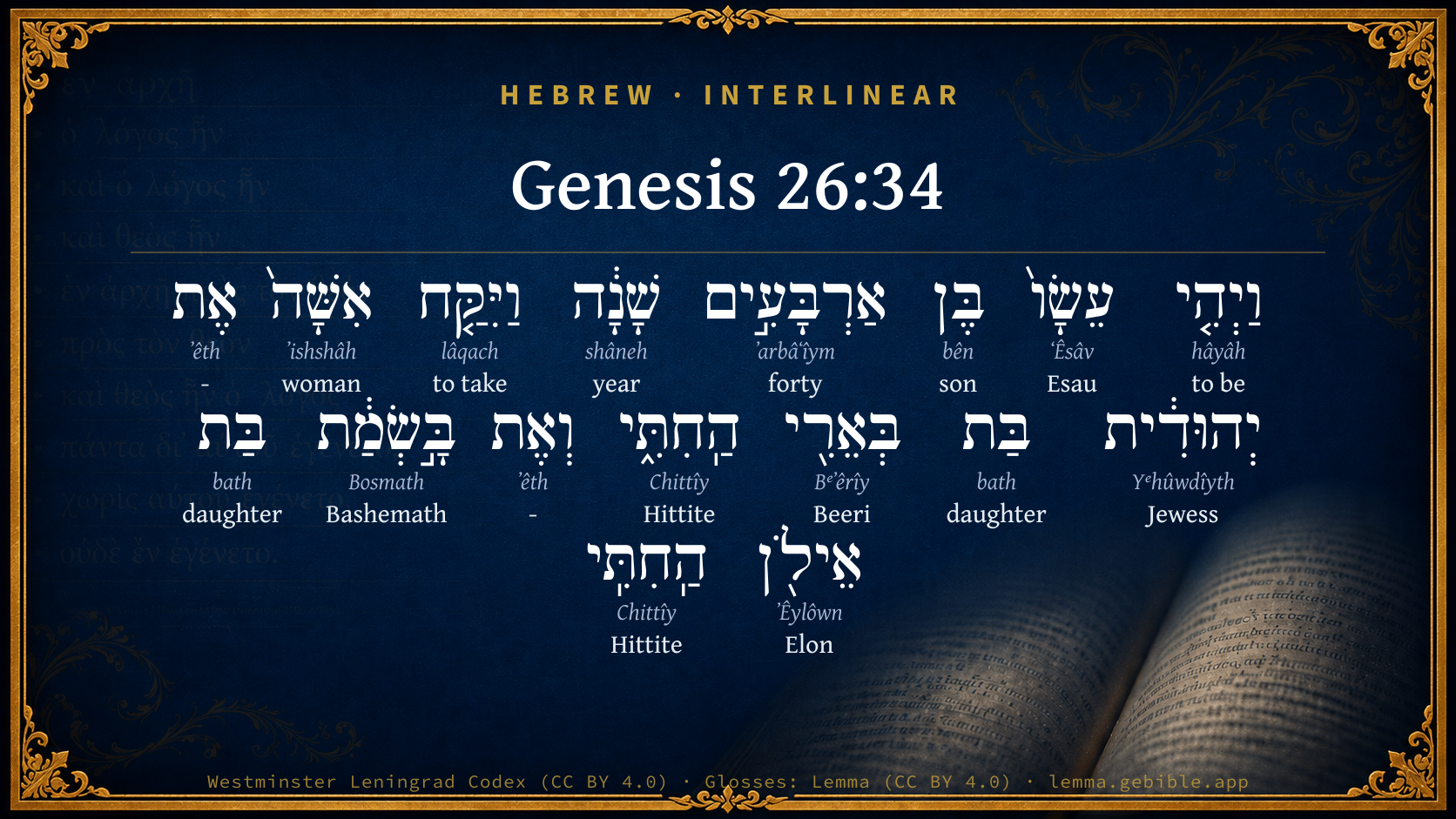
Hebrew (Westminster Leningrad Codex) Genesis 26:34 appears in the Hebrew Old Testament. The text above is from the Westminster Leningrad Codex. Each word links to its Strong’s number, a concise gloss, and parsing drawn from the Open Scriptures Hebrew Bible morphology. Click any word for its full Brown-Driver-Briggs (BDB) entry.
Download image
Cite this verse

Genesis 26:34 (World English Bible). Public Domain. Lemma interlinear Bible study tool, https://lemma.gebible.app/v/genesis/26/34.

Show BibTeX & RIS
BibTeX
RIS
English Translation
When Esau was forty years old, he took as wife Judith, the daughter of Beeri the Hittite, and Basemath, the daughter of Elon the Hittite.
World English Bible · Public Domain
Highlights
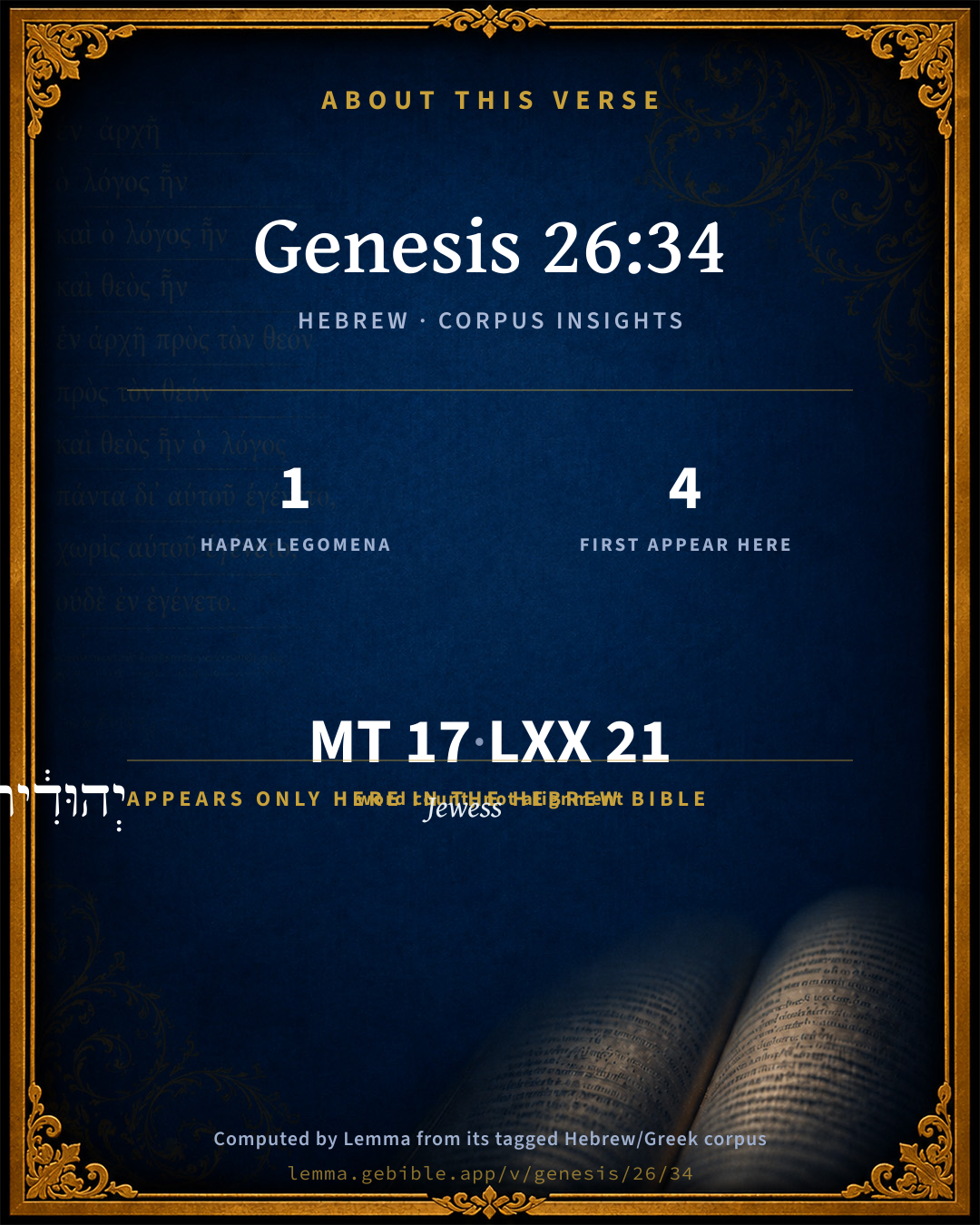
  • 1 hapax legomenon — only here in the Hebrew Bible
  • 4 first appearances in the Hebrew Bible
Full analysis ↓
Download a study sheet

One document with this verse’s original text, its word-by-word gloss line, the meaning frame, cross-references with their text, attributed commentary, and full source and license credits — printable, and it pastes into notes with its structure intact.

This verse Autodidact and up

Study sheet (.html) Plain text (.txt)

A passage Seminary Student

Up to 50 verses in one chapter. A passage sheet keeps up to 6 commentary sources and 12 cross-references per verse, in the order this page ranks them, and says so on the sheet whenever that leaves anything out. Ask for a single verse and you get the Autodidact verse sheet above.

Everything on this page stays free to read, with no account — the sheet is a download of what is already on screen, not access to it.

Want to remove ads? Support Godless Engineer
Compare translations 3

The same verse in 3 English versions, stacked beneath the original-language interlinear above. Click any original word for its lexicon entry.

Each is an independent rendering of the whole verse — the interlinear is not word-aligned to these translations.

Highlighted words mark where these versions differ — a whole-verse word diff, not a word-by-word alignment.

  • World English Bible Public Domain
    When Esau was forty years old, he took as wife Judith, the daughter of Beeri the Hittite, and Basemath, the daughter of Elon the Hittite.
  • King James Version Public Domain
    And Esau was forty years old when he took to wife Judith the daughter of Beeri the Hittite, and Bashemath the daughter of Elon the Hittite:
  • unfoldingWord Literal Text CC BY-SA 4.0
    And Esau was a son of forty years, and he took a wife Judith the daughter of Beeri the Hittite, and Basemath the daughter of Elon the Hittite.

unfoldingWord Literal Text — © unfoldingWord, licensed CC BY-SA 4.0. Word-aligned USFM3 via Door43 (git.door43.org/unfoldingWord/en_ult).

Versions to compare (up to 4)

3 of 4 selected

Show all 18 translations

Every available English version of this verse, each an independent rendering of the whole verse.

  • World English Bible Public Domain
    When Esau was forty years old, he took as wife Judith, the daughter of Beeri the Hittite, and Basemath, the daughter of Elon the Hittite.
  • Berean Standard Bible Public Domain
    When Esau was forty years old, he took as his wives Judith daughter of Beeri the Hittite and Basemath daughter of Elon the Hittite.
  • Majority Standard Bible Public Domain
    When Esau was forty years old, he took as his wives Judith daughter of Beeri the Hittite and Basemath daughter of Elon the Hittite.
  • King James Version Public Domain
    And Esau was forty years old when he took to wife Judith the daughter of Beeri the Hittite, and Bashemath the daughter of Elon the Hittite:
  • American Standard Version (1901) Public Domain
    And when Esau was forty years old he took to wife Judith the daughter of Beeri the Hittite, and Basemath the daughter of Elon the Hittite.
  • Revised Version (1885) Public Domain
    And when Esau was forty years old he took to wife Judith the daughter of Beeri the Hittite, and Basemath the daughter of Elon the Hittite:
  • Geneva Bible (1599) Public Domain
    Nowe when Esau was fourtie yeere olde, he tooke to wife Iudith, the daughter of Beeri an Hittite, and Bashemath the daughter of Elon an Hittite also.
  • Douay-Rheims (1899) Public Domain
    And Esau being forty years old, married wives, Judith the daughter of Beeri the Hethite, and Basemath the daughter of Elon of the same place.
  • Young's Literal Translation Public Domain
    And Esau is a son of forty years, and he taketh a wife, Judith, daughter of Beeri the Hittite, and Bashemath, daughter of Elon the Hittite,
  • Literal Standard Version CC BY-SA 4.0
    And Esau is a son of forty years, and he takes a wife, Judith, daughter of Beeri the Hittite, and Bashemath, daughter of Elon the Hittite,
  • Unlocked Literal Bible CC BY-SA 4.0
    When Esau was forty years old, he took a wife, Judith the daughter of Beeri the Hittite, and also Basemath the daughter of Elon the Hittite.
  • unfoldingWord Literal Text CC BY-SA 4.0
    And Esau was a son of forty years, and he took a wife Judith the daughter of Beeri the Hittite, and Basemath the daughter of Elon the Hittite.
  • Darby Bible Public Domain
    And Esau was forty years old, when he took as wives Judith the daughter of Beeri the Hittite, and Basmath the daughter of Elon the Hittite.
  • World Messianic Bible Public Domain
    When Esau was forty years old, he took as wife Judith, the daughter of Beeri the Hittite, and Basemath, the daughter of Elon the Hittite.
  • Webster's Bible Public Domain
    And Esau was forty years old when he took for a wife Judith the daughter of Beeri the Hittite, and Bashemath the daughter of Elon the Hittite:
  • Free Bible Version CC BY-SA 4.0
    When Esau was 40, he married Judith, daughter of Beeri the Hittite, as well as Basemath, daughter of Elon the Hittite.
  • Bible in Basic English Public Domain
    And when Esau was forty years old, he took as his wives Judith, the daughter of Beeri the Hittite, and Basemath, the daughter of Elon the Hittite:
  • JPS Tanakh (1917) Public Domain
    And when Esau was forty years old, he took to wife Judith the daughter of Beeri the Hittite, and Basemath the daughter of Elon the Hittite.

Literal Standard Version (2020), Covenant Press — licensed CC BY-SA 4.0. Text via the HelloAO Bible API (eBible.org). Unlocked Literal Bible (unfoldingWord) — licensed CC BY-SA 4.0. Text via the HelloAO Bible API (eBible.org). unfoldingWord Literal Text — © unfoldingWord, licensed CC BY-SA 4.0. Word-aligned USFM3 via Door43 (git.door43.org/unfoldingWord/en_ult). Free Bible Version, Dr. Jonathan Gallagher — licensed CC BY-SA 4.0. Text via the HelloAO Bible API (eBible.org).

Word by word

More ways to search: Search by grammar → Find every occurrence → Compare this word →

Practice this passage: Drill this verse → Learn its vocabulary →

יְהוּדִ֔ית
Yᵉhûwdîyth
H3067
“Jewess”
Noun, Proper
Part of Speech
Noun
Type
Proper
Full BDB Definition

Origin: the same as H3066

TWOT: None

Judith = "Jewess" or " praised" - the daughter of Beeri the Hittite and wife of Esau
  1. וַיְהִ֤י hâyâh H1961 “and · to be” Conjunction + Verb, Qal, Sequential Imperfect, 3rd Person, Masculine, Singular
  2. עֵשָׂו֙ ʻÊsâv H6215 “Esau” Noun, Proper
  3. בֶּן bên H1121 “son of” Noun, Common, Masculine, Singular, Construct
  4. אַרְבָּעִ֣ים ʼarbâʻîym H705 “forty” Adjective, Cardinal number, Both, Plural, Absolute
  5. שָׁנָ֔ה shâneh H8141 “year” Noun, Common, Feminine, Singular, Absolute
  6. וַיִּקַּ֤ח lâqach H3947 “and · to take” Conjunction + Verb, Qal, Sequential Imperfect, 3rd Person, Masculine, Singular
  7. אִשָּׁה֙ ʼishshâh H802 “woman” Noun, Common, Feminine, Singular, Absolute
  8. אֶת ʼêth H853 “-” Particle, Direct Object
  9. בַּת bath H1323 “daughter of” Noun, Common, Feminine, Singular, Construct
  10. בְּאֵרִ֖י Bᵉʼêrîy H882 “Beeri” Noun, Proper
  11. הַֽחִתִּ֑י Chittîy H2850 “the · Hittite” Particle, Definite Article + Noun, Gentilic, Masculine, Singular, Absolute
  12. וְאֶת ʼêth H853 “and · -” Conjunction + Particle, Direct Object
  13. בָּ֣שְׂמַ֔ת Bosmath H1315 “Bashemath” Noun, Proper
  14. בַּת bath H1323 “daughter of” Noun, Common, Feminine, Singular, Construct
  15. אֵילֹ֖ן ʼÊylôwn H356 “Elon” Noun, Proper
  16. הַֽחִתִּֽי Chittîy H2850 “the · Hittite” Particle, Definite Article + Noun, Gentilic, Masculine, Singular, Absolute

About this verse

These counts appear in no published source. They are computed here, from the morphology-tagged text and Lemma’s own curated glosses. What Lemma adds →

17
words
14
distinct lemmas
Pentateuch
section

Notable vocabulary

1 hapax legomenon — a word that appears only here in the entire Hebrew Bible:

  • יְהוּדִ֔ית Jewess H3067

First appearance in Scripture

These words make their first canonical appearance in the Hebrew Bible here:

  • יְהוּדִ֔ית Jewess H3067
  • בְּאֵרִ֖י Beeri H882
  • בָּ֣שְׂמַ֔ת Bashemath H1315
  • אֵילֹ֖ן Elon H356

Shared distinctive vocabulary

בְּאֵרִ֖י Beeri H882 occurs in 2 verses of the Hebrew Bible. Also found in:

Grammatical profile

  • 2 verbs
  • 12 nouns
  • 1 adjective
  • 2 particles

Verb forms

  • וַיְהִ֤י Qal · Sequential Imperfect
  • וַיִּקַּ֤ח Qal · Sequential Imperfect

Repetition

Words recur within this verse — often emphatic in Hebrew:

  • בַּת daughter H1323 ×2
  • הַֽחִתִּ֑י Hittite H2850 ×2

Hebrew & Septuagint length

In English translation the verse runs 25 words from the Hebrew and 25 from the Septuagint (LXX English) — the same length.

A rough comparison of the two English renderings, which tokenize alike — not a word-level alignment.

Word counts can differ between the Hebrew and the Greek without any difference in meaning — e.g. the Hebrew direct-object marker אֵת has no separate Greek word, and Greek often adds the article ὁ.

In the original languages it is 17 Hebrew tokens and 21 Greek tokens — but the two are counted differently (Hebrew bundles its prefixes and suffixes into one token; the Greek is in lemma form), so that isn’t a like-for-like length.

Cross-references

8

Topical passages linked to Genesis 26:34 in the Treasury of Scripture Knowledge — connected by theme and wording, ordered by reader-vote popularity; previews shown in the World English Bible.

  • Genesis 36:2 Esau took his wives from the daughters of Canaan: Adah the daughter of Elon, the Hittite; and Oholibamah the daughter of Anah, the daughter of Zibeon, the Hivite;
  • Genesis 36:13 These are the sons of Reuel: Nahath, Zerah, Shammah, and Mizzah. These were the sons of Basemath, Esau's wife.
  • Exodus 34:16 and you take of their daughters to your sons, and their daughters play the prostitute after their gods, and make your sons play the prostitute after their gods.
  • Genesis 24:3 I will make you swear by Yahweh, the God of heaven and the God of the earth, that you shall not take a wife for my son of the daughters of the Canaanites, among whom I live.
  • Genesis 28:9 Esau went to Ishmael, and took, besides the wives that he had, Mahalath the daughter of Ishmael, Abraham's son, the sister of Nebaioth, to be his wife.
  • Genesis 36:5 Oholibamah bore Jeush, Jalam, and Korah. These are the sons of Esau, who were born to him in the land of Canaan.
  • 1 Corinthians 7:2 But, because of sexual immoralities, let each man have his own wife, and let each woman have her own husband.
  • Hebrews 12:16 lest there be any sexually immoral person, or profane person, as Esau, who sold his birthright for one meal.

Cross-references courtesy of OpenBible.info (CC BY 4.0).

Hebrew and Greek witnesses Masoretic Hebrew ↔ Greek Septuagint

The same verse in the two great witnesses to the Old Testament, shown verse-for-verse.

These are two independent witnesses, not word-aligned to each other, and the Septuagint is shown in lemma (dictionary) form.

Hebrew Genesis 26:34 Masoretic · Westminster Leningrad Codex

וַיְהִ֤י עֵשָׂו֙ בֶּן אַרְבָּעִ֣ים שָׁנָ֔ה וַיִּקַּ֤ח אִשָּׁה֙ אֶת יְהוּדִ֔ית בַּת בְּאֵרִ֖י הַֽחִתִּ֑י וְאֶת בָּ֣שְׂמַ֔ת בַּת אֵילֹ֖ן הַֽחִתִּֽי

When Esau was forty years old, he took as wife Judith, the daughter of Beeri the Hittite, and Basemath, the daughter of Elon the Hittite.

World English Bible · Public Domain

Greek LXX Genesis 26:34 Septuagint · lemma form

εἰμί δέ ησαυ ἔτος τεσσαράκοντα καί λαμβάνω γυνή ιουδιν ὁ θυγάτηρ βεηρ ὁ χετταῖος καί ὁ βασεμμαθ θυγάτηρ αιλων ὁ ευαῖος

And Esau was forty years old; and he took as wife Judith the daughter of Beoch the Chettite, and Basemath, daughter of Helon the Chettite.

LXX2012 (modern English Septuagint) · Public Domain

Hebrew: Westminster Leningrad Codex (CC BY 4.0). Greek: Septuagint (public domain); English from LXX2012 (modern English Septuagint) (Public Domain). How the Septuagint differs from the Hebrew →

Targum (Aramaic paraphrase)

2

The Targum is the ancient Jewish Aramaic paraphrase of the Hebrew Scriptures — an interpretive translation, not the Hebrew text itself. Onkelos (literal) and Pseudo-Jonathan (expansive) render the Torah, and Jonathan the Prophets. Coverage is partial: where no permissively-licensed English translation exists for a verse, only the Aramaic is shown. This is verse-level text, not a word-by-word alignment to the Hebrew.

  1. Targum Onkelos Torah (Genesis–Deuteronomy)
    וַהֲוָה עֵשָׂו בַּר אַרְבְּעִין שְׁנִין וּנְסִיב אִתְּתָא יָת יְהוּדִית בַּת בְּאֵרִי חִתָּאָה וְיָת בָּשְׂמַת בַּת אֵילוֹן חִתָּאָה

    (no public-domain English translation for this verse)

    Targum Onkelos — Aramaic: “Onkelos Genesis” (public domain); “Onkelos Exodus” (public domain); “Onkelos Leviticus” (public domain); “Onkelos Numbers” (public domain); “Onkelos Deuteronomy” (public domain). English: “Sefaria Community Translation” (CC0 1.0 (public-domain dedication)); “J.W. Etheridge. The Targums of Onkelos and Jonathan Ben Uzziel on the Pentateuch. London: Longmans, Green, 1862” (public domain). Text via Sefaria.

  2. Targum Pseudo-Jonathan Torah (Genesis–Deuteronomy)
    וַהֲוָה עֵשָו בַּר אַרְבְּעִין שְׁנִין וּנְסֵיב אִיתָא יַת יְהוּדִית בְּרַת בְּאֵרִי חִיתָּאָה וְיַת בָּשְמַת בְּרַת אֵילוֹן חִיתָּאָה

    And Esau was the son of forty years; and he took to wife Yehudith daughter of Beari the Hittah, and Basemath daughter of Elon the Hittah.

    Targum Pseudo-Jonathan — Aramaic: “Targum Jonathan on Genesis” (public domain); “Targum Jonathan on Exodus” (public domain); “Targum Jonathan on Leviticus” (public domain); “Targum Jonathan on Numbers” (public domain); “Targum Jonathan on Deuteronomy” (public domain). English: “The Targum of Jonathan ben Uzziel, trans. J. W. Etheridge, London, 1862” (public domain). Text via Sefaria.

Commentary

Notes on Genesis 26:34 from classic Christian and Jewish commentators (each source and its license shown beneath its notes). The classic Christian expositions comment on the surrounding passage and are grouped to its opening verse, so a note may address several verses; the Jewish commentaries on the Tanakh (Rashi and others) are per-verse, so they appear only where the commentator wrote on this verse.

Lemma curates 59 commentaries, every one of them public domain or Creative Commons licensed, each selected and text-cleaned for this edition rather than reprinted as found. About our sources →

Trapp's Complete Commentary

John Trapp

Gen 26:34 And Esau was forty years old when he took to wife Judith the daughter of Beeri the Hittite, and Bashemath the daughter of Elon the Hittite:

Ver. 34. And Esau was forty years old.] In an apish imitation of his father, who married not till that age; keeping under his body, and bringing it into subjection, as Paul, {1Co 9:27} being inured by good education, to hard labour, prayer, and pious meditation. But Esau did not so, a pleasure monger; he was a profane person, and, as the Hebrews say, a filthy whore master. So much also the apostle seems to intimate, when he sets them together, and saith, "Let there be no fornicator, or profane person, as Esau". {Heb 12:16}

He took to wife.] Not consulting his parents, or craving their consent. This was abdicationis praeludium; Deus quem destruit, dementat.

John Trapp, A Commentary or Exposition upon All the Books of the Old and New Testament (1647–1656) — public domain. Text from a community e-Sword module.

The Biblical Illustrator

Joseph S. Exell

Gen_26:34-35

And Esau was forty years old when he took to wife Judith the daughter of Beeri the Hittite, and Bashemath the daughter of Elon the Hittite: which were a grief of mind unto Isaac and to Rebekah.

Esaus wives

I. Esau was forty years old when he married. A sin is aggravated sometimes by the age of the sinner. Some men learn nothing by age: they are forty years old on the books of the registrar; they are no age at all in the books of wisdom.

II. Esaus wives were a grief of mind unto Isaac and to Rebekah. Sin has consequences. Actions are not solitary and uninfluential; they have relations to other actions and to influences simply innumerable and incalculable.

III. A sin does not confine itself to one line of punishment. Esau went against the law of his country and his people in marrying Canaanitish women. What was the punishment? Endless, ubiquitous, complete--

(1) Esau was alienated from his family;

(2) he was a rebel against the laws of organised society;

(3) he forfeited his hereditary rights. The law of the land was: To marry a Canaanitish woman is to lose your primogeniture. Esau supplanted himself. Find out the roots and beginnings of things, and you will always discover that a man is his own supplanter, his own enemy. (J. Parker, D. D.)

Esaus marriage

I. IT WAS IN ACCORDANCE WITH HIS CHARACTER. Prodigal, and careless of consequences.

II. IT WAS IRRELIGIOUS.

1. Against the interests of the Church of God.

2. A transgression of duty towards his parents. (T. H. Leale.)

Lessons

1. Wicked children usually increase sin with their age.

2. Reprobate spirits take all the wage of sin, to put away blessing and bring on the curse.

3. Idolatrous wives and multiplicity of them hasten ruin to them who take them. Lust loves idolatrous yoke-fellows.

4. Bigamy and unholy matches prove greatest griefs to gracious parents. (G. Hughes, B. D.)

Esau supplants himself

To marry thus was to drop out of the entail, to forfeit position, and to commit hereditary suicide. It was then that Esau sold his birthright. How we have felt for him as an injured man I How often we have sentimentally said we prefer Esau to Jacob, the child of the mountains to the plain man dwelling in tents, the rough shaggy hunter to the hairless man who stayed at home! It was too bad of Jacob to treat his brother so. Find out the roots and beginnings of things, and you will always discover that a man is his own supplanter: his own enemy. You will find far back--ten years ago, twenty, and more, yea, a quarter of a century--that a man did something which has been following him all the time. When the crises come that the public can look at, they pity him within the four corners of the visible crisis itself: they do not know how judgment has been tracking the man, watching him with pitiless, critical eye, waiting for its turn to come. We read over such little verses as these as though they were related to an ancient anecdote, and have really no immediate concern to the public of our own century. We come upon a second line, and say, Poor Esau! that was too bad! Let us be just! No man can injure you so much as you can injure yourself. If you have not injured yourself you may defy the world; the world will come round you in due time. Keep substantially right--that is, right in purpose, right in motive, right in the centre of the mind;and slips and misadventures notwithstanding, God will have regard to the uppermost meaning of your life, and if you have been true to Him in the intent of your heart, the world cannot take your birthright, cannot break your spiritual primogeniture. An awful thing is this searching into the past. Long ago, in some unsuspected way, we sold our birthright. When we omitted, in the first instance, our religious duty, the whole battle was lost; when we shortened the prayer by two minutes, the birthright was gone; when we haggled with the enemy, instead of smiting him in the face with the lightning of God, our birthright passed from us; when we first lost standing in our mothers heart we slipped away from the hand of God. Verily, in such instances, the mother and the God are very close to one another. When the mother lets us go for moral reasons, I do not see how God can help us. (J. Parker, D. D.)

.

The Biblical Illustrator, edited by Joseph S. Exell (c. 1880s–1900s) — public domain. Text from a community e-Sword module.

Joseph Benson's Commentary

Gen 26:34. He took to wife — Contrary to the command of his father, mother, and grandfather, he marries Canaanites, who were strangers to the blessing of Abraham, and subject to the curse of Noah.

Joseph Benson's Commentary on the Old and New Testaments (1811–1818) — public domain. Text from a community e-Sword module.

Whedon's Commentary on the Bible

Daniel D. Whedon

ESAU’S MARRIAGE, Gen_26:34-35.

34. Judith… and Bashemath — Two wives, and both Hittites, and both married in the same year, was polygamy equal to Lamech’s, (Gen_4:19,) and led an apostle to call him a fornicator, (Heb_12:16,) and might well have caused his parents a great “grief of mind,” (Gen_26:35,) and bitterness of spirit. See further on Gen_28:9; Gen_36:2-3.

Daniel D. Whedon (gen. ed.), Commentary on the Old and New Testaments (1874–1909) — public domain. Text from a community e-Sword module.

The Preacher's Complete Homiletical Commentary

Joseph S. Exell (gen. ed.)

CRITICAL NOTES.—

Gen_26:34. The daughter of Beeri the Hittite, and Bashemath, the daughter of Elon the Hittite.] These were the children of Heth, with whom Abraham dealt in the purchase of Machpelah.—

Gen_26:35. Grief of mind.] “Greek, Were contentious with. Chald. Were rebellious and stubborn against. Jer. Targ. They served God with a strange service—were idolaters. Heb. They were a bitterness of spirit to Isaac and to Rebekah—a standing grief, not only because of their heathen descent, but also because of their uncongenial tempers. They brought only trouble into the family.” (Jacobus.)

MAIN HOMILETICS OF THE PARAGRAPH.—Gen_26:34-35

ESAU’S MARRIAGE

I. It was in accordance with his character. The manner in which he disposed of his birthright showed a man prodigal and careless of consequences. He carried this disposition with him thoughout life, and his marriage was no exception to the general course of his conduct. Given certain dispositions and propensities, and answering circumstances, and a man’s actions may be predicted with tolerable certainty. Esau in the matter of his marriage did what we might naturally expect such a man to do.

II. It was irreligious.

1. It was against the interests of the Church of God. He married women who belonged to a heathen nation,—the Hittites whom God had cursed, and who were steeped in crime and corruption. This was an unholy alliance, most certain to lower the tone of his own character and to injure the prospects of the Church of God. As a fact of history he was the father of a nation who through long centuries were the perpetual enemies of Israel.

2. It was a transgression of duty towards his parents. He was old enough to be free from the direct control of his parents—to act and choose for himself. But he ought not to have acted contrary to their wish, especially when that wish was reasonable and righteous. His conduct was a “grief of mind unto Isaac and to Rebekah.” It may truly be said, that one of the greatest griefs of this sad world is the grief caused by children to their parents.

SUGGESTIVE COMMENTS ON THE VERSES

Gen_26:34-35. Esau had got acquainted with this tribe in his hunting expeditions. They belonged to a family gone in transgression and apostacy from God. The two wives chosen from such a stock were a source of great grief to the parents of Esau. The choice manifested his tolerance at least of the carnal, and his indifference to the spiritual.—(Murphy.)

The Preacher's Complete Homiletical Commentary (gen. ed. Joseph S. Exell; Funk & Wagnalls, c. 1892) — public domain (pre-1929). A full-Bible homiletical/sermon-outline anthology covering 65 of 66 books (2 John is absent from the source module). Text from a community e-Sword module.

Lange's Commentary on the Holy Scriptures

FIFTH SECTION

Isaac’s sorrow over Esau’s marriage with the daughters of Canaan

Gen_26:34-35

34And Esau was forty years old when he took to wife Judith [celebrated?] the daughter, of Beeri7 [heroic son? Fontanus?] the Hittite, and Bashemath [lovely, בֹּשֶׂם, fragrance, spicy] the daughter of Elon [oak-grove, strength] the Hittite: 35Which were a grief of mind8 [a heart-sorrow] unto Isaac and Rebekah.

EXEGETICAL AND CRITICAL

Esau was forty years old.—Isaac, therefore, according to Gen_25:26, was about 100 years.—According to Gen_28:9, he took Mahalath as his third wife, together with the two mentioned here. These names are mostly different, as to form, from those of Gen_36:2, etc. The points of resemblance are, first, the number three; secondly, the name of Bashemath; third, the designation of one of them as the daughter of Elon, the other as a daughter of Ishmael. In respect to the dissimilarities and their solution, see Knobel, p. 278, on Genesis 36; Delitzsch, 505; Keil, 229.—Which were a grief of mind.—Lit.: “a bitterness of spirit.” Their Canaanitish descent, which, in itself, was mortifying to Esau’s parents, corresponds with the Canaanitish conduct. It is characteristic of Esau, however, that, without the counsel and consent of his parents, he took to himself two wives at once, and these, too, from the Canaanites. Bashemath, Ahuzzath, Mahalath (Gen_28:9) are Arabic forms.

DOCTRINAL AND ETHICAL

1. Esau’s ill-assorted marriage a continuance of the prodigality in the disposal of his birthright.

2. The threefold offence: 1. Polygamy without any necessary inducement; 2. women of Canaanitish origin; 3. without the advice, and to the displeasure of his parents.

3. The heart-sorrow of the parents over the misalliance of the son.—How it produced an effect in the mind of Rebekah, different from that produced in the mind of Isaac.

HOMILETICAL AND PRACTICAL

See Doctrinal and Ethical paragraphs.

Starke: Lange: Children ought not to marry without the advice and consent of their parents.—Cramer: Next to the perception of God’s wrath, there is no greater grief on earth than that caused by children to their parents.—Gerlach: Esau may be regarded as a heathen, already and before his expulsion from the line of blessing.—Calwer Handb.: Took two wives. Opposed to the beautiful example of his father.—In addition to the trials undergone up to this time, domestic troubles are now added. It is very possible that this act of disobedience toward God and his parents, of which Esau became guilty by his marriage, matured the resolution of Rebekah, to act as related in Genesis 27.—Schröder: The notice respecting Esau, serves, preëminently, to prepare for that which follows (Esau’s action). A self-attestation of his lawful expulsion from the chosen generation, and, at the same time, an actual warning to Jacob.—Lamentation and grief of mind appeared when he was old, and had hoped that his trials were at an end (Luther).

Footnotes:

[7][Gen_26:34.—Beeri, of a well.—A. G.]

[8][Gen_26:35.—The margin, lit., bitterness of spirit.—A. G.

Lange's Commentary on the Holy Scriptures (Critical, Doctrinal, and Homiletical), ed. John Peter Lange, English translation edited by Philip Schaff (1864–1880) — public domain. Text from a community e-Sword module.

F. W. Grant's Numerical Bible

Section 1. (Gen 26:34-35; Gen 27:1-46; Gen 28:1-22.)

God the unchanging Blesser, but the righteous God.

We have first, then, to consider Jacob as Jacob, blessed in the purpose of God, but the blessing yet barren, because he is this. Let us remember that he does not really gain the blessing through deceit, but that God had already destined him to it. By his deceit he only gets driven from the land, twenty years a fugitive. That the blessing could not be Esau’s we are first of all reminded here. At the end of forty years (the period of perfect probation), he marries at once two Canaanitish wives, chooses in self-will the people of the curse. How could the blessing go with this? Yet Jacob too fails, and would supplement God’s assurance of blessing by his own craft; thus he is blessed, indeed, but delays the enjoyment of the blessing. Esau’s blessing is not really such, and though living by his sword, not by the soil, he is to serve his brother, though not without slipping his neck at times out of the yoke. We are all quite conscious that the flesh does this. For the present, indeed, Jacob has to give way before Esau, -the necessary fruit of his own doing. And between Jacob merely and Esau the victory is ever with Esau. So the Jew sought the blessing, but in carnal ways which drove him from the land. The applications of this are many and various.

The dream at Bethel takes place when Jacob is just about to leave the land, and we are all aware of how the Lord applied this vision to Himself. He, as the Son of Man, in fact, secures to Israel Jehovah’s care and ministrations while outcast from their inheritance, and when they shall, with Nathanael’s faith, confess Him Son of God and King of Israel, they shall have, in a more blessed way than ever yet, their house of God on earth. Meanwhile, only the faith of a little remnant has answered to the glorious vision, and it could not hinder their present banishment out of their land. Jacob’s covenant with God shows the low and legal spirit which is incapable of rising to the height of God’s grace here.

Beautiful it is to see how, the moment he is under chastening, and a wanderer, God can appear to Jacob. But the dwelling of God with man implies the holiness which becometh His house forever. We must stoop our necks to the yoke and accept the fruit of our own ways. God can assure Jacob of no escape from this, but that in it and through it all the blessing shall be attained.

F. W. Grant, The Numerical Bible (4th ed., 1903) — public domain. Text from a community e-Sword module.

Tyndale Open Study Notes

Tyndale Open Resources

26:34-35 Esau’s marriages illustrate how unfit he was to lead the covenant people into God’s blessings, and how foolish was Isaac’s later attempt to bless Esau (27:1-40). Esau later married a third wife in a vain attempt to do the right thing (28:6-9).

Tyndale Open Study Notes — © Tyndale Open Resources, licensed CC BY-SA 4.0. Text via the HelloAO Bible API.

Matthew Henry's Commentary

Here is, 1. Esau's foolish marriage - foolish, some think, in marrying two wives together, for which perhaps he is called a fornicator (Heb 12:16), or rather in marrying Canaanites, who were strangers to the blessing to Abraham, and subject to the curse of Noah, for which he is called profane; for hereby he intimated that he neither desired the blessing nor dreaded the curse of God. 2. The grief and trouble it created to his tender parents. (1.) It grieved them that he married without asking, or at least without taking, their advice and consent: see whose steps those children tread in who either contemn or contradict their parents in disposing of themselves. (2.) It grieved them that he married the daughters of Hittites, who had no religion among them; for Isaac remembered his father's care concerning him, that he should by no means marry a Canaanite. (3.) It should seem, the wives he married were provoking in their conduct towards Isaac and Rebekah; those children have little reason to expect the blessing of God who do that which is a grief of mind to their good parents.

Matthew Henry's Commentary on the Whole Bible (1708–1710) — public domain (CC PDM 1.0). Text via the HelloAO Bible API.

Jamieson, Fausset & Brown

Robert Jamieson, A. R. Fausset & David Brown

Esau . . . took to wife--If the pious feelings of Abraham recoiled from the idea of Isaac forming a matrimonial connection with a Canaanitish woman [Gen 24:3], that devout patriarch himself would be equally opposed to such a union on the part of his children; and we may easily imagine how much his pious heart was wounded, and the family peace destroyed, when his favorite but wayward son brought no less than two idolatrous wives among them--an additional proof that Esau neither desired the blessing nor dreaded the curse of God. These wives never gained the affections of his parents, and this estrangement was overruled by God for keeping the chosen family aloof from the dangers of heathen influence.

Next: Genesis Chapter 27

Jamieson, Fausset & Brown — Commentary Critical and Explanatory on the Whole Bible (1871) — public domain (CC PDM 1.0). Text via the HelloAO Bible API.

Adam Clarke's Commentary

Verse 34. He took to wife - the daughter, &c.] It is very likely that the wives taken by Esau were daughters of chiefs among the Hittites, and by this union he sought to increase and strengthen his secular power and influence.

Adam Clarke's Commentary on the Bible (1810–1826) — public domain. Text from a community e-Sword/MySword module.

John Calvin's Commentaries

34. And Esau was forty years old. For many reasons Moses relates the marriages of Esau. Inasmuch as he mingled himself with the inhabitants of the land, from whom the holy race of Abraham was separated, and contracted affinities by which he became entangled; this was a kind of prelude of his rejection. It happened also, by the wonderful counsel of God, that these daughters-in-law were grievous and troublesome to the holy patriarch (Isaac) and his wife, in order that they might not by degrees become favorable to that reprobate people. If the manners of the people had been pleasing, and they had had good and obedient daughters, perhaps also, with their consent, Isaac might have taken a wife from among them. But it was not lawful for those to be bound together in marriage, whom God designed to be perpetual enemies. For how would the inheritance of the land be secured to the posterity of Abraham, but by the destruction of those among whom he sojourned for a time? Therefore God cuts off all inducements to these inauspicious marriages, that the disunion which he had established might remain. It appears hence, with what perpetual affection Esau was loved by Isaac; for although the holy man justly regarded his son’s wives with aversion, and his mind was exasperated against them, he never failed to act with the greatest kindness towards his son, as we shall afterwards see. We have elsewhere spoken concerning polygamy. This corruption had so far prevailed in every direction among many people, that the custom, though vicious, had acquired the force of law. It is not, therefore, surprising that a man addicted to the flesh indulged his appetite by taking two wives.

John Calvin's Commentaries (1540-1563) — public domain. Text from the Calvin Translation Society English edition (1840s-50s) via the Christian Classics Ethereal Library (ccel.org). Calvin's coverage is partial (roughly two-thirds of the Bible); uncommented books and verses are honest gaps, never fabricated. The 19th-century editor's footnotes and remarks are omitted so the notes are faithfully Calvin's own voice.

Ellicott's Commentary for English Readers

ESAU’S MARRIAGE WITH CANAANITISH WOMEN.

(34) Esau was forty years old.—He was there fore of exactly the same age as Isaac was when, sixty years before, he married Rebekah. But by thus inter marrying with idolaters Esau violated the great principle laid down by Abraham (Gen_24:3), forfeited thereby his birthright, and, as such marriages were illegal, is even called a fornicator in Heb_12:16. As his conduct was regarded by his parents with “grief of mind”—Heb., bitterness of spirit: that is, with mingled anger and sorrow—Esau partially repented, and took as a third wife a daughter of Ishmael (Gen_28:9). In the Tôldôth Esau (Gen_36:2-3) the names are different, and a fourth wife, of the inhabitants of Seir, takes the place of Judith.

Judith.—The names are remarkable, as showing that the Hittites spoke a Semitic tongue. Judith is the feminine form of Judah, and means praised. Beeri can scarcely be the original name of her father, as it means well-finder, but was probably gained by his skill in discovering water. We find it, however, in the genealogy of Hosea (Hos_1:1). Bashemath or Basmath, the fragrant, was the name also of a daughter of Solomon (1 King 4:15); and Elon, oak-grove, was the name of a judge (Jdg_12:11).

As this conduct of Esau prepares the mind for his final rejection and loss of the birthright, the place of these two verses would rightly be at the beginning of Genesis 27. The Jews arrange them as a separate section.

A Bible Commentary for English Readers, edited by Charles John Ellicott (1878–1897) — public domain. Text from a community e-Sword module.

The Cambridge Bible for Schools and Colleges

gen. ed. J. J. S. Perowne

34, 35 (P). Esau’s Hittite Wives

34. forty years old] The same age as Isaac, when he married Rebekah, Gen_25:20.

Judith … Basemath … Hittite] See Gen_36:2-3. Judith and Basemath are here described as “Hittites,” by which name were known, according to P, some of the principal inhabitants of the land; cf. note on Gen_23:3. Groups of Hittites doubtless had come from the north and settled in Canaan. But in P there is little difference between Canaanites and Hittites.

The Cambridge Bible for Schools and Colleges (gen. ed. J. J. S. Perowne; Cambridge University Press, 1878–1918) — public domain. Text from a community e-Sword module.

Matthew Poole's English Annotations

Both Hittites, the worst of the Canaanites, Eze 16:3; which, from his grandfather Abraham’s severe charge, Gen 24:3, he must needs know would be highly displeasing both to God and to his parents. And as Esau had several names, being called also Edom and Seir; so it seems these women and their parents had, by comparing this with Gen 36:2, which was usual in those times and places. Or Esau had more wives than these.

Matthew Poole's English Annotations on the Holy Bible (1683–1685) — public domain. Text from a community e-Sword/MySword module.

The Pulpit Commentary

And Esau was forty years old literally, a son of forty years; the age of Isaac when he married Rebekah (Gen_25:20) when he took to wife Judith (Jehu-dith, "Celebrated," "Praised," if Shemitic; but the name is probably Phoenician) the daughter of Beeri ("of a well"? "The Well-finder," vide Gen_36:24) the Hittits, and Bashemath ("Sweet-smelling," "Fragrant") the daughter of Elon the Hittite)adding to them afterwards Maha-lath the daughter of Ishmael, and sister of Nebajoth. (Gen_28:9) On Esau"s wives vide Gen_36:2, Gen_36:3.

The Pulpit Commentary (1880–1919), ed. H.D.M. Spence-Jones & Joseph S. Exell — public domain. Text from a community e-Sword module.

John Wesley's Explanatory Notes

He took to wife - Marrying Canaanites, who were strangers to the blessing of Abraham, and subject to the curse of Noah.

John Wesley, Explanatory Notes Upon the Whole Bible (1754–1765) — public domain. Text via the GEBible commentary corpus.

Keil & Delitzsch

C. F. Keil & F. Delitzsch

Esau's Marriage. - To the various troubles which the Philistines prepared for Isaac, but which, through the blessing of God, only contributed to the increase of his wealth and importance, a domestic cross was added, which caused him great and lasting sorrow. Esau married two wives in the 40th year of his age, the 100th of Isaac's life (Gen 25:26); and that not from his own relations in Mesopotamia, but from among the Canaanites whom God had cast off. On their names, see Gen 34:2-3. They became "bitterness of spirit," the cause of deep trouble, to his parents, viz., on account of their Canaanitish character, which was so opposed to the vocation of the patriarchs; whilst Esau by these marriages furnished another proof, how thoroughly his heart was set upon earthly things.

Keil & Delitzsch — Biblical Commentary on the Old Testament (1861–1891) — public domain (CC PDM 1.0). Text via the HelloAO Bible API. (Old Testament only.)

Kretzmann's Popular Commentary

Paul E. Kretzmann

The marriage of Esau

v. 34. And Esau was forty years old when he took to wife Judith, the daughter of Beeri, the Hittite, and Bashemath, the daughter of Elon, the Hittite. Esau gave proof of the state of his mind toward his parents in taking this important step without asking either their counsel or consent. It is strange, indeed, if marriages contracted in this manner turn out well for all concerned.

v. 35. Which were a grief of mind unto Isaac and to Rebekah. They were literally a bitterness of spirit to them, they caused them many a bitter hour, their heathen descent itself being mortifying, and their heathen belief and conduct agreeing with their ancestral traditions. Where temporal, fleshly factors are decisive in the matter of marriage, the chances are that true happiness will not live in such a home. Christian young people will not think of entering upon this most important step without the knowledge and consent of their parents.

Paul E. Kretzmann, Popular Commentary of the Bible (1921–1924) — public domain. Text from a community e-Sword module.

unfoldingWord translationNotes

Door43 World Missions Community

General Information:

Most of Genesis 26 was about Isaac. These verses are about his older son Esau.

forty

"40" (See: Numbers)

he took a wife

"he married." You can state explicitly that he married two women. AT: "he took two wives" (See: Assumed Knowledge and Implicit Information)

Judith ... Basemath

These are the names of Esau's wives. (See: How to Translate Names)

Beeri ... Elon

These are names of men. (See: How to Translate Names)

the Hittite

"the descendant of Heth" or "a descendant of Heth." The Hittite people were the descendants of Heth. (See: How to Translate Names)

They brought sorrow to Isaac and Rebekah

Here "they" refers to Judith and Basemath. To make someone sorrowful or miserable is spoken of as if "sorrow" were an object that a person could bring to another person. AT: "They made Isaac and Rebekah sorrowful" or "Isaac and Rebekah were miserable because of them" (See: Metaphor)

translationWords

Esau

year

Hittite

Isaac

Rebekah

unfoldingWord translationNotes — © Distant Shores Media and the Door43 World Missions Community, licensed CC BY-SA 4.0. Source: git.door43.org/Door43/en_tn.

Rashi

Rabbi Shlomo Yitzchaki (Rashi)

בן ארבעים שנה [AND ESAU WAS] FORTY YEARS OLD —Esau is compared to a boar, as it is said, (Psalms 80:14) “The boar from the wood doth ravage it”. The boar when it lies down stretches forth its cloven hoof as much as to say, “See, I am a clean animal” (whilst really cloven hoofs are a feature of clean animals only in conjunction with another that is lacking in the swine). In the same way these dukes of Esau rob and extort and pretend to be honorable (Genesis Rabbah 65:1). For the whole forty years Esau enticed women from their husbands and ill-treated them; when he reached the age of forty he said, “My father took a wife when he was forty and I shall do the same” (Gen. R. 65).

Rashi on the Tanakh — English translations: “The Judaica Press complete Tanach with Rashi, translated by A. J. Rosenberg” (CC BY 4.0); “Pentateuch with Rashi's commentary by M. Rosenbaum and A.M. Silbermann, 1929-1934” (public domain); “The Metsudah Tanach series, Lakewood, N.J” (CC BY 4.0); and “The Book of Joshua, Metsudah Publications, 1997” (CC BY 4.0). Text via Sefaria.

Radak

Rabbi David Kimhi (Radak)

ויהי עשו, the reason why he did not marry until he was 40 years of age was that he wanted to emulate his father who had married at the age of 40. He wanted to create the impression that he was walking in the footsteps of his father. However, he did not observe his father’s ways who had not been allowed to marry a woman of Canaanite descent. In that respect he followed his eyes, judging by external appearances, not ancestry, and personal virtues. He had not bothered to consult with his father. He was guided by the influence the family of his wives wielded in the land of Canaan, for after mentioning the names of the wives it becomes clear that the father of each was a well known personality. Seeing Esau appeared a great man to the fathers of these girls, they consented to let him marry them.

Radak on the Tanakh — English translations: “Sefaria Community Translation” (CC0 1.0 (public-domain dedication)); “Eliyahu Munk, HaChut Hameshulash” (CC BY 4.0); “Rabbi Mike Feuer, Jerusalem Anthology” (CC BY 4.0); and “R. David Kimhi on the first book of Psalms, Translated by R.G. Finch, London, 1919” (public domain). Text via Sefaria.

Lesson kit

Teaching starters — assembled from the data on this page, not authored interpretation. Every prompt links to the verse data it draws on. Edit before teaching.

Genesis, in the Pentateuch, opens this verse with 17 words (14 distinct Hebrew lemmas). Its most distinctive word is Yᵉhûwdîyth (“Jewess”). A historical commentator’s framing appears above. Read the whole chapter for the surrounding context.

Discussion questions

  1. How does “Jewess” (Yᵉhûwdîyth) shape what this verse is saying?
  2. 1 word here appears nowhere else in the Hebrew Bible. Why might the author reach for such rare wording?
  3. 4 words make their first appearance in Scripture here. What does this debut establish?
  4. How does Hosea 1:1, which shares the word «Beeri», read alongside this verse?
  5. What does the repetition of “daughter” (2× in this one verse) do in this verse?
  6. The translations on this page render this verse differently — a whole-verse word diff, not a word-by-word alignment. What might account for the different wordings?
  7. «וַיְהִ֤י» is a Qal Sequential Imperfect verb. How does that grammatical form shape the action described?
  8. Compare how Trapp's Complete Commentary and The Biblical Illustrator read this verse. Where do they agree or differ?

Things to notice

  • 1 word in this verse appears nowhere else in the Hebrew Bible.
  • 4 words make their first canonical appearance in Scripture here.
  • This verse counts 17 Hebrew ↔ 21 Greek words.
  • These translations choose different wording for 5 words in this verse.
  • “daughter” occurs 2× in this single verse.

Reading settings

Reading text

Shown beneath each verse's original-language words.

Old Testament
Old Testament edition

Read the OT as the Masoretic Hebrew (MT) or the Greek Septuagint (LXX).

English shown for the Greek Septuagint (in the Hebrew ↔ Greek comparison).

Comparing translations? Open the Compare panel on any verse page to stack up to four side by side.