
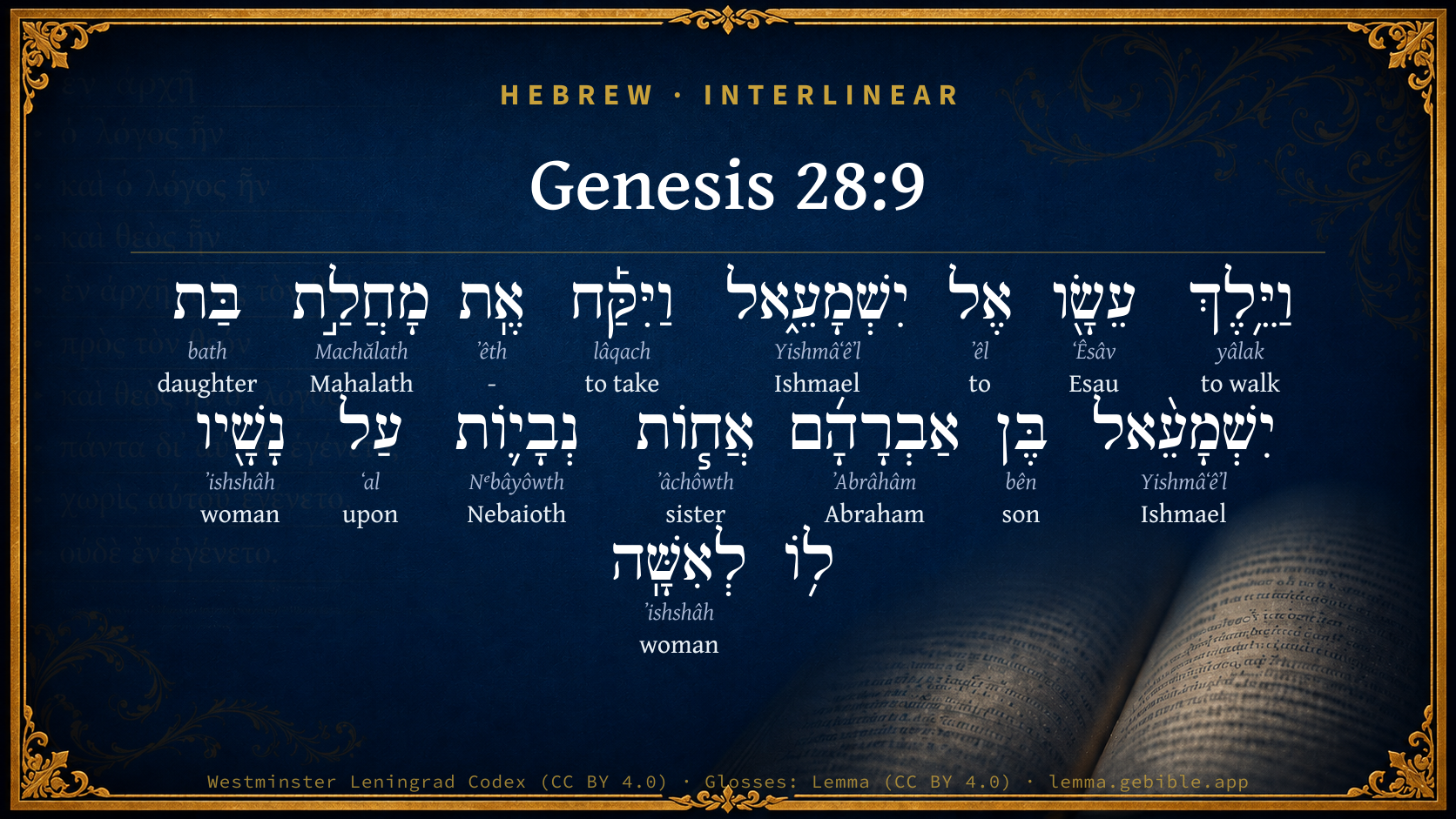
Genesis 28:9

Hebrew (Westminster Leningrad Codex) Genesis 28:9 appears in the Hebrew Old Testament. The text above is from the Westminster Leningrad Codex. Each word links to its Strong’s number, a concise gloss, and parsing drawn from the Open Scriptures Hebrew Bible morphology. Click any word for its full Brown-Driver-Briggs (BDB) entry.
Download image
Cite this verse

Genesis 28:9 (World English Bible). Public Domain. Lemma interlinear Bible study tool, https://lemma.gebible.app/v/genesis/28/9.

Show BibTeX & RIS
BibTeX
RIS
English Translation
Esau went to Ishmael, and took, besides the wives that he had, Mahalath the daughter of Ishmael, Abraham's son, the sister of Nebaioth, to be his wife.
World English Bible · Public Domain
Highlights
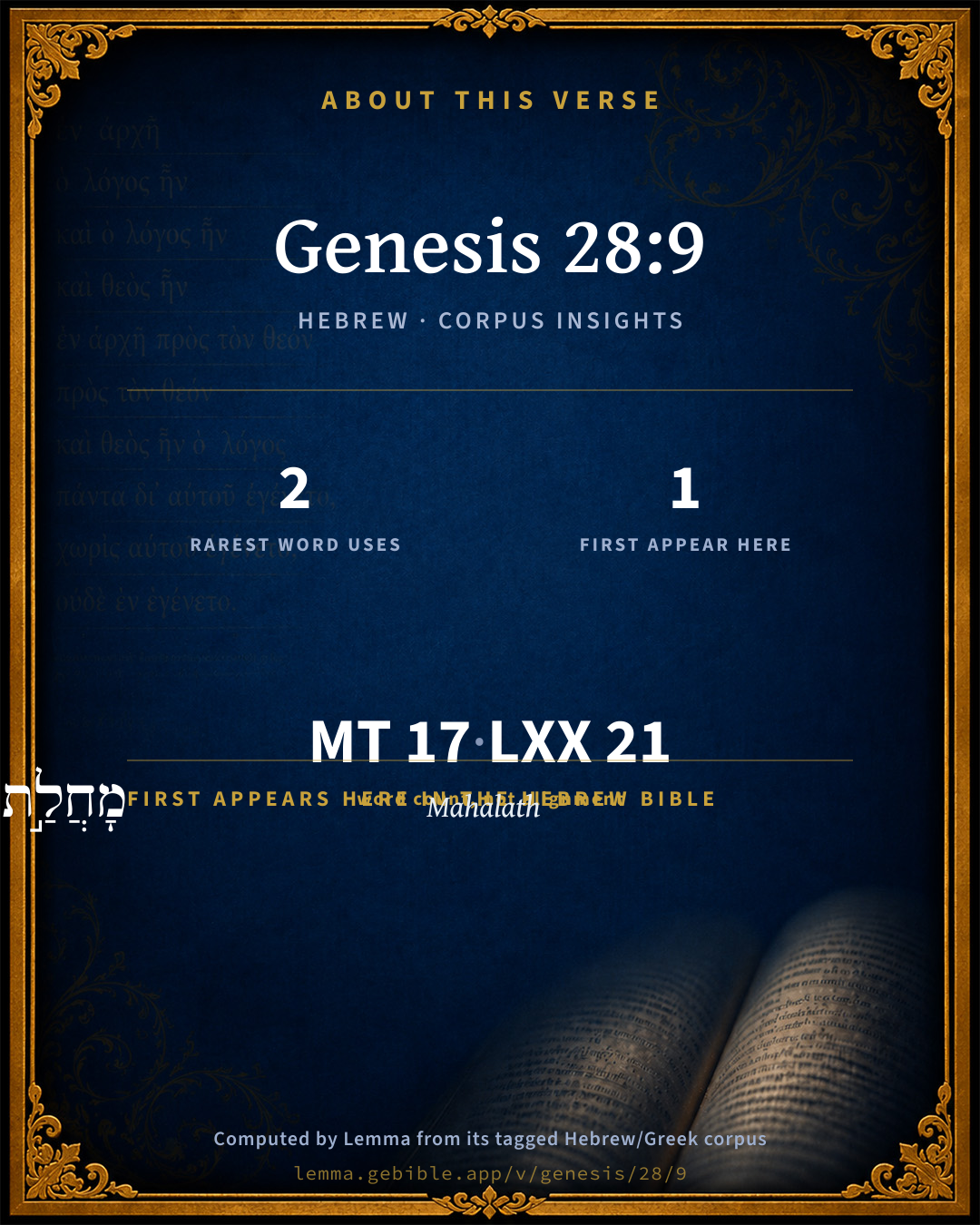
  • 1 first appearance in the Hebrew Bible
Full analysis ↓
Download a study sheet

One document with this verse’s original text, its word-by-word gloss line, the meaning frame, cross-references with their text, attributed commentary, and full source and license credits — printable, and it pastes into notes with its structure intact.

This verse Autodidact and up

Study sheet (.html) Plain text (.txt)

A passage Seminary Student

Up to 50 verses in one chapter. A passage sheet keeps up to 6 commentary sources and 12 cross-references per verse, in the order this page ranks them, and says so on the sheet whenever that leaves anything out. Ask for a single verse and you get the Autodidact verse sheet above.

Everything on this page stays free to read, with no account — the sheet is a download of what is already on screen, not access to it.

Want to remove ads? Support Godless Engineer
Compare translations 3

The same verse in 3 English versions, stacked beneath the original-language interlinear above. Click any original word for its lexicon entry.

Each is an independent rendering of the whole verse — the interlinear is not word-aligned to these translations.

Highlighted words mark where these versions differ — a whole-verse word diff, not a word-by-word alignment.

  • World English Bible Public Domain
    Esau went to Ishmael, and took, besides the wives that he had, Mahalath the daughter of Ishmael, Abraham's son, the sister of Nebaioth, to be his wife.
  • King James Version Public Domain
    Then went Esau unto Ishmael, and took unto the wives which he had Mahalath the daughter of Ishmael Abraham's son, the sister of Nebajoth, to be his wife.
  • unfoldingWord Literal Text CC BY-SA 4.0
    So Esau went to Ishmael and he took as a wife Mahalath, the daughter of Ishmael, Abraham’s son, the sister of Nebaioth, in addition to his wives to him. Jacob’s Dream at Bethel 28:10-22

unfoldingWord Literal Text — © unfoldingWord, licensed CC BY-SA 4.0. Word-aligned USFM3 via Door43 (git.door43.org/unfoldingWord/en_ult).

Versions to compare (up to 4)

3 of 4 selected

Show all 18 translations

Every available English version of this verse, each an independent rendering of the whole verse.

  • World English Bible Public Domain
    Esau went to Ishmael, and took, besides the wives that he had, Mahalath the daughter of Ishmael, Abraham's son, the sister of Nebaioth, to be his wife.
  • Berean Standard Bible Public Domain
    Esau went to Ishmael and married Mahalath, the sister of Nebaioth and daughter of Abraham’s son Ishmael, in addition to the wives he already had.
  • Majority Standard Bible Public Domain
    Esau went to Ishmael and married Mahalath, the sister of Nebaioth and daughter of Abraham’s son Ishmael, in addition to the wives he already had.
  • King James Version Public Domain
    Then went Esau unto Ishmael, and took unto the wives which he had Mahalath the daughter of Ishmael Abraham's son, the sister of Nebajoth, to be his wife.
  • American Standard Version (1901) Public Domain
    And Esau went unto Ishmael, and took, besides the wives that he had, Mahalath the daughter of Ishmael Abraham's son, the sister of Nebaioth, to be his wife.
  • Revised Version (1885) Public Domain
    and Esau went unto Ishmael, and took unto the wives which he had Mahalath the daughter of Ishmael Abraham’s son, the sister of Nebaioth, to be his wife.
  • Geneva Bible (1599) Public Domain
    Then went Esau to Ishmael, and tooke vnto the wiues, which he had, Mahalath the daughter of Ishmael Abrahams sonne, the sister of Nabaioth, to be his wife.
  • Douay-Rheims (1899) Public Domain
    He went to Ismael, and took to wife, besides them he had before, Maheleth the daughter of Ismael, Abraham's son, the sister of Nabajoth.
  • Young's Literal Translation Public Domain
    and Esau goeth unto Ishmael, and taketh Mahalath, daughter of Ishmael, Abraham's son, sister of Nebajoth, unto his wives, to himself, for a wife.
  • Literal Standard Version CC BY-SA 4.0
    and Esau goes to Ishmael, and takes Mahalath, daughter of Ishmael, Abraham’s son, sister of Nebajoth, to his wives, to himself, for a wife.
  • Unlocked Literal Bible CC BY-SA 4.0
    So he went to Ishmael, and took, besides the wives that he had, Mahalath the daughter of Ishmael, Abraham's son, the sister of Nebaioth, to be his wife.
  • unfoldingWord Literal Text CC BY-SA 4.0
    So Esau went to Ishmael and he took as a wife Mahalath, the daughter of Ishmael, Abraham’s son, the sister of Nebaioth, in addition to his wives to him. Jacob’s Dream at Bethel 28:10-22
  • Darby Bible Public Domain
    And Esau went to Ishmael, and took, besides the wives that he had, Mahalath the daughter of Ishmael Abraham's son, the sister of Nebaioth, to be his wife.
  • World Messianic Bible Public Domain
    So Esau went to Ishmael, and took, in addition to the wives that he had, Mahalath the daughter of Ishmael, Abraham’s son, the sister of Nebaioth, to be his wife.
  • Webster's Bible Public Domain
    Then went Esau to Ishmael, and took to the wives which he had, Mahalath the daughter of Ishmael Abraham's son, the sister of Nebajoth, to be his wife.
  • Free Bible Version CC BY-SA 4.0
    So he went to Ishmael's family and married an additional wife—Mahalath, the daughter of Ishmael, Abraham's son, the sister of Nebaioth.
  • Bible in Basic English Public Domain
    So Esau went to Ishmael and took Mahalath, the daughter of Abraham's son Ishmael, the sister of Nebaioth, to be his wife in addition to the wives he had.
  • JPS Tanakh (1917) Public Domain
    so Esau went unto Ishmael, and took unto the wives that he had Mahalath the daughter of Ishmael Abraham's son, the sister of Nebaioth, to be his wife.

Literal Standard Version (2020), Covenant Press — licensed CC BY-SA 4.0. Text via the HelloAO Bible API (eBible.org). Unlocked Literal Bible (unfoldingWord) — licensed CC BY-SA 4.0. Text via the HelloAO Bible API (eBible.org). unfoldingWord Literal Text — © unfoldingWord, licensed CC BY-SA 4.0. Word-aligned USFM3 via Door43 (git.door43.org/unfoldingWord/en_ult). Free Bible Version, Dr. Jonathan Gallagher — licensed CC BY-SA 4.0. Text via the HelloAO Bible API (eBible.org).

Word by word

More ways to search: Search by grammar → Find every occurrence → Compare this word →

Practice this passage: Drill this verse → Learn its vocabulary →

מָחֲלַ֣ת
Machălath
H4258
“Mahalath”
Noun, Proper
Part of Speech
Noun
Type
Proper
Full BDB Definition

Origin: the same as H4257

TWOT: None

Mahalath = "stringed instrument" - daughter of Jerimoth son of king David and wife, evidently the - daughter of Ishmael and wife of Esau
  1. וַיֵּ֥לֶךְ yâlak H3212 “and · to walk” Conjunction + Verb, Qal, Sequential Imperfect, 3rd Person, Masculine, Singular
  2. עֵשָׂ֖ו ʻÊsâv H6215 “Esau” Noun, Proper
  3. אֶל ʼêl H413 “to” Preposition
  4. יִשְׁמָעֵ֑אל Yishmâʻêʼl H3458 “Ishmael” Noun, Proper
  5. וַיִּקַּ֡ח lâqach H3947 “and · to take” Conjunction + Verb, Qal, Sequential Imperfect, 3rd Person, Masculine, Singular
  6. אֶֽת ʼêth H853 “-” Particle, Direct Object
  7. בַּת bath H1323 “daughter of” Noun, Common, Feminine, Singular, Construct
  8. יִשְׁמָעֵ֨אל Yishmâʻêʼl H3458 “Ishmael” Noun, Proper
  9. בֶּן bên H1121 “son of” Noun, Common, Masculine, Singular, Construct
  10. אַבְרָהָ֜ם ʼAbrâhâm H85 “Abraham” Noun, Proper
  11. אֲח֧וֹת ʼâchôwth H269 “sister of” Noun, Common, Feminine, Singular, Construct
  12. נְבָי֛וֹת Nᵉbâyôwth H5032 “Nebaioth” Noun, Proper
  13. עַל ʻal H5921 “upon” Preposition
  14. נָשָׁ֖יו ʼishshâh H802 “women · his” Noun, Common, Feminine, Plural, Construct + Suffix, Personal, 3rd Person, Masculine, Singular
  15. לְאִשָּֽׁה ʼishshâh H802 “to/for · woman” Preposition + Noun, Common, Feminine, Singular, Absolute

About this verse

These counts appear in no published source. They are computed here, from the morphology-tagged text and Lemma’s own curated glosses. What Lemma adds →

17
words
14
distinct lemmas
Pentateuch
section

Notable vocabulary

The rarest word here is מָחֲלַ֣ת Mahalath H4258 — appearing just 2 times in the whole Hebrew Bible.

First appearance in Scripture

This word makes its first canonical appearance in the Hebrew Bible here:

  • מָחֲלַ֣ת Mahalath H4258

Shared distinctive vocabulary

מָחֲלַ֣ת Mahalath H4258 occurs in 2 verses of the Hebrew Bible. Also found in:

Grammatical profile

  • 2 verbs
  • 11 nouns
  • 3 prepositions
  • 1 particle

Verb forms

  • וַיֵּ֥לֶךְ Qal · Sequential Imperfect
  • וַיִּקַּ֡ח Qal · Sequential Imperfect

Repetition

Words recur within this verse — often emphatic in Hebrew:

  • יִשְׁמָעֵ֑אל Ishmael H3458 ×2
  • נָשָׁ֖יו woman H802 ×2

Hebrew & Septuagint length

In English translation the verse runs 27 words from the Hebrew and 27 from the Septuagint (LXX English) — the same length.

A rough comparison of the two English renderings, which tokenize alike — not a word-level alignment.

Word counts can differ between the Hebrew and the Greek without any difference in meaning — e.g. the Hebrew direct-object marker אֵת has no separate Greek word, and Greek often adds the article ὁ.

In the original languages it is 17 Hebrew tokens and 21 Greek tokens — but the two are counted differently (Hebrew bundles its prefixes and suffixes into one token; the Greek is in lemma form), so that isn’t a like-for-like length.

Cross-references

5

Topical passages linked to Genesis 28:9 in the Treasury of Scripture Knowledge — connected by theme and wording, ordered by reader-vote popularity; previews shown in the World English Bible.

  • Genesis 36:3 and Basemath, Ishmael's daughter, sister of Nebaioth.
  • Genesis 25:13–17 These are the names of the sons of Ishmael, by their names, according to the order of their birth: the firstborn of Ishmael, Nebaioth, then Kedar, Adbeel, Mibsam,
  • Genesis 26:34 When Esau was forty years old, he took as wife Judith, the daughter of Beeri the Hittite, and Basemath, the daughter of Elon the Hittite.
  • Genesis 36:13 These are the sons of Reuel: Nahath, Zerah, Shammah, and Mizzah. These were the sons of Basemath, Esau's wife.
  • Genesis 36:18 These are the sons of Oholibamah, Esau's wife: chief Jeush, chief Jalam, chief Korah: these are the chiefs who came of Oholibamah the daughter of Anah, Esau's wife.

Cross-references courtesy of OpenBible.info (CC BY 4.0).

Hebrew and Greek witnesses Masoretic Hebrew ↔ Greek Septuagint

The same verse in the two great witnesses to the Old Testament, shown verse-for-verse.

These are two independent witnesses, not word-aligned to each other, and the Septuagint is shown in lemma (dictionary) form.

Hebrew Genesis 28:9 Masoretic · Westminster Leningrad Codex

וַיֵּ֥לֶךְ עֵשָׂ֖ו אֶל יִשְׁמָעֵ֑אל וַיִּקַּ֡ח אֶֽת מָחֲלַ֣ת בַּת יִשְׁמָעֵ֨אל בֶּן אַבְרָהָ֜ם אֲח֧וֹת נְבָי֛וֹת עַל נָשָׁ֖יו ל֥וֹ לְאִשָּֽׁה

Esau went to Ishmael, and took, besides the wives that he had, Mahalath the daughter of Ishmael, Abraham's son, the sister of Nebaioth, to be his wife.

World English Bible · Public Domain

Greek LXX Genesis 28:9 Septuagint · lemma form

καί πορεύομαι ησαυ πρός ισμαηλ καί λαμβάνω ὁ μαελεθ θυγάτηρ ισμαηλ ὁ υἱός αβρααμ ἀδελφή ναβαιωθ πρός ὁ γυνή αὐτός γυνή

Esau went to Ismael, and took Maeleth the daughter of Ismael, the son of Abraam, the sister of Nabeoth, a wife in addition to his other wives.

LXX2012 (modern English Septuagint) · Public Domain

Hebrew: Westminster Leningrad Codex (CC BY 4.0). Greek: Septuagint (public domain); English from LXX2012 (modern English Septuagint) (Public Domain). How the Septuagint differs from the Hebrew →

Targum (Aramaic paraphrase)

2

The Targum is the ancient Jewish Aramaic paraphrase of the Hebrew Scriptures — an interpretive translation, not the Hebrew text itself. Onkelos (literal) and Pseudo-Jonathan (expansive) render the Torah, and Jonathan the Prophets. Coverage is partial: where no permissively-licensed English translation exists for a verse, only the Aramaic is shown. This is verse-level text, not a word-by-word alignment to the Hebrew.

  1. Targum Onkelos Torah (Genesis–Deuteronomy)
    וַאֲזַל עֵשָׂו לְוַת יִשְׁמָעֵאל וּנְסִיב יָת מַחֲלַת בַּת יִשְׁמָעֵאל בַּר אַבְרָהָם אֲחָתֵהּ דִּנְבָיוֹת עַל נְשׁוֹהִי לֵהּ לְאִנְתּוּ: ססס

    (no public-domain English translation for this verse)

    Targum Onkelos — Aramaic: “Onkelos Genesis” (public domain); “Onkelos Exodus” (public domain); “Onkelos Leviticus” (public domain); “Onkelos Numbers” (public domain); “Onkelos Deuteronomy” (public domain). English: “Sefaria Community Translation” (CC0 1.0 (public-domain dedication)); “J.W. Etheridge. The Targums of Onkelos and Jonathan Ben Uzziel on the Pentateuch. London: Longmans, Green, 1862” (public domain). Text via Sefaria.

  2. Targum Pseudo-Jonathan Torah (Genesis–Deuteronomy)
    וַאֲזַל עֵשָו לְוַת יִשְׁמָעֵאל וּנְסֵיב יַת מָחֲלַת הִיא בָּשְמַת בַּת יִשְׁמָעֵאל בַּר אַבְרָהָם אַחֲתֵיהּ דִנְבָיוֹת מִן אִמֵיהּ עַל נְשׁוֹי לֵיהּ לְאִנְתּוּ

    and Esau went unto Ishmael, and took to wife Mahalath, who is Besemath the daughter of Ishmael bar Abraham, the sister of Nebaioth from his mother, besides his other wives.

    Targum Pseudo-Jonathan — Aramaic: “Targum Jonathan on Genesis” (public domain); “Targum Jonathan on Exodus” (public domain); “Targum Jonathan on Leviticus” (public domain); “Targum Jonathan on Numbers” (public domain); “Targum Jonathan on Deuteronomy” (public domain). English: “The Targum of Jonathan ben Uzziel, trans. J. W. Etheridge, London, 1862” (public domain). Text via Sefaria.

Commentary

Notes on Genesis 28:9 from classic Christian and Jewish commentators (each source and its license shown beneath its notes). The classic Christian expositions comment on the surrounding passage and are grouped to its opening verse, so a note may address several verses; the Jewish commentaries on the Tanakh (Rashi and others) are per-verse, so they appear only where the commentator wrote on this verse.

Lemma curates 59 commentaries, every one of them public domain or Creative Commons licensed, each selected and text-cleaned for this edition rather than reprinted as found. About our sources →

Trapp's Complete Commentary

John Trapp

Gen 28:9 Then went Esau unto Ishmael, and took unto the wives which he had Mahalath the daughter of Ishmael Abraham’s son, the sister of Nebajoth, to be his wife.

Ver. 9. Then went Esau unto Ishmael.] Stulta haec fuit κακοζηλια, et hypocrisis , saith Pareus rightly. Apes will be imitating men: spiders have their webs, and wasps their honeycombs. Hypocrites will needs do something, that they may seem to be somebody: but, for want of an inward principle, they do nothing well: they amend one error with another, as Esau here; and as Herod prevents perjury by murder. Thus, while they shun the sands, they rush upon the rocks, and while they keep off the shallows, they fall into the whirlpool. {a} Sed nemo ira perplexus tenetur inter duo vitia, quin exitus pateat absque tertio , saith an ancient.

{a} Incidit in Scyllam, cupiens vitare Charybdim .

John Trapp, A Commentary or Exposition upon All the Books of the Old and New Testament (1647–1656) — public domain. Text from a community e-Sword module.

Joseph Benson's Commentary

Gen 28:9. Esau went unto Ishmael — That is, the family of Ishmael, for Ishmael himself, no doubt, was dead before this time, (see Gen 25:17,) and took Mahalath to be his wife. It is probable that he thought by this means to ingratiate himself with his father, and so to get another and a better blessing. But, alas! he mends one fault by committing another, and taking a third wife, when he had one too many before.

Joseph Benson's Commentary on the Old and New Testaments (1811–1818) — public domain. Text from a community e-Sword module.

Geneva Bible (1599)

Geneva Bible translators

Or, beside his wives.

Thinking hereby to have reconciled himself to his father, but all in vain: for he taketh not away the cause of the evil.

Geneva Bible (1599) marginal notes — public domain. Text via Bolls.life.

Adam Clarke's Commentary

Verse 9. Then went Esau unto Ishmael] Those who are apt to take every thing by the wrong handle, and who think it was utterly impossible for Esau to do any right action, have classed his taking a daughter of Ishmael among his crimes; whereas there is nothing more plain than that he did this with a sincere desire to obey and please his parents. Having heard the pious advice which Isaac gave to Jacob, he therefore went and took a wife from the family of his grandfather Abraham, as Jacob was desired to do out of the family of his maternal uncle Laban. Mahalath, whom he took to wife, stood in the same degree of relationship to Isaac his father as Rachel did to his mother Rebekah. Esau married his father's niece; Jacob married his mother's niece. It was therefore most obviously to please his parents that Esau took this additional wife. It is supposed that Ishmael must have been dead thirteen or fourteen years before this time, and that going to Ishmael signifies only going to the family of Ishmael. If we follow the common computation, and allow that Isaac was now about one hundred and thirty-six or one hundred and thirty-seven years of age, and Jacob seventy-seven, and as Ishmael died in the one hundred and thirty-seventh year of his age, which according to the common computation was the one hundred and twenty-third of Isaac, then Ishmael must have been dead about fourteen years. But if we allow the ingenious reasoning of Mr. Skinner and Dr. Kennicott, that Jacob was at this time only fifty-seven years of age, and Isaac consequently only one hundred and seventeen, it will appear that Ishmael did not die till six years after this period; and hence with propriety it might be said, Esau went unto Ishmael, and took Mahalath the daughter of Ishmael to be his wife. See Clarke on Ge 26:34, &c.

Adam Clarke's Commentary on the Bible (1810–1826) — public domain. Text from a community e-Sword/MySword module.

The Cambridge Bible for Schools and Colleges

gen. ed. J. J. S. Perowne

9. unto the wives] i.e. in addition to Judith and Basemath (Gen_26:34).

Mahalath … the sister of Nebaioth] Nebaioth was the firstborn son of Ishmael (Gen_25:13). In Gen_36:3, the name of Ishmael’s daughter, sister of Nebaioth, appears as Basemath. Here she is called Mahalath; while Basemath, in Gen_26:34, is the name of one of Esau’s Hittite wives.

Ishmael is mentioned in this verse as the uncle of Esau. The reference is personal, though it may also denote tribal kinship. According to P’s chronology, it would appear that Ishmael was at this time 114 years old, and lived for 23 years more. Cf. Gen_17:24-25, Gen_25:17; Gen_25:26, Gen_26:34.

The Cambridge Bible for Schools and Colleges (gen. ed. J. J. S. Perowne; Cambridge University Press, 1878–1918) — public domain. Text from a community e-Sword module.

John Gill's Exposition

Then went Esau unto Ishmael,.... Not to Ishmael in person, for he was now dead, Gen 25:17, and had been dead as is reckoned about fourteen years before this, but to the house of Ishmael:

and took unto the wives which he had; the daughters of Heth, and who seem by this to be both alive at this time:

Mahalath the daughter of Ishmael, Abraham's son; the same with Bashemath, Gen 36:3; as the Targum of Jonathan expresses it, this person having two names, and is further described:

the sister of Nebajoth, to be his wife; who was the eldest son of Ishmael, and, his father being dead, was the principal in the family; and this woman Esau took to wife was his sister by his mother's side, as the above Targum expresses, as well as by his father's; whereas he might have other sisters only by his father's side, he having had more wives than one. This Esau seems to have done in order to curry favour with his father, who was displeased with his other wives, and therefore takes one of his father's brother's daughters; but in this he acted an unwise part, on more accounts than one; partly as it was taking to wife the daughter of one that was cast out of his grandfather's house, and had been a persecutor of his father, and therefore not likely to be agreeable to him; and partly as being a daughter of the bondmaid's son: children born of her could not inherit the land promised to Abraham and Isaac.

John Gill's Exposition of the Whole Bible (1746–1763) — public domain (CC PDM 1.0). Text via the HelloAO Bible API.

Haydock's Catholic Bible Commentary

To Ismael’s family; for he had been dead fourteen years. Esau asks no advice. It is doubtful whether he meant to appease or irritate his parents, (Menochius) by this marriage with the daughter of Ismael. She lived with her brother, the head of the Nabutheans, and is called Basemath, chap. xxxvi. 3. (Calmet)

George Leo Haydock (1774–1849), Haydock's Catholic Family Bible and Commentary, 1859 edition — public domain. Excludes Psalms (Douay-Rheims chapter numbering differs from Protestant) and Deuterocanonical books (Catholic canon only).

Matthew Poole's English Annotations

1760

Esau went unto Ishmael; either to his person, or rather to his family, called Ishmael by their father’s name, as David is sometimes put for David’s posterity; for Ishmael seems to have been dead before this, from Gen 25:17, though that may possibly be a prolepsis, and then this may be Ishmael himself.

Mahalath, called also Bashemath, Gen 36:3. He thought by this means to ingratiate himself with his father, and so to get another and a better blessing; but he takes no care to reconcile himself to God, nor observes his hand in the business. Besides, he mends one fault by committing another, and taking a third wife when he had one too many before, and her too he unwisely fetcheth out of that stock which was begotten to bondage, and was utterly uncapable of the inheritance.

Nebajoth was Ishmael’s eldest son, Gen 25:13, who alone is here mentioned, either in the name of all the rest, whose sister she is by consequence supposed to be; or because peradventure she and Nebajoth were Ishmael’s children by the same mother, and the rest by another.

Matthew Poole's English Annotations on the Holy Bible (1683–1685) — public domain. Text from a community e-Sword/MySword module.

Whedon's Commentary on the Bible

Daniel D. Whedon

9. Then went Esau unto Ishmael — That is, unto the family of Ishmael, who, himself, had been dead many years. Gen_25:17. Nebajoth was Ishmael’s firstborn. Gen_25:13. Here we discern, again, in Esau’s action, the wild, impetuous child of nature. He already has two wives and they have borne him children; but noticing how Jacob is blessed, and commanded not to take a Canaanitish wife, he speeds away to marry Ishmael’s daughter.

“Esau is the representative of natural kindliness and honesty, but these qualities are joined to rudeness, and to a want of susceptibility for what is higher. He is void of all anticipation and longing. He is satisfied with what is visible; in short, he is a profane person. Heb_12:16. Such persons, even if grace reaches their hearts, which was not the case with Esau, are not adapted for heading a religious development.” — Hengstenberg.

Daniel D. Whedon (gen. ed.), Commentary on the Old and New Testaments (1874–1909) — public domain. Text from a community e-Sword module.

Scofield Reference Notes

C. I. Scofield

Mahalath

Gen 36:3 is called Bashemath:

The Scofield Reference Bible (1917 edition), notes by C. I. Scofield — public domain. Text from a community e-Sword module.

Rashi

Rabbi Shlomo Yitzchaki (Rashi)

אחות נביות THE SISTER OF NEBAIOTH — By a logical inference from what is stated that she was “the daughter of Ishmael” would I not know that she was the sister of Nebaioth? But the words are added to tell us that Ishmael died after he had betrothed her to Esau and before her marriage, and that her brother Nebaioth gave her away in marriage And we may learn, also, that Jacob was at that period sixty-three years old For Ishmael was seventy-four years old when Jacob was born — since Ishmael was fourteen years older than Isaac, and Isaac was sixty when they (Jacob and Esau) were born, making seventy-four and his (Ishmael’s) years were one hundred and thirty seven — as it is said (25:17) “And these are the years of Ishmael etc.” — consequently when Ishmael died Jacob was sixty-three years old. We learn from this that he (Jacob) concealed himself in Eber’s School for fourteen years and only after that did he proceed to Haran. For before Joseph’s birth he had stayed in Laban’s house only fourteen years, as it is said (31:41) “I served thee fourteen years for thy two daughters and six years for thy flock”, and he received the sheep as wages only after Joseph was born, for it is said (30:25) “And it came to pass when Rachel had borne Joseph etc. [that Jacob wished to leave Laban and he agreed to remain with him on condition of receiving certain sheep as wages]. Now Joseph was thirty years old when he became ruler in Egypt, and from then until the time that Jacob came down to Egypt was nine years — seven of plenty and two of famine — and Jacob then said to Pharaoh (47:9), “The days of the years of my pilgrimage are a hundred and thirty years”. Go and calculate: the fourteen years he passed with Laban before Joseph’s birth, and the thirty years of Joseph’s life before he became ruler and the nine years from when he became ruler until the time that Jacob came to Egypt make fifty three years from the time he joined Laban until the time he came to Egypt But when he parted from his father he was sixty-three years old, as shown above, so that you have 116 years as his age when he came to Egypt, on the assumption that the fifty-three years he spent with Laban etc. began immediately after he had left his father. But he (Jacob) himself said to Pharaoh, “[I am] one hundred and thirty years”. So you see that fourteen years are missing on this assumption. Thus you learn that after he had received the blessings he concealed himself in Eber’ School for fourteen years (Megillah 17a). But he received no punishment for them (these fourteen years) on account of the merit of having studied the Torah in Eber’s School during that period For Joseph was separated from his father only twenty-two years — that is, from the age of seventeen to that of thirty-nine - corresponding to the twenty-two years during which Jacob was separated from his father and could not perform the duty of honouring him (by actively attending to his needs), viz, the twenty years he spent in Laban's house and the two years he passed in travelling home - for it is written (33:17) with regard to his journey homewards, "And Jacob built him a house and made booths for his cattle", and our Rabbis, of blessed memory, inferred (Megillah 17a) from this verse that during his travels he passed eighteen months at Succoth, since a house means a dwelling for the rainy season, and "booths" means for the summer time. And this statement that the study of the Torah protects one from punishment fits in with the calculation which we made above, based upon the Sacred Text, regarding the period from when he left his father until the time when he went down to Egypt at the age of 130 years, where we found a surplus of 14 years, so that he must have been absent from his father for 36 years. But we may regard it as certain that when on his journey to Laban he concealed himself in Eber's house it was for the purpose of studying the Torah with him and that because of the merit of studying the Torah he received no punishment for them (those fourteen years) so that Joseph was separated from him only twenty-two years "measure for measure"(Megillah 17a). Thus far (beginning at "But he received no punishment") is found in an old Rashi text.

על נשיו BESIDES HIS FORMER WIVES — He added wickedness to wickedness for he did not divorce his first wives (Genesis Rabbah 67:13).

Rashi on the Tanakh — English translations: “The Judaica Press complete Tanach with Rashi, translated by A. J. Rosenberg” (CC BY 4.0); “Pentateuch with Rashi's commentary by M. Rosenbaum and A.M. Silbermann, 1929-1934” (public domain); “The Metsudah Tanach series, Lakewood, N.J” (CC BY 4.0); and “The Book of Joshua, Metsudah Publications, 1997” (CC BY 4.0). Text via Sefaria.

Radak

Rabbi David Kimhi (Radak)

וילך...אחות נביות. This Nevayot was an extremely well known personality, and so was his sister. (25,20) Compare also the formulation in Genesis 10,21 which shows that Yaphet was a well known personality.

על נשיו, he married Machalat in addition not instead of his other wives. She was to represent a higher level of spirituality in Esau’s household. His other wives now occupied a socially inferior status.

Radak on the Tanakh — English translations: “Sefaria Community Translation” (CC0 1.0 (public-domain dedication)); “Eliyahu Munk, HaChut Hameshulash” (CC BY 4.0); “Rabbi Mike Feuer, Jerusalem Anthology” (CC BY 4.0); and “R. David Kimhi on the first book of Psalms, Translated by R.G. Finch, London, 1919” (public domain). Text via Sefaria.

Lesson kit

Teaching starters — assembled from the data on this page, not authored interpretation. Every prompt links to the verse data it draws on. Edit before teaching.

Genesis, in the Pentateuch, opens this verse with 17 words (14 distinct Hebrew lemmas). Its most distinctive word is Machălath (“Mahalath”). A historical commentator’s framing appears above. Read the whole chapter for the surrounding context.

Discussion questions

  1. What does “Mahalath” (Machălath) contribute to the verse as a whole?
  2. This is the first place “Mahalath” appears in Scripture (first appears here). What does its debut here establish?
  3. How does 2 Chronicles 11:18, which shares the word «Mahalath», read alongside this verse?
  4. What does the repetition of “Ishmael” (2× in this one verse) do in this verse?
  5. These translations render this verse differently. What is at stake in choosing one wording over another?
  6. «וַיֵּ֥לֶךְ» is a Qal Sequential Imperfect verb. How does that grammatical form shape the action described?
  7. Compare how Trapp's Complete Commentary and Joseph Benson's Commentary read this verse. Where do they agree or differ?

Things to notice

Reading settings

Reading text

Shown beneath each verse's original-language words.

Old Testament
Old Testament edition

Read the OT as the Masoretic Hebrew (MT) or the Greek Septuagint (LXX).

English shown for the Greek Septuagint (in the Hebrew ↔ Greek comparison).

Comparing translations? Open the Compare panel on any verse page to stack up to four side by side.