
Joshua 17:3

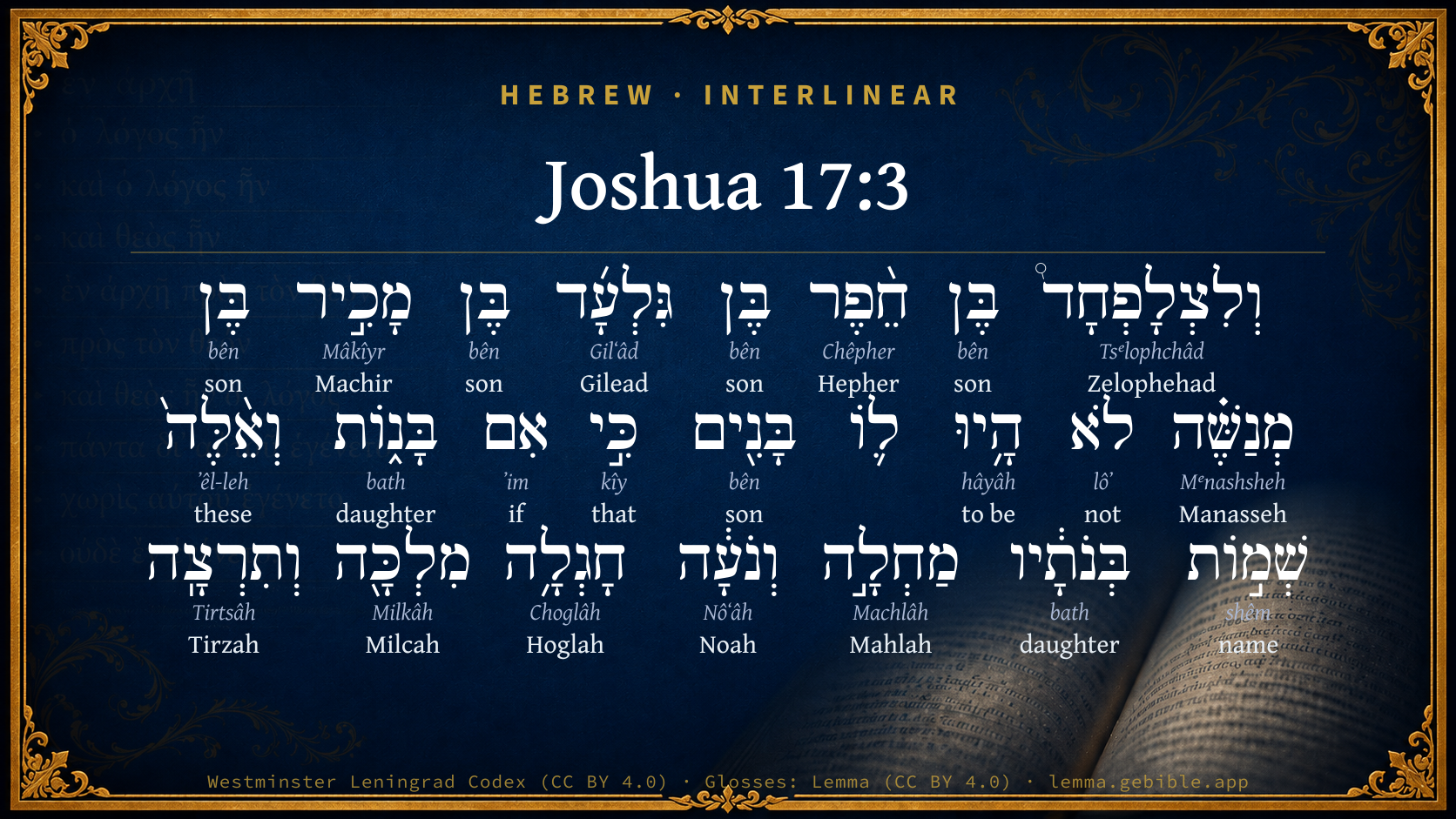
Hebrew (Westminster Leningrad Codex) Joshua 17:3 appears in the Hebrew Old Testament. The text above is from the Westminster Leningrad Codex. Each word links to its Strong’s number, a concise gloss, and parsing drawn from the Open Scriptures Hebrew Bible morphology. Click any word for its full Brown-Driver-Briggs (BDB) entry.
Download image
Cite this verse

Joshua 17:3 (World English Bible). Public Domain. Lemma interlinear Bible study tool, https://lemma.gebible.app/v/joshua/17/3.

Show BibTeX & RIS
BibTeX
RIS
English Translation
But Zelophehad, the son of Hepher, the son of Gilead, the son of Machir, the son of Manasseh, had no sons, but daughters: and these are the names of his daughters: Mahlah, and Noah, Hoglah, Milcah, and Tirzah.
World English Bible · Public Domain
Download a study sheet

One document with this verse’s original text, its word-by-word gloss line, the meaning frame, cross-references with their text, attributed commentary, and full source and license credits — printable, and it pastes into notes with its structure intact.

This verse Autodidact and up

Study sheet (.html) Plain text (.txt)

A passage Seminary Student

Up to 50 verses in one chapter. A passage sheet keeps up to 6 commentary sources and 12 cross-references per verse, in the order this page ranks them, and says so on the sheet whenever that leaves anything out. Ask for a single verse and you get the Autodidact verse sheet above.

Everything on this page stays free to read, with no account — the sheet is a download of what is already on screen, not access to it.

Want to remove ads? Support Godless Engineer
Compare translations 3

The same verse in 3 English versions, stacked beneath the original-language interlinear above. Click any original word for its lexicon entry.

Each is an independent rendering of the whole verse — the interlinear is not word-aligned to these translations.

Highlighted words mark where these versions differ — a whole-verse word diff, not a word-by-word alignment.

  • World English Bible Public Domain
    But Zelophehad, the son of Hepher, the son of Gilead, the son of Machir, the son of Manasseh, had no sons, but daughters: and these are the names of his daughters: Mahlah, and Noah, Hoglah, Milcah, and Tirzah.
  • King James Version Public Domain
    But Zelophehad, the son of Hepher, the son of Gilead, the son of Machir, the son of Manasseh, had no sons, but daughters: and these are the names of his daughters, Mahlah, and Noah, Hoglah, Milcah, and Tirzah.
  • unfoldingWord Literal Text CC BY-SA 4.0
    Now regarding Zelophehad, the son of Hepher, the son of Gilead, the son of Machir, the son of Manasseh, no sons were to him, if not daughters. And these the names of his daughters: Mahlah and Noah, Hoglah, Milkah and Tirzah.

unfoldingWord Literal Text — © unfoldingWord, licensed CC BY-SA 4.0. Word-aligned USFM3 via Door43 (git.door43.org/unfoldingWord/en_ult).

Versions to compare (up to 4)

3 of 4 selected

Show all 18 translations

Every available English version of this verse, each an independent rendering of the whole verse.

  • World English Bible Public Domain
    But Zelophehad, the son of Hepher, the son of Gilead, the son of Machir, the son of Manasseh, had no sons, but daughters: and these are the names of his daughters: Mahlah, and Noah, Hoglah, Milcah, and Tirzah.
  • Berean Standard Bible Public Domain
    But Zelophehad son of Hepher (the son of Gilead, the son of Machir, the son of Manasseh) had no sons but only daughters. These are the names of his daughters: Mahlah, Noah, Hoglah, Milcah, and Tirzah.
  • Majority Standard Bible Public Domain
    But Zelophehad son of Hepher (the son of Gilead, the son of Machir, the son of Manasseh) had no sons but only daughters. These are the names of his daughters: Mahlah, Noah, Hoglah, Milcah, and Tirzah.
  • King James Version Public Domain
    But Zelophehad, the son of Hepher, the son of Gilead, the son of Machir, the son of Manasseh, had no sons, but daughters: and these are the names of his daughters, Mahlah, and Noah, Hoglah, Milcah, and Tirzah.
  • American Standard Version (1901) Public Domain
    But Zelophehad, the son of Hepher, the son of Gilead, the son of Machir, the son of Manasseh, had no sons, but daughters: and these are the names of his daughters: Mahlah, and Noah, Hoglah, Milcah, and Tirzah.
  • Revised Version (1885) Public Domain
    But Zelophehad, the son of Hepher, the son of Gilead, the son of Machir, the son of Manasseh, had no sons, but daughters: and these are the names of his daughters, Mahlah, and Noah, Hoglah, Milcah, and Tirzah.
  • Geneva Bible (1599) Public Domain
    But Zelophehad the sonne of Hephir, the sonne of Gilead, the sonne of Machir, ye sonne of Manasseh, had no sonnes, but daughters: and these are the names of his daughters, Mahlah, and Noah, Hoglah, Milcah and Tirzah:
  • Douay-Rheims (1899) Public Domain
    But Salphaad the son of Hepher the son of Galaad the son of Machir the son of Manasses had no sons, but only daughters: whose names are these, Maala and Noa and Hegla and Melcha and Thersa.
  • Young's Literal Translation Public Domain
    As to Zelophehad, son of Hepher, son of Gilead, son of Machir, son of Manasseh, he hath no children except daughters, and these `are' the names of his daughters: Mahlah, and Noah, Hoglah, Milcah, and Tirzah,
  • Literal Standard Version CC BY-SA 4.0
    As for Zelophehad, son of Hepher, son of Gilead, son of Machir, son of Manasseh, he has no children except daughters, and these [are] the names of his daughters: Mahlah, and Noah, Hoglah, Milcah, and Tirzah,
  • Unlocked Literal Bible CC BY-SA 4.0
    Now Zelophehad son of Hepher son of Gilead son of Makir son of Manasseh had no sons, but only daughters. The names of his daughters were Mahlah, Noah, Hoglah, Milkah, and Tirzah.
  • unfoldingWord Literal Text CC BY-SA 4.0
    Now regarding Zelophehad, the son of Hepher, the son of Gilead, the son of Machir, the son of Manasseh, no sons were to him, if not daughters. And these the names of his daughters: Mahlah and Noah, Hoglah, Milkah and Tirzah.
  • Darby Bible Public Domain
    And Zelophehad, the son of Hepher, the son of Gilead, the son of Machir, the son of Manasseh, had no sons, but daughters; and these are the names of his daughters: Mahlah, and Noah, Hoglah, Milcah, and Tirzah.
  • World Messianic Bible Public Domain
    But Zelophehad, the son of Hepher, the son of Gilead, the son of Machir, the son of Manasseh, had no sons, but daughters. These are the names of his daughters: Mahlah, Noah, Hoglah, Milcah, and Tirzah.
  • Webster's Bible Public Domain
    But Zelophehad, the son of Hepher, the son of Gilead, the son of Machir, the son of Manasseh, had no sons, but daughters: and these are the names of his daughters, Mahlah, and Noah, Hoglah, Milcah, and Tirzah.
  • Free Bible Version CC BY-SA 4.0
    But Zelophehad, son of Hepher, son of Gilead, son of Machir, son of Manasseh, had no sons. He only had daughters, whose names were Mahlah, Noah, Hoglah, Milcah, and Tirzah.
  • Bible in Basic English Public Domain
    But Zelophehad, the son of Hepher, the son of Gilead, the son of Machir, the son of Manasseh, had no sons, but only daughters; and these are the names of his daughters: Mahlah, and Noah, Hoglah, Milcah, and Tirzah.
  • JPS Tanakh (1917) Public Domain
    But Zelophehad, the son of Hepher, the son of Gilead, the son of Machir, the son of Manasseh, had no sons, but daughters; and these are the names of his daughters: Mahlah, and Noah, Hoglah, Milcah, and Tirzah.

Literal Standard Version (2020), Covenant Press — licensed CC BY-SA 4.0. Text via the HelloAO Bible API (eBible.org). Unlocked Literal Bible (unfoldingWord) — licensed CC BY-SA 4.0. Text via the HelloAO Bible API (eBible.org). unfoldingWord Literal Text — © unfoldingWord, licensed CC BY-SA 4.0. Word-aligned USFM3 via Door43 (git.door43.org/unfoldingWord/en_ult). Free Bible Version, Dr. Jonathan Gallagher — licensed CC BY-SA 4.0. Text via the HelloAO Bible API (eBible.org).

Word by word

More ways to search: Search by grammar → Find every occurrence → Compare this word →

Practice this passage: Drill this verse → Learn its vocabulary →

וְנֹעָ֔ה
Nôʻâh
H5270
“and · Noah”
Conjunction + Noun, Proper
Part of Speech
Conjunction + Noun
Type
Proper
Full BDB Definition

Origin: from H5128

TWOT: None

Noah = "motion" - one of the 5 daughters of Zelophehad in the time of the exodus
  1. וְלִצְלָפְחָד֩ Tsᵉlophchâd H6765 “and · to/for · Zelophehad” Conjunction + Preposition + Noun, Proper
  2. בֶּן bên H1121 “son of” Noun, Common, Masculine, Singular, Construct
  3. חֵ֨פֶר Chêpher H2660 “Hepher” Noun, Proper
  4. בֶּן bên H1121 “son of” Noun, Common, Masculine, Singular, Construct
  5. גִּלְעָ֜ד Gilʻâd H1568 “Gilead” Noun, Proper
  6. בֶּן bên H1121 “son of” Noun, Common, Masculine, Singular, Construct
  7. מָכִ֣יר Mâkîyr H4353 “Machir” Noun, Proper
  8. בֶּן bên H1121 “son of” Noun, Common, Masculine, Singular, Construct
  9. מְנַשֶּׁ֗ה Mᵉnashsheh H4519 “Manasseh” Noun, Proper
  10. לֹא lôʼ H3808 “not” Particle, Negative
  11. הָ֥יוּ hâyâh H1961 “to be” Verb, Qal, Perfect, 3rd Person, Common, Plural
  12. בָּנִ֖ים bên H1121 “sons” Noun, Common, Masculine, Plural, Absolute
  13. כִּ֣י kîy H3588 “that” Conjunction
  14. אִם ʼim H518 “if” Conjunction
  15. בָּנ֑וֹת bath H1323 “daughters” Noun, Common, Feminine, Plural, Absolute
  16. וְאֵ֨לֶּה֙ ʼêl-leh H428 “and · these” Conjunction + Pronoun, Demonstrative, Common, Plural
  17. שְׁמ֣וֹת shêm H8034 “names of” Noun, Common, Masculine, Plural, Construct
  18. בְּנֹתָ֔יו bath H1323 “daughters · his” Noun, Common, Feminine, Plural, Construct + Suffix, Personal, 3rd Person, Masculine, Singular
  19. מַחְלָ֣ה Machlâh H4244 “Mahlah” Noun, Proper
  20. חָגְלָ֥ה Choglâh H2295 “Hoglah” Noun, Proper
  21. מִלְכָּ֖ה Milkâh H4435 “Milcah” Noun, Proper
  22. וְתִרְצָֽה Tirtsâh H8656 “and · Tirzah” Conjunction + Noun, Proper

About this verse

These counts appear in no published source. They are computed here, from the morphology-tagged text and Lemma’s own curated glosses. What Lemma adds →

24
words
18
distinct lemmas
Historical
section

Notable vocabulary

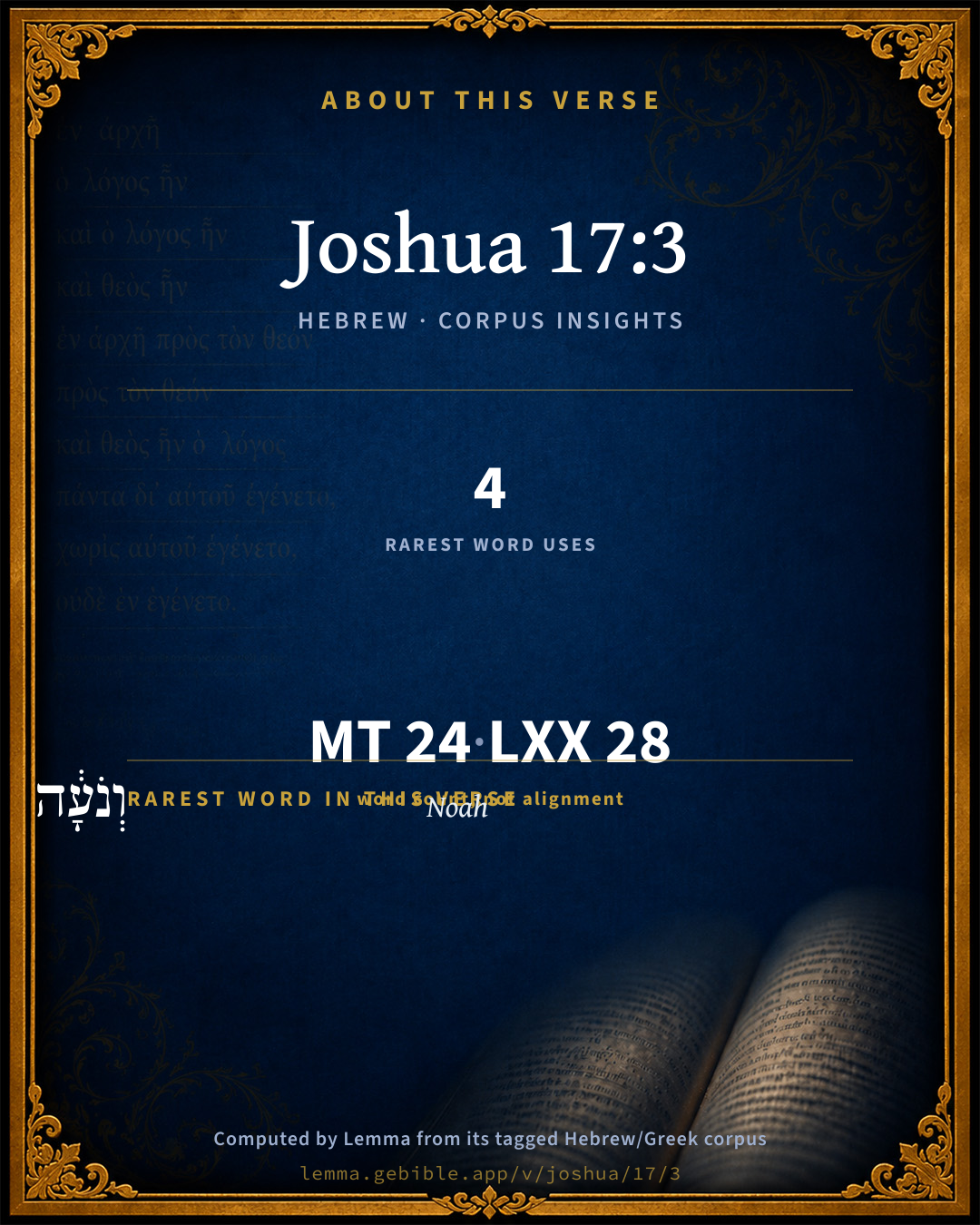
The rarest word here is וְנֹעָ֔ה Noah H5270 — appearing just 4 times in the whole Hebrew Bible.

Shared distinctive vocabulary

וְנֹעָ֔ה Noah H5270 occurs in 4 verses of the Hebrew Bible. Also found in:

Grammatical profile

  • 1 verb
  • 18 nouns
  • 1 pronoun
  • 1 preposition
  • 2 conjunctions
  • 1 particle

Verb forms

  • הָ֥יוּ Qal · Perfect

Repetition

Words recur within this verse — often emphatic in Hebrew:

  • בֶּן son H1121 ×5
  • בָּנ֑וֹת daughter H1323 ×2

Hebrew & Septuagint length

In English translation the verse runs 38 words from the Hebrew and 30 from the Septuagint (LXX English) — closely comparable.

A rough comparison of the two English renderings, which tokenize alike — not a word-level alignment.

Word counts can differ between the Hebrew and the Greek without any difference in meaning — e.g. the Hebrew direct-object marker אֵת has no separate Greek word, and Greek often adds the article ὁ.

In the original languages it is 24 Hebrew tokens and 28 Greek tokens — but the two are counted differently (Hebrew bundles its prefixes and suffixes into one token; the Greek is in lemma form), so that isn’t a like-for-like length.

Cross-references

3

Topical passages linked to Joshua 17:3 in the Treasury of Scripture Knowledge — connected by theme and wording, ordered by reader-vote popularity; previews shown in the World English Bible.

  • Numbers 26:33 Zelophehad the son of Hepher had no sons, but daughters: and the names of the daughters of Zelophehad were Mahlah, and Noah, Hoglah, Milcah, and Tirzah.
  • Numbers 27:1 Then drew near the daughters of Zelophehad, the son of Hepher, the son of Gilead, the son of Machir, the son of Manasseh, of the families of Manasseh the son of Joseph; and these are the names of his daughters: Mahlah, Noah, and Hoglah, and Milcah, and Tirzah.
  • Numbers 36:2–11 and they said, Yahweh commanded my lord to give the land for inheritance by lot to the children of Israel: and my lord was commanded by Yahweh to give the inheritance of Zelophehad our brother to his daughters.

Cross-references courtesy of OpenBible.info (CC BY 4.0).

Hebrew and Greek witnesses Masoretic Hebrew ↔ Greek Septuagint

The same verse in the two great witnesses to the Old Testament, shown verse-for-verse.

These are two independent witnesses, not word-aligned to each other, and the Septuagint is shown in lemma (dictionary) form.

Hebrew Joshua 17:3 Masoretic · Westminster Leningrad Codex

וְלִצְלָפְחָד֩ בֶּן חֵ֨פֶר בֶּן גִּלְעָ֜ד בֶּן מָכִ֣יר בֶּן מְנַשֶּׁ֗ה לֹא הָ֥יוּ ל֛וֹ בָּנִ֖ים כִּ֣י אִם בָּנ֑וֹת וְאֵ֨לֶּה֙ שְׁמ֣וֹת בְּנֹתָ֔יו מַחְלָ֣ה וְנֹעָ֔ה חָגְלָ֥ה מִלְכָּ֖ה וְתִרְצָֽה

But Zelophehad, the son of Hepher, the son of Gilead, the son of Machir, the son of Manasseh, had no sons, but daughters: and these are the names of his daughters: Mahlah, and Noah, Hoglah, Milcah, and Tirzah.

World English Bible · Public Domain

Greek LXX Joshua 17:3 Septuagint · lemma form

καί ὁ σαλπααδ υἱός οφερ οὐ εἰμί αὐτός υἱός ἀλλά ἤ θυγάτηρ καί οὗτος ὁ ὄνομα ὁ θυγάτηρ σαλπααδ μααλα καί νουα καί εγλα καί μελχα καί θερσα

And Salpaad the sons of Opher had no sons but daughters: and these are the names of the daughters of Salpaad; Maala, and Nua, and Egla, and Melcha, and Thersa.

LXX2012 (modern English Septuagint) · Public Domain

Hebrew: Westminster Leningrad Codex (CC BY 4.0). Greek: Septuagint (public domain); English from LXX2012 (modern English Septuagint) (Public Domain). How the Septuagint differs from the Hebrew →

Targum (Aramaic paraphrase)

1

The Targum is the ancient Jewish Aramaic paraphrase of the Hebrew Scriptures — an interpretive translation, not the Hebrew text itself. Onkelos (literal) and Pseudo-Jonathan (expansive) render the Torah, and Jonathan the Prophets. Coverage is partial: where no permissively-licensed English translation exists for a verse, only the Aramaic is shown. This is verse-level text, not a word-by-word alignment to the Hebrew.

  1. Targum Jonathan Prophets (Joshua–Malachi)
    וְלִצְלָפְחָד בַּר חֵפֶר בַּר גִלְעָד בַּר מָכִיר בַּר מְנַשֶׁה לָא הֲווֹ לֵיהּ בְּנִין אֱלָהֵן בְּנָן וְאִלֵין שְׁמָהַת בְּנָתֵיהּ מַחְלָה וְנֹעָה חָגְלָה מִלְכָּה וְתִרְצָה:

    (no public-domain English translation for this verse)

    Targum Jonathan — Aramaic: “Mikraot Gedolot” (public domain). English: “Sefaria Community Translation” (CC0 1.0 (public-domain dedication)); “London "Chaldee Paraphrase," 1871” (public domain). Text via Sefaria.

Commentary

Notes on Joshua 17:3 from classic Christian and Jewish commentators (each source and its license shown beneath its notes). The classic Christian expositions comment on the surrounding passage and are grouped to its opening verse, so a note may address several verses; the Jewish commentaries on the Tanakh (Rashi and others) are per-verse, so they appear only where the commentator wrote on this verse.

Lemma curates 59 commentaries, every one of them public domain or Creative Commons licensed, each selected and text-cleaned for this edition rather than reprinted as found. About our sources →

Trapp's Complete Commentary

John Trapp

Jos 17:3 But Zelophehad, the son of Hepher, the son of Gilead, the son of Machir, the son of Manasseh, had no sons, but daughters: and these [are] the names of his daughters, Mahlah, and Noah, Hoglah, Milcah, and Tirzah.

Ver. 3. But Zelophehad.] These daughters of his are commended by their names, by their masculine faith, and by their modesty in suing for their portion. See their plea and success in Num 27:1-3, &c.

John Trapp, A Commentary or Exposition upon All the Books of the Old and New Testament (1647–1656) — public domain. Text from a community e-Sword module.

Tyndale Open Study Notes

Tyndale Open Resources

17:3-6 In ancient Israel, inheritance usually passed from a father to his sons. Without sons, a man’s name could pass into oblivion. However, Zelophehad’s daughters had petitioned Moses, Moses had inquired of God, and God had ruled that they should inherit their father’s portion (see Num 27:1-11). God’s ruling established a general principle, declaring that no family would be excluded from a portion of God’s material blessings.

Tyndale Open Study Notes — © Tyndale Open Resources, licensed CC BY-SA 4.0. Text via the HelloAO Bible API.

Adam Clarke's Commentary

Verse 3. Zelophehad - had no sons, but daughters] See this case considered at large in the notes on Nu 27:1-7; Nu 36:1, &c.

Adam Clarke's Commentary on the Bible (1810–1826) — public domain. Text from a community e-Sword/MySword module.

The Cambridge Bible for Schools and Colleges

gen. ed. J. J. S. Perowne

3. But Zelophehad] He seems to have been the second son of his father, Hepher. He had been born during the bondage in Egypt, and came out thence with Moses, but died in the wilderness, as did the whole of that generation (Num_14:35; Num_27:3). He died without male heirs.

The Cambridge Bible for Schools and Colleges (gen. ed. J. J. S. Perowne; Cambridge University Press, 1878–1918) — public domain. Text from a community e-Sword module.

John Gill's Exposition

But Zelophehad, the son of Hepher, the son of Gilead, the son of Machir, the son of Manasseh, had no sons, but daughters,.... The descent of this man is particularly given, to show the truth and reality of it, upon which his daughters made their request, and that granted and now claimed:

and these are the names of his daughters, Mahlah, and Noah, Hoglah,

Milcah, and Tirzah; by the same names, and in the same order they are called in Num 26:33; the order is a little different in Num 36:11.

John Gill's Exposition of the Whole Bible (1746–1763) — public domain (CC PDM 1.0). Text via the HelloAO Bible API.

Matthew Poole's English Annotations

No sons, but daughters; of whom see Poole "Num 26:33"; see Poole "Num 27:1".

Matthew Poole's English Annotations on the Holy Bible (1683–1685) — public domain. Text from a community e-Sword/MySword module.

unfoldingWord translationNotes

Door43 World Missions Community

Zelophehad ... Hepher ... Eleazar

These are men's names. (See: How to Translate Names)

Mahlah, Noah, Hoglah, Milkah, and Tirzah

These are women's names. (See: How to Translate Names)

to give to us an inheritance

The land is spoken of as if it were an inheritance that the people received as a permanent possession. AT: "to give to us some land as an inheritance" (See: Metaphor)

he gave those women an inheritance

Possible meanings are 1) "Joshua gave those women an inheritance" or 2) "Eleazar gave those women an inheritance."

translationWords

priest

command

Moses

inherit

brother

ancestor

unfoldingWord translationNotes — © Distant Shores Media and the Door43 World Missions Community, licensed CC BY-SA 4.0. Source: git.door43.org/Door43/en_tn.

Lesson kit

Teaching starters — assembled from the data on this page, not authored interpretation. Every prompt links to the verse data it draws on. Edit before teaching.

Joshua, in the Historical, opens this verse with 24 words (18 distinct Hebrew lemmas). Its most distinctive word is Nôʻâh (“Noah”). A historical commentator’s framing appears above. Read the whole chapter for the surrounding context.

Discussion questions

  1. The word Nôʻâh carries the sense “Noah.” How does it shape the verse?
  2. How does Numbers 26:33, which shares the word «Noah», read alongside this verse?
  3. What does the repetition of “son” (5× in this one verse) do in this verse?
  4. These translations render this verse differently. What is at stake in choosing one wording over another?
  5. «הָ֥יוּ» is a Qal Perfect verb. How does that grammatical form shape the action described?
  6. Compare how Trapp's Complete Commentary and Tyndale Open Study Notes read this verse. Where do they agree or differ?

Things to notice

Reading settings

Reading text

Shown beneath each verse's original-language words.

Old Testament
Old Testament edition

Read the OT as the Masoretic Hebrew (MT) or the Greek Septuagint (LXX).

English shown for the Greek Septuagint (in the Hebrew ↔ Greek comparison).

Comparing translations? Open the Compare panel on any verse page to stack up to four side by side.