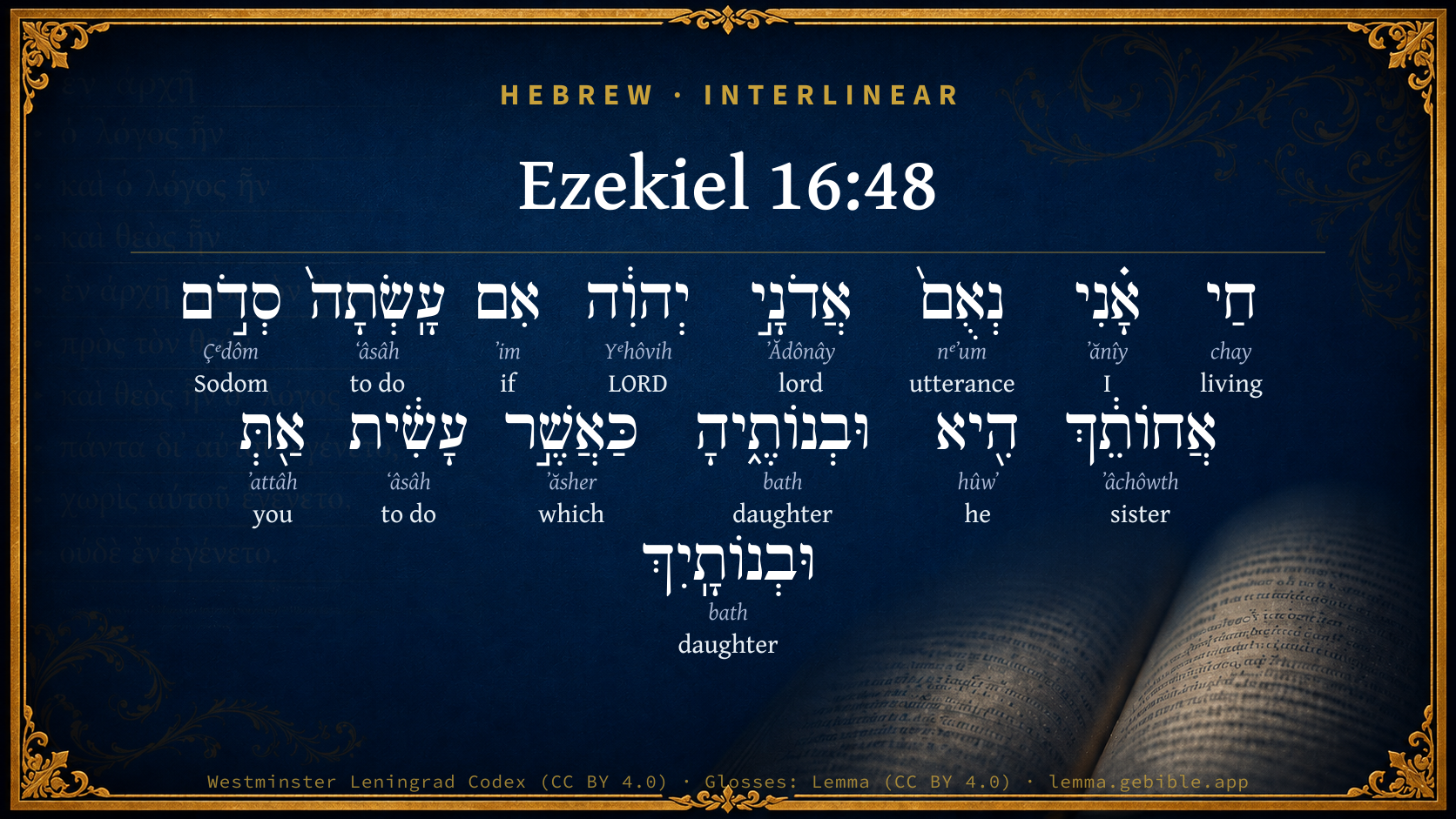
Ezekiel 16:48

Hebrew (Westminster Leningrad Codex) Ezekiel 16:48 appears in the Hebrew Old Testament. The text above is from the Westminster Leningrad Codex. Each word links to its Strong’s number, a concise gloss, and parsing drawn from the Open Scriptures Hebrew Bible morphology. Click any word for its full Brown-Driver-Briggs (BDB) entry.
Download image
Cite this verse

Ezekiel 16:48 (World English Bible). Public Domain. Lemma interlinear Bible study tool, https://lemma.gebible.app/v/ezekiel/16/48.

Show BibTeX & RIS
BibTeX
RIS
English Translation
As I live, says the Lord Yahweh, Sodom your sister has not done, she nor her daughters, as you have done, you and your daughters.
World English Bible · Public Domain
Download a study sheet

One document with this verse’s original text, its word-by-word gloss line, the meaning frame, cross-references with their text, attributed commentary, and full source and license credits — printable, and it pastes into notes with its structure intact.

This verse Autodidact and up

Study sheet (.html) Plain text (.txt)

A passage Seminary Student

Up to 50 verses in one chapter. A passage sheet keeps up to 6 commentary sources and 12 cross-references per verse, in the order this page ranks them, and says so on the sheet whenever that leaves anything out. Ask for a single verse and you get the Autodidact verse sheet above.

Everything on this page stays free to read, with no account — the sheet is a download of what is already on screen, not access to it.

Want to remove ads? Support Godless Engineer
Compare translations 3

The same verse in 3 English versions, stacked beneath the original-language interlinear above. Click any original word for its lexicon entry.

Each is an independent rendering of the whole verse — the interlinear is not word-aligned to these translations.

Highlighted words mark where these versions differ — a whole-verse word diff, not a word-by-word alignment.

  • World English Bible Public Domain
    As I live, says the Lord Yahweh, Sodom your sister has not done, she nor her daughters, as you have done, you and your daughters.
  • King James Version Public Domain
    As I live, saith the Lord GOD, Sodom thy sister hath not done, she nor her daughters, as thou hast done, thou and thy daughters.
  • unfoldingWord Literal Text CC BY-SA 4.0
    As I live—this is the Lord Yahweh’s declaration—your sister Sodom and her daughters, have not done as much evil as you and your daughters have done.

unfoldingWord Literal Text — © unfoldingWord, licensed CC BY-SA 4.0. Word-aligned USFM3 via Door43 (git.door43.org/unfoldingWord/en_ult).

Versions to compare (up to 4)

3 of 4 selected

Show all 18 translations

Every available English version of this verse, each an independent rendering of the whole verse.

  • World English Bible Public Domain
    As I live, says the Lord Yahweh, Sodom your sister has not done, she nor her daughters, as you have done, you and your daughters.
  • Berean Standard Bible Public Domain
    As surely as I live, declares the Lord GOD, your sister Sodom and her daughters never did as you and your daughters have done.
  • Majority Standard Bible Public Domain
    As surely as I live, declares the Lord GOD, your sister Sodom and her daughters never did as you and your daughters have done.
  • King James Version Public Domain
    As I live, saith the Lord GOD, Sodom thy sister hath not done, she nor her daughters, as thou hast done, thou and thy daughters.
  • American Standard Version (1901) Public Domain
    As I live, saith the Lord Jehovah, Sodom thy sister hath not done, she nor her daughters, as thou hast done, thou and thy daughters.
  • Revised Version (1885) Public Domain
    As I live, saith the Lord GOD, Sodom thy sister hath not done, she nor her daughters, as thou hast done, thou and thy daughters.
  • Geneva Bible (1599) Public Domain
    As I liue, saith the Lord God, Sodom thy sister hath not done, neither shee nor her daughters, as thou hast done and thy daughters.
  • Douay-Rheims (1899) Public Domain
    as I live, saith the Lord God, thy sister Sodom herself, and her daughters, have not done as thou hast done, and thy daughters.
  • Young's Literal Translation Public Domain
    I live -- an affirmation of the Lord Jehovah, Sodom thy sister hath not done -- she and her daughters -- As thou hast done -- thou and thy daughters.
  • Literal Standard Version CC BY-SA 4.0
    [As] I live—a declaration of Lord YHWH, || Your sister Sodom has not done—she and her daughters—As you have done—you and your daughters.
  • Unlocked Literal Bible CC BY-SA 4.0
    As I live—this is the Lord Yahweh's declaration—your sister Sodom and her daughters, have not done as much evil as you and your daughters have done.
  • unfoldingWord Literal Text CC BY-SA 4.0
    As I live—this is the Lord Yahweh’s declaration—your sister Sodom and her daughters, have not done as much evil as you and your daughters have done.
  • Darby Bible Public Domain
    [As] I live, saith the Lord Jehovah, Sodom thy sister hath not done, she nor her daughters, as thou hast done, thou and thy daughters!
  • World Messianic Bible Public Domain
    As I live,” says the Lord GOD, “Sodom your sister has not done, she nor her daughters, as you have done, you and your daughters.
  • Webster's Bible Public Domain
    As I live, saith the Lord GOD, Sodom thy sister hath not done, she nor her daughters, as thou hast done, thou and thy daughters.
  • Free Bible Version CC BY-SA 4.0
    As I live, declares the Lord God, your sister Sodom and her daughters didn't ever do what you and your daughters have done.
  • Bible in Basic English Public Domain
    By my life, says the Lord, Sodom your sister never did, she or her daughters, what you and your daughters have done.
  • JPS Tanakh (1917) Public Domain
    As I live, saith the Lord GOD, Sodom thy sister hath not done, she nor her daughters, as thou hast done, thou and thy daughters.

Literal Standard Version (2020), Covenant Press — licensed CC BY-SA 4.0. Text via the HelloAO Bible API (eBible.org). Unlocked Literal Bible (unfoldingWord) — licensed CC BY-SA 4.0. Text via the HelloAO Bible API (eBible.org). unfoldingWord Literal Text — © unfoldingWord, licensed CC BY-SA 4.0. Word-aligned USFM3 via Door43 (git.door43.org/unfoldingWord/en_ult). Free Bible Version, Dr. Jonathan Gallagher — licensed CC BY-SA 4.0. Text via the HelloAO Bible API (eBible.org).

Word by word

More ways to search: Search by grammar → Find every occurrence → Compare this word →

Practice this passage: Drill this verse → Learn its vocabulary →

סְדֹ֣ם
Çᵉdôm
H5467
“Sodom”
Noun, Proper
Part of Speech
Noun
Type
Proper
Full BDB Definition

Origin: from an unused root meaning to scorch

TWOT: 1465

Sodom = "burning" - a Canaanite city, usually paired with Gomorrah, located in the area of the Dead Sea and the Jordan river; both cities destroyed by God in judgment
  1. חַי chay H2416 “living” Adjective, Adjective, Masculine, Singular, Absolute
  2. אָ֗נִי ʼănîy H589 “I” Pronoun, Personal, 1st Person, Common, Singular
  3. נְאֻם֙ nᵉʼum H5002 “utterance of” Noun, Common, Masculine, Singular, Construct
  4. אֲדֹנָ֣י ʼĂdônây H136 “Lord · my” Noun, Common, Masculine, Plural, Construct + Suffix, Personal, 1st Person, Common, Singular
  5. יְהוִ֔ה Yᵉhôvih H3069 “LORD” Noun, Proper
  6. אִם ʼim H518 “if” Conjunction
  7. עָֽשְׂתָה֙ ʻâsâh H6213 “to do” Verb, Qal, Perfect, 3rd Person, Feminine, Singular
  8. אֲחוֹתֵ֔ךְ ʼâchôwth H269 “sister · your” Noun, Common, Feminine, Singular, Construct + Suffix, Personal, 2nd Person, Feminine, Singular
  9. הִ֖יא hûwʼ H1931 “he” Pronoun, Personal, 3rd Person, Feminine, Singular
  10. וּבְנוֹתֶ֑יהָ bath H1323 “and · daughters · her” Conjunction + Noun, Common, Feminine, Plural, Construct + Suffix, Personal, 3rd Person, Feminine, Singular
  11. כַּאֲשֶׁ֣ר ʼăsher H834 “like/as · which” Preposition + Particle, Relative
  12. עָשִׂ֔ית ʻâsâh H6213 “to do” Verb, Qal, Perfect, 2nd Person, Feminine, Singular
  13. אַ֖תְּ ʼattâh H859 “you” Pronoun, Personal, 2nd Person, Feminine, Singular
  14. וּבְנוֹתָֽיִךְ bath H1323 “and · daughters · your” Conjunction + Noun, Common, Feminine, Plural, Construct + Suffix, Personal, 2nd Person, Feminine, Singular

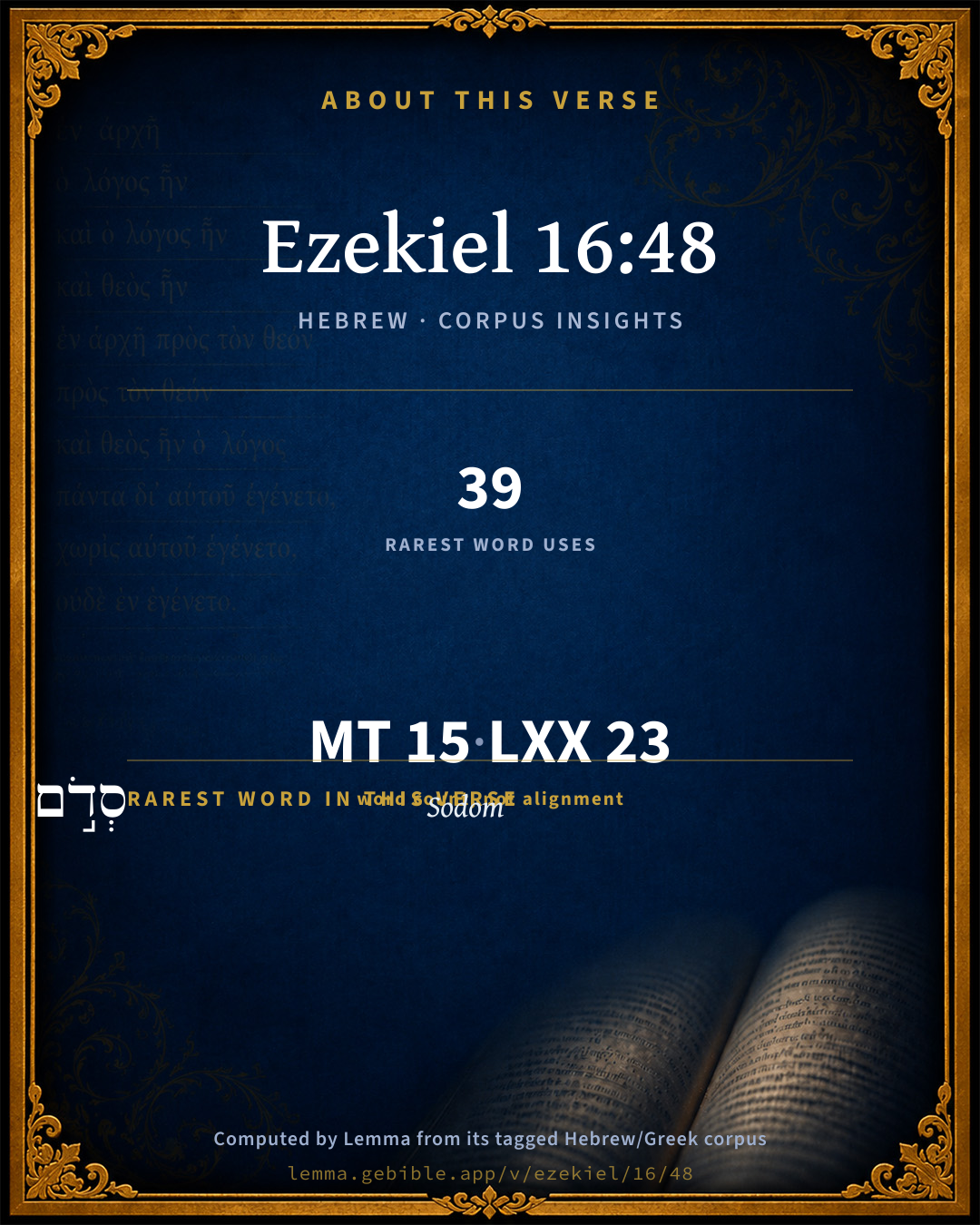
About this verse

These counts appear in no published source. They are computed here, from the morphology-tagged text and Lemma’s own curated glosses. What Lemma adds →

15
words
13
distinct lemmas
Prophets
section

Shared distinctive vocabulary

סְדֹ֣ם Sodom H5467 occurs in 38 verses of the Hebrew Bible. Also found in:

Grammatical profile

  • 2 verbs
  • 7 nouns
  • 1 adjective
  • 3 pronouns
  • 1 conjunction
  • 1 particle

Verb forms

  • עָֽשְׂתָה֙ Qal · Perfect
  • עָשִׂ֔ית Qal · Perfect

Repetition

Words recur within this verse — often emphatic in Hebrew:

  • עָֽשְׂתָה֙ to do H6213 ×2
  • וּבְנוֹתֶ֑יהָ daughter H1323 ×2

Hebrew & Septuagint length

In English translation the verse runs 25 words from the Hebrew and 21 from the Septuagint (LXX English) — closely comparable.

A rough comparison of the two English renderings, which tokenize alike — not a word-level alignment.

Word counts can differ between the Hebrew and the Greek without any difference in meaning — e.g. the Hebrew direct-object marker אֵת has no separate Greek word, and Greek often adds the article ὁ.

In the original languages it is 15 Hebrew tokens and 23 Greek tokens — but the two are counted differently (Hebrew bundles its prefixes and suffixes into one token; the Greek is in lemma form), so that isn’t a like-for-like length.

Cross-references

5

Topical passages linked to Ezekiel 16:48 in the Treasury of Scripture Knowledge — connected by theme and wording, ordered by reader-vote popularity; previews shown in the World English Bible.

  • Matthew 10:15 Most assuredly I tell you, it will be more tolerable for the land of Sodom and Gomorrah in the day of judgment than for that city.
  • Matthew 11:23–24 You, Capernaum, who are exalted to Heaven, you will go down to Hades. For if the mighty works had been done in Sodom which were done in you, it would have remained until this day.
  • Mark 6:11 Whoever will not receive you nor hear you, as you depart from there, shake off the dust that is under your feet for a testimony against them. Assuredly, I tell you, it will be more tolerable for Sodom and Gomorrah in the day of judgment than for that city!"
  • Luke 10:12 I tell you, it will be more tolerable in that day for Sodom than for that city.
  • Acts 7:52 Which of the prophets didn't your fathers persecute? They killed those who foretold the coming of the Righteous One, of whom you have now become betrayers and murderers.

Cross-references courtesy of OpenBible.info (CC BY 4.0).

Hebrew and Greek witnesses Masoretic Hebrew ↔ Greek Septuagint

The same verse in the two great witnesses to the Old Testament, shown verse-for-verse.

These are two independent witnesses, not word-aligned to each other, and the Septuagint is shown in lemma (dictionary) form.

Hebrew Ezekiel 16:48 Masoretic · Westminster Leningrad Codex

חַי אָ֗נִי נְאֻם֙ אֲדֹנָ֣י יְהוִ֔ה אִם עָֽשְׂתָה֙ סְדֹ֣ם אֲחוֹתֵ֔ךְ הִ֖יא וּבְנוֹתֶ֑יהָ כַּאֲשֶׁ֣ר עָשִׂ֔ית אַ֖תְּ וּבְנוֹתָֽיִךְ

As I live, says the Lord Yahweh, Sodom your sister has not done, she nor her daughters, as you have done, you and your daughters.

World English Bible · Public Domain

Greek LXX Ezekiel 16:48 Septuagint · lemma form

ζάω ἐγώ λέγω κύριος εἰ ποιέω σοδομα ὁ ἀδελφή σύ αὐτός καί ὁ θυγάτηρ αὐτός ὅς τρόπος ποιέω σύ καί ὁ θυγάτηρ σύ

As I live, says the Lord, this Sodom and her daughters have not done as you and your daughters have done.

LXX2012 (modern English Septuagint) · Public Domain

Hebrew: Westminster Leningrad Codex (CC BY 4.0). Greek: Septuagint (public domain); English from LXX2012 (modern English Septuagint) (Public Domain). How the Septuagint differs from the Hebrew →

Targum (Aramaic paraphrase)

1

The Targum is the ancient Jewish Aramaic paraphrase of the Hebrew Scriptures — an interpretive translation, not the Hebrew text itself. Onkelos (literal) and Pseudo-Jonathan (expansive) render the Torah, and Jonathan the Prophets. Coverage is partial: where no permissively-licensed English translation exists for a verse, only the Aramaic is shown. This is verse-level text, not a word-by-word alignment to the Hebrew.

  1. Targum Jonathan Prophets (Joshua–Malachi)
    קַיָם אֲנָא אֲמַר יְיָ אֱלֹהִים אִם עַבְדַת סְדוֹם אֲחָתִיךְ הִיא וְכַפְרָנָהָא כְּמָא דַעֲבַדְתְּ אַתְּ וְכַפְרָנָיִךְ:

    (no public-domain English translation for this verse)

    Targum Jonathan — Aramaic: “Mikraot Gedolot” (public domain). English: “Sefaria Community Translation” (CC0 1.0 (public-domain dedication)); “London "Chaldee Paraphrase," 1871” (public domain). Text via Sefaria.

Commentary

Notes on Ezekiel 16:48 from classic Christian and Jewish commentators (each source and its license shown beneath its notes). The classic Christian expositions comment on the surrounding passage and are grouped to its opening verse, so a note may address several verses; the Jewish commentaries on the Tanakh (Rashi and others) are per-verse, so they appear only where the commentator wrote on this verse.

Lemma curates 59 commentaries, every one of them public domain or Creative Commons licensed, each selected and text-cleaned for this edition rather than reprinted as found. About our sources →

Trapp's Complete Commentary

John Trapp

Eze 16:48 [As] I live, saith the Lord GOD, Sodom thy sister hath not done, she nor her daughters, as thou hast done, thou and thy daughters.

Ver. 48. As I live, saith the Lord God, Sodom thy sister hath not done.] Heb., If Sodom thy sister hath done, &c.; q.d., Then let me never be trusted more. Here, then, is a double oath taken by God, to assure this people that they had outsinned Sodom - a truth that they would not easily assent to. To this day we cannot get men to believe that their natures are so naught, their lives so lewd, their state so dangerous, as the preachers make them. Their hearts are good, their penny good silver, &c. The prophet Isaiah lost his life, say the Rabbis, for calling the rulers of Jerusalem rulers of Sodom, and the people of Judah people of Gomorrah. {Isa 1:10}

John Trapp, A Commentary or Exposition upon All the Books of the Old and New Testament (1647–1656) — public domain. Text from a community e-Sword module.

The Biblical Illustrator

Joseph S. Exell

Eze_16:48-50

Pride, fulness of head, and abundance of idleness.

The conflict in a luxurious age

1. We must be on our guard against the suggestions of pride and self-complacency, by endeavouring to form as humble an estimate as possible of our own powers and works. We cannot better the world but by bettering ourselves. We cannot put down the pride of the generation in which we live, but we can mortify our own.

2. In regard of that danger which arises to the soul from living in plenty and abundance, we can regulate ourselves in our use of meats and drinks and personal indulgence, practising at certain times a holy moderation and abstinence, that we be not overcome of such delights. And as a safeguard to ourselves in this matter, let us remember the poor. It may be said that in our nation no sooner is a case of real suffering made public than contributions flow in on all sides; and yet do our public prints reveal, almost daily, abuses of the very law by which we provide for poor and indigent persons, which ought to bring to our remembrance more keenly than it does that cumulative sin of Sodom and her daughters, Neither did she strengthen the hands of the poor and needy.

3. In regard of the disposition to abundance of idleness, which is increasing, I believe, daily, to which all the incidents of our national prosperity minister, and which must in the end issue in the disturbance of our tranquillity, it is not that you here can do anything to stem that torrent of self-indulgence which is flowing in upon us, especially in the lowest orders, whose tastes are the coarsest, and whose wills through ignorance are the most perverse; but you can resist the tendency to it in yourselves; you can endure this hardness at least, of girding up your loins to do the work which God has appointed for you in the world, as men who believe that it is their duty, required of them by the laws of true religion and sound morality. (T. L. Claughton, M. A.)

The bread of idleness demoralising

Honest work is the best employment for fallen man; and the bread of idleness breeds trouble in those that eat it. This is often illustrated in the luxuriant affluence of tropical vegetation. Mr. Dilke believes that the banana plant is one of the greatest curses of tropical countries, because it will support life with no labour. It grows as a weed, and hangs down its bunches of ripe tempting fruit into your lap as you lie in its cool shade. The terrible results of the plentiful possession of this tree are seen in Ceylon, at Panama, in the coast lands of Mexico, and at Auckland in New Zealand. At Pitcairns island the plantain grove has beaten the missionary from the field; there is much lip Christianity, but no practice to be got from a people who possess the fatal plant. The much-abused cocoanut cannot come near it as a devils agent. Such are the results of eating the bread of idleness. (R. A. Bertram.)

Idle and aimless living

Some time ago I read in a paper of a gentleman being brought up before the magistrate. What was the charge against him? Nothing very serious, you will say. He was found wandering in the fields. He was asked where he was going, and he said he was not going anywhere. He was asked where he came from, and he said he did not know. They asked him where his home was, and he said he had none. They brought him up for wandering as what? a dangerous lunatic. The man who has no aim or object in life, but just wanders about anywhere or nowhere, acts like a dangerous lunatic, and assuredly he is not morally sane. What! Am I aiming at nothing? Have I all this machinery of life, making up a vessel more wonderful than the finest steamboat, and am I going nowhere? My heart throbs are the pulsing of a divinely arranged machinery: do they beat for nothing? Do I get up every morning, and go about this world, and work hard, and all for nothing which will last? As a being created of God for noblest purposes, am I spending my existence in a purposeless manner? How foolish! (C. H. Spurgeon.)

Prosperity tests character

The soundness of a vessel is not seen when it is empty, but when it is filled with water, then we shall see whether it will leak or no. (Manton.)

It is in our prosperity that we are tested. Men are not fully discovered to themselves till they are tried by fulness of success. Praise finds out the leak of pride, wealth reveals the flaw of selfishness, and learning discovers the leak of unbelief. Davids besetting sin was little seen in the tracks of the wild goats, but it became conspicuous upon the terraces of his palace. Success is the crucible of character. Hence the prosperity which some welcome as an unmixed favour may far more rightly be regarded as an intense form of test illustrations and meditations. (C. H. Spurgeon.)

The folly and danger of pride

I. The sinfulness and danger of pride.

1. Pride is, as far as we know, the first sin that ever was committed. It seems to have been the leading transgression in the defection of fallen angels.

2. Pride renders persons, in a special manner, hateful and abominable in the sight of God (Pro_8:13; Jam_4:6; 1Pe_5:5).

3. Pride is productive of other sins. Hence springs covetousness (Hab_2:5), persecution (Psa_10:2), strifes and quarrels (Pro_13:10).

4. Pride is a destructive sin. It is a presage of the ruin of those in whom it reigns (Pro_16:18). It produces shame (Pro_11:2). Sodom (Gen_19:24-25). Haughty Pharaoh and his hosts (Exo_14:27-28). Haman (Est_7:10). Nebuchadnezzar (Dan_4:32-33). Herod (Act_12:23).

II. Some remedies against it.

1. Endeavour to acquire the knowledge of your own meanness and sinfulness, and of the holiness and majesty of God; for by comparing yourselves with Him you will sink into nothing in your own esteem.

2. Be persuaded of the excellency of humility, the grace opposite to pride, and be clothed with it (1Pe_5:5).

3. Consider well the examples of humility set before you in the sacred Scriptures. Abraham, Jacob, David, Agur, Paul, and many others; yea, the holy angels fall down before the throne in lowest adoration; but, above all, the example of Jesus Christ (Php_2:5).

4. Understand that all your natural and acquired abilities are the gifts of God. Talents intrusted to your care and management (1Co_4:7). (Pulpit Assistant.)

Idlers

I. Idlers are generally careless. It is said that a stitch in time saves nine. But the idler seldom takes the stitch in time. He is careless in his habits, careless over his soul, and careless about everything. An idle man thinks any way of doing a thing will do if it gets done. He has not sufficient interest to take pains with his work. Whatever you do for Christ, do it well; because God sees your work. He not only looks on the work of stupendous magnitude which is being done by an angel; but He also sees you at your post of deacon and helper and teacher and visitor.

II. Idlers are often sinful. Experience proves this. An English proverb tells us that, An idle brain is the devils workshop,--and it is confirmed by an old Latin proverb, which says, Evil thoughts intrude in an unemployed mind as naturally as worms generate in a stagnant pond. Let me show how idle Christians become sinful. You join a church, but that is all you do for Christ; you never speak a word to the perishing, never visit the sick. Your soul is an empty spiritual house, which the devil uses as a purified workshop where he invents sinful thoughts and wicked actions.

III. Idlers are always miserable. Another old English proverb tells us that, The used key is always bright. But the key which hangs on the nail soon becomes rusted. And your soul will soon rust unless you employ it in good work. Do not allow yourself to be even for only half an hour without finding something useful to do.

IV. Idlers soon tire of work. Some people only pray when they are compelled by misfortune. They soon tire of what is to them the task of prayer. An idle prayer gets nothing; it is like a rusted sword.

V. Idlers always mean well.

VI. Idlers are often of a kindly disposition. They are too lazy to be angry. But they are always ready to do a good turn, if it does not last too long. Christians belong to a life-saving institution. What would you think of the lifeboat men if they sat smoking their pipes the shore when there was a wreck crowded with human beings at the entrance of the harbour? Christians, there are human wrecks about! Come to the rescue! (W. Birch.)

Idleness

Of the various evils to which mankind are subject, few steal upon the soul with such fatal security, and deprive us at once of dignity, of happiness, and virtue, as Idleness. To active crimes that annoy the peace of others, even the most hardened sinner is forced to be awake; but against the still, corroding vices of the heart, that chiefly affect ourselves, we are seldom guarded, except by the voluntary exercise of our own reason, or the friendly admonitions of others.

1. If we look up to the great Creator, as to the source of all perfections, and contemplate His wisdom and His goodness in His works, we shall find that no living example of Idleness or inactivity is ordained by His Providence. All seem working together, and gradually fulfilling some wise and beneficent purpose, which He has appointed. While the face of nature presents us with this general scene of action, shall man remain, in contradiction to the will of heaven, in the rest and sloth of Idleness? Nothing could degrade him more in that scale of being in which he was intended to hold so distinguished a rank. There are active duties allotted to every human being; and the fulfilling of them with cheerfulness and diligence should form no inconsiderable portion of our happiness. While some are assiduously providing for their own household, by following their respective avocations, others may be engaged in laudable attempts to extend the boundaries of science, and to increase the comforts of social life;--while many are anxiously employed in protecting the helplessness of infancy, and in forming the manners of childhood, a few, whom fortune has placed above these humble duties, might fill the offices of state with advantage; and, by their industry, their virtues, and their wisdom, greatly contribute to the general welfare.

2. In a state of indolence are engendered many evils and many sorrows. Among the lower classes of the community Idleness is productive of misery and guilt in every varied form. The ties of every duty, indeed, will be but slightly felt by him who gives himself up to Idleness. His predominant vice gradually undermines his principles, and spreads licentiousness through his character. If a man of this description have a family, all bred up under the contagious influence of his vices, it is impossible to tell how far and wide the stream of corruption will spread. So much is Idleness to be dreaded in its consequences when it infects the poor. If we consider those of middle life, who might be said to possess the object of Agurs prayer, and to have neither poverty nor riches, we shall perceive the same vice diffusing its miseries. Under the pleasing delusion of comfort and of ease we may observe some quitting the active scenes of life, which habit had rendered familiar, and almost natural, in pursuit of happiness in retirement. But it is not every mind that is formed or prepared for the enjoyment of solitude. A languid discontent and a peevish neglect of ordinary comforts soon lead to sensuality and excess of every kind. Self-indulgence is the last idol of the heart; and the short remnant of life is often divided between the feebleness or pain of disease and the stupors of intoxication. To those who may not be in danger of gross and sensual vices, Idleness still brings with it distresses that ought to be dreaded. If temptation from the body should be resisted, it seldom fails to fasten on the mind. The human frame is so constituted as to require frequent alternations of action and of rest. The animal functions cannot be properly performed without them; and how these affect the mind is well known. It may be remarked, however, that even excess of labour is not so injurious as excess of ease. Idleness, indeed, completely disqualifies us for every rational enjoyment. One chief pleasure in human life is the blessing of repose after fatigue; or the relaxation of amusements, either solitary or social, after labour. But these, to the idle, are like food to one whose appetite is already cloyed.

3. Let me earnestly exhort you, therefore, to guard against a vice, whose pernicious influence is so extensive, and whose consequences ought to be so much dreaded. Whatever be your situation, reason and religion will point out to you some scheme of duties appropriated to it, which it should be at once your interest and pleasure to fulfil. Life abounds also with such frequent opportunities of doing good, or improving time, that no part of the small portion which remains should be squandered away in trifles; for, next to the vice of Idleness, is that of employing time amiss. It is fortunate, indeed, for the generality, that many of the active duties are forced on them by necessity: for those who have it in their power to do what they please, always do the least; and soon find the ardour of voluntary pursuits gradually subside, till it is wholly lost in a passion for pleasure, or the love of ease. (J. Hewlett, B. D.)

The Biblical Illustrator, edited by Joseph S. Exell (c. 1880s–1900s) — public domain. Text from a community e-Sword module.

Jamieson, Fausset & Brown

Robert Jamieson, A. R. Fausset & David Brown

Sodom-- (Mat 11:24). Judah's guilt was not positively, but relatively, greater than Sodom's; because it was in the midst of such higher privileges, and such solemn warnings; a fortiori, the guilt of unbelievers in the midst of the highest of all lights, namely, the Gospel, is the greatest.

Jamieson, Fausset & Brown — Commentary Critical and Explanatory on the Whole Bible (1871) — public domain (CC PDM 1.0). Text via the HelloAO Bible API.

John Calvin's Commentaries

Since what we have lately seen was difficult to be believed, hence God interposes an oath. Nor is it surprising that shame was so despised and cast far away by the Jews, since they were inured to it; and we know how they were swollen with pride, for they always boasted in their adoption and gloried in the name of God. Besides, we know that at this day, if any one accuses a wicked nation, yet it is not so detestable as Sodom, and if he uses this phrase, he inflames all against himself, and causes them to reject his language with indignation. For who will suffer either one city or nation to be compared with Sodom? As far as concerned the Jews, we have said that it was intolerable in them to be fastidious and proud. There was also another reason why they should be indignant at being pronounced worse than the Sodomites: since God had not chosen them as his peculiar treasure in vain and marked them with magnificent titles: you shall be a nation of priests unto me, you shall be my inheritance, and besides, my son — my first-born Israel. (Exodus 19:6, and Exodus 4:22.) We now see how necessary the interposition by oath was to sanction what the Prophet had said. God therefore here swears by himself, because we call him in as a witness and judge when we swear. But he swears by himself or by his life, because, as the Apostle teaches, he has no greater by whom to swear. (Hebrews 6:13.) Whatever it be, he here prostrates all foolish boasting, by which the Jews were puffed up when he swears by himself, that they were worse than Sodom and her daughters. And here also he calls in like manner the smaller cities daughters of Jerusalem. This was very hard upon the Jews, when the Prophet says and often repeats, thy sister Sodom. But he wounds their feelings far more bitterly, that Sodom was just in preference to Jerusalem: this was indeed intolerable, and yet we see that the Holy Spirit by no means indulges them here. Hence we must not regard what the reprobate are able to bear, but they must be treated according to their own disposition, and since they rise fiercely against God, so also are they to be subdued, and, according to the common proverb, “a hard wedge must be formed for a hard knot.” It now follows —

John Calvin's Commentaries (1540-1563) — public domain. Text from the Calvin Translation Society English edition (1840s-50s) via the Christian Classics Ethereal Library (ccel.org). Calvin's coverage is partial (roughly two-thirds of the Bible); uncommented books and verses are honest gaps, never fabricated. The 19th-century editor's footnotes and remarks are omitted so the notes are faithfully Calvin's own voice.

The Cambridge Bible for Schools and Colleges

gen. ed. J. J. S. Perowne

48. Cf. Mat_10:15; Mat_11:24.

The Cambridge Bible for Schools and Colleges (gen. ed. J. J. S. Perowne; Cambridge University Press, 1878–1918) — public domain. Text from a community e-Sword module.

John Gill's Exposition

Behold, this was the iniquity of thy sister Sodom,.... Namely, the first after mentioned, the source and spring of the rest; the causes and means of which are declared; and the same, as is suggested, was the sin of Jerusalem: namely,

pride; which was the sin of the devils, and the cause of their ruin; the sin of our first parents, by which they fell, and destroyed themselves, and their posterity; and is the prevailing, governing, sin of human nature: it has been the ruin of kingdoms and states, of cities and particular persons; a sin hateful to God, and destructive to man:

fulness of bread; the land of Sodom was very fruitful before it was destroyed; it was like the garden of the Lord, Gen 13:10; it brought forth plentifully, so that there was great fulness of provision, of all sorts of food, which is meant by bread: this, considered in itself, was not sinful, but a blessing; it was the Lord's mercy and goodness to them that they had such plenty; but it was their sin that they abused it; luxury and intemperance, eating and drinking to excess, are here meant; which led on to that sin, and kindled the flames of it, and were the fuel to it, which has its name from them; and, besides, this fulness of good things enjoyed by them was the source of their pride, and served to increase that, as before mentioned:

and abundance of idleness was in her and in her daughters; or, "peace of rest" (b); prosperity and ease, security and quietness, at leisure, and without labour; two words are used to express the same thing, and to denote, as Kimchi observes, the abundance of it: sloth and idleness, as they often arise from the goodness and fruitfulness of a country, said fulness of provision, so they are the cause of much sin and wickedness; for, if persons are not employed in some business or another, either of the head or hand, they will be doing evil:

neither did she strengthen the hands of the poor and needy; though she had such abundance of food to supply them with, and so much leisure to attend to their distress; but her pride would not suffer her to do it; and she was too idle and slothful to regard such service; perhaps more is intended than is expressed; that she weakened the hands of the poor and needy, and cruelly oppressed them; which is often done by proud men, in great affluence and at leisure, which they abuse to bad purposes.

(b) "quies otii, vel otium quietas"; so some in Vatablus; "prosperitas otii", Castalio; "tranquillitas quietas", Starckius.

John Gill's Exposition of the Whole Bible (1746–1763) — public domain (CC PDM 1.0). Text via the HelloAO Bible API.

Matthew Poole's English Annotations

As I live; an oath which God often confirms his word by, and certainly that may be believed which the God of truth confirms by his own oath. See this oath explained, Eze 5:11.

Hath not done; hath not equalled thy sins, how little soever thou believest this; the disparity lieth in this, she the less, thou the greater sinner.

Matthew Poole's English Annotations on the Holy Bible (1683–1685) — public domain. Text from a community e-Sword/MySword module.

Lesson kit

Teaching starters — assembled from the data on this page, not authored interpretation. Every prompt links to the verse data it draws on. Edit before teaching.

Ezekiel, in the Prophets, opens this verse with 15 words (13 distinct Hebrew lemmas). Its most distinctive word is Çᵉdôm (“Sodom”). A historical commentator’s framing appears above. Read the whole chapter for the surrounding context.

Discussion questions

  1. The word Çᵉdôm carries the sense “Sodom.” How does it shape the verse?
  2. Genesis 10:19 shares the word «Sodom» with this verse. How do the two illuminate each other?
  3. “to do” occurs 2× in this one verse. What is the effect of the repetition?
  4. The translations on this page render this verse differently — a whole-verse word diff, not a word-by-word alignment. What might account for the different wordings?
  5. The verb «עָֽשְׂתָה֙» is Qal Perfect. How does its form color the action?
  6. Reading how Trapp's Complete Commentary and The Biblical Illustrator read this verse, where do the two commentators agree and where do they part?

Things to notice

Reading settings

Reading text

Shown beneath each verse's original-language words.

Old Testament
Old Testament edition

Read the OT as the Masoretic Hebrew (MT) or the Greek Septuagint (LXX).

English shown for the Greek Septuagint (in the Hebrew ↔ Greek comparison).

Comparing translations? Open the Compare panel on any verse page to stack up to four side by side.