
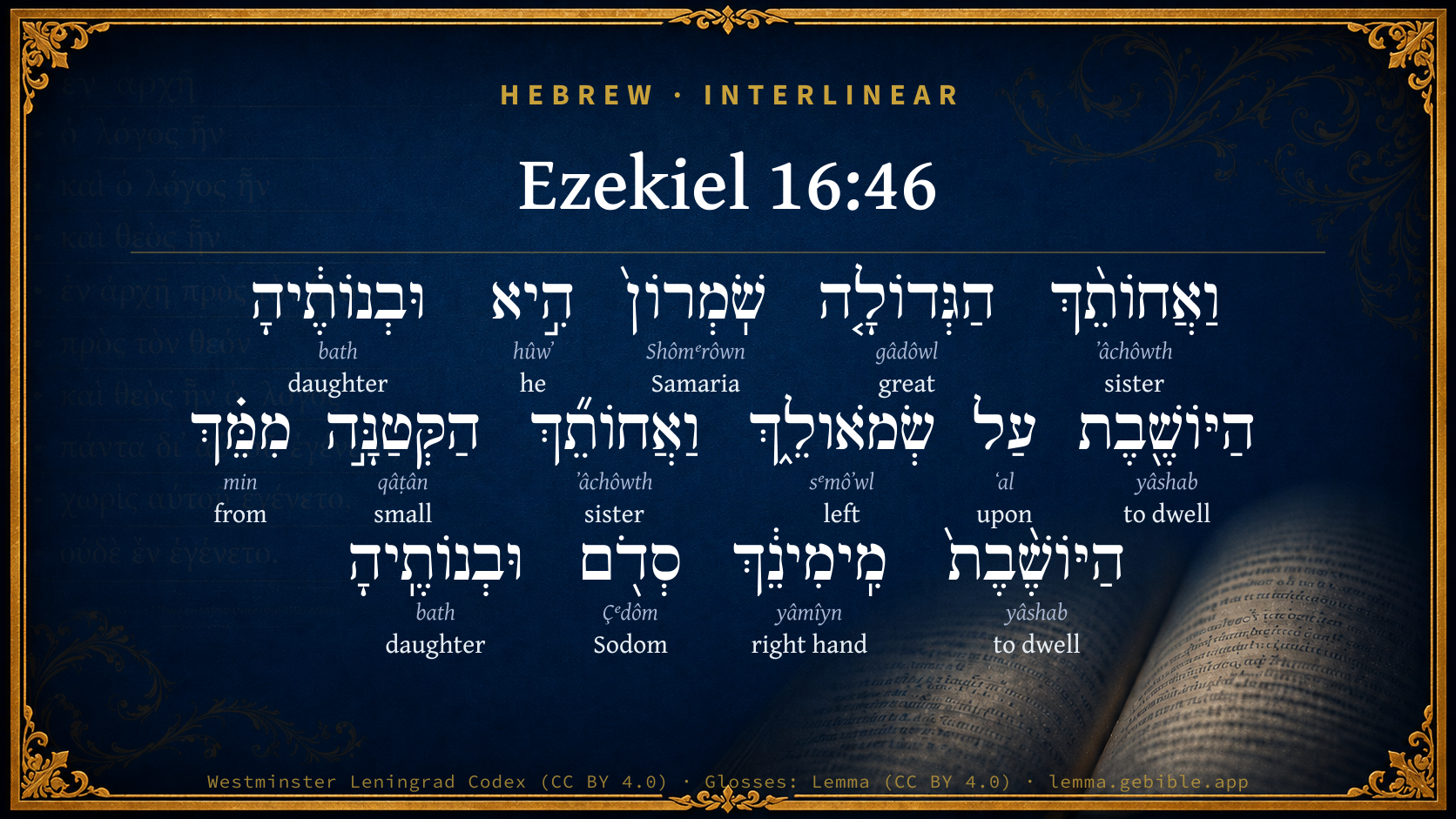
Ezekiel 16:46

Hebrew (Westminster Leningrad Codex) Ezekiel 16:46 appears in the Hebrew Old Testament. The text above is from the Westminster Leningrad Codex. Each word links to its Strong’s number, a concise gloss, and parsing drawn from the Open Scriptures Hebrew Bible morphology. Click any word for its full Brown-Driver-Briggs (BDB) entry.
Download image
Cite this verse

Ezekiel 16:46 (World English Bible). Public Domain. Lemma interlinear Bible study tool, https://lemma.gebible.app/v/ezekiel/16/46.

Show BibTeX & RIS
BibTeX
RIS
English Translation
Your elder sister is Samaria, who dwells at your left hand, she and her daughters; and your younger sister, who dwells at your right hand, is Sodom and her daughters.
World English Bible · Public Domain
Download a study sheet

One document with this verse’s original text, its word-by-word gloss line, the meaning frame, cross-references with their text, attributed commentary, and full source and license credits — printable, and it pastes into notes with its structure intact.

This verse Autodidact and up

Study sheet (.html) Plain text (.txt)

A passage Seminary Student

Up to 50 verses in one chapter. A passage sheet keeps up to 6 commentary sources and 12 cross-references per verse, in the order this page ranks them, and says so on the sheet whenever that leaves anything out. Ask for a single verse and you get the Autodidact verse sheet above.

Everything on this page stays free to read, with no account — the sheet is a download of what is already on screen, not access to it.

Want to remove ads? Support Godless Engineer
Compare translations 3

The same verse in 3 English versions, stacked beneath the original-language interlinear above. Click any original word for its lexicon entry.

Each is an independent rendering of the whole verse — the interlinear is not word-aligned to these translations.

Highlighted words mark where these versions differ — a whole-verse word diff, not a word-by-word alignment.

  • World English Bible Public Domain
    Your elder sister is Samaria, who dwells at your left hand, she and her daughters; and your younger sister, who dwells at your right hand, is Sodom and her daughters.
  • King James Version Public Domain
    And thine elder sister is Samaria, she and her daughters that dwell at thy left hand: and thy younger sister, that dwelleth at thy right hand, is Sodom and her daughters.
  • unfoldingWord Literal Text CC BY-SA 4.0
    Your older sister was Samaria and her daughters were the ones living in the north, while your younger sister was the one living south of you, that is, Sodom and her daughters.

unfoldingWord Literal Text — © unfoldingWord, licensed CC BY-SA 4.0. Word-aligned USFM3 via Door43 (git.door43.org/unfoldingWord/en_ult).

Versions to compare (up to 4)

3 of 4 selected

Show all 18 translations

Every available English version of this verse, each an independent rendering of the whole verse.

  • World English Bible Public Domain
    Your elder sister is Samaria, who dwells at your left hand, she and her daughters; and your younger sister, who dwells at your right hand, is Sodom and her daughters.
  • Berean Standard Bible Public Domain
    Your older sister was Samaria, who lived with her daughters to your north; and your younger sister was Sodom, who lived with her daughters to your south.
  • Majority Standard Bible Public Domain
    Your older sister was Samaria, who lived with her daughters to your north; and your younger sister was Sodom, who lived with her daughters to your south.
  • King James Version Public Domain
    And thine elder sister is Samaria, she and her daughters that dwell at thy left hand: and thy younger sister, that dwelleth at thy right hand, is Sodom and her daughters.
  • American Standard Version (1901) Public Domain
    And thine elder sister is Samaria, that dwelleth at thy left hand, she and her daughters; and thy younger sister, that dwelleth at thy right hand, is Sodom and her daughters.
  • Revised Version (1885) Public Domain
    And thine elder sister is Samaria, that dwelleth at thy left hand, she and her daughters: and thy younger sister, that dwelleth at thy right hand, is Sodom and her daughters.
  • Geneva Bible (1599) Public Domain
    And thine elder sister is Samaria, and her daughters, that dwell at thy left hand, and thy yong sister, that dwelleth at thy right hand, is Sodom, and her daughters.
  • Douay-Rheims (1899) Public Domain
    And thy elder sister is Samaria, she and her daughters that dwell at thy left hand: and thy younger sister that dwelleth at thy right hand is Sodom, and her daughters.
  • Young's Literal Translation Public Domain
    And thine elder sister `is' Samaria, she and her daughters, Who is dwelling at thy left hand, And thy younger sister, who is dwelling on thy right hand, `is' Sodom and her daughters.
  • Literal Standard Version CC BY-SA 4.0
    And your older sister [is] Samaria, she and her daughters, || Who is dwelling at your left hand, || And your younger sister, who is dwelling on your right hand, [is] Sodom and her daughters.
  • Unlocked Literal Bible CC BY-SA 4.0
    Your older sister was Samaria and her daughters were the ones living in the north, while your younger sister was the one living south of you, that is, Sodom and her daughters.
  • unfoldingWord Literal Text CC BY-SA 4.0
    Your older sister was Samaria and her daughters were the ones living in the north, while your younger sister was the one living south of you, that is, Sodom and her daughters.
  • Darby Bible Public Domain
    And thine elder sister is Samaria that dwelleth at thy left hand, she and her daughters; and thy younger sister, that dwelleth at thy right hand, is Sodom and her daughters.
  • World Messianic Bible Public Domain
    Your elder sister is Samaria, who dwells at your left hand, she and her daughters; and your younger sister, who dwells at your right hand, is Sodom with her daughters.
  • Webster's Bible Public Domain
    And thy elder sister is Samaria, she and her daughters that dwell at thy left hand: and thy younger sister, that dwelleth at thy right hand, is Sodom and her daughters.
  • Free Bible Version CC BY-SA 4.0
    Your older sister was Samaria, who lived north of you with her daughters. Your younger sister was Sodom, who lived south of you with her daughters.
  • Bible in Basic English Public Domain
    Your older sister is Samaria, living at your left hand, she and her daughters: and your younger sister, living at your right hand, is Sodom and her daughters.
  • JPS Tanakh (1917) Public Domain
    And thine elder sister is Samaria, that dwelleth at thy left hand, she and her daughters; and thy younger sister, that dwelleth at thy right hand, is Sodom and her daughters.

Literal Standard Version (2020), Covenant Press — licensed CC BY-SA 4.0. Text via the HelloAO Bible API (eBible.org). Unlocked Literal Bible (unfoldingWord) — licensed CC BY-SA 4.0. Text via the HelloAO Bible API (eBible.org). unfoldingWord Literal Text — © unfoldingWord, licensed CC BY-SA 4.0. Word-aligned USFM3 via Door43 (git.door43.org/unfoldingWord/en_ult). Free Bible Version, Dr. Jonathan Gallagher — licensed CC BY-SA 4.0. Text via the HelloAO Bible API (eBible.org).

Word by word

More ways to search: Search by grammar → Find every occurrence → Compare this word →

Practice this passage: Drill this verse → Learn its vocabulary →

סְדֹ֖ם
Çᵉdôm
H5467
“Sodom”
Noun, Proper
Part of Speech
Noun
Type
Proper
Full BDB Definition

Origin: from an unused root meaning to scorch

TWOT: 1465

Sodom = "burning" - a Canaanite city, usually paired with Gomorrah, located in the area of the Dead Sea and the Jordan river; both cities destroyed by God in judgment
  1. וַאֲחוֹתֵ֨ךְ ʼâchôwth H269 “and · sister · your” Conjunction + Noun, Common, Feminine, Singular, Construct + Suffix, Personal, 2nd Person, Feminine, Singular
  2. הַגְּדוֹלָ֤ה gâdôwl H1419 “the · great” Particle, Definite Article + Adjective, Adjective, Feminine, Singular, Absolute
  3. שֹֽׁמְרוֹן֙ Shômᵉrôwn H8111 “Samaria” Noun, Proper
  4. הִ֣יא hûwʼ H1931 “he” Pronoun, Personal, 3rd Person, Feminine, Singular
  5. וּבְנוֹתֶ֔יהָ bath H1323 “and · daughters · her” Conjunction + Noun, Common, Feminine, Plural, Construct + Suffix, Personal, 3rd Person, Feminine, Singular
  6. הַיּוֹשֶׁ֖בֶת yâshab H3427 “the · dwelling” Particle, Definite Article + Verb, Qal, Participle Active, Feminine, Singular, Absolute
  7. עַל ʻal H5921 “upon” Preposition
  8. שְׂמֹאולֵ֑ךְ sᵉmôʼwl H8040 “left · your” Noun, Common, Masculine, Singular, Construct + Suffix, Personal, 2nd Person, Feminine, Singular
  9. וַאֲחוֹתֵ֞ךְ ʼâchôwth H269 “and · sister · your” Conjunction + Noun, Common, Feminine, Singular, Construct + Suffix, Personal, 2nd Person, Feminine, Singular
  10. הַקְּטַנָּ֣ה qâṭân H6996 “the · small” Particle, Definite Article + Adjective, Adjective, Feminine, Singular, Absolute
  11. מִמֵּ֗ךְ min H4480 “from · you” Preposition + Suffix, Personal, 2nd Person, Feminine, Singular
  12. הַיּוֹשֶׁ֨בֶת֙ yâshab H3427 “the · dwelling” Particle, Definite Article + Verb, Qal, Participle Active, Feminine, Singular, Absolute
  13. מִֽימִינֵ֔ךְ yâmîyn H3225 “from · right hand · your” Preposition + Noun, Common, Feminine, Singular, Construct + Suffix, Personal, 2nd Person, Feminine, Singular
  14. וּבְנוֹתֶֽיהָ bath H1323 “and · daughters · her” Conjunction + Noun, Common, Feminine, Plural, Construct + Suffix, Personal, 3rd Person, Feminine, Singular

About this verse

These counts appear in no published source. They are computed here, from the morphology-tagged text and Lemma’s own curated glosses. What Lemma adds →

15
words
12
distinct lemmas
Prophets
section

Shared distinctive vocabulary

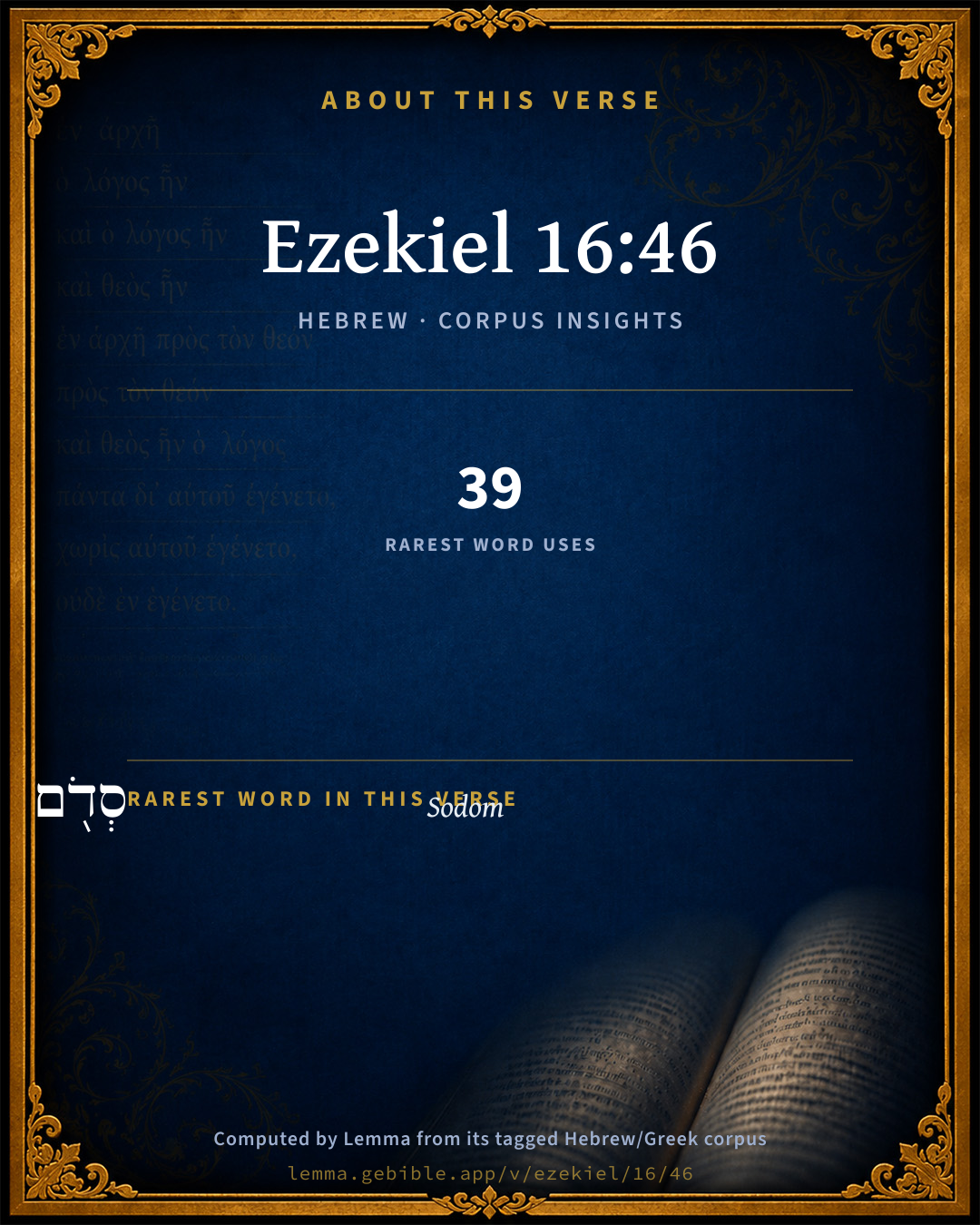
סְדֹ֖ם Sodom H5467 occurs in 38 verses of the Hebrew Bible. Also found in:

Grammatical profile

  • 2 verbs
  • 8 nouns
  • 2 adjectives
  • 1 pronoun
  • 2 prepositions

Verb forms

  • הַיּוֹשֶׁ֖בֶת Qal · Participle Active
  • הַיּוֹשֶׁ֨בֶת֙ Qal · Participle Active

Repetition

Words recur within this verse — often emphatic in Hebrew:

  • וַאֲחוֹתֵ֨ךְ sister H269 ×2
  • וּבְנוֹתֶ֔יהָ daughter H1323 ×2
  • הַיּוֹשֶׁ֖בֶת to dwell H3427 ×2

Hebrew & Septuagint length

In English translation the verse runs 30 words from the Hebrew and 30 from the Septuagint (LXX English) — the same length.

A rough comparison of the two English renderings, which tokenize alike — not a word-level alignment.

Word counts can differ between the Hebrew and the Greek without any difference in meaning — e.g. the Hebrew direct-object marker אֵת has no separate Greek word, and Greek often adds the article ὁ.

Cross-references

26

Topical passages linked to Ezekiel 16:46 in the Treasury of Scripture Knowledge — connected by theme and wording, ordered by reader-vote popularity; previews shown in the World English Bible.

  • Ezekiel 23:4 The names of them were Oholah the elder, and Oholibah her sister: and they became mine, and they bore sons and daughters. As for their names, Samaria is Oholah, and Jerusalem Oholibah.
  • Genesis 13:10–13 Lot lifted up his eyes, and saw all the plain of the Jordan, that it was well watered every where, before Yahweh destroyed Sodom and Gomorrah, like the garden of Yahweh, like the land of Egypt, as you go to Zoar.
  • Jeremiah 3:8–11 I saw, when, for this very cause that backsliding Israel had committed adultery, I had put her away and given her a bill of divorce, yet treacherous Judah, her sister, didn't fear; but she also went and played the prostitute.
  • Ezekiel 16:48–49 As I live, says the Lord Yahweh, Sodom your sister has not done, she nor her daughters, as you have done, you and your daughters.
  • Ezekiel 16:51 Neither has Samaria committed half of your sins; but you have multiplied your abominations more than they, and have justified your sisters by all your abominations which you have done.
  • Ezekiel 16:53–56 I will turn again their captivity, the captivity of Sodom and her daughters, and the captivity of Samaria and her daughters, and the captivity of your captives in the midst of them;
  • Ezekiel 16:61 Then shall you remember your ways, and be ashamed, when you shall receive your sisters, your elder [sisters] and your younger; and I will give them to you for daughters, but not by your covenant.
  • Genesis 14:8 There went out the king of Sodom, and the king of Gomorrah, and the king of Admah, and the king of Zeboiim, and the king of Bela (the same is Zoar); and they set the battle in array against them in the valley of Siddim;
  • Genesis 18:20–33 Yahweh said, "Because the cry of Sodom and Gomorrah is great, and because their sin is very grievous,
  • Genesis 19:24–25 Then Yahweh rained on Sodom and on Gomorrah sulfur and fire from Yahweh out of the sky.
  • Genesis 19:29 It happened, when God destroyed the cities of the plain, that God remembered Abraham, and sent Lot out of the midst of the overthrow, when he overthrew the cities in which Lot lived.
  • Deuteronomy 29:23 [and that] the whole land of it is sulfur, and salt, [and] a burning, [that] it is not sown, nor bears, nor any grass grows therein, like the overthrow of Sodom and Gomorrah, Admah and Zeboiim, which Yahweh overthrew in his anger, and in his wrath:
  • Deuteronomy 32:32 For their vine is of the vine of Sodom, Of the fields of Gomorrah: Their grapes are grapes of gall, Their clusters are bitter:
  • Isaiah 1:9–10 Unless Yahweh of hosts had left to us a very small remnant, We would have been as Sodom; We would have been like Gomorrah.
  • Jeremiah 23:14 In the prophets of Jerusalem also I have seen a horrible thing: they commit adultery, and walk in lies; and they strengthen the hands of evil-doers, so that none does return from his wickedness: they are all of them become to me as Sodom, and the inhabitants of it as Gomorrah.
  • Lamentations 4:6 For the iniquity of the daughter of my people is greater than the sin of Sodom, That was overthrown as in a moment, and no hands were laid on her.
  • Ezekiel 16:27 See therefore, I have stretched out my hand over you, and have diminished your ordinary [food], and delivered you to the will of those who hate you, the daughters of the Philistines, who are ashamed of your lewd way.
  • Ezekiel 23:11 Her sister Oholibah saw this, yet was she more corrupt in her doting than she, and in her prostitution which were more than the prostitution of her sister.
  • Ezekiel 23:31–33 You have walked in the way of your sister; therefore will I give her cup into your hand.
  • Ezekiel 26:6 Her daughters who are in the field shall be slain with the sword: and they shall know that I am Yahweh.
  • Hosea 11:8 "How can I give you up, Ephraim? How can I hand you over, Israel? How can I make you like Admah? How can I make you like Zeboiim? My heart is turned within me, My compassion is aroused.
  • Micah 1:5 "All this is for the disobedience of Jacob, And for the sins of the house of Israel. What is the disobedience of Jacob? Isn't it Samaria? And what are the high places of Judah? Aren't they Jerusalem?
  • Luke 17:28–30 Likewise, even as it happened in the days of Lot: they ate, they drank, they bought, they sold, they planted, they built;
  • 2 Peter 2:6 and turning the cities of Sodom and Gomorrah into ashes, condemned them to destruction, having made them an example to those who would live ungodly;
  • Jude 1:7 Even as Sodom and Gomorrah, and the cities around them, having, in the same way as these, given themselves over to sexual immorality and gone after strange flesh, are set forth as an example, suffering the punishment of eternal fire.
  • Revelation 11:8 Their dead bodies will be in the street of the great city, which spiritually is called Sodom and Egypt, where also their Lord was crucified.

Cross-references courtesy of OpenBible.info (CC BY 4.0).

Hebrew and Greek witnesses Masoretic Hebrew ↔ Greek Septuagint

The same verse in the two great witnesses to the Old Testament, shown verse-for-verse.

These are two independent witnesses, not word-aligned to each other, and the Septuagint is shown in lemma (dictionary) form.

Hebrew Ezekiel 16:46 Masoretic · Westminster Leningrad Codex

וַאֲחוֹתֵ֨ךְ הַגְּדוֹלָ֤ה שֹֽׁמְרוֹן֙ הִ֣יא וּבְנוֹתֶ֔יהָ הַיּוֹשֶׁ֖בֶת עַל שְׂמֹאולֵ֑ךְ וַאֲחוֹתֵ֞ךְ הַקְּטַנָּ֣ה מִמֵּ֗ךְ הַיּוֹשֶׁ֨בֶת֙ מִֽימִינֵ֔ךְ סְדֹ֖ם וּבְנוֹתֶֽיהָ

Your elder sister is Samaria, who dwells at your left hand, she and her daughters; and your younger sister, who dwells at your right hand, is Sodom and her daughters.

World English Bible · Public Domain

Greek LXX Ezekiel 16:46 Septuagint · lemma form

ὁ ἀδελφή σύ ὁ πρεσβύτερος σαμαρεία αὐτός καί ὁ θυγάτηρ αὐτός ὁ καταοἰκέω ἐκ εὐώνυμος σύ καί ὁ ἀδελφή σύ ὁ νέος σύ ὁ καταοἰκέω ἐκ δεξιός σύ σοδομα καί ὁ θυγάτηρ αὐτός

Your elder sister who dwells on your left hand is Samaria, she and her daughters: and your younger sister, that dwells on the right hand, is Sodom and her daughters.

LXX2012 (modern English Septuagint) · Public Domain

Hebrew: Westminster Leningrad Codex (CC BY 4.0). Greek: Septuagint (public domain); English from LXX2012 (modern English Septuagint) (Public Domain). How the Septuagint differs from the Hebrew →

Targum (Aramaic paraphrase)

1

The Targum is the ancient Jewish Aramaic paraphrase of the Hebrew Scriptures — an interpretive translation, not the Hebrew text itself. Onkelos (literal) and Pseudo-Jonathan (expansive) render the Torah, and Jonathan the Prophets. Coverage is partial: where no permissively-licensed English translation exists for a verse, only the Aramaic is shown. This is verse-level text, not a word-by-word alignment to the Hebrew.

  1. Targum Jonathan Prophets (Joshua–Malachi)
    וַאֲחָתִיךְ רַבְּתָא שׁוֹמְרוֹן הִיא וְכַפְרָנָהָא דְיָתְבָא עַל שְׂמָאלִיךְ וַאֲחָתִיךְ דִזְעֵירָא מִנִיךְ דְיַתְבָא מִימִינִיךְ סְדוֹם וְכַפְרָנָהָא:

    (no public-domain English translation for this verse)

    Targum Jonathan — Aramaic: “Mikraot Gedolot” (public domain). English: “Sefaria Community Translation” (CC0 1.0 (public-domain dedication)); “London "Chaldee Paraphrase," 1871” (public domain). Text via Sefaria.

Commentary

Notes on Ezekiel 16:46 from classic Christian and Jewish commentators (each source and its license shown beneath its notes). The classic Christian expositions comment on the surrounding passage and are grouped to its opening verse, so a note may address several verses; the Jewish commentaries on the Tanakh (Rashi and others) are per-verse, so they appear only where the commentator wrote on this verse.

Lemma curates 59 commentaries, every one of them public domain or Creative Commons licensed, each selected and text-cleaned for this edition rather than reprinted as found. About our sources →

Trapp's Complete Commentary

John Trapp

Eze 16:46 And thine elder sister [is] Samaria, she and her daughters that dwell at thy left hand: and thy younger sister, that dwelleth at thy right hand, [is] Sodom and her daughters.

Ver. 46. She and her daughters,] i.e., Her cities and villages.

That dwell at thy left hand.] Thou art well set up therewhile, well neighboured.

That dwelleth at thy right hand.] That did do so, but new dwelleth with devils; being "thrown out for an example, suffering the vengeance of eternal fire." {Jdg 1:7}

John Trapp, A Commentary or Exposition upon All the Books of the Old and New Testament (1647–1656) — public domain. Text from a community e-Sword module.

Joseph Benson's Commentary

Eze 16:46-47. Thine elder sister is Samaria, she and her daughters — That is, her lesser towns. “Samaria is called the elder, or greater sister, because it was a much larger city and kingdom, greater for power, riches, and numbers of people, and more nearly allied to Judah. And Sodom is called the younger sister, as being a smaller and less populous city, and further removed in blood from Jerusalem and its inhabitants, being only, as it were, a half sister. That dwell at thy left hand — That is, toward the north, Samaria lying northward of Jerusalem, as Sodom lay southward of it. For these two quarters of the world are expressed by the right and left in the Hebrew language, being placed in such a position to those that set their faces eastward. The prophet here considers Samaria and Sodom as two cities still subsisting; though Sodom had been long since destroyed, and Samaria had been overthrown one hundred and twenty-seven years before this prophecy of Ezekiel was delivered. Yet thou hast not walked after their ways — Thou hast not been content merely to be as bad as they, but hast carried thy wickedness to a much greater height, and committed many more crimes than they: see note on Eze 5:7. “The vices of Sodom and Samaria were not attended with such aggravating circumstances as those of Jerusalem; for they had not been blessed with the same great privileges.”

Joseph Benson's Commentary on the Old and New Testaments (1811–1818) — public domain. Text from a community e-Sword module.

Tyndale Open Study Notes

Tyndale Open Resources

16:46-50 Samaria, Jerusalem’s older (or larger) sister, had practiced deviant worship ever since Jeroboam introduced golden calves into his national shrines at Dan and Bethel (1 Kgs 12:28-33). • Sodom, Jerusalem’s younger (or smaller) sister, was a byword for sexual sin (Gen 19:4-9) and for pride, gluttony, laziness, and neglect of the poor and needy.

Tyndale Open Study Notes — © Tyndale Open Resources, licensed CC BY-SA 4.0. Text via the HelloAO Bible API.

Geneva Bible (1599)

Geneva Bible translators

Hebrew, thy sister younger than thou.

That is, her cities.

Geneva Bible (1599) marginal notes — public domain. Text via Bolls.life.

Jamieson, Fausset & Brown

Robert Jamieson, A. R. Fausset & David Brown

elder sister . . . Samaria--older than Sodom, to whom Judah was less nearly related by kindred than she was to Samaria. Sodom is therefore called her younger sister; Samaria, her "elder sister" [GROTIUS]. Samaria is called the "elder," because in a moral respect more nearly related to Judah [FAIRBAIRN]. Samaria had made the calves at Dan and Beth-el in imitation of the cherubim.

her daughters--the inferior towns subject to Samaria (compare Num 21:25, Margin).

left--The Orientals faced the east in marking the directions of the sky; thus the north was "left," the south "right."

Sodom . . . daughters--Ammon and Moab, offshoots from Sodom; also the towns subject to it.

Jamieson, Fausset & Brown — Commentary Critical and Explanatory on the Whole Bible (1871) — public domain (CC PDM 1.0). Text via the HelloAO Bible API.

Adam Clarke's Commentary

Verse 46. Thine elder sister is Samaria, she and her daughters that dwell at thy left] It is supposed that the prophet by Sodom in this place means the Israelites that dwelt beyond Jordan, in the land of the Moabites and Ammonites; or rather of the Moabites and Ammonites themselves. Literally, Sodom could not be called the younger sister of Jerusalem, as it existed before Jerusalem had a name. In looking east from Jerusalem, Samaria was on the left, and Sodom on the right hand; that is, the first was on the north, the second on the south of Jerusalem.

Adam Clarke's Commentary on the Bible (1810–1826) — public domain. Text from a community e-Sword/MySword module.

Ellicott's Commentary for English Readers

(46) Thine elder sister.—The words elder and younger mean, literally, greater and smaller. They thus come, like the Latin major and minor, to be used for older and younger; but still their original and most common meaning, which should be retained here, is greater and smaller. Chronologically, Sodom was not younger than Jerusalem, nor is there evidence that Samaria was older. The terms are to be understood of Samaria as the capital of the far larger northern kingdom, and of Sodom as a single city of no great population. The Orientals, in describing geographical positions, considered themselves as facing the east, and hence Samaria (at the north) was on the left, and Sodom on the right. Sodom is spoken of poetically as if still in existence. They were both the spiritual sisters of Judah, just as all alike were daughters of the Amorite and Hittite.

A Bible Commentary for English Readers, edited by Charles John Ellicott (1878–1897) — public domain. Text from a community e-Sword module.

The Cambridge Bible for Schools and Colleges

gen. ed. J. J. S. Perowne

46. elder sister] “elder” is lit. greater, and the reference is to the greater political importance and wider territory of Samaria; as on the other hand Sodom was smaller than Judah. In estimating the quarters of the heavens the beholder faced the east, having the north on his left, &c.

her daughters] i.e. subordinate towns.

The Cambridge Bible for Schools and Colleges (gen. ed. J. J. S. Perowne; Cambridge University Press, 1878–1918) — public domain. Text from a community e-Sword module.

John Gill's Exposition

Yet hast thou not walked after their ways,.... But in ways more evil; were not content to keep pace with them, and do as they did; but outwent them, outstripped them in wickedness:

nor done after their abominations; but committed greater abominations than they did; sins of a more heinous nature, and attended with more aggravated circumstances; having more power and wealth, more Wisdom and understanding; the means of grace, the word and ordinances of God:

but, as if that were a very little thing; to commit the sins that Samaria and Sodom did: or, "it was loathing to thee as a little thing" (a); they despised and loathed their sins as too mean and little, and not flagitious and enormous, or bold and daring enough to be committed; and looked upon them, with contempt, as sneaking sinners, that had no soul nor spirit in them, or taste for sinful pleasures, in comparison of them: or the sense is, it would have been a little thing, comparatively speaking, had they only walked after the ways and abominations of Samaria and Sodom, and stopped there; but they had greatly exceeded them; and so the Targum,

"if thou hadst walked in their ways, and done according to their abominations, thy sin had been small.''

Kimchi interprets it of a small time that the Jews continued in the ways and worship of God, after the captivity of the ten tribes, which were carried away in the sixth year of Hezekiah; so that there were but three and twenty years left of his reign, when his son Manasseh succeeded him, and was more wicked than all before him; and these three and twenty years are the little time here spoken of and within a very little time, and

thou wast corrupted more than they in all their ways; this explains what is meant by not walking after their ways and abominations; they were greater sinners than they; more corrupt in their principles and practices; more hardened in them, and more difficult to be reclaimed from them; see Mat 11:23.

(a) "tanquam parvum, fastidio fuit hoc", Junius & Tremellius, Piscator, Polanus; "velut parum fastidi", Starckius.

John Gill's Exposition of the Whole Bible (1746–1763) — public domain (CC PDM 1.0). Text via the HelloAO Bible API.

Albert Barnes' Notes on the Bible

The temple looked to the east. Samaria was on its left, and Sodom on its right hand.

Albert Barnes' Notes on the Bible (1834–1885) — public domain. Text from a community e-Sword/MySword module.

Haydock's Catholic Bible Commentary

Right: southward. --- Sodom. The city was more ancient than Jerusalem. Hence it here designates Ruben, (Haydock) and the Jews east of the Jordan; (Prado) or rather Moab and Ammon, (ver. 55.; Calmet) and the rest of the Gentiles. (Haydock) --- Samaria shewed Jerusalem the road to idolatry, and therefore is called her elder sister. The number of the ten tribes was also greater than that of the kingdom of Juda, which became corrupt as Sodom, only by degrees. (Theodoret)

George Leo Haydock (1774–1849), Haydock's Catholic Family Bible and Commentary, 1859 edition — public domain. Excludes Psalms (Douay-Rheims chapter numbering differs from Protestant) and Deuterocanonical books (Catholic canon only).

Matthew Poole's English Annotations

Thine elder sister, i.e. the greater for power, riches, and numbers of people, not the elder for years.

Samaria; metropolis, or mother city, of the revolted and idolatrous ten tribes.

Her daughters; lesser cities of the kingdom of Israel, or the people who dwelt in them.

At thy left hand; northward, as you look toward the east.

Thy younger sister; or lesser, so the Hebrew; which consists of fewer people, is of less power.

At thy right hand; southward from Jerusalem. Sodom, as chief city.

Her daughters; either the cities near in place, and joined in affinity, idolatry, and other sins like Sodom, or the inhabitants of those cities.

Matthew Poole's English Annotations on the Holy Bible (1683–1685) — public domain. Text from a community e-Sword/MySword module.

Whedon's Commentary on the Bible

Daniel D. Whedon

46. Elder sister… younger sister — The reference is not to the relative age of Sodom and Samaria as compared with Jerusalem, but to their relative importance.

And her daughters — Suburban towns and colonies.

Daniel D. Whedon (gen. ed.), Commentary on the Old and New Testaments (1874–1909) — public domain. Text from a community e-Sword module.

The Pulpit Commentary

No very adequate reason appears for the assignment of the respective ages of the two sisters. Historically, Sodom, as the oldest representative of evil, would have seemed to claim precedence. Samaria may have had this position assigned to it as more closely connected with Judah. The left and right hands indicate respectively a position to the north and south of Jerusalem, the observer of the heavens looking east, as, we may note, the temple did. (Eze_8:16) The comparison with Samaria is developed more fully in ch. 23. The daughters are, as elsewhere, the cities dependent on Sodom and Samaria respectively.

The Pulpit Commentary (1880–1919), ed. H.D.M. Spence-Jones & Joseph S. Exell — public domain. Text from a community e-Sword module.

John Wesley's Explanatory Notes

Thine elder sister - The greater for power, riches, and numbers of people. Her daughters - The lesser cities of the kingdom of Israel. Thy left hand - Northward as you look toward the east. Thy younger sister - Which was smaller and less populous. Thy right hand - Southward from Jerusalem.

John Wesley, Explanatory Notes Upon the Whole Bible (1754–1765) — public domain. Text via the GEBible commentary corpus.

unfoldingWord translationNotes

Door43 World Missions Community

General Information:

Yahweh continues to speak about Jerusalem as if the city were his unfaithful wife. The city represents the people who live there. (See: Metaphor and Metonymy)

Your older sister was Samaria ... your younger sister was the one living south of you, that is, Sodom

Samaria and Sodom were both cities that Yahweh had judged for their idolatry and wickedness. Yahweh speaks of these cities being Jerusalem's sisters to express that she belonged to a family that practiced idolatry and wickedness. (See: Assumed Knowledge and Implicit Information and Metaphor)

translationWords

sister

Samaria

life

Sodom

unfoldingWord translationNotes — © Distant Shores Media and the Door43 World Missions Community, licensed CC BY-SA 4.0. Source: git.door43.org/Door43/en_tn.

Rashi

Rabbi Shlomo Yitzchaki (Rashi)

at your left Since the territory of Judah was at the southern border of Eretz Israel [and one is considered facing east], all the other tribes were situated at their left [since they are north of Judah].

Rashi on the Tanakh — English translations: “The Judaica Press complete Tanach with Rashi, translated by A. J. Rosenberg” (CC BY 4.0); “Pentateuch with Rashi's commentary by M. Rosenbaum and A.M. Silbermann, 1929-1934” (public domain); “The Metsudah Tanach series, Lakewood, N.J” (CC BY 4.0); and “The Book of Joshua, Metsudah Publications, 1997” (CC BY 4.0). Text via Sefaria.

Lesson kit

Teaching starters — assembled from the data on this page, not authored interpretation. Every prompt links to the verse data it draws on. Edit before teaching.

Ezekiel, in the Prophets, opens this verse with 15 words (12 distinct Hebrew lemmas). Its most distinctive word is Çᵉdôm (“Sodom”). A historical commentator’s framing appears above. Read the whole chapter for the surrounding context.

Discussion questions

  1. What does “Sodom” (Çᵉdôm) contribute to the verse as a whole?
  2. Genesis 10:19 shares the word «Sodom» with this verse. How do the two illuminate each other?
  3. “sister” occurs 2× in this one verse. What is the effect of the repetition?
  4. The translations on this page render this verse differently — a whole-verse word diff, not a word-by-word alignment. What might account for the different wordings?
  5. The verb «הַיּוֹשֶׁ֖בֶת» is Qal Participle Active. How does its form color the action?
  6. Reading how Trapp's Complete Commentary and Joseph Benson's Commentary read this verse, where do the two commentators agree and where do they part?

Things to notice

Reading settings

Reading text

Shown beneath each verse's original-language words.

Old Testament
Old Testament edition

Read the OT as the Masoretic Hebrew (MT) or the Greek Septuagint (LXX).

English shown for the Greek Septuagint (in the Hebrew ↔ Greek comparison).

Comparing translations? Open the Compare panel on any verse page to stack up to four side by side.