
2 Chronicles 13:19

Hebrew (Westminster Leningrad Codex) 2 Chronicles 13:19 appears in the Hebrew Old Testament. The text above is from the Westminster Leningrad Codex. Each word links to its Strong’s number, a concise gloss, and parsing drawn from the Open Scriptures Hebrew Bible morphology. Click any word for its full Brown-Driver-Briggs (BDB) entry.
Download image
Cite this verse

2 Chronicles 13:19 (World English Bible). Public Domain. Lemma interlinear Bible study tool, https://lemma.gebible.app/v/2-chronicles/13/19.

Show BibTeX & RIS
BibTeX
RIS
English Translation
Abijah pursued after Jeroboam, and took cities from him, Bethel with the towns of it, and Jeshanah with the towns of it, and Ephron with the towns of it.
World English Bible · Public Domain
Highlights
  • 1 first appearance in the Hebrew Bible
Full analysis ↓
Download a study sheet

One document with this verse’s original text, its word-by-word gloss line, the meaning frame, cross-references with their text, attributed commentary, and full source and license credits — printable, and it pastes into notes with its structure intact.

This verse Autodidact and up

Study sheet (.html) Plain text (.txt)

A passage Seminary Student

Up to 50 verses in one chapter. A passage sheet keeps up to 6 commentary sources and 12 cross-references per verse, in the order this page ranks them, and says so on the sheet whenever that leaves anything out. Ask for a single verse and you get the Autodidact verse sheet above.

Everything on this page stays free to read, with no account — the sheet is a download of what is already on screen, not access to it.

Want to remove ads? Support Godless Engineer
Compare translations 3

The same verse in 3 English versions, stacked beneath the original-language interlinear above. Click any original word for its lexicon entry.

Each is an independent rendering of the whole verse — the interlinear is not word-aligned to these translations.

Highlighted words mark where these versions differ — a whole-verse word diff, not a word-by-word alignment.

  • World English Bible Public Domain
    Abijah pursued after Jeroboam, and took cities from him, Bethel with the towns of it, and Jeshanah with the towns of it, and Ephron with the towns of it.
  • King James Version Public Domain
    And Abijah pursued after Jeroboam, and took cities from him, Bethel with the towns thereof, and Jeshanah with the towns thereof, and Ephraim with the towns thereof.
  • unfoldingWord Literal Text CC BY-SA 4.0
    And Abijah pursued after Jeroboam; and he captured from him cities: Bethel and its daughters, and Jeshanah and its daughters, and Ephron and its daughters.

unfoldingWord Literal Text — © unfoldingWord, licensed CC BY-SA 4.0. Word-aligned USFM3 via Door43 (git.door43.org/unfoldingWord/en_ult).

Versions to compare (up to 4)

3 of 4 selected

Show all 18 translations

Every available English version of this verse, each an independent rendering of the whole verse.

  • World English Bible Public Domain
    Abijah pursued after Jeroboam, and took cities from him, Bethel with the towns of it, and Jeshanah with the towns of it, and Ephron with the towns of it.
  • Berean Standard Bible Public Domain
    Abijah pursued Jeroboam and captured some cities from him: Bethel, Jeshanah, and Ephron, along with their villages.
  • Majority Standard Bible Public Domain
    Abijah pursued Jeroboam and captured some cities from him: Bethel, Jeshanah, and Ephron, along with their villages.
  • King James Version Public Domain
    And Abijah pursued after Jeroboam, and took cities from him, Bethel with the towns thereof, and Jeshanah with the towns thereof, and Ephraim with the towns thereof.
  • American Standard Version (1901) Public Domain
    And Abijah pursued after Jeroboam, and took cities from him, Beth-el with the towns thereof, and Jeshanah with the towns thereof, and Ephron with the towns thereof.
  • Revised Version (1885) Public Domain
    And Abijah pursued after Jeroboam, and took cities from him, Beth-el with the towns thereof, and Jeshanah with the towns thereof, and Ephron with the towns thereof.
  • Geneva Bible (1599) Public Domain
    And Abiiah pursued after Ieroboam, and tooke cities from him, euen Beth-el, and the villages thereof, and Ieshanah with her villages, and Ephron with her villages.
  • Douay-Rheims (1899) Public Domain
    And Abia pursued after Jeroboam, and took cities from him, Bethel and her daughters, and Jesana with her daughters, Ephron also and her daughters.
  • Young's Literal Translation Public Domain
    And Abijah pursueth after Jeroboam, and captureth from him cities, Beth-El and its small towns, and Jeshanah and its small towns, and Ephraim and its small towns.
  • Literal Standard Version CC BY-SA 4.0
    And Abijah pursues after Jeroboam and captures cities from him: Beth-El and its small towns, and Jeshanah and its small towns, and Ephraim and its small towns.
  • Unlocked Literal Bible CC BY-SA 4.0
    Abijah pursued Jeroboam; he took cities from him: Bethel with its villages, Jeshanah with its villages, and Ephron with its villages.
  • unfoldingWord Literal Text CC BY-SA 4.0
    And Abijah pursued after Jeroboam; and he captured from him cities: Bethel and its daughters, and Jeshanah and its daughters, and Ephron and its daughters.
  • Darby Bible Public Domain
    And Abijah pursued after Jeroboam, and took cities from him: Bethel with its dependent villages, and Jeshanah with its dependent villages, and Ephron with its dependent villages.
  • World Messianic Bible Public Domain
    Abijah pursued Jeroboam, and took cities from him: Bethel with its villages, Jeshanah with its villages, and Ephron with its villages.
  • Webster's Bible Public Domain
    And Abijah pursued Jeroboam, and took cities from him, Beth-el with its towns, and Jeshanah with its towns, and Ephron with its towns.
  • Free Bible Version CC BY-SA 4.0
    Abijah chased Jeroboam and captured some towns from him: Bethel, Jeshanah, and Ephron, along with their villages.
  • Bible in Basic English Public Domain
    And Abijah went after Jeroboam and took some of his towns, Beth-el with its small towns and Jeshanah with its small towns and Ephron with its small towns.
  • JPS Tanakh (1917) Public Domain
    And Abijah pursued after Jeroboam, and took cities from him, Bethel with the towns thereof, and Jeshanah with the towns thereof, and Ephrain with the towns thereof.

Literal Standard Version (2020), Covenant Press — licensed CC BY-SA 4.0. Text via the HelloAO Bible API (eBible.org). Unlocked Literal Bible (unfoldingWord) — licensed CC BY-SA 4.0. Text via the HelloAO Bible API (eBible.org). unfoldingWord Literal Text — © unfoldingWord, licensed CC BY-SA 4.0. Word-aligned USFM3 via Door43 (git.door43.org/unfoldingWord/en_ult). Free Bible Version, Dr. Jonathan Gallagher — licensed CC BY-SA 4.0. Text via the HelloAO Bible API (eBible.org).

Word by word

More ways to search: Search by grammar → Find every occurrence → Compare this word →

Practice this passage: Drill this verse → Learn its vocabulary →

יְשָׁנָ֖ה
Yᵉshânâh
H3466
“Jeshanah”
Noun, Proper
Part of Speech
Noun
Type
Proper
Full BDB Definition

Origin: from H3465

TWOT: None

Jeshanah = "storage" - a town of the southern border of the northern kingdom near Bethel
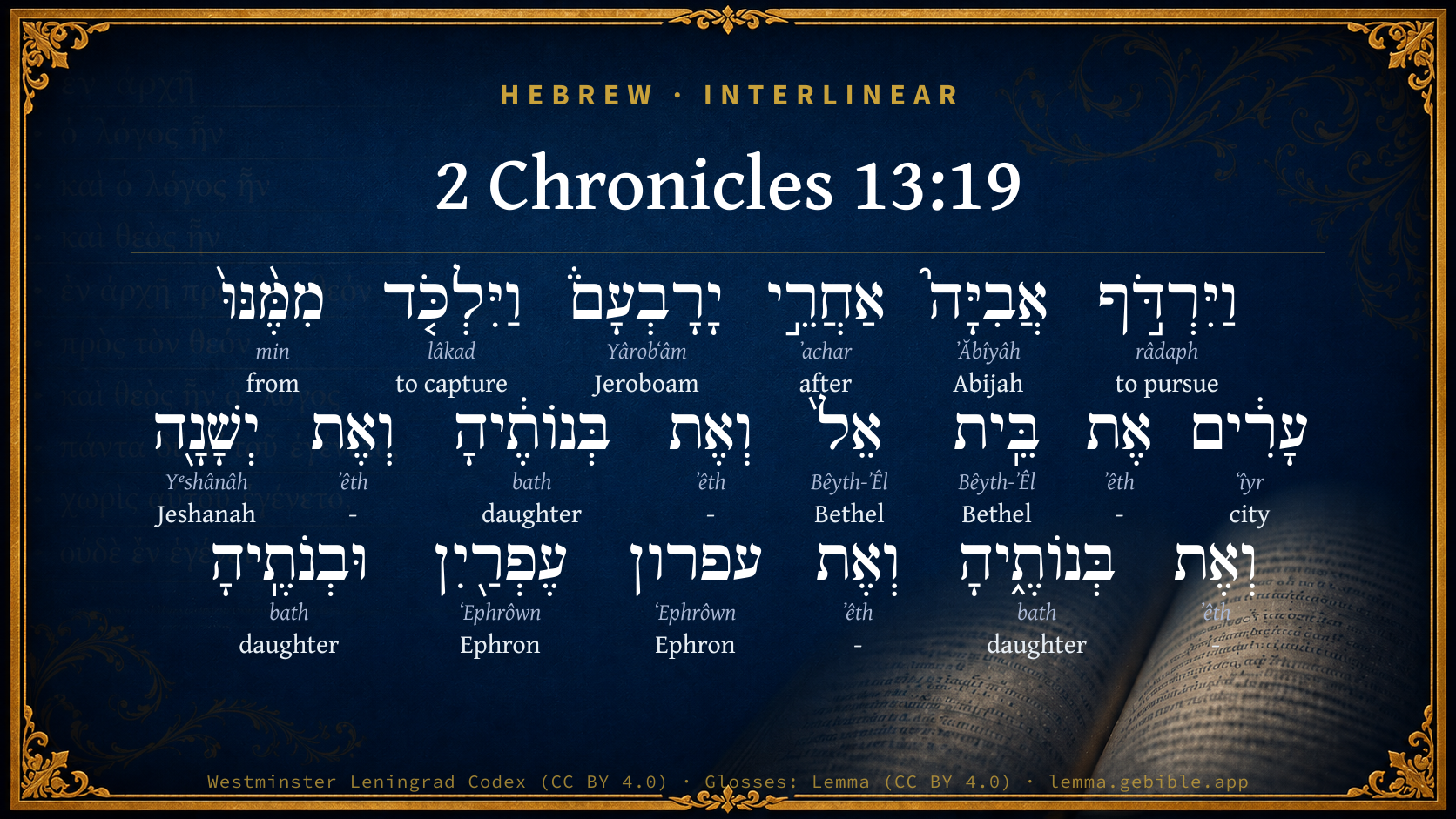
  1. וַיִּרְדֹּ֣ף râdaph H7291 “and · to pursue” Conjunction + Verb, Qal, Sequential Imperfect, 3rd Person, Masculine, Singular
  2. אֲבִיָּה֮ ʼĂbîyâh H29 “Abijah” Noun, Proper
  3. אַחֲרֵ֣י ʼachar H310 “after” Preposition
  4. יָרָבְעָם֒ Yârobʻâm H3379 “Jeroboam” Noun, Proper
  5. וַיִּלְכֹּ֤ד lâkad H3920 “and · to capture” Conjunction + Verb, Qal, Sequential Imperfect, 3rd Person, Masculine, Singular
  6. מִמֶּ֨נּוּ֙ min H4480 “from · us” Preposition + Suffix, Personal, 1st Person, Common, Plural
  7. עָרִ֔ים ʻîyr H5892 “cities” Noun, Common, Feminine, Plural, Absolute
  8. אֶת ʼêth H853 “-” Particle, Direct Object
  9. בֵּֽית Bêyth-ʼÊl H1008 “Bethel” Noun, Proper
  10. אֵל֙ Bêyth-ʼÊl H1008 “Bethel” Noun, Proper
  11. וְאֶת ʼêth H853 “and · -” Conjunction + Particle, Direct Object
  12. בְּנוֹתֶ֔יהָ bath H1323 “daughters · her” Noun, Common, Feminine, Plural, Construct + Suffix, Personal, 3rd Person, Feminine, Singular
  13. וְאֶת ʼêth H853 “and · -” Conjunction + Particle, Direct Object
  14. וְאֶת ʼêth H853 “and · -” Conjunction + Particle, Direct Object
  15. בְּנוֹתֶ֑יהָ bath H1323 “daughters · her” Noun, Common, Feminine, Plural, Construct + Suffix, Personal, 3rd Person, Feminine, Singular
  16. וְאֶת ʼêth H853 “and · -” Conjunction + Particle, Direct Object
  17. עפרון ʻEphrôwn H6085 “Ephron” Noun, Proper
  18. עֶפְרַ֖יִן ʻEphrôwn H6085 “Ephron” Noun, Proper
  19. וּבְנֹתֶֽיהָ bath H1323 “and · daughters · her” Conjunction + Noun, Common, Feminine, Plural, Construct + Suffix, Personal, 3rd Person, Feminine, Singular

About this verse

These counts appear in no published source. They are computed here, from the morphology-tagged text and Lemma’s own curated glosses. What Lemma adds →

20
words
12
distinct lemmas
Historical
section

Notable vocabulary

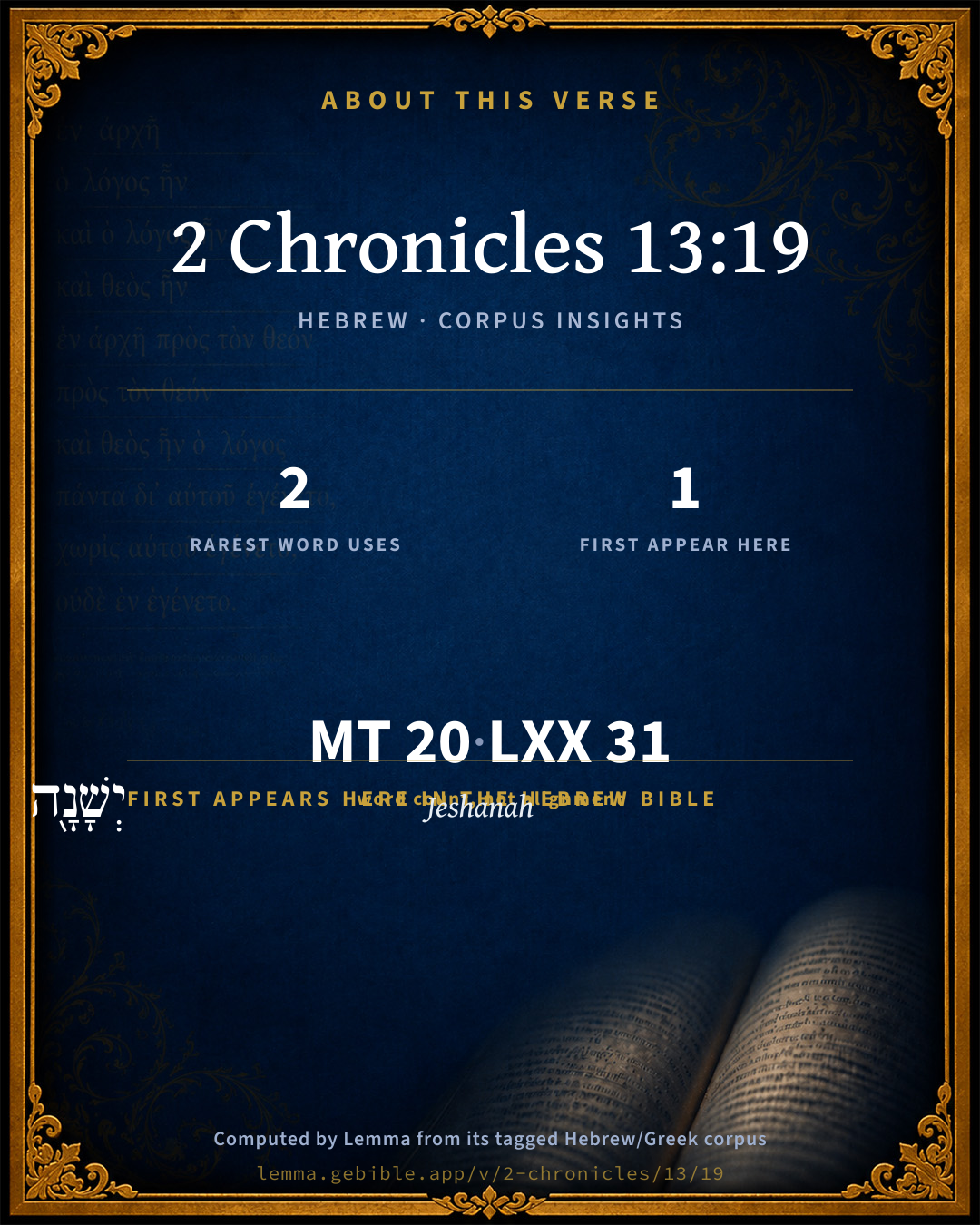
The rarest word here is יְשָׁנָ֖ה Jeshanah H3466 — appearing just 2 times in the whole Hebrew Bible.

First appearance in Scripture

This word makes its first canonical appearance in the Hebrew Bible here:

  • יְשָׁנָ֖ה Jeshanah H3466

Shared distinctive vocabulary

יְשָׁנָ֖ה Jeshanah H3466 occurs in 2 verses of the Hebrew Bible. Also found in:

Grammatical profile

  • 2 verbs
  • 11 nouns
  • 2 prepositions
  • 5 particles

Verb forms

  • וַיִּרְדֹּ֣ף Qal · Sequential Imperfect
  • וַיִּלְכֹּ֤ד Qal · Sequential Imperfect

Repetition

Words recur within this verse — often emphatic in Hebrew:

  • בְּנוֹתֶ֔יהָ daughter H1323 ×3
  • בֵּֽית Bethel H1008 ×2
  • עפרון Ephron H6085 ×2

Hebrew & Septuagint length

In English translation the verse runs 29 words from the Hebrew and 26 from the Septuagint (LXX English) — closely comparable.

A rough comparison of the two English renderings, which tokenize alike — not a word-level alignment.

Word counts can differ between the Hebrew and the Greek without any difference in meaning — e.g. the Hebrew direct-object marker אֵת has no separate Greek word, and Greek often adds the article ὁ.

In the original languages it is 20 Hebrew tokens and 31 Greek tokens — but the two are counted differently (Hebrew bundles its prefixes and suffixes into one token; the Greek is in lemma form), so that isn’t a like-for-like length.

Cross-references

7

Topical passages linked to 2 Chronicles 13:19 in the Treasury of Scripture Knowledge — connected by theme and wording, ordered by reader-vote popularity; previews shown in the World English Bible.

  • Joshua 15:9 and the border extended from the top of the mountain to the spring of the waters of Nephtoah, and went out to the cities of Mount Ephron; and the border extended to Baalah (the same is Kiriath Jearim);
  • 2 Chronicles 15:8 When Asa heard these words, and the prophecy of Oded the prophet, he took courage, and put away the abominations out of all the land of Judah and Benjamin, and out of the cities which he had taken from the hill-country of Ephraim; and he renewed the altar of Yahweh, that was before the porch of Yahweh.
  • Joshua 10:19 but don't stay; pursue after your enemies, and strike the hindmost of them; don't allow them to enter into their cities: for Yahweh your God has delivered them into your hand.
  • Joshua 10:39 and he took it, and the king of it, and all the cities of it; and they struck them with the edge of the sword, and utterly destroyed all the souls who were therein; he left none remaining: as he had done to Hebron, so he did to Debir, and to the king of it; as he had done also to Libnah, and to the king of it.
  • Joshua 11:12 All the cities of those kings, and all the kings of them, did Joshua take, and he struck them with the edge of the sword, and utterly destroyed them; as Moses the servant of Yahweh commanded.
  • 1 Samuel 31:7 When the men of Israel who were on the other side of the valley, and those who were beyond the Jordan, saw that the men of Israel fled, and that Saul and his sons were dead, they forsook the cities, and fled; and the Philistines came and lived in them.
  • John 11:54 Jesus therefore walked no more openly among the Jews, but departed from there into the country near the wilderness, to a city called Ephraim. He stayed there with his disciples.

Cross-references courtesy of OpenBible.info (CC BY 4.0).

Hebrew and Greek witnesses Masoretic Hebrew ↔ Greek Septuagint

The same verse in the two great witnesses to the Old Testament, shown verse-for-verse.

These are two independent witnesses, not word-aligned to each other, and the Septuagint is shown in lemma (dictionary) form.

Hebrew 2 Chronicles 13:19 Masoretic · Westminster Leningrad Codex

וַיִּרְדֹּ֣ף אֲבִיָּה֮ אַחֲרֵ֣י יָרָבְעָם֒ וַיִּלְכֹּ֤ד מִמֶּ֨נּוּ֙ עָרִ֔ים אֶת בֵּֽית אֵל֙ וְאֶת בְּנוֹתֶ֔יהָ וְאֶת יְשָׁנָ֖ה וְאֶת בְּנוֹתֶ֑יהָ וְאֶת עפרון עֶפְרַ֖יִן וּבְנֹתֶֽיהָ

Abijah pursued after Jeroboam, and took cities from him, Bethel with the towns of it, and Jeshanah with the towns of it, and Ephron with the towns of it.

World English Bible · Public Domain

Greek LXX 2 Chronicles 13:19 Septuagint · lemma form

καί καταδιώκω αβια ὀπίσω ιεροβοαμ καί προ καταλαμβάνω παρά αὐτός πόλις ὁ βαιθηλ καί ὁ κώμη αὐτός καί ὁ ισανα καί ὁ κώμη αὐτός καί ὁ εφρων καί ὁ κώμη αὐτός

And Abia pursued after Jeroboam, and he took from him the cities, Baethel and her towns, and Jesyna and her towns, and Ephron and her towns.

LXX2012 (modern English Septuagint) · Public Domain

On this verse, Ellicott's Commentary for English Readers discusses the Septuagint’s reading. Read the note in Commentary ↓

Hebrew: Westminster Leningrad Codex (CC BY 4.0). Greek: Septuagint (public domain); English from LXX2012 (modern English Septuagint) (Public Domain). How the Septuagint differs from the Hebrew →

Commentary

Notes on 2 Chronicles 13:19 from classic Christian and Jewish commentators (each source and its license shown beneath its notes). The classic Christian expositions comment on the surrounding passage and are grouped to its opening verse, so a note may address several verses; the Jewish commentaries on the Tanakh (Rashi and others) are per-verse, so they appear only where the commentator wrote on this verse.

Lemma curates 59 commentaries, every one of them public domain or Creative Commons licensed, each selected and text-cleaned for this edition rather than reprinted as found. About our sources →

Trapp's Complete Commentary

John Trapp

2Ch 13:19 And Abijah pursued after Jeroboam, and took cities from him, Bethel with the towns thereof, and Jeshanah with the towns thereof, and Ephrain with the towns thereof.

Ver. 19. And took cities from him, Bethel.] Where stood one of the golden calves, secured, haply, by the inhabitants before the enemy came, as idolaters’ main care is for their idols.

John Trapp, A Commentary or Exposition upon All the Books of the Old and New Testament (1647–1656) — public domain. Text from a community e-Sword module.

Joseph Benson's Commentary

2Ch 13:19. Abijah took cities from him, Beth-el, &c. — Which, however, Jeroboam recovered afterward, as appears by the course of the history. What became of the golden calf at Beth-el, when that place came thus into the hands of the king of Judah, we are not told. Probably when Jeroboam’s host was discomfited, and he expected that Abijah would pursue his victory, he removed the golden calf from thence to some safer place. And Ephraim — A city so called, possibly the same which is mentioned Joh 11:54; or that which is called Ophra, Jdg 8:27.

Joseph Benson's Commentary on the Old and New Testaments (1811–1818) — public domain. Text from a community e-Sword module.

Tyndale Open Study Notes

Tyndale Open Resources

13:19 The Lord granted the kingdom of Judah a miraculous victory. Abijah took the territories surrounding Bethel, Jeshanah, and Ephron from Israel (13:19). Together with Zemaraim (13:4), these towns in the hill country on the northern border of Judah formed a geographical unit (see Josh 18:22-23). The subsequent history of this territorial gain is not known; by the time of Amos (about 760 BC), Bethel was a major pagan shrine in Israel.

Tyndale Open Study Notes — © Tyndale Open Resources, licensed CC BY-SA 4.0. Text via the HelloAO Bible API.

Geneva Bible (1599)

Geneva Bible translators

Hebrew, daughters.

Geneva Bible (1599) marginal notes — public domain. Text via Bolls.life.

Jamieson, Fausset & Brown

Robert Jamieson, A. R. Fausset & David Brown

Abijah pursued after Jeroboam, and took cities from him--This sanguinary action widened the breach between the people of the two kingdoms. Abijah abandoned his original design of attempting the subjugation of the ten tribes, contenting himself with the recovery of a few border towns, which, though lying within Judah or Benjamin, had been alienated to the new or northern kingdom. Among these was Beth-el, which, with its sacred associations, he might be strongly desirous to wrest from profanation.

Jamieson, Fausset & Brown — Commentary Critical and Explanatory on the Whole Bible (1871) — public domain (CC PDM 1.0). Text via the HelloAO Bible API.

Adam Clarke's Commentary

Verse 19. Beth-el] "Beth-lehem." - Targum.

Jeshanah] We know not where these towns lay.

Adam Clarke's Commentary on the Bible (1810–1826) — public domain. Text from a community e-Sword/MySword module.

Ellicott's Commentary for English Readers

(19) Took cities from him.—The three cities and their districts were only temporarily annexed to Judah. According to 1Ki_15:17-21, Baasha, King of Israel, attempted in the next reign to fortify Ramah, which was only about five miles north of Jerusalem. He had probably recovered these towns before doing so (Bertheau).

Bethel.—Beitin. (Gen_12:8; Jos_7:2.)

Jeshanah.—Not mentioned elsewhere in the Old Testament. Probably identical with Ἰσάνας of Josephus (Ant. xiv. 15, § 12); site unknown. Syriac, Shâlâ; Arabic, Sâiâ.

Ephrain.—So the Heb. margin; Heb. text, Ephron; and so LXX., Vulg., Syriac, Arabic. Mount Ephron (Jos_15:9) was situated too far to the south to be intended here. Perhaps Ophrah, near Bethel (Jdg_6:11), or the town called Ephraim (Joh_6:54)—especially if Ephrain be the right reading—which also was near Bethel, according to Josephus (Bell. Jud. iv. 9, §9), is to be understood. Ophrah and Ephraim may be identical.

The Arabic adds: “And Zâghâr with the towns thereof.”

A Bible Commentary for English Readers, edited by Charles John Ellicott (1878–1897) — public domain. Text from a community e-Sword module.

The Cambridge Bible for Schools and Colleges

gen. ed. J. J. S. Perowne

19. Beth-el] Beth-el was apparently subsequently recovered by the Northern Kingdom; cp. 2Ki_10:29. Nothing is said, be it noted, of the capture of the golden calf. It may have been removed for safety before the city was taken.

Jeshanah] Nothing is certainly known of this place, which is mentioned here only. It has been identified with Ain Sînia, a little to the north of Beth-el.

Ephrain] R.V. Ephron (following the C’thîb, whereas A.V. agrees with the K’rî). Ephrain is a later form of the name Ephron, as Shamrain (Ezr_4:10; Ezr_4:17) is of Shomron (Samaria). The place has been identified with eṭ-Ṭaiyebeh, a place S.E. of Ain Sînia and N.E. of Beitin (Beth-el). It was probably the city called Ephraim, to which our Lord retired after the raising of Lazarus (Joh_11:54).

The Cambridge Bible for Schools and Colleges (gen. ed. J. J. S. Perowne; Cambridge University Press, 1878–1918) — public domain. Text from a community e-Sword module.

John Gill's Exposition

Neither did Jeroboam recover strength again in the days of Abijah,.... So as to bring an army into the field against him, and fight him:

and the Lord struck him; by some Jewish writers (a), this is interpreted of Abijah; and the reason of his being stricken, they say, was because he did not destroy the calf when he took Bethel; but it is best to understand it of Jeroboam, since Abijah is afterwards said to wax mighty:

and he died; not immediately, for he lived two years after Abijah, Kg1 14:20, but continued under a lingering disease he was smitten with, and which issued in his death.

(a) Bereshit Rabba, sect. 65. fol. 58. 8. Seder Olam Rabba, c. 16.

John Gill's Exposition of the Whole Bible (1746–1763) — public domain (CC PDM 1.0). Text via the HelloAO Bible API.

Albert Barnes' Notes on the Bible

Jeshanah is probably identical with the “Isanas” of Josephus, where a battle took place in the war between Antigonus and Herod; but its situation cannot be fixed. For Ephrain, see Jos 18:23 note.

Albert Barnes' Notes on the Bible (1834–1885) — public domain. Text from a community e-Sword/MySword module.

Haydock's Catholic Bible Commentary

Bethel, the head of the calf worship; though Abulensis thinks it was another city, otherwise it would not have been spared. The calf continued there till the reign of Jehu, 4 Kings x. 29. (Menochius) --- Jesana; perhaps Senna, (Numbers xxxiv. 4.; Calmet) seven miles north of Jericho. (Eusebius) --- The versions read differently. --- Ephron. The Masorets have Ephraim. (Calmet) --- Protestants, "Ephraim, with the towns thereof." (Haydock) --- Josue (xv. 9.) places Mount Ephron between Juda and Ephraim; and we find a town of the name, (1 Machabees v. 46.) but on the other side of the Jordan.

George Leo Haydock (1774–1849), Haydock's Catholic Family Bible and Commentary, 1859 edition — public domain. Excludes Psalms (Douay-Rheims chapter numbering differs from Protestant) and Deuterocanonical books (Catholic canon only).

Matthew Poole's English Annotations

Beth-el; which Jeroboam recovered afterwards, as appears by the course of the history, though it be not particularly mentioned, which is the case of many other considerable things. And in the mean time it is very probable, that when Jeroboam’s host was discomfited, and he expected that Abijah would pursue his victory, he removed the golden calf from Beth-el, which lay near Abijah’s kingdom, to some safer place.

Ephrain; a city so called, possibly the same which is mentioned Joh 11:54, or that which is called Ophrah, Jdg 8:27.

Matthew Poole's English Annotations on the Holy Bible (1683–1685) — public domain. Text from a community e-Sword/MySword module.

Whedon's Commentary on the Bible

Daniel D. Whedon

19. Beth-el with the towns thereof — It must have been a great humiliation to Jeroboam to lose this ancient city, the principal seat of his calf worship. It was subsequently recovered by the northern kingdom, but when and by whom is not recorded. The sites of Jeshanah… and Ephraim are now unknown.

Daniel D. Whedon (gen. ed.), Commentary on the Old and New Testaments (1874–1909) — public domain. Text from a community e-Sword module.

The Pulpit Commentary

Bethel. Abijah was, perhaps, the rather permitted to take this city as the head-quarters of Jeroboam"s irreligious worship. Jeshanah. A place not known elsewhere in Scripture by this name, which by derivation means "old." Grove (Dr. Smith"s "Bible Dictionary," 1. p. 1035) quotes Josephus ("Ant.," 14:15. as speaking of a place so named, the scene of a battle between Herod and Antigonus"s general, Pappus, but Josephus does not assign its site. Ephrain; or, according to Chethiv, Epron. Grove (Dr. Smith"s "Bible Dictionary," 1. p. 569) says that conjecture has identified it with the Ephraim of 2Sa_13:23, with the Ophrah of Jos_18:23, and with the Ephraim of Joh_11:54; possibly the modern El-Taiyibeh (Dr. Robinson, 1:44), about five miles from Bethel.

Vers. 19, 20.

Jeroboam: career, character, reputation.

There are three things which belong to every man, with the shaping of which he himself has much, though not everything, to do, and which are of the first importance to him. We look at them in connection with Jeroboam.

I HIS CAREER. At first, and for some time, we find him steadily rising; beginning low, he distinguishes himself by the character of his work, is promoted to a post of some importance; (1Ki_11:28) he gains the confidence and good will of the people, is regarded as one who may aspire to the highest position in the state; he has to retire for a time from the presence of Solomon, who suspects his loyalty, but upon the death of that sovereign he returns, takes advantage of the inexperience and foolhardiness of Rehoboam, and mounts the throne, reigning over ten-twelfths of the whole land. Then he maintains his position for some nineteen years, keeping up a chronic war with royal rival at Jerusalem, and apparently holding his own. Then he has a pitched battle with Abijah, and, spite of clever generalship (vers. 13, 14), he is signally defeated; his troops are utterly muted, and he has to sacrifice three important places. From that time he declines in strength and spirit, until, cowed if not crushed by his defeat, he dies of disappointment and chagrin. "The Lord struck him.

II HIS CHARACTER. He was evidently an active and able workman, competent to undertake the more difficult and responsible posts in the building of fortifications; he was a man of ambition as well as of resource, willing to enter the open door to mount the "fiery courser of opportunity; " he was capable of patience as well as of vigorous action; he could bide his time in Egypt as well as strike the blow when the hour was ripe; he was courageous and self-confident, not shrinking from the dangerous position of heading a revolt against the rightful ruler of the land (ver. 6); he was utterly unscrupulous as to the measures he adopted to retain the loyalty of his people (vers. 8-10); he was prepared to abolish the accepted and true faith, and import a false and low religion; also to rid himself of the best men as priests, introducing the lowest to take their place. (1Ki_12:31) All piety and principle he subordinated to the one end of preserving his throne and his dynasty. Thus he made shipwreck of faith and of a good conscience.

III HIS REPUTATION. For reputation is to be very carefully distinguished from character. A man may have a good reputation, and, in the sight of him who is the Truth, a very bad character; such were the Pharisees of our Lord"s time, and such have been hypocrites of all time. Or a man may have a bad reputation and a noble character; such was Paul amongst his countrymen; such have been the reformers and martyrs of all ages. But Jeroboam"s reputation has answered to his character. He was, indeed, regarded as a man of considerable ability; (1Ki_11:24) but the one chief and continual association with his name is that of the great mischief-maker, the man who wrought dire evil to his country; he was known, and is known, as the man "who made Israel to sin." From his character, career, and reputation we may be reminded:

1. That it is right to be concerned about our career, right to wish for onethat is bright and pleasant and honourable; and with this desire in our heart we should

(1) ask for Divine guidance and aid;

(2) do all that industry, patience, and moderation will accomplish to compass that end; and

(3) be quite prepared to take a lower place if that should be the will of our heavenly Father concerning us.

2. That it is of more importance that we should possess a good reputation; not that we need trouble ourselves about what the sinful or the foolish are saying of us, but that we should care much to win the esteem of the good and wise.

3. That the essential thing is a sound character in the sight of God. That is the foundation of all; on it rests a good reputation and a bright career. Therefore let us ask ourselves what we are; and let us be dissatisfied with ourselves unless we can believe that we are true disciples of Jesus Christ, "children of our Father who is in heaven," resembling him in spirit and in principle. C.

The Pulpit Commentary (1880–1919), ed. H.D.M. Spence-Jones & Joseph S. Exell — public domain. Text from a community e-Sword module.

unfoldingWord translationNotes

Door43 World Missions Community

Abijah pursued

"Abijah chased after"

Jeshanah ... Ephron

These are the names of cities. (See: How to Translate Names)

Yahweh struck him, and he died

Yahweh causing Jeroboam to die is spoken of as if Yahweh struck Jeroboam. It is possible that this refers to Yahweh causing Jeroboam to become ill. AT: "Yahweh caused Jeroboam to die" or "Yahweh caused Jeroboam to become ill, and he died" (See: Metaphor and Assumed Knowledge and Implicit Information)

he took fourteen wives for himself

The idiom "took ... wives" means that he married. AT: "he married fourteen women" (See: Idiom)

fourteen wives ... twenty-two sons and sixteen daughters

"14 wives ... 22 sons and 16 daughters" (See: Numbers)

his behavior, and words

"his behavior, and his sayings" or "his behavior, and the things that he said"

are written in the history of the prophet Iddo

This can be stated in active form. AT: "are in the history that the prophet Iddo wrote" (See: Active or Passive)

translationWords

Bethel

power

die

prophet

unfoldingWord translationNotes — © Distant Shores Media and the Door43 World Missions Community, licensed CC BY-SA 4.0. Source: git.door43.org/Door43/en_tn.

Lesson kit

Teaching starters — assembled from the data on this page, not authored interpretation. Every prompt links to the verse data it draws on. Edit before teaching.

2 Chronicles, in the Historical, opens this verse with 20 words (12 distinct Hebrew lemmas). Its most distinctive word is Yᵉshânâh (“Jeshanah”). A historical commentator’s framing appears above. Read the whole chapter for the surrounding context.

Discussion questions

  1. What does “Jeshanah” (Yᵉshânâh) contribute to the verse as a whole?
  2. The word “Jeshanah” first appears here in Scripture. What is being introduced at this debut?
  3. Nehemiah 12:39 shares the word «Jeshanah» with this verse. How do the two illuminate each other?
  4. “daughter” occurs 3× in this one verse. What is the effect of the repetition?
  5. The translations on this page render this verse differently — a whole-verse word diff, not a word-by-word alignment. What might account for the different wordings?
  6. The verb «וַיִּרְדֹּ֣ף» is Qal Sequential Imperfect. How does its form color the action?
  7. Reading how Trapp's Complete Commentary and Joseph Benson's Commentary read this verse, where do the two commentators agree and where do they part?

Things to notice

Reading settings

Reading text

Shown beneath each verse's original-language words.

Old Testament
Old Testament edition

Read the OT as the Masoretic Hebrew (MT) or the Greek Septuagint (LXX).

English shown for the Greek Septuagint (in the Hebrew ↔ Greek comparison).

Comparing translations? Open the Compare panel on any verse page to stack up to four side by side.