Ezekiel 13:17

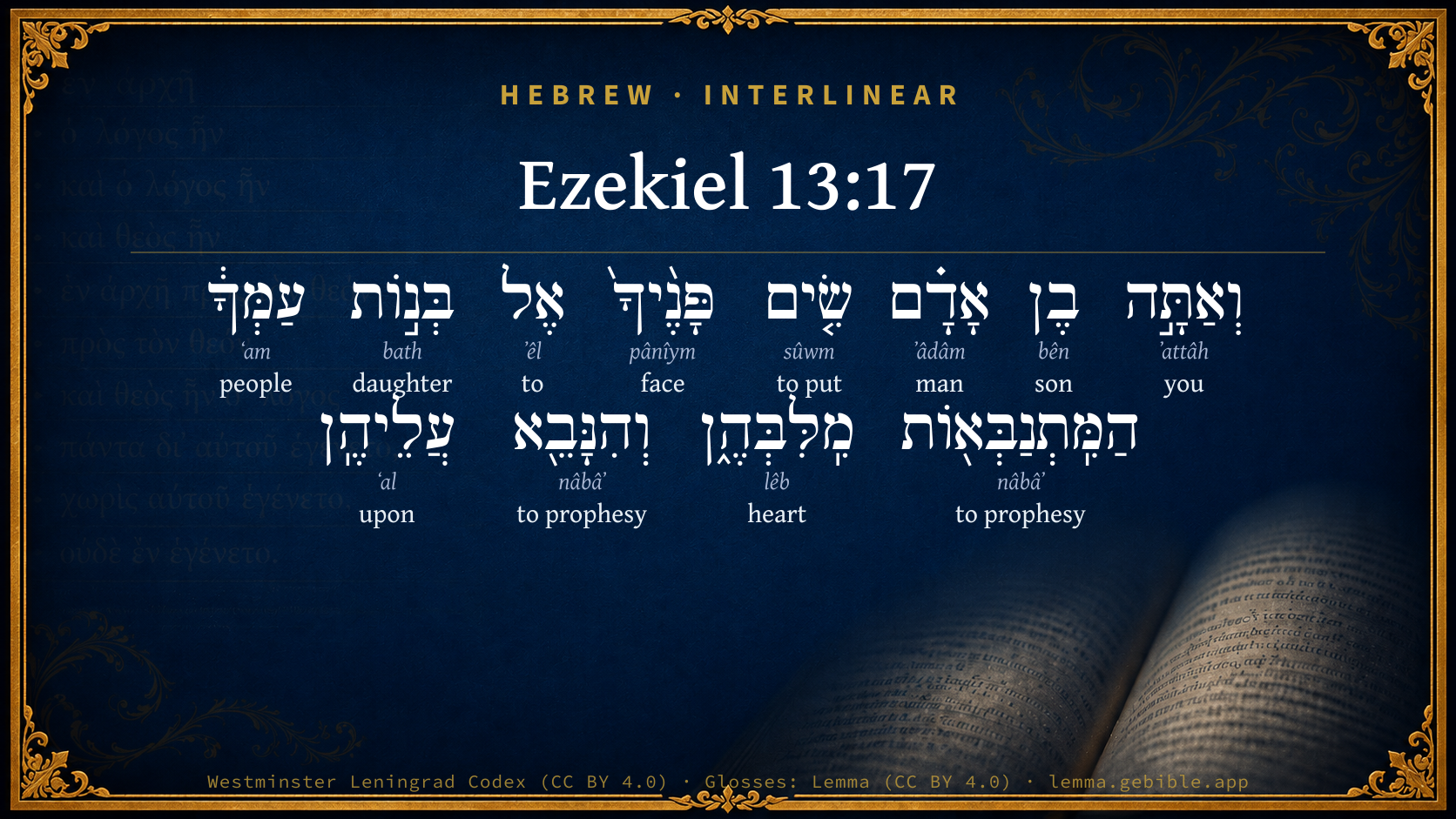
Hebrew (Westminster Leningrad Codex) Ezekiel 13:17 appears in the Hebrew Old Testament. The text above is from the Westminster Leningrad Codex. Each word links to its Strong’s number, a concise gloss, and parsing drawn from the Open Scriptures Hebrew Bible morphology. Click any word for its full Brown-Driver-Briggs (BDB) entry.
Download image
Cite this verse

Ezekiel 13:17 (World English Bible). Public Domain. Lemma interlinear Bible study tool, https://lemma.gebible.app/v/ezekiel/13/17.

Show BibTeX & RIS
BibTeX
RIS
English Translation
You, son of man, set your face against the daughters of your people, who prophesy out of their own heart; and prophesy you against them,
World English Bible · Public Domain
Download a study sheet

One document with this verse’s original text, its word-by-word gloss line, the meaning frame, cross-references with their text, attributed commentary, and full source and license credits — printable, and it pastes into notes with its structure intact.

This verse Autodidact and up

Study sheet (.html) Plain text (.txt)

A passage Seminary Student

Up to 50 verses in one chapter. A passage sheet keeps up to 6 commentary sources and 12 cross-references per verse, in the order this page ranks them, and says so on the sheet whenever that leaves anything out. Ask for a single verse and you get the Autodidact verse sheet above.

Everything on this page stays free to read, with no account — the sheet is a download of what is already on screen, not access to it.

Want to remove ads? Support Godless Engineer
Compare translations 3

The same verse in 3 English versions, stacked beneath the original-language interlinear above. Click any original word for its lexicon entry.

Each is an independent rendering of the whole verse — the interlinear is not word-aligned to these translations.

Highlighted words mark where these versions differ — a whole-verse word diff, not a word-by-word alignment.

  • World English Bible Public Domain
    You, son of man, set your face against the daughters of your people, who prophesy out of their own heart; and prophesy you against them,
  • King James Version Public Domain
    Likewise, thou son of man, set thy face against the daughters of thy people, which prophesy out of their own heart; and prophesy thou against them,
  • unfoldingWord Literal Text CC BY-SA 4.0
    So you, son of man, set your face against the daughters of your people who prophesy out of their own minds, and prophesy against them.

unfoldingWord Literal Text — © unfoldingWord, licensed CC BY-SA 4.0. Word-aligned USFM3 via Door43 (git.door43.org/unfoldingWord/en_ult).

Versions to compare (up to 4)

3 of 4 selected

Show all 18 translations

Every available English version of this verse, each an independent rendering of the whole verse.

  • World English Bible Public Domain
    You, son of man, set your face against the daughters of your people, who prophesy out of their own heart; and prophesy you against them,
  • Berean Standard Bible Public Domain
    Now, O son of man, set your face against the daughters of your people who prophesy out of their own imagination. Prophesy against them
  • Majority Standard Bible Public Domain
    Now, O son of man, set your face against the daughters of your people who prophesy out of their own imagination. Prophesy against them
  • King James Version Public Domain
    Likewise, thou son of man, set thy face against the daughters of thy people, which prophesy out of their own heart; and prophesy thou against them,
  • American Standard Version (1901) Public Domain
    And thou, son of man, set thy face against the daughters of thy people, that prophesy out of their own heart; and prophesy thou against them,
  • Revised Version (1885) Public Domain
    And thou, son of man, set thy face against the daughters of thy people, which prophesy out of their own heart; and prophesy thou against them,
  • Geneva Bible (1599) Public Domain
    Likewise thou sonne of man, set thy face against the daughters of thy people, which prophesie out of their owne heart: and prophesie thou against them, and say,
  • Douay-Rheims (1899) Public Domain
    And thou, son of man, set thy face against the daughters of thy people that prophesy out of their own heart: and do thou prophesy against them,
  • Young's Literal Translation Public Domain
    And thou, son of man, set thy face against the daughters of thy people, who are prophesying out of their own heart, and prophesy concerning them,
  • Literal Standard Version CC BY-SA 4.0
    And you, son of man, set your face against the daughters of your people, who are prophesying out of their own heart, and prophesy concerning them,
  • Unlocked Literal Bible CC BY-SA 4.0
    So you, son of man, set your face against the daughters of your people who prophesy out of their own minds, and prophesy against them.
  • unfoldingWord Literal Text CC BY-SA 4.0
    So you, son of man, set your face against the daughters of your people who prophesy out of their own minds, and prophesy against them.
  • Darby Bible Public Domain
    And thou, son of man, set thy face against the daughters of thy people, who prophesy out of their own heart; and prophesy against them,
  • World Messianic Bible Public Domain
    You, son of man, set your face against the daughters of your people, who prophesy out of their own heart; and prophesy against them,
  • Webster's Bible Public Domain
    Likewise, thou son of man, set thy face against the daughters of thy people, who prophesy out of their own heart; and prophesy thou against them,
  • Free Bible Version CC BY-SA 4.0
    Now, son of man, you are to oppose those Israelite women who make up prophecies in their own minds. Prophesy against them
  • Bible in Basic English Public Domain
    And you, son of man, let your face be turned against the daughters of your people, who are acting the part of prophets at their pleasure; be a prophet against them, and say,
  • JPS Tanakh (1917) Public Domain
    And thou, son of man, set thy face against the daughters of thy people, that prophesy out of their own heart; and prophesy thou against them,

Literal Standard Version (2020), Covenant Press — licensed CC BY-SA 4.0. Text via the HelloAO Bible API (eBible.org). Unlocked Literal Bible (unfoldingWord) — licensed CC BY-SA 4.0. Text via the HelloAO Bible API (eBible.org). unfoldingWord Literal Text — © unfoldingWord, licensed CC BY-SA 4.0. Word-aligned USFM3 via Door43 (git.door43.org/unfoldingWord/en_ult). Free Bible Version, Dr. Jonathan Gallagher — licensed CC BY-SA 4.0. Text via the HelloAO Bible API (eBible.org).

Word by word

More ways to search: Search by grammar → Find every occurrence → Compare this word →

Practice this passage: Drill this verse → Learn its vocabulary →

הַמִּֽתְנַבְּא֖וֹת
nâbâʼ
H5012
“the · prophesying”
Particle, Definite Article + Verb, Hithpael, Participle Active, Feminine, Plural, Absolute
Part of Speech
Particle + Verb
Stem
Hithpael
Form
Participle Active
Gender
Feminine
Number
Plural
State
Absolute
Full BDB Definition

Origin: a primitive root

TWOT: 1277

to prophesy - (Niphal) - to prophesy - under influence of divine spirit - of false prophets - (Hithpael) - to prophesy - under influence of divine spirit - of false prophets
  1. וְאַתָּ֣ה ʼattâh H859 “and · you” Conjunction + Pronoun, Personal, 2nd Person, Masculine, Singular
  2. בֶן bên H1121 “son of” Noun, Common, Masculine, Singular, Construct
  3. אָדָ֗ם ʼâdâm H120 “man” Noun, Common, Masculine, Singular, Absolute
  4. שִׂ֤ים sûwm H7760 “put” Verb, Qal, Imperative, 2nd Person, Masculine, Singular
  5. פָּנֶ֨יךָ֙ pânîym H6440 “face(s) · your” Noun, Common, Both, Plural, Construct + Suffix, Personal, 2nd Person, Masculine, Singular
  6. אֶל ʼêl H413 “to” Preposition
  7. בְּנ֣וֹת bath H1323 “daughters of” Noun, Common, Feminine, Plural, Construct
  8. עַמְּךָ֔ ʻam H5971 “people · your” Noun, Common, Masculine, Singular, Construct + Suffix, Personal, 2nd Person, Masculine, Singular
  9. מִֽלִּבְּהֶ֑ן lêb H3820 “from · heart · their” Preposition + Noun, Common, Masculine, Singular, Construct + Suffix, Personal, 3rd Person, Feminine, Plural
  10. וְהִנָּבֵ֖א nâbâʼ H5012 “and · prophesy” Conjunction + Verb, Niphal, Imperative, 2nd Person, Masculine, Singular
  11. עֲלֵיהֶֽן ʻal H5921 “upon · them” Preposition + Suffix, Personal, 3rd Person, Feminine, Plural

About this verse

These counts appear in no published source. They are computed here, from the morphology-tagged text and Lemma’s own curated glosses. What Lemma adds →

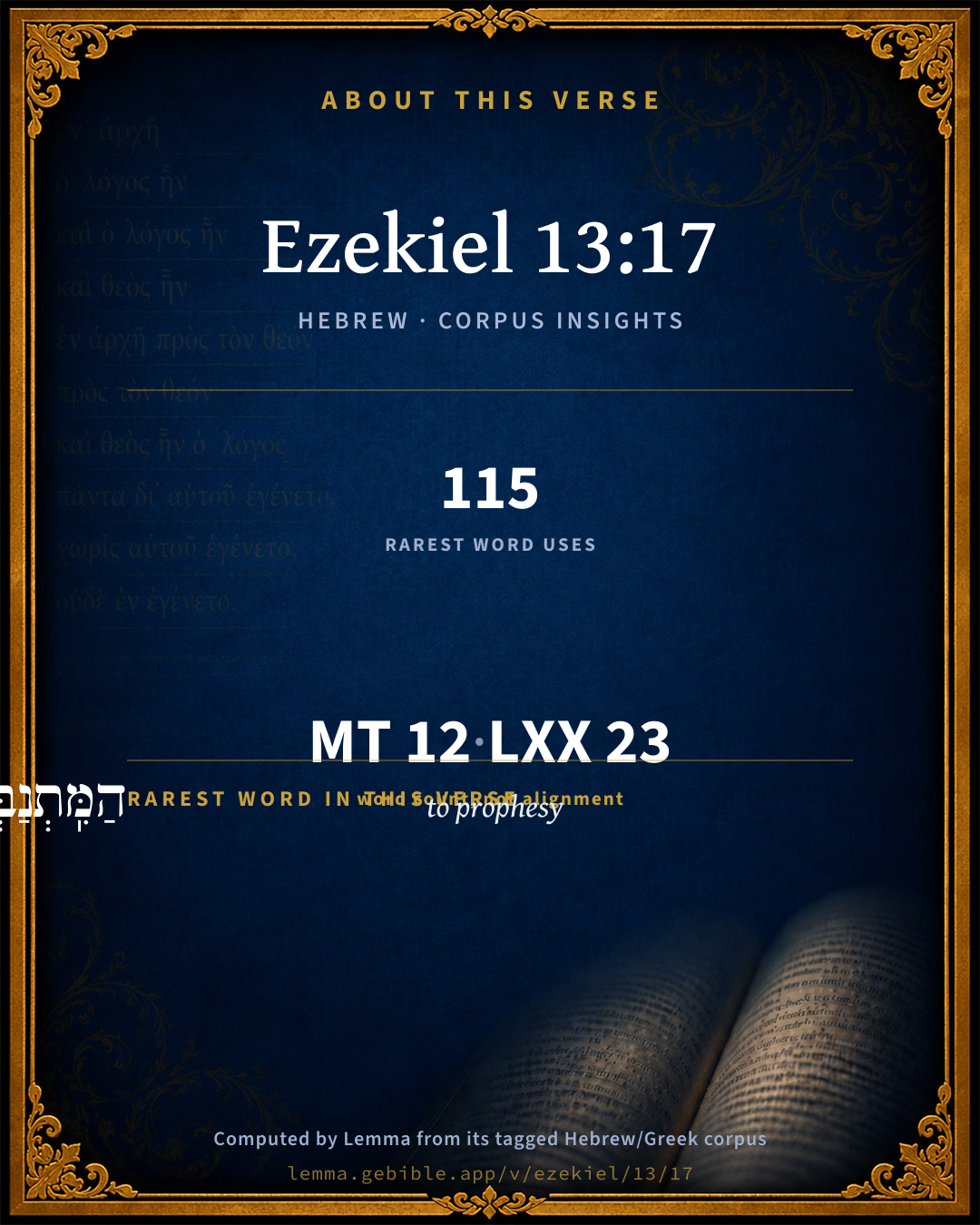
12
words
11
distinct lemmas
Prophets
section

Grammatical profile

  • 3 verbs
  • 6 nouns
  • 1 pronoun
  • 2 prepositions

Verb forms

  • שִׂ֤ים Qal · Imperative
  • הַמִּֽתְנַבְּא֖וֹת Hithpael · Participle Active
  • וְהִנָּבֵ֖א Niphal · Imperative

Repetition

A word recurs within this verse — often emphatic in Hebrew:

  • הַמִּֽתְנַבְּא֖וֹת to prophesy H5012 ×2

Hebrew & Septuagint length

In English translation the verse runs 25 words from the Hebrew and 26 from the Septuagint (LXX English) — closely comparable.

A rough comparison of the two English renderings, which tokenize alike — not a word-level alignment.

Word counts can differ between the Hebrew and the Greek without any difference in meaning — e.g. the Hebrew direct-object marker אֵת has no separate Greek word, and Greek often adds the article ὁ.

In the original languages it is 12 Hebrew tokens and 23 Greek tokens — but the two are counted differently (Hebrew bundles its prefixes and suffixes into one token; the Greek is in lemma form), so that isn’t a like-for-like length.

Cross-references

11

Topical passages linked to Ezekiel 13:17 in the Treasury of Scripture Knowledge — connected by theme and wording, ordered by reader-vote popularity; previews shown in the World English Bible.

  • Ezekiel 13:2 Son of man, prophesy against the prophets of Israel who prophesy, and say you to those who prophesy out of their own heart, Hear you the word of Yahweh:
  • Judges 4:4 Now Deborah, a prophetess, the wife of Lappidoth, she judged Israel at that time.
  • 2 Kings 22:14 So Hilkiah the priest, and Ahikam, and Achbor, and Shaphan, and Asaiah, went to Huldah the prophetess, the wife of Shallum the son of Tikvah, the son of Harhas, keeper of the wardrobe (now she lived in Jerusalem in the second quarter); and they talked with her.
  • Revelation 2:20 But I have this against you, that you tolerate your woman, Jezebel, who calls herself a prophetess. She teaches and seduces my servants to commit sexual immorality, and to eat things sacrificed to idols.
  • Luke 2:36 There was one Anna, a prophetess, the daughter of Phanuel, of the tribe of Asher (she was of a great age, having lived with a husband seven years from her virginity,
  • Isaiah 3:16–26 Moreover Yahweh said, "Because the daughters of Zion are haughty, And walk with outstretched necks and flirting eyes, Walking to trip as they go, Jingling ornaments on their feet;
  • Isaiah 4:4 when the Lord shall have washed away the filth of the daughters of Zion, and shall have purged the blood of Jerusalem from its midst, by the spirit of justice, and by the spirit of burning.
  • Ezekiel 4:3 Take for yourself an iron pan, and set it for a wall of iron between you and the city: and set your face toward it, and it shall be besieged, and you shall lay siege against it. This shall be a sign to the house of Israel.
  • Ezekiel 20:46 Son of man, set your face toward the south, and drop [your word] toward the south, and prophesy against the forest of the field in the South;
  • Ezekiel 21:2 Son of man, set your face toward Jerusalem, and drop [your word] toward the sanctuaries, and prophesy against the land of Israel;
  • 2 Peter 2:1 But there also arose false prophets among the people, as among you also there will be false teachers, who will secretly bring in destructive heresies, denying even the Master who bought them, bringing on themselves swift destruction.

Cross-references courtesy of OpenBible.info (CC BY 4.0).

Hebrew and Greek witnesses Masoretic Hebrew ↔ Greek Septuagint

The same verse in the two great witnesses to the Old Testament, shown verse-for-verse.

These are two independent witnesses, not word-aligned to each other, and the Septuagint is shown in lemma (dictionary) form.

Hebrew Ezekiel 13:17 Masoretic · Westminster Leningrad Codex

וְאַתָּ֣ה בֶן אָדָ֗ם שִׂ֤ים פָּנֶ֨יךָ֙ אֶל בְּנ֣וֹת עַמְּךָ֔ הַמִּֽתְנַבְּא֖וֹת מִֽלִּבְּהֶ֑ן וְהִנָּבֵ֖א עֲלֵיהֶֽן

You, son of man, set your face against the daughters of your people, who prophesy out of their own heart; and prophesy you against them,

World English Bible · Public Domain

Greek LXX Ezekiel 13:17 Septuagint · lemma form

καί σύ υἱός ἄνθρωπος στηρίζω ὁ πρόσωπον σύ ἐπί ὁ θυγάτηρ ὁ λαός σύ ὁ προφητεύω ἀπό καρδία αὐτός καί προφητεύω ἐπί αὐτός

And you, son of man, set your face firmly against the daughters of your people, that prophesy out of their own heart; and prophesy against them.

LXX2012 (modern English Septuagint) · Public Domain

On this verse, Keil & Delitzsch discusses the Septuagint’s reading. Read the note in Commentary ↓

Hebrew: Westminster Leningrad Codex (CC BY 4.0). Greek: Septuagint (public domain); English from LXX2012 (modern English Septuagint) (Public Domain). How the Septuagint differs from the Hebrew →

Targum (Aramaic paraphrase)

1

The Targum is the ancient Jewish Aramaic paraphrase of the Hebrew Scriptures — an interpretive translation, not the Hebrew text itself. Onkelos (literal) and Pseudo-Jonathan (expansive) render the Torah, and Jonathan the Prophets. Coverage is partial: where no permissively-licensed English translation exists for a verse, only the Aramaic is shown. This is verse-level text, not a word-by-word alignment to the Hebrew.

  1. Targum Jonathan Prophets (Joshua–Malachi)
    וְאַתְּ בַּר אָדָם קַבֵּיל נְבוּאָה עַל בְּנַת עַמָךְ דְמִתְנַבָּן כִּרְעוּת לִבְּהוֹן וְאִתְנַבֵּי עֲלֵיהֶן:

    (no public-domain English translation for this verse)

    Targum Jonathan — Aramaic: “Mikraot Gedolot” (public domain). English: “Sefaria Community Translation” (CC0 1.0 (public-domain dedication)); “London "Chaldee Paraphrase," 1871” (public domain). Text via Sefaria.

Commentary

Notes on Ezekiel 13:17 from classic Christian and Jewish commentators (each source and its license shown beneath its notes). The classic Christian expositions comment on the surrounding passage and are grouped to its opening verse, so a note may address several verses; the Jewish commentaries on the Tanakh (Rashi and others) are per-verse, so they appear only where the commentator wrote on this verse.

Lemma curates 59 commentaries, every one of them public domain or Creative Commons licensed, each selected and text-cleaned for this edition rather than reprinted as found. About our sources →

Matthew Henry's Commentary

As God has promised that when he pours out his Spirit upon his people both their sons and their daughters shall prophesy, so the devil, when he acts as a spirit of lies and falsehood, is so in the mouth not only of false prophets, but of false prophetesses too, and those are the deceivers whom the prophet is here directed to prophesy against; for they are not such despicable enemies to God's truths as deserve not to be taken notice of, nor yet will either the weakness of their sex excuse their sin or the tenderness and respect that are owing to it exempt them from the reproaches and threatenings of the word of God. No: Son of man, set they face against the daughters of thy people, Eze 13:17. God takes no pleasure in owning them for his people. They are thy people, as Exo 32:7. The women pretend to a spirit of prophecy, and are in the same song with the men, as Ahab's prophets were: Go on, and prosper. They prophesy out of their own heart too; they say what comes uppermost and what they know nothing of. Therefore prophesy against them from God's own mouth. The prophet must set his face against them, and try if they can look him in the face and stand to what they say. Note, When sinners grow very impudent it is time for reprovers to be very bold. Now observe,

I. How the sin of these false prophetesses is described, and what are the particulars of it. 1. They told deliberate lies to those who consulted them, and came to them to be advised, and to be told their fortune: "You do mischief by your lying to my people that hear your lies (Eze 13:19); they come to be told the truth, but you tell them lies; and, because you humour them in their sins, they are willing to hear you." Note, It is ill with those people who can better hear pleasing lies than unpleasing truths; and it is a temptation to those who lie in wait to deceive to tell lies when they find people willing to hear them and to excuse themselves with this, Si populus vult decipi, decipiatur - If the people will be deceived, let them. 2. They profaned the name of God by pretending to have received those lies from him (Eze 13:19): "You pollute my name among my people, and make use of that for the patronising of your lies and the gaining of credit to them." Note, Those greatly pollute God's holy name that make use of it to give countenance to falsehood and wickedness. Yet this they did for handfuls of barley and pieces of bread. They did it for gain; they cared not what dishonour they did to God's name by their lying, so they could but make a hand of it for themselves. There is nothing so sacred which men of mercenary spirits, in whom the love of this world reigns, will not profane and prostitute, if they can but get money by the bargain. But they did it for poor gain; if they could get no more for it, rather than break they would sell you a false prophecy that should please you to a nicety for the beggar's dole, a piece of bread or a handful of barley; and yet that was more than it was worth. Had they asked it as an alms, for God's sake, surely they might have had it, and God would have been honoured; but, taking it as a fee for a false prophecy, God's name if polluted, and the smallness of the reward heightens the offence. For a piece of bread that man will transgress, Pro 28:21. Had their poverty been their temptation to steal, and so to take the name of the Lord in vain, it would not have been nearly so bad as when it tempted them to prophesy lies in his name and so to profane it. 3. They kept people in awe, and terrified them with their pretensions: "You hunt the souls of my people (Eze 13:18), hunt them to make them flee (Eze 13:20), hunt them into gardens (so the margin reads it); you use all the arts you have to court or compel them into those places where you deliver your pretended predictions, or you have got such an influence upon them that you make them do just as you would have them to do, and tyrannise over them." It was indeed the people's fault that they did regard them, but it was their fault by lies and falsehoods to command that regard; they pretended to save the souls alive that came to them, Eze 13:18. If they would but be hearers of them, and contributors to them, they might be sure of salvation; thus they beguiled unstable souls that had a concern about salvation as their end but did not rightly understand the way, and therefore hearkened to those who were most confident in promising it to them. "But will you pretend to save souls, or secure salvation to your party?" Those are justly suspected that make such pretensions. 4. They discouraged those that were honest and good, and encouraged those that were wicked and profane: You slay the souls that should not die, and save those alive that should not live, Eze 13:19. This is explained (Eze 13:22): You have made the heart of the righteous sad, whom I have not made sad; because they would not, they durst not, countenance your pretensions, you thundered out the judgments of God against them, to their great grief and trouble; you put them under invidious characters, to make them either despicable or odious to the people, and pretended to do it in God's name, which made them go many a time with a sad heart; whereas it was the will of God that they should be comforted, and by having respect put upon them should have encouragement given them. But on the other side, and which is still worse, you have strengthened the hands of the wicked and emboldened them to go on in their wicked ways and not to return from them, which was the thing the true prophets with earnestness called them to. "You have promised sinners life in their sinful ways, have told them that they shall have peace though they go on, by which their hands have been strengthened and their hearts hardened." Some think this refers to the severe censures they passed upon those who had already gone into captivity (who were humbled under their affliction, by which their hearts were made sad), and the commendations they gave to those who rebelled against the king of Babylon, who were hardened in their impieties, by which their hands were strengthened; or by their polluting the name of God they saddened the hearts of good people who have a value and veneration for the word of God, and confirmed atheists and infidels in their contempt of divine revelation and furnished them with arguments against it. Note, Those have a great deal to answer for who grieve the spirits, and weaken the hands, of good people, and who gratify the lusts of sinners, and animate them in their opposition to God and religion. Nor can any thing strengthen the hands of sinners more than to tell them that they may be saved in their sins without repentance, or that there may be repentance though they do not return from their wicked ways. 5. They mimicked the true prophets, by giving signs for the illustrating of their false predictions (as Hananiah did, Jer 28:10), and they were signs agreeable to their sex; they sewed little pillows to the people's arm-holes, to signify that they might be easy and repose themselves, and needed not be disquieted with the apprehensions of trouble approaching. And they made kerchiefs upon the head of every stature, of persons of every age, young and old, distinguishable by their stature, Eze 13:18. These kerchiefs were badges of liberty or triumph, intimating that they should not only be delivered from the Chaldeans, but be victorious over them. Some think these were some superstitious rites which they used with those to whom they delivered their divinations, preparing them for the reception of them by putting enchanted pillows under their arms and handkerchiefs on their heads, to raise their fancies and their expectations of something great. Or perhaps the expressions are figurative: they did all they could to make people secure, which is signified by laying them easy, and to make people proud, which is signified by dressing them fine with handkerchiefs, perhaps laid or embroidered on their heads.

II. How the wrath of God against them is expressed. Here is a woe to them (Eze 13:18), and God declares himself against the methods they took to delude and deceive, Eze 13:20. But what course will God take with them? 1. They shall be confounded in their attempts, and shall proceed no further; for (Eze 13:23) you shall see no more vanity nor divine revelations; not that they shall themselves lay down their pretensions in a way of repentance, but when the event gives them the lie they shall be silent for shame; or their fancies and imaginations shall not be disposed to receive impressions which assist them in their divinations as they have been; or they themselves shall be cut off. 2. God's people shall be delivered out of their hands. When they see themselves deluded by them into a false peace and a fool's paradise, and that though they would not leave their sin their sin has left them, and they see no more vanity nor divine divinations, they shall turn their back upon them, shall slight their predictions. The righteous shall be no more saddened by them, no, nor the wicked strengthened: The pillows shall be torn from their arms, and the kerchiefs from their heads; the fallacies shall be discovered, their frauds detected, and the people of God shall no more be in their hand, to be hunted as they had been. Note, It is a great mercy to be delivered from a servile regard to, and fear of, those who, under colour of a divine authority, impose upon and tyrannise over the consciences of men, and say to their souls, Bow down, that we may go over. But it is a sore grief to those who delight in such usurpations to have their power broken and the prey delivered; such was the reformation to the church of Rome. And, when God does this, he makes it to appear that he is the Lord, that it is his prerogative to give law to souls.

Matthew Henry's Commentary on the Whole Bible (1708–1710) — public domain (CC PDM 1.0). Text via the HelloAO Bible API.

The Cambridge Bible for Schools and Colleges

gen. ed. J. J. S. Perowne

17–23. Denunciation of the false prophetesses

Female prophets were not unknown in Israel whether in earlier or later times, as Deborah (Jdg_4:3) and Huldah (2Ki_22:14). The prophetesses referred to here were like the prophets, prophesying out of their own heart (Eze_13:17). Their prophesying was by some species of divination, which they used in order to obtain oracles. The methods of divination practised are somewhat obscure: they bound fillets upon the joints and threw cloths or veils over the heads of those who consulted them. By these means they “hunted” souls; they saved souls alive that should not live and slew souls that should not die (Eze_13:19), or as expressed otherwise, they made the heart of the righteous sad and strengthened the hands of the wicked (Eze_13:22). In other words like the false prophets they misled the people, promising life to the ungodly and prophesying disaster to those who were righteous.

The Cambridge Bible for Schools and Colleges (gen. ed. J. J. S. Perowne; Cambridge University Press, 1878–1918) — public domain. Text from a community e-Sword module.

Trapp's Complete Commentary

John Trapp

Eze 13:17 Likewise, thou son of man, set thy face against the daughters of thy people, which prophesy out of their own heart; and prophesy thou against them,

Ver. 17. Likewise, thou son of man.] A prophet’s work is never done. Agricolis redit labor actus in orbem.

Set thy face against the daughters.] The prophet had rather have contended with men than women, and more honour it had been for him; but he must do as bidden. Mulieres genus fragile sunt; Women are delecate; yet the prophet must set his face against them as stout agents for the devil, who hath ever made great use of them. Such were Noadiah; {Neh 6:14} that apocalyptical Jezebel, Bridget Matild; those two Jezebels of New England, Mrs Hutchinson and Mrs Dyer, our recent most impudent preacheresses in London and elsewhere. {a}

{a} Mr Weld’s "Sectar. of New England." Matildis Comitissa, vulgo dicta filia S. Petri.

John Trapp, A Commentary or Exposition upon All the Books of the Old and New Testament (1647–1656) — public domain. Text from a community e-Sword module.

Joseph Benson's Commentary

Eze 13:17-19. Likewise, set thy face against the daughters of thy people — Direct thy discourse against the female pretenders to prophecy. God sometimes bestowed the gift of prophecy upon women, Exo 15:20; Jdg 9:4; 2Ki 22:14. This encouraged others of that sex to pretend to the same gift: compare Rev 2:20. Wo to the women that sew pillows, &c. — As the prophet compares the deceitful practices of the false prophets to the daubing of a wall, so he represents the artifices of these female seducers by sewing pillows under the hearers’ arms, that they might rest securely in their evil ways. “The eastern mode of sitting,” says Harmer, chap. 6. observ. 35, “supported by pillows, explains this representation of Ezekiel. Dr. Russel has given us a print representing a fine eastern lady reposing herself on one of these bolsters, or pillows, by leaning with one of her arms on one of them, while she is smoking.” In Barbary and the Levant they “always cover the floors of their houses with carpets; and along the sides of the wall, or floor, a range of narrow beds, or mattresses, is often placed upon these carpets; and, for their further ease and convenience, several velvet or damask bolsters are placed upon these carpets or mattresses: indulgences that seem to be alluded to by the stretching of themselves upon couches, and by the sewing of pillows to arm-holes.” — Shaw’s Travels, p. 209, second edition. Sir John Chardin also mentions “a mattress, with large cushions, placed at the back and sides” of the person who uses it as a bed, Harm., vol. 2., chap. 6. observ. 46. See also, to the same purpose, Lady M. W. Montague’s description of a Turkish lady’s apartment, let. 32, vol. 2. p. 55. And make kerchiefs upon the head of every stature — Rather, Upon every head, כל ראשׁ, of every stature, the false prophetess doing this without distinction of stature or age. “This,” says Bishop Newcome, “may be a strong, eastern manner of expressing that these women hoodwinked their votaries, and kept them in spiritual darkness.” In the same light the passage is considered by Lowth and many others. “Or the covering of the head may have been of the ornamental kind, to denote prosperity or victory, as pillows denoted tranquillity and plenty; and both may have been significantly applied to the heads and arms of those who consulted the prophetesses.” Thus we are told by Dr. Shaw, p. 221, and Lady M. W. Montague, vol. 2. p. 30, that the eastern women bind on their other ornaments for the head with a handkerchief, which the latter calls “a rich embroidered handkerchief.” These prophetesses, therefore, Harmer thinks, “did the same thing by their flattering words, as would have been best expressed, if they had thought fit to signify the same thing by actions only, (as the prophets sometimes did,) by making bolsters for the arms, and presenting them to the Israelitish women, whom they wanted to assure of the continuance of their prosperity; and embroidering handkerchiefs, proper to bind over the ornaments of females in a state of honour, and afterward putting them on their heads. Whereas, the true prophets of God gave them to understand, in direct contradiction to all this, that if the Jews would not yield up themselves to the Chaldeans, great numbers of their men should perish, and their women should be brought down from those elevated places in which they sat supported by rich bolsters, and should be forced to sit on the ground; and, instead of a rich attire for their heads, should have their hair miserably dishevelled, strongly marking out grief in a despairing neglect of their persons. Such is the description Isaiah gives of the state of captives, (Eze 47:1-2,) which every one must see is just the reverse of what these prophetesses are represented as doing: Come down and sit in the dust, &c.” — Harmer, chap. 6., observ. 35.

To hunt souls — To allure, draw, or drive men into those nets and snares that they have laid for them, and thereby to make them their prey. Or to destroy men, to expose them to the divine vengeance, by lulling them into security, and enticing them to commit sin in following their directions. Will ye hunt the souls of my people? — Will ye make a prey of men’s souls by deluding them with fair promises and vain hopes? Will ye draw my people into destruction, by promising them safety and happiness, while they continue in sin? “This verse,” says Secker, “should seem to mean, that these women made every body easy to their ruin, for their own profit.” Will ye pollute me among my people? — Will ye profane my name, by making use of it to give credit to your own dreams and lies? Or, Will ye dishonour it by employing it to the vilest use, the encouraging of wickedness, and the discouraging of piety and virtue? For handfuls of barley, &c. — For the sake of gain to yourselves, even for the meanest presents? It is well known how customary gifts were, and still are, in the East. These false prophets and prophetesses being chiefly, if not solely, consulted by the corrupt and wicked part of the Jews, who made them presents for their answers; and those presents being generally the larger the more agreeable the answers were, therefore these prophets and prophetesses always uttered what was pleasing, and gave encouragement to the wicked, and what tended to disgrace and discourage the truly good. To slay the souls that should not die — To denounce or prophesy death and destruction to those that shall be preserved. Thus they denounced death to those who yielded themselves to the Chaldeans in Jeconiah’s captivity, whom God had determined to preserve alive, Jer 29:5-6. And they encouraged those who remained at Jerusalem, with promises of peace and safety, who, God had foretold, should perish: see Eze 5:12. Or the words may be understood, in a more general sense, of discouraging the godly, and confirming the wicked in their evil ways: see Eze 13:22; and Jer 23:14; Jer 23:17. To slay, and make alive, signify here, to promise men life, or threaten them with death. So the prophet says he came to destroy the city, (Eze 43:3,) when he came to pronounce the sentence of destruction upon it. — Lowth.

Joseph Benson's Commentary on the Old and New Testaments (1811–1818) — public domain. Text from a community e-Sword module.

The Preacher's Complete Homiletical Commentary

Joseph S. Exell (gen. ed.)

CONDEMNATION OF THE PROPHETESSES (Eze_13:17-23)

EXEGETICAL NOTES.—A disposition to prophecy was in the air; so women as well as men, in Jerusalem and among the exiles, were influenced by it. Naturally it assumed different forms in the one from what it did in the other. Men daub walls, women sew, make veils, &c. Both are deceiving, and shall certainly be set at nought. There seems no weight to be accorded to the suggestion that the existence of these prophetesses was proof of “a fresh instance of declension into heathen usages.” The gift of true prophecy came to holy women in the earlier history of Israel before Christ and also in the later, and might be pretended to.

Eze_13:18. Ignorance of the practices alluded to here stands in the way of clearing up the meaning of this verse. We can decide only by probabilities. “Woe unto the women who sew coverings on every joint of the hands.” Whether these coverings were cushions or amulets or other objects, their use seems to have been to make an appearance which would impress the people. So with the following, “And who make veils on the head of every stature;” under the envelopment of clothing on the head adapted to their varying size—figure, age, condition—they fitted themselves to act upon their hearers, “to hunt [as bird-catcher’s] souls,” and thus ensnare to their ruin. The verse condemns sensational methods of divination resorted to by the prophetesses, whether the method was by gesture or dress or word. Hence the question of surprise at the infatuation which would use such means. “The souls of my people will ye hunt and the souls of yourselves will ye keep alive?” Persuading themselves of their own security, they entered on practices intended to persuade the Israelites to the same confidence, while destruction only would result to them.

Eze_13:19. “And will ye profane me among my people,” by prophesying in my name, for handfuls of barley and for pieces of bread, offerings such as were brought when consulting a seer (1Sa_9:7-8; 1Ki_14:3; cf. Mic_3:5); and by declaring that ye speak the words of the Lord when they are not, the result of such profaning the Lord being “to slay souls which should not die and to keep alive souls which should not live, by your lying to my people, hearers of lying.

Eze_13:20. Punishment of the women. “Behold I [come] to your coverings with which ye hunt souls as [if they were] flying [birds], and I tear them off your arms.” Their snares shall be spread in vain, “I set free the souls which ye hunt, the souls” which ye deal with “as flying [birds].”

Eze_13:21. “And I tear your veils and deliver my people from your hand.” Ye seduce them by your various artifices, so as to destroy the people, and I would expose your pretences so as to save them.

Eze_13:22. Because the prophetesses have acted so that false impressions of God are produced on the mind of the righteous and wicked, disheartening the former in good and confirming the latter in evil ways, “Therefore ye shall not see vanity and shall not divine divinations any more, and I will deliver my people out of your hand.” It is with God they are in conflict, and the utter failure of their prophecies will so appear that “ye shall know that I am the Lord:” knowledge of God is for the guilty a doom, for the righteous a security.

HOMILETICS

WOMEN IN RELIGIOUS MOVEMENTS

Serious events were about to occur in Israel. The shadow of them was cast over women as well as men. Spiritual influence knows no sex. Women “show piety at home,” in the more retired ways along which the little ones, the weak, the downcast of the world make their journey, but the groundswell of religious emotion rolling over a people impels some of its women into open and even audacious appearances.

I. The women assume deceptive methods. By dresses, or gestures, or other devices they pander to the senses so as to attract and impress those who hear them. If women are naturally more disposed to such methods than men, yet the warning is of unrestricted interest, that external representations in religion are of uncertain tendency; strong to promote error, they are poor allies in advancing truth.

II. Women are induced to act from unworthy motives. There is desire for power. They strive to move and control souls, and thus, as in later days, to “glory in the flesh” with their adherents. There is self regard. They persuade themselves that things will turn out so as to bring security for themselves, to save their own souls, even though they shrink from the narrow way of life and endure no hardness. There is greed. A very trifling present gets them to say that all is well when all is not well; that that is right which is wrong before God.

III. They are held responsible for their procedure. They hide the threatenings of the Lord, or pare down their awful meaning. They comfort souls in sin; distress souls seeking God. The painful result of their lies is that they hunt into peril those whom God would rescue; seize and kill souls whom God would save. Standing thus against God’s love and grace, they are counted out for condemnation, as the false prophets were. She who sins must suffer loss.

ERROR PREACHED (Eze_13:22)

I. The painful effects of erroneous teachings. The good are disheartened by scruples, perplexities, fears, and weakened to pursue their journey in the ways of the Lord: the evil are emboldened to go on the broad road by opiates to conscience and confirmation to unbelief.

II. The contrariety to God in them. He is the God of all comfort to those that fear His name; but this teaching breaks the inflow of His promises. He would make the dead in trespasses and sins to live through faith in Christ the Truth; but this teaching prevents faith, and He can do no mighty work of salvation.

III. The valid test for them. When high pretensions, dogmatic operations, fascinating proffers act so as to relax supreme regard to truth, righteousness, purity, and a true follower of Christ is depressed; or when hopes are produced in the mind of those who are not yielding themselves unto God that they will live, then each class may know that the words they hear are opposed to those of Him who is the true and living One, and are condemned by Him.

1. A people professing to know the Lord are not unaffected by the popular erroneous teaching of their day.

2. They may hope for His interference in their behalf, for He lays their real interest deeply to heart.

The Preacher's Complete Homiletical Commentary (gen. ed. Joseph S. Exell; Funk & Wagnalls, c. 1892) — public domain (pre-1929). A full-Bible homiletical/sermon-outline anthology covering 65 of 66 books (2 John is absent from the source module). Text from a community e-Sword module.

Keil & Delitzsch

C. F. Keil & F. Delitzsch

Against the False Prophetesses

As the Lord had not endowed men only with the gifts of prophecy, but sometimes women also, e.g., Miriam, Deborah, and Huldah; so women also rose up along with the false prophets, and prophesied out of their own hearts without being impelled by the Spirit of God. Eze 13:17-19. Their conduct. - Eze 13:17. And thou, son of man, direct thy face towards the daughters of thy people, who prophesy out of their heart and prophesy against them, Eze 13:18. And say, Thus saith the Lord Jehovah, Woe to those who sew coverings together over all the joints of my hands, and make caps for the head of every size, to catch souls! Ye catch the souls of my people, and keep your souls alive. Eze 13:19. And ye profane me with my people for handfuls of barley and for pieces of bread, to slay souls which should not die, and to keep alive which should not live, by your lying to my people who hearken to lying. - Like the prophets in Eze 13:2, the prophetesses are here described as prophesying out of their own heart (Eze 13:17); and in Eze 13:18 and Eze 13:19 their offences are more particularly described. The meaning of these verses is entirely dependent upon the view to be taken of ידי, which the majority of expositors, following the lead of the lxx, the Syriac, and the Vulgate, have regarded as identical with ידים or יד, and understood as referring to the hands of the women or prophetesses. But there is nothing to justify the assumption that ידי is an unusual form for ידים, which even Ewald takes it to be (Lehrbuch, 177a). Still less can it stand for the singular יד. And we have not sufficient ground for altering the text, as the expression זרועתיכם in Eze 13:20 (I will tear the כּסתות from your arms) does not require the assumption that the prophetesses had hidden their arms in כסתות; and such a supposition is by no means obviously in harmony with the facts.

The word כּסתות, from כּסת, with ת fem. treated as a radical letter (cf. Ewald, 186e), means a covering or concealment = כּסוּת. The meaning "cushion" or "pillow" (lxx προσκεφάλαια, Vulg. pulvilli) is merely an inference drawn from this passage, and is decidedly erroneous; for the word תּפר (to sew together) is inapplicable to cushions, as well as the phrase על כּל־אצּילי ידי, inasmuch as cushions are not placed upon the joints of the hands, and still less are they sewed together upon them. The latter is also a decisive reason for rejecting the explanation given by Hvernick, namely, that the kesâthōth were carpets, which were used as couches, and upon which these voluptuous women are represented as reclining. For cushions or couches are not placed upon, but under, the arm-joints (or elbows) and the shoulders, which Hvernick understands by אצּילי יד. This also overthrows another explanation given of the words, namely, that they refer to carpets, which the prophetesses had sewed together for all their arm-joints, so as to form comfortable beds upon splendid carpets, that they may indulge in licentiousness thereon. The explanation given by Ephraem Syrus, and adopted by Hitzig, namely, that the kesâthōth were amulets or straps, which they would round their arm-joints when they received or delivered their oracles, is equally untenable. For, as Kliefoth has observed, "it is evident that there is not a word in the text about adultery, or amulets, or straps used in prayer." And again, when we proceed to the next clause, the traditional rendering of מספּחות, as signifying either pillows (ὑπαυχένια, Symm.; cervicalia, Vulg.) or broad cloaks = מטפּחות (Hitzig, Hvernick, etc.), is neither supported by the usage of the language, nor in harmony with על ראשׁ. Mispâchōth, from sâphach, to join, cannot have any other meaning in the present context than a cap fitting close to the head; and על must denote the pattern which was followed, as in Psa 110:4; Est 9:26 : they make the caps after (answering to) the head of every stature. The words of both clauses are figurative, and have been correctly explained by Kliefoth as follows: "A double charge is brought against the prophetesses. In the first place, they sew coverings together to wrap round all the joints of the hand of God, so that He cannot touch them; i.e., they cover up and conceal the word of God by their prophesying, more especially its rebuking and threatening force, so that the threatening and judicial arm of God, which ought above all to become both manifest and effective through His prophetic word, does not become either one or the other. In the second place, they make coverings upon the heads of men, and construct them in such a form that they exactly fit the stature or size or every individual, so that the men neither hear nor see; i.e., by means of their flattering lies, which adapt themselves to the subjective inclinations of their hearers at the time, they cover up the senses of the men, so that they retain neither ear nor eye for the truth." They do both of these to catch souls. The inevitable consequence of their act is represented as having been intended by them; and this intention is then still further defined as being to catch the souls of the people of God; i.e., to allure them to destruction, and take care of their own souls. The clause הנּפשׁות תּצודדנה is not to be taken as a question, "Will ye catch the souls?" implying a doubt whether they really thought that they could carry on such conduct as theirs with perfect impunity (Hvernick). It contains a simple statement of what really took place in their catching of souls, namely, "they catch the souls of the people of God, and preserve their own souls;" i.e., they rob the people of God of their lives, and take care of their own (Kliefoth). לעמּי is used instead of the genitive (stat. constr.) to show that the accent rests upon עמּי. And in the same way we have לכנה instead of the suffix. The construction is the same as in Sa1 14:16. Eze 13:19 shows how great their sin had been. They profane God among His people; namely, by delivering the suggestions of their own heart to the people as divine revelations, for the purpose of getting their daily bread thereby (cf. Mic 3:5); by hurling into destruction, through their lies, those who are only too glad to listen to lying; by slaying the souls of the people which ought to live, and by preserving those which ought not to live, i.e., their own souls (Deu 18:20). The punishment for this will not fail to come.

Keil & Delitzsch — Biblical Commentary on the Old Testament (1861–1891) — public domain (CC PDM 1.0). Text via the HelloAO Bible API. (Old Testament only.)

Tyndale Open Study Notes

Tyndale Open Resources

13:17-19 Like the false male prophets (13:1-16), some women prophets proclaimed words that came only from their own imaginations. The false male prophets had been using conventional forms of prophecy, but the women used magical techniques involving charms and veils. Motivated by personal gain (a few handfuls of barley or a piece of bread), they promised life and death (cp. 3:17-21; 33:1-9), but to the wrong people.

Tyndale Open Study Notes — © Tyndale Open Resources, licensed CC BY-SA 4.0. Text via the HelloAO Bible API.

Jamieson, Fausset & Brown

Robert Jamieson, A. R. Fausset & David Brown

set thy face--put on a bold countenance, fearlessly to denounce them (Eze 3:8-9; Isa 50:7).

daughters--the false prophetesses; alluded to only here; elsewhere the guilt specified in the women is the active share they took in maintaining idolatry (Eze 8:14). It was only in extraordinary emergencies that God bestowed prophecy on women, for example on Miriam, Deborah, Huldah (Exo 15:20; Jdg 4:4; Kg2 22:14); so in the last days to come (Joe 2:28). The rareness of such instances enhanced their guilt in pretending inspiration.

Jamieson, Fausset & Brown — Commentary Critical and Explanatory on the Whole Bible (1871) — public domain (CC PDM 1.0). Text via the HelloAO Bible API.

Adam Clarke's Commentary

Verse 17. Set thy face against the daughters of thy people, which prophesy] From this it appears that there were prophetesses in the land of Israel, that were really inspired by the Lord: for as a false religion necessarily implies a true one, of which it is the ape; so false prophetesses necessarily imply true ones, whom they endeavoured to imitate.

That there were true prophetesses among the Jews is evident enough from such being mentioned in the sacred writings. Miriam, the sister of Moses Ex 15:20; Nu 12:2; Deborah, Jdg 4:4; Huldah, 2Kg 22:14; Anna, the daughter of Phanuel, Lu 2:36; the four daughters of Philip the deacon, Ac 21:9.

Calmet observes that there was scarcely a heresy in the primitive Church that was not supported and fomented by seducing women.

Adam Clarke's Commentary on the Bible (1810–1826) — public domain. Text from a community e-Sword/MySword module.

John Calvin's Commentaries

WE may gather from this passage that Satan’s lies were not spread among the people so much by men as by women. We know that the gift of prophecy is sometimes though rarely allowed to women, and there is no doubt that female prophets existed whenever God wished to brand men with a mark of ignominy as strongly as possible. I say as much as possible, because the sister of Moses enjoyed the prophetic gift, and this never ceased to the reproach of her brother. (Exodus 15:20.) But when Deborah and Huldah discharged the prophetic office, (Judges 4:4, and 2 Kings 22:14,) God doubtless wished to raise them on high to shame the men, and obliquely to show them their slothfulness. Whatever may be the reason, women have sometimes enjoyed the prophetic gift. And this is the meaning of Joel’s second chapter, (Joel 2:28,)Your sons shall see visions and your daughters shall prophesy. There is no doubt that the Spirit transfers to the kingdom of Christ what had been customary among the ancient people. For we know that Christ’s kingdom is described, or rather depicted, under the image of that government which God formerly held under the law. Since, then, certain women were gifted with the prophetic spirit, Satan, according to his custom, abused this under a false pretense. We know that he always emulates God and transforms himself into an angel of light, because if he were to show himself openly, all would instantly flee from him: hence he uses God’s name deceptively, to ingratiate himself among the simple and incautious. And he not only sends forth false prophets to scatter abroad their lies and impostures, but he turns even females to the same injurious use.

Here we see how anxiously we ought to guard against any corruption which may creep in to contaminate the pure gifts of God. But this contest seems not to have been sufficiently honorable to the servant of God; for it was almost a matter of shame when they engaged with women. We know that those who desire praise for their bravery do not willingly engage with unequal antagonists who have no strength to resist; since there is no praise in a victory when it is too easy: so also Ezekiel could put away from him this undertaking, since it was unworthy of the prophetic office. Hence it appears, that God’s servants cannot faithfully discharge the duties assigned to them, unless they strive to remove all impediments. This then is the condition of all those to whom God assigns the office of teaching, that they may oppose all false doctrines and errors, and never consider or wish for great praise from their victory: it should suffice them to assert God’s truth against all Satan’s devices. Thus we see Paul strove with a workman (Demetrius), (Acts 19:24,) and that was all but ridiculous: and truly he might seem not sufficiently to regard his dignity; for from the time when he saw secret things which it was not lawful for him to utter, and was carried up to the third heaven, (2 Corinthians 12:4,) when he engages in a contest with a craftsman, he seems to forget that dignity to which God had raised him. But we must remember the reason which I have mentioned, that as the duty of teaching is assigned to God’s servants, so they are appointed as his avengers and defenders of the doctrine of which they are heralds. Hence if, so to speak, fleas were to come out of the earth and rail at sound doctrine, none who are influenced by a desire of edification will hesitate to contend even with those fleas. Thus the Prophet’s modesty is conspicuous, because by God’s command he turns to these weak women to refute even them.

John Calvin's Commentaries (1540-1563) — public domain. Text from the Calvin Translation Society English edition (1840s-50s) via the Christian Classics Ethereal Library (ccel.org). Calvin's coverage is partial (roughly two-thirds of the Bible); uncommented books and verses are honest gaps, never fabricated. The 19th-century editor's footnotes and remarks are omitted so the notes are faithfully Calvin's own voice.

Ellicott's Commentary for English Readers

(17-23) Likewise, thou son of man, set thy face . . .—This passage deals with a class of people the false prophetesses, who are not mentioned elsewhere in the Old Testament. True prophetesses, as in the case of Miriam (Exo_15:20), Deborah (Jdg_4:4), and, at this very time, Huldah (2Ki_22:14; 2Ch_34:22), and somewhat later, Noadiah (Neh_6:14), are frequently spoken of, and continued to exist in New Testament times, as in the case of Anna (Luk_2:36). It was naturally to be expected that as false prophets dogged the steps of the true, the same thing would happen with the other sex, and we find express mention of a false prophetess in Rev_2:20. Their course, in prophesying “out of their own heart” deceiving the people, was essentially the same as that of the false prophets; but they are described as doing this in ways suited to their sex. Of the general meaning of this description there can be no doubt; but it is difficult to follow it with certainty in the details, because of the occurrence of some words of uncertain meaning, found nowhere else, and of some others in an unusual sense. Without attempting a discussion of each single word, (which would be useless except with a careful examination of the original), the following is given as the most probable translation of Eze_13:18-21; but it is to be remembered that several of the words, like the similar ones in Isa_3:16-24, are so uncertain that there is a difference of opinion in regard to their exact meaning :—“Woe to those who fasten charms on every finger-joint, that place kerchiefs on heads of every height to snare souls. Will ye snare the souls of my people, and keep your own souls alive? (19) And will ye profane me with my people for handfuls of barley, and for pieces of bread, to slay souls that should not die, and to make live souls that should not live, by your lying to my people who hearken to a lie? (20) Therefore, thus saith the Lord Jehovah, Behold, I am against your charms, when ye snare the souls like birds, and I will tear them from your arms, and will let the souls go, the souls that ye are snaring like birds. (21) Your kerchiefs also will I tear, and deliver my people out of your hand, and they shall be no more in your hand to be snared; and ye shall know that I am the Lord.” (See Excursus 8 at the end of this book, on Eze_13:6-7; Eze_13:14.)

A Bible Commentary for English Readers, edited by Charles John Ellicott (1878–1897) — public domain. Text from a community e-Sword module.

John Gill's Exposition

And will ye pollute me among my people,.... Defile the name of the Lord, by abusing it, to cover their wicked designs and practices, pretending they were seat by him, when they were not; that what they said came from him, though he spoke not by them; and that it was his will they declared, when it was their own, and what came out of their own hearts and heads: so the Targum, "will ye pollute my will among my people"; to profane his name among the Gentiles was a great sin, but to pollute it among his own people was greater; attempting to draw them aside from his fear and worship, and that for gain, for small gain too:

for handfuls of barley and for pieces of bread; which shows them to be abandoned creatures, that were ready to do or say anything for the meanest trifle; their consciences were seared; they gave up themselves to work wickedness with greediness, and for filthy lucre's sake, and for a small portion of that; which exaggerates their sin and folly; see Pro 28:21;

to slay the souls that should not die; by threatening the captives in Babylon, who had surrendered themselves in Jehoiachim's time, with destruction and death; who ought to have been comforted in their exile, and whom the Lord in his own time would deliver:

and to save the souls alive that should not live; by promising the inhabitants of Jerusalem long life, safety, and prosperity; when they should either die by the sword, famine, and pestilence; or be carried captive, which was as death; for so they did, or attempted to do, both the one and the other, by their false prophecies, as follows:

by your lying to my people that hear your lies? their false prophecies, which some hearkened to, and believed; and others were intimidated by, and feared that so it would be.

John Gill's Exposition of the Whole Bible (1746–1763) — public domain (CC PDM 1.0). Text via the HelloAO Bible API.

Albert Barnes' Notes on the Bible

A rebuke to the false prophetesses, and a declaration that God will confound them, and deliver their victims from their snares. Women were sometimes inspired by the true God, as were Miriam, Deborah, Hannah, and Huldah; but an order of prophetesses was unknown among the people of God, and the existence of such a class in the last days of the kings of Judah was a fresh instance of declension into pagan usages.

Eze 13:18-21. Render thus: “Woe to the women that” put charms on every finger-joint, that set veils upon heads of every height to ensnare souls. “Will ye” ensnare “the souls of my people,” and keep your own souls alive, and will ye profane my name “among my people for handfuls of barley and pieces of bread, to slay the souls that should not die, and to” keep alive “the souls that should not live, by lying to my people” who listen to “a lie? Wherefore thus saith the Lord God, Behold” I will come upon your charms, where ye are ensnaring the souls like birds; “and I will tear them from your arms and will let the souls go” free, “even the souls” which ye are ensnaring like birds. “Your” veils “also will I tear, and deliver my people out of your hand, and they shall be no more in your hand to be” ensnared; “and ye shall know that I am the Lord.”

Most ancient interpreters and many modern interpreters have understood the “pillows” (or charms) and “kerchiefs” (or veils), as appliances to which the sorcerers had resort in order to attract notice. The veil was a conspicuous ornament in the east - women whatever their “stature” (or, height) putting them on - and it was worn by magicians in order to seem more mysterious and awful.

Eze 13:19

Pollute me - Profane Me by your false words, which ye pretend to be from Me.

Handfuls of barley - Such were the gifts with which men used to approach a seer (compare 1Sa 9:7-8; 1Ki 14:3).

Eze 13:20

To make them fly - If the marginal reading “into gardens” be adopted, it must mean, Ye entice men to the gardens or groves, where magical arts are practiced. That groves were used for this purpose and for idolatrous rites is notorious.

Albert Barnes' Notes on the Bible (1834–1885) — public domain. Text from a community e-Sword/MySword module.

Haydock's Catholic Bible Commentary

Daughters: so false prophets are styled in scorn, (Vatable) or witches; (Rabbins) though it seems rather that there were false prophetesses as well as true ones. Such were Prisca and Maximilla among the Montanists. Women have commonly fostered heresies. (Calmet) --- These pretended to be illuminated, like Debora and Holda; but flattered the people in their sins, instead of reclaiming them. (Worthington)

George Leo Haydock (1774–1849), Haydock's Catholic Family Bible and Commentary, 1859 edition — public domain. Excludes Psalms (Douay-Rheims chapter numbering differs from Protestant) and Deuterocanonical books (Catholic canon only).

Matthew Poole's English Annotations

Now turn thyself and discourse against the prophetesses, fear them not: see the phrase, Eze 4:3. Some would have the prophet’s words to be intended against the effeminate men, who were of no value, and by contempt called the daughters of his people; but I see no cause why the prophet’s words should not be directed against the women who pretended to be prophetesses.

Of thy people, that were with him in Babylon. Or rather, because they were Jews, they are called daughters of his people. Or might they not be daughters of priests, and so more nearly of kin to Ezekiel?

Which prophesy; there were women who had the gift of prophecy, Exo 15:20; Jdg 4:4; 2Ki 22:14; Joe 2:28, and brought messages from God, but these in the text pretend themselves to be prophetesses, and speak their own imaginations, and fasten their lies on the God of truth.

Matthew Poole's English Annotations on the Holy Bible (1683–1685) — public domain. Text from a community e-Sword/MySword module.

Whedon's Commentary on the Bible

Daniel D. Whedon

17. Set thy face against the daughters of thy people — For good or for evil the influence of woman was powerful in Hebrew history. We know the names of several true prophetesses, like Miriam and Huldah, but the name of but one false prophetess has come down to us (Neh_6:14). When women turn politicians, and attempt to prophesy out of their own hearts concerning the future, look out for trouble (Jer_44:15). When women become false prophetesses they drop to the lowest level of superstitious fortune tellers.

Daniel D. Whedon (gen. ed.), Commentary on the Old and New Testaments (1874–1909) — public domain. Text from a community e-Sword module.

The Pulpit Commentary

Set thy face against the daughters of thy people. Here we note that the formula, "thy people," of Eze_3:11 reappears. The section which follows (vers. 17-23) throws an interesting side light on the position of women in the religious life of Israel. For good as for evil, their influence was stronger there than in most other nations. Miriam had led the, (Exo_15:21) and had been followed by Deborah. (Jud_1:5:4) Huldah had been almost as prominent in Josiah"s reformation as Hilkiah the high priest. (2Ki_22:14-20; 2Ch_34:22) It was but natural that there should be women on the other side also, guiding their own sex; and it is probable that Ezekiel had in his thoughts some special leaders who headed the women of Jerusalem in their opposition to Jeremiah, as afterwards at Pathros. (Jer_44:15) So, later on, we have the prophetess Noadiah heading the opposition to Nehemiah; (Neh_6:14) and in the New Testament, on the one hand, Anns (Luk_2:36) and the daughters of Philip, (Act_21:9) and on the other, the ill-regulated prophetesses of Corinth (1Co_11:5) and the woman Jezebel, who called herself a prophetess. (Rev_2:20)

Vers. 17-20. Effeminate religion.

If Ezekiel is not to be read with prosaic literalness as referring to the women of Jerusalem, but is to be understood to describe, in scornful metaphor, the false prophets as daughters of Jerusalem sewing pillows, he has here given us a picture of effeminate religion.

I THE RELIGION WHICH IGNORES STERN FACTS IS EFFEMINATE.

1. There is a noble sphere for woman in religion. The women of the Bible give us many a fine example of exalted piety. From Deborah, "the mother in Israel," to the Marys of the gospel story, women have appeared on the sacred page as inspiring examples. The Bible elevates the position of woman, and teaches us to treat her with reverence.

2. There is something feminine in the highest character of men. We see it in Jeremiah and St. John. Christ combines in his own Person the perfection of a woman"s character with the perfection of a man"s.

3. Nevertheless, there is an effeminacy of religion. "Effeminate," says Hengstenberg, "is all accommodation theology." The present inclination to shun the stern facts of revelation, and confine attention to what is pleasing, runs in the direction of effeminacy. If we adapt our religion to the inclinations of people, instead of declaring the whole counsel of God, whether men will hear or whether they will forbear, we betray a sad lack of virile strength.

II EFFEMINATE RELIGION AIMS ONLY AT EASE AND COMFORT. These "daughters of Jerusalem," the effeminate prophets, spent their time in sewing pillows when they should have been forging swords or building solid walls; for they were only whispering soft words of hollow consolation when they should have been renouncing sin and preparing to face calamity.

1. There are pillows for evil consciences. Men desire to escape from the stabs of conscience. They would lay the restless conscience at ease. An effeminate religion helps to do this by lulling the alarmed sense of guilt and danger.

2. There are pillows for indolence. When called to action effeminate souls prefer ease and comfort. We meet with consoling promises in Scripture, but not for such. It is the mistake of many that they convert the religion which should be a stimulant into an opiate.

III EFFEMINATE RELIGION MUST BE DENOUNCED AND OPPOSED.

1. It is cruel. The prophets of Jerusalem were fattening themselves at the expense of their neighbours, and preserving their own lives by destroying the lives of other people (ver. 18).

2. It is mercenary. God is "polluted" for "handfuls of barley and pieces of bread." This "preaching to the times" in meek submission to the zeitgeist is a profitable thing for the popular preacher, but it means unfaithfulness to the Master when pleasant words only are spoken, and bard truths are hidden in order to bring "grist to the mill.

3. It is fatal. God says, "Behold, I am against your pillows." The present age has a horror of pain. But sin is worse than pain, and rough dealing which saves from sin is better than pillows of ease for impenitent souls. They who trust to artificial comfort now will be awakened by the terrible arm of judgment. The pillows are supposed to be made for God"s arms, so that he may act softly. But no softened doctrine will destroy the stern facts of judgment.

Vers. 17-23. False prophetesses.

Women have always played an important part in the religious history of every nation, sometimes for good, sometimes for evil. The Scriptures, with their proverbial impartiality, record instances of both kinds of women who rendered signal service to their people by their fidelity to God, and of women who used their influence to corrupt and to mislead those over whom their power extended. Of the prophetesses whose pretensions are exposed in this passage we know nothing from other sources of information. But if curiosity is unsatisfied, enough is here revealed to justify us in thinking of these women as a very pernicious element in the Hebrew nation at the era of the Captivity.

I THEIR SEDUCTIVE AND IMPOSING ARTS. It is not important for us to understand all the allusions in this passage. Whatever were these pillows and kerchiefs, it seems char that they were used in connection with superstitious divinations, and were intended to impress all beholders with a sense of the dignity and mysterious powers of these sorceresses. The mystic veil that robed the tall form of the prophetesses, the paraphernalia with which such persons were wont to invest themselves, tended to inspire reverence and awe, as if for a supernatural power revealed in the stately presence and authoritative voice.

II THEIR MERCENARY ENDS. There is something picturesque and striking in the description given by the prophet of the poor, deluded victims who resorted to the sorceresses, carrying with them "handfuls of barley and pieces of bread the common tribute paid in such cases and to such persons. Probably the women loved to exercise power and to exact respect; yet with most of them the motive was mercenary, and they were content to deceive others if they could enrich, or even support, themselves.

III THEIR PROPHECIES. The term could only have been applied to their utterances in irony. For it is evident

(1) that their inspiration came from their own heart, and

(2) that the substance of their so called prophecies was false.

They were animated by a desire to please those who resorted to them; and this they did to gratify their own prejudices or to display their own worldly wisdom. In such communications there was nothing that deserved the name of prophecy; for a prophet is one who speaks in the place of God, and who shows no regard to the person or to the wishes of those addressed. It was no spirit of rivalry or of jealousy which induced the Prophet Ezekiel to speak thus severely of these female impostors; it was for the public good that their deceptions should be exposed.

IV THEIR PERVERSION OF RIGHTEOUSNESS. They are said to have hunted the souls of the Lord"s people; and this they did by their perverse and unjust oracles. The language used concerning them is very remarkable, and it could not have been used through mere delight in antithesis. It is said that the ministry of the "prophetesses" was "to slay the souls that should not die, and to save the souls alive that should not live." They were reproached with their attempt to subvert God"s righteous providence: "With lies ye have grieved the heart of the righteous, whom I have not made sad; and strengthened the hands of the wicked, that he should not return from his wicked way." A more scathing denunciation could not have been uttered than this; these women strove to overturn the moral order, to encourage the rebellious, and to depress the just and godly!

V THEIR UNMASKING AND EXPOSURE. The God of truth and rectitude declared himself opposed to these seducers of his people. The symbols of their delusive arts should be stripped from them. Their hypocrisy should be unveiled, and their pretences should be ridiculed. The means by which they had been wont to ensnare men should be taken from them. Their reputation and their power should be destroyed, and their influence should come to an end.

VI THE DELIVERANCE OF THEIR VICTIMS. Those whom the false prophetesses sought to entangle and to capture were the Lord"s people; and the Lord claimed his own. It was his purpose to deliver them out of the hand of their spiritual toe, and to let the hunted souls go free. The means by which this result was to be brought about are not stated; but the resources of the Omnipotent were sufficient to ransom and liberate his own. Thus it should be made apparent to all observers that the Lord reigneth, and that he is ever mindful of his own. T.

Vers. 17-23. Effeminate religion.

Moral evil is sadly contagious. The boastful, arrogant temper of the false prophets spread to the women also. It was a time of great excitement a national crisis, in which all political considerations were intermingled with religion. Amid the general panic of fear, women as well as men were stirred to action. The party who sought God and desired to know his will were a small minority. The major part of the people, both men and women, were carried away by a spirit of carnal wisdom. They cared far more to secure personal advantage than to please God. But the gravamen of their offence was that they falsely assumed to speak in the stead of God.

I SELF-MADE RELIGION IS VAIN. In every age men have ventured to invent for themselves religious creeds and forms. The human mind has chafed against God"s requirements as being irksome and severe, and the world has carved out a religion that shall be self-pleasing, a lullaby to conscience, a sedative to fear. The doctrines and creeds have been spun out of men"s self-consciousness, and have had no foundation outside themselves. In the pride of their heart they have imagined that Reason was a god, and that this internal god was supreme. They see vanity and prophesy falsehood.

II THIS SELF-MADE RELIGION IS LUXURIOUS. All its beliefs and practices are regulated by pleasure. What ministers to present enjoyment is tolerated; what is unpleasant is denounced. "They sew pillows to all armholes." Bodily ease is paramount. To crucify the flesh is a heresy. To wear a jewelled cross upon the breast is an ornament, and is therefore approved; but to obey commands which are a burden to the flesh, to bear Christ"s cross of pain and reproach, this is contemned. He who really desires acceptance with God may well suspect any religion that panders to bodily pleasure. "He who is a friend of the world is an enemy of God.

III SELF-MADE RELIGION SEEKS EARTHLY ADVANTAGE. "Will ye pollute me among my people for handfuls of barley and for pieces of bread?" These self-styled servants of God really cared nothing for the honour of God. They did not scruple to profane his Name, and to trample on sacred things, if only they could gain a pitiance of bread thereby. They made merchandise of religion. It was a religion toe the body, not for the soul. They acted as if gain were godliness. So is it ofttimes now. If religion would ensure prosperity to secular business, many men would profess to Do religious. But if religion frowns upon fraud and deceit, they will eschew it as unfriendly to their worldly prospects. Yet, in the long run, godliness is favourable to every human interest. "It is profitable for all things.

IV SELF-MADE RELIGION IS HOSTILE TO RIGHTEOUSNESS. These false prophets sought "to slay the souls that should not die, and to save the souls alive that should not live." It seeks to frustrate all God"s purposes, to overturn the very foundations of righteousness. God"s plan of government is to make righteousness contribute to life. "The just shall live by faith;" "The soul that sinneth, it shall die." But this self-made religion of proud men strives to arrest the processes of God"s rule, and endeavours to make the worst things appear the best. "It puts darkness for light, and light for darkness." It would fain slay the righteous; for the godly are as thorns in the sides of the hypocrite. It seeks to confuse men"s ideas of truth and error, of right and wrong.

V THIS SELF-MADE RELIGION IS INJURIOUS BOTH TO THE WICKED AND TO THE RIGHTEOUS. "Ye have made the heart of the righteous sad, whom I have not made sad; and strengthened the hands of the wicked, that he should Lot return from his wicked way." It is God"s wise intention that, in proportion as men are righteous, they should have joy. This is theft encouragement and, in part, their reward. He who seeks to prevent this is fighting against God. But it is a greater wrong still to encourage the wicked in their evil ways. The pains and disappointments which the wicked experience are the thorns with which God would hedge up their way and turn them back. He who promises heaven to sinners is a confederate in their sin, and shall share their punishment. Such a one is a soul-murderer. On his skirts is indelibly fixed the blood of human souls. To encourage false hopes is treason against humanity.

VI SELF-MADE RELIGION SHALL SUFFER A COLLAPSE. Sooner or later the bubble will burst, for it has no foundation in truth or in reality. It is a mirage of men"s heated imagination, and cannot long endure. The God of truth will, in his own time, appear; will scatter to the winds the flimsy fancies of men; and the mischief they have sought to do to others shall return in tenfold disaster upon their own heads. If men will not know and acknowledge God in the day of his kindness, they shall recognize him in the night time of his vengeance. Falsehood cannot perpetuate itself. Like Jonah"s gourd, it springs up in a night, and in a night it perishes. But the truth, like its Author, is omnipotent, and must prevail.

Truth, crushed to earth, shall rise again, The eternal years of God are hers. But Error, wounded, writhes with pain, And dies amid her worshippers.

Vers. 17-23. False prophetesses, their characteristics and condemnation,

thou son of man, set thy face against the daughters of thy people," etc. God sometimes raised up and inspired women to be prophetesses to his people. Miriam, (Exo_15:20) Deborah, (Jud_1:4:4) Hannah, (1Sa_2:1-10) and Huldah (2Ki_22:14-20) were genuine prophetesses of the Lord in the times of the Old Testament. And in the time of Ezekiel there were false prophetesses women who pretended to possess Divine inspiration, and to speak with Divine authority, but who "prophesied out of their own heart," and grievously misled the people. Greenhill suggests that they probably exceeded the false prophets in doing mischief; "for women, by reason of the tenderness of their nature, sweetness of their voices, respect amongst men, have the advantage to insinuate their opinions, and persuade more powerfully, especially when they have a repute for holiness, and are esteemed prophetical, as these were." There are difficulties in the interpretation of this paragraph; but, happily, the permanent moral instruction which it conveys is not obscure. It sets before us

I THE ACCOMMODATING AND FLATTERING CHARACTER OF FALSE PROPHECY. The pretended prophetesses are spoken of as "the women that sew pillows upon all elbows, and make kerchiefs for the head of persons of every stature." The precise meaning of these pillows and kerchiefs is very uncertain; but it seems to us that they should be interpreted figuratively. The aim of these false prophetesses was to make the people feel secure and at ease. They represented the state of national affairs as safe, comfortable, and full of promise. They thus ministered to a delusive repose and pleasure. They, in this respect, resembled the prophets who said, "Peace, when there was no peace," and who daubed the flimsy wall of false hopes with the untempered mortar of deceptive assurances. As M. Henry expresses it, "They did all they could to make people secure,which is signified by laying them easy, and to make people proud, which is signified by dressing them fine with handkerchiefs." False prophets, preachers, and teachers whom God hath not sent make it their object to say what will please the people and bring popularity to themselves.

II THE PERNICIOUS POWER OF FALSE PROPHECY.

1. It is blasphemous towards God. "Ye have profaned me among my people." They blasphemed the sacred Name by employing it to authorize their false and evil communications. Moreover, as Hengstenberg remarks, "They profane God among the people, inasmuch as they assign him a friendly position towards sin.

2. It is ruinous to man. The false prophetesses are charged with hunting the souls of the Lord"s people, slaying the souls that should not die, and strengthening "the hands of the wicked, that he should not return from his wicked way, and be saved alive." They encouraged sinners in their sins by assuring them that they were secure. The propagation of religious error is destructive of the health and life of souls. Such errors act as deadly poisons upon the moral life of those who receive them.

III THE SELFISH MOTIVE OF FALSE PROPHECY. "Ye have profaned me among my people for handfuls of barley and for pieces of bread." They prophesied for their own profit, not for the good of the people. "There is nothing so sacred," says M. Henry, "which men of mercenary spirits, in whom the love of this world reigns, will not profane and prostitute, if they can but get money by the bargain. But they did it for poor gain; if they could get no more for it, rather than break they would sell you a false prophecy that should please you to a nicety for a beggar"s dole, a piece of bread or a handful of barley; and yet that was more than it was worth." False and corrupt teachers are never actuated in their work by zeal for the glory of God or the good of men. They seek their own popularity or power, their temporal enrichment or comfort. Our Lord said, "I seek not mine own glory." And the true Christian minister can say, with St. Paul, "I seek not yours, but you.

IV THE READY ACCEPTANCE OF FALSE PROPHECY. "Your lying to my people that hearken unto lies." Isaiah speaks of people who say to the prophets, "Prophesy not unto us right things, speak unto us smooth things, prophesy deceits." And there are people still who would rather hear pleasing fallacies than unpleasant truths; who wish to be soothed and comforted rather than summoned to repentance and conversion. What madness is theirs? "Is it wise in the man who has nearly ruined his constitution by intemperance, to ask the physician to tell him that he is in good health, and is carrying on a harmless course of indulgence? Is it wise in the man who is washing his property by neglect or extravagance, to persuade his friends to hush their reproving voice, and flatter him that his prosperity is secure? Would the deceit in the former case change the condition of the patient? or the falsehood in the latter repair the fortunes of the spendthrift? How much greater is the folly of the sinner, who, instead of turning from sin to God, through faith in Christ, and thus getting rid of his alarms by abandoning his course of sin, refuses to change his conduct, and asks for a false representation of his condition! He is walking to the edge of a precipice, and solicits those who see his danger to tell him that he is safe" (James).

V THE JUDGMENT OF GOD AGAINST THE AUTHORS OF FALSE PROPHECY.

1. He will strip then of their seductions. "Thus saith the Lord God: Behold I am against your pillows," etc. (vers. 20, 21). When the Chaldeans took Jerusalem, slew its inhabitants, or seized and carried them into captivity, the seductions of these false prophetesses were completely destroyed. They would "no more see vanity, nor divine divinations." They would be put to utter silence and clothed with guilty shame. Teachers of error must sooner or later be confounded; for in its conflict with truth falsehood must ultimately be completely vanquished.

2. He will defeat their designs. "I will let the souls go, even the souls that ye hunt to make them fly or, "as birds"; and deliver my people out of your hand, and they shall be no more in your hand to be hunted." The dark designs of the false prophetesses would be frustrated by God, and they themselves would be involved in the dire miseries that were coming upon the people of Jerusalem. Every one who cherishes purposes and is engaged in enterprises which are opposed to the holy will of God is advancing to total and terrible disappointment.

3. He will convince them of his own Being and supremacy. "Ye shall know that I am the Lord" (see our notes on these words in. W.J. (Eze_6:7, 10 11:10)

The Pulpit Commentary (1880–1919), ed. H.D.M. Spence-Jones & Joseph S. Exell — public domain. Text from a community e-Sword module.

Kretzmann's Popular Commentary

Paul E. Kretzmann

Against the False Prophetesses

v. 17. Likewise, thou son of man, set thy face against the daughters of thy people, the very expression signifying that these false prophetesses had cut themselves off from any true fellowship with the true God, which prophesy out of their own heart, pretending an inspiration which had not been vouchsafed them; and prophesy thou against them,

v. 18. and say, Thus saith the Lord God, Woe to the women that sew pillows to all armholes, and make kerchiefs upon the head of every stature to hunt souls, literally, "who sew together for themselves coverings for all joints of My hands and make caps for the head of every size to catch souls!" that is, their false prophecies served to cover the joints of the Lord, so that He was hindered in carrying out His intentions against them; and they provide veils, or caps, thick coverings, for the heads of all men, no matter what their status and stature, so that they fit each individual ease and keep the persons concerned from hearing and seeing the truth and the effect of the truth upon others. Will ye hunt the souls of My people, coaxing them to their destruction, and will ye save the souls alive that come unto you? or, "ye will hunt the souls among My people, and ye will save souls alive among you!" that is, they would cause the souls of others to perish, while making every attempt to save their own.

v. 19. And will ye pollute Me among My people for handfuls of barley and for pieces of bread, the reward of unrighteousness, the price which they demanded for their false messages proclaimed by them, to slay the souls that should not die, to barter away immortal souls for paltry gain, and to save the souls alive that should not live, by promising safety to those on the broad way to ruin, by your lying to My people that hear your lies, accepting their false statements as divine truth.

v. 20. Wherefore, thus saith the Lord God, Behold, I am against your pillows wherewith ye there hunt the souls to make them fly, that is, Jehovah, the God of the covenant, intended to take away the covers which the false prophetesses used, and to liberate the souls which they had enmeshed by their fine speeches; and I will tear them from your arms and will let the souls go, even the souls that ye hunt to make them fly, so that they might escape like birds from the net of a fowler.

v. 21. Your kerchiefs also, the caps which they used for such evil purposes, will I tear and deliver My people out of your hand, and they shall be no more in your hand to be hunted, to be the prey of their wicked designs; and ye shall know that I am the Lord, His righteous judgments, carried out in this manner, being a proof of His true godhead.

v. 22. Because with lies ye have made the heart of the righteous sad, since flair false messages threw suspicions upon the true believers among the exiles, whom I have not made sad, and strengthened the hands of the wicked, who relied upon their false representations, that he should not return from his wicked way, by promising him life,

v. 23. therefore ye shall see no more vanity, have visions of things which were without foundation, which were invented by them for their own evil purposes, nor divine divinations, in false predictions of the future; for I will deliver My people out of your hand, namely, those who are Israelites in truth; and ye shall know that I am the Lord. As false teachers, imitating the ways of the Lord’s true servants, deceive souls and cause them to perish, so, on the other hand, the true ministers of God plainly tell the unrighteous that they are doomed to destruction, while they promise safety and deliverance to those who place their trust in the grace of Jehovah.

Paul E. Kretzmann, Popular Commentary of the Bible (1921–1924) — public domain. Text from a community e-Sword module.

unfoldingWord translationNotes

Door43 World Missions Community

set your face against the daughters

This is a command to stare at the women as a symbol of punishing them. Translate "set your face against" as you did in Ezekiel 4:3. AT: "stare at the daughters" (See: Symbolic Action)

set your face against

Here "face" is a metonym for attention or gaze, and "set your face" represents staring. AT: "stare at" (See: Metonymy)

daughters of your people

This idiom refers to women who belong to the same people group as Ezekiel does. AT: "women of Israel" or "your countrywomen" (See: Idiom)

prophesy out of their own minds

"prophesying only the things that they think in their own minds." See how you translated a similar phrase in Ezekiel 13:2.

prophesy against

"prophesy about the bad things that will happen to them." See how you translated this in Ezekiel 4:7.

sew magic charms onto every part of their hand

This means that they sew magic charms together and then attach them to their hands, not that they sew them directly onto their hands.

charms

objects believed to have magical powers.

used to hunt down people

Yahweh speaks of these women using beauty, mystery, and lies to deceive people as if the people were animals that the women hunted down and trapped with their charms. This can be stated in active form. AT: "that they use to hunt down people" (See: Metaphor and Active or Passive)

make veils for their heads of every size

This means that they make veils to put on the heads of people of different height. AT: "make veils for the heads of women of every stature" (See: Assumed Knowledge and Implicit Information)

Will you hunt down my people but save your own lives?

Yahweh asks this as a leading question to rebuke the women who do these things. The implicit answer is, "no." AT: "Do not think that you will be able to save your own lives after you have hunted down my people!" (See: Rhetorical Question)

translationWords

Son of Man

face

people group

prophet

mind

Lord Yahweh

woe

magic

veil

save

life

unfoldingWord translationNotes — © Distant Shores Media and the Door43 World Missions Community, licensed CC BY-SA 4.0. Source: git.door43.org/Door43/en_tn.

Lesson kit

Teaching starters — assembled from the data on this page, not authored interpretation. Every prompt links to the verse data it draws on. Edit before teaching.

Ezekiel, in the Prophets, opens this verse with 12 words (11 distinct Hebrew lemmas). Its most distinctive word is nâbâʼ (“to prophesy”). A historical commentator’s framing appears above. Read the whole chapter for the surrounding context.

Discussion questions

  1. How does “to prophesy” (nâbâʼ) shape what this verse is saying?
  2. How does Ezekiel 13:2, which shares this passage’s theme, read alongside this verse?
  3. What does the repetition of “to prophesy” (2× in this one verse) do in this verse?
  4. These translations render this verse differently. What is at stake in choosing one wording over another?
  5. «שִׂ֤ים» is a Qal Imperative verb. How does that grammatical form shape the action described?
  6. Compare how Matthew Henry's Commentary and The Cambridge Bible for Schools and Colleges read this verse. Where do they agree or differ?

Things to notice

Reading settings

Reading text

Shown beneath each verse's original-language words.

Old Testament
Old Testament edition

Read the OT as the Masoretic Hebrew (MT) or the Greek Septuagint (LXX).

English shown for the Greek Septuagint (in the Hebrew ↔ Greek comparison).

Comparing translations? Open the Compare panel on any verse page to stack up to four side by side.