Proverbs 30:15

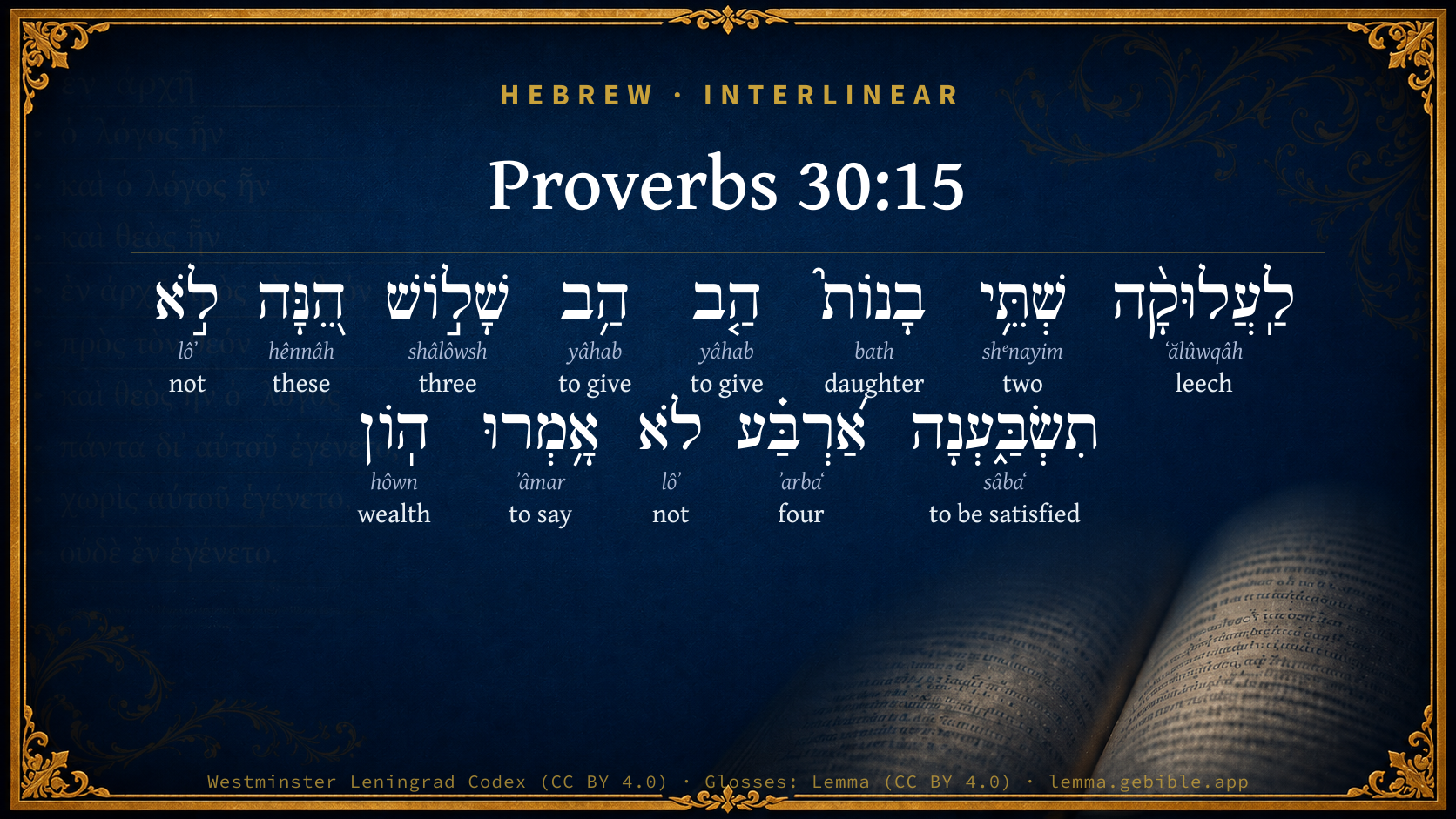
Hebrew (Westminster Leningrad Codex) Proverbs 30:15 appears in the Hebrew Old Testament. The text above is from the Westminster Leningrad Codex. Each word links to its Strong’s number, a concise gloss, and parsing drawn from the Open Scriptures Hebrew Bible morphology. Click any word for its full Brown-Driver-Briggs (BDB) entry.
Download image
Cite this verse

Proverbs 30:15 (World English Bible). Public Domain. Lemma interlinear Bible study tool, https://lemma.gebible.app/v/proverbs/30/15.

Show BibTeX & RIS
BibTeX
RIS
English Translation
"The leach has two daughters: 'Give, give.' "There are three things that are never satisfied; Four that don't say, 'Enough:'
World English Bible · Public Domain
Highlights
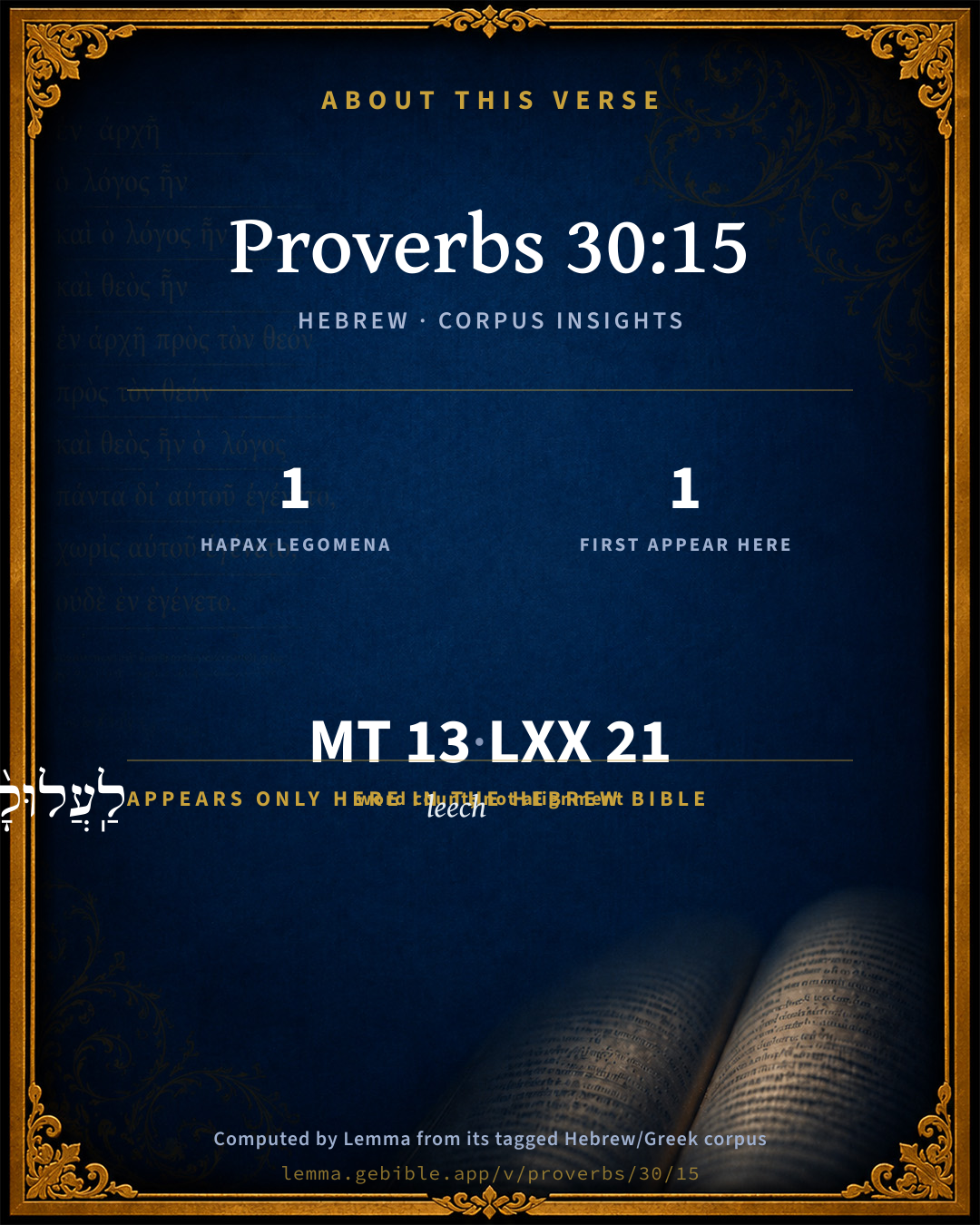
  • 1 hapax legomenon — only here in the Hebrew Bible
  • 1 first appearance in the Hebrew Bible
Full analysis ↓
Download a study sheet

One document with this verse’s original text, its word-by-word gloss line, the meaning frame, cross-references with their text, attributed commentary, and full source and license credits — printable, and it pastes into notes with its structure intact.

This verse Autodidact and up

Study sheet (.html) Plain text (.txt)

A passage Seminary Student

Up to 50 verses in one chapter. A passage sheet keeps up to 6 commentary sources and 12 cross-references per verse, in the order this page ranks them, and says so on the sheet whenever that leaves anything out. Ask for a single verse and you get the Autodidact verse sheet above.

Everything on this page stays free to read, with no account — the sheet is a download of what is already on screen, not access to it.

Want to remove ads? Support Godless Engineer
Compare translations 3

The same verse in 3 English versions, stacked beneath the original-language interlinear above. Click any original word for its lexicon entry.

Each is an independent rendering of the whole verse — the interlinear is not word-aligned to these translations.

Highlighted words mark where these versions differ — a whole-verse word diff, not a word-by-word alignment.

  • World English Bible Public Domain
    "The leach has two daughters: 'Give, give.' "There are three things that are never satisfied; Four that don't say, 'Enough:'
  • King James Version Public Domain
    The horseleach hath two daughters, crying, Give, give. There are three things that are never satisfied, yea, four things say not, It is enough:
  • unfoldingWord Literal Text CC BY-SA 4.0
    Two daughters to the leech, ‘Give! Give!’ three, they are not satisfied; four, they do not say, ‘Enough:’

unfoldingWord Literal Text — © unfoldingWord, licensed CC BY-SA 4.0. Word-aligned USFM3 via Door43 (git.door43.org/unfoldingWord/en_ult).

Versions to compare (up to 4)

3 of 4 selected

Show all 18 translations

Every available English version of this verse, each an independent rendering of the whole verse.

  • World English Bible Public Domain
    "The leach has two daughters: 'Give, give.' "There are three things that are never satisfied; Four that don't say, 'Enough:'
  • Berean Standard Bible Public Domain
    The leech has two daughters: Give and Give. There are three things that are never satisfied, four that never say, ‘Enough!’:
  • Majority Standard Bible Public Domain
    The leech has two daughters: Give and Give. There are three things that are never satisfied, four that never say, ‘Enough!’:
  • King James Version Public Domain
    The horseleach hath two daughters, crying, Give, give. There are three things that are never satisfied, yea, four things say not, It is enough:
  • American Standard Version (1901) Public Domain
    The horseleach hath two daughters, `crying', Give, give. There are three things that are never satisfied, `Yea', four that say not, Enough:
  • Revised Version (1885) Public Domain
    The horseleach hath two daughters, Crying, Give, give. There are three things that are never satisfied, yea, four that say not, Enough:
  • Geneva Bible (1599) Public Domain
    The horse leache hath two daughters which crye, Giue, giue. There be three things that will not be satisfied: yea, foure that say not, It is ynough.
  • Douay-Rheims (1899) Public Domain
    The horseleech hath two daughters that say: Bring, bring. There are three things that never are satisfied, and the fourth never saith: It is enough.
  • Young's Literal Translation Public Domain
    To the leech `are' two daughters, `Give, give, Lo, three things are not satisfied, Four have not said `Sufficiency;'
  • Literal Standard Version CC BY-SA 4.0
    To the leech [are] two daughters—Give! Give! Behold, three things are not satisfied, || Four have not said “Sufficiency”;
  • Unlocked Literal Bible CC BY-SA 4.0
    The leech has two daughters: “Give and give” they cry. There are three things that are never satisfied, four that never say, “Enough”:
  • unfoldingWord Literal Text CC BY-SA 4.0
    Two daughters to the leech, ‘Give! Give!’ three, they are not satisfied; four, they do not say, ‘Enough:’
  • Darby Bible Public Domain
    The leech hath two daughters: Give, give. There are three [things] never satisfied; four which say not, It is enough:
  • World Messianic Bible Public Domain
    “The leech has two daughters: ‘Give, give.’ “There are three things that are never satisfied; four that don’t say, ‘Enough!’:
  • Webster's Bible Public Domain
    The horse-leech hath two daughters, crying, Give, give. There are three things that are never satisfied, yes, four things say not, It is enough:
  • Free Bible Version CC BY-SA 4.0
    The leech has two daughters who cry out, “Give me! Give me!” There are three things that are never satisfied, four that never say, “Enough!”:
  • Bible in Basic English Public Domain
    The night-spirit has two daughters, Give, give. There are three things which are never full, even four which never say, Enough:
  • JPS Tanakh (1917) Public Domain
    The horseleech hath two daughters: 'Give, give.' There are three things that are never satisfied, yea, four that say not: 'Enough':

Literal Standard Version (2020), Covenant Press — licensed CC BY-SA 4.0. Text via the HelloAO Bible API (eBible.org). Unlocked Literal Bible (unfoldingWord) — licensed CC BY-SA 4.0. Text via the HelloAO Bible API (eBible.org). unfoldingWord Literal Text — © unfoldingWord, licensed CC BY-SA 4.0. Word-aligned USFM3 via Door43 (git.door43.org/unfoldingWord/en_ult). Free Bible Version, Dr. Jonathan Gallagher — licensed CC BY-SA 4.0. Text via the HelloAO Bible API (eBible.org).

Word by word

More ways to search: Search by grammar → Find every occurrence → Compare this word →

Practice this passage: Drill this verse → Learn its vocabulary →

לַֽעֲלוּקָ֨ה
ʻălûwqâh
H5936
“to/for · leech”
Preposition + Noun, Common, Feminine, Singular, Absolute
Part of Speech
Preposition + Noun
Type
Common
Gender
Feminine
Number
Singular
State
Absolute
Full BDB Definition

Origin: pass part of an unused root meaning to suck

TWOT: 1636a

leech
  1. שְׁתֵּ֥י shᵉnayim H8147 “two” Adjective, Cardinal number, Feminine, Dual, Construct
  2. בָנוֹת֮ bath H1323 “daughters” Noun, Common, Feminine, Plural, Absolute
  3. הַ֤ב yâhab H3051 “give” Verb, Qal, Imperative, 2nd Person, Masculine, Singular
  4. הַ֥ב yâhab H3051 “give” Verb, Qal, Imperative, 2nd Person, Masculine, Singular
  5. שָׁל֣וֹשׁ shâlôwsh H7969 “three” Adjective, Cardinal number, Feminine, Singular, Absolute
  6. הֵ֭נָּה hênnâh H2007 “these” Pronoun, Personal, 3rd Person, Feminine, Plural
  7. לֹ֣א lôʼ H3808 “not” Particle, Negative
  8. תִשְׂבַּ֑עְנָה sâbaʻ H7646 “to be satisfied” Verb, Qal, Imperfect, 3rd Person, Feminine, Plural
  9. אַ֝רְבַּ֗ע ʼarbaʻ H702 “four” Adjective, Cardinal number, Feminine, Singular, Absolute
  10. לֹא lôʼ H3808 “not” Particle, Negative
  11. אָ֥מְרוּ ʼâmar H559 “to say” Verb, Qal, Perfect, 3rd Person, Common, Plural
  12. הֽוֹן hôwn H1952 “wealth” Noun, Common, Masculine, Singular, Absolute

About this verse

These counts appear in no published source. They are computed here, from the morphology-tagged text and Lemma’s own curated glosses. What Lemma adds →

13
words
11
distinct lemmas
Wisdom
section

Notable vocabulary

1 hapax legomenon — a word that appears only here in the entire Hebrew Bible:

  • לַֽעֲלוּקָ֨ה leech H5936

First appearance in Scripture

This word makes its first canonical appearance in the Hebrew Bible here:

  • לַֽעֲלוּקָ֨ה leech H5936

Shared distinctive vocabulary

הֽוֹן wealth H1952 occurs in 26 verses of the Hebrew Bible. Also found in:

Grammatical profile

  • 4 verbs
  • 3 nouns
  • 3 adjectives
  • 1 pronoun
  • 2 particles

Verb forms

  • הַ֤ב Qal · Imperative
  • הַ֥ב Qal · Imperative
  • תִשְׂבַּ֑עְנָה Qal · Imperfect
  • אָ֥מְרוּ Qal · Perfect

Repetition

Words recur within this verse — often emphatic in Hebrew:

  • הַ֤ב to give H3051 ×2
  • לֹ֣א not H3808 ×2

Hebrew & Septuagint length

In English translation the verse runs 20 words from the Hebrew and 25 from the Septuagint (LXX English) — closely comparable.

A rough comparison of the two English renderings, which tokenize alike — not a word-level alignment.

Word counts can differ between the Hebrew and the Greek without any difference in meaning — e.g. the Hebrew direct-object marker אֵת has no separate Greek word, and Greek often adds the article ὁ.

In the original languages it is 13 Hebrew tokens and 21 Greek tokens — but the two are counted differently (Hebrew bundles its prefixes and suffixes into one token; the Greek is in lemma form), so that isn’t a like-for-like length.

Cross-references

23

Topical passages linked to Proverbs 30:15 in the Treasury of Scripture Knowledge — connected by theme and wording, ordered by reader-vote popularity; previews shown in the World English Bible.

  • Proverbs 30:21 "For three things the earth tremble, And under four, it can't bear up:
  • Proverbs 6:16 There are six things which Yahweh hates; Yes, seven which are an abomination to him:
  • Proverbs 30:29 "There are three things which are stately in their march, Four which are stately in going:
  • Romans 16:18 For those who are such don't serve our Lord, Jesus Christ, but their own belly; and by their smooth and flattering speech, they deceive the hearts of the innocent.
  • Amos 1:11 Thus says Yahweh: "For three transgressions of Edom, yes, for four, I will not turn away its punishment; Because he pursued his brother with the sword, And cast off all pity, And his anger raged continually, And he kept his wrath forever;
  • John 8:39 They answered him, "Our father is Abraham." Jesus said to them, "If you were Abraham's children, you would do the works of Abraham.
  • John 8:44 You are of your Father, the devil, and you want to do the desires of your father. He was a murderer from the beginning, and doesn't stand in the truth, because there is no truth in him. When he speaks a lie, he speaks on his own; for he is a liar, and the father of it.
  • 2 Peter 2:3 In covetousness they will exploit you with deceptive words: whose sentence now from of old doesn't linger, and their destruction will not slumber.
  • 2 Peter 2:13–15 receiving the wages of unrighteousness; people who count it pleasure to revel in the day-time, spots and blemishes, reveling in their deceit while they feast with you;
  • Jude 1:11–12 Woe to them! For they went in the way of Cain, and ran riotously in the error of Balaam for hire, and perished in Korah's rebellion.
  • Proverbs 30:24 "There are four things which are little on the earth, But they are exceedingly wise:
  • Amos 1:3 Thus says Yahweh: "For three transgressions of Damascus, yes, for four, I will not turn away its punishment; Because they have threshed Gilead with threshing instruments of iron;
  • Amos 1:6 Thus says Yahweh: "For three transgressions of Gaza, yes, for four, I will not turn away its punishment; Because they carried away captive the whole community, To deliver them up to Edom;
  • Amos 1:13 Thus says Yahweh: "For three transgressions of the children of Ammon, yes, for four, I will not turn away its punishment; Because they have ripped open the pregnant women of Gilead, That they may enlarge their border.
  • Amos 2:1 Thus says Yahweh: "For three transgressions of Moab, yes, for four, I will not turn away its punishment; Because he burned the bones of the king of Edom into lime;
  • Amos 2:4 Thus says Yahweh: "For three transgressions of Judah, yes, for four, I will not turn away its punishment; Because they have rejected Yahweh's law, And have not kept his statutes, And their lies have led them astray, After which their fathers walked;
  • Micah 7:3 Their hands are on that which is evil to do it diligently. The ruler and judge ask for a bribe; And the powerful man dictates the evil desire of his soul. Thus they conspire together.
  • Matthew 23:32 Fill up, then, the measure of your fathers.
  • Isaiah 56:11–12 Yes, the dogs are greedy, they can never have enough; and these are shepherds who can't understand: they have all turned to their own way, each one to his gain, from every quarter.
  • Isaiah 57:3 But draw near here, you sons of the sorceress, the seed of the adulterer and the prostitute.
  • Ezekiel 16:44–46 Behold, everyone who uses proverbs shall use [this] proverb against you, saying, As is the mother, so is her daughter.
  • Hosea 4:18 Their drink has become sour. They play the prostitute continually. Her rulers dearly love their shameful way.
  • Amos 1:9 Thus says Yahweh: "For three transgressions of Tyre, yes, for four, I will not turn away its punishment; Because they delivered up the whole community to Edom, And didn't remember the brotherly covenant;

Cross-references courtesy of OpenBible.info (CC BY 4.0).

Hebrew and Greek witnesses Masoretic Hebrew ↔ Greek Septuagint

The same verse in the two great witnesses to the Old Testament, shown verse-for-verse.

These are two independent witnesses, not word-aligned to each other, and the Septuagint is shown in lemma (dictionary) form.

Hebrew Proverbs 30:15 Masoretic · Westminster Leningrad Codex

לַֽעֲלוּקָ֨ה שְׁתֵּ֥י בָנוֹת֮ הַ֤ב הַ֥ב שָׁל֣וֹשׁ הֵ֭נָּה לֹ֣א תִשְׂבַּ֑עְנָה אַ֝רְבַּ֗ע לֹא אָ֥מְרוּ הֽוֹן

"The leach has two daughters: 'Give, give.' "There are three things that are never satisfied; Four that don't say, 'Enough:'

World English Bible · Public Domain

Greek LXX Proverbs 30:15 Septuagint · lemma form

ὁ βδέλλα τρεῖς θυγάτηρ εἰμί ἀγαπάω ἀγαπάω καί ὁ τρεῖς ἑαυτοῦ οὐ ἐνπίμπλημι αὐτός καί ὁ τέταρτος οὐ ἀρκέω εἶπον ἱκανός

The horse-leech had three dearly beloved daughters: and these three did not satisfy her; and the fourth was not contented so as to say, Enough.

LXX2012 (modern English Septuagint) · Public Domain

On this verse, Adam Clarke's Commentary discusses the Septuagint’s reading. Read the note in Commentary ↓

Hebrew: Westminster Leningrad Codex (CC BY 4.0). Greek: Septuagint (public domain); English from LXX2012 (modern English Septuagint) (Public Domain). How the Septuagint differs from the Hebrew →

Commentary

Notes on Proverbs 30:15 from classic Christian and Jewish commentators (each source and its license shown beneath its notes). The classic Christian expositions comment on the surrounding passage and are grouped to its opening verse, so a note may address several verses; the Jewish commentaries on the Tanakh (Rashi and others) are per-verse, so they appear only where the commentator wrote on this verse.

Lemma curates 59 commentaries, every one of them public domain or Creative Commons licensed, each selected and text-cleaned for this edition rather than reprinted as found. About our sources →

Trapp's Complete Commentary

John Trapp

Pro 30:15 The horseleach hath two daughters, [crying], Give, give. There are three [things that] are never satisfied, [yea], four [things] say not, [It is] enough:

Ver. 15. The horseleech {a} hath two daughters.] That is, Two forks in her tongue, whereby she first pricketh the flesh, and then sucketh the blood. Hereunto Solomon seemeth to resemble those cruel cormorants spoken of in the former verse. By the horseleech some understand the devil, that great red dragon, red with the blood of souls, which he hath sucked and swallowed, {1Pe 5:8} seeking whom he may (καταπιη) let down his wide gullet, while he glut gluts their blood, as the young eaglets are said to do, {Job 39:30} by a word made from the sound, {b} By the horseleech’s two daughters they understand covetousness and luxury, whom the devil hath long since espoused to the Romish clergy.

“Cuius avaritiae totus non sufficit orbis,

Cuius luxuriae meretrix non sufficit omnis.”

{a} Sanguisuga. Hirudo, ab haerendo. Non missura cutem nisi plena cruoris hirudo.

{b} Iegna legundum.

John Trapp, A Commentary or Exposition upon All the Books of the Old and New Testament (1647–1656) — public domain. Text from a community e-Sword module.

Joseph Benson's Commentary

Pro 30:15. The horseleech — An insatiable creature, sucking blood till it be ready to burst; hath two daughters — The following things, which resemble the horseleech in their insatiableness, nothing being more common than to call those persons or things the sons or daughters of those whose example they imitate. And whereas it is objected that they are not only two, but three, yea, four, as is said in the next clause, the answer is easy, that though he begin with two, yet he proceeds from thence to three and four, all which are said to be the daughters of the horseleech, if the words be rendered properly, as they are in the Hebrew, as we shall presently see. Crying, Give, give — Never filled, but always craving, and ready to receive more and more. There are three — It should rather have been rendered, Yea, three, or they (namely, the daughters of the horse- leech) are three; that are never satisfied — This is added to explain the former clause, Give, give, and to show the cause of that excessive desire of more, namely, they are not contented with what they have. Four things — Or, yea, they are four; which say not, It is enough — Hebrew, הון, it is wealth, it is abundance. Those are never rich that are always coveting.

Joseph Benson's Commentary on the Old and New Testaments (1811–1818) — public domain. Text from a community e-Sword module.

Keil & Delitzsch

C. F. Keil & F. Delitzsch

With the characteristic of insatiableness Pro 30:11-14 closes, and there follows an apophthegma de quatuor insatiabilibus quae ideo comparantur cum sanguisuga (C. B. Michaelis). We translate the text here as it lies before us:

15 The ‛Alûka hath two daughters: Give! Give!

Three of these are never satisfied;

Four say not: Enough!

16 The under-world and the closing of the womb;

The earth is not satisfied with water;

And the fire saith not: Enough!

We begin with Masoretic externalities. The first ב in הב is Beth minusculum; probably it had accidentally this diminutive form in the original MSS, to which the Midrash (cf. Sepher Taghin ed. Bargs, 1866, p. 47) has added absurd conceits. This first הב has Pasek after it, which in this case is servant to the Olewejored going before, according to the rule Thorath Emeth, p. 24, here, as at Psa 85:9, Mehuppach. The second הב, which of itself alone is the representative of Olewejored, has in Hutter, as in the Cod. Erfurt 2, and Cod. 2 of the Leipzig Public Library, the pausal punctuation הב (cf. קח, Sa1 21:10), but which is not sufficiently attested. Instead of לא־אמרוּ, 15b, לא אמרוּ, and instead of לא־אמרה f, 16b, לא אמרה are to be written; the Zinnorith removes the Makkeph, according to Thorath Emeth, p. 9, Accentuationssystem, iv. 2. Instead of מים, 16a, only Jablonski, as Mhlau remarks, has מים; but incorrectly, since Athnach, after Olewejored, has no pausal force (vid., Thorath Emeth, p. 37). All that is without any weight as to the import of the words. But the punctuation affords some little service for the setting aside of a view of Rabbenu Tam (vid., Tosaphoth to Aboda zara 17a, and Erubin 19a), which has been lately advocated by Lwenstein. That view is, that ‛Alûka is the name of a wise man, not Solomon's, because the Pesikta does not reckon this among the names of Solomon, nor yet a name of hell, because it is not, in the Gemara, numbered among the names of Gehinnom. Thus לעלוּקה would be a superscription, like לדוד and לשׁלמה, Psa 26:1; Psa 72:1, provided with Asla Legarmeh. But this is not possible, for the Asla Legarmeh, at Psa 26:1 and Psa 72:1, is the transformation of Olewejored, inadmissible on the first word of the verse (Accentuationssystem, xix. 1); but no Olewejored can follow such an Asla Legarmeh, which has the force of an Olewejored, as after this לעלוקה, which the accentuation then does not regard as the author's name given as a superscription. עלוּקה is not the name of a person, and generally not a proper name, but a generic name of certain traditional signification. "One must drink no water" - says the Gemara Aboda zara 12b - "out of a river or pond, nor (immediately) with his mouth, nor by means of his hand; he who, nevertheless, does it, his blood comes on his own head, because of the danger. What danger? סכּנת עלוּקה," i.e., the danger of swallowing a leech. The Aram. also designates a leech by עלוּקא (cf. e.g., Targ. Ps. 12:9: hence the godless walk about like the leech, which sucks the blood of men), and the Arab. by 'alaḳ (n. unit. 'alaḳat), as the word is also rendered here by the Aram. and Arab. translators. Accordingly, all the Greeks render it by βδέλλη; Jerome, by sanguisuga (Rashi, sangsue); also Luther's Eigel is not the Igel erinaceus [hedgehog], but the Egel, i.e., as we now designate it, the Blutegel [leech], or (less correctly) Blutigel. עלוּקה is the fem. of the adj. עלוּק, attached to, which meaning, together with the whole verbal stem, the Arab. has preserved (vid., Mhlau's Mittheilung des Art. 'aluka aus dem Kamus, p. 42).

(Note: Nldeke has remarked, with reference to Mhlau's Monographie, that ‛aluḳa, in the sense of tenacious (tenax), is also found in Syr. (Geopon. xiii. 9, xli. 26), and that generally the stem עלק, to cleave, to adhere, is more common in Aram. than one would suppose. But this, however common in Arab., is by no means so in Syr.; and one may affirm that, among other Arabisms found in the Proverbs of Agur, the word ‛Alûka has decidedly an Arab. sound.)

But if, now, the ‛Alûka is the leech,

(Note: In Sanscrit the leech is called galaukas (masc.) or galaukâ (fem.), i.e., the inhabitant of the water (from gala, water, and ôkas, dwelling). Ewald regards this as a transformation of the Semitic name.)

which are then its two daughters, to which is here given the name הב הב, and which at the same time have this cry of desire in their mouths? Grotius and others understand, by the two daughters of the leech, the two branches of its tongue; more correctly: the double-membered overlip of its sucker. C. B. Michaelis thinks that the greedy cry, "Give! Give!" is personified: voces istae concipiuntur ut hirudinis filiae, quas ex se gignat et velut mater sobolem impense diligat. But since this does not satisfy, symbolical interpretations of ‛Aluka have been resorted to. The Talmud, Aboda zara 17a, regards it as a name of hell. In this sense it is used in the language of the Pijut (synagogue poetry).

(Note: So says e.g., Salomo ha-Babli, in a Zulath of the first Chanukka-Sabbats (beginning אין צוּר חלף): יקדוּ כּהבהבי עלק, they burn like the flames of hell.)

If ‛Alûka is hell, then fancy has the widest room for finding an answer to the question, What are the two daughters? The Talmud supposes that רשׁות (the worldly domination) and מינות (heresy) are meant. The Church-fathers also, understanding by ‛Alûka the power of the devil, expatiated in such interpretations. Of the same character are Calmet's interpretation, that sanguisuga is a figure of the mala cupiditas, and its twin-daughters are avaritia and ambitio. The truth lying in all these is this, that here there must be some kind of symbol. But if the poet meant, by the two daughters of the ‛Alûka, two beings or things which he does not name, then he kept the best of his symbol to himself. And could he use ‛Alûka, this common name for the leech, without further intimation, in any kind of symbolical sense? The most of modern interpreters do nothing to promote the understanding of the word, for they suppose that ‛Alûka, from its nearest signification, denotes a demoniacal spirit of the character of a vampire, like the Dakin of the Indians, which nourish themselves on human flesh; the ghouls of the Arabs and Persians, which inhabit graveyards, and kill and eat men, particularly wanderers in the desert; in regard to which it is to be remarked, that (Arab.) ‛awlaḳ is indeed a name for a demon, and that al‛aluwaḳ, according to the Kamus, is used in the sense of alghwal. Thus Dathe, Dderlein, Ziegler, Umbreit; thus also Hitzig, Ewald, and others. Mhlau, while he concurs in this understanding of the word, and now throwing open the question, Which, then, are the two daughters of the demoness ‛Alûka? finds no answer to it in the proverb itself, and therefore accepts of the view of Ewald, since 15b-16, taken by themselves, form a fully completed whole, that the line 'לעלוקה וגו is the beginning of a numerical proverb, the end of which is wanting. We acknowledge, because of the obscurity - not possibly aimed at by the author himself - in which the two daughters remain, the fragmentary characters of the proverb of the ‛Alûka; Stuart also does this, for he regards it as brought out of a connection in which it was intelligible - but we believe that the line 'שׁלושׁ וגו is an original formal part of this proverb. For the proverb forming, according to Mhlau's judgment, a whole rounded off:

שׁלושׁ הנה לא תשׂבענה

ארבע לא אמרו הון

שׁאול ועצר רחם

ארץ לא שׂבעה מים

ואשׁ לא אמרה הון

contains a mark which makes the original combination of these five lines improbable. Always where the third is exceeded by the fourth, the step from the third to the fourth is taken by the connecting Vav: Pro 30:18, וארבע; Pro 30:21, ותחת ארבע; Pro 30:29, וארבעה. We therefore conclude that 'ארבע לא וגו is the original commencement of independent proverb. This proverb is:

Four things say not: Enough!

The under-world and the closing of the womb [i.e., unfruitful womb] -

The earth is not satisfied with water,

And the fire says not: Enough!

a tetrastich more acceptable and appropriate than the Arab. proverb (Freytag, Provv. iii. p. 61, No. 347): "three things are not satisfied by three: the womb, and wood by fire, and the earth by rain;" and, on the other hand, it is remarkable to find it thus clothed in the Indian language,

(Note: That not only natural productions, but also ideas and literary productions (words, proverbs, knowledge), were conveyed from the Indians to the Semites, and from the Semites to the Indians, on the great highways by sea and land, is a fact abundantly verified. There is not in this, however, any means of determining the situation of Massa.)

as given in the Hitopadesa (p. 67 of Lassen's ed.), and in Pantschatantra, i. 153 (ed. of Kosegarten):

nâgnis tṛpjati kâshṭhânân nâpagânân mahôdadhih

nântakah sarvabhûtânân na punsân vâmalocanâh.

Fire is not sated with wood, nor the ocean with the streams,

Nor death with all the living, nor the beautiful-eyed with men.

As in the proverb of Agur the 4 falls into 2 + 2, so also in this Indian sloka. In both, fire and the realm of death (ântaka is death as the personified "end-maker") correspond; and as there the womb and the earth, so here feminarium cupiditas and the ocean. The parallelizing of ארץ and רחם is after passages such as Psa 139:15; Job 1:21 (cf. also Pro 5:16; Num 24:7; Isa 48:1); that of שׁאול and אשׁ is to be judged of

(Note: The parallelizing of רחם and שׁאול, Berachoth 15b, is not directly aimed at by the poet.)

after passages such as Deu 32:22, Isa 56:1-12 :24. That לא אמרו הון repeats itself in לא אמרה הון is now, as we render the proverb independently, much more satisfactory than if it began with 'שׁלושׁ וגו: it rounds itself off, for the end returns into the beginning. Regarding הון, vid., Pro 1:13. From הוּן, to be light, it signifies living lightly; ease, superabundance, in that which renders life light or easy. "Used accusatively, and as an exclamation, it is equivalent to plenty! enough! It is used in the same sense in the North African Arab. brrakat (spreading out, fulness). Wetzstein remarks that in Damascus lahôn i.e., hitherto, is used in the sense of ḥajah, enough; and that, accordingly, we may attempt to explain הון of our Heb. language in the sense of (Arab.) hawn haddah, i.e., here the end of it!" (Mhlau).

But what do we now make of the two remaining lines of the proverb of the ‛Alûka? The proverb also in this division of two lines is a fragment. Ewald completes it, for to the one line, of which, according to his view, the fragment consists, he adds two:

The bloodsucker has two daughters, "Hither! hither!"

Three saying, "Hither, hither, hither the blood,

The blood of the wicked child."

A proverb of this kind may stand in the O.T. alone: it sounds as if quoted from Grimm's Mhrchen, and is a side-piece to Zappert's altdeutsch. Schlummerliede. Cannot the mutilation of the proverb be rectified in a less violent way without any self-made addition? If this is the case, that in Pro 30:15 and Pro 30:16, which now form one proverb, there are two melted together, only the first of which lies before us in a confused form, then this phenomenon is explained by supposing that the proverb of the ‛Alûka originally stood in this form:

The ‛Alûka has two daughters: Give! give! -

The under-world and the closing of the womb;

There are three that are never satisfied.

Thus completed, this tristich presents itself as the original side-piece of the lost tetrastich, beginning with ארבע. One might suppose that if שׁאול and עצר רחם have to be regarded as the daughters of the ‛Alûka, which Hitzig and also Zckler have recognised, then there exists no reason for dividing the one proverb into two. Yet the taking of them as separate is necessary, for this reason, because in the fourth, into which it expands, the ‛Alûka is altogether left out of account. But in the above tristich it is taken into account, as was to be expected, as the mother with her children. This, that sheol (שׁאול is for the most part fem.), and the womb (רחם = רחם, which is fem., Jer 20:17) to which conception is denied, are called, on account of their greediness, the daughters of the ‛Alûka, is to be understood in the same way as when a mountain height is called, Isa 5:1, a horn of the son of oil. In the Arab., which is inexhaustibly rich in such figurative names, a man is called "a son of the clay (limi);" a thief, "a son of the night;" a nettle, "the daughter of fire." The under-world and a closed womb have the ‛Alûka nature; they are insatiable, like the leech. It is unnecessary to interpret, as Zckler at last does, ‛Alûka as the name of a female demon, and the לילית, "daughters," as her companions. It may be adduced in favour of this view that לעלוּקה is without the article, after the manner of a proper name. But is it really without the article? Such a doubtful case we had before us at Pro 27:23. As yet only Bttcher, 394, has entered on this difficulty of punctuation. We compare Gen 29:27, בּעבדה; Kg1 12:32, לעגלים; Ch1 13:7, בּעגלה; and consequently also Psa 146:7, לעשׁוּקים; thus the assimilating force of the Chateph appears here to have changed the syntactically required ל and בּ into ל and בּ. But also supposing that עלוּקה in לעלוּקה is treated as a proper name, this is explained from the circumstance that the leech is not meant here in the natural history sense of the word, but as embodied greediness, and is made a person, one individual being. Also the symbol of the two daughters is opposed to the mythological character of the ‛Alûka. The imper. הב, from יהב, occurs only here and at Dan 7:17 (= תּן), and in the bibl. Heb. only with the intentional āh, and in inflection forms. The insatiableness of sheol (Pro 27:20) is described by Isa; Isa 5:14; and Rachel, Gen 30:1, with her "Give me children," is an example of the greediness of the "closed-up womb" (Gen 20:18). The womb of a childless wife is meant, which, because she would have children, the nuptiae never satisfy; or also of one who, because she does not fear to become pregnant, invites to her many men, and always burns anew with lust. "In Arab. 'aluwaḳ means not only one fast bound to her husband, but, according to Wetzstein, in the whole of Syria and Palestine, the prostitute, as well as the κίναιδοι, are called 'ulak (plur. 'alwak), because they obtrude themselves and hold fast to their victim" (Mhlau). In the third line, the three: the leech, hell, and the shut womb, are summarized: tira sunt quae non satiantur. Thus it is to be translated with Fleischer, not with Mhlau and others, tira haec non satiantur. "These three" is expressed in Heb. by שׁלשׁ־אלּה, Exo 21:11, or אלּה(ה) שׁלשׁת, Sa2 21:22; הנּה (which, besides, does not signify haec, but illa) is here, taken correctly, the pred., and represents in general the verb of being (Isa 51:19), vid., at Pro 6:16. Zckler finds the point of the proverb in the greediness of the unfruitful womb, and is of opinion that the poet purposely somewhat concealed this point, and gave to his proverb thereby the enhanced attraction of the ingenious. But the tetrastich 'אברע וגו shows that hell, which is compared to fire, and the unfruitful womb, to which the parched and thirsty earth is compared, were placed by the poet on one and the same line; it is otherwise with Pro 30:18-20, but where that point is nothing less than concealed.

Keil & Delitzsch — Biblical Commentary on the Old Testament (1861–1891) — public domain (CC PDM 1.0). Text via the HelloAO Bible API. (Old Testament only.)

Tyndale Open Study Notes

Tyndale Open Resources

30:15-16 The number parallelism (three . . . no, four) is a device for presenting a list of poetic examples. This list shows powers that are insatiable and often dangerous. See also 30:18-19, 21-23, 29-31. • The grave, which stands for death itself, never seems to have enough—people keep dying (27:20). • barren womb: Women who are unable to have children often long to have them, like Sarah until she gave birth to Isaac, Rebekah until the birth of Esau and Jacob, and Hannah until the birth of Samuel. • The thirsty desert and a fire consume anything in their path.

Tyndale Open Study Notes — © Tyndale Open Resources, licensed CC BY-SA 4.0. Text via the HelloAO Bible API.

Geneva Bible (1599)

Geneva Bible translators

The leech hath two forks in her tongue, which here he calleth her two daughters, whereby she sucketh the blood, and is never satiated: even so are the covetous extortioners insatiable.

Geneva Bible (1599) marginal notes — public domain. Text via Bolls.life.

Matthew Henry's Commentary

He had spoken before of those that devoured the poor (Pro 30:14), and had spoken of them last, as the worst of all the four generations there mentioned; now here he speaks of their insatiableness in doing this. The temper that puts them upon it is made up of cruelty and covetousness. Now those are two daughters of the horse-leech, its genuine offspring, that still cry, "Give, give, give more blood, give more money;" for the bloody are still blood-thirsty; being drunk with blood, they add thirst to their drunkenness, and will seek it yet again. Those also that love silver shall never be satisfied with silver. Thus, while from these two principles they are devouring the poor, they are continually uneasy to themselves, as David's enemies, Psa 59:14, Psa 59:15. Now, for the further illustration of this,

I. He specifies four other things which are insatiable, to which those devourers are compared, which say not, It is enough, or It is wealth. Those are never rich that are always coveting. Now these four things that are always craving are, 1. The grave, into which multitudes fall, and yet still more will fall, and it swallows them all up, and returns none, Hell and destruction are never full, Pro 27:20. When it comes to our turn we shall find the grave ready for us, Job 17:1. 2. The barren womb, which is impatient of its affliction in being barren, and cries, as Rachel did, Give me children. 3. The parched ground in time of drought (especially in those hot countries), which still soaks in the rain that comes in abundance upon it and in a little time wants more. 4. The fire, which, when it has consumed abundance of fuel, yet still devours all the combustible matter that is thrown into it. So insatiable are the corrupt desires of sinners, and so little satisfaction have they even in the gratification of them.

II. He adds a terrible threatening to disobedient children (Pro 30:17), for warning to the first of those four wicked generations, that curse their parents (Pro 30:11), and shows here,

1. Who they are that belong to that generation, not only those that curse their parents in heat and passion, but, (1.) Those that mock at them, though it be but with a scornful eye, looking with disdain upon them because of their bodily infirmities, or looking sour or dogged at them when they instruct or command, impatient at their checks and angry at them. God takes notice with what eye children look upon their parents, and will reckon for the leering look and the casts of the evil eye as well as for the bad language given them. (2.) Those that despise to obey them, that think it a thing below them to be dutiful to their parents, especially to the mother, they scorn to be controlled by her; and thus she that bore them in sorrow in greater sorrow bears their manners.

2. What their doom will be. Those that dishonour their parents shall be set up as monuments of God's vengeance; they shall be hanged in chains, as it were, for the birds of prey to pick out their eyes, those eyes with which they looked so scornfully on their good parents. The dead bodies of malefactors were not to hang all night, but before night the ravens would have picked out their eyes. If men do not punish undutiful children, God will, and will load those with the greatest infamy that conduct themselves haughtily towards their parents. Many who have come to an ignominious end have owned that the wicked courses that brought them to it began in a contempt of their parents' authority.

Matthew Henry's Commentary on the Whole Bible (1708–1710) — public domain (CC PDM 1.0). Text via the HelloAO Bible API.

Jamieson, Fausset & Brown

Robert Jamieson, A. R. Fausset & David Brown

horse leech--supposed by some to be the vampire (a fabulous creature), as being literally insatiable; but the other subjects mentioned must be taken as this, comparatively insatiable. The use of a fabulous creature agreeably to popular notions is not inconsistent with inspiration.

There are three . . . yea, four--(Compare Pro 6:16).

Jamieson, Fausset & Brown — Commentary Critical and Explanatory on the Whole Bible (1871) — public domain (CC PDM 1.0). Text via the HelloAO Bible API.

Adam Clarke's Commentary

Verse 15. The horseleech hath two daughters, crying, Give, give.] "This horseleech," says Calmet, "is COVETOUSNESS, and her two daughters are Avarice and Ambition. They never say, It is enough; they are never satisfied; they are never contented."

Many explanations have been given of this verse; but as all the versions agree in rendering עלוקה alukah the horseleech or blood-sucker, the general meaning collected has been, "There are persons so excessively covetous and greedy, that they will scarcely let any live but themselves; and when they lay hold of any thing by which they may profit, they never let go their hold till they have extracted the last portion of good from it." Horace has well expressed this disposition, and by the same emblem, applied to a poor poet, who seizes on and extracts all he can from an author of repute, and obliges all to hear him read his wretched verses.

Quem vero arripuit, tenet, occiditque legendo,

Non missura cutem, nisi plena cruoris, HIRUDO.

DE ARTE POET., ver. 475.

"But if he seize you, then the torture dread;

He fastens on you till he reads you dead;

And like a LEECH, voracious of his food,

Quits not his cruel hold till gorged with blood."

FRANCIS.

The word אלוקה alukah, which we here translate horseleech, is read in no other part of the Bible. May it not, like Agur, Jakeh, Ithiel, and Ucal, be a proper name, belonging to some well-known woman of his acquaintance, and well known to the public, who had two daughters notorious for their covetousness and lechery? And at first view the following verse may be thought to confirm this supposition: "There are three things that are never satisfied, yea, four things say not, It is enough." the grave, the barren womb, the earth, the fire. What an astonishing similarity there is between this and the following institute, taken from the Code of Hindoo Laws, chap. xx., sec. i., p. 203.

"A woman is never satisfied with the copulation of man, no more than a fire is satisfied with burning fuel; or the main ocean is with receiving the rivers; or death, with the dying of men and animals." You can no more satisfy these two daughters of Alukah than you can the grave, c.

Some of the rabbins have thought that alukah signifies destiny, or the necessity of dying, which they say has two daughters, Eden and Gehenna, paradise and hell. The former has never enough of righteous souls the latter, of the wicked. Similar to them is the opinion of Bochart, who thinks alukah means destiny, and the two daughters, the grave and hell; into the first of which the body descends after death, and into the second, the soul.

The Septuagint gives it a curious turn, by connecting the fifteenth with the sixteenth verse: Τῃ Βδελλῃ θυγατερες ησαν αγαπησει αγαπωμεναι, και αἱ τρεις αὑται ουκ ενεπιμπλασαν αυτην, και ἡ τεταρτη ουκ ηρκεσθη ειπειν· Ἱκανον; "The horseleech had three well-beloved daughters; and these three were not able to satisfy her desire: and the fourth was not satisfied, so as to say, It is enough."

After all, I think my own conjecture the most probable. Alukah is a proper name, and the two daughters were of the description I have mentioned.

Adam Clarke's Commentary on the Bible (1810–1826) — public domain. Text from a community e-Sword/MySword module.

Ellicott's Commentary for English Readers

(15) The horseleach hath two daughters, crying, Give, give.—The word “crying” is not in the Hebrew. The leech is here chosen as the emblem of insatiable greed; if it could speak, its “daughters,” i.e., the words it would utter, would be “Give, give.” So it forms an introduction to the quartette of “insatiable things” which follow.

A Bible Commentary for English Readers, edited by Charles John Ellicott (1878–1897) — public domain. Text from a community e-Sword module.

The Cambridge Bible for Schools and Colleges

gen. ed. J. J. S. Perowne

15. The horseleach] βδέλλα, LXX.; sanguisuga, Vulg. The Heb. word occurs only here, and its derivation is doubtful, but as Maurer points out, the rendering leach has the sanction of the ancient interpreters, and accords with the sense of cognate Arabic and Aramaic roots. It gives moreover an excellent meaning, and is after the manner of this chapter and of the Book of Proverbs generally, in drawing an illustration of the subject in hand from the animal world. There seems no reason therefore for seeing in the word a mythical or “quasi-mythical expression,” denoting a vampire, or Ghoul.

two daughters … three things … yea, four] The climax is reached gradually. As the children of the leach, twice as many as herself, are each of them like herself insatiable, so are there, not two things only in creation, but three, yea four, of like character. Comp. for this typical use of numbers, Amo_1:3, and note there in this Series.

crying] The word is supplied. The Heb. is two daughters, Give, give. Some therefore would supply, called (R.V. marg.) instead of crying.

Dean Plumptre quotes Hor. de Art. Poet. 476:

“Non missura cutem, nisi plena cruoris, hirudo.”

15, 16. Four things that are insatiable.

The Cambridge Bible for Schools and Colleges (gen. ed. J. J. S. Perowne; Cambridge University Press, 1878–1918) — public domain. Text from a community e-Sword module.

John Gill's Exposition

The horse leech hath two daughters, crying, Give, give,.... Or "the blood sucker" (l); so it began to be called in the times of Pliny (m), to which the last generation of men may well be compared; blood thirsty creatures, that never have enough, and are not satisfied with the flesh of men, nor with their blood; and such particularly the Papists are: and not only this generation of men, but there are three or four things besides, which resemble the horse leech for its insatiableness; for the horse leech has not two daughters only, but more. Some, by her two daughters, understand the two forks of its tongue, which some naturalists say it has; though later ones, and more diligent inquirers into those things, find it has not; but either with its three teeth, or by the compression of its mouth on all sides, sucks the blood, and will not let go until it is filled with it (n): others have proposed the two sorts of leeches as its daughters, the sea leech, and that which is found in fenny and marshy places. But it is best, by its daughters, to understand such that resemble it, and are like unto it; as those that are of like nature and quality, and do the same things as others, are called their children; see Mat 23:31, Jo1 3:10; and so the number of its daughters, which are always craving and asking for more, and are never satisfied, are not only two, but more, as follows;

there are three things; or, "yea, there are three things"

that are never satiated: yea, four things say not, It is enough; not two only, but three, and even four, that are quite insatiable and are as follow. The Syriac version renders the whole thus,

"the horse leech hath three beloved daughters; three, "I say", they are, which are not satisfied; and the fourth says not, It is enough.''

Some, as Abendana observes, interpret it of hell, by a transposition of the letters; because everyone that perverts his ways descends thither. Bochart (o) interprets it of fate, and so Noldius (p): and Schultens renders the word, the most monstrous of evils; it signifying in the Arabic language, as he observes, anything monstrous and dreadful; such as wood demons, serpents, and dragons, which devour men and beasts. Suidas (q), by the "horse leech", understands sin, whose daughters are fornication, envy, and idolatry, which are never satisfied by evil actions, and the fourth is evil concupiscence.

(l) "sanguisugae", V. L. Pagninus, Tigurine version. Mercerus, Gejerus. (m) Nat. Hist. l. 8. c. 10. (n) "Non missura cutem nisi plena cruoris hirudo", Horat. de Arte Poet. fine. (o) Hierozoic. par. 2. l. 5. c. 19. col. 801. (p) Concord. Ebr. Par. p. 467. No. 1425. (q) In voce

John Gill's Exposition of the Whole Bible (1746–1763) — public domain (CC PDM 1.0). Text via the HelloAO Bible API.

Albert Barnes' Notes on the Bible

Note the numeration mounting to a climax, the two, the three, the four (Amo 1:3 etc.). The word rendered “horseleach” is found nowhere else, and its etymology is doubtful; but there are good grounds for taking the word in its literal sense, as giving an example, in the natural world, of the insatiable greed of which the next verse gives other instances. Its voracious appetite is here represented, to express its intensity, as two daughters, uttering the same ceaseless cry for more.

Pro 30:16

The grave - Hebrew שׁאול she'ôl. The “Hell” or Hades of Pro 27:20, all-consuming yet never full.

Albert Barnes' Notes on the Bible (1834–1885) — public domain. Text from a community e-Sword/MySword module.

Haydock's Catholic Bible Commentary

The horse-leech: concupiscence, which hath two daughters that are never satisfied, viz., lust and avarice. (Challoner)

George Leo Haydock (1774–1849), Haydock's Catholic Family Bible and Commentary, 1859 edition — public domain. Excludes Psalms (Douay-Rheims chapter numbering differs from Protestant) and Deuterocanonical books (Catholic canon only).

Matthew Poole's English Annotations

The horseleech, an insatiable creature, sucking blood till it be ready to burst,

hath two daughters; which are either,

1. The two forks into which her tongue is divided, and wherewith she sucks: but those who have more accurately observed and described the frame of that creature tell us that they have no tongue, and that they suck either by three little teeth, or several parts of the mouth gathered and compressed together. Or rather,

2. The following things, which resemble the horse leech in its insatiableness; nothing being more ordinary than to call those persons or things the sons or daughters of those whose examples they imitate. And whereas it is objected, that they are not only two, but three, yea, four, as is said in the next clause, the answer is easy, that though he begin with two, yet he proceeds from thence to three, and four, all which are said to be the daughters of the horseleech, if the words be rendered commodiously, and as they are in the Hebrew, as we shall presently see.

Crying, Give, give; never filled, and always craving, and ready to receive more and more.

There are three things; or, yea, (which may be understood in this, as it is in our translation of the next clause,) they (to wit, the daughters of the horseleech) are three; that are never satisfied; which is added partly to explain the former clause,

Give, give, and to show the cause of that excessive desire of more, because they were not contented with what they had; and partly to give the reason why he calls them the daughters of the horseleech. Yea, four things say not; or, yea, they (the daughters forementioned) are four, which say not.

Matthew Poole's English Annotations on the Holy Bible (1683–1685) — public domain. Text from a community e-Sword/MySword module.

Whedon's Commentary on the Bible

Daniel D. Whedon

15. The horseleech — עלוקה, (‘halukah.) This word occurs nowhere else in the Bible, and the critics are by no means agreed as to its meaning. Dr. A. Clarke thinks it may have been the proper name of some well-known woman of the time. Stuart thinks it means the fabled vampire, and so translates. All the ancient versions however, render it leech, or bloodsucker. But the ancients and some moderns, according to their principles of mystical interpretation, had various notions of what it symbolized. Some of the Rabbies thought it meant “destiny,” and the two daughters, paradise and sheol. The former never has enough of the righteous, the latter of the wicked. Bochart makes the two daughters, “the grave and hell.” Calmet says, ‘halukah is covetousness, and the two daughters, avarice and ambition. All this is fanciful. Alukah, the leech, is the emblem of insatiableness, and the two daughters are probably its two suckers, whose continual cry is, “Give, give.” (See Webster’s Dictionary for a description of the leech and its two suckers.) The horseleech is a less powerful leech, commonly attacking the membranes of the month and nostrils of animals that drink at the pools where it exists. It is probable, although no comparison is expressed between the leech and the following things named, that similitude is implied. So the Septuagint understood it, or made it: The bloodsucker has three daughters well beloved, and these three were not able to fill her, and the fourth was not content to say, Enough.

Three… four — It was common among the Hebrews to specify a number, and then to add another, somewhat as we say three or four. See on Pro_6:16.

Daniel D. Whedon (gen. ed.), Commentary on the Old and New Testaments (1874–1909) — public domain. Text from a community e-Sword module.

The Pulpit Commentary

Vers. 15, 16. Having spoken of insatiate cupidity, the writer now introduces four things which are insatiable. The form of the apothegm is climacteric, mounting from two to three, and thence to four, like the famous passage in Amo_1:3, etc.. (comp. Pro_6:16, though there is no special stress there laid on the last member of the climax; Job_5:19 Job_33:29 Ecc_11:2)

The horseleach hath two daughters, crying, Give, give. The word "crying" is not in the Hebrew, which says, "The alukah hath two daughters: Give! Give!" The insatiable appetite of this creature is represented by two words, which are personified as daughters, whom the mother has produced and dearly loves. This word alukah is not found again in the Old Testament; but in later Hebrew and in Aramaic it means "leech" or "bloodsucker;" and so it is translated by the Septuagint, bdella , and by St. Jerome sanguisuga. The word is derived from a root which in Arabic means "to adhere." There are several kinds of leeches common in Palestine, and their bloodthirsty nature is well known; as Horace says, "Ars Poet.," 476"Non missura cutem, nisi plena cruoris, hirudo.

It seems simple and quite satisfactory to accept the word thus, and to see in the voracity of the leech an example of the greed further developed in the following clauses; but commentators have not been contented with this explanation, and have offered various suggestions which are either unnecessary or inadmissible. Thus the Talmud considers alukah to be an appellation of hell, and the two daughters to be the Power of the world, and Heresy. Some of the Fathers regard it as a symbol of the devil and his dominion; others, as a personification of cupidity with its two offshoots avarice and ambition. Some moderns deem it to mean a vampire or blood thirsty demon, a ghoul, in accordance with Eastern myth. But, as we have said, such interpretations are unnecessary and unsupported by sufficient authority. The allusion to the tastes of the leech is found elsewhere. Thus Theocritus, "Idyll.," 2:55 Ai ai erwv aniare ti meu melan ek croolla pepwkav. ~

And Plautus, "Epidic.," 2:2, 5"Jam ego me convortam in hirudinem atque Eorum exsugebo sanguinem, Senati qui columen cluent.

Ewald and others find traces of mutilation in this proverb, and endeavour to supply what is lost in various ways; but the text as it stands is intelligible, and needs no addition. The rest of the verse is an application of the truth first stated. The type of cupidity there enunciated is instanced and exemplified in four special cases. There are three things that are never satisfied. And then a corrective climax is addressed. Yea, four things say not, It is enough. The four in the following verse are divided into two plus two. Septuagint, "The leech had three daughters dearly beloved, and these three did not satisfy her, and the fourth was not contented to say, Enough.

Vers. 15, 16. Reflections on the insatiable.

I THE EXTERNAL LIFE IS THE MIRROR OF THE INTERNAL. Our spirit finds analogies to itself in the objects of nature, of history, and in the general course of human life. And all that we observe there, in the great world, may serve as a light to reveal to us what passes here, in the world of each man"s heart.

II IMAGES OF INSATIABLE APPETITE. Hades; the barren womb; the thirsty earth; the all-devouring fire. The vampire, or bloodsucker, seems to be intended in the first example; it is supposed to suck the blood of the sleeping by night.

III THE SPIRIT OF MAN IS INSATIABLE. And whether this appetite is rightly or wrongly directed, upon this depends his weal or woe. It may be directed to what is perishable or pernicious to gold, power, pleasure, etc. Drunkenness is the commonest illustration of the in satiety of man"s nature. Or it may be directed to righteousness, to the. knowledge of the truth, to the enjoyment of the good; and then it carries the power and promise of the "endless life J.

Vers. 15, 16. The unsatisfied human heart.

There are many things in nature which are not satisfied; but there is one thing in that which is above nature which is much less easily satisfied an intelligent, responsible, immortal spirit.

I THE INSATIABLE IN NATURE. Agur specifies four things; in these we find three features which supply a contrast to the craving of the human soul. The insatiable:

1. Limited by consciousness. The grave never says, "It is enough;" though millions have descended into its dark void, and though many ages have witnessed its consumption, it is as recipient as ever; it is, and it will remain, unfilled. But it is unconscious of its reception; it is only in iron, nation that it can be said to crave or to cry, "Give! give!

2. Limited by time. Childless womanhood is not unconscious; its craving is real and keen enough; but it is not lasting; it only extends over a few years of life; there is a large proportion of life, before and after, when no such longing is cherished.

3. Limited by quantity. The parched earth drinks in the rain hour after hour, and even day after day, as if it would not be satisfied with any quantity; but there is a measure of moisture which saturates and suffices; beyond that, anything that falls or flows is redundant.

II THE UNSATISFIED HUMAN HEART. Here there are practically no limitations. The human heart:

1. Is painfully conscious of its deep craving. Unlike the grave, unlike the fire, which seems animated indeed, but is actually unconscious, the human soul is profoundly moved as it yearns for something more and better than anything it holds; down to its depths it is disturbed, troubled, agitated. Its voice, crying, "Give! Give!" is not merely poetical, it is pathetic and even passionate.

2. Is unlimited by time. Unlike childless womanhood, its yearning for what it has not is not confined to a few years of its existence; it extends through life; it reaches on to old age, to the very hour of departure. It does not grow, thrive, fade, and die; it lasts; it is often found to be as keen and vigorous at the end as at the beginning, in the near neighbourhood of death as in the prime of life.

3. Is unlimited by quantity. Nothing that is human or earthly does satisfy the human heart. All affection, all honour, all power, all occupation, all pleasures, run into it, but they do not fill it. (see Ecc_1:7 Ecc_2:1-11) The heart of man, created for that which is highest and best, is not satisfied with anything that falls short of that. It is profoundly conscious that something is wanting of which it is not possessed. It says, blindly perhaps, but earnestly and sometimes passionately, Give! give! I have not enough. I eat, but am still a hungered; I drink, but am still athirst.

III THE SATISFIED HUMAN SOUL. There is one source of satisfaction; it is found in God himself. "O Lord, thou hast made us for thyself, and our heart findeth no rest until it resteth in thee;" but in him, "who is our home," we do find rest and peace. To us to whom the Son of God and Saviour of mankind has spoken, the voice of cheer and hope is ever calling, "Come unto me... I will give you rest." In

(1) the friendship,

(2) the service,

(3) the likeness, of Jesus Christ, and in

(4) the good hope through his grace of eternal life, we find the supreme and the lasting satisfaction of the soul.

He is the Bread of life, and eating of him we do not hunger more. C.

The Pulpit Commentary (1880–1919), ed. H.D.M. Spence-Jones & Joseph S. Exell — public domain. Text from a community e-Sword module.

John Wesley's Explanatory Notes

The horse-leach - An insatiable creature, sucking blood 'till it is ready to burst. Two daughters - The following things resemble the horse-leach in its insatiableness; nothing being more ordinary than to call those persons or things the sons or daughters of those whose examples they imitate. Three - Though he begins with two, yet he proceeds from thence to three, and four, all which are said to be the daughters of the horse-leach.

John Wesley, Explanatory Notes Upon the Whole Bible (1754–1765) — public domain. Text via the GEBible commentary corpus.

Bridges on Proverbs

Charles Bridges

Agur describes in an artificial mode of expression,†1 but with forcible imagery, the cravings of human lust. If viewed in reference to the last generation, they form an admirably finished picture of the merciless and avaricious tyrant. They are like the horseleech, which hath two daughters, crying, Give, give. They are like the three and four things, the grave, the womb, the earth, and the fire.†2 But with a more general reference the figures are graphically instructive. The horseleech with its two-forked tongue like two daughters, sucks the blood with an insatiable appetite.†3 The grave opens the mouth for fresh victims.†4 The barren womb eagerly covets the blessing.†5 The parched earth, after large supplies, still thirsts for more. The fire, when the spark first kindles a coal, or lights upon combustible matter, never ceases to burn as long as fuel is supplied, and in many a disastrous conflagration, leaves us to cry out in fearful wonder, "Behold! how great a matter a little fire kindleth." (Jas 3:5 .) And yet these are scarcely adequate representations of that insatiable thirst within, that never says — It is enough. The greater the portion, the greater the lust. Every indulgence provokes the appetite.†6 ’The horseleech hath but two daughters. But we have’ — says Bishop Sanderson — ’I know not how many craving lusts, no less importunately clamorous than they; till they be served, incessantly crying, Give, give; but much more unsatisfied than they. For they will be filled in time, and when they are filled, they tumble off, and there is an end. But our lusts will never be satisfied. Like Pharaoh’s kine, when they have eaten up all the fat ones, they are still as hungry and as whining as they were before.’†7

How blessed then is the state, to which the Gospel brings us — "Having food and raiment, let us be therewith content"! What a merciful-deliverance from that "destruction and perdition," the certain end of lawless lust. (1Ti 6:6-10 .) Happy child of God! — weaned from his old indulgence! disciplined under his father’s yoke! satisfied abundantly with his father’s love. Whether "he abound or suffer need" — he can say — "It is wealth — I am full, and abound." (Php 4:12, Php 4:18 .) Has he not found that, which answers every demand, supplies every need, and satisfies every desire? What but God can fill the soul, which God hath made, and made for himself?

Footnotes:

†1 See Pro 30:21, Pro 30:24, Pro 30:29 ; Pro 6:16 . Amo 1:3, Amo 1:6, Amo 1:9 ; Amo 2:1, Amo 2:4 .

†2 Holden. Compare Psa 59:12, Psa 59:14-15 .

†3 Reformer’s Notes.

’Non missura cutem, nisi plena cruoris hirudo.’

Hor. De Arte Poetica, 476.

†4 Pro 27:20. Hab 2:5 .

†5 Gen 30:1. 1Sa 1:6, 1Sa 1:11 .

†6 See Augustine’s Confession, Lib. iii. c. 1.

†7 Sermon on Php 4:11 . ’By the daughters of the horseleech may be understood covetousness and prodigality. Both then cry, Give - give. The former cries - Give, to keep; the latter cries - Give, to spend. Neither of them saith - It is enough.’ Caryl on Job 20:20 .

Charles Bridges, An Exposition of the Book of Proverbs (1846) — public domain. Text from a community e-Sword module.

unfoldingWord translationNotes

Door43 World Missions Community

The leech has two daughters

This is an example of something that always wants more. AT: "Greed has two daughters" (See: Metaphor)

leech

a type of worm that attaches itself to the skin and sucks blood

"Give and give" they cry

Another possible meaning is "and they are both named Give Me."

There are three things that are never satisfied, four that never say, "Enough"

This use of the numbers "three" and "four" together here is likely a poetic device. AT: "There are four things that are never satisfied, who never say, 'Enough'" (See: Poetry)

are never satisfied

This can be stated positively. AT: "always want more" (See: Litotes)

land that is never satisfied with water

Land that is no longer producing food because there has been no rain is spoken of as if it were a person who does not have enough water to drink. (See: Personification)

scorns obedience to a mother

The word "obedience" is a metonym for the mother herself. It is also an abstract noun that can be stated as "obey." AT: "considers his mother worthless and will not obey her" (See: Abstract Nouns and Metonymy)

his eyes ... the vultures

The writer says that the person will die by giving two pictures of what happens to people who die away from where people live.

his eyes will be pecked out by the ravens of the valley

This can be translated in active form. AT: "the ravens of the valley will peck out his eyes" (See: Active or Passive)

ravens

large, shiny, black birds that eat plants and dead animals

he will be eaten by the vultures

This can be translated in active form. AT: "the vultures will eat him" (See: Active or Passive)

vultures

any one of several large birds that eat dead animals and have small, featherless heads

translationWords

Hades

barren

womb

mock

obey

unfoldingWord translationNotes — © Distant Shores Media and the Door43 World Missions Community, licensed CC BY-SA 4.0. Source: git.door43.org/Door43/en_tn.

Rashi

Rabbi Shlomo Yitzchaki (Rashi)

The leech has Menachem (Machbereth p. 134) interprets עלוקה according to its apparent meaning. We learn that it is Arabic, but the commentators say that it is an expression of the grave and the descent. Indeed, we learn this in Midrash Psalms (31:9), which interprets the “two daughters” as Paradise and Gehinnom. This one says, “Give me righteous people!” and this one says, “Give me wicked people!”

four that do not say, “Enough!” Heb. הון, lit. wealth. We have much [wealth].

Rashi on the Tanakh — English translations: “The Judaica Press complete Tanach with Rashi, translated by A. J. Rosenberg” (CC BY 4.0); “Pentateuch with Rashi's commentary by M. Rosenbaum and A.M. Silbermann, 1929-1934” (public domain); “The Metsudah Tanach series, Lakewood, N.J” (CC BY 4.0); and “The Book of Joshua, Metsudah Publications, 1997” (CC BY 4.0). Text via Sefaria.

Lesson kit

Teaching starters — assembled from the data on this page, not authored interpretation. Every prompt links to the verse data it draws on. Edit before teaching.

Proverbs, in the Wisdom, opens this verse with 13 words (11 distinct Hebrew lemmas). Its most distinctive word is ʻălûwqâh (“leech”). A historical commentator’s framing appears above. Read the whole chapter for the surrounding context.

Discussion questions

  1. How does “leech” (ʻălûwqâh) shape what this verse is saying?
  2. This verse holds 1 word here found nowhere else in the Hebrew Bible. What might the rare word draw attention to?
  3. The word “leech” first appears here in Scripture. What is being introduced at this debut?
  4. Psalms 44:12 shares the word «wealth» with this verse. How do the two illuminate each other?
  5. “to give” occurs 2× in this one verse. What is the effect of the repetition?
  6. These translations render this verse differently. What is at stake in choosing one wording over another?
  7. The verb «הַ֤ב» is Qal Imperative. How does its form color the action?
  8. Reading how Trapp's Complete Commentary and Joseph Benson's Commentary read this verse, where do the two commentators agree and where do they part?

Things to notice

  • 1 word in this verse appears nowhere else in the Hebrew Bible.
  • 1 word makes its first canonical appearance in Scripture here.
  • This verse counts 13 Hebrew ↔ 21 Greek words.
  • These translations choose different wording for 11 words in this verse.
  • “to give” occurs 2× in this single verse.

Reading settings

Reading text

Shown beneath each verse's original-language words.

Old Testament
Old Testament edition

Read the OT as the Masoretic Hebrew (MT) or the Greek Septuagint (LXX).

English shown for the Greek Septuagint (in the Hebrew ↔ Greek comparison).

Comparing translations? Open the Compare panel on any verse page to stack up to four side by side.