
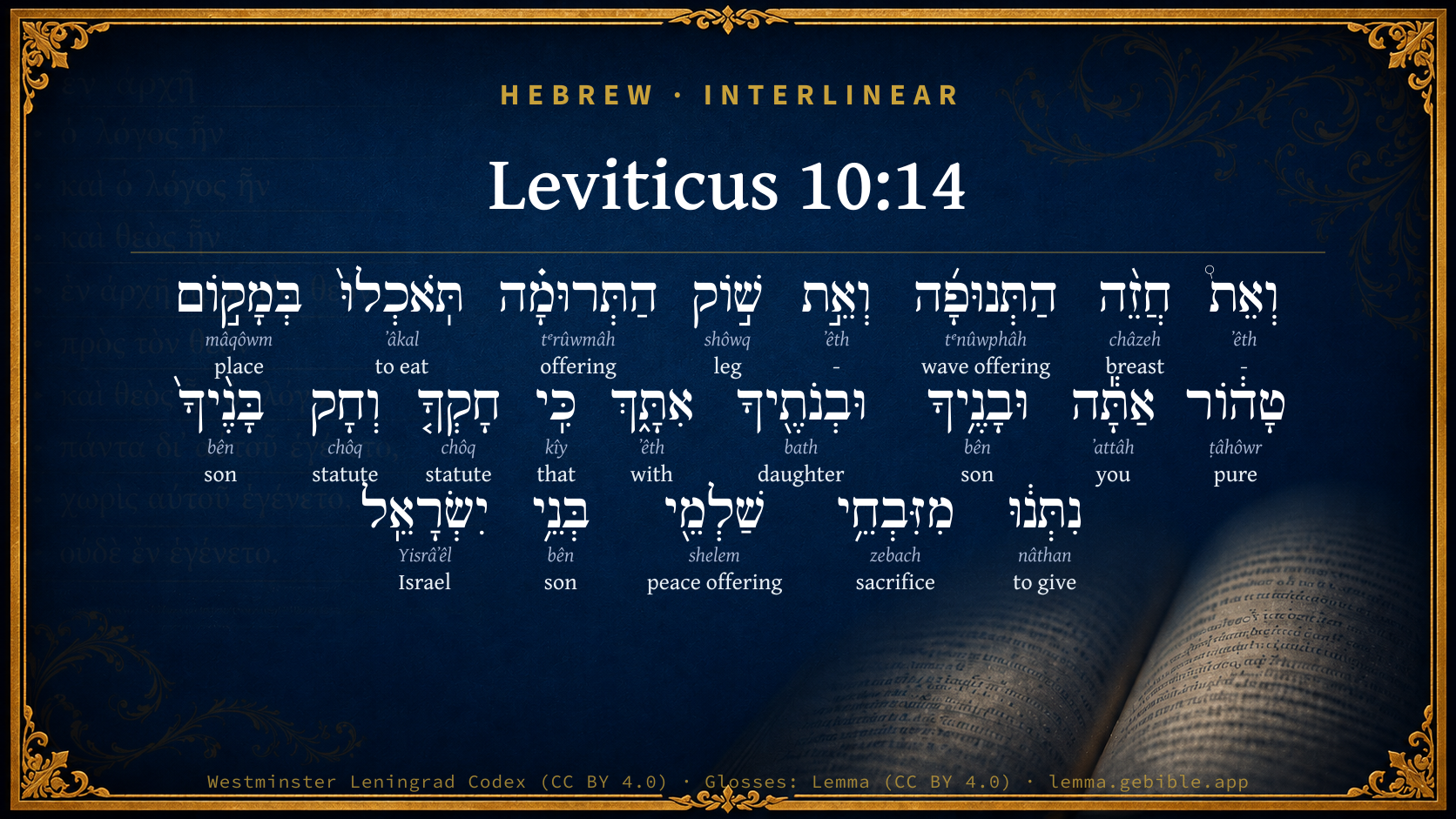
Leviticus 10:14

Hebrew (Westminster Leningrad Codex) Leviticus 10:14 appears in the Hebrew Old Testament. The text above is from the Westminster Leningrad Codex. Each word links to its Strong’s number, a concise gloss, and parsing drawn from the Open Scriptures Hebrew Bible morphology. Click any word for its full Brown-Driver-Briggs (BDB) entry.
Download image
Cite this verse

Leviticus 10:14 (World English Bible). Public Domain. Lemma interlinear Bible study tool, https://lemma.gebible.app/v/leviticus/10/14.

Show BibTeX & RIS
BibTeX
RIS
English Translation
The waved breast and the heaved thigh you shall eat in a clean place, you, and your sons, and your daughters with you: for they are given as your portion, and your sons' portion, out of the sacrifices of the peace offerings of the children of Israel.
World English Bible · Public Domain
Download a study sheet

One document with this verse’s original text, its word-by-word gloss line, the meaning frame, cross-references with their text, attributed commentary, and full source and license credits — printable, and it pastes into notes with its structure intact.

This verse Autodidact and up

Study sheet (.html) Plain text (.txt)

A passage Seminary Student

Up to 50 verses in one chapter. A passage sheet keeps up to 6 commentary sources and 12 cross-references per verse, in the order this page ranks them, and says so on the sheet whenever that leaves anything out. Ask for a single verse and you get the Autodidact verse sheet above.

Everything on this page stays free to read, with no account — the sheet is a download of what is already on screen, not access to it.

Want to remove ads? Support Godless Engineer
Compare translations 3

The same verse in 3 English versions, stacked beneath the original-language interlinear above. Click any original word for its lexicon entry.

Each is an independent rendering of the whole verse — the interlinear is not word-aligned to these translations.

Highlighted words mark where these versions differ — a whole-verse word diff, not a word-by-word alignment.

  • World English Bible Public Domain
    The waved breast and the heaved thigh you shall eat in a clean place, you, and your sons, and your daughters with you: for they are given as your portion, and your sons' portion, out of the sacrifices of the peace offerings of the children of Israel.
  • King James Version Public Domain
    And the wave breast and heave shoulder shall ye eat in a clean place; thou, and thy sons, and thy daughters with thee: for they be thy due, and thy sons' due, which are given out of the sacrifices of peace offerings of the children of Israel.
  • unfoldingWord Literal Text CC BY-SA 4.0
    And the breast of the raised offering and the thigh of the contribution you shall eat in a clean place, you and your sons and your daughters with you, for they are given your portion and the portion of your sons from the sacrifices of the peace offerings of the sons of Israel.

unfoldingWord Literal Text — © unfoldingWord, licensed CC BY-SA 4.0. Word-aligned USFM3 via Door43 (git.door43.org/unfoldingWord/en_ult).

Versions to compare (up to 4)

3 of 4 selected

Show all 18 translations

Every available English version of this verse, each an independent rendering of the whole verse.

  • World English Bible Public Domain
    The waved breast and the heaved thigh you shall eat in a clean place, you, and your sons, and your daughters with you: for they are given as your portion, and your sons' portion, out of the sacrifices of the peace offerings of the children of Israel.
  • Berean Standard Bible Public Domain
    And you and your sons and daughters may eat the breast of the wave offering and the thigh of the contribution in a ceremonially clean place, because these portions have been assigned to you and your children from the peace offerings of the sons of Israel.
  • Majority Standard Bible Public Domain
    And you and your sons and daughters may eat the breast of the wave offering and the thigh of the contribution in a ceremonially clean place, because these portions have been assigned to you and your children from the peace offerings of the sons of Israel.
  • King James Version Public Domain
    And the wave breast and heave shoulder shall ye eat in a clean place; thou, and thy sons, and thy daughters with thee: for they be thy due, and thy sons' due, which are given out of the sacrifices of peace offerings of the children of Israel.
  • American Standard Version (1901) Public Domain
    And the wave-breast and the heave-thigh shall ye eat in a clean place, thou, and thy sons, and thy daughters with thee: for they are given as thy portion, and thy sons' portion, out of the sacrifices of the peace-offerings of the children of Israel.
  • Revised Version (1885) Public Domain
    And the wave breast and the heave thigh shall ye eat in a clean place; thou, and thy sons, and thy daughters with thee: for they are given as thy due, and thy sons’ due, out of the sacrifices of the peace offerings of the children of Israel.
  • Geneva Bible (1599) Public Domain
    Also the shaken breast and the heaue shoulder shall yee eate in a cleane place: thou, and thy sonnes, and thy daughters with thee: for they are giuen as thy duetie and thy sonnes duety, of the peace offringes of the children of Israel.
  • Douay-Rheims (1899) Public Domain
    The breast also that is offered, and the shoulder that is separated, you shall eat in a most clean place, thou and thy sons, and thy daughters with thee. For they are set aside for thee and thy children, of the victims of peace offerings of the children of Israel:
  • Young's Literal Translation Public Domain
    `And the breast of the wave-offering, and the leg of the heave-offering, ye do eat in a clean place, thou, and thy sons, and thy daughters with thee; for thy portion and the portion of thy sons they have been given, out of the sacrifices of peace-offerings of the sons of Israel;
  • Literal Standard Version CC BY-SA 4.0
    And you eat the breast of the wave-offering and the leg of the raised-offering in a clean place, you, and your sons, and your daughters with you; they have been given for your portion and the portion of your sons, out of the sacrifices of peace-offerings of the sons of Israel;
  • Unlocked Literal Bible CC BY-SA 4.0
    The breast that is waved and the thigh that is presented to Yahweh, you must eat in a clean place acceptable to God. You and your sons and daughters with you should eat those portions, for they are given as your share and your sons' share out of the sacrifices of the fellowship offerings of the people of Israel.
  • unfoldingWord Literal Text CC BY-SA 4.0
    And the breast of the raised offering and the thigh of the contribution you shall eat in a clean place, you and your sons and your daughters with you, for they are given your portion and the portion of your sons from the sacrifices of the peace offerings of the sons of Israel.
  • Darby Bible Public Domain
    And the breast of the wave-offering, and the shoulder of the heave-offering shall ye eat in a clean place, thou, and thy sons, and thy daughters with thee; for [as] thy due, and thy sons' due, are they given of the sacrifices of peace-offerings of the children of Israel.
  • World Messianic Bible Public Domain
    The waved breast and the heaved thigh you shall eat in a clean place, you, and your sons, and your daughters with you: for they are given as your portion, and your sons’ portion, out of the sacrifices of the peace offerings of the children of Israel.
  • Webster's Bible Public Domain
    And the wave-breast and heave-shoulder shall ye eat in a clean place; thou, and thy sons, and thy daughters with thee: for they are thy due, and thy sons' due, which are given out of the sacrifices of peace-offerings of the children of Israel.
  • Free Bible Version CC BY-SA 4.0
    You and your male and female descendants can eat the breast of the wave offering and the thigh contribution anywhere that is ceremonially clean, because you and your descendants have been given these as your share from the peace offerings of the Israelites.
  • Bible in Basic English Public Domain
    And the breast which is waved and the leg which is lifted up on high, you are to take as your food in a clean place; you and your sons and your daughters with you: for they are given to you as your right and your sons' right, from the peace-offerings of the children of Israel.
  • JPS Tanakh (1917) Public Domain
    And the breast of waving and the thigh of heaving shall ye eat in a clean place; thou, and thy sons, and thy daughters with thee; for they are given as thy due, and thy sons' due, out of the sacrifices of the peace-offerings of the children of Israel.

Literal Standard Version (2020), Covenant Press — licensed CC BY-SA 4.0. Text via the HelloAO Bible API (eBible.org). Unlocked Literal Bible (unfoldingWord) — licensed CC BY-SA 4.0. Text via the HelloAO Bible API (eBible.org). unfoldingWord Literal Text — © unfoldingWord, licensed CC BY-SA 4.0. Word-aligned USFM3 via Door43 (git.door43.org/unfoldingWord/en_ult). Free Bible Version, Dr. Jonathan Gallagher — licensed CC BY-SA 4.0. Text via the HelloAO Bible API (eBible.org).

Word by word

More ways to search: Search by grammar → Find every occurrence → Compare this word →

Practice this passage: Drill this verse → Learn its vocabulary →

חֲזֵ֨ה
châzeh
H2373
“breast of”
Noun, Common, Masculine, Singular, Construct
Part of Speech
Noun
Type
Common
Gender
Masculine
Number
Singular
State
Construct
Full BDB Definition

Origin: from H2372

TWOT: 634a

breast (of animals), breast of an animal sacrifice
  1. וְאֵת֩ ʼêth H853 “and · -” Conjunction + Particle, Direct Object
  2. הַתְּנוּפָ֜ה tᵉnûwphâh H8573 “the · wave offering” Particle, Definite Article + Noun, Common, Feminine, Singular, Absolute
  3. וְאֵ֣ת ʼêth H853 “and · -” Conjunction + Particle, Direct Object
  4. שׁ֣וֹק shôwq H7785 “leg of” Noun, Common, Feminine, Singular, Construct
  5. הַתְּרוּמָ֗ה tᵉrûwmâh H8641 “the · offering” Particle, Definite Article + Noun, Common, Feminine, Singular, Absolute
  6. תֹּֽאכְלוּ֙ ʼâkal H398 “to eat” Verb, Qal, Imperfect, 2nd Person, Masculine, Plural
  7. בְּמָק֣וֹם mâqôwm H4725 “in/at · place” Preposition + Noun, Common, Masculine, Singular, Absolute
  8. טָה֔וֹר ṭâhôwr H2889 “pure” Adjective, Adjective, Masculine, Singular, Absolute
  9. אַתָּ֕ה ʼattâh H859 “you” Pronoun, Personal, 2nd Person, Masculine, Singular
  10. וּבָנֶ֥יךָ bên H1121 “and · sons · your” Conjunction + Noun, Common, Masculine, Plural, Construct + Suffix, Personal, 2nd Person, Masculine, Singular
  11. וּבְנֹתֶ֖יךָ bath H1323 “and · daughters · your” Conjunction + Noun, Common, Feminine, Plural, Construct + Suffix, Personal, 2nd Person, Masculine, Singular
  12. אִתָּ֑ךְ ʼêth H854 “with · you” Preposition + Suffix, Personal, 2nd Person, Feminine, Singular
  13. כִּֽי kîy H3588 “that” Conjunction
  14. חָקְךָ֤ chôq H2706 “statute · your” Noun, Common, Masculine, Singular, Construct + Suffix, Personal, 2nd Person, Masculine, Singular
  15. וְחָק chôq H2706 “and · statute of” Conjunction + Noun, Common, Masculine, Singular, Construct
  16. בָּנֶ֨יךָ֙ bên H1121 “sons · your” Noun, Common, Masculine, Plural, Construct + Suffix, Personal, 2nd Person, Masculine, Singular
  17. נִתְּנ֔וּ nâthan H5414 “to give” Verb, Niphal, Perfect, 3rd Person, Common, Plural
  18. מִזִּבְחֵ֥י zebach H2077 “from · sacrifices of” Preposition + Noun, Common, Masculine, Plural, Construct
  19. שַׁלְמֵ֖י shelem H8002 “peace offerings of” Noun, Common, Masculine, Plural, Construct
  20. בְּנֵ֥י bên H1121 “sons of” Noun, Common, Masculine, Plural, Construct
  21. יִשְׂרָאֵֽל Yisrâʼêl H3478 “Israel” Noun, Proper

About this verse

These counts appear in no published source. They are computed here, from the morphology-tagged text and Lemma’s own curated glosses. What Lemma adds →

22
words
18
distinct lemmas
Pentateuch
section

Notable vocabulary

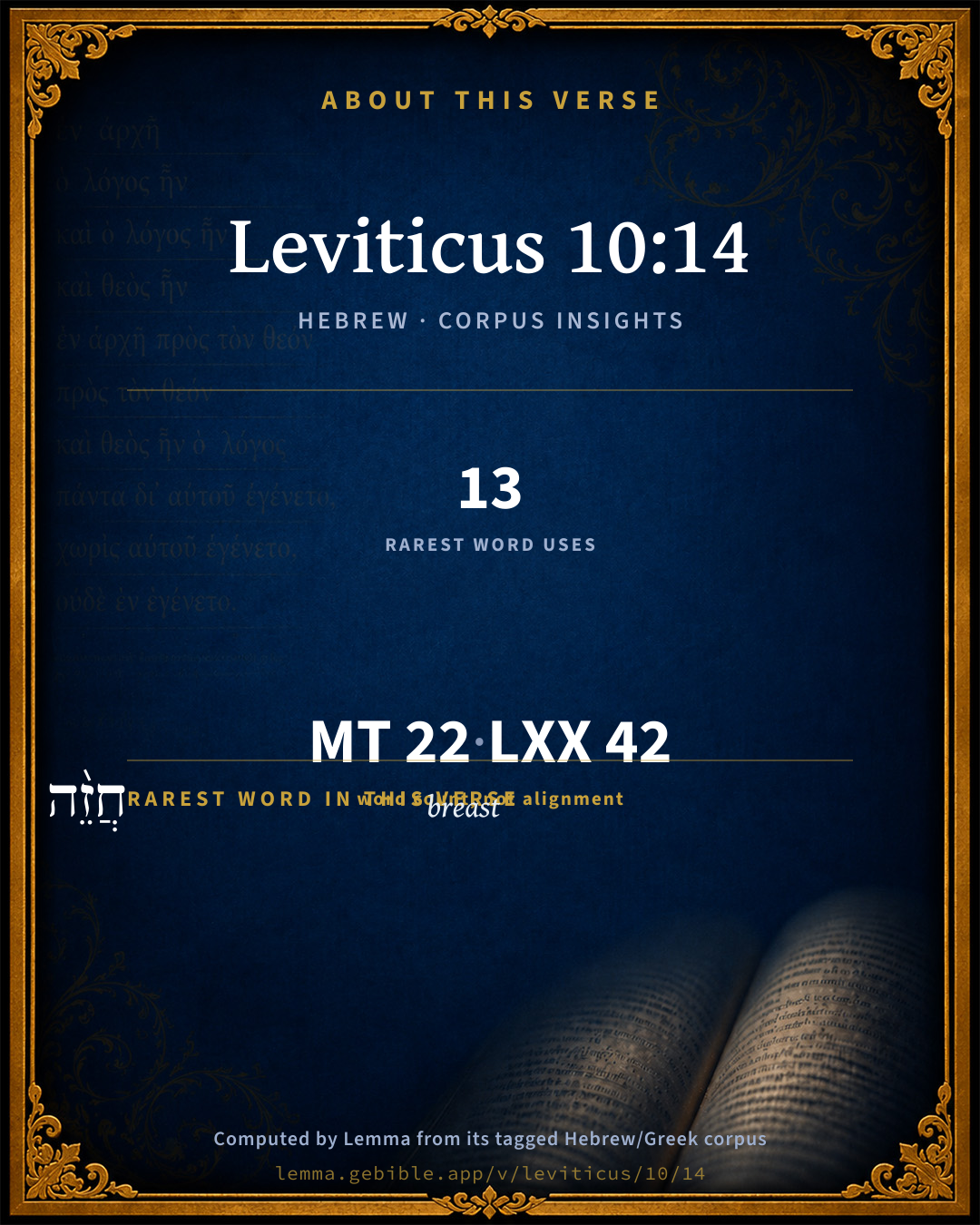
The rarest word here is חֲזֵ֨ה breast H2373 — appearing just 13 times in the whole Hebrew Bible.

Shared distinctive vocabulary

חֲזֵ֨ה breast H2373 occurs in 12 verses of the Hebrew Bible. Also found in:

Grammatical profile

  • 2 verbs
  • 14 nouns
  • 1 adjective
  • 1 pronoun
  • 1 preposition
  • 1 conjunction
  • 2 particles

Verb forms

  • תֹּֽאכְלוּ֙ Qal · Imperfect
  • נִתְּנ֔וּ Niphal · Perfect

Repetition

Words recur within this verse — often emphatic in Hebrew:

  • וּבָנֶ֥יךָ son H1121 ×3
  • חָקְךָ֤ statute H2706 ×2

Hebrew & Septuagint length

In English translation the verse runs 47 words from the Hebrew and 53 from the Septuagint (LXX English) — closely comparable.

A rough comparison of the two English renderings, which tokenize alike — not a word-level alignment.

Word counts can differ between the Hebrew and the Greek without any difference in meaning — e.g. the Hebrew direct-object marker אֵת has no separate Greek word, and Greek often adds the article ὁ.

In the original languages it is 22 Hebrew tokens and 42 Greek tokens — but the two are counted differently (Hebrew bundles its prefixes and suffixes into one token; the Greek is in lemma form), so that isn’t a like-for-like length.

Cross-references

5

Topical passages linked to Leviticus 10:14 in the Treasury of Scripture Knowledge — connected by theme and wording, ordered by reader-vote popularity; previews shown in the World English Bible.

  • Numbers 18:11 This is your: the heave-offering of their gift, even all the wave-offerings of the children of Israel; I have given them to you, and to your sons and to your daughters with you, as a portion forever; everyone who is clean in your house shall eat of it.
  • Exodus 29:24–28 You shall put all of this in Aaron's hands, and in his sons' hands, and shall wave them for a wave-offering before Yahweh.
  • Leviticus 7:29–34 "Speak to the children of Israel, saying, 'He who offers the sacrifice of his peace offerings to Yahweh shall bring his offering to Yahweh out of the sacrifice of his peace offerings.
  • Leviticus 9:21 and the breasts and the right thigh Aaron waved for a wave offering before Yahweh, as Moses commanded.
  • John 4:34 Jesus said to them, "My food is to do the will of him who sent me, and to accomplish his work.

Cross-references courtesy of OpenBible.info (CC BY 4.0).

Hebrew and Greek witnesses Masoretic Hebrew ↔ Greek Septuagint

The same verse in the two great witnesses to the Old Testament, shown verse-for-verse.

These are two independent witnesses, not word-aligned to each other, and the Septuagint is shown in lemma (dictionary) form.

Hebrew Leviticus 10:14 Masoretic · Westminster Leningrad Codex

וְאֵת֩ חֲזֵ֨ה הַתְּנוּפָ֜ה וְאֵ֣ת שׁ֣וֹק הַתְּרוּמָ֗ה תֹּֽאכְלוּ֙ בְּמָק֣וֹם טָה֔וֹר אַתָּ֕ה וּבָנֶ֥יךָ וּבְנֹתֶ֖יךָ אִתָּ֑ךְ כִּֽי חָקְךָ֤ וְחָק בָּנֶ֨יךָ֙ נִתְּנ֔וּ מִזִּבְחֵ֥י שַׁלְמֵ֖י בְּנֵ֥י יִשְׂרָאֵֽל

The waved breast and the heaved thigh you shall eat in a clean place, you, and your sons, and your daughters with you: for they are given as your portion, and your sons' portion, out of the sacrifices of the peace offerings of the children of Israel.

World English Bible · Public Domain

Greek LXX Leviticus 10:14 Septuagint · lemma form

καί ὁ στηθύνιον ὁ ἀφόρισμα καί ὁ βραχίων ὁ ἀφαίρεμα ἐσθίω ἐν τόπος ἅγιος σύ καί ὁ υἱός σύ καί ὁ οἶκος σύ μετά σύ νόμιμος γάρ σύ καί νόμιμος ὁ υἱός σύ δίδωμι ἀπό ὁ θυσία ὁ σωτήριον ὁ υἱός ἰσραήλ

And you⌃ shall eat the breast of separation, and the shoulder of the choice-offering in the holy place, you and your sons and your house with you; for it has been given as an ordinance for you and an ordinance for your sons, of the sacrifices of peace-offering of the children of Israel.

LXX2012 (modern English Septuagint) · Public Domain

On this verse, Haydock's Catholic Bible Commentary discusses the Septuagint’s reading. Read the note in Commentary ↓

Hebrew: Westminster Leningrad Codex (CC BY 4.0). Greek: Septuagint (public domain); English from LXX2012 (modern English Septuagint) (Public Domain). How the Septuagint differs from the Hebrew →

Targum (Aramaic paraphrase)

2

The Targum is the ancient Jewish Aramaic paraphrase of the Hebrew Scriptures — an interpretive translation, not the Hebrew text itself. Onkelos (literal) and Pseudo-Jonathan (expansive) render the Torah, and Jonathan the Prophets. Coverage is partial: where no permissively-licensed English translation exists for a verse, only the Aramaic is shown. This is verse-level text, not a word-by-word alignment to the Hebrew.

  1. Targum Onkelos Torah (Genesis–Deuteronomy)
    וְיָת חֶדְיָא דַאֲרָמוּתָא וְיָת שׁוֹקָא דְאַפְרָשׁוּתָא תֵּיכְלוּן בַּאֲתַר דְכֵי אַתְּ וּבְנָיךְ וּבְנָתָיךְ עִמָךְ אֲרֵי חֳלָקָךְ וָחֳלַק בְּנָיךְ אִתְיְהִיבוּ מִנִכְסַת קוּדְשַׁיָא דִבְנֵי יִשְׂרָאֵל

    (no public-domain English translation for this verse)

    Targum Onkelos — Aramaic: “Onkelos Genesis” (public domain); “Onkelos Exodus” (public domain); “Onkelos Leviticus” (public domain); “Onkelos Numbers” (public domain); “Onkelos Deuteronomy” (public domain). English: “Sefaria Community Translation” (CC0 1.0 (public-domain dedication)); “J.W. Etheridge. The Targums of Onkelos and Jonathan Ben Uzziel on the Pentateuch. London: Longmans, Green, 1862” (public domain). Text via Sefaria.

  2. Targum Pseudo-Jonathan Torah (Genesis–Deuteronomy)
    וְיַת חַדְיָא דַאֲרָמוּתָא וְיַת שׁוֹקָא דְאַפְרָשׁוּתָא תֵּיכְלוּן בַּאֲתַר דְכֵי אַנְתְּ וּבְנָךְ וּבְנָתָךְ עִמָךְ אֲרוּם חוּלְקָךְ וְחוּלַק בְּנָךְ אִתְיְהִבוּ מִנִכְסַת קוּדְשַׁיָא דִבְנֵי יִשְרָאֵל

    But the breast of the uplifting and the shoulder of the separation you may eat in (any) clean place, thou and thy sons with thee, because it is thy portion and the portion of thy sons which hath been given from the hallowed sacrifices of the children of Israel.

    Targum Pseudo-Jonathan — Aramaic: “Targum Jonathan on Genesis” (public domain); “Targum Jonathan on Exodus” (public domain); “Targum Jonathan on Leviticus” (public domain); “Targum Jonathan on Numbers” (public domain); “Targum Jonathan on Deuteronomy” (public domain). English: “The Targum of Jonathan ben Uzziel, trans. J. W. Etheridge, London, 1862” (public domain). Text via Sefaria.

Commentary

Notes on Leviticus 10:14 from classic Christian and Jewish commentators (each source and its license shown beneath its notes). The classic Christian expositions comment on the surrounding passage and are grouped to its opening verse, so a note may address several verses; the Jewish commentaries on the Tanakh (Rashi and others) are per-verse, so they appear only where the commentator wrote on this verse.

Lemma curates 59 commentaries, every one of them public domain or Creative Commons licensed, each selected and text-cleaned for this edition rather than reprinted as found. About our sources →

Trapp's Complete Commentary

John Trapp

Lev 10:14 And the wave breast and heave shoulder shall ye eat in a clean place; thou, and thy sons, and thy daughters with thee: for [they be] thy due, and thy sons’ due, [which] are given out of the sacrifices of peace offerings of the children of Israel.

Ver. 14. And the wave breast, and heave shoulder.] These were the priests’ due: teaching them to set breast and shoulder to God’s work: and minding them, that a minister should be both a breast to love, and a shoulder to support the people in their troubles and burdens.

John Trapp, A Commentary or Exposition upon All the Books of the Old and New Testament (1647–1656) — public domain. Text from a community e-Sword module.

Geneva Bible (1599)

Geneva Bible translators

Or, where is no uncleanness.

For the breast and shoulders of the peace offerings might be brought to their families, so that their daughters might eat of them, as also of the offerings of firstfruits, the firstborn, and the Easter lamb, Read Lev. 22:12,13.

Or, right or portion.

Geneva Bible (1599) marginal notes — public domain. Text via Bolls.life.

Adam Clarke's Commentary

Verse 14. Wave-breast and heave-shoulder] See Clarke on Le 7:38 and see "Ex 29:27".

Adam Clarke's Commentary on the Bible (1810–1826) — public domain. Text from a community e-Sword/MySword module.

Ellicott's Commentary for English Readers

(14) And the wave breast and heave shoulder.—That is, of the peace offering which was offered by the nation. (See Lev_9:18-21.) As they were given to the priests for the maintenance of their families (see Lev_7:34), these portions might be eaten anywhere within the camp, provided the place was not defiled by ceremonial uncleanness.

A Bible Commentary for English Readers, edited by Charles John Ellicott (1878–1897) — public domain. Text from a community e-Sword module.

The Cambridge Bible for Schools and Colleges

gen. ed. J. J. S. Perowne

14. For the ‘wave breast’ and the ‘heave thigh’ see Appendix IV, pp. 183 ff.

(6) Aaron’s excuse for not eating the Sin-Offering (16–20)

The Sin-Offering is that of Lev_9:15 which was offered as the first, i.e. as Aaron’s, Sin-Offering, and burnt without the camp (Lev_9:11). This burning (as opposed to eating by the priests) should only have taken place, if (as was not done in this case) the blood had been brought into the ‘tent of meeting.’ Moses is angry with Aaron’s sons, but they acted under direction, and Aaron acknowledges his responsibility by replying.

The Cambridge Bible for Schools and Colleges (gen. ed. J. J. S. Perowne; Cambridge University Press, 1878–1918) — public domain. Text from a community e-Sword module.

John Gill's Exposition

The heave shoulder and wave breast shall they bring,.... Not the priests, but the owners to the priests, Lev 7:29,

with the offerings made by fire of the fat: upon the inwards, kidneys, and caul of the liver, which was all burnt:

to wave it for a wave offering before the Lord, the shoulder was lifted up, and the breast waved to and fro before the Lord of the whole earth, and towards the several parts of it, to show and own his right to all they had, and then they were given to the priests as a token of it:

and it shall be thine, and thy sons with thee; both the shoulder and the breast:

by a statute for ever, to be observed as long as the ceremonial law and Levitical priesthood lasted, even to the end of the Jewish age and economy, and the coming of the Messiah:

as the Lord hath commanded; Lev 7:33.

John Gill's Exposition of the Whole Bible (1746–1763) — public domain (CC PDM 1.0). Text via the HelloAO Bible API.

Haydock's Catholic Bible Commentary

Place, at home. The Septuagint translate, "in the holy place;" understanding that these sacrifices for sin were to be eaten in the court of the tabernacle. Malvenda allows, that the children of the priests, and their wives, might come thither to eat the parts of the peace-offerings allotted to them. But of this there is no proof.

George Leo Haydock (1774–1849), Haydock's Catholic Family Bible and Commentary, 1859 edition — public domain. Excludes Psalms (Douay-Rheims chapter numbering differs from Protestant) and Deuterocanonical books (Catholic canon only).

Matthew Poole's English Annotations

In a clean place; in any of your dwellings, or any place in the camp, which he supposeth to be kept clean from all ceremonial defilement, as they ought to be; whence the lepers were put out of the camp. See Num 5:1-3. In any place where the women as well as the men might come, for the daughters of the priests might eat these as well as their sons, as it here follows.

And thy daughters, to wit, if they were maids, or widows, or divorced, Lev 22:11-13.

Matthew Poole's English Annotations on the Holy Bible (1683–1685) — public domain. Text from a community e-Sword/MySword module.

John Wesley's Explanatory Notes

In a clean place - In any of your dwellings, or any place in the camp, which was kept clean from all ceremonial defilement. In any place where the women as well as the men might come, for the daughters of the priest might eat these as well as their sons, if they were maids, or widows, or divorced, chap. xxii, 11-13.

John Wesley, Explanatory Notes Upon the Whole Bible (1754–1765) — public domain. Text via the GEBible commentary corpus.

unfoldingWord translationNotes

Door43 World Missions Community

The breast that is waved and the thigh that is presented to Yahweh

This can be translated in active form. AT: "The breast and thigh that a person waved and presented to Yahweh" (See: Active or Passive)

the breast

the front part of the animal's body below the neck

the thigh

the upper part of the leg above the knee

in a clean place

A place that is fit to be used for God's purposes is spoken of as if it were physically clean. (See: Metaphor)

for they are given as your share

This can be translated in active form. AT: "for Yahweh has given them as your share" (See: Active or Passive)

You and your sons and daughters

Here "You" refers to Aaron. (See: Forms of You)

They will be yours and your sons' with you as a share forever

Translate this so it is understood that the portion belongs to Aaron and his sons. AT: "This portion will always be for you and your sons" (See: Assumed Knowledge and Implicit Information)

translationWords

raise

sacrifice

Yahweh

clean

fellowship offering

eternity

unfoldingWord translationNotes — © Distant Shores Media and the Door43 World Missions Community, licensed CC BY-SA 4.0. Source: git.door43.org/Door43/en_tn.

Rashi

Rabbi Shlomo Yitzchaki (Rashi)

ואת חזה התנופה AND THE WAVE BREAST of the communal) peace-offerings,

תאכלו במקום טהור YE SHALL EAT IN A CLEAN PLACE —But had they eaten those that preceded this (the sin-offering and the meal-offering) in an unclean place? But he said this because the preceding ones being holy in the highest degree the eating of them had necessarily to take place in a holy spot (in the court of the Tabernacle), but these,however, were not required to be eaten “within the hangings” (i. e. in the court which was enclosed by hangings), but they were, however, required to be eaten in the camp of Israel (and not beyond the confines of that camp), that being a clean place in so far as lepers were precluded from entering it. From this we infer that sacrifices holy in a lower degree, being similar to the peace-offerings mentioned here, may be eaten anywhere within the city of Jerusalem, this area corresponding to “the camp of Israel” in the wilderness (see Rashi on 4:12; Zevachim 55a).

אתה ובניך ובנתיך THOU AND THY SONS AND THY DAUGHTERS — You and your sons have a claim to a portion, but your daughters have no claim to a portion; if, however, you give them part of these sacrifices as a gift they are permitted to eat of the breast and the shoulder. Or perhaps this is not the meaning, but if means that the daughters have also a claim to a portion? It, however, states immediately afterwards: “for as thy due and thy sons’ due are they given” there is a due to sons but there is no due to daughters (Sifra, Shemini, Chapter 1 10).

Rashi on the Tanakh — English translations: “The Judaica Press complete Tanach with Rashi, translated by A. J. Rosenberg” (CC BY 4.0); “Pentateuch with Rashi's commentary by M. Rosenbaum and A.M. Silbermann, 1929-1934” (public domain); “The Metsudah Tanach series, Lakewood, N.J” (CC BY 4.0); and “The Book of Joshua, Metsudah Publications, 1997” (CC BY 4.0). Text via Sefaria.

Lesson kit

Teaching starters — assembled from the data on this page, not authored interpretation. Every prompt links to the verse data it draws on. Edit before teaching.

Leviticus, in the Pentateuch, opens this verse with 22 words (18 distinct Hebrew lemmas). Its most distinctive word is châzeh (“breast”). A historical commentator’s framing appears above. Read the whole chapter for the surrounding context.

Discussion questions

  1. What does “breast” (châzeh) contribute to the verse as a whole?
  2. Exodus 29:26 shares the word «breast» with this verse. How do the two illuminate each other?
  3. “son” occurs 3× in this one verse. What is the effect of the repetition?
  4. These translations render this verse differently. What is at stake in choosing one wording over another?
  5. The verb «תֹּֽאכְלוּ֙» is Qal Imperfect. How does its form color the action?
  6. Reading how Trapp's Complete Commentary and Geneva Bible (1599) read this verse, where do the two commentators agree and where do they part?

Things to notice

Reading settings

Reading text

Shown beneath each verse's original-language words.

Old Testament
Old Testament edition

Read the OT as the Masoretic Hebrew (MT) or the Greek Septuagint (LXX).

English shown for the Greek Septuagint (in the Hebrew ↔ Greek comparison).

Comparing translations? Open the Compare panel on any verse page to stack up to four side by side.