
Genesis 36:2

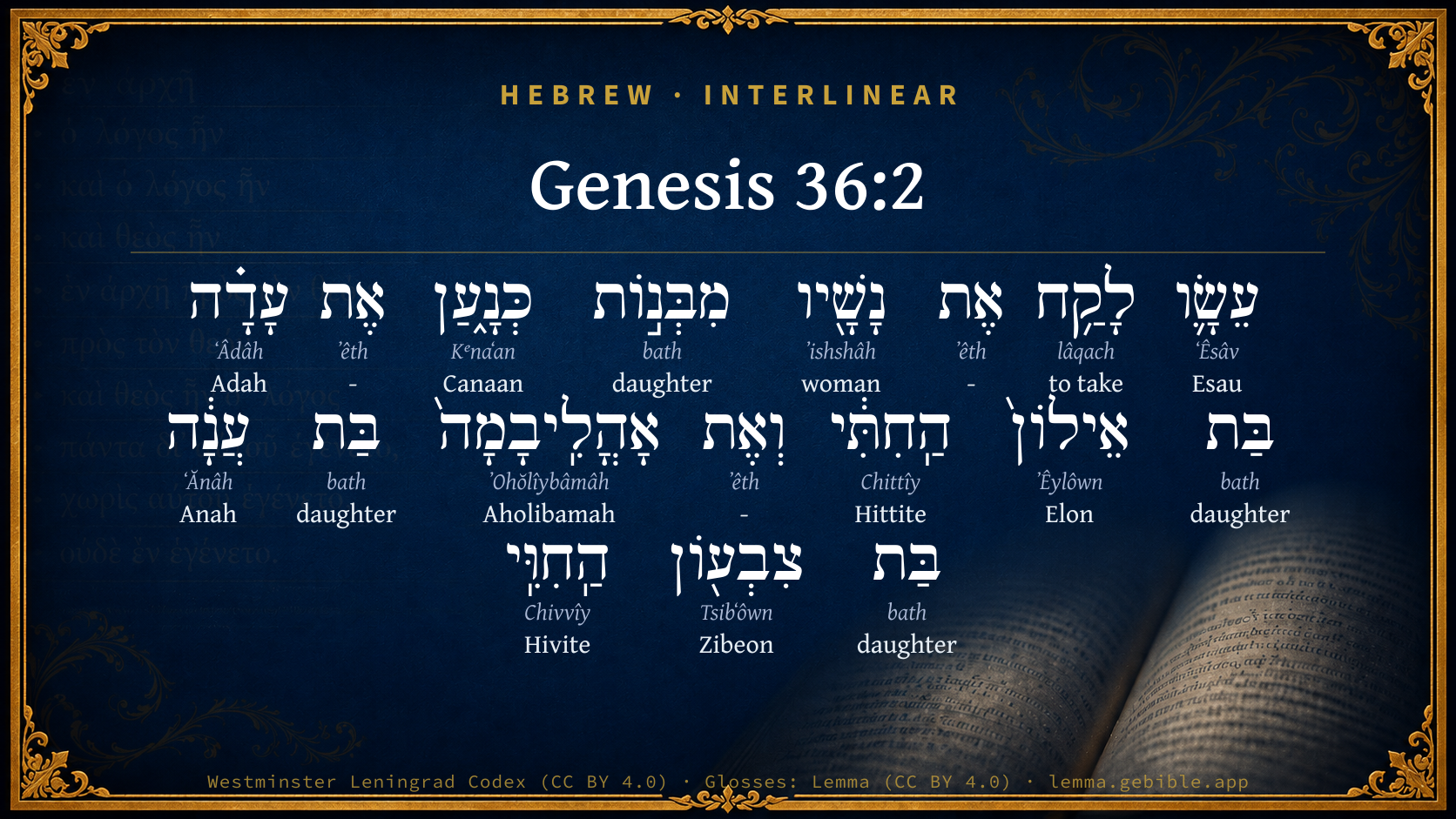
Hebrew (Westminster Leningrad Codex) Genesis 36:2 appears in the Hebrew Old Testament. The text above is from the Westminster Leningrad Codex. Each word links to its Strong’s number, a concise gloss, and parsing drawn from the Open Scriptures Hebrew Bible morphology. Click any word for its full Brown-Driver-Briggs (BDB) entry.
Download image
Cite this verse

Genesis 36:2 (World English Bible). Public Domain. Lemma interlinear Bible study tool, https://lemma.gebible.app/v/genesis/36/2.

Show BibTeX & RIS
BibTeX
RIS
English Translation
Esau took his wives from the daughters of Canaan: Adah the daughter of Elon, the Hittite; and Oholibamah the daughter of Anah, the daughter of Zibeon, the Hivite;
World English Bible · Public Domain
Highlights
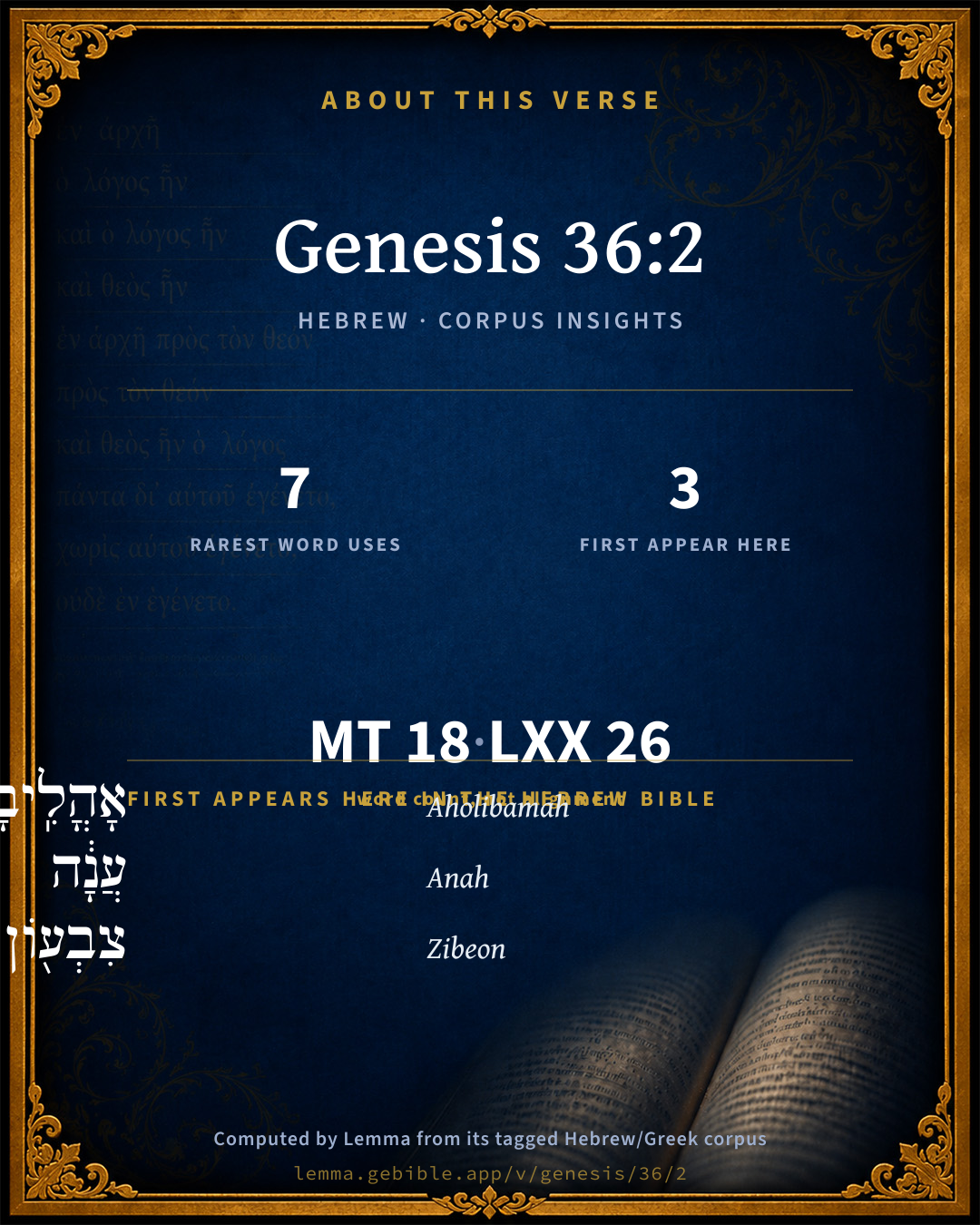
  • 3 first appearances in the Hebrew Bible
Full analysis ↓
Download a study sheet

One document with this verse’s original text, its word-by-word gloss line, the meaning frame, cross-references with their text, attributed commentary, and full source and license credits — printable, and it pastes into notes with its structure intact.

This verse Autodidact and up

Study sheet (.html) Plain text (.txt)

A passage Seminary Student

Up to 50 verses in one chapter. A passage sheet keeps up to 6 commentary sources and 12 cross-references per verse, in the order this page ranks them, and says so on the sheet whenever that leaves anything out. Ask for a single verse and you get the Autodidact verse sheet above.

Everything on this page stays free to read, with no account — the sheet is a download of what is already on screen, not access to it.

Want to remove ads? Support Godless Engineer
Compare translations 3

The same verse in 3 English versions, stacked beneath the original-language interlinear above. Click any original word for its lexicon entry.

Each is an independent rendering of the whole verse — the interlinear is not word-aligned to these translations.

Highlighted words mark where these versions differ — a whole-verse word diff, not a word-by-word alignment.

  • World English Bible Public Domain
    Esau took his wives from the daughters of Canaan: Adah the daughter of Elon, the Hittite; and Oholibamah the daughter of Anah, the daughter of Zibeon, the Hivite;
  • King James Version Public Domain
    Esau took his wives of the daughters of Canaan; Adah the daughter of Elon the Hittite, and Aholibamah the daughter of Anah the daughter of Zibeon the Hivite;
  • unfoldingWord Literal Text CC BY-SA 4.0
    Esau had taken his wives from the daughters of Canaan: Adah, the daughter of Elon the Hittite, and Oholibamah, the daughter of Anah the daughter of Zibeon the Hivite,

unfoldingWord Literal Text — © unfoldingWord, licensed CC BY-SA 4.0. Word-aligned USFM3 via Door43 (git.door43.org/unfoldingWord/en_ult).

Versions to compare (up to 4)

3 of 4 selected

Show all 18 translations

Every available English version of this verse, each an independent rendering of the whole verse.

  • World English Bible Public Domain
    Esau took his wives from the daughters of Canaan: Adah the daughter of Elon, the Hittite; and Oholibamah the daughter of Anah, the daughter of Zibeon, the Hivite;
  • Berean Standard Bible Public Domain
    Esau took his wives from the daughters of Canaan: Adah daughter of Elon the Hittite, Oholibamah daughter of Anah and granddaughter of Zibeon the Hivite,
  • Majority Standard Bible Public Domain
    Esau took his wives from the daughters of Canaan: Adah daughter of Elon the Hittite, Oholibamah daughter of Anah and granddaughter of Zibeon the Hivite,
  • King James Version Public Domain
    Esau took his wives of the daughters of Canaan; Adah the daughter of Elon the Hittite, and Aholibamah the daughter of Anah the daughter of Zibeon the Hivite;
  • American Standard Version (1901) Public Domain
    Esau took his wives of the daughters of Canaan: Adah the daughter of Elon the Hittite, and Oholibamah the daughter of Anah, the daughter of Zibeon the Hivite,
  • Revised Version (1885) Public Domain
    Esau took his wives of the daughters of Canaan; Adah the daughter of Elon the Hittite, and Oholibamah the daughter of Anah, the daughter of Zibeon the Hivite;
  • Geneva Bible (1599) Public Domain
    Esau tooke his wiues of the daughters of Canaan: Adah the daughter of Elon an Hittite, and Aholibamah the daughter of Anah, the daughter of Zibeon an Hiuite,
  • Douay-Rheims (1899) Public Domain
    Esau took wives of the daughters of Chanaan: Ada the daughter of Elon the Hethite, and Oolibama the daughter of Ana, the daughter of Sebeon the Hevite:
  • Young's Literal Translation Public Domain
    Esau hath taken his wives from the daughters of Canaan: Adah daughter of Elon the Hittite, and Aholibamah daughter of Anah, daughter of Zibeon the Hivite,
  • Literal Standard Version CC BY-SA 4.0
    Esau has taken his wives from the daughters of Canaan: Adah daughter of Elon the Hittite, and Aholibamah daughter of Anah, daughter of Zibeon the Hivite,
  • Unlocked Literal Bible CC BY-SA 4.0
    Esau took his wives from the Canaanites. These were his wives: Adah the daughter of Elon the Hittite; Oholibamah the daughter of Anah, the granddaughter of Zibeon the Hivite;
  • unfoldingWord Literal Text CC BY-SA 4.0
    Esau had taken his wives from the daughters of Canaan: Adah, the daughter of Elon the Hittite, and Oholibamah, the daughter of Anah the daughter of Zibeon the Hivite,
  • Darby Bible Public Domain
    Esau took his wives of the daughters of Canaan: Adah the daughter of Elon the Hittite, and Oholibamah the daughter of Anah, daughter of Zibeon the Hivite,
  • World Messianic Bible Public Domain
    Esau took his wives from the daughters of Canaan: Adah the daughter of Elon, the Hittite; and Oholibamah the daughter of Anah, the daughter of Zibeon, the Hivite;
  • Webster's Bible Public Domain
    Esau took his wives of the daughters of Canaan; Adah the daughter of Elon the Hittite, and Aholibamah the daughter of Anah the daughter of Zibeon the Hivite;
  • Free Bible Version CC BY-SA 4.0
    Esau married two Canaanite women: Adah, daughter of Elon the Hittite, and Oholibamah, daughter of Anah, and granddaughter of Zibeon the Hivite.
  • Bible in Basic English Public Domain
    Esau's wives were women of Canaan: Adah, the daughter of Elon the Hittite, and Oholibamah, the daughter of Anah, the daughter of Zibeon the Hivite,
  • JPS Tanakh (1917) Public Domain
    Esau took his wives of the daughters of Canaan; Adah the daughter of Elon the Hittite, and Oholibamah the daughter of Anah, the daughter of Zibeon the Hivite,

Literal Standard Version (2020), Covenant Press — licensed CC BY-SA 4.0. Text via the HelloAO Bible API (eBible.org). Unlocked Literal Bible (unfoldingWord) — licensed CC BY-SA 4.0. Text via the HelloAO Bible API (eBible.org). unfoldingWord Literal Text — © unfoldingWord, licensed CC BY-SA 4.0. Word-aligned USFM3 via Door43 (git.door43.org/unfoldingWord/en_ult). Free Bible Version, Dr. Jonathan Gallagher — licensed CC BY-SA 4.0. Text via the HelloAO Bible API (eBible.org).

Word by word

More ways to search: Search by grammar → Find every occurrence → Compare this word →

Practice this passage: Drill this verse → Learn its vocabulary →

אֵילוֹן֙
ʼÊylôwn
H356
“Elon”
Noun, Proper
Part of Speech
Noun
Type
Proper
Full BDB Definition

Origin: from H352

TWOT: None

Elon = "terebinth, mighty" - Hittite, father-in-law of Esau - second son of Zebulun - Zebulonite judge of Israel - town in Dan
  1. עֵשָׂ֛ו ʻÊsâv H6215 “Esau” Noun, Proper
  2. לָקַ֥ח lâqach H3947 “to take” Verb, Qal, Perfect, 3rd Person, Masculine, Singular
  3. אֶת ʼêth H853 “-” Particle, Direct Object
  4. נָשָׁ֖יו ʼishshâh H802 “women · his” Noun, Common, Feminine, Plural, Construct + Suffix, Personal, 3rd Person, Masculine, Singular
  5. מִבְּנ֣וֹת bath H1323 “from · daughters of” Preposition + Noun, Common, Feminine, Plural, Construct
  6. כְּנָ֑עַן Kᵉnaʻan H3667 “Canaan” Noun, Proper
  7. אֶת ʼêth H853 “-” Particle, Direct Object
  8. עָדָ֗ה ʻÂdâh H5711 “Adah” Noun, Proper
  9. בַּת bath H1323 “daughter of” Noun, Common, Feminine, Singular, Construct
  10. הַֽחִתִּ֔י Chittîy H2850 “the · Hittite” Particle, Definite Article + Noun, Gentilic, Masculine, Singular, Absolute
  11. וְאֶת ʼêth H853 “and · -” Conjunction + Particle, Direct Object
  12. אָהֳלִֽיבָמָה֙ ʼOhŏlîybâmâh H173 “Aholibamah” Noun, Proper
  13. בַּת bath H1323 “daughter of” Noun, Common, Feminine, Singular, Construct
  14. עֲנָ֔ה ʻĂnâh H6034 “Anah” Noun, Proper
  15. בַּת bath H1323 “daughter of” Noun, Common, Feminine, Singular, Construct
  16. צִבְע֖וֹן Tsibʻôwn H6649 “Zibeon” Noun, Proper
  17. הַֽחִוִּֽי Chivvîy H2340 “the · Hivite” Particle, Definite Article + Noun, Gentilic, Masculine, Singular, Absolute

About this verse

These counts appear in no published source. They are computed here, from the morphology-tagged text and Lemma’s own curated glosses. What Lemma adds →

18
words
13
distinct lemmas
Pentateuch
section

Notable vocabulary

The rarest word here is אֵילוֹן֙ Elon H356 — appearing just 7 times in the whole Hebrew Bible.

First appearance in Scripture

These words make their first canonical appearance in the Hebrew Bible here:

  • אָהֳלִֽיבָמָה֙ Aholibamah H173
  • עֲנָ֔ה Anah H6034
  • צִבְע֖וֹן Zibeon H6649

Shared distinctive vocabulary

אֵילוֹן֙ Elon H356 occurs in 7 verses of the Hebrew Bible. Also found in:

Grammatical profile

  • 1 verb
  • 14 nouns
  • 3 particles

Verb forms

  • לָקַ֥ח Qal · Perfect

Repetition

A word recurs within this verse — often emphatic in Hebrew:

  • מִבְּנ֣וֹת daughter H1323 ×4

Hebrew & Septuagint length

In English translation the verse runs 28 words from the Hebrew and 30 from the Septuagint (LXX English) — closely comparable.

A rough comparison of the two English renderings, which tokenize alike — not a word-level alignment.

Word counts can differ between the Hebrew and the Greek without any difference in meaning — e.g. the Hebrew direct-object marker אֵת has no separate Greek word, and Greek often adds the article ὁ.

In the original languages it is 18 Hebrew tokens and 26 Greek tokens — but the two are counted differently (Hebrew bundles its prefixes and suffixes into one token; the Greek is in lemma form), so that isn’t a like-for-like length.

Cross-references

5

Topical passages linked to Genesis 36:2 in the Treasury of Scripture Knowledge — connected by theme and wording, ordered by reader-vote popularity; previews shown in the World English Bible.

  • Genesis 36:25 These are the children of Anah: Dishon and Oholibamah, the daughter of Anah.
  • Genesis 9:25 He said, "Cursed be Canaan; A servant of servants will he be to his brothers."
  • Genesis 27:46 Rebekah said to Isaac, "I am weary of my life because of the daughters of Heth. If Jacob takes a wife of the daughters of Heth, such as these, of the daughters of the land, what good will my life do me?"
  • Genesis 28:9 Esau went to Ishmael, and took, besides the wives that he had, Mahalath the daughter of Ishmael, Abraham's son, the sister of Nebaioth, to be his wife.
  • Genesis 26:34–35 When Esau was forty years old, he took as wife Judith, the daughter of Beeri the Hittite, and Basemath, the daughter of Elon the Hittite.

Cross-references courtesy of OpenBible.info (CC BY 4.0).

Hebrew and Greek witnesses Masoretic Hebrew ↔ Greek Septuagint

The same verse in the two great witnesses to the Old Testament, shown verse-for-verse.

These are two independent witnesses, not word-aligned to each other, and the Septuagint is shown in lemma (dictionary) form.

Hebrew Genesis 36:2 Masoretic · Westminster Leningrad Codex

עֵשָׂ֛ו לָקַ֥ח אֶת נָשָׁ֖יו מִבְּנ֣וֹת כְּנָ֑עַן אֶת עָדָ֗ה בַּת אֵילוֹן֙ הַֽחִתִּ֔י וְאֶת אָהֳלִֽיבָמָה֙ בַּת עֲנָ֔ה בַּת צִבְע֖וֹן הַֽחִוִּֽי

Esau took his wives from the daughters of Canaan: Adah the daughter of Elon, the Hittite; and Oholibamah the daughter of Anah, the daughter of Zibeon, the Hivite;

World English Bible · Public Domain

Greek LXX Genesis 36:2 Septuagint · lemma form

ησαυ δέ λαμβάνω γυνή ἑαυτοῦ ἀπό ὁ θυγάτηρ ὁ χαναναῖος ὁ αδα θυγάτηρ αιλων ὁ χετταῖος καί ὁ ελιβεμα θυγάτηρ ανα ὁ υἱός σεβεγων ὁ ευαῖος

And Esau took to himself wives of the daughters of the Chananites; Ada, the daughter of Aelom the Chettite; and Olibema, daughter of Ana the son of Sebegon, the Evite;

LXX2012 (modern English Septuagint) · Public Domain

On this verse, Adam Clarke's Commentary discusses the Septuagint’s reading. Read the note in Commentary ↓

Hebrew: Westminster Leningrad Codex (CC BY 4.0). Greek: Septuagint (public domain); English from LXX2012 (modern English Septuagint) (Public Domain). How the Septuagint differs from the Hebrew →

Targum (Aramaic paraphrase)

2

The Targum is the ancient Jewish Aramaic paraphrase of the Hebrew Scriptures — an interpretive translation, not the Hebrew text itself. Onkelos (literal) and Pseudo-Jonathan (expansive) render the Torah, and Jonathan the Prophets. Coverage is partial: where no permissively-licensed English translation exists for a verse, only the Aramaic is shown. This is verse-level text, not a word-by-word alignment to the Hebrew.

  1. Targum Onkelos Torah (Genesis–Deuteronomy)
    עֵשָׂו נְסִיב יָת נְשׁוֹהִי מִבְּנַת כְּנָעַן יָת עָדָה בַּת אֵילוֹן חִתָּאָה וְיָת אָהֳלִיבָמָה בַּת עֲנָה בַּת צִבְעוֹן חִוָאָה

    (no public-domain English translation for this verse)

    Targum Onkelos — Aramaic: “Onkelos Genesis” (public domain); “Onkelos Exodus” (public domain); “Onkelos Leviticus” (public domain); “Onkelos Numbers” (public domain); “Onkelos Deuteronomy” (public domain). English: “Sefaria Community Translation” (CC0 1.0 (public-domain dedication)); “J.W. Etheridge. The Targums of Onkelos and Jonathan Ben Uzziel on the Pentateuch. London: Longmans, Green, 1862” (public domain). Text via Sefaria.

  2. Targum Pseudo-Jonathan Torah (Genesis–Deuteronomy)
    עֵשָו נְסִיב יַת נְשׁוֹי מִבְּנַת כְּנָעַן יַת עָדָה בְּרַת אֵלוֹן חִיתָּאָה וְיַת אָהֳלִיבָמָה בְּרַת עֲנָה בְּרַת צִבְעוֹן חִיוָאָה

    Esau took wives of the daughters of Kenaan, Adah the daughter of Elon the Hittah, and Ahalibama the daughter of Ana, the daughter of Sibeon the Hiva,

    Targum Pseudo-Jonathan — Aramaic: “Targum Jonathan on Genesis” (public domain); “Targum Jonathan on Exodus” (public domain); “Targum Jonathan on Leviticus” (public domain); “Targum Jonathan on Numbers” (public domain); “Targum Jonathan on Deuteronomy” (public domain). English: “The Targum of Jonathan ben Uzziel, trans. J. W. Etheridge, London, 1862” (public domain). Text via Sefaria.

Commentary

Notes on Genesis 36:2 from classic Christian and Jewish commentators (each source and its license shown beneath its notes). The classic Christian expositions comment on the surrounding passage and are grouped to its opening verse, so a note may address several verses; the Jewish commentaries on the Tanakh (Rashi and others) are per-verse, so they appear only where the commentator wrote on this verse.

Lemma curates 59 commentaries, every one of them public domain or Creative Commons licensed, each selected and text-cleaned for this edition rather than reprinted as found. About our sources →

Adam Clarke's Commentary

Verse 2. His wives] It appears that Esau's wives went by very different names. Aholibamah is named Judith, Ge 26:34; Adah is called Bashemath in the same place; and she who is here called Bashemath is called Mahalath, Ge 28:9. These are variations which cannot be easily accounted for; and they are not of sufficient importance to engross much time. It is well known that the same persons in Scripture are often called by different names. See the Table of variations, chap. xxv., where there are some slight examples. See Clarke on Ge 25:18.

Anah the daughter of Zibeon] But this same Anah is said to be the son of Zibeon, Ge 36:24, though in this and Ge 36:14 he is said to be the daughter of Zibeon. But the Samaritan, the Septuagint, (and the Syriac, in Ge 36:2,) read son instead of daughter, which Houbigant and Kennicott contend to be the true reading. Others say that daughter should be referred to Aholibamah, who was the daughter of Anah, and granddaughter of Zibeon. I should rather prefer the reading of the Samaritan, Septuagint, and Syriac, and read, both here and in Ge 36:14, "Aholibamah, the daughter of Anah the SON of Zibeon," and then the whole will agree with Ge 36:24.

Adam Clarke's Commentary on the Bible (1810–1826) — public domain. Text from a community e-Sword/MySword module.

The Cambridge Bible for Schools and Colleges

gen. ed. J. J. S. Perowne

2. Esau took his wives] The list of Esau’s wives in this chapter does not agree with that in Gen_26:34 and Gen_28:9.

(a) In this passage and in Gen_36:9-14 Esau’s wives are (1) Adah, the daughter of Elon the Hittite; (2) Oholibamah, the daughter of Anah, the daughter of Zibeon the Hivite; (3) Basemath, the daughter of Ishmael, and sister of Nebaioth.

(b) In Gen_26:34 (P) and Gen_28:9 (P) Esau’s wives are (1) Judith, the daughter of Beeri the Hittite; (2) Basemath, the daughter of Elon the Hittite; (3) Mahalath, the daughter of Ishmael, and sister of Nebaioth. Thus there are two widely differing versions of P tradition. For the differences are too considerable to have arisen from corruptions in the text.

Anah, the daughter of Zibeon the Hivite] “Daughter,” as in Gen_36:14. But the reading “son” is found in LXX, Sam. and Syr. Pesh., and is to be preferred; see Gen_36:24. “Daughter” is probably a correction, on the assumption that “Anah” was a feminine name.

the Hivite] For “Hivite” should be read “Horite,” if the Anah of Gen_36:2 be the same as the Anah in Gen_36:24. Probably, in Gen_36:25, “the daughter of Anah” has been introduced as a gloss.

The Cambridge Bible for Schools and Colleges (gen. ed. J. J. S. Perowne; Cambridge University Press, 1878–1918) — public domain. Text from a community e-Sword module.

The Pulpit Commentary

Vers. 2, 3. Esau took his wives (the expression refers in this place not to the marriage, but to the removal, of his wives) of the daughters of Canaan; i.e. who were of the daughters of Canaan (vide Gen_26:34) Adah "Beauty" (Gesenius); the name also of one of Lamech"s wives (cf. Gen_4:19) the daughter of Elon (Gesenius)the Hittite, and Aholibamah of the High Place" (Gesenius)the daughter of Anah (Gesenius) the daughteri.e. the grand-daughter, though, after the LXX and the Samaritan, some read the son, as in ver. 24 (Gesenius, Kalisch, Furst, et alii)of Zibeon (Gesenius); "Wild," "Robber" (Furst)the Hivite; and Bashemath (Gesenius)Ishmael"s daughter, sister of Nebajoth Place". (Gesenius) The difference between this account and that previously given. (Gen_26:34 Gen_28:9) will appear at a glance by setting the two lists of wives in parallel columns: 1. Judith, daughter of Beeri the 1. Aholibamah, daughter of Hittite. Anah, daughter of Zibeon the Hivite. 2. Bashemath, daughter of Elon 2. Adah, daughter of Elon the the Hittite. Hittite. 3. Mahalath, daughter of 3. Bashemath, Ishmael"s Ishmael, sister of Nebajoth. daughter, sister of Nebajoth. The two lists agree in saying

(1) that Esau had three wives,

(2) that one of them was the daughter of Elon the Hittite,

(3) that another of them was Ishmael"s daughter, the sister of Nebajoth, and

(4) that the name of one of them was Bashemath.

The discrepancy between the two is greatest in respect of the first wife, who appears with a different name and a different parentage in the two lists; while with reference to the second and the third wives, it is only the difference of name that requires to be accounted for. Now since the two lists belong to the so-called Elohistic document (Tuch, Bleak, Stahelin, Davidson, et alii), the hypothesis must be discarded "that the Hebrew text, though containing several important coincidences, evidently embodies two accounts irreconcilably different" (Kalisch) a conclusion which can only be maintained by ascribing to the author the most absolute literary incompetence. Equally the conjecture must be set aside that the two lists refer to different persons, the second three being names of wives which Esau took on the decease of the first. The solutions that appear most entitled to acceptance, though all are more or less conjectural, proceed upon the supposition that Esau had only three wives, or at most four.

1. On the hypothesis that Esau had not more than three wives, it is only needful to presume that each of them had two names, a not unusual circumstance in Oriental countries (Rosenm Havernick) one of them, probably that contained in the present list, bestowed on the occasion of marriage; and that Anah, the father of Aholibamah, was the same person with Beeri, or the Well-Man, who received that cognomen from the incident related in ver. 24, viz., that he discovered certain hot springs while feeding his father"s asses (Hengstenberg, Keil, Kurtz) the peculiarity that in one place (Gen_26:34) he is styled a Hittite, in another (Gen_36:2) a Hivite, and in a third (Gen_36:20) a Horite, being explained by the conjecture that the first was the generic term for the race, the second the specific designation of the tribe, and the third the particular name for the inhabitants of the district to which he belonged (Keil, Lange, "Speaker s Commentary).

2. Another solution gives to Esau four wives, by supposing Judith to have died without issue (Murphy, Jacobus), or, in consequence of being childless, though still living, to have been passed over in silence in the former genealogical register (Quarry), and Aholibamah to have been the fourth partner whom Esau espoused. The Samaritan version reads Mahalath for Bashemath in the second list, which it regards as an error of transcription (W. L. Alexander in Kitto"s " Cyclopedia"); while others think that Adah has been written by inadvertence for Bashemath (Inglis)"; but such conjectures are as unnecessary as they are manifestly arbitrary.

The Pulpit Commentary (1880–1919), ed. H.D.M. Spence-Jones & Joseph S. Exell — public domain. Text from a community e-Sword module.

Tyndale Open Study Notes

Tyndale Open Resources

36:2-3 Esau’s three wives—Adah, Oholibamah, and Basemath—are listed. Two of these wives’ names are different from those listed earlier (26:34; 28:9). Perhaps the others died, or Esau favored these three among a total of six, or these were just different names for the same three. There is not enough information to decide.

36:2 Oholibamah was a great-granddaughter of Seir the Horite, whose descendants lived in Edom when Esau went to live there (36:20, 25).

Tyndale Open Study Notes — © Tyndale Open Resources, licensed CC BY-SA 4.0. Text via the HelloAO Bible API.

Geneva Bible (1599)

Geneva Bible translators

Besides those wives whereof is spoken, Gen. 26:34.

Geneva Bible (1599) marginal notes — public domain. Text via Bolls.life.

Jamieson, Fausset & Brown

Robert Jamieson, A. R. Fausset & David Brown

Esau took his wives of the daughters of Canaan--There were three, mentioned under different names; for it is evident that Bashemath is the same as Mahalath (Gen 28:9), since they both stand in the relation of daughter to Ishmael and sister to Nebajoth; and hence it may be inferred that Adah is the same as Judith, Aholibamah as Bathsemath (Gen 26:34). It was not unusual for women, in that early age, to have two names, as Sarai was also Iscah [Gen 11:29]; and this is the more probable in the case of Esau's wives, who of course would have to take new names when they went from Canaan to settle in mount Seir.

Jamieson, Fausset & Brown — Commentary Critical and Explanatory on the Whole Bible (1871) — public domain (CC PDM 1.0). Text via the HelloAO Bible API.

Ellicott's Commentary for English Readers

(2) Adah the daughter of Elon the Hittite.—In Gen_26:34, she is called “Bashemath the daughter of Elon the Hittite,” and is placed second. Here she is everywhere placed first. We do not often elsewhere find women possessed of two names, but it has not been sufficiently borne in mind that she was a Hittite, and her own name in her own language neither Adah nor Bashemath. As Adah means ornament, and Bashemath sweet-scented, both may possibly have been terms of endearment, arising from modifications of her Hittite name.

Aholibamah the daughter of Anah the daughter of Zibeon the Hivite.—She is supposed to answer to Judith the daughter of “Beeri the Hittite,” in Gen_26:34. But in Gen_36:24-25, we find her genealogy given again, and Zibeon, the father of Anah, the father of Aholibamah, is there described as a Horite. Now, as Hivi (Hivite) and Hori (Horite) differ in Hebrew only in the length of the top of the middle letter, and as mistakes in the transcription of Biblical names are of constant occurrence, it seems certain that Aholibamah was a Horite, and therefore, entirely distinct from Judith. Judith, the first wife, apparently had no children, and hence arose the temptation to Esau to marry some one besides. Hence, too, Adah comes in her proper order, as being the first wife who had sons; and Eliphaz as the son of the first wife who had children, has the right of primogeniture. Hence, too, Aholibamah in the genealogy is always placed third. She was the fourth and last wife taken, and her children are placed after those of Bashemath. And this was a matter of far too great importance in a genealogy for there to be any mistake made in it. And now we see the reason for giving the genealogy of the Horites, and also why Esau took the Horite land for a possession. In some expedition into the country of Seir, Esau had married the daughter of one of the dukes there, and through her had acquired a right to ducal rank. Through her family, moreover, he had friendly relations with one portion at least of the Horite people. Our knowledge of the princely Hittites has of late been too largely increased for us to be able to connect a Horite race with them, and Rebekah distinctly calls Judith and Adah-Bashemath daughters of Heth. Excepting the Semites, no race in Palestine stands so high as the Hittites, and no race so low as the Horites. But their rulers were probably of a higher breed; and Esau’s invasions of their country, his final settlement there, and the introduction of the genealogy of “Seir the Horite,” together with Aholibamah’s place as the last of Esau’s wives, all are facts which strongly confirm the supposition of his having contracted a Horite marriage during Jacob’s absence in Padan-aram.

The meanness of the Horites is not a deduction merely from their having dwelt in caves, for the country is so admirably adapted to this mode of living that it still exists there; but they are omitted from the table of nations in Genesis 10, and seem generally to have been a feeble aboriginal race.

A Bible Commentary for English Readers, edited by Charles John Ellicott (1878–1897) — public domain. Text from a community e-Sword module.

John Gill's Exposition

And Esau took his wives of the daughters of Canaan,.... Of the Canaanites, the posterity of cursed Canaan, most of them were of them, though not all, the two following were, and so those, if different from them in Gen 26:34, one of his wives was of the family of Ishmael, as after related:

Adah the daughter of Elon the Hittite; according to Jarchi and Aben Ezra, this is the same with Bashemath, Gen 26:34; and that she had two names:

and Aholibamah the daughter of Anah, the daughter of Zibeon the Hivite; the daughter of the one, and the granddaughter of the other, it being usual in Scripture to call grandchildren children, for Zibeon and Anah were father and son, Gen 36:24; and the Samaritan, Septuagint, and Syriac versions read here, "the daughter of Anah the son of Zibeon": there are an Anah and a Zibeon who were brethren, Gen 36:20; wherefore Aben Ezra supposes that these two brothers, or the father and son, lay with the same woman, and it could not be known whose child it was that was born of her, and therefore this was called the daughter of them both. Jarchi supposes this wife of Esau to be the same with Judith, Gen 26:34; but not only the names differ, but also the names of their fathers, and of the tribe or nation they were of.

John Gill's Exposition of the Whole Bible (1746–1763) — public domain (CC PDM 1.0). Text via the HelloAO Bible API.

Haydock's Catholic Bible Commentary

Ada. These wives of Esau are called by other names, chap. xxvi. But it was very common amongst the ancients for the same persons to have two names, as Esau himself was also called Edom. (Challoner) --- Ana, the daughter of Sebeon. It is not certain that Ana was a woman. The Samaritan and Septuagint make him son of Sebeon, both here and ver. 14, (Haydock) as well as some Latin copies; and he is mentioned as such, ver. 24. The daughter of Sebeon may, therefore, designate his grand-daughter, which is not unusual. Sebeon is called Hevite, Hethite, and Horrite, on account of his dwelling in different countries; though some think they were different persons. (Calmet) --- This, and innumerable other difficulties, may convince Protestants that the Scriptures are not easy. (Worthington)

George Leo Haydock (1774–1849), Haydock's Catholic Family Bible and Commentary, 1859 edition — public domain. Excludes Psalms (Douay-Rheims chapter numbering differs from Protestant) and Deuterocanonical books (Catholic canon only).

Matthew Poole's English Annotations

If this account be compared with that Gen 26:34, we shall find some difficulties, which yet admit of an easy reconciliation, if these things be considered.

1. That it is very usual, and confessed by all, that the same persons are oft called by several names.

2. That the names of some persons are in Scripture given to others, because of a great resemblance between them. Upon which account the parents of the Israelites are called Armorites and Hittites, Eze 16:3; and the governors of Jerusalem are called the rulers of Sodom and Gomorrah, Isa 1:10; and John the Baptist is called Elias, Mat 17:12.

3. That the same men ere ofttimes denominated from several countries, as Christ is noted to have a threefold country in Scripture; Bethlehem by his birth, Nazareth by his education, and Capernaum by his much residence and preaching there.

4. That the same names are sometimes common to men and women.

5. That persons are called the children, not only of their immediate parents, but of their grandparents, and of those who adopted them. These things premised, the seeming contradictions objected by infidels do vanish. She who was properly called Judith, Gen 26:24, is here called Aholibamah, a name which seems to be given her either by Isaac or by Moses, from her settledness in her idolatrous courses. And Adah was also called Bashemath, Gen 26:34; and Mahalath, Ishmael’s daughter, was called Bashemath, either because in her principles and manners she resembled Esau’s other wife so called, or to show that Ishmael’s marriage to a third wife was no less opprobrious to him and displeasing to his parents than the former.

Anah, a man, and the son of Zibeon, as appears from Gen 35:24, called here a Hivite, is called Beeri the Hittite, Gen 26:34, either because those two people were mixed together in habitation and by marriage, or because the one people were larger than the other, and comprehended under their name, or because he was a Hivite by birth, a Hittite by habitation or incorporation with them. Hence also we may learn how Aholibamah here comes to be the daughter both of Anah and of Zibeon; the one being either the natural or proper father, and the other either the grandfather, or father by adoption.

Matthew Poole's English Annotations on the Holy Bible (1683–1685) — public domain. Text from a community e-Sword/MySword module.

Rashi

Rabbi Shlomo Yitzchaki (Rashi)

עדה בת אילון ADAH THE DAUGHTER OF ELON — She is identical with Basemath daughter of Elon (cf. 26:34) and she was called Basemath because she offered spices (בשמים) as incense to idols.

אהליבמה OHOLIBAMAH is identical with Judith. He (Esau) changed her name to Judith (Jewess), suggesting that she had abandoned idol-worship, so that he might deceive his father.

בת ענה בת צבעון THE DAUGHTER OF ANAH THE DAUGHTER OF ZIBEON — If she was the daughter of Anah she could not have been the daughter of Zibeon, for Anah was the son of Zibeon as it is said (v. 24) “And these are the sons of Zibeon: Aiah and Anah”! Scripture thus tells us that Zibeon took his daughter-in-law, Anah’s wife, and of them twain Oholibamah was born (so that being a daughter of Anah’s wife she is called also his daughter). This text informs you that these were all of illegitimate birth (Midrash Tanchuma, Vayeshev 1).

Rashi on the Tanakh — English translations: “The Judaica Press complete Tanach with Rashi, translated by A. J. Rosenberg” (CC BY 4.0); “Pentateuch with Rashi's commentary by M. Rosenbaum and A.M. Silbermann, 1929-1934” (public domain); “The Metsudah Tanach series, Lakewood, N.J” (CC BY 4.0); and “The Book of Joshua, Metsudah Publications, 1997” (CC BY 4.0). Text via Sefaria.

Ramban (Nachmanides)

Rabbi Moshe ben Nachman (Ramban / Nachmanides)

ADAH THE DAUGHTER OF ELON. She is identical with Basmath the daughter of Elon, and she was called Basmath because she burned incense (besamim) to the idols. And Oholibamah, (mentioned here), is identical with Judith. In order to deceive his father, the wicked Esau changed her name to Judith (Jewess) to suggest that she had abandoned idol-worship.

Ramban (Nachmanides) on the Tanakh — English translation: “Commentary on the Torah by Ramban (Nachmanides). Translated and annotated by Charles B. Chavel. New York, Shilo Pub. House, 1971-1976” (CC BY 4.0). Text via Sefaria.

Radak

Rabbi David Kimhi (Radak)

עשו, these wives are not now described as having the names which had introduced them to the reader in 26,34 where they were called Yehudit and Bosmat. Each of these women was known by two names. This is a common occurrence throughout Scripture. Similarly, Tzivon had been introduced earlier as Beeri (26,34) and Bosmat in verse 3 of our chapter had previously been introduces as Machalat. (28,9)

Radak on the Tanakh — English translations: “Sefaria Community Translation” (CC0 1.0 (public-domain dedication)); “Eliyahu Munk, HaChut Hameshulash” (CC BY 4.0); “Rabbi Mike Feuer, Jerusalem Anthology” (CC BY 4.0); and “R. David Kimhi on the first book of Psalms, Translated by R.G. Finch, London, 1919” (public domain). Text via Sefaria.

Lesson kit

Teaching starters — assembled from the data on this page, not authored interpretation. Every prompt links to the verse data it draws on. Edit before teaching.

Genesis, in the Pentateuch, opens this verse with 18 words (13 distinct Hebrew lemmas). Its most distinctive word is ʼÊylôwn (“Elon”). A historical commentator’s framing appears above. Read the whole chapter for the surrounding context.

Discussion questions

  1. How does “Elon” (ʼÊylôwn) shape what this verse is saying?
  2. 3 words make their first appearance in Scripture here. What does this debut establish?
  3. How does Genesis 26:34, which shares the word «Elon», read alongside this verse?
  4. What does the repetition of “daughter” (4× in this one verse) do in this verse?
  5. These translations render this verse differently. What is at stake in choosing one wording over another?
  6. «לָקַ֥ח» is a Qal Perfect verb. How does that grammatical form shape the action described?
  7. Compare how Adam Clarke's Commentary and The Cambridge Bible for Schools and Colleges read this verse. Where do they agree or differ?

Things to notice

Reading settings

Reading text

Shown beneath each verse's original-language words.

Old Testament
Old Testament edition

Read the OT as the Masoretic Hebrew (MT) or the Greek Septuagint (LXX).

English shown for the Greek Septuagint (in the Hebrew ↔ Greek comparison).

Comparing translations? Open the Compare panel on any verse page to stack up to four side by side.