Joshua 15:16

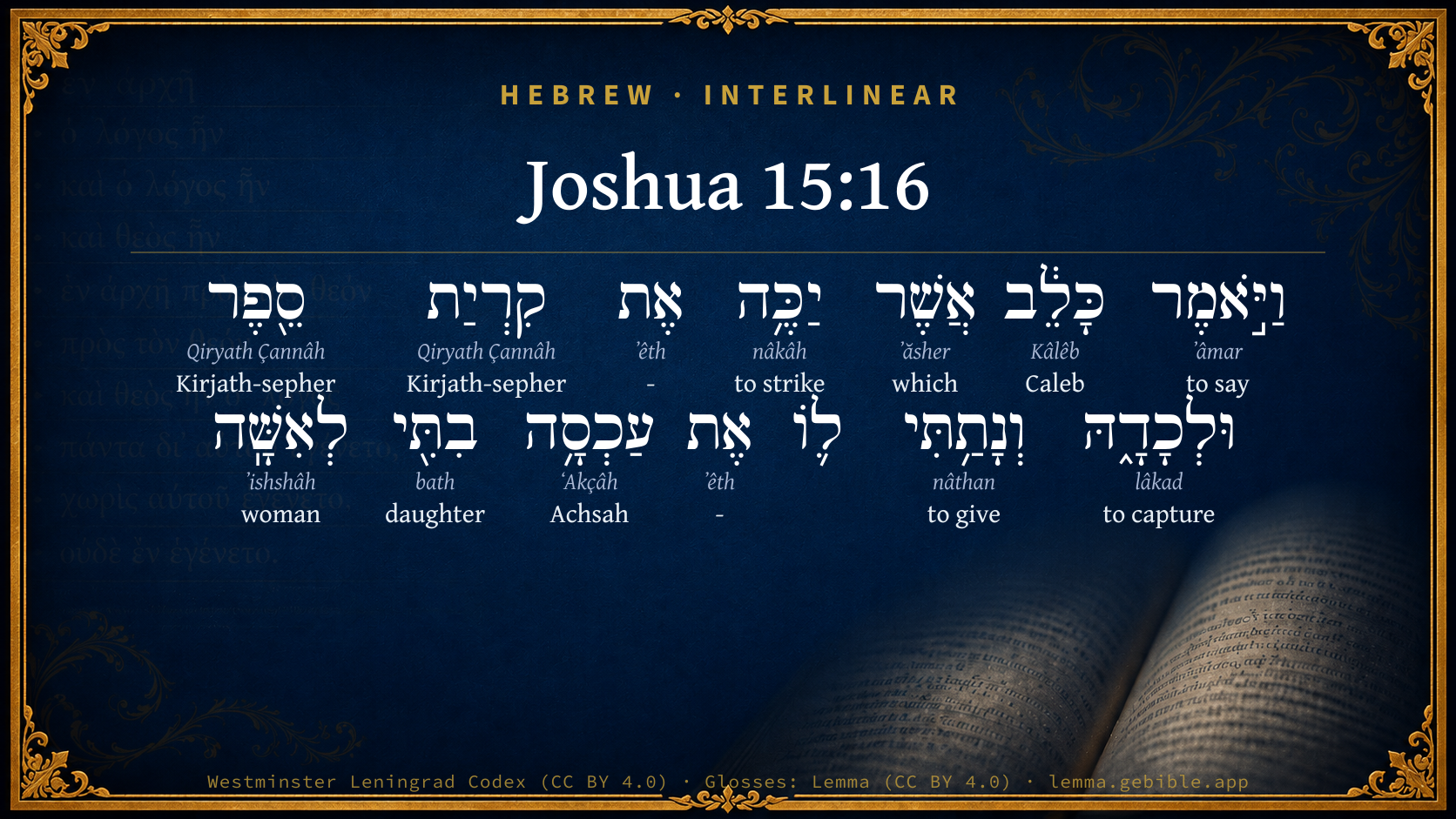
Hebrew (Westminster Leningrad Codex) Joshua 15:16 appears in the Hebrew Old Testament. The text above is from the Westminster Leningrad Codex. Each word links to its Strong’s number, a concise gloss, and parsing drawn from the Open Scriptures Hebrew Bible morphology. Click any word for its full Brown-Driver-Briggs (BDB) entry.
Download image
Cite this verse

Joshua 15:16 (World English Bible). Public Domain. Lemma interlinear Bible study tool, https://lemma.gebible.app/v/joshua/15/16.

Show BibTeX & RIS
BibTeX
RIS
English Translation
Caleb said, He who strikes Kiriath Sepher, and takes it, to him will I give Achsah my daughter as wife.
World English Bible · Public Domain
Highlights
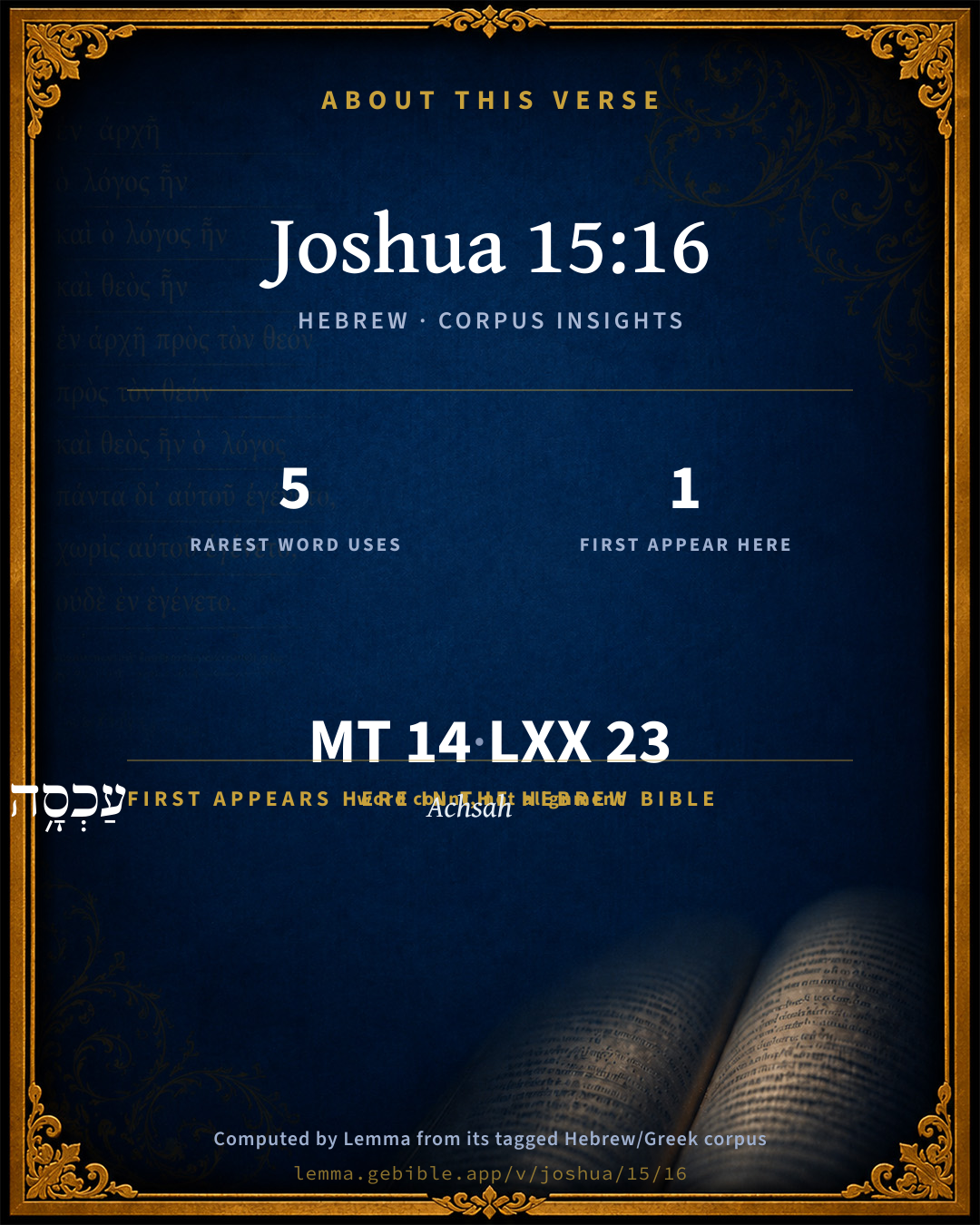
  • 1 first appearance in the Hebrew Bible
Full analysis ↓
Download a study sheet

One document with this verse’s original text, its word-by-word gloss line, the meaning frame, cross-references with their text, attributed commentary, and full source and license credits — printable, and it pastes into notes with its structure intact.

This verse Autodidact and up

Study sheet (.html) Plain text (.txt)

A passage Seminary Student

Up to 50 verses in one chapter. A passage sheet keeps up to 6 commentary sources and 12 cross-references per verse, in the order this page ranks them, and says so on the sheet whenever that leaves anything out. Ask for a single verse and you get the Autodidact verse sheet above.

Everything on this page stays free to read, with no account — the sheet is a download of what is already on screen, not access to it.

Want to remove ads? Support Godless Engineer
Compare translations 3

The same verse in 3 English versions, stacked beneath the original-language interlinear above. Click any original word for its lexicon entry.

Each is an independent rendering of the whole verse — the interlinear is not word-aligned to these translations.

Highlighted words mark where these versions differ — a whole-verse word diff, not a word-by-word alignment.

  • World English Bible Public Domain
    Caleb said, He who strikes Kiriath Sepher, and takes it, to him will I give Achsah my daughter as wife.
  • King James Version Public Domain
    And Caleb said, He that smiteth Kirjathsepher, and taketh it, to him will I give Achsah my daughter to wife.
  • unfoldingWord Literal Text CC BY-SA 4.0
    And Caleb said, “Whoever strikes Kiriath Sepher and captures it, I will give my daughter Aksah to him for a wife.”

unfoldingWord Literal Text — © unfoldingWord, licensed CC BY-SA 4.0. Word-aligned USFM3 via Door43 (git.door43.org/unfoldingWord/en_ult).

Versions to compare (up to 4)

3 of 4 selected

Show all 18 translations

Every available English version of this verse, each an independent rendering of the whole verse.

  • World English Bible Public Domain
    Caleb said, He who strikes Kiriath Sepher, and takes it, to him will I give Achsah my daughter as wife.
  • Berean Standard Bible Public Domain
    And Caleb said, “To the man who strikes down Kiriath-sepher and captures it, I will give my daughter Acsah in marriage.”
  • Majority Standard Bible Public Domain
    And Caleb said, “To the man who strikes down Kiriath-sepher and captures it, I will give my daughter Acsah in marriage.”
  • King James Version Public Domain
    And Caleb said, He that smiteth Kirjathsepher, and taketh it, to him will I give Achsah my daughter to wife.
  • American Standard Version (1901) Public Domain
    And Caleb said, He that smiteth Kiriath-sepher, and taketh it, to him will I give Achsah my daughter to wife.
  • Revised Version (1885) Public Domain
    And Caleb said, He that smiteth Kiriath-sepher, and taketh it, to him will I give Achsah my daughter to wife.
  • Geneva Bible (1599) Public Domain
    Then Caleb sayd, He that smiteth Kiriath-sepher, and taketh it, euen to him wil I giue Achsah my daughter to wife.
  • Douay-Rheims (1899) Public Domain
    And Caleb said: He that shall smite Cariath-Sepher, and take it, I will give him Axa my daughter to wife.
  • Young's Literal Translation Public Domain
    And Caleb saith, `He who smiteth Kirjath-Sephar, and hath captured it -- I have given to him Achsah my daughter for a wife.'
  • Literal Standard Version CC BY-SA 4.0
    And Caleb says, “He who strikes Kirjath-Sephar, and has captured it—I have given my daughter Achsah to him for a wife.”
  • Unlocked Literal Bible CC BY-SA 4.0
    Caleb said, “The man who attacks Kiriath Sepher and captures it, to him I will give Aksah my daughter as a wife.”
  • unfoldingWord Literal Text CC BY-SA 4.0
    And Caleb said, “Whoever strikes Kiriath Sepher and captures it, I will give my daughter Aksah to him for a wife.”
  • Darby Bible Public Domain
    And Caleb said, He that smites Kirjath-sepher and takes it, to him will I give Achsah my daughter as wife.
  • World Messianic Bible Public Domain
    Caleb said, “He who strikes Kiriath Sepher, and takes it, to him I will give Achsah my daughter as wife.”
  • Webster's Bible Public Domain
    And Caleb said, He that smiteth Kirjath-sepher, and taketh it, to him will I give Achsah my daughter for a wife.
  • Free Bible Version CC BY-SA 4.0
    Caleb announced, “Whoever attacks Kiriath-sepher and captures it, I will give him my daughter Acsah to marry.”
  • Bible in Basic English Public Domain
    And Caleb said, I will give Achsah, my daughter, as wife to the man who overcomes Kiriath-sepher and takes it.
  • JPS Tanakh (1917) Public Domain
    And Caleb said: 'He that smiteth Kiriath-sepher, and taketh it, to him will I give Achsah my daughter to wife.'

Literal Standard Version (2020), Covenant Press — licensed CC BY-SA 4.0. Text via the HelloAO Bible API (eBible.org). Unlocked Literal Bible (unfoldingWord) — licensed CC BY-SA 4.0. Text via the HelloAO Bible API (eBible.org). unfoldingWord Literal Text — © unfoldingWord, licensed CC BY-SA 4.0. Word-aligned USFM3 via Door43 (git.door43.org/unfoldingWord/en_ult). Free Bible Version, Dr. Jonathan Gallagher — licensed CC BY-SA 4.0. Text via the HelloAO Bible API (eBible.org).

Word by word

More ways to search: Search by grammar → Find every occurrence → Compare this word →

Practice this passage: Drill this verse → Learn its vocabulary →

עַכְסָ֥ה
ʻAkçâh
H5915
“Achsah”
Noun, Proper
Part of Speech
Noun
Type
Proper
Full BDB Definition

Origin: from H5914

TWOT: None

Achsah = "ankle chain" or " anklet" - the daughter of Caleb and wife of Caleb's brother Othniel to whom she was given as a reward for capturing Debir
  1. וַיֹּ֣אמֶר ʼâmar H559 “and · to say” Conjunction + Verb, Qal, Sequential Imperfect, 3rd Person, Masculine, Singular
  2. כָּלֵ֔ב Kâlêb H3612 “Caleb” Noun, Proper
  3. אֲשֶׁר ʼăsher H834 “which” Particle, Relative
  4. יַכֶּ֥ה nâkâh H5221 “to strike” Verb, Hiphil, Imperfect, 3rd Person, Masculine, Singular
  5. אֶת ʼêth H853 “-” Particle, Direct Object
  6. קִרְיַת Qiryath Çannâh H7158 “Kirjath-sepher” Noun, Proper
  7. סֵ֖פֶר Qiryath Çannâh H7158 “Kirjath-sepher” Noun, Proper
  8. וּלְכָדָ֑הּ lâkad H3920 “and · to capture · her” Conjunction + Verb, Qal, Sequential Perfect, 3rd Person, Masculine, Singular + Suffix, Personal, 3rd Person, Feminine, Singular
  9. וְנָתַ֥תִּי nâthan H5414 “and · to give” Conjunction + Verb, Qal, Sequential Perfect, 1st Person, Common, Singular
  10. אֶת ʼêth H853 “-” Particle, Direct Object
  11. בִתִּ֖י bath H1323 “daughter · my” Noun, Common, Feminine, Singular, Construct + Suffix, Personal, 1st Person, Common, Singular
  12. לְאִשָּֽׁה ʼishshâh H802 “to/for · woman” Preposition + Noun, Common, Feminine, Singular, Absolute

About this verse

These counts appear in no published source. They are computed here, from the morphology-tagged text and Lemma’s own curated glosses. What Lemma adds →

14
words
11
distinct lemmas
Historical
section

Notable vocabulary

The rarest word here is עַכְסָ֥ה Achsah H5915 — appearing just 5 times in the whole Hebrew Bible.

First appearance in Scripture

This word makes its first canonical appearance in the Hebrew Bible here:

  • עַכְסָ֥ה Achsah H5915

Shared distinctive vocabulary

עַכְסָ֥ה Achsah H5915 occurs in 5 verses of the Hebrew Bible. Also found in:

Grammatical profile

  • 4 verbs
  • 6 nouns
  • 1 preposition
  • 3 particles

Verb forms

  • וַיֹּ֣אמֶר Qal · Sequential Imperfect
  • יַכֶּ֥ה Hiphil · Imperfect
  • וּלְכָדָ֑הּ Qal · Sequential Perfect
  • וְנָתַ֥תִּי Qal · Sequential Perfect

Repetition

A word recurs within this verse — often emphatic in Hebrew:

  • קִרְיַת Kirjath-sepher H7158 ×2

Hebrew & Septuagint length

In English translation the verse runs 20 words from the Hebrew and 25 from the Septuagint (LXX English) — closely comparable.

A rough comparison of the two English renderings, which tokenize alike — not a word-level alignment.

Word counts can differ between the Hebrew and the Greek without any difference in meaning — e.g. the Hebrew direct-object marker אֵת has no separate Greek word, and Greek often adds the article ὁ.

In the original languages it is 14 Hebrew tokens and 23 Greek tokens — but the two are counted differently (Hebrew bundles its prefixes and suffixes into one token; the Greek is in lemma form), so that isn’t a like-for-like length.

Cross-references

2

Topical passages linked to Joshua 15:16 in the Treasury of Scripture Knowledge — connected by theme and wording, ordered by reader-vote popularity; previews shown in the World English Bible.

  • Judges 1:12–13 Caleb said, He who strikes Kiriath Sepher, and takes it, to him will I give Achsah my daughter as wife.
  • Judges 1:6 But Adoni-bezek fled; and they pursued after him, and caught him, and cut off his thumbs and his great toes.

Cross-references courtesy of OpenBible.info (CC BY 4.0).

Hebrew and Greek witnesses Masoretic Hebrew ↔ Greek Septuagint

The same verse in the two great witnesses to the Old Testament, shown verse-for-verse.

These are two independent witnesses, not word-aligned to each other, and the Septuagint is shown in lemma (dictionary) form.

Hebrew Joshua 15:16 Masoretic · Westminster Leningrad Codex

וַיֹּ֣אמֶר כָּלֵ֔ב אֲשֶׁר יַכֶּ֥ה אֶת קִרְיַת סֵ֖פֶר וּלְכָדָ֑הּ וְנָתַ֥תִּי ל֛וֹ אֶת עַכְסָ֥ה בִתִּ֖י לְאִשָּֽׁה

Caleb said, He who strikes Kiriath Sepher, and takes it, to him will I give Achsah my daughter as wife.

World English Bible · Public Domain

Greek LXX Joshua 15:16 Septuagint · lemma form

καί εἶπον χαλεβ ὅς ἐάν λαμβάνω καί ἐκκόπτω ὁ πόλις ὁ γράμμα καί κυριεύω αὐτός δίδωμι αὐτός ὁ αχσαν θυγάτηρ ἐγώ εἰς γυνή

And Chaleb said, Whosoever shall take and destroy the city of Letters, and master it, to him will I give my daughter Ascha to wife.

LXX2012 (modern English Septuagint) · Public Domain

Hebrew: Westminster Leningrad Codex (CC BY 4.0). Greek: Septuagint (public domain); English from LXX2012 (modern English Septuagint) (Public Domain). How the Septuagint differs from the Hebrew →

Targum (Aramaic paraphrase)

1

The Targum is the ancient Jewish Aramaic paraphrase of the Hebrew Scriptures — an interpretive translation, not the Hebrew text itself. Onkelos (literal) and Pseudo-Jonathan (expansive) render the Torah, and Jonathan the Prophets. Coverage is partial: where no permissively-licensed English translation exists for a verse, only the Aramaic is shown. This is verse-level text, not a word-by-word alignment to the Hebrew.

  1. Targum Jonathan Prophets (Joshua–Malachi)
    וַאֲמַר כָּלֵב דִמְחֵי יַת קִרְיַת אַרְכֵי וְיִכְבְּשִׁינָהּ וְאֶתֵּן לֵיהּ יַת עַכְסָה בְּרַתִּי לְאִתּוּ:

    (no public-domain English translation for this verse)

    Targum Jonathan — Aramaic: “Mikraot Gedolot” (public domain). English: “Sefaria Community Translation” (CC0 1.0 (public-domain dedication)); “London "Chaldee Paraphrase," 1871” (public domain). Text via Sefaria.

Commentary

Notes on Joshua 15:16 from classic Christian and Jewish commentators (each source and its license shown beneath its notes). The classic Christian expositions comment on the surrounding passage and are grouped to its opening verse, so a note may address several verses; the Jewish commentaries on the Tanakh (Rashi and others) are per-verse, so they appear only where the commentator wrote on this verse.

Lemma curates 59 commentaries, every one of them public domain or Creative Commons licensed, each selected and text-cleaned for this edition rather than reprinted as found. About our sources →

Jamieson, Fausset & Brown

Robert Jamieson, A. R. Fausset & David Brown

OTHNIEL, FOR HIS VALOR, HAS ACHSAH TO WIFE. (Jos 15:16-20)

He that smiteth Kirjath-sepher--This offer was made as an incentive to youthful bravery (see on Sa1 17:25); and the prize was won by Othniel, Caleb's younger brother (Jdg 1:13; Jdg 3:9). This was the occasion of drawing out the latent energies of him who was destined to be the first judge in Israel.

Jamieson, Fausset & Brown — Commentary Critical and Explanatory on the Whole Bible (1871) — public domain (CC PDM 1.0). Text via the HelloAO Bible API.

Trapp's Complete Commentary

John Trapp

Jos 15:16 And Caleb said, He that smiteth Kirjathsepher, and taketh it, to him will I give Achsah my daughter to wife.

Ver. 16. To him will I give Achsah my daughter.] Yet with her consent, who as she was not to be forced, {Gen 24:51; Gen 24:57} so she might not refuse without reason, and say -

“ Non amo te Sabidi, nec possum dicere quare. ” - Martial.

John Trapp, A Commentary or Exposition upon All the Books of the Old and New Testament (1647–1656) — public domain. Text from a community e-Sword module.

Joseph Benson's Commentary

Jos 15:16. Caleb said — Made proclamation throughout the army which he led against Debir. Achsah my daughter to wife — Which is to be understood with some conditions, as, if he were one who could marry her according to God’s law; and if she were willing; for though parents had a great power over their children, they could not force them to marry any person against their own wills. He might otherwise be an unfit and unworthy person; but this was a divine impulse, that Othniel’s valour might be more manifest, and so the way prepared for his future government of the people, Jdg 3:9.

Joseph Benson's Commentary on the Old and New Testaments (1811–1818) — public domain. Text from a community e-Sword module.

Tyndale Open Study Notes

Tyndale Open Resources

15:16 Cp. 1 Sam 17:25; 18:27.

Tyndale Open Study Notes — © Tyndale Open Resources, licensed CC BY-SA 4.0. Text via the HelloAO Bible API.

Adam Clarke's Commentary

Verse 16. Will I give Achsah my daughter] In ancient times fathers assumed an absolute right over their children, especially in disposing of them in marriage; and it was customary for a king or great man to promise his daughter in marriage to him who should take a city, kill an enemy, c. So Saul promised his daughter in marriage to him who should kill Goliath, 1Sa 17:25 and Caleb offers his on this occasion to him who should take Kirjath-sepher. Profane writers furnish many similar examples.

Adam Clarke's Commentary on the Bible (1810–1826) — public domain. Text from a community e-Sword/MySword module.

The Cambridge Bible for Schools and Colleges

gen. ed. J. J. S. Perowne

16. to him will I give Achsah my daughter] So Saul promised to the victor over Goliath to “give him his daughter” (1Sa_17:25), and undertook if David was valiant for him to give him to wife his elder daughter Merab (1Sa_18:17).

The Cambridge Bible for Schools and Colleges (gen. ed. J. J. S. Perowne; Cambridge University Press, 1878–1918) — public domain. Text from a community e-Sword module.

John Gill's Exposition

And Caleb said, he that smiteth Kirjathsepher, and taketh it,.... Which he ordered to be proclaimed through the army that was under his command; and which was done not so much on the account of the difficulty of taking the place, through the number of the inhabitants of it, and its fortifications, which it seems had fallen again into the hands of the Canaanites, since it was taken by Joshua; nor through inactivity, diffidence, and timorousness in himself; but that others, who were officers, and men of valour under him, might gather some laurels as well as himself; and chiefly being under a divine impulse, he ordered this declaration to be made, whereby his brother Othniel, who was to be a judge in Israel, might appear a great man, and fit for such an office; and as an encouragement, he promises as follows:

to him will I give Achsah my daughter to wife; and to be married into the family of the chief prince of the tribe of Judah was a very great honour, as well as no doubt a very large dowry might be expected, and was given with her, and very probably the city of Debir was promised that should be taken. This Achsah seems to be a daughter of Caleb by a concubine, Ch1 2:48.

John Gill's Exposition of the Whole Bible (1746–1763) — public domain (CC PDM 1.0). Text via the HelloAO Bible API.

Haydock's Catholic Bible Commentary

Wife. Parents had full authority to do this. Saul promised his daughter to the person who should overcome Goliah[Goliath]. Something was required by way of dowry for the lady. (Grotius) (1 Kings xvii. 25.)

George Leo Haydock (1774–1849), Haydock's Catholic Family Bible and Commentary, 1859 edition — public domain. Excludes Psalms (Douay-Rheims chapter numbering differs from Protestant) and Deuterocanonical books (Catholic canon only).

Matthew Poole's English Annotations

Which is to be understood with some conditions, as, if he were one who could marry her by God’s law; for every promise contrary to that is void; and if she were willing; for though parents had a great power over their children, they could not force them to marry any person against their own wills. He might otherwise be an unfit and unworthy person: but this was no ordinary motion propounded to the imitation of others, but a Divine impulse, that Othniel’s valour might be more manifest, and so the way prepared for his future government of the people, Jdg 3:9.

Matthew Poole's English Annotations on the Holy Bible (1683–1685) — public domain. Text from a community e-Sword/MySword module.

Whedon's Commentary on the Bible

Daniel D. Whedon

16. Caleb said — The veteran leader finding Debir, perhaps after his previous conquests, a more difficult fortress, arouses his warriors with the promise of a prize.

Smiteth Kirjath-sepher — The old name of the city, as quoting the warrior’s own words.

My daughter to wife — Said in the spirit of the Oriental as well as the Roman rule, by which the parent was absolute lord of his children, and of the Oriental custom of marrying parties without regard to previous affection or even acquaintance. Saul thus promised his daughter to the slayer of Goliath. 1Sa_17:25.

Daniel D. Whedon (gen. ed.), Commentary on the Old and New Testaments (1874–1909) — public domain. Text from a community e-Sword module.

The Pulpit Commentary

And Caleb said. (cf. 1Sa_17:25 1Ch_11:6)

HOMILIES BY J. WAITE Vers. 16-19. Fulness of blessing.

Achsah had something of her father"s spirit in her ambitious, vigorous, resolute, quick to seize the present opportunity. Having so lately won his own suit Caleb could scarcely deny her heir"s. Through the simple, Oriental form of this narrative we see the working of deep and universal principles of human life. Let us regard it as suggestive of that restless craving of our nature which can find satisfaction only in the realisation of the higher good.

I NATURE"S CRAVING. Achsah covets a prize that is as yet beyond her reach. "Give me a blessing. Thou hast given me a south (dry, barren) land; give me also springs of water." How expressive is this of that yearning of the heart by virtue of which it cannot rest content with present possessions, but is ever reaching forth towards something more, a richer inheritance, a completer blessing, the perfect filling up of its capacity, the sense of absolute blessedness.

1. There is an appetite in the soul of man which is not only insatiable but often becomes more intense the more it is fed with finite gratifications. What is the meaning of life"s restless toil and endeavour, and the perpetual craving for some new form of excitement in the giddy round and dance of pleasure? It simply shows what power there is in earthly good to awaken hopes and longings that it cannot gratify, to quicken an appetite that it cannot appease. It is not enlargement of possession, the conquering of fair kingdoms either of knowledge, or wealth, or social distinction, or means of enjoyment, that can bring contentment to the soul. This will only feed its discontent unless other conditions are supplied. Man has that within him which spurns all his attempts to satisfy it thus. It is the mark of his essential greatness that he is conscious of a hunger which no earth-grown food can satisfy, a thirst which earthly streams cannot slake, "an aching void the world can never fill." Study the facts of your own consciousness. The day dreams of your imagination and your heart have never been realised. Many a pleasant prospect has proved like the mirage of the desert. Many a fondly cherished purpose has been like a river that loses itself in the sand. Many a stay in which you trusted has been but as a reed that breaks and wounds the hand that leans upon it. The world has not satisfied you. Your fellow creatures have not satisfied you. You have least of all been satisfied from yourself. Amid the happiest arrangement of circumstances you dream of one that is better. Rich as your earthly inheritance may be, there are times when it seems dry and barren to you, and, like Achsah, you crave for something more,

2. When this appetite lifts itself up consciously to the higher level, fixes itself upon the spiritual good, it,is the evidence of a new Divine life in the soul. We come here to an altogether peculiar and distinctive element of feeling. The mere experience of the unsatisfactoriness of all other kinds of good does not of itself prepare men to seek after the joys of faith. God said to His sense bound people in the prophetic age, "Thou art wearied in the greatness of thy way, yet saidst thou not. There is no hope". (Isa_57:10) Their vain carnal life disappointed them, but they did not repent of it. They were wearied in it, disgusted with it, and still they clung to it. They hoped on notwithstanding the blighting and withering of all their hopes. How true to human nature and human experience in every age! The carnal appetite will never resolve itself into the spiritual. They are essentially different things, and point to essentially different causes. The long series of life"s disappointments may be gathered up at last into one sad, deep sigh of conscious emptiness and weariness is vanity," etc. But does it necessarily assume the form and tone of an upward yearning for "the things that are above"? Nay, there is no saving virtue in the mere groans of a discontented heart. One dare not place much confidence even in deathbed confessions of the vanity of the world. The attraction earthwards may have ceased, but perhaps there is no attraction heavenwards to take its place. The lights of earth may be growing dim, but there is no soul-captivating view of brightening lights that shine along the eternal shore; natural desire fails, but there is no longing for the pure satisfactions of a higher and a better sphere. So that it is a momentous revolution in the spiritual history of a man, happen when it will, when he first begins distinctly to reach forth towards the heavenly and Divine. He becomes a "new creature" when there is thus awakened within him the aspiration of a pure and holy life that he has never known before. The appetite of his being has taken a new direction, assumed an altogether new character. He hungers for the "bread of life," and thirsts for the "river of the water of life after righteousness," and "thirsts for the living God.

II ITS TRUE SATISFACTION. Achsah"s request is immediately granted. She receives from her father a completed "blessing the richer land added to the poorer to supplement its deficiency.

1. God is ever ready to respond to every pure aspiration of our nature. He who "opens His hand and satisfies the wants of every living thing" will never disregard the cry of His suppliant children. Every true spiritual desire of which we are conscious contains in itself the pledge of its own fulfilment.

2. Christ is God"s answer to the soul"s deepest craving. In Him is the fulness of all satisfying good. "Whosoever drinketh of the water that I shall give him shall never thirst; but the water that I shall give him shall be in him a well of water springing up into everlasting life". (Joh_4:14) In Him we find the rest of absolute contentment.

3. The joy of the higher, life that Christ gives deepens and purifies every natural joy. As the "upper springs" feed the "nether," so when He has conferred on us the Diviner good we discern a richer meaning and worth in the inferior good. "Our heart is at the secret source Of every precious thing.

All that is naturally fair and pleasant upon earth becomes invested with a new charm, and in that which before seemed barren and profitless there are opened to us unexpected fountains of delight. "We thirst for springs of heavenly life, And here all day they rise. W.

HOMILIES BY W.F. ADENEY Vers. 16-19. The story of Achsah.

I LOVE IS THE STRONGEST MOTIVE OF CONDUCT. AS Othniel was nephew to Caleb, and therefore must have known Achsah, it is probable that he accepted the challenge to seize Kirjath-sepher from motives of real affection for the daughter of Caleb. God has providentially arranged that human love should serve as a help for the performance of difficult tasks. Christianity appropriates and consecrates the emotion of love by directing it to Christ. Love is worthless when it will not encounter danger and attempt hard tasks. The highest human affection is shown not in mere pleasing emotions, but in sacrifice and toil

II HUSBANDS AND WIVES SHOULD EXERCISE MUTUAL CONFIDENCE. Achsah first consults her husband and then proffers her request to her father. Though husbands and wives have separate spheres of duty, each should be interested in that of the other. There should be no secrets between them. They should learn to act as one in important questions. True sympathy will be shown in questions of conduct and choice, not merely in circumstances of trouble.

III THE DESIRE OF EARTHLY CONVENIENCES IS NOT IN ITSELF WRONG. Achsah cannot be accused of covetousness. Her request was reasonable. If we do not put earth in the place of heaven, nor grasp for ourselves what is due to others, nor forget duty and generosity in greed and self seeking, the attempt to improve our condition in the world is natural and right.

IV CHILDREN SHOULD COMBINE CONFIDENCE WITH SUBMISSION IN THEIR CONDUCT TO THEIR PARENTS. Achsah is an example of this combination. She shows confidence in making her request. She shows submission in alighting off her ass and asking the favour from her father as a "blessing." Reverence and humility are always becoming, but slavish fear is a proof either of the tyrannous character of the parent, or of the mean nature of the child. Confidence joined to submission constitutes the right attitude of Christians in approaching their heavenly Father. (Rom_8:15)

V NO EARTHLY BLESSING IS PERFECT IN ITSELF. The southland is of little use without the springs of water. In every condition of life we feel the need of something more to give us satisfaction. Wealth generates the hunger for greater wealth. As the field is barren without the Waters of heaven, so any earthly inheritance is profitless to us unless there are added the showers of spiritual blessings. W.F.A. (1Ti_4:8)

The Pulpit Commentary (1880–1919), ed. H.D.M. Spence-Jones & Joseph S. Exell — public domain. Text from a community e-Sword module.

John Wesley's Explanatory Notes

To wife - Which is to be understood with some conditions, as, if he were one who could marry her by God's law; and if she were willing; for though parents had a great power over their children, they could not force them to marry any person against their own wills. He might otherwise be an unfit and unworthy person; but this was a divine impulse, that Othniel's valour might be more manifest, and so the way prepared for his future government of the people, Judg. iii, 9.

John Wesley, Explanatory Notes Upon the Whole Bible (1754–1765) — public domain. Text via the GEBible commentary corpus.

unfoldingWord translationNotes

Door43 World Missions Community

Kiriath Sepher

This is the name of a place. (See: How to Translate Names)

Aksah

This is a woman's name. (See: How to Translate Names)

Othniel ... Kenaz

These are men's names. (See: How to Translate Names)

translationWords

Caleb

unfoldingWord translationNotes — © Distant Shores Media and the Door43 World Missions Community, licensed CC BY-SA 4.0. Source: git.door43.org/Door43/en_tn.

Lesson kit

Teaching starters — assembled from the data on this page, not authored interpretation. Every prompt links to the verse data it draws on. Edit before teaching.

Joshua, in the Historical, opens this verse with 14 words (11 distinct Hebrew lemmas). Its most distinctive word is ʻAkçâh (“Achsah”). A historical commentator’s framing appears above. Read the whole chapter for the surrounding context.

Discussion questions

  1. What does “Achsah” (ʻAkçâh) contribute to the verse as a whole?
  2. This is the first place “Achsah” appears in Scripture (first appears here). What does its debut here establish?
  3. How does Joshua 15:17, which shares the word «Achsah», read alongside this verse?
  4. What does the repetition of “Kirjath-sepher” (2× in this one verse) do in this verse?
  5. The translations on this page render this verse differently — a whole-verse word diff, not a word-by-word alignment. What might account for the different wordings?
  6. «וַיֹּ֣אמֶר» is a Qal Sequential Imperfect verb. How does that grammatical form shape the action described?
  7. Compare how Jamieson, Fausset & Brown and Trapp's Complete Commentary read this verse. Where do they agree or differ?

Things to notice

Reading settings

Reading text

Shown beneath each verse's original-language words.

Old Testament
Old Testament edition

Read the OT as the Masoretic Hebrew (MT) or the Greek Septuagint (LXX).

English shown for the Greek Septuagint (in the Hebrew ↔ Greek comparison).

Comparing translations? Open the Compare panel on any verse page to stack up to four side by side.