
1 Chronicles 7:15

Hebrew (Westminster Leningrad Codex) 1 Chronicles 7:15 appears in the Hebrew Old Testament. The text above is from the Westminster Leningrad Codex. Each word links to its Strong’s number, a concise gloss, and parsing drawn from the Open Scriptures Hebrew Bible morphology. Click any word for its full Brown-Driver-Briggs (BDB) entry.
Download image
Cite this verse

1 Chronicles 7:15 (World English Bible). Public Domain. Lemma interlinear Bible study tool, https://lemma.gebible.app/v/1-chronicles/7/15.

Show BibTeX & RIS
BibTeX
RIS
English Translation
and Machir took a wife of Huppim and Shuppim, whose sister's name was Maacah; and the name of the second was Zelophehad: and Zelophehad had daughters.
World English Bible · Public Domain
Download a study sheet

One document with this verse’s original text, its word-by-word gloss line, the meaning frame, cross-references with their text, attributed commentary, and full source and license credits — printable, and it pastes into notes with its structure intact.

This verse Autodidact and up

Study sheet (.html) Plain text (.txt)

A passage Seminary Student

Up to 50 verses in one chapter. A passage sheet keeps up to 6 commentary sources and 12 cross-references per verse, in the order this page ranks them, and says so on the sheet whenever that leaves anything out. Ask for a single verse and you get the Autodidact verse sheet above.

Everything on this page stays free to read, with no account — the sheet is a download of what is already on screen, not access to it.

Want to remove ads? Support Godless Engineer
Compare translations 3

The same verse in 3 English versions, stacked beneath the original-language interlinear above. Click any original word for its lexicon entry.

Each is an independent rendering of the whole verse — the interlinear is not word-aligned to these translations.

Highlighted words mark where these versions differ — a whole-verse word diff, not a word-by-word alignment.

  • World English Bible Public Domain
    and Machir took a wife of Huppim and Shuppim, whose sister's name was Maacah; and the name of the second was Zelophehad: and Zelophehad had daughters.
  • King James Version Public Domain
    And Machir took to wife the sister of Huppim and Shuppim, whose sister's name was Maachah;) and the name of the second was Zelophehad: and Zelophehad had daughters.
  • unfoldingWord Literal Text CC BY-SA 4.0
    And Makir took a wife of Huppim and of Shuppim. And the name of his sister Maakah. And the name of the second, Zelophehad. And daughters were to Zelophehad.

unfoldingWord Literal Text — © unfoldingWord, licensed CC BY-SA 4.0. Word-aligned USFM3 via Door43 (git.door43.org/unfoldingWord/en_ult).

Versions to compare (up to 4)

3 of 4 selected

Show all 18 translations

Every available English version of this verse, each an independent rendering of the whole verse.

  • World English Bible Public Domain
    and Machir took a wife of Huppim and Shuppim, whose sister's name was Maacah; and the name of the second was Zelophehad: and Zelophehad had daughters.
  • Berean Standard Bible Public Domain
    Machir took a wife from among the Huppites and Shuppites. The name of his sister was Maacah. Another descendant was named Zelophehad, who had only daughters.
  • Majority Standard Bible Public Domain
    Machir took a wife from among the Huppites and Shuppites. The name of his sister was Maacah. Another descendant was named Zelophehad, who had only daughters.
  • King James Version Public Domain
    And Machir took to wife the sister of Huppim and Shuppim, whose sister's name was Maachah;) and the name of the second was Zelophehad: and Zelophehad had daughters.
  • American Standard Version (1901) Public Domain
    and Machir took a wife of Huppim and Shuppim, whose sister's name was Maacah; and the name of the second was Zelophehad: and Zelophehad had daughters.
  • Revised Version (1885) Public Domain
    and Machir took a wife of Huppim and Shuppim, whose sister’s name was Maacah;) and the name of the second was Zelophehad: and Zelophehad had daughters.
  • Geneva Bible (1599) Public Domain
    And Machir tooke to wife the sister of Huppim and Shuppim, and the name of their sister was Maachah. And the name of the second sonne was Zelophehad, and Zelophehad had daughters.
  • Douay-Rheims (1899) Public Domain
    And Machir took wives for his sons Happhim, and Saphan: and he had a sister named Maacha: the name of the second was Salphaad, and Salphaad had daughters.
  • Young's Literal Translation Public Domain
    And Machir took wives for Huppim and for Shuppim, and the name of the one `is' Maachah, and the name of the second Zelophehad, and Zelophehad hath daughters.
  • Literal Standard Version CC BY-SA 4.0
    And Machir took wives for Huppim and for Shuppim, and the name of the first [is] Maachah, and the name of the second Zelophehad, and Zelophehad has daughters.
  • Unlocked Literal Bible CC BY-SA 4.0
    Makir took a wife from the Huppites and Shuppites. A sister's name was Maakah. Another of Manasseh's descendants was Zelophehad, who had only daughters.
  • unfoldingWord Literal Text CC BY-SA 4.0
    And Makir took a wife of Huppim and of Shuppim. And the name of his sister Maakah. And the name of the second, Zelophehad. And daughters were to Zelophehad.
  • Darby Bible Public Domain
    And Machir took a wife [the sister] of Huppim and Shuppim, and the name of their sister was Maachah. And the name of the second [son] was Zelophehad; and Zelophehad had daughters.
  • World Messianic Bible Public Domain
    Machir took a wife of Huppim and Shuppim, whose sister’s name was Maacah. The name of the second was Zelophehad; and Zelophehad had daughters.
  • Webster's Bible Public Domain
    And Machir took for a wife the sister of Huppim and Shuppim, whose sister's name was Maachah;) and the name of the second was Zelophehad: and Zelophehad had daughters.
  • Free Bible Version CC BY-SA 4.0
    Makir found a wife for Huppim and a wife for Shuppim. His sister's name was Maacah. The second was called Zelophehad. She only had daughters.
  • Bible in Basic English Public Domain
    (And Gilead took a wife, whose name was Maacah, and his sister's name was Hammoleketh;) and the name of his brother was Zelophehad, who was the father of daughters.
  • JPS Tanakh (1917) Public Domain
    and Machir took a wife of Huppim and Shuppim, whose sister's name was Maacah — and the name of the second was Zelophehad; and Zelophehad had daughters.

Literal Standard Version (2020), Covenant Press — licensed CC BY-SA 4.0. Text via the HelloAO Bible API (eBible.org). Unlocked Literal Bible (unfoldingWord) — licensed CC BY-SA 4.0. Text via the HelloAO Bible API (eBible.org). unfoldingWord Literal Text — © unfoldingWord, licensed CC BY-SA 4.0. Word-aligned USFM3 via Door43 (git.door43.org/unfoldingWord/en_ult). Free Bible Version, Dr. Jonathan Gallagher — licensed CC BY-SA 4.0. Text via the HelloAO Bible API (eBible.org).

Word by word

More ways to search: Search by grammar → Find every occurrence → Compare this word →

Practice this passage: Drill this verse → Learn its vocabulary →

לְחֻפִּ֣ים
Chuppîym
H2650
“to/for · Huppim”
Preposition + Noun, Proper
Part of Speech
Preposition + Noun
Type
Proper
Full BDB Definition

Origin: pl. of H2646 [compare H2349 ]

TWOT: None

Huppim = "protected" - the head of a Benjamite family
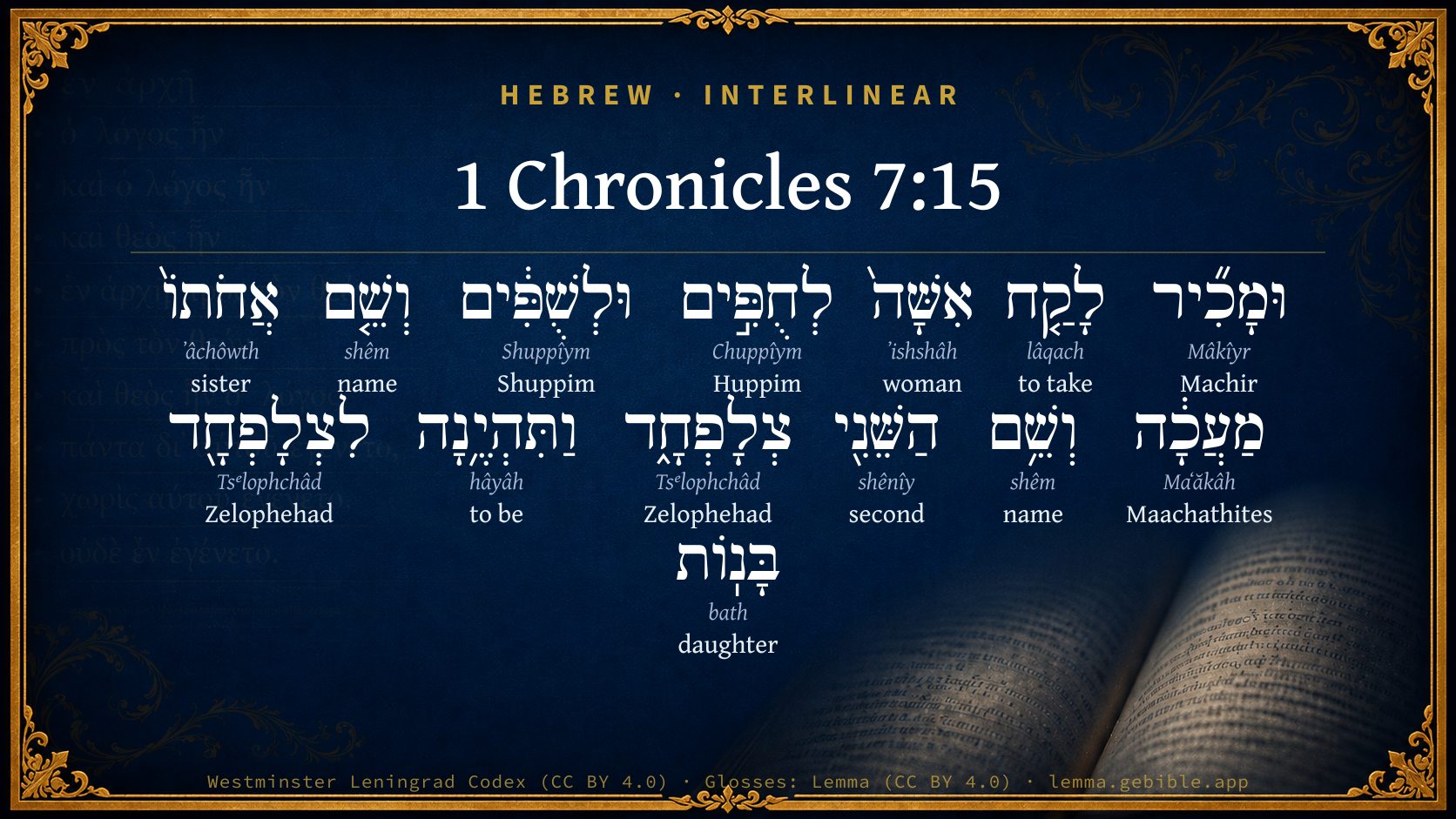
  1. וּמָכִ֞יר Mâkîyr H4353 “and · Machir” Conjunction + Noun, Proper
  2. לָקַ֤ח lâqach H3947 “to take” Verb, Qal, Perfect, 3rd Person, Masculine, Singular
  3. אִשָּׁה֙ ʼishshâh H802 “woman” Noun, Common, Feminine, Singular, Absolute
  4. וּלְשֻׁפִּ֔ים Shuppîym H8206 “and · to/for · Shuppim” Conjunction + Preposition + Noun, Proper
  5. וְשֵׁ֤ם shêm H8034 “and · name of” Conjunction + Noun, Common, Masculine, Singular, Construct
  6. אֲחֹתוֹ֙ ʼâchôwth H269 “sister · his” Noun, Common, Feminine, Singular, Construct + Suffix, Personal, 3rd Person, Masculine, Singular
  7. מַעֲכָ֔ה Maʻăkâh H4601 “Maachathites” Noun, Proper
  8. וְשֵׁ֥ם shêm H8034 “and · name of” Conjunction + Noun, Common, Masculine, Singular, Construct
  9. הַשֵּׁנִ֖י shênîy H8145 “the · second” Particle, Definite Article + Adjective, Ordinal number, Masculine, Singular, Absolute
  10. צְלָפְחָ֑ד Tsᵉlophchâd H6765 “Zelophehad” Noun, Proper
  11. וַתִּהְיֶ֥נָה hâyâh H1961 “and · to be” Conjunction + Verb, Qal, Sequential Imperfect, 3rd Person, Feminine, Plural
  12. לִצְלָפְחָ֖ד Tsᵉlophchâd H6765 “to/for · Zelophehad” Preposition + Noun, Proper
  13. בָּנֽוֹת bath H1323 “daughters” Noun, Common, Feminine, Plural, Absolute

About this verse

These counts appear in no published source. They are computed here, from the morphology-tagged text and Lemma’s own curated glosses. What Lemma adds →

14
words
12
distinct lemmas
Historical
section

Notable vocabulary

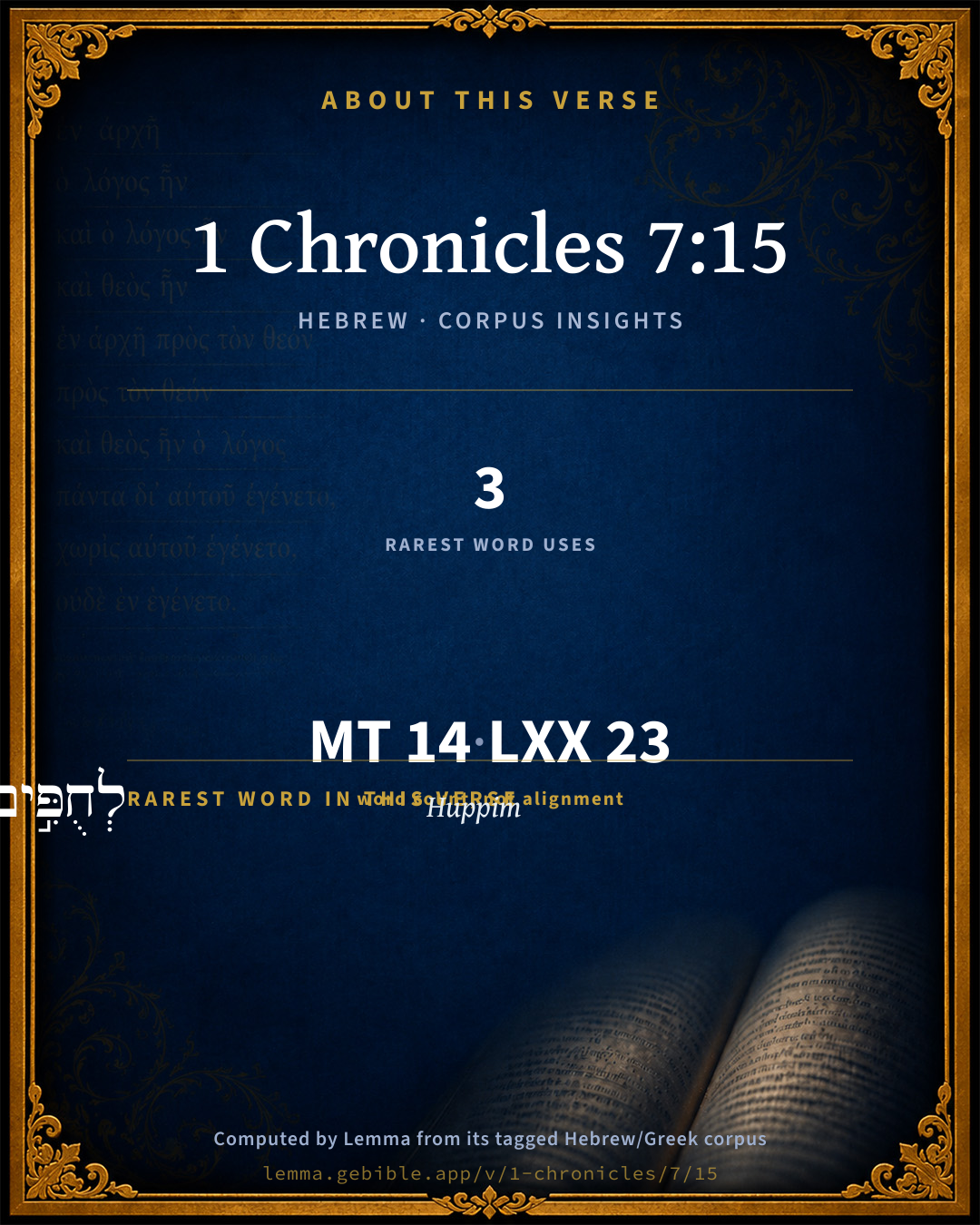
The rarest word here is לְחֻפִּ֣ים Huppim H2650 — appearing just 3 times in the whole Hebrew Bible.

Shared distinctive vocabulary

לְחֻפִּ֣ים Huppim H2650 occurs in 3 verses of the Hebrew Bible. Also found in:

Grammatical profile

  • 2 verbs
  • 11 nouns
  • 1 adjective

Verb forms

  • לָקַ֤ח Qal · Perfect
  • וַתִּהְיֶ֥נָה Qal · Sequential Imperfect

Repetition

Words recur within this verse — often emphatic in Hebrew:

  • וְשֵׁ֤ם name H8034 ×2
  • צְלָפְחָ֑ד Zelophehad H6765 ×2

Hebrew & Septuagint length

In English translation the verse runs 26 words from the Hebrew and 30 from the Septuagint (LXX English) — closely comparable.

A rough comparison of the two English renderings, which tokenize alike — not a word-level alignment.

Word counts can differ between the Hebrew and the Greek without any difference in meaning — e.g. the Hebrew direct-object marker אֵת has no separate Greek word, and Greek often adds the article ὁ.

In the original languages it is 14 Hebrew tokens and 23 Greek tokens — but the two are counted differently (Hebrew bundles its prefixes and suffixes into one token; the Greek is in lemma form), so that isn’t a like-for-like length.

Cross-references

3

Topical passages linked to 1 Chronicles 7:15 in the Treasury of Scripture Knowledge — connected by theme and wording, ordered by reader-vote popularity; previews shown in the World English Bible.

  • Numbers 26:33 Zelophehad the son of Hepher had no sons, but daughters: and the names of the daughters of Zelophehad were Mahlah, and Noah, Hoglah, Milcah, and Tirzah.
  • Numbers 36:1–12 The heads of the fathers' [houses] of the family of the children of Gilead, the son of Machir, the son of Manasseh, of the families of the sons of Joseph, came near, and spoke before Moses, and before the princes, the heads of the fathers' [houses] of the children of Israel:
  • Numbers 27:1–11 Then drew near the daughters of Zelophehad, the son of Hepher, the son of Gilead, the son of Machir, the son of Manasseh, of the families of Manasseh the son of Joseph; and these are the names of his daughters: Mahlah, Noah, and Hoglah, and Milcah, and Tirzah.

Cross-references courtesy of OpenBible.info (CC BY 4.0).

Hebrew and Greek witnesses Masoretic Hebrew ↔ Greek Septuagint

The same verse in the two great witnesses to the Old Testament, shown verse-for-verse.

These are two independent witnesses, not word-aligned to each other, and the Septuagint is shown in lemma (dictionary) form.

Hebrew 1 Chronicles 7:15 Masoretic · Westminster Leningrad Codex

וּמָכִ֞יר לָקַ֤ח אִשָּׁה֙ לְחֻפִּ֣ים וּלְשֻׁפִּ֔ים וְשֵׁ֤ם אֲחֹתוֹ֙ מַעֲכָ֔ה וְשֵׁ֥ם הַשֵּׁנִ֖י צְלָפְחָ֑ד וַתִּהְיֶ֥נָה לִצְלָפְחָ֖ד בָּנֽוֹת

and Machir took a wife of Huppim and Shuppim, whose sister's name was Maacah; and the name of the second was Zelophehad: and Zelophehad had daughters.

World English Bible · Public Domain

Greek LXX 1 Chronicles 7:15 Septuagint · lemma form

καί μαχιρ λαμβάνω γυνή ὁ αμφιν καί μαμφιν καί ὄνομα ἀδελφή αὐτός μοωχα καί ὄνομα ὁ δεύτερος σαλπααδ καί γεννάω ὁ σαλπααδ θυγάτηρ

And Machir took a wife for Apphin and Sapphin, and his sister's name was Moocha; and the name of the second son was Sapphaad; and to Sapphaad were born daughters.

LXX2012 (modern English Septuagint) · Public Domain

Hebrew: Westminster Leningrad Codex (CC BY 4.0). Greek: Septuagint (public domain); English from LXX2012 (modern English Septuagint) (Public Domain). How the Septuagint differs from the Hebrew →

Commentary

Notes on 1 Chronicles 7:15 from classic Christian and Jewish commentators (each source and its license shown beneath its notes). The classic Christian expositions comment on the surrounding passage and are grouped to its opening verse, so a note may address several verses; the Jewish commentaries on the Tanakh (Rashi and others) are per-verse, so they appear only where the commentator wrote on this verse.

Lemma curates 59 commentaries, every one of them public domain or Creative Commons licensed, each selected and text-cleaned for this edition rather than reprinted as found. About our sources →

Trapp's Complete Commentary

John Trapp

1Ch 7:15 And Machir took to wife [the sister] of Huppim and Shuppim, whose sister’s name [was] Maachah;) and the name of the second [was] Zelophehad: and Zelophehad had daughters.

Ver. 15. And Zelophehad had daughters,] i.e., Daughters only, whose case, brought before the Lord, occasioned those two judicial laws in Num 27:1-11; Num 36:2-12.

John Trapp, A Commentary or Exposition upon All the Books of the Old and New Testament (1647–1656) — public domain. Text from a community e-Sword module.

Ellicott's Commentary for English Readers

(15) And Machir took to wife.—The Hebrew cannot mean this. Translate, now Machir took a wife of Huppim and of Shuppim (the two Benjamite clans of 1Ch_7:12); and the name of the first (read ‘ahath) was Maachah, and the name of the second (read shçnîth) was. . . .” (the name is omitted). It is tempting to make Zeiophehad the other wife, who had only daughters, whereas Maachah bore a son (1Ch_7:16); but Numbers, l.c., and Josh., l.c., make Zelophehad a man. We must, therefore, suppose a lacuna of some few words, which gave the name of Machir’s second wife, and the descent of Zelophehad from her. The expression “of Huppim and of Shuppim” is literally “to Huppim and to Shuppim,” that is, belonging to. So “of Tola,” (1Ch_7:2).

We have no means of further elucidating the import of this curious tribal record. That it relates to West Manasseh is inferred from its position here, as well from the fact that 1Ch_5:23-24 treated of East Manasseh. (See also Jos_17:1-5.) The name of Gilead, however, points to the transjordanic half of the tribe. The whole passage seems to assert an Aramean and a Benjamite element in the population of Western Manasseh.

A Bible Commentary for English Readers, edited by Charles John Ellicott (1878–1897) — public domain. Text from a community e-Sword module.

The Cambridge Bible for Schools and Colleges

gen. ed. J. J. S. Perowne

15. took to wife the sister of Huppim and Shuppim] R.V. took a wife of H. and Sh., i.e. allied himself by marriage to these two families.

whose sister’s name] Render, and his (Machir’s) sister’s name. The statement regarding Maachah is ethnographical, and means that the people of Maachah (a district at the foot of Hermon) were related by blood to Machir (the Eastern Manassites).

Zelophehad had daughters] Num_27:1-11.

The Cambridge Bible for Schools and Colleges (gen. ed. J. J. S. Perowne; Cambridge University Press, 1878–1918) — public domain. Text from a community e-Sword module.

John Gill's Exposition

And his sister Hammoleketh,.... The sister of Gilead so named; though the Targum renders it "that reigned"; and so Kimchi, that reigned in some part of Gilead; and the Vulgate Latin version translates it, "a queen bare Ishod, and Abiezer, and Mahalah"; Abiezer is the same with Jeezer, from whom a family sprung of that name, Num 26:30, of which Gideon was, Jdg 6:11.

.

1 Chronicles 7:19

ch1 7:19

ch1 7:19

ch1 7:19And the sons of Shemida,.... Another son of Gilead's sister, unless the same with Ishod; from him sprung the family of the Shemidaites, Num 26:30.

were, Ahian, and Shechem, and Likhi, and Aniam; from Shechem came the family of the Shethemites, as from Likhi, if he is the same with Helek, as probably he may be, was the family of the Helekites, Num 26:30.

John Gill's Exposition of the Whole Bible (1746–1763) — public domain (CC PDM 1.0). Text via the HelloAO Bible API.

Haydock's Catholic Bible Commentary

And Saphan. St. Jerome seems to have taken them for women. If they were the sons of Hir, (ver. 12) Machir probably adopted them. Hebrew, "Machir took a wife from Happhim," &c. But does one woman marry two men? Syriac and Arabic, "Machir took a wife one of the sisters of Huphim and Suphim, (the great and powerful) named Maacha." (Calmet) --- Protestants, "the sister of Huppim....whose sister’s name was Maachah." (Haydock) --- Hebrew may have this sense, with a small alteration. (Calmet) --- Le Clerc thinks that the name of the woman has been lost, and the text altered. --- Second. This also seems defective, as no first had been mentioned. (Calmet) --- Two intervened between Machir and Salphaad, namely, Galaad and Hepher, (Numbers xxvi. 29., and xxvii. 1.; Menochius) so that Salphaad was his great-grandson. (Haydock)

George Leo Haydock (1774–1849), Haydock's Catholic Family Bible and Commentary, 1859 edition — public domain. Excludes Psalms (Douay-Rheims chapter numbering differs from Protestant) and Deuterocanonical books (Catholic canon only).

Matthew Poole's English Annotations

The sister; which word is here fitly understood out of the following clause, where it is expressed, and she is called Maachah, who also is called the wife of Machir, 1Ch 7:16. The name of the second; of the second son or grandson of Machir; for so Zelophehad was, Num 26:29, &c. Or Zelophehad is here called the second, because he was the younger brother of Ashriel, who was the eldest son of Hepher, the son of Gilead, the son of Machir.

Had daughters, i.e. only daughters, and no sons.

Matthew Poole's English Annotations on the Holy Bible (1683–1685) — public domain. Text from a community e-Sword/MySword module.

The Pulpit Commentary

Maachah. Of this Maachah, one among tea of the same name, nothing else is known. The Peshito Syriac makes her the mother instead of wife of Machir. The distinct mention of the marriage of a Manassite to a Benjamite woman is to be noticed. Zelophehad. The meaning of the preceding words, and the name of the second, is unintelligible. Zelophehad was son of Hephen, who was (through Gilead and Maehir) great-grandson of Manasseh. (Jos_17:3) The number and names and wise appeal and success of the daughters hero spoken of, are given in Jos_17:3-6; Num_26:33 Num_27:1-11 Num_36:5-12.

Woman"s rights in ancient times.

The condition and the disabilities of Eastern women should be explained, described, and duly contrasted with the position won by women in all Christian countries. Especially deal with their secluded lives in their harems, or private apartments; the utter neglect of their education and culture; their disadvantages in never going out into society; and their utterly dependent position, involving the crushing of their personal wills, or the leaving them undeveloped and unexercised. And yet among them some women made for themselves spheres, by force of their character and ability. Give Bible illustrations, such as Sarah, Rebekah, Moses" mother, Miriam, Deborah, Hannah, Jezebel, Athaliah, etc. Always women have found spheres among the children and dependents, but sometimes wider and public spheres have opened to them. Women have little recognized legal or public rights in the East. Woman has no standing apart from her husband, and this makes the lot of the Eastern widow so inexpressibly sad. The name Zelophehad recalls a remarkable exception a case in which women, having no male protector, succeeded in securing and maintaining their own rights; and the story is detailed in the Scripture as affording important instructive features. Compare the modern assertion of woman"s legal and governmental rights, and tell how modern legislation has aided in removing women"s disabilities. This Zelophehad was a descendant of Manasseh, who died during the wilderness wanderings, leaving no sons, only five daughters, who, by the custom of the time, would be treated as unable to inherit his estates. These five daughters appealed to Moses, (Num_27:1-7) on the ground that their father had not died under any such judgment as disabled his children, and they asked to be authorized to stand as his heirs. The matter was a new and difficult one, and Moses took it directly to God, and by Divine direction established the new rule that when there were no sons the daughters might claim the rights of heirs. A remarkable illustration of the wise adjustment of law in its practical application to new and unanticipated cases. Bishop Wordsworth says, "It seems to have been God"s design in the Levitical dispensation to elevate woman from the degradation into which she had fallen, and to prepare her gradually for that state of dignity and grace to which she is now advanced in the gospel by the incarnation of the Son of God, the Seed of the woman.

I WOMAN"S PLACE IN FAMILY LIFE. There she properly takes a headship, bearing rule over both children and dependents. Illustrate by the interesting picture of the "virtuous woman and wife" given in the Book of Proverbs. If the woman be but a member of the family and not the head, still there is the due and honourable place of childhood, sisterhood, and friendship. No woman lacks a sphere of kindly useful service save the woman who wants none, because life is for her a mere low self-sphere. Plead for the nobility of womanly duties and relations in the home. Martha and Mary could even prove ministers to the bodily needs of a Friend who was the world"s Saviour; many a woman since has "entertained angels unawares.

II WOMAN"S PLACE IN PUBLIC LIFE. Home, in most cases, provides ample and satisfying spheres. But for women who are free from family ties suitable public spheres are found among other women, among the suffering , the poor, and the children; and where there is endowment literature finds work for woman. These spheres are daily enlarging. They should be fully detailed, and an earnest plea should be made against the wasting of womans powers when such broad spheres claim her abilities and energies, and on them she may enter into the joy of "serving Christ.

R.T.

The Pulpit Commentary (1880–1919), ed. H.D.M. Spence-Jones & Joseph S. Exell — public domain. Text from a community e-Sword module.

John Wesley's Explanatory Notes

Second - Of the second son or grandson of Machir; for so Zelophehad was. Had daughters - Only daughters, and no sons.

John Wesley, Explanatory Notes Upon the Whole Bible (1754–1765) — public domain. Text via the GEBible commentary corpus.

Keil & Delitzsch

C. F. Keil & F. Delitzsch

And his sister Hammoleketh,.... The sister of Gilead so named; though the Targum renders it "that reigned"; and so Kimchi, that reigned in some part of Gilead; and the Vulgate Latin version translates it, "a queen bare Ishod, and Abiezer, and Mahalah"; Abiezer is the same with Jeezer, from whom a family sprung of that name, Num 26:30, of which Gideon was, Jdg 6:11.

.

1 Chronicles 7:19

ch1 7:19

ch1 7:19

ch1 7:19And the sons of Shemida,.... Another son of Gilead's sister, unless the same with Ishod; from him sprung the family of the Shemidaites, Num 26:30.

were, Ahian, and Shechem, and Likhi, and Aniam; from Shechem came the family of the Shethemites, as from Likhi, if he is the same with Helek, as probably he may be, was the family of the Helekites, Num 26:30.

Keil & Delitzsch — Biblical Commentary on the Old Testament (1861–1891) — public domain (CC PDM 1.0). Text via the HelloAO Bible API. (Old Testament only.)

Lesson kit

Teaching starters — assembled from the data on this page, not authored interpretation. Every prompt links to the verse data it draws on. Edit before teaching.

1 Chronicles, in the Historical, opens this verse with 14 words (12 distinct Hebrew lemmas). Its most distinctive word is Chuppîym (“Huppim”). A historical commentator’s framing appears above. Read the whole chapter for the surrounding context.

Discussion questions

  1. The word Chuppîym carries the sense “Huppim.” How does it shape the verse?
  2. Genesis 46:21 shares the word «Huppim» with this verse. How do the two illuminate each other?
  3. “name” occurs 2× in this one verse. What is the effect of the repetition?
  4. These translations render this verse differently; the difference is in the English rendering, not the original. What questions does that raise?
  5. The verb «לָקַ֤ח» is Qal Perfect. How does its form color the action?
  6. Reading how Trapp's Complete Commentary and Ellicott's Commentary for English Readers read this verse, where do the two commentators agree and where do they part?

Things to notice

Reading settings

Reading text

Shown beneath each verse's original-language words.

Old Testament
Old Testament edition

Read the OT as the Masoretic Hebrew (MT) or the Greek Septuagint (LXX).

English shown for the Greek Septuagint (in the Hebrew ↔ Greek comparison).

Comparing translations? Open the Compare panel on any verse page to stack up to four side by side.