
1 Chronicles 7:28

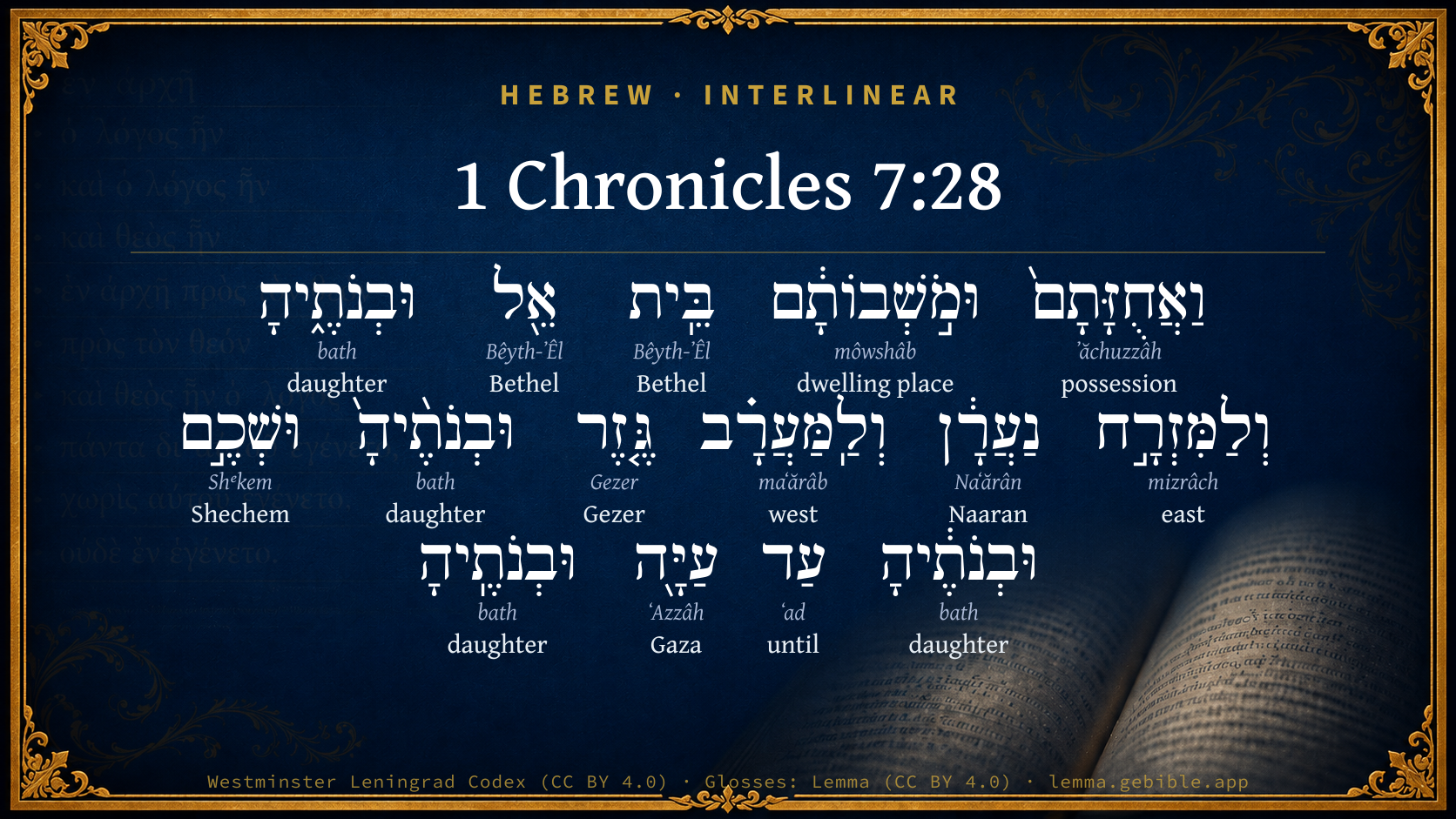
Hebrew (Westminster Leningrad Codex) 1 Chronicles 7:28 appears in the Hebrew Old Testament. The text above is from the Westminster Leningrad Codex. Each word links to its Strong’s number, a concise gloss, and parsing drawn from the Open Scriptures Hebrew Bible morphology. Click any word for its full Brown-Driver-Briggs (BDB) entry.
Download image
Cite this verse

1 Chronicles 7:28 (World English Bible). Public Domain. Lemma interlinear Bible study tool, https://lemma.gebible.app/v/1-chronicles/7/28.

Show BibTeX & RIS
BibTeX
RIS
English Translation
Their possessions and habitations were Bethel and the towns of it, and eastward Naaran, and westward Gezer, with the towns of it; Shechem also and the towns of it, to Azzah and the towns of it;
World English Bible · Public Domain
Highlights
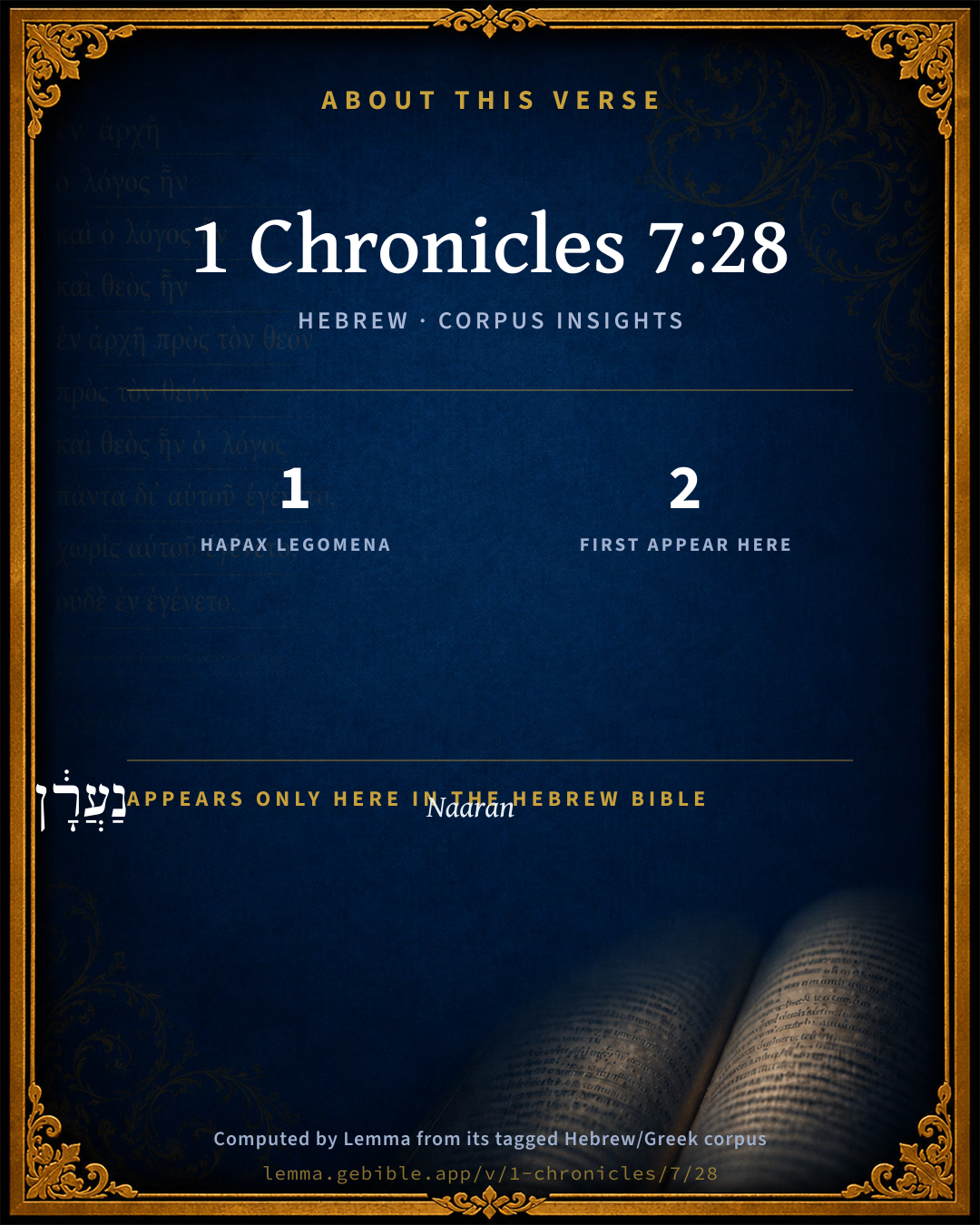
  • 1 hapax legomenon — only here in the Hebrew Bible
  • 2 first appearances in the Hebrew Bible
Full analysis ↓
Download a study sheet

One document with this verse’s original text, its word-by-word gloss line, the meaning frame, cross-references with their text, attributed commentary, and full source and license credits — printable, and it pastes into notes with its structure intact.

This verse Autodidact and up

Study sheet (.html) Plain text (.txt)

A passage Seminary Student

Up to 50 verses in one chapter. A passage sheet keeps up to 6 commentary sources and 12 cross-references per verse, in the order this page ranks them, and says so on the sheet whenever that leaves anything out. Ask for a single verse and you get the Autodidact verse sheet above.

Everything on this page stays free to read, with no account — the sheet is a download of what is already on screen, not access to it.

Want to remove ads? Support Godless Engineer
Compare translations 3

The same verse in 3 English versions, stacked beneath the original-language interlinear above. Click any original word for its lexicon entry.

Each is an independent rendering of the whole verse — the interlinear is not word-aligned to these translations.

Highlighted words mark where these versions differ — a whole-verse word diff, not a word-by-word alignment.

  • World English Bible Public Domain
    Their possessions and habitations were Bethel and the towns of it, and eastward Naaran, and westward Gezer, with the towns of it; Shechem also and the towns of it, to Azzah and the towns of it;
  • King James Version Public Domain
    And their possessions and habitations were, Bethel and the towns thereof, and eastward Naaran, and westward Gezer, with the towns thereof; Shechem also and the towns thereof, unto Gaza and the towns thereof:
  • unfoldingWord Literal Text CC BY-SA 4.0
    And their holdings and their dwellings Bethel and its daughters. And to the east, Naaran. And to the west, Gezer and its daughters and Shechem and its daughters, unto Ayyah and its daughters.

unfoldingWord Literal Text — © unfoldingWord, licensed CC BY-SA 4.0. Word-aligned USFM3 via Door43 (git.door43.org/unfoldingWord/en_ult).

Versions to compare (up to 4)

3 of 4 selected

Show all 18 translations

Every available English version of this verse, each an independent rendering of the whole verse.

  • World English Bible Public Domain
    Their possessions and habitations were Bethel and the towns of it, and eastward Naaran, and westward Gezer, with the towns of it; Shechem also and the towns of it, to Azzah and the towns of it;
  • Berean Standard Bible Public Domain
    Their holdings and settlements included Bethel and its villages, Naaran to the east, Gezer and its villages to the west, and Shechem and its villages as far as Ayyah and its villages.
  • Majority Standard Bible Public Domain
    Their holdings and settlements included Bethel and its villages, Naaran to the east, Gezer and its villages to the west, and Shechem and its villages as far as Ayyah and its villages.
  • King James Version Public Domain
    And their possessions and habitations were, Bethel and the towns thereof, and eastward Naaran, and westward Gezer, with the towns thereof; Shechem also and the towns thereof, unto Gaza and the towns thereof:
  • American Standard Version (1901) Public Domain
    And their possessions and habitations were Beth-el and the towns thereof, and eastward Naaran, and westward Gezer, with the towns thereof; Shechem also and the towns thereof, unto Azzah and the towns thereof;
  • Revised Version (1885) Public Domain
    And their possessions and habitations were Beth-el and the towns thereof, and eastward Naaran, and westward Gezer, with the towns thereof; Shechem also and the towns thereof, unto Azzah and the towns thereof:
  • Geneva Bible (1599) Public Domain
    And their possessions and their habitations were Beth-el, and the villages thereof, and Eastward Naaran, and Westwarde Gezer with the villages thereof, Shechem also and the villages thereof, vnto Azzah, and the villages thereof,
  • Douay-Rheims (1899) Public Domain
    And their possessions and habitations were Bethel with her daughters, and eastward Noran, and westward Gazer and her daughters, Sichem also with her daughters, as far as Ass with her daughters.
  • Young's Literal Translation Public Domain
    And their possession and their dwellings `are' Beth-El and its small towns, and to the east Naaran, and to the west Gezer and its small towns, and Shechem and its small towns, unto Gaza and its small towns;
  • Literal Standard Version CC BY-SA 4.0
    And their possession and their dwellings [are] Beth-El and its small towns, and Naaran to the east, and Gezer and its small towns to the west, and Shechem and its small towns, as far as Gaza and its small towns;
  • Unlocked Literal Bible CC BY-SA 4.0
    Their possessions and residences were Bethel and its surrounding villages. They extended eastward to Naaran and westward to Gezer and its villages, and to Shechem and its villages to Ayyah and its villages.
  • unfoldingWord Literal Text CC BY-SA 4.0
    And their holdings and their dwellings Bethel and its daughters. And to the east, Naaran. And to the west, Gezer and its daughters and Shechem and its daughters, unto Ayyah and its daughters.
  • Darby Bible Public Domain
    And their possession and dwelling-places were Bethel and its dependent villages, and eastward Naaran, and westward Gezer and its dependent villages, and Shechem and its dependent villages as far as to Gazah and its dependent villages.
  • World Messianic Bible Public Domain
    Their possessions and settlements were Bethel and its towns, and eastward Naaran, and westward Gezer with its towns; Shechem also and its towns, to Azzah and its towns;
  • Webster's Bible Public Domain
    And their possessions and habitations were, Beth-el, and its towns, and eastward Naaram, and westward Gezer, with its towns; Shechem also and its towns, to Gaza and its towns:
  • Free Bible Version CC BY-SA 4.0
    The land they owned and the places they lived included Bethel and nearby towns, from Naaran to the east to Gezer and its towns to the west, and Shechem and its towns up to Ayyah and its towns.
  • Bible in Basic English Public Domain
    Their heritage and their living-places were Beth-el and its daughter-towns, and Naaran to the east, and Gezer to the west, with its daughter-towns, as well as Shechem and its daughter-towns as far as Azzah and its daughter-towns;
  • JPS Tanakh (1917) Public Domain
    And their possessions and habitations were Beth-el and the towns thereof, and eastward Naaran, and westward Gezer, with the towns thereof; Shechem also and the towns thereof, unto Aiah and the towns thereof;

Literal Standard Version (2020), Covenant Press — licensed CC BY-SA 4.0. Text via the HelloAO Bible API (eBible.org). Unlocked Literal Bible (unfoldingWord) — licensed CC BY-SA 4.0. Text via the HelloAO Bible API (eBible.org). unfoldingWord Literal Text — © unfoldingWord, licensed CC BY-SA 4.0. Word-aligned USFM3 via Door43 (git.door43.org/unfoldingWord/en_ult). Free Bible Version, Dr. Jonathan Gallagher — licensed CC BY-SA 4.0. Text via the HelloAO Bible API (eBible.org).

Word by word

More ways to search: Search by grammar → Find every occurrence → Compare this word →

Practice this passage: Drill this verse → Learn its vocabulary →

נַעֲרָ֔ן
Naʻărân
H5295
“Naaran”
Noun, Proper
Part of Speech
Noun
Type
Proper
Full BDB Definition

Origin: from H5288

TWOT: None

Naaran = "juvenile" - a town on the eastern limit of the territory of Ephraim
  1. וַאֲחֻזָּתָם֙ ʼăchuzzâh H272 “and · possession · their” Conjunction + Noun, Common, Feminine, Singular, Construct + Suffix, Personal, 3rd Person, Masculine, Plural
  2. וּמֹ֣שְׁבוֹתָ֔ם môwshâb H4186 “and · dwelling places · their” Conjunction + Noun, Common, Masculine, Plural, Construct + Suffix, Personal, 3rd Person, Masculine, Plural
  3. בֵּֽית Bêyth-ʼÊl H1008 “Bethel” Noun, Proper
  4. אֵ֖ל Bêyth-ʼÊl H1008 “Bethel” Noun, Proper
  5. וּבְנֹתֶ֑יהָ bath H1323 “and · daughters · her” Conjunction + Noun, Common, Feminine, Plural, Construct + Suffix, Personal, 3rd Person, Feminine, Singular
  6. וְלַמִּזְרָ֣ח mizrâch H4217 “and · to/for the · east” Conjunction + Preposition, Determined + Noun, Common, Masculine, Singular, Absolute
  7. וְלַֽמַּעֲרָ֗ב maʻărâb H4628 “and · to/for the · west” Conjunction + Preposition, Determined + Noun, Common, Masculine, Singular, Absolute
  8. גֶּ֤זֶר Gezer H1507 “Gezer” Noun, Proper
  9. וּבְנֹתֶ֨יהָ֙ bath H1323 “and · daughters · her” Conjunction + Noun, Common, Feminine, Plural, Construct + Suffix, Personal, 3rd Person, Feminine, Singular
  10. וּשְׁכֶ֣ם Shᵉkem H7927 “and · Shechem” Conjunction + Noun, Proper
  11. וּבְנֹתֶ֔יהָ bath H1323 “and · daughters · her” Conjunction + Noun, Common, Feminine, Plural, Construct + Suffix, Personal, 3rd Person, Feminine, Singular
  12. עַד ʻad H5704 “until” Preposition
  13. עַיָּ֖ה ʻAzzâh H5804 “Gaza” Noun, Proper
  14. וּבְנֹתֶֽיהָ bath H1323 “and · daughters · her” Conjunction + Noun, Common, Feminine, Plural, Construct + Suffix, Personal, 3rd Person, Feminine, Singular

About this verse

These counts appear in no published source. They are computed here, from the morphology-tagged text and Lemma’s own curated glosses. What Lemma adds →

15
words
11
distinct lemmas
Historical
section

Notable vocabulary

1 hapax legomenon — a word that appears only here in the entire Hebrew Bible:

  • נַעֲרָ֔ן Naaran H5295

First appearance in Scripture

These words make their first canonical appearance in the Hebrew Bible here:

  • נַעֲרָ֔ן Naaran H5295
  • וְלַֽמַּעֲרָ֗ב west H4628

Shared distinctive vocabulary

וְלַֽמַּעֲרָ֗ב west H4628 occurs in 14 verses of the Hebrew Bible. Also found in:

Grammatical profile

  • 14 nouns
  • 1 preposition

Repetition

Words recur within this verse — often emphatic in Hebrew:

  • וּבְנֹתֶ֑יהָ daughter H1323 ×4
  • בֵּֽית Bethel H1008 ×2

Hebrew & Septuagint length

In English translation the verse runs 36 words from the Hebrew and 32 from the Septuagint (LXX English) — closely comparable.

A rough comparison of the two English renderings, which tokenize alike — not a word-level alignment.

Word counts can differ between the Hebrew and the Greek without any difference in meaning — e.g. the Hebrew direct-object marker אֵת has no separate Greek word, and Greek often adds the article ὁ.

Cross-references

4

Topical passages linked to 1 Chronicles 7:28 in the Treasury of Scripture Knowledge — connected by theme and wording, ordered by reader-vote popularity; previews shown in the World English Bible.

  • Genesis 28:19 He called the name of that place Bethel, but the name of the city was Luz at the first.
  • Joshua 16:2–3 and it went out from Bethel to Luz, and passed along to the border of the Archites to Ataroth;
  • Judges 1:22 The house of Joseph, they also went up against Bethel; and Yahweh was with them.
  • 1 Chronicles 6:66–67 Some of the families of the sons of Kohath had cities of their borders out of the tribe of Ephraim.

Cross-references courtesy of OpenBible.info (CC BY 4.0).

Hebrew and Greek witnesses Masoretic Hebrew ↔ Greek Septuagint

The same verse in the two great witnesses to the Old Testament, shown verse-for-verse.

These are two independent witnesses, not word-aligned to each other, and the Septuagint is shown in lemma (dictionary) form.

Hebrew 1 Chronicles 7:28 Masoretic · Westminster Leningrad Codex

וַאֲחֻזָּתָם֙ וּמֹ֣שְׁבוֹתָ֔ם בֵּֽית אֵ֖ל וּבְנֹתֶ֑יהָ וְלַמִּזְרָ֣ח נַעֲרָ֔ן וְלַֽמַּעֲרָ֗ב גֶּ֤זֶר וּבְנֹתֶ֨יהָ֙ וּשְׁכֶ֣ם וּבְנֹתֶ֔יהָ עַד עַיָּ֖ה וּבְנֹתֶֽיהָ

Their possessions and habitations were Bethel and the towns of it, and eastward Naaran, and westward Gezer, with the towns of it; Shechem also and the towns of it, to Azzah and the towns of it;

World English Bible · Public Domain

Greek LXX 1 Chronicles 7:28 Septuagint · lemma form

καί κατάσχεσις αὐτός καί κατοικία αὐτός βαιθηλ καί ὁ κώμη αὐτός κατά ἀνατολή νααραν πρός δυσμή γαζερ καί ὁ κώμη αὐτός καί συχεμ καί ὁ κώμη αὐτός ἕως γαιαν καί ὁ κώμη αὐτός

And their possession and their dwelling were Baethel and her towns, to the east Noaran, westward Gazer and her towns, and Sychem and her towns, as far as Gaza and her towns.

LXX2012 (modern English Septuagint) · Public Domain

On this verse, Ellicott's Commentary for English Readers discusses the Septuagint’s reading. Read the note in Commentary ↓

Hebrew: Westminster Leningrad Codex (CC BY 4.0). Greek: Septuagint (public domain); English from LXX2012 (modern English Septuagint) (Public Domain). How the Septuagint differs from the Hebrew →

Commentary

Notes on 1 Chronicles 7:28 from classic Christian and Jewish commentators (each source and its license shown beneath its notes). The classic Christian expositions comment on the surrounding passage and are grouped to its opening verse, so a note may address several verses; the Jewish commentaries on the Tanakh (Rashi and others) are per-verse, so they appear only where the commentator wrote on this verse.

Lemma curates 59 commentaries, every one of them public domain or Creative Commons licensed, each selected and text-cleaned for this edition rather than reprinted as found. About our sources →

Ellicott's Commentary for English Readers

THE BOUNDS OF EPHRAIM AND WEST MANASSEH

(1Ch_7:28-29).

Comp. 1Ch_6:54, sqq., where a list of the cities of the Levites is similarly added to their tribal registers.

(28) And their possessions.—Heb., and their domain and their seats were Bethel and her daughters; “their domain,” that is, the domain of both divisions of the tribe of Joseph.

Bethel—originally assigned to Benjamin (Jos_18:22), belonged later to the northern kingdom. The present list appears therefore to be younger than the disruption of Solomon’s empire.

Naaran, or Naarah (Naapá) (Jos_16:7) was a town north-east of Jericho. Gezer lay on the southwest border of Ephraim (Jos_16:3), Shechem (Nablûs, Νεάπολις) on the north. Gaza: so the LXX„ Vulg. (Aza which represents the Hebrew ‘Azzâh, i.e., Gaza), and Targum; but a great number of MSS. and seventeen editions read Ayyah, a place not mentioned elsewhere, but doubtless lying on the north-west border of Ephraim.

(29) And by the borders of the children of Manasseh.—Literally, and upon the hands of the sons of Manasseh, a favourite phrase with the chronicler, occurring nine times in Chronicles and once in Ezra. (See Note on 1Ch_6:31.) The four cities lay within the territory of Issachar and Asher, but were assigned to Manassen (Jos_17:11). They mark the northward marches of the two houses of Joseph, as the cities of 1Ch_7:28 mark the southward. They long withstood the Israelite occupation (Jos_17:12-16; see also Jdg_5:19. “Then fought the kings of Canaan, in Taanach, by the waters of Megiddo.”)

A Bible Commentary for English Readers, edited by Charles John Ellicott (1878–1897) — public domain. Text from a community e-Sword module.

The Cambridge Bible for Schools and Colleges

gen. ed. J. J. S. Perowne

28. Beth-el] Jdg_1:22-25; 1Ki_12:29; 1Ki_12:32. Beth-el is perhaps the modern Beitîn (Bädeker, p. 213). The city was on the border of Ephraim and Benjamin and in Jos_18:22 is assigned to Benjamin, but it was originally conquered by Ephraim (Jdg_1:22), and during the division of the kingdom it belonged to the North: cp. 2Ch_13:19, note.

Naaran] In Jos_16:7, Naarath (R.V. Naarah).

Gezer … Shechem] See 1Ch_6:67, note.

unto Gaza] Gaza (Heb. Azzah) the well-known Philistine city was in the extreme south-west of Palestine and can hardly be intended here in a list of Ephraimite cities. Some Heb. MSS read Ayyah, a reading which is in part supported by LXX (B) ἔως Γαιάν.

28, 29. The Seats of the Sons of Joseph

It is difficult to say why the possessions of Ephraim (1Ch_7:28) and Manasseh (1Ch_7:29) are mentioned here, and also why having been mentioned, they are not more fully described.

The Cambridge Bible for Schools and Colleges (gen. ed. J. J. S. Perowne; Cambridge University Press, 1878–1918) — public domain. Text from a community e-Sword module.

Joseph Benson's Commentary

1Ch 7:28. Their possessions — That is, the portion allotted to the tribe of Ephraim: were Beth-el — Which stood in the border of Benjamin, but belonged to Ephraim. Unto Gaza — Not the Gaza of the Philistines, which belonged to another tribe, and was remote from Ephraim, but another place of the same name. Or rather Adazza, as in the margin; the particle ad, here rendered unto, being part of the name.

Joseph Benson's Commentary on the Old and New Testaments (1811–1818) — public domain. Text from a community e-Sword module.

Geneva Bible (1599)

Geneva Bible translators

Or, Adaiah.

Geneva Bible (1599) marginal notes — public domain. Text via Bolls.life.

John Gill's Exposition

And the sons of Zophah,.... The eldest of the sons of Helem:

Suah, and Harnepher, and Shual, and Beri, and Imrah, Bezer; and Hod, and Shamma, and Shilshah, and Ithran, and Beera; in all eleven.

John Gill's Exposition of the Whole Bible (1746–1763) — public domain (CC PDM 1.0). Text via the HelloAO Bible API.

Matthew Poole's English Annotations

Their possessions, i.e. the portion allotted to the tribe of Ephraim.

Beth-el; which stood in the border of Benjamin, but belonged to Ephraim.

Unto Gaza, not that of the Philistines, which belonged to another tribe, and was remote from Ephraim; but another of the same name. Or rather Adasa, as it is in the margin of our Bible; the particle ad, here rendered unto, being a part of the name; for why should unto be put to this town, which is not put to any of the other?

Matthew Poole's English Annotations on the Holy Bible (1683–1685) — public domain. Text from a community e-Sword/MySword module.

The Pulpit Commentary

Naaran. This place is probably the same with the Naarath or Naarah of Jos_16:7; though here it is said to be an eastward limit, and there its description might rather seem that of a southward limit. Gaza. This name can scarcely designate the well-known Gaza, assigned to Judah (Jos_15:47; Jud_1:18) but so largely the prey of the Philistines (Jud_1:3:3 16:21; 1Sa_6:17)

The Pulpit Commentary (1880–1919), ed. H.D.M. Spence-Jones & Joseph S. Exell — public domain. Text from a community e-Sword module.

Keil & Delitzsch

C. F. Keil & F. Delitzsch

And the sons of Zophah,.... The eldest of the sons of Helem:

Suah, and Harnepher, and Shual, and Beri, and Imrah, Bezer; and Hod, and Shamma, and Shilshah, and Ithran, and Beera; in all eleven.

Keil & Delitzsch — Biblical Commentary on the Old Testament (1861–1891) — public domain (CC PDM 1.0). Text via the HelloAO Bible API. (Old Testament only.)

Scofield Reference Notes

C. I. Scofield

Narran

Naarath, Jos 16:7.

The Scofield Reference Bible (1917 edition), notes by C. I. Scofield — public domain. Text from a community e-Sword module.

unfoldingWord translationNotes

Door43 World Missions Community

Their possessions and residences were Bethel ... villages

The abstract nouns "possessions" and "residences" can be translated with verbal phrases. AT: "They possessed and resided in Bethel ... villages" or "They owned and lived in Bethel ... villages" (See: Abstract Nouns)

Bethel ... Dor

All of the names listed here are the names of towns. (See: How to Translate Names)

In these towns the descendants of Joseph son of Israel lived

"The descendants of Joseph, son of Israel, lived in these towns"

translationWords

possess

Bethel

Shechem

Manasseh

Joseph (OT)

Jacob

life

unfoldingWord translationNotes — © Distant Shores Media and the Door43 World Missions Community, licensed CC BY-SA 4.0. Source: git.door43.org/Door43/en_tn.

Lesson kit

Teaching starters — assembled from the data on this page, not authored interpretation. Every prompt links to the verse data it draws on. Edit before teaching.

1 Chronicles, in the Historical, opens this verse with 15 words (11 distinct Hebrew lemmas). Its most distinctive word is Naʻărân (“Naaran”). A historical commentator’s framing appears above. Read the whole chapter for the surrounding context.

Discussion questions

  1. What does “Naaran” (Naʻărân) contribute to the verse as a whole?
  2. This verse holds 1 word here found nowhere else in the Hebrew Bible. What might the rare word draw attention to?
  3. 2 words here appear for the first time in Scripture. What is being introduced at this debut?
  4. 1 Chronicles 12:15 shares the word «west» with this verse. How do the two illuminate each other?
  5. “daughter” occurs 4× in this one verse. What is the effect of the repetition?
  6. These translations render this verse differently; the difference is in the English rendering, not the original. What questions does that raise?
  7. Reading how Ellicott's Commentary for English Readers and The Cambridge Bible for Schools and Colleges read this verse, where do the two commentators agree and where do they part?

Things to notice

  • 1 word in this verse appears nowhere else in the Hebrew Bible.
  • 2 words make their first canonical appearance in Scripture here.
  • These translations choose different wording for 15 words in this verse.
  • “daughter” occurs 4× in this single verse.
  • 11 distinct Hebrew lemmas span 15 words in this verse.

Reading settings

Reading text

Shown beneath each verse's original-language words.

Old Testament
Old Testament edition

Read the OT as the Masoretic Hebrew (MT) or the Greek Septuagint (LXX).

English shown for the Greek Septuagint (in the Hebrew ↔ Greek comparison).

Comparing translations? Open the Compare panel on any verse page to stack up to four side by side.