
Numbers 18:11

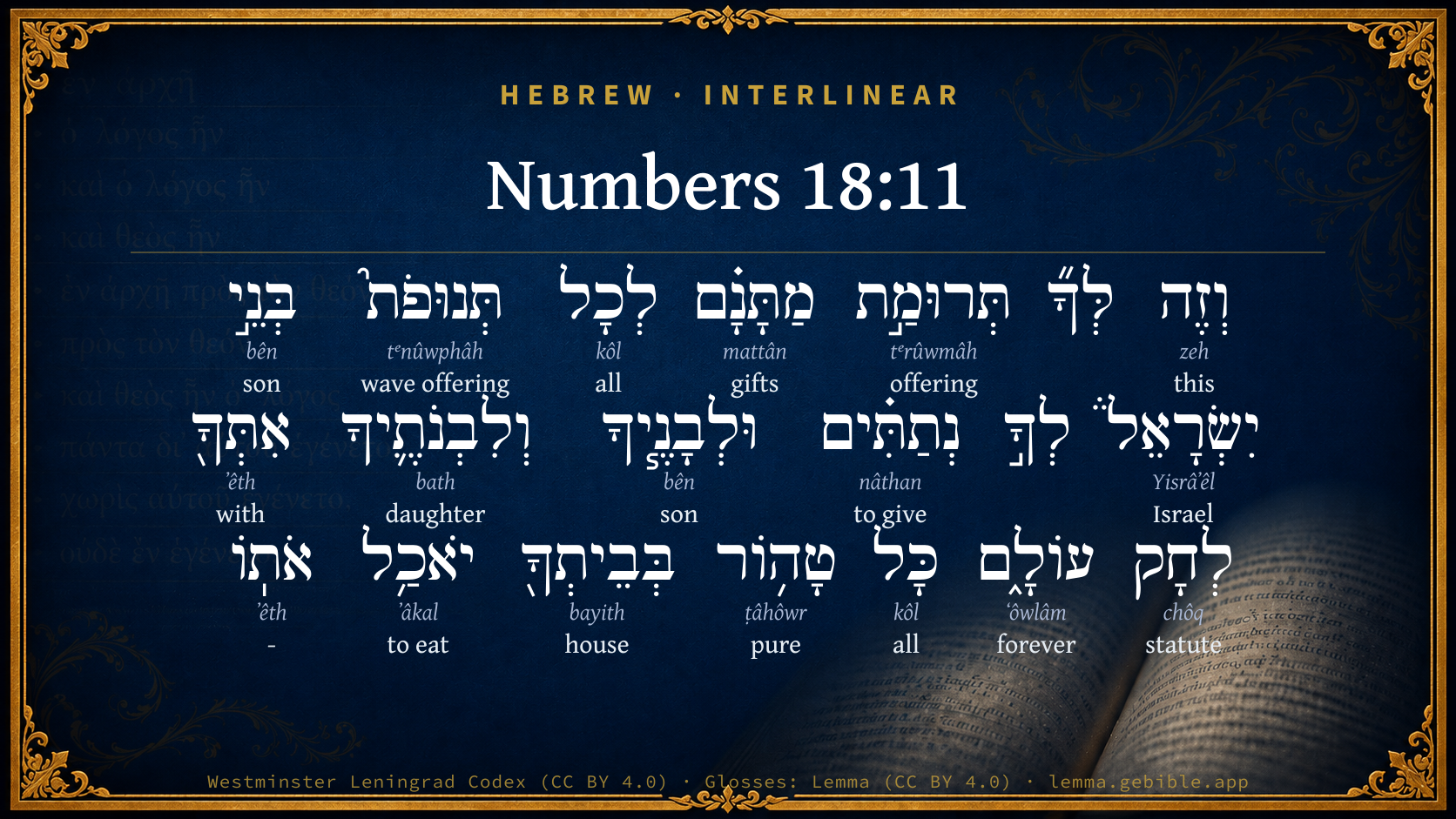
Hebrew (Westminster Leningrad Codex) Numbers 18:11 appears in the Hebrew Old Testament. The text above is from the Westminster Leningrad Codex. Each word links to its Strong’s number, a concise gloss, and parsing drawn from the Open Scriptures Hebrew Bible morphology. Click any word for its full Brown-Driver-Briggs (BDB) entry.
Download image
Cite this verse

Numbers 18:11 (World English Bible). Public Domain. Lemma interlinear Bible study tool, https://lemma.gebible.app/v/numbers/18/11.

Show BibTeX & RIS
BibTeX
RIS
English Translation
This is your: the heave-offering of their gift, even all the wave-offerings of the children of Israel; I have given them to you, and to your sons and to your daughters with you, as a portion forever; everyone who is clean in your house shall eat of it.
World English Bible · Public Domain
Download a study sheet

One document with this verse’s original text, its word-by-word gloss line, the meaning frame, cross-references with their text, attributed commentary, and full source and license credits — printable, and it pastes into notes with its structure intact.

This verse Autodidact and up

Study sheet (.html) Plain text (.txt)

A passage Seminary Student

Up to 50 verses in one chapter. A passage sheet keeps up to 6 commentary sources and 12 cross-references per verse, in the order this page ranks them, and says so on the sheet whenever that leaves anything out. Ask for a single verse and you get the Autodidact verse sheet above.

Everything on this page stays free to read, with no account — the sheet is a download of what is already on screen, not access to it.

Want to remove ads? Support Godless Engineer
Compare translations 3

The same verse in 3 English versions, stacked beneath the original-language interlinear above. Click any original word for its lexicon entry.

Each is an independent rendering of the whole verse — the interlinear is not word-aligned to these translations.

Highlighted words mark where these versions differ — a whole-verse word diff, not a word-by-word alignment.

  • World English Bible Public Domain
    This is your: the heave-offering of their gift, even all the wave-offerings of the children of Israel; I have given them to you, and to your sons and to your daughters with you, as a portion forever; everyone who is clean in your house shall eat of it.
  • King James Version Public Domain
    And this is thine; the heave offering of their gift, with all the wave offerings of the children of Israel: I have given them unto thee, and to thy sons and to thy daughters with thee, by a statute for ever: every one that is clean in thy house shall eat of it.
  • unfoldingWord Literal Text CC BY-SA 4.0
    And this for you: the contribution of their gift, for all the raised offerings of the sons of Israel. To you I have given them and to your sons and to your daughters with you for a statute of eternity. Every clean one in your house shall eat it.

unfoldingWord Literal Text — © unfoldingWord, licensed CC BY-SA 4.0. Word-aligned USFM3 via Door43 (git.door43.org/unfoldingWord/en_ult).

Versions to compare (up to 4)

3 of 4 selected

Show all 18 translations

Every available English version of this verse, each an independent rendering of the whole verse.

  • World English Bible Public Domain
    This is your: the heave-offering of their gift, even all the wave-offerings of the children of Israel; I have given them to you, and to your sons and to your daughters with you, as a portion forever; everyone who is clean in your house shall eat of it.
  • Berean Standard Bible Public Domain
    And this is yours as well: the offering of their gifts, along with all the wave offerings of the Israelites. I have given this to you and your sons and daughters as a permanent statute. Every ceremonially clean person in your household may eat it.
  • Majority Standard Bible Public Domain
    And this is yours as well: the offering of their gifts, along with all the wave offerings of the Israelites. I have given this to you and your sons and daughters as a permanent statute. Every ceremonially clean person in your household may eat it.
  • King James Version Public Domain
    And this is thine; the heave offering of their gift, with all the wave offerings of the children of Israel: I have given them unto thee, and to thy sons and to thy daughters with thee, by a statute for ever: every one that is clean in thy house shall eat of it.
  • American Standard Version (1901) Public Domain
    And this is thine: the heave-offering of their gift, even all the wave-offerings of the children of Israel; I have given them unto thee, and to thy sons and to thy daughters with thee, as a portion for ever; every one that is clean in thy house shall eat thereof.
  • Revised Version (1885) Public Domain
    And this is thine; the heave offering of their gift, even all the wave offerings of the children of Israel: I have given them unto thee, and to thy sons and to thy daughters with thee, as a due for ever: every one that is clean in thy house shall eat thereof.
  • Geneva Bible (1599) Public Domain
    This also shalbe thine: the heaue offering of their gift, with all the shake offerings of the children of Israel: I haue giuen them vnto thee and to thy sonnes and to thy daughters with thee, to be a duetie for euer al the cleane in thine house shall eate of it.
  • Douay-Rheims (1899) Public Domain
    But the firstfruits, which the children of Israel shall vow and offer, I have given to thee, and to thy sons, and to thy daughters, by a perpetual law. He that is clean in thy house, shall eat them.
  • Young's Literal Translation Public Domain
    `And this `is' thine: the heave-offering of their gift, to all the wave-offerings of the sons of Israel, to thee I have given them, and to thy sons, and to thy daughters with thee, by a statute age-during; every clean one in thy house doth eat it;
  • Literal Standard Version CC BY-SA 4.0
    And this [is] yours: the raised-offering of their gift, with all the wave-offerings of the sons of Israel; I have given them to you, and to your sons, and to your daughters with you, by a continuous statute; every clean one in your house eats it;
  • Unlocked Literal Bible CC BY-SA 4.0
    These are the offerings that will belong to you, set apart out of all their gifts of the wave offerings of the people of Israel. I have given them to you, your sons, and your daughters, as your portion forever. Everyone who is ceremonially clean in your family may eat any of these offerings.
  • unfoldingWord Literal Text CC BY-SA 4.0
    And this for you: the contribution of their gift, for all the raised offerings of the sons of Israel. To you I have given them and to your sons and to your daughters with you for a statute of eternity. Every clean one in your house shall eat it.
  • Darby Bible Public Domain
    And this shall be thine: the heave-offering of their gift, with all the wave-offerings of the children of Israel; I have given them unto thee, and to thy sons and to thy daughters with thee, by an everlasting statute; every one that is clean in thy house shall eat of it.
  • World Messianic Bible Public Domain
    “This is yours, too: the wave offering of their gift, even all the wave offerings of the children of Israel. I have given them to you, and to your sons and to your daughters with you, as a portion forever. Everyone who is clean in your house shall eat of it.
  • Webster's Bible Public Domain
    And this is thine; the heave-offering of their gift, with all the wave-offerings of the children of Israel: I have given them to thee, and to thy sons, and to thy daughters with thee, by a statute for ever: every one that is clean in thy house shall eat of it.
  • Free Bible Version CC BY-SA 4.0
    The following also belongs to you: the voluntary gifts as well as all the wave offerings of the Israelites. I have given this to you and your sons and daughters as a permanent rule. Everyone in your household who is ceremonially clean is allowed to eat it.
  • Bible in Basic English Public Domain
    And this is yours: the lifted offering which they give and all the wave offerings of the children of Israel I have given to you and to your sons and to your daughters as your right for ever: everyone in your house who is clean may have them for food.
  • JPS Tanakh (1917) Public Domain
    And this is thine: the heave-offering of their gift, even all the wave-offerings of the children of Israel; I have given them unto thee, and to thy sons and to thy daughters with thee, as a due for ever; every one that is clean in thy house may eat thereof.

Literal Standard Version (2020), Covenant Press — licensed CC BY-SA 4.0. Text via the HelloAO Bible API (eBible.org). Unlocked Literal Bible (unfoldingWord) — licensed CC BY-SA 4.0. Text via the HelloAO Bible API (eBible.org). unfoldingWord Literal Text — © unfoldingWord, licensed CC BY-SA 4.0. Word-aligned USFM3 via Door43 (git.door43.org/unfoldingWord/en_ult). Free Bible Version, Dr. Jonathan Gallagher — licensed CC BY-SA 4.0. Text via the HelloAO Bible API (eBible.org).

Word by word

More ways to search: Search by grammar → Find every occurrence → Compare this word →

Practice this passage: Drill this verse → Learn its vocabulary →

מַתָּנָ֗ם
mattân
H4976
“gifts · their”
Noun, Common, Masculine, Singular, Construct + Suffix, Personal, 3rd Person, Masculine, Plural
Part of Speech
Noun
Type
Common
Gender
Masculine
Number
Singular
State
Construct
Full BDB Definition

Origin: from H5414

TWOT: 1443b

gifts, offerings, presents
  1. וְזֶה zeh H2088 “and · this” Conjunction + Pronoun, Demonstrative, Masculine, Singular
  2. תְּרוּמַ֣ת tᵉrûwmâh H8641 “offering of” Noun, Common, Feminine, Singular, Construct
  3. לְכָל kôl H3605 “to/for · all of” Preposition + Noun, Common, Masculine, Singular, Construct
  4. תְּנוּפֹת֮ tᵉnûwphâh H8573 “wave offerings of” Noun, Common, Feminine, Plural, Construct
  5. בְּנֵ֣י bên H1121 “sons of” Noun, Common, Masculine, Plural, Construct
  6. יִשְׂרָאֵל֒ Yisrâʼêl H3478 “Israel” Noun, Proper
  7. נְתַתִּ֗ים nâthan H5414 “to give · them” Verb, Qal, Perfect, 1st Person, Common, Singular + Suffix, Personal, 3rd Person, Masculine, Plural
  8. וּלְבָנֶ֧יךָ bên H1121 “and · to/for · sons · your” Conjunction + Preposition + Noun, Common, Masculine, Plural, Construct + Suffix, Personal, 2nd Person, Masculine, Singular
  9. וְלִבְנֹתֶ֛יךָ bath H1323 “and · to/for · daughters · your” Conjunction + Preposition + Noun, Common, Feminine, Plural, Construct + Suffix, Personal, 2nd Person, Masculine, Singular
  10. אִתְּךָ֖ ʼêth H854 “with · you” Preposition + Suffix, Personal, 2nd Person, Masculine, Singular
  11. לְחָק chôq H2706 “to/for · statute of” Preposition + Noun, Common, Masculine, Singular, Construct
  12. עוֹלָ֑ם ʻôwlâm H5769 “forever” Noun, Common, Masculine, Singular, Absolute
  13. כָּל kôl H3605 “all of” Noun, Common, Masculine, Singular, Construct
  14. טָה֥וֹר ṭâhôwr H2889 “pure” Adjective, Adjective, Masculine, Singular, Absolute
  15. בְּבֵיתְךָ֖ bayith H1004 “in/at · house · your” Preposition + Noun, Common, Masculine, Singular, Construct + Suffix, Personal, 2nd Person, Masculine, Singular
  16. יֹאכַ֥ל ʼâkal H398 “to eat” Verb, Qal, Imperfect, 3rd Person, Masculine, Singular
  17. אֹתֽוֹ ʼêth H853 “- · him” Particle, Direct Object + Suffix, Personal, 3rd Person, Masculine, Singular

About this verse

These counts appear in no published source. They are computed here, from the morphology-tagged text and Lemma’s own curated glosses. What Lemma adds →

20
words
16
distinct lemmas
Pentateuch
section

Notable vocabulary

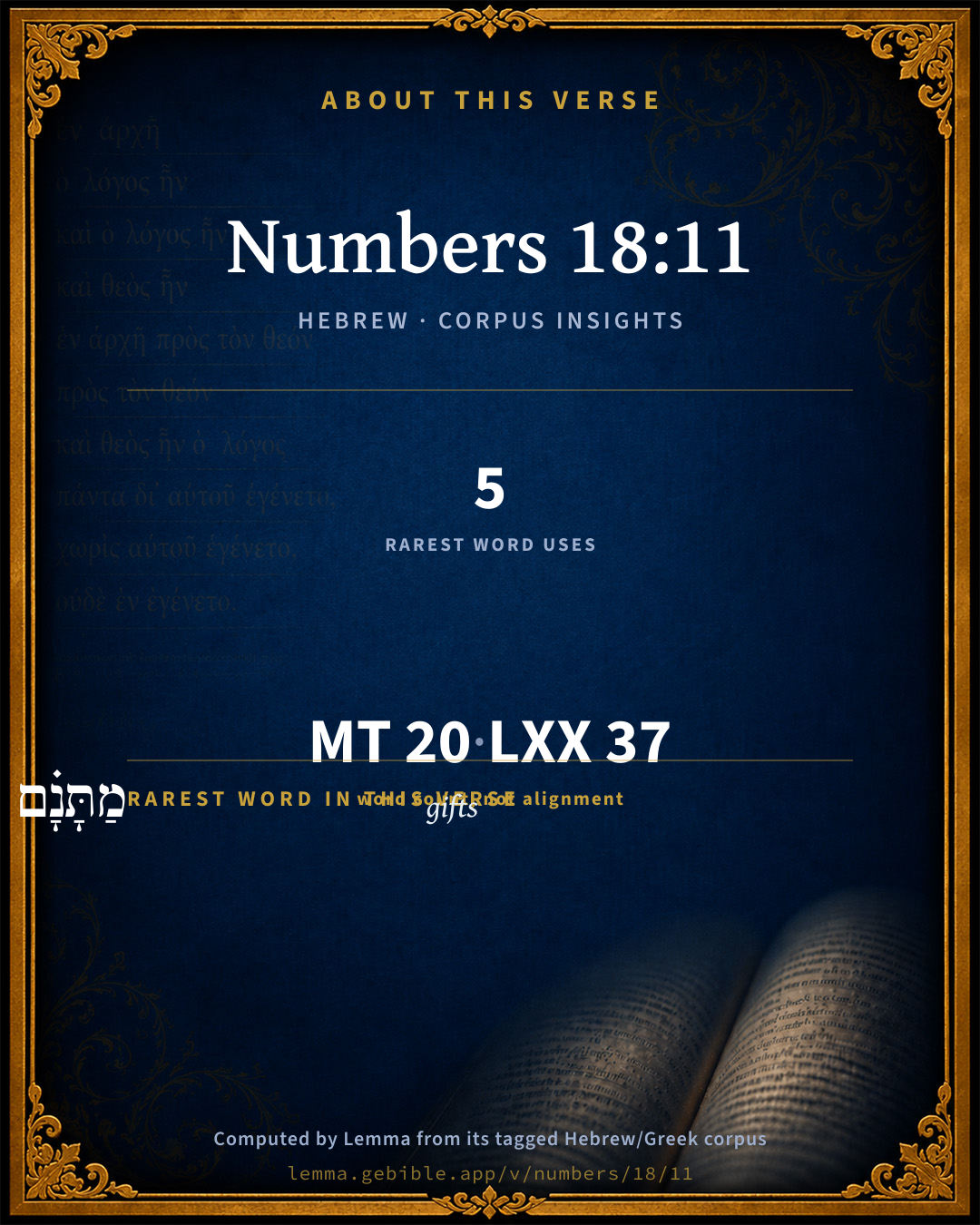
The rarest word here is מַתָּנָ֗ם gifts H4976 — appearing just 5 times in the whole Hebrew Bible.

Shared distinctive vocabulary

מַתָּנָ֗ם gifts H4976 occurs in 5 verses of the Hebrew Bible. Also found in:

Grammatical profile

  • 2 verbs
  • 12 nouns
  • 1 adjective
  • 1 pronoun
  • 3 prepositions
  • 1 particle

Verb forms

  • נְתַתִּ֗ים Qal · Perfect
  • יֹאכַ֥ל Qal · Imperfect

Repetition

Words recur within this verse — often emphatic in Hebrew:

  • לְכָל all H3605 ×2
  • בְּנֵ֣י son H1121 ×2

Hebrew & Septuagint length

In English translation the verse runs 48 words from the Hebrew and 49 from the Septuagint (LXX English) — closely comparable.

A rough comparison of the two English renderings, which tokenize alike — not a word-level alignment.

Word counts can differ between the Hebrew and the Greek without any difference in meaning — e.g. the Hebrew direct-object marker אֵת has no separate Greek word, and Greek often adds the article ὁ.

In the original languages it is 20 Hebrew tokens and 37 Greek tokens — but the two are counted differently (Hebrew bundles its prefixes and suffixes into one token; the Greek is in lemma form), so that isn’t a like-for-like length.

Cross-references

7

Topical passages linked to Numbers 18:11 in the Treasury of Scripture Knowledge — connected by theme and wording, ordered by reader-vote popularity; previews shown in the World English Bible.

  • Deuteronomy 18:3 This shall be the priests' due from the people, from those who offer a sacrifice, whether it be ox or sheep, that they shall give to the priest the shoulder, and the two cheeks, and the maw.
  • Exodus 29:27–28 You shall sanctify the breast of the wave-offering, and the thigh of the heave-offering, which is waved, and which is heaved up, of the ram of consecration, even of that which is for Aaron, and of that which is for his sons:
  • Leviticus 10:14 The waved breast and the heaved thigh you shall eat in a clean place, you, and your sons, and your daughters with you: for they are given as your portion, and your sons' portion, out of the sacrifices of the peace offerings of the children of Israel.
  • Leviticus 7:14 Of it he shall offer one out of each offering for a heave offering to Yahweh. It shall be the priest's who sprinkles the blood of the peace offerings.
  • Leviticus 7:30–34 With his own hands he shall bring the offerings of Yahweh made by fire. He shall bring the fat with the breast, that the breast may be waved for a wave offering before Yahweh.
  • Leviticus 22:1–16 Yahweh spoke to Moses, saying,
  • Numbers 18:8 Yahweh spoke to Aaron, I, behold, I have given you the charge of my heave-offerings, even all the holy things of the children of Israel; to you have I given them by reason of the anointing, and to your sons, as a portion forever.

Cross-references courtesy of OpenBible.info (CC BY 4.0).

Hebrew and Greek witnesses Masoretic Hebrew ↔ Greek Septuagint

The same verse in the two great witnesses to the Old Testament, shown verse-for-verse.

These are two independent witnesses, not word-aligned to each other, and the Septuagint is shown in lemma (dictionary) form.

Hebrew Numbers 18:11 Masoretic · Westminster Leningrad Codex

וְזֶה לְּךָ֞ תְּרוּמַ֣ת מַתָּנָ֗ם לְכָל תְּנוּפֹת֮ בְּנֵ֣י יִשְׂרָאֵל֒ לְךָ֣ נְתַתִּ֗ים וּלְבָנֶ֧יךָ וְלִבְנֹתֶ֛יךָ אִתְּךָ֖ לְחָק עוֹלָ֑ם כָּל טָה֥וֹר בְּבֵיתְךָ֖ יֹאכַ֥ל אֹתֽוֹ

This is your: the heave-offering of their gift, even all the wave-offerings of the children of Israel; I have given them to you, and to your sons and to your daughters with you, as a portion forever; everyone who is clean in your house shall eat of it.

World English Bible · Public Domain

Greek LXX Numbers 18:11 Septuagint · lemma form

καί οὗτος εἰμί σύ ἀπαρχή δόμα αὐτός ἀπό πᾶς ὁ ἐπίθεμα ὁ υἱός ἰσραήλ σύ δίδωμι αὐτός καί ὁ υἱός σύ καί ὁ θυγάτηρ σύ μετά σύ νόμιμος αἰώνιος πᾶς καθαρός ἐν ὁ οἶκος σύ ἐσθίω αὐτός

And this shall be to you of the first fruits of their gifts, of all the wave-offerings of the children of Israel; to you have I given them and to your sons and your daughters with you, a perpetual ordinance; every clean person in your house shall eat them.

LXX2012 (modern English Septuagint) · Public Domain

Hebrew: Westminster Leningrad Codex (CC BY 4.0). Greek: Septuagint (public domain); English from LXX2012 (modern English Septuagint) (Public Domain). How the Septuagint differs from the Hebrew →

Targum (Aramaic paraphrase)

2

The Targum is the ancient Jewish Aramaic paraphrase of the Hebrew Scriptures — an interpretive translation, not the Hebrew text itself. Onkelos (literal) and Pseudo-Jonathan (expansive) render the Torah, and Jonathan the Prophets. Coverage is partial: where no permissively-licensed English translation exists for a verse, only the Aramaic is shown. This is verse-level text, not a word-by-word alignment to the Hebrew.

  1. Targum Onkelos Torah (Genesis–Deuteronomy)
    וְדֵין לָךְ אַפְרָשׁוּת מַתְּנַתְהוֹן לְכָל אֲרָמוּת בְּנֵי יִשְׂרָאֵל לָךְ יְהַבְתִּינוּן וְלִבְנָיךְ וְלִבְנְתָיךְ עִמָךְ לִקְיַם עֲלָם כָּל דִדְכֵי בְּבֵיתָךְ יֵיכוֹל יָתֵיהּ

    (no public-domain English translation for this verse)

    Targum Onkelos — Aramaic: “Onkelos Genesis” (public domain); “Onkelos Exodus” (public domain); “Onkelos Leviticus” (public domain); “Onkelos Numbers” (public domain); “Onkelos Deuteronomy” (public domain). English: “Sefaria Community Translation” (CC0 1.0 (public-domain dedication)); “J.W. Etheridge. The Targums of Onkelos and Jonathan Ben Uzziel on the Pentateuch. London: Longmans, Green, 1862” (public domain). Text via Sefaria.

  2. Targum Pseudo-Jonathan Torah (Genesis–Deuteronomy)
    וְדֵין דְזָכִיתִי לָךְ אַפְרָשׁוּת מַתְּנַתְהוֹן לְכָל אֲרָמוּת בְּנֵי יִשְרָאֵל לָךְ יְהַבְתִּינוּן וְלִבְנָךְ וְלִבְנָתָךְ עִמָךְ לִקְיַים עֲלָם כָּל דְיִדְכֵּי בְּבֵיתָךְ יֵיכוּל יָתֵיהּ

    And this is what I have set apart to thee of their separated minchas, and of all the uplifted things of the sons of Israel, to thee have I given them, and to thy sons and thy daughters with thee by an everlasting statute. Whoever is clean in thy house may eat of it.

    Targum Pseudo-Jonathan — Aramaic: “Targum Jonathan on Genesis” (public domain); “Targum Jonathan on Exodus” (public domain); “Targum Jonathan on Leviticus” (public domain); “Targum Jonathan on Numbers” (public domain); “Targum Jonathan on Deuteronomy” (public domain). English: “The Targum of Jonathan ben Uzziel, trans. J. W. Etheridge, London, 1862” (public domain). Text via Sefaria.

Commentary

Notes on Numbers 18:11 from classic Christian and Jewish commentators (each source and its license shown beneath its notes). The classic Christian expositions comment on the surrounding passage and are grouped to its opening verse, so a note may address several verses; the Jewish commentaries on the Tanakh (Rashi and others) are per-verse, so they appear only where the commentator wrote on this verse.

Lemma curates 59 commentaries, every one of them public domain or Creative Commons licensed, each selected and text-cleaned for this edition rather than reprinted as found. About our sources →

Geneva Bible (1599)

Geneva Bible translators

Read Lev. 10:14.

Geneva Bible (1599) marginal notes — public domain. Text via Bolls.life.

Ellicott's Commentary for English Readers

(11) The heave offering of their gift, with all the wave offerings . . . —See Lev_7:34.

Every one that is clean in thy house shall eat of it.—See Lev_22:10-13.

A Bible Commentary for English Readers, edited by Charles John Ellicott (1878–1897) — public domain. Text from a community e-Sword module.

The Cambridge Bible for Schools and Colleges

gen. ed. J. J. S. Perowne

11. the contribution from their gift] The portions of the peace-offering which were contributed to the priest, i.e. the breast and the right thigh.

and all the wave-offerings] i.e. including that part of the contribution—the breast—which was waved. For the ceremony of waving see on Num_18:25.

The Cambridge Bible for Schools and Colleges (gen. ed. J. J. S. Perowne; Cambridge University Press, 1878–1918) — public domain. Text from a community e-Sword module.

John Gill's Exposition

And this is thine,.... What follow, which appertained to the priests, are the less or lighter holy things:

the heave offering of their gift: the right shoulder, given to the priest for an heave offering of the sacrifices of peace offerings, Lev 7:32; according to Jarchi, it was what was lifted up or heaved from the thank offering, the peace offerings, and the ram of the Nazarites, see Lev 7:14,

with all the wave offerings of the children of Israel; which were waved to and fro before the Lord, as the breast of the peace offerings, called therefore the wave breast, Lev 7:30,

I have given them unto thee, and to thy sons, and to thy daughters with thee, by a statute for ever; for these were to be eaten in their own houses, and by their families, wives, children, and servants bought with their money, or born in their houses; but not hired servants, nor sojourners, nor strangers; nor their daughters married to strangers though, if widows, or divorced, and without children, and returned to their father's house, they might eat of them, Lev 22:10; thus a provision was made for the maintenance of the priests of the Lord and their families, until the Messiah should come; who has also appointed that they that preach the Gospel should live of it, Co1 9:13,

everyone that is clean in thy house shall eat of it: that was clean in a ceremonial sense; had not touched a dead body, &c. Jarchi says, this is said to comprehend his wife; but that might be concluded from what is said before, for if his children, much more might his wife eat of it.

John Gill's Exposition of the Whole Bible (1746–1763) — public domain (CC PDM 1.0). Text via the HelloAO Bible API.

Haydock's Catholic Bible Commentary

House, perpetually. Hired servants were not admitted to eat of them, Leviticus xxii. 10. (Calmet)

George Leo Haydock (1774–1849), Haydock's Catholic Family Bible and Commentary, 1859 edition — public domain. Excludes Psalms (Douay-Rheims chapter numbering differs from Protestant) and Deuterocanonical books (Catholic canon only).

Matthew Poole's English Annotations

The heave-offering, i.e. the right shoulder, which was the priest’s.

Of their gift, to wit, of their peace-offerings, as may appear, because here is an enumeration of all that belonged to the priest in the several oblations, and therefore it is not likely that he would omit the peace-offerings, wherein the priest had a share, and the very share here spoken of and called a heave-offering, which was the right shoulder, Lev 7:32, which also might be eaten by the daughters, Lev 7:34; 10:14, as is here said. See Num 6:17, &c. The wave-offerings, to wit, the breasts of the peace-offerings, which were waved Lev 7:30,31,34.

With thee, i.e. who are with thee in thy house; for if they were married to strangers, they might not eat of them, Lev 22:12,13.

In thy house, to wit, as fixed members of thy house, though they be bond-slaves; for strangers and hired servants were excepted, Lev 22:10,11.

Matthew Poole's English Annotations on the Holy Bible (1683–1685) — public domain. Text from a community e-Sword/MySword module.

Whedon's Commentary on the Bible

Daniel D. Whedon

11. The wave offerings — The waving or moving to and fro of sacrifices was a sign of dedication. This was done in the case of the thank offering with the breast and right shoulder, Lev_9:21; Lev_10:15, and in the case of the Nazarite’s meat offering, Num_6:20. See Lev_7:30; Lev_23:20, notes.

Sons and… daughters — All the members of the priestly families, both male and female, including the bought and house-born servants, (Deu_12:12,) ceremonially clean, (Lev_22:3,) might eat the following holy things: The heave and wave offerings, the firstfruits, all the fat (best) of (olive) oil, new wine, and corn, and every clean thing devoted or placed under the ban. To the priest also belonged every firstborn of man and beast, all of which were redeemable except the perfect firstborn of the sacrificial animals. See Num_5:9, note.

Daniel D. Whedon (gen. ed.), Commentary on the Old and New Testaments (1874–1909) — public domain. Text from a community e-Sword module.

The Pulpit Commentary

And this is thine. Here begins a second list of holy gifts which might be eaten at home by all members of the priestly families who were clean; they included

(1) all wave offerings, especially the wave breast and heave shoulder of the peace offerings;

(2) all first-fruits of every kind;

(3) all that was devoted;

(4) all the first-born, or their substitutes. The first and third must have been very variable in amount, but the second and fourth, if honestly rendered, must have brought in a vast amount both of produce and of revenue. With all the wave offerings. Rather, "in all the wave offerings," as in verse 8.

The Pulpit Commentary (1880–1919), ed. H.D.M. Spence-Jones & Joseph S. Exell — public domain. Text from a community e-Sword module.

Rashi

Rabbi Shlomo Yitzchaki (Rashi)

תרומת מתנם [AND THIS IS THINE:] THE HEAVE OFFERING OF THEIR GIFTS (i.e. of offerings given of their free will) — that which is set apart from the thanksgiving offering (cf. Leviticus 7:34), and from the festival offerings and from the ram of the Nazarite (Numbers 6:17).

לכל תנופת [AND THIS IS THINE: THE HEAVE OFFERING OF THEIR GIFT] AS REGARDS ALL THAT FORMS A WAVE OFFERING [OF THE CHILDREN OF ISRAEL] — That the above named offerings are intended is evident, for, you see, it is these that require waving (Sifrei Bamidbar 117:2).

כל טהור EVERY ONE THAT IS CLEAN [IN THY HOUSE SHALL EAT IT] — but not those who are unclean. Another explanation is: The expression “every one [in the house] that is clean” is intended to include his (the priest’s) wife (cf. Sifrei Bamidbar 117:2).

Rashi on the Tanakh — English translations: “The Judaica Press complete Tanach with Rashi, translated by A. J. Rosenberg” (CC BY 4.0); “Pentateuch with Rashi's commentary by M. Rosenbaum and A.M. Silbermann, 1929-1934” (public domain); “The Metsudah Tanach series, Lakewood, N.J” (CC BY 4.0); and “The Book of Joshua, Metsudah Publications, 1997” (CC BY 4.0). Text via Sefaria.

Sforno

Rabbi Ovadia Sforno

Their terumah-gift. This refers to what the owner gives to the kohanim from offerings of lighter holiness, from which the owner also receives a share.

Sforno on the Tanakh — English translation: “Yalkut, Sifsei Chachomim Chumash, Metsudah Publications, 2009” (CC BY 4.0). Text via Sefaria.

Lesson kit

Teaching starters — assembled from the data on this page, not authored interpretation. Every prompt links to the verse data it draws on. Edit before teaching.

Numbers, in the Pentateuch, opens this verse with 20 words (16 distinct Hebrew lemmas). Its most distinctive word is mattân (“gifts”). A historical commentator’s framing appears above. Read the whole chapter for the surrounding context.

Discussion questions

  1. What does “gifts” (mattân) contribute to the verse as a whole?
  2. How does Genesis 34:12, which shares the word «gifts», read alongside this verse?
  3. What does the repetition of “all” (2× in this one verse) do in this verse?
  4. The translations on this page render this verse differently — a whole-verse word diff, not a word-by-word alignment. What might account for the different wordings?
  5. «נְתַתִּ֗ים» is a Qal Perfect verb. How does that grammatical form shape the action described?
  6. Compare how Geneva Bible (1599) and Ellicott's Commentary for English Readers read this verse. Where do they agree or differ?

Things to notice

Reading settings

Reading text

Shown beneath each verse's original-language words.

Old Testament
Old Testament edition

Read the OT as the Masoretic Hebrew (MT) or the Greek Septuagint (LXX).

English shown for the Greek Septuagint (in the Hebrew ↔ Greek comparison).

Comparing translations? Open the Compare panel on any verse page to stack up to four side by side.