Numbers 21:25

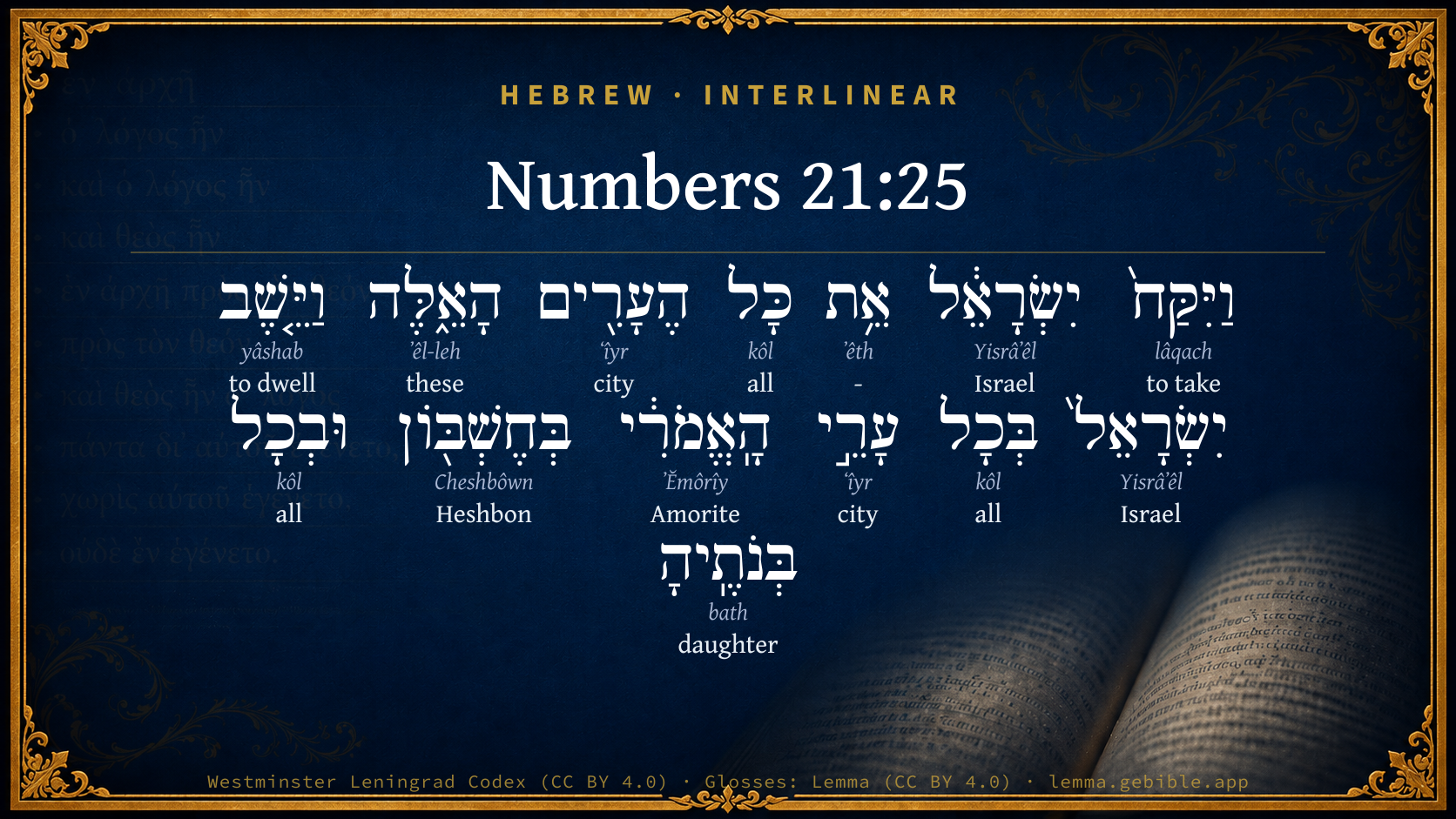
Hebrew (Westminster Leningrad Codex) Numbers 21:25 appears in the Hebrew Old Testament. The text above is from the Westminster Leningrad Codex. Each word links to its Strong’s number, a concise gloss, and parsing drawn from the Open Scriptures Hebrew Bible morphology. Click any word for its full Brown-Driver-Briggs (BDB) entry.
Download image
Cite this verse

Numbers 21:25 (World English Bible). Public Domain. Lemma interlinear Bible study tool, https://lemma.gebible.app/v/numbers/21/25.

Show BibTeX & RIS
BibTeX
RIS
English Translation
Israel took all these cities: and Israel lived in all the cities of the Amorites, in Heshbon, and in all the towns of it.
World English Bible · Public Domain
Highlights
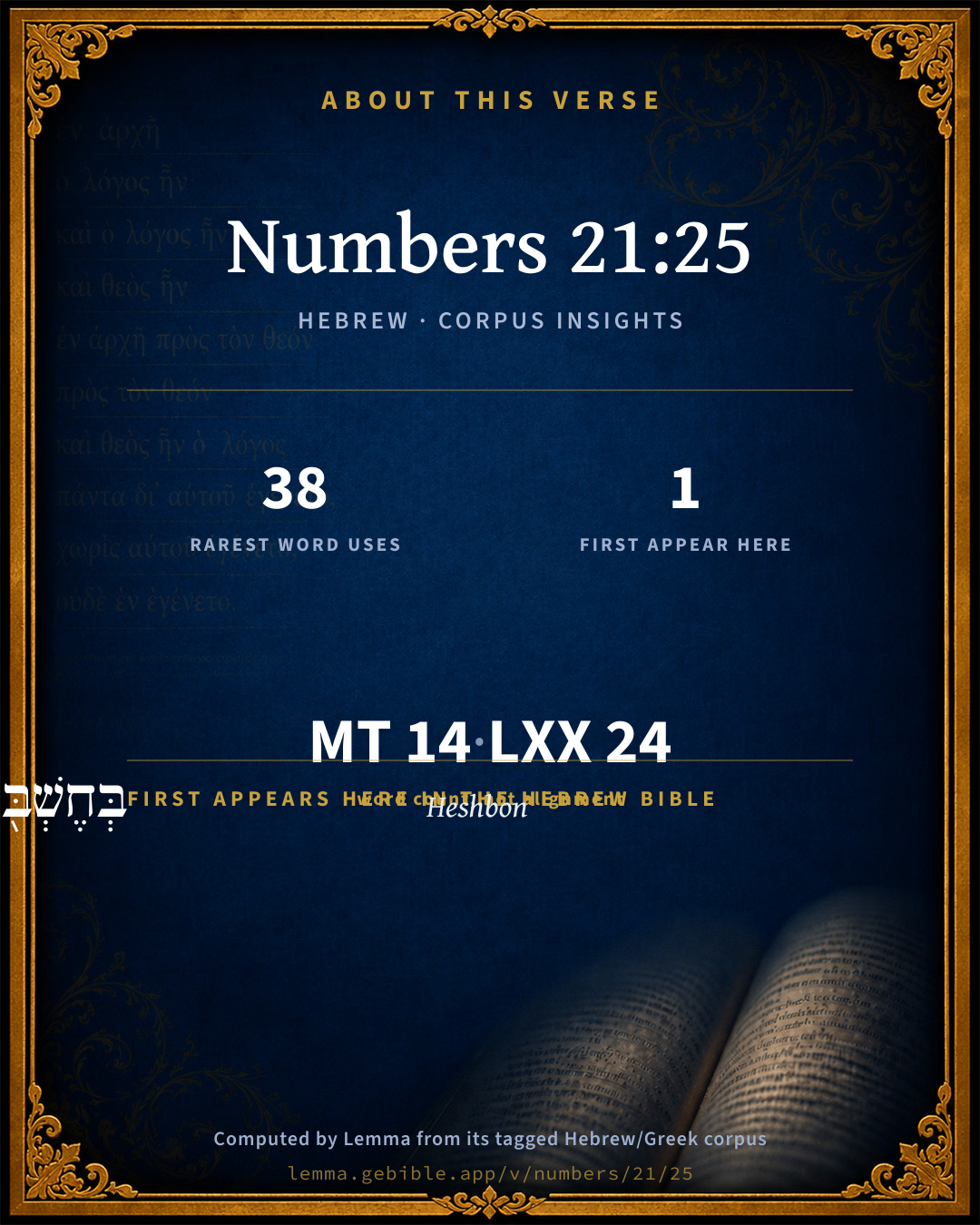
  • 1 first appearance in the Hebrew Bible
Full analysis ↓
Download a study sheet

One document with this verse’s original text, its word-by-word gloss line, the meaning frame, cross-references with their text, attributed commentary, and full source and license credits — printable, and it pastes into notes with its structure intact.

This verse Autodidact and up

Study sheet (.html) Plain text (.txt)

A passage Seminary Student

Up to 50 verses in one chapter. A passage sheet keeps up to 6 commentary sources and 12 cross-references per verse, in the order this page ranks them, and says so on the sheet whenever that leaves anything out. Ask for a single verse and you get the Autodidact verse sheet above.

Everything on this page stays free to read, with no account — the sheet is a download of what is already on screen, not access to it.

Want to remove ads? Support Godless Engineer
Compare translations 3

The same verse in 3 English versions, stacked beneath the original-language interlinear above. Click any original word for its lexicon entry.

Each is an independent rendering of the whole verse — the interlinear is not word-aligned to these translations.

Highlighted words mark where these versions differ — a whole-verse word diff, not a word-by-word alignment.

  • World English Bible Public Domain
    Israel took all these cities: and Israel lived in all the cities of the Amorites, in Heshbon, and in all the towns of it.
  • King James Version Public Domain
    And Israel took all these cities: and Israel dwelt in all the cities of the Amorites, in Heshbon, and in all the villages thereof.
  • unfoldingWord Literal Text CC BY-SA 4.0
    And Israel took all these cities, and Israel dwelled in all the cities of the Amorite, in Heshbon and in all its daughters.

unfoldingWord Literal Text — © unfoldingWord, licensed CC BY-SA 4.0. Word-aligned USFM3 via Door43 (git.door43.org/unfoldingWord/en_ult).

Versions to compare (up to 4)

3 of 4 selected

Show all 18 translations

Every available English version of this verse, each an independent rendering of the whole verse.

  • World English Bible Public Domain
    Israel took all these cities: and Israel lived in all the cities of the Amorites, in Heshbon, and in all the towns of it.
  • Berean Standard Bible Public Domain
    Israel captured all the cities of the Amorites and occupied them, including Heshbon and all its villages.
  • Majority Standard Bible Public Domain
    Israel captured all the cities of the Amorites and occupied them, including Heshbon and all its villages.
  • King James Version Public Domain
    And Israel took all these cities: and Israel dwelt in all the cities of the Amorites, in Heshbon, and in all the villages thereof.
  • American Standard Version (1901) Public Domain
    And Israel took all these cities: and Israel dwelt in all the cities of the Amorites, in Heshbon, and in all the towns thereof.
  • Revised Version (1885) Public Domain
    And Israel took all these cities: and Israel dwelt in all the cities of the Amorites, in Heshbon, and in all the towns thereof.
  • Geneva Bible (1599) Public Domain
    And Israel tooke al these cities, and dwelt in all the cities of the Amorites in Heshbon and in all the villages thereof.
  • Douay-Rheims (1899) Public Domain
    So Israel took all his cities, and dwelt in the cities of the Amorrhite, to wit, in Hesebon, and in the villages thereof.
  • Young's Literal Translation Public Domain
    And Israel taketh all these cities, and Israel dwelleth in all the cities of the Amorite, in Heshbon, and in all its villages;
  • Literal Standard Version CC BY-SA 4.0
    And Israel takes all these cities, and Israel dwells in all the cities of the Amorite, in Heshbon and in all its villages;
  • Unlocked Literal Bible CC BY-SA 4.0
    Israel took all the Amorite cities and lived in all of them, including Heshbon and all of its villages.
  • unfoldingWord Literal Text CC BY-SA 4.0
    And Israel took all these cities, and Israel dwelled in all the cities of the Amorite, in Heshbon and in all its daughters.
  • Darby Bible Public Domain
    And Israel took all these cities, and Israel dwelt in all the cities of the Amorites, at Heshbon, and in all its dependent villages.
  • World Messianic Bible Public Domain
    Israel took all these cities. Israel lived in all the cities of the Amorites, in Heshbon, and in all its villages.
  • Webster's Bible Public Domain
    And Israel took all these cities: and Israel dwelt in all the cities of the Amorites, in Heshbon, and in all its villages.
  • Free Bible Version CC BY-SA 4.0
    The Israelites conquered all the Amorite towns and took them over, including Heshbon and its surrounding villages.
  • Bible in Basic English Public Domain
    And Israel took all their towns, living in Heshbon and all the towns and small places of the Amorites.
  • JPS Tanakh (1917) Public Domain
    And Israel took all these cities; and Israel dwelt in all the cities of the Amorites, in Heshbon, and in all the towns thereof.

Literal Standard Version (2020), Covenant Press — licensed CC BY-SA 4.0. Text via the HelloAO Bible API (eBible.org). Unlocked Literal Bible (unfoldingWord) — licensed CC BY-SA 4.0. Text via the HelloAO Bible API (eBible.org). unfoldingWord Literal Text — © unfoldingWord, licensed CC BY-SA 4.0. Word-aligned USFM3 via Door43 (git.door43.org/unfoldingWord/en_ult). Free Bible Version, Dr. Jonathan Gallagher — licensed CC BY-SA 4.0. Text via the HelloAO Bible API (eBible.org).

Word by word

More ways to search: Search by grammar → Find every occurrence → Compare this word →

Practice this passage: Drill this verse → Learn its vocabulary →

בְּחֶשְׁבּ֖וֹן
Cheshbôwn
H2809
“in/at · Heshbon”
Preposition + Noun, Proper
Part of Speech
Preposition + Noun
Type
Proper
Full BDB Definition

Origin: the same as H2808

TWOT: None

Heshbon = "stronghold" - the capital city of Sihon, king of the Amorites, located on the western border of the high plain and on the border line between the tribes of Reuben and Gad
  1. וַיִּקַּח֙ lâqach H3947 “and · to take” Conjunction + Verb, Qal, Sequential Imperfect, 3rd Person, Masculine, Singular
  2. יִשְׂרָאֵ֔ל Yisrâʼêl H3478 “Israel” Noun, Proper
  3. אֵ֥ת ʼêth H853 “-” Particle, Direct Object
  4. כָּל kôl H3605 “all of” Noun, Common, Masculine, Singular, Construct
  5. הֶעָרִ֖ים ʻîyr H5892 “the · cities” Particle, Definite Article + Noun, Common, Feminine, Plural, Absolute
  6. הָאֵ֑לֶּה ʼêl-leh H428 “the · these” Particle, Definite Article + Pronoun, Demonstrative, Common, Plural
  7. וַיֵּ֤שֶׁב yâshab H3427 “and · to dwell” Conjunction + Verb, Qal, Sequential Imperfect, 3rd Person, Masculine, Singular
  8. יִשְׂרָאֵל֙ Yisrâʼêl H3478 “Israel” Noun, Proper
  9. בְּכָל kôl H3605 “in/at · all of” Preposition + Noun, Common, Masculine, Singular, Construct
  10. עָרֵ֣י ʻîyr H5892 “cities of” Noun, Common, Feminine, Plural, Construct
  11. הָֽאֱמֹרִ֔י ʼĔmôrîy H567 “the · Amorite” Particle, Definite Article + Noun, Gentilic, Masculine, Singular, Absolute
  12. וּבְכָל kôl H3605 “and · in/at · all of” Conjunction + Preposition + Noun, Common, Masculine, Singular, Construct
  13. בְּנֹתֶֽיהָ bath H1323 “daughters · her” Noun, Common, Feminine, Plural, Construct + Suffix, Personal, 3rd Person, Feminine, Singular

About this verse

These counts appear in no published source. They are computed here, from the morphology-tagged text and Lemma’s own curated glosses. What Lemma adds →

14
words
10
distinct lemmas
Pentateuch
section

First appearance in Scripture

This word makes its first canonical appearance in the Hebrew Bible here:

  • בְּחֶשְׁבּ֖וֹן Heshbon H2809

Shared distinctive vocabulary

בְּחֶשְׁבּ֖וֹן Heshbon H2809 occurs in 37 verses of the Hebrew Bible. Also found in:

Grammatical profile

  • 2 verbs
  • 10 nouns
  • 1 pronoun
  • 1 particle

Verb forms

  • וַיִּקַּח֙ Qal · Sequential Imperfect
  • וַיֵּ֤שֶׁב Qal · Sequential Imperfect

Repetition

Words recur within this verse — often emphatic in Hebrew:

  • כָּל all H3605 ×3
  • יִשְׂרָאֵ֔ל Israel H3478 ×2
  • הֶעָרִ֖ים city H5892 ×2

Hebrew & Septuagint length

In English translation the verse runs 24 words from the Hebrew and 25 from the Septuagint (LXX English) — closely comparable.

A rough comparison of the two English renderings, which tokenize alike — not a word-level alignment.

Word counts can differ between the Hebrew and the Greek without any difference in meaning — e.g. the Hebrew direct-object marker אֵת has no separate Greek word, and Greek often adds the article ὁ.

In the original languages it is 14 Hebrew tokens and 24 Greek tokens — but the two are counted differently (Hebrew bundles its prefixes and suffixes into one token; the Greek is in lemma form), so that isn’t a like-for-like length.

Cross-references

13

Topical passages linked to Numbers 21:25 in the Treasury of Scripture Knowledge — connected by theme and wording, ordered by reader-vote popularity; previews shown in the World English Bible.

  • Numbers 21:31 Thus Israel lived in the land of the Amorites.
  • Numbers 32:33–42 Moses gave to them, even to the children of Gad, and to the children of Reuben, and to the half-tribe of Manasseh the son of Joseph, the kingdom of Sihon king of the Amorites, and the kingdom of Og king of Bashan, the land, according to the cities of it with [their] borders, even the cities of the land round about.
  • Deuteronomy 2:12 The Horites also lived in Seir before, but the children of Esau succeeded them; and they destroyed them from before them, and lived in their place; as Israel did to the land of his possession, which Yahweh gave to them.)
  • Song of Solomon 7:4 Your neck is like an ivory tower. Your eyes are like the pools in Heshbon by the gate of Bath-rabbim; Your nose is like the tower of Lebanon which looks toward Damascus.
  • Isaiah 15:4 Heshbon cries out, and Elealeh; their voice is heard even to Jahaz: therefore the armed men of Moab cry aloud; his soul trembles within him.
  • Isaiah 16:8–9 For the fields of Heshbon languish, [and] the vine of Sibmah; the lords of the nations have broken down the choice branches of it, which reached even to Jazer, which wandered into the wilderness; its shoots were spread abroad, they passed over the sea.
  • Jeremiah 48:2 The praise of Moab is no more; in Heshbon they have devised evil against her: Come, and let us cut her off from being a nation. You also, Madmen, shall be brought to silence: the sword shall pursue you.
  • Jeremiah 48:34 From the cry of Heshbon even to Elealeh, even to Jahaz have they uttered their voice, from Zoar even to Horonaim, to Eglath Shelishiyah: for the waters of Nimrim also shall become desolate.
  • Jeremiah 48:45 Those who fled stand without strength under the shadow of Heshbon; for a fire is gone forth out of Heshbon, and a flame from the midst of Sihon, and has devoured the corner of Moab, and the crown of the head of the tumultuous ones.
  • Ezekiel 16:46 Your elder sister is Samaria, who dwells at your left hand, she and her daughters; and your younger sister, who dwells at your right hand, is Sodom and her daughters.
  • Ezekiel 16:49 Behold, this was the iniquity of your sister Sodom: pride, fullness of bread, and prosperous ease was in her and in her daughters; neither did she strengthen the hand of the poor and needy.
  • Ezekiel 16:53 I will turn again their captivity, the captivity of Sodom and her daughters, and the captivity of Samaria and her daughters, and the captivity of your captives in the midst of them;
  • Amos 2:10 Also I brought you up out of the land of Egypt, And led you forty years in the wilderness, To possess the land of the Amorite.

Cross-references courtesy of OpenBible.info (CC BY 4.0).

Hebrew and Greek witnesses Masoretic Hebrew ↔ Greek Septuagint

The same verse in the two great witnesses to the Old Testament, shown verse-for-verse.

These are two independent witnesses, not word-aligned to each other, and the Septuagint is shown in lemma (dictionary) form.

Hebrew Numbers 21:25 Masoretic · Westminster Leningrad Codex

וַיִּקַּח֙ יִשְׂרָאֵ֔ל אֵ֥ת כָּל הֶעָרִ֖ים הָאֵ֑לֶּה וַיֵּ֤שֶׁב יִשְׂרָאֵל֙ בְּכָל עָרֵ֣י הָֽאֱמֹרִ֔י בְּחֶשְׁבּ֖וֹן וּבְכָל בְּנֹתֶֽיהָ

Israel took all these cities: and Israel lived in all the cities of the Amorites, in Heshbon, and in all the towns of it.

World English Bible · Public Domain

Greek LXX Numbers 21:25 Septuagint · lemma form

καί λαμβάνω ἰσραήλ πᾶς ὁ πόλις οὗτος καί καταοἰκέω ἰσραήλ ἐν πᾶς ὁ πόλις ὁ ἀμορραῖος ἐν εσεβων καί ἐν πᾶς ὁ συνκυρόω αὐτός

And Israel took all their cities, and Israel lived in all the cities of the Amorites, in Esebon, and in all cities belonging to it.

LXX2012 (modern English Septuagint) · Public Domain

Hebrew: Westminster Leningrad Codex (CC BY 4.0). Greek: Septuagint (public domain); English from LXX2012 (modern English Septuagint) (Public Domain). How the Septuagint differs from the Hebrew →

Targum (Aramaic paraphrase)

2

The Targum is the ancient Jewish Aramaic paraphrase of the Hebrew Scriptures — an interpretive translation, not the Hebrew text itself. Onkelos (literal) and Pseudo-Jonathan (expansive) render the Torah, and Jonathan the Prophets. Coverage is partial: where no permissively-licensed English translation exists for a verse, only the Aramaic is shown. This is verse-level text, not a word-by-word alignment to the Hebrew.

  1. Targum Onkelos Torah (Genesis–Deuteronomy)
    וּכְבַשׁ יִשְׂרָאֵל יָת כָּל קִרְוַיָא הָאִלֵין וִיתֵיב יִשְׂרָאֵל בְּכָל קִרְוֵי אֱמוֹרָאָה בְּחֶשְׁבּוֹן וּבְכָל כַּפְרָנָהָא

    (no public-domain English translation for this verse)

    Targum Onkelos — Aramaic: “Onkelos Genesis” (public domain); “Onkelos Exodus” (public domain); “Onkelos Leviticus” (public domain); “Onkelos Numbers” (public domain); “Onkelos Deuteronomy” (public domain). English: “Sefaria Community Translation” (CC0 1.0 (public-domain dedication)); “J.W. Etheridge. The Targums of Onkelos and Jonathan Ben Uzziel on the Pentateuch. London: Longmans, Green, 1862” (public domain). Text via Sefaria.

  2. Targum Pseudo-Jonathan Torah (Genesis–Deuteronomy)
    וּנְסֵיב יִשְרָאֵל יַת כָּל קִרְוַיָא הָאִלֵין וִיתֵיב יִשְרָאֵל בְּכָל קִרְוֵי אֱמוֹרָאֵי בְּחֶשְׁבּוֹן וּבְכָל כַּפְרָנָהָא

    And Israel took all those cities, and dwelt in all the cities of the Amorites, in Heshbon, and in all her villages.

    Targum Pseudo-Jonathan — Aramaic: “Targum Jonathan on Genesis” (public domain); “Targum Jonathan on Exodus” (public domain); “Targum Jonathan on Leviticus” (public domain); “Targum Jonathan on Numbers” (public domain); “Targum Jonathan on Deuteronomy” (public domain). English: “The Targum of Jonathan ben Uzziel, trans. J. W. Etheridge, London, 1862” (public domain). Text via Sefaria.

Commentary

Notes on Numbers 21:25 from classic Christian and Jewish commentators (each source and its license shown beneath its notes). The classic Christian expositions comment on the surrounding passage and are grouped to its opening verse, so a note may address several verses; the Jewish commentaries on the Tanakh (Rashi and others) are per-verse, so they appear only where the commentator wrote on this verse.

Lemma curates 59 commentaries, every one of them public domain or Creative Commons licensed, each selected and text-cleaned for this edition rather than reprinted as found. About our sources →

Tyndale Open Study Notes

Tyndale Open Resources

21:25 The area conquered at this time became home to the tribes of Reuben, Gad, and Manasseh (cp. ch 32).

Tyndale Open Study Notes — © Tyndale Open Resources, licensed CC BY-SA 4.0. Text via the HelloAO Bible API.

Geneva Bible (1599)

Geneva Bible translators

Hebrew, daughters.

Geneva Bible (1599) marginal notes — public domain. Text via Bolls.life.

Jamieson, Fausset & Brown

Robert Jamieson, A. R. Fausset & David Brown

Israel dwelt in all the cities--after exterminating the inhabitants who had been previously doomed (Deu 2:34).

Jamieson, Fausset & Brown — Commentary Critical and Explanatory on the Whole Bible (1871) — public domain (CC PDM 1.0). Text via the HelloAO Bible API.

Ellicott's Commentary for English Readers

(25) And Israel dwelt in all the cities of the Amorites.—If, as appears most probable, this and the thirty-first verse form a part of the original narrative, the word which is rendered dwelt should be rendered sojourned, or abode, and understood, in accordance with the frequent use of the word (as, e.g., in Num_22:5; Num_22:8), of a temporary occupation or encampment. The permanent occupation of the eastern side of the Jordan by the Israelites was subsequent to the death of Moses.

A Bible Commentary for English Readers, edited by Charles John Ellicott (1878–1897) — public domain. Text from a community e-Sword module.

The Cambridge Bible for Schools and Colleges

gen. ed. J. J. S. Perowne

25. all the cities] No Amorite cities have as yet been mentioned. It is probable that a portion of the narrative, which must have contained a list of captured cities, has been lost.

the Amorites] The name Amurrâ occurs in Babylonian and Assyrian texts and in the Tell-el-Amarna tablets for the inhabitants of Syria and Palestine in general, before the time of the Exodus. But the natives whom the Israelites found in and around Palestine on their arrival were by no means homogeneous, and various names, such as Canaanites, Hittites, Hivites, Perizzites and others, frequently appear. The name ‘Amorite’ is sometimes used for the native inhabitants generally: see Gen_15:16; Gen_48:22, Jos_24:15, Amo_2:9, 1Ki_21:26, 2Ki_21:11. But sometimes it denotes natives in particular localities; e.g. in Canaan west of the Jordan (Jos_5:1; Jos_7:7); in the district afterwards occupied by Judah (Jos_10:5 f., 12, Jdg_1:34-36); in the Negeb and to the south and east of the Dead Sea (Gen_14:7, Deu_1:7; Deu_1:44). Most frequently, however, it denotes the inhabitants of the district east of the Jordan, under the rule of Sihon and Og. Whether they were the original inhabitants who had been driven out by Moab and Ammon, but had regained their footing under the leadership of these two kings, or whether they had only first gained their territory by driving out Moab and Ammon, we do not know.

Heshbon] The modern Ḥesbân, standing some 2940 feet above the sea, about 18 miles from the Jordan, opposite to Jericho.

all the towns thereof] R.V. marg. ‘daughters’ is the literal meaning of the Heb. The word denotes the small towns and villages near, and dependent upon, Heshbon; cf. Num_21:32, Num_32:42, Jdg_1:27.

The Cambridge Bible for Schools and Colleges (gen. ed. J. J. S. Perowne; Cambridge University Press, 1878–1918) — public domain. Text from a community e-Sword module.

John Gill's Exposition

For there is a fire gone out of Heshbon,.... Not before, but after Sihon had subdued it, as Jarchi observes; and is to be understood of his soldiers going out from thence, and making desolations in the adjacent parts, like a strong fire, and the fierce flames of it there is no resisting; and so the Jerusalem Targum,"for a people mighty, and burning like fire, are gone out of Heshbon:''see Amo 1:4, a flame from the city of Sihon: which is the same thing in other words, the city of Sihon being Heshbon, and a flame the same with fire; warriors, as both the Targums of Oakelos and Jerusalem interpret it; this seems to be what those composers undertook in their poetical way to foretell would be the case in future times; concluding, from the conquests already made, that they would be extended much further, and that no opposition could hinder:

it hath consumed Ar of Moab; the metropolis of the country of Moab, that is, they were as sure of it, and endeavoured to make the people by these their compositions as confident of it, that this city would fall into the hands of their armies, and be destroyed, as if it was already done; otherwise it does not appear that it ever was taken out of the hands of the Moabites, until taken by the Assyrians or Chaldeans; of this city See Gill on Isa 15:1.

and the lords of the high places of Arnon; who had the government of the high, strong, and fortified places all along the river Arnon; these it is suggested would be conquered by the Amorites; all the three Targums interpret it of the priests and worshippers in the temples, and at the altars of the idols in Arnon; and it may be rendered, "the Baals of the high places of Arnon", as if the gods of those places should fall into the victors' hands; and which seems to have some confirmation from what follows; and it may be observed, that in these parts there were some places called Bamoth Baal, or the high places of Baal, see Num 22:41, and Beth Baal Meon, which has its name from its being the temple and habitation of Baal, Jos 13:17.

John Gill's Exposition of the Whole Bible (1746–1763) — public domain (CC PDM 1.0). Text via the HelloAO Bible API.

Albert Barnes' Notes on the Bible

Heshbon - Now Heshban, a ruined city, due east of the point where the Jordan enters the Dead Sea; conspicuous from all parts of the high plateau on which it stands, but concealed, like the rest of the plateau, from the valley beneath.

Albert Barnes' Notes on the Bible (1834–1885) — public domain. Text from a community e-Sword/MySword module.

Matthew Poole's English Annotations

Having destroyed the ancient inhabitants, Deu 2:34.

Matthew Poole's English Annotations on the Holy Bible (1683–1685) — public domain. Text from a community e-Sword/MySword module.

Whedon's Commentary on the Bible

Daniel D. Whedon

25. Heshbon — See Jos_13:17, note.

Villages — Hebrew, daughters, that is, lesser towns.

Daniel D. Whedon (gen. ed.), Commentary on the Old and New Testaments (1874–1909) — public domain. Text from a community e-Sword module.

The Pulpit Commentary

And Israel dwelt in all the cities of the Amorites. The territory overrun at this time was about fifty miles north and south, by nearly thirty east and west. It was not permanently occupied until a somewhat later period; (Num_32:33) but we may suppose that the flocks and herds, with sufficient forces to guard them, spread themselves at once over the broad pasture lands. Heshbon, and all the villages, thereof. Literally, "the daughters thereof. By a similar figure we speak of a "mother city." Heshbon occupied a central position in the kingdom of Sihon, half way between Arnon and Jabbok, and about eighteen miles eastward of the point where Jordan falls into the Salt Lake; it stood on a table-land nearly 3000 feet above the sea, and had been made his city (i.e. his capital) by Sihon at the time of his victories over Moab.

The Pulpit Commentary (1880–1919), ed. H.D.M. Spence-Jones & Joseph S. Exell — public domain. Text from a community e-Sword module.

Rashi

Rabbi Shlomo Yitzchaki (Rashi)

בנתיה (lit., its daughters) — the villages adjacent to it.

Rashi on the Tanakh — English translations: “The Judaica Press complete Tanach with Rashi, translated by A. J. Rosenberg” (CC BY 4.0); “Pentateuch with Rashi's commentary by M. Rosenbaum and A.M. Silbermann, 1929-1934” (public domain); “The Metsudah Tanach series, Lakewood, N.J” (CC BY 4.0); and “The Book of Joshua, Metsudah Publications, 1997” (CC BY 4.0). Text via Sefaria.

Lesson kit

Teaching starters — assembled from the data on this page, not authored interpretation. Every prompt links to the verse data it draws on. Edit before teaching.

Numbers, in the Pentateuch, opens this verse with 14 words (10 distinct Hebrew lemmas). Its most distinctive word is Cheshbôwn (“Heshbon”). A historical commentator’s framing appears above. Read the whole chapter for the surrounding context.

Discussion questions

  1. How does “Heshbon” (Cheshbôwn) shape what this verse is saying?
  2. The word “Heshbon” first appears here in Scripture. What is being introduced at this debut?
  3. Numbers 21:26 shares the word «Heshbon» with this verse. How do the two illuminate each other?
  4. “all” occurs 3× in this one verse. What is the effect of the repetition?
  5. These translations render this verse differently; the difference is in the English rendering, not the original. What questions does that raise?
  6. The verb «וַיִּקַּח֙» is Qal Sequential Imperfect. How does its form color the action?
  7. Reading how Tyndale Open Study Notes and Geneva Bible (1599) read this verse, where do the two commentators agree and where do they part?

Things to notice

Reading settings

Reading text

Shown beneath each verse's original-language words.

Old Testament
Old Testament edition

Read the OT as the Masoretic Hebrew (MT) or the Greek Septuagint (LXX).

English shown for the Greek Septuagint (in the Hebrew ↔ Greek comparison).

Comparing translations? Open the Compare panel on any verse page to stack up to four side by side.