Isaiah 1:8

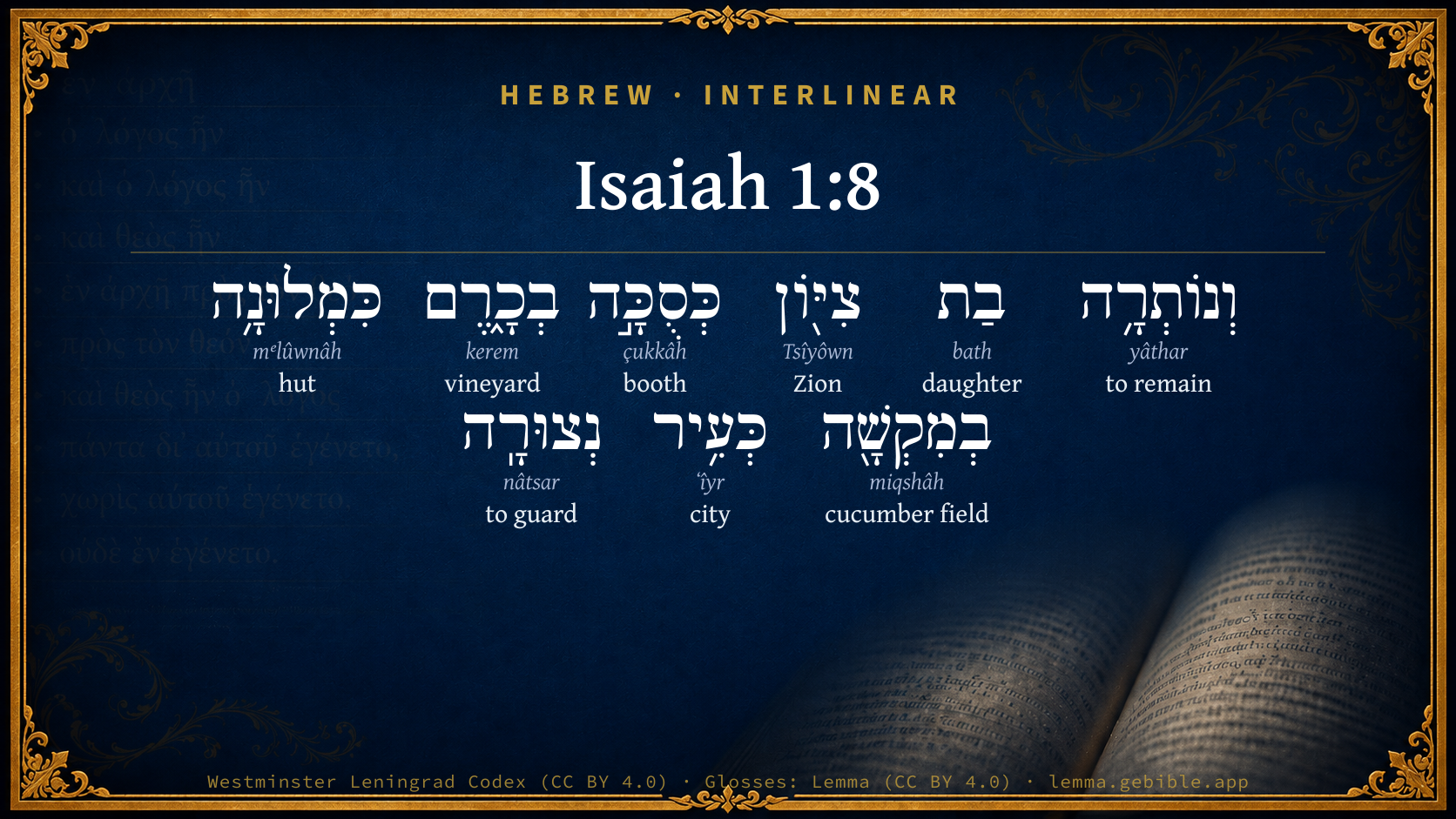
Hebrew (Westminster Leningrad Codex) Isaiah 1:8 appears in the Hebrew Old Testament. The text above is from the Westminster Leningrad Codex. Each word links to its Strong’s number, a concise gloss, and parsing drawn from the Open Scriptures Hebrew Bible morphology. Click any word for its full Brown-Driver-Briggs (BDB) entry.
Download image
Cite this verse

Isaiah 1:8 (World English Bible). Public Domain. Lemma interlinear Bible study tool, https://lemma.gebible.app/v/isaiah/1/8.

Show BibTeX & RIS
BibTeX
RIS
English Translation
The daughter of Zion is left like a shelter in a vineyard, Like a hut in a field of melons, Like a besieged city.
World English Bible · Public Domain
Highlights
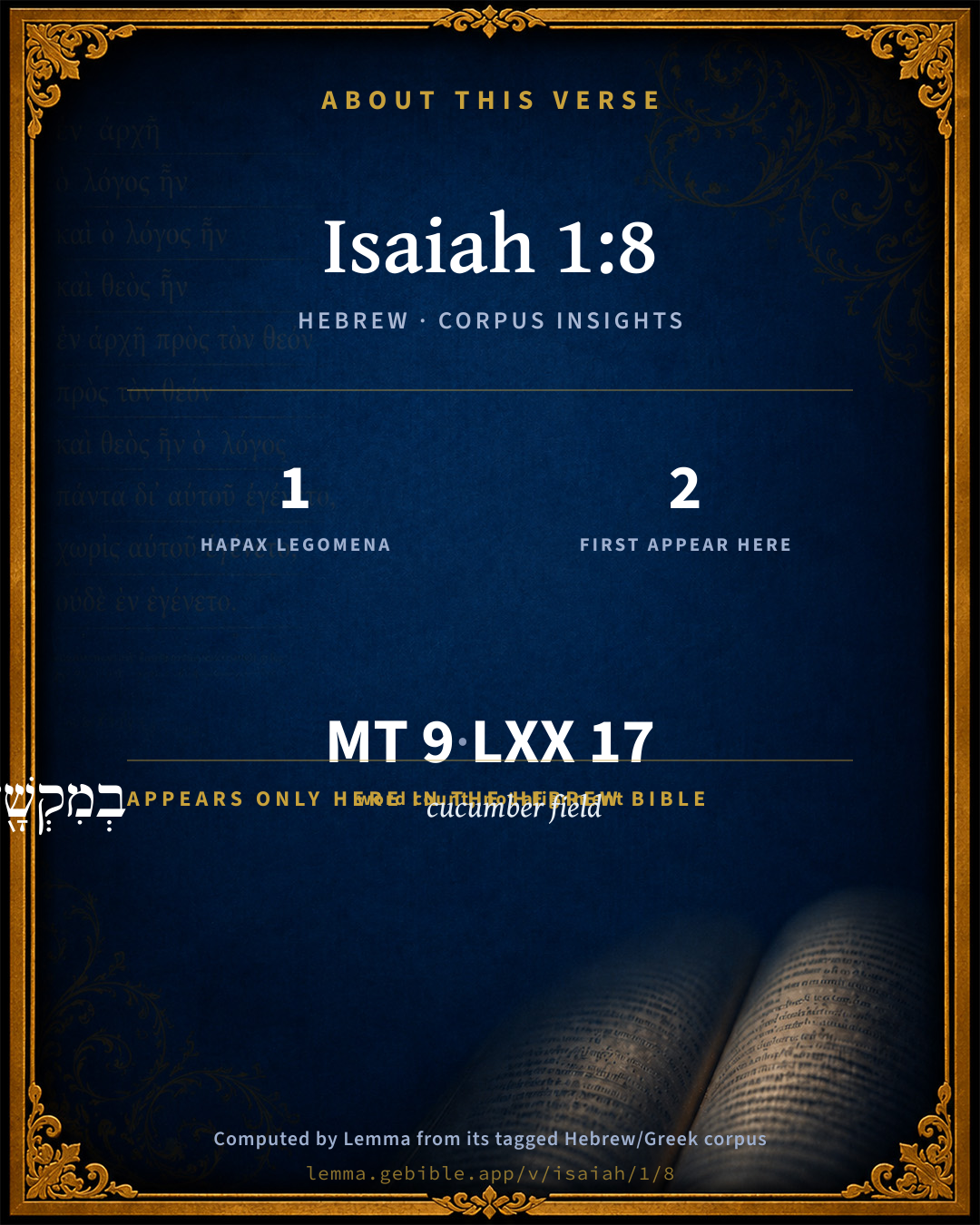
  • 1 hapax legomenon — only here in the Hebrew Bible
  • 2 first appearances in the Hebrew Bible
Full analysis ↓
Download a study sheet

One document with this verse’s original text, its word-by-word gloss line, the meaning frame, cross-references with their text, attributed commentary, and full source and license credits — printable, and it pastes into notes with its structure intact.

This verse Autodidact and up

Study sheet (.html) Plain text (.txt)

A passage Seminary Student

Up to 50 verses in one chapter. A passage sheet keeps up to 6 commentary sources and 12 cross-references per verse, in the order this page ranks them, and says so on the sheet whenever that leaves anything out. Ask for a single verse and you get the Autodidact verse sheet above.

Everything on this page stays free to read, with no account — the sheet is a download of what is already on screen, not access to it.

Want to remove ads? Support Godless Engineer
Compare translations 3

The same verse in 3 English versions, stacked beneath the original-language interlinear above. Click any original word for its lexicon entry.

Each is an independent rendering of the whole verse — the interlinear is not word-aligned to these translations.

Highlighted words mark where these versions differ — a whole-verse word diff, not a word-by-word alignment.

  • World English Bible Public Domain
    The daughter of Zion is left like a shelter in a vineyard, Like a hut in a field of melons, Like a besieged city.
  • King James Version Public Domain
    And the daughter of Zion is left as a cottage in a vineyard, as a lodge in a garden of cucumbers, as a besieged city.
  • unfoldingWord Literal Text CC BY-SA 4.0
    And the daughter of Zion is left like a booth in a vineyard, like a hut in a cucumber field, like a besieged city.

unfoldingWord Literal Text — © unfoldingWord, licensed CC BY-SA 4.0. Word-aligned USFM3 via Door43 (git.door43.org/unfoldingWord/en_ult).

Versions to compare (up to 4)

3 of 4 selected

Show all 18 translations

Every available English version of this verse, each an independent rendering of the whole verse.

  • World English Bible Public Domain
    The daughter of Zion is left like a shelter in a vineyard, Like a hut in a field of melons, Like a besieged city.
  • Berean Standard Bible Public Domain
    And the Daughter of Zion is abandoned like a shelter in a vineyard, like a shack in a cucumber field, like a city besieged.
  • Majority Standard Bible Public Domain
    And the Daughter of Zion is abandoned like a shelter in a vineyard, like a shack in a cucumber field, like a city besieged.
  • King James Version Public Domain
    And the daughter of Zion is left as a cottage in a vineyard, as a lodge in a garden of cucumbers, as a besieged city.
  • American Standard Version (1901) Public Domain
    And the daughter of Zion is left as a booth in a vineyard, as a lodge in a garden of cucumbers, as a besieged city.
  • Revised Version (1885) Public Domain
    And the daughter of Zion is left as a booth in a vineyard, as a lodge in a garden of cucumbers, as a besieged city.
  • Geneva Bible (1599) Public Domain
    And the daughter of Zion shall remaine like a cotage in a vineyarde, like a lodge in a garden of cucumbers, and like a besieged citie.
  • Douay-Rheims (1899) Public Domain
    And the daughter of Sion shall be left as a covert in a vineyard, and as a lodge in a garden of cucumbers, and as a city that is laid waste.
  • Young's Literal Translation Public Domain
    And left hath been the daughter of Zion, As a booth in a vineyard, As a lodge in a place of cucumbers -- as a city besieged.
  • Literal Standard Version CC BY-SA 4.0
    And the daughter of Zion has been left, || As a shelter in a vineyard, || As a lodge in a place of cucumbers—as a city besieged.
  • Unlocked Literal Bible CC BY-SA 4.0
    The daughter of Zion is left like a hut in a vineyard, like a shed in a garden of cucumbers, like a besieged city.
  • unfoldingWord Literal Text CC BY-SA 4.0
    And the daughter of Zion is left like a booth in a vineyard, like a hut in a cucumber field, like a besieged city.
  • Darby Bible Public Domain
    And the daughter of Zion is left, as a booth in a vineyard, as a night-lodge in a cucumber-garden, as a besieged city.
  • World Messianic Bible Public Domain
    The daughter of Zion is left like a shelter in a vineyard, like a hut in a field of melons, like a besieged city.
  • Webster's Bible Public Domain
    And the daughter of Zion is left as a cottage in a vineyard, as a lodge in a garden of cucumbers, as a besieged city.
  • Free Bible Version CC BY-SA 4.0
    The daughter of Zion is left like a shack in a vineyard, like a hut in a cucumber field, like a city under attack.
  • Bible in Basic English Public Domain
    And the daughter of Zion has become like a tent in a vine-garden, like a watchman's house in a field of fruit, like a town shut in by armies.
  • JPS Tanakh (1917) Public Domain
    And the daughter of Zion is left as a booth in a vineyard, as a lodge in a garden of cucumbers, as a besieged city.

Literal Standard Version (2020), Covenant Press — licensed CC BY-SA 4.0. Text via the HelloAO Bible API (eBible.org). Unlocked Literal Bible (unfoldingWord) — licensed CC BY-SA 4.0. Text via the HelloAO Bible API (eBible.org). unfoldingWord Literal Text — © unfoldingWord, licensed CC BY-SA 4.0. Word-aligned USFM3 via Door43 (git.door43.org/unfoldingWord/en_ult). Free Bible Version, Dr. Jonathan Gallagher — licensed CC BY-SA 4.0. Text via the HelloAO Bible API (eBible.org).

Word by word

More ways to search: Search by grammar → Find every occurrence → Compare this word →

Practice this passage: Drill this verse → Learn its vocabulary →

בְמִקְשָׁ֖ה
miqshâh
H4750
“in/at · cucumber field”
Preposition + Noun, Common, Feminine, Singular, Absolute
Part of Speech
Preposition + Noun
Type
Common
Gender
Feminine
Number
Singular
State
Absolute
Full BDB Definition

Origin: denominative from H7180

TWOT: 2083b

place or field of cucumbers
  1. וְנוֹתְרָ֥ה yâthar H3498 “and · to remain” Conjunction + Verb, Niphal, Perfect, 3rd Person, Feminine, Singular
  2. בַת bath H1323 “daughter of” Noun, Common, Feminine, Singular, Construct
  3. צִיּ֖וֹן Tsîyôwn H6726 “Zion” Noun, Proper
  4. כְּסֻכָּ֣ה çukkâh H5521 “like/as · booth” Preposition + Noun, Common, Feminine, Singular, Absolute
  5. בְכָ֑רֶם kerem H3754 “in/at · vineyard” Preposition + Noun, Common, Both, Singular, Absolute
  6. כִּמְלוּנָ֥ה mᵉlûwnâh H4412 “like/as · hut” Preposition + Noun, Common, Feminine, Singular, Absolute
  7. כְּעִ֥יר ʻîyr H5892 “like/as · city” Preposition + Noun, Common, Feminine, Singular, Absolute
  8. נְצוּרָֽה nâtsar H5341 “guarded” Verb, Qal, Participle Passive, Feminine, Singular, Absolute

About this verse

These counts appear in no published source. They are computed here, from the morphology-tagged text and Lemma’s own curated glosses. What Lemma adds →

9
words
9
distinct lemmas
Prophets
section

Notable vocabulary

1 hapax legomenon — a word that appears only here in the entire Hebrew Bible:

  • בְמִקְשָׁ֖ה cucumber field H4750

First appearance in Scripture

These words make their first canonical appearance in the Hebrew Bible here:

  • כִּמְלוּנָ֥ה hut H4412
  • בְמִקְשָׁ֖ה cucumber field H4750

Shared distinctive vocabulary

כִּמְלוּנָ֥ה hut H4412 occurs in 2 verses of the Hebrew Bible. Also found in:

Grammatical profile

  • 2 verbs
  • 7 nouns

Verb forms

  • וְנוֹתְרָ֥ה Niphal · Perfect
  • נְצוּרָֽה Qal · Participle Passive

Hebrew & Septuagint length

In English translation the verse runs 24 words from the Hebrew and 28 from the Septuagint (LXX English) — closely comparable.

A rough comparison of the two English renderings, which tokenize alike — not a word-level alignment.

Word counts can differ between the Hebrew and the Greek without any difference in meaning — e.g. the Hebrew direct-object marker אֵת has no separate Greek word, and Greek often adds the article ὁ.

In the original languages it is 9 Hebrew tokens and 17 Greek tokens — but the two are counted differently (Hebrew bundles its prefixes and suffixes into one token; the Greek is in lemma form), so that isn’t a like-for-like length.

Cross-references

14

Topical passages linked to Isaiah 1:8 in the Treasury of Scripture Knowledge — connected by theme and wording, ordered by reader-vote popularity; previews shown in the World English Bible.

  • Zechariah 9:9 Rejoice greatly, daughter of Zion! Shout, daughter of Jerusalem! Behold, your king comes to you! He is righteous, and having salvation; Lowly, and riding on a donkey, Even on a colt, the foal of a donkey.
  • John 12:15 "Don't be afraid, daughter of Zion. Behold, your King comes, sitting on a donkey's colt."
  • Zechariah 2:10 Sing and rejoice, daughter of Zion; for, behold, I come, and I will dwell in the midst of you,' says Yahweh.
  • Isaiah 62:11 Behold, Yahweh has proclaimed to the end of the earth, Say you to the daughter of Zion, Behold, your salvation comes; behold, his reward is with him, and his recompense before him.
  • Isaiah 10:32 This very day shall he halt at Nob: he shakes his hand at the mountain of the daughter of Zion, the hill of Jerusalem.
  • Lamentations 2:6 He has violently taken away his tent, as if it were of a garden; he has destroyed his place of assembly: Yahweh has caused solemn assembly and Sabbath to be forgotten in Zion, Has despised in the indignation of his anger the king and the priest.
  • Job 27:18 He builds his house as the moth, As a booth which the watchman makes.
  • Psalms 9:14 That I may show forth all your praise. In the gates of the daughter of Zion, I will rejoice in your salvation.
  • Isaiah 4:4 when the Lord shall have washed away the filth of the daughters of Zion, and shall have purged the blood of Jerusalem from its midst, by the spirit of justice, and by the spirit of burning.
  • Isaiah 37:22 this is the word which Yahweh has spoken concerning him: The virgin daughter of Zion has despised you and ridiculed you; the daughter of Jerusalem has shaken her head at you.
  • Lamentations 2:1 How has the Lord covered the daughter of Zion with a cloud in his anger! He has cast down from heaven to the earth the beauty of Israel, And hasn't remembered his footstool in the day of his anger.
  • Isaiah 8:8 and it shall sweep onward into Judah; it shall overflow and pass through; it shall reach even to the neck; and the stretching out of its wings shall fill the breadth of your land, Immanuel.
  • Jeremiah 4:17 As keepers of a field are they against her round about, because she has been rebellious against me, says Yahweh.
  • Luke 19:43–44 For the days will come on you, when your enemies will throw up a barricade against you, surround you, hem you in on every side,

Cross-references courtesy of OpenBible.info (CC BY 4.0).

Hebrew and Greek witnesses Masoretic Hebrew ↔ Greek Septuagint

The same verse in the two great witnesses to the Old Testament, shown verse-for-verse.

These are two independent witnesses, not word-aligned to each other, and the Septuagint is shown in lemma (dictionary) form.

Hebrew Isaiah 1:8 Masoretic · Westminster Leningrad Codex

וְנוֹתְרָ֥ה בַת צִיּ֖וֹן כְּסֻכָּ֣ה בְכָ֑רֶם כִּמְלוּנָ֥ה בְמִקְשָׁ֖ה כְּעִ֥יר נְצוּרָֽה

The daughter of Zion is left like a shelter in a vineyard, Like a hut in a field of melons, Like a besieged city.

World English Bible · Public Domain

Greek LXX Isaiah 1:8 Septuagint · lemma form

ἐν καταλείπω ὁ θυγάτηρ σιων ὡς σκηνή ἐν ἀμπελών καί ὡς ὀπωροφυλάκιον ἐν σικυήρατον ὡς πόλις πολιορκέω

The daughter of Sion shall be deserted as a tent in a vineyard, and as a storehouse of fruits in a garden of cucumbers, as a besieged city.

LXX2012 (modern English Septuagint) · Public Domain

On this verse, Adam Clarke's Commentary discusses the Septuagint’s reading. Read the note in Commentary ↓

Hebrew: Westminster Leningrad Codex (CC BY 4.0). Greek: Septuagint (public domain); English from LXX2012 (modern English Septuagint) (Public Domain). How the Septuagint differs from the Hebrew →

Targum (Aramaic paraphrase)

1

The Targum is the ancient Jewish Aramaic paraphrase of the Hebrew Scriptures — an interpretive translation, not the Hebrew text itself. Onkelos (literal) and Pseudo-Jonathan (expansive) render the Torah, and Jonathan the Prophets. Coverage is partial: where no permissively-licensed English translation exists for a verse, only the Aramaic is shown. This is verse-level text, not a word-by-word alignment to the Hebrew.

  1. Targum Jonathan Prophets (Joshua–Malachi)
    וְאִשְׁתְּאַרַת כְּנִשְׁתָּא דְצִיוֹן כְּמִטַלַלְתָּא בְּכַרְמָא בָּתַר דְקַטְפוּהִי כְּעַרְסַל מַבְּתּוּתָא בְּמִקְשַׁיָא בָּתַר דִאַבְעָיוּהִי כְּקַרְתָּא דְצָיְרִין עֲלָהּ:

    The congregation of Zion is left as a booth in a vineyard after they have gathered the grapes; as a lodge for passing the night in, in a garden of cucumbers after they have gleaned it; as a city against which they lay siege.

    Targum Jonathan — Aramaic: “Mikraot Gedolot” (public domain). English: “Sefaria Community Translation” (CC0 1.0 (public-domain dedication)); “London "Chaldee Paraphrase," 1871” (public domain). Text via Sefaria.

Commentary

Notes on Isaiah 1:8 from classic Christian and Jewish commentators (each source and its license shown beneath its notes). The classic Christian expositions comment on the surrounding passage and are grouped to its opening verse, so a note may address several verses; the Jewish commentaries on the Tanakh (Rashi and others) are per-verse, so they appear only where the commentator wrote on this verse.

Lemma curates 59 commentaries, every one of them public domain or Creative Commons licensed, each selected and text-cleaned for this edition rather than reprinted as found. About our sources →

Trapp's Complete Commentary

John Trapp

Isa 1:8 And the daughter of Zion is left as a cottage in a vineyard, as a lodge in a garden of cucumbers, as a besieged city.

Ver. 8. And the daughter of Zion.] Jerusalem, which is called the daughter of Zion, say some, because standing at the foot of that hill as a daughter; it comes out from between the feet, being also cherished and tendered by God as his daughter. Howbeit, as dear as she was to him, she fell into deep distress when she became undutiful. Abused mercy turneth into fury.

Is left as a cottage in a vineyard.] As a shed or booth, whereof after the vintage there is little use or regard.

As a lodge in a garden of cucumbers.] Or, Melons, which, when ripe, lie on the ground. So, saith one, do God’s ripest and best servants, being humble, and meanly conceited of themselves.

As a besieged city.] Besieged, though at a distance; as Rome was at the time when Saguntum was beleagured.

John Trapp, A Commentary or Exposition upon All the Books of the Old and New Testament (1647–1656) — public domain. Text from a community e-Sword module.

Albert Barnes' Notes on the Bible

And the daughter of Zion - Zion, or Sion, was the name of one of the hills on which the city of Jerusalem was built. On this hill formerly stood the city of the Jebusites, and when David took it from them he transferred to it his court, and it was called the city of David, or the holy hill. It was in the southern part of the city. As Zion became the residence of the court, and was the most important part of the city, the name was often used to denote the city itself, and is often applied to the whole of Jerusalem. The phrase ‘daughter of Zion’ here means Zion itself, or Jerusalem. The name daughter is given to it by a personification in accordance with a common custom in Eastern writers, by which beautiful towns and cities are likened to young females. The name mother is also applied in the same way. Perhaps the custom arose from the fact that when a city was built, towns and villages would spring up round it - and the first would be called the mother-city (hence, the word metropolis). The expression was also employed as an image of beauty, from a fancied resemblance between a beautiful town and a beautiful and well-dressed woman. Thus Psa 45:13, the phrase daughter of Tyre, means Tyre itself; Psa 137:8, daughter of Babylon, that is, Babylon; Isa 37:22, ‘The virgin, the daughter of Zion;’ Jer 46:2; Isa 23:12; Jer 14:17; Num 21:23, Num 21:32, (Hebrew); Jdg 11:26. Is left. נותרה nôtherâh. The word used here denotes left as a part or remnant is left - not left entire, or complete, but in a weakened or divided state.

As a cottage - literally, “a shade,” or “shelter” - כסכה kesûkkâh, a temporary habitation erected in vineyards to give shelter to the grape gatherers, and to those who were uppointed to watch the vineyard to guard it from depredations; compare the note at Mat 21:33. The following passage from Mr. Jowett’s ‘Christian Researches,’ describing what he himself saw, will throw light on this verse. ‘Extensive fields of ripe melons and cucumbers adorned the sides of the river (the Nile). They grew in such abundance that the sailors freely helped themselves. Some guard, however, is placed upon them. Occasionally, but at long and desolate intervals, we may observe a little hut, made of reeds, just capable of containing one man; being in fact little more than a fence against a north wind. In these I have observed, sometimes, a poor old man, perhaps lame, protecting the property. It exactly illustrates Isa 1:8.’ ‘Gardens were often probably unfenced, and formerly, as now, esculent vegetables were planted in some fertile spot in the open field. A custom prevails in Hindostan, as travelers inform us, of planting in the commencement of the rainy season, in the extensive plains, an abundance of melons, cucumbers, gourds, etc. In the center of the field is an artificial mound with a hut on the top, just large enough to shelter a person from the storm and the heat;’ Bib. Dic. A.S.U. The sketch in the book will convey a clear idea of such a cottage. Such a cottage would be designed only for a temporary habitation. So Jerusalem seemed to be left amidst the surrounding desolation as a temporary abode, soon to be destroyed.

As a lodge - The word lodge here properly denotes a place for passing the night, but it means also a temporary abode. It was erected to afford a shelter to those who guarded the enclosure from thieves, or from jackals, and small foxes. ‘The jackal,’ says Hasselquist, ‘is a species of mustela, which is very common in Palestine, especially during the vintage, and often destroys whole vineyards, and gardens of cucumbers.’

A garden of cucumbers - The word cucumbers here probably includes every thing of the melon kind, as well as the cucumber. They are in great request in that region on account of their cooling qualities, and are produced in great abundance and perfection. These things are particularly mentioned among the luxuries which the Israelites enjoyed in Egypt, and for which they sighed when they were in the wilderness. Num 11:5 : ‘We remember - the cucumbers and the melons,’ etc. The cucumber which is produced in Egypt and Palestine is large - usually a foot in length, soft, tender, sweet, and easy of digestion (Gesenius), and being of a cooling nature, was especially delicious in their hot climate. The meaning here is, that Jerusalem seemed to be left as a temporary, lonely habitation, soon to be forsaken and destroyed.

As a besieged city - נצוּרה כעיר ke‛ı̂yr netsôrâh. Lowth. ‘As a city taken by siege.’ Noyes. “‘So is the delivered city.’ This translation was first proposed by Arnoldi of Marburg. It avoids the incongruity of comparing a city with a city, and requires no alteration of the text except a change of the vowel points. According to this translation, the meaning will be, that all things round about the city lay desolate, like the withered vines of a cucumber garden around the watchman’s hut; in other words, that the city alone stood safe amidst the ruins caused by the enemy, like the hut in a gathered garden of cucumber.” Noyes. According to this interpretation, the word נצוּרה netsôrâh is derived not from צור tsûr, to besiege, to press, to straiten; but from נצר nâtsar, to preserve, keep, defend; compare Eze 6:12. The Hebrew will bear this translation; and the concinnity of the comparison will thus be preserved. I rather prefer, however, the common interpretation, as being more obviously the sense of the Hebrew, and as being sufficiently in accordance with the design of the prophet. The idea then is, that of a city straitened by a siege, yet standing as a temporary habitation, while all the country around was lying in ruins. Jerusalem, alone preserved amidst the desolation spreading throughout the land, will resemble a temporary lodge in the garden - itself soon to be removed or destroyed. The essential idea, whatever translation is adopted, is that of the solitude, loneliness, and temporary continuance of even Jerusalem, while all around was involved in desolation and ruin.

Albert Barnes' Notes on the Bible (1834–1885) — public domain. Text from a community e-Sword/MySword module.

The Biblical Illustrator

Joseph S. Exell

Isa_1:8

A cottage in a vineyard

A lodge in a garden

The true point of the comparison will not appear until the crop is over, and the lodge forsaken by the keeper.

Then the poles fall down or lean every way, and those green boughs with which it is shaded will have been scattered by the wind leaving only a ragged, sprawling wreck,--a most affecting type of utter desolation--as Sodom, and like unto Gomorrah. (Thomsons The, Land and the Book. )

The Biblical Illustrator, edited by Joseph S. Exell (c. 1880s–1900s) — public domain. Text from a community e-Sword module.

Keil & Delitzsch

C. F. Keil & F. Delitzsch

"And the daughter of Zion remains lie a hut in a vineyard; like a hammock in a cucumber field." The vineyard and cucumber field (mikshah, from kisshu, a cucumber, Cucumis, not a gourd, Cucurbita; at least not the true round gourd, whose Hebrew name, dalâth, does not occur in the Old Testament) are pictured by the prophet in their condition before the harvest (not after, as the Targums render it), when it is necessary that they should be watched. The point of comparison therefore is, that in the vineyard and cucumber field not a human being is to be seen in any direction; and there is nothing but the cottage and the night barrack or hammock (cf., Job 27:18) to show that there are any human beings there at all. So did Jerusalem stand in the midst of desolation, reaching far and wide - a sign, however, that the land was not entirely depopulated. But what is the meaning of the third point of comparison? Hitzig renders it, "like a watch-tower;" Knobel, "like a guard-city." But the noun neither means a tower nor a castle (although the latter would be quite possible, according to the primary meaning, Cingere); and nezurâh does not mean "watch" or "guard." On the other hand, the comparison indicated (like, or as) does not suit what would seem the most natural rendering, viz., "like a guarded city," i.e., a city shielded from danger. Moreover, it is inadmissible to take the first two Caphs in the sense of sicut (as) and the third in the sense of sic (so); since, although this correlative is common in clauses indicating identity, it is not so in sentences which institute a simple comparison. We therefore adopt the rendering, Isa 1:8, "As a besieged city," deriving nezurâh not from zur, niphal nâzor (never used), as Luzzatto does, but from nâzar, which signifies to observe with keen eye, either with a good intention, or, as in Job 7:20, for a hostile purpose. It may therefore be employed, like the synonyms in Sa2 11:16 and Jer 5:6, to denote the reconnoitring of a city. Jerusalem was not actually blockaded at the time when the prophet uttered his predictions; but it was like a blockaded city. In the case of such a city there is a desolate space, completely cleared of human beings, left between it and the blockading army, in the centre of which the city itself stands solitary and still, shut up to itself. The citizens do not venture out; the enemy does not come within the circle that immediately surrounds the city, for fear of the shots of the citizens; and everything within this circle is destroyed, either by the citizens themselves, to prevent the enemy from finding anything useful, or else by the enemy, who cut down the trees. Thus, with all the joy that might be felt at the preservation of Jerusalem, it presented but a gloomy appearance. It was, as it were, in a state of siege. A proof that this is the way in which the passage is to be explained, may be found in Jer 4:16-17, where the actual storming of Jerusalem is foretold, and the enemy is called nozerim, probably with reference to the simile before us.

Keil & Delitzsch — Biblical Commentary on the Old Testament (1861–1891) — public domain (CC PDM 1.0). Text via the HelloAO Bible API. (Old Testament only.)

Tyndale Open Study Notes

Tyndale Open Resources

1:8 Beautiful Jerusalem (Hebrew The daughter of Zion): Zion, one of the hills on which Jerusalem stands, often served as a synonym for Jerusalem. Zion carried with it the notion of God’s presence (Ps 46), his protection of his people, and Jerusalem’s resistance to enemy forces. Now, however, the opposite was true. Jerusalem had become weak, like a helpless city under siege and like an abandoned . . . shelter or lean-to.

Tyndale Open Study Notes — © Tyndale Open Resources, licensed CC BY-SA 4.0. Text via the HelloAO Bible API.

Geneva Bible (1599)

Geneva Bible translators

That is, Jerusalem.

Geneva Bible (1599) marginal notes — public domain. Text via Bolls.life.

Jamieson, Fausset & Brown

Robert Jamieson, A. R. Fausset & David Brown

daughter of Zion--the city (Psa 9:14), Jerusalem and its inhabitants (Kg2 19:21): "daughter" (feminine, singular being used as a neuter collective noun), equivalent to sons (Isa 12:6, Margin) [MAURER]. Metropolis or "mother-city" is the corresponding term. The idea of youthful beauty is included in "daughter."

left--as a remnant escaping the general destruction.

cottage--a hut, made to give temporary shelter to the caretaker of the vineyard.

lodge--not permanent.

besieged--rather, as "left," and Isa 1:9 require, preserved, namely, from the desolation all round [MAURER].

Jamieson, Fausset & Brown — Commentary Critical and Explanatory on the Whole Bible (1871) — public domain (CC PDM 1.0). Text via the HelloAO Bible API.

Adam Clarke's Commentary

Verse 8. As a cottage in a vineyard - "As a shed in a vineyard"] A little temporary hut covered with boughs, straw, turf, or the like materials, for a shelter from the heat by day, and the cold and dews by night, for the watchman that kept the garden or vineyard during the short season the fruit was ripening, (see Job 27:18,) and presently removed when it had served that purpose. See Harmer's Observ. i. 454. They were probably obliged to have such a constant watch to defend the fruit from the jackals. "The jackal," (chical of the Turks,) says Hasselquist, (Travels, p. 227,) "is a species of mustela which is very common in Palestine, especially during the vintage; and often destroys whole vineyards, and gardens of cucumbers." "There is also plenty of the canis vulpes, the fox, near the convent of St. John in the desert, about vintage time; for they destroy all the vines unless they are strictly watched." Ibid. p. 184. See So 2:15.

Fruits of the gourd kind, melons, watermelons, cucumbers, c., are much used and in great request in the Levant, on account of their cooling quality. The Israelites in the wilderness regretted the loss of the cucumbers and melons among the other good things of Egypt, Nu 11:5. In Egypt the season of watermelons, which are most in request, and which the common people then chiefly live upon, lasts but three weeks. See Hasselquist, p. 256. Tavernier makes it of longer continuance:

L'on y void de grands carreaux de melons et de concombres, mais beaucoup plus de derniers, dont les Levantins font leur delices. Le plus souvent, ils les mangent sans les peter, apres quoi ils vont boire une verre d'eau. Dans toute l'Asie c'est la nourriture ordinaire du petit peuple pendant trois ou quatre mois toute la famine en vit, et quand un enfant demand a manger, au lieu qu'en France ou aillieurs nous luy donnerions du pain, dans le Levant on luy presente un concombre, qu'il mange cru comme on le vient de cueillir. Les concombres dans le Levant ont une bonte particuliere; et quoiqu' on les mange crus, ils ne font jamais de mal;

"There are to he seen great beds of melons and cucumbers, but a greater number of the latter, of which the Levantines are particularly fond. In general they eat them without taking off the rind, after which they drink a glass of water. In every part of Asia this is the aliment of the common people for three or four months; the whole family live on them; and when a child asks something to eat, instead of giving it a piece of bread, as is done in France and other countries, they present it with a cucumber, which it eats raw, as gathered. Cucumbers in the Levant are peculiarly excellent; and although eaten raw, they are seldom injurious." Tavernier, Relat. du Serrail, cap. xix.

As a lodge, c.] That is, after the fruit was gathered the lodge being then permitted to fall into decay. Such was the desolate, ruined state of the city.

As a beseiged city - "A city taken by seige"] So the ὡς πολις πολιορκουμενη; Septuagint: see also the Vulgate.

Adam Clarke's Commentary on the Bible (1810–1826) — public domain. Text from a community e-Sword/MySword module.

Ellicott's Commentary for English Readers

(8) The daughter of Zion.—The phrase stands, as everywhere (Psa_45:12; Lam_2:8; Mic_4:10), for the ideal city personified.

Is left as a cottage in a vineyard . . .—The “hut,” or “booth,” in which the keeper of the vineyards dwelt, apart from other habitations, was an almost proverbial type of isolation, yet to such a state was Zion all but reduced. The second similitude is of the same character. Cucumbers and other plants of the gourd type (Jon_4:6) were largely cultivated in Judæa, and here, too, each field or garden, like the olive groves and vineyards of Italy, had its solitary hut.

As a besieged city.—The comparison of the besieged city to itself is at first startling. Rhetorically, however, it forms a climax. The city was not at this time actually besieged, but it was so hemmed in with perils, so isolated from all help, that this was what its condition practically came to. It was neither more nor less than “as a besieged city,” or ‘within a measurable distance’ of becoming so.

A Bible Commentary for English Readers, edited by Charles John Ellicott (1878–1897) — public domain. Text from a community e-Sword module.

The Cambridge Bible for Schools and Colleges

gen. ed. J. J. S. Perowne

8. daughter of Zion] A gen. of apposition = “the daughter, Zion.” It is a personification either of the city or the population of Jerusalem, or both together. The capital is as yet spared, but its isolation in the midst of the devastated country suggests to the imagination of the prophet two homely and vivid pictures of forlorn and dreary solitariness: like a booth in a vineyard, or a night-lodge in a cucumber field. Such frail structures, consisting of four poles stuck in the ground, with cross-pieces supporting a couch and a slight roof or awning overhead, were erected for the watchers who guarded the fruit or crop from thieves and wild animals. (See Wetzstein’s description in Del. Comm. on Job, Trans., vol. ii. p. 74, and ed.)

as a besieged city] The exact sense is doubtful. Some render: “like a city under observation,” others: “like a watch-tower.”

An interesting parallel to the idea of the verse is furnished by Sennacherib’s boast (in 701) that he shut up Hezekiah in his capital “like a bird in a cage.”

The Cambridge Bible for Schools and Colleges (gen. ed. J. J. S. Perowne; Cambridge University Press, 1878–1918) — public domain. Text from a community e-Sword module.

John Gill's Exposition

And the daughter of Zion is left as a cottage in the vineyard,.... The Targum is,

"after they have got in the vintage.''

A cottage in the vineyard was a booth, as the word (e) signifies, which was erected in the middle of the vineyard for the keeper of the vineyard to watch in night and day, that the fruit might not be hurt by birds, or stolen by thieves, and was a very, lonely place; and when the clusters of the vine were gathered, this cottage or booth was left by the keeper himself: and such it is suggested Jerusalem should be, not only stand alone, the cities all around being destroyed by the besiegers, but empty of inhabitants itself, when taken.

As a lodge in a garden of cucumbers: the Targum adds here also,

"after they have gathered them out of it.''

A lodge in a garden of cucumbers was built up for the gardener to watch in at night, that nobody came and stole away the cucumbers, and this was also a lonely place; but when the cucumbers were gathered, the gardener left his lodge entirely; and such a forsaken place would Jerusalem be at the time of its destruction; see Luk 19:43.

as a besieged city; which is in great distress, and none care to come near it, and as many as can make their escape out of it; or "as a city kept"; so Gussetius (f), who understands this, and all the above clauses, of some places preserved from the sword in the common desolation.

(e) , Sept. (f) "ut urbs custodita", Gusset. Comment. Ling. Ebr. p. 529. "Observata vel observanda", Forerius.

John Gill's Exposition of the Whole Bible (1746–1763) — public domain (CC PDM 1.0). Text via the HelloAO Bible API.

Haydock's Catholic Bible Commentary

Cucumbers. Or melons, which grew in the fields, and huts were erected for guards, till they were gathered.

George Leo Haydock (1774–1849), Haydock's Catholic Family Bible and Commentary, 1859 edition — public domain. Excludes Psalms (Douay-Rheims chapter numbering differs from Protestant) and Deuterocanonical books (Catholic canon only).

Matthew Poole's English Annotations

The daughter of Zion, i.e. Zion, or Jerusalem; for these two names are promiscuously used of the same place; the name of daughter being frequently given to cities or countries. Thus the daughter of Babylon is put for Babylon itself, Psa 137:8; Isa 47:1. In the same sense we read of the daughter of Tyre, Psa 45:12, and of Zidon, Isa 23:12, and of Egypt, Jer 46:11,24, and of Edom, Lam 4:21.

Is left as a cottage in a vineyard as a lodge in a garden of cucumbers; is left solitary, all the neighbouring villages and country round about it being laid waste.

Matthew Poole's English Annotations on the Holy Bible (1683–1685) — public domain. Text from a community e-Sword/MySword module.

Whedon's Commentary on the Bible

Daniel D. Whedon

8. The daughter of Zion — Zion was the strong hill of Jerusalem. made sacred in David’s devout thoughts of Jehovah’s presence in the tabernacle erected there. It was the seat of regal dominion and of sacred worship during

David’s life — the “chosen habitation” of Jehovah. Psa_2:6; Psa_132:13. By a rhetorical figure all Jerusalem was called Zion, as the seat of religion and of the Church. Isa_10:24. The Church was called “Daughter of Zion,” denoting virgin innocence, and youthful promise of vigour and fruitfulness. There would be a faithful few in Jerusalem, even when ravages of war would be upon her. These Isaiah sees are to be left as a desolated, tumble-down lodge after the harvest of the country gardens. The cottage or lodge here spoken of is a rude temporary shelter erected in the open grounds, where vines, cucumbers, gourds, etc., are growing, and in which “lodge” some lonely man or boy is set to watch, either to guard the plants from robbers or to scare away foxes and jackals from the vines.

Cucumbers — Not such as pass by that name with us, but a species of melon, Cucumis chate, or C. sativis, said by Hasselquist to be used, the first by grandees, the second by common people.

Daniel D. Whedon (gen. ed.), Commentary on the Old and New Testaments (1874–1909) — public domain. Text from a community e-Sword module.

The Pulpit Commentary

The daughter of Zion. Not "the faithful Church" (Kay), but the city of Jerusalem, which is thus personified. Comp. Isa_47:1, Isa_47:5, where Babylon is called the "daughter of the Chaldeans;" and Lam_1:6 Lam_2:1, Lam_2:4, Lam_2:8, Lam_2:10, where the phrase here used is repeated in the same sense. More commonly it designates the people without the. (Lam_2:13 Lam_4:22 Mic_3:8, 10 Zec_2:10 Zec_9:9, etc.) As a cottage; rather, as a booth (Revised Version; see Lev_23:42). Vineyards required to be watched for a few weeks only as the fruit began to ripen; and the watchers, or keepers, built themselves, therefore, mere "booths" for their protection. (Job_27:18) These were frail, solitary dwellings very forlorn, very helpless. Such was now Jerusalem. As a lodge in a garden of cucumbers. Cucumber-gardens required watching throughout the season, i.e. from spring to autumn, and their watcher needed a more solid edifice than a booth. Hence such gardens had "lodges" in them, i.e. permanent huts or sheds, such as those still seen in Palestine (Tristram"s "Natural History of Palestine," p. 442). As a besieged city. Though not yet besieged, Jerusalem is as if besieged isolated, surrounded by waste tracts, threatened.

The Pulpit Commentary (1880–1919), ed. H.D.M. Spence-Jones & Joseph S. Exell — public domain. Text from a community e-Sword module.

John Wesley's Explanatory Notes

Is left - Is left solitary, all the neighbouring villages and country round about it being laid waste.

John Wesley, Explanatory Notes Upon the Whole Bible (1754–1765) — public domain. Text via the GEBible commentary corpus.

J. A. Alexander on Isaiah

Joseph Addison Alexander

The extent of the desolation is expressed by comparing the church or nation to a watch-shed in a field or vineyard, far from other habitations, and forsaken after the ingathering. “And the daughter of Zion,” (i.e., the people of Zion or Jerusalem), considered as the capital of Judah, and therefore representing the whole nation, “is left”, not forsaken, but left over or behind as a survivor, “like a booth”, a temporary covert of leaves and branches, “in a vineyard, like a lodge in a melon-field, like a watched city” (i.e., watched by friends and foes), besieged and garrisoned, and therefore insulated, cut off from all communication with the country. That Jerusalem is not called the daughter of Zion from its local situation on that mountain, is clear from the analogous phrases daughter of Tyre; daughter of Babylon, where no such explanation is admissible.

Joseph Addison Alexander, The Prophecies of Isaiah (1846–1847; New York: Scribner, 1870–1878) — public domain. Text from a community e-Sword module.

Rashi

Rabbi Shlomo Yitzchaki (Rashi)

And the daughter of Zion shall be left devoid of its inhabitants, for they will be exiled from its midst, as a hut in a vineyard, made by a watchman, and when the produce of the vineyard is gathered, he leaves his hut and goes away, after they gather it.

like a lodge in a cucumber field As the lodge, which the watchman made at the end of a cucumber field, to watch its cucumber, is left, for after it is gathered, he leaves it and goes away; the one in the vineyard is called a hut since he lives in it day and night; by day, he guards it from the birds and by night from the thieves, b ut cucumbers are hard, and there is no fear of the birds, and one need not watch them by day. It is, therefore, called a lodge since it is a place of lodging at night. Jonathan renders: Like a bed in a lodge (again repeated in Hebrew), [in] a cucumber field, in a cucumber field after it has been picked (בָּתַר דְאַבְעָיוּהִי), after it has been picked. [This is the expression of the Mishnah] (Peah 4:5): “There are three gatherings (אַבְעָיוֹת) a day.”

like a besieged city Like a city which was besieged, and they make huts around it to hide the troops, and when they give up the siege [lit., when they go away from it], they leave them and go away. All this is Jonathan’s translation.

Rashi on the Tanakh — English translations: “The Judaica Press complete Tanach with Rashi, translated by A. J. Rosenberg” (CC BY 4.0); “Pentateuch with Rashi's commentary by M. Rosenbaum and A.M. Silbermann, 1929-1934” (public domain); “The Metsudah Tanach series, Lakewood, N.J” (CC BY 4.0); and “The Book of Joshua, Metsudah Publications, 1997” (CC BY 4.0). Text via Sefaria.

Ibn Ezra

Rabbi Abraham ibn Ezra

And the daughter of Zion is left, etc. The fortified cities of Judah will be taken and only Zion will be left.

סוכה The hut. The place for the watchman; that is, the temple built in honour of the Almighty.

מלונה A lodge, where the watchman stays through the night. במקשה In the garden of cucumbers.

נצורה Ruined (comp. 65:4)

Ibn Ezra on the Tanakh — English translations: “Sefaria Community Translation” (CC0 1.0 (public-domain dedication)); “Yalkut, Sifsei Chachomim Chumash, Metsudah Publications, 2009” (CC BY 4.0); and “Commentary of Ibn Ezra on Isaiah - trans. by M. Friedlander, 1873” (public domain). Text via Sefaria.

Lesson kit

Teaching starters — assembled from the data on this page, not authored interpretation. Every prompt links to the verse data it draws on. Edit before teaching.

Isaiah, in the Prophets, opens this verse with 9 words (9 distinct Hebrew lemmas). Its most distinctive word is miqshâh (“cucumber field”). A historical commentator’s framing appears above. Read the whole chapter for the surrounding context.

Discussion questions

  1. What does “cucumber field” (miqshâh) contribute to the verse as a whole?
  2. This verse holds 1 word here found nowhere else in the Hebrew Bible. What might the rare word draw attention to?
  3. 2 words here appear for the first time in Scripture. What is being introduced at this debut?
  4. Isaiah 24:20 shares the word «hut» with this verse. How do the two illuminate each other?
  5. The translations on this page render this verse differently — a whole-verse word diff, not a word-by-word alignment. What might account for the different wordings?
  6. The verb «וְנוֹתְרָ֥ה» is Niphal Perfect. How does its form color the action?
  7. Reading how Trapp's Complete Commentary and Albert Barnes' Notes on the Bible read this verse, where do the two commentators agree and where do they part?

Things to notice

Reading settings

Reading text

Shown beneath each verse's original-language words.

Old Testament
Old Testament edition

Read the OT as the Masoretic Hebrew (MT) or the Greek Septuagint (LXX).

English shown for the Greek Septuagint (in the Hebrew ↔ Greek comparison).

Comparing translations? Open the Compare panel on any verse page to stack up to four side by side.