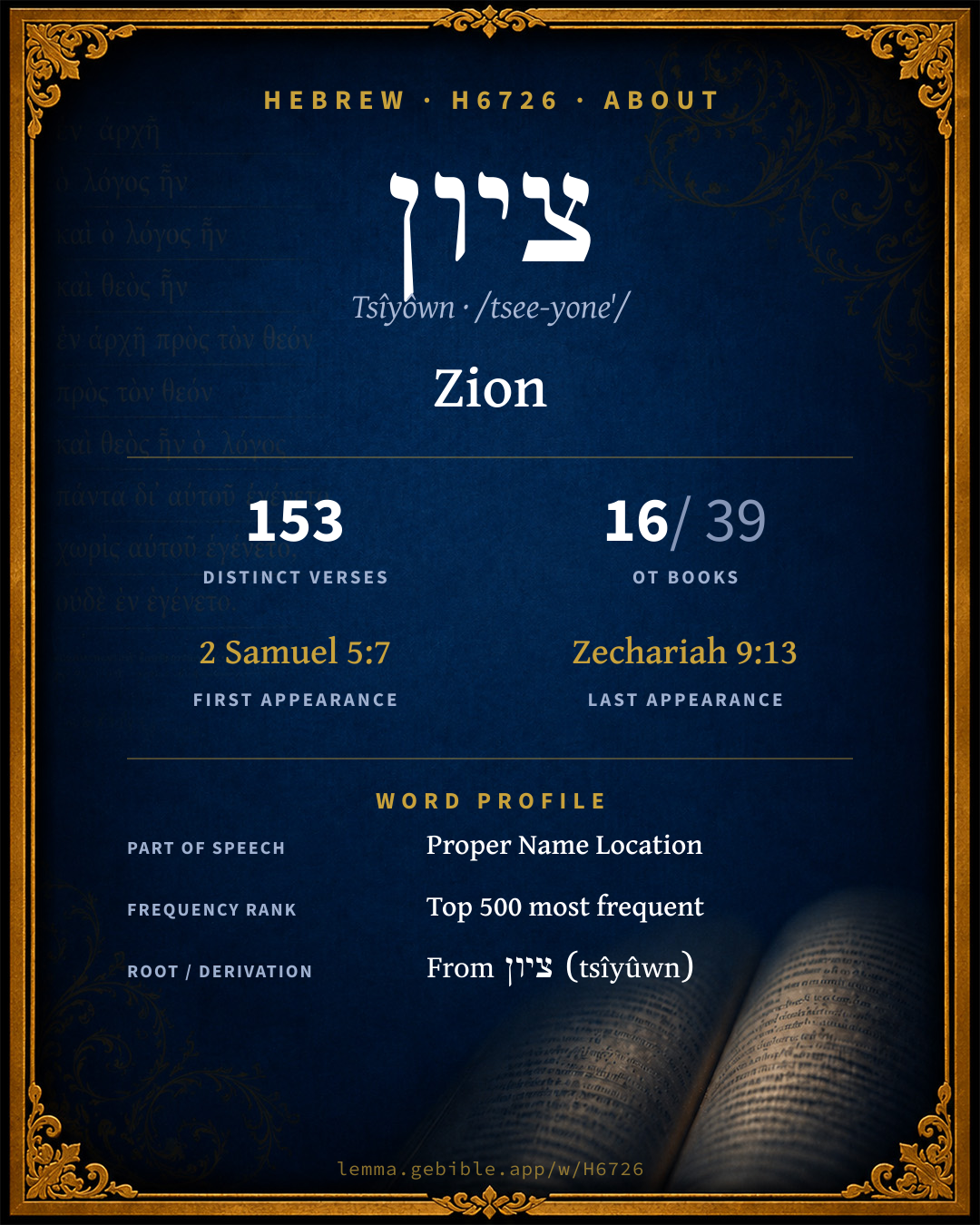
צִיּוֹן
Zion
BDB lists 2 entries for ‘Zion’ fuller range ↓
Full lexicon entry — Brown-Driver-Briggs (BDB)
From Brown-Driver-Briggs (BDB)
Where this word appears
Grammar key — what these labels mean
Part of speech
- Noun
- A naming word — a person, place, thing, or idea.
Noun type
- Proper
- A name of a specific person, place, or people (e.g. Abraham, Zion, Israel).
Every verse where H6726 appears — 153 distinct verses across 16 books. Click any verse to open its interlinear word-by-word view. Verse text shown in the World English Bible for context — . Each verse’s Hebrew form is shown with its reference; the English is not keyword-highlighted, since the data carries no word-level English alignment. Use “Compare translations” on any verse to read it across multiple English versions. This concordance covers the Hebrew Bible; Septuagint (Greek Old Testament) occurrences are not indexed here.
2 Samuel 1 verse
1 Kings 1 verse
2 Kings 2 verses
- 2 Kings 19:21 צִיּ֔וֹן n Proper This is the word that Yahweh has spoken concerning him: The virgin daughter of Zion has despised you and ridiculed you; the daughter of Jerusalem has shaken her head at you.
- 2 Kings 19:31 צִיּ֑וֹן n Proper For out of Jerusalem shall go forth a remnant, and out of Mount Zion those who shall escape: the zeal of Yahweh shall perform this.
1 Chronicles 1 verse
2 Chronicles 1 verse
Psalms 38 verses
- Psalms 2:6 צִ֝יּ֗וֹן n Proper "Yet I have set my king on my holy hill of Zion."
- Psalms 9:11 צִיּ֑וֹן n Proper Sing praises to Yahweh, who dwells in Zion, And declare among the people what he has done.
- Psalms 9:14 צִיּ֑וֹן n Proper That I may show forth all your praise. In the gates of the daughter of Zion, I will rejoice in your salvation.
- Psalms 14:7 מִ/צִּיּוֹן֮ prep + n Proper Oh that the salvation of Israel would come out of Zion! When Yahweh restores the fortunes of his people, Then Jacob shall rejoice, and Israel shall be glad.
- Psalms 20:2 וּ֝/מִ/צִּיּ֗וֹן conj + prep + n Proper Send you help from the sanctuary, Grant you support from Zion,
- Psalms 48:2 צִ֭יּוֹן n Proper Beautiful in elevation, the joy of the whole earth, Is Mount Zion, on the north sides, The city of the great King.
- Psalms 48:11 צִיּ֗וֹן n Proper Let Mount Zion be glad! Let the daughters of Judah rejoice, Because of your judgments.
- Psalms 48:12 צִ֭יּוֹן n Proper Walk about Zion, and go around her. Number its towers;
- Psalms 50:2 מִ/צִּיּ֥וֹן prep + n Proper Out of Zion, the perfection of beauty, God shines forth.
- Psalms 51:18 צִיּ֑וֹן n Proper Do well in your good pleasure to Zion. Build the walls of Jerusalem.
- Psalms 53:6 מִ/צִּיּוֹן֮ prep + n Proper Oh that the salvation of Israel would come out of Zion! When God brings back the captivity of his people, Then Jacob shall rejoice. Israel shall be glad.
- Psalms 65:1 בְּ/צִיּ֑וֹן prep + n Proper Praise waits for you, God, in Zion. To you shall vows be performed.
- Psalms 69:35 צִיּ֗וֹן n Proper For God will save Zion, and build the cities of Judah. They shall settle there, and own it.
- Psalms 74:2 צִ֝יּ֗וֹן n Proper Remember your congregation, which you purchased of old, Which you have redeemed to be the tribe of your inheritance; Mount Zion, in which you have lived.
- Psalms 76:2 בְ/צִיּֽוֹן prep + n Proper His tent is also in Salem; His dwelling place in Zion.
- Psalms 78:68 צִ֝יּ֗וֹן n Proper But chose the tribe of Judah, Mount Zion which he loved.
- Psalms 84:7 בְּ/צִיּֽוֹן prep + n Proper They go from strength to strength. Everyone of them appears before God in Zion.
- Psalms 87:2 צִיּ֑וֹן n Proper Yahweh loves the gates of Zion more than all the dwellings of Jacob.
- Psalms 87:5 וּֽ/לֲ/צִיּ֨וֹן conj + prep + n Proper Yes, of Zion it will be said, "This one and that one was born in her;" The Most High himself will establish her.
- Psalms 97:8 צִיּ֗וֹן n Proper Zion heard and was glad. The daughters of Judah rejoiced, Because of your judgments, Yahweh.
- Psalms 99:2 בְּ/צִיּ֣וֹן prep + n Proper Yahweh is great in Zion. He is high above all the peoples.
- Psalms 102:13 צִיּ֑וֹן n Proper You will arise and have mercy on Zion; For it is time to have pity on her. Yes, the set time has come.
- Psalms 102:16 צִיּ֑וֹן n Proper For Yahweh has built up Zion. He has appeared in his glory.
- Psalms 102:21 בְּ֭/צִיּוֹן prep + n Proper That men may declare the name of Yahweh in Zion, And his praise in Jerusalem;
- Psalms 110:2 מִ/צִּיּ֑וֹן prep + n Proper Yahweh will send forth the rod of your strength out of Zion. Rule in the midst of your enemies.
- Psalms 125:1 צִיּ֥וֹן n Proper Those who trust in Yahweh are as Mount Zion, Which can't be moved, but remains forever.
- Psalms 126:1 צִיּ֑וֹן n Proper When Yahweh brought back those who returned to Zion, We were like those who dream.
- Psalms 128:5 מִ/צִּ֫יּ֥וֹן prep + n Proper May Yahweh bless you out of Zion, And may you see the good of Jerusalem all the days of your life.
- Psalms 129:5 צִיּֽוֹן n Proper Let them be disappointed and turned backward, All those who hate Zion.
- Psalms 132:13 בְּ/צִיּ֑וֹן prep + n Proper For Yahweh has chosen Zion. He has desired it for his habitation.
- Psalms 133:3 צִ֫יּ֥וֹן n Proper Like the dew of Hermon, That comes down on the hills of Zion: For there Yahweh gives the blessing, Even life forevermore.
- Psalms 134:3 מִ/צִּיּ֑וֹן prep + n Proper May Yahweh bless you from Zion; Even he who made heaven and earth.
- Psalms 135:21 מִ/צִּיּ֗וֹן prep + n Proper Blessed be Yahweh from Zion, Who dwells at Jerusalem. Praise Yah!
- Psalms 137:1 צִיּֽוֹן n Proper By the rivers of Babylon, there we sat down. Yes, we wept, when we remembered Zion.
- Psalms 137:3 צִיּֽוֹן n Proper For there, those who led us captive asked us for songs. Those who tormented us demanded songs of joy: "Sing us one of the songs of Zion!"
- Psalms 146:10 צִ֭יּוֹן n Proper Yahweh will reign forever; Your God, O Zion, to all generations. Praise Yah!
- Psalms 147:12 צִיּֽוֹן n Proper Praise Yahweh, Jerusalem! Praise your God, Zion!
- Psalms 149:2 צִ֝יּ֗וֹן n Proper Let Israel rejoice in him who made them. Let the children of Zion be joyful in their King.
Song of Solomon 1 verse
Isaiah 46 verses
- Isaiah 1:8 צִיּ֖וֹן n Proper The daughter of Zion is left like a shelter in a vineyard, Like a hut in a field of melons, Like a besieged city.
- Isaiah 1:27 צִיּ֖וֹן n Proper Zion shall be redeemed with justice, And her converts with righteousness.
- Isaiah 2:3 מִ/צִּיּוֹן֙ prep + n Proper Many peoples shall go and say, "Come, let's go up to the mountain of Yahweh, To the house of the God of Jacob; And he will teach us of his ways, And we will walk in his paths. For out of Zion the law shall go forth, And the word of Yahweh from Jerusalem.
- Isaiah 3:16 צִיּ֔וֹן n Proper Moreover Yahweh said, "Because the daughters of Zion are haughty, And walk with outstretched necks and flirting eyes, Walking to trip as they go, Jingling ornaments on their feet;
- Isaiah 3:17 צִיּ֑וֹן n Proper Therefore the Lord brings sores on the crown of the head of the women of Zion, And Yahweh will make their scalps bald."
- Isaiah 4:3 בְּ/צִיּ֗וֹן prep + n Proper It will happen, that he who is left in Zion, and he who remains in Jerusalem, shall be called holy, even everyone who is written among the living in Jerusalem;
- Isaiah 4:4 צִיּ֔וֹן n Proper when the Lord shall have washed away the filth of the daughters of Zion, and shall have purged the blood of Jerusalem from its midst, by the spirit of justice, and by the spirit of burning.
- Isaiah 4:5 צִיּ֜וֹן n Proper Yahweh will create over the whole habitation of Mount Zion, and over her assemblies, a cloud and smoke by day, and the shining of a flaming fire by night; for over all the glory will be a canopy.
- Isaiah 8:18 צִיּֽוֹן n Proper Behold, I and the children whom Yahweh has given me are for signs and for wonders in Israel from Yahweh of Hosts, who dwells in Mount Zion.
- Isaiah 10:12 צִיּ֖וֹן n Proper Therefore it shall happen that, when the Lord has performed his whole work on Mount Zion and on Jerusalem, I will punish the fruit of the stout heart of the king of Assyria, and the glory of his high looks.
- Isaiah 10:24 צִיּ֖וֹן n Proper Therefore thus says the Lord, Yahweh of Hosts, my people who dwell in Zion, don't be afraid of the Assyrian, though he strike you with the rod, and lift up his staff against you, after the manner of Egypt.
- Isaiah 12:6 צִיּ֑וֹן n Proper Cry aloud and shout, you inhabitant of Zion; for great in the midst of you is the Holy One of Israel!"
- Isaiah 14:32 צִיּ֔וֹן n Proper What then shall one answer the messengers of the nation? That Yahweh has founded Zion, and in her shall the afflicted of his people take refuge.
- Isaiah 16:1 צִיּֽוֹן n Proper Send you the lambs for the ruler of the land from Selah to the wilderness, to the mountain of the daughter of Zion.
- Isaiah 18:7 צִיּֽוֹן n Proper In that time shall a present be brought to Yahweh of Hosts [from] a people tall and smooth, even from a people awesome from their beginning onward, a nation that measures out and treads down, whose land the rivers divide, to the place of the name of Yahweh of Hosts, Mount Zion.
- Isaiah 24:23 צִיּוֹן֙ n Proper Then the moon shall be confounded, and the sun ashamed; for Yahweh of Hosts will reign on Mount Zion, and in Jerusalem; and before his elders shall be glory.
- Isaiah 28:16 בְּ/צִיּ֖וֹן prep + n Proper therefore thus says the Lord Yahweh, Behold, I lay in Zion for a foundation a stone, a tried stone, a precious corner -[stone] of sure foundation: he who believes shall not be in haste.
- Isaiah 29:8 צִיּֽוֹן n Proper It shall be as when a hungry man dreams, and, behold, he eats; but he awakes, and his soul is empty: or as when a thirsty man dreams, and, behold, he drinks; but he awakes, and, behold, he is faint, and his soul has appetite: so shall the multitude of all the nations be, that fight against Mount Zion.
- Isaiah 30:19 בְּ/צִיּ֥וֹן prep + n Proper For the people shall dwell in Zion at Jerusalem; you shall weep no more; he will surely be gracious to you at the voice of your cry; when he shall hear, he will answer you.
- Isaiah 31:4 צִיּ֖וֹן n Proper For thus says Yahweh to me, As the lion and the young lion growling over his prey, if a multitude of shepherds are called forth against him, will not be dismayed at their voice, nor abase himself for the noise of them: so will Yahweh of Hosts come down to fight on Mount Zion, and on the hill of it.
- Isaiah 31:9 בְּ/צִיּ֔וֹן prep + n Proper His rock shall pass away by reason of terror, and his princes shall be dismayed at the ensign, says Yahweh, whose fire is in Zion, and his furnace in Jerusalem.
- Isaiah 33:5 צִיּ֔וֹן n Proper Yahweh is exalted; for he dwells on high: he has filled Zion with justice and righteousness.
- Isaiah 33:14 בְ/צִיּוֹן֙ prep + n Proper The sinners in Zion are afraid; trembling has seized the godless ones: Who among us can dwell with the devouring fire? who among us can dwell with everlasting burning?
- Isaiah 33:20 צִיּ֔וֹן n Proper Look on Zion, the city of our solemnities: your eyes shall see Jerusalem a quiet habitation, a tent that shall not be removed, the stakes of it shall never be plucked up, neither shall any of the cords of it be broken.
- Isaiah 34:8 צִיּֽוֹן n Proper For Yahweh has a day of vengeance, a year of recompense for the cause of Zion.
- Isaiah 35:10 צִיּוֹן֙ n Proper and the ransomed of Yahweh shall return, and come with singing to Zion; and everlasting joy shall be on their heads: they shall obtain gladness and joy, and sorrow and sighing shall flee away.
- Isaiah 37:22 צִיּ֔וֹן n Proper this is the word which Yahweh has spoken concerning him: The virgin daughter of Zion has despised you and ridiculed you; the daughter of Jerusalem has shaken her head at you.
- Isaiah 37:32 צִיּ֑וֹן n Proper For out of Jerusalem shall go forth a remnant, and out of Mount Zion those who shall escape. The zeal of Yahweh of Hosts will perform this.
- Isaiah 40:9 צִיּ֔וֹן n Proper You who tell good news to Zion, go up on a high mountain; you who tell good news to Jerusalem, lift up your voice with strength; lift it up, don't be afraid; say to the cities of Judah, Behold, your God!
- Isaiah 41:27 לְ/צִיּ֖וֹן prep + n Proper [I am the] first [who says] to Zion, Behold, behold them; and I will give to Jerusalem one who brings good news.
- Isaiah 46:13 בְ/צִיּוֹן֙ prep + n Proper I bring near my righteousness, it shall not be far off, and my salvation shall not wait; and I will place salvation in Zion for Israel my glory.
- Isaiah 49:14 צִיּ֖וֹן n Proper But Zion said, Yahweh has forsaken me, and the Lord has forgotten me.
- Isaiah 51:3 צִיּ֗וֹן n Proper For Yahweh has comforted Zion; he has comforted all her waste places, and has made her wilderness like Eden, and her desert like the garden of Yahweh; joy and gladness shall be found therein, thanksgiving, and the voice of melody.
- Isaiah 51:11 צִיּוֹן֙ n Proper The ransomed of Yahweh shall return, and come with singing to Zion; and everlasting joy shall be on their heads: they shall obtain gladness and joy; [and] sorrow and sighing shall flee away.
- Isaiah 51:16 לְ/צִיּ֖וֹן prep + n Proper I have put my words in your mouth, and have covered you in the shadow of my hand, that I may plant the heavens, and lay the foundations of the earth, and tell Zion, You are my people.
- Isaiah 52:1 צִיּ֑וֹן n Proper Awake, awake, put on your strength, Zion; put on your beautiful garments, Jerusalem, the holy city: for henceforth there shall no more come into you the uncircumcised and the unclean.
- Isaiah 52:2 צִיּֽוֹן n Proper Shake yourself from the dust; arise, sit [on your throne], Jerusalem: loose yourself from the bonds of your neck, captive daughter of Zion.
- Isaiah 52:7 לְ/צִיּ֖וֹן prep + n Proper How beautiful on the mountains are the feet of him who brings good news, who publishes peace, who brings good news of good, who publishes salvation, who says to Zion, Your God reigns!
- Isaiah 52:8 צִיּֽוֹן n Proper The voice of your watchmen! they lift up the voice, together do they sing; for they shall see eye to eye, when Yahweh returns to Zion.
- Isaiah 59:20 לְ/צִיּוֹן֙ prep + n Proper A Redeemer will come to Zion, and to those who turn from disobedience in Jacob, says Yahweh.
- Isaiah 60:14 צִיּ֖וֹן n Proper The sons of those who afflicted you shall come bending to you; and all those who despised you shall bow themselves down at the soles of your feet; and they shall call you The city of Yahweh, The Zion of the Holy One of Israel.
- Isaiah 61:3 צִיּ֗וֹן n Proper to appoint to those who mourn in Zion, to give to them a garland for ashes, the oil of joy for mourning, the garment of praise for the spirit of heaviness; that they may be called trees of righteousness, the planting of Yahweh, that he may be glorified.
- Isaiah 62:1 צִיּוֹן֙ n Proper For Zion's sake will I not hold my peace, and for Jerusalem's sake I will not rest, until her righteousness go forth as brightness, and her salvation as a lamp that burns.
- Isaiah 62:11 צִיּ֔וֹן n Proper Behold, Yahweh has proclaimed to the end of the earth, Say you to the daughter of Zion, Behold, your salvation comes; behold, his reward is with him, and his recompense before him.
- Isaiah 64:10 צִיּוֹן֙ n Proper Your holy cities are become a wilderness, Zion is become a wilderness, Jerusalem a desolation.
- Isaiah 66:8 צִיּ֖וֹן n Proper Who has heard such a thing? who has seen such things? Shall a land be born in one day? shall a nation be brought forth at once? for as soon as Zion travailed, she brought forth her children.
Jeremiah 17 verses
- Jeremiah 3:14 צִיּֽוֹן n Proper Return, backsliding children, says Yahweh; for I am a husband to you: and I will take you one of a city, and two of a family, and I will bring you to Zion:
- Jeremiah 4:6 צִיּ֔וֹנָ/ה n Proper + sfx dem Set up a standard toward Zion: flee for safety, don't stay; for I will bring evil from the north, and a great destruction.
- Jeremiah 4:31 צִיּ֛וֹן n Proper For I have heard a voice as of a woman in travail, the anguish as of her who brings forth her first child, the voice of the daughter of Zion, who gasps for breath, who spreads her hands, [saying], Woe is me now! for my soul faints before the murderers.
- Jeremiah 6:2 צִיּֽוֹן n Proper The comely and delicate one, the daughter of Zion, will I cut off.
- Jeremiah 6:23 צִיּֽוֹן n Proper They lay hold on bow and spear; they are cruel, and have no mercy; their voice roars like the sea, and they ride on horses, everyone set in array, as a man to the battle, against you, daughter of Zion.
- Jeremiah 8:19 בְּ/צִיּ֔וֹן prep + n Proper Behold, the voice of the cry of the daughter of my people from a land that is very far off: isn't Yahweh in Zion? Isn't her King in her? Why have they provoked me to anger with their engraved images, and with foreign vanities?
- Jeremiah 9:19 מִ/צִּיּ֖וֹן prep + n Proper For a voice of wailing is heard out of Zion, How are we ruined! we are greatly confounded, because we have forsaken the land, because they have cast down our dwellings.
- Jeremiah 14:19 בְּ/צִיּוֹן֙ prep + n Proper Have you utterly rejected Judah? has your soul loathed Zion? why have you struck us, and there is no healing for us? We looked for peace, but no good came; and for a time of healing, and, behold, dismay!
- Jeremiah 26:18 צִיּ֞וֹן n Proper Micah the Morashtite prophesied in the days of Hezekiah king of Judah; and he spoke to all the people of Judah, saying, Thus says Yahweh of Hosts: Zion shall be plowed as a field, and Jerusalem shall become heaps, and the mountain of the house as the high places of a forest.
- Jeremiah 30:17 צִיּ֣וֹן n Proper For I will restore health to you, and I will heal you of your wounds, says Yahweh; because they have called you an outcast, [saying], It is Zion, whom no man seeks after.
- Jeremiah 31:6 צִיּ֔וֹן n Proper For there shall be a day, that the watchmen on the hills of Ephraim shall cry, Arise you, and let us go up to Zion to Yahweh our God.
- Jeremiah 31:12 צִיּוֹן֒ n Proper They shall come and sing in the height of Zion, and shall flow to the goodness of Yahweh, to the grain, and to the new wine, and to the oil, and to the young of the flock and of the herd: and their soul shall be as a watered garden; and they shall not sorrow any more at all.
- Jeremiah 50:5 צִיּ֣וֹן n Proper They shall inquire concerning Zion with their faces turned toward it, [saying], Come you, and join yourselves to Yahweh in an everlasting covenant that shall not be forgotten.
- Jeremiah 50:28 בְּ/צִיּ֗וֹן prep + n Proper The voice of those who flee and escape out of the land of Babylon, to declare in Zion the vengeance of Yahweh our God, the vengeance of his temple.
- Jeremiah 51:10 בְ/צִיּ֔וֹן prep + n Proper Yahweh has brought forth our righteousness: come, and let us declare in Zion the work of Yahweh our God.
- Jeremiah 51:24 בְ/צִיּ֖וֹן prep + n Proper I will render to Babylon and to all the inhabitants of Chaldea all their evil that they have done in Zion in your sight, says Yahweh.
- Jeremiah 51:35 צִיּ֑וֹן n Proper The violence done to me and to my flesh be on Babylon, shall the inhabitant of Zion say; and, My blood be on the inhabitants of Chaldea, shall Jerusalem say.
Lamentations 15 verses
- Lamentations 1:4 צִיּ֜וֹן n Proper The ways of Zion do mourn, because none come to the solemn assembly; All her gates are desolate, her priests do sigh: Her virgins are afflicted, and she herself is in bitterness.
- Lamentations 1:6 צִיּ֖וֹן n Proper From the daughter of Zion all her majesty is departed: Her princes are become like harts that find no pasture, They are gone without strength before the pursuer.
- Lamentations 1:17 צִיּ֜וֹן n Proper Zion spreads forth her hands; there is none to comfort her; Yahweh has commanded concerning Jacob, that those who are round about him should be his adversaries: Jerusalem is among them as an unclean thing.
- Lamentations 2:1 צִיּ֔וֹן n Proper How has the Lord covered the daughter of Zion with a cloud in his anger! He has cast down from heaven to the earth the beauty of Israel, And hasn't remembered his footstool in the day of his anger.
- Lamentations 2:4 צִיּ֔וֹן n Proper He has bent his bow like an enemy, he has stood with his right hand as an adversary, Has killed all that were pleasant to the eye: In the tent of the daughter of Zion he has poured out his wrath like fire.
- Lamentations 2:6 בְּ/צִיּוֹן֙ prep + n Proper He has violently taken away his tent, as if it were of a garden; he has destroyed his place of assembly: Yahweh has caused solemn assembly and Sabbath to be forgotten in Zion, Has despised in the indignation of his anger the king and the priest.
- Lamentations 2:8 צִיּ֔וֹן n Proper Yahweh has purposed to destroy the wall of the daughter of Zion; He has stretched out the line, he has not withdrawn his hand from destroying; He has made the rampart and wall to lament; they languish together.
- Lamentations 2:10 צִיּ֔וֹן n Proper The elders of the daughter of Zion sit on the ground, they keep silence; They have cast up dust on their heads; they have girded themselves with sackcloth: The virgins of Jerusalem hang down their heads to the ground.
- Lamentations 2:13 צִיּ֑וֹן n Proper What shall I testify to you? what shall I liken to you, daughter of Jerusalem? What shall I compare to you, that I may comfort you, virgin daughter of Zion? For your breach is great like the sea: who can heal you?
- Lamentations 2:18 צִ֠יּוֹן n Proper Their heart cried to the Lord: wall of the daughter of Zion, let tears run down like a river day and night; Give yourself no respite; don't let the apple of your eye cease.
- Lamentations 4:2 צִיּוֹן֙ n Proper The precious sons of Zion, comparable to fine gold, How are they esteemed as earthen pitchers, the work of the hands of the potter!
- Lamentations 4:11 בְּ/צִיּ֔וֹן prep + n Proper Yahweh has accomplished his wrath, he has poured out his fierce anger; He has kindled a fire in Zion, which has devoured the foundations of it.
- Lamentations 4:22 צִיּ֔וֹן n Proper The punishment of your iniquity is accomplished, daughter of Zion; he will no more carry you away into captivity: He will visit your iniquity, daughter of Edom; he will uncover your sins.
- Lamentations 5:11 בְּ/צִיּ֣וֹן prep + n Proper They ravished the women in Zion, The virgins in the cities of Judah.
- Lamentations 5:18 צִיּוֹן֙ n Proper For the mountain of Zion, which is desolate: The foxes walk on it.
Joel 7 verses
- Joel 2:1 בְּ/צִיּ֗וֹן prep + n Proper Blow you the trumpet in Zion, And sound an alarm in my holy mountain! Let all the inhabitants of the land tremble, For the day of Yahweh comes, For it is close at hand:
- Joel 2:15 בְּ/צִיּ֑וֹן prep + n Proper Blow the trumpet in Zion! Sanctify a fast. Call a solemn assembly.
- Joel 2:23 צִיּ֗וֹן n Proper "Be glad then, you children of Zion, And rejoice in Yahweh, your God; For he gives you the former rain in just measure, And he causes the rain to come down for you, The former rain and the latter rain, As before.
- Joel 2:32 צִיּ֨וֹן n Proper It will happen that whoever will call on the name of Yahweh shall be saved; For in Mount Zion and in Jerusalem there will be those who escape, As Yahweh has said, And among the remnant, those whom Yahweh calls.
- Joel 3:16 מִ/צִּיּ֣וֹן prep + n Proper Yahweh will roar from Zion, And thunder from Jerusalem; And the heavens and the earth will shake; But Yahweh will be a refuge to his people, And a stronghold to the children of Israel.
- Joel 3:17 בְּ/צִיּ֣וֹן prep + n Proper "So you will know that I am Yahweh, your God, Dwelling in Zion, my holy mountain. Then Jerusalem will be holy, And no strangers will pass through her any more.
- Joel 3:21 בְּ/צִיּֽוֹן prep + n Proper I will cleanse their blood, That I have not cleansed: For Yahweh dwells in Zion."
Amos 2 verses
- Amos 1:2 מִ/צִיּ֣וֹן prep + n Proper He said: "Yahweh will roar from Zion, And utter his voice from Jerusalem; And the pastures of the shepherds will mourn, And the top of Carmel will wither."
- Amos 6:1 בְּ/צִיּ֔וֹן prep + n Proper Woe to those who are at ease in Zion, And to those who are secure on the mountain of Samaria, The notable men of the chief of the nations, To whom the house of Israel come!
Obadiah 2 verses
Micah 9 verses
- Micah 1:13 צִיּ֔וֹן n Proper Harness the chariot to the swift steed, inhabitant of Lachish. She was the beginning of sin to the daughter of Zion; For the transgressions of Israel were found in you.
- Micah 3:10 צִיּ֖וֹן n Proper They build up Zion with blood, And Jerusalem with iniquity.
- Micah 3:12 צִיּ֖וֹן n Proper Therefore Zion for your sake will be plowed like a field, And Jerusalem will become heaps of rubble, And the mountain of the temple like the high places of a forest.
- Micah 4:2 מִ/צִּיּוֹן֙ prep + n Proper Many nations will go and say, "Come, and let us go up to the mountain of Yahweh, And to the house of the God of Jacob; And he will teach us of his ways, And we will walk in his paths." For out of Zion will go forth the law, And the word of Yahweh from Jerusalem;
- Micah 4:7 צִיּ֔וֹן n Proper And I will make that which was lame a remnant, And that which was cast far off a strong nation: And Yahweh will reign over them on Mount Zion from then on, even forever.
- Micah 4:8 צִיּ֖וֹן n Proper You, tower of the flock, the hill of the daughter of Zion, To you it will come, Yes, the former dominion will come, The kingdom of the daughter of Jerusalem.
- Micah 4:10 צִיּ֖וֹן n Proper Be in pain, and labor to bring forth, daughter of Zion, Like a woman in travail; For now you will go forth out of the city, And will dwell in the field, And will come even to Babylon. There you will be rescued. There Yahweh will redeem you from the hand of your enemies.
- Micah 4:11 בְּ/צִיּ֖וֹן prep + n Proper Now many nations have assembled against you, that say, 'Let her be defiled, And let our eye gloat over Zion.'
- Micah 4:13 צִיּ֗וֹן n Proper Arise and thresh, daughter of Zion; For I will make your horn iron, And I will make your hoofs brass; And you will beat in pieces many peoples: And I will devote their gain to Yahweh, And their substance to the Lord of the whole earth.
Zephaniah 2 verses
Zechariah 8 verses
- Zechariah 1:14 וּ/לְ/צִיּ֖וֹן conj + prep + n Proper So the angel who talked with me said to me, "Proclaim, saying, 'Thus says Yahweh of Hosts: "I am jealous for Jerusalem and for Zion with a great jealousy.
- Zechariah 1:17 צִיּ֔וֹן n Proper "Proclaim further, saying, 'Thus says Yahweh of Hosts: "My cities will again overflow with prosperity, and Yahweh will again comfort Zion, and will again choose Jerusalem."'"
- Zechariah 2:7 צִיּ֖וֹן n Proper 'Come, Zion! Escape, you who dwell with the daughter of Babylon.'
- Zechariah 2:10 צִיּ֑וֹן n Proper Sing and rejoice, daughter of Zion; for, behold, I come, and I will dwell in the midst of you,' says Yahweh.
- Zechariah 8:2 לְ/צִיּ֖וֹן prep + n Proper Thus says Yahweh of Hosts: "I am jealous for Zion with great jealousy, and I am jealous for her with great wrath."
- Zechariah 8:3 צִיּ֔וֹן n Proper Thus says Yahweh: "I have returned to Zion, and will dwell in the midst of Jerusalem. Jerusalem shall be called 'The City of Truth;' and the mountain of Yahweh of Hosts, 'The Holy Mountain.'"
- Zechariah 9:9 צִיּ֗וֹן n Proper Rejoice greatly, daughter of Zion! Shout, daughter of Jerusalem! Behold, your king comes to you! He is righteous, and having salvation; Lowly, and riding on a donkey, Even on a colt, the foal of a donkey.
- Zechariah 9:13 צִיּ֔וֹן n Proper For indeed I bend Judah as a bow for me. I have filled the bow with Ephraim; And I will stir up your sons, Zion, Against your sons, Greece, And will make you like the sword of a mighty man.
About this entry
At a glance — auto-summarized from this page’s data, not written by a person. Every figure links to its source below. This summary describes the numbers; it doesn’t interpret them.
At its core, ציון (Tsîyôwn) means “Zion.” First canonically at 2 Samuel 5:7, it enters the text early. It appears 153 verses across 16 books of the Hebrew Bible, among its common vocabulary. The word gravitates to Isaiah (30%), then Psalms and Jeremiah. Each statement above links to its evidence; the full detail follows below.
Gloss history
Strong's 1890 vs modern scholarship
About this word
Strong's H6726 catalogs a Hebrew word from the Hebrew Old Testament.
These counts are not copied from any lexicon or concordance. They are computed here, from the morphology-tagged Hebrew Old Testament. What Lemma adds →
- 153
- distinct verses
- The word appears in 153 distinct verses.
- 16 / 39
- OT books
- The word appears in 16 of 39 Old Testament books.
- #294
- by frequency
- Top 500 most frequent Hebrew words (rank 294 of 8,640 Hebrew words by occurrence).
View all 153 occurrences in the concordance →
By section of the Old Testament
By traditional corpus
Conventional, traditional groupings — biblical authorship is debated, so this is a traditional corpus grouping, not an authorship claim. Each share is this word’s portion of its verses in that division of the Hebrew canon. Each figure is a share of the word’s 153 distinct verses.
- Prophets (Nevi'im) 97 verses · 63%
- Writings (Ketuvim) 56 verses · 37%
How translations render this word
Counts come from each version’s own published word-to-Strong’s tagging or interlinear alignment — an approximate guide to how each version renders this word, not a word-level alignment the data otherwise carries. Because each total is that version’s own tagged count, the per-version totals vary from one another and need not match the appearance or distinct-verse counts above. These counts may also differ from a printed concordance because Lemma counts each distinctly tagged rendering and does not collapse phrase taggings into a single head-word total. This is a fixed set of word-tagged versions (KJV, ASV, BSB, ULT) and does not change with the reading translation you choose elsewhere. Each version’s license is shown beside its name below (and on Sources).
- King James Version: Zion 137×, Thee out of zion 3×, Is zion 2×
- American Standard Version: Zion 129×, Thee out of zion 3×, Daughter of zion 2×
- Berean Standard Bible: Zion 147×
- unfoldingWord Literal Text: Zion 141×, Is in zion 2×
King James Version Public Domain
Renders H6726 across 154 tagged occurrences — most commonly:
Plus 10 renderings that appear only once — usually multi-word phrases or single function words the recovered tagging swept in, not distinct renderings.
American Standard Version Public Domain
Renders H6726 across 154 tagged occurrences — most commonly:
Plus 16 renderings that appear only once — usually multi-word phrases or single function words the recovered tagging swept in, not distinct renderings.
Berean Standard Bible Public Domain
Renders H6726 across 153 tagged occurrences — most commonly:
Plus 6 renderings that appear only once — usually multi-word phrases or single function words the recovered tagging swept in, not distinct renderings. Not rendered by a distinct English word in 1 further occurrence.
unfoldingWord Literal Text CC BY-SA 4.0
Renders H6726 across 148 tagged occurrences — most commonly:
Plus 5 renderings that appear only once — usually multi-word phrases or single function words the recovered tagging swept in, not distinct renderings.
Senses in BDB
The 2 senses BDB distinguishes for this word, in lexicon order (not ranked by frequency or importance). The full entry — with sub-senses — is in the Lexicon Entry tab.
- Zion = "parched place"
- another name for Jerusalem especially in the prophetic books
Word origin
n.pr.loc. Σ(ε)ιων; Ṣîyyôn, Zion (Syriac ܨܶܗܝܘܿܢ, older form, according to LagBN 84, cf. 198);—צ׳ 2 S 5:7 +; צִיּו֫נָה Je 4:6;—stronghold (of Jebusites), מְצֻדַת צ׳ captured by David, and made his residence 2 S 5:7 = 1 Ch 11:5 (both + הִיא עִיר דָּוִד), on S. part of E. hill of Jerusalem, distinct from site of temple 1 K 8:1 = 2 Ch 5:2 (both מֵעִיר ד׳ הִיא צ׳), not elsewhere in narrative, but often in poets and proph.: as name of Jerus., from political point of view (sometimes = inhabitants), Am 6:7 (‖ הַר־שֹׁמְרוֹן), ‖ יְרוּשָׁלַםִ Mi 3:10, 12 = Je 26:18; Is 4:3; 30:19; 40:9; 41:27; 52:1; 62:1; 64:9 Zp 3:16; Zc 1:14, 17 ψ 51:20 and (בַּת־צ׳) Is 52:2; Mi 4:8 (‖ בַּת־יְרוּשׁ׳), La 2:13 (‖ id.), also (יוֹשֶׁבֶת צ׳) Je 51:35; = Jerus. also Is 14:32; 33:5 +, so especially in phr. בְּנוֹת צ׳ Is 3:16, 17; 4:4; Ct 3:11, בְּנֵי צ׳ La 4:2; Jo 2:23 ψ 149:2 (‖ יִשְׂרָאֵל), cf. Zc 9:13, יָֽלְדָה צ׳ אֶת־בָּנֶיהָ Is 66:8, and even הַר־צ׳ 2 K 19:31 = Is 37:32 (both ‖ יְרוּשׁ׳), Is 29:8 (‖ אֲרִיאֵל v 7), Ob 17, 21 ψ 48:12 (‖ בְּנוֹת יֶהוֹדָה), 125:1; so also הַר־בַּת צ׳ Is 16:1 and 10:32 Qr (Kt בית: ‖ גִּבְעַת־יְרוּשׁ׳); cf. מְרוֹם־צ׳ Je 31:12; in foll. הַר־צ׳ might refer to temple-hill Is 10:12 (+ יְרוּשׁ׳), 31:4 (+ גִּבְעָתָהּ = יְרוּשׁ׳ v 5), La 5:18; Jo 3:5 (+ יְרוּשׁ׳); specif. of Jerus. as abode of י׳ and place of his worship Am 1:2; Is 31:9; Zc 8:3; Mi 4:2 = Is 2:3; Jo 4:16 ψ 102:22; 135:21; 147:12 (all ‖ יְרוּשׁ׳), 76:3 (‖ שָׁלֵם); partic. of sanctuary 20:3 (‖ קֹדֶשׁ), 14:7 = 53:7 +; of Jerus. הַר־צ׳ ψ 48:3 (‖ קִרְיַת מֶלֶךְ רָ֑ב), 78:68 (‖ שֵׁבֶט יְהוּדָה), Is 24:23 (‖ יְרוּשׁ׳), etc.; הַרֲרֵי צ׳ in same sense †ψ 133:3; particularly of sanctuary Is 4:5 and (‖ הַר־קָדְשִׁי) Jo 2:1; 4:17; צ׳ הַר־קָדְשִׁי ψ 2:6 is seat of king.—Vid. also בַּת־צ׳, הַר־צ׳, ישֶׁבֶת צ׳, sub בַּת, הַר, יָשַׁב.
— Brown-Driver-Briggs (Oxford 1906, public domain), digitized via Sefaria, supplemented by the OpenScriptures HebrewLexicon (CC BY 4.0). See Sources.
Derived from ציון (tsîyûwn) (H6725) — signpost.
Jastrow Dictionary
A second Hebrew/Aramaic lexicon for comparison, covering Aramaic and post-biblical (Talmudic, Targumic, Midrashic) usage that the biblical-Hebrew BDB does not. Matched by lemma rather than by Strong’s number, so a lemma may carry more than one Jastrow headword (shown separately below), and the entries cover usage well beyond the Bible.
צִיּוֹן
- (b. h.) pr. n. Mount Zion, Zion (= Jerusalem). Midr. Till. to Ps. XLVIII אבל בצ׳ אינו כן but this is not the case with the city of Zion. Midr. Till. to Ps. LXXXVII צ׳ שהוא פלטין שלי Zion which is my (the Lord’s) palace; a. fr.
צִיּוּן
- heap of stones, mark, esp. the mark put up to indicate the neighborhood of an unclean place. Erub. 54ᵇ מאי … צ׳ לישנא דסימנא הוא what evidence is there that this tsiyyun (Jer. XXXI, 20) means sign? Answ. ref. to Ez. XXXIX, 15. Y. Shek. I, 46ᵃ מיכן לצ׳ from here (Ez. l. c.) we have an evidence for the custom of marking sunken graves; M. Kat. 5ᵃ. Ib. 5ᵇ אין מעמידין צ׳ במקום וכ׳ we must not put up a mark on the very spot of uncleanness. Ex. R. s. 52 (play on צִיוֹן, Cant. III, 11) מה הצ׳ הזה נראה באצבע וכ׳ as a mark is seen (pointed at) with the finger, so is Israel (distinguishable by his features); a. e.—Pl. צִיּוּנִים, צִיּוּנִין. Erub. l. c. (ref. to Jer. l. c.) עשו צ׳ לתורה make marks (mnemonical notes) for the study of the Law, v. סִימָן; Yalk. Jer. 315.—Denom. צִיֵּן. e.g. Jeremiah 31:20
A Dictionary of the Targumim, the Talmud Babli and Yerushalmi, and the Midrashic Literature (Marcus Jastrow; London, Luzac, 1903) — Public Domain. Digitized via Sefaria. Digitized via Sefaria. Full attribution on Sources.
Forms in the corpus
The 45 distinct written forms H6726 takes in the Hebrew Bible, most frequent first — each parse links to that state’s occurrences in the concordance. Hebrew forms include their vowel points and cantillation, so a single lemma takes many written forms.
| Form | Parsing | Example | Uses |
|---|---|---|---|
| צִיּ֔וֹן | Noun, Proper | 1 Chronicles 11:5 | 23 |
| צִיּ֑וֹן | Noun, Proper | 2 Kings 19:31 | 16 |
| צִיּ֖וֹן | Noun, Proper | Isaiah 1:8 | 16 |
| צִיּֽוֹן | Noun, Proper | 1 Kings 8:1 | 16 |
| צִיּ֗וֹן | Noun, Proper | Isaiah 51:3 | 8 |
| צִיּוֹן֙ | Noun, Proper | Isaiah 24:23 | 7 |
| בְּ/צִיּ֔וֹן | Noun, Proper | Amos 6:1 | 4 |
| לְ/צִיּ֖וֹן | Noun, Proper | Isaiah 41:27 | 4 |
| צִ֝יּ֗וֹן | Noun, Proper | Psalms 2:6 | 4 |
| בְּ/צִיּ֑וֹן | Noun, Proper | Joel 2:15 | 3 |
| בְּ/צִיּ֗וֹן | Noun, Proper | Isaiah 4:3 | 3 |
| בְּ/צִיּ֣וֹן | Noun, Proper | Joel 3:17 | 3 |
| צִ֭יּוֹן | Noun, Proper | Psalms 48:2 | 3 |
| צִיּ֜וֹן | Noun, Proper | Isaiah 4:5 | 3 |
| בְ/צִיּוֹן֙ | Noun, Proper | Isaiah 33:14 | 2 |
| בְּ/צִיּ֖וֹן | Noun, Proper | Isaiah 28:16 | 2 |
| בְּ/צִיּֽוֹן | Noun, Proper | Joel 3:21 | 2 |
| בְּ/צִיּוֹן֙ | Noun, Proper | Jeremiah 14:19 | 2 |
| מִ/צִּיּ֑וֹן | Noun, Proper | Psalms 110:2 | 2 |
| מִ/צִּיּוֹן֙ | Noun, Proper | Isaiah 2:3 | 2 |
| מִ/צִּיּוֹן֮ | Noun, Proper | Psalms 14:7 | 2 |
| צִיּ֛וֹן | Noun, Proper | Jeremiah 4:31 | 2 |
| צִיּ֣וֹן | Noun, Proper | Jeremiah 30:17 | 2 |
| בְ/צִיּ֔וֹן | Noun, Proper | Jeremiah 51:10 | 1 |
| בְ/צִיּ֖וֹן | Noun, Proper | Jeremiah 51:24 | 1 |
| בְ/צִיּֽוֹן | Noun, Proper | Psalms 76:2 | 1 |
| בְּ/צִיּ֥וֹן | Noun, Proper | Isaiah 30:19 | 1 |
| בְּ֭/צִיּוֹן | Noun, Proper | Psalms 102:21 | 1 |
| וּ/לְ/צִיּ֖וֹן | Noun, Proper | Zechariah 1:14 | 1 |
| וּ֝/מִ/צִּיּ֗וֹן | Noun, Proper | Psalms 20:2 | 1 |
| וּֽ/לֲ/צִיּ֨וֹן | Noun, Proper | Psalms 87:5 | 1 |
| לְ/צִיּוֹן֙ | Noun, Proper | Isaiah 59:20 | 1 |
| מִ/צִיּ֣וֹן | Noun, Proper | Amos 1:2 | 1 |
| מִ/צִּ֫יּ֥וֹן | Noun, Proper | Psalms 128:5 | 1 |
| מִ/צִּיּ֖וֹן | Noun, Proper | Jeremiah 9:19 | 1 |
| מִ/צִּיּ֗וֹן | Noun, Proper | Psalms 135:21 | 1 |
| מִ/צִּיּ֣וֹן | Noun, Proper | Joel 3:16 | 1 |
| מִ/צִּיּ֥וֹן | Noun, Proper | Psalms 50:2 | 1 |
| צִ֠יּוֹן | Noun, Proper | Lamentations 2:18 | 1 |
| צִ֫יּ֥וֹן | Noun, Proper | Psalms 133:3 | 1 |
| צִיּ֔וֹנָ/ה | Noun, Proper | Jeremiah 4:6 | 1 |
| צִיּ֞וֹן | Noun, Proper | Jeremiah 26:18 | 1 |
| צִיּ֥וֹן | Noun, Proper | Psalms 125:1 | 1 |
| צִיּ֨וֹן | Noun, Proper | Joel 2:32 | 1 |
| צִיּוֹן֒ | Noun, Proper | Jeremiah 31:12 | 1 |
Same root — word family
Other BDB entries built from the same root as H6726, grouped by Strong’s listed origin. These share a root / origin per the lexicon — not necessarily a shared meaning. Each links to that word’s own entry.
Derives from
Proper names from this root
People and places named from this root — a name, not an additional meaning of the word.
Compare all same-root words → 1 of the same-root words is a proper name (a person or place). They share a root, not necessarily a meaning.
Bible dictionary
Public-domain dictionary articles matched to this entry by name (Zion). A biblical name can be shared by more than one person or place, so an article may treat several.
Easton's Bible Dictionary · M. G. Easton, 1897
Sunny; height, one of the eminences on which Jerusalem was built. It was surrounded on all sides, except the north, by deep valleys, that of the Tyropoeon (q.v.) separating it from Moriah (q.v.), which it surpasses in height by 105 feet. It was the south-eastern hill of Jerusalem.
When David took it from the Jebusites (Josh. 15:63; 2 Sam. 5:7) he built on it a citadel and a palace, and it became "the city of David" (1 Kings 8:1; 2 Kings 19:21, 31; 1 Chr. 11:5). In the later books of the Old Testament this name was sometimes used (Ps. 87:2; 149:2; Isa. 33:14; Joel 2:1) to denote Jerusalem in general, and sometimes God's chosen Israel (Ps. 51:18; 87:5).
In the New Testament (see SION) it is used sometimes to denote the Church of God (Heb. 12:22), and sometimes the heavenly city (Rev. 14:1).
Smith's Bible Dictionary · William Smith, 1863
[Jerusalem]
Hitchcock's Bible Names Dictionary · Roswell D. Hitchcock, 1869
monument; raised up; sepulcher
Classic public-domain reference works; full attribution on Sources.
Septuagint verse parallels
This word appears in 142 verses that also exist in the Greek Old Testament (Septuagint), out of the 153 Hebrew verses it occurs in. You can read those verses in Greek by switching the Old Testament edition to the Septuagint.
Read these verses in the Septuagint
- 2 Samuel 5:7
- 1 Kings 8:1
- 2 Kings 19:21
- 1 Chronicles 11:5
- 2 Chronicles 5:2
- Psalms 2:6
- Song of Solomon 3:11
- Isaiah 1:8
- Jeremiah 3:14
- Lamentations 1:4
- Joel 2:1
- Amos 1:2
This is a verse-level parallel only — the same verses exist in both the Hebrew and Greek Old Testaments. No word-level Hebrew↔Greek correspondence is claimed: the data carries no such alignment, so no Greek word is shown as this Hebrew word’s translation. Coverage is not total — the Septuagint omits the deuterocanon and renumbers the Psalms, so some Hebrew verses have no direct Greek parallel.