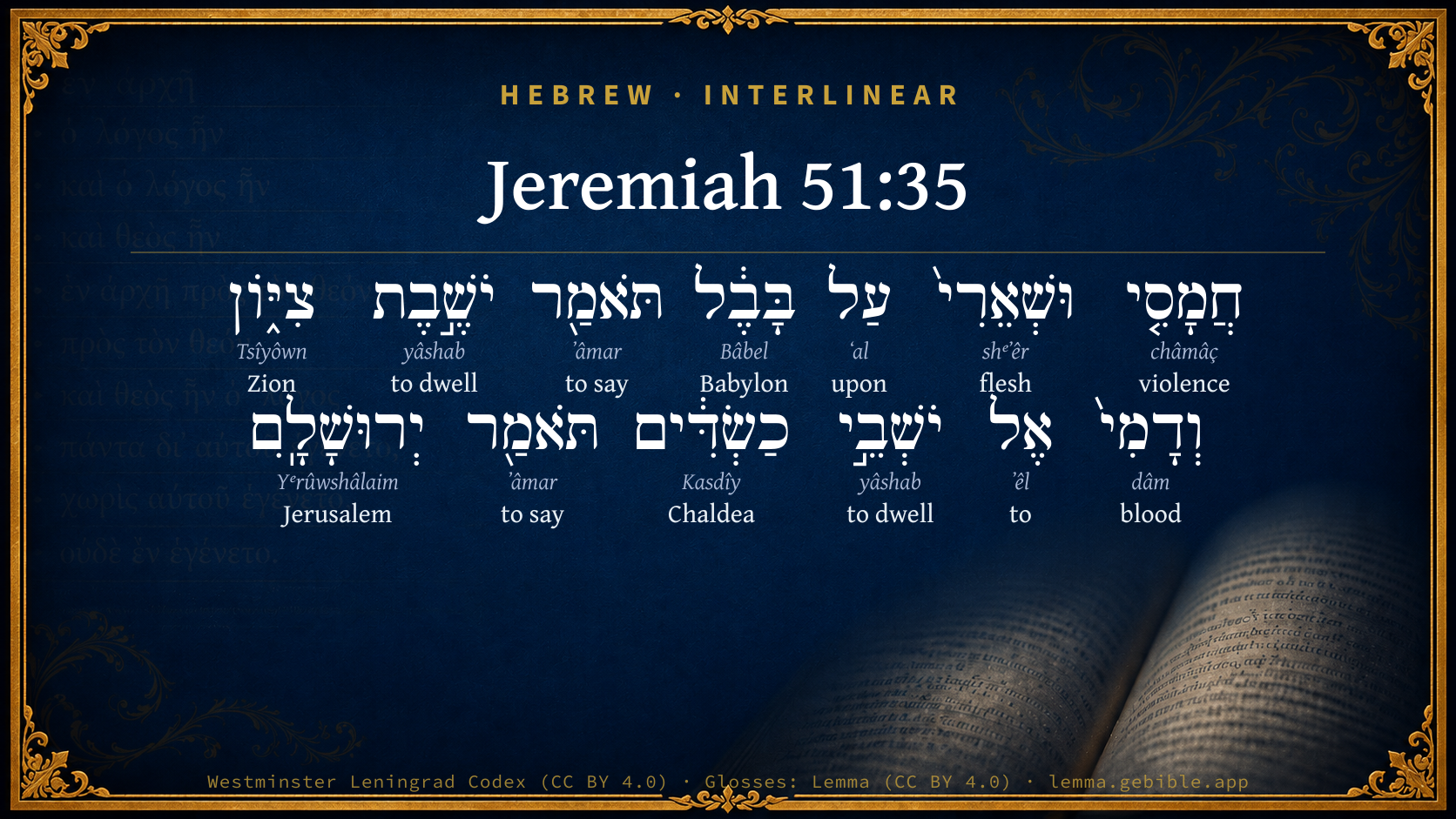
Jeremiah 51:35

Hebrew (Westminster Leningrad Codex) Jeremiah 51:35 appears in the Hebrew Old Testament. The text above is from the Westminster Leningrad Codex. Each word links to its Strong’s number, a concise gloss, and parsing drawn from the Open Scriptures Hebrew Bible morphology. Click any word for its full Brown-Driver-Briggs (BDB) entry.
Download image
Cite this verse

Jeremiah 51:35 (World English Bible). Public Domain. Lemma interlinear Bible study tool, https://lemma.gebible.app/v/jeremiah/51/35.

Show BibTeX & RIS
BibTeX
RIS
English Translation
The violence done to me and to my flesh be on Babylon, shall the inhabitant of Zion say; and, My blood be on the inhabitants of Chaldea, shall Jerusalem say.
World English Bible · Public Domain
Download a study sheet

One document with this verse’s original text, its word-by-word gloss line, the meaning frame, cross-references with their text, attributed commentary, and full source and license credits — printable, and it pastes into notes with its structure intact.

This verse Autodidact and up

Study sheet (.html) Plain text (.txt)

A passage Seminary Student

Up to 50 verses in one chapter. A passage sheet keeps up to 6 commentary sources and 12 cross-references per verse, in the order this page ranks them, and says so on the sheet whenever that leaves anything out. Ask for a single verse and you get the Autodidact verse sheet above.

Everything on this page stays free to read, with no account — the sheet is a download of what is already on screen, not access to it.

Want to remove ads? Support Godless Engineer
Compare translations 3

The same verse in 3 English versions, stacked beneath the original-language interlinear above. Click any original word for its lexicon entry.

Each is an independent rendering of the whole verse — the interlinear is not word-aligned to these translations.

Highlighted words mark where these versions differ — a whole-verse word diff, not a word-by-word alignment.

  • World English Bible Public Domain
    The violence done to me and to my flesh be on Babylon, shall the inhabitant of Zion say; and, My blood be on the inhabitants of Chaldea, shall Jerusalem say.
  • King James Version Public Domain
    The violence done to me and to my flesh be upon Babylon, shall the inhabitant of Zion say; and my blood upon the inhabitants of Chaldea, shall Jerusalem say.
  • unfoldingWord Literal Text CC BY-SA 4.0
    The one who lives in Zion will say, ‘May the violence done to me and my flesh be on Babylon.’ Jerusalem will say, ‘May my blood be on the inhabitants of Chaldea.’

unfoldingWord Literal Text — © unfoldingWord, licensed CC BY-SA 4.0. Word-aligned USFM3 via Door43 (git.door43.org/unfoldingWord/en_ult).

Versions to compare (up to 4)

3 of 4 selected

Show all 18 translations

Every available English version of this verse, each an independent rendering of the whole verse.

  • World English Bible Public Domain
    The violence done to me and to my flesh be on Babylon, shall the inhabitant of Zion say; and, My blood be on the inhabitants of Chaldea, shall Jerusalem say.
  • Berean Standard Bible Public Domain
    May the violence done to me and to my flesh be upon Babylon,” says the dweller of Zion. “May my blood be on the dwellers of Chaldea,” says Jerusalem.
  • Majority Standard Bible Public Domain
    May the violence done to me and to my flesh be upon Babylon,” says the dweller of Zion. “May my blood be on the dwellers of Chaldea,” says Jerusalem.
  • King James Version Public Domain
    The violence done to me and to my flesh be upon Babylon, shall the inhabitant of Zion say; and my blood upon the inhabitants of Chaldea, shall Jerusalem say.
  • American Standard Version (1901) Public Domain
    The violence done to me and to my flesh be upon Babylon, shall the inhabitant of Zion say; and, My blood be upon the inhabitants of Chaldea, shall Jerusalem say.
  • Revised Version (1885) Public Domain
    The violence done to me and to my flesh be upon Babylon, shall the inhabitant of Zion say; and, My blood be upon the inhabitants of Chaldea, shall Jerusalem say.
  • Geneva Bible (1599) Public Domain
    The spoyle of me, and that which was left of me, is brought vnto Babel, shall the inhabitant of Zion say: and my blood vnto the inhabitantes of Caldea, shall Ierusalem say.
  • Douay-Rheims (1899) Public Domain
    The wrong done to me, and my flesh be upon Babylon, saith the habitation of Sion: and my blood upon the inhabitants of Chaldea, saith Jerusalem.
  • Young's Literal Translation Public Domain
    My wrong, and `that of' my flesh `is' on Babylon, Say doth the inhabitant of Zion, And my blood `is' on the inhabitants of Chaldea, Say doth Jerusalem.
  • Literal Standard Version CC BY-SA 4.0
    My wrong, and [that of] my flesh, [is] on Babylon—The inhabitant of Zion says; And my blood [is] on the inhabitants of Chaldea—Jerusalem says.
  • Unlocked Literal Bible CC BY-SA 4.0
    The one who lives in Zion will say, 'May the violence done to me and my flesh be on Babylon.' Jerusalem will say, 'May my blood be on the inhabitants of Chaldea.'
  • unfoldingWord Literal Text CC BY-SA 4.0
    The one who lives in Zion will say, ‘May the violence done to me and my flesh be on Babylon.’ Jerusalem will say, ‘May my blood be on the inhabitants of Chaldea.’
  • Darby Bible Public Domain
    The violence done to me and to my flesh be upon Babylon, shall the inhabitress of Zion say; and, My blood be upon the inhabitants of Chaldea, shall Jerusalem say.
  • World Messianic Bible Public Domain
    May the violence done to me and to my flesh be on Babylon!” the inhabitant of Zion will say; and, “May my blood be on the inhabitants of Kasdim!” will Jerusalem say.
  • Webster's Bible Public Domain
    The violence done to me and to my flesh be upon Babylon, shall the inhabitant of Zion say; and my blood upon the inhabitants of Chaldea, shall Jerusalem say.
  • Free Bible Version CC BY-SA 4.0
    “Babylon must bear the responsibility for the violent attacks on us,” say the inhabitants of Zion. “The people of Babylonia must bear the responsibility for the blood shed in my city,” says Jerusalem.
  • Bible in Basic English Public Domain
    May the violent things done to me, and my downfall, come on Babylon, the daughter of Zion will say; and, May my blood be on the people of Chaldaea, Jerusalem will say.
  • JPS Tanakh (1917) Public Domain
    'The violence done to me and to my flesh be upon Babylon', shall the inhabitant of Zion say; and: 'My blood be upon the inhabitants of Chaldea', shall Jerusalem say.

Literal Standard Version (2020), Covenant Press — licensed CC BY-SA 4.0. Text via the HelloAO Bible API (eBible.org). Unlocked Literal Bible (unfoldingWord) — licensed CC BY-SA 4.0. Text via the HelloAO Bible API (eBible.org). unfoldingWord Literal Text — © unfoldingWord, licensed CC BY-SA 4.0. Word-aligned USFM3 via Door43 (git.door43.org/unfoldingWord/en_ult). Free Bible Version, Dr. Jonathan Gallagher — licensed CC BY-SA 4.0. Text via the HelloAO Bible API (eBible.org).

Word by word

More ways to search: Search by grammar → Find every occurrence → Compare this word →

Practice this passage: Drill this verse → Learn its vocabulary →

וּשְׁאֵרִי֙
shᵉʼêr
H7607
“and · flesh · my”
Conjunction + Noun, Common, Masculine, Singular, Construct + Suffix, Personal, 1st Person, Common, Singular
Part of Speech
Conjunction + Noun
Type
Common
Gender
Masculine
Number
Singular
State
Construct
Full BDB Definition

Origin: from H7604

TWOT: 2308a

flesh, food, body, near kin, near kinswoman - flesh - as food - for physical power (figuratively) - flesh relation, blood relation - self
  1. חֲמָסִ֤י châmâç H2555 “violence · my” Noun, Common, Masculine, Singular, Construct + Suffix, Personal, 1st Person, Common, Singular
  2. עַל ʻal H5921 “upon” Preposition
  3. בָּבֶ֔ל Bâbel H894 “Babylon” Noun, Proper
  4. תֹּאמַ֖ר ʼâmar H559 “to say” Verb, Qal, Imperfect, 3rd Person, Feminine, Singular
  5. יֹשֶׁ֣בֶת yâshab H3427 “dwelling” Verb, Qal, Participle Active, Feminine, Singular, Construct
  6. צִיּ֑וֹן Tsîyôwn H6726 “Zion” Noun, Proper
  7. וְדָמִי֙ dâm H1818 “and · blood · my” Conjunction + Noun, Common, Masculine, Singular, Construct + Suffix, Personal, 1st Person, Common, Singular
  8. אֶל ʼêl H413 “to” Preposition
  9. יֹשְׁבֵ֣י yâshab H3427 “dwelling” Verb, Qal, Participle Active, Masculine, Plural, Construct
  10. כַשְׂדִּ֔ים Kasdîy H3778 “Chaldea” Noun, Proper
  11. תֹּאמַ֖ר ʼâmar H559 “to say” Verb, Qal, Imperfect, 3rd Person, Feminine, Singular
  12. יְרוּשָׁלִָֽם Yᵉrûwshâlaim H3389 “Jerusalem” Noun, Proper

About this verse

These counts appear in no published source. They are computed here, from the morphology-tagged text and Lemma’s own curated glosses. What Lemma adds →

13
words
11
distinct lemmas
Prophets
section

Notable vocabulary

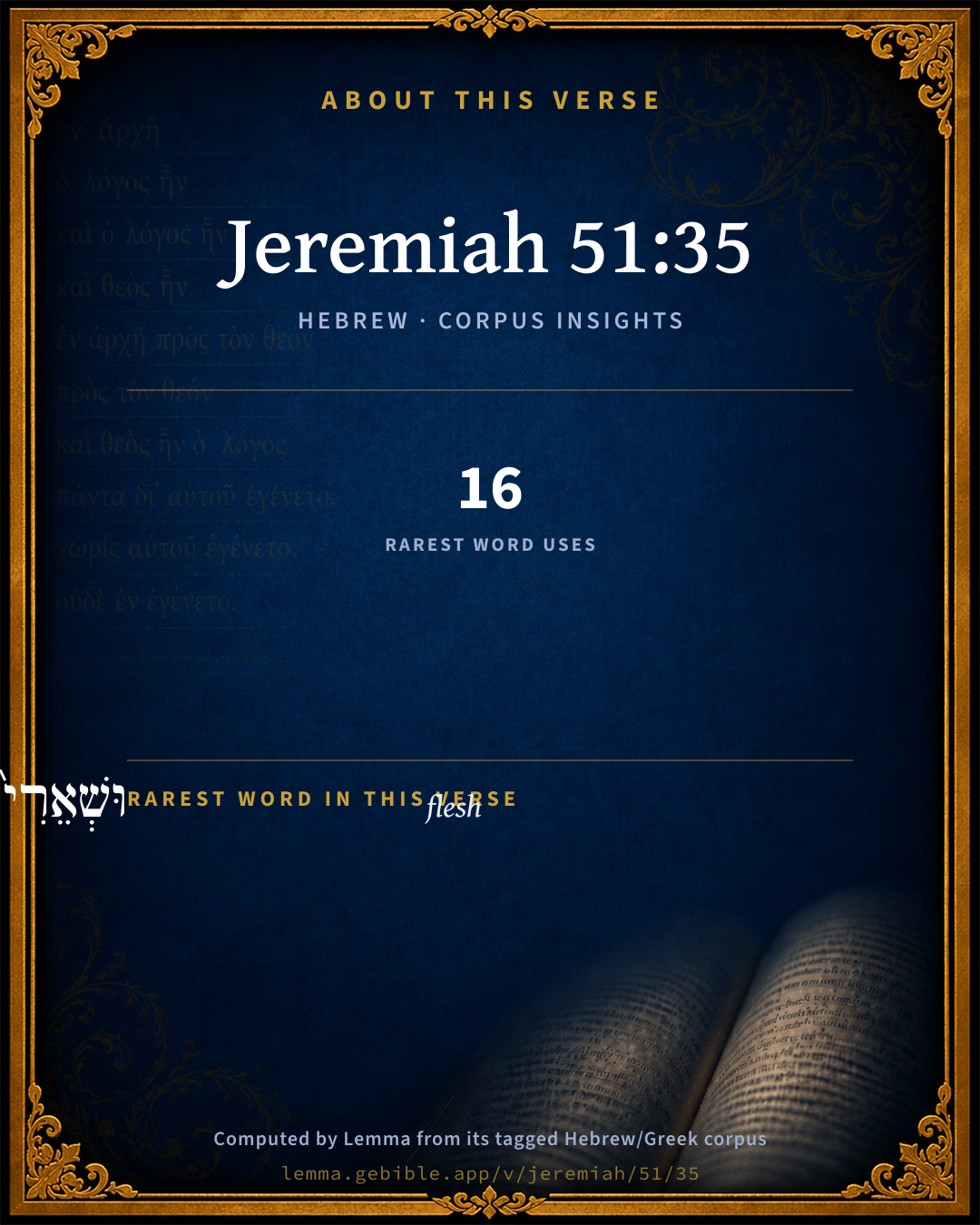
The rarest word here is וּשְׁאֵרִי֙ flesh H7607 — appearing just 16 times in the whole Hebrew Bible.

Shared distinctive vocabulary

וּשְׁאֵרִי֙ flesh H7607 occurs in 16 verses of the Hebrew Bible. Also found in:

Grammatical profile

  • 4 verbs
  • 7 nouns
  • 2 prepositions

Verb forms

  • תֹּאמַ֖ר Qal · Imperfect
  • יֹשֶׁ֣בֶת Qal · Participle Active
  • יֹשְׁבֵ֣י Qal · Participle Active
  • תֹּאמַ֖ר Qal · Imperfect

Repetition

Words recur within this verse — often emphatic in Hebrew:

  • תֹּאמַ֖ר to say H559 ×2
  • יֹשֶׁ֣בֶת to dwell H3427 ×2

Cross-references

15

Topical passages linked to Jeremiah 51:35 in the Treasury of Scripture Knowledge — connected by theme and wording, ordered by reader-vote popularity; previews shown in the World English Bible.

  • Jeremiah 50:29 Call together the archers against Babylon, all those who bend the bow; encamp against her round about; let none of it escape: recompense her according to her work; according to all that she has done, do to her; for she has been proud against Yahweh, against the Holy One of Israel.
  • Revelation 18:20 Rejoice over her, O heaven, you saints, apostles, and prophets; for God has judged your judgment on her."
  • Judges 9:20 but if not, let fire come out from Abimelech, and devour the men of Shechem, and the house of Millo; and let fire come out from the men of Shechem, and from the house of Millo, and devour Abimelech.
  • Judges 9:24 that the violence done to the seventy sons of Jerubbaal might come, and that their blood might be laid on Abimelech their brother, who killed them, and on the men of Shechem, who strengthened his hands to kill his brothers.
  • Judges 9:56–57 Thus God requited the wickedness of Abimelech, which he did to his father, in killing his seventy brothers;
  • Psalms 9:12 For he who avenges blood remembers them. He doesn't forget the cry of the afflicted.
  • Psalms 12:5 "Because of the oppression of the weak and because of the groaning of the needy, I will now arise," says Yahweh; "I will set him in safety from those who malign him."
  • Psalms 137:8–9 Daughter of Babylon, doomed to destruction, He will be happy who rewards you, As you have served us.
  • Isaiah 26:20–21 Come, my people, enter you into your chambers, and shut your doors about you: hide yourself for a little moment, until the indignation be past.
  • Zechariah 1:15 I am very angry with the nations that are at ease; for I was but a little displeased, but they added to the calamity."
  • Matthew 7:2 For with whatever judgment you judge, you will be judged; and with whatever measure you measure, it will be measured to you.
  • James 2:13 For judgment is without mercy to him who has shown no mercy. Mercy triumphs over judgment.
  • Revelation 6:10 They cried with a loud voice, saying, "How long, Master, the holy and true, until you judge and avenge our blood on those who dwell on the earth?"
  • Revelation 16:6 For they poured out the blood of the saints and the prophets, and you have given them blood to drink. They deserve this."
  • Revelation 18:6 Return to her just as she returned, and repay her double as she did, and according to her works. In the cup which she mixed, mix to her double.

Cross-references courtesy of OpenBible.info (CC BY 4.0).

Hebrew and Greek witnesses Masoretic Hebrew ↔ Greek Septuagint

The same verse in the two great witnesses to the Old Testament, shown verse-for-verse.

These are two independent witnesses, not word-aligned to each other, and the Septuagint is shown in lemma (dictionary) form.

Hebrew Jeremiah 51:35 Masoretic · Westminster Leningrad Codex

חֲמָסִ֤י וּשְׁאֵרִי֙ עַל בָּבֶ֔ל תֹּאמַ֖ר יֹשֶׁ֣בֶת צִיּ֑וֹן וְדָמִי֙ אֶל יֹשְׁבֵ֣י כַשְׂדִּ֔ים תֹּאמַ֖ר יְרוּשָׁלִָֽם

The violence done to me and to my flesh be on Babylon, shall the inhabitant of Zion say; and, My blood be on the inhabitants of Chaldea, shall Jerusalem say.

World English Bible · Public Domain

Greek LXX Structure differs

In the Septuagint, Jeremiah is about an eighth shorter than the Hebrew and arranges its material differently — the Oracles Against the Nations (Hebrew chapters 46–51) appear in the middle of the Greek book, after 25:13. Because the chapter and verse boundaries do not line up, a verse-for-verse comparison with the Hebrew is not shown.

A verse-for-verse comparison isn’t shown here because the chapters and verses don’t line up. Switch to the LXX edition with the MT / LXX toggle above to read the Greek directly.

Hebrew: Westminster Leningrad Codex (CC BY 4.0). Greek: Septuagint (public domain); English from a public-domain English Septuagint. How the Septuagint differs from the Hebrew →

Targum (Aramaic paraphrase)

1

The Targum is the ancient Jewish Aramaic paraphrase of the Hebrew Scriptures — an interpretive translation, not the Hebrew text itself. Onkelos (literal) and Pseudo-Jonathan (expansive) render the Torah, and Jonathan the Prophets. Coverage is partial: where no permissively-licensed English translation exists for a verse, only the Aramaic is shown. This is verse-level text, not a word-by-word alignment to the Hebrew.

  1. Targum Jonathan Prophets (Joshua–Malachi)
    חֲטוּפִי וּבוּזִי עַל בָּבֶל תֵּימַר כְּנִשְׁתָּא דְצִיוֹן וְחוֹבַת דַם זַכַּאי דְאִתְשַׁד בִּי עַל יַתְבֵי אַרְעָא כַסְדָאֵי תֵּימַר יְרוּשְׁלֵם:

    (no public-domain English translation for this verse)

    Targum Jonathan — Aramaic: “Mikraot Gedolot” (public domain). English: “Sefaria Community Translation” (CC0 1.0 (public-domain dedication)); “London "Chaldee Paraphrase," 1871” (public domain). Text via Sefaria.

Commentary

Notes on Jeremiah 51:35 from classic Christian and Jewish commentators (each source and its license shown beneath its notes). The classic Christian expositions comment on the surrounding passage and are grouped to its opening verse, so a note may address several verses; the Jewish commentaries on the Tanakh (Rashi and others) are per-verse, so they appear only where the commentator wrote on this verse.

Lemma curates 59 commentaries, every one of them public domain or Creative Commons licensed, each selected and text-cleaned for this edition rather than reprinted as found. About our sources →

Trapp's Complete Commentary

John Trapp

Jer 51:35 The violence done to me and to my flesh [be] upon Babylon, shall the inhabitant of Zion say; and my blood upon the inhabitants of Chaldea, shall Jerusalem say.

Ver. 35. The violence done to me and to my flesh.] Torn and tossed as carrion by that ravenous beast; the Lord look upon it and requite it.

John Trapp, A Commentary or Exposition upon All the Books of the Old and New Testament (1647–1656) — public domain. Text from a community e-Sword module.

Tyndale Open Study Notes

Tyndale Open Resources

51:35 Make Babylon suffer as she made us suffer: See “Prayers for Vengeance” Theme Note.

Tyndale Open Study Notes — © Tyndale Open Resources, licensed CC BY-SA 4.0. Text via the HelloAO Bible API.

Jamieson, Fausset & Brown

Robert Jamieson, A. R. Fausset & David Brown

my flesh--which Nebuchadnezzar hath "devoured" (Jer 51:34). Zion thus calls her kinsmen (Rom 11:14) slain throughout the country or carried captives to Babylon [GROTIUS]. Or, as "my blood" follows, it and "my flesh" constitute the whole man: Zion, in its totality, its citizens and all its substance, have been a prey to Babylon's violence (Psa 137:8).

Jamieson, Fausset & Brown — Commentary Critical and Explanatory on the Whole Bible (1871) — public domain (CC PDM 1.0). Text via the HelloAO Bible API.

Adam Clarke's Commentary

Verse 35. The violence done to me - be upon Babylon, - and my blood upon the inhabitants of Chaldea] Zion begins to speak, Jer 51:34, and ends with this verse. The answer of Jehovah begins with the next verse. Though the Chaldeans have been the instrument of God to punish the Jews, yet in return they, being themselves exceedingly wicked, shall suffer for all the carnage they have made, and for all the blood they have shed.

Adam Clarke's Commentary on the Bible (1810–1826) — public domain. Text from a community e-Sword/MySword module.

John Calvin's Commentaries

Jeremiah goes on with the same subject; for, after having shown that the calamities of the people were not unknown to God, he now, in an indirect way, exhorts the faithful to deposit their complaints in the bosom of God, and to apply, or appeal to him, as their defender. The design, then, of the Prophet is, (after having explained how grievously the Jews had been afflicted,) to show them that their only remedy was, to flee to God, and to plead their cause before him.

And this passage is entitled to particular notice, so that we may also learn in extreme evils, when all things seem hopeless, to discover our evils to God, and thus to unburden our anxieties in his bosom. For how is it, that sorrow often overwhelms us, except that we do not follow what God’s Spirit prescribes to us? For it is said in the Psalms,

“Roll thy cares into God’s bosom, and he will sustain thee, and will not give the righteous to a perpetual change.” (Psalm 55:23)

We may, then, by prayer, unburden ourselves, and this is the best remedy: but we murmur, and sometimes clamor, or at least we bite and champ the bridle, according to a common proverb; and, in the meantime, we neglect the chief thing, and what the Prophet teaches us here.

We ought, then, carefully to mark the design of what is here taught, when it is said, my violence and my flesh be upon Babylon When he adds, Say will (or let) the daughter of Sion, he no doubt shows that the faithful have always this consolation in their extreme calamities, that they can expostulate with God as to their enemies and their cruelty. Then he says, my plunder or violence; some render it “the plunder of me,” which is harsh. But the meaning of the Prophet is not ambiguous, for it follows afterwards, my flesh Then violence was that which was done by enemies. But the people is here spoken of under the name of a woman, according to what is commonly done, Let the inhabitress of Sion say, My plunder and my flesh. By the second word the Prophet shows sufficiently plain what he understood by plunder. My flesh, he says, (even that which the Chaldeans had devoured and consumed,) be on Babylon This is of the greatest weight, for by these words he intimates, that though the Chaldeans thought that they had exercised with impunity their cruelty towards the Jews, yet their innocent blood cried, and was opposed to them as an enemy.

To the same purpose he afterwards adds, Let Jerusalem say, My blood is upon the Chaldeans.

John Calvin's Commentaries (1540-1563) — public domain. Text from the Calvin Translation Society English edition (1840s-50s) via the Christian Classics Ethereal Library (ccel.org). Calvin's coverage is partial (roughly two-thirds of the Bible); uncommented books and verses are honest gaps, never fabricated. The 19th-century editor's footnotes and remarks are omitted so the notes are faithfully Calvin's own voice.

Ellicott's Commentary for English Readers

(35) The violence done to me and to my flesh . . .—The imagery of the “dragon” or “crocodile” is continued. The “inhabitress of Zion” pleads that her “flesh” and “blood” have been devoured by the Babylonian conqueror, and asks for the application of the law of retribution.

A Bible Commentary for English Readers, edited by Charles John Ellicott (1878–1897) — public domain. Text from a community e-Sword module.

The Cambridge Bible for Schools and Colleges

gen. ed. J. J. S. Perowne

35. The violence done to me and to my flesh] mg. My wrong and my flesh, i.e. the injuries which I have wrongfully suffered at the hands of Babylon. But it is possible that the Heb. translated “flesh” may here have the sense of an Arabic word of similar letters, signifying blood-revenge, thus making a good parallel with “My blood” in the next clause. In that case we should render May the violence … and my blood-revenge be upon, etc.

inhabitant] For mg. inhabitress see on Jer_4:11.

The Cambridge Bible for Schools and Colleges (gen. ed. J. J. S. Perowne; Cambridge University Press, 1878–1918) — public domain. Text from a community e-Sword module.

John Gill's Exposition

And Babylon shall become heaps,.... The houses should be demolished, and the stones lie in heaps one upon another, and become mere rubbish:

a dwelling place for dragons; and other wild and savage creatures. Dragons, as Aelianus (a) observes, love to live in desert places, and such now Babylon is; it lies in ruins; and even its palace is so full of scorpions and serpents, as Benjamin of Tudela (b) says it was in his time, that men durst not enter into it; see Jer 50:39;

an astonishment, and an hissing, without an inhabitant; an astonishment to neighbouring nations, and to all that pass by; who shall hiss at the destruction of it, and rejoice, there being not so much as a single inhabitant in it; which is its case to this day; see Jer 50:13.

(a) De Animal. l. 6. c. 63. (b) Itinerarium, p. 76.

John Gill's Exposition of the Whole Bible (1746–1763) — public domain (CC PDM 1.0). Text via the HelloAO Bible API.

Matthew Poole's English Annotations

The words are either a prayer, or a prediction of God’s vengeance upon Babylon; so Psa 137:7,8. God hath said vengeance is his, and he will repay it. The church of the Jews here commits its cause to God, and prayeth him to execute vengeance for her. How far it is lawful for us to pray against our enemies we have heard once and again.

Matthew Poole's English Annotations on the Holy Bible (1683–1685) — public domain. Text from a community e-Sword/MySword module.

The Pulpit Commentary

And to my flesh; rather, and my (eaten) flesh. (comp. Mic_3:3) Inhabitant; rather, inhabitress; i.e. virgin inhabiting.

The Pulpit Commentary (1880–1919), ed. H.D.M. Spence-Jones & Joseph S. Exell — public domain. Text from a community e-Sword module.

Rashi

Rabbi Shlomo Yitzchaki (Rashi)

the plundering done me and my food The cry of violence done me and my food, for they have eaten my food.

Rashi on the Tanakh — English translations: “The Judaica Press complete Tanach with Rashi, translated by A. J. Rosenberg” (CC BY 4.0); “Pentateuch with Rashi's commentary by M. Rosenbaum and A.M. Silbermann, 1929-1934” (public domain); “The Metsudah Tanach series, Lakewood, N.J” (CC BY 4.0); and “The Book of Joshua, Metsudah Publications, 1997” (CC BY 4.0). Text via Sefaria.

Lesson kit

Teaching starters — assembled from the data on this page, not authored interpretation. Every prompt links to the verse data it draws on. Edit before teaching.

Jeremiah, in the Prophets, opens this verse with 13 words (11 distinct Hebrew lemmas). Its most distinctive word is shᵉʼêr (“flesh”). A historical commentator’s framing appears above. Read the whole chapter for the surrounding context.

Discussion questions

  1. How does “flesh” (shᵉʼêr) shape what this verse is saying?
  2. How does Exodus 21:10, which shares the word «flesh», read alongside this verse?
  3. What does the repetition of “to say” (2× in this one verse) do in this verse?
  4. These translations render this verse differently. What is at stake in choosing one wording over another?
  5. «תֹּאמַ֖ר» is a Qal Imperfect verb. How does that grammatical form shape the action described?
  6. Compare how Trapp's Complete Commentary and Tyndale Open Study Notes read this verse. Where do they agree or differ?

Things to notice

Reading settings

Reading text

Shown beneath each verse's original-language words.

Old Testament
Old Testament edition

Read the OT as the Masoretic Hebrew (MT) or the Greek Septuagint (LXX).

English shown for the Greek Septuagint (in the Hebrew ↔ Greek comparison).

Comparing translations? Open the Compare panel on any verse page to stack up to four side by side.