

Isaiah 51:3

Hebrew (Westminster Leningrad Codex) Isaiah 51:3 appears in the Hebrew Old Testament. The text above is from the Westminster Leningrad Codex. Each word links to its Strong’s number, a concise gloss, and parsing drawn from the Open Scriptures Hebrew Bible morphology. Click any word for its full Brown-Driver-Briggs (BDB) entry.
Download image
Cite this verse

Isaiah 51:3 (World English Bible). Public Domain. Lemma interlinear Bible study tool, https://lemma.gebible.app/v/isaiah/51/3.

Show BibTeX & RIS
BibTeX
RIS
English Translation
For Yahweh has comforted Zion; he has comforted all her waste places, and has made her wilderness like Eden, and her desert like the garden of Yahweh; joy and gladness shall be found therein, thanksgiving, and the voice of melody.
World English Bible · Public Domain
Download a study sheet

One document with this verse’s original text, its word-by-word gloss line, the meaning frame, cross-references with their text, attributed commentary, and full source and license credits — printable, and it pastes into notes with its structure intact.

This verse Autodidact and up

Study sheet (.html) Plain text (.txt)

A passage Seminary Student

Up to 50 verses in one chapter. A passage sheet keeps up to 6 commentary sources and 12 cross-references per verse, in the order this page ranks them, and says so on the sheet whenever that leaves anything out. Ask for a single verse and you get the Autodidact verse sheet above.

Everything on this page stays free to read, with no account — the sheet is a download of what is already on screen, not access to it.

Want to remove ads? Support Godless Engineer
Compare translations 3

The same verse in 3 English versions, stacked beneath the original-language interlinear above. Click any original word for its lexicon entry.

Each is an independent rendering of the whole verse — the interlinear is not word-aligned to these translations.

Highlighted words mark where these versions differ — a whole-verse word diff, not a word-by-word alignment.

  • World English Bible Public Domain
    For Yahweh has comforted Zion; he has comforted all her waste places, and has made her wilderness like Eden, and her desert like the garden of Yahweh; joy and gladness shall be found therein, thanksgiving, and the voice of melody.
  • King James Version Public Domain
    For the LORD shall comfort Zion: he will comfort all her waste places; and he will make her wilderness like Eden, and her desert like the garden of the LORD; joy and gladness shall be found therein, thanksgiving, and the voice of melody.
  • unfoldingWord Literal Text CC BY-SA 4.0
    For Yahweh will comfort Zion; he will comfort all of her desolations, and he will make her wilderness like Eden and her desert plain like the garden of Yahweh. Joy and gladness will be found in her, thanksgiving and the voice of song.

unfoldingWord Literal Text — © unfoldingWord, licensed CC BY-SA 4.0. Word-aligned USFM3 via Door43 (git.door43.org/unfoldingWord/en_ult).

Versions to compare (up to 4)

3 of 4 selected

Show all 18 translations

Every available English version of this verse, each an independent rendering of the whole verse.

  • World English Bible Public Domain
    For Yahweh has comforted Zion; he has comforted all her waste places, and has made her wilderness like Eden, and her desert like the garden of Yahweh; joy and gladness shall be found therein, thanksgiving, and the voice of melody.
  • Berean Standard Bible Public Domain
    For the LORD will comfort Zion and will look with compassion on all her ruins; He will make her wilderness like Eden and her desert like the garden of the LORD. Joy and gladness will be found in her, thanksgiving and melodious song.
  • Majority Standard Bible Public Domain
    For the LORD will comfort Zion and will look with compassion on all her ruins; He will make her wilderness like Eden and her desert like the garden of the LORD. Joy and gladness will be found in her, thanksgiving and melodious song.
  • King James Version Public Domain
    For the LORD shall comfort Zion: he will comfort all her waste places; and he will make her wilderness like Eden, and her desert like the garden of the LORD; joy and gladness shall be found therein, thanksgiving, and the voice of melody.
  • American Standard Version (1901) Public Domain
    For Jehovah hath comforted Zion; he hath comforted all her waste places, and hath made her wilderness like Eden, and her desert like the garden of Jehovah; joy and gladness shall be found therein, thanksgiving, and the voice of melody.
  • Revised Version (1885) Public Domain
    For the LORD hath comforted Zion: he hath comforted all her waste places, and hath made her wilderness like Eden, and her desert like the garden of the LORD; joy and gladness shall be found therein, thanksgiving, and the voice of melody.
  • Geneva Bible (1599) Public Domain
    Surely the Lord shall comfort Zion: he shall comfort all her desolations, and he shall make her desert like Eden, and her wildernes like the garden of the Lord: ioy and gladnesse shalbe founde therein: praise, and the voyce of singing.
  • Douay-Rheims (1899) Public Domain
    The Lord therefore will comfort Sion, and will comfort all the ruins thereof: and he will make her desert as a place of pleasure, and her wilderness as the garden of the Lord. Joy and gladness shall be found therein, thanksgiving, and the voice of praise.
  • Young's Literal Translation Public Domain
    For Jehovah hath comforted Zion, He hath comforted all her wastes, And He setteth her wilderness as Eden, And her desert as a garden of Jehovah, Joy, yea, gladness is found in her, Confession, and the voice of song.
  • Literal Standard Version CC BY-SA 4.0
    For YHWH has comforted Zion, || He has comforted all her ruins, || And He sets her wilderness as Eden, || And her desert as a garden of YHWH, || Joy, indeed, gladness is found in her, || Confession, and the voice of song.
  • Unlocked Literal Bible CC BY-SA 4.0
    Yes, Yahweh will comfort Zion; he will comfort all her waste places; her wilderness he made like Eden, and her desert plains beside the Jordan River valley like the garden of Yahweh; joy and gladness will be found in her, thanksgiving, and the sound of singing.
  • unfoldingWord Literal Text CC BY-SA 4.0
    For Yahweh will comfort Zion; he will comfort all of her desolations, and he will make her wilderness like Eden and her desert plain like the garden of Yahweh. Joy and gladness will be found in her, thanksgiving and the voice of song.
  • Darby Bible Public Domain
    For Jehovah shall comfort Zion, he shall comfort all her waste places; and he will make her wilderness like Eden, and her desert like the garden of Jehovah: gladness and joy shall be found therein, thanksgiving, and the voice of song.
  • World Messianic Bible Public Domain
    For the LORD has comforted Zion. He has comforted all her waste places, and has made her wilderness like Eden, and her desert like the garden of the LORD. Joy and gladness will be found in them, thanksgiving, and the voice of melody.
  • Webster's Bible Public Domain
    For the LORD will comfort Zion: he will comfort all her waste places; and he will make her wilderness like Eden, and her desert like the garden of the LORD; joy and gladness shall be found therein, thanksgiving, and the voice of melody.
  • Free Bible Version CC BY-SA 4.0
    The Lord will care for Zion and feel sorry about all her ruined places. He will make her wilderness like Eden, and her desert areas like the garden of the Lord. People there will have joy and happiness, giving thanks and singing sweet songs.
  • Bible in Basic English Public Domain
    For the Lord has given comfort to Zion: he has made glad all her broken walls; making her waste places like Eden, and changing her dry land into the garden of the Lord; joy and delight will be there, praise and the sound of melody.
  • JPS Tanakh (1917) Public Domain
    For the LORD hath comforted Zion; He hath comforted all her waste places, and hath made her wilderness like Eden, and her desert like the garden of the LORD; joy and gladness shall be found therein, thanksgiving, and the voice of melody.

Literal Standard Version (2020), Covenant Press — licensed CC BY-SA 4.0. Text via the HelloAO Bible API (eBible.org). Unlocked Literal Bible (unfoldingWord) — licensed CC BY-SA 4.0. Text via the HelloAO Bible API (eBible.org). unfoldingWord Literal Text — © unfoldingWord, licensed CC BY-SA 4.0. Word-aligned USFM3 via Door43 (git.door43.org/unfoldingWord/en_ult). Free Bible Version, Dr. Jonathan Gallagher — licensed CC BY-SA 4.0. Text via the HelloAO Bible API (eBible.org).

Word by word

More ways to search: Search by grammar → Find every occurrence → Compare this word →

Practice this passage: Drill this verse → Learn its vocabulary →

זִמְרָֽה
zimrâh
H2172
“song”
Noun, Common, Feminine, Singular, Absolute
Part of Speech
Noun
Type
Common
Gender
Feminine
Number
Singular
State
Absolute
Full BDB Definition

Origin: from H2167

TWOT: 558a

music, melody, song
  1. כִּֽי kîy H3588 “that” Conjunction
  2. נִחַ֨ם nâcham H5162 “to comfort” Verb, Piel, Perfect, 3rd Person, Masculine, Singular
  3. יְהוָ֜ה Yᵉhôvâh H3068 “LORD” Noun, Proper
  4. צִיּ֗וֹן Tsîyôwn H6726 “Zion” Noun, Proper
  5. נִחַם֙ nâcham H5162 “to comfort” Verb, Piel, Perfect, 3rd Person, Masculine, Singular
  6. כָּל kôl H3605 “all of” Noun, Common, Masculine, Singular, Construct
  7. חָרְבֹתֶ֔יהָ chorbâh H2723 “ruins · her” Noun, Common, Feminine, Plural, Construct + Suffix, Personal, 3rd Person, Feminine, Singular
  8. וַיָּ֤שֶׂם sûwm H7760 “and · to put” Conjunction + Verb, Qal, Sequential Imperfect, 3rd Person, Masculine, Singular
  9. מִדְבָּרָהּ֙ midbâr H4057 “wilderness · her” Noun, Common, Masculine, Singular, Construct + Suffix, Personal, 3rd Person, Feminine, Singular
  10. כְּעֵ֔דֶן ʻÊden H5731 “like/as · Eden” Preposition + Noun, Proper
  11. וְעַרְבָתָ֖הּ ʻărâbâh H6160 “and · wilderness · her” Conjunction + Noun, Common, Feminine, Singular, Construct + Suffix, Personal, 3rd Person, Feminine, Singular
  12. כְּגַן gan H1588 “like/as · garden of” Preposition + Noun, Common, Both, Singular, Construct
  13. יְהוָ֑ה Yᵉhôvâh H3068 “LORD” Noun, Proper
  14. שָׂשׂ֤וֹן sâsôwn H8342 “gladness” Noun, Common, Masculine, Singular, Absolute
  15. וְשִׂמְחָה֙ simchâh H8057 “and · joy” Conjunction + Noun, Common, Feminine, Singular, Absolute
  16. יִמָּ֣צֵא mâtsâʼ H4672 “to find” Verb, Niphal, Imperfect, 3rd Person, Masculine, Singular
  17. תּוֹדָ֖ה tôwdâh H8426 “thanksgiving” Noun, Common, Feminine, Singular, Absolute
  18. וְק֥וֹל qôwl H6963 “and · voice of” Conjunction + Noun, Common, Masculine, Singular, Construct

About this verse

These counts appear in no published source. They are computed here, from the morphology-tagged text and Lemma’s own curated glosses. What Lemma adds →

20
words
17
distinct lemmas
Prophets
section

Notable vocabulary

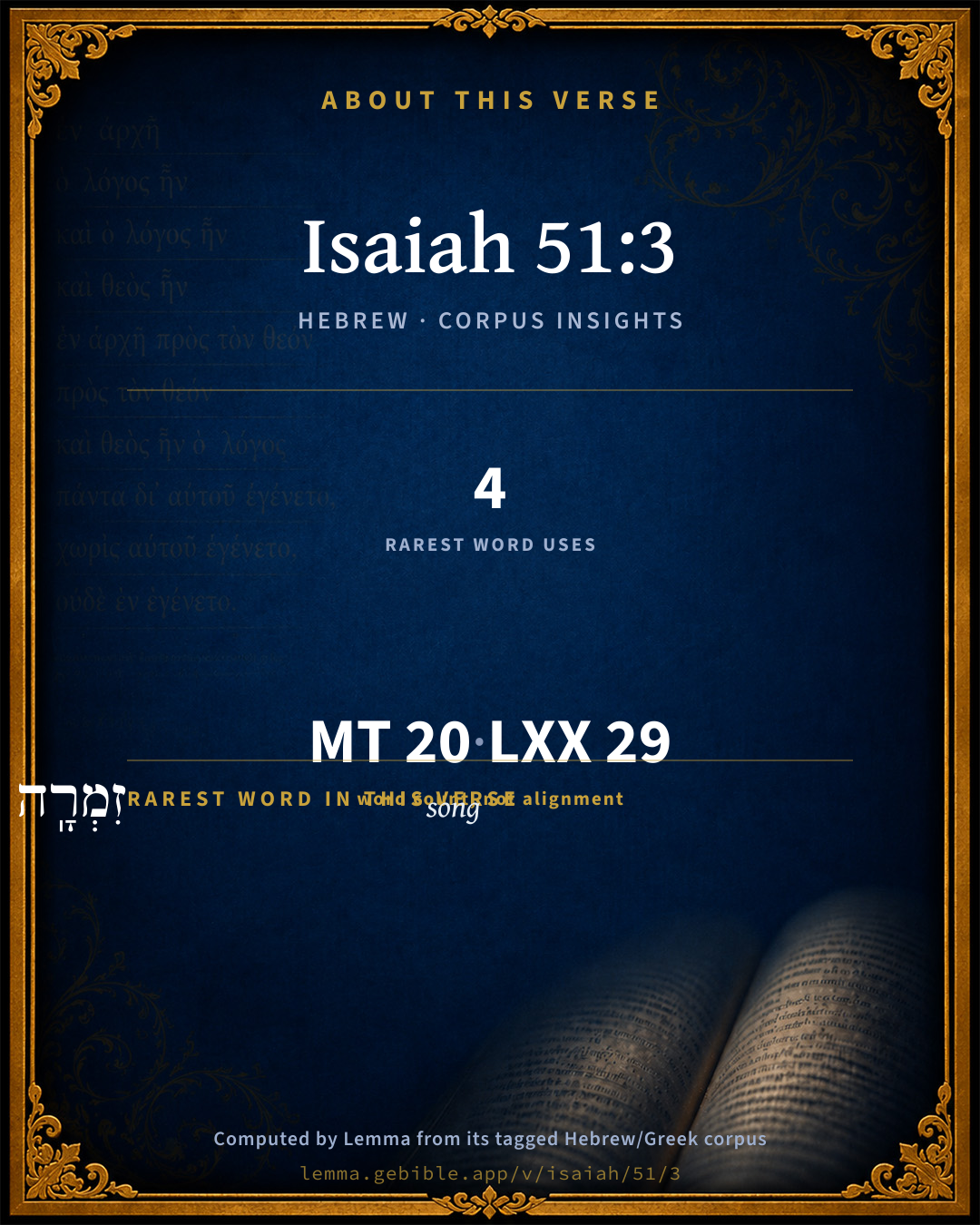
The rarest word here is זִמְרָֽה song H2172 — appearing just 4 times in the whole Hebrew Bible.

Shared distinctive vocabulary

זִמְרָֽה song H2172 occurs in 4 verses of the Hebrew Bible. Also found in:

Grammatical profile

  • 4 verbs
  • 14 nouns
  • 1 preposition
  • 1 conjunction

Verb forms

  • נִחַ֨ם Piel · Perfect
  • נִחַם֙ Piel · Perfect
  • וַיָּ֤שֶׂם Qal · Sequential Imperfect
  • יִמָּ֣צֵא Niphal · Imperfect

Repetition

Words recur within this verse — often emphatic in Hebrew:

  • נִחַ֨ם to comfort H5162 ×2
  • יְהוָ֜ה LORD H3068 ×2

Hebrew & Septuagint length

In English translation the verse runs 40 words from the Hebrew and 50 from the Septuagint (LXX English) — closely comparable.

A rough comparison of the two English renderings, which tokenize alike — not a word-level alignment.

Word counts can differ between the Hebrew and the Greek without any difference in meaning — e.g. the Hebrew direct-object marker אֵת has no separate Greek word, and Greek often adds the article ὁ.

In the original languages it is 20 Hebrew tokens and 29 Greek tokens — but the two are counted differently (Hebrew bundles its prefixes and suffixes into one token; the Greek is in lemma form), so that isn’t a like-for-like length.

Cross-references

27

Topical passages linked to Isaiah 51:3 in the Treasury of Scripture Knowledge — connected by theme and wording, ordered by reader-vote popularity; previews shown in the World English Bible.

  • Isaiah 49:13 Sing, heavens; and be joyful, earth; and break forth into singing, mountains: for Yahweh has comforted his people, and will have compassion on his afflicted.
  • Isaiah 52:9 Break forth into joy, sing together, you waste places of Jerusalem; for Yahweh has comforted his people, he has redeemed Jerusalem.
  • Joel 2:3 A fire devours before them, And behind them, a flame burns. The land is as the garden of Eden before them, And behind them, a desolate wilderness. Yes, and no one has escaped them.
  • Genesis 13:10 Lot lifted up his eyes, and saw all the plain of the Jordan, that it was well watered every where, before Yahweh destroyed Sodom and Gomorrah, like the garden of Yahweh, like the land of Egypt, as you go to Zoar.
  • Jeremiah 31:12–14 They shall come and sing in the height of Zion, and shall flow to the goodness of Yahweh, to the grain, and to the new wine, and to the oil, and to the young of the flock and of the herd: and their soul shall be as a watered garden; and they shall not sorrow any more at all.
  • Jeremiah 31:25 For I have satiated the weary soul, and every sorrowful soul have I replenished.
  • Jeremiah 33:11–13 the voice of joy and the voice of gladness, the voice of the bridegroom and the voice of the bride, the voice of those who say, Give thanks to Yahweh of Hosts, for Yahweh is good, for his loving kindness endures forever; [and of them] who bring [sacrifices of] thanksgiving into the house of Yahweh. For I will cause the captivity of the land to return as at the first, says Yahweh.
  • Zephaniah 3:14–20 Sing, daughter of Zion! Shout, Israel! Be glad and rejoice with all your heart, daughter of Jerusalem.
  • 1 Peter 1:8 whom not having known you love; in whom, though now you don't see him, yet believing, you rejoice greatly with joy unspeakable and full of glory--
  • Isaiah 35:7–10 The glowing sand shall become a pool, and the thirsty ground springs of water: in the habitation of jackals, where they lay, shall be grass with reeds and rushes.
  • Isaiah 40:1–2 Comfort you, comfort you my people, says your God.
  • Isaiah 41:18–19 I will open rivers on the bare heights, and springs in the midst of the valleys; I will make the wilderness a pool of water, and the dry land springs of water.
  • Ezekiel 31:8–10 The cedars in the garden of God could not hide it; the fir trees were not like its boughs, and the plane trees were not as its branches; nor was any tree in the garden of God like it in its beauty.
  • 2 Corinthians 1:3–4 Blessed be the God and Father of our Lord Jesus Christ, the Father of mercies and God of all comfort;
  • Genesis 2:8–9 Yahweh God planted a garden eastward, in Eden, and there he put the man whom he had formed.
  • Psalms 85:8 I will hear what God, Yahweh, will speak, For he will speak peace to his people, his saints; But let them not turn again to folly.
  • Psalms 102:13–14 You will arise and have mercy on Zion; For it is time to have pity on her. Yes, the set time has come.
  • Isaiah 12:1 In that day you will say, "I will give thanks to you, Yahweh; for though you were angry with me, your anger has turned away and you comfort me.
  • Isaiah 25:9 It shall be said in that day, Behold, this is our God; we have waited for him, and he will save us: this is Yahweh; we have waited for him, we will be glad and rejoice in his salvation.
  • Isaiah 35:1–2 The wilderness and the dry land shall be glad; and the desert shall rejoice, and blossom as the rose.
  • Isaiah 44:26 who confirms the word of his servant, and performs the counsel of his messengers; who says of Jerusalem, She shall be inhabited; and of the cities of Judah, They shall be built, and I will raise up the waste places of it;
  • Isaiah 51:12 I, even I, am he who comforts you: who are you, that you are afraid of man who shall die, and of the son of man who shall be made as grass;
  • Isaiah 54:6–8 For Yahweh has called you as a wife forsaken and grieved in spirit, even a wife of youth, when she is cast off, says your God.
  • Isaiah 61:1–4 The Spirit of the Lord Yahweh is on me; because Yahweh has anointed me to preach good news to the humble; he has sent me to bind up the broken-hearted, to proclaim liberty to the captives, and the opening [of the prison] to those who are bound;
  • Isaiah 66:10–14 Rejoice you with Jerusalem, and be glad for her, all you who love her: rejoice for joy with her, all you who mourn over her;
  • Revelation 19:1–7 After these things I heard something like a loud voice of a great multitude in heaven, saying, "Hallelujah! Salvation, power, and glory belong to our God:
  • Isaiah 49:8 Thus says Yahweh, In an acceptable time have I answered you, and in a day of salvation have I helped you; and I will preserve you, and give you for a covenant of the people, to raise up the land, to make them inherit the desolate heritage:

Cross-references courtesy of OpenBible.info (CC BY 4.0).

Hebrew and Greek witnesses Masoretic Hebrew ↔ Greek Septuagint

The same verse in the two great witnesses to the Old Testament, shown verse-for-verse.

These are two independent witnesses, not word-aligned to each other, and the Septuagint is shown in lemma (dictionary) form.

Hebrew Isaiah 51:3 Masoretic · Westminster Leningrad Codex

כִּֽי נִחַ֨ם יְהוָ֜ה צִיּ֗וֹן נִחַם֙ כָּל חָרְבֹתֶ֔יהָ וַיָּ֤שֶׂם מִדְבָּרָהּ֙ כְּעֵ֔דֶן וְעַרְבָתָ֖הּ כְּגַן יְהוָ֑ה שָׂשׂ֤וֹן וְשִׂמְחָה֙ יִמָּ֣צֵא בָ֔הּ תּוֹדָ֖ה וְק֥וֹל זִמְרָֽה

For Yahweh has comforted Zion; he has comforted all her waste places, and has made her wilderness like Eden, and her desert like the garden of Yahweh; joy and gladness shall be found therein, thanksgiving, and the voice of melody.

World English Bible · Public Domain

Greek LXX Isaiah 51:3 Septuagint · lemma form

καί σύ νῦν παρακαλέω σιων καί παρακαλέω πᾶς ὁ ἔρημος αὐτός καί τίθημι ὁ ἔρημος αὐτός ὡς παράδεισος κύριος εὐφροσύνη καί ἀγαλλίαμα εὑρίσκω ἐν αὐτός ἐξομολόγησις καί φωνή αἴνεσις

And now I will comfort you, O Sion: and I have comforted all her desert places; and I will make her desert places as a garden, and her western places as the garden of the Lord; they shall find in her gladness and exultation, thanksgiving and the voice of praise.

LXX2012 (modern English Septuagint) · Public Domain

On this verse, Albert Barnes' Notes on the Bible discusses the Septuagint’s reading. Read the note in Commentary ↓

Hebrew: Westminster Leningrad Codex (CC BY 4.0). Greek: Septuagint (public domain); English from LXX2012 (modern English Septuagint) (Public Domain). How the Septuagint differs from the Hebrew →

Targum (Aramaic paraphrase)

1

The Targum is the ancient Jewish Aramaic paraphrase of the Hebrew Scriptures — an interpretive translation, not the Hebrew text itself. Onkelos (literal) and Pseudo-Jonathan (expansive) render the Torah, and Jonathan the Prophets. Coverage is partial: where no permissively-licensed English translation exists for a verse, only the Aramaic is shown. This is verse-level text, not a word-by-word alignment to the Hebrew.

  1. Targum Jonathan Prophets (Joshua–Malachi)
    אֲרֵי עֲתִיד יְיָ לְנַחֲמָא צִיוֹן לְנַחֲמָא כָּל חָרְבָתָהָא וִישַׁוֵי מַדְבְּרָהָא כְּעֵדֶן וּמֵישְׁרָאָה כְּגִינְתָא דַייָ בִּיעַ וְחֶדְוָא יִשְׁתְּכַח בָּהּ מַעֲלֵי תוֹדָתָא וְקַל דִמְשַׁבְּחִין:

    For the Lord will comfort Zion, He will comfort all her waste places, and He will make her wilderness like Eden, and her desert like the garden of the Lord; joy and gladness shall be found therein, they that offer thanksgiving, and the voice of them that praise.

    Targum Jonathan — Aramaic: “Mikraot Gedolot” (public domain). English: “Sefaria Community Translation” (CC0 1.0 (public-domain dedication)); “London "Chaldee Paraphrase," 1871” (public domain). Text via Sefaria.

Commentary

Notes on Isaiah 51:3 from classic Christian and Jewish commentators (each source and its license shown beneath its notes). The classic Christian expositions comment on the surrounding passage and are grouped to its opening verse, so a note may address several verses; the Jewish commentaries on the Tanakh (Rashi and others) are per-verse, so they appear only where the commentator wrote on this verse.

Lemma curates 59 commentaries, every one of them public domain or Creative Commons licensed, each selected and text-cleaned for this edition rather than reprinted as found. About our sources →

Trapp's Complete Commentary

John Trapp

Isa 51:3 For the LORD shall comfort Zion: he will comfort all her waste places; and he will make her wilderness like Eden, and her desert like the garden of the LORD; joy and gladness shall be found therein, thanksgiving, and the voice of melody.

Ver. 3. For the Lord shall comfort Zion.] (As once he did Abraham) by multiplying her children, giving her good store of converts. These were the apostles and the primitive Christians, those earthly angels, who made the world, which before was as a waste wilderness, to become a most pleasant and plentiful paradise. Chrysostom somewhere calleth them angels, and saith that they were puriores coelo afflictione facti, more clear than the azured sky.

Joy and gladness shall be found in them.] See Isa 35:10.

Thanksgiving, and the voice of melody.] Paul as the precentor sweetly sings and gives the note to us all, "Blessed be the God and Father of our Lord Jesus Christ, who hath blessed us," &c. {Eph 1:3-7}

John Trapp, A Commentary or Exposition upon All the Books of the Old and New Testament (1647–1656) — public domain. Text from a community e-Sword module.

The Biblical Illustrator

Joseph S. Exell

Isa_51:3

For the Lord shall comfort Zion

Zion comforted

I.

THERE IS A LOW ESTATE, OF THE CATHOLIC UNIVERSAL CHURCH, AND OF PARTICULAR BRANCHES OF IT, AND LIKEWISE OF INDIVIDUAL MEMBERS.

II. THERE ARE GRACIOUS PROMISES OF REVIVAL, of restored fertility and productiveness.

III. THE MODE IT WHICH THESE BLESSED EFFECTS MAY BE LOOKED AND SOUGHT FOR. When the eye of faith is directed towards Christ, when we believe in Him as the Lord our righteousness, when the prayer of faith ascends to heaven, when the ear hearkens to the inspired Word, then we may expect that God will be gracious to His inheritance, and refresh it when it is weary. We may not look for the supplies of the Spirit of God unless we earnestly ask for them. (H. J. Hastings, M.A.)

The depression, prosperity and delight of the Church

Taking these words as the prophets statement with regard to the spiritual Church of God, under the appellation of Zion, we propose from these words to call attention--

I. TO THE DEPRESSION OF THE CHURCH.

1. This depression arises from the small number of those who belong to the Church.

2. The depression consists also in the want of spiritual vigour on the part of those who belong to the Church.

II. TO THE PROSPERITY OF THE CHURCH. Observe--

1. The source to which the prosperity of the Church is assigned. For the Lord shall comfort Zion, etc. Christianity is, emphatically, the ministration of the Spirit.

2. The nature of the prosperity by which the Church will be distinguished. What: is the precise import of this comforting of Zion, this comforting of her waste places, making her wilderness like the garden of Eden, and her desert like the garden of the Lord? Here you will observe, that a vast augmentation of the numbers of the Church must plainly be regarded as included. A great purification and refinement in the characters of those who do pertain to the Church will signalize those future days.

3. The means to be adopted by the true friends of the Church in order that the period of this predicted prosperity may arrive.

III. TO THE DELIGHT OF THE CHURCH. Joy and gladness shall be found therein, thanksgiving and the voice of melody. This emotion may properly arise from contemplating--

1. The wonderful change which shall have been accomplished in the condition of the Church itself.

2. The connection between the prosperity of the Church and the glorification of God.

3. The connection between the prosperity of the Church and the happiness of mankind.

Conclusion:

1. Our first anxiety, of course, must be, that you may individually belong to the Church of God yourselves.

2. What we next desire of you is, that you will labour in all the appointed means and instrumentalities by which the prosperity of the Church of God is to be secured. (J. Parsons.)

Zion comforted

(1) The land of bliss is

(2) full of human beings

(3) in festive frame and active enjoyment. (E. Delitzsch, D.D.)

A cheerful prospect

I. HEAVENLY COMFORT PROMISED. This is a promise to Gods Church. The Church of God--captured as it has been by Christ from the world, chosen to be the palace where He dwells, builded together for a temple wherein He is worshipped--is frequently called Zion.

1. The object of this comfort. The Lord will comfort Zion. Well He may, for she is His chosen. The Lord has chosen Zion. He would have those upon whom His choice is fixed be glad and happy.

2. The Lord Himself is the Comforter. There are sorrows for which there is no solace within the reach of the creature; there is a ruin which it would baffle any mortal to retrieve. Happy for us that the Omnipotent comes to our aid.

3. How does the Lord propose to comfort Zion? If you read the verse through you will find it is by making her fertile. The true way to comfort the Church is to build her synagogues, restore the desolation of former times, to sow her fields, plant her vineyards, make her soil fruitful, call out the industry of her sons and daughters, and fill them with lively, ardent zeal.

4. The promise is given in words that contain an absolute pledge. He shall and He will are terms that admit of no equivocation.

II. THE MOURNFUL CASES FAVOURED. He will make her wilderness like Eden, and her desert like the garden of the Lord.

1. Are there not to be found in the visible Church persons whose character is here vividly depicted?

(1) There are those who once were fruitful, hut are now comparable to wastes. I remember one Monday afternoon, when we had been waiting upon the Lord in prayer ever since seven oclock in the morning, that there came a most remarkable wave of prayer over the assembly. And then two backsliders got up and prayed one aider the other. According to their own account, they had been very bad fellows indeed, and had sorely transgressed against God; but there they were, broken-hearted and fairly broken down. It was a sight to make angels rejoice as their tears flowed. Certainly their sobs and cries touched the hearts of all of us who were assembled. I thought to myself, Then God is blessing us, for when backsliders come back it is a proof that God has visited His people.

(2) Then a second department of the promise is, He will make her wilderness like Eden. I take the wilderness here to be a place of scanty vegetation. Oh, how many there are in the Church of God who are just like that! They are Christians, but sorry Christians they are.

(3) A third character is implied in the desert--the deserted places where no man dwells, where the traveller does not care to linger. How many professors of religion answer to this description of the soil! They are like deserts. You not only never did bring forth fruit, but you never concerned yourself to do so.

2. Ask ye now, what does the Lord say He will do for them? He says that He will make the wilderness like Eden. You know what Eden was. It was the garden of the earth in the days of primeval probity. So the Lord says that when He visits His Church He will make these poor backsliders, these immature Christians, these nominal professors, like Eden. Moreover, as if to strengthen the volume of His grace and of our hope, He says that He will make her desert like the garden of the Lord. He shall come to you and delight your heart and soul with His converse.

III. CERTAIN DESIRABLE RESULTS WHICH ARE PREDICTED. Joy and gladness shall be found therein, thanksgiving, and the voice of melody. You notice the doubles. The parallelism of Hebrew poetry, perhaps, necessitated them. Still I remember how John Bunyan says that all the flowers in Gods garden bloom double. We are told of manifold mercies, that is, mercies which are folded up one in another, so that you may unwrap them and find a fresh mercy enclosed in every fold. Here we have joy and gladness, thanksgiving, and the voice of melody. The Lord multiplies His grace. Oh, what a delightful thing must a visitation from God be to His Church! Without God all she can do is to groan. Nay, she will not always do that. She sometimes indulges a foolish conceit, and says: I am rich and increased in goods, and have need of nothing. After that will soon be heard the hooting of dragons and the cry of owls. Let God visit His Church, and there is sure to be thanksgiving and the voice of melody. This is the mark of a revived Church everywhere. New impetus is given to the service of song. (C. H. Spurgeon.)

The garden of the Lord

The garden of God

(for children):--Here and elsewhere Holy Scripture pictures a gathering of the upright and holy as a garden, and Christly people, whether men or children, as the trees and plants and flowers in such a garden. In His garden--

I. GOD WILL HAVE NO WEEDS. This reminds us--

1. What a number of evils must be destroyed. Idleness, falsehood, cowardice, disobedience, etc., are weeds that must be plucked up and destroyed.

2. The ways by which evils are to be destroyed.

(1) Like weeds, they are to be plucked up and burnt. There must be no half measures in dealing with sin. We must get at the roots and then burn the whole.

(2) Like weeds, they must be cleared by better life taking their place. In New Zealand, where the hoe of the settlers failed to destroy the rank vegetation that had rooted there for centuries, they have successfully adopted the plan of planting among it our common English clover. And as it grows it actually is rooting out the formidable flax-weed with its fibrous leaves and strong woody roots. So truth, courage, love, will root out lying, cowardice, selfishness. We get rid of evil from hearts and lives by the expulsive power of a new affection.

II. THERE IS A GREAT VARIETY OF FLOWERS. Rich rose, stately tulip, sweet lily of the valley, etc.

a thousand varieties all helping us to understand the famous preacher who said, Flowers are the sweetest things God ever made and forgot to put a soul into. So there is great variety in the virtues; no monotony in Christian character. There are virtues that, like lofty trees and brilliant flowers, make heroes and martyrs. And there are others like flowers with tiny petals and delicate tints. St. Francis of Sales said, How carefully we should cherish the little virtues which spring up at the foot of the Cross. What are they? some one asked him. Humility, meekness, kindness, simplicity, candour, he replied.

III. HE HIMSELF HAS JOY. Over true souls He rejoices. The prophet says, God rejoices over them with singing. God seems to sing over those of whom He says, as of, David, a man after God s own heart; as of Daniel, O man greatly beloved; as of the Lord Jesus Christ, My well-beloved Son in whom I am well pleased.

IV. ALL THE BEAUTY OF ALL THE FLOWERS IS TO BE TRACED TO HIS CARE.

1. He is the Owner.

2. He is the Sower.

3. He is the Gardener--Christ called God the Husbandman.

4. He is the Source of all life and beauty. For He is Sun, and Wind: is as dew--and showers also. (U. R. Thomas, B.A.)

The Biblical Illustrator, edited by Joseph S. Exell (c. 1880s–1900s) — public domain. Text from a community e-Sword module.

Joseph Benson's Commentary

Isa 51:3. For, &c. — The prophet, in these words, seems to be giving a reason why they should look unto, or consider, that famous example of Abraham and Sarah; namely, because they should find the like wonder wrought on their behalf. Or the meaning may be, therefore, for the sake of Abraham and of that covenant which God made with him, and by which he promised to bless him and his seed for ever; the Lord shall comfort Zion — His church, frequently, as we have seen, called by that name. He will make her wilderness like Eden — Although she may be waste and desolate like a wilderness or desert for a time, yet she shall be restored and made as pleasant and flourishing as the garden of Eden was. The expressions are figurative, and, according to Vitringa, “in their primary sense, refer to the state of Zion after their restoration from Babylon; in their secondary and spiritual sense, to the redemption of the church by the Messiah, and the consequent blessings of grace.” See Isa 49:19; Isa 52:9.

Joseph Benson's Commentary on the Old and New Testaments (1811–1818) — public domain. Text from a community e-Sword module.

The Preacher's Complete Homiletical Commentary

Joseph S. Exell (gen. ed.)

COMFORT IN TROUBLE

Isa_51:3; Isa_51:12, and Isa_52:9. For the Lord shall comfort Zion, &c.

The prophecy is addressed to those who are striving after the right kind of life and seeking Jehovah, and not turning from Him to make earthly things and themselves the object of their pursuits; for such only are in a condition by faith to regard that as possible, which seems impossible to human understanding, because the very opposite is lying before the eye of the senses (Delitzsch).

I. The people of God often stand in urgent need of Divine comfort. They not only have their full share of the sorrows which are common to humanity, but they have troubles to which the people of the world are strangers. Hence we are told that “many are the afflictions of the righteous,” &c. The Saviour prepared His people for this: “In the world,” &c., “Whosoever will be my disciple,” &c The people of God have to fight every inch of their way to heaven: “These are they,” &c. Their chief sorrows spring from sources unknown to and incomprehensible by the world. They are soul sorrows, having their origin in the vivid views which they have of the evil of sin, and of their own individual guilt in the sight of God, &c. Sometimes they fear that after all they shall never reach the celestial Canaan. Therefore they have the need of all the comfort which can be given them on the way to heaven. (See pp. 2, 4, 386; cf. Rom_7:22-24; Gal_5:17; Gal_4:29; Rom_8:36; 2Co_4:8-14; 2Ti_3:12; Psa_88:18; Pro_17:1; Isa_38:14-15; 2Ti_4:10; 2Ti_4:16; Psa_51:5-8; 2Co_7:5.)

II. It is God’s will that His people should to comforted amid all their tribulations. “See how God resolves to comfort His people: ‘I, even I, will do it.’ He had ordered His ministers to do it (Isa_40:1), but because they cannot reach the heart, He takes the work into His own hands. See how He glories in it; He takes it among the titles of His honour to be “the God that comforteth them that are cast down;” He delights in being so (M. Henry). Because He would have His people happy. His people should remember this, and cultivate the spirit of Christian cheerfulness, because,

1. Uncomfortable Christians often dishonour the Lord.

2. Uncomfortable Christians cannot be as diligent as they ought to be in the duties of religion. Working out their own salvation. Working for God in seeking to save others (Psa_51:12-13; P. D. 450–453).

III. The bestowment of Divine comfort inspires them with grateful and exultant joy (Isa_51:12; Isa_52:9). “Where there is joy and gladness to their satisfaction, it is fit there should be thanksgiving to God’s honour; for whatever is the matter of their rejoicing, ought to be the matter of their thanksgiving, and the returns of God’s favour ought to be celebrated with the voice of melody; which will be the more melodious when God gives songs in the night, songs in the desert” (M. Henry).

There may be elevated joy in the midst of deep affliction (Rom_5:3; Php_3:1; Php_4:4, &c.) Eleven of the thirteen epistles of Paul begin with exclamations of praise and thanksgiving (2Co_1:3-4). Take to praising God under all circumstances, and thus you will lift your soul right out of your sorrow, and taste the pleasures of immortality. “In everything give thanks.” Let this be your constant occupation. He well deserves our warmest praise.

CONCLUSION:

1. The duty and privilege of believers to seek Divine comfort. God has given us express assurances that it is His purpose that His people should have ample and unceasing comfort amid all their sorrows and sufferings (Isa_40:1; Isa_51:3; Isa_51:12; Php_3:1; Php_4:4). Most ungracious on our part not readily and gladly to receive the comfort so provided. To refuse to be comforted, is to be guilty of a frustration of the merciful purposes of God towards us.

2. The duty and privilege of comforted believers to comfort others. God comforts you, that you may comfort others—that He may use you as comforters. Experimental knowledge helps us to speak with authority and power—fits us to be able and ready comforters. What we have received we must give (2Co_1:3-4).—Alfred Tucker.

God will give His people, I. Consolation. II. Fruitfulness. III. Gladness—J. E. Page.

PARADISE RESTORED

Isa_51:3. For the Lord shall comfort Zion, &c.

The Church is a garden planted by the Lord, luxuriant in beauty and fruitfulness, and filled with happy occupants. The promise is as yet only in process of fulfilment; and that we may look more clearly into the future, we are called to look into the past. Eden was the garden of the Lord, the primeval paradise, the place of consummate beauty and happiness, ere sin had blighted its joys and stained its purity. To make Zion like Eden is to bring back the vanished glories of that happy place. To the extent that this is accomplished, the Church is—

I. A PLACE OF DIVINE COMFORT AND FELLOWSHIP. No sooner do we press in by faith, through Christ, the door, than we enjoy the comforts of Divine love, and are admitted to heavenly fellowships (Heb_6:18). Did Adam hear the voice of the Lord God? Here the intercourse is renewed. Life conducts through an Eden radiant with the Divine presence. What a change since the day when the Lord drove forth the man from Eden! That door has been again unbarred, and Christ has secured for us a welcome into a fairer paradise than that then was lost. The Church is “a habitation of God.” Enter, then, and you will enjoy this rich comfort and lofty fellowship. So long as you stand outside, you cannot know the beauties of the garden; you cannot survey its landscapes, nor breathe its perfumes. God has not disowned and forsaken this fallen world: it is not, as we might have expected, desolated by His wrath: we can still find an Eden in it—a garden of God’s presence and favour.

II. A PLACE OF HELPFUL SOCIAL LIFE. Such was the life of the first pair, and such would have been the life of their children, but for the entrance of sin. Alas, how that fact has altered the course of human history! What jarring discords in our domestic and social life! But if the Church is to be as Eden, human society will be regenerated: the love, peace, and helpful companionship that were found in the garden of the Lord will be restored, when this promise is accomplished to the full. The Church will yet leaven society with her principles of brotherly love and mutual help. The world around is like a wilderness, where the wild plants of nature grow in rank profusion. But God has engaged to reclaim Zion’s waste places. This garden is ever extending its walls, and will do so till the whole earth becomes an Eden.

III. A PLACE OF JOY. “Joy and gladness shall be found therein.” No jarring strife shall mar its harmony: love to God and to each other shall reign among the happy inmates of the restored Paradise. We naturally think of a garden as a place of joy. Surrounded by all that is fair and peaceful, the mind depressed by trial is relieved by the cheerful notes of the birds, the luxuriance of the foliage, and the forms and hues of the flowers. The Church of Christ is such a garden, in which we taste joys unknown by the world. “The fruit of the Spirit is joy,”—the joy of sin forgiven and heaven secured,—the joy of communion with Christ, and assurance of His love—the joy of mutual endearment and mutual service. What joy can surpass that which is the heritage of all who dwell within this happy inclosure?

IV. A SCENE OF WORSHIP. There shall be found therein “thanksgiving and the voice of melody.” What a delightful exercise is that of praise! What a happy garden, ever jubilant with sacred song!

These, then, are the features of this garden of the Church. Not on earth can we behold them in all their perfection. The earthly paradise, reopened to us by Christ, will soon become the heavenly paradise (Rev_2:7; Rev_22:1-2). May we all at last become inmates of the Eden above, the paradise of beauty and splendour, the abode of love and joy and worship unending!—William Guthrie, M.A.

The Preacher's Complete Homiletical Commentary (gen. ed. Joseph S. Exell; Funk & Wagnalls, c. 1892) — public domain (pre-1929). A full-Bible homiletical/sermon-outline anthology covering 65 of 66 books (2 John is absent from the source module). Text from a community e-Sword module.

Tyndale Open Study Notes

Tyndale Open Resources

51:3 Eden . . . the garden of the Lord: God’s salvation will one day reestablish conditions like those in which human beings first lived (see Gen 2–3).

Tyndale Open Study Notes — © Tyndale Open Resources, licensed CC BY-SA 4.0. Text via the HelloAO Bible API.

Geneva Bible (1599)

Geneva Bible translators

As plentiful as Paradise, Gen. 2:8.

Geneva Bible (1599) marginal notes — public domain. Text via Bolls.life.

Jamieson, Fausset & Brown

Robert Jamieson, A. R. Fausset & David Brown

For--See for the argument, see on Isa 51:2.

the garden of the Lord--restoration of the primeval paradise (Gen 2:8; Eze 28:13; Rev 2:7).

melody--Hebrew, "psalm." God's praises shall again be heard.

Jamieson, Fausset & Brown — Commentary Critical and Explanatory on the Whole Bible (1871) — public domain (CC PDM 1.0). Text via the HelloAO Bible API.

Ellicott's Commentary for English Readers

(3) He will make her wilderness like Eden.—Interesting as showing Isaiah’s acquaintance with Genesis 1-3. (Comp. Eze_31:9; Eze_31:16; Eze_36:35; Joe_2:3.) “Paradise” has already entered into the idea of future restoration (Rev_2:7).

A Bible Commentary for English Readers, edited by Charles John Ellicott (1878–1897) — public domain. Text from a community e-Sword module.

The Cambridge Bible for Schools and Colleges

gen. ed. J. J. S. Perowne

3. shall comfort … will comfort … will make] lit. as R.V. hath comforted … hath made (perf. of certainty).

like the garden of the Lord] Gen_13:10; cf. Eze_28:13; Eze_31:8 f.

joy and gladness &c.] Cf. Jer_33:11.

The Cambridge Bible for Schools and Colleges (gen. ed. J. J. S. Perowne; Cambridge University Press, 1878–1918) — public domain. Text from a community e-Sword module.

John Gill's Exposition

For the Lord shall comfort Zion,.... The church, by his Spirit, in the ministration of the word, and administration of ordinances; by the donation of the blessings of grace, and by the application of Gospel promises; by the discoveries of his love; by granting his gracious presence; by blessing his word; and by calling many souls, and adding them to his people: and in order to engage the church and people of God to believe God will do this, and that he can and will bless and increase them when in a low estate, the above instances of calling Abraham alone, and the blessing and increasing him, are produced:

he will comfort all her waste places; by rebuilding them, and restoring them to their former lustre and glory: the church may be said to be "waste" and desolate, and like "a wilderness" and "desert", as in the next clauses, when the doctrines of the Gospel are departed from, the ordinances of public worship are not attended to, and the discipline of it is not kept up; when there are great declensions among the Lord's people, in their faith, love, patience, forbearance, self-denial, spirituality, and heavenly mindedness; when divisions and animosities prevail among them; when there is a negligence in their lives and conversations; and there are but few instances of conversion, and a general unconcernedness about those things; but so it will not always be:

and he will make her wilderness like Eden, and her desert like the garden of the Lord; the church is a "garden", a small spot, in comparison of the world, distinguished and separated by the grace of God from others; in which are many precious souls, comparable to trees, herbs, and plants; and these do not grow up of themselves, but are planted there by the Lord; and much pains are taken by him, the husbandman, to cultivate this garden: for it is his, the garden of the Lord; it is of his planting; it is his property, and enclosed for his rise; it is an Eden, pleasantly situated on a fruitful hill, Christ Jesus, by the river of divine love; is full of pleasant plants, pleasant to the owner of the garden, and to the saints themselves; it becomes fruitful through the dews of divine grace, the rising of Christ, the sun of righteousness, and the blowing of the south wind, the blessed Spirit; and may be said to be in a very comfortable condition, when the word and ordinances are duly ministered; when the graces of the Spirit are in exercise, and many souls are converted: the consequence of which is,

joy and gladness shall be found therein, thanksgiving, and the voice of melody; for the pure preaching of the Gospel; the feast of fat things made in the holy mountain; the presence of God enjoyed; a lively exercise of grace in the saints; and many souls born again. The Targum is,

"joy and rejoicing shall be found in her; they that offer thanksgiving, and the voice of them that praise;''

all hearts filled with joy and gladness.

John Gill's Exposition of the Whole Bible (1746–1763) — public domain (CC PDM 1.0). Text via the HelloAO Bible API.

Albert Barnes' Notes on the Bible

For the Lord shall comfort Zion - On the word ‘Zion,’ see the notes at Isa 1:8. The meaning here is, that he would again restore it from its ruins. The argument is drawn from the statement in the previous verses. If God had raised up so great a nation from so humble all origin, he had power to restore the waste places of Judea to more than their former beauty and prosperity (see the notes at Isa 40:1).

And he will make her wilderness - Judea is here represented as lying waste. It is to be remembered that the time to which the prophet here refers is that of the captivity, and near its close. Of course, as that would have continued seventy years, in so long a period Judea would have become almost an extended wilderness, a wide waste. Any country, that was naturally as fertile as Judea, would in that time be overrun with briers, thorns, and underbrush, and even with a wild and luxuriant growth of the trees of the forest.

Like Eden - Gen. 2 Like a cultivated and fertile garden - distinguished not only for its fertility, but for its beauty and order.

Her desert like the garden of the Lord - Like the garden which the Lord planted Gen 2:8. Septuagint, Ὡς παράδεισον κυρίου Hōs paradeison kuriou - ‘As the paradise of the Lord.’ The idea is. that it should be again distinguished for its beauty and fertility.

Joy and gladness - The sound of rejoicing and praise shall be again heard there, where are now heard the cries of wild beasts.

The voice of melody - Hebrew, ‘A psalm The praises of God shall again be celebrated.

Albert Barnes' Notes on the Bible (1834–1885) — public domain. Text from a community e-Sword/MySword module.

Matthew Poole's English Annotations

For: so this comes in as a reason why they should look unto or consider that famous example of Abraham and Sarah, because they should find the like wonder wrought on their behalf. Or, Therefore, or for the sake of Abraham, my friend, and of that covenant which I made with him, and by which I promised to bless him and his seed for ever.

Shall comfort Zion; his church, which is frequently called by that name, both in the Old and New Testament.

He will make her wilderness like Eden, and her desert like the garden of the Lord: although she shall be waste and desolate like a wilderness or desert for a time, yet she shall be restored, and be made as pleasant and flourishing as the garden of Eden was.

Matthew Poole's English Annotations on the Holy Bible (1683–1685) — public domain. Text from a community e-Sword/MySword module.

The Pulpit Commentary

The Lord shall comfort Zion. (comp. Isa_40:1 Isa_49:3 Isa_51:12 Isa_52:9, etc.) Literally, the word used is has comforted; i.e. has so determined the matter in his counsels that it may be considered as already accomplished. Her waste places... her wilderness... her desert. Though Nebuchadnezzar "left of the poor of the land to be vinedressers and husbandmen", (2Ki_25:12 Jer_52:16) yet the population was not sufficient to maintain cultivation generally. Thus, much of Judaea, during the absence of the exiles, became a wilderness" and a desert". (see Eze_36:34) Like Eden... like the garden of the Lord. The Prophet Joel compares Judaea before its desolation to the garden of: (Joe_2:3) and Ezekiel, like Isaiah, prophesies that it shall once more become "like the garden of Eden," when the exiles have returned to it. (Eze_37:3-5) With the last-named writer, Eden represents all that is glorious, not in nature only, but in art. (Eze_28:13 Eze_31:8, Eze_31:9, Eze_31:16, Eze_31:18) The voice of melody. (comp. Isa_35:10, and infra, ver. 11) As music ceases out of the land in time of affliction, (Isa_24:8) so when a "time of refreshing from the Lord" arrives, there is at once singing and "melody". (comp. Rev_5:8 Rev_14:2 Rev_15:2)

HOMILIES BY W. CLARKSON Ver. 3. "The garden of the Lord.

The Lord would comfort Zion, and make her wilderness like Eden, her desert like the garden of the Lord; joy and gladness would. be found therein. The expression, "garden of the Lord," signified everything that was choice, inviting, eligible, that ministered to peace and satisfaction. It may be taken as suggestive of the Church of Christ, which ought to be, to the outside and unreclaimed world, what the cultivated garden is to the surrounding wilderness. The Church each separate Church of Christ should be as the garden of Lord in respect of

I CULTURE, DIVINE AND HUMAN. The garden is marked out from other spaces by the superior culture which it receives; every square inch of it has attention flora the gardener"s hand. The ideal garden is carefully and regularly weeded, digged, planted, pruned, etc. The Church of Christ should show the signs of heavenly, of spiritual culture. On it the Divine Husbandman has bestowed the greatest care. He has wrought upon it, suffered for it, watched over it, tended it with wondrous condescension and inexhaustible love. Human culture has also been expended upon it: the ministry of man, the watchful love, the earnest "prayer, the faithful admonition, the solemn vows of its own members, have been given to improve and perfect it: it is, or it should be, well-cultivated ground.

II SECURITY. The garden is fenced on all sides, that no wild animal, that no intruder of any kind, may enter, to steal or to ravage. The Church of Christ should be a sphere of the greatest possible security. In it there should be no occasion to be dreading the presence of the marauder, of "the thief who comes... to steal or to destroy," of the enemy that undermines faith, or that wins away holy love, or that deadens sacred zeal. There we should be free to walk without apprehension, without fear of harm.

III BEAUTY. We aim to make our gardens as beautiful as the finest taste can make them; to exclude all that is unsightly, and so to introduce and arrange everything that, in part and in whole, it shall be attractive and inviting. From the Church of Christ should be excluded all that is distasteful to the Divine Lord all that is irreverent, untruthful, discourteous, ungenerous, inconsiderate. Within the Church should grow and flourish all these graces of the Spirit of God which are fair and comely in the sight of God and man.

IV FRUITFULNESS. What the fruitage of the productive garden is to the house-bolder, that the many-sided usefulness of the active and earnest Church is to the Lord of the vineyard.

V VARIETY. That is a poor and imperfect garden in which are only two or three kinds of flowers, and where the beds and lawns are laid out so as to suggest monotony. That is a poor and imperfect Church where only one or two orders of intelligence or moral excellence or piety are found. Our Lord does not want to see all the flowers and shrubs and trees in his garden cut and trimmed so as to be of an unvarying pattern.

VI PEACE AND HAPPINESS. We associate with the garden the thought of tranquility and peace. It is the abode of domestic felicity; there friendship spends its golden hours; it is the resort of happy love. The Church should be the home of peace and joy. To it we should be glad to retire from the bustle and strife of life; in its fold we should find the purest and the sweetest satisfaction which earth can yield. There have been Churches which might justly be called the arena of conflict or the wilderness of neglect. The ideal Church that at which we should aim, and for which we should strive and sacrifice is one that might be appropriately designated, "The garden of the Lord. C.

The Pulpit Commentary (1880–1919), ed. H.D.M. Spence-Jones & Joseph S. Exell — public domain. Text from a community e-Sword module.

John Wesley's Explanatory Notes

Therefore - For the sake of Abraham, and of that covenant which I made with him. Garden - Flourishing as the garden of Eden.

John Wesley, Explanatory Notes Upon the Whole Bible (1754–1765) — public domain. Text via the GEBible commentary corpus.

J. A. Alexander on Isaiah

Joseph Addison Alexander

“For Jehovah hath comforted Zion.” As soon as the strict sense of the futures in v. 2 has been reinstated, the connection becomes obvious. ‘I have blessed and increased him, and I bless and increase him; for Jehovah has begun to comfort Zion.’ The comparison of Isa 40:1 shows what we are here to understand by Zion, viz Jehovah’s people, of which it was the capital, the sanctuary, and the symbol. What is there commanded is here, in a certain sort, performed, or its performance more distinctly and positively pronounced. “He hath comforted all her wastes (or ruins),” (i.e., restored cheerfulness to what was wholly desolate). This phrase proves nothing as to the Prophet’s viewing Zion merely as a ruinous city, since in any case this is the substratum of his metaphor. The question is not whether he has reference to Zion or Jerusalem as a town, but whether this town is considered merely as a town, and mentioned for its own sake, or in the sense before explained, as the established representative and emblem of the church or chosen people. (See above, on Isa 49:21). “And hath placed (or made) her wilderness like Eden, and her desert like the garden of the Lord.” This beautiful comparison is the strongest possible expression of a joyful change from total barrenness and desolation to the highest pitch of fertility and beauty. It is closely copied in Eze 31:9; but the same comparison, in more concise terms, is employed by Moses (Gen 13:10). Even there, notwithstanding what is added about Egypt, but still more unequivocally here; the reference is not to a garden or to pleasure-grounds in general, as Luther and several of the later Germans have assumed, with no small damage to the force and beauty of their versions, but to Eden as a proper name, the garden of Jehovah, the Paradise, as the Septuagint renders it, both here and in Gen 2:8, the grand historical and yet ideal designation of the most consummate terrene excellence, analogous, if not still more nearly related, to the Grecian pictures of Arcadia and of Tempe. “Joy and gladness shall be found in her,” (i.e., in Zion, thus transformed into a paradise). ‘Shall be found’ does not simply mean ‘shall be’, but also that they shall be there accessible, not only present in their abstract essence, as it were, but in the actual experience of those who dwell there. “Thanksgiving and the voice of melody.” The music of the common version of this last clause is at once too familiar and too sacred to be superseded, simply for the purpose of expressing more distinctly the exact sense of the last word, which originally signifies the sound of an instrument or instrumental music, but is afterwards used to denote song in general, or rather as a vehicle of praise to God.

Joseph Addison Alexander, The Prophecies of Isaiah (1846–1847; New York: Scribner, 1870–1878) — public domain. Text from a community e-Sword module.

unfoldingWord translationNotes

Door43 World Missions Community

Yahweh will comfort Zion

The city of Zion, which is also called Jerusalem, here represents the people of Zion. AT: "Yahweh will comfort the people of Zion" (See: Metonymy)

he will comfort all her waste places

Here "waste places" represents the people who live in those desolate areas. AT: "he will comfort the people who live in all her waste places" (See: Metonymy)

her waste places ... her wilderness ... her desert plains

The word "her" refers to Zion. Cities are often spoken of as if they were women. (See: Personification)

waste places

places that have been destroyed

her wilderness he made like Eden, and her desert plains ... like the garden of Yahweh

These phrases mean that God will make the empty places in Israel beautiful. In prophecy, events that will happen in the future are often described as being in the past. This emphasizes that they will certainly happen. AT: "he will make her wilderness like Eden and her desert plains ... like the garden of Yahweh (See: Parallelism and Predictive Past)

joy and gladness will be found in her

Joy and gladness mean the same thing. Being found there represents being there. AT: "there will be joy and gladness in Zion again" (See: Doublet and Active or Passive)

translationWords

Yahweh

comfort

Zion

waste

Eden

desert

Jordan River

joy

unfoldingWord translationNotes — © Distant Shores Media and the Door43 World Missions Community, licensed CC BY-SA 4.0. Source: git.door43.org/Door43/en_tn.

Rashi

Rabbi Shlomo Yitzchaki (Rashi)

and its wasteland Heb. וְעַרְבָתָהּ. This too is an expression of a desert. Comp. (Jer. 2:6) “In a wasteland (עֲרָבָה) and a land of pits,” but the wasteland once had a settlement and it was destroyed.

thanksgiving A voice of thanks.

Rashi on the Tanakh — English translations: “The Judaica Press complete Tanach with Rashi, translated by A. J. Rosenberg” (CC BY 4.0); “Pentateuch with Rashi's commentary by M. Rosenbaum and A.M. Silbermann, 1929-1934” (public domain); “The Metsudah Tanach series, Lakewood, N.J” (CC BY 4.0); and “The Book of Joshua, Metsudah Publications, 1997” (CC BY 4.0). Text via Sefaria.

Ibn Ezra

Rabbi Abraham ibn Ezra

The Lord shall comfort Zion, etc. Thus the connection of this verse with the preceding one is explained. He hath comforted all her waste places, by the multitude of her children, of her inhabitants.

Ibn Ezra on the Tanakh — English translations: “Sefaria Community Translation” (CC0 1.0 (public-domain dedication)); “Yalkut, Sifsei Chachomim Chumash, Metsudah Publications, 2009” (CC BY 4.0); and “Commentary of Ibn Ezra on Isaiah - trans. by M. Friedlander, 1873” (public domain). Text via Sefaria.

Lesson kit

Teaching starters — assembled from the data on this page, not authored interpretation. Every prompt links to the verse data it draws on. Edit before teaching.

Isaiah, in the Prophets, opens this verse with 20 words (17 distinct Hebrew lemmas). Its most distinctive word is zimrâh (“song”). A historical commentator’s framing appears above. Read the whole chapter for the surrounding context.

Discussion questions

  1. What does “song” (zimrâh) contribute to the verse as a whole?
  2. Psalms 81:2 shares the word «song» with this verse. How do the two illuminate each other?
  3. “to comfort” occurs 2× in this one verse. What is the effect of the repetition?
  4. These translations render this verse differently; the difference is in the English rendering, not the original. What questions does that raise?
  5. The verb «נִחַ֨ם» is Piel Perfect. How does its form color the action?
  6. Reading how Trapp's Complete Commentary and The Biblical Illustrator read this verse, where do the two commentators agree and where do they part?

Things to notice

Reading settings

Reading text

Shown beneath each verse's original-language words.

Old Testament
Old Testament edition

Read the OT as the Masoretic Hebrew (MT) or the Greek Septuagint (LXX).

English shown for the Greek Septuagint (in the Hebrew ↔ Greek comparison).

Comparing translations? Open the Compare panel on any verse page to stack up to four side by side.