
Isaiah 4:5

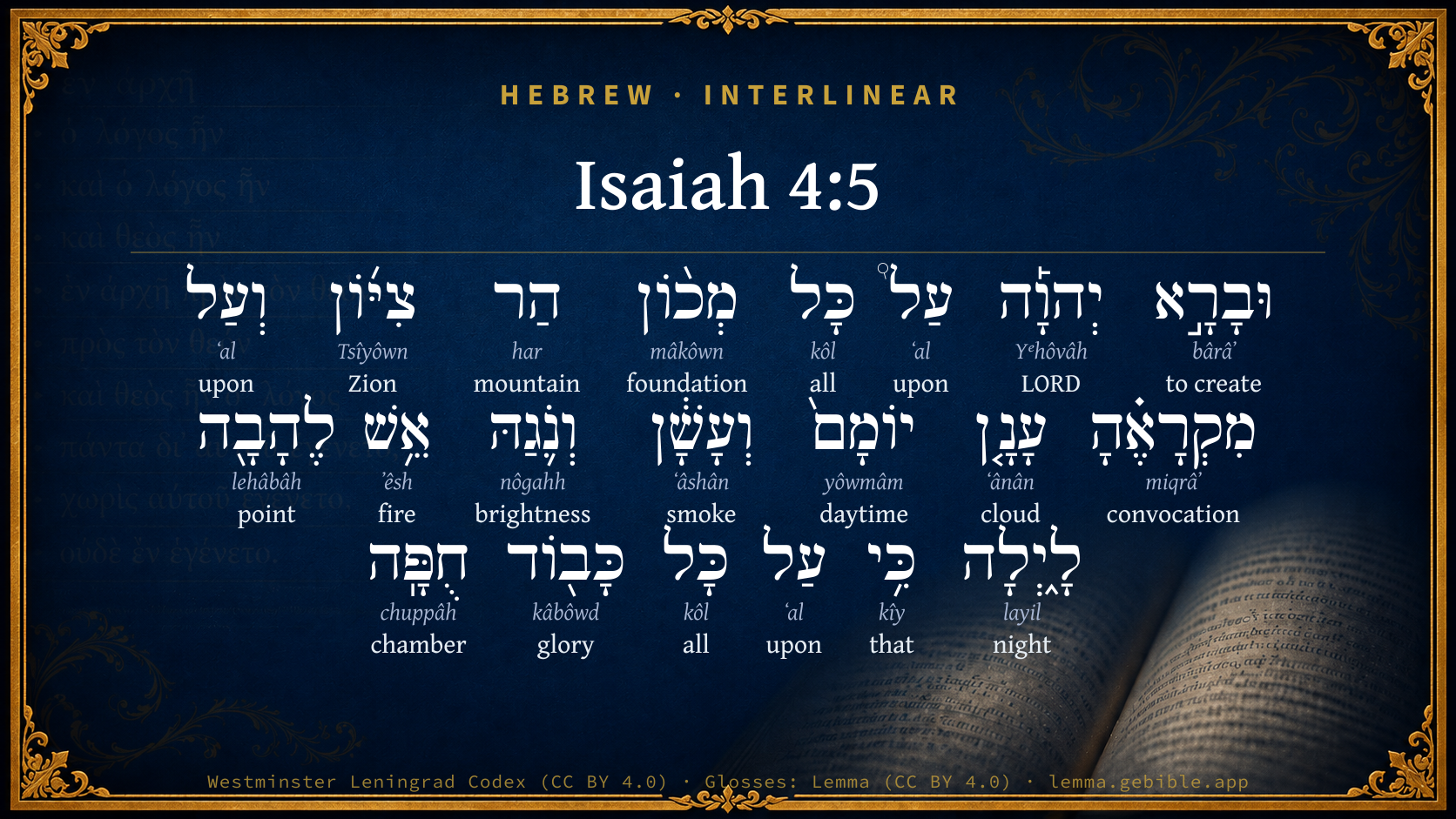
Hebrew (Westminster Leningrad Codex) Isaiah 4:5 appears in the Hebrew Old Testament. The text above is from the Westminster Leningrad Codex. Each word links to its Strong’s number, a concise gloss, and parsing drawn from the Open Scriptures Hebrew Bible morphology. Click any word for its full Brown-Driver-Briggs (BDB) entry.
Download image
Cite this verse

Isaiah 4:5 (World English Bible). Public Domain. Lemma interlinear Bible study tool, https://lemma.gebible.app/v/isaiah/4/5.

Show BibTeX & RIS
BibTeX
RIS
English Translation
Yahweh will create over the whole habitation of Mount Zion, and over her assemblies, a cloud and smoke by day, and the shining of a flaming fire by night; for over all the glory will be a canopy.
World English Bible · Public Domain
Download a study sheet

One document with this verse’s original text, its word-by-word gloss line, the meaning frame, cross-references with their text, attributed commentary, and full source and license credits — printable, and it pastes into notes with its structure intact.

This verse Autodidact and up

Study sheet (.html) Plain text (.txt)

A passage Seminary Student

Up to 50 verses in one chapter. A passage sheet keeps up to 6 commentary sources and 12 cross-references per verse, in the order this page ranks them, and says so on the sheet whenever that leaves anything out. Ask for a single verse and you get the Autodidact verse sheet above.

Everything on this page stays free to read, with no account — the sheet is a download of what is already on screen, not access to it.

Want to remove ads? Support Godless Engineer
Compare translations 3

The same verse in 3 English versions, stacked beneath the original-language interlinear above. Click any original word for its lexicon entry.

Each is an independent rendering of the whole verse — the interlinear is not word-aligned to these translations.

Highlighted words mark where these versions differ — a whole-verse word diff, not a word-by-word alignment.

  • World English Bible Public Domain
    Yahweh will create over the whole habitation of Mount Zion, and over her assemblies, a cloud and smoke by day, and the shining of a flaming fire by night; for over all the glory will be a canopy.
  • King James Version Public Domain
    And the LORD will create upon every dwelling place of mount Zion, and upon her assemblies, a cloud and smoke by day, and the shining of a flaming fire by night: for upon all the glory shall be a defence.
  • unfoldingWord Literal Text CC BY-SA 4.0
    And Yahweh will create over all of the site of Mount Zion and over its assemblies a cloud and smoke by day and the shining of a fire, a flame, by night, for over all of the glory a canopy.

unfoldingWord Literal Text — © unfoldingWord, licensed CC BY-SA 4.0. Word-aligned USFM3 via Door43 (git.door43.org/unfoldingWord/en_ult).

Versions to compare (up to 4)

3 of 4 selected

Show all 18 translations

Every available English version of this verse, each an independent rendering of the whole verse.

  • World English Bible Public Domain
    Yahweh will create over the whole habitation of Mount Zion, and over her assemblies, a cloud and smoke by day, and the shining of a flaming fire by night; for over all the glory will be a canopy.
  • Berean Standard Bible Public Domain
    Then the LORD will create over all of Mount Zion and over her assemblies a cloud of smoke by day and a glowing flame of fire by night. For over all the glory there will be a canopy,
  • Majority Standard Bible Public Domain
    Then the LORD will create over all of Mount Zion and over her assemblies a cloud of smoke by day and a glowing flame of fire by night. For over all the glory there will be a canopy,
  • King James Version Public Domain
    And the LORD will create upon every dwelling place of mount Zion, and upon her assemblies, a cloud and smoke by day, and the shining of a flaming fire by night: for upon all the glory shall be a defence.
  • American Standard Version (1901) Public Domain
    And Jehovah will create over the whole habitation of mount Zion, and over her assemblies, a cloud and smoke by day, and the shining of a flaming fire by night; for over all the glory `shall be spread' a covering.
  • Revised Version (1885) Public Domain
    And the LORD will create over the whole habitation of mount Zion, and over her assemblies, a cloud and smoke by day, and the shining of a flaming fire by night: for over all the glory shall be spread a canopy.
  • Geneva Bible (1599) Public Domain
    And the Lord shall create vpon euery place of mount Zion, and vpon the assemblies thereof, a cloude and smoke by day, and the shining of a flaming fire by night: for vpon all the glory shall be a defence.
  • Douay-Rheims (1899) Public Domain
    And the Lord will create upon every place of mount Sion, and where he is called upon, a cloud by day, and a smoke and the brightness of a flaming fire in the night: for over all the glory shall be a protection.
  • Young's Literal Translation Public Domain
    Then hath Jehovah prepared Over every fixed place of Mount Zion, And over her convocations, A cloud by day, and smoke, And the shining of a flaming fire by night, That, over all honour a safe-guard,
  • Literal Standard Version CC BY-SA 4.0
    Then YHWH has created || Over every fixed place of Mount Zion, || And over her convocations, || A cloud by day, and smoke, || And the shining of a flaming fire by night, || That over all glory—a safeguard,
  • Unlocked Literal Bible CC BY-SA 4.0
    Then over the whole site of Mount Zion and over her place of assembly, Yahweh will create cloud and smoke by day, and the shining of a flaming fire by night; it will be a canopy over all the glory.
  • unfoldingWord Literal Text CC BY-SA 4.0
    And Yahweh will create over all of the site of Mount Zion and over its assemblies a cloud and smoke by day and the shining of a fire, a flame, by night, for over all of the glory a canopy.
  • Darby Bible Public Domain
    And Jehovah will create over every dwelling-place of mount Zion, and over its convocations, a cloud by day and a smoke, and the brightness of a flame of fire by night: for over all the glory shall be a covering.
  • World Messianic Bible Public Domain
    The LORD will create over the whole habitation of Mount Zion and over her assemblies, a cloud and smoke by day, and the shining of a flaming fire by night, for over all the glory will be a canopy.
  • Webster's Bible Public Domain
    And the LORD will create upon every dwelling place of mount Zion, and upon her assemblies, a cloud and smoke by day, and the shining of a flaming fire by night: for upon all the glory shall be a defense.
  • Free Bible Version CC BY-SA 4.0
    Then the Lord will create over the whole of Mount Zion and over the assembly of those who meet there a cloud of smoke during the day and a blazing flame of fire during night—over everything there will be this glorious canopy.
  • Bible in Basic English Public Domain
    And over every living-place on Mount Zion, all over all her meetings, the Lord will make a cloud and smoke by day, and the shining of a flaming fire by night, for over all, the glory of the Lord will be a cover and a tent;
  • JPS Tanakh (1917) Public Domain
    And the LORD will create over the whole habitation of mount Zion, and over her assemblies, a cloud and smoke by day, and the shining of a flaming fire by night; for over all the glory shall be a canopy.

Literal Standard Version (2020), Covenant Press — licensed CC BY-SA 4.0. Text via the HelloAO Bible API (eBible.org). Unlocked Literal Bible (unfoldingWord) — licensed CC BY-SA 4.0. Text via the HelloAO Bible API (eBible.org). unfoldingWord Literal Text — © unfoldingWord, licensed CC BY-SA 4.0. Word-aligned USFM3 via Door43 (git.door43.org/unfoldingWord/en_ult). Free Bible Version, Dr. Jonathan Gallagher — licensed CC BY-SA 4.0. Text via the HelloAO Bible API (eBible.org).

Word by word

More ways to search: Search by grammar → Find every occurrence → Compare this word →

Practice this passage: Drill this verse → Learn its vocabulary →

חֻפָּֽה
chuppâh
H2646
“chamber”
Noun, Common, Feminine, Singular, Absolute
Part of Speech
Noun
Type
Common
Gender
Feminine
Number
Singular
State
Absolute
Full BDB Definition

Origin: from H2645

TWOT: 710b

chamber, room, canopy, closet - canopy - chamber - divine protection (figuratively)
  1. וּבָרָ֣א bârâʼ H1254 “and · to create” Conjunction + Verb, Qal, Sequential Perfect, 3rd Person, Masculine, Singular
  2. יְהוָ֡ה Yᵉhôvâh H3068 “LORD” Noun, Proper
  3. עַל֩ ʻal H5921 “upon” Preposition
  4. כָּל kôl H3605 “all of” Noun, Common, Masculine, Singular, Construct
  5. מְכ֨וֹן mâkôwn H4349 “foundation of” Noun, Common, Masculine, Singular, Construct
  6. הַר har H2022 “mountain of” Noun, Common, Masculine, Singular, Construct
  7. צִיּ֜וֹן Tsîyôwn H6726 “Zion” Noun, Proper
  8. וְעַל ʻal H5921 “and · upon” Conjunction + Preposition
  9. מִקְרָאֶ֗הָ miqrâʼ H4744 “convocations · her” Noun, Common, Masculine, Plural, Construct + Suffix, Personal, 3rd Person, Feminine, Singular
  10. עָנָ֤ן ʻânân H6051 “cloud” Noun, Common, Masculine, Singular, Absolute
  11. יוֹמָם֙ yôwmâm H3119 “daytime” Adverb
  12. וְעָשָׁ֔ן ʻâshân H6227 “and · smoke” Conjunction + Noun, Common, Masculine, Singular, Absolute
  13. וְנֹ֛גַהּ nôgahh H5051 “and · brightness of” Conjunction + Noun, Common, Feminine, Singular, Construct
  14. אֵ֥שׁ ʼêsh H784 “fire” Noun, Common, Both, Singular, Absolute
  15. לֶהָבָ֖ה lehâbâh H3852 “point” Noun, Common, Feminine, Singular, Absolute
  16. לָ֑יְלָה layil H3915 “night” Noun, Common, Masculine, Singular, Absolute
  17. כִּ֥י kîy H3588 “that” Conjunction
  18. עַל ʻal H5921 “upon” Preposition
  19. כָּל kôl H3605 “all of” Noun, Common, Masculine, Singular, Construct
  20. כָּב֖וֹד kâbôwd H3519 “glory” Noun, Common, Both, Singular, Absolute

About this verse

These counts appear in no published source. They are computed here, from the morphology-tagged text and Lemma’s own curated glosses. What Lemma adds →

21
words
18
distinct lemmas
Prophets
section

Notable vocabulary

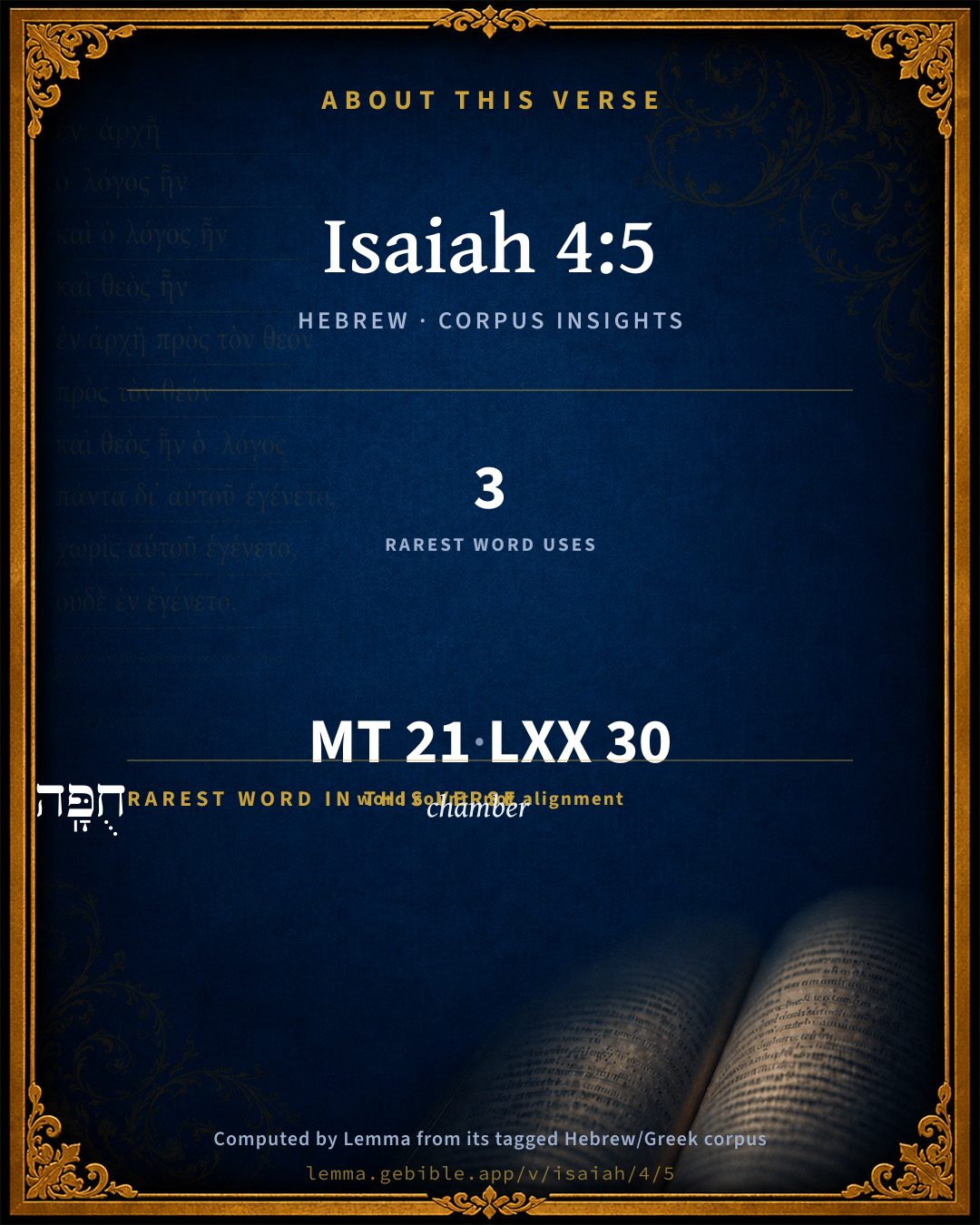
The rarest word here is חֻפָּֽה chamber H2646 — appearing just 3 times in the whole Hebrew Bible.

Shared distinctive vocabulary

חֻפָּֽה chamber H2646 occurs in 3 verses of the Hebrew Bible. Also found in:

Grammatical profile

  • 1 verb
  • 15 nouns
  • 3 prepositions
  • 1 conjunction
  • 1 adverb

Verb forms

  • וּבָרָ֣א Qal · Sequential Perfect

Repetition

Words recur within this verse — often emphatic in Hebrew:

Hebrew & Septuagint length

In English translation the verse runs 38 words from the Hebrew and 54 from the Septuagint (LXX English) — the Septuagint runs noticeably longer here. See the side-by-side →

A rough comparison of the two English renderings, which tokenize alike — not a word-level alignment.

Word counts can differ between the Hebrew and the Greek without any difference in meaning — e.g. the Hebrew direct-object marker אֵת has no separate Greek word, and Greek often adds the article ὁ.

In the original languages it is 21 Hebrew tokens and 30 Greek tokens — but the two are counted differently (Hebrew bundles its prefixes and suffixes into one token; the Greek is in lemma form), so that isn’t a like-for-like length.

Cross-references

20

Topical passages linked to Isaiah 4:5 in the Treasury of Scripture Knowledge — connected by theme and wording, ordered by reader-vote popularity; previews shown in the World English Bible.

  • Exodus 13:21–22 Yahweh went before them by day in a pillar of cloud, to lead them on their way, and by night in a pillar of fire, to give them light, that they might go by day and by night:
  • Nehemiah 9:12 Moreover in a pillar of cloud you led them by day; and in a pillar of fire by night, to give them light in the way in which they should go.
  • Exodus 40:34–38 Then the cloud covered the tent of meeting, and the glory of Yahweh filled the tent.
  • Numbers 9:15–22 On the day that the tabernacle was raised up, the cloud covered the tabernacle, even the Tent of the Testimony: and at evening it was over the tabernacle as it were the appearance of fire, until morning.
  • Psalms 78:14 In the daytime he also led them with a cloud, And all night with a light of fire.
  • Psalms 85:9 Surely his salvation is near those who fear him, That glory may dwell in our land.
  • Isaiah 33:20 Look on Zion, the city of our solemnities: your eyes shall see Jerusalem a quiet habitation, a tent that shall not be removed, the stakes of it shall never be plucked up, neither shall any of the cords of it be broken.
  • Isaiah 46:13 I bring near my righteousness, it shall not be far off, and my salvation shall not wait; and I will place salvation in Zion for Israel my glory.
  • Isaiah 60:1 Arise, shine; for your light is come, and the glory of Yahweh is risen on you.
  • Exodus 14:24 It happened in the morning watch, that Yahweh looked out on the host of the Egyptians through the pillar of fire and of cloud, and confused the Egyptian army.
  • Psalms 89:7 A very awesome God in the council of the holy ones, To be feared above all those who are around him?
  • Isaiah 31:4–5 For thus says Yahweh to me, As the lion and the young lion growling over his prey, if a multitude of shepherds are called forth against him, will not be dismayed at their voice, nor abase himself for the noise of them: so will Yahweh of Hosts come down to fight on Mount Zion, and on the hill of it.
  • Zechariah 2:5–10 For I,' says Yahweh, 'will be to her a wall of fire around it, and I will be the glory in the midst of her.
  • Matthew 28:20 teaching them to observe all things that I commanded you. Behold, I am with you always, even to the end of the age." Amen.
  • Exodus 14:19–20 The angel of God, who went before the camp of Israel, moved and went behind them; and the pillar of cloud moved from before them, and stood behind them.
  • Exodus 26:7 "You shall make curtains of goats' hair for a covering over the tent: eleven curtains shall you make them.
  • Psalms 87:2–3 Yahweh loves the gates of Zion more than all the dwellings of Jacob.
  • Psalms 111:1 Praise Yah! I will give thanks to Yahweh with my whole heart, In the council of the upright, and in the congregation.
  • Isaiah 32:18 My people shall abide in a peaceable habitation, and in safe dwellings, and in quiet resting-places.
  • Isaiah 37:35 For I will defend this city to save it, for my own sake, and for my servant David's sake.

Cross-references courtesy of OpenBible.info (CC BY 4.0).

Hebrew and Greek witnesses Masoretic Hebrew ↔ Greek Septuagint

The same verse in the two great witnesses to the Old Testament, shown verse-for-verse.

Here the Septuagint runs noticeably longer than the Hebrew — LXX2012 (modern English Septuagint) 54 words vs World English Bible 38. A rough length comparison of the two English translations, not a word-level alignment — read both below.

These are two independent witnesses, not word-aligned to each other, and the Septuagint is shown in lemma (dictionary) form.

Hebrew Isaiah 4:5 Masoretic · Westminster Leningrad Codex

וּבָרָ֣א יְהוָ֡ה עַל֩ כָּל מְכ֨וֹן הַר צִיּ֜וֹן וְעַל מִקְרָאֶ֗הָ עָנָ֤ן יוֹמָם֙ וְעָשָׁ֔ן וְנֹ֛גַהּ אֵ֥שׁ לֶהָבָ֖ה לָ֑יְלָה כִּ֥י עַל כָּל כָּב֖וֹד חֻפָּֽה

Yahweh will create over the whole habitation of Mount Zion, and over her assemblies, a cloud and smoke by day, and the shining of a flaming fire by night; for over all the glory will be a canopy.

World English Bible · Public Domain

Greek LXX Isaiah 4:5 Septuagint · lemma form

καί ἥκω καί εἰμί πᾶς τόπος ὁ ὄρος σιων καί πᾶς ὁ περικύκλῳ αὐτός σκιάζω νεφέλη ἡμέρα καί ὡς καπνός καί ὡς φῶς πῦρ καίω νύξ πᾶς ὁ δόξα σκεπάζω

And he shall come, and it shall be with regard to every place of mount Sion, yes, all the region round about it shall a cloud overshadow by day, and there shall be as it were the smoke and light of fire burning by night: and upon all the glory shall be a defence.

LXX2012 (modern English Septuagint) · Public Domain

On this verse, Adam Clarke's Commentary discusses the Septuagint’s reading. Read the note in Commentary ↓

Hebrew: Westminster Leningrad Codex (CC BY 4.0). Greek: Septuagint (public domain); English from LXX2012 (modern English Septuagint) (Public Domain). How the Septuagint differs from the Hebrew →

Targum (Aramaic paraphrase)

1

The Targum is the ancient Jewish Aramaic paraphrase of the Hebrew Scriptures — an interpretive translation, not the Hebrew text itself. Onkelos (literal) and Pseudo-Jonathan (expansive) render the Torah, and Jonathan the Prophets. Coverage is partial: where no permissively-licensed English translation exists for a verse, only the Aramaic is shown. This is verse-level text, not a word-by-word alignment to the Hebrew.

  1. Targum Jonathan Prophets (Joshua–Malachi)
    וְיִבְרִי יְיָ עַל כָּל מִקְדַשׁ טוּרָא דְצִיוֹן וְעַל אֲתַר בֵּית שְׁכִינְתֵּיהּ עֲנַן יְקַר יְהֵא מַטִיל עֲלוֹהִי בִימָמָא וְאַמִטְתָא וְזֵיהוֹר כְּאֵשָׁא שַׁלְהוֹבֵי בְּלֵילְיָא אֲרֵי יַתִּיר מִן יְקָרָא דַאֲמִיר לְאַיְתָאָה עֲלוֹהִי שְׁכִנְתָּא תְהֵי מְנַנָא עֲלוֹהִי בְּגִנוּן:

    And the Lord will create upon every holy place of the mountain of Zion, and upon the place of the house of His Shekinah a cloud of glory; which shall be shadowing over it by day, and a thick cloud and a brightness as of flaming fire by night; because of the excellency of the glory which He has promised to bring upon it, the Shekinah shall be protecting it with a protection.

    Targum Jonathan — Aramaic: “Mikraot Gedolot” (public domain). English: “Sefaria Community Translation” (CC0 1.0 (public-domain dedication)); “London "Chaldee Paraphrase," 1871” (public domain). Text via Sefaria.

Commentary

Notes on Isaiah 4:5 from classic Christian and Jewish commentators (each source and its license shown beneath its notes). The classic Christian expositions comment on the surrounding passage and are grouped to its opening verse, so a note may address several verses; the Jewish commentaries on the Tanakh (Rashi and others) are per-verse, so they appear only where the commentator wrote on this verse.

Lemma curates 59 commentaries, every one of them public domain or Creative Commons licensed, each selected and text-cleaned for this edition rather than reprinted as found. About our sources →

Jamieson, Fausset & Brown

Robert Jamieson, A. R. Fausset & David Brown

create--The "new creation" needs as much God's creative omnipotence, as the material creation (Co2 4:6; Eph 2:10). So it shall be in the case of the Holy Jerusalem to come (Isa 65:17-18).

upon--The pillar of cloud stood over the tabernacle, as symbol of God's favor and presence (Exo 13:21-22; Psa 91:1). Both on individual families ("every dwelling") and on the general sacred "assemblies" (Lev 23:2). The "cloud" became a "fire" by night in order to be seen by the Lord's people.

upon all the glory--"upon the glorious whole"; namely, the Lord's people and sanctuary [MAURER]. May it not mean, "Upon whatever the glory (the Shekinah spoken of in the previous clause) shall rest, there shall be a defense." The symbol of His presence shall ensure also safety. So it was to Israel against the Egyptians at the Red Sea (Exo 14:19-20). So it shall be to literal Jerusalem hereafter (Zac 2:5). Also to the Church, the spiritual "Zion" (Isa 32:18; Isa 33:15-17; Heb 12:22).

tabernacle--Christ's body (Joh 1:14). "The word 'tabernacled' (Greek for 'dwelt') among us" (Joh 2:21; Heb 8:2). It is a "shadow from the heat" and "refuge from the storm" of divine wrath against man's sins (Isa 25:4). Heat and storms are violent in the East; so that a portable tent is a needful part of a traveller's outfit. Such shall be God's wrath hereafter, from which the "escaped of Israel" shall be sheltered by Jesus Christ (Isa 26:20-21; Isa 32:2).

covert--answering to "defense" (Isa 4:5). The Hebrew for defense in Isa 4:5, is "covering"; the lid of the ark or mercy seat was named from the same Hebrew word, caphar; the propitiatory; for it, being sprinkled with blood by the high priest once a year, on the day of atonement, covered the people typically from wrath. Jesus Christ is the true Mercy Seat, on whom the Shekinah rested, the propitiatory, or atonement, beneath whom the law is kept, as it was literally within the ark, and man is covered from the storm. The redeemed Israel shall also be, by union with Him, a tabernacle for God's glory, which, unlike that in the wilderness, shall not be taken down (Isa 38:20).

A new prophecy; entire in itself. Probably delivered about the same time as the second and third chapters, in Uzziah's reign. Compare Isa 5:15-16 with Isa 2:17; and Isa 5:1 with Isa 3:14. However, the close of the chapter alludes generally to the still distant invasion of Assyrians in a later reign (compare Isa 5:26 with Isa 7:18; and Isa 5:25 with Isa 9:12). When the time drew nigh, according to the ordinary prophetic usage, he handles the details more particularly (Isa. 7:1-8:22); namely, the calamities caused by the Syro-Israelitish invasion, and subsequently by the Assyrians whom Ahaz had invited to his help.

Next: Isaiah Chapter 5

Jamieson, Fausset & Brown — Commentary Critical and Explanatory on the Whole Bible (1871) — public domain (CC PDM 1.0). Text via the HelloAO Bible API.

Trapp's Complete Commentary

John Trapp

Isa 4:5 And the LORD will create upon every dwelling place of mount Zion, and upon her assemblies, a cloud and smoke by day, and the shining of a flaming fire by night: for upon all the glory [shall be] a defence.

Ver. 5. And the Lord will create.] For the safeguard and security of his peculiar people thus purified unto himself, {Tit 2:14} and that they may serve him without fear in holiness and righteousness before him all and every day of their lives. {Luk 1:74-75} God, rather than fail, will "create," as he did of old in Egypt and the wilderness, "a cloud by day, a flaming fire by night"; against heat, a "tabernacle"; against storm and rain, a "covert"; anything, everything that heart can wish or need require: dux erit et defensor, lux erit et consolator. He will be to all his "a sun and a shield; he will give grace and glory," &c. {Psa 84:11 Son 2:3}

Upon every dwelling place.] Upon every private house, and place of his people’s abode: their walls are continually before him. {Isa 49:16} He loveth to look upon their habitations, and will hedge them about. {Job 1:10}

And upon her assemblies.] Or, Meeting places for God’s services. Howbeit this is to be taken cum exceptione crucis: with the exception of the cross, the poor Protestants in France have not only been disturbed, but destroyed, at their church assemblies, by the Duke of Guise and other Popish persecutors. But the godly in such a case "glorify God in the very fire," and bear fruit in such a tempest by God’s defence and benediction.

A cloud and smoke.] Or, A smokey cloud, alluding to that cloudy pillar {Exo 13:21; Exo 14:19} which was a cloud by day and a fire by night to Israel: so is Christ a cooling refreshment to his own in the scorching day of temptation or trouble, and a comfortable lamp of light to direct and protect them through the wilderness of this world. The cloud was spread over them for a covering, {Psa 105:39} and sometimes came between them and their enemies behind them; {Exo 14:19} and this was done in Egypt, where was no rain: how then was there a cloud? God "created it."

For upon all the glory.] Israel is called "God’s glory"; {Isa 46:13} the "house of his glory"; {Isa 60:7} "a crown of glory"; {Isa 62:3} a "throne of glory"; {Jer 14:21} God’s ornament; the beauty of his ornament, and that set in majesty; {Eze 7:20} his royal "diadem"; {Isa 62:3} his "jewels," {Mal 3:17} which he wears, as great men do their jewels, to make him glorious in the eyes of men; they are the signet on his right hand. {Isa 49:5}

Shall be a covering] As the cloud covered the tabernacle, and as the rams’ skins covered the ark from the violence of wind and weather; so will Christ the Church.

John Trapp, A Commentary or Exposition upon All the Books of the Old and New Testament (1647–1656) — public domain. Text from a community e-Sword module.

The Biblical Illustrator

Joseph S. Exell

Isa_4:5

A cloud and smoke by day and the shining of a flaming fire by night

The pillar cloud of Israel--Christ, the Leader of His Church

(with Exo_13:21-22):--It was good for the Israelites that they were so long in the wilderness.

There the most impressive intimations of a present Deity followed their every step. Miracles were wrought, to feed them when hungry, and to satisfy their thirsty souls. Jesus was in the manna--I am the living Bread which came down from heaven. There, in the form of a vast column of mingled fire and smoke, is the mysterious yet faithful guide of the Lords people. When it is stationary, they rest; when it advances, they journey. The pillar cloud was typical of Jesus Christ, and Jesus Christ ever liveth as the Churchs Prophet, Priest, and King. And the Lord will create upon every dwelling place of Mount Zion, etc. If the pillar cloud was the shadow of good things to come, Jesus Christ is the glorious substance; and we shall endeavour to show in what manner the Redeemer leads His Church.

I. JESUS LEADS THE CHURCH BY HIS WORD. Not more certainly was there one pillar cloud than there is one Bible. The Word stands alone in its authority. It is the sole director of our faith; it is the sole regulator of our walk. The Word is the sole standard in all matters pertaining to the worship of God, and if human opinions or imperial statutes should oppose its high demands, we must obey God rather than men.

II. JESUS LEADS THE CHURCH BY HIS SPIRIT. How precious the promise which He made to His disciples. The Comforter, who is the Holy Ghost, whom the Father will send in My name, He shall teach you all things, and bring all things to your remembrance, whatsoever I have said unto you. The Word is a lamp to the feet and a light to the path; but what if the hands of men are so feeble that they cannot hold the heaven-sent lamp? What if the darkness which shrouds their minds is so dense that all the rays shining from the Word serve only to render the darkness visible? In such circumstances how desirable to have a living guide to expound the infallible directory! The cloud which was in the tabernacle by day, and the fire by night, formed a guiding pillar, but for which the people of Israel must have wandered and lost their way In the desert. Yet there was an imperfection arising from its very nature. The fiery pillar taught seeing men where to go; but it could not give sight to the blind. It pointed to the direction in which the pilgrims were to advance; but it could not make the lame man leap as an hart. We do not say that the Spirit of Christ did not impart inward light, saving knowledge, in the days of Moses. Wherever holiness adorned any character, He, the Sanctifier, was its source. The crowning excellence of the New Testament economy is, that it is the dispensation of the Spirit. While it does not dispense with forms, it specially inculcates the power of godliness. While it commends the Word, it holds the Word to be powerless without the Spirit of God.

III. JESUS LEADS THE CHURCH BY HIS PROVIDENCE. The Saviour whom we adore, is Ruler of all worlds. Supreme in heaven, He is not less so on earth. The Author of salvation, He is the regulator of all the complicated wheels of providence. Providence is a volume which is often hard to be understood. And the reason why we put providence after the Word and Spirit of Christ is, that no man is able to explain providence aright until he has studied the Word, and been taught by the Spirit of the Lord. (J. Patrick, M. A.)

Israels guide and guard

I. It refers to the Church of God IN ITS PRIVATE AND DOMESTIC CHARACTER. These are denoted by the expressions--every dwelling place of Mount Zion. It is one among the many beautiful descriptions of the true Christian, with which the Bible abounds, not simply that he does approach to God, but that he takes delight in doing so; and having tasted that the Lord is gracious, he will strive to realise, in his own parental character, the exalted qualities, which God ascribed to Abraham, and which doubtless were even then in the course of development, though as yet he had no child. Happy is that parent, happy is that child, with respect to whom it can be truly said, The fathers to the children shall make known Thy truth.

II. The second aspect, under which the Church of God is here presented to us, is IN ITS SOCIAL AND COLLECTIVE CHARACTER. This is indicated by the expressions her assemblies. The expression refers to the union of the servants of God in public worship: corresponding exactly to that of which our Saviour spoke, when He said--Where two or three are gathered together in My name, there am I in the midst of them. There can be no doubt, that from the very earliest ages of the Church, the rest of the holy Sabbath was observed; and the more the spirit of genuine religion diffused itself, the more did men of similar tastes and feelings seek pious association with each other. (G. Weight, M. A.)

The glory of Christs Church

1. Experience has amply shown the true glory of a Church does not consist in outward pomp or splendour. Even Solomon confessed that the magnificence which adorned his temple in all its untarnished glory was unworthy to become a residence, or to receive the manifested tokens of Jehovahs presence. In rich and stately decorations even the heathen may enshrine his lifeless idol, and outvie the splendour of the ancient Jewish sanctuary. On the other hand, the patriarchs in their wandering, and the persecuted Christians, convened in woods and caves and retired chambers, have beheld the manifested light of Gods countenance, and have seen His power and glory as graciously displayed as in the most splendid sanctuary.

2. The true and essential glory of the Church principally consists in the spirituality, holiness, and unity of its members.

3. The doctrine of the restoration of the image of God in the soul of man, by the agency of the Holy Spirit, challenges for the Church which prominently exhibits it, the title of a glorious Church.

4. Of the varied glories of the Church, none in its early days was more conspicuous than that of unity in government, discipline, worship, and spirit. Long has Satan prevailed in his endeavours to divide and conquer. (G. Almond.)

God in His sanctuary

I. RELIGIOUS WORSHIP, WHETHER IN THE FAMILY OR THE SANCTUARY, IS PARTICULARLY REGARDED BY GOD.

II. GOD WILL EXPRESS HIS APPROVAL BY MANIFESTATIONS OF HIS PRESENCE. The benefits of the Jews from the Shechinah were a type of the benefits of Jesus among us. What were these?

1. The manifestation of truth--the Urim and Thummim. Jesus Christ is the only medium through which we can have knowledge of God, redemption, and the way of worship.

2. The display of holiness. Wherever the Shechinah appeared there was an impression of holiness. Moses and the bush. The Holy of Holies. So in the Gospel, we have not only a display of truth, hut of holiness also.

3. Communication of comfort. The cloud covered Israel in a heated atmosphere; it dropped dew, and they were baptized in the cloud. Is not this the end of the spiritual manifestation? The Holy Ghost is called the Comforter.

III. THESE MANIFESTATIONS OF THE DIVINE PRESENCE CONSTITUTE THE GLORY OF THE CHURCH. What was the temple without it? And how is this house filled with glory? It is not in the altar, the shewbread, the ark, or the manna, but in Jesus presence walking among the candlesticks. (J. Summerfield, M. A.)

Upon all the glory shall be a defence

A Gospel profession the glory of a nation

These words are a recapitulation of the whole verse, and are a Gospel promise given out in law terms, or a New Testament mercy under Old Testament expressions.

1. What is here expressed as to the type and figure. For the glory and defence two pairs of things seem to be intended: the ark and the mercy seat; the tabernacle and the pillar of fire.

(1) The ark is oftentimes called the glory of God (Psa_78:61; 1Sa_4:21). The word which we have rendered a defence, properly, signifies a covering; as was the mercy seat the covering of the ark. So that upon the glory shall be a defence, is as much as, unto you the mercy seat shall be on the ark, or you shall have the mercy represented and intimated thereby.

(2) The tabernacle and cloud, or pillar of fire, are also called to mind; so the words are expressive of that figure of Gods gracious presence with His people, which we have recounted (Exo_40:34). Then a cloud covered the tent of the congregation, and the glory of the Lord filled the tabernacle.

2. What is here intended, as to the substance of the mercy promised. All those things were typical of Christ. Apply, then, this promise to Gospel times, and the substance of it is comprehended in these two propositions:

I. THE PRESENCE OF CHRIST WITH ANY PEOPLE IS THE GLORY OF ANY PEOPLE. This is the glory here spoken of, as is evident to anyone that will but read Isa_4:2, and consider its influence unto these words. This is their glory, or they have none. Is it in their number, that they are great, many, and populous? God thinks not so (Deu_7:7; Psa_105:12). You know what it cost David in being seduced by Satan into the contrary opinion. There is nothing more common in the Scripture than for the Lord to speak contempt of the multitude of any people, as a thing of nought. Is it in their wisdom and counsel, their understanding for the ordering of their affairs? Is that their glory? Why, see how God derides the prince of Tyrus, who was lifted up with an apprehension hereof; and counted himself as God, upon that account (Eze_27:1-36; Jer_9:23-24).

1. Now, Christ may be said to be present with a people two ways.

(1) In respect of the dispensation of His Gospel amongst them, the profession of it and subjection to the ordinances thereof.

(2) In and by His Spirit, dwelling in their hearts by faith, uniting them to Himself.

2. This is the glory of any people upon a threefold account.

(1) This alone makes them honourable and precious before God.

(2) This presence of Christ makes men comely and excellent in themselves (Psa_16:3)

(3) This alone makes any truly useful unto others.

Here lies the preservation of any nation from ruin. Prosperity is from hence Mic_5:7) If you desire the glory of the nation, labour to promote the interest of Christ in the nation. Value, encourage and close with them in and with whom is the presence of Christ.

II. THE PRESENCE OF GOD IN SPECIAL PROVIDENCE OVER A PEOPLE ATTENDS THE PRESENCE OF CHRIST IN GRACE WITH A PEOPLE. (J. Owen, D. D.)

Christ the Defence of His people

I. A DEFENDER OF THE HOME. It is upon every dwelling place of Mount Zion that there shall be the cloud and smoke by day, and the pillar of fire by night. What is a house without Christ?

II. A DEFENDER OF THE CHURCH. Upon all her assemblies, as well as in every dwelling place, rose the symbols of His presence. Eli trembled for the ark of God, and men now tremble for the safety of the Church in this wilderness world. But it is safe as the children of Israel under the cloud and the pillar.

III. A DEFENDER OF THE PERSON. We need personal protection. A shade in the heat of calamity; a tent in the storm of adversity. This Christ is to His people.

1. In temporal matters.

2. In the interests of the soul. (J. S. H.)

The Biblical Illustrator, edited by Joseph S. Exell (c. 1880s–1900s) — public domain. Text from a community e-Sword module.

Joseph Benson's Commentary

Isa 4:5. And the Lord will create — Will, in a marvellous manner, produce, as it were, by a new work of creation; upon every dwelling-place of mount Zion — Upon all the private habitations of his people; and upon her assemblies — Upon the places of their public worship, and the persons assembled therein; a cloud and smoke by day, and the shining, &c. — He alludes to the pillar of a cloud and fire, which conducted and protected the Israelites in the wilderness, and afterward rested upon the tabernacle; and his words imply, that God would be the protector and glory of Zion. Such he was to Jerusalem after the return from Babylon; directing the Jews in their various difficulties, and defending them in their weak state against all the contrivances and attempts of their enemies, as we learn from the book of Nehemiah: and thus especially he was present with, and guided, protected, and preserved the first Christian Church, when he destroyed their unbelieving and disobedient countrymen. Upon all the glory shall be a defence — Upon all that church and people, which God will make glorious: upon the literal, but especially upon the mystical Jerusalem, upon all holy societies, or assemblies of sincere Christians. A learned commentator, who says the dwelling-places and assemblies of Sion “refer to the meetings of the apostles and other Christians at Jerusalem;” and that the next clause, upon all the glory, &c., means that the divine protection shall be afforded wherever God manifests himself by the extraordinary signs of his gracious presence, adds as follows: “Every symbol of the divine grace and glory, such as was the cloud, brings with it the protection and defence of that place or assembly, which is blessed with this prerogative. The event proves the truth of this interpretation. So long as God was in the temple, that place rejoiced in the benefit of the divine protection. When the voice was heard, ‘Let us depart hence,’ it was left to the desolation of its enemies.” Now the same, as he says, holds good in the Christian Church. While she cleaves to God, adheres to his truth, possesses his grace, obeys his laws, and worships him in the beauty of holiness, she has his presence with her, and is safe and happy. But, when the reverse of all this takes place, when his truth is disbelieved, his grace neglected, his laws broken, and his ordinances slighted, or attended in a mere formal way, his presence is withdrawn, and her glory and defence depart together.

Joseph Benson's Commentary on the Old and New Testaments (1811–1818) — public domain. Text from a community e-Sword module.

MacLaren's Expositions of Holy Scripture

Alexander MacLaren

Isaiah

THE PERPETUAL PILLAR OF CLOUD AND FIRE

Isa 4:5.

The pillar of cloud and fire in the Exodus was one: there are to be as many pillars as there are ‘assemblies’ in the new era. Is it straining the language too much to find significance in that difference? Instead of the formal unity of the Old Covenant, there is a variety which yet is a more vital unity. Is there not a hint here of the same lesson that is taught by the change of the one golden lamp-stand into the seven, which are a better unity because Jesus Christ walks among them?

The heart of this promise, thus cast into the form of ancient experiences, but with significant variations, is that of true communion with God.

That communion makes those who have it glorious.

That communion supplies unfailing guidance.

A man in close fellowship with God will have wonderful flashes of sagacity, even about small practical matters. The gleam of the pillar will illumine conscience, and shine on many difficult, dark places. The ‘simplicity’ of a saintly soul will often see deeper into puzzling contingencies than the vulpine craftiness of the ‘prudent.’ The darker the night, the brighter the guidance.

That communion gives a defence.

The pillar came between Egypt and Israel, and kept the foe off the timid crowd of slaves. Whatever forms our enemies take, fellowship with God will invest us with a defence as protean as our perils. The same cloud is represented in the context as being ‘a pavilion for a shadow in the heat, and for a refuge and for a covert from storm and from rain.’

Alexander MacLaren, Expositions of Holy Scripture (1904–1910) — public domain. Text from a community e-Sword module.

Tyndale Open Study Notes

Tyndale Open Resources

4:5 The references to a canopy of cloud . . . and smoke and flaming fire recall God’s continuous presence and protection during the exodus from Egypt (Exod 13:21-22; 14:21-22).

Tyndale Open Study Notes — © Tyndale Open Resources, licensed CC BY-SA 4.0. Text via the HelloAO Bible API.

Geneva Bible (1599)

Geneva Bible translators

He alludeth to the pillar of the cloud, Exod. 13:21, meaning, that God’s favor and protection should appear in every place.

The faithful are called the glory of God, because his image and tokens of his grace shine in them.

Geneva Bible (1599) marginal notes — public domain. Text via Bolls.life.

Adam Clarke's Commentary

Verse 5. And the Lord will create - One MS., the Septuagint, and the Arabic, have יביא yabi, He shall bring: the cloud already exists; the Lord will bring it over. This is a blessed promise of the presence of God in all the assemblies of his people.

Every dwelling place - "the station"] The Hebrew text has, every station: but four MSS. (one ancient) omit כל col, all; very rightly, as it should seem: for the station was Mount Zion itself, and no other. See Ex 15:17. And the Septuagint, Arabic, and MSS., add the same word כל col, before מקראה mikraeha, probably right: the word has only changed its place by mistake. מקראיה mikrayeh, "the place where they were gathered together in their holy assemblies," says Sal ben Melech. But twenty-five of Kennicott's MSS., and twenty-two of De Rossi's fifty-three editions, besides the Septuagint, Syriac, and Arabic, have the word in the plural number.

A cloud and smoke by day] This is a manifest allusion to the pillar of a cloud and of fire which attended the Israelites in their passage out of Egypt, and to the glory that rested on the tabernacle, Ex 13:21; Ex 40:38. The prophet Zechariah, Zec 2:5, applies the same image to the same purpose: -

"And I will be unto her a wall of fire round about;

And a glory will I be in the midst of her."

That is, the visible presence of God shall protect her. Which explains the conclusion of this verse of Isaiah; where the makkaph between כל col, and כבוד cabod, connecting the two words in construction, which ought not to be connected, has thrown an obscurity upon the sentence, and misled most of the translators.

For upon all the glory shall be a defense.] Whatever God creates, he must uphold, or it will fail, Every degree of grace brings with it a degree of power to maintain itself in the soul.

Adam Clarke's Commentary on the Bible (1810–1826) — public domain. Text from a community e-Sword/MySword module.

Ellicott's Commentary for English Readers

(5) And the Lord will create . . .—The verb “create” has all the solemn force with which we find it in Gen_1:1. It is one of Isaiah’s favourite words. The word for “dwelling-place” is almost invariably used for the tabernacle or temple, and would seem to have that meaning here. This determines the character of the “assemblies.” They are not the meetings of the people for counsel or debate, as in a Greek ecclesia, but their “gatherings,” their “solemn assemblies,” in the courts of the temple. The thoughts of the prophet travel back to the history of the Exodus, when the presence of Jehovah was manifested as a cloud by day and a pillar of fire by night (Exo_13:21; Num_9:15; Num_10:34; Num_14:14). In that Presence there would be safety and peace. The image is a favourite one with Isaiah, possibly as connected with the vision of Isa_6:4, for God’s protection of His people.

Upon all the glory shall be a defence.—The phrase is almost startlingly abrupt. The thought seems to be that over the “glory” of the new Jerusalem, as just described, there shall be stretched the overarching canopy of the Divine Love. The word for “defence” occurs in this sense in Psa_19:5, Joe_2:16, and is still used by Jews of the “canopy” held over bride and bridegroom at a wedding. The “baldacchino” over the altar of an Italian church probably represents the image that was present to Isaiah’s mind.

A Bible Commentary for English Readers, edited by Charles John Ellicott (1878–1897) — public domain. Text from a community e-Sword module.

The Cambridge Bible for Schools and Colleges

gen. ed. J. J. S. Perowne

5. upon every dwelling place …] rather, over the whole (divine) habitation of Mount Zion. The word is never used of human dwellings. It might be translated, “foundation”; in either case it is equivalent to “sanctuary.”

her assemblies] convocations, worshipping assemblies, as in Isa_1:13.

a cloud … night] better (disregarding the accents), a cloud by day and smoke with the shining of a flaming fire by night.

for upon all the glory … defence] A perplexing clause. A literal translation would be for over every glory (should be) a canopy. So rendered, the words express a general principle of ceremonial propriety: wherever there is “a glory” (as e.g. royal majesty), it must be provided with a suitable canopy. The clause may be a marginal gloss suggested to a reader by the first part of the verse. The word for “canopy” occurs only in Psa_19:5; Joe_2:16 in the sense of “nuptial pavilion” (see Robertson Smith, Marriage and Kinship in Early Arabia, pp. 168f.). In post-biblical Hebrew it means (as here) “canopy” in general.

5, 6. The gracious presence of God becomes a visible fact to men’s eyes, in the cloud of fire and smoke which overshadows and protects the new Jerusalem. The symbolism is drawn from the story of the Exodus and the tabernacle in the desert (Exo_13:21 f., Exo_40:34-38, &c.).

The Cambridge Bible for Schools and Colleges (gen. ed. J. J. S. Perowne; Cambridge University Press, 1878–1918) — public domain. Text from a community e-Sword module.

John Gill's Exposition

And the Lord will create on every dwelling place of Mount Zion,.... That is, on every particular church of Christ in Gospel times, and especially in the latter day; which are the dwelling places of Father, Son, and Spirit, and of believers in Christ. The word (o) used signifies a place well fitted up, and prepared, and established, and settled; and such will be the churches of Christ in the latter day glory; they will be fitly framed together and built up, a habitation for God, through the Spirit; they will be beautified, and made glorious, and will be established upon the top of the mountains, and be tabernacles that shall not be taken down, whose stakes and cords shall not be removed and broken, Eph 2:21 and so will be sure dwellings, and quiet resting places; and happy will those be who will be the inhabitants of them, since they will have the best of company, the best of provisions, and all health and prosperity, Isa 32:18,

and upon her assemblies; or "her convocations" (p); in allusion to the holy convocations and solemn assemblies of the Israelites at their festivals, Lev 23:2 which are the churches of Christ, as before, consisting of men called by the grace of God, with a holy calling; called to be saints, and so are an assembly of saints, Psa 89:7 called by means of the Gospel, as the Israelites were by the blowing of the trumpets, to assemble together, to hear the word, and attend every part of divine worship, Num 10:2 and as the invisible church is called Zion, and the general assembly, Heb 12:22 so particular visible churches are called assemblies, Ecc 12:11 and which will be very numerous in the latter day, and well attended.

A cloud and smoke by day, and the shining of a flaming fire by night; alluding to the Lord's going before the children of Israel in the wilderness, in a pillar of cloud by day, and in a pillar of fire by night; and to their being upon and covering the tabernacle, when it rested; and also to the cloud and smoke that were upon Mount Sinai, when the Lord was present there, Exo 13:20 and as a cloud was frequently a symbol of the divine Presence, both in the Old and in the New Testament, Exo 19:9, Kg1 8:10 so it may here signify that the presence of God with his churches in the latter day will be very manifest and remarkable; he will be seen over them, and be the glory in the midst of them, Zac 2:5 and it may also denote the gracious protection of the churches by Christ from all their enemies; as the cloud stood between the Israelites and the Egyptians, when they passed through the Red sea, and secured them from them, Exo 14:19 as well as a cloud, is refreshing and protecting from heat, as Christ then will be from heat of every kind. See Gill on Isa 4:6. And as the pillar of fire was to give light to the children of Israel, and direct them in their passage through the wilderness in the night time; so Christ will be the light of his people, by the very great illuminations of his spirit, and the clear preaching of the Gospel, which will give both light and heat; and from both which will arise such a bright shining light, as shall drive away the night of affliction, darkness, desertion, and sleepiness, which shall precede this glorious day. See Isa 60:1 and this will be all the Lord's doing, a work of his almighty power, and therefore signified by a "creation"; it will be a new, strange, and marvellous work; wonderful in the eyes of the saints, and in the eyes of the world, that those who have been forsaken and hated should be made an eternal excellency, and the joy of many generations, Isa 60:15,

for upon all the glory shall he a defence; the glory of the churches in the latter day will greatly consist in the presence of God and Christ; in the pouring forth of the Spirit upon them; in the purity of Gospel doctrine, worship, and discipline among them; in the holiness of their lives and conversation; and in the peace, harmony, and unity, that shall subsist with them; and the defence of this glory will be partly the ministers of the Gospel, in the pure administration of the word and ordinances, as means, but principally the Lord himself, who will be a wall of fire about them, and will appoint salvation as walls and bulwarks to them, Zac 2:5.

(o) a "paravit, disposuit". (p) "super convocationes ejus", Junius & Tremellius, Cocceius.

John Gill's Exposition of the Whole Bible (1746–1763) — public domain (CC PDM 1.0). Text via the HelloAO Bible API.

Albert Barnes' Notes on the Bible

And the Lord will create - The meaning of this verse and the next is, that God would take his people into his holy care and protection. The idea is expressed by images drawn, in this verse, from the protection which he afforded to the Israelites in their journeying from Egypt. The word “create” means here, he will afford, or furnish, such a defense.

Upon every dwelling-place ... - Upon all the habitations of his people; that is, they shall be secure, and regarded as under his protection. The word “upon” refers to the fact that the pillar of cloud stood “over” the tabernacle in the wilderness, as a symbol of the divine favor and presence. So his protection should be “on” or “over” the houses of all his people; compare Psa 92:4-6.

Of mount Zion - compare the note at Isa 1:8.

And upon her assemblies - Their convocations; their sacred assemblies, such as were called together on the Sabbath; Lev 23:2; Num 28:18. It refers here to their “future” assemblies, and, therefore, includes the Christian church assembled to worship God.

A cloud and smoke by day - This refers to the pillar of cloud that went before the Israelites in their journey in the wilderness; Exo 13:21; Exo 14:20.

By day - By day, this appeared to them as a cloud; by night, as a pillar of fire; Exo 13:21-22. That is, it was always conspicuous, and could be seen by all the people. A pillar of cloud could not have been seen by night; and God changes the symbols of his presence and protection, so that at all times his people may see them. The meaning here is, that as God gave to the Israelites a symbol of his presence and protection, so he would be the protecter and defender of his people hereafter.

For upon all the glory - Above all the “glorious object;” that is, his church, his people. It is here called ‘the glory,’ as being a glorious, or an honorable object.

A defense - This word properly means “a covering, a protection,” from the verb “to cover,” and means that God will protect, or defend his people.

Albert Barnes' Notes on the Bible (1834–1885) — public domain. Text from a community e-Sword/MySword module.

Haydock's Catholic Bible Commentary

Protection. God will protect his Church, more than he did the Israelites by the pillar, Exodus xiv. 20. (St. Basil, &c.)

George Leo Haydock (1774–1849), Haydock's Catholic Family Bible and Commentary, 1859 edition — public domain. Excludes Psalms (Douay-Rheims chapter numbering differs from Protestant) and Deuterocanonical books (Catholic canon only).

Matthew Poole's English Annotations

Will create; will in a marvellous manner produce, as it were by a new work of creation.

A cloud and smoke by day, and the shining of a flashing fire by night; a pillar of cloud and fire, like that wherewith the Lord directed, and protected, and honoured the israelites, when they came out of Egypt; whereby he implies that God would be their protector and their glory.

Upon all the glory; upon all that church and people, which God will make so glorious, not only in his own eyes, but even in the eyes of the world; upon all holy assemblies of sincere Christians.

Matthew Poole's English Annotations on the Holy Bible (1683–1685) — public domain. Text from a community e-Sword/MySword module.

Whedon's Commentary on the Bible

Daniel D. Whedon

5. When such times come, the Lord will create — Renew, and make holy.

Every dwelling place — Every household in mount Zion. “Zion,” the local, prefigures “Zion,” the universal — the “Zion” of all ages and places. The palmy days of specific revelations and protections in the wilderness were a type of what, in a degree indefinably more glorious, shall be wrought upon the “Zion” of the future ages.

Daniel D. Whedon (gen. ed.), Commentary on the Old and New Testaments (1874–1909) — public domain. Text from a community e-Sword module.

The Pulpit Commentary

Upon every dwelling-place ("over the whole habitation," Revised Version). Mr. Cheyne translates "upon the whole site," and takes the "site" to be especially the temple. Makon seems certainly never to be used for anything but "God"s dwelling-place". (Exo_15:17 1Ki_8:13, 1Ki_8:39, etc.; 2Ch_6:2, 2Ch_6:30, etc.; Ezr_2:68 Psa_33:14 Psa_89:14 Psa_97:2 Psa_104:5 Isa_18:4 Dan_8:11) Perhaps, however, every dwelling-place of God, i.e. every Christian Church, is intended. On these, and on all Christian assemblies, there will rest a new presence of God one which he will have "created;" recalling that of the pillar of fire and of cloud which rested in the wilderness on the Jewish tabernacle. (Exo_33:9 Exo_40:34-38, etc.) A cloud and smoke by day. The "pillar of the cloud" is never said in the Pentateuch to have been one of" smoke;" but Sinai "smoked" when God descended on it, (Exo_19:18 Exo_20:18) and the psalmist speaks of a "smoke" as issuing out of God"s nostrils. (Psa_18:8) In the poetry of Isaiah," smoke, no less than "cloud," symbolizes God"s presence. (see Isa_6:4) Upon all the glory shall be a defense; rather, as in the margin, a covering. Over all the glory of Zion, its purged temple and its purified assemblies, the presence of God shall rest like a canopy, protecting it.

Vers. 5, 6. Divine protection.

In strong, poetic terms the prophet intimates

I THAT GOD TAKES A DIVINE PLEASURE IN HIS PEOPLE. We know from other Scriptures that the Lord"s portion is his people. (Exo_19:5 Deu_32:9 Psa_47:4) Here the people of God are spoken of as "the glory" of the Lord (ver. 5). There are aspects in which it must appear to us the extreme point of Divine condescension to use such terms of his redeemed ones. But there are other aspects in which we can see that they are not altogether inappropriate. God"s ancient people were, and his regenerated children are, the witnesses and instances of his glorious redemption. Redeemed from political or spiritual bondage, they rejoice in a blessed freedom; raised from dark depths of misery and despair, they sing the psalms of joy and hope; purged from vanity and folly, they walk in the ascending path of heavenly wisdom.

II THAT GOD PROMISES HIS PEOPLE HIS DIVINE PROTECTION. "Upon all the glory shall be a defense." As in the old desert days the tribes of Israel were led by the pillar of cloud by day and all the night by a pillar of fire, so shall the Divine Leader guide his people in the path which is still before them (ver. 5). From the burning heat and from the pelting storm there shall be found a covert for those who put their trust in him. God"s promised defense extends:

1. To his people in their various relationships; whether gathered in the family "dwelling-place," or met in their sacred "assemblies," or, we may add, whether journeying in that solitariness of spirit with which we must all. be familiar (Gal_6:5) along the path of life; that is, in their domestic, ecclesiastical, and individual relations.

2. To his people in the checkered experiences of their career. God will be their defense from

(1) the perils peculiar to prosperity (pride, selfishness, contemptuousness, worldliness, etc.) there shall be "a shadow in the daytime from the heat;" and

(2) the dangers incident to adversity (sullenness, rebelliousness, moroseness, despair, etc.) there shall be "a covert from storm and from rain.

III THAT THESE DIVINE PROMISES ARE CONDITIONAL ON OUR CONTINUED OBEDIENCE AND BELIEVING PRAYER. God speaks peace unto his people, "but let them not turn again to folly". (Psa_85:8; see Eze_33:13) The Divine promise proved good in this particular instance just so long and so far as the conditions which were implied were faithfully observed. God"s promises are "exceeding great and precious," and we may "live thereby," if we will. But we must not fail

(1) to walk in the way of his commandments, nor

(2) to plead his Word in expectant prayer; if we do, we shall fail to enjoy in its fullness the defense of the "almighty arms. C.

The Pulpit Commentary (1880–1919), ed. H.D.M. Spence-Jones & Joseph S. Exell — public domain. Text from a community e-Sword module.

John Wesley's Explanatory Notes

Create - Will in a marvelous manner produce, as it were by a new creation. A cloud - A pillar of cloud and fire, like that wherewith he directed the Israelites, when they came out of Egypt: whereby he implies, that God would be their protector, and their glory. The glory - Upon all that church and people, which God will make so glorious; upon all holy assemblies of sincere Christians.

John Wesley, Explanatory Notes Upon the Whole Bible (1754–1765) — public domain. Text via the GEBible commentary corpus.

Keil & Delitzsch

C. F. Keil & F. Delitzsch

"And Jehovah creates over every spot of Mount Zion, and over its festal assemblies, a cloud by day, and smoke, and the shining of flaming fire by night: for over all the glory comes a canopy." Just as Jehovah guided and shielded Israel in the days of the redemption from Egypt in a smoke-cloud by day and a fire-cloud by night, which either moved in front like a pillar, or floated above them as a roof (Num 14:14, etc.), the perpetuation of His presence at Sinai (Exo 19:9, Exo 19:16.); so would Jehovah in like manner shield the Israel of the final redemption, which would no longer need the pillar of cloud since its wanderings would be over, but only the cloudy covering; and such a covering Jehovah would create, as the praet. consec. וּברא) ("and He creates") distinctly affirms. The verb bârâh always denotes a divine and miraculous production, having its commencement in time; for even the natural is also supernatural in its first institution by God. In the case before us, however, the reference is to a fresh manifestation of His gracious presence, exalted above the present course of nature. This manifestation would consist by day in "a cloud," and as the hendiadys "cloud and smoke" (i.e., cloud in form and smoke in substance) distinctly affirms, a smoke-cloud, not a watery cloud, like those which ordinarily cover the sky; and by night in a fiery splendour, not merely a lingering fiery splendour like that of the evening sky, but, as the words clearly indicate, a flaming brightness (lehâbâh ), and therefore real and living fire. The purpose of the cloud would not only be to overshadow, but also to serve as a wall of defence against opposing influences;

(Note: The cloud derived its name, ‛ânân, not from the idea of covering, but from that of coming to meet one. The clouds come towards the man who gazes at them, inserting themselves between him and the sky, and thus forcing themselves upon his notice instead of the sky; hence the visible outer side of the vault of heaven is also called ‛anan (plur. ‛anân), just as the same word is used to denote the outermost portion of the branches or foliage of a tree which is the first to strike the eye (in contradistinction to the inner portions, which are not so easily seen, seven if visible at all).)

and the fire would not only give light, but by flaming and flashing would ward off hostile powers. But, above all, the cloud and fire were intended as signs of the nearness of God, and His satisfaction. In the most glorious times of the temple a smoke-cloud of this kind filled the Holy of holies; and there was only one occasion - namely, at the dedication of Solomon's temple - on which it filled the whole building (Kg1 8:10); but now the cloud, the smoke of which, moreover, would be turned at night into flaming fire, would extend over every spot (mâcōn, a more poetical word for mâkōm) of Mount Zion, and over the festal assemblies thereon. The whole mountain would thus become a Holy of holies. It would be holy not only as being the dwelling-place of Jehovah, but as the gathering-place of a community of saints. "Her assemblies" (mikrâehâ) points back to Zion, and is a plural written defectively (at least in our editions),

(Note: Such codices and ancient editions as Soncino (1488), Brescia (1494), and many others, have the word with the yod of the plural.)

- as, for example, in Jer 19:8. There is no necessity to take this noun in the sense of "meeting halls" (a meaning which it never has anywhere else), as Gesenius, Ewald, Hitzig, and others have done, since it may also signify "the meetings," though not in an abstract, but in a concrete sense (ecclesiae).

(Note: It is doubtful whether the form מפעל (מפעל) is ever strictly a nomen actionis kal (Ges. 84, 14). Its meaning seems rather to be always concrete, even in Arabic, where menâm signifies a sleeping-place, sleeping-time, or a dream, but never sleep, or sleeping (like inse, Heb. shenâh, or naum, Heb. nūm).)

The explanatory clause, "for over all the glory (comes) a canopy," admits of several interpretations. Dr. Shegg and others take it in the general sense: "for defence and covering are coming for all that is glorious." Now, even if this thought were not so jejune as it is, the word Chuppâh would not be the word used to denote covering for the sake of protection; it signifies rather covering for the sake of beautifying and honouring that which is covered. Chuppâh is the name still given by the Jews to the wedding canopy, i.e., a canopy supported on four poles and carried by four boys, under which the bride and bridegroom receive the nuptial blessing - a meaning which is apparently more appropriate, even in Psa 19:6 and Joe 2:16, than the ordinary explanation thalamus to torus. Such a canopy would float above Mount Zion in the form of a cloud of smoke and blaze of fire. (There is no necessity to take Chuppâh as a third pers. pual, since תּהיה, which follows immediately afterwards in Isa 4:6, may easily be supplied in thought.) The only question is whether Col Câbōd signifies "every kind of glory," or according to Psa 39:6; Psa 45:14, "pure glory" (Hofmann, Stud. u. Krit. 1847, pp. 936-38). The thought that Jerusalem would now be "all glory," as its inhabitants were all holiness, and therefore that this shield would be spread out over pure glory, is one that thoroughly commends itself. but we nevertheless prefer the former, as more in accordance with the substantive clause. The glory which Zion would now possess would be exposed to no further injury: Jehovah would acknowledge it by signs of His gracious presence; for henceforth there would be nothing glorious in Zion, over which there would not be a canopy spread in the manner described, shading and yet enlightening, hiding, defending, and adorning it.

Keil & Delitzsch — Biblical Commentary on the Old Testament (1861–1891) — public domain (CC PDM 1.0). Text via the HelloAO Bible API. (Old Testament only.)

J. A. Alexander on Isaiah

Joseph Addison Alexander

“And Jehovah will create (implying the exercise of almighty power and the production of a new effect) over the whole extent (literally, place or space) of Mount Zion (in its widest and most spiritual sense, as appears from what follows), and over her assemblies, a cloud by day and smoke (i.e., a cloud of smoke), and the brightness of a flaming fire by night; for over all the glory (previously promised, there shall be) a covering (or shelter).” The church is not only to be purified by God’s judgments, but glorified by His manifested presence, and in that state of glory kept secure by His protection. The presence of God is here denoted by the ancient symbol of a fiery cloud, and is promised to the church in its whole extent and to its several assemblies, as distinguished from the one indivisible congregation, and its one exclusive place of meeting, under the old economy. The two appearances described in this verse are those presented by a fire at different times, a smoke by day and a flame by night. Some regard this as the statement of a general fact, ‘over every thing glorious there is protection,’ (i.e., men are accustomed to protect what they value highly); but the great majority of writers understand it as a prophecy or promise.

Isa 4:6 “And there shall be a shelter (properly a booth or covert of leaves and branches, to serve) for a shadow by day (as a protection) from heat, and for a covert and for a hiding-place from storm and from rain.” The promise of refuge and protection is repeated or continued under the figure of a shelter from heat and rain, natural emblems for distress and danger.

Joseph Addison Alexander, The Prophecies of Isaiah (1846–1847; New York: Scribner, 1870–1878) — public domain. Text from a community e-Sword module.

unfoldingWord translationNotes

Door43 World Missions Community

a canopy over all the glory

Possible meanings are 1) a canopy for protecting the glorious city, or 2) a canopy consisting of God's glory that will protect the city. If the first meaning is followed, then it may further mean that the city is glorious because Yahweh is present in it.

canopy

This is a cloth that is hung over something to cover it for protecton.

translationWords

Yahweh

Zion

assembly

fire

glory

refuge

unfoldingWord translationNotes — © Distant Shores Media and the Door43 World Missions Community, licensed CC BY-SA 4.0. Source: git.door43.org/Door43/en_tn.

Rashi

Rabbi Shlomo Yitzchaki (Rashi)

וְעַל מִקְרָאֶהָ and over those summoned therein.

a cloud by day and smoke to protect them from the nations.

for, in addition to every honor stated to them, shall be a shelter, for I will cause My Shechinah to cover them. Seven chupoth [shelters or canopies] are [mentioned here]: cloud, smoke, splendor, fire, flame, shelter, Shechinah.

Rashi on the Tanakh — English translations: “The Judaica Press complete Tanach with Rashi, translated by A. J. Rosenberg” (CC BY 4.0); “Pentateuch with Rashi's commentary by M. Rosenbaum and A.M. Silbermann, 1929-1934” (public domain); “The Metsudah Tanach series, Lakewood, N.J” (CC BY 4.0); and “The Book of Joshua, Metsudah Publications, 1997” (CC BY 4.0). Text via Sefaria.

Lesson kit

Teaching starters — assembled from the data on this page, not authored interpretation. Every prompt links to the verse data it draws on. Edit before teaching.

Isaiah, in the Prophets, opens this verse with 21 words (18 distinct Hebrew lemmas). Its most distinctive word is chuppâh (“chamber”). The Greek Septuagint runs longer here. A historical commentator’s framing appears above. Read the whole chapter for the surrounding context.

Discussion questions

  1. The word chuppâh carries the sense “chamber.” How does it shape the verse?
  2. Psalms 19:5 shares the word «chamber» with this verse. How do the two illuminate each other?
  3. “upon” occurs 3× in this one verse. What is the effect of the repetition?
  4. Compared with the Hebrew, the Septuagint runs longer here. What questions does that raise?
  5. These translations render this verse differently; the difference is in the English rendering, not the original. What questions does that raise?
  6. The verb «וּבָרָ֣א» is Qal Sequential Perfect. How does its form color the action?
  7. Reading how Jamieson, Fausset & Brown and Trapp's Complete Commentary read this verse, where do the two commentators agree and where do they part?

Things to notice

Reading settings

Reading text

Shown beneath each verse's original-language words.

Old Testament
Old Testament edition

Read the OT as the Masoretic Hebrew (MT) or the Greek Septuagint (LXX).

English shown for the Greek Septuagint (in the Hebrew ↔ Greek comparison).

Comparing translations? Open the Compare panel on any verse page to stack up to four side by side.