
Isaiah 34:8

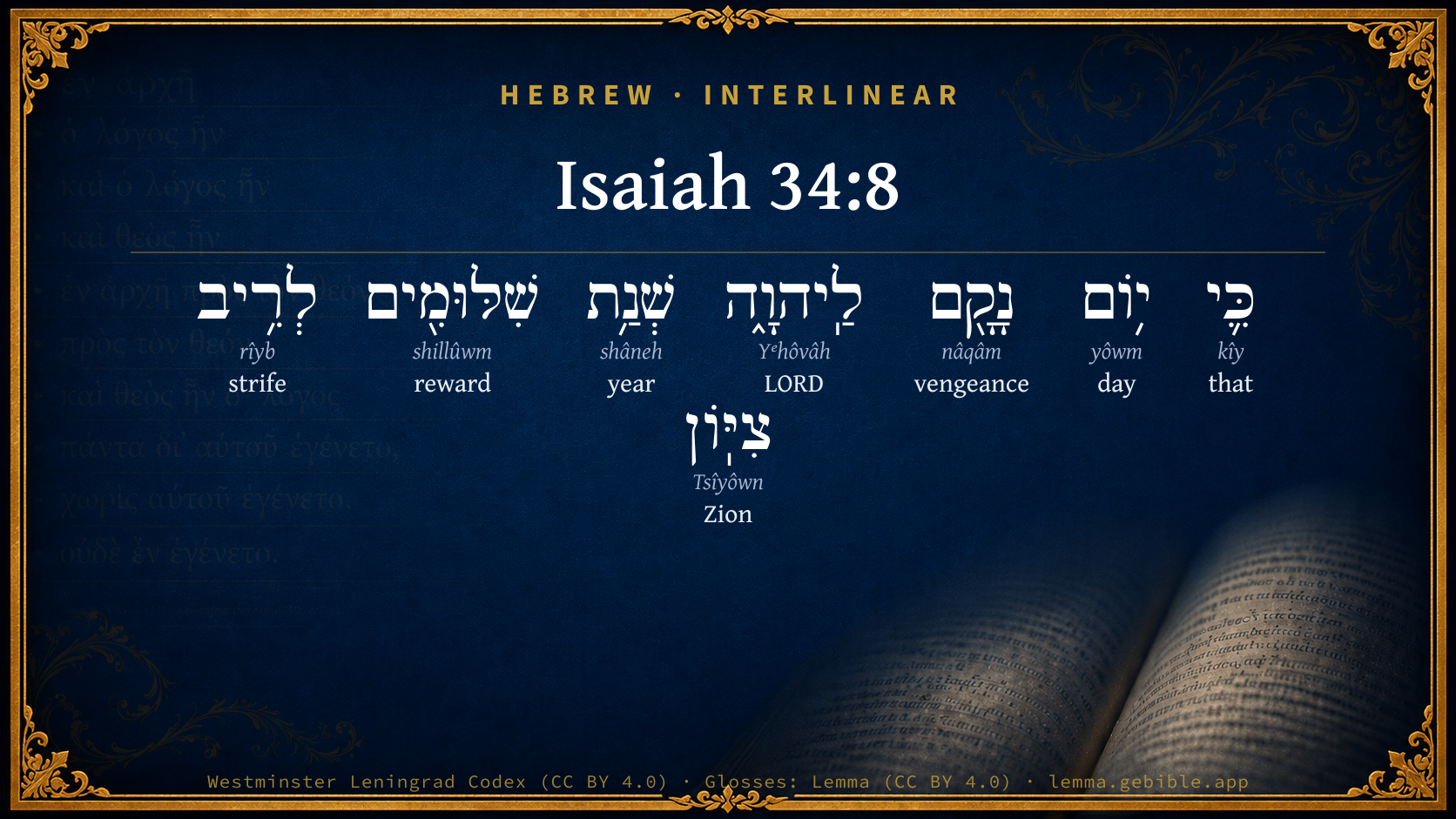
Hebrew (Westminster Leningrad Codex) Isaiah 34:8 appears in the Hebrew Old Testament. The text above is from the Westminster Leningrad Codex. Each word links to its Strong’s number, a concise gloss, and parsing drawn from the Open Scriptures Hebrew Bible morphology. Click any word for its full Brown-Driver-Briggs (BDB) entry.
Download image
Cite this verse

Isaiah 34:8 (World English Bible). Public Domain. Lemma interlinear Bible study tool, https://lemma.gebible.app/v/isaiah/34/8.

Show BibTeX & RIS
BibTeX
RIS
English Translation
For Yahweh has a day of vengeance, a year of recompense for the cause of Zion.
World English Bible · Public Domain
Highlights
  • 1 first appearance in the Hebrew Bible
Full analysis ↓
Download a study sheet

One document with this verse’s original text, its word-by-word gloss line, the meaning frame, cross-references with their text, attributed commentary, and full source and license credits — printable, and it pastes into notes with its structure intact.

This verse Autodidact and up

Study sheet (.html) Plain text (.txt)

A passage Seminary Student

Up to 50 verses in one chapter. A passage sheet keeps up to 6 commentary sources and 12 cross-references per verse, in the order this page ranks them, and says so on the sheet whenever that leaves anything out. Ask for a single verse and you get the Autodidact verse sheet above.

Everything on this page stays free to read, with no account — the sheet is a download of what is already on screen, not access to it.

Want to remove ads? Support Godless Engineer
Compare translations 3

The same verse in 3 English versions, stacked beneath the original-language interlinear above. Click any original word for its lexicon entry.

Each is an independent rendering of the whole verse — the interlinear is not word-aligned to these translations.

Highlighted words mark where these versions differ — a whole-verse word diff, not a word-by-word alignment.

  • World English Bible Public Domain
    For Yahweh has a day of vengeance, a year of recompense for the cause of Zion.
  • King James Version Public Domain
    For it is the day of the LORD's vengeance, and the year of recompences for the controversy of Zion.
  • unfoldingWord Literal Text CC BY-SA 4.0
    For a day of vengeance to Yahweh, a year of retribution for the cause of Zion.

unfoldingWord Literal Text — © unfoldingWord, licensed CC BY-SA 4.0. Word-aligned USFM3 via Door43 (git.door43.org/unfoldingWord/en_ult).

Versions to compare (up to 4)

3 of 4 selected

Show all 18 translations

Every available English version of this verse, each an independent rendering of the whole verse.

  • World English Bible Public Domain
    For Yahweh has a day of vengeance, a year of recompense for the cause of Zion.
  • Berean Standard Bible Public Domain
    For the LORD has a day of vengeance, a year of recompense for the cause of Zion.
  • Majority Standard Bible Public Domain
    For the LORD has a day of vengeance, a year of recompense for the cause of Zion.
  • King James Version Public Domain
    For it is the day of the LORD's vengeance, and the year of recompences for the controversy of Zion.
  • American Standard Version (1901) Public Domain
    For Jehovah hath a day of vengeance, a year of recompense for the cause of Zion.
  • Revised Version (1885) Public Domain
    For it is the day of the LORD’S vengeance, the year of recompence in the controversy of Zion.
  • Geneva Bible (1599) Public Domain
    For it is the day of the Lordes vengeance, and the yeere of recompence for the iudgement of Zion.
  • Douay-Rheims (1899) Public Domain
    For it is the day of the vengeance of the Lord, the year of recompenses of the judgment of Sion.
  • Young's Literal Translation Public Domain
    (For a day of vengeance `is' to Jehovah, A year of recompences for Zion's strife,)
  • Literal Standard Version CC BY-SA 4.0
    (For a day of vengeance [is] to YHWH, || A year of recompenses for Zion’s strife),
  • Unlocked Literal Bible CC BY-SA 4.0
    For it will be a day of vengeance for Yahweh and a year when he will pay them back for the cause of Zion.
  • unfoldingWord Literal Text CC BY-SA 4.0
    For a day of vengeance to Yahweh, a year of retribution for the cause of Zion.
  • Darby Bible Public Domain
    For it is the day of Jehovah's vengeance, the year of recompenses for the controversy of Zion.
  • World Messianic Bible Public Domain
    For the LORD has a day of vengeance, a year of recompense for the cause of Zion.
  • Webster's Bible Public Domain
    For it is the day of the LORD'S vengeance, and the year of recompenses for the controversy of Zion.
  • Free Bible Version CC BY-SA 4.0
    For the Lord has a day of punishment, a year of retribution, for the trouble caused to Zion.
  • Bible in Basic English Public Domain
    For it is the day of the Lord's punishment, when he gives payment for the wrongs done to Zion.
  • JPS Tanakh (1917) Public Domain
    For the LORD hath a day of vengeance, a year of recompense for the controversy of Zion.

Literal Standard Version (2020), Covenant Press — licensed CC BY-SA 4.0. Text via the HelloAO Bible API (eBible.org). Unlocked Literal Bible (unfoldingWord) — licensed CC BY-SA 4.0. Text via the HelloAO Bible API (eBible.org). unfoldingWord Literal Text — © unfoldingWord, licensed CC BY-SA 4.0. Word-aligned USFM3 via Door43 (git.door43.org/unfoldingWord/en_ult). Free Bible Version, Dr. Jonathan Gallagher — licensed CC BY-SA 4.0. Text via the HelloAO Bible API (eBible.org).

Word by word

More ways to search: Search by grammar → Find every occurrence → Compare this word →

Practice this passage: Drill this verse → Learn its vocabulary →

About this verse

These counts appear in no published source. They are computed here, from the morphology-tagged text and Lemma’s own curated glosses. What Lemma adds →

8
words
8
distinct lemmas
Prophets
section

Notable vocabulary

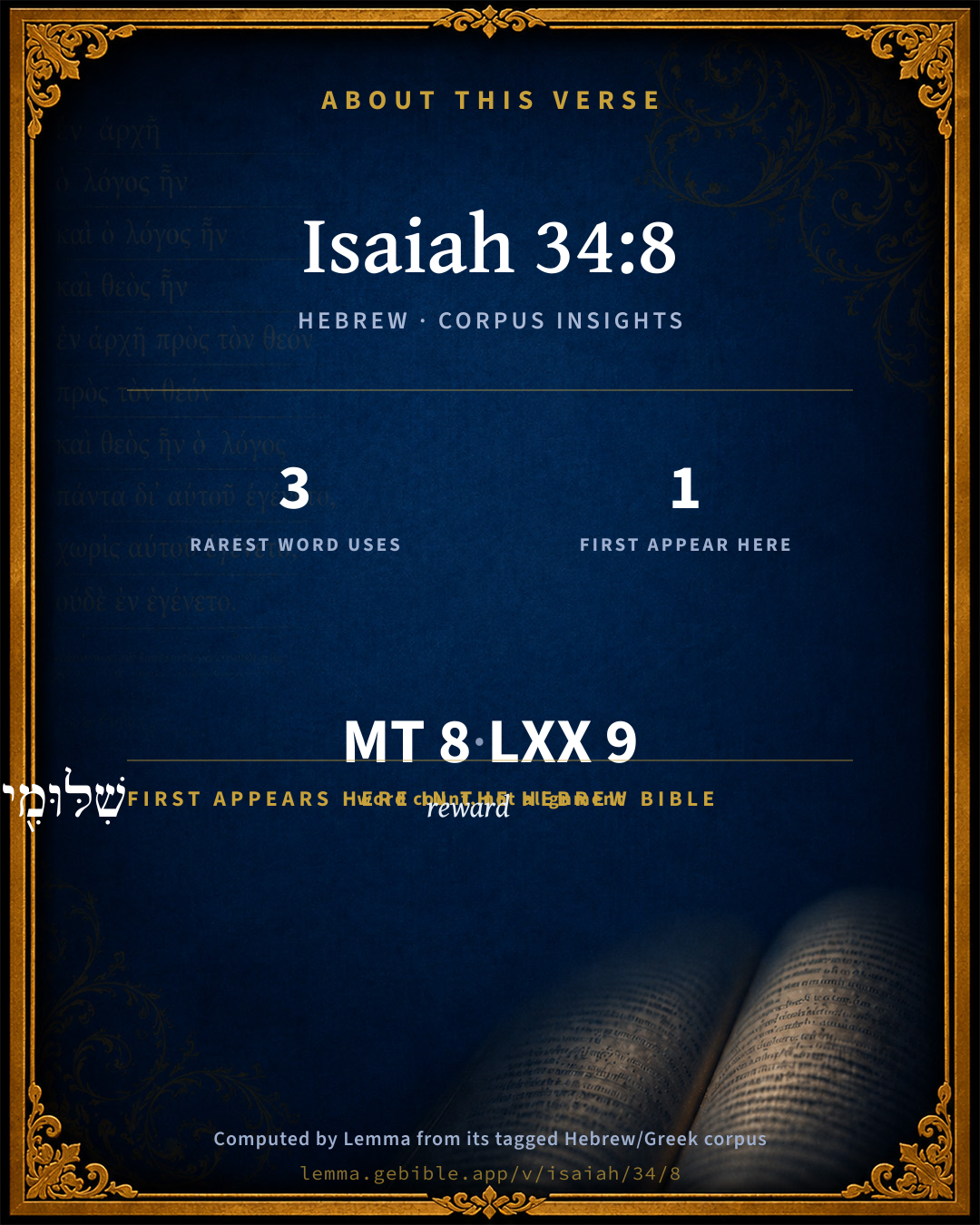
The rarest word here is שִׁלּוּמִ֖ים reward H7966 — appearing just 3 times in the whole Hebrew Bible.

First appearance in Scripture

This word makes its first canonical appearance in the Hebrew Bible here:

  • שִׁלּוּמִ֖ים reward H7966

Shared distinctive vocabulary

שִׁלּוּמִ֖ים reward H7966 occurs in 3 verses of the Hebrew Bible. Also found in:

Grammatical profile

  • 7 nouns
  • 1 conjunction

Hebrew & Septuagint length

In English translation the verse runs 16 words from the Hebrew and 20 from the Septuagint (LXX English) — closely comparable.

A rough comparison of the two English renderings, which tokenize alike — not a word-level alignment.

Word counts can differ between the Hebrew and the Greek without any difference in meaning — e.g. the Hebrew direct-object marker אֵת has no separate Greek word, and Greek often adds the article ὁ.

In the original languages it is 8 Hebrew tokens and 9 Greek tokens — but the two are counted differently (Hebrew bundles its prefixes and suffixes into one token; the Greek is in lemma form), so that isn’t a like-for-like length.

Cross-references

18

Topical passages linked to Isaiah 34:8 in the Treasury of Scripture Knowledge — connected by theme and wording, ordered by reader-vote popularity; previews shown in the World English Bible.

  • Isaiah 63:4 For the day of vengeance was in my heart, and the year of my redeemed is come.
  • Isaiah 61:2 to proclaim the year of Yahweh's favor, and the day of vengeance of our God; to comfort all who mourn;
  • Psalms 94:1 Yahweh, you God to whom vengeance belongs, You God to whom vengeance belongs, shine forth.
  • Isaiah 35:4 Tell those who are of a fearful heart, Be strong, don't be afraid: behold, your God will come [with] vengeance, [with] the recompense of God; he will come and save you.
  • Jeremiah 46:10 For that day is [a day] of the Lord, Yahweh of Hosts, a day of vengeance, that he may avenge him of his adversaries: and the sword shall devour and be satiate, and shall drink its fill of their blood; for the Lord, Yahweh of hosts, has a sacrifice in the north country by the river Euphrates.
  • Deuteronomy 32:35 Vengeance is mine, and recompense, At the time when their foot shall slide: For the day of their calamity is at hand, The things that are to come on them shall make haste.
  • Revelation 6:10–11 They cried with a loud voice, saying, "How long, Master, the holy and true, until you judge and avenge our blood on those who dwell on the earth?"
  • Revelation 18:20 Rejoice over her, O heaven, you saints, apostles, and prophets; for God has judged your judgment on her."
  • Revelation 19:2 for true and righteous are his judgments. For he has judged the great prostitute, who corrupted the earth with her sexual immorality, and he has avenged the blood of his servants at her hand."
  • Deuteronomy 32:41–43 If I whet my glittering sword, My hand take hold on judgment; I will render vengeance to my adversaries, Will recompense those who hate me.
  • Isaiah 26:21 For, behold, Yahweh comes forth out of his place to punish the inhabitants of the earth for their iniquity: the earth also shall disclose her blood, and shall no more cover her slain.
  • Isaiah 49:26 I will feed those who oppress you with their own flesh; and they shall be drunken with their own blood, as with sweet wine: and all flesh shall know that I, Yahweh, am your Savior, and your Redeemer, the Mighty One of Jacob.
  • Isaiah 59:17–18 He put on righteousness as a breastplate, and a helmet of salvation on his head; and he put on garments of vengeance for clothing, and was clad with zeal as a mantle.
  • Micah 6:1 Listen now to what Yahweh says: "Arise, plead your case before the mountains, And let the hills hear what you have to say.
  • Luke 18:7 Won't God avenge his chosen ones, who are crying out to him day and night, and yet he exercises patience with them?
  • Romans 2:5 But according to your hardness and unrepentant heart you are treasuring up for yourself wrath in the day of wrath, revelation, and of the righteous judgment of God;
  • Romans 2:8–9 but to those who are self-seeking, and don't obey the truth, but obey unrighteousness, will be wrath and indignation,
  • 2 Thessalonians 1:6–10 Since it is a righteous thing with God to repay affliction to those who afflict you,

Cross-references courtesy of OpenBible.info (CC BY 4.0).

Hebrew and Greek witnesses Masoretic Hebrew ↔ Greek Septuagint

The same verse in the two great witnesses to the Old Testament, shown verse-for-verse.

These are two independent witnesses, not word-aligned to each other, and the Septuagint is shown in lemma (dictionary) form.

Hebrew Isaiah 34:8 Masoretic · Westminster Leningrad Codex

כִּ֛י י֥וֹם נָקָ֖ם לַֽיהוָ֑ה שְׁנַ֥ת שִׁלּוּמִ֖ים לְרִ֥יב צִיּֽוֹן

For Yahweh has a day of vengeance, a year of recompense for the cause of Zion.

World English Bible · Public Domain

Greek LXX Isaiah 34:8 Septuagint · lemma form

ἡμέρα γάρ κρίσις κύριος καί ἐνιαυτός ἀνταπόδοσις κρίσις σιων

For it is the day of judgment of the Lord, and the year of the recompence of Sion in judgment.

LXX2012 (modern English Septuagint) · Public Domain

Hebrew: Westminster Leningrad Codex (CC BY 4.0). Greek: Septuagint (public domain); English from LXX2012 (modern English Septuagint) (Public Domain). How the Septuagint differs from the Hebrew →

Targum (Aramaic paraphrase)

1

The Targum is the ancient Jewish Aramaic paraphrase of the Hebrew Scriptures — an interpretive translation, not the Hebrew text itself. Onkelos (literal) and Pseudo-Jonathan (expansive) render the Torah, and Jonathan the Prophets. Coverage is partial: where no permissively-licensed English translation exists for a verse, only the Aramaic is shown. This is verse-level text, not a word-by-word alignment to the Hebrew.

  1. Targum Jonathan Prophets (Joshua–Malachi)
    אֲרֵי יוֹם פּוּרְעֲנוּתָא קֳדָם יְיָ שְׁנַת תוּשְׁלֵמָא לְמֶעְבַּד פּוּרְעֲנוּת דִין עוּלְבָּנָא דְצִיוֹן:

    For it is the day of vengeance before the presence of the Lord; the year of recompense, to take vengeance of judgment on account of the ignominy of Zion.

    Targum Jonathan — Aramaic: “Mikraot Gedolot” (public domain). English: “Sefaria Community Translation” (CC0 1.0 (public-domain dedication)); “London "Chaldee Paraphrase," 1871” (public domain). Text via Sefaria.

Commentary

Notes on Isaiah 34:8 from classic Christian and Jewish commentators (each source and its license shown beneath its notes). The classic Christian expositions comment on the surrounding passage and are grouped to its opening verse, so a note may address several verses; the Jewish commentaries on the Tanakh (Rashi and others) are per-verse, so they appear only where the commentator wrote on this verse.

Lemma curates 59 commentaries, every one of them public domain or Creative Commons licensed, each selected and text-cleaned for this edition rather than reprinted as found. About our sources →

Trapp's Complete Commentary

John Trapp

Isa 34:8 For [it is] the day of the LORD’S vengeance, [and] the year of recompences for the controversy of Zion.

Ver. 8. For the controversy of Zion,] i.e., Of the Church, both Jewish and Christian, saith Piscator. {compare Rev 18:2}

John Trapp, A Commentary or Exposition upon All the Books of the Old and New Testament (1647–1656) — public domain. Text from a community e-Sword module.

The Preacher's Complete Homiletical Commentary

Joseph S. Exell (gen. ed.)

THE CONTROVERSY OF ZION

Isa_34:8. For it is the day of the Lord’s vengeance, &c.

The Lord has always been mindful of His Church. He is pledged to her defence against the world, and against the world-spirit which often intrudes within her pale. Chapter 34 contains a description of the effects of the Divine vengeance in the typical case of Edom; chapter 35 describes the flourishing state of the Church consequent upon the execution of the Divine judgments.

I. There is a parallel between God’s dealings with individuals and society. Such a parallel may be presumed to exist, inasmuch as any society is made up of individuals; and God cares equally for the single and the corporate life. Taking the mass of men, evil dispositions lead to evil deeds, and these to habits, before they are turned to the service of God. God intervenes in the way of judgment; times of judgment are appointed them, foreshadowing a future day of the Lord’s vengeance.

1. Individual judgments. God’s controversy with Jacob at Peniel, when Jacob’s thigh was put out of joint, was but the climax of the Divine vengeance in respect of his sinful past, and became the turning-point of his life. Not only are bad men changed in this way, but good men are made better (Isa_38:12-14; Lam_3:3-21; Job_10:16-20; H. E. I. 56–59, 66–70, 116). God strikes, that human nature may be laid bare in its depths, and a thorough work of regeneration accomplished, proceeding from within outward. Afflictions do not always soften; but they do so often enough to form a large part of the method of the Divine vengeance.

2. Social and national judgments. Jacob became Israel, and Israel the Church of God, the representative of God on earth, even as Edom, of which Esau, the godless, was the ancestor, is regarded in Scripture as the representative of the world-power. Edom was emphatically the troubler of Israel. Its judgments—prophetic of greater in the future—were sent by the Defender of Zion—

(1.) To make manifest its sin;

(2.) To show the theocratic character of Israel.

But the Edom, or world-spirit, was in Israel herself; hence the judgments of the Church. The idea of the theocracy was interfered with when Israel wished a king, like the other nations (1Sa_8:6-7). That could only be entertained by Jehovah if kings held their right to rule direct from Himself. And so He raised up David and David’s line (1Sa_16:1-13; Gen_49:8). Hence the institution and perpetuation of the prophetic line—Samuel, Isaiah, Ezekiel, &c.—to assert and maintain the idea of the theocracy.

With a grander display of the Divine power this tale has been re-told under the Christian dispensation. Social and national crises are still brought about, in the wise judgment of God, first, to make manifest the sins of communities and nations; and, second, to direct men to the Church of Christ. In times of the Church’s unfaithfulness, apostles, truly apostolic men, reformers, &c., interfere.

II. Antagonism between the Church and the world must end in the defeat and subjugation of the world. Jehovah is the defender of the cause of Zion through the ages. He has espoused the cause of holiness against ungodliness. His people may be dispersed, but the Church does not die out. From the lowest ebb it returns to the flow. The blood of its martyrs becomes seed. Its opponents turn ever feebler. This is seen in their more spasmodic efforts. Its benign influence has extended far; ever larger numbers are being brought under its yoke. The world fights every inch of the ground; but—

III. The great day is surely coming.

1. There must come a complete manifestation of the Church’s inherent glory.

(1.) This manifestation will take place by displays of Divine vengeance on the enemies of Zion. This method of the ancient time has not become obsolete.

(2.) The manifestation will not be short-lived, but continue, so that destruction may be succeeded by a realised state of salvation.

(3.) Last of all, there shall be seen the triumph of the Church, when Church and world shall be conterminous, and fulness of blessing be enjoyed. (Chapter 35 still awaits its largest fulfilment.)

CONCLUSION.—

1. We have a Gospel of terror to preach to the world—a Gospel of terror, for the Divine vengeance is informed by the greatest heart of love. Is the Church, as some say, becoming less powerful in our time? Let the question at least provoke searchings of heart. God still sends judgments upon unfaithful Churches.

2. Remember, in times of darkness and trial, that the Lord has the deepest interest in His Church. It cannot disappear from the world; but be alive to removing from it causes of weakness.

3. Let us encourage one another in the hope of a time when the Church’s glory shall be fully manifested, when the time of recompenses for the long controversy of Zion shall arrive. Let us work in the Church so as to help to bring about the glad time coming.—J. Macrae Simcock.

The Preacher's Complete Homiletical Commentary (gen. ed. Joseph S. Exell; Funk & Wagnalls, c. 1892) — public domain (pre-1929). A full-Bible homiletical/sermon-outline anthology covering 65 of 66 books (2 John is absent from the source module). Text from a community e-Sword module.

Tyndale Open Study Notes

Tyndale Open Resources

34:8 The Lord’s revenge refers to God’s wrathful but righteous vengeance against his enemies and the oppressors of his people on the day of the Lord. • Edom will be paid back: There will be retribution for Edom’s crimes against Judah (see also Ps 137:7; Lam 4:21; Obad; Mal 1:3-5). Edom, with its history of treachery, would come to an end.

Tyndale Open Study Notes — © Tyndale Open Resources, licensed CC BY-SA 4.0. Text via the HelloAO Bible API.

Jamieson, Fausset & Brown

Robert Jamieson, A. R. Fausset & David Brown

recompenses for the controversy of Zion--that is, the year when God will retaliate on those who have contended with Zion. Her controversy is His. Edom had thought to extend its borders by laying hold of its neighbor's lands and has instigated Babylon to cruelty towards fallen Judah (Psa 137:7; Eze 36:5); therefore Edom shall suffer the same herself (Lam 4:21-22). The final winding up of the controversy between God and all enemies of Him and His people is also foreshadowed (Isa 61:2; Isa 63:4; Isa 66:14-16; Mal 4:1, Mal 4:3; Th2 1:7-9; Rev 11:18; Rev 18:20; Rev 19:2).

Jamieson, Fausset & Brown — Commentary Critical and Explanatory on the Whole Bible (1871) — public domain (CC PDM 1.0). Text via the HelloAO Bible API.

Adam Clarke's Commentary

Verse 8. The year of recompenses for the controversy of Zion - "The year of recompense to the defender of the cause of Zion"] As from דון dun, דין din, a judge; so from רוב rub, ריב rib, an advocate, or defender; Judici Sionis: Syriac.

Adam Clarke's Commentary on the Bible (1810–1826) — public domain. Text from a community e-Sword/MySword module.

Ellicott's Commentary for English Readers

(8) The year of recompences for the controversy of Zion . . .—The long-delayed day of retribution should come at last. This would be the outcome from the hand of Jehovah for the persistent hostility of the Edomites to the city which He had chosen.

A Bible Commentary for English Readers, edited by Charles John Ellicott (1878–1897) — public domain. Text from a community e-Sword module.

The Cambridge Bible for Schools and Colleges

gen. ed. J. J. S. Perowne

8. Comp. ch. Isa_61:2, Isa_63:4; Jer_50:28; Jer_51:6; Jer_51:11.

the controversy of Zion] with Edom.

The Cambridge Bible for Schools and Colleges (gen. ed. J. J. S. Perowne; Cambridge University Press, 1878–1918) — public domain. Text from a community e-Sword module.

John Gill's Exposition

For it is the day of the Lord's vengeance,.... The time which he has appointed to take vengeance on antichrist, his 1260 days, or years; being up, in which he is to reign; these being expired, the time is come for the Lord to avenge the blood of his saints; see Rev 18:20,

and the year of recompences for the controversy of Zion; the church of God, which has been for many ages abused and injured by the antichristian powers, for which the Lord will have a controversy with them; he will appear in favour of his people, and plead the cause of Zion, and recompense their enemies for all the injuries they have done them; then they that have led into captivity shall go into captivity, and they that have killed with the sword shall be killed with it, Rev 13:10 this will be a time of double recompence; and therefore perhaps the word is used in the plural number; it will be the time of rewarding antichrist as he has rewarded others; and it will be the time of the dead, that they shall be judged, and rewards given to God's servants the prophets, Rev 18:6. The Targum is,

"the year of recompence, to take vengeance of judgment for the injury of Zion.''

John Gill's Exposition of the Whole Bible (1746–1763) — public domain (CC PDM 1.0). Text via the HelloAO Bible API.

Albert Barnes' Notes on the Bible

For it is the day of the Lord’s vengeance - A time when Yahweh will take vengeance.

The year of recompenses for the controversy of Zion - The time when he will recompense, that is, punish those who have had a controversy with Zion.

Albert Barnes' Notes on the Bible (1834–1885) — public domain. Text from a community e-Sword/MySword module.

Haydock's Catholic Bible Commentary

Recompenses. When the persecutors of Sion, that is, of the Church, shall receive their reward. (Challoner) --- The Idumeans had frequently shown their ill-will towards the Jews, 2 Paralipomenon xxviii. 17., and Amos i. 11. (Calmet) --- Sion shall perish as the wicked in hell shall be tormented. (Worthington)

George Leo Haydock (1774–1849), Haydock's Catholic Family Bible and Commentary, 1859 edition — public domain. Excludes Psalms (Douay-Rheims chapter numbering differs from Protestant) and Deuterocanonical books (Catholic canon only).

Matthew Poole's English Annotations

This is the time which God hath long since appointed and fixed, to avenge the cause of his oppressed and persecuted people against all their enemies.

Matthew Poole's English Annotations on the Holy Bible (1683–1685) — public domain. Text from a community e-Sword/MySword module.

Whedon's Commentary on the Bible

Daniel D. Whedon

8-10. Day of the Lord’s vengeance — Sure as the pillars of God’s throne stand, divine judgment must overtake wrong and wrongdoers, and Zion, or the Church of God, must be vindicated and defended. The ideal of most terrific punishment is found in the terms brimstone and burning pitch; in the unquenchable fire; in the smoke forever ascending, and in the desert gloom and the impassable waste, that befall the land thus visited. These terms, used as mere figures here, are expanded into symbols in the Book of Revelation; symbols answering to the real idea of awful retributions which will fall upon sin, sinners, and all sinful agencies in the world’s last days. Emblematically the land of Edom becomes a wilderness, and, as an antagonistic kingdom, is destroyed forever.

Daniel D. Whedon (gen. ed.), Commentary on the Old and New Testaments (1874–1909) — public domain. Text from a community e-Sword module.

The Pulpit Commentary

The day of the Lord"s vengeance. (comp. Isa_61:2 and Isa_63:4) In all three places the "day" of God"s vengeance is contrasted with the "year" of his recompense, to show how infinite is his mercy, how short-lived, comparatively speaking, his auger. Mr. Cheyne well compares the concluding clauses of the second commandment, where "retribution is declared to descend to the third and fourth generation, but mercy to the thousandth." Recompenses for the controversy of Zion; rather, for the vindication of Zion; i.e. for the maintenance of her right in the quarrel between her and her enemies.

The Lord"s controversy.

"The year of recompenses for the controversy of Zion." Fausset says, "When Judah was captive in Babylon, Edom in every way insulted over her fallen mistress, and killed many of those Jews whom the Chaldeans had left, and hence was held guilty of fratricide by God (Esau, their ancestor, having been brother to Jacob): this was the cause of the denunciations of the prophets against Edom." (Isa_63:1 Jer_49:7 Eze_25:12-14 Eze_35:3-15 Joe_3:19 Amo_1:11, 12 Oba_1:8, Oba_1:10,mal Oba_1:3, Oba_1:4) The Israelites were familiar with the law of retaliation. It was the pervading law of men as gathered into tribes, and their basis-idea of justice. Moses adopted it for his legal system, but qualified its operation, preparing the way for an entire change from personal retaliation for offences, to a calm, unbiased, systematic consideration of the case of all wrong-doers, and adjustment of punishments on a fixed scale. So far as the idea of retaliation was right as between men, it may be applied as between God and men, and it is introduced in this verse. Edom took advantage of Israel"s weakness to act unbrotherly, and to encroach. Therefore the Lord has a controversy with Edom; and he will surely retaliate, bringing judgments upon them.

I RETALIATION AS A PRIMITIVE IDEA OF JUSTICE, "It was an ethical maxim, extensively accepted among ancient nations, that men must suffer the same pains that they have inflicted on others. The later Greeks called this the Neoptolemictisis, from the circumstance that Neoptolemus was punished in the same way in which he had sinned. He had murdered at the altar, and at the altar he was murdered." Show how natural the retaliatory idea seems to children. The old sentiment still lingers in men"s minds, so that we have great satisfaction in hearing of cases wherein Providence deals the blow to men which they have dealt to others.

II RETALIATION DANGEROUS BECAUSE OF THE CHARACTER OF AVENGERS. It would be a safe working principle if men were good, and not subject to unworthy passions. These make men do more than retaliate.

III RETALIATION AS A PART OF DIVINE DEALING. He has a year of recompenses a time when he will make a man"s violent doing fall upon his own pate. All sin is wrong done to him; it calls for due recompense. It must be precisely shown how far the idea of retaliation may be applied to God.

IV RETALIATION BY GOD IS GUARANTEED BY THE CHARACTER OF GOD. It can never be the expression of personal feeling. It can never be unqualified or excessive. It can never be without its own aim to secure the final good of those on whom it must fall. R.T.

The Pulpit Commentary (1880–1919), ed. H.D.M. Spence-Jones & Joseph S. Exell — public domain. Text from a community e-Sword module.

John Wesley's Explanatory Notes

For - This is the time which God hath fixed, to avenge the cause of his persecuted people.

John Wesley, Explanatory Notes Upon the Whole Bible (1754–1765) — public domain. Text via the GEBible commentary corpus.

Keil & Delitzsch

C. F. Keil & F. Delitzsch

Thus does Jehovah avenge His church upon Edom. "For Jehovah hath a day of vengeance, a year of recompense, to contend for Zion. And the brooks of Edom are turned into pitch, and its dust into brimstone, and its land becomes burning pitch. Day and night it is not quenched; the smoke of Edom goes up for ever: it lies waste from generation to generation; no one passes through it for ever and ever." The one expression, "to contend for Zion," is like a flash of lightning, throwing light upon the obscurity of prophecy, both backwards and forwards. A day and a year of judgment upon Edom (compare Isa 61:2; Isa 63:4) would do justice to Zion against its accusers and persecutors (rı̄bh, vindicare, as in Isa 51:22). The everlasting punishment which would fall upon it is depicted in figures and colours, suggested by the proximity of Edom to the Dead Sea, and the volcanic character of this mountainous country. The unquenchable fire (for which compare Isa 66:24), and the eternally ascending smoke (cf., Rev 19:3), prove that the end of all things is referred to. The prophet meant primarily, no doubt, that the punishment announced would fall upon the land of Edom, and within its geographical boundaries; but this particular punishment represented the punishment of all nations, and all men who were Edomitish in their feelings and conduct towards the congregation of Jehovah.

Keil & Delitzsch — Biblical Commentary on the Old Testament (1861–1891) — public domain (CC PDM 1.0). Text via the HelloAO Bible API. (Old Testament only.)

J. A. Alexander on Isaiah

Joseph Addison Alexander

“For (there is) a day of vengeance to Jehovah, a year of recompenses for the cause of Zion,” (i.e., to maintain her cause). This verse connects the judgments threatened against Edom with the cause of Zion or the church of God. On the construction and meaning of the first words of the sentence, compare Isa 2:12.

Joseph Addison Alexander, The Prophecies of Isaiah (1846–1847; New York: Scribner, 1870–1878) — public domain. Text from a community e-Sword module.

unfoldingWord translationNotes

Door43 World Missions Community

it will be a day of vengeance for Yahweh

Here "day" is an idiom for a point in time; it is not a literal "day." AT: "it will be the time when Yahweh gets revenge" (See: Idiom)

he will pay them back for the cause of Zion

This means that he will take revenge on them for how they had previously waged war against the people of Jerusalem. AT: "he will give them the punishment they deserve for what they had done to the people of Zion" (See: Assumed Knowledge and Implicit Information)

The streams of Edom will be turned into pitch ... become burning pitch

The water and land becoming useless for drinking or growing food because it is burnt and covered in pitch and sulfur is spoken of as if their streams and land will actually become pitch and sulfur. AT: "The streams in Edom will be full of pitch and the ground will be covered with burning sulfur and burning pitch" (See: Metaphor)

her dust ... her land

"Edom's dust ... Edom's land"

pitch

a thick, black substance that burns for a long time

It will burn night and day

This means all of the time. AT: "It will burn throughout the night and the day" or "It will burn constantly, all night and all day" (See: Merism)

from generation to generation

The phrase "generation to generation" refers to all generations of people who will live in the future. See how you translated this phrase in Isaiah 13:20. AT: "forever" (See: Idiom)

translationWords

avenge

Yahweh

Zion

Edom

sulfur

eternity

generation

waste

unfoldingWord translationNotes — © Distant Shores Media and the Door43 World Missions Community, licensed CC BY-SA 4.0. Source: git.door43.org/Door43/en_tn.

Rashi

Rabbi Shlomo Yitzchaki (Rashi)

retribution for the plea of Zion That He will mete out punishment (lit., pay a reward) for the plea of Zion, who cries before Him to judge her from those who harm her.

Rashi on the Tanakh — English translations: “The Judaica Press complete Tanach with Rashi, translated by A. J. Rosenberg” (CC BY 4.0); “Pentateuch with Rashi's commentary by M. Rosenbaum and A.M. Silbermann, 1929-1934” (public domain); “The Metsudah Tanach series, Lakewood, N.J” (CC BY 4.0); and “The Book of Joshua, Metsudah Publications, 1997” (CC BY 4.0). Text via Sefaria.

Ibn Ezra

Rabbi Abraham ibn Ezra

For it is the day of the Lord’s vengeance, etc. This verse shows that the prophecy refers to the Messianic period; some believe, that it was fulfilled already in the time of Nebuchadnezzar, after the conquest of Zion; comp. The cup will be passed also to thee (Lam. 4:21).

The year of recompences. Comp. Thy reward shall return over thine own head (Obad. 15); these words refer likewise to Edom.

Ibn Ezra on the Tanakh — English translations: “Sefaria Community Translation” (CC0 1.0 (public-domain dedication)); “Yalkut, Sifsei Chachomim Chumash, Metsudah Publications, 2009” (CC BY 4.0); and “Commentary of Ibn Ezra on Isaiah - trans. by M. Friedlander, 1873” (public domain). Text via Sefaria.

Lesson kit

Teaching starters — assembled from the data on this page, not authored interpretation. Every prompt links to the verse data it draws on. Edit before teaching.

Isaiah, in the Prophets, opens this verse with 8 words (8 distinct Hebrew lemmas). Its most distinctive word is shillûwm (“reward”). A historical commentator’s framing appears above. Read the whole chapter for the surrounding context.

Discussion questions

  1. The word shillûwm carries the sense “reward.” How does it shape the verse?
  2. The word “reward” first appears here in Scripture. What is being introduced at this debut?
  3. Hosea 9:7 shares the word «reward» with this verse. How do the two illuminate each other?
  4. These translations render this verse differently; the difference is in the English rendering, not the original. What questions does that raise?
  5. Reading how Trapp's Complete Commentary and The Preacher's Complete Homiletical Commentary read this verse, where do the two commentators agree and where do they part?

Things to notice

Reading settings

Reading text

Shown beneath each verse's original-language words.

Old Testament
Old Testament edition

Read the OT as the Masoretic Hebrew (MT) or the Greek Septuagint (LXX).

English shown for the Greek Septuagint (in the Hebrew ↔ Greek comparison).

Comparing translations? Open the Compare panel on any verse page to stack up to four side by side.