
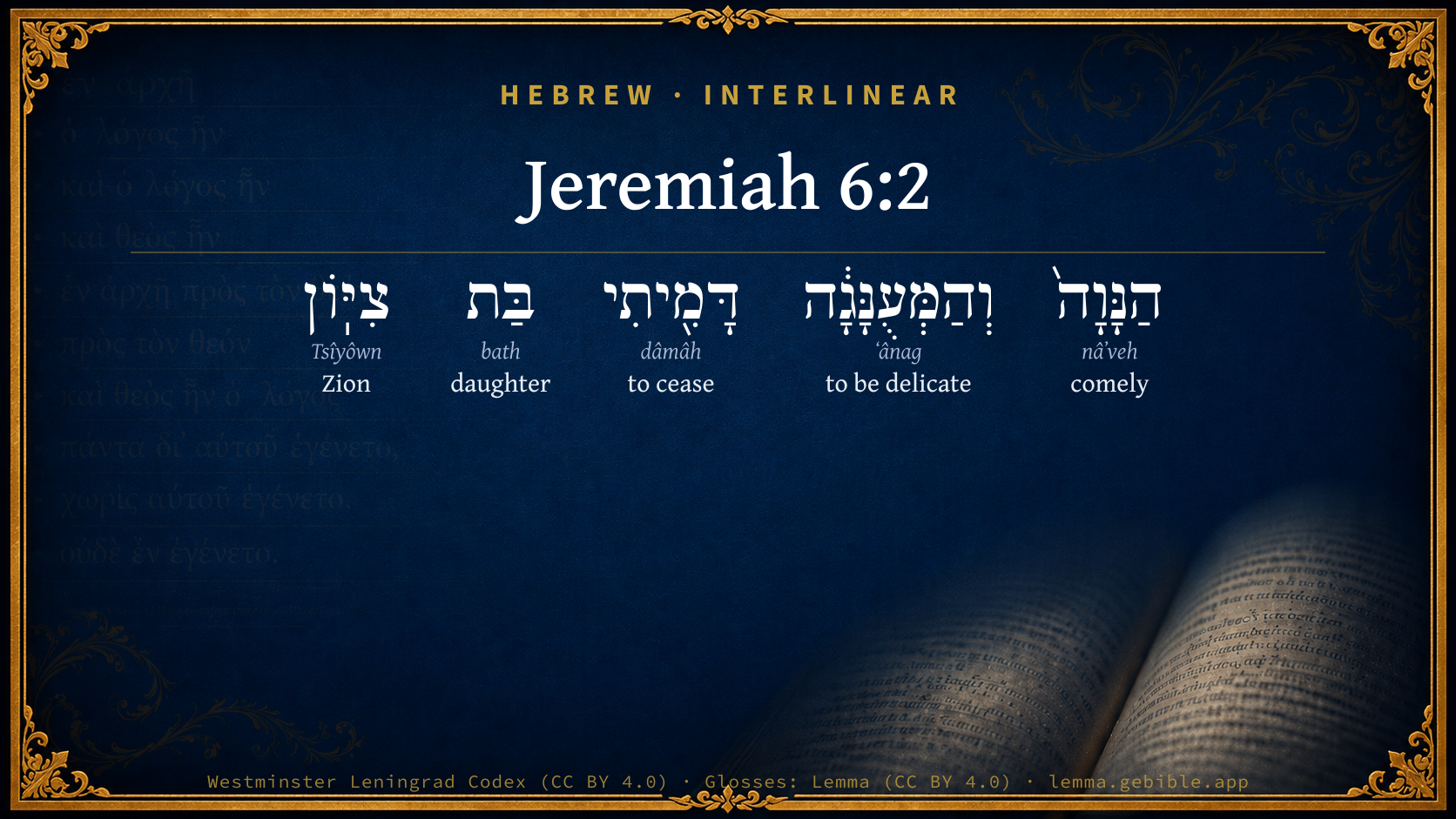
Jeremiah 6:2

Hebrew (Westminster Leningrad Codex) Jeremiah 6:2 appears in the Hebrew Old Testament. The text above is from the Westminster Leningrad Codex. Each word links to its Strong’s number, a concise gloss, and parsing drawn from the Open Scriptures Hebrew Bible morphology. Click any word for its full Brown-Driver-Briggs (BDB) entry.
Download image
Cite this verse

Jeremiah 6:2 (World English Bible). Public Domain. Lemma interlinear Bible study tool, https://lemma.gebible.app/v/jeremiah/6/2.

Show BibTeX & RIS
BibTeX
RIS
English Translation
The comely and delicate one, the daughter of Zion, will I cut off.
World English Bible · Public Domain
Download a study sheet

One document with this verse’s original text, its word-by-word gloss line, the meaning frame, cross-references with their text, attributed commentary, and full source and license credits — printable, and it pastes into notes with its structure intact.

This verse Autodidact and up

Study sheet (.html) Plain text (.txt)

A passage Seminary Student

Up to 50 verses in one chapter. A passage sheet keeps up to 6 commentary sources and 12 cross-references per verse, in the order this page ranks them, and says so on the sheet whenever that leaves anything out. Ask for a single verse and you get the Autodidact verse sheet above.

Everything on this page stays free to read, with no account — the sheet is a download of what is already on screen, not access to it.

Want to remove ads? Support Godless Engineer
Compare translations 3

The same verse in 3 English versions, stacked beneath the original-language interlinear above. Click any original word for its lexicon entry.

Each is an independent rendering of the whole verse — the interlinear is not word-aligned to these translations.

Highlighted words mark where these versions differ — a whole-verse word diff, not a word-by-word alignment.

  • World English Bible Public Domain
    The comely and delicate one, the daughter of Zion, will I cut off.
  • King James Version Public Domain
    I have likened the daughter of Zion to a comely and delicate woman.
  • unfoldingWord Literal Text CC BY-SA 4.0
    I liken the daughter of Zion the beautiful and delicate woman.

unfoldingWord Literal Text — © unfoldingWord, licensed CC BY-SA 4.0. Word-aligned USFM3 via Door43 (git.door43.org/unfoldingWord/en_ult).

Versions to compare (up to 4)

3 of 4 selected

Show all 18 translations

Every available English version of this verse, each an independent rendering of the whole verse.

  • World English Bible Public Domain
    The comely and delicate one, the daughter of Zion, will I cut off.
  • Berean Standard Bible Public Domain
    Though she is beautiful and delicate, I will destroy the Daughter of Zion.
  • Majority Standard Bible Public Domain
    Though she is beautiful and delicate, I will destroy the Daughter of Zion.
  • King James Version Public Domain
    I have likened the daughter of Zion to a comely and delicate woman.
  • American Standard Version (1901) Public Domain
    The comely and delicate one, the daughter of Zion, will I cut off.
  • Revised Version (1885) Public Domain
    The comely and delicate one, the daughter of Zion, will I cut off.
  • Geneva Bible (1599) Public Domain
    I haue compared the daughter of Zion to a beautifull and daintie woman.
  • Douay-Rheims (1899) Public Domain
    I have likened the daughter of Sion to a beautiful and delicate woman.
  • Young's Literal Translation Public Domain
    The comely and the delicate one I have cut off, The daughter of Zion.
  • Literal Standard Version CC BY-SA 4.0
    I have cut off the lovely and delicate one, || The daughter of Zion.
  • Unlocked Literal Bible CC BY-SA 4.0
    The daughter of Zion, the beautiful and delicate woman, will be destroyed.
  • unfoldingWord Literal Text CC BY-SA 4.0
    I liken the daughter of Zion the beautiful and delicate woman.
  • Darby Bible Public Domain
    The comely and delicate one do I cut off, the daughter of Zion.
  • World Messianic Bible Public Domain
    I will cut off the beautiful and delicate one, the daughter of Zion.
  • Webster's Bible Public Domain
    I have likened the daughter of Zion to a comely and delicate woman.
  • Free Bible Version CC BY-SA 4.0
    Even though she is pretty and delightful, I will destroy the Daughter of Zion.
  • Bible in Basic English Public Domain
    The fair and delicate one, the daughter of Zion, will be cut off by my hand.
  • JPS Tanakh (1917) Public Domain
    The comely and delicate one, the daughter of Zion, will I cut off.

Literal Standard Version (2020), Covenant Press — licensed CC BY-SA 4.0. Text via the HelloAO Bible API (eBible.org). Unlocked Literal Bible (unfoldingWord) — licensed CC BY-SA 4.0. Text via the HelloAO Bible API (eBible.org). unfoldingWord Literal Text — © unfoldingWord, licensed CC BY-SA 4.0. Word-aligned USFM3 via Door43 (git.door43.org/unfoldingWord/en_ult). Free Bible Version, Dr. Jonathan Gallagher — licensed CC BY-SA 4.0. Text via the HelloAO Bible API (eBible.org).

Word by word

More ways to search: Search by grammar → Find every occurrence → Compare this word →

Practice this passage: Drill this verse → Learn its vocabulary →

About this verse

These counts appear in no published source. They are computed here, from the morphology-tagged text and Lemma’s own curated glosses. What Lemma adds →

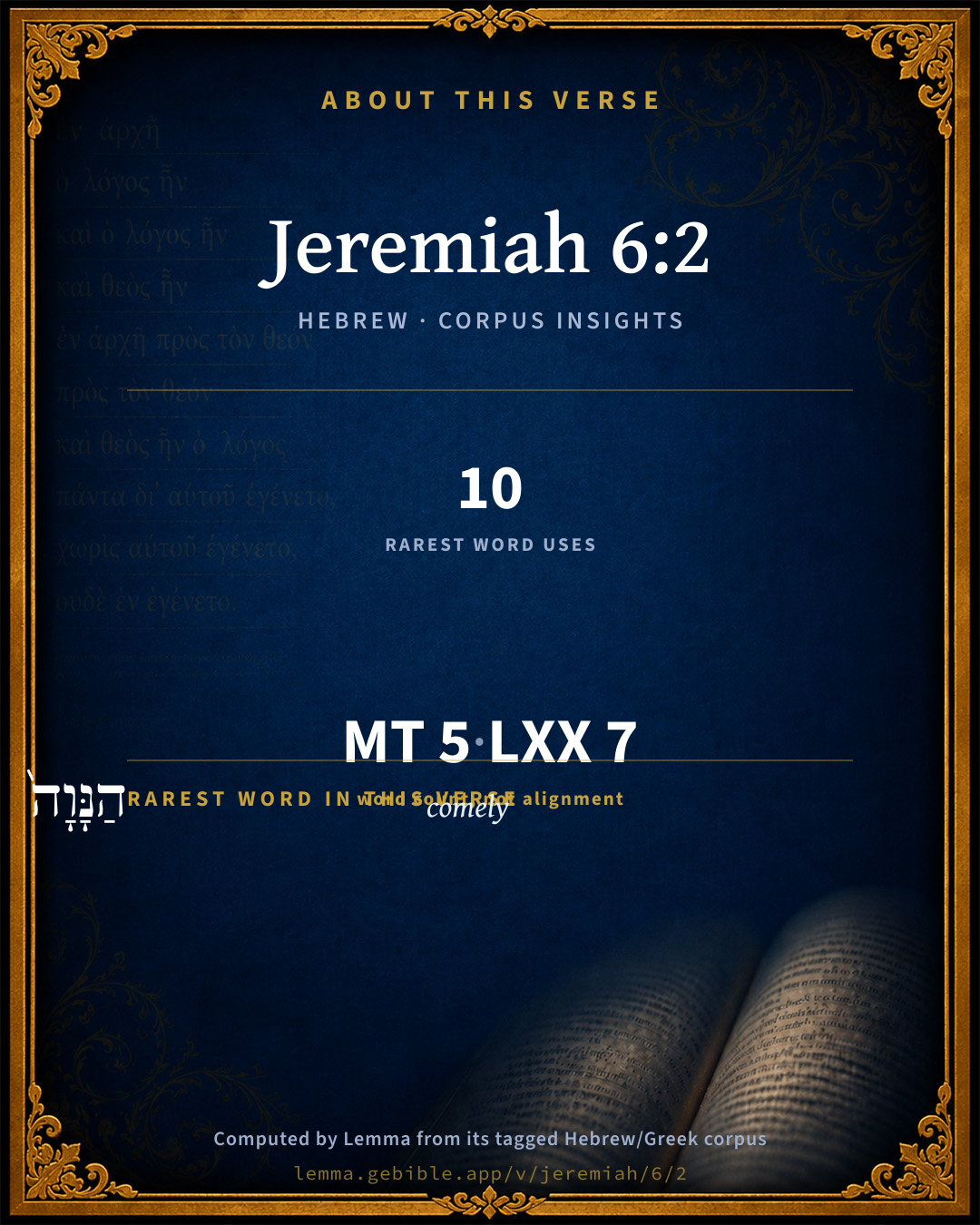
5
words
5
distinct lemmas
Prophets
section

Notable vocabulary

The rarest word here is הַנָּוָה֙ comely H5000 — appearing just 10 times in the whole Hebrew Bible.

Shared distinctive vocabulary

הַנָּוָה֙ comely H5000 occurs in 10 verses of the Hebrew Bible. Also found in:

Grammatical profile

  • 2 verbs
  • 2 nouns
  • 1 adjective

Verb forms

  • וְהַמְּעֻנָּגָ֔ה Pual · Participle Passive
  • דָּמִ֖יתִי Qal · Perfect

Hebrew & Septuagint length

In the original languages it is 5 Hebrew tokens and 7 Greek tokens — but the two are counted differently (Hebrew bundles its prefixes and suffixes into one token; the Greek is in lemma form), so that isn’t a like-for-like length.

Cross-references

5

Topical passages linked to Jeremiah 6:2 in the Treasury of Scripture Knowledge — connected by theme and wording, ordered by reader-vote popularity; previews shown in the World English Bible.

  • Isaiah 1:8 The daughter of Zion is left like a shelter in a vineyard, Like a hut in a field of melons, Like a besieged city.
  • Jeremiah 4:31 For I have heard a voice as of a woman in travail, the anguish as of her who brings forth her first child, the voice of the daughter of Zion, who gasps for breath, who spreads her hands, [saying], Woe is me now! for my soul faints before the murderers.
  • Isaiah 3:16–17 Moreover Yahweh said, "Because the daughters of Zion are haughty, And walk with outstretched necks and flirting eyes, Walking to trip as they go, Jingling ornaments on their feet;
  • Lamentations 2:1 How has the Lord covered the daughter of Zion with a cloud in his anger! He has cast down from heaven to the earth the beauty of Israel, And hasn't remembered his footstool in the day of his anger.
  • Lamentations 2:13 What shall I testify to you? what shall I liken to you, daughter of Jerusalem? What shall I compare to you, that I may comfort you, virgin daughter of Zion? For your breach is great like the sea: who can heal you?

Cross-references courtesy of OpenBible.info (CC BY 4.0).

Hebrew and Greek witnesses Masoretic Hebrew ↔ Greek Septuagint

The same verse in the two great witnesses to the Old Testament, shown verse-for-verse.

These are two independent witnesses, not word-aligned to each other, and the Septuagint is shown in lemma (dictionary) form.

Hebrew Jeremiah 6:2 Masoretic · Westminster Leningrad Codex

הַנָּוָה֙ וְהַמְּעֻנָּגָ֔ה דָּמִ֖יתִי בַּת צִיּֽוֹן

The comely and delicate one, the daughter of Zion, will I cut off.

World English Bible · Public Domain

Greek LXX Structure differs

In the Septuagint, Jeremiah is about an eighth shorter than the Hebrew and arranges its material differently — the Oracles Against the Nations (Hebrew chapters 46–51) appear in the middle of the Greek book, after 25:13. Because the chapter and verse boundaries do not line up, a verse-for-verse comparison with the Hebrew is not shown.

A verse-for-verse comparison isn’t shown here because the chapters and verses don’t line up. Switch to the LXX edition with the MT / LXX toggle above to read the Greek directly.

Hebrew: Westminster Leningrad Codex (CC BY 4.0). Greek: Septuagint (public domain); English from a public-domain English Septuagint. How the Septuagint differs from the Hebrew →

Targum (Aramaic paraphrase)

1

The Targum is the ancient Jewish Aramaic paraphrase of the Hebrew Scriptures — an interpretive translation, not the Hebrew text itself. Onkelos (literal) and Pseudo-Jonathan (expansive) render the Torah, and Jonathan the Prophets. Coverage is partial: where no permissively-licensed English translation exists for a verse, only the Aramaic is shown. This is verse-level text, not a word-by-word alignment to the Hebrew.

  1. Targum Jonathan Prophets (Joshua–Malachi)
    יָאֲתָה וּמְפַנַקְתָּא אֵיכְדֵין קַלְקֵילְתָּא יַת אוֹרְחָתַיִךְ בְּכֵן בְּהִיתַת כְּנִשְׁתָּא דְצִיוֹן:

    (no public-domain English translation for this verse)

    Targum Jonathan — Aramaic: “Mikraot Gedolot” (public domain). English: “Sefaria Community Translation” (CC0 1.0 (public-domain dedication)); “London "Chaldee Paraphrase," 1871” (public domain). Text via Sefaria.

Commentary

Notes on Jeremiah 6:2 from classic Christian and Jewish commentators (each source and its license shown beneath its notes). The classic Christian expositions comment on the surrounding passage and are grouped to its opening verse, so a note may address several verses; the Jewish commentaries on the Tanakh (Rashi and others) are per-verse, so they appear only where the commentator wrote on this verse.

Lemma curates 59 commentaries, every one of them public domain or Creative Commons licensed, each selected and text-cleaned for this edition rather than reprinted as found. About our sources →

Trapp's Complete Commentary

John Trapp

Jer 6:2 I have likened the daughter of Zion to a comely and delicate [woman].

Ver. 2. I have likened the daughter of Zion to a comely and delicate woman.] Certatim amatae bucolicae puellae; some fair shepherdess, to whom the kings with their armies make love (but for no love), that they may destroy and spoil her.

John Trapp, A Commentary or Exposition upon All the Books of the Old and New Testament (1647–1656) — public domain. Text from a community e-Sword module.

Joseph Benson's Commentary

Jer 6:2-3. I have likened, &c. — There being nothing for woman in the Hebrew text, and the word נוה, here rendered comely, frequently signifying a pasture, a sheep-fold, and a habitation, the verse is translated different ways by learned men. Houbigant and several others read it and the next verse thus: “I have likened the daughter of Sion to a pleasant pasture, whither the shepherds, with their flocks, come to feed: they have pitched their tents near it, and they feed round it, every one in his place.”

According to this reading, in which Sion is likened to a rich pasture, the shepherds and their flocks that come together to take possession of it, and eat it up, mean the Chaldean generals and their armies, who should possess themselves of Judea and Jerusalem, with as much ease as shepherds lead their flocks into a fresh and open pasture, and should enrich themselves with the spoil thereof. This is certainly a very easy and probable sense of the passage. Blaney, however, prefers rendering the word נוהhabitation; and, taking the verb דמיתיto signify here, not, I have likened, but, I have destroyed, (a sense which it sometimes bears,) he reads the passage, “The habitation, even the delightful one, have I doomed to destruction, the daughter of Sion. The shepherds, with their flocks, shall come to her. And they shall pitch their tents against her round about.” “Jerusalem,” he observes, “is in like manner called simply נוה, the habitation, Isa 27:10. And it seems entitled to the name by way of eminence, as the chief residence both of Israel and the God of Israel. Accordingly, speaking of the very desolation here intended, the psalmist says, They have devoured Jacob, and laid waste his dwelling-place, נוהו, Psa 79:7. It is also called God’s habitation, Exo 15:13; 2Sa 15:25, &c. And, with respect to the epithet annexed, the delightful one, Jerusalem is frequently spoken of in terms that show it to have been, in a very eminent degree, the object of delight both with God and man.”

Joseph Benson's Commentary on the Old and New Testaments (1811–1818) — public domain. Text from a community e-Sword module.

Tyndale Open Study Notes

Tyndale Open Resources

6:2-5 Jeremiah portrayed the commanding officers of the invading army as shepherds who led their flocks of soldiers to camp around the city. The initial plan was to strike the city walls at noon, when the attackers could see their work. But the people in the city were so weakened that the attack at night was just as effective (see 2 Kgs 25:1-4).

Tyndale Open Study Notes — © Tyndale Open Resources, licensed CC BY-SA 4.0. Text via the HelloAO Bible API.

Geneva Bible (1599)

Geneva Bible translators

I have entreated her gently, and given her abundance of all things.

Geneva Bible (1599) marginal notes — public domain. Text via Bolls.life.

Jamieson, Fausset & Brown

Robert Jamieson, A. R. Fausset & David Brown

likened--rather, "I lay waste." Literally, "O comely and delicate one, I lay waste the daughter of Zion," that is, "thee." So Zac 3:9, "before Joshua," that is, "before thee" [MAURER].

Jamieson, Fausset & Brown — Commentary Critical and Explanatory on the Whole Bible (1871) — public domain (CC PDM 1.0). Text via the HelloAO Bible API.

John Calvin's Commentaries

As the place, where the Prophet was born, was pastoral, he retained many expressions derived from his education; for God did not divest his servants of every natural endowment when he appointed them to teach his people. Hence the Prophet here speaks according to notions imbibed in his early age and childhood. The daughter of Sion, he says, is like a quiet maid, that is, one dwelling at leisure and enjoying herself; and yet she would be exposed to many indignities, for come shall shepherds, and around fix their tents; and the whole country would be subjected to plunder. But it is doubtful whether the Prophet says, that the daughter of Sion might be compared to a maid, tender and delicate, dwelling at ease and cheerful, or whether he means, that rest had been for a time granted to the people. There seems, indeed, to be no great difference, though there is some, between the two explanations.

If we take the verb, דמיתי, damiti, in the sense of comparing, as interpreters do, then it is the same as though the Prophet had said, “I seem to see in the state of Jerusalem the image of a tender and delicate maid.” Thus Jeremiah speaks in his own name. But the sentence may be more fitly applied to God, — that he had made the daughter of Sion quiet for a time, and had given her peace with her enemies, so that she lived at ease and cheerfully.

Though these two views differ, yet the subject itself is nearly the same. The Prophet, no doubt, condemns here the Jews for their extreme torpidity, inasmuch as they had wholly misapplied the quietness granted them by God. He then proves that they were very thoughtless and stupid in thinking that their tranquillity would be perpetual, for it was God’s favor, and only for a time. Hence he says, that the Jews were until that very day like a tender maid. For though the country of the ten tribes had been laid waste, and all had been driven away into exile, yet the kingdom of Judah continued safe. They had, indeed, been plundered by enemies, but in comparison with their brethren they had been very kindly treated. This, then, is the reason, why he says that they were like a maid delicate and tender.

John Calvin's Commentaries (1540-1563) — public domain. Text from the Calvin Translation Society English edition (1840s-50s) via the Christian Classics Ethereal Library (ccel.org). Calvin's coverage is partial (roughly two-thirds of the Bible); uncommented books and verses are honest gaps, never fabricated. The 19th-century editor's footnotes and remarks are omitted so the notes are faithfully Calvin's own voice.

Ellicott's Commentary for English Readers

(2) To a comely and delicate woman.—“Woman” is not in the Hebrew, and the word translated “comely” is elsewhere (Isa_65:10; Jer_23:3; Exo_15:13) rendered “fold” or “habitation;” and the passage should probably stand thus, I have likened the daughter of Zion to a fair pasturage, thus suggesting the imagery which is developed in the next verse. The clause is, however, rendered by some scholars as the fair and delicate one (or, the fair pasturage), the daughter of Zion, I have destroyed.

A Bible Commentary for English Readers, edited by Charles John Ellicott (1878–1897) — public domain. Text from a community e-Sword module.

The Cambridge Bible for Schools and Colleges

gen. ed. J. J. S. Perowne

2. The comely … cut off] So the MT., but it is open to suspicion, and the Versions differ much from it. With some emendation the sense may be that Zion is compared to a pasturage, upon which shepherds bring their flocks to feed, the latter denoting the enemy carrying with them devastation.

The comely and delicate one] better, the pasturage, yea, the luxuriant one.

The Cambridge Bible for Schools and Colleges (gen. ed. J. J. S. Perowne; Cambridge University Press, 1878–1918) — public domain. Text from a community e-Sword module.

John Gill's Exposition

I have likened the daughter of Zion to a comely and delicate woman. That dwells at home and lives in pleasure, and deliciously, in great peace and quietness, in entire ease and security, in no fear of enemies, or apprehension of danger; and so it describes the secure state of the Jews. Kimchi and Ben Melech supply the word "woman" as we do; but others supply "land" or "pasture"; and think that the Jewish nation is compared to pleasant and delightful lands and pastures, which are inviting to shepherds to come and pitch their tents about them; as follows. The words are by some rendered, "O beautiful and delicate one, I have cut off, or destroyed the daughter of Zion" (o); in which sense the word is used in Isa 6:5 and to this purpose is the Targum,

"O beautiful and delicate one, how hast thou corrupted thy ways? therefore the congregation of Zion is confounded;''

but the former senses seem to be best; in which the word used is understood as having the signification of likening or comparing; for which see Sol 1:9.

(o) So Jarchi and Joseph Kimchi. Vid. Gataker in loc.

John Gill's Exposition of the Whole Bible (1746–1763) — public domain (CC PDM 1.0). Text via the HelloAO Bible API.

Albert Barnes' Notes on the Bible

The whole verse is difficult, but should probably be translated; “to a pasturage, yea a luxuriant pasturage, have I likened (or, have reduced to silence, i. e., destroyed) the daughter of Zion.”

Albert Barnes' Notes on the Bible (1834–1885) — public domain. Text from a community e-Sword/MySword module.

Matthew Poole's English Annotations

Woman: this supplement is not in the text; they that approve it render the epithet comely variously, for one dwelling at home, as the Hebrew nays doth also signify, Hab 2:5; and so the word delicate serves to explain it, as showing the reason of her tarrying at home; not as a good housewife, discreetly guiding and governing her affairs at home, as she is described, Pro 31:10, &c.; Tit 2:5; but through her delicacy exposing herself to all wantonness and voluptuousness, tarrying at home to give entertainment to her paramours: or she, through her state and pride, is so delicate and nice that she will not set her foot out of door, Deu 28:56; possibly occasioned by the great wealth and riches that God had blessed Jerusalem with. This may also point at Judah’s effeminacy, that will be so dispirited as not to have courage to oppose the adversary, but easily taken in her dwelling and habitation. Others, as a beautiful shepherdess. Some there are that rather choose to supply the defect by the word land or pasture, as being that which is greatly desirable by shepherds, as if she were some comely shepherdess, solacing herself in her delightful pastures: see Eze 34:14; and so it may not be without some allusion to the next verse, where her enemies are. called by the names of shepherds, as being enticed by the pleasantness of her land.

Matthew Poole's English Annotations on the Holy Bible (1683–1685) — public domain. Text from a community e-Sword/MySword module.

Whedon's Commentary on the Bible

Daniel D. Whedon

2. I have likened — Rather, I have laid waste. The city is personified as a beautiful and delicately-reared woman to whom desolation has come. But Nagelsbach, followed by Dean Smith, prefers the sense of the Authorized Version, and translates the whole verse: “To a pasturage, yea, a luxuriant pasturage, have I likened the daughter of Zion.”

Daniel D. Whedon (gen. ed.), Commentary on the Old and New Testaments (1874–1909) — public domain. Text from a community e-Sword module.

The Pulpit Commentary

I have likened... a comely and delicate woman. This passage is one of the most difficult in the book, and if there is corruption of the text anywhere, it is here. The most generally adopted rendering is, "The comely and delicate one will I destroy, even the daughter of Zion," giving the verb the same sense as in Hos_4:5 (literally it is, I have brought to silence, or perfect of prophetic certitude). The context, however, seems to favor the rendering "pasturage" (including the idea of a nomad settlement), instead of "comely;" but how to make this fit in with the remainder of the existing text is far from clear. The true and original reading probably only survives in fragments.

Vers. 2, 3. The Lord"s pasture.

Patterns of things spiritual and eternal are scattered broadcast over God"s universe. Nothing is more pleasant than to trace these resemblances out. Our Lord was ever "likening" things in the kingdom of heaven to things he saw around him in the world. His own word, "parables," tells of things "placed by the side" of others for comparison of their likenesses or contrasts. The prophet in these verses "likens" Jerusalem the daughter of Zion to a beautiful and luxuriant pasturage (cf. Exposition). He was speaking of the material city. But that daughter of Zion leads our thoughts to the heavenly Jerusalem, the city of God, the Church, "which he has purchased with his own blood." Now, that may be fitly likened to such a pasture; it is the Lord"s pasture. For

I THESE THE SHEEP OF THE GOOD SHEPHERD FIND REST AND REFRESHMENT AFTER THE OFTEN WEARY JOURNEY OVER THE WAYS OF THE WORLD. (Cf. Ps 23 Ps 34) See the many testimonies to the spiritually refreshing and restful influence of the worship of the Church. "He maketh me to lie down in green pastures," etc.

II THERE HIS SHEEP FIND PASTURE. I will abundantly bless her provision: I will feed her poor with bread." By the ministry of God"s truth, by the application, through the Holy Spirit"s grace, of the things of Christ. Christ"s people are fed as with the Bread of life.

III THE COMELINESS AND BEAUTY OF THE CHURCH OF CHRIST JUSTIFY THIS COMPARISON. True, the Church has not yet put on her "beautiful garments." The prophetic visions of her glory and majesty still wait to be realized. "The bride" has not yet" made herself ready." But even as she is, in her garments of humiliation, treading her painful way as a weary pilgrim, who is like unto her? Where are moral beauty and grace to be found such as she possesses, and has shown yea, is showing still in spite of all imperfections? Even now oh, how much more by-and-by! the Church of Christ, the Lord"s pasture, is the fairest, loveliest scene this poor sin and sorrow stricken earth presents. Even now she is Christ"s bride, and all spiritual beauty and comeliness are summed up in that.

IV FOR ATTRACTIVENESS. Cf. ver. 3, which tells how other shepherds were irresistibly drawn to this pasturage, and how eagerly they led their flocks there. As concerned the earthly Jerusalem this had no happy meaning, but as concerns Christ"s Church its meaning is happy and blessed indeed. It is good that the fowls of the air should lodge in the branches of the great tree, which has sprung from the tiny seed planted by the Lord. And it is good that "nations, and peoples, and tribes, and tongues" should, as many already have been, and as all others will be, drawn by the attractiveness of the rich and luxuriant pasturage which the Lord"s pasture offers. It is a weary world; self and sin are cruel taskmasters; they have no green pastures into which they lead their sheep, The opened ear of those whose hearts are touched with Christ"s sympathy perpetually hears the cry for help, the longing to be led into the pasture of the Lord. It is a reproach to every professed disciple of Christ if he do not, by what he is and by the spirit of his life, attract others to the Lord"s pasture, and lead them to say, "We will go with you, for we see that the Lord is with you.

V IT IS THERE WHERE THE LORD LEADS HIS SHEEP. Many think they can be Christ"s without uniting themselves to his people, keeping amid the world"s ways and standing aloof from the Lord"s pasture. But this is wrong. There is a sense in which the old saying, "Nulla salus extra ecclesiam," is true, and nothing casts graver doubt on the reality of our discipleship than absence of sympathy with other disciples, and no liking for their companionship. Love for "the brethren" is given as one note of having "passed from death unto life," It is the Lord"s will that his people should be banded together in their several folds, and the instinct of the renewed heart almost certainly leads it to desire this pasturage. Hence, as a fact, there are scarce any, if any, of the disciples of Christ who are not found in one or other of the folds into which the one flock of the Good Shepherd is divided.

CONCLUSION. Ask two questions:

1. Of those who are not Christs. Do you find that the ways of the world are really better than the Lord"s pasture? is it better to serve sin and self than Christ? We are sure that there can be but one answer. Why, then, do you not hear the voice of the Good Shepherd and "follow" him?

2. Of those who are his. Are you careful not to blotch and blur that likeness? Many do this, so that the likeness cannot be traced, and the world turns away from it, not drawn by what it sees. Strive to let men see in you somewhat much of that spiritual grace and beauty which will lead men greatly to desire to enter the Lord"s pasture for themselves. C.

The Pulpit Commentary (1880–1919), ed. H.D.M. Spence-Jones & Joseph S. Exell — public domain. Text from a community e-Sword module.

Rashi

Rabbi Shlomo Yitzchaki (Rashi)

The comely and the delicate one have I destroyed Heb. דמיתי. Jonathan renders it as an expression related to (25:37) “And the dwellings of peace shall be destroyed (ונדמוּ).” Also (47:5), “Ashkelon has been destroyed (נדמתה).”

Rashi on the Tanakh — English translations: “The Judaica Press complete Tanach with Rashi, translated by A. J. Rosenberg” (CC BY 4.0); “Pentateuch with Rashi's commentary by M. Rosenbaum and A.M. Silbermann, 1929-1934” (public domain); “The Metsudah Tanach series, Lakewood, N.J” (CC BY 4.0); and “The Book of Joshua, Metsudah Publications, 1997” (CC BY 4.0). Text via Sefaria.

Lesson kit

Teaching starters — assembled from the data on this page, not authored interpretation. Every prompt links to the verse data it draws on. Edit before teaching.

Jeremiah, in the Prophets, opens this verse with 5 words (5 distinct Hebrew lemmas). Its most distinctive word is nâʼveh (“comely”). A historical commentator’s framing appears above. Read the whole chapter for the surrounding context.

Discussion questions

  1. How does “comely” (nâʼveh) shape what this verse is saying?
  2. How does Psalms 33:1, which shares the word «comely», read alongside this verse?
  3. The translations on this page render this verse differently — a whole-verse word diff, not a word-by-word alignment. What might account for the different wordings?
  4. «וְהַמְּעֻנָּגָ֔ה» is a Pual Participle Passive verb. How does that grammatical form shape the action described?
  5. Compare how Trapp's Complete Commentary and Joseph Benson's Commentary read this verse. Where do they agree or differ?

Things to notice

Reading settings

Reading text

Shown beneath each verse's original-language words.

Old Testament
Old Testament edition

Read the OT as the Masoretic Hebrew (MT) or the Greek Septuagint (LXX).

English shown for the Greek Septuagint (in the Hebrew ↔ Greek comparison).

Comparing translations? Open the Compare panel on any verse page to stack up to four side by side.