
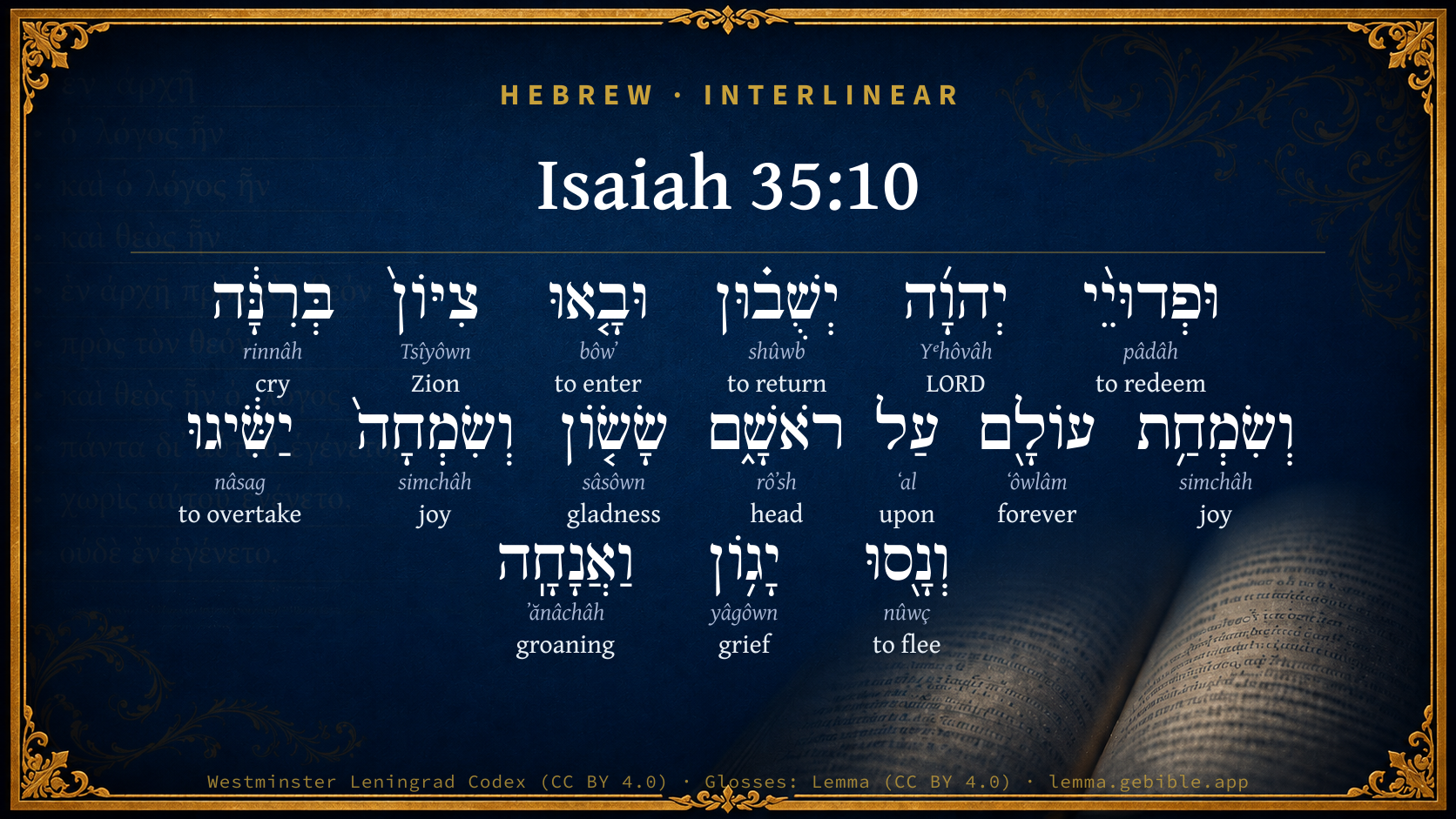
Isaiah 35:10

Hebrew (Westminster Leningrad Codex) Isaiah 35:10 appears in the Hebrew Old Testament. The text above is from the Westminster Leningrad Codex. Each word links to its Strong’s number, a concise gloss, and parsing drawn from the Open Scriptures Hebrew Bible morphology. Click any word for its full Brown-Driver-Briggs (BDB) entry.
Download image
Cite this verse

Isaiah 35:10 (World English Bible). Public Domain. Lemma interlinear Bible study tool, https://lemma.gebible.app/v/isaiah/35/10.

Show BibTeX & RIS
BibTeX
RIS
English Translation
and the ransomed of Yahweh shall return, and come with singing to Zion; and everlasting joy shall be on their heads: they shall obtain gladness and joy, and sorrow and sighing shall flee away.
World English Bible · Public Domain
Download a study sheet

One document with this verse’s original text, its word-by-word gloss line, the meaning frame, cross-references with their text, attributed commentary, and full source and license credits — printable, and it pastes into notes with its structure intact.

This verse Autodidact and up

Study sheet (.html) Plain text (.txt)

A passage Seminary Student

Up to 50 verses in one chapter. A passage sheet keeps up to 6 commentary sources and 12 cross-references per verse, in the order this page ranks them, and says so on the sheet whenever that leaves anything out. Ask for a single verse and you get the Autodidact verse sheet above.

Everything on this page stays free to read, with no account — the sheet is a download of what is already on screen, not access to it.

Want to remove ads? Support Godless Engineer
Compare translations 3

The same verse in 3 English versions, stacked beneath the original-language interlinear above. Click any original word for its lexicon entry.

Each is an independent rendering of the whole verse — the interlinear is not word-aligned to these translations.

Highlighted words mark where these versions differ — a whole-verse word diff, not a word-by-word alignment.

  • World English Bible Public Domain
    and the ransomed of Yahweh shall return, and come with singing to Zion; and everlasting joy shall be on their heads: they shall obtain gladness and joy, and sorrow and sighing shall flee away.
  • King James Version Public Domain
    And the ransomed of the LORD shall return, and come to Zion with songs and everlasting joy upon their heads: they shall obtain joy and gladness, and sorrow and sighing shall flee away.
  • unfoldingWord Literal Text CC BY-SA 4.0
    and the ransomed of Yahweh will return and come Zion with singing, and joy of eternity on their heads. Gladness and joy will overtake, and sorrow and sighing will flee.

unfoldingWord Literal Text — © unfoldingWord, licensed CC BY-SA 4.0. Word-aligned USFM3 via Door43 (git.door43.org/unfoldingWord/en_ult).

Versions to compare (up to 4)

3 of 4 selected

Show all 18 translations

Every available English version of this verse, each an independent rendering of the whole verse.

  • World English Bible Public Domain
    and the ransomed of Yahweh shall return, and come with singing to Zion; and everlasting joy shall be on their heads: they shall obtain gladness and joy, and sorrow and sighing shall flee away.
  • Berean Standard Bible Public Domain
    So the redeemed of the LORD will return and enter Zion with singing, crowned with everlasting joy. Gladness and joy will overtake them, and sorrow and sighing will flee.
  • Majority Standard Bible Public Domain
    So the redeemed of the LORD will return and enter Zion with singing, crowned with everlasting joy. Gladness and joy will overtake them, and sorrow and sighing will flee.
  • King James Version Public Domain
    And the ransomed of the LORD shall return, and come to Zion with songs and everlasting joy upon their heads: they shall obtain joy and gladness, and sorrow and sighing shall flee away.
  • American Standard Version (1901) Public Domain
    and the ransomed of Jehovah shall return, and come with singing unto Zion; and everlasting joy shall be upon their heads: they shall obtain gladness and joy, and sorrow and sighing shall flee away.
  • Revised Version (1885) Public Domain
    and the ransomed of the LORD shall return, and come with singing unto Zion; and everlasting joy shall be upon their heads: they shall obtain gladness and joy, and sorrow and sighing shall flee away.
  • Geneva Bible (1599) Public Domain
    Therefore the redeemed of the Lord shall returne and come to Zion with prayse: and euerlasting ioy shall bee vpon their heads: they shall obteine ioye and gladnesse, and sorow and mourning shall flee away.
  • Douay-Rheims (1899) Public Domain
    And the redeemed of the Lord shall return, and shall come into Sion with praise, and everlasting joy shall be upon their heads: they shall obtain joy and gladness, and sorrow and mourning shall flee away.
  • Young's Literal Translation Public Domain
    And the ransomed of Jehovah return, And have entered Zion with singing. And joy age-during on their head, Joy and gladness they attain, And fled away have sorrow and sighing!
  • Literal Standard Version CC BY-SA 4.0
    And the ransomed of YHWH return, || And have entered Zion with singing, || And [with] continuous joy on their head, || They attain joy and gladness, || And sorrow and sighing have fled away!
  • Unlocked Literal Bible CC BY-SA 4.0
    The ransomed of Yahweh will return and come with singing to Zion, and everlasting joy will be on their heads; gladness and joy will overtake them; sorrow and sighing will flee away.
  • unfoldingWord Literal Text CC BY-SA 4.0
    and the ransomed of Yahweh will return and come Zion with singing, and joy of eternity on their heads. Gladness and joy will overtake, and sorrow and sighing will flee.
  • Darby Bible Public Domain
    And the ransomed of Jehovah shall return, and come to Zion with singing; and everlasting joy shall be upon their heads: they shall obtain gladness and joy, and sorrow and sighing shall flee away.
  • World Messianic Bible Public Domain
    Then the LORD’s ransomed ones will return, and come with singing to Zion; and everlasting joy will be on their heads. They will obtain gladness and joy, and sorrow and sighing will flee away.”
  • Webster's Bible Public Domain
    And the ransomed of the LORD shall return, and come to Zion with songs and everlasting joy upon their heads: they shall obtain joy and gladness, and sorrow and sighing shall flee away.
  • Free Bible Version CC BY-SA 4.0
    Those the Lord has set free will return, singing as they enter Jerusalem, wearing crowns of everlasting joy. They are overcome with thankfulness and happiness; sorrow and sadness simply disappear.
  • Bible in Basic English Public Domain
    Even those whom he has made free, will come back again; they will come with songs to Zion; on their heads will be eternal joy; delight and joy will be theirs, and sorrow and sounds of grief will be gone for ever.
  • JPS Tanakh (1917) Public Domain
    And the ransomed of the LORD shall return, and come with singing unto Zion, and everlasting joy shall be upon their heads; they shall obtain gladness and joy, and sorrow and sighing shall flee away.

Literal Standard Version (2020), Covenant Press — licensed CC BY-SA 4.0. Text via the HelloAO Bible API (eBible.org). Unlocked Literal Bible (unfoldingWord) — licensed CC BY-SA 4.0. Text via the HelloAO Bible API (eBible.org). unfoldingWord Literal Text — © unfoldingWord, licensed CC BY-SA 4.0. Word-aligned USFM3 via Door43 (git.door43.org/unfoldingWord/en_ult). Free Bible Version, Dr. Jonathan Gallagher — licensed CC BY-SA 4.0. Text via the HelloAO Bible API (eBible.org).

Word by word

More ways to search: Search by grammar → Find every occurrence → Compare this word →

Practice this passage: Drill this verse → Learn its vocabulary →

וַאֲנָחָֽה
ʼănâchâh
H585
“and · groaning”
Conjunction + Noun, Common, Feminine, Singular, Absolute
Part of Speech
Conjunction + Noun
Type
Common
Gender
Feminine
Number
Singular
State
Absolute
Full BDB Definition

Origin: from H585

TWOT: 127a

sighing, groaning (expression of grief or physical distress)
  1. וּפְדוּיֵ֨י pâdâh H6299 “and · redeemed” Conjunction + Verb, Qal, Participle Passive, Masculine, Plural, Construct
  2. יְהוָ֜ה Yᵉhôvâh H3068 “LORD” Noun, Proper
  3. יְשֻׁב֗וּן shûwb H7725 “to return” Verb, Qal, Imperfect, 3rd Person, Masculine, Plural + Suffix, n
  4. וּבָ֤אוּ bôwʼ H935 “and · to enter” Conjunction + Verb, Qal, Sequential Perfect, 3rd Person, Common, Plural
  5. צִיּוֹן֙ Tsîyôwn H6726 “Zion” Noun, Proper
  6. בְּרִנָּ֔ה rinnâh H7440 “in/at · cry” Preposition + Noun, Common, Feminine, Singular, Absolute
  7. וְשִׂמְחַ֥ת simchâh H8057 “and · joy of” Conjunction + Noun, Common, Feminine, Singular, Construct
  8. עוֹלָ֖ם ʻôwlâm H5769 “forever” Noun, Common, Masculine, Singular, Absolute
  9. עַל ʻal H5921 “upon” Preposition
  10. רֹאשָׁ֑ם rôʼsh H7218 “head · their” Noun, Common, Masculine, Singular, Construct + Suffix, Personal, 3rd Person, Masculine, Plural
  11. שָׂשׂ֤וֹן sâsôwn H8342 “gladness” Noun, Common, Masculine, Singular, Absolute
  12. וְשִׂמְחָה֙ simchâh H8057 “and · joy” Conjunction + Noun, Common, Feminine, Singular, Absolute
  13. יַשִּׂ֔יגוּ nâsag H5381 “to overtake” Verb, Hiphil, Imperfect, 3rd Person, Masculine, Plural
  14. וְנָ֖סוּ nûwç H5127 “and · to flee” Conjunction + Verb, Qal, Sequential Perfect, 3rd Person, Common, Plural
  15. יָג֥וֹן yâgôwn H3015 “grief” Noun, Common, Masculine, Singular, Absolute

About this verse

These counts appear in no published source. They are computed here, from the morphology-tagged text and Lemma’s own curated glosses. What Lemma adds →

16
words
15
distinct lemmas
Prophets
section

Notable vocabulary

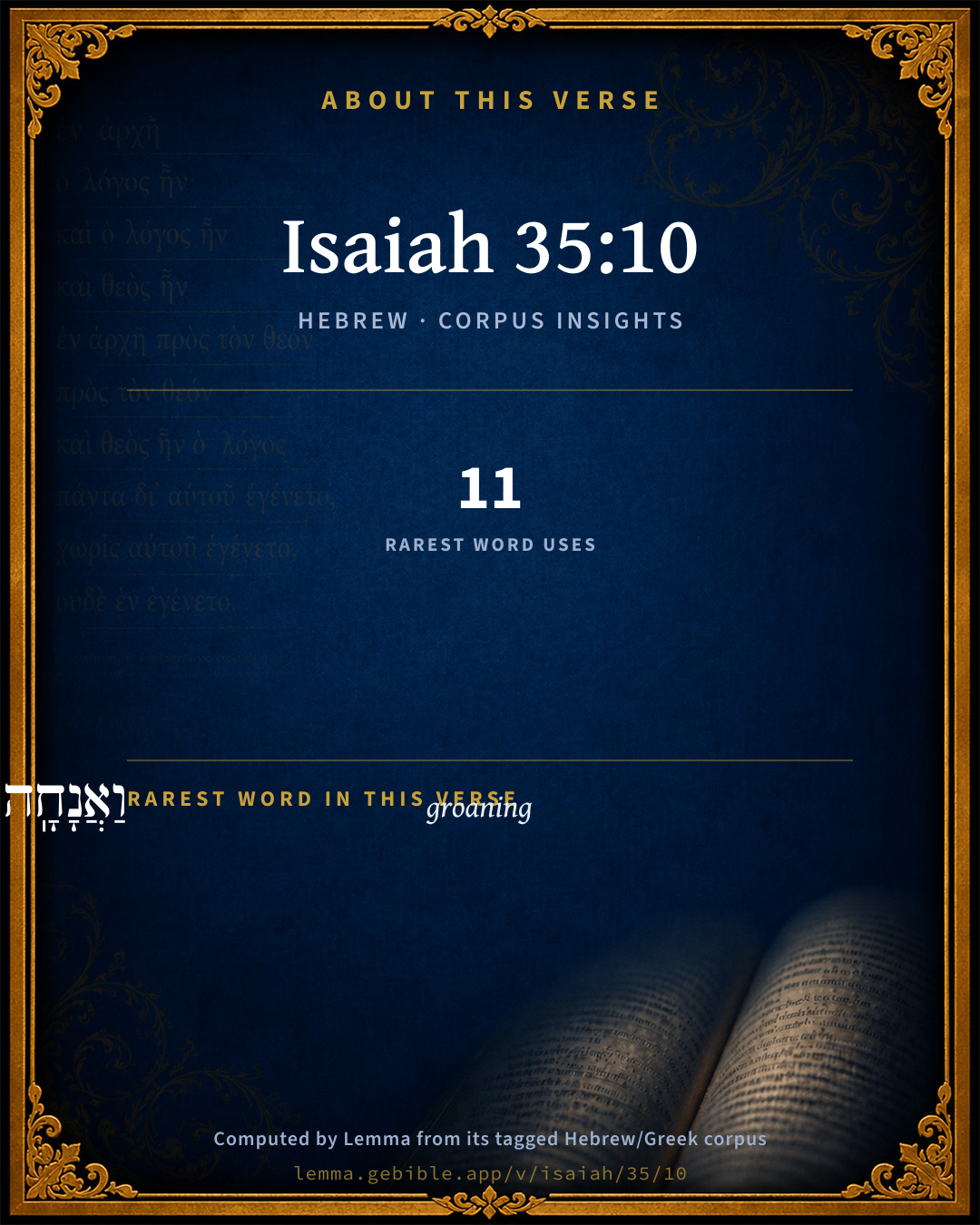
The rarest word here is וַאֲנָחָֽה groaning H585 — appearing just 11 times in the whole Hebrew Bible.

Shared distinctive vocabulary

וַאֲנָחָֽה groaning H585 occurs in 11 verses of the Hebrew Bible. Also found in:

Grammatical profile

  • 5 verbs
  • 10 nouns
  • 1 preposition

Verb forms

  • וּפְדוּיֵ֨י Qal · Participle Passive
  • יְשֻׁב֗וּן Qal · Imperfect
  • וּבָ֤אוּ Qal · Sequential Perfect
  • יַשִּׂ֔יגוּ Hiphil · Imperfect
  • וְנָ֖סוּ Qal · Sequential Perfect

Repetition

A word recurs within this verse — often emphatic in Hebrew:

  • וְשִׂמְחַ֥ת joy H8057 ×2

Hebrew & Septuagint length

In English translation the verse runs 34 words from the Hebrew and 41 from the Septuagint (LXX English) — closely comparable.

A rough comparison of the two English renderings, which tokenize alike — not a word-level alignment.

Word counts can differ between the Hebrew and the Greek without any difference in meaning — e.g. the Hebrew direct-object marker אֵת has no separate Greek word, and Greek often adds the article ὁ.

Cross-references

18

Topical passages linked to Isaiah 35:10 in the Treasury of Scripture Knowledge — connected by theme and wording, ordered by reader-vote popularity; previews shown in the World English Bible.

  • Isaiah 30:19 For the people shall dwell in Zion at Jerusalem; you shall weep no more; he will surely be gracious to you at the voice of your cry; when he shall hear, he will answer you.
  • Revelation 21:4 He will wipe away from them every tear from their eyes. Death will be no more; neither will there be mourning, nor crying, nor pain, any more. The first things have passed away."
  • Isaiah 25:8 He has swallowed up death forever; and the Lord Yahweh will wipe away tears from off all faces; and the reproach of his people will he take away from off all the earth: for Yahweh has spoken it.
  • Isaiah 51:10–11 Isn't it you who dried up the sea, the waters of the great deep; who made the depths of the sea a way for the redeemed to pass over?
  • Isaiah 65:19 I will rejoice in Jerusalem, and joy in my people; and there shall be heard in her no more the voice of weeping and the voice of crying.
  • Jeremiah 33:11 the voice of joy and the voice of gladness, the voice of the bridegroom and the voice of the bride, the voice of those who say, Give thanks to Yahweh of Hosts, for Yahweh is good, for his loving kindness endures forever; [and of them] who bring [sacrifices of] thanksgiving into the house of Yahweh. For I will cause the captivity of the land to return as at the first, says Yahweh.
  • Jude 1:21 Keep yourselves in the love of God, looking for the mercy of our Lord Jesus Christ to eternal life.
  • Revelation 14:1–4 I saw, and behold, the Lamb standing on Mount Zion, and with him a number, one hundred forty-four thousand, having his name, and the name of his Father, written on their foreheads.
  • Jeremiah 31:11–14 For Yahweh has ransomed Jacob, and redeemed him from the hand of him who was stronger than he.
  • John 16:22 Therefore you now have sorrow, but I will see you again, and your heart will rejoice, and no one will take your joy away from you.
  • 1 Timothy 2:6 who gave himself as a ransom for all; the testimony in its own times;
  • Revelation 19:1–7 After these things I heard something like a loud voice of a great multitude in heaven, saying, "Hallelujah! Salvation, power, and glory belong to our God:
  • Isaiah 60:20 Your sun shall no more go down, neither shall your moon withdraw itself; for Yahweh will be your everlasting light, and the days of your mourning shall be ended.
  • Matthew 20:28 even as the Son of Man came not to be served, but to serve, and to give his life as a ransom for many."
  • Revelation 15:2–4 I saw something like a sea of glass mixed with fire, and those who overcame the beast, his image, and the number of his name, standing on the sea of glass, having harps of God.
  • Psalms 84:7 They go from strength to strength. Everyone of them appears before God in Zion.
  • Revelation 7:9–17 After these things I looked, and behold, a great multitude, which no man could number, out of every nation and of all tribes, peoples, and languages, standing before the throne and before the Lamb, dressed in white robes, with palm branches in their hands.
  • Revelation 18:20 Rejoice over her, O heaven, you saints, apostles, and prophets; for God has judged your judgment on her."

Cross-references courtesy of OpenBible.info (CC BY 4.0).

Hebrew and Greek witnesses Masoretic Hebrew ↔ Greek Septuagint

The same verse in the two great witnesses to the Old Testament, shown verse-for-verse.

These are two independent witnesses, not word-aligned to each other, and the Septuagint is shown in lemma (dictionary) form.

Hebrew Isaiah 35:10 Masoretic · Westminster Leningrad Codex

וּפְדוּיֵ֨י יְהוָ֜ה יְשֻׁב֗וּן וּבָ֤אוּ צִיּוֹן֙ בְּרִנָּ֔ה וְשִׂמְחַ֥ת עוֹלָ֖ם עַל רֹאשָׁ֑ם שָׂשׂ֤וֹן וְשִׂמְחָה֙ יַשִּׂ֔יגוּ וְנָ֖סוּ יָג֥וֹן וַאֲנָחָֽה

and the ransomed of Yahweh shall return, and come with singing to Zion; and everlasting joy shall be on their heads: they shall obtain gladness and joy, and sorrow and sighing shall flee away.

World English Bible · Public Domain

Greek LXX Isaiah 35:10 Septuagint · lemma form

καί συνἄγω διά κύριος ἀποστρέφω καί ἥκω εἰς σιων μετά εὐφροσύνη καί εὐφροσύνη αἰώνιος ὑπέρ κεφαλή αὐτός ἐπί γάρ κεφαλή αὐτός αἴνεσις καί ἀγαλλίαμα καί εὐφροσύνη καταλαμβάνω αὐτός ἀποδιδράσκω ὀδύνη καί λύπη καί στεναγμός

and shall return, and come to Sion with joy, and everlasting joy shall be over their head; for on their head shall be praise and exultation, and joy shall take possession of them: sorrow and pain, and groaning have fled away.

LXX2012 (modern English Septuagint) · Public Domain

On this verse, J. A. Alexander on Isaiah discusses the Septuagint’s reading. Read the note in Commentary ↓

Hebrew: Westminster Leningrad Codex (CC BY 4.0). Greek: Septuagint (public domain); English from LXX2012 (modern English Septuagint) (Public Domain). How the Septuagint differs from the Hebrew →

Targum (Aramaic paraphrase)

1

The Targum is the ancient Jewish Aramaic paraphrase of the Hebrew Scriptures — an interpretive translation, not the Hebrew text itself. Onkelos (literal) and Pseudo-Jonathan (expansive) render the Torah, and Jonathan the Prophets. Coverage is partial: where no permissively-licensed English translation exists for a verse, only the Aramaic is shown. This is verse-level text, not a word-by-word alignment to the Hebrew.

  1. Targum Jonathan Prophets (Joshua–Malachi)
    וּפְרִיקַיָא דַייָ יְתוּבוּן וְיַתְכַּנְשׁוּן מִבֵּינֵי גַלְוַתְהוֹן וְיָעַלוּן לְצִיוֹן בְּתוּשְׁבַּחְתָּא וְחֶדְוַת עֲלַם תְּהֵי לְהוֹן דִי לָא פַסְקָא וַעֲנַן יְקָר תְּהֵי מַטַל עַל רֵישֵׁיהוֹן בִּיעַ וְחֶדְוָא יִשְׁכְּחוּן וִיסוּף מִנְהוֹן מִבֵּית יִשְׂרָאֵל דְוָנָא וְתֵינָחָתָא:

    And the redeemed of the Lord shall return, because they shall be gathered from the midst of their captivity; and they shall come to Zion with a song, and they shall have everlasting joy, which shall not cease, and a cloud of glory shall overshadow their heads: joy and gladness shall be found, and sorrow and sighing shall cease from them, namely, from the house of Israel.

    Targum Jonathan — Aramaic: “Mikraot Gedolot” (public domain). English: “Sefaria Community Translation” (CC0 1.0 (public-domain dedication)); “London "Chaldee Paraphrase," 1871” (public domain). Text via Sefaria.

Commentary

Notes on Isaiah 35:10 from classic Christian and Jewish commentators (each source and its license shown beneath its notes). The classic Christian expositions comment on the surrounding passage and are grouped to its opening verse, so a note may address several verses; the Jewish commentaries on the Tanakh (Rashi and others) are per-verse, so they appear only where the commentator wrote on this verse.

Lemma curates 59 commentaries, every one of them public domain or Creative Commons licensed, each selected and text-cleaned for this edition rather than reprinted as found. About our sources →

Trapp's Complete Commentary

John Trapp

Isa 35:10 And the ransomed of the LORD shall return, and come to Zion with songs and everlasting joy upon their heads: they shall obtain joy and gladness, and sorrow and sighing shall flee away.

Ver. 10. And the ransomed of the Lord.] Those happy ones. {Deu 33:29}

Shall return.] To the Lord, from whom they had deeply revolted.

With songs.] As they were wont to do in their sacred solemnities.

And everlasting joy upon their heads.] As an unfadeable crown; {1Pe 1:5; 1Pe 5:4} they shall pass from the jaws of death to the joys of heaven. {a}

Joy and gladness,] i.e., Outward and inward, say some.

And sorrow and sighing.] Their joys shall be sincere and constant.

{a} Tantum gaudebimus quantum amabimus. Tantum amabimus quantum cognoscemus. - Aug.

John Trapp, A Commentary or Exposition upon All the Books of the Old and New Testament (1647–1656) — public domain. Text from a community e-Sword module.

The Biblical Illustrator

Joseph S. Exell

Isa_35:10

And the ransomed of the Lord shall return

Marching to music

My object will be to give the text its highest practical appropriation as setting forth in glowing language the return of Gods spiritual Israel, His ransomed ones, from every land.

I. WHO THEY ARE.

1. The ransomed of the Lord. To ransom signifies to redeem or free from captivity or punishment by paying down an equivalent, to rescue from danger and death, to deliver from the possession of an enemy either by/exploits of warfare or purchase by gold. The Lords ransomed people are, therefore, those who have been spiritually rescued, emancipated, delivered. They are the purchased property of God by the precious blood of Christ.

2. The ransomed of the Lord are the regenerate of the Holy Ghost. They have been quickened into new life as well as redeemed.

3. The ransomed of the Lord are the adopted into the family of God. What a unique and beautiful sequence we have here. Life purchased, life begotten, life ennobled.

II. WHITHER ARE THEY JOURNEYING? To Zion. The old-time Zion was typical of the city which hath foundations, whose maker and builder is God. Let us glance at the parallelism.

1. Zion of old was the seat and scene of worship. The ransomed of the Lord in returning are going to Zion above, to join the immortal worshippers in the temple not made with hands. We shall worship, but we shall also serve in multifold ministries of good.

2. Zion of old was the seat of royalty. There were set, we are told, thrones of judgment, the thrones of the house of David. Jerusalem was the metropolis of the nation--the centre of monarchy, authority, power, and splendour. Heaven is the city of the Great King. On its sapphire throne, belted as with a rainbow of mercy and grace, sits the Mediator-King of the New Covenant, crowned with many crowns, holding the sceptre of righteousness. To His ransomed ones He says, Verily, I say unto you, that ye which follow Me in the regeneration, when the Son of Man shall sit on the throne of His glory, ye shall also sit upon, thrones. To him that overcometh will I grant to sit with Me on My, throne. Be thou faithful unto death, and I will give thee the crown of life.

3. Zion of old was the seat of rest. It was the terminus of the pilgrim-worshippers journey. With the ransomed of the Lord it is now the pilgrimage; but daily they pitch their moving tents a days march nearer home, heaven, rest. What a magic word is rest. What volumes of meaning it holds! Rest from conflict, rest from sorrow, rest from suffering, rest from self and sin, rest from all the ills of the time-life! Rest in the Lord in holy contemplation, holy worship, holy service, holy visions, holy companionships, holy pleasures for evermore!

III. WHAT IS THE SPIRIT IN WHICH THEY JOURNEY? With songs and everlasting joy upon their heads. They march to music made in the sanctuary of the soul. Undoubtedly the allusion is to the Songs of Degrees or of the Ascents, which the rejoicing tribes sung on their way to the great festive celebrations at Jerusalem, or to the paeans of deliverance the emancipated exiles rang out as onward they pressed to the laud of their fathers and God. Thus the homeward-bound hosts of God on the highway of holiness are urging their way. They are like soldiers returning from the scene and spoils of a great victory, with heart and step keeping time to jubilant melody. But the ransomed not only sing on the way home, they also Come to Zion with songs. It is a jubilant arrival.

IV. WHAT DO THE RANSOMED OF THE LORD REALISE ON THEIR ARRIVAL HOME? Joy and gladness--i.e outward and inward joy. The joy of holy retrospect; the gladness of present possession of glory; the joy of fulfilled hope, perfected manhood, satisfied life, prospective progression, intellectually and morally, for ever and ever. It is the joy and gladness--

1. Of heavenly reunions.

2. Of perfected knowledge.

3. Of the beatific vision.

This joy and gladness will mean the exclusion of sorrow and sighing. As light expels darkness, and day excludes the night, so the rapture of joy prevents the sighings of sorrow. (J. O. Keen, D. D.)

Deliverance from the burdens of life

1. What are the real sources of that deep power of sorrow which broods so heavily over life? There is, first, over our bodily life and the world of nature which subserves it, the continual blight of pain and suffering. In natures highest beauty, even to our power of imagination, there is always some imperfection. But it is no mere pious imagination to declare that its burden is absolutely as nothing in comparison with the burden of the spiritual evil, the blindness, the weakness, and the sin of man. These are the two great burdens which are so heavy upon our human life, and they are worst in this--that they seem to separate us from our Father in heaven, alike by themist of doubt and by the gloom of fear.

2. Need I remind you how the Gospel meets both these things and scatters them to the winds? That law of suffering and of death it hallows doubly by the revelation of the Cross, because, it overrules it to our own good, because it makes it a condition of our saving others. The Gospel deals still more decisively with the burden of sin. In it lies the very essence of redemption. But you will ask me, Is that promise realised after all? Remember, that by the very nature of the case the kingdom of Christ here is seen only in the first stages of its conflict against the power of evil. What it can offer us is only a true but an imperfect earnest of a perfect future. Has it given us, and does it give us now, that which it thus professes to give? I answer unhesitatingly, Yes. These things are no dream. They are a present and blessed reality, and we feel sometimes as if they were the only reality in a very fleeting and unsubstantial world. But the reality is yet imperfect. Joy and gladness may be ours, but sorrow and sighing have not yet fled away. There is a heaven hereafter in which alone all these promises shall be quite fulfilled. (A. Barry, D. D.)

Everlasting joy upon their heads

This expression may allude to the ancient custom of wearing crowns in seasons of mirth and festivity, which were considered as marks of honour and dignity; or, it may refer to the practice of anointing the head on joyous, festive occasions, which probably gave rise to the phrase used by the royal poet of the oil of gladness Psa_45:7). (R. Macculloch.)

Sorrow and sighing shall flee away

The flight of sorrow

I. WHAT IS INVOLVED IN THE STATEMENT that sorrow and sighing shall flee away? The susceptibility of sorrow and the power of expressing sorrow will not be destroyed; but there shall be no appeal to the susceptibility, and no use for the power of sorrowful expression.

1. The sorrow of bodily disease shall pass away with the pain, the languor, the weakness which disease imposes, the nervous excitement which it often sets up, and the debility which it so frequently creates. Disease shall pass away, with all its interruptions of domestic and social intercourse, with all its power to mar our enjoyment, and to interfere with our work. It will flee before a new constitution, before the health and vigour and young rich life of a body, raised in incorruption--raised in glory--raised in power--raised in Christ-like spirituality.

2. The sorrow of dying will pass away. The fear of death--the pains of death--the separations of death--the material consequences of death--the abasement of death.

3. The sorrow of bereavement will pass away. And with it widowhood, orphanage, the loss of wife and children, and every painful farewell which death so often and so rigorously exacts.

4. The sorrow of poverty will flee away, with its hunger and thirst, its nakedness and cold, its homelessness and wretchedness, and all the neglect and contempt, the painful dependence, the degradation and dishonour, which it too often brings.

5. The sorrows caused by the sins of others will flee away. The wicked, whatever now may be their power, through relationship or through position, shall cease to trouble. Slavery, oppression, and persecution will utterly cease. The sorrows caused by the hell-fired tongue, by the fist of wickedness, by the feet swift in running to do mischief, shall flee away. Nothing shall enter the sorrowless world that defileth, that worketh abomination or maketh a lie.

6. The sorrows produced by the fear of evil, by dark imaginations, and by blighted hopes, shall flee away. The flat, Peace, be still, shall be spoken to every soul.

7. The sorrows of this lifes illusions and delusions shall pass away. Everything shall, by and by, far exceed your hopes.

8. The sorrows of sin will pass away. The smart of the conscience, remorse, dread, discord between the passions and the sanctified will, chastisement, even temporary Divine desertion.

9. Every heart knoweth its own bitterness. The own bitterness of the heart shall flee away. Secret sorrow--sorrow that you hardly admit to yourselves--sorrow upon which you have never put the raiment of speech--the sorrow that you have never groaned out to the nearest friend you have--nameless sorrow, my sorrow--sorrow in all its roots, in all its branches, sorrow in all its blossomings and fruits, in all its depths, and in all its manifestations, shall flee away. And this fleeing away of sorrow will leave the channels of the emotions open only to the streams of enjoyment. What a mighty effect this will have upon the character and the entire life! The flight of sorrow will enlarge the love of the heart: for suffering often makes us self-enclosed and self-engrossed; it will help, moreover, to secure uninterrupted intercourse and unbroken activity; it will be the departure of correction no longer needed--the withdrawment of discipline not further required--it will be like the fleeing away of winter when the time of the singing of birds has come.

II. WHEN SHALL THIS BE? The text points to Hezekiahs reign--to that portion of his reign through which God blessed the people whom he governed with remarkable prosperity. But does this exhaust the text? We think not. I you think it does, there are other words from the mouth of God on this subject (Isa_25:8; Rev_7:17). When shall this be? It shall be to the individual saint when his earthly career terminates. To the saints as a body, this will be realised at the times of restitution of all things.

III. BY WHAT SIGNS MAY WE BE ASSURED THAT OUR SORROWS WILL FLEE AWAY? There are five sure signs.

1. Personal faith--not in King Hezekiah, but in King Jesus.

2. Acknowledged and avowed citizenship in the kingdom of the Saviour. We lay stress upon avowal, because where there is no avowal there must always be reason for doubting and suspicion.

3. The fleeing away of sin--the being cleansed from sin.

4. The present effect of sorrow. If sorrow bends the will and subdues the affections, then it is sanctified, and herein is a sign that sorrow will flee away.

5. A living hope--hope born of faith--hope the child of Gods promises--the hope which is the anchor of the soul. Write on your hearts this onesentence concerning your sorrows and sighs, they shall flee away. The love of God, like the sun upon the snow-drift, which melts the snow, raises it in vapour and then disperses it, shall make sorrow flee away. The power of God, like the north wind, which driveth away the rain, shall constrain sorrow to flee away. (S. Martin.)

Sorrow and sighing shall flee away

There is consolation in this very form of expression--flee away. It shows an instability as characterising sorrow in the case we contemplate. Sorrow to the redeemed man is not the sea which is found in its appointed bed in summer and in winter; but it is the crested wave which is here to-day and gone to-morrow. It is not the mountain which stands in its place year after year, and century after century; but it is the clouds which rise rein the valley, and travel up the sides of the mountain, and sometimes cap and completely hide it, but which from their very nature must flee away. The sorrows of the saints are sorrows which from their very character must pass away. (S. Martin.)

.

The Biblical Illustrator, edited by Joseph S. Exell (c. 1880s–1900s) — public domain. Text from a community e-Sword module.

Joseph Benson's Commentary

Isa 35:10. And the ransomed of the Lord — They whom God shall rescue from their captivity and slavery in Babylon, say some; shall return and come to Zion — Shall be restored to their own land, from whence they had been carried captive. But the following expressions are far too magnificent and emphatical to be answered by the mere return of the Jews to Judea and Jerusalem, which was accompanied and followed by many sighs and sorrows, as appears both from sacred and profane historians. We must, therefore, of necessity, understand this verse as being intended, like the preceding verses, of gospel times, and therefore by the ransomed of the Lord we must understand those who are delivered from the guilt and power of sin, and from every kind of spiritual bondage, whether to the devil, the world, or the flesh. These may be said to return, and come to Zion, with songs, when they unite themselves to God’s church and people on earth, and more especially when they arrive at the heavenly Canaan, and are admitted into the New Jerusalem, the city of the living God, and incorporated in a glorious society, with an innumerable company of angels, and the spirits of just men made perfect; with the general assembly and church of the firstborn, who are written in heaven. Then, indeed, are their heads crowned with everlasting joy; and they obtain joy and gladness in perfection, and sorrow and sighing flee away for ever. Thus these prophecies, which relate to the Assyrian invasion, conclude, for the support of the people of God, under that and other subsequent calamities, and to direct their joy, in their deliverance from them, to something higher. And thus should our joyful hopes and cheering prospects of eternal life swallow up both all the joys and all the sorrows of this present time.

Joseph Benson's Commentary on the Old and New Testaments (1811–1818) — public domain. Text from a community e-Sword module.

Tyndale Open Study Notes

Tyndale Open Resources

35:10 Jerusalem: The prophecy extends beyond the return of Israel from exile to the final establishment of God’s kingdom on earth. It will be characterized by joy and gladness and the absence of sorrow and mourning (see also 25:7; 51:11; Rev 21:4).

Tyndale Open Study Notes — © Tyndale Open Resources, licensed CC BY-SA 4.0. Text via the HelloAO Bible API.

Geneva Bible (1599)

Geneva Bible translators

Whom the Lord shall deliver from the captivity of Babylon.

Geneva Bible (1599) marginal notes — public domain. Text via Bolls.life.

Jamieson, Fausset & Brown

Robert Jamieson, A. R. Fausset & David Brown

Language: literally, applying to the return from Babylon; figuratively and more fully to the completed redemption of both literal and spiritual Israel.

joy upon . . . heads-- (Psa 126:2). Joy manifested in their countenances. Some fancy an allusion to the custom of pouring oil "upon the head," or wearing chaplets in times of public festivity (Ecc 9:8).

This and the thirty-seventh through thirty-ninth chapters form the historical appendix closing the first division of Isaiah's prophecies, and were added to make the parts of these referring to Assyria more intelligible. So Jer. 52:1-34; compare 2Ki. 25:1-30. The section occurs almost word for word (Kg2 18:13, Kg2 18:17-20; 2Ki. 19:1-37); Kg2 18:14-16, however, is additional matter. Hezekiah's "writing" also is in Isaiah, not in Kings (Isa 38:9-20). We know from Ch2 32:32 that Isaiah wrote the acts of Hezekiah. It is, therefore, probable, that his record here (Isa. 36:1-39:8) was incorporated into the Book of Kings by its compiler. Sennacherib lived, according to Assyrian inscriptions, more than twenty years after his invasion; but as Isaiah survived Hezekiah (Ch2 32:32), who lived upwards of fifteen years after the invasion (Isa 38:5), the record of Sennacherib's death (Isa 37:38) is no objection to this section having come from Isaiah; 2Ch. 32:1-33 is probably an abstract drawn from Isaiah's account, as the chronicler himself implies (Ch2 32:32). Pul was probably the last of the old dynasty, and Sargon, a powerful satrap, who contrived to possess himself of supreme power and found a new dynasty (see on Isa 20:1). No attempt was made by Judah to throw off the Assyrian yoke during his vigorous reign. The accession of his son Sennacherib was thought by Hezekiah the opportune time to refuse the long-paid tribute; Egypt and Ethiopia, to secure an ally against Assyria on their Asiatic frontier, promised help; Isaiah, while opposed to submission to Assyria, advised reliance on Jehovah, and not on Egypt, but his advice was disregarded, and so Sennacherib invaded Judea, 712 B.C. He was the builder of the largest of the excavated palaces, that of Koyunjik. HINCKS has deciphered his name in the inscriptions. In the third year of his reign, these state that he overran Syria, took Sidon and other Phœnician cities, and then passed to southwest Palestine, where he defeated the Egyptians and Ethiopians (compare Kg2 18:21; Kg2 19:9). His subsequent retreat, after his host was destroyed by God, is of course suppressed in the inscriptions. But other particulars inscribed agree strikingly with the Bible; the capture of the "defensed cities of Judah," the devastation of the country and deportation of its inhabitants; the increased tribute imposed on Hezekiah--thirty talents of gold--this exact number being given in both; the silver is set down in the inscriptions at eight hundred talents, in the Bible three hundred; the latter may have been the actual amount carried off, the larger sum may include the silver from the temple doors, pillars, &c. (Kg2 18:16).

Next: Isaiah Chapter 36

Jamieson, Fausset & Brown — Commentary Critical and Explanatory on the Whole Bible (1871) — public domain (CC PDM 1.0). Text via the HelloAO Bible API.

Adam Clarke's Commentary

Verse 10. The ransomed] פדויי peduyey, from פדה padah, "to redeem by paying a price." Those for whom a price was paid down to redeem them from bondage and death.

Sighing shall flee away.] אנחה anachah. Never was a sorrowful accent better expressed than in this strong guttural word, an-ach-ah; nearly the same with the Irish in their funeral wailings, och-och-on. The whole nation express all their mournful accents by these three monosyllables.

THIS chapter contains the following parts: -

1. We have here blessed promises of the latter-day glory.

2. The prophet may be considered as addressing the teachers of the Gospel, to show them that it was their business to encourage and direct the people in their expectation of redemption.

3. A promise of the manifestation of God among men is given.

4. The miracles which Christ should work are explicitly mentioned.

5. The privileges of Christianity are specified; there shall be, 1. Thorough teaching; 2. Holy walking.

6. Perfect safety.

7. Complete happiness. And -

8. Final glory.

The chapter shows also that no impurity should be tolerated in the Church of God; for as that is the mystical body of Christ, it should be like himself, without spot or wrinkle, or any such thing.

Adam Clarke's Commentary on the Bible (1810–1826) — public domain. Text from a community e-Sword/MySword module.

Ellicott's Commentary for English Readers

(10) With songs and everlasting joy . . .—The first volume of Isaiah’s prophecy closes fitly with this transcendent picture, carrying the thoughts of men beyond any possible earthly fulfilment. The outward imagery probably had its starting-point in the processions of the pilgrims who came up to the Temple singing psalms, like those known as the “songs of degrees” at their successive halting-places (Psalms 120-134).

Sorrow and sighing shall flee away.—The words have a special interest as being the closing utterance of Isaiah’s political activity, written, therefore, probably, in his old age, and in the midst of much trouble, whether he wrote at the close of Hezekiah’s reign, or the beginning of Manasseh’s, which must have been sufficiently dark and gloomy. (See 2Ch_32:26; 2Ch_33:1-10.) The hopes of the prophet were, however, inextinguishable, and they formed a natural starting-point for the words: “Comfort ye, comfort ye, my people,” with which the second collection opens, the intermediate chapters being obviously of the nature of an historical appendix. They find their echo in Rev_7:17, “God shall wipe away all tears from their eyes.”

A Bible Commentary for English Readers, edited by Charles John Ellicott (1878–1897) — public domain. Text from a community e-Sword module.

The Cambridge Bible for Schools and Colleges

gen. ed. J. J. S. Perowne

10. The verse is found verbatim in ch. Isa_51:11. Cf. also Isa_51:3, Isa_61:7.

everlasting joy shall be upon their heads] See ch. Isa_61:3—“a garland for ashes” (R.V.).

The Cambridge Bible for Schools and Colleges (gen. ed. J. J. S. Perowne; Cambridge University Press, 1878–1918) — public domain. Text from a community e-Sword module.

John Gill's Exposition

And the ransomed of the Lord shall return,.... The same with the "redeemed" in Isa 35:9 these shall return, or be converted, as the Vulgate Latin version; they are in the same state and condition with other men by nature, but, by virtue of their being ransomed by Christ, they are by the grace of God turned from darkness to light, from the power of Satan unto God; they are returned from the paths in which they had been straying to Christ, the Shepherd and Bishop of souls, in order to walk in his ways,

and come to Zion with songs; being called by grace, and converted, they turn their backs on the world, and the men of it, and ask the way to Zion, with their faces thitherwards, even to the church of God; and they find their way, being directed and brought there by the Lord himself; where they come readily and willingly, not only to hear the Gospel, but to submit to all ordinances, and become members of a Gospel church; see Heb 12:20 and hither they "come with songs", for electing, redeeming, calling, justifying, and pardoning grace; everyone of which blessings requires a song, and with which they are now affected, seeing their interest in them, and cannot forbear speaking of them to the glory of divine grace:

and everlasting joy upon their heads; seen in their countenances, and by the lifting up of their heads; and which oil of gladness, is poured upon them, and diffused all over them, like the ointment on Aaron's head: and this is "everlasting": not as to the exercise of it, which is often interrupted by sin, temptation, and desertion; but as to the ground and foundation of it, the everlasting love of God, the everlasting covenant of his grace, and the everlasting righteousness and salvation by Christ; and, as to the principle and habit of it, which can never be lost, nor any man take it away:

they shall obtain joy and gladness; by having the presence of God, and communion with him; through his love being shed abroad in their hearts; by being favoured with views of Christ, and interest in him, and with the gracious influences of the blessed Spirit:

and sorrow and sighing shall flee away; which before attended them, through convictions of sin, but now removed by the discoveries and applications of pardoning grace and mercy; or what was occasioned by want of the divine Presence, now enjoyed; being come to Zion, they are made joyful in the house of prayer, and are satisfied with the marrow and fatness of Gospel ordinances, and continually hear the joyful sound of the Gospel itself: all this may be applied to the state of the saints in heaven; for the highway before described not only leads to Zion the church below, but to the Zion above, to the heavenly glory; and all the redeemed, all that walk in this way, shall come thither; at death their souls "return" to God that gave them, and are in immediate happiness with Christ; and in the resurrection shall return from their dusty beds, and shall appear before God in Zion above; and "with songs" to Father, Son, and Spirit, for what each have done for them, in election, redemption, and conversion; and for persevering grace, and for being safely brought over Jordan's river, and from the grave; see Co1 15:54, they shall then enter into joy, which will never end; there will be nothing to interrupt it to all eternity; it will be "everlasting joy" indeed; and this will be "upon their heads", visible and manifest, and be upon them as a crown of life, righteousness, and glory, that shall never fade away; they shall then "obtain joy and gladness", in all the fulness thereof, their joy in the Lord will be complete; which these several words and phrases used are expressive of; and then there will be no more "sorrow and sighing"; for there will be no more sin and unbelief, or any other corruption of nature; no more darkness and desertion; no more of any of Satan's temptations; no more distresses, inward or outward; and so no more sighing within, nor sorrowing without; all tears will be wiped away. The Jews (b) apply this passage to the world to come.

(b) T. Bab. Sanhedrin, fol. 110. 2.

Next: Isaiah Chapter 36

John Gill's Exposition of the Whole Bible (1746–1763) — public domain (CC PDM 1.0). Text via the HelloAO Bible API.

Albert Barnes' Notes on the Bible

And the ransomed of the Lord - The word rendered here ‘ransomed,’ is different from the word rendered ‘redeemed’ in Isa 35:9. This word is פדוּיי pedûyēy from פדה pâdâh; though it is not easy, perhaps not possible, to designate the difference in the sense. Doubtless there was a shade of difference among the Hebrews, but what it was is not now known. See this word explained in the note at Isa 1:27. The language here is all derived from the deliverance from Babylon, and the images employed by the prophet relate to that event. Still, there can be no doubt that he meant to describe the deliverance under the Messiah.

Shall return, and come to Zion - This language also is that which expresses the return from Babylon. In a more general sense, and in the sense intended particularly by the prophet, it means, doubtless, that all who are the redeemed of God shall be gathered under his protection, and shall be saved.

With songs - With rejoicing - as the ransomed captives would return from Babylon, and as all who are redeemed enter the church on earth, and will enter into heaven above.

And everlasting joy upon their heads - This may be an expression denoting the fact that joy is manifest in the face and aspect (Gesenius). Thus we say that joy lights up the countenance, and it is possible that the Hebrews expressed this idea by applying it to the head. Thus the Hebrews say Psa 126:2 :

Then was our mouth filled with laughter.

And our tongue with singing.

Or it may refer to the practice of anointing the head with oil and perfume in times of festivity and joy - in contrast with the custom of throwing ashes on the head in times of grief and calamity (Rosenmuller). Or it may refer to a custom of wearing a wreath or chaplet of flowers in times of festivity, as is often done now, and as was commonly done among the ancients in triumphal processions (Vitringa). Whichever exposition be adopted, the idea is the same, that there would be great joy, and that that joy would be perpetual and unfading. This is true of all who return to Zion under the Messiah. Joy is one of the first emotions; joy at redemption, and at the pardon of sin; joy in view of the hopes of eternal life, and of the everlasting favor of God. But this joy is not short-lived and fading, like the garland of flowers on the head; it is constant, increasing, everlasting.

And sorrow and sighing shall flee away - (See the note at Isa 25:8).

This is a most beautiful close of the series or succession of prophecies which we have been thus far contemplating. The result of all is, that the redeemed of the Lord shall have joy and rejoicing; that all their enemies shall be subdued, and that they shall be rescued from all their foes. In the analysis of the prophecy contained in the thirty-fourth and thirty-fifth chapters, it was stated that this prophecy seemed to be a summary of all that Isaiah had before uttered, and was designed to show that all the enemies of the people of God would be destroyed, and that they would be triumphantly delivered and saved. All these minor deliverances were preparatory to and emblematic of the greater deliverance under the Messiah; and accordingly all his predictions look forward to, and terminate in that. In the portions of prophecy which we have been over, we have seen the people of God represented as in danger from the Syrians, the Assyrians, the Egyptians, the Moabites, the Edomites, the Babylonians; and in reference to them all, the same result has been predicted, that they would be delivered from them, and that their enemies would be destroyed.

This has been, in the chapters which we have passed over, successively foretold of Damascus, of Egypt, of Moab, of Ethiopia, of Babylon, of Edom, and of Sennacherib; and the prophet has reached the conclusion that all the enemies of God’s people would ultimately be destroyed, and that they would be safe under the reign of the Messiah, to which all their deliverances were preparatory, and in which they all would terminate, Having pursued this course of the prophecy; having looked at all these foes; having seen them in vision all destroyed; having seen the Prince of Peace come; having seen the wonders that he would perform; having seen all danger subside, and the preparation made for the eternal security and joy of all his people, the prophet closes this series of predictions with the beautiful statement now before us, ‘the redeemed of Yahweh shall return, and come to Zion with songs, and everlasting joy; and sorrow and sighing shall flee away.’

Albert Barnes' Notes on the Bible (1834–1885) — public domain. Text from a community e-Sword/MySword module.

Haydock's Catholic Bible Commentary

Sion. Before the defeat of Sennacherib, the roads were unsafe, chap. xxxviii. 8. (Calmet)

George Leo Haydock (1774–1849), Haydock's Catholic Family Bible and Commentary, 1859 edition — public domain. Excludes Psalms (Douay-Rheims chapter numbering differs from Protestant) and Deuterocanonical books (Catholic canon only).

Matthew Poole's English Annotations

The ransomed of the Lord; they whom God shall rescue and redeem from their corporal slavery in Babylon, and especially from their spiritual bondage under sin and Satan.

Shall return, and come to Zion; shall come again to Zion, from whence they had been carried away captive. Or, shall return, to wit, to the Lord now mentioned, and come to Zion, i.e. join themselves to God’s church and people.

Sorrow and sighing shall flee away; which expressions are too magnificent and emphatical to be satisfied by the return of the Jews from Babylon to their own land, which was accompanied and followed with many sighs and sorrows, as appears, both from sacred and other historians; and therefore must necessarily be understood of gospel times, and of the joy and happiness purchased by Christ for his people, begun here, and continued to all eternity.

Matthew Poole's English Annotations on the Holy Bible (1683–1685) — public domain. Text from a community e-Sword/MySword module.

The Pulpit Commentary

The ransomed of the Lord shall return. The blessedness of the last times would be incomplete to Jewish ideas without this crowning feature. There had already been a great dispersion of the faithful; (Isa_1:7-9) there was to be a still greater one; (Isa_11:11) Israel could not be content or happy until her "outcasts" were recalled, "the dispersed of Judah gathered together from the four corners of the earth". (Isa_11:12) The return here prophesied is again announced, in almost the same words, in Isa_51:11. With songs (see the comment on ver. 2). Everlasting joy upon their heads. Anointed, as it were, with "the oil of gladness" (Psa_45:7) forever and ever. Sorrow and sighing shall rise away. (comp. Isa_25:8 Rev_7:17 Rev_21:4)

Within the gates.

If the two preceding verses may be regarded as descriptive of the Christian pilgrimage, the text may appropriately be treated as pictorial of the heavenly city in which that journey ends. The language of this verse suggests to us

I THE DISTINGUISHING FEATURE OF THOSE WHO ARE ADMITTED. They are "the ransomed of the Lord." They were in spiritual bondage: they have been redeemed by a Divine Deliverer; they have been ransomed at a great price; they have been rescued from the power of their enemies (outward and inward) and walk in liberty, thankful for what they have escaped from, anticipating the more perfect freedom and the more excellent estate they are travelling toward.

II THE SPECIAL CHARACTERISTICS OF THE CITY ITSELF. "Shall come to Zion.

1. It is the very home of God. Jerusalem was "the city of God it was the place on earth which he chose for his manifested presence. There, in a peculiar sense, he abode; there, as in no other city, be was approached and was worshipped; there, as nowhere else, men felt that they stood in his near presence and rejoiced in fellowship with him. The heavenly Zion is to be to all who shall be received within its gates the place where God is, the home of the living and reigning Savior. There we are to be "at home with the Lord.

2. It is the place of perfect security and of transcendent beauty. The "mountains were round about Jerusalem," and "beautiful for situation, the joy of the whole earth, was Mount Zion." The heavenly city, of which it is the earthly type, will prove a home of absolute security, into which no enemy will ever come, from which temptation and sin are safely barred; (see Rev_21:27) and of surpassing beauty and glory. (Rev_21:1, Rev_21:10, Rev_21:11, Rev_21:18, Rev_21:19, Rev_21:23) There shall be everything which will give pure and inexhaustible delight to all holy souls, to those in whom has been planted and nourished the appreciation of that which is really beautiful and glorious.

III THE JOY WHICH WILL ATTEND ADMISSION. They shall come to Zion with songs." How transcendent must that moment be when the human soul is assured, by actual sight of the heavenly city, that immortal glory is his blest estate!

IV THE FULL AND ABIDING BLESSEDNESS OF THE CELESTIAL HOME. "Everlasting joy... sorrow and sighing shall flee away." Here are the two grand essentials of perfect blessedness.

1. The absence of all that mars. Here many a "goodly heritage" loses half its value to the possessor of it by reason of some one serious drawback; it is some bodily infirmity, or it is some grave anxiety, or it is some keen disappointment, or it is some irreparable loss which, though everything else be fair and fruitful, makes life seem to have as much of shadow as of sunshine. There, sorrow and sighing shall have fled away.

2. The presence of lasting and ever-growing joy. Here, with the constitution of our mind and with the fading of our faculty, pleasure palls, joys fade and disappear. After a few decades life becomes less and less valuable, until it is felt to be a burden that can ill be borne. There, it is an "everlasting song," and instead of its strain becoming less tuneful or inspiriting, the enlarging and unfolding powers of our immortal manhood will make the heavenly life more musical and rapturous as the years and the centuries are left behind us. C.

The return of the ransomed.

"Whoever is familiar with the bold and magnificent character of the prophetic style will not deem the liberation from the Captivity an event too trivial to be predicted in the language here employed." "Minor and temporary deliverances are not only emblems of the great salvation, but preparatory to it." "The first volume of Isaiah"s prophecy closes fitly with this transcendent picture, carrying the thoughts of men beyond any possible earthly fulfillment. The outward imagery probably had its starting-point in the processions of the pilgrims who came up to the temple singing psalms, like those known as the "songs of degrees," at their successive halting-places." Very strange is the fascination which the "future" exercises on men. It is a "Will-o"-the-wisp" which is ever enticing men on. "At first Time made nought but to-day With its joys, its successes, and sorrow; Then, to keep on good terms with the world, He promised he"d make a to-morrow.

No man is really satisfied. He is always hoping for something to happen in the future. And so he is lifted onwards towards the eternal, and in his very restlessness he reveals his immortality. Illustrate from the romance of the child, the ambition of the apprentice, the outlooking of the man, the persistent hopes of the Jewish race. This onlooking is peculiarly characteristic of the Christian, who has the "promise of the life that now is, and of that which is to come." The Christian"s best is in the eternal.

I THE PEOPLE. Ransomed of the Lord." The word reminds us of the prisoner and the slave. It may properly be applied in a religious sense, because the Bible represents men as "in bondage," and as "redeemed." "Sold under sin." "Ye were the servants of sin." "Gave his life a ransom.

1. Observe from what bondage we are ransomed. Describe the wretched condition of the slave. How much worse is the condition of the slaves of sin, drink, lust, evil passions, or selfish worldliness! There is a peculiar degradation and a certain final ruin involved in the supreme service of self. "Whosoever committeth sin is the slave of sin.

2. By whom were we ransomed? "Of the Lord." It was a glorious day for England when she broke the fetters of the slave, and let the oppressed go free. It would be thought a great thing for a king to bend down and with his own hands release the slave. Yet God"s own Son, God himself "manifest," is our Deliverer. When "there was no eye to pity, and no a,"m to save, his eye pitied and his arm brought salvation." We sing, as Moses did, The Lord is become my Salvation.

3. At what price has the ransom been accomplished? "Not with corruptible things," but with "the precious blood of Christ." Illustrate the supreme efforts that are often made to raise a ransom price; but what is all the wealth in the world compared with Jesus, who was given for us? Surely such a ransom involves that some great blessedness is yet in store for us.

II THE PLEDGE OF RETURN. "Shall return." It is the word of the living God. Israel, while in captivity, may fully rest upon the Lord"s promises. There is a sense in which we may regard ourselves as the "ransomed of the Lord," left for a while in the land of bondage until our home is ready; and while we wait we have comforting assurances in:

1. The work of Jesus: which is represented as being still carried on for us in the heavenly places.

2. The work of the Holy Ghost, who is our Seal, our Earnest, our Sanctifier, unto the day of redemption.

3. The promises of God, which are "exceeding great and precious promises," and which are "yea and amen in Christ Jesus.

III THE RETURN. (For the figures of Israel going to the temple for the feasts, see Psalm 120-126.) Picture the scene of the journey of the exiles from Babylon to Jerusalem. "Songs and everlasting joy "they know.

1. Theirs is the joy of ransomed ones. Illustrate by the ecstasy of the freed bird, the liberated prisoner, the escaped slave.

2. Theirs is the joy of conquerors. Over sin and self and the world. Illustrate by the triumph of a general returning to his country.

3. Theirs is the joy of those who are going home. Illustrate by the schoolboy, or the traveler, nearing the time for home. "As when the weary traveler gains The height of some o"er-looking hill, The sight his fainting spirit cheers, He eyes his home, though distant still.

IV THE HOME. "Zion." Our "Father"s house." "Is it a place?" we often ask. We know little about it. God gives us only figures and pictures which appeal to imagination. The text gives two aspects of it.

1. "Sorrow and sighing flee away." Sorrow comes out of

(1) separations;

(2) infirmities;

(3) death;

(4) sin. "There the weary are at rest.

"The pilgrims enter the city like worn sky-birds to their nests.

2. They obtain joy and gladness. This they have through

(1) exalted powers;

(2) established purity;

(3) intercourse with the loved ones of their human fellowship;

(4) nobler and higher service; and

(5) the vision, the presence, the smile, of Jesus. They are "ever with the Lord. R.T.

The Pulpit Commentary (1880–1919), ed. H.D.M. Spence-Jones & Joseph S. Exell — public domain. Text from a community e-Sword module.

J. A. Alexander on Isaiah

Joseph Addison Alexander

“And the ransomed of Jehovah shall return and come to Zion with shouting, and everlasting joy upon their head; gladness and joy shall overtake (them), and sorrow and sighing shall flee away.” The whole series of promises is here summed up in that of restoration and complete redemption. Zion is mentioned as the journey’s end; they shall not only move towards it but attain it. The words ‘everlasting joy’ may either be governed by the preposition (with shouting and everlasting joy upon their head), or construed with the substantive verb understood (everlasting joy shall be upon their head). The latter construction seems to agree best with the Massoretic accents. In the last clause, joy and gladness may be either the subject or the object of the verb. The latter construction is given in the English Bible (they shall obtain joy and gladness) after the example of the Targum, Peshito, and Vulgate. In favor of the other, which is given in the Septuagint (‘for on their head shall be praise and exultation, and joy shall take possession of them’ - kai euphrosune katalempsetai autous) may be urged the analogy of Deu 28:2 (‘all these blessings shall come on thee and overtake thee’) and of the last clause of the verse, where sorrow and sighing are the subjects of the verb. "The highway before described not only leads to Zion the church below, but to the Zion above, to the heavenly glory; and all the redeemed, all that walk in this way, shall come thither; at death their souls return to God that gave them, and in the resurrection their bodies shall return from their dusty beds and appear before God in Zion." (Gill) The allusions to the Babylonian exile are correctly explained upon the principle that minor and temporal deliverances were not only emblems of the great salvation but preparatory to it.

Joseph Addison Alexander, The Prophecies of Isaiah (1846–1847; New York: Scribner, 1870–1878) — public domain. Text from a community e-Sword module.

unfoldingWord translationNotes

Door43 World Missions Community

The ransomed of Yahweh

To "ransom" means to "rescue." This refers to people whom Yahweh has rescued. AT: "Those whom Yahweh has rescued" (See: Nominal Adjectives)

everlasting joy will be on their heads

This uses a person's head to mean the person as a whole. AT: "they will have everlasting joy" (See: Synecdoche)

gladness and joy ... sorrow and sighing

The words "gladness" and "joy" mean basically the same thing, as do "sorrow" and "sighing." Together they emphasize the intensity of these emotions. (See: Doublet)

gladness and joy will overtake them

This speaks of the people being overwhelmed by gladness and joy by giving these emotions the human quality of being able to overtake someone by force. AT: "they will be overwhelmed by joy and gladness" (See: Personification)

sorrow and sighing will flee away

This speaks of the people no longer being sorrowful and sighing by giving these emotions the human ability to run away. AT: "they will no longer be sorrowful and sighing" (See: Personification)

translationWords

ransom

Yahweh

Zion

eternity

joy

head

unfoldingWord translationNotes — © Distant Shores Media and the Door43 World Missions Community, licensed CC BY-SA 4.0. Source: git.door43.org/Door43/en_tn.

Rashi

Rabbi Shlomo Yitzchaki (Rashi)

with joy of days of yore (Heb. שִׂמְחַתעוֹלָם, joy that is from days of yore, which they already experienced on the way of their Exodus from Egypt, “and the Lord was going before them by day” (Ex. 13:21).

shall flee The sadness and the sighing shall flee from them.

Rashi on the Tanakh — English translations: “The Judaica Press complete Tanach with Rashi, translated by A. J. Rosenberg” (CC BY 4.0); “Pentateuch with Rashi's commentary by M. Rosenbaum and A.M. Silbermann, 1929-1934” (public domain); “The Metsudah Tanach series, Lakewood, N.J” (CC BY 4.0); and “The Book of Joshua, Metsudah Publications, 1997” (CC BY 4.0). Text via Sefaria.

Ibn Ezra

Rabbi Abraham ibn Ezra

And the ransomed, etc. And those that return, will come to Zion with rejoicing and with everlasting joy upon their heads. The head is the principal seat of the soul. According to others the joy will be like a cover over their heads; this explanation is also admissible.

ששון ושמחה ישיגו Joy and gladness shall reach them. According to others: they shall obtain joy and gladness.

Ibn Ezra on the Tanakh — English translations: “Sefaria Community Translation” (CC0 1.0 (public-domain dedication)); “Yalkut, Sifsei Chachomim Chumash, Metsudah Publications, 2009” (CC BY 4.0); and “Commentary of Ibn Ezra on Isaiah - trans. by M. Friedlander, 1873” (public domain). Text via Sefaria.

Lesson kit

Teaching starters — assembled from the data on this page, not authored interpretation. Every prompt links to the verse data it draws on. Edit before teaching.

Isaiah, in the Prophets, opens this verse with 16 words (15 distinct Hebrew lemmas). Its most distinctive word is ʼănâchâh (“groaning”). A historical commentator’s framing appears above. Read the whole chapter for the surrounding context.

Discussion questions

  1. The word ʼănâchâh carries the sense “groaning.” How does it shape the verse?
  2. Job 3:24 shares the word «groaning» with this verse. How do the two illuminate each other?
  3. “joy” occurs 2× in this one verse. What is the effect of the repetition?
  4. These translations render this verse differently; the difference is in the English rendering, not the original. What questions does that raise?
  5. The verb «וּפְדוּיֵ֨י» is Qal Participle Passive. How does its form color the action?
  6. Reading how Trapp's Complete Commentary and The Biblical Illustrator read this verse, where do the two commentators agree and where do they part?

Things to notice

Reading settings

Reading text

Shown beneath each verse's original-language words.

Old Testament
Old Testament edition

Read the OT as the Masoretic Hebrew (MT) or the Greek Septuagint (LXX).

English shown for the Greek Septuagint (in the Hebrew ↔ Greek comparison).

Comparing translations? Open the Compare panel on any verse page to stack up to four side by side.