
Psalms 97:8

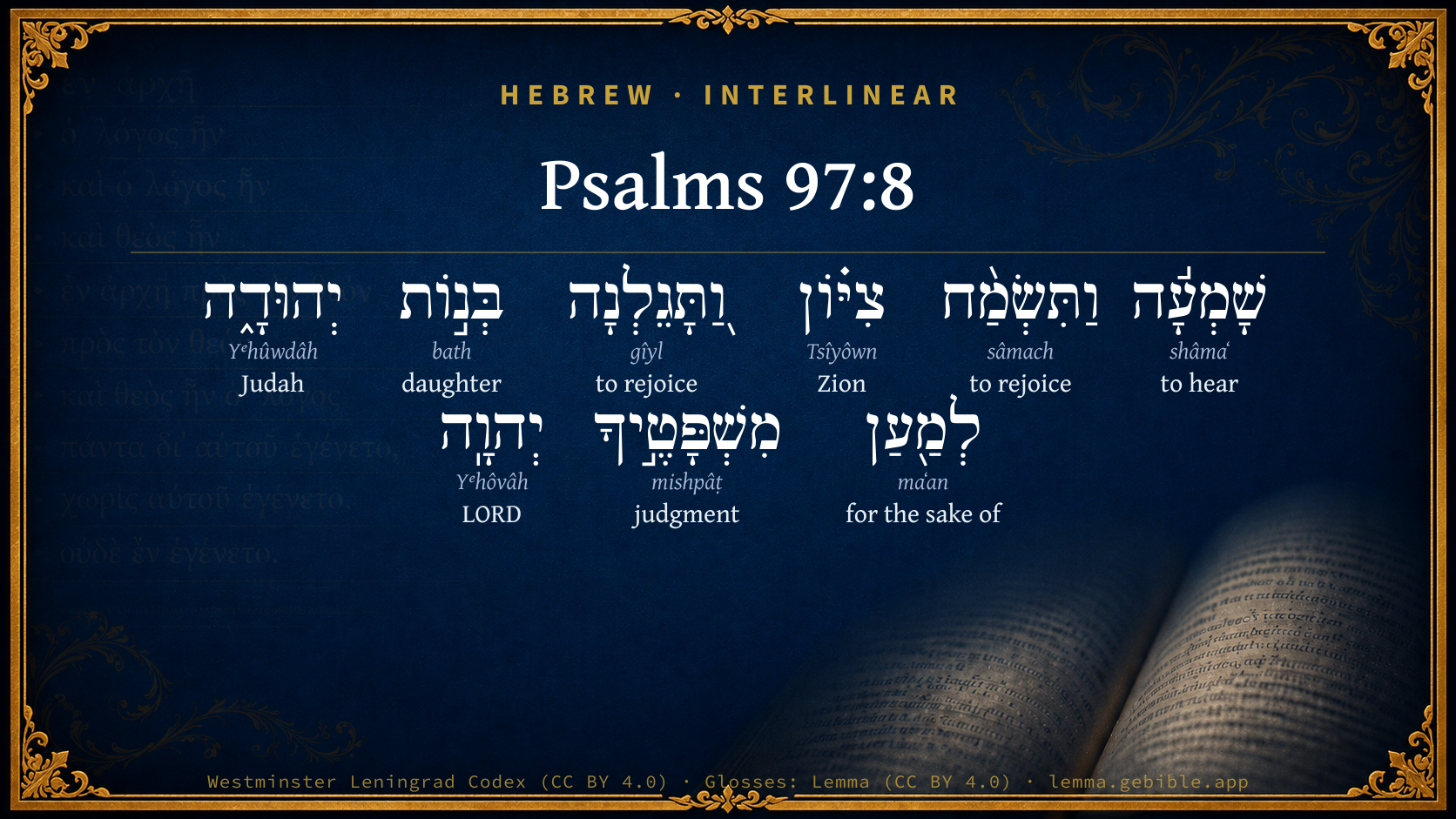
Hebrew (Westminster Leningrad Codex) Psalms 97:8 appears in the Hebrew Old Testament. The text above is from the Westminster Leningrad Codex. Each word links to its Strong’s number, a concise gloss, and parsing drawn from the Open Scriptures Hebrew Bible morphology. Click any word for its full Brown-Driver-Briggs (BDB) entry.
Download image
Cite this verse

Psalms 97:8 (World English Bible). Public Domain. Lemma interlinear Bible study tool, https://lemma.gebible.app/v/psalms/97/8.

Show BibTeX & RIS
BibTeX
RIS
English Translation
Zion heard and was glad. The daughters of Judah rejoiced, Because of your judgments, Yahweh.
World English Bible · Public Domain
Download a study sheet

One document with this verse’s original text, its word-by-word gloss line, the meaning frame, cross-references with their text, attributed commentary, and full source and license credits — printable, and it pastes into notes with its structure intact.

This verse Autodidact and up

Study sheet (.html) Plain text (.txt)

A passage Seminary Student

Up to 50 verses in one chapter. A passage sheet keeps up to 6 commentary sources and 12 cross-references per verse, in the order this page ranks them, and says so on the sheet whenever that leaves anything out. Ask for a single verse and you get the Autodidact verse sheet above.

Everything on this page stays free to read, with no account — the sheet is a download of what is already on screen, not access to it.

Want to remove ads? Support Godless Engineer
Compare translations 3

The same verse in 3 English versions, stacked beneath the original-language interlinear above. Click any original word for its lexicon entry.

Each is an independent rendering of the whole verse — the interlinear is not word-aligned to these translations.

Highlighted words mark where these versions differ — a whole-verse word diff, not a word-by-word alignment.

  • World English Bible Public Domain
    Zion heard and was glad. The daughters of Judah rejoiced, Because of your judgments, Yahweh.
  • King James Version Public Domain
    Zion heard, and was glad; and the daughters of Judah rejoiced because of thy judgments, O LORD.
  • unfoldingWord Literal Text CC BY-SA 4.0
    Zion heard and was glad, and the daughters of Judah rejoiced because of your judgments, Yahweh.

unfoldingWord Literal Text — © unfoldingWord, licensed CC BY-SA 4.0. Word-aligned USFM3 via Door43 (git.door43.org/unfoldingWord/en_ult).

Versions to compare (up to 4)

3 of 4 selected

Show all 18 translations

Every available English version of this verse, each an independent rendering of the whole verse.

  • World English Bible Public Domain
    Zion heard and was glad. The daughters of Judah rejoiced, Because of your judgments, Yahweh.
  • Berean Standard Bible Public Domain
    Zion hears and rejoices, and the towns of Judah exult because of Your judgments, O LORD.
  • Majority Standard Bible Public Domain
    Zion hears and rejoices, and the towns of Judah exult because of Your judgments, O LORD.
  • King James Version Public Domain
    Zion heard, and was glad; and the daughters of Judah rejoiced because of thy judgments, O LORD.
  • American Standard Version (1901) Public Domain
    Zion heard and was glad, And the daughters of Judah rejoiced, Because of thy judgments, O Jehovah.
  • Revised Version (1885) Public Domain
    Zion heard and was glad, and the daughters of Judah rejoiced; because of thy judgments, O LORD.
  • Geneva Bible (1599) Public Domain
    Zion heard of it, and was glad: and the daughters of Iudah reioyced, because of thy iudgements, O Lord.
  • Douay-Rheims (1899) Public Domain
    Sion heard, and was glad. And the daughters of Juda rejoiced, because of thy judgments, O Lord.
  • Young's Literal Translation Public Domain
    Zion hath heard and rejoiceth, And daughters of Judah are joyful, Because of Thy judgments, O Jehovah.
  • Literal Standard Version CC BY-SA 4.0
    Zion has heard and rejoices, || And daughters of Judah are joyful, || Because of Your judgments, O YHWH.
  • Unlocked Literal Bible CC BY-SA 4.0
    Zion heard and was glad, and the towns of Judah rejoiced because of your righteous decrees, Yahweh.
  • unfoldingWord Literal Text CC BY-SA 4.0
    Zion heard and was glad, and the daughters of Judah rejoiced because of your judgments, Yahweh.
  • Darby Bible Public Domain
    Zion heard, and rejoiced; and the daughters of Judah were glad, because of thy judgments, O Jehovah.
  • World Messianic Bible Public Domain
    Zion heard and was glad. The daughters of Judah rejoiced because of your judgments, LORD.
  • Webster's Bible Public Domain
    Zion heard, and was glad; and the daughters of Judah rejoiced because of thy judgments, O LORD.
  • Free Bible Version CC BY-SA 4.0
    Jerusalem hears this and celebrates; all the towns of Judah are happy because of your judgments, Lord.
  • Bible in Basic English Public Domain
    Zion gave ear and was glad; and the daughters of Judah were full of joy, because of your decisions, O Lord.
  • JPS Tanakh (1917) Public Domain
    Zion heard and was glad, and the daughters of Judah rejoiced; because of Thy judgments, O LORD.

Literal Standard Version (2020), Covenant Press — licensed CC BY-SA 4.0. Text via the HelloAO Bible API (eBible.org). Unlocked Literal Bible (unfoldingWord) — licensed CC BY-SA 4.0. Text via the HelloAO Bible API (eBible.org). unfoldingWord Literal Text — © unfoldingWord, licensed CC BY-SA 4.0. Word-aligned USFM3 via Door43 (git.door43.org/unfoldingWord/en_ult). Free Bible Version, Dr. Jonathan Gallagher — licensed CC BY-SA 4.0. Text via the HelloAO Bible API (eBible.org).

Word by word

More ways to search: Search by grammar → Find every occurrence → Compare this word →

Practice this passage: Drill this verse → Learn its vocabulary →

וַ֭תָּגֵלְנָה
gîyl
H1523
“and · to rejoice”
Conjunction + Verb, Qal, Sequential Imperfect, 3rd Person, Feminine, Plural
Part of Speech
Conjunction + Verb
Stem
Qal
Form
Sequential Imperfect
Person
3rd Person
Gender
Feminine
Number
Plural
Full BDB Definition

Origin: a primitive root

TWOT: 346

to rejoice, exult, be glad - (Qal) - to rejoice - to tremble (from fear)
  1. שָׁמְעָ֬ה shâmaʻ H8085 “to hear” Verb, Qal, Perfect, 3rd Person, Feminine, Singular
  2. וַתִּשְׂמַ֨ח sâmach H8055 “and · to rejoice” Conjunction + Verb, Qal, Sequential Imperfect, 3rd Person, Feminine, Singular
  3. צִיּ֗וֹן Tsîyôwn H6726 “Zion” Noun, Proper
  4. בְּנ֣וֹת bath H1323 “daughters of” Noun, Common, Feminine, Plural, Construct
  5. יְהוּדָ֑ה Yᵉhûwdâh H3063 “Judah” Noun, Proper
  6. לְמַ֖עַן maʻan H4616 “for the sake of” Preposition
  7. מִשְׁפָּטֶ֣יךָ mishpâṭ H4941 “judgments · your” Noun, Common, Masculine, Plural, Construct + Suffix, Personal, 2nd Person, Masculine, Singular
  8. יְהוָֽה Yᵉhôvâh H3068 “LORD” Noun, Proper

About this verse

These counts appear in no published source. They are computed here, from the morphology-tagged text and Lemma’s own curated glosses. What Lemma adds →

9
words
9
distinct lemmas
Wisdom
section

Shared distinctive vocabulary

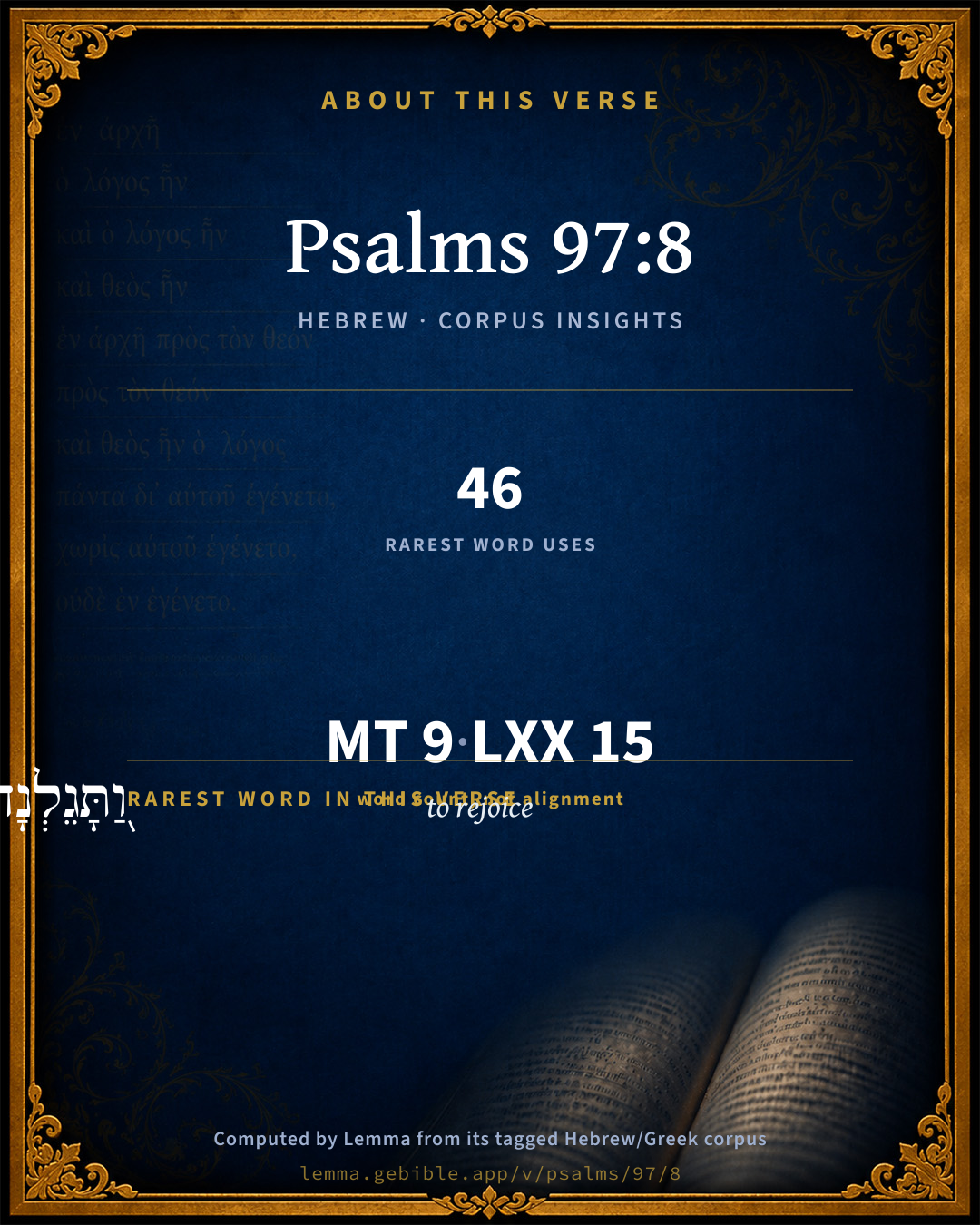
וַ֭תָּגֵלְנָה to rejoice H1523 occurs in 44 verses of the Hebrew Bible. Also found in:

Grammatical profile

  • 3 verbs
  • 5 nouns
  • 1 preposition

Verb forms

  • שָׁמְעָ֬ה Qal · Perfect
  • וַתִּשְׂמַ֨ח Qal · Sequential Imperfect
  • וַ֭תָּגֵלְנָה Qal · Sequential Imperfect

Hebrew & Septuagint length

In English translation the verse runs 15 words from the Hebrew and 16 from the Septuagint (LXX English) — closely comparable.

A rough comparison of the two English renderings, which tokenize alike — not a word-level alignment.

Word counts can differ between the Hebrew and the Greek without any difference in meaning — e.g. the Hebrew direct-object marker אֵת has no separate Greek word, and Greek often adds the article ὁ.

In the original languages it is 9 Hebrew tokens and 15 Greek tokens — but the two are counted differently (Hebrew bundles its prefixes and suffixes into one token; the Greek is in lemma form), so that isn’t a like-for-like length.

Cross-references

11

Topical passages linked to Psalms 97:8 in the Treasury of Scripture Knowledge — connected by theme and wording, ordered by reader-vote popularity; previews shown in the World English Bible.

  • Psalms 48:11 Let Mount Zion be glad! Let the daughters of Judah rejoice, Because of your judgments.
  • Zechariah 9:9 Rejoice greatly, daughter of Zion! Shout, daughter of Jerusalem! Behold, your king comes to you! He is righteous, and having salvation; Lowly, and riding on a donkey, Even on a colt, the foal of a donkey.
  • Revelation 18:20 Rejoice over her, O heaven, you saints, apostles, and prophets; for God has judged your judgment on her."
  • Isaiah 52:7–10 How beautiful on the mountains are the feet of him who brings good news, who publishes peace, who brings good news of good, who publishes salvation, who says to Zion, Your God reigns!
  • Isaiah 62:11 Behold, Yahweh has proclaimed to the end of the earth, Say you to the daughter of Zion, Behold, your salvation comes; behold, his reward is with him, and his recompense before him.
  • Matthew 21:4–9 All this was done, that it might be fulfilled which was spoken through the prophet, saying,
  • Psalms 52:6 The righteous also will see it, and fear, And laugh at him, saying,
  • Psalms 58:10 The righteous shall rejoice when he sees the vengeance. He shall wash his feet in the blood of the wicked;
  • Isaiah 51:3 For Yahweh has comforted Zion; he has comforted all her waste places, and has made her wilderness like Eden, and her desert like the garden of Yahweh; joy and gladness shall be found therein, thanksgiving, and the voice of melody.
  • Zephaniah 3:14–17 Sing, daughter of Zion! Shout, Israel! Be glad and rejoice with all your heart, daughter of Jerusalem.
  • Revelation 19:1–7 After these things I heard something like a loud voice of a great multitude in heaven, saying, "Hallelujah! Salvation, power, and glory belong to our God:

Cross-references courtesy of OpenBible.info (CC BY 4.0).

Hebrew and Greek witnesses Masoretic Hebrew ↔ Greek Septuagint

The same verse in the two great witnesses to the Old Testament, shown verse-for-verse.

You’re reading Greek Psalm 96 (Hebrew Psalm 97). The Septuagint counts the superscription, so verse numbers can differ from the Hebrew — chapter-level alignment, not verse-by-verse. Numbering follows Rahlfs.

These are two independent witnesses, not word-aligned to each other, and the Septuagint is shown in lemma (dictionary) form.

Hebrew Psalms 97:8 Masoretic · Westminster Leningrad Codex

שָׁמְעָ֬ה וַתִּשְׂמַ֨ח צִיּ֗וֹן וַ֭תָּגֵלְנָה בְּנ֣וֹת יְהוּדָ֑ה לְמַ֖עַן מִשְׁפָּטֶ֣יךָ יְהוָֽה

Zion heard and was glad. The daughters of Judah rejoiced, Because of your judgments, Yahweh.

World English Bible · Public Domain

Greek LXX Greek Psalm 96:8 Septuagint · lemma form

ἀκούω καί εὐφραίνω σιων καί ἀγαλλιάομαι ὁ θυγάτηρ ὁ ἰουδαία ἕνεκεν ὁ κρίμα σύ κύριος

Sion heard and rejoiced; and the daughters of Judea exulted, because of your judgments, O Lord.

LXX2012 (modern English Septuagint) · Public Domain

Hebrew: Westminster Leningrad Codex (CC BY 4.0). Greek: Septuagint (public domain); English from LXX2012 (modern English Septuagint) (Public Domain). How the Septuagint differs from the Hebrew →

Commentary

Notes on Psalms 97:8 from classic Christian and Jewish commentators (each source and its license shown beneath its notes). The classic Christian expositions comment on the surrounding passage and are grouped to its opening verse, so a note may address several verses; the Jewish commentaries on the Tanakh (Rashi and others) are per-verse, so they appear only where the commentator wrote on this verse.

Lemma curates 59 commentaries, every one of them public domain or Creative Commons licensed, each selected and text-cleaned for this edition rather than reprinted as found. About our sources →

The Cambridge Bible for Schools and Colleges

gen. ed. J. J. S. Perowne

8. From Psa_48:11, but with a significant change. Then (Psa_97:8) the deliverance was wrought in sight of the city; now Zion and the cities of Judah only hear the glad tidings brought from distant Babylon to Zion in her humiliation (Isa_52:7-8).

The Cambridge Bible for Schools and Colleges (gen. ed. J. J. S. Perowne; Cambridge University Press, 1878–1918) — public domain. Text from a community e-Sword module.

Trapp's Complete Commentary

John Trapp

Psa 97:8 Zion heard, and was glad; and the daughters of Judah rejoiced because of thy judgments, O LORD.

Ver. 8. Zion heard, and was glad] Heard what? the downfall of the devil’s kingdom, and the erecting of Christ’s sceptre; this was good news to the Church, and her children. Berne was the first town that after the Reformation burnt their images. Zurich followed on an Ash Wednesday, which they observe and celebrate every year to this day, with all mirths, plays, and pastimes, as an Ash Wednesday of God’s own making.

John Trapp, A Commentary or Exposition upon All the Books of the Old and New Testament (1647–1656) — public domain. Text from a community e-Sword module.

The Biblical Illustrator

Joseph S. Exell

Psa_97:8

Zion heard, and was glad; and the daughters of Judah rejoiced because of Thy judgments, O Lord.

The judgments of God are a proper cause of gladness and rejoicing to His people

I. The Church is glad, and rejoices in the judgments of God, because it is itself redeemed with judgment.

1. By judgment the Church is redeemed from the curse of the law--judgment on Christ.

2. By judgment the Church is delivered from the captivity of Satan--judgment oil Satan.

3. By judgment the Church is freed from the bondage and tyranny of the world--judgment on the world.

4. By judgment the Church is to be redeemed from the power of Antichrist (Rev_18:20).

5. By judgment the Church is to be redeemed from the power of sin--judgment on the Church.

II. The Church is glad, and rejoices in the judgments of God, because they are the triumphs of Christ.

1. The triumphs of Christ are of two kinds--

(1) The triumphs of His grace.

(2) The triumphs of His vengeance.

2. The one as well as the other is rejoiced in and celebrated by the Church.

III. The Church is glad, and rejoices in the judgments of God, because they diminish the amount and prevalency of sin.

1. The direct effect of judgments is to remove the barriers which hinder the progress of the truth.

2. Another effect of Divine judgments is to deter from the commission of sin.

3. The effect of the finally overwhelming judgments of God is to remove sin from its place in the moral universe, and shut it up in everlasting concealment, Hellazar-house.

IV. The Church is glad, and rejoices in the judgments of God, because they furnish a glorious manifestation of Himself.

1. They reveal His holiness--He cannot look upon sin.

2. They manifest His justice. He gives to each one according to his work.

3. They that prove His omnipresence as a moral governor. No sin escapes Him.

4. They demonstrate His truth--for they are for the most part predicted.

5. They exhibit His power--for they overwhelm the mightiest.

6. They reveal His love to the Church--for they are chiefly in her defence and rescue. (James Stewart.)

The Biblical Illustrator, edited by Joseph S. Exell (c. 1880s–1900s) — public domain. Text from a community e-Sword module.

Joseph Benson's Commentary

Psa 97:8-9. Zion heard — The people dwelling in Zion, or Jerusalem and Judah, to whom Christ came, and to whom the gospel was first preached. Or God’s church and people, who, both in the Psalms and prophetical writings, are often called Zion; heard the fame of thy judgments, as the following words declare; the ruin of idolatry, and the setting up of the kingdom of the Messiah in the world. And was glad — Very glad to hear of the conversion of some and the confusion of others, of the victory of Christ over all opposing power, and of the overthrow of the kingdom of Satan among men. And the daughters of Judah — Particular churches, or individual members of Christ’s universal church, rejoiced — According to the exhortation of the prophet; Rejoice greatly, O daughter of Zion, for behold thy king cometh unto thee. Because of thy judgments, O Lord — Thy judgments on thine enemies, whereby thou hast evinced thyself to be superior to the powers of the earth, and the gods of the nations. Not that they take pleasure in the ruin of others, but because the execution of the divine judgments upon idols and idolaters, and other daring sinners, makes way for the advancement of God’s glory, and the enlargement and establishment of Christ’s kingdom in the world. Thus, at the fall of Babylon it is said, Rejoice over her, thou heaven, and ye holy apostles and prophets, for God hath avenged you on her. And Eusebius, speaking of the times under Constantine, says, “A bright and glorious day, no cloud overshadowing it, did enlighten, with rays of heavenly light, the churches of Christ over all the earth; and among all Christians there was an inexpressible joy and a kind of celestial gladness.” — Eccl. Hist., book 10. For thou art exalted above all gods — As thou always wast in truth exalted, so thou hast now proved and declared thyself to be so in the eyes of the whole world, by subduing them under thy feet.

Joseph Benson's Commentary on the Old and New Testaments (1811–1818) — public domain. Text from a community e-Sword module.

J. A. Alexander on Psalms

Joseph Addison Alexander

8. (Psa 97:8) Zion hears and rejoices, and glad are the daughters of Judah, because of thy judgments, Jehovah! While the heathen are confounded, the people of God rejoice. The terms of the verse are borrowed from Ps. 98:11, in the note upon which the ambiguous phrase, daughters of Judah, is explained. The judgments here particularly meant are those inflicted on the unbelieving Gentiles.

Joseph Addison Alexander, The Psalms Translated and Explained (1850) — public domain. Text from a community e-Sword module.

Tyndale Open Study Notes

Tyndale Open Resources

97:8-12 Jerusalem rejoices at the news of the Lord’s coming, for he brings justice and rescues the upright of heart.

Tyndale Open Study Notes — © Tyndale Open Resources, licensed CC BY-SA 4.0. Text via the HelloAO Bible API.

Geneva Bible (1599)

Geneva Bible translators

The Jews shall have occasion to rejoice, that the Gentiles are made partakers with them of God’s favor.

Geneva Bible (1599) marginal notes — public domain. Text via Bolls.life.

Matthew Henry's Commentary

The kingdom of the Messiah, like the pillar of cloud and fire, as it has a dark side towards the Egyptians, so it has a bright side towards the Israel of God. It is set up in spite of opposition; and then the earth saw and trembled (Psa 97:4), but Zion heard and was glad, very glad, to hear of the conversion of some and of the confusion of others, that is, the conquest of all that stood it out against Christ. Rejoice greatly, O daughter of Zion! for behold thy king comes unto thee, Zac 9:9. And not Zion only, where the temple was, but even the daughters of Judah, rejoiced; the common people, the inhabitants of the villages, they shall triumph in Christ's victories. The command (Psa 97:1) is, Let the earth rejoice; but it is only the sons of Zion and the daughters of Judah that do rejoice. All should bid the kingdom of the Messiah welcome, but few do. Now here observe,

I. The reasons that are given for Zion's joy in the government of the Redeemer. The faithful servants of God may well rejoice and be glad, 1. Because God is glorified, and whatever redounds to his honour is very much his people's pleasure. They rejoice because of thy judgments, O Lord! which may take in both the judgments of his mouth and the judgments of his hand, the word of his gospel and his works wrought for the propagating of it, miracles and marvellous providences; for in these we must own, "Thou, Lord, art high above all the earth (Psa 97:9); thou hast manifested thy sovereignty in the kingdom of nature, and thy command of all its powers, and thy dominion over all nations, over all hearts; thou art exalted far above all gods" - all deputed gods, that is, princes - all counterfeit gods, that is, idols. The exaltation of Christ, and the advancement of God's glory among men thereby, are the rejoicing of all the saints. 2. Because care is taken for their safety. Those that pay allegiance to Christ as a King shall be sure of his protection. Princes are the shields of the earth; Christ is so to his subjects; they may put their trust under his shadow and rejoice in it, for (Psa 97:10) He preserves the souls of the saints; he preserves their lives as long as he has any work for them to do, and wonderfully delivers them many a time out of the hand of the wicked, their persecutors that thirst after their blood; for precious in the sight of the Lord is the death of his saints. But something more is meant than their lives; for those that will be his disciples must be willing to lay down their lives, and not indent for the securing of them. It is the immortal soul that Christ preserves, the inward man, which may be renewed more and more when the outward man decays. He will preserve the souls of his saints from sin, from apostasy, and despair, under their greatest trials; he will deliver them out of the hands of the wicked one that seeks to devour them; he will preserve them safely to his heavenly kingdom, Ti2 4:18. They have therefore reason to be glad, being thus safe. 3. Because provision is made for their comfort. Those that rejoice in Christ Jesus, and in his exaltation, have fountains of joy treasured up for them, which will be opened sooner or later (Psa 97:11): Light is sown for the righteous, that is, gladness for the upright in heart. The subjects of Christ's kingdom are told to expect tribulation in the world. They must suffer by its malice, and must not share in its mirth; yet let them know, to their comfort, that light is sown for them; it is designed and prepared for them. What is sown will come up again in due time; though, like a winter seedness, it may lie long under the clods, and seem to be lost and buried, yet it will return in a rich and plentiful increase. God's goodness shall be sure of a harvest in the appointed weeks. Those that sow in tears shall, without fail, reap in joy, Psa 126:5, Psa 126:6. Christ told his disciples, at parting (Joh 16:20), You shall be sorrowful, but your sorrow shall be turned into joy. Gladness is sure to the upright in heart, to those only that are sincere in religion. The joy of the hypocrite is but for a moment. There is no serenity without a lasting sincerity,

II. The rules that are given for Zion's joy. 1. Let it be a pure and holy joy. "You that love the Lord Jesus, that love his appearing and kingdom, that love his word and his exaltation, see that you hate evil, the evil of sin, every thing that is offensive to him and will throw you out of his favour." Note, A true love to God will show itself in a real hatred of all sin, as that abominable thing which he hates. The joy of the saints should likewise confirm their antipathy to sin and divine comforts should put their mouths out of taste for sensual pleasures. 2. Let the joy terminate in God (Psa 97:12): Rejoice in the Lord, you righteous. Let all the streams of comfort, which flow to us in the channel of Christ's kingdom, lead us to the fountain, and oblige us to rejoice in the Lord. All the lines of joy must meet in him as in the centre. See Phi 3:3; Phi 4:4. 3. Let it express itself in praise and thanksgiving: Give thanks at the remembrance of his holiness. Whatever is the matter of our rejoicing ought to be the matter of our thanksgiving, and particularly the holiness of God. Those that hate sin themselves are glad that God does so, in hopes that therefore he will not suffer it to have dominion over them. Note, (1.) We ought to be much in the remembrance of God's holiness, the infinite purity, rectitude, and perfection of the divine nature. We must be ever mindful of his holy covenant, which he has confirmed with an oath by his holiness. (2.) We ought to give thanks at the remembrance of his holiness, not only give him the glory of it as it is an honour to him, but give him thanks for it as it is a favour to us; and an unspeakable favour it will be if, through grace, we are partakers of his holiness. It is God's holiness which, above all his attributes, the angels celebrate. Isa 6:3, Holy, holy, holy. Sinners tremble, but saints rejoice, at the remembrance of God's holiness, Psa 30:4.

Matthew Henry's Commentary on the Whole Bible (1708–1710) — public domain (CC PDM 1.0). Text via the HelloAO Bible API.

Adam Clarke's Commentary

Verse 8. Zion heard, and was glad] All the land of Israel, long desolated, heard of the judgments which God had shown among the enemies of his people.

And the daughters of Judah] All the villages of the land-Zion as the mother, and all the villages in the country as her daughters, rejoice in the deliverance of God's people.

Adam Clarke's Commentary on the Bible (1810–1826) — public domain. Text from a community e-Sword/MySword module.

John Calvin's Commentaries

8 Zion heard, and was glad In the former part of the psalm he had spoken of that joy which should be common to all the world. Now he makes special mention of God’s chosen nation; and this partly, because they were to enjoy the first-fruits of this joy, and partly, because he would remove all occasion for rivalry or envy. Accordingly, having said that the Gentile nations should be brought to equal privileges with the posterity of Abraham, he adds, that the Jews would not suffer any diminution of honor by this co-partnership of privilege, but might rather reasonably rejoice in being chosen of God to be the fountain out of which the world was to be watered and refreshed. Those of whom the Psalmist speaks were the true children of Abraham and them only. They had a double reason for rejoicing, when God extended his government and glory from the rising to the setting sun; for, while he exhibited to them in Christ the complete fulfillment of that redemption which was promised, they, at the same time, saw the glory of God diffused from the narrow limits of Judea to all parts of the world. When the nations were blessed in the seed of Abraham, agreeably to the prediction which had gone before, this was no inconsiderable confirmation of their faith, as also, when they saw a religion which had been hated and despised universally embraced. But why, it may be asked, does he speak of those things being heard, rather than seen? Two reasons may be given for this. First, he would have God’s believing people anticipate the blessing by hope, ere the consummation of it arrived; and, again, the language intimates, that the glory of the Gospel would be spread to such distant quarters, that the Jews would rather hear of it by report, than witness it with their own eyes.

John Calvin's Commentaries (1540-1563) — public domain. Text from the Calvin Translation Society English edition (1840s-50s) via the Christian Classics Ethereal Library (ccel.org). Calvin's coverage is partial (roughly two-thirds of the Bible); uncommented books and verses are honest gaps, never fabricated. The 19th-century editor's footnotes and remarks are omitted so the notes are faithfully Calvin's own voice.

Ellicott's Commentary for English Readers

(8) Zion heard.—See Psa_48:11, Note.

A Bible Commentary for English Readers, edited by Charles John Ellicott (1878–1897) — public domain. Text from a community e-Sword module.

John Gill's Exposition

Zion heard, and was glad,.... Or, the congregation of Zion, as the Targum; the church of Christ, and the members of it, called Zion, in allusion to the mountain of that name, in which the temple stood; a type of the church, Heb 12:22, these heard the Gospel, the good news and glad tidings of good things; they heard that Zion's King reigned, and that his kingdom was enlarged, and interest increased; they heard the heavenly men declare his righteousness, by which they are justified from all things; they heard of the conversion of the Gentiles, and the confusion of idolaters; of the incarnation of Christ, and of his being worshipped by angels; all which filled them with joy and gladness:

and the daughters of Judah rejoiced; particular congregated churches, particular believers and professors of Christ and his Gospel; these rejoiced at the above things, as well as because of what follows:

because of thy judgments, O Lord; either the doctrines of the Gospel, which come from the God of judgment, and are according to his justice and holiness; and are matter of joy and gladness when they are spread in the world, and succeed to the conversion of sinners, the comfort of saints and the glory of Christ; see Psa 19:9, or his judgments upon his enemies, and the enemies of his church and people; which also are an occasion of rejoicing to them, because Christ is thereby glorified in his power, justice, truth, and faithfulness, Rev 19:1.

John Gill's Exposition of the Whole Bible (1746–1763) — public domain (CC PDM 1.0). Text via the HelloAO Bible API.

Albert Barnes' Notes on the Bible

Zion heard, and was glad - The good news came to Zion that all the idols of the pagan were confounded or were overcome: that is, that the Lord reigned. There was joy in Zion that the evils and abominations of idolatry were at an end, and that the worship of Yahweh had taken the place of idol-worship. The idea is, that the displacement of idols, or the fact that they had ceased to be worshipped, was a cause of joy to the worshippers of the true God. Whatever tends to remove the worship of idols from the world, and to extend and establish the worship of the living God, is an occasion of gladness.

And the daughters of Judah rejoiced ... - See the notes at Psa 48:11. Woman has special occasion to rejoice in the spread of the true religion. It is that only which has lifted her from a state of deep degradation; which has elevated her to be a companion instead of a slave; which has made her the intelligent wife and mother, rather than the mere inmate of a harem.

Albert Barnes' Notes on the Bible (1834–1885) — public domain. Text from a community e-Sword/MySword module.

Matthew Poole's English Annotations

Zion; thy people dwelling in Zion, or Jerusalem, and Judah, to whom Christ came, and among whom the gospel was first preached. Or, thy church and people, who both in the prophetical writings are oft called Zion. Heard the fame of thy judgments, as the following words declare; the ruin of idolatry and the setting up the kingdom of the Messias in the world.

The daughters of Judah; particular churches, or rather persons, members of Zion.

Rejoiced; not that they took pleasure in the ruin of others, but because that made way for the advancement of God’s glory and Christ’s kingdom in the world.

Matthew Poole's English Annotations on the Holy Bible (1683–1685) — public domain. Text from a community e-Sword/MySword module.

The Treasury of David

Charles H. Spurgeon

Ver. 8. Zion heard, and was glad. While the heathen are confounded the people of God are made to triumph, for they love to see their God exalted. The day shall come when the literal Zion, so long forsaken, shall joy in the common salvation. It did so at the first when the apostles dwelt at Jerusalem, and the good days will come back again.

And the daughters of Judah rejoiced. Each individual believer is glad when he sees false systems broken up and idol gods broken down; the judgments of the Lord afford unalloyed delight to those who worship the true God in spirit and in truth. In the first ages of Christianity the believing Israel rejoiced to see Christ's kingdom victorious among the heathen, and even yet, though for a while turning aside, the daughters of Judah will sympathise in the wide spread reign of Jehovah their God, through the gospel of his dear Son. As the women of Judah went forth to meet David in the dance, singing his victory over the Philistine, so shall they chant the triumphs of David's son and Lord.

Ver. 8. Zion heard, etc. But why, it may be asked, does he speak of those things being heard, rather than seen? Two reasons may be given for this. First, he would have God's believing people anticipate the blessing by hope, ere the consummation of it arrived; and, again, the language intimates, that the glory of the Gospel would be spread to such distant quarters, that the Jews would rather hear of it by report, than witness it with their own eyes. John Calvin.

Ver. 8. The daughters of Judah rejoiced. David alludes to a custom familiar in Judea, of forming choral bands of maidens after a victory or some happy circumstance. Thus after the passage of the Red Sea, when the Egyptians were drowned and the people of God brought in safety to the farthest shore, Miriam the prophetess, the sister of Aaron, took a timbrel in her hand, and all the women followed her with timbrels and dancing, saying, Let us sing unto the Lord, for he hath triumphed gloriously; the horse and his rider hath he thrown into the sea. When Goliath was slain by David, it is said 1Sa 18:6-7, "When David returned from the slaughter of the Philistine, the women came out of all cities of Israel, singing and dancing, to meet king Saul, with tabrets, with joy, and with instruments of music. And the women sang as they played, and said, Saul hath slain his thousands, and David his ten thousands." Le Blanc.

Ver. 8.

1. The world is terrified at the divine judgments.

2. The church rejoices in them, "Zion heard", etc.; or,

1. When the world is glad the church is sad.

2. When the world is sad the church is glad.

G.R.

Psalms 97:9*

Charles H. Spurgeon's The Treasury of David (1869–1885) — public domain. Psalms only. Text from a community e-Sword/MySword module.

Whedon's Commentary on the Bible

Daniel D. Whedon

8. Zion heard, and was glad—The form of the verbs (Kal preterit) in this verse, together with the historic facts alleged, namely, the “rejoicings,” and the “judgments,” clearly point us to some occasion of the signal interposition of God in behalf of the nation.

Daughters of Judah—A poetical title for cities of Judah. See on Psa_48:11

Daniel D. Whedon (gen. ed.), Commentary on the Old and New Testaments (1874–1909) — public domain. Text from a community e-Sword module.

The Pulpit Commentary

Zion heard, and was glad. (comp. Psa_48:11) To Zion, the Church of God, the company of his saints, the theophany brings, not shame, but rejoicing. The Lord comes for their relief, for their deliverance, for their exaltation. And the daughters of Judah rejoiced. The "daughters of Judah" are the other cities of Judaea besides Jerusalem. In a Christian sense, they may be taken to represent the irregularly organized Churches, which will participate in the general joy of the faithful at Christ"s final coming. Because of thy judgments, O Lord. It does not show any vindictive feeling, if the saints, persecuted so long, "rejoice" when an end is put to their sufferings by the final judgment of the wicked.

The Pulpit Commentary (1880–1919), ed. H.D.M. Spence-Jones & Joseph S. Exell — public domain. Text from a community e-Sword module.

John Wesley's Explanatory Notes

Zion - Thy people dwelling in Zion or Jerusalem, to whom Christ came. Heard - The fame of thy judgments, and the setting up the kingdom of the Messiah.

John Wesley, Explanatory Notes Upon the Whole Bible (1754–1765) — public domain. Text via the GEBible commentary corpus.

Rashi

Rabbi Shlomo Yitzchaki (Rashi)

Your judgments Your vengeance.

Rashi on the Tanakh — English translations: “The Judaica Press complete Tanach with Rashi, translated by A. J. Rosenberg” (CC BY 4.0); “Pentateuch with Rashi's commentary by M. Rosenbaum and A.M. Silbermann, 1929-1934” (public domain); “The Metsudah Tanach series, Lakewood, N.J” (CC BY 4.0); and “The Book of Joshua, Metsudah Publications, 1997” (CC BY 4.0). Text via Sefaria.

Lesson kit

Teaching starters — assembled from the data on this page, not authored interpretation. Every prompt links to the verse data it draws on. Edit before teaching.

Psalms, in the Wisdom, opens this verse with 9 words (9 distinct Hebrew lemmas). Its most distinctive word is gîyl (“to rejoice”). A historical commentator’s framing appears above. Read the whole chapter for the surrounding context.

Discussion questions

  1. What does “to rejoice” (gîyl) contribute to the verse as a whole?
  2. 1 Chronicles 16:31 shares the word «to rejoice» with this verse. How do the two illuminate each other?
  3. These translations render this verse differently; the difference is in the English rendering, not the original. What questions does that raise?
  4. The verb «שָׁמְעָ֬ה» is Qal Perfect. How does its form color the action?
  5. Reading how The Cambridge Bible for Schools and Colleges and Trapp's Complete Commentary read this verse, where do the two commentators agree and where do they part?

Things to notice

Reading settings

Reading text

Shown beneath each verse's original-language words.

Old Testament
Old Testament edition

Read the OT as the Masoretic Hebrew (MT) or the Greek Septuagint (LXX).

English shown for the Greek Septuagint (in the Hebrew ↔ Greek comparison).

Comparing translations? Open the Compare panel on any verse page to stack up to four side by side.