
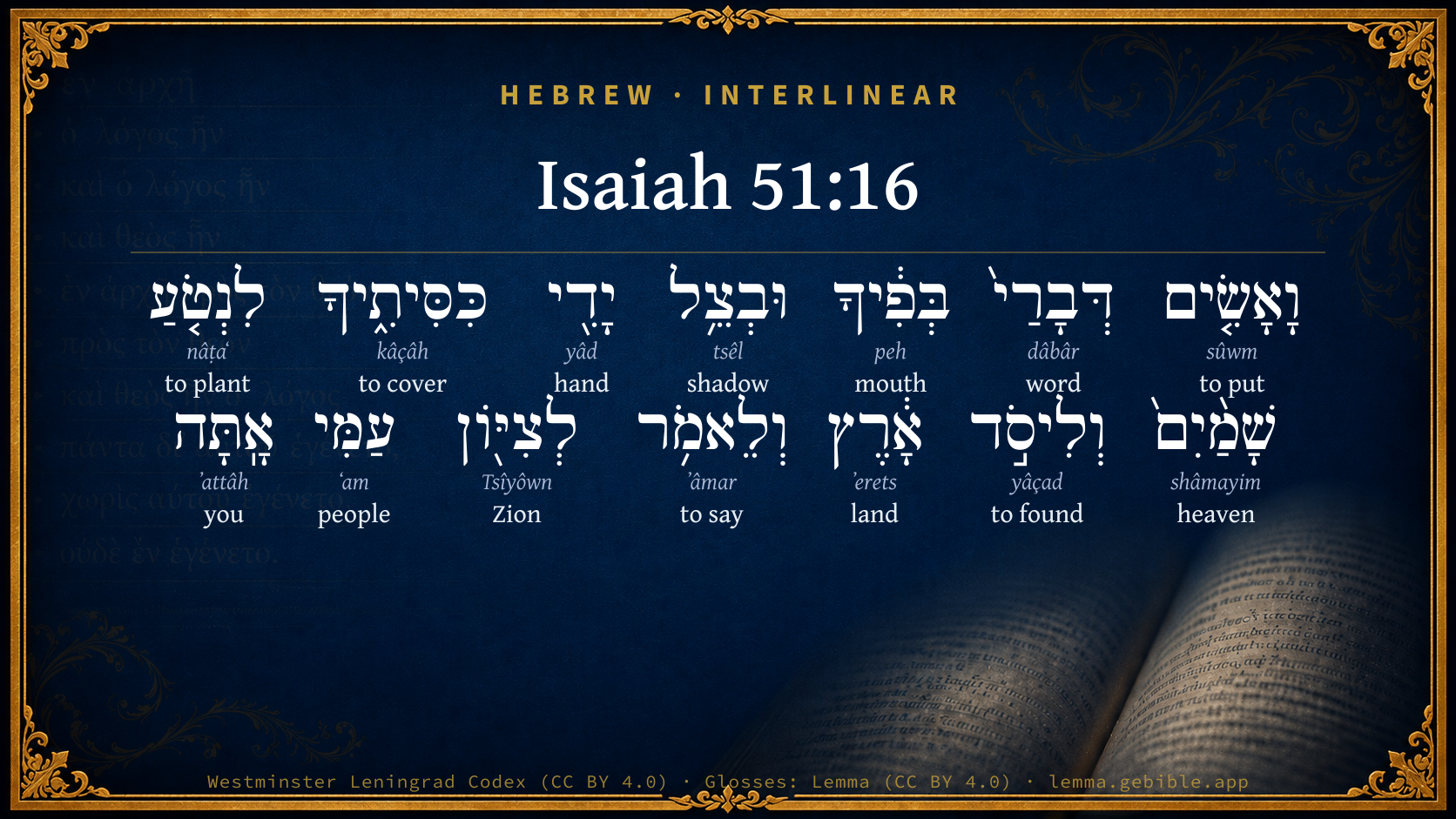
Isaiah 51:16

Hebrew (Westminster Leningrad Codex) Isaiah 51:16 appears in the Hebrew Old Testament. The text above is from the Westminster Leningrad Codex. Each word links to its Strong’s number, a concise gloss, and parsing drawn from the Open Scriptures Hebrew Bible morphology. Click any word for its full Brown-Driver-Briggs (BDB) entry.
Download image
Cite this verse

Isaiah 51:16 (World English Bible). Public Domain. Lemma interlinear Bible study tool, https://lemma.gebible.app/v/isaiah/51/16.

Show BibTeX & RIS
BibTeX
RIS
English Translation
I have put my words in your mouth, and have covered you in the shadow of my hand, that I may plant the heavens, and lay the foundations of the earth, and tell Zion, You are my people.
World English Bible · Public Domain
Download a study sheet

One document with this verse’s original text, its word-by-word gloss line, the meaning frame, cross-references with their text, attributed commentary, and full source and license credits — printable, and it pastes into notes with its structure intact.

This verse Autodidact and up

Study sheet (.html) Plain text (.txt)

A passage Seminary Student

Up to 50 verses in one chapter. A passage sheet keeps up to 6 commentary sources and 12 cross-references per verse, in the order this page ranks them, and says so on the sheet whenever that leaves anything out. Ask for a single verse and you get the Autodidact verse sheet above.

Everything on this page stays free to read, with no account — the sheet is a download of what is already on screen, not access to it.

Want to remove ads? Support Godless Engineer
Compare translations 3

The same verse in 3 English versions, stacked beneath the original-language interlinear above. Click any original word for its lexicon entry.

Each is an independent rendering of the whole verse — the interlinear is not word-aligned to these translations.

Highlighted words mark where these versions differ — a whole-verse word diff, not a word-by-word alignment.

  • World English Bible Public Domain
    I have put my words in your mouth, and have covered you in the shadow of my hand, that I may plant the heavens, and lay the foundations of the earth, and tell Zion, You are my people.
  • King James Version Public Domain
    And I have put my words in thy mouth, and I have covered thee in the shadow of mine hand, that I may plant the heavens, and lay the foundations of the earth, and say unto Zion, Thou art my people.
  • unfoldingWord Literal Text CC BY-SA 4.0
    And I have put my words in your mouth, and I have covered you with the shadow of my hand, to plant the heavens and to found the earth and to say to Zion, ‘You my people.’”

unfoldingWord Literal Text — © unfoldingWord, licensed CC BY-SA 4.0. Word-aligned USFM3 via Door43 (git.door43.org/unfoldingWord/en_ult).

Versions to compare (up to 4)

3 of 4 selected

Show all 18 translations

Every available English version of this verse, each an independent rendering of the whole verse.

  • World English Bible Public Domain
    I have put my words in your mouth, and have covered you in the shadow of my hand, that I may plant the heavens, and lay the foundations of the earth, and tell Zion, You are my people.
  • Berean Standard Bible Public Domain
    I have put My words in your mouth, and covered you with the shadow of My hand, to establish the heavens, to found the earth, and to say to Zion, ‘You are My people.’”
  • Majority Standard Bible Public Domain
    I have put My words in your mouth, and covered you with the shadow of My hand, to establish the heavens, to found the earth, and to say to Zion, ‘You are My people.’”
  • King James Version Public Domain
    And I have put my words in thy mouth, and I have covered thee in the shadow of mine hand, that I may plant the heavens, and lay the foundations of the earth, and say unto Zion, Thou art my people.
  • American Standard Version (1901) Public Domain
    And I have put my words in thy mouth, and have covered thee in the shadow of my hand, that I may plant the heavens, and lay the foundations of the earth, and say unto Zion, Thou art my people.
  • Revised Version (1885) Public Domain
    And I have put my words in thy mouth, and have covered thee in the shadow of mine hand, that I may plant the heavens, and lay the foundations of the earth, and say unto Zion, Thou art my people.
  • Geneva Bible (1599) Public Domain
    And I haue put my wordes in thy mouth, and haue defended thee in the shadowe of mine hand, that I may plant the heauens, and lay the foundation of the earth, and say vnto Zion, Thou art my people.
  • Douay-Rheims (1899) Public Domain
    I have put my words in thy mouth, and have protected thee in the shadow of my hand, that thou mightest plant the heavens, and found the earth: and mightest say to Sion: Thou art my people.
  • Young's Literal Translation Public Domain
    And I put My words in thy mouth, And with the shadow of My hand have covered thee, To plant the heavens, and to found earth, And to say to Zion, `My people `art' thou.'
  • Literal Standard Version CC BY-SA 4.0
    And I put My words in your mouth, || And have covered you with the shadow of My hand, || To plant the heavens, and to found earth, || And to say to Zion, You [are] My people.”
  • Unlocked Literal Bible CC BY-SA 4.0
    I have placed my words in your mouth, and I have covered you in the shadow of my hand, that I may plant the heavens, lay the foundations of the earth, and say to Zion, 'You are my people.'”
  • unfoldingWord Literal Text CC BY-SA 4.0
    And I have put my words in your mouth, and I have covered you with the shadow of my hand, to plant the heavens and to found the earth and to say to Zion, ‘You my people.’”
  • Darby Bible Public Domain
    And I have put my words in thy mouth, and covered thee with the shadow of my hand, to plant the heavens, and to lay the foundations of the earth, and to say unto Zion, Thou art my people.
  • World Messianic Bible Public Domain
    I have put my words in your mouth and have covered you in the shadow of my hand, that I may plant the heavens, and lay the foundations of the earth, and tell Zion, ‘You are my people.’”
  • Webster's Bible Public Domain
    And I have put my words in thy mouth, and have covered thee in the shade of my hand, that I may plant the heavens, and lay the foundations of the earth, and say to Zion, Thou art my people.
  • Free Bible Version CC BY-SA 4.0
    I have told you what to say, and I have protected you with my hand. I created the heavens and founded the earth, and told Zion, “You are my people.”
  • Bible in Basic English Public Domain
    And I have put my words in your mouth, covering you with the shade of my hand, stretching out the heavens, and placing the earth on its base, and saying to Zion, You are my people.
  • JPS Tanakh (1917) Public Domain
    And I have put My words in thy mouth, and have covered thee in the shadow of My hand, that I may plant the heavens, and lay the foundations of the earth, and say unto Zion: 'Thou art My people.'

Literal Standard Version (2020), Covenant Press — licensed CC BY-SA 4.0. Text via the HelloAO Bible API (eBible.org). Unlocked Literal Bible (unfoldingWord) — licensed CC BY-SA 4.0. Text via the HelloAO Bible API (eBible.org). unfoldingWord Literal Text — © unfoldingWord, licensed CC BY-SA 4.0. Word-aligned USFM3 via Door43 (git.door43.org/unfoldingWord/en_ult). Free Bible Version, Dr. Jonathan Gallagher — licensed CC BY-SA 4.0. Text via the HelloAO Bible API (eBible.org).

Word by word

More ways to search: Search by grammar → Find every occurrence → Compare this word →

Practice this passage: Drill this verse → Learn its vocabulary →

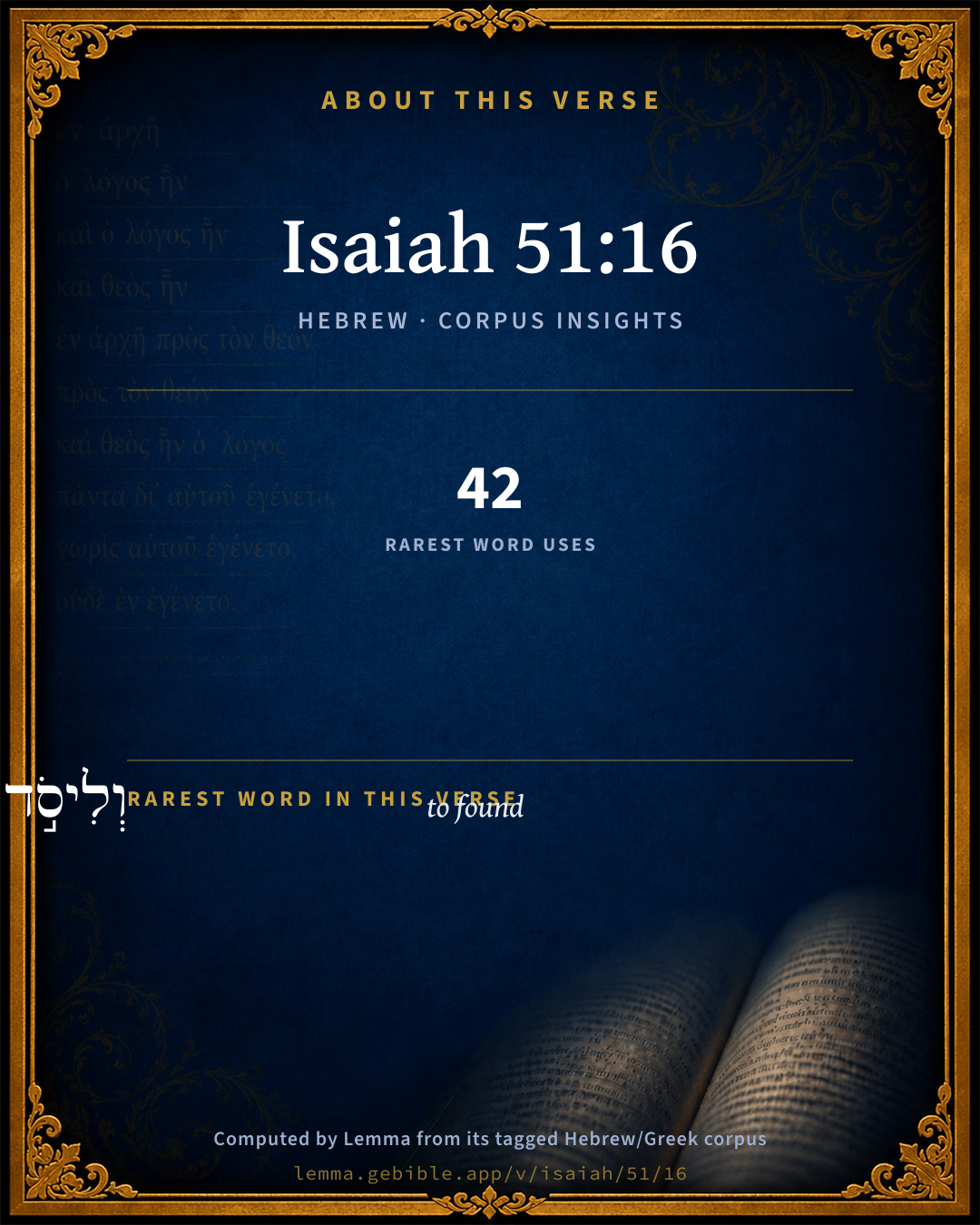
וְלִיסֹ֣ד
yâçad
H3245
“and · to found”
Conjunction + Preposition + Verb, Qal, Infinitive Construct
Part of Speech
Conjunction + Preposition + Verb
Stem
Qal
Form
Infinitive Construct
Full BDB Definition

Origin: a primitive root

TWOT: 875

to found, fix, establish, lay foundation - (Qal) to found, establish, begin - (Niphal) - to fix or seat themselves close together, sit in conclave - to be founded - (Piel) - to found - to establish, appoint, ordain - (Pual) to be founded, be laid - (Hophal) to be founded
  1. וָאָשִׂ֤ים sûwm H7760 “and · to put” Conjunction + Verb, Qal, Sequential Imperfect, 1st Person, Common, Singular
  2. דְּבָרַי֙ dâbâr H1697 “words · my” Noun, Common, Masculine, Plural, Construct + Suffix, Personal, 1st Person, Common, Singular
  3. בְּפִ֔יךָ peh H6310 “in/at · mouth · your” Preposition + Noun, Common, Masculine, Singular, Construct + Suffix, Personal, 2nd Person, Masculine, Singular
  4. וּבְצֵ֥ל tsêl H6738 “and · in/at · shadow of” Conjunction + Preposition + Noun, Common, Masculine, Singular, Construct
  5. יָדִ֖י yâd H3027 “hand · my” Noun, Common, Both, Singular, Construct + Suffix, Personal, 1st Person, Common, Singular
  6. כִּסִּיתִ֑יךָ kâçâh H3680 “to cover · you” Verb, Piel, Perfect, 1st Person, Common, Singular + Suffix, Personal, 2nd Person, Masculine, Singular
  7. לִנְטֹ֤עַ nâṭaʻ H5193 “to plant” Preposition + Verb, Qal, Infinitive Construct
  8. שָׁמַ֨יִם֙ shâmayim H8064 “heaven(s)” Noun, Common, Masculine, Plural, Absolute
  9. אָ֔רֶץ ʼerets H776 “land” Noun, Common, Both, Singular, Absolute
  10. וְלֵאמֹ֥ר ʼâmar H559 “and · to say” Conjunction + Preposition + Verb, Qal, Infinitive Construct
  11. לְצִיּ֖וֹן Tsîyôwn H6726 “to/for · Zion” Preposition + Noun, Proper
  12. עַמִּי ʻam H5971 “people · my” Noun, Common, Masculine, Singular, Construct + Suffix, Personal, 1st Person, Common, Singular
  13. אָֽתָּה ʼattâh H859 “you” Pronoun, Personal, 2nd Person, Masculine, Singular

About this verse

These counts appear in no published source. They are computed here, from the morphology-tagged text and Lemma’s own curated glosses. What Lemma adds →

14
words
14
distinct lemmas
Prophets
section

Shared distinctive vocabulary

וְלִיסֹ֣ד to found H3245 occurs in 41 verses of the Hebrew Bible. Also found in:

Grammatical profile

  • 5 verbs
  • 8 nouns
  • 1 pronoun

Verb forms

  • וָאָשִׂ֤ים Qal · Sequential Imperfect
  • כִּסִּיתִ֑יךָ Piel · Perfect
  • לִנְטֹ֤עַ Qal · Infinitive Construct
  • וְלִיסֹ֣ד Qal · Infinitive Construct
  • וְלֵאמֹ֥ר Qal · Infinitive Construct

Hebrew & Septuagint length

In English translation the verse runs 38 words from the Hebrew and 40 from the Septuagint (LXX English) — closely comparable.

A rough comparison of the two English renderings, which tokenize alike — not a word-level alignment.

Word counts can differ between the Hebrew and the Greek without any difference in meaning — e.g. the Hebrew direct-object marker אֵת has no separate Greek word, and Greek often adds the article ὁ.

Cross-references

26

Topical passages linked to Isaiah 51:16 in the Treasury of Scripture Knowledge — connected by theme and wording, ordered by reader-vote popularity; previews shown in the World English Bible.

  • Isaiah 59:21 As for me, this is my covenant with them, says Yahweh: my Spirit who is on you, and my words which I have put in your mouth, shall not depart out of your mouth, nor out of the mouth of your seed, nor out of the mouth of your seed's seed, says Yahweh, from henceforth and forever.
  • Isaiah 49:2 and he has made my mouth like a sharp sword; in the shadow of his hand has he hid me: and he has made me a polished shaft; in his quiver has he kept me close:
  • John 17:8 for the words which you have given me I have given to them, and they received them, and knew for sure that I came forth from you, and they have believed that you sent me.
  • Deuteronomy 18:18 I will raise them up a prophet from among their brothers, like you; and I will put my words in his mouth, and he shall speak to them all that I shall command him.
  • Jeremiah 31:33 But this is the covenant that I will make with the house of Israel after those days, says Yahweh: I will put my law in their inward parts, and in their heart will I write it; and I will be their God, and they shall be my people:
  • Isaiah 66:22 For as the new heavens and the new earth, which I will make, shall remain before me, says Yahweh, so shall your seed and your name remain.
  • Isaiah 48:13 Yes, my hand has laid the foundation of the earth, and my right hand has spread out the heavens: when I call to them, they stand up together.
  • Isaiah 50:4 The Lord Yahweh has given me the tongue of those who are taught, that I may know how to sustain with words him who is weary: he wakens morning by morning, he wakens my ear to hear as those who are taught.
  • Zechariah 13:9 I will bring the third part into the fire, And will refine them as silver is refined, And will test them like gold is tested. They will call on my name, and I will hear them. I will say, 'It is my people;' And they will say, 'Yahweh is my God.'"
  • John 8:38–40 I say the things which I have seen with my Father; and you also do the things which you have seen with your father."
  • Isaiah 65:17 For, behold, I create new heavens and a new earth; and the former things shall not be remembered, nor come into mind.
  • 2 Peter 3:13 But, according to his promise, we look for new heavens and a new earth, in which dwells righteousness.
  • Deuteronomy 33:27 The eternal God is [your] dwelling-place, Underneath are the everlasting arms. He thrust out the enemy from before you, Said, Destroy.
  • Psalms 92:13 They are planted in Yahweh's house. They will flourish in our God's courts.
  • Isaiah 49:8 Thus says Yahweh, In an acceptable time have I answered you, and in a day of salvation have I helped you; and I will preserve you, and give you for a covenant of the people, to raise up the land, to make them inherit the desolate heritage:
  • Isaiah 60:14–15 The sons of those who afflicted you shall come bending to you; and all those who despised you shall bow themselves down at the soles of your feet; and they shall call you The city of Yahweh, The Zion of the Holy One of Israel.
  • John 3:34 For he whom God has sent speaks the words of God; for God gives the Spirit without measure.
  • Hebrews 8:10 "For this is the covenant that I will make with the house of Israel. After those days," says the Lord; "I will put my laws into their mind, I will also write them on their heart. I will be to them a God, And they will be to me a people.
  • Exodus 33:22 It will happen, while my glory passes by, that I will put you in a cleft of the rock, and will cover you with my hand until I have passed by;
  • Psalms 75:3 The earth and all its inhabitants quake. I firmly hold its pillars. Selah.
  • Isaiah 45:18 For thus says Yahweh who created the heavens, the God who formed the earth and made it, who established it and didn't create it a waste, who formed it to be inhabited: I am Yahweh; and there is no one else.
  • Isaiah 60:21 Your people also shall be all righteous; they shall inherit the land forever, the branch of my planting, the work of my hands, that I may be glorified.
  • Jeremiah 32:38 and they shall be my people, and I will be their God:
  • Zechariah 8:8 and I will bring them, and they will dwell in the midst of Jerusalem; and they will be my people, and I will be their God, in truth and in righteousness."
  • Revelation 1:1 This is the Revelation of Jesus Christ, which God gave him to show to his servants the things which must happen soon, which he sent and made known by his angel to his servant, John,
  • Isaiah 61:3 to appoint to those who mourn in Zion, to give to them a garland for ashes, the oil of joy for mourning, the garment of praise for the spirit of heaviness; that they may be called trees of righteousness, the planting of Yahweh, that he may be glorified.

Cross-references courtesy of OpenBible.info (CC BY 4.0).

Hebrew and Greek witnesses Masoretic Hebrew ↔ Greek Septuagint

The same verse in the two great witnesses to the Old Testament, shown verse-for-verse.

These are two independent witnesses, not word-aligned to each other, and the Septuagint is shown in lemma (dictionary) form.

Hebrew Isaiah 51:16 Masoretic · Westminster Leningrad Codex

וָאָשִׂ֤ים דְּבָרַי֙ בְּפִ֔יךָ וּבְצֵ֥ל יָדִ֖י כִּסִּיתִ֑יךָ לִנְטֹ֤עַ שָׁמַ֨יִם֙ וְלִיסֹ֣ד אָ֔רֶץ וְלֵאמֹ֥ר לְצִיּ֖וֹן עַמִּי אָֽתָּה

I have put my words in your mouth, and have covered you in the shadow of my hand, that I may plant the heavens, and lay the foundations of the earth, and tell Zion, You are my people.

World English Bible · Public Domain

Greek LXX Isaiah 51:16 Septuagint · lemma form

τίθημι ὁ λόγος ἐγώ εἰς ὁ στόμα σύ καί ὑπό ὁ σκιά ὁ χείρ ἐγώ σκεπάζω σύ ἐν ὅς ἵστημι ὁ οὐρανός καί θεμελιόω ὁ γῆ καί εἶπον σιων λαός ἐγώ εἰμί σύ

I will put my words into your mouth, and I will shelter you under the shadow of my hand, with which I fixed the sky, and founded the earth: and the Lord shall say to Sion, You are my people.

LXX2012 (modern English Septuagint) · Public Domain

On this verse, John Gill's Exposition discusses the Septuagint’s reading. Read the note in Commentary ↓

Hebrew: Westminster Leningrad Codex (CC BY 4.0). Greek: Septuagint (public domain); English from LXX2012 (modern English Septuagint) (Public Domain). How the Septuagint differs from the Hebrew →

Targum (Aramaic paraphrase)

1

The Targum is the ancient Jewish Aramaic paraphrase of the Hebrew Scriptures — an interpretive translation, not the Hebrew text itself. Onkelos (literal) and Pseudo-Jonathan (expansive) render the Torah, and Jonathan the Prophets. Coverage is partial: where no permissively-licensed English translation exists for a verse, only the Aramaic is shown. This is verse-level text, not a word-by-word alignment to the Hebrew.

  1. Targum Jonathan Prophets (Joshua–Malachi)
    וְשַׁוֵיתִי פִּתְגָמֵי נְבוּאָתִי בְּפוּמָךְ וּבִטְלַל גְבוּרְתִּי אַגְנֵית עֲלָךְ לְקַיָמָא עַמָא דַאֲמִיר עֲלֵיהוֹן דְיִסְגוּן כְּכוֹכְבֵי שְׁמַיָא וּלְשַׁכְלָלָא כְנִשְׁתָּא דַאֲמִיר עֲלֵיהוֹן דְיִסְגוּן כְּעַפְרָא דְאַרְעָא וּלְמֵימַר לִדְדָיְרִין בְּצִיוֹן עַמִי אַתּוּן:

    I have put the words of my prophecy in thy mouth, and with the shadow of my power have I protected thee, to raise up the nation, concerning which it hath been promised that they shall be as many as the stars of heaven, and to establish the congregation it has been promised concerning them, that they shall multiply like the dust of the earth, and to say to the inhabitants of Zion, Ye are my people.

    Targum Jonathan — Aramaic: “Mikraot Gedolot” (public domain). English: “Sefaria Community Translation” (CC0 1.0 (public-domain dedication)); “London "Chaldee Paraphrase," 1871” (public domain). Text via Sefaria.

Commentary

Notes on Isaiah 51:16 from classic Christian and Jewish commentators (each source and its license shown beneath its notes). The classic Christian expositions comment on the surrounding passage and are grouped to its opening verse, so a note may address several verses; the Jewish commentaries on the Tanakh (Rashi and others) are per-verse, so they appear only where the commentator wrote on this verse.

Lemma curates 59 commentaries, every one of them public domain or Creative Commons licensed, each selected and text-cleaned for this edition rather than reprinted as found. About our sources →

Trapp's Complete Commentary

John Trapp

Isa 51:16 And I have put my words in thy mouth, and I have covered thee in the shadow of mine hand, that I may plant the heavens, and lay the foundations of the earth, and say unto Zion, Thou [art] my people.

Ver. 16. And I have put my words in thy mouth.] O Isaiah, my servant; but especially, O Christ, my Son.

That I may plant the heavens, &c.] God doth as great a wonder, in saying to Zion, "Thou art my people," in the work of renovation, as if he had made a new world. "Whosoever is in Christ is a new creature," or a new creation. {2Co 5:17} Christ is called, "The beginning of the creation of God." {Rev 3:14} Some, by "planting the heavens and laying the foundation of the earth" here, understand the state of the gospel, called by St Peter a "new heaven and a new earth"; and the same, they say, is called by our Saviour "regeneration" in Mat 19:28, "Ye which have followed me in the regeneration," &c.; and by the author to the Hebrews, "The world to come." {Heb 2:5}

John Trapp, A Commentary or Exposition upon All the Books of the Old and New Testament (1647–1656) — public domain. Text from a community e-Sword module.

The Biblical Illustrator

Joseph S. Exell

Isa_51:16

And I have put My words in thy mouth

The seed-corn of a new world

The words in their mouth are the seed-corn of a new world in the midst of the old.

(F. Delitzsch, D.D.)

Commissioned, endowed, preserved

Like the first creation, the new is a gradual process, advancing from age to age.

I. IN THIS WORK GOD EMPLOYS HIS SERVANTS. When it is said, That I may plant, etc., it is obvious that it is through Israel the work is to be 1Co_3:9).

II. FOR THIS WORK GOD ARMS HIS SERVANTS. I have put My words in thy mouth.

III. FOR THIS WORK AND IN IT GOD PRESERVES HIS SERVANTS. I have covered thee, etc. (W. Guthrie, M.A.)

The Biblical Illustrator, edited by Joseph S. Exell (c. 1880s–1900s) — public domain. Text from a community e-Sword module.

Tyndale Open Study Notes

Tyndale Open Resources

51:16 my words in your mouth: The focus shifted back to the servant. • You are my people: Israel was the covenant community.

Tyndale Open Study Notes — © Tyndale Open Resources, licensed CC BY-SA 4.0. Text via the HelloAO Bible API.

Geneva Bible (1599)

Geneva Bible translators

That all things may be restored in heaven and earth, Eph. 1:10.

Meaning, of Isaiah, and of all true ministers, who are defended by his protection.

Geneva Bible (1599) marginal notes — public domain. Text via Bolls.life.

Jamieson, Fausset & Brown

Robert Jamieson, A. R. Fausset & David Brown

Addressed to Israel, embodied in "the servant of Jehovah" (Isa 42:1), Messiah, its ideal and representative Head, through whom the elect remnant is to be restored.

put my words in thy mouth--true of Israel, the depository of true religion, but fully realized only in Israel's Head and antitype, Messiah (Isa 49:2; Isa 50:4-5; Isa 59:21; Deu 18:18; Joh 3:34).

covered . . . in . . . shadow of . . . hand--protected thee (see on Isa 49:2).

plant--rather, "fix" as a tabernacle; so it ought to be rendered (Dan 11:45). The "new creation," now going on in the spiritual world by the Gospel (Eph 2:10), and hereafter to be extended to the visible world, is meant (Isa 65:17; Isa 66:22; compare Isa 13:13; Pe2 3:10-13).

Zion--Its restoration is a leading part in the new creation to come (Isa 65:17, Isa 65:19).

Jamieson, Fausset & Brown — Commentary Critical and Explanatory on the Whole Bible (1871) — public domain (CC PDM 1.0). Text via the HelloAO Bible API.

Adam Clarke's Commentary

Verse 16. That I may plant the heavens - "To stretch out the heavens"] In the present text it is לנתע lintoa, "to plant the heavens:" the phrase is certainly very obscure, and in all probability is a mistake for לנטות lintoth. This latter is the word used in Isa 51:13 just before, in the very same sentence; and this phrase occurs very frequently in Isaiah, Isa 40:22; Isa 42:5; Isa 44:24; Isa 45:12; the former in no other place. It is also very remarkable, that in the Samaritan text, Nu 24:6, these two words are twice changed by mistake, one for the other, in the same verse.

Adam Clarke's Commentary on the Bible (1810–1826) — public domain. Text from a community e-Sword/MySword module.

Ellicott's Commentary for English Readers

(16) And I have put my words in thy mouth . . .—Some interpreters assume, that while Isa_51:1? was spoken to the Jewish exiles, this, which reminds us of Isa_49:2, is addressed to the Servant of the Lord. Of these, some (Cheyne), struck by the apparent abruptness, assume it to be misplaced. There seems no adequate reason for adopting either hypothesis. The words are spoken to Israel, contemplated as in its ideal, as were the others to the actual Israel. It remains true, as ever, that that ideal is fulfilled only in the Servant.

That I may plant.—Noteworthy as the first intimation of the new heaven and the new earth, implying a restitution of all things, of which we find the expression in Isa_65:17; Isa_66:22.

A Bible Commentary for English Readers, edited by Charles John Ellicott (1878–1897) — public domain. Text from a community e-Sword module.

The Cambridge Bible for Schools and Colleges

gen. ed. J. J. S. Perowne

16. I have put my words in thy mouth] recurring in ch. Isa_59:21.

covered thee in the shadow of mine hand] Taken almost exactly from Isa_49:2.

that I may plant &c.] This is no doubt the right translation, not “that thou mayest plant” (lit. “to plant”). The metaphor of “planting” the heavens is strange; some critics substitute “to stretch forth” (changing a letter), as in Isa_51:13, with which likewise the following words correspond.

The verse is remarkable in two respects. (1) It throws an important light on the idea of the Servant of the Lord. Language which is elsewhere used of the Servant is here applied to Israel, to whom the verse is undoubtedly addressed. This would be a strong confirmation of the theory that the Servant is in some sense a personification of Israel. (2) The conception of a new moral universe about to be created is partly anticipated both in Isa_51:6 (where the transitoriness of the present world is asserted), and in Isa_51:9 f. (see the notes above). This verse, however, adds the further idea that the new creation is the ultimate goal of God’s dealings with Israel, whose religious mission culminates in a universal and everlasting salvation.

The Cambridge Bible for Schools and Colleges (gen. ed. J. J. S. Perowne; Cambridge University Press, 1878–1918) — public domain. Text from a community e-Sword module.

John Gill's Exposition

And I have put my words in thy mouth,.... His promises and his truths, either in the mouth of his church, and people for them, both to preserve and transmit to future generations, and to publish and declare to the comfort of each other, Isa 59:21 or to the Prophet Isaiah, to make known to the people of Israel; or to Christ himself, the great Prophet in Israel, by whom grace and truth are come, and by whom God has spoken all his mind and will, and in whom all the promises are yea and amen. The doctrines of God, and not men, as appears by their truth, purity, harmony and efficacy; they are the words of faith and sound doctrine, of peace and reconciliation, of pardon and righteousness, of salvation and eternal life; and these were put into the mouth of Christ, to be published and declared by him as the great Prophet of the church; for which he was abundantly qualified as man and Mediator, by being anointed with the Holy Ghost, without measure, and by having the tongue of the learned given him: hence he declares, that the doctrine he preached was not his own as man, but his Father's, and that he spoke nothing of himself, but what he heard of him, and was taught by him, and had a commandment from him to say; and which words or doctrines he delivered to his apostles, and put into their mouths to make known unto men; see Joh 7:16.

And have covered thee in the shadow of my hand; protected and defended both the church and its members, Christ and his ministers, his interest and kingdom, his Gospel, and the truths of it, with its ordinances; and continued them from age to age, notwithstanding the virulence and violence of false teachers and persecutors, see Isa 49:2,

that I may plant the heavens, and lay the foundations of the earth; form and establish Gospel churches in the world, in the Roman empire, and elsewhere, both by the words and doctrines of the Gospel; by the ministry of the apostles, and other preachers of the word; and by the hand of almighty power, the efficacious grace of God attending the same: so the Septuagint, Syriac, and Arabic versions connect this clause with the former,

by which I have settled the heavens, &c. these are called "heavens", for their purity, brightness, and glory they have from the Lord; for the doctrines and ordinances of the Gospel, which are from heaven, and not of men; and for the true members of them, which are men born from above, and partakers of the heavenly calling; and for the ministers of the Gospel, those stars of light, which here hold forth the light of the divine word to men; and where the sun of righteousness arises with healing in his wings, and where the clouds drop down the rain of heavenly doctrine: these are said to be "planted", as if they were gardens, as the churches of Christ are, planted with all kind of pleasant plants, with trees of righteousness, the planting of the Lord, that he may be glorified; and these, being watered with the dew of heaven, flourish and bring forth fruit: but planting rather denotes the stability and duration of the churches of Christ, which will continue as long as the days of heaven: or "that thou mayest plant" (t); referring either to the ministers of the word, who are instruments in planting churches, Co1 3:7, or to Christ, the chief master builder and founder of them; though this may principally respect the making of the new heaven, and the new earth, which will be of Christ's forming and making, Rev 21:1 for it is not to be understood of the first making of the heavens and earth in a natural sense, or in a political sense of the settling and establishing of the Jewish nation:

and say unto Zion, thou art my people; the church of God, consisting whether of Jews or Gentiles, especially the latter, who once were not, but now, being called through the ministry of the word, are the people of God: and more particularly this will be declared and made manifest in the New Jerusalem state, when all the elect of God will be gathered in, Rev 21:3.

(t) "ut plantes", V. L.

John Gill's Exposition of the Whole Bible (1746–1763) — public domain (CC PDM 1.0). Text via the HelloAO Bible API.

Albert Barnes' Notes on the Bible

And I have put my words in thy mouth - That is, he had committed his truth to the Jewish people; to Zion. He had entrusted them with his statutes and his laws; he had given them the promise of the Messiah, and through him the assurance that the true religion would be spread to other nations. He would, therefore, preserve them, and restore them again to their own land.

And have covered thee in the shadow of mine hand - That is, I have protected thee (see the notes at Isa 49:2).

That I may plant the heavens - Lowth renders this, ‘To stretch out the heavens.’ Noyes, ‘To establish the heavens.’ Jerome, Ut plantes coelos - ‘That thou mayest plant the heavens.’ The Septuagint, Ἐν ῇ ἔστησα τὸν οὐρανὸν En ē estēsa ton ouranon ‘By which I have established heaven.’ The Chaldee renders it, ‘In the shadow of my power have I protected thee, that I might raise up the people of whom it was said, that they should be multiplied as the stars of heaven.’ But the language here is evidently entirely figurative. It refers to the restoration of the Jews to their own land; to the re-establishment of religion there; to the introduction of the new economy under the Messiah, and to all the great changes which would be consequent on that. This is compared with the work of forming the heavens, and laying the foundation of the earth. It would require almighty power; and it would produce so great changes, that it might be compared to the work of creating the universe out of nothing. Probably also the idea is included here that stability would be given to the true religion by what God was about to do permanency that might be compared with the firmness and duration of the heavens and the earth.

And say unto Zion ... - That is, God would restore them to their own land, and acknowledge them as his own.

Albert Barnes' Notes on the Bible (1834–1885) — public domain. Text from a community e-Sword/MySword module.

Haydock's Catholic Bible Commentary

People. This may refer to Isaias, Cyrus, &c., as figures of Christ, chap. xlix. 1. He has bestowed greater favours on Christians than Cyrus did on the Jews, opening the kingdom of heaven to true believers, &c., Ephesians ii. 19.

George Leo Haydock (1774–1849), Haydock's Catholic Family Bible and Commentary, 1859 edition — public domain. Excludes Psalms (Douay-Rheims chapter numbering differs from Protestant) and Deuterocanonical books (Catholic canon only).

Matthew Poole's English Annotations

I have put my words in thy mouth; these great and glorious promises which are in thy mouth are not the vain words of man, a weak, and inconstant, and unfaithful creature, but the words of the almighty, unchangeable, and faithful God, and therefore they shall be infallibly accomplished. These words are manifestly spoken by God, either,

1. To Isaiah, by whom these promises were delivered. Or,

2. To Christ, of whom and to whom many things are said in this prophecy, as we have already seen, and will further appear. And such abrupt and sudden apostrophes to persons not mentioned in the foregoing words are not unusual in this prophecy, as hath been observed. Or rather,

3. To Israel, to God’s church and people, to whom he speaks both in the foregoing and following verses. For God’s word is frequently said to be

put into the mouths, not only of the prophets, but of the people also, as Isa 59:21; as also Deu 30:14; Jos 1:8, &c.

Have covered thee in the shadow of mine hand; have protected thee by my almighty power. See the same phrase Isa 49:2.

That I may plant the heavens, and lay the foundations of the earth; I have given thee these promises and this protection in all thy calamities, to assure thee of any care and kindness to thee, and that I will reform thee in a most glorious manner, and bring thee unto that perfect and blessed estate which is reserved for the days of the Messiah, which in Scripture phrase is called a making of new heavens and a new earth, Isa 65:17; 66:22; 2Pe 3:13, and elsewhere.

And say unto Zion, Thou art my people; that I may own thee for my people, in a more illustrious manner than ever I have done.

Matthew Poole's English Annotations on the Holy Bible (1683–1685) — public domain. Text from a community e-Sword/MySword module.

The Pulpit Commentary

And I have put my words in thy mouth. Some commentators detach this verse altogether from the preceding passage, and regard it as a fragment intruded here out of its proper place by some unaccountable accident. From the close resemblance of the expressions used to those in Isa_49:2, they consider that the person addressed must be "the Servant of Jehovah," and hence conclude that the verse "originally stood in some other context" (Cheyne). It is, however, quite possible to regard Israel as still addressed; since Israel too was the recipient of God"s words, (see Isa_59:21) and was protected by God"s hand from destruction, and kept in existence until the happy time should come when God would create a new heaven and a new earth (Isa_65:17) for Israel"s dwelling-place, and say unto Zioni.e. to the "new Jerusalem" Rev_21:2)Thou art my people. This crowning promise well terminates the comforting address wherewith Jehovah at this time saw fit to cheer and encourage his captive people.

Man, God"s agent.

"I have put my words in thy mouth, and I have covered thee in the shadow of mine hand." This statement was most perfectly realized in the ideal Man, the Lord Jesus Christ, who could say, "The words that I speak unto you I speak not of myself; but the Father that dwelleth in me, he doeth the works." Possibly the figures in the text are designed to represent the reestablishment of Jerusalem as the centre of a restored Jewish nation, and God likens this to the putting up of a fallen tent, and intimates that his faithful ones should be used as his agents, in setting up the poles, driving in the pegs, and straining the cords.

I MAN"S POWERS FITTED FOR GOD"S SERVICE. God made him, adapted him, and endowed him, precisely with a view to service. We recognize a design and an aim in everything God has made. We set before ourselves a distinct purpose in anything we make it is to serve us.

Because man has the trust of what he calls "independence" and "free-will," he does not cease to be God"s servant, God"s agent; though, turning his free-will into self-will, be too often spoils his powers, and renders them unfit for God"s service. Each one of us ought to find out precisely the powers with which we are endowed; and in the line of them we must look for our spheres and our work. What we can do, that we must do for God.

II MAN"S POWERS OUGHT TO BE AT GOD"S DISPOSAL. The call should be heard by us each new morning, "Who is willing to consecrate himself this day unto the Lord?" God should have first choice of our service. It should ever be enough to us that God calls. "As the eyes of a servant.., to the hand of the master, so our eyes should wait on God." The practical rule of life should be this belong to God. My service is for him, my leisure may be for others and myself.

III MAN"S POWERS ARE IN GOD"S USE. It is not a question that he may use us, he does use us, we are his voice, his sword, his staff. He is now working out his purposes on earth by human agencies. Nothing alters the fact; but the joy of being willing workers may be ours. And our doings are ennobled when we can see them to be God"s doings by us. Man realizes Iris noblest individuality, the design of his being, only as thus he is willing to be mouthpiece for God, and to be covered in the shadow of God"s hand, as he plants, or digs, or builds. R.T.

The Pulpit Commentary (1880–1919), ed. H.D.M. Spence-Jones & Joseph S. Exell — public domain. Text from a community e-Sword module.

John Wesley's Explanatory Notes

I have - These words are spoken by God to his church and people, to whom he speaks both in the foregoing and following verses. For God's word is frequently said to be put into the mouths, not only of the prophets, but of the people also. Covered - Have protected thee by my almighty power, that I may bring thee to that perfect and blessed estate which is reserved for the days of the Messiah, which in scripture phrase is called a making of new heavens, and a new earth, chap. lxv, 17.

John Wesley, Explanatory Notes Upon the Whole Bible (1754–1765) — public domain. Text via the GEBible commentary corpus.

Keil & Delitzsch

C. F. Keil & F. Delitzsch

The promise, as the pledge of which Jehovah has staked His absolute power, to which everything must yield, now rises up to an eschatological height, from the historical point at which it began. "And I put my words into thy mouth, and in the shadow of my hand have I covered thee, to plant heavens, and to found an earth, and to say to Zion, Thou art my people." It is a lofty calling, a glorious future, for the preparation and introduction of which Israel, although fallen as low as Isa 51:7 describes, has been equipped and kept in the shadow of unapproachable omnipotence. Jehovah has put His words into the mouth of this Israel - His words, the force and certainty of which are measured by His all-determining absoluteness. And what is the exalted calling which it is to subserve through the medium of these words, and for which it is preserved, without previously, or indeed at any time, passing away? We must not render it, "that thou mayest plant," etc., with which the conclusion does not harmonize, viz., "that thou mayest say," etc.; for it is not Israel who says this to Israel, but Jehovah says it to Israel. The planter, founder, speaker, is therefore Jehovah. It is God's own work, to which Israel is merely instrumentally subservient, by means of the words of God place din its mouth, viz., the new creation of the world, and the restoration of Israel to favour; both of them, the former as well as the latter, regalia of God. The reference is to the last times. The Targum explains it thus: "to restore the people of whom it is said, They will be as numerous as the stars of heaven; and to perfect the church, of which it is said, They will be as numerous as the dust of the earth." Knobel understands by this a completion of the theocracy, and a new arrangement of the condition of the world; Ewald, a new spiritual creation, of which the liberation of Israel is the first corner-stone. But the prophecy speaks of a new heaven and a new earth, in something more than a figurative sense, as a new creation of God (Isa 65:17). Jehovah intends to create a new world of righteousness and salvation, and practically to acknowledge Zion as His people. The preparation for this great and all-renewing work of the future is aided by the true Israel, which is now enslaved by the heathen, and disowned and persecuted by its own countrymen. A future of salvation, embracing Israel and the heaven and the earth, is implied in the words placed by Jehovah in the mouth of His church, which was faithful to its calling. These words in their mouth are the seed-corns of a new world in the midst of the old. The fact that the very same thing is said here of the true spiritual Israel, as in Isa 49:2 of the one servant of Jehovah, may be explained in the same manner as when the apostles apply to themselves, in Act 13:47, a word of God relating to the one Servant of Jehovah, by saying, "So hath the Lord commanded us." The One is, in fact, one with this Israel; He is this Israel in its highest potency; He towers above it, but only as the head rises above the members of the body, with which it forms a living whole. There is no necessity, therefore, to assume, as Hengstenberg and Philippi do, that Isa 51:13 contains an address from the One who then stood before the mind of the prophet. "There is no proof," as Vitringa affirms, "of any change in the object in this passage, nor any solid reason for assuming it." The circumference of the idea is always the same. Here, however, it merely takes the direction towards the centre, and penetrates its smaller inner circle, but does not go back to the centre itself.

Keil & Delitzsch — Biblical Commentary on the Old Testament (1861–1891) — public domain (CC PDM 1.0). Text via the HelloAO Bible API. (Old Testament only.)

J. A. Alexander on Isaiah

Joseph Addison Alexander

“And I have put my words in thy mouth, and in the shadow of my hand I have hid thee, to plant the heavens, and to found the earth, and to say to Zion, Thou art my people.” That these words are not addressed to Zion or the Church is evident; because in the last clause she is spoken of in the third person, and addressed in the next verse with a sudden change to the feminine form from the masculine which is here used. That it is not the Prophet may be readily inferred from the nature of the work described in the second clause. The only remaining supposition is that the Messiah is the object of address, and that His work or mission is here described, viz. to plant the heavens, (i.e., to establish them), perhaps with allusion to the erection of a tent by the insertion of its stakes in the ground. The new creation thus announced can only mean the reproduction of the church in a new form, by what we usually call the change of dispensations. The outward economy should all be new, and yet the identity of the chosen people should remain unbroken. For He Whom God had called to plant new heavens and to found a new earth was likewise commissioned to say to Zion, ‘Thou art still my people.’

Joseph Addison Alexander, The Prophecies of Isaiah (1846–1847; New York: Scribner, 1870–1878) — public domain. Text from a community e-Sword module.

unfoldingWord translationNotes

Door43 World Missions Community

I have placed my words in your mouth

This speaks of Yahweh telling Isaiah what to say as if his words were a physical object Yahweh had placed in Isaiah's mouth. AT: "I have told you what to say" (See: Metaphor)

I have covered you in the shadow of my hand

Yahweh's "hand" refers to his power. This speaks of Yahweh protecting Isaiah as if his hand were covering him to protect him. AT: "my power has kept you safe" or "I have protected you and kept you safe" (See: Metonymy and Metaphor)

that I may plant the heavens

The word "plant" means to establish something in the ground. Here Yahweh firmly establishing the heavens is spoken of as if the heavens were a tent that he would spread out and firmly set it in place with tent pegs. AT: "that I may establish the heavens" (See: Metaphor)

lay the foundations of the earth

The word "foundation" normally refers to a stone structure that gives support to a building from underneath. Here it describes a similar structure that was thought to support and hold the earth in place. See how you translated a similar phrase in Isaiah 24:18.

translationWords

word

shadow

hand

heaven

found

Zion

people of God

unfoldingWord translationNotes — © Distant Shores Media and the Door43 World Missions Community, licensed CC BY-SA 4.0. Source: git.door43.org/Door43/en_tn.

Rashi

Rabbi Shlomo Yitzchaki (Rashi)

to plant the heavens to preserve the people about whom it was said that they shall be as many as the stars of the heavens [from Jonathan].

and to found the earth And to found the congregation about whom it is said that they shall be as many as the dust of the earth [from Jonathan].

Rashi on the Tanakh — English translations: “The Judaica Press complete Tanach with Rashi, translated by A. J. Rosenberg” (CC BY 4.0); “Pentateuch with Rashi's commentary by M. Rosenbaum and A.M. Silbermann, 1929-1934” (public domain); “The Metsudah Tanach series, Lakewood, N.J” (CC BY 4.0); and “The Book of Joshua, Metsudah Publications, 1997” (CC BY 4.0). Text via Sefaria.

Ibn Ezra

Rabbi Abraham ibn Ezra

I have covered thee to protect thee against him, who was ready to destroy (ver. 13).

To plant the heavens. A figurative expression for the announcement to be made to the countries that they shall be restored to their former happiness.

ליסוד To lay the foundations. It is the infinitive; the radical י is silent, according to the rule; the word ליסוד is, however, in form similar to the perfect verb; comp. לישון to sleep (Eccl. 5:11)

Ibn Ezra on the Tanakh — English translations: “Sefaria Community Translation” (CC0 1.0 (public-domain dedication)); “Yalkut, Sifsei Chachomim Chumash, Metsudah Publications, 2009” (CC BY 4.0); and “Commentary of Ibn Ezra on Isaiah - trans. by M. Friedlander, 1873” (public domain). Text via Sefaria.

Lesson kit

Teaching starters — assembled from the data on this page, not authored interpretation. Every prompt links to the verse data it draws on. Edit before teaching.

Isaiah, in the Prophets, opens this verse with 14 words (14 distinct Hebrew lemmas). Its most distinctive word is yâçad (“to found”). A historical commentator’s framing appears above. Read the whole chapter for the surrounding context.

Discussion questions

  1. How does “to found” (yâçad) shape what this verse is saying?
  2. Exodus 9:18 shares the word «to found» with this verse. How do the two illuminate each other?
  3. These translations render this verse differently; the difference is in the English rendering, not the original. What questions does that raise?
  4. The verb «וָאָשִׂ֤ים» is Qal Sequential Imperfect. How does its form color the action?
  5. Reading how Trapp's Complete Commentary and The Biblical Illustrator read this verse, where do the two commentators agree and where do they part?

Things to notice

Reading settings

Reading text

Shown beneath each verse's original-language words.

Old Testament
Old Testament edition

Read the OT as the Masoretic Hebrew (MT) or the Greek Septuagint (LXX).

English shown for the Greek Septuagint (in the Hebrew ↔ Greek comparison).

Comparing translations? Open the Compare panel on any verse page to stack up to four side by side.