Zephaniah 3:14

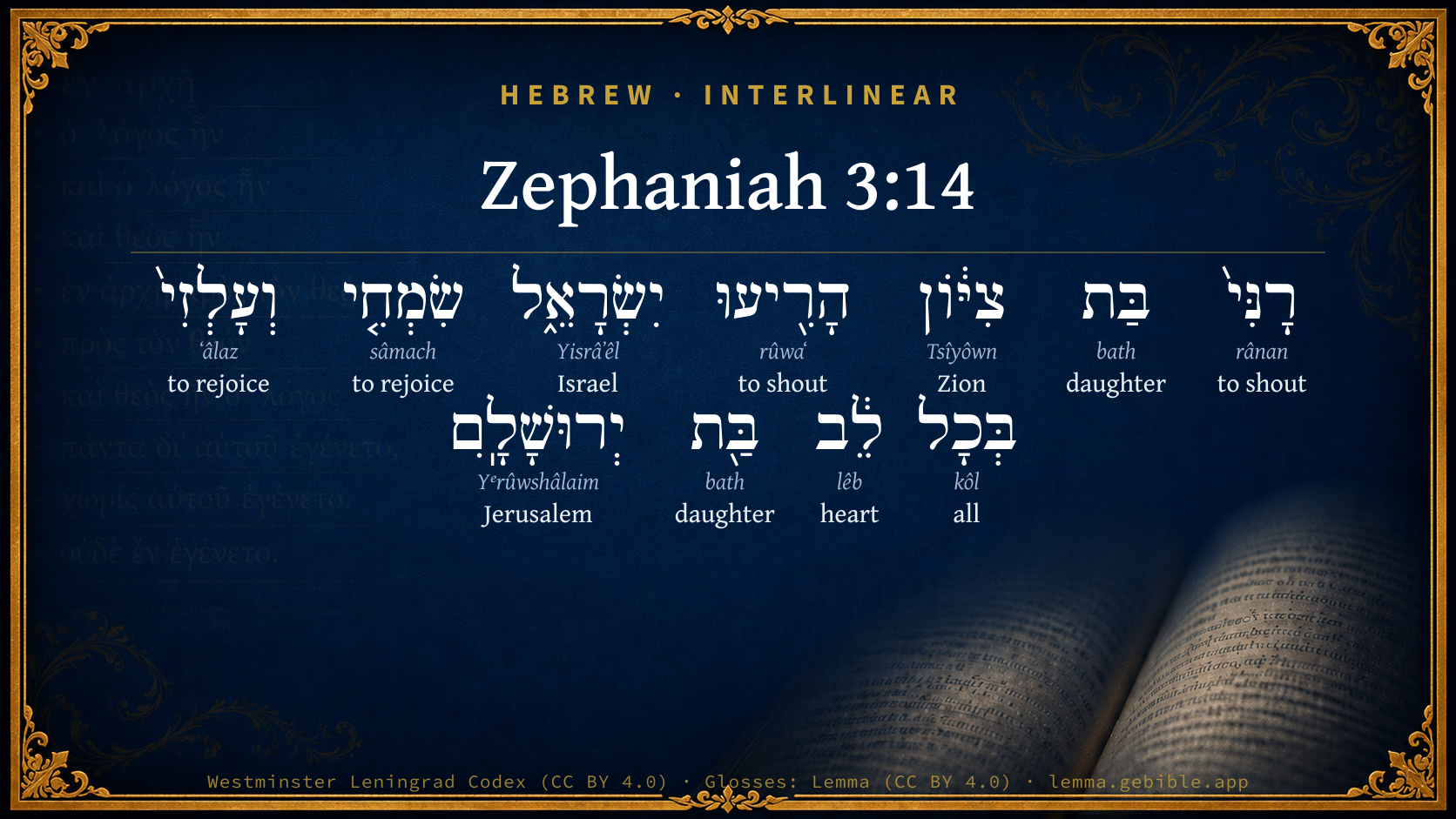
Hebrew (Westminster Leningrad Codex) Zephaniah 3:14 appears in the Hebrew Old Testament. The text above is from the Westminster Leningrad Codex. Each word links to its Strong’s number, a concise gloss, and parsing drawn from the Open Scriptures Hebrew Bible morphology. Click any word for its full Brown-Driver-Briggs (BDB) entry.
Download image
Cite this verse

Zephaniah 3:14 (World English Bible). Public Domain. Lemma interlinear Bible study tool, https://lemma.gebible.app/v/zephaniah/3/14.

Show BibTeX & RIS
BibTeX
RIS
English Translation
Sing, daughter of Zion! Shout, Israel! Be glad and rejoice with all your heart, daughter of Jerusalem.
World English Bible · Public Domain
Download a study sheet

One document with this verse’s original text, its word-by-word gloss line, the meaning frame, cross-references with their text, attributed commentary, and full source and license credits — printable, and it pastes into notes with its structure intact.

This verse Autodidact and up

Study sheet (.html) Plain text (.txt)

A passage Seminary Student

Up to 50 verses in one chapter. A passage sheet keeps up to 6 commentary sources and 12 cross-references per verse, in the order this page ranks them, and says so on the sheet whenever that leaves anything out. Ask for a single verse and you get the Autodidact verse sheet above.

Everything on this page stays free to read, with no account — the sheet is a download of what is already on screen, not access to it.

Want to remove ads? Support Godless Engineer
Compare translations 3

The same verse in 3 English versions, stacked beneath the original-language interlinear above. Click any original word for its lexicon entry.

Each is an independent rendering of the whole verse — the interlinear is not word-aligned to these translations.

Highlighted words mark where these versions differ — a whole-verse word diff, not a word-by-word alignment.

  • World English Bible Public Domain
    Sing, daughter of Zion! Shout, Israel! Be glad and rejoice with all your heart, daughter of Jerusalem.
  • King James Version Public Domain
    Sing, O daughter of Zion; shout, O Israel; be glad and rejoice with all the heart, O daughter of Jerusalem.
  • unfoldingWord Literal Text CC BY-SA 4.0
    Sing, daughter of Zion! Shout, Israel! Rejoice and exult with all of heart, daughter of Jerusalem!

unfoldingWord Literal Text — © unfoldingWord, licensed CC BY-SA 4.0. Word-aligned USFM3 via Door43 (git.door43.org/unfoldingWord/en_ult).

Versions to compare (up to 4)

3 of 4 selected

Show all 18 translations

Every available English version of this verse, each an independent rendering of the whole verse.

  • World English Bible Public Domain
    Sing, daughter of Zion! Shout, Israel! Be glad and rejoice with all your heart, daughter of Jerusalem.
  • Berean Standard Bible Public Domain
    Sing for joy, O Daughter of Zion; shout aloud, O Israel! Be glad and rejoice with all your heart, O Daughter of Jerusalem!
  • Majority Standard Bible Public Domain
    Sing for joy, O Daughter of Zion; shout aloud, O Israel! Be glad and rejoice with all your heart, O Daughter of Jerusalem!
  • King James Version Public Domain
    Sing, O daughter of Zion; shout, O Israel; be glad and rejoice with all the heart, O daughter of Jerusalem.
  • American Standard Version (1901) Public Domain
    Sing, O daughter of Zion; shout, O Israel; be glad and rejoice with all the heart, O daughter of Jerusalem.
  • Revised Version (1885) Public Domain
    Sing, O daughter of Zion; shout, O Israel; be glad and rejoice with all the heart, O daughter of Jerusalem.
  • Geneva Bible (1599) Public Domain
    Reioyce, O daughter Zion: be ye ioyfull, O Israel: be glad and reioyce with all thine heart, O daughter Ierusalem.
  • Douay-Rheims (1899) Public Domain
    Give praise, O daughter of Sion: shout, O Israel: be glad, and rejoice with all thy heart, O daughter of Jerusalem.
  • Young's Literal Translation Public Domain
    Cry aloud, O daughter of Zion, shout, O Israel, Rejoice and exult with the whole heart, O daughter of Jerusalem.
  • Literal Standard Version CC BY-SA 4.0
    Cry aloud, O daughter of Zion, shout, O Israel, || Rejoice and exult with the whole heart, O daughter of Jerusalem.
  • Unlocked Literal Bible CC BY-SA 4.0
    Sing, daughter of Zion! Shout, Israel. Be glad and rejoice with all your heart, daughter of Jerusalem.
  • unfoldingWord Literal Text CC BY-SA 4.0
    Sing, daughter of Zion! Shout, Israel! Rejoice and exult with all of heart, daughter of Jerusalem!
  • Darby Bible Public Domain
    Exult, O daughter of Zion; shout, O Israel; rejoice and be glad with all the heart, O daughter of Jerusalem:
  • World Messianic Bible Public Domain
    Sing, daughter of Zion! Shout, Israel! Be glad and rejoice with all your heart, daughter of Jerusalem.
  • Webster's Bible Public Domain
    Sing, O daughter of Zion; shout, O Israel; be glad and rejoice with all the heart, O daughter of Jerusalem.
  • Free Bible Version CC BY-SA 4.0
    Sing out, Jerusalem! Shout aloud, Israel! Jerusalem, be happy and celebrate with all your heart!
  • Bible in Basic English Public Domain
    Make melody, O daughter of Zion; give a loud cry, O Israel; be glad and let your heart be full of joy, O daughter of Jerusalem.
  • JPS Tanakh (1917) Public Domain
    Sing, O daughter of Zion, shout, O Israel; be glad and rejoice with all the heart, O daughter of Jerusalem.

Literal Standard Version (2020), Covenant Press — licensed CC BY-SA 4.0. Text via the HelloAO Bible API (eBible.org). Unlocked Literal Bible (unfoldingWord) — licensed CC BY-SA 4.0. Text via the HelloAO Bible API (eBible.org). unfoldingWord Literal Text — © unfoldingWord, licensed CC BY-SA 4.0. Word-aligned USFM3 via Door43 (git.door43.org/unfoldingWord/en_ult). Free Bible Version, Dr. Jonathan Gallagher — licensed CC BY-SA 4.0. Text via the HelloAO Bible API (eBible.org).

Word by word

More ways to search: Search by grammar → Find every occurrence → Compare this word →

Practice this passage: Drill this verse → Learn its vocabulary →

וְעָלְזִי֙
ʻâlaz
H5937
“and · rejoice”
Conjunction + Verb, Qal, Imperative, 2nd Person, Feminine, Singular
Part of Speech
Conjunction + Verb
Stem
Qal
Form
Imperative
Person
2nd Person
Gender
Feminine
Number
Singular
Full BDB Definition

Origin: a primitive root

TWOT: 1625

(Qal) to exult, rejoice, triumph
  1. רָנִּי֙ rânan H7442 “shout” Verb, Qal, Imperative, 2nd Person, Feminine, Singular
  2. בַּת bath H1323 “daughter of” Noun, Common, Feminine, Singular, Construct
  3. צִיּ֔וֹן Tsîyôwn H6726 “Zion” Noun, Proper
  4. הָרִ֖יעוּ rûwaʻ H7321 “shout” Verb, Hiphil, Imperative, 2nd Person, Masculine, Plural
  5. יִשְׂרָאֵ֑ל Yisrâʼêl H3478 “Israel” Noun, Proper
  6. שִׂמְחִ֤י sâmach H8055 “rejoice” Verb, Qal, Imperative, 2nd Person, Feminine, Singular
  7. בְּכָל kôl H3605 “in/at · all of” Preposition + Noun, Common, Masculine, Singular, Construct
  8. לֵ֔ב lêb H3820 “heart” Noun, Common, Masculine, Singular, Absolute
  9. בַּ֖ת bath H1323 “daughter of” Noun, Common, Feminine, Singular, Construct
  10. יְרוּשָׁלִָֽם Yᵉrûwshâlaim H3389 “Jerusalem” Noun, Proper

About this verse

These counts appear in no published source. They are computed here, from the morphology-tagged text and Lemma’s own curated glosses. What Lemma adds →

11
words
10
distinct lemmas
Prophets
section

Notable vocabulary

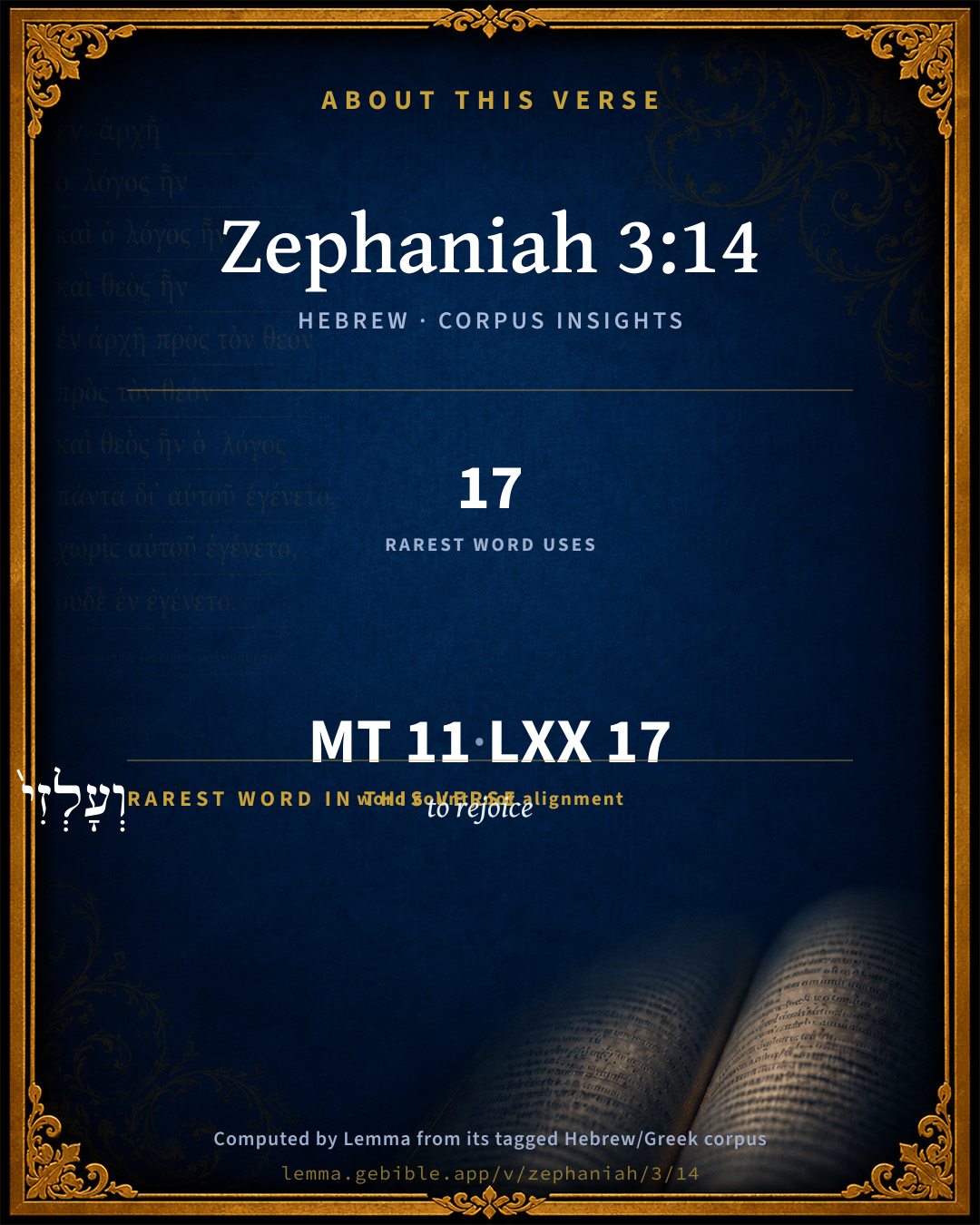
The rarest word here is וְעָלְזִי֙ to rejoice H5937 — appearing just 17 times in the whole Hebrew Bible.

Shared distinctive vocabulary

וְעָלְזִי֙ to rejoice H5937 occurs in 16 verses of the Hebrew Bible. Also found in:

Grammatical profile

  • 4 verbs
  • 7 nouns

Verb forms

  • רָנִּי֙ Qal · Imperative
  • הָרִ֖יעוּ Hiphil · Imperative
  • שִׂמְחִ֤י Qal · Imperative
  • וְעָלְזִי֙ Qal · Imperative

Repetition

A word recurs within this verse — often emphatic in Hebrew:

  • בַּת daughter H1323 ×2

Hebrew & Septuagint length

In English translation the verse runs 17 words from the Hebrew and 23 from the Septuagint (LXX English) — closely comparable.

A rough comparison of the two English renderings, which tokenize alike — not a word-level alignment.

Word counts can differ between the Hebrew and the Greek without any difference in meaning — e.g. the Hebrew direct-object marker אֵת has no separate Greek word, and Greek often adds the article ὁ.

In the original languages it is 11 Hebrew tokens and 17 Greek tokens — but the two are counted differently (Hebrew bundles its prefixes and suffixes into one token; the Greek is in lemma form), so that isn’t a like-for-like length.

Cross-references

27

Topical passages linked to Zephaniah 3:14 in the Treasury of Scripture Knowledge — connected by theme and wording, ordered by reader-vote popularity; previews shown in the World English Bible.

  • Isaiah 12:6 Cry aloud and shout, you inhabitant of Zion; for great in the midst of you is the Holy One of Israel!"
  • Micah 4:8 You, tower of the flock, the hill of the daughter of Zion, To you it will come, Yes, the former dominion will come, The kingdom of the daughter of Jerusalem.
  • Zechariah 2:10–11 Sing and rejoice, daughter of Zion; for, behold, I come, and I will dwell in the midst of you,' says Yahweh.
  • Psalms 95:1–2 Oh come, let's sing to Yahweh. Let's shout aloud to the rock of our salvation!
  • Isaiah 65:18–19 But be you glad and rejoice forever in that which I create; for, behold, I create Jerusalem a rejoicing, and her people a joy.
  • Zechariah 9:9–10 Rejoice greatly, daughter of Zion! Shout, daughter of Jerusalem! Behold, your king comes to you! He is righteous, and having salvation; Lowly, and riding on a donkey, Even on a colt, the foal of a donkey.
  • Psalms 81:1–3 Sing aloud to God, our strength! Make a joyful shout to the God of Jacob!
  • Psalms 100:1–2 Shout for joy to Yahweh, all you lands!
  • Psalms 126:2–3 Then our mouth was filled with laughter, And our tongue with singing. Then they said among the nations, "Yahweh has done great things for them."
  • Isaiah 24:14–16 These shall lift up their voice, they shall shout; for the majesty of Yahweh they cry aloud from the sea.
  • Isaiah 35:2 It shall blossom abundantly, and rejoice even with joy and singing; the glory of Lebanon shall be given to it, the excellency of Carmel and Sharon: they shall see the glory of Yahweh, the excellency of our God.
  • Isaiah 40:9 You who tell good news to Zion, go up on a high mountain; you who tell good news to Jerusalem, lift up your voice with strength; lift it up, don't be afraid; say to the cities of Judah, Behold, your God!
  • Isaiah 42:10–12 Sing to Yahweh a new song, and his praise from the end of the earth; you who go down to the sea, and all that is therein, the isles, and the inhabitants of it.
  • Isaiah 51:11 The ransomed of Yahweh shall return, and come with singing to Zion; and everlasting joy shall be on their heads: they shall obtain gladness and joy; [and] sorrow and sighing shall flee away.
  • Isaiah 54:1 Sing, barren, you who didn't bear; break forth into singing, and cry aloud, you who did not travail with child: for more are the children of the desolate than the children of the married wife, says Yahweh.
  • Isaiah 65:13–14 Therefore thus says the Lord Yahweh, Behold, my servants shall eat, but you shall be hungry; behold, my servants shall drink, but you shall be thirsty; behold, my servants shall rejoice, but you shall be disappointed;
  • Luke 2:10–14 The angel said to them, "Don't be afraid, for behold, I bring you good news of great joy which will be to all the people.
  • Ezra 3:11–13 They sang one to another in praising and giving thanks to Yahweh, [saying], For he is good, for his loving kindness endures forever toward Israel. All the people shouted with a great shout, when they praised Yahweh, because the foundation of the house of Yahweh was laid.
  • Nehemiah 12:43 They offered great sacrifices that day, and rejoiced; for God had made them rejoice with great joy; and the women also and the children rejoiced: so that the joy of Jerusalem was heard even afar off.
  • Psalms 14:7 Oh that the salvation of Israel would come out of Zion! When Yahweh restores the fortunes of his people, Then Jacob shall rejoice, and Israel shall be glad.
  • Matthew 21:9 The multitudes who went before him, and who followed kept shouting, "Hosanna to the son of David! Blessed is he who comes in the name of the Lord! Hosanna in the highest!"
  • Revelation 19:1–6 After these things I heard something like a loud voice of a great multitude in heaven, saying, "Hallelujah! Salvation, power, and glory belong to our God:
  • Psalms 47:5–7 God has gone up with a shout, Yahweh with the sound of a trumpet.
  • Jeremiah 30:19 Out of them shall proceed thanksgiving and the voice of those who make merry: and I will multiply them, and they shall not be few; I will also glorify them, and they shall not be small.
  • Jeremiah 31:13 Then shall the virgin rejoice in the dance, and the young men and the old together; for I will turn their mourning into joy, and will comfort them, and make them rejoice from their sorrow.
  • Jeremiah 33:11 the voice of joy and the voice of gladness, the voice of the bridegroom and the voice of the bride, the voice of those who say, Give thanks to Yahweh of Hosts, for Yahweh is good, for his loving kindness endures forever; [and of them] who bring [sacrifices of] thanksgiving into the house of Yahweh. For I will cause the captivity of the land to return as at the first, says Yahweh.
  • Zechariah 9:15–17 Yahweh of Hosts will defend them; And they will destroy and overcome with sling-stones; And they will drink, and roar as through wine; And they will be filled like bowls, Like the corners of the altar.

Cross-references courtesy of OpenBible.info (CC BY 4.0).

Hebrew and Greek witnesses Masoretic Hebrew ↔ Greek Septuagint

The same verse in the two great witnesses to the Old Testament, shown verse-for-verse.

These are two independent witnesses, not word-aligned to each other, and the Septuagint is shown in lemma (dictionary) form.

Hebrew Zephaniah 3:14 Masoretic · Westminster Leningrad Codex

רָנִּי֙ בַּת צִיּ֔וֹן הָרִ֖יעוּ יִשְׂרָאֵ֑ל שִׂמְחִ֤י וְעָלְזִי֙ בְּכָל לֵ֔ב בַּ֖ת יְרוּשָׁלִָֽם

Sing, daughter of Zion! Shout, Israel! Be glad and rejoice with all your heart, daughter of Jerusalem.

World English Bible · Public Domain

Greek LXX Zephaniah 3:14 Septuagint · lemma form

χαίρω σφόδρα θυγάτηρ σιων κηρύσσω θυγάτηρ ἰερουσαλήμ εὐφραίνω καί κατατέρπω ἐκ ὅλος ὁ καρδία σύ θυγάτηρ ἰερουσαλήμ

Rejoice, O daughter of Sion; cry aloud, O daughter of Jerusalem; rejoice and delight yourself with all your heart, O daughter of Jerusalem.

LXX2012 (modern English Septuagint) · Public Domain

On this verse, The Pulpit Commentary discusses the Septuagint’s reading. Read the note in Commentary ↓

Hebrew: Westminster Leningrad Codex (CC BY 4.0). Greek: Septuagint (public domain); English from LXX2012 (modern English Septuagint) (Public Domain). How the Septuagint differs from the Hebrew →

Targum (Aramaic paraphrase)

1

The Targum is the ancient Jewish Aramaic paraphrase of the Hebrew Scriptures — an interpretive translation, not the Hebrew text itself. Onkelos (literal) and Pseudo-Jonathan (expansive) render the Torah, and Jonathan the Prophets. Coverage is partial: where no permissively-licensed English translation exists for a verse, only the Aramaic is shown. This is verse-level text, not a word-by-word alignment to the Hebrew.

  1. Targum Jonathan Prophets (Joshua–Malachi)
    שַׁבְּחִי כְּנִשְׁתָּא דְצִיוֹן וּבוּעוּ יִשְׂרָאֵל חֲדוּ וּבוּעוּ בְּכָל לִבָּא כְּנִשְׁתָּא דִירוּשְׁלֵם:

    (no public-domain English translation for this verse)

    Targum Jonathan — Aramaic: “Mikraot Gedolot” (public domain). English: “Sefaria Community Translation” (CC0 1.0 (public-domain dedication)); “London "Chaldee Paraphrase," 1871” (public domain). Text via Sefaria.

Commentary

Notes on Zephaniah 3:14 from classic Christian and Jewish commentators (each source and its license shown beneath its notes). The classic Christian expositions comment on the surrounding passage and are grouped to its opening verse, so a note may address several verses; the Jewish commentaries on the Tanakh (Rashi and others) are per-verse, so they appear only where the commentator wrote on this verse.

Lemma curates 59 commentaries, every one of them public domain or Creative Commons licensed, each selected and text-cleaned for this edition rather than reprinted as found. About our sources →

Matthew Henry's Commentary

After the promises of the taking away of sin, here follow promises of the taking away of trouble; for when the cause is removed the effect will cease. What makes a people holy will make them happy of course. The precious promises here made to the purified people were to have their full accomplishment in the comforts of the gospel, in the hope, and much more in the enjoyment, of which, they are here called upon, 1. To rejoice and sing (Zep 3:14): Sing, O daughter of Zion! sing for joy; Shout, O Israel! in a holy transport and exultation; be glad and rejoice with all the heart; let the joy be inward, let it be great. Those that love God with all their heart have occasion with all their heart to rejoice in him. It was promised (Zep 3:13) that their sins should be mortified and their fears silenced, and then follows, Sing and rejoice. Note, Those that reform have cause to rejoice, whereas Israel cannot rejoice for joy as other people, while she goes a whoring from her God. God's promises, applied by faith, furnish the saints with constant and abundant matter for joy; they are filled with joy and peace in believing them. 2. To throw off all their discouragements (Zep 3:16): In that day it shall be said to Jerusalem (God will say it by his prophets, by his providences, their neighbours shall say it, they shall say it to one another), "Fear thou not, be not disposed to fear, do not easily admit the impressions of it; when things are bad, fear not their being worse, but hope they will mend; frighten not thyself upon every occasion. Let not thy hands be slack or faint; wring not thy hands in despair; drop not thy hands in despondence; disfit not thyself for thy work and warfare by giving way to doubts and fears. Pluck up thy spirits, and, in token of that, lift up thy hands, the hands that hung down, Heb 12:12; Isa 35:3. Lift up thy hands in prayer to God; lift up thy hands to help thyself." Fear makes the hands slack, but faith and hope make them vigorous, and the joy of the Lord will be our strength both for doing and suffering.

Let us now see what these precious promises are which are here made to the people of God, for the banishing of their griefs and fears and the encouraging of their hopes and joys; and to us are these promises made as well as to them.

I. An end shall be put to all their troubles and distresses (Zep 3:15): "The Lord has taken away thy judgments, has removed all the calamities thou hast been groaning under, which were the punishments of thy sin; the noise of war shall be silenced, the reproach of famine done away, and the captivity brought back. Though some grievances remain, they shall be only afflictions, and not judgments, for sin shall be pardoned. He has cast out thy enemy, that has thrust himself into thy land, and triumphed over thee. He has swept out thy enemy" (so some read it), "as dirt is swept out of the house to the dunghill." When they sweep out their sins with the besom of reformation God will sweep out their enemies with the besom of destruction. If they should need correction, they shall fall into the hands of the Lord, whose mercies are great, and shall not again fall into the hands of man, whose tender mercies are cruel: "Thou shalt not see evil any more, not such evil days as thou hast seen." Note, The way to get clear of the evil of trouble is to keep clear from the evil of sin; and to those that do so trouble has no real evil in it.

II. God will give them the tokens of his presence with them; though he has long seemed to stand at a distance (they having provoked him to withdraw), he will make it to appear that he is with them of a truth: "The Lord is in the midst of thee, O Zion! of thee, O Jerusalem! as the sun in the centre of the universe, to diffuse his light and influence upon every part. He is in the midst of thee, to preside in all thy affairs and to take care of all thy interests." And, 1. "He is the King of Israel (Zep 3:15) and is in the midst of thee as a king in the midst of his people." With an eye to this, our Lord Jesus is called the King of Israel (Joh 1:49); and he is, and will be, in the midst of his church always, even to the end of the world, to receive the homage of his subjects, and to give out his favours to them, even where but two or three are gathered together in his name. 2. "He is the Lord thy God, thine in covenant, and he is in the midst of thee as thy God, whom thou hast an interest in and whose own thou art. He has put himself into dear relations to thee, laid himself by promise under obligations to thee, and, that thou mayest have abundant comfort in both, he is in the midst of thee, nigh at hand to answer both." 3. "He that is in the midst of thee as thy God and King is mighty, is almighty, is able to do all that for thee that thou needest and canst desire." 4. "He has engaged his power for thy succour: He will save. He will be Jesus, will answer the name, for he will save his people from their sins."

III. God will take delight in them, and in doing them good. The expressions of this are very lively and affecting (Zep 3:17): He will rejoice over thee with joy, will not only be well pleased with thee, upon thy repentance and reformation, and take thee into favour, but will take a complacency in thee, as the bridegroom does in his bride, or the bride in her ornaments, Isa 62:3-5. The conversion of sinners and the consolation of saints are the joy of angels, for they are the joy of God him-self. The church should be the joy of the whole earth (Psa 48:2), for it is the joy of the whole heaven. He will rest in his love, will be silent in his love, so the word is. "I will not rebuke thee as I have done, for thy sins; I will acquiesce in thee, and in my relation to thee." I know not where there is the like expression of Christ's love to his church, unless in that song of songs, Sol 4:9, Thou hast ravished my heart, my sister, my spouse, with one of thy eyes. O the condescensions of divine grace! The great God not only loves his saints, but he loves to love them, is pleased that he has pitched upon these objects of his love. He will joy over them with singing. He that is grieved for the sin of sinners rejoices in the graces and services of the saints, and is ready to express that joy by singing over them. The Lord takes pleasure in those that fear him, and in them Jesus Christ will shortly be glorified and admired.

IV. God will comfort Zion's mourners, who sympathize with her in her griefs, and will wipe away their tears (Zep 3:18): I will gather those who are sorrowful for the solemn assemblies, to whom the reproach of it was a burden. See, 1. Who those are whom God will rejoice in and make to rejoice. They are such as are sorrowful. Those only must expect to reap in joy that sow in tears. The sorrowful now shall be for ever joyful. 2. What is the great matter of sorrow to Zion's mourners, when Zion is in mourning. Many are her calamities. The city is ruined, and the palaces are demolished; trade is at an end, and the administration of public justice; but all these are nothing to them in comparison with the desolations of the sanctuary, the destruction of the temple and the altar, to attend on which, in solemn feasts, all Israel used to come together three times a year. It is for those sacred solemn assemblies that they are sorrowful, (1.) Because they are dispersed; there is no temple to come up to, or, if there were, no people to come up to it; so that the solemn feasts and sabbaths are forgotten in Zion, Lam 2:6. Note, The restraining of public assemblies for religious worship, the scattering of them by their enemies, or the forsaking of them by their friends, so that either there are no assemblies or not solemn ones, is a very sorrowful thing to all good people. If the ways of Zion mourn, the sons of Zion mourn too. And hereby they make it to appear that they are indeed of Zion, living members of that body with the grievances of which they are so sensibly affected. (2.) Because they are despised; the reproach of the solemn assemblies is a burden to them. It had been the lot of the solemn assemblies to lie under a great deal of reproach. Satan and his instruments having a particular spite at them, as the great support of the interest of God's kingdom among men. Black and odious characters have been put upon those assemblies; and this is a burden to all those that have a cordial concern for the glory of God and the welfare of the souls of men. They reckon that the reproaches of those who reproach the solemn assemblies fall upon them, fall foul upon them.

V. God will recover the captives out of the hands of their oppressors, and bring home the banished that seemed to be expelled, Zep 3:19, Zep 3:20. 1. Their enemies shall be disabled to detain them in bondage: "At that time I will undo all that afflict thee, will break their power, and blast their counsels, so that they shall be forced to surrender the prey they have taken." Conficiam - I will take them to task; "I will be doing with them shortly, and so as to make an end of them." Note, Those that abuse and oppress God's people take the ready way to undo themselves. 2. They shall be enabled to assert and recover their liberty, and all the difficulties in the way of it shall be surmounted. Is the church weak and wounded? I will save her that halts, as was promised, Mic 4:7. He will help her when she cannot help herself; even the lame shall take the prey, Isa 33:23. Is she dispersed, and not likely to incorporate for her common benefit? I will gather her that was driven out, and bring her again at the time that I gather her. One act of mercy and grace shall serve both to collect them out of their dispersions and to conduct them to their own land. When the people's hearts are prepared, the work will be done suddenly; and who can hinder it if God undertake to effect it? "I will turn back your captivity before your eyes, saith the Lord; you shall plainly discern the hand of God in it, and say, This is the Lord's doing."

VI. God will by all this put honour upon them and gain them respect from all about them. Israel was at first made high above all nations in praise and fame, Deu 26:19. The reproach brought upon them was therefore one of the sorest of their grievances (nothing cuts deeper to those that are in honour than disgrace does); and therefore when God returns, in mercy, to his church, it is here promised that she shall regain her credit; all the reproach shall be for ever rolled way, as Israel's at Gilgal, Jos 5:9. The church shall be as honourable as ever she had been despicable. 1. Even those that reproached her shall be made to respect her: "I will get them praise and fame in every land, where they have been put to shame, that the same who were the witnesses of their disgrace may see cause to change their mind concerning them." Those that said, "This is Zion whom no man looks after," shall say, "This is Zion whom the great God looks after." And she that was looked upon to be the offscouring of the earth now appears to be the darling of heaven. 2. Even those that never knew her shall be brought to honour her (Zep 3:20): I will make you a name and a praise among all people of the earth. So the Jewish church was when the fear of the Jews fell upon their neighbours (Est 8:17), and some of all nations said, we will go with you, for we have heard that God is with you, Zac 8:23. So the Christian church was when it was made to flourish in the world, for there is that in it which may justly recommend it to the value and esteem of all the people of the earth. And so the universal church of the firstborn will be in the great day, when the saints shall be brought together to Christ, that he may be admired and glorified in them, and they admired and glorified in him before angels and men. Then will God's Israel be made a name and a praise to eternity.

Matthew Henry's Commentary on the Whole Bible (1708–1710) — public domain (CC PDM 1.0). Text via the HelloAO Bible API.

Trapp's Complete Commentary

John Trapp

Zep 3:14 Sing, O daughter of Zion; shout, O Israel; be glad and rejoice with all the heart, O daughter of Jerusalem.

Ver. 14. Sing, O daughter of Zion; shout, O Israel] Joy is the just man’s portion, which the wicked may not meddle with, Hos 9:1. In the transgression of an evil man there is a snare or a cord to strangle his joy with, to check and choke all his comforts, but the righteous sing and rejoice, Pro 29:6, they are commanded so to do; yea, the command is doubled and trebled here and elsewhere in both Testaments; and it is a sin for such not to rejoice, as well as not to repent.

Be glad and rejoice with all the heart] Which no wicked man can do: his mirth is but the hypocrisy of mirth; like a little counterfeit complexion. It may smooth the face, never cheer up the heart; like a slight dash of rain that soaketh not to the root, or a handful of brushwood or sear thorns under the pot, Ecc 7:6. As their humiliations are but skin deep, they rent their garments and not their hearts, they grieve in the face and not in the heart, Mat 6:16, so do they rejoice in the face and not with all their heart, 2Co 5:12.

John Trapp, A Commentary or Exposition upon All the Books of the Old and New Testament (1647–1656) — public domain. Text from a community e-Sword module.

The Biblical Illustrator

Joseph S. Exell

Zep_3:14-17

Sing, O daughter of Zion.

Joy: human and Divine

Here is a call to the regenerated inhabitants of Jerusalem to exult in the mercy of God, who has wrought their deliverance.

I. The joy of the regenerated man.

1. The joy of gratitude for the deliverance from evil.

2. The joy of conscious security.

II. The joy of the regenerating God. The joy of infinite benevolence. In this joy the redeemed will participate. (Homilist.)

Exhortation to joy

These words form the basis of an exhortation to joy, and are given as the reason why the Church should rejoice for her salvation, accomplished by her Saviour.

I. The great deliverance of the church.

1. The deliverer is God in Christ.

2. Her captivity, lying under judgment.

3. Imprisoned by her enemies.

4. The removal of her judgment by Christ.

5. And victory obtained over her foes.

II. Her blessed state after deliverance.

1. God is in the midst of the Church.

2. As a mighty king to protect her.

3. As a wise prince to govern her.

4. As the father of all His people, to provide for all their wants.

Hence we naturally suppose that, being thus blessed, they will gather round Him, depend upon Him, fight for Him, and live and die with Him.

III. Her promised prospects. Not see evil any more.

1. Sin shall not destroy her.

2. Satan shall not prevail against her.

3. The world shall not ruin her.

4. The law cannot condemn her.

IV. Her appointed proceedings. Let not thine hands be slack.

1. We are commanded not to fear, either Satan, the world, sin, the law, the anger of God, or wrath to come.

2. We are to be courageous. Inferences. See what encouragement--

(1) For earnestness in prayer.

(2) Diligence in reading.

(3) Constancy in hearing.

(4) Faithfulness in reproving.

(5) Boldness in standing out for Christ, and the truth of His Gospel. (T. B. Baker.)

The Biblical Illustrator, edited by Joseph S. Exell (c. 1880s–1900s) — public domain. Text from a community e-Sword module.

Joseph Benson's Commentary

Zep 3:14-15. Sing, O daughter of Zion — At that time, O daughter of Zion, thou shalt break forth into loud and joyful praises to Jehovah, for his goodness toward thee; and thou mayest even now do it, for thou shalt certainly enjoy this prosperous state. The injunction here to Zion, to be thankful and joyful, is trebled, sing, shout, and rejoice, as it is elsewhere in both Testaments; and it is a sin for the people of God not to rejoice, as well as not to repent. Thus, after the promises to take away sin, here follow promises of the taking away of trouble; for when the cause is removed, the effect will cease. What makes a people holy, will make them happy of course. But the precious promises here made to God’s purified people, although in some measure fulfilled to the Jews at their return from captivity, yet, in their full propriety of meaning, belong to the times of the gospel, and have their full accomplishment only in the comforts and joyful hopes of future felicity, which are the portion of the true disciples of the Lord Jesus. The Lord hath taken away thy judgments — That is, thy punishments. The prophet speaks of what was future, as though it were already past; of what God certainly would do, as if it were done already. He hath cast out thine enemy — Hath taken away the power of hurting thee from those who were before injurious to thee; or, hath removed thine enemies, who were the instruments of his vengeance. The King of Israel, &c., is in the midst of thee — He is returned to redeem and save thee, and gives manifest tokens of his presence in thee, and protection over thee. Thou shalt not see evil any more — While thy conduct is as becomes my presence with thee, thou shalt neither feel, nor have cause to fear, such evils as thou hast formerly suffered.

Joseph Benson's Commentary on the Old and New Testaments (1811–1818) — public domain. Text from a community e-Sword module.

Whedon's Commentary on the Bible

Daniel D. Whedon

THE JOY OF THE REDEEMED DAUGHTER OF ZION, Zep_3:14-20.

These verses, which form the closing section of the Book of Zephaniah, fall naturally into two parts, Zep_3:14-17 and Zep_3:18-20. In the former the daughter of Zion is urged to rejoice mightily, because Jehovah has redeemed her and now rules in the midst of her. In the latter Jehovah promises to the restored community deliverance from all foes, the removal of all reproach, the restoration of the dispersed, and the exaltation of the faithful among the nations of the earth.

14. Sing,… shout,… be glad and rejoice — The accumulation of these verbs indicates that there is abundant cause for rejoicing (Zec_2:10; Zec_9:9). The use of four verbs necessitated the use of several terms denoting Jerusalem, “daughter of Zion,” “Israel,” “daughter of Jerusalem.” The city might be called Israel, because it was the center of the restored and redeemed Israel.

Daniel D. Whedon (gen. ed.), Commentary on the Old and New Testaments (1874–1909) — public domain. Text from a community e-Sword module.

The Preacher's Complete Homiletical Commentary

Joseph S. Exell (gen. ed.)

CRITICAL NOTES.]

Zep_3:14.] Fulness of joy indicated by repetition of words.

Zep_3:15.] The reasons given for exultation. Evil removed, enemies destroyed, full enjoyment of God’s presence.

Zep_3:16.] Therefore no cause for fear, but reason for diligence. Slack] Faint not (Heb_12:12) through alarm and anxiety (Isa_13:7).

Zep_3:17.] Jehovah within is mighty to help and save, and rejoices over his rescued people (Isa_62:5; Isa_65:19). Rest] Be silent in his love; love deeply felt and absorbed in its objects. “As a man caresses his dearest wife, so will God then quietly repose in thy love” [Calvin]. To be silent, not to speak, is here very appropriately employed to express the non-remembrance of iniquity [Hend.].

HOMILETICS

THE JOY OF THE REDEEMED.—Zep_3:14-17

These words are a call to the converted Israelites, and the inhabitants of Jerusalem, to exult in their distinguished blessings. The prophet seems to be in a transport of joy himself, as he adds word to word, and epithet to epithet, in tender feelings. Three designations are given: “Daughter of Zion,” “Israel,” and “daughter of Jerusalem.” The wonders of “that day” are great, and the source of exultant joy to all who see them. The causes of this joy are distinctly pointed out.

I. Judgments are removed. “The Lord hath taken away thy judgments.” Israel was chastised in mercy, but God forgave her sins, and took away her judgments. Christians are freed from condemnation by the law, and rejoice in hope of salvation. When sin is pardoned, the consequences of sin are removed. When the cause is destroyed the effects will cease; happiness follows the way of holiness.

II. Enemies are subdued. “He hath cast out (lit. cleared quite away) thine enemy.” This is a type of the destruction of antichrist, the casting out of the prince of this world (Mat_12:31), and the overthrow of all opposition. Delivered from all enemies, God’s people will serve him without fear, in holiness and righteousness all their days (Luk_1:74-75).

III. God is enthroned in their midst. “Even the Lord is in the midst of thee.” God seemed to desert them for a time, but now returns to a purified temple. As King of Israel he sits enthroned in mercy to receive the homage of a grateful nation. He dwells in the Church, and will be with his people to the end of time.

1. To deliver them from evil. “Thou shalt not see evil any more.”

2. To strengthen their hearts. They will neither be weary nor faint in God’s service. Saving health will be imparted, timidity shall be overcome, and men will admire their courage.

3. To rejoice over them with sacred joy. “He will rejoice over thee with joy.” With a bridegroom’s joy will God “rejoice in Jerusalem, and joy in his people” (Isa_65:19; Isa_62:5). But man’s love is only a faint shadow of God’s love. Love in twofold aspects—in its silence and exultation—represents God’s satisfaction and joy in his people. He exults over and takes pleasure in those that fear him. Rejoicing now is only the first-fruits. Those who weep by the rivers of Babylon will sing in the new Jerusalem: “Sing, (O daughter of Zion), shout, (O Israel), be glad, and rejoice with all thy heart, O daughter of Jerusalem.”

HOMILETIC HINTS AND OUTLINES

Zep_3:14. Whether the Church or the faithful soul—she is summoned by all her names—called to the fullest joy in God, with every expression, and every feeling. Sing; it is the inarticulate, thrilling, trembling burst of joy: shout; again the inarticulate, yet louder, swell of joy; a trumpet-blast: and then, too, deep within; be glad, the calm inward joy of the soul; exult, the triumph of the soul which cannot contain itself for joy; and this, with the whole heart, no corner of it not pervaded with joy. The ground of this is the complete removal of every evil, and the full presence of God [Pusey].

Zep_3:15-17. Very remarkable is the use of the sacred number three in these verses. Threefold is the description of their being freed from sins:

(1) They shall not do iniquity;

(2) nor speak lies;

(3) neither shall a deceitful tongue be in their mouth. Threefold their blessedness: They shall

(1) feed;

(2) lie down;

(3) none make them afraid. Threefold the exhortation to joy: sing, to God the Father; shout, to God the Son; be glad and rejoice, in God the Holy Ghost. The promise is threefold:

(1) Thou shalt not see evil any more;

(2) fear thou not;

(3) let not thine hands be slack. The love of God is threefold:

(1) He will rejoice over thee with joy;

(2) He will rest in his love;

(3) He will joy over thee with singing [Pusey].

Zep_3:17. God in the midst.

1. God near. In his works, but specially present with his saints.

2. God mighty. Mighty to comfort, sustain, and defend.

3. God will save. He is willing, bound by promise, oath, and blood.

4. But is he thy God? Thine by promise, covenant, and actual possession.

“How happy, then, are they to whom

The Lord our God is known;

Whom he, from all the world besides,

Has chosen for his own!”

He will rejoice over thee. The satisfaction here implied is the Saviour’s own joy arising out of the salvation of his people. First, we may view this joy as the result of success. Secondly, as a manifestation of benevolence. Thirdly, as indicative of the delight and complacency with which he regards his people. The Saviour’s joy over, and in, his people is the sinner’s hope. Lastly, the Saviour’s joy is the saint’s example. He was infinitely more than an example, and nothing less. If we depend upon him, we must resemble him [Jay].

ILLUSTRATIONS TO CHAPTER 3

Zep_3:14-15. Sing. Thy words have darted hope into my soul, and comfort dawns upon me [Southern].

“Joy is our duty, glory, health,

The sunshine of the soul;

Our best encomium on the Power

Who sweetly plans the whole” [Young].

The Preacher's Complete Homiletical Commentary (gen. ed. Joseph S. Exell; Funk & Wagnalls, c. 1892) — public domain (pre-1929). A full-Bible homiletical/sermon-outline anthology covering 65 of 66 books (2 John is absent from the source module). Text from a community e-Sword module.

MacLaren's Expositions of Holy Scripture

Alexander MacLaren

Zephaniah

ZION’S JOY AND GOD’S

Zep 3:14, Zep 3:17.

What a wonderful rush of exuberant gladness there is in these words! The swift, short clauses, the triple invocation in the former verse, the triple promise in the latter, the heaped together synonyms, all help the impression. The very words seem to dance with joy. But more remarkable than this is the parallelism between the two verses. Zion is called to rejoice in God because God rejoices in her. She is to shout for joy and sing because God’s joy too has a voice, and breaks out into singing. For every throb of joy in man’s heart, there is a wave of gladness in God’s. The notes of our praise are at once the echoes and the occasions of His. We are to be glad because He is glad: He is glad because we are so. We sing for joy, and He joys over us with singing because we do.

I. God’s joy over Zion.

It is to be noticed that the former verse of our text is followed by the assurance: ‘The Lord is in the midst of thee’; and that the latter verse is preceded by the same assurance. So, then, intimate fellowship and communion between God and Israel lies at the root both of God’s joy in man and man’s joy in God.

We are solemnly warned by ‘profound thinkers’ of letting the shadow of our emotions fall upon God. No doubt there is a real danger there; but there is a worse danger, that of conceiving of a God who has no life and heart; and it is better to hold fast by this-that in Him is that which corresponds to what in us is gladness. We are often told, too, that the Jehovah of the Old Testament is a stern and repellent God, and the religion of the Old Testament is gloomy and servile. But such a misconception is hard to maintain in the face of such words as these. Zephaniah, of whom we know little, and whose words are mainly forecasts of judgments and woes pronounced against Zion that was rebellious and polluted, ends his prophecy with these companion pictures, like a gleam of sunshine which often streams out at the close of a dark winter’s day. To him the judgments which he prophesied were no contradiction of the love and gladness of God. The thought of a glad God might be a very awful thought; such an insight as this prophet had gives a blessed meaning to it. We may think of the joy that belongs to the divine nature as coming from the completeness of His being, which is raised far above all that makes of sorrow. But it is not in Himself alone that He is glad; but it is because He loves. The exercise of love is ever blessedness. His joy is in self-impartation; His delights are in the sons of men: ‘As the bridegroom rejoiceth over the bride, so shall thy God rejoice over thee.’ His gladness is in His children when they let Him love them, and do not throw back His love on itself. As in man’s physical frame it is pain to have secretions dammed up, so when God’s love is forced back upon itself and prevented from flowing out in blessing, some shadow of suffering cannot but pass across that calm sky. He is glad when His face is mirrored in ours, and the rays from Him are reflected from us.

But there is another wonderfully bold and beautiful thought in this representation of the gladness of God. Note the double form which it assumes: ‘He will rest’-literally, be silent-’in His love; He will joy over thee with singing.’ As to the former, loving hearts on earth know that the deepest love knows no utterance, and can find none. A heart full of love rests as having attained its desire and accomplished its purpose. It keeps a perpetual Sabbath, and is content to be silent.

But side by side with this picture of the repose of God’s joy is set with great poetic insight the precisely opposite image of a love which delights in expression, and rejoices over its object with singing. The combination of the two helps to express the depth and intensity of the one love, which like a song-bird rises with quivering delight and pours out as it rises an ever louder and more joyous note, and then drops, composed and still, to its nest upon the dewy ground.

II. Zion’s joy in God.

To the Prophet, the fact that ‘the Lord is in the midst of thee’ was the guarantee for the confident assurance ‘Thou shalt not fear any more’; and this assurance was to be the occasion of exuberant gladness, which ripples over in the very words of our first text. That great thought of ‘God dwelling in the midst’ is rightly a pain and a terror to rebellious wills and alienated hearts. It needs some preparation of mind and spirit to be glad because God is near; and they who find their satisfaction in earthly sources, and those who seek for it in these, see no word of good news, but rather a ‘fearful looking for of judgment’ in the thought that God is in their midst. The word rendered ‘rejoices’ in the first verse of our text is not the same as that so translated in the second. The latter means literally, to move in a circle; while the former literally means, to leap for joy. Thus the gladness of God is thought of as expressing itself in dignified, calm movements, whilst Zion’s joy is likened in its expression to the more violent movements of the dance. True human joy is like God’s, in that He delights in us and we in Him, and in that both He and we delight in the exercise of love. But we are never to forget that the differences are real as the resemblances, and that it is reserved for the higher form of our experiences in a future life to ‘enter into the joy of the Lord.’

It becomes us to see to it that our religion is a religion of joy. Our text is an authoritative command as well as a joyful exhortation, and we do not fairly represent the facts of Christian faith if we do not ‘rejoice in the Lord always.’ In all the sadness and troubles which necessarily accompany us, as they do all men, we ought by the effort of faith to set the Lord always before us that we be not moved. The secret of stable and perpetual joy still lies where Zephaniah found it-in the assurance that the Lord is with us, and in the vision of His love resting upon us, and rejoicing over us with singing. If thus our love clasps His, and His joy finds its way into our hearts, it will remain with us that our ‘joy may be full’; and being guarded by Him whilst still there is fear of stumbling, He will set us at last ‘before the presence of His glory without blemish in exceeding joy.

Alexander MacLaren, Expositions of Holy Scripture (1904–1910) — public domain. Text from a community e-Sword module.

Tyndale Open Study Notes

Tyndale Open Resources

3:14 Sing . . . shout aloud . . . ! Be glad and rejoice: The cumulative effect of these commands emphasizes that God’s people will one day experience unsurpassed joy.

Tyndale Open Study Notes — © Tyndale Open Resources, licensed CC BY-SA 4.0. Text via the HelloAO Bible API.

unfoldingWord translationNotes

Door43 World Missions Community

General Information:

In verses Zep 3:14-20, Zephaniah tells the remnant of Israel who survived the judgment that they should rejoice.

daughter of Zion ... daughter of Jerusalem

Here "daughter" refers to all the people who lived in the city. (See: Idiom)

Be glad and rejoice

These two phrases mean the same thing and emphasize how happy they should be. AT: "Be very happy" (See: Doublet)

with all your heart

Here "heart" refers to the inner being of a person. AT: "with all your inner being" (See: Metonymy)

Yahweh has taken away your punishment

Here to "take away" punishment is an idiom that means to stop doing it. AT: "Yahweh has stopped punishing you" (See: Idiom)

You will never again fear evil

The abstract noun "evil" can be stated as an action. AT: "You will no longer be afraid that people will harm you" (See: Abstract Nouns)

In that day

"At that time" or "When this happens." This phrase here refers to the time of peace and restoration that immediately follows the day of Yahweh.

say to Jerusalem ... Zion

The names of these cities here refer to the people who live in them. AT: "say to the people of Jerusalem ... people of Zion" (See: Metonymy)

Do not let your hands falter

To feel weak or helpless is spoken of as if their hands became physically weak. Here "hands" represents the whole person. AT: "Do not become weak" (See: Metaphor and Synecdoche)

translationWords

Zion

joy

heart

Jerusalem

punish

king

evil

unfoldingWord translationNotes — © Distant Shores Media and the Door43 World Missions Community, licensed CC BY-SA 4.0. Source: git.door43.org/Door43/en_tn.

Jamieson, Fausset & Brown

Robert Jamieson, A. R. Fausset & David Brown

The prophet in mental vision sees the joyful day of Zion present, and bids her rejoice at it.

Jamieson, Fausset & Brown — Commentary Critical and Explanatory on the Whole Bible (1871) — public domain (CC PDM 1.0). Text via the HelloAO Bible API.

Adam Clarke's Commentary

Verse 14. Sing, O daughter of Zion] Here is not only a gracious prophetic promise of their restoration from captivity, but of their conversion to God through Christ.

Adam Clarke's Commentary on the Bible (1810–1826) — public domain. Text from a community e-Sword/MySword module.

John Calvin's Commentaries

The Prophet confirms what he has been teaching, and encourages the faithful to rejoice, as though he saw with his eyes what he had previously promised. For thus the Prophets, while encouraging the faithful to entertain hope, stimulate them to testify their gratitude, as though God’s favor was already enjoyed. It is certain, that this instruction was set before the Jews for this purpose,—that in their exile and extreme distress they might yet prepare themselves to give thanks to God, as though they were already, as they say, in possession of what they had prayed for. But we must remember the design of our Prophet, and the common mode of proceeding which all the Prophets followed; for the faithful are exhorted to praise God the same as if they had already enjoyed his blessings, which yet were remote, and seemed concealed from their view.

We now then perceive what the Prophet meant in encouraging the Jews to praise God: he indeed congratulates them as though they were already enjoying that happiness, which was yet far distant: but as it is a congratulation only, we must also bear in mind, that God deals so bountifully with his Church as to stimulate the faithful to gratitude; for we pollute all his benefits, except we return for them, as it has been stated elsewhere, the sacrifice of praise: and as a confirmation of this is the repetition found here, which would have otherwise appeared superfluous. "Exult, daughter of Sion, shout, be glad; rejoice with all thine heart, daughter of Jerusalem.”

But the Prophet was not thus earnest without reason; for he saw how difficult it was to console the afflicted, especially when God manifested no evidence of hope according to the perception of the flesh; but his purpose was by this heap of words to fortify them, that they might with more alacrity struggle with so many hard and severe trials.

He then adds, that God had taken away the judgments of Zion. By judgments, he means those punishments which would have been inflicted if it had been the Lord’s purpose to deal according to strict justice with the Jews, as when any one says in our language, J’ai brule tous tes proces. He intimates then that God would no more make an enquiry as to the sins of his people. The word משפט, meshiphath, we know, has various meanings in Hebrew; but in this place, as I have said, it means what we call in French, Toutes procedures. In short, God declares that the sins of his people are buried, so that he in a manner cuts off his character as a judge, and remits his own right, so that he will no more contend with the Jews, or summon them, as they say, to trial. Jehovah then will take away thy judgments

Then follows an explanation, By clearing he has turned aside all enemies; for we know that war is one of God’s judgments. As then God had punished the Jews by the Assyrians, by the Egyptians, by the Chaldeans, and by other heathen nations, he says now, that all enemies would be turned away. It hence follows, that neither the Assyrians nor the Chaldeans had assailed them merely through their own inclination, but that they were, according to what has been elsewhere stated, the swords, as it were, of God.

It afterwards follows, The king of Israel is Jehovah in the midst of thee. Here the Prophet briefly shows, that the sum of real and true happiness is then possessed, when God declares, that he undertakes the care of his people. God is said to be in the midst of us, when he testifies that we live under his guardianship and protection. Properly speaking, he never forsakes his own; but these forms of speech, we know, are to be referred to the perception of the flesh. When the Lord is said to be afar off, or to dwell in the midst of us, it is to be understood with reference to our ideas: for we think God to be then absent when he gives liberty to our enemies, and we seem to be exposed as a prey to them; but God is said to dwell in the midst of us when he protects us by his power, and turns aside all assaults. Thus, then, our Prophet now says, that God will be in the midst of his Church; for he would really and effectually prove that he is the guardian of his elect people. He had been indeed for a time absent, when his people were deprived of all help, according to what Moses expresses when he says, that the people had deluded themselves, because they had renounced God, by whose hand they had been safely protected, and were also to be protected to the end. Exodus 32:25

He lastly adds, Thou shalt not see evil. Some read, “Thou shalt not fear evil,” by inserting י, iod; but the meaning is the same: for the verb, to see, in Hebrew is, we know, often to be taken in the sense of finding or experiencing. Thou shalt then see no evil; that is, God will cause thee to live in quietness, free from every disturbance. If the other reading, Thou shalt not fear evil, be preferred, then the reference is to the blessing promised in the law; for nothing is more desirable than peace and tranquillity. Since then this is the chief of temporal blessings, the Prophet does not without reason say, that the Church would be exempt from all fear and anxiety, when God should dwell in the midst of it, according to what he says in Psalm 46:1. It now follows—

John Calvin's Commentaries (1540-1563) — public domain. Text from the Calvin Translation Society English edition (1840s-50s) via the Christian Classics Ethereal Library (ccel.org). Calvin's coverage is partial (roughly two-thirds of the Bible); uncommented books and verses are honest gaps, never fabricated. The 19th-century editor's footnotes and remarks are omitted so the notes are faithfully Calvin's own voice.

Ellicott's Commentary for English Readers

(14-20) The blessedness of Jerusalem when she has been thus brought through suffering to glory.

A Bible Commentary for English Readers, edited by Charles John Ellicott (1878–1897) — public domain. Text from a community e-Sword module.

The Cambridge Bible for Schools and Colleges

gen. ed. J. J. S. Perowne

14. Sing, O daughter of Zion] Isa_54:1.

14–20. The Joy of the Redeemed People in the Lord’s Presence among them

The prophet looks forward to the time when all Zion’s afflictions shall be over, when she shall be redeemed and all her captive children restored, when the end contemplated by the Covenant, and towards which her history has been moving, even the Lord’s full presence in the midst of her, shall have been reached. In those days Zion shall sing and shout for joy, for her name shall be The Lord is there (Eze_48:35).

The Cambridge Bible for Schools and Colleges (gen. ed. J. J. S. Perowne; Cambridge University Press, 1878–1918) — public domain. Text from a community e-Sword module.

John Gill's Exposition

Sing, O daughter of Zion The congregation of Zion, as the Targum; the church of Christ in Gospel times, which has great reason to sing and rejoice, because of the coming of Christ, redemption by him, and all other benefits and blessings of grace; because of the Gospel, and the ordinances of it, and the numbers of souls converted, both among Jews and Gentiles; especially the church in the latter day is here called upon to sing for joy, when the Jews will be converted; to which these words and what follow relate: shout, O Israel; the ten tribes, as Kimchi and Ben Melech interpret it; which shall now return, and all Israel shall be saved, ( Romans 11:26 ) and therefore just cause of shouting, and of keeping a jubilee on that account: be glad and rejoice with all the heart, O daughter of Jerusalem; the metropolis of the two tribes; for now the children of Israel and of Judah shall be together, and seek the Lord their God, and the true Messiah, and find him; and shall embrace him, profess and serve him; which will be matter of great joy; and this will be sincere and hearty, and devoid of all hypocrisy. Several terms are used, describing the people of the Jews, to comprehend them all; and several words to express their joy, in order to set forth the greatness of it, as their happy case would require; as follows:

John Gill's Exposition of the Whole Bible (1746–1763) — public domain (CC PDM 1.0). Text via the HelloAO Bible API.

Albert Barnes' Notes on the Bible

Sing, O daughter of Sion; shout, O Israel; be glad and rejoice with all the heart, O daughter of Jerusalem - Very remarkable throughout all these verses is the use of the sacred number three, secretly conveying to the thoughtful soul the thought of Him, Father Son and Holy Spirit, the Holy and Undivided Trinity by whose operation these things shall be. Threefold is the description of their being freed from sins:

(1) they shall “not do iniquity,”

(2) “nor speak lies,”

(3) “neither shall a deceitful tongue be found in their mouth.”

Threefold their blessedness; They shall:

(1) “feed,”

(2) “lie down,”

(3) “none make them afraid.”

Threefold the exhortation to joy here. (Rup.): “Sing to God the Father; ‘shout’ to God the Son; ‘be glad and rejoice’ in God the Holy Spirit, which Holy Trinity is One God, from whom thou hast received it that thou art:

(1) ‘the daughter of Zion’

(2) ‘Israel’

(3) ‘the daughter of Jerusalem’

‘The daughter of Zion’ by faith, ‘Israel’ by hope, ‘Jerusalem’ by charity.” And this hidden teaching of that holy mystery is continued; “The Lord,” God the Father, “hath taken away thy judgments; He God” the Son, “hath cast out (cleared quite away) thine enemy; the king of Israel, the Lord,” the Holy Spirit, “is in the midst of thee!” Zep 3:15. The promise is threefold:

(1) “thou shalt not see evil anymore”

(2) “fear thou not”

(3) “let not thine hands be slack”

The love of God is threefold:

(1) “He will rejoice over thee with joy”

(2) “He will rest in His love”

(3) “He will joy over thee with singing”

Again the words in these four verses are so framed as to be “ful”- filled in the end. All in this life are but shadows of that fullness. First, whether the Church or the faithful soul, she is summoned by all her names, “daughter of Zion” (“the thirsty” athirst for God) “Israel” (“Prince with God”) “Jerusalem” (“City of Peace”). By all she is called to the fullest joy in God with every expression and every feeling. “Sing;” it is the inarticulate, thrilling, trembling burst of joy; “shout;” again the inarticulate yet louder swell of joy, a trumpet-blast; and then too, deep within, “be glad,” the calm even joy of the inward soul; “exult,” the triumph of the soul which cannot contain itself for joy; and this, “with the whole heart,” no corner of it not pervaded with joy. The ground of this is the complete removal of every evil, and the full presence of God.

Albert Barnes' Notes on the Bible (1834–1885) — public domain. Text from a community e-Sword/MySword module.

Matthew Poole's English Annotations

For all these mercies the church is enjoined to be thankful, and to rejoice, and it is trebled,

Sing, shout, and rejoice, O daughter of Zion, Israel, and daughter of Jerusalem: the same persons, the same duty, but differently expressed, but the whole heart required in all.

Matthew Poole's English Annotations on the Holy Bible (1683–1685) — public domain. Text from a community e-Sword/MySword module.

The Pulpit Commentary

Vers 14-20. Israel shall be cam forted and largely blessed by the presence of Jehovah and exalted to honour in the eyes of all the world.

In view of the coming blessing, the prophet bursts forth in exultation, yet with a vein of prophecy running through all the canticle. After the late denunciation of woe and judgment, he soothes the faithful with the promise of the grace and peace which the time of Messiah shall bring. Sing, O daughter of Zion. (Isa_1:8 Zec_2:1-4 Zec_9:9) He calls on the restored remnant of Judah to show its joy by outward tokens. O Israel. All the tribes are to unite in praising God. This is one of the passages where "Israel" is supposed to have been written by mistake for "Jerusalem." So Jer_23:6. The LXX gives, yugater Ierousalhm , "daughter of Jerusalem". (see note on Zec_1:19) The prophet enjoins a triple note of exultation in order to confirm the universal joy. (On the use of the number "three" in this passage, see Dr. Pusey"s note, p. 480.)

Vers. 14-17. The reciprocal joy of Israel and Jehovah.

I THE JOY OF ISRAEL IN JEHOVAH. (Vers. 14-16)

1. The character in which Israel is summoned to rejoice. Indicated by the names in which she is addressed.

(1) Daughter of Zion. Zion meaning "sunny," hence "arid," and so "thirsty," or thirsting after God.

(2) Israel. Signifying "Prince of God," or one who has power with God, and can prevail.

(3) Daughter of Jerusalem. Equivalent to "City of peace." At all events, those whom God calls to rejoice in the fulness of his salvation are those who hunger and thirst after righteousness, (Mat_5:6) these who seek his face and call upon his Name, (Rom_10:12) and those who are possessed of a spirit of peace. (Mat_5:9)

1. The enthusiasm with which she is invited to rejoice. Suggested by the threefold call to sing, shout, and be glad. Sing, it is the inarticulate, thrilling, trembling burst of joy; shout, again the inarticulate, yet louder swell of joy, a trumpet blast; and then too, deep within, be glad, the calm even joy of the inward soul; exult, the triumph of the soul which cannot contain itself for joy; and this with the whole heart, no corner of it not pervaded with joy" (Pusey).

2. The grounds on which Israel is called to rejoice.

(1) Judgments taken away. The calamities inflicted on her because of her iniquities have been removed. (Isa_40:2) Meaning, her sins have been pardoned. Believers under the gospel have the same cause for exultation. For them, as for Israel, is no condemnation more. (Rom_5:11 Rom_8:1)

(2) Enemies cast out. In the case of Israel this was so far true that henceforth she was no more seriously harassed as a nation after the restoration. Of believers under the gospel it is true that their chief enemy, the prince of this world, has been cast out by Jesus Christ, (Joh_12:31) while sin, which represents his power in them, will ultimately be expelled from their renewed natures. (Gal_1:4 Eph_1:4 Eph_5:27 Tit_2:15)

(3) God returned. As her covenant God, Lord thy God;" rightful King, King of Israel, even the Lord, is in the midst of thee;" powerful Protector, the Lord thy God is "a Mighty One who will save thee." In the same characters God abides in the Church and dwells in the heart of the believer.

(4) Prosperity secured. With Jehovah in her midst she shall no more see or experience evil. (Psa_91:10) The same true of the Christian believer, in whose heart God dwells. (2Th_3:3 1Pe_3:13)

3. The signs Israel shows that she does rejoice.

(1) No more fear. "In that day it shall be raid to Jerusalem, Fear thou not." So Christ says to his little flock, "Fear not!". (Luk_12:32Jo Luk_6:20)

(2) No more despondency. "O Zion, let not thine hands be slack." Drooping hands are the sign of a fainting heart. Believers are exhorted to faint not. (Luk_18:1 2Co_4:16)

(3) No more indolence. Slack hands are idle hands; and no greater enemy to activity in Churches or individuals exists than lack of joy, as nothing stimulates to religious work like the experience of religious joy.

II THE JOY OF JEHOVAH IN ISRAEL. (Ver. 17)

1. The character of this joy. The joy:

(1) Of a conqueror over the prey he has captured (ver. 8); Israel in her restoration being a trophy of his prowess.

(2) Of an artificer in the work of his hands (ver. 11); Israel in her purified condition being a production of his grace.

(3) Of an owner in the value of his possession (ver. 10); Jehovah speaking of Israel as "his dispersed.

(4) Of a lover in the object of his affection, as e.g. of a bridegroom in his. (Isa_62:5)

1. The tenderness of this joy. It was a joy springing out of love to Israel, the joy of one who seeks the happiness of another, rather than of one who glories in his own felicity. In God"s joy over Israel is no element of selfishness; it is all sympathy and affection.

2. The intensity of this joy. Marked by the gradation of clauses. Beginning with an inward feeling of delight, it swells in volume and deepens in tenderness till it becomes too great for utterance, and the subject of it is "silent in his love," after which it keeps on rising like a tide, till at length it overflows the soul"s banks and breaks forth into song.

3. The spontaneity of this joy. It is not meant that Jehovah"s joy in Israel is occasioned or evoked by Israel"s joy in Jehovah, but rather that Jehovah"s joy in Israel should prompt and sustain Israel"s joy in Jehovah, As "we love him because he first loved us", (1Jn_4:19) so can we only "joy in God through our Lord Jesus Christ" (Rom_5:11) when we realize that he for Christ"s sake is well pleased with us. T.W.

Vers. 14-17. Joy, human and Divine.

"Sing, O daughter of Zion; shout, O Israel; be glad and rejoice with all the heart, O daughter of Jerusalem. The Lord hath taken away thy judgments, he hath cast out thine enemy," etc. Here is a call to the regenerated inhabitants of Jerusalem to exult in the mercy of God, who has wrought their deliverance, at the same time, a beautiful description of the sublime delight with which Jehovah will regard them in the future. The words bring under our notice joy, human and Divine.

I THE JOY OF THE REGENERATED MAN. "Sing, O daughter of Zion; shoat, O Israel; be glad and rejoice." What is the joy?

1. The joy of gratitude for the deliverance,from evil. "The Lord hath taken away thy judgments, he hath east out thine enemy." What is the joy of the slave in the hour of his emancipation, of the prisoner on leaving his cell, of the long suffering invalid on his restoration to full health? Far more is the joy of the man who feels himself morally delivered delivered from the power of sin, and brought into the "glorious liberty of the children of God." Gratitude is always an element of joy.

2. The joy of conscious security. "Even the Lord is in the midst of thee: thou shalt not see evil any more." What joy breaks forth in the apostolic challenge, "Who shall separate us from the love of God?" etc.! Here is the joy of regenerated humanity, the joy of gratitude for the greatest deliverance, the joy of conscious security from all possible dangers.

II THE JOY OF THE REGENERATING GOD. "The Lord thy God in the midst of thee within thee is mighty; he will save, he will rejoice over thee with joy; he will rest in his love, he will joy over thee with singing." What is the joy of God? It is the joy of infinite benevolence. What is the joy of the genuine patriot when he has delivered his country from a power that threatened its utter destruction? What is the joy of a loving physician when he has rescued his patient from the very jaws of death? What is the joy of a loving parent who has rescued his child from ruin? Some such joy as this infinitely superior is the joy of God over regenerated humanity. In this joy the redeemed will participate; indeed, it will be their heaven. "Enter into the joy of thy Lord." "Rejoice over thee with singing." Does God sing? Yes; in all the happy voices of the universe, especially in the shouts of the redeemed. D.T.

The Pulpit Commentary (1880–1919), ed. H.D.M. Spence-Jones & Joseph S. Exell — public domain. Text from a community e-Sword module.

Keil & Delitzsch

C. F. Keil & F. Delitzsch

"Exult, O daughter Zion; shout, O Israel! rejoice and exult with all the heart, O daughter Jerusalem. Zep 3:15. Jehovah has removed thy judgments, cleared away thine enemy; the King of Israel, Jehovah, is in the midst of thee: thou wilt see evil no more. Zep 3:16. In that day will men say to Jerusalem, Fear not, O Zion; let not thy hands drop. Zep 3:17. Jehovah thy God is in the midst of thee, a hero who helps: He rejoices over thee in delight, He is silent in His love, exults over thee with rejoicing." The daughter Zion, i.e., the reassembled remnant of Israel, is to exult and shout at the fulness of the salvation prepared for it. The fulness is indicated in the heaping up of words for exulting and rejoicing. The greater the exultation, the greater must the object be over which men exult. הריעוּ, to break out into a cry of joy, is a plural, because the Israel addressed is a plurality. The re-establishment of the covenant of grace assigns the reason for the exultation. God has removed the judgments, and cleared away the enemies, who served as the executors of His judgments. Pinnâh, piel, to put in order (sc., a house), by clearing away what is lying about in disorder (Gen 24:31; Lev 14:36), hence to sweep away or remove. 'Oyēbh: with indefinite generality, every enemy. Now is Jehovah once more in the midst of the daughter Zion as King of Israel, whereas, so long as Israel was given up to the power of the enemy, He had ceased to be its King. Yehōvâh is in apposition to melekj Yisrâ'ēl, which is placed first for the sake of emphasis, and not a predicate. The predicate is merely בּקרבּך (in the midst of thee). The accent lies upon the fact that Jehovah is in the midst of His congregation as King of Israel (cf. Zep 3:17). Because this is the case, she will no more see, i.e., experience, evil (ראה as in Jer 5:12; Isa 44:16, etc.), and need not therefore any longer fear and despair. This is stated in Zep 3:16 : They will say to Jerusalem, Fear not. She will have so little fear, that men will be able to call her the fearless one. ציּון is a vocative of address. It is simpler to assume this than to supply ל from the previous clause. The falling of the hands is a sign of despair through alarm and anxiety (cf. Isa 13:7). This thought is still further explained in Zep 3:17. Jehovah, the God of Zion, is within her, and is a hero who helps or saves; He has inward joy in His rescued and blessed people (cf. Isa 62:5; Isa 65:19). יחרישׁ בּאחבתו appears unsuitable, since we cannot think of it as indicating silence as to sins that may occur (cf. Psa 50:21; Isa 22:14), inasmuch as, according to Zep 3:13, the remnant of Israel commits no sin. Ewald and Hitzig would therefore read yachădı̄sh; and Ewald renders it "he will grow young again," which Hitzig rejects as at variance with the language, because we should then have יתחדּשׁ. He therefore takes yachădı̄sh as synonymous with יעשׂה חדשׁות, he will do a new thing (Isa 43:19). But this rendering cannot be justified by the usage of the language, and does not even yield a thought in harmony with the context. Silence in His love is an expression used to denote love deeply felt, which is absorbed in its object with thoughtfulness and admiration,

(Note: "He assumes the person of a mortal man, because, unless He stammers in this manner, He cannot sufficiently show how much He loves us. Thy God will therefore be quiet in His love, i.e., this will be the greatest delight of thy God, this His chief pleasure, when He shall cherish thee. As a man caresses his dearest wife, so will God then quietly repose in thy love." - Calvin.)

and forms the correlate to rejoicing with exultation, i.e., to the loud demonstration of one's love. The two clauses contain simply a description, drawn from man's mode of showing love, and transferred to God, to set forth the great satisfaction which the Lord has in His redeemed people, and are merely a poetical filling up of the expression, "He will rejoice over thee with joy." This joy of His love will the Lord extend to all who are troubled and pine in misery.

Keil & Delitzsch — Biblical Commentary on the Old Testament (1861–1891) — public domain (CC PDM 1.0). Text via the HelloAO Bible API. (Old Testament only.)

Lesson kit

Teaching starters — assembled from the data on this page, not authored interpretation. Every prompt links to the verse data it draws on. Edit before teaching.

Zephaniah, in the Prophets, opens this verse with 11 words (10 distinct Hebrew lemmas). Its most distinctive word is ʻâlaz (“to rejoice”). A historical commentator’s framing appears above. Read the whole chapter for the surrounding context.

Discussion questions

  1. The word ʻâlaz carries the sense “to rejoice.” How does it shape the verse?
  2. 2 Samuel 1:20 shares the word «to rejoice» with this verse. How do the two illuminate each other?
  3. “daughter” occurs 2× in this one verse. What is the effect of the repetition?
  4. These translations render this verse differently. What is at stake in choosing one wording over another?
  5. The verb «רָנִּי֙» is Qal Imperative. How does its form color the action?
  6. Reading how Matthew Henry's Commentary and Trapp's Complete Commentary read this verse, where do the two commentators agree and where do they part?

Things to notice

Reading settings

Reading text

Shown beneath each verse's original-language words.

Old Testament
Old Testament edition

Read the OT as the Masoretic Hebrew (MT) or the Greek Septuagint (LXX).

English shown for the Greek Septuagint (in the Hebrew ↔ Greek comparison).

Comparing translations? Open the Compare panel on any verse page to stack up to four side by side.