Psalms 53:6

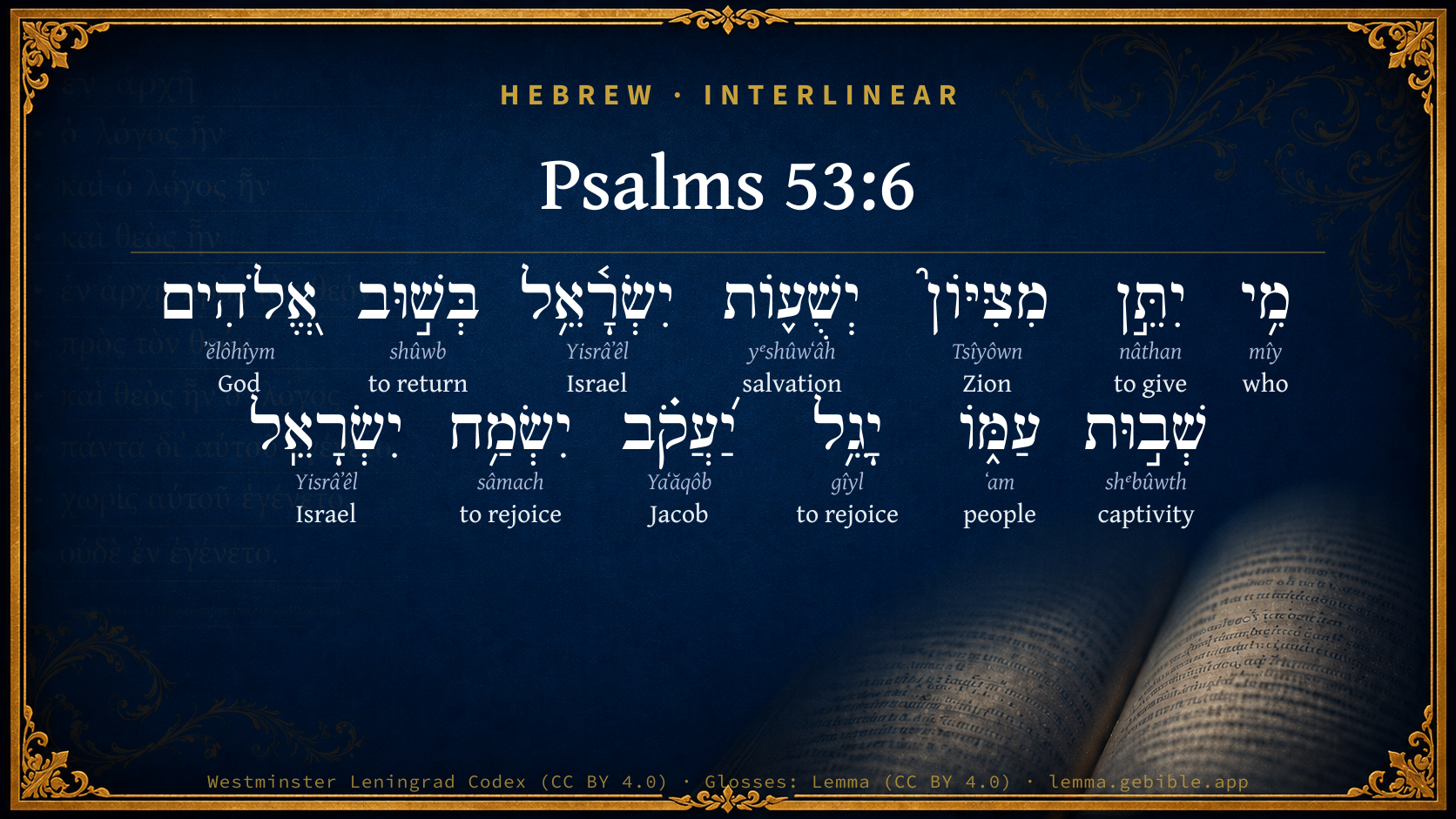
Hebrew (Westminster Leningrad Codex) Psalms 53:6 appears in the Hebrew Old Testament. The text above is from the Westminster Leningrad Codex. Each word links to its Strong’s number, a concise gloss, and parsing drawn from the Open Scriptures Hebrew Bible morphology. Click any word for its full Brown-Driver-Briggs (BDB) entry.
Download image
Cite this verse

Psalms 53:6 (World English Bible). Public Domain. Lemma interlinear Bible study tool, https://lemma.gebible.app/v/psalms/53/6.

Show BibTeX & RIS
BibTeX
RIS
English Translation
Oh that the salvation of Israel would come out of Zion! When God brings back the captivity of his people, Then Jacob shall rejoice. Israel shall be glad.
World English Bible · Public Domain
Download a study sheet

One document with this verse’s original text, its word-by-word gloss line, the meaning frame, cross-references with their text, attributed commentary, and full source and license credits — printable, and it pastes into notes with its structure intact.

This verse Autodidact and up

Study sheet (.html) Plain text (.txt)

A passage Seminary Student

Up to 50 verses in one chapter. A passage sheet keeps up to 6 commentary sources and 12 cross-references per verse, in the order this page ranks them, and says so on the sheet whenever that leaves anything out. Ask for a single verse and you get the Autodidact verse sheet above.

Everything on this page stays free to read, with no account — the sheet is a download of what is already on screen, not access to it.

Want to remove ads? Support Godless Engineer
Compare translations 3

The same verse in 3 English versions, stacked beneath the original-language interlinear above. Click any original word for its lexicon entry.

Each is an independent rendering of the whole verse — the interlinear is not word-aligned to these translations.

Highlighted words mark where these versions differ — a whole-verse word diff, not a word-by-word alignment.

  • World English Bible Public Domain
    Oh that the salvation of Israel would come out of Zion! When God brings back the captivity of his people, Then Jacob shall rejoice. Israel shall be glad.
  • King James Version Public Domain
    Oh that the salvation of Israel were come out of Zion! When God bringeth back the captivity of his people, Jacob shall rejoice, and Israel shall be glad.
  • unfoldingWord Literal Text CC BY-SA 4.0
    Who will give the salvation of Israel from Zion? When God restores the prosperity of his people, Jacob will be glad, Israel will rejoice.

unfoldingWord Literal Text — © unfoldingWord, licensed CC BY-SA 4.0. Word-aligned USFM3 via Door43 (git.door43.org/unfoldingWord/en_ult).

Versions to compare (up to 4)

3 of 4 selected

Show all 18 translations

Every available English version of this verse, each an independent rendering of the whole verse.

  • World English Bible Public Domain
    Oh that the salvation of Israel would come out of Zion! When God brings back the captivity of his people, Then Jacob shall rejoice. Israel shall be glad.
  • Berean Standard Bible Public Domain
    Oh, that the salvation of Israel would come from Zion! When God restores His captive people, let Jacob rejoice, let Israel be glad!
  • Majority Standard Bible Public Domain
    Oh, that the salvation of Israel would come from Zion! When God restores His captive people, let Jacob rejoice, let Israel be glad!
  • King James Version Public Domain
    Oh that the salvation of Israel were come out of Zion! When God bringeth back the captivity of his people, Jacob shall rejoice, and Israel shall be glad.
  • American Standard Version (1901) Public Domain
    Oh that the salvation of Israel were come out of Zion! When God bringeth back the captivity of his people, Then shall Jacob rejoice, `and' Israel shall be glad. Psalm 54 For the Chief Musician; on stringed instruments. Maschil of David; when the Ziphites came and said to Saul, Doth not David hide himself with us?
  • Revised Version (1885) Public Domain
    Oh that the salvation of Israel were come out of Zion! When God bringeth back the captivity of his people, then shall Jacob rejoice, and Israel shall be glad.
  • Geneva Bible (1599) Public Domain
    Oh giue saluation vnto Israel out of Zion: when God turneth the captiuitie of his people, then Iaakob shall reioyce, and Israel shalbe glad.
  • Douay-Rheims (1899) Public Domain
    They have not called upon God: there have they trembled for fear, where there was no fear. For God hath scattered the bones of them that please men: they have been confounded, because God hath despised them.
  • Young's Literal Translation Public Domain
    Who doth give from Zion the salvation of Israel? When God turneth back `to' a captivity of His people, Jacob doth rejoice -- Israel is glad!
  • Literal Standard Version CC BY-SA 4.0
    Who gives the salvation of Israel from Zion? When God turns back [to] a captivity of His people, || Jacob rejoices—Israel is glad!
  • Unlocked Literal Bible CC BY-SA 4.0
    Oh, that the salvation of Israel would come from Zion! When God brings back his people from the captivity, then Jacob will rejoice and Israel will be glad!
  • unfoldingWord Literal Text CC BY-SA 4.0
    Who will give the salvation of Israel from Zion? When God restores the prosperity of his people, Jacob will be glad, Israel will rejoice.
  • Darby Bible Public Domain
    Oh that the salvation of Israel were come out of Zion! When God turneth again the captivity of his people, Jacob shall be glad, Israel shall rejoice.
  • World Messianic Bible Public Domain
    Oh that the salvation [yeshuat] of Israel would come out of Zion! When God brings back his people from captivity, then Jacob shall rejoice, and Israel shall be glad.
  • Webster's Bible Public Domain
    \\53:5\\There they were in great fear, where no fear was: for God hath scattered the bones of him that encampeth against thee: thou hast put them to shame, because God hath despised them.
  • Free Bible Version CC BY-SA 4.0
    If only God's salvation would come from Zion! When God restores his people, the people of Jacob will celebrate, and the people of Israel will be glad.
  • Bible in Basic English Public Domain
    May the salvation of Israel come out of Zion! When the fate of his people is changed by God, Jacob will have joy, and Israel will be glad.
  • JPS Tanakh (1917) Public Domain
    (53-7) Oh that the salvation of Israel were come out of Zion! When God turneth the captivity of His people, let Jacob rejoice, let Israel be glad.

Literal Standard Version (2020), Covenant Press — licensed CC BY-SA 4.0. Text via the HelloAO Bible API (eBible.org). Unlocked Literal Bible (unfoldingWord) — licensed CC BY-SA 4.0. Text via the HelloAO Bible API (eBible.org). unfoldingWord Literal Text — © unfoldingWord, licensed CC BY-SA 4.0. Word-aligned USFM3 via Door43 (git.door43.org/unfoldingWord/en_ult). Free Bible Version, Dr. Jonathan Gallagher — licensed CC BY-SA 4.0. Text via the HelloAO Bible API (eBible.org).

Word by word

More ways to search: Search by grammar → Find every occurrence → Compare this word →

Practice this passage: Drill this verse → Learn its vocabulary →

שְׁב֣וּת
shᵉbûwth
H7622
“captivity of”
Noun, Common, Feminine, Singular, Construct
Part of Speech
Noun
Type
Common
Gender
Feminine
Number
Singular
State
Construct
Full BDB Definition

Origin: from H7617

TWOT: 2311d

captivity, captives
  1. מִ֥י mîy H4310 “who” Particle, Interrogative
  2. יִתֵּ֣ן nâthan H5414 “to give” Verb, Qal, Imperfect, 3rd Person, Masculine, Singular
  3. מִצִּיּוֹן֮ Tsîyôwn H6726 “from · Zion” Preposition + Noun, Proper
  4. יְשֻׁע֪וֹת yᵉshûwʻâh H3444 “deliverances of” Noun, Common, Feminine, Plural, Construct
  5. יִשְׂרָ֫אֵ֥ל Yisrâʼêl H3478 “Israel” Noun, Proper
  6. בְּשׁ֣וּב shûwb H7725 “in/at · to return” Preposition + Verb, Qal, Infinitive Construct
  7. אֱ֭לֹהִים ʼĕlôhîym H430 “God(s)” Noun, Common, Masculine, Plural, Absolute
  8. עַמּ֑וֹ ʻam H5971 “people · his” Noun, Common, Masculine, Singular, Construct + Suffix, Personal, 3rd Person, Masculine, Singular
  9. יָגֵ֥ל gîyl H1523 “to rejoice” Verb, Qal, Imperfect, 3rd Person, Masculine, Singular
  10. יַ֝עֲקֹ֗ב Yaʻăqôb H3290 “Jacob” Noun, Proper
  11. יִשְׂמַ֥ח sâmach H8055 “to rejoice” Verb, Qal, Imperfect, 3rd Person, Masculine, Singular
  12. יִשְׂרָאֵֽל Yisrâʼêl H3478 “Israel” Noun, Proper

About this verse

These counts appear in no published source. They are computed here, from the morphology-tagged text and Lemma’s own curated glosses. What Lemma adds →

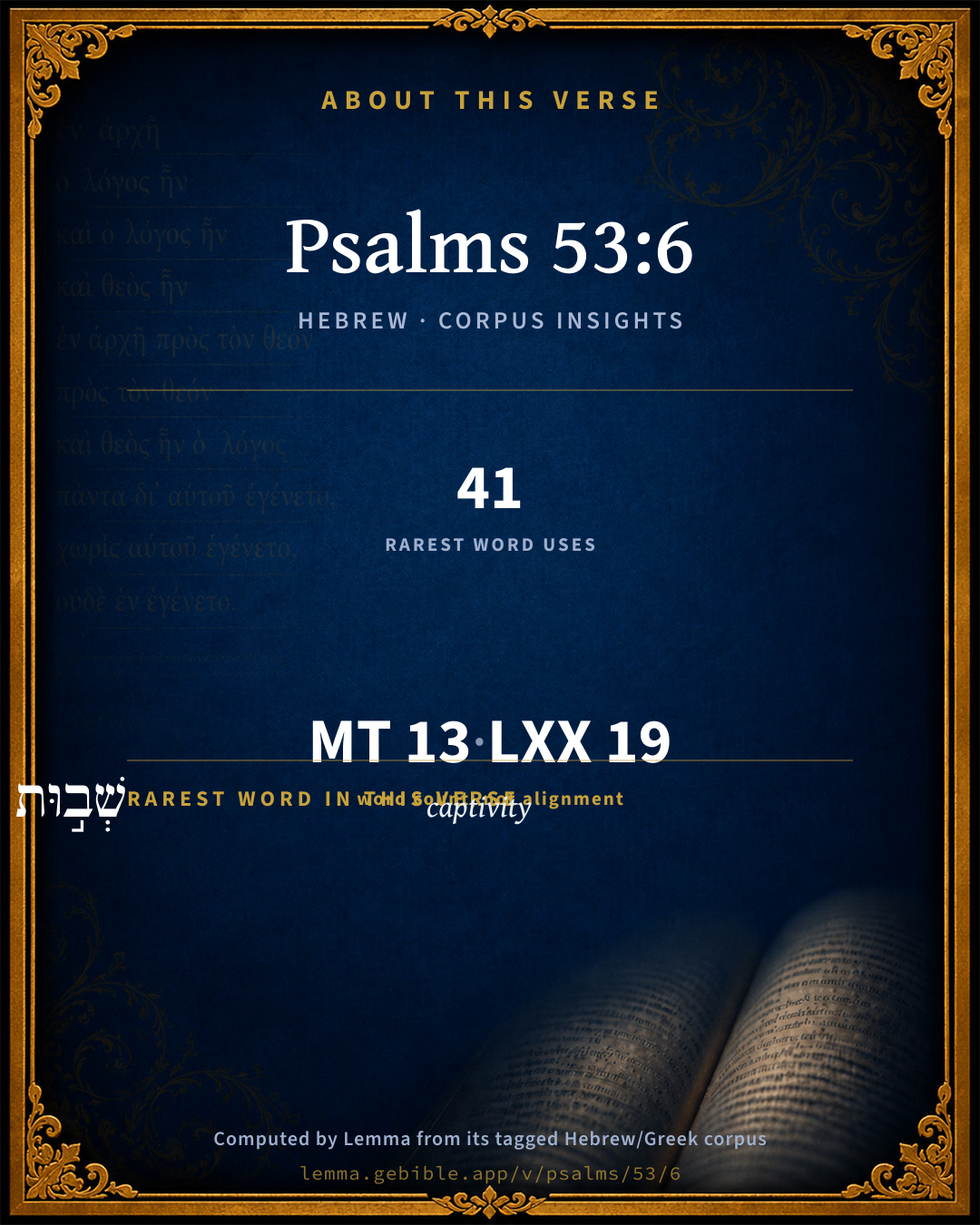
13
words
12
distinct lemmas
Wisdom
section

Shared distinctive vocabulary

שְׁב֣וּת captivity H7622 occurs in 26 verses of the Hebrew Bible. Also found in:

Grammatical profile

  • 4 verbs
  • 8 nouns
  • 1 particle

Verb forms

  • יִתֵּ֣ן Qal · Imperfect
  • בְּשׁ֣וּב Qal · Infinitive Construct
  • יָגֵ֥ל Qal · Imperfect
  • יִשְׂמַ֥ח Qal · Imperfect

Repetition

A word recurs within this verse — often emphatic in Hebrew:

  • יִשְׂרָ֫אֵ֥ל Israel H3478 ×2

Hebrew & Septuagint length

In English translation the verse runs 28 words from the Hebrew and 27 from the Septuagint (LXX English) — closely comparable.

A rough comparison of the two English renderings, which tokenize alike — not a word-level alignment.

Word counts can differ between the Hebrew and the Greek without any difference in meaning — e.g. the Hebrew direct-object marker אֵת has no separate Greek word, and Greek often adds the article ὁ.

In the original languages it is 13 Hebrew tokens and 19 Greek tokens — but the two are counted differently (Hebrew bundles its prefixes and suffixes into one token; the Greek is in lemma form), so that isn’t a like-for-like length.

Cross-references

15

Topical passages linked to Psalms 53:6 in the Treasury of Scripture Knowledge — connected by theme and wording, ordered by reader-vote popularity; previews shown in the World English Bible.

  • Psalms 14:7 Oh that the salvation of Israel would come out of Zion! When Yahweh restores the fortunes of his people, Then Jacob shall rejoice, and Israel shall be glad.
  • Jeremiah 30:18 Thus says Yahweh: Behold, I will turn again the captivity of Jacob's tents, and have compassion on his dwelling-places; and the city shall be built on its own hill, and the palace shall be inhabited after its own manner.
  • Isaiah 12:6 Cry aloud and shout, you inhabitant of Zion; for great in the midst of you is the Holy One of Israel!"
  • Nehemiah 12:43 They offered great sacrifices that day, and rejoiced; for God had made them rejoice with great joy; and the women also and the children rejoiced: so that the joy of Jerusalem was heard even afar off.
  • Psalms 106:46–48 He made them also to be pitied By all those who carried them captive.
  • Psalms 126:1–4 When Yahweh brought back those who returned to Zion, We were like those who dream.
  • Isaiah 12:1–3 In that day you will say, "I will give thanks to you, Yahweh; for though you were angry with me, your anger has turned away and you comfort me.
  • Isaiah 14:32 What then shall one answer the messengers of the nation? That Yahweh has founded Zion, and in her shall the afflicted of his people take refuge.
  • Ezra 3:11 They sang one to another in praising and giving thanks to Yahweh, [saying], For he is good, for his loving kindness endures forever toward Israel. All the people shouted with a great shout, when they praised Yahweh, because the foundation of the house of Yahweh was laid.
  • Psalms 85:1 Yahweh, you have been favorable to your land. You have restored the fortunes of Jacob.
  • Jeremiah 31:23 Thus says Yahweh of Hosts, the God of Israel, Yet again shall they use this speech in the land of Judah and in the cities of it, when I shall bring again their captivity: Yahweh bless you, habitation of righteousness, mountain of holiness.
  • Joel 3:1 "For, behold, in those days, And in that time, When I restore the fortunes of Judah and Jerusalem,
  • Amos 9:14 I will bring back the captivity of my people Israel, And they will rebuild the ruined cities, and inhabit them; and they will plant vineyards, and drink wine from them. They shall also make gardens, And eat the fruit of them.
  • Job 42:10 Yahweh turned the captivity of Job, when he prayed for his friends. Yahweh gave Job twice as much as he had before.
  • Psalms 50:2 Out of Zion, the perfection of beauty, God shines forth.

Cross-references courtesy of OpenBible.info (CC BY 4.0).

Hebrew and Greek witnesses Masoretic Hebrew ↔ Greek Septuagint

The same verse in the two great witnesses to the Old Testament, shown verse-for-verse.

You’re reading Greek Psalm 52 (Hebrew Psalm 53). The Septuagint counts the superscription, so verse numbers can differ from the Hebrew — chapter-level alignment, not verse-by-verse. Numbering follows Rahlfs.

These are two independent witnesses, not word-aligned to each other, and the Septuagint is shown in lemma (dictionary) form.

Hebrew Psalms 53:6 Masoretic · Westminster Leningrad Codex

מִ֥י יִתֵּ֣ן מִצִּיּוֹן֮ יְשֻׁע֪וֹת יִשְׂרָ֫אֵ֥ל בְּשׁ֣וּב אֱ֭לֹהִים שְׁב֣וּת עַמּ֑וֹ יָגֵ֥ל יַ֝עֲקֹ֗ב יִשְׂמַ֥ח יִשְׂרָאֵֽל

Oh that the salvation of Israel would come out of Zion! When God brings back the captivity of his people, Then Jacob shall rejoice. Israel shall be glad.

World English Bible · Public Domain

Greek LXX Greek Psalm 52:6 Septuagint · lemma form

ἐκεῖ φοβέω φόβος ὅς οὐ εἰμί φόβος ὅτι ὁ θεός διασκορπίζω ὀστέον ἀνθρωπάρεσκος κατααἰσχύνω ὅτι ὁ θεός ἐκοὐδενόω αὐτός

Who will bring the salvation of Israel out of Sion? When the Lord turns the captivity of his people, Jacob shall exult, and Israel shall be glad.

LXX2012 (modern English Septuagint) · Public Domain

On this verse, Adam Clarke's Commentary discusses the Septuagint’s reading. Read the note in Commentary ↓

Hebrew: Westminster Leningrad Codex (CC BY 4.0). Greek: Septuagint (public domain); English from LXX2012 (modern English Septuagint) (Public Domain). How the Septuagint differs from the Hebrew →

Commentary

Notes on Psalms 53:6 from classic Christian and Jewish commentators (each source and its license shown beneath its notes). The classic Christian expositions comment on the surrounding passage and are grouped to its opening verse, so a note may address several verses; the Jewish commentaries on the Tanakh (Rashi and others) are per-verse, so they appear only where the commentator wrote on this verse.

Lemma curates 59 commentaries, every one of them public domain or Creative Commons licensed, each selected and text-cleaned for this edition rather than reprinted as found. About our sources →

Trapp's Complete Commentary

John Trapp

Psa 53:6 Oh that the salvation of Israel [were come] out of Zion! When God bringeth back the captivity of his people, Jacob shall rejoice, [and] Israel shall be glad.

Ver. 6. Oh that the salvation] Heb. Salvations; indicat plenam salutem, Let it show full salvation, saith Kimchi.

John Trapp, A Commentary or Exposition upon All the Books of the Old and New Testament (1647–1656) — public domain. Text from a community e-Sword module.

The Biblical Illustrator

Joseph S. Exell

Psa_53:6

Oh that the salvation of Israel were come out of Zion.

The salvation of the Church, and the destruction of her enemies

I. The destruction of the wicked (Psa_53:5).

1. Utter and irreversible.

2. Effected by God.

3. Overtaking them when they regarded themselves as quite secure.

4. Inflicted because of their hostility to the people of God.

(1) He is in covenant relation with His people, and is pledged to help them.

(2) He is profoundly and tenderly interested in His people (Isa_49:14-16; Mat_18:5-6; Mat_25:40; Mat_25:45; Act_9:4). An inspiring and strengthening consideration for the people of God. Motive and encouragement to those who would aid them. Warning to those who would injure them.

II. The destruction of the wicked in former times as an encouragement to the good to expect salvation from present dangers. This we take to be the connecting link between Psa_53:5; Psa_6:1-10.

1. The poetic view of salvation. It is here represented as deliverance from captivity.

2. The grand source of salvation. Out of Zion.

3. The earnest desire of salvation.

4. The encouragement to expect salvation. God is unchangeable. What He has done in the past He is able to do in the present. He is faithful. What He has promised that will He perform. (W. Jones.)

.

Psa_54:1-7

The Biblical Illustrator, edited by Joseph S. Exell (c. 1880s–1900s) — public domain. Text from a community e-Sword module.

Joseph Benson's Commentary

Psa 53:6. O that the salvation, &c. — See on Psa 14:7.

Joseph Benson's Commentary on the Old and New Testaments (1811–1818) — public domain. Text from a community e-Sword module.

J. A. Alexander on Psalms

Joseph Addison Alexander

7. (Psa 53:6). Who will give out of Zion salvations (to) Israel—in God's returning (to) the captivity of his people—let Jacob exult, let Israel joy! See above, on Psa 14:7. The only variations are the change of Jehovah to Elohim, and of the singular salvation to its plural, denoting variety and fulness. See above, on Psa 18:50 (49). The exact translation is salvations of Israel, and the meaning of the next clause, "when God revisits (or in God's revisiting) his captive people."

Joseph Addison Alexander, The Psalms Translated and Explained (1850) — public domain. Text from a community e-Sword module.

Adam Clarke's Commentary

Verse 6. O that the salvation of Israel were come out of Zion!] I have already shown that the proper translation is, "Who shall give from Zion salvation to Israel?" The word salvation is in the plural here, deliverances: but many MSS., with the Septuagint, Vulgate, Arabic, and Anglo-Saxon, have it in the singular.

When God bringeth back] When Jehovah bringeth back, is the reading of more than twenty of Kennicott's and De Rossi's MSS., with the Septuagint, Syriac, and Chaldee, and Justinianus' Polyglot Psalter.

For larger notes and an analysis, the reader is requested to refer to Ps 14:1, c. (note) and for a comparison of the two Psalms he may consult Dr. Kennicott's Hebrew Bible, where, under Ps 14:1, &c., in the lower margin, the variations are exhibited at one view.

Adam Clarke's Commentary on the Bible (1810–1826) — public domain. Text from a community e-Sword/MySword module.

The Cambridge Bible for Schools and Colleges

gen. ed. J. J. S. Perowne

6. Concluding prayer for the full restoration of Israel. Some commentators have regarded this as a liturgical addition, but its presence in both recensions is in favour of its originality. It forms an appropriate conclusion to the Ps., and the recollection of past deliverance in Psa_53:5 naturally passes into a prayer for further restoration.

the salvation of Israel] Lit. salvations, victory and deliverance full and complete. (Psa_14:7 has the singular.) Zion is Jehovah’s dwelling-place, the centre from which He exercises His earthly sovereignty.

when God bringeth back &c.] Or, as R.V. marg., returneth to the captivity &c. For God Psa_14:7 has Jehovah. At first sight these words seem to fix the date of the Psalm in the period of the Exile (Psa_126:1). Nor does the phrase out of Zion exclude such a view. The exiles turned to Zion even in her desolation (Dan_6:10; 1Ki_8:44), and from thence Jehovah might be expected to restore His people. But (1) it is very probable that the phrase rendered bring back the captivity means rather turn the fortunes[26]. This meaning suits all the passages in which the phrase occurs, while turn the captivity does not, except in the figurative sense of restoring prosperity. See e.g. Job_42:10; Eze_16:53; Zep_2:7. And (2) even if turn the captivity is the original meaning, the phrase is used by Amos (Amo_9:14) and Hosea (Hos_6:11) long before the Babylonian Captivity. In the time of Hezekiah the words might refer to the recent fall of the Northern Kingdom.

[26] Lit. turn a turning, the word sh’bûth being derived from shûb ‘to turn’ or ‘return,’ not from shâbâh, ‘to take captive.’ The regular word for the Babylonian captivity is gôlâh, ‘exile.’

then shall Jacob rejoice] Properly a wish or prayer (cp. Psa_13:5-6): let Jacob rejoice, and Israel be glad.

The Cambridge Bible for Schools and Colleges (gen. ed. J. J. S. Perowne; Cambridge University Press, 1878–1918) — public domain. Text from a community e-Sword module.

John Gill's Exposition

O that the salvation of Israel were come out of Zion!.... Or, "who will give (f) out of Zion the salvation of Israel?" The Targum adds, "except the Lord"; and this is a request to him for it: and, as in Psa 14:7, it may be a wish for the first coming of Christ, to work out salvation for his people; here it may be expressive of the desire of the church for his coming in a spiritual manner, in the latter day, to take to himself his great power, and reign; to destroy antichrist, and deliver his people from bondage and oppression by him; when the Gentiles shall be gathered in, the Jews will be converted, and all Israel saved; see Rom 11:25. It is in the original text, "salvations" (g); denoting the complete salvation of the church; when all her enemies will be destroyed, and all peace and prosperity shall be enjoyed by her; See Gill on Psa 14:6.

when God bringeth back the captivity of his people: who have been carried into it by antichrist, Rev 13:10;

Jacob shall rejoice, and Israel shall be glad; for now the kingdoms of this world will become Christ's; the marriage of the Lamb will be come, and the bride made ready, through the calling of the Gentiles, and the conversion of the Jews; which will occasion the twenty four elders, the representatives of the Christian church, to give thanks to the Lord God Almighty, and cause many voices to be heard in heaven, expressing great joy on this occasion, Rev 11:15.

(f) "quis dabit", V. L. Pagninus, Montanus, &c. (g) "salutes", Pagninus, Montanus, Cocceius; so Ainsworth.

Next: Psalms Chapter 54

John Gill's Exposition of the Whole Bible (1746–1763) — public domain (CC PDM 1.0). Text via the HelloAO Bible API.

Albert Barnes' Notes on the Bible

Oh that the salvation of Israel ... - The only change here from Psa 14:7 is that the word אלהים 'Elohiym, God, is substituted for “Jehovah,” Lord, and that the word rendered “salvation” is here in the plural. On the supposition that the psalm was adapted to a state of things when the city had been besieged, and the enemy discomfited, this language would express the deep and earnest desire of the people that the Lord would grant deliverance. Perhaps it may be supposed, also, that at the time of such a siege, and while the Lord interposed to save them from the siege, it was also true that there was some general danger hanging over the people; that even the nation might be described as in some sense “captive;” or that some portions of the land were subject to a foreign power. The desire expressed is, that the deliverance might be complete, and that the whole land might be brought to the possession of liberty, and be rescued from all foreign domination. That time, when it should arrive, would be the occasion of universal rejoicing.

Albert Barnes' Notes on the Bible (1834–1885) — public domain. Text from a community e-Sword/MySword module.

The Treasury of David

Charles H. Spurgeon

Ver. 6. Oh that the salvation of Israel were come out of Zion. Would God the final battle were well over. When will the Lord avenge his own elect? When will the long oppression of the saints come to its close, and glory crown their heads? The word salvation is in the plural, to show its greatness.

When God bringeth back the captivity of his people, Jacob shall rejoice, and Israel shall be glad. Inasmuch as the yoke has been heavy, and the bondage cruel, the liberty will be happy, and the triumph joyous. The second advent and the restoration of Israel are our hope and expectation. We have attempted to throw into rhyme the last two verses of this Psalm:

The foes of Zion quake for fright.

Where no fear was they quail;

For well they know that sword of might

Which cuts through coats of mail.

The Lord of old defiled their shields,

And all their spears he scorned;

Their bones lay scattered over the fields,

Unburied and unmourned.

Let Zion's foes be filled with shame;

Her sons are blessed of God;

Though scoffers now despise their name,

The Lord shall break the rod.

Oh! would our God to Zion turn,

God with salvation clad;

Then Judah's harps should music learn,

And Israel be glad.

None.

Ver. 6.

I. There is salvation for Israel.

II. That salvation is in Zion.

III. Their salvation remains there when they are banished

from it.

I. Their joy becomes greater when they return. G. R.

Charles H. Spurgeon's The Treasury of David (1869–1885) — public domain. Psalms only. Text from a community e-Sword/MySword module.

The Pulpit Commentary

This verse is identical with Psa_14:7, except in the substitution of "Elohim" for "Jehovah," and in the pointing of one word.

The Pulpit Commentary (1880–1919), ed. H.D.M. Spence-Jones & Joseph S. Exell — public domain. Text from a community e-Sword module.

Keil & Delitzsch

C. F. Keil & F. Delitzsch

The two texts now again coincide. Instead of ישׁוּעת, we here have ישׁעות; the expression is strengthened, the plural signifies entire, full, and final salvation.

Keil & Delitzsch — Biblical Commentary on the Old Testament (1861–1891) — public domain (CC PDM 1.0). Text via the HelloAO Bible API. (Old Testament only.)

unfoldingWord translationNotes

Door43 World Missions Community

Oh, that the salvation of Israel would come

The word "Oh" here introduces an exclamation that expresses a hope or prayer. AT: "I hope that the salvation of Israel will come" or "I pray that the salvation of will come" (See: Exclamations)

the salvation of Israel would come from Zion

The salvation represents God, the savior, whose temple is in Zion. AT: "the savior of Israel would come from Zion" or "God would come from Zion and save Israel" (See: Metonymy)

When God brings back his people from the captivity

"When God saves his captive people"

Jacob will rejoice and Israel will be glad!

These two phrases have the same meaning. (See: Parallelism)

Jacob

Here "Jacob" refers to the descendants of Jacob, the Israelites. (See: Metonymy)

translationWords

save

Israel

Zion

people of God

captive

Jacob

joy

unfoldingWord translationNotes — © Distant Shores Media and the Door43 World Missions Community, licensed CC BY-SA 4.0. Source: git.door43.org/Door43/en_tn.

Rashi

Rabbi Shlomo Yitzchaki (Rashi)

there was never such fear This fear was not like the first fear that came over Belshazzar, for in this redemption the Holy One, blessed be He, scattered the bones of חוֹנָךְ, those who camp around you, Jerusalem, as the matter that is stated (Zech. 14:12): “His flesh will waste away, etc.” Menachem (p. 91) interpreted it that way, but Dunash (pp. 63f.) interpreted it as (Prov. 22:6): “Train (חנך) a child according to his way”; the “chaph” of חוֹנָךְ is a radical as the “chaph” of חֲנֹךְ, train.

You have put them to shame You, O Lord, have put all my enemies to shame, for You have rejected them.

Rashi on the Tanakh — English translations: “The Judaica Press complete Tanach with Rashi, translated by A. J. Rosenberg” (CC BY 4.0); “Pentateuch with Rashi's commentary by M. Rosenbaum and A.M. Silbermann, 1929-1934” (public domain); “The Metsudah Tanach series, Lakewood, N.J” (CC BY 4.0); and “The Book of Joshua, Metsudah Publications, 1997” (CC BY 4.0). Text via Sefaria.

Lesson kit

Teaching starters — assembled from the data on this page, not authored interpretation. Every prompt links to the verse data it draws on. Edit before teaching.

Psalms, in the Wisdom, opens this verse with 13 words (12 distinct Hebrew lemmas). Its most distinctive word is shᵉbûwth (“captivity”). A historical commentator’s framing appears above. Read the whole chapter for the surrounding context.

Discussion questions

  1. What does “captivity” (shᵉbûwth) contribute to the verse as a whole?
  2. Deuteronomy 30:3 shares the word «captivity» with this verse. How do the two illuminate each other?
  3. “Israel” occurs 2× in this one verse. What is the effect of the repetition?
  4. These translations render this verse differently; the difference is in the English rendering, not the original. What questions does that raise?
  5. The verb «יִתֵּ֣ן» is Qal Imperfect. How does its form color the action?
  6. Reading how Trapp's Complete Commentary and The Biblical Illustrator read this verse, where do the two commentators agree and where do they part?

Things to notice

Reading settings

Reading text

Shown beneath each verse's original-language words.

Old Testament
Old Testament edition

Read the OT as the Masoretic Hebrew (MT) or the Greek Septuagint (LXX).

English shown for the Greek Septuagint (in the Hebrew ↔ Greek comparison).

Comparing translations? Open the Compare panel on any verse page to stack up to four side by side.