
Isaiah 62:11

Hebrew (Westminster Leningrad Codex) Isaiah 62:11 appears in the Hebrew Old Testament. The text above is from the Westminster Leningrad Codex. Each word links to its Strong’s number, a concise gloss, and parsing drawn from the Open Scriptures Hebrew Bible morphology. Click any word for its full Brown-Driver-Briggs (BDB) entry.
Download image
Cite this verse

Isaiah 62:11 (World English Bible). Public Domain. Lemma interlinear Bible study tool, https://lemma.gebible.app/v/isaiah/62/11.

Show BibTeX & RIS
BibTeX
RIS
English Translation
Behold, Yahweh has proclaimed to the end of the earth, Say you to the daughter of Zion, Behold, your salvation comes; behold, his reward is with him, and his recompense before him.
World English Bible · Public Domain
Download a study sheet

One document with this verse’s original text, its word-by-word gloss line, the meaning frame, cross-references with their text, attributed commentary, and full source and license credits — printable, and it pastes into notes with its structure intact.

This verse Autodidact and up

Study sheet (.html) Plain text (.txt)

A passage Seminary Student

Up to 50 verses in one chapter. A passage sheet keeps up to 6 commentary sources and 12 cross-references per verse, in the order this page ranks them, and says so on the sheet whenever that leaves anything out. Ask for a single verse and you get the Autodidact verse sheet above.

Everything on this page stays free to read, with no account — the sheet is a download of what is already on screen, not access to it.

Want to remove ads? Support Godless Engineer
Compare translations 3

The same verse in 3 English versions, stacked beneath the original-language interlinear above. Click any original word for its lexicon entry.

Each is an independent rendering of the whole verse — the interlinear is not word-aligned to these translations.

Highlighted words mark where these versions differ — a whole-verse word diff, not a word-by-word alignment.

  • World English Bible Public Domain
    Behold, Yahweh has proclaimed to the end of the earth, Say you to the daughter of Zion, Behold, your salvation comes; behold, his reward is with him, and his recompense before him.
  • King James Version Public Domain
    Behold, the LORD hath proclaimed unto the end of the world, Say ye to the daughter of Zion, Behold, thy salvation cometh; behold, his reward is with him, and his work before him.
  • unfoldingWord Literal Text CC BY-SA 4.0
    Behold, Yahweh has made heard to the end of the earth: “Say to the daughter of Zion, ‘Behold, your salvation is coming! Behold, his wage with him, and his reward to his face.’”

unfoldingWord Literal Text — © unfoldingWord, licensed CC BY-SA 4.0. Word-aligned USFM3 via Door43 (git.door43.org/unfoldingWord/en_ult).

Versions to compare (up to 4)

3 of 4 selected

Show all 18 translations

Every available English version of this verse, each an independent rendering of the whole verse.

  • World English Bible Public Domain
    Behold, Yahweh has proclaimed to the end of the earth, Say you to the daughter of Zion, Behold, your salvation comes; behold, his reward is with him, and his recompense before him.
  • Berean Standard Bible Public Domain
    Behold, the LORD has proclaimed to the ends of the earth, “Say to Daughter Zion: See, your Savior comes! Look, His reward is with Him, and His recompense goes before Him.”
  • Majority Standard Bible Public Domain
    Behold, the LORD has proclaimed to the ends of the earth, “Say to Daughter Zion: See, your Savior comes! Look, His reward is with Him, and His recompense goes before Him.”
  • King James Version Public Domain
    Behold, the LORD hath proclaimed unto the end of the world, Say ye to the daughter of Zion, Behold, thy salvation cometh; behold, his reward is with him, and his work before him.
  • American Standard Version (1901) Public Domain
    Behold, Jehovah hath proclaimed unto the end of the earth, Say ye to the daughter of Zion, Behold, thy salvation cometh; behold, his reward is with him, and his recompense before him.
  • Revised Version (1885) Public Domain
    Behold, the LORD hath proclaimed unto the end of the earth, Say ye to the daughter of Zion, Behold, thy salvation cometh; behold, his reward is with him, and his recompence before him.
  • Geneva Bible (1599) Public Domain
    Beholde, the Lord hath proclaimed vnto the endes of the world: tell the daughter Zion, Beholde, thy Sauiour commeth: beholde, his wages is with him, and his worke is before him.
  • Douay-Rheims (1899) Public Domain
    Behold the Lord hath made it to be heard in the ends of the earth, tell the daughter of Sion: Behold thy Saviour cometh: behold his reward is with him, and his work before him.
  • Young's Literal Translation Public Domain
    Lo, Jehovah hath proclaimed unto the end of the earth: `Say ye to the daughter of Zion, Lo, thy salvation hath come,' Lo, his hire `is' with him, and his wage before him.
  • Literal Standard Version CC BY-SA 4.0
    Behold, YHWH has proclaimed to the end of the earth: “Say to the daughter of Zion, || Behold, your salvation has come, || Behold, His hire [is] with Him, || And His wage before Him.”
  • Unlocked Literal Bible CC BY-SA 4.0
    Look, Yahweh announces to the ends of the earth, “Say to the daughter of Zion: Look, your Savior is coming! See, his reward is with him, and his recompense is going before him.”
  • unfoldingWord Literal Text CC BY-SA 4.0
    Behold, Yahweh has made heard to the end of the earth: “Say to the daughter of Zion, ‘Behold, your salvation is coming! Behold, his wage with him, and his reward to his face.’”
  • Darby Bible Public Domain
    Behold, Jehovah hath proclaimed unto the end of the earth, Say ye to the daughter of Zion, Behold, thy salvation cometh; behold, his reward is with him, and his recompence before him.
  • World Messianic Bible Public Domain
    Behold, the LORD has proclaimed to the end of the earth: “Say to the daughter of Zion, ‘Behold, your salvation comes! Behold, his reward is with him, and his recompense before him!’”
  • Webster's Bible Public Domain
    Behold, the LORD hath proclaimed to the end of the world, Say ye to the daughter of Zion, Behold, thy salvation cometh; Behold, his reward is with him, and his work before him.
  • Free Bible Version CC BY-SA 4.0
    See! The Lord has announced to everyone on earth, Tell the Daughter of Zion: Look! Your Savior is coming. He's bringing his reward with him, coming to give his gift!
  • Bible in Basic English Public Domain
    The Lord has sent out word to the end of the earth, Say to the daughter of Zion, See, your saviour comes; those whom he has made free are with him, and those to whom he has given salvation go before him.
  • JPS Tanakh (1917) Public Domain
    Behold, the LORD hath proclaimed unto the end of the earth: say ye to the daughter of Zion: 'Behold, thy salvation cometh; behold, His reward is with Him, and His recompense before Him.'

Literal Standard Version (2020), Covenant Press — licensed CC BY-SA 4.0. Text via the HelloAO Bible API (eBible.org). Unlocked Literal Bible (unfoldingWord) — licensed CC BY-SA 4.0. Text via the HelloAO Bible API (eBible.org). unfoldingWord Literal Text — © unfoldingWord, licensed CC BY-SA 4.0. Word-aligned USFM3 via Door43 (git.door43.org/unfoldingWord/en_ult). Free Bible Version, Dr. Jonathan Gallagher — licensed CC BY-SA 4.0. Text via the HelloAO Bible API (eBible.org).

Word by word

More ways to search: Search by grammar → Find every occurrence → Compare this word →

Practice this passage: Drill this verse → Learn its vocabulary →

וּפְעֻלָּת֖וֹ
pᵉʻullâh
H6468
“and · wages · his”
Conjunction + Noun, Common, Feminine, Singular, Construct + Suffix, Personal, 3rd Person, Masculine, Singular
Part of Speech
Conjunction + Noun
Type
Common
Gender
Feminine
Number
Singular
State
Construct
Full BDB Definition

Origin: pass part of H6466

TWOT: 1792b

work, recompense, reward - work - wages
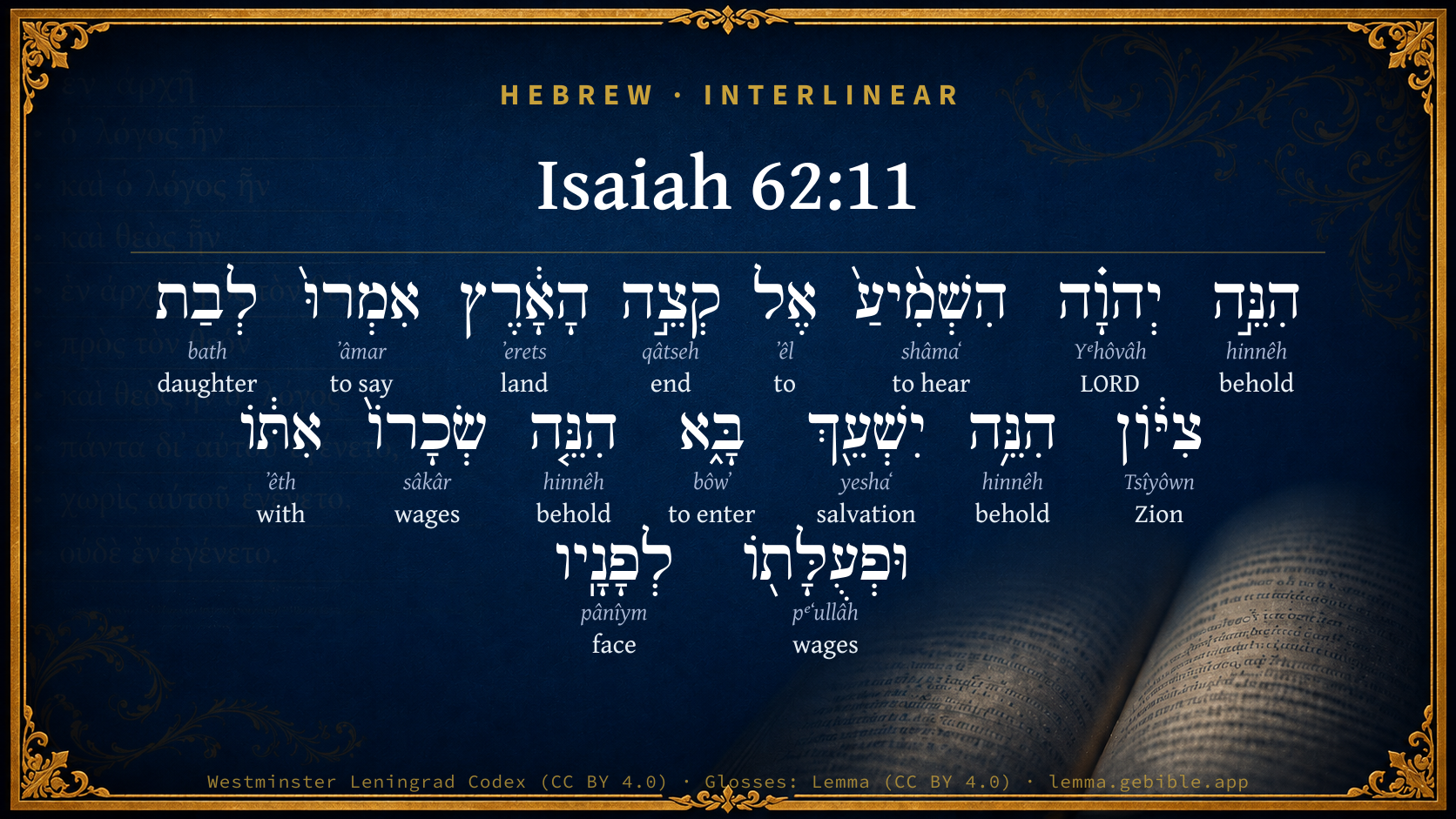
  1. הִנֵּ֣ה hinnêh H2009 “behold” Particle, Demonstrative
  2. יְהוָ֗ה Yᵉhôvâh H3068 “LORD” Noun, Proper
  3. הִשְׁמִ֨יעַ֙ shâmaʻ H8085 “to hear” Verb, Hiphil, Perfect, 3rd Person, Masculine, Singular
  4. אֶל ʼêl H413 “to” Preposition
  5. קְצֵ֣ה qâtseh H7097 “end of” Noun, Common, Both, Singular, Construct
  6. הָאָ֔רֶץ ʼerets H776 “the · land” Particle, Definite Article + Noun, Common, Both, Singular, Absolute
  7. אִמְרוּ֙ ʼâmar H559 “say” Verb, Qal, Imperative, 2nd Person, Masculine, Plural
  8. לְבַת bath H1323 “to/for · daughter of” Preposition + Noun, Common, Feminine, Singular, Construct
  9. צִיּ֔וֹן Tsîyôwn H6726 “Zion” Noun, Proper
  10. הִנֵּ֥ה hinnêh H2009 “behold” Particle, Demonstrative
  11. יִשְׁעֵ֖ךְ yeshaʻ H3468 “salvation · your” Noun, Common, Masculine, Singular, Construct + Suffix, Personal, 2nd Person, Feminine, Singular
  12. בָּ֑א bôwʼ H935 “to enter” Verb, Qal, Perfect, 3rd Person, Masculine, Singular
  13. הִנֵּ֤ה hinnêh H2009 “behold” Particle, Demonstrative
  14. שְׂכָרוֹ֙ sâkâr H7939 “wages · his” Noun, Common, Masculine, Singular, Construct + Suffix, Personal, 3rd Person, Masculine, Singular
  15. אִתּ֔וֹ ʼêth H854 “with · him” Preposition + Suffix, Personal, 3rd Person, Masculine, Singular
  16. לְפָנָֽיו pânîym H6440 “to/for · face(s) · his” Preposition + Noun, Common, Both, Plural, Construct + Suffix, Personal, 3rd Person, Masculine, Singular

About this verse

These counts appear in no published source. They are computed here, from the morphology-tagged text and Lemma’s own curated glosses. What Lemma adds →

17
words
15
distinct lemmas
Prophets
section

Notable vocabulary

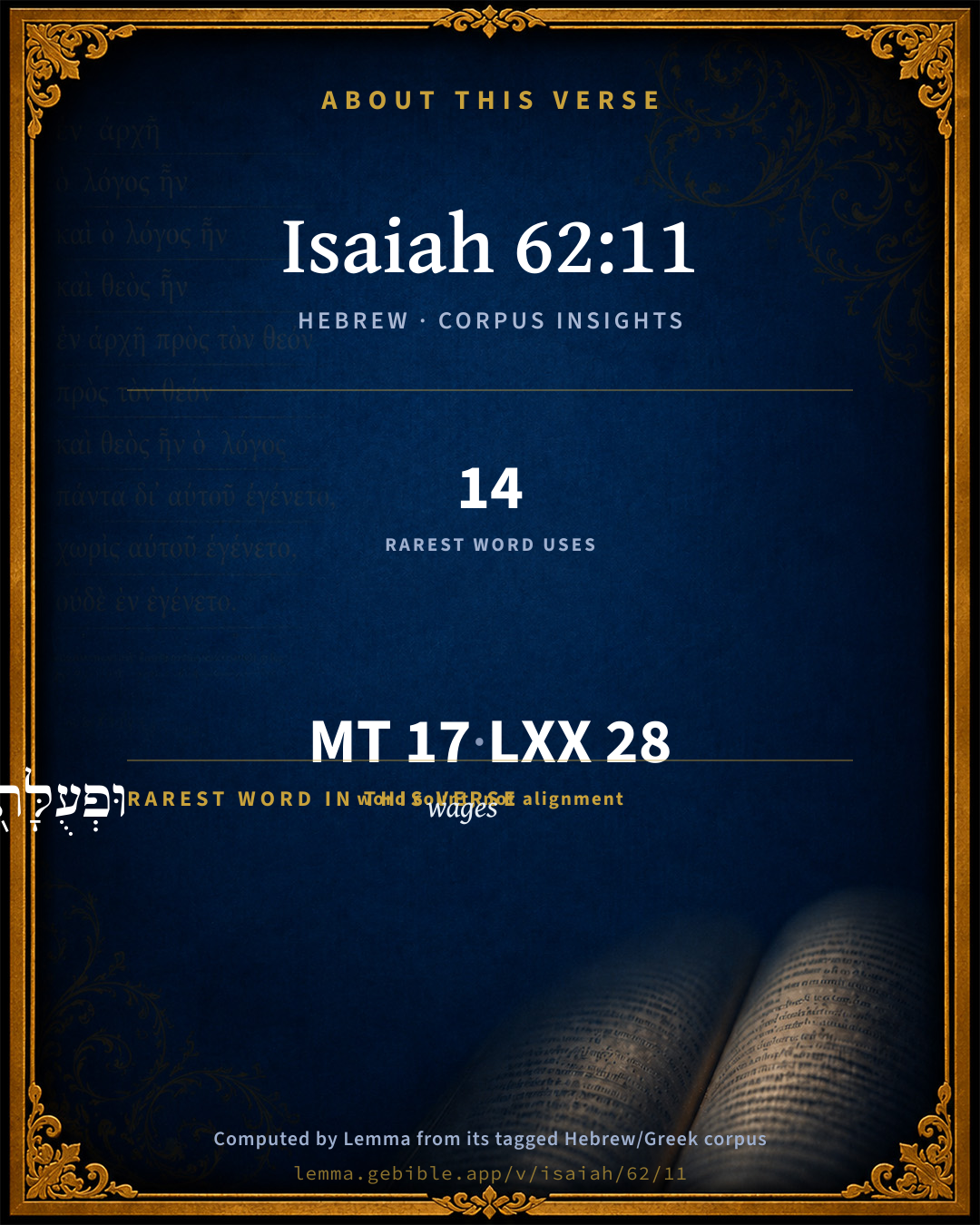
The rarest word here is וּפְעֻלָּת֖וֹ wages H6468 — appearing just 14 times in the whole Hebrew Bible.

Shared distinctive vocabulary

וּפְעֻלָּת֖וֹ wages H6468 occurs in 14 verses of the Hebrew Bible. Also found in:

Grammatical profile

  • 3 verbs
  • 9 nouns
  • 2 prepositions
  • 3 particles

Verb forms

  • הִשְׁמִ֨יעַ֙ Hiphil · Perfect
  • אִמְרוּ֙ Qal · Imperative
  • בָּ֑א Qal · Perfect

Repetition

A word recurs within this verse — often emphatic in Hebrew:

  • הִנֵּ֣ה behold H2009 ×3

Hebrew & Septuagint length

In English translation the verse runs 32 words from the Hebrew and 35 from the Septuagint (LXX English) — closely comparable.

A rough comparison of the two English renderings, which tokenize alike — not a word-level alignment.

Word counts can differ between the Hebrew and the Greek without any difference in meaning — e.g. the Hebrew direct-object marker אֵת has no separate Greek word, and Greek often adds the article ὁ.

In the original languages it is 17 Hebrew tokens and 28 Greek tokens — but the two are counted differently (Hebrew bundles its prefixes and suffixes into one token; the Greek is in lemma form), so that isn’t a like-for-like length.

Cross-references

10

Topical passages linked to Isaiah 62:11 in the Treasury of Scripture Knowledge — connected by theme and wording, ordered by reader-vote popularity; previews shown in the World English Bible.

  • Zechariah 9:9 Rejoice greatly, daughter of Zion! Shout, daughter of Jerusalem! Behold, your king comes to you! He is righteous, and having salvation; Lowly, and riding on a donkey, Even on a colt, the foal of a donkey.
  • Matthew 21:5 "Tell the daughter of Zion, Behold, your King comes to you, Humble, and riding on a donkey, On a colt, the foal of a donkey."
  • John 12:15 "Don't be afraid, daughter of Zion. Behold, your King comes, sitting on a donkey's colt."
  • Revelation 22:12 "Behold, I come quickly. My reward is with me, to repay to each man according to his work.
  • Isaiah 40:9–10 You who tell good news to Zion, go up on a high mountain; you who tell good news to Jerusalem, lift up your voice with strength; lift it up, don't be afraid; say to the cities of Judah, Behold, your God!
  • Romans 10:11–18 For the Scripture says, "Whoever believes in him will not be disappointed."
  • Psalms 98:1–3 Sing to Yahweh a new song, For he has done marvelous things! His right hand, and his holy arm, have worked salvation for him.
  • Isaiah 49:4 But I said, I have labored in vain, I have spent my strength for nothing and vanity; yet surely the justice [due] to me is with Yahweh, and my recompense with my God.
  • Isaiah 49:6 yes, he says, It is too light a thing that you should be my servant to raise up the tribes of Jacob, and to restore the preserved of Israel: I will also give you for a light to the Gentiles, that you may be my salvation to the end of the earth.
  • Mark 16:15 He said to them, "Go into all the world, and preach the Gospel to the whole creation.

Cross-references courtesy of OpenBible.info (CC BY 4.0).

Hebrew and Greek witnesses Masoretic Hebrew ↔ Greek Septuagint

The same verse in the two great witnesses to the Old Testament, shown verse-for-verse.

These are two independent witnesses, not word-aligned to each other, and the Septuagint is shown in lemma (dictionary) form.

Hebrew Isaiah 62:11 Masoretic · Westminster Leningrad Codex

הִנֵּ֣ה יְהוָ֗ה הִשְׁמִ֨יעַ֙ אֶל קְצֵ֣ה הָאָ֔רֶץ אִמְרוּ֙ לְבַת צִיּ֔וֹן הִנֵּ֥ה יִשְׁעֵ֖ךְ בָּ֑א הִנֵּ֤ה שְׂכָרוֹ֙ אִתּ֔וֹ וּפְעֻלָּת֖וֹ לְפָנָֽיו

Behold, Yahweh has proclaimed to the end of the earth, Say you to the daughter of Zion, Behold, your salvation comes; behold, his reward is with him, and his recompense before him.

World English Bible · Public Domain

Greek LXX Isaiah 62:11 Septuagint · lemma form

ἰδού γάρ κύριος ποιέω ἀκουστός ἕως ἔσχατος ὁ γῆ εἶπον ὁ θυγάτηρ σιων ἰδού σύ ὁ σωτήρ παραγίγνομαι ἔχω ὁ ἑαυτοῦ μισθός καί ὁ ἔργον πρό πρόσωπον αὐτός

For behold, the Lord has proclaimed to the end of the earth, say you⌃ to the daughter of Sion, Behold, your Saviour has come to you, having his reward and his work before his face.

LXX2012 (modern English Septuagint) · Public Domain

On this verse, John Gill's Exposition discusses the Septuagint’s reading. Read the note in Commentary ↓

Hebrew: Westminster Leningrad Codex (CC BY 4.0). Greek: Septuagint (public domain); English from LXX2012 (modern English Septuagint) (Public Domain). How the Septuagint differs from the Hebrew →

Targum (Aramaic paraphrase)

1

The Targum is the ancient Jewish Aramaic paraphrase of the Hebrew Scriptures — an interpretive translation, not the Hebrew text itself. Onkelos (literal) and Pseudo-Jonathan (expansive) render the Torah, and Jonathan the Prophets. Coverage is partial: where no permissively-licensed English translation exists for a verse, only the Aramaic is shown. This is verse-level text, not a word-by-word alignment to the Hebrew.

  1. Targum Jonathan Prophets (Joshua–Malachi)
    הָא יְיָ אַשְׁמַע לִסְיָפֵי אַרְעָא אֱמָרוּ לִכְנִשְׁתָּא דְצִיוֹן דָא פָרְקִיךְ מִתְגְלֵי הָא אֲגַר עָבְדֵי מֵימְרֵהּ עִמֵהּ וְכָל עוֹבָדֵיהוֹן גְלַן קֳדָמוֹהִי:

    Behold, the Lord hath proclaimed unto the ends of the world, Say ye to the congregation of Zion, Behold, thy Redeemer shall be revealed; Behold, the reward for them that do His word is with Him: and all their works are manifest before Him.

    Targum Jonathan — Aramaic: “Mikraot Gedolot” (public domain). English: “Sefaria Community Translation” (CC0 1.0 (public-domain dedication)); “London "Chaldee Paraphrase," 1871” (public domain). Text via Sefaria.

Commentary

Notes on Isaiah 62:11 from classic Christian and Jewish commentators (each source and its license shown beneath its notes). The classic Christian expositions comment on the surrounding passage and are grouped to its opening verse, so a note may address several verses; the Jewish commentaries on the Tanakh (Rashi and others) are per-verse, so they appear only where the commentator wrote on this verse.

Lemma curates 59 commentaries, every one of them public domain or Creative Commons licensed, each selected and text-cleaned for this edition rather than reprinted as found. About our sources →

Trapp's Complete Commentary

John Trapp

Isa 62:11 Behold, the LORD hath proclaimed unto the end of the world, Say ye to the daughter of Zion, Behold, thy salvation cometh; behold, his reward [is] with him, and his work before him.

Ver. 11. Behold, thy salvation cometh,] i.e., Christ thy Saviour. {as Luk 2:30}

Behold, his reward is with him.] See on Isa 40:10. The three "beholds" in this verse should he well weighed.

And his work before him,] i.e., That which he worketh for us and in us, rewarding the work of his own free grace.

John Trapp, A Commentary or Exposition upon All the Books of the Old and New Testament (1647–1656) — public domain. Text from a community e-Sword module.

The Biblical Illustrator

Joseph S. Exell

Isa_62:11-12

Behold, the Lord hath proclaimed unto the end of the world

Who is this?

(with Isa_63:1):--As in Gods immediate dealingswith men we usually see the Son of God most manifest, this passage may fitly represent the glorious appearance of our Lord Jesus Christ whenever He has come forth to vindicate the cause of His people and to overthrow their enemies. This vision will be astoundingly fulfilled in the second coming of our Lord Jesus Christ. The fourteenth and nineteenth chapters of the Book of Revelation give us parallel passages to this. The scene before us describes an interposition of the Messiah; the return of the Divinely-appointed Champion from the defeat of His enemies. As it is evidently picture of salvation rather than of damnation; as the main feature in it is that He is mighty to save; as the great and chief element of the whole thing is that the year of His redeemed is come, and that the Warriors own arm has brought salvation to His people; I cannot question that this text is applicable to the first coming of Christ. Then He did battle with the hosts of sin and death and hell, and so vanquished them that in His resurrection He returned with the keys of death and hell at HIS girdle. Then was He seen as mighty to save.

I. THERE IS A PROCLAMATION (verses 11, 12). The commentators as a whole can see no connection between the sixty-third chapter and the preceding part of the Book of Isaiah; but surely that connection is plain enough to the common reader. In these verses the coming of the Saviour is proclaimed, and in the next chapter that coming is seen in vision, and the evangelical prophet beholds the Saviour so vividly that he is startled, and inquires, Who is this?

1. This great announcement tells you that there is a salvation from without. Within your heart there is nothing that can save you. The proclamation is, Behold, thy salvation cometh. It comes from a source beyond yourself.

2. It is a salvation which comes through a person. Thy salvation cometh; behold, His reward is with Him, and His work before Him. The great salvation which we have to proclaim is salvation by Jesus Christ, the Son of God.

3. This salvation leads to holiness; for the text says of those who receive the Saviour, They shall call them, The holy people.

4. It is salvation by, redemption; for it is written that they shall be called The redeemed of the Lord. In the sacred Scriptures there is no salvation for men except by redemption.

5. This salvation is complete. Thou shalt be called, Sought out, A city not forsaken. See the beginning of it: Sought out, See the end of it: Not forsaken. You will not begin with God, but God will begin with you. You shall be sought out, and then you will seek Him. He seeks you even now. But suppose the Lord found you, and then left you; you would perish, after all. But it shall not be so; for the same Lord who calls you Sought out also calls you Not forsaken. You shall never be forsaken of the grace of God, nor of the God of grace.

II. CONSIDER THE QUESTION, Who is this that cometh from Edom? The prophet beholds in vision the Captain of salvation, returning from battle, arrayed like the warriors of whom we read, the valiant men are in scarlet. He beholds the majestic march of this mighty Conqueror, and he cries, Who is this? When a soul first hears the proclamation of Gods salvation, and then sees Jesus coming to him, he says, Who is this?

1. The question in part arises from anxiety, as if he said, Who is this that espouses my cause? Is He able to save?

2. The question also indicates ignorance. We do not any of us know our Lord Jesus to the full yet. Who is this? is a question we may still put to the sacred oracle. Paul, after he had known Christ fifteen years, yet desired that he might know Him; for His love passeth knowledge.

3. As the sinner looks, and looks again, he cries, Who is this? in delighted amazement. Is it indeed the Son of God? Does He intervene to save me? The God whom I offended, does He stoop to fight and rout my sins? It is even He.

4. I think the question is asked, also, by way of adoration. As the soul begins to see Jesus, its anxiety is removed by knowledge, and is replaced by an astonishment which ripens into worship.

5. It appears from the question that the person asking it knows whence the Conqueror came; for it is written, Who is this that cometh from Edom, with dyed garments from Bozrah? Yes, our Redeemer has returned from death, as said the Psalmist, Thou wilt not leave My soul in hell, neither wilt Thou suffer Thine Holy One to see corruption? Next notice that the prophet in vision observes the colour of the Conquerors garments. Who is this that cometh from Edom, with dyed garments from Bozrah? Red is not Christs colour; hence the question arises, Wherefore art Thou red in Thine apparel. Our beloveds garments are whiter than any fuller can make them. The glory of His purity is such that we say to ourselves, Red, why, that is the colour of Edom, the adversary! Red, that is the colour of the earth of our manhood. Red is the colour of our scarlet sins. Why is He red? Although the text treats of the blood of His adversaries, yet I would have you devoutly think of our Lord literally as shedding His own blood, for His victory was thus accomplished. The text sets forth the result of that blood-shedding in the overthrow of His enemies and ours; but we cannot separate the effect from the cause. I remember how Rutherford seems to glow and burn when in his prose poetry he talks of the bonnie red man.

7. But yet the question comes from one who perceives that the Conqueror is royally arrayed. This that is glorious in His apparel. The Jesus we have to preach to you is no mean Saviour; He is clothed with glory and honour because of the suffering of death.

8. The question ends with travelling in the greatness of His strength. He did not come back from slaughtering our enemies feeble and wounded, but He returned in majestic march, like a victor who would have all men know that his force is irresistible. The earth shook beneath our Lords feet on the resurrection morning, for there was a great earthquake. The Roman guards became as dead men at His appearing. The Lord Jesus Christ is no petty, puny Saviour. As He travels through the nations it is as a strong man against whom none can stand, mighty to rescue every soul that puts its trust in Him.

III. CONSIDER THE ANSWER. NO one can answer for Jesus: He must speak for Himself. Like the sun, He can only be seen by His own light. He is His own interpreter. Not even the angels could explain the Saviour: they get no further than desiring to look into the things which are in Him. He himself answers the question Who is this? The answer which our Lord gives is twofold. He describes Himself--

IV. As a Speaker I that speak in righteousness. Is He not the Word? Every word that Christ speaks is true. The Gospel which He proclaims is a just and righteous one, meeting both the claims of God and the demands of conscience.

2. Our Lord also describes Himself as a Saviour. I that speak in righteousness, mighty to save. Observe that the word mighty is joined with His saving, and not with his destroying. Conclusion: Hearken to the proclamation, Behold thy salvation cometh. Jesus can save you, for He is mighty to save! He has saved others like you. He can overthrow, all your enemies. He can do this alone. He is able to save you now. It is a sad wonder that men do not believe in Jesus. (C. H. Spurgeon.)

The Biblical Illustrator, edited by Joseph S. Exell (c. 1880s–1900s) — public domain. Text from a community e-Sword module.

Joseph Benson's Commentary

Isa 62:11-12. The Lord hath proclaimed unto the end of the world — Hath commanded his gospel to be preached to every creature: or hath sent forth his messengers into all parts of the world, in order to the conversion of Jews and Gentiles. Say ye to the daughter of Zion — That is, to Jerusalem, or the church. Behold, thy salvation cometh — Either the time of it is come, or rather the person that effects it, thy Saviour. Behold, his reward is with him — That is, he has it in his power, and is ready to reward his faithful servants; and his work before him — The work necessary to be wrought in and upon his people, to make them his people, the work of regeneration and sanctification. And they shall call them — Or, they shall be called; the holy people — A people peculiarly holy, cured of their inclination to idolatry, and all other sins, and consecrated to God only. The redeemed of the Lord — So redeemed as none but God could redeem them; and redeemed to be his, the bonds whereby other lords held them in subjection being broken, that they might be his servants. And thou shalt be called, Sought out — Or one found that was lost, Eze 34:16. Or rather, sought to, or sought for, that is, one in great esteem and request; one that the Gentiles shall seek to join themselves to, so as to be one church with thee. Or, one cared for, namely, by God, whom he hath, out of infinite love, gathered to himself. A city not forsaken — The meaning is, that they should thus esteem the gospel church, that she should be accosted with such salutations as these are, the holy people, the redeemed of the Lord, &c. Vitringa thinks that the first completion of this prophecy is to be sought for in the times of the Emperor Constantine; but it is probable that it has a further reference to some great and future reformation and restoration of the church.

Joseph Benson's Commentary on the Old and New Testaments (1811–1818) — public domain. Text from a community e-Sword module.

Geneva Bible (1599)

Geneva Bible translators

He shall have all power to bring his purpose to pass, as Isa. 40:10.

Ye Prophets and Ministers show the people of this their deliverance: which was chiefly meant of our salvation by Christ, Zech. 9:9; Matt. 21:5.

Geneva Bible (1599) marginal notes — public domain. Text via Bolls.life.

Jamieson, Fausset & Brown

Robert Jamieson, A. R. Fausset & David Brown

salvation--embodied in the Saviour (see Zac 9:9).

his work--rather, recompense (Isa 40:10).

Jamieson, Fausset & Brown — Commentary Critical and Explanatory on the Whole Bible (1871) — public domain (CC PDM 1.0). Text via the HelloAO Bible API.

Adam Clarke's Commentary

Verse 11. Unto the end of the world] אל קצה הארץ el ketseh haarets - Instead of אל el, to, עד ad, UNTO, is the reading of two of Kennicott's MSS.; and one of mine has מקצה mikketseh, "FROM the end of the earth."

Behold, thy salvation cometh - "Lo, thy Saviour cometh"] So all the ancient Versions render the word ישעך yishech.

Behold, his reward] See Clarke on Isa 40:10; "Isa 40:11". This reward he carries as it were in his hand. His work is before him - he perfectly knows what is to be done; and is perfectly able to do it. He will do what God should do, and what man cannot do; and men should be workers with him. Let no man fear that the promise shall not be fulfilled on account of its difficulty, its greatness, the hinderances in the way, or the unworthiness of the person to whom it is made. It is God's work; he is able to do it, and as willing as he is able.

Adam Clarke's Commentary on the Bible (1810–1826) — public domain. Text from a community e-Sword/MySword module.

Ellicott's Commentary for English Readers

(11) The Lord hath proclaimed . . .—A partial fulfilment of the words is found in the decree of Cyrus (Ezr_1:1-2); but they have also a wider range, and take in all the events by which history becomes as the voice of God, proclaiming His will.

The end of the world has been restricted by some commentators to the western regions of the Mediterranean, but without sufficient reason.

Behold, his reward is with him.—Repeated from Isa_40:10, where see Notes.

A Bible Commentary for English Readers, edited by Charles John Ellicott (1878–1897) — public domain. Text from a community e-Sword module.

The Cambridge Bible for Schools and Colleges

gen. ed. J. J. S. Perowne

11. Behold, the Lord hath proclaimed unto the end of the world] Cf. ch. Isa_48:20. There redeemed Israel is enjoined to declare to all the world the great salvation it has experienced; here Jehovah Himself makes it known.

thy salvation cometh] Instead of “the Lord God shall come” in ch. Isa_40:10.

Behold his reward is with him &c.] Repeated from Isa_40:10 (see on the passage). The chief Ancient Versions seem to have felt the want of a personal antecedent to the pronouns; hence they render in the previous clause “thy Saviour” for “thy salvation.”

The Cambridge Bible for Schools and Colleges (gen. ed. J. J. S. Perowne; Cambridge University Press, 1878–1918) — public domain. Text from a community e-Sword module.

John Gill's Exposition

Behold, the Lord hath proclaimed unto the end of the world,.... This is not to be interpreted of the proclamation by Cyrus, giving liberty to the people of the Jews to return to their own land, for that did not reach to the end of the world; but of the proclamation of the Gospel, which, as when first published, the sound of it went into all the earth, and the words of it to the ends of the world, Rom 10:18. So it will be in the latter day, when it shall be preached to all nations, from one end of the world to the other, Rev 14:6,

Say ye to the daughter of Zion, behold, thy salvation cometh; or "thy Saviour" (l), or "thy Redeemer", as the Targum, Septuagint, Vulgate Latin, Syriac, and Arabic versions; and which is to be understood not of his first coming, or of his incarnation, though that is sometimes foretold in much such language, Zac 9:9 and the same things are said of him with respect to that, as follows: "behold, his reward is with him, and his work before him"; See Gill on Isa 40:10, but of his spiritual coming, of which notice is given to the church, the congregation of Zion, as the Targum renders it: who will come in a spiritual manner, and do a great work in the world; destroy antichrist; convert Jews and Gentiles; take to himself his great power and reign; and give a reward to his servants the prophets, his saints, and them that fear his name, Th2 2:8. The Targum is,

"behold, a reward to them that do his word is with him, and all their works are manifest before him.''

The word behold is three times used in this verse, to raise attention to what is said, and as pointing out something wonderful, and to express the certainty of it.

(l) "tuus Salvator", V. L. Munster, Tigurine version.

John Gill's Exposition of the Whole Bible (1746–1763) — public domain (CC PDM 1.0). Text via the HelloAO Bible API.

Albert Barnes' Notes on the Bible

Behold the Lord hath proclaimed - Proclamation is made to all nations that Yahweh is about to come and rescue his people.

Say ye to the daughter of Zion - To Jerusalem (see the notes at Isa 1:8).

Thy salvation cometh - Lowth renders this, ‘Lo!, thy Saviour cometh.’ So the Vulgate, the Septuagint, the Chaldee, and the Syriac. The Hebrew word properly means salvation, but the reference is to God as the Deliverer or Saviour. The immediate allusion is probably to the return from Babylon, but the remote and more important reference is to the coming of the Redeemer (see the notes at Isa 40:1-10).

Behold, his reward is with him - See these words explained in the notes at Isa 40:10.

Albert Barnes' Notes on the Bible (1834–1885) — public domain. Text from a community e-Sword/MySword module.

Haydock's Catholic Bible Commentary

CHAPTER LXII.

Work the redemption of mankind. (Haydock) --- Though Cyrus was a figure of Christ, he was as much beneath him as earth is below heaven, Zacharias ix. 9. (Calmet)

George Leo Haydock (1774–1849), Haydock's Catholic Family Bible and Commentary, 1859 edition — public domain. Excludes Psalms (Douay-Rheims chapter numbering differs from Protestant) and Deuterocanonical books (Catholic canon only).

Matthew Poole's English Annotations

The Lord hath proclaimed: this may be understood of Cyrus’s proclamation, being thereunto directed by God: see 2Ch 36:22, &c.

To the daughter of Zion, i.e. to Jerusalem, or the church: the sum of which proclamation is in the, following words.

Thy salvation cometh; either,

1. The time of it is come, Isa 56:1; 60:1. Or rather,

2. The person that effects it, thy Saviour, by a metonymy of the efficient, Luk 2:30.

His work, i.e. the reward due to the work, the same thing with the former: See Poole "Isa 40:10". Or, his work is ready cut out for him which he is to do. Or, he will industriously set himself about the work that is before him, Joh 4:34; and he is said to bring it with him, viz. the reward that he will give to his true worshippers; or, he brings eternal salvation with him, or the reward of redemption, which is the subject of the next chapter.

Matthew Poole's English Annotations on the Holy Bible (1683–1685) — public domain. Text from a community e-Sword/MySword module.

Whedon's Commentary on the Bible

Daniel D. Whedon

11. Behold, the Lord hath proclaimed — Better, Jehovah proclaimeth. The message is to go to the ends of the earth. Remote nations must know that Jehovah alone is the true God, and that in a high sense his people are the only truly favoured ones of the earth. Some think the long caravan trains of returning Israel from Babylon to be the occasion for announcements such as this, here and elsewhere. Partly so, it may be; but the prophet’s ken has come to reach far above and beyond this once most important event.

Daughter of Zion — Primarily, Jerusalem and its people; but the far-extending Zion of God is the larger meaning.

Thy salvation cometh — Better, thy Saviour cometh. However, it matters little which terms are used; yet the latter takes precedence from what follows. His reward (Psa_2:7) is with him — Which is now coming to be a realized possession.

Daniel D. Whedon (gen. ed.), Commentary on the Old and New Testaments (1874–1909) — public domain. Text from a community e-Sword module.

The Pulpit Commentary

Meanwhile Jehovah, by his angels or his prophets, causes it to be made known to the ends of the earth that the redemption of Israel draws nigh, and that Zion"s" salvation" approaches. His reward is with him, etc. The words are repeated from Isa_40:10. Here they are certainly said of Israel. They go forth from Babylon, having their reward with themi.e. liberty, honour, riches to some extent, (Ezr_1:4-11) and their work, or rather their recompense the possession of Palestine before them.

The nearness of the Lord"s coming used as a persuasion.

The immediate reference here is to the Lord"s manifestation in the providences that led to the return of the exiles to Jerusalem. The Church has in every age had some great hope held out before it, and that hope could always be conceived of as a coming or manifestation of the Lord. Three "comings" are commonly recognized. Our Lord"s coming in the flesh, as the Babe of Bethlehem, and the "Man Christ Jesus." Our Lord"s coming in the Spirit, in the power of the Holy Ghost. Our Lord"s coming in some manifestation of himself for the judgment of sinners and the glorifying of his saints. This is the special persuasion to holiness, activity, and. spiritual preparedness which now rests on Christ"s Church.

I THIS BELIEF THE SECOND COMING HAS ALWAYS BEEN HELD BY THE CHURCH; and the fact that some sections have held distorted and extravagant views of it must not be allowed to deprive us all of the inspiration that comes from so sober, yet so great and so glorious a hope. The belief was plainly held by the apostolic Church, and used by the early teachers as a persuasion to watchfulness, quietness of trust, and godly living. Bulwer Lytton is true to life when he describes Olynthus and a party of Christians singing amid the awful desolations of Pompeii, within hearing of the multitude that was rushing hither and thither for precious life singing with the calm assurance that their Lord was now very near"Woe to the proud ones who defy him, Woe to the wicked who deny him, Woe to the wicked, woe!

II THE DOCTRINE OF THE SECOND COMING HAS ALWAYS HAD ITS PLACE IN THE CHURCH"S CREED. In the Apostles" Creed: "From thence he shall come again to judge both the quick and the dead." In the Creed of St. Athanasius: "From whence he shall come to judge the quick and the dead, at whose coming all men shall rise again with their bodies, and shall give account for their own works.

III THE DOCTRINE OF THE SECOND COMING IS TAUGHT IN OUR HYMNS. The real faith and hope of the Church may be better shown by its favourite hymns even than by its formal creed. In every collection of hymns for Christian use some portion is devoted to the Lord"s second advent, and not a few of these hymns have become very sacred and dear to Christian hearts. A few may be recalled to mind"Lo, he comes with clouds descending." "When thou, my righteous Judge, shalt come." "Great God, what do I see and hear?" "The Lord shall come, the earth shall quake.

Or that magnificent song of the ancient Church"Day of Wrath! that awful day, Shall the bannered cross display, Earth in ashes melt away.

IV DEVOUT SOULS USE THIS HOPE IN URGING THE CLAIMS OF CHRIST ON CHRISTIAN DISCIPLES. For instance, J. A. James says, We are to be waiting for the Son of God from heaven, and to be looking for his coming as our blessed hope, above all other hopes. This waiting for Christ was in an eminent degree characteristic of the primitive Christians; it is frequently mentioned by the apostles, and seems to have been a prevailing feeling of the Churches. All earnest Christians now have the same spirit. The bride, the Lamb"s wife, is, and must be, supposed to be ever looking for the return of the heavenly Bridegroom. The want of tiffs habitual looking for the return of Christ indicates a low state of piety, a prevalence of worldly-mindedness among professing Christians." There is often much foolish talk about the "lost hope of the Church;" and it is strongly asserted that the Church generally is no longer looking for the coming of Christ. Nothing could be further from the truth. All that is true in connection with such statements is, that the great majority of Christian people fail to see that Scripture teaches the Lord"s coming in any prescribed mode and time and form. The Church has been content with the inspiration and persuasion of the great fact and the large hope. The universal Church keeps her eyes fixed on the east, watching for the first signs of the dawning of the day of God; but the Church also accepts her Lord"s declaration, that it is not for her "to know the times and the seasons. R.T.

The Pulpit Commentary (1880–1919), ed. H.D.M. Spence-Jones & Joseph S. Exell — public domain. Text from a community e-Sword module.

John Wesley's Explanatory Notes

Zion - To Jerusalem, or the church. Thy salvation - Thy saviour. Reward - The reward due to the work.

John Wesley, Explanatory Notes Upon the Whole Bible (1754–1765) — public domain. Text via the GEBible commentary corpus.

J. A. Alexander on Isaiah

Joseph Addison Alexander

“Behold, Jehovah has caused it to be heard to the end of the earth, Say ye to the daughter of Zion, behold, thy salvation cometh; behold, His reward is with Him and His hire before Him.” There is some doubt as to the connection of the clauses. It may be questioned whether the verse contains the words uttered by Jehovah to the end of the earth, and if so, whether these continue to the end of the verse, or only to the third behold. But the plain sense of the words, the context here, and the analogy of Isa 40:10, are all completely satisfied by the hypothesis that the Messiah (or Jehovah) is here described as coming to His people, bringing with Him a vast multitude of strangers or new converts, the reward of His own labors, and at the same time the occasion of a vast enlargement to His church. At the same time, let it be observed that this hypothesis is not one framed for the occasion, without reference or even in opposition to the previous explanation of passages in every point resembling this, but one suggested at the outset of the book, and found upon comparison, at every step of the interpretation, to be more satisfactory than any other.

Joseph Addison Alexander, The Prophecies of Isaiah (1846–1847; New York: Scribner, 1870–1878) — public domain. Text from a community e-Sword module.

unfoldingWord translationNotes

Door43 World Missions Community

Look

"Take notice!"

the ends of the earth

The places on the earth that are very far away are spoken of as if they were the places where the earth ends. This phrase also forms a merism and refers to everywhere in between the ends. See how you translated this in Isaiah 40:28. AT "the farthest places of the earth" or "the entire earth" (See: Metaphor and Merism)

the daughter of Zion

"Daughter" represents the people of Jerusalem (Zion). See how you translated this in Isaiah 1:8. (See: Idiom)

See, his reward is with him, and his recompense is going before him

These clauses represent the same idea for emphasis. See how you translated a similar phrase in Isaiah 40:10. (See: Parallelism)

you will be called

This can be stated actively, "they will call you" (See: Active or Passive)

translationWords

Zion

Savior

reward

holy

redeem

unfoldingWord translationNotes — © Distant Shores Media and the Door43 World Missions Community, licensed CC BY-SA 4.0. Source: git.door43.org/Door43/en_tn.

Rashi

Rabbi Shlomo Yitzchaki (Rashi)

Behold his reward [that is prepared] to give to His servants is prepared with Him.

and His wage [Lit. His deed.] The reward for the deed they did with Him, is before Him, prepared to give.

Rashi on the Tanakh — English translations: “The Judaica Press complete Tanach with Rashi, translated by A. J. Rosenberg” (CC BY 4.0); “Pentateuch with Rashi's commentary by M. Rosenbaum and A.M. Silbermann, 1929-1934” (public domain); “The Metsudah Tanach series, Lakewood, N.J” (CC BY 4.0); and “The Book of Joshua, Metsudah Publications, 1997” (CC BY 4.0). Text via Sefaria.

Ibn Ezra

Rabbi Abraham ibn Ezra

The daughter of Zion. The daughter, whom she has born.

ופעלתו And His wages. I have already explained this word (61:8).

His reward, for those that bear patiently the exile, or for those that will honour Israel.

Ibn Ezra on the Tanakh — English translations: “Sefaria Community Translation” (CC0 1.0 (public-domain dedication)); “Yalkut, Sifsei Chachomim Chumash, Metsudah Publications, 2009” (CC BY 4.0); and “Commentary of Ibn Ezra on Isaiah - trans. by M. Friedlander, 1873” (public domain). Text via Sefaria.

Lesson kit

Teaching starters — assembled from the data on this page, not authored interpretation. Every prompt links to the verse data it draws on. Edit before teaching.

Isaiah, in the Prophets, opens this verse with 17 words (15 distinct Hebrew lemmas). Its most distinctive word is pᵉʻullâh (“wages”). A historical commentator’s framing appears above. Read the whole chapter for the surrounding context.

Discussion questions

  1. How does “wages” (pᵉʻullâh) shape what this verse is saying?
  2. How does Leviticus 19:13, which shares the word «wages», read alongside this verse?
  3. What does the repetition of “behold” (3× in this one verse) do in this verse?
  4. The translations on this page render this verse differently — a whole-verse word diff, not a word-by-word alignment. What might account for the different wordings?
  5. «הִשְׁמִ֨יעַ֙» is a Hiphil Perfect verb. How does that grammatical form shape the action described?
  6. Compare how Trapp's Complete Commentary and The Biblical Illustrator read this verse. Where do they agree or differ?

Things to notice

Reading settings

Reading text

Shown beneath each verse's original-language words.

Old Testament
Old Testament edition

Read the OT as the Masoretic Hebrew (MT) or the Greek Septuagint (LXX).

English shown for the Greek Septuagint (in the Hebrew ↔ Greek comparison).

Comparing translations? Open the Compare panel on any verse page to stack up to four side by side.