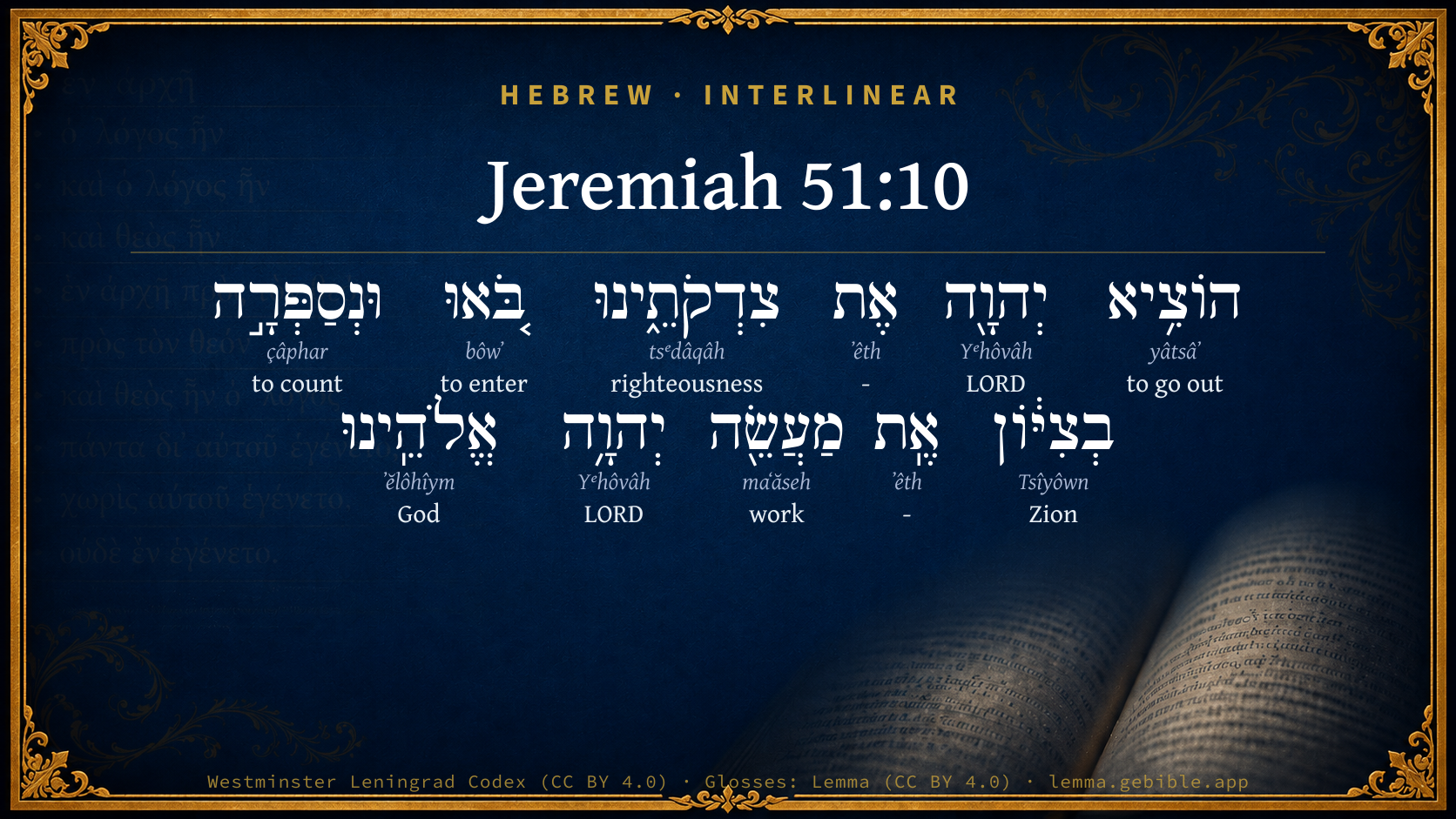
Jeremiah 51:10

Hebrew (Westminster Leningrad Codex) Jeremiah 51:10 appears in the Hebrew Old Testament. The text above is from the Westminster Leningrad Codex. Each word links to its Strong’s number, a concise gloss, and parsing drawn from the Open Scriptures Hebrew Bible morphology. Click any word for its full Brown-Driver-Briggs (BDB) entry.
Download image
Cite this verse

Jeremiah 51:10 (World English Bible). Public Domain. Lemma interlinear Bible study tool, https://lemma.gebible.app/v/jeremiah/51/10.

Show BibTeX & RIS
BibTeX
RIS
English Translation
Yahweh has brought forth our righteousness: come, and let us declare in Zion the work of Yahweh our God.
World English Bible · Public Domain
Download a study sheet

One document with this verse’s original text, its word-by-word gloss line, the meaning frame, cross-references with their text, attributed commentary, and full source and license credits — printable, and it pastes into notes with its structure intact.

This verse Autodidact and up

Study sheet (.html) Plain text (.txt)

A passage Seminary Student

Up to 50 verses in one chapter. A passage sheet keeps up to 6 commentary sources and 12 cross-references per verse, in the order this page ranks them, and says so on the sheet whenever that leaves anything out. Ask for a single verse and you get the Autodidact verse sheet above.

Everything on this page stays free to read, with no account — the sheet is a download of what is already on screen, not access to it.

Want to remove ads? Support Godless Engineer
Compare translations 3

The same verse in 3 English versions, stacked beneath the original-language interlinear above. Click any original word for its lexicon entry.

Each is an independent rendering of the whole verse — the interlinear is not word-aligned to these translations.

Highlighted words mark where these versions differ — a whole-verse word diff, not a word-by-word alignment.

  • World English Bible Public Domain
    Yahweh has brought forth our righteousness: come, and let us declare in Zion the work of Yahweh our God.
  • King James Version Public Domain
    The LORD hath brought forth our righteousness: come, and let us declare in Zion the work of the LORD our God.
  • unfoldingWord Literal Text CC BY-SA 4.0
    Yahweh has declared our innocence. Come, let us tell in Zion the deeds of Yahweh our God.’

unfoldingWord Literal Text — © unfoldingWord, licensed CC BY-SA 4.0. Word-aligned USFM3 via Door43 (git.door43.org/unfoldingWord/en_ult).

Versions to compare (up to 4)

3 of 4 selected

Show all 18 translations

Every available English version of this verse, each an independent rendering of the whole verse.

  • World English Bible Public Domain
    Yahweh has brought forth our righteousness: come, and let us declare in Zion the work of Yahweh our God.
  • Berean Standard Bible Public Domain
    “The LORD has brought forth our vindication; come, let us tell in Zion what the LORD our God has accomplished.”
  • Majority Standard Bible Public Domain
    “The LORD has brought forth our vindication; come, let us tell in Zion what the LORD our God has accomplished.”
  • King James Version Public Domain
    The LORD hath brought forth our righteousness: come, and let us declare in Zion the work of the LORD our God.
  • American Standard Version (1901) Public Domain
    Jehovah hath brought forth our righteousness: come, and let us declare in Zion the work of Jehovah our God.
  • Revised Version (1885) Public Domain
    The LORD hath brought forth our righteousness: come, and let us declare in Zion the work of the LORD our God.
  • Geneva Bible (1599) Public Domain
    The Lord hath brought forth our righteousnesse: come and let vs declare in Zion the worke of the Lord our God.
  • Douay-Rheims (1899) Public Domain
    The Lord hath brought forth our justices: Come, and let us declare in Sion the work of the Lord our God.
  • Young's Literal Translation Public Domain
    Jehovah hath brought forth our righteousnesses, Come, and we recount in Zion the work of Jehovah our God.
  • Literal Standard Version CC BY-SA 4.0
    YHWH has brought forth our righteousnesses, || Come, and we recount in Zion the work of our God YHWH.
  • Unlocked Literal Bible CC BY-SA 4.0
    Yahweh has declared our innocence. Come, let us tell in Zion the deeds of Yahweh our God.'
  • unfoldingWord Literal Text CC BY-SA 4.0
    Yahweh has declared our innocence. Come, let us tell in Zion the deeds of Yahweh our God.’
  • Darby Bible Public Domain
    Jehovah hath brought forth our righteousness: come, and let us declare in Zion the work of Jehovah our God.
  • World Messianic Bible Public Domain
    ‘The LORD has produced our righteousness. Come, and let’s declare in Zion the work of the LORD our God.’
  • Webster's Bible Public Domain
    The LORD hath brought forth our righteousness: come, and let us declare in Zion the work of the LORD our God.
  • Free Bible Version CC BY-SA 4.0
    The Lord has encouraged and supported us. Come on, let's tell people here in Jerusalem what the Lord has done for us!”
  • Bible in Basic English Public Domain
    The Lord has made clear our righteousness: come, and let us give an account in Zion of the work of the Lord our God.
  • JPS Tanakh (1917) Public Domain
    The LORD hath brought forth our victory; come, and let us declare in Zion the work of the LORD our God.

Literal Standard Version (2020), Covenant Press — licensed CC BY-SA 4.0. Text via the HelloAO Bible API (eBible.org). Unlocked Literal Bible (unfoldingWord) — licensed CC BY-SA 4.0. Text via the HelloAO Bible API (eBible.org). unfoldingWord Literal Text — © unfoldingWord, licensed CC BY-SA 4.0. Word-aligned USFM3 via Door43 (git.door43.org/unfoldingWord/en_ult). Free Bible Version, Dr. Jonathan Gallagher — licensed CC BY-SA 4.0. Text via the HelloAO Bible API (eBible.org).

Word by word

More ways to search: Search by grammar → Find every occurrence → Compare this word →

Practice this passage: Drill this verse → Learn its vocabulary →

בְצִיּ֔וֹן
Tsîyôwn
H6726
“in/at · Zion”
Preposition + Noun, Proper
Part of Speech
Preposition + Noun
Type
Proper
Full BDB Definition

Origin: the same (regularly) as H6725

TWOT: 1910

Zion = "parched place" - another name for Jerusalem especially in the prophetic books
  1. הוֹצִ֥יא yâtsâʼ H3318 “to go out” Verb, Hiphil, Perfect, 3rd Person, Masculine, Singular
  2. יְהוָ֖ה Yᵉhôvâh H3068 “LORD” Noun, Proper
  3. אֶת ʼêth H853 “-” Particle, Direct Object
  4. צִדְקֹתֵ֑ינוּ tsᵉdâqâh H6666 “righteous acts · our” Noun, Common, Feminine, Plural, Construct + Suffix, Personal, 1st Person, Common, Plural
  5. בֹּ֚אוּ bôwʼ H935 “enter” Verb, Qal, Imperative, 2nd Person, Masculine, Plural
  6. וּנְסַפְּרָ֣ה çâphar H5608 “and · to count” Conjunction + Verb, Piel, Cohortative, 1st Person, Common, Plural
  7. אֶֽת ʼêth H853 “-” Particle, Direct Object
  8. מַעֲשֵׂ֖ה maʻăseh H4639 “work of” Noun, Common, Masculine, Singular, Construct
  9. יְהוָ֥ה Yᵉhôvâh H3068 “LORD” Noun, Proper
  10. אֱלֹהֵֽינוּ ʼĕlôhîym H430 “God(s) · our” Noun, Common, Masculine, Plural, Construct + Suffix, Personal, 1st Person, Common, Plural

About this verse

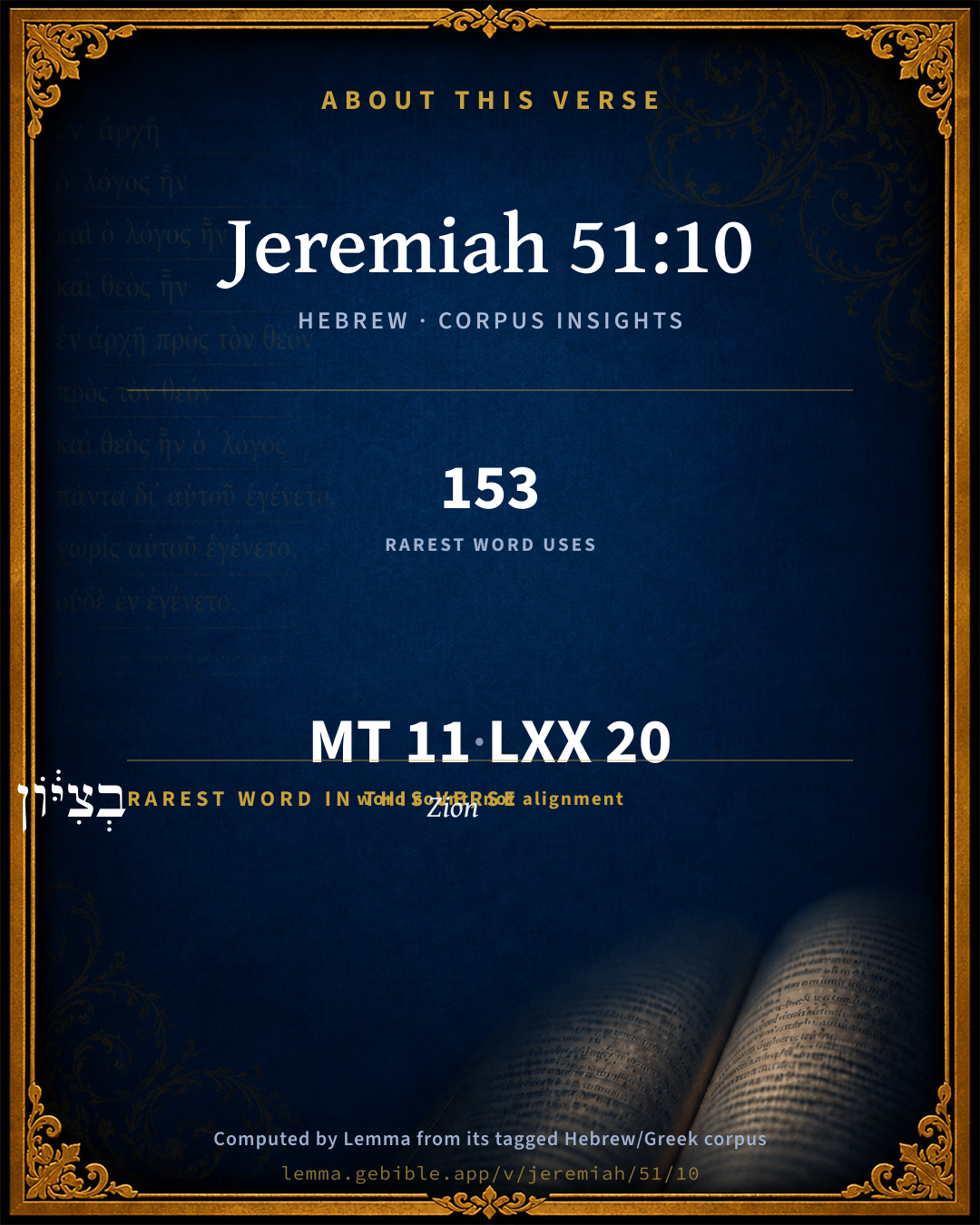
These counts appear in no published source. They are computed here, from the morphology-tagged text and Lemma’s own curated glosses. What Lemma adds →

11
words
9
distinct lemmas
Prophets
section

Grammatical profile

  • 3 verbs
  • 6 nouns
  • 2 particles

Verb forms

  • הוֹצִ֥יא Hiphil · Perfect
  • בֹּ֚אוּ Qal · Imperative
  • וּנְסַפְּרָ֣ה Piel · Cohortative

Repetition

A word recurs within this verse — often emphatic in Hebrew:

  • יְהוָ֖ה LORD H3068 ×2

Hebrew & Septuagint length

In the original languages it is 11 Hebrew tokens and 20 Greek tokens — but the two are counted differently (Hebrew bundles its prefixes and suffixes into one token; the Greek is in lemma form), so that isn’t a like-for-like length.

Cross-references

13

Topical passages linked to Jeremiah 51:10 in the Treasury of Scripture Knowledge — connected by theme and wording, ordered by reader-vote popularity; previews shown in the World English Bible.

  • Jeremiah 50:28 The voice of those who flee and escape out of the land of Babylon, to declare in Zion the vengeance of Yahweh our God, the vengeance of his temple.
  • Psalms 37:6 He will make your righteousness go forth as the light, And your justice as the noon day sun.
  • Isaiah 40:2 Speak comfortably to Jerusalem; and cry to her, that her warfare is accomplished, that her iniquity is pardoned, that she has received of Yahweh's hand double for all her sins.
  • Isaiah 51:11 The ransomed of Yahweh shall return, and come with singing to Zion; and everlasting joy shall be on their heads: they shall obtain gladness and joy; [and] sorrow and sighing shall flee away.
  • Psalms 9:14 That I may show forth all your praise. In the gates of the daughter of Zion, I will rejoice in your salvation.
  • Psalms 102:19–21 For he has looked down from the height of his sanctuary. From heaven, Yahweh saw the earth;
  • Psalms 116:18–19 I will pay my vows to Yahweh, Yes, in the presence of all his people,
  • Psalms 126:1–3 When Yahweh brought back those who returned to Zion, We were like those who dream.
  • Isaiah 52:9–10 Break forth into joy, sing together, you waste places of Jerusalem; for Yahweh has comforted his people, he has redeemed Jerusalem.
  • Jeremiah 31:6–9 For there shall be a day, that the watchmen on the hills of Ephraim shall cry, Arise you, and let us go up to Zion to Yahweh our God.
  • Micah 7:9–10 I will bear the indignation of Yahweh, Because I have sinned against him, Until he pleads my case, and executes judgment for me. He will bring me forth to the light. I will see his righteousness.
  • Revelation 14:1–3 I saw, and behold, the Lamb standing on Mount Zion, and with him a number, one hundred forty-four thousand, having his name, and the name of his Father, written on their foreheads.
  • Revelation 19:1–6 After these things I heard something like a loud voice of a great multitude in heaven, saying, "Hallelujah! Salvation, power, and glory belong to our God:

Cross-references courtesy of OpenBible.info (CC BY 4.0).

Hebrew and Greek witnesses Masoretic Hebrew ↔ Greek Septuagint

The same verse in the two great witnesses to the Old Testament, shown verse-for-verse.

These are two independent witnesses, not word-aligned to each other, and the Septuagint is shown in lemma (dictionary) form.

Hebrew Jeremiah 51:10 Masoretic · Westminster Leningrad Codex

הוֹצִ֥יא יְהוָ֖ה אֶת צִדְקֹתֵ֑ינוּ בֹּ֚אוּ וּנְסַפְּרָ֣ה בְצִיּ֔וֹן אֶֽת מַעֲשֵׂ֖ה יְהוָ֥ה אֱלֹהֵֽינוּ

Yahweh has brought forth our righteousness: come, and let us declare in Zion the work of Yahweh our God.

World English Bible · Public Domain

Greek LXX Structure differs

In the Septuagint, Jeremiah is about an eighth shorter than the Hebrew and arranges its material differently — the Oracles Against the Nations (Hebrew chapters 46–51) appear in the middle of the Greek book, after 25:13. Because the chapter and verse boundaries do not line up, a verse-for-verse comparison with the Hebrew is not shown.

A verse-for-verse comparison isn’t shown here because the chapters and verses don’t line up. Switch to the LXX edition with the MT / LXX toggle above to read the Greek directly.

Hebrew: Westminster Leningrad Codex (CC BY 4.0). Greek: Septuagint (public domain); English from a public-domain English Septuagint. How the Septuagint differs from the Hebrew →

Targum (Aramaic paraphrase)

1

The Targum is the ancient Jewish Aramaic paraphrase of the Hebrew Scriptures — an interpretive translation, not the Hebrew text itself. Onkelos (literal) and Pseudo-Jonathan (expansive) render the Torah, and Jonathan the Prophets. Coverage is partial: where no permissively-licensed English translation exists for a verse, only the Aramaic is shown. This is verse-level text, not a word-by-word alignment to the Hebrew.

  1. Targum Jonathan Prophets (Joshua–Malachi)
    גְלָא יְיָ יַת זְכוּתָנָא אֲתוֹ וְנִשְׁתָּעֵי בְצִיוֹן יַת עוֹבָדָא דִי עָבֵיד יְיָ אֱלָהָנָא:

    (no public-domain English translation for this verse)

    Targum Jonathan — Aramaic: “Mikraot Gedolot” (public domain). English: “Sefaria Community Translation” (CC0 1.0 (public-domain dedication)); “London "Chaldee Paraphrase," 1871” (public domain). Text via Sefaria.

Commentary

Notes on Jeremiah 51:10 from classic Christian and Jewish commentators (each source and its license shown beneath its notes). The classic Christian expositions comment on the surrounding passage and are grouped to its opening verse, so a note may address several verses; the Jewish commentaries on the Tanakh (Rashi and others) are per-verse, so they appear only where the commentator wrote on this verse.

Lemma curates 59 commentaries, every one of them public domain or Creative Commons licensed, each selected and text-cleaned for this edition rather than reprinted as found. About our sources →

Trapp's Complete Commentary

John Trapp

Jer 51:10 The LORD hath brought forth our righteousness: come, and let us declare in Zion the work of the LORD our God.

Ver. 10. The Lord hath brought forth our righteousness,] i.e., Our just cause, and the righteousness of our religion, derided by the Babylonians.

John Trapp, A Commentary or Exposition upon All the Books of the Old and New Testament (1647–1656) — public domain. Text from a community e-Sword module.

Joseph Benson's Commentary

Jer 51:10. The Lord hath brought forth our righteousness — Hath made manifest the equity of our cause, revenged the wrongs we have suffered, and shown ours to be the true religion, by bringing such remarkable judgments upon our enemies. Come, and let us declare in Zion, &c. — Therefore let us give glory to him in the assemblies of his church, and in the most public manner imaginable. This is spoken in the persons of the captive Jews.

Joseph Benson's Commentary on the Old and New Testaments (1811–1818) — public domain. Text from a community e-Sword module.

Geneva Bible (1599)

Geneva Bible translators

In approving our cause and punishing our enemies.

Geneva Bible (1599) marginal notes — public domain. Text via Bolls.life.

Jamieson, Fausset & Brown

Robert Jamieson, A. R. Fausset & David Brown

Next after the speech of the confederates of Babylon, comes that of the Jews celebrating with thanksgivings the promise-keeping faithfulness of their covenant God.

brought forth, &c.-- (Psa 37:6).

our righteousness--not the Jews' merits, but God's faithfulness to Himself and to His covenant, which constituted the "righteousness" of His people, that is, their justification in their controversy with Babylon, the cruel enemy of God and His people. Compare Jer 23:6, "The Lord our righteousness"; Mic 7:9. Their righteousness is His righteousness.

declare in Zion-- (Psa 102:13-21).

Jamieson, Fausset & Brown — Commentary Critical and Explanatory on the Whole Bible (1871) — public domain (CC PDM 1.0). Text via the HelloAO Bible API.

Adam Clarke's Commentary

Verse 10. The Lord hath brought forth our righteousness.] This is the answer of the Jews. God has vindicated our cause.

Adam Clarke's Commentary on the Bible (1810–1826) — public domain. Text from a community e-Sword/MySword module.

John Calvin's Commentaries

The Prophet here addresses the faithful, and especially shows, that the ruin of Babylon would be a sure evidence of God’s paternal favor towards his Church. And it was no common consolation to the faithful, in their extreme miseries, to know, that so dear and precious to God was their salvation, that he would by no means spare the Babylonians, whom the whole world regarded as half gods; for, as I have said, the power of that monarchy filled the minds of men with astonishment. When the faithful, then, knew that the Babylonians were to perish, because they had oppressed and cruelly treated them, an invaluable consolation, as I have said, must hence have been conveyed to them. The Prophet then reminds us here, that it would be a singular testimony as to God’s favor to his Church, when he subverted Babylon, and he also exhorts the faithful to gratitude: for it is the design of all God’s benefits, that his name may be celebrated by us, according to what David says:

“What shall I render to the Lord for all the benefits which he has bestowed on me? The cup of salvation will I take and call on the name of the Lord.” (Psalm 116:12, 13.)

He then says, first, Brought forth hath Jehovah our righteousness Here, some anxiously toil to untie a knot, where there is none; for fearing lest the word, righteousness, should be laid hold on for the purpose of setting up merits, they say that righteousness is the remission of sins. Then they thus explain the words of the Prophet,” God has at length unfolded his mercy towards us, and it is our righteousness when all our iniquities are buried.” But this is forced. When the Prophet speaks here of righteousnesses, he does not mean the merits by which the Jews were to obtain what had been promised to them; but righteousnesses he calls their good cause with regard to the Babylonians. For righteousness has various meanings; and when a comparison is made between men, God is said to bring forth our righteousness, when he vindicates our integrity from the calumnies of the wicked. So Jacob said,

“The Lord will bring forth my righteousness as the dawn.” (Genesis 30:33)

But in this sense our righteousness has a reference to our adversaries. So whenever David asked of God to regard his righteousness, he no doubt compared himself with his enemies. And righteousness here is to be taken simply with reference to the Babylonians. For though God had punished the Jews as they deserved, yet as to the Babylonians they were cruel tyrants and wicked robbers. The cause, then, of the chosen people was just, with regard to them. This is the reason why he says, that God brought forth their righteousnesses The rest to-morrow.

John Calvin's Commentaries (1540-1563) — public domain. Text from the Calvin Translation Society English edition (1840s-50s) via the Christian Classics Ethereal Library (ccel.org). Calvin's coverage is partial (roughly two-thirds of the Bible); uncommented books and verses are honest gaps, never fabricated. The 19th-century editor's footnotes and remarks are omitted so the notes are faithfully Calvin's own voice.

Ellicott's Commentary for English Readers

(10) The Lord hath brought forth our righteousness . . .—The Hebrew noun is plural—the many righteous acts or forms of righteousness. The thought is parallel to that of Isa_62:1. The exile in Babylon had been a time of reformation and growth in righteousness. The day of vengeance on the oppressing city was also a day of acquittal for Israel. It was seen that she had not forfeited the favour of Jehovah. She could still sing, as of old (Jdg_5:11), the righteous acts of the Lord, and would sing them, as of old, in the restored sanctuary of Zion.

A Bible Commentary for English Readers, edited by Charles John Ellicott (1878–1897) — public domain. Text from a community e-Sword module.

The Cambridge Bible for Schools and Colleges

gen. ed. J. J. S. Perowne

10. hath brought forth our righteousness] hath made known the justice of our cause (by our enemy’s overthrow). Cp. Psa_37:6.

The Cambridge Bible for Schools and Colleges (gen. ed. J. J. S. Perowne; Cambridge University Press, 1878–1918) — public domain. Text from a community e-Sword module.

John Gill's Exposition

The Lord hath brought forth our righteousness,.... Or "righteousnesses" (i) this, as Kimchi observes, is spoken in the person of the Israelites; not as though the Jews had done no iniquity, for which they were carried captive; they had committed much, and were far from being righteous in themselves, but were so in comparison of the Chaldeans; and who had gone beyond their commission, and had greatly oppressed them, and used them cruelly; and now the Lord, by bringing destruction upon them, vindicated the cause of his people, and showed it to be a righteous one; and that the religion they professed was true, and which the Chaldeans had derided and reproached: this righteousness, not of their persons, but of their cause, and the truth of their holy religion, the Lord brought forth to the light, and made it manifest, by taking their parts, and destroying their enemies:

come, and let us declare in Zion the work of the Lord our God; the Jews encourage one another to return into their own land, rebuild their temple, and set up the worship of God in it; and there declare the wondrous work of God in the destruction of Babylon, and their deliverance from thence; giving him the praise and glory of it; and exciting others to join with them in it, it being the Lord's work, and marvellous in their eyes; and so, when mystical Babylon is destroyed, voices will be heard in heaven, in the church, ascribing salvation, honour, and glory, to God, Rev 19:1. All this is true, in an evangelic sense, of such as are redeemed by Christ, and brought out of mystical Babylon, and are effectually called by the grace of God; to these the Lord brings forth the righteousness of Christ, which he makes their own, by imputing it to them; and he brings it near to them, and puts it upon them; it is revealed unto them from faith to faith; it is applied to them by the Spirit of God, and put into their hands to plead with God, as their justifying righteousness; and which is brought forth by him on all occasions, to free them from all charges exhibited against them by law or justice, by the world, Satan, or their own hearts, Rom 8:33; and it becomes such persons to declare in Zion, in the church of God, the works of the Lord; not their own, which will not bear the light, nor bear speaking of; but the works of God, of creation and providence; but more especially of grace, as the great work of redemption by Jesus Christ; and particularly the Spirit's work of grace upon their hearts, which is not the work of men, but of God; being a new creation work; a regeneration; a resurrection from the dead; and requiring almighty power, to which man is unfit and unequal: this lies in the quickening of men dead in trespasses and sins; in enlightening such as are darkness itself; in an implantation of the principles of grace and holiness in them; in giving them new hearts and new spirits; and in bringing them off of their own righteousness, to depend on Christ alone for salvation; and which work, as it is begun, will be carried on, and performed in them, until the day of Christ; and, wherever it is, should not be concealed, but should be declared in the gates of Zion, publicly, freely, and fitly and faithfully, to the glory of the grace of God, and for the comfort of his people, to whom every such declaration is matter of joy and pleasure; see Psa 66:16.

(i) "justitas nostras", V. L. Pagninus, Montanus, Piscator, Cocceius, Schmidt.

John Gill's Exposition of the Whole Bible (1746–1763) — public domain (CC PDM 1.0). Text via the HelloAO Bible API.

Albert Barnes' Notes on the Bible

Yahweh hath brought to the light those things which prove us to be righteous: i. e., by punishing Babylon He hath justified

Albert Barnes' Notes on the Bible (1834–1885) — public domain. Text from a community e-Sword/MySword module.

Haydock's Catholic Bible Commentary

Justices. We had not injured the Chaldeans, though we had offended God.

George Leo Haydock (1774–1849), Haydock's Catholic Family Bible and Commentary, 1859 edition — public domain. Excludes Psalms (Douay-Rheims chapter numbering differs from Protestant) and Deuterocanonical books (Catholic canon only).

Matthew Poole's English Annotations

These words are spoken as in the person of the Jews, owning the destruction of Babylon,

1. To be the mighty work of God.

2. An act of justice and judgment, pleading the cause and revenging the wrongs of his people; and owning the Jewish religion, and calling one to another to go to the temple to declare what God had done for them, and to give thanks unto him for it.

Matthew Poole's English Annotations on the Holy Bible (1683–1685) — public domain. Text from a community e-Sword/MySword module.

Whedon's Commentary on the Bible

Daniel D. Whedon

10. Righteousness — Literally, righteousnesses; the things which show us to be righteous.

Daniel D. Whedon (gen. ed.), Commentary on the Old and New Testaments (1874–1909) — public domain. Text from a community e-Sword module.

The Pulpit Commentary

Our righteousness; literally, our righteousnesses; not in the sense of "righteous deeds", (as in Isa_64:6 Jud_1:5:11) but "those things which prove us to righteous; i.e. by punishing Babylon he hath justified us" (Payne Smith).

Public thanksgiving.

In the destruction of Babylon and the restoration of Israel the devout sufferers of the Captivity see the justification of their conduct which had lain under a shadow while they shared in the punishment of their guilty brethren. So happy an issue from their troubles calls for devout gratitude, and this finds its expression in hymns of praise and public thanksgiving.

I PRAISE IS ONE OF THE MOST IMPORTANT ELEMENTS OF WORSHIP. Two faults may be observed in much of our worship both arising from our centering it in ourselves.

1. It is too selfish. We are more earnest in prayer than in praise. In sore need we cry out with terrible anxiety; but when the need is satisfied we return thanks in poor and faint tones. We are eager to obtain blessings for ourselves, but little desirous of glorifying God. Yet the essence of worship is self-surrender. We degrade it and contradict its spirit when we make it serve the ends of self-seeking.

2. It is too subjective. We dwell much on our own feelings instead of going out of self in the contemplation of God. Consequently our worship is pitched too much in the minor key. We wail out "Misereres" when we should be shouting "Magnificats." We have much to say about our low estate, but little concerning the way in which God has regarded it. But, the highest worship is adoration the going out of self in wonder, love, and praise towards the glory of God. It would be well if we made less mention of our own feelings and were more ready to "declare the work of the Lord our God.

II PRAISE MUST BE DEFINITE IF IT IS TO BE EARNEST. Much of our worship is vapid and senseless because it is expressed in big vague phrases which carry little thought to our minds.

1. We should praise God by declaring his works. It is his character that we adore. But we see and realize this as it is reflected in his works. We see the glory of the sun, not by gazing with eagle vision into its dazzling centre, but by looking abroad on the many hues that it casts on land and sea and sky. We cannot see the glory of God by abstract speculations on divinity; we must study his works in nature, providence, and redemption.

2. We should praise God by noting those particular works which affect our experience. This is the secret of earnest praise. The Jews declare the works they have witnessed; i.e. the special blessings of the restoration. Each man can call to mind some of the blessings he has personally enjoyed, and in the consideration of these see good ground for glorifying God.

III THE EXPRESSION OF PRAISE SHOULD BE PUBLIC. The people come together; they assemble at Zion, the place of public worship; they declare make public the works of God. This is fitting for many reasons.

1. It glorifies God. This is the only way in which we can glorify him. We cannot add to his glory, but we may reflect it.

2. It increases our own thankfulness. Joy is sympathetic. By sharing it we increase it.

3. It leads others to see the same glory and goodness of God. A song of praise is the most effectual sermon on the grace of God; for it is

a. the language of experience,

b. an expression of feeling, and

c. a vivid representation of "the works of the Lord our God.

See homily on Jer_10:16.

Praise the outcome of saintly experience.

These are the words of Jeremiah, but there can be little doubt he is but instinctively interpreting the emotion that must fill the breasts of his countrymen when his predictions were accomplished. As a representative Israelite, he expresses the deep-seated impulse that is felt when the greater providences and special spiritual deliverances of life are realized.

I EXPERIENCES OF SAVING GRACE AN OCCASION OF THANKSGIVING AND PRAISE. We owe thankful recognition to God for our creation, preservation, and the recurring, mercies of our temporal life; but there are stronger emotions awakened by the experiences of grace in the spiritual nature.

1. Notice some of these. This deliverance from Babylon. Conversion, or the rescue of the soul from the spiritual Babylon. The triumphs of the gospel; faithfulness of saints; increase of spiritual power and influence; preservation of Christian institutions in times of spiritual apathy or persecution; evangelization of heathen lands, etc. Special answers to prayer, or peace and comfort in private fellowship with our heavenly Father.

2. Their general character. "The Lord hath brought forth our righteousness" ("righteousnesses"). This deliverance was a great act of judgment. The cause of God"s people was vindicated, and the guilt of Babylon avenged! (cf. Psa_37:6) The whole world was witness of the character and meaning of the event. And this is the element in all the experiences of grace that awakens special thanksgiving they are manifestations of Divine righteousness in the life of men; triumphs of truth and holiness and love.

II THE SPECIAL DUTY TO WHICH THEY CALL US.

1. Declaring and interpreting God"s work to men,

a. by word;

b. by work.

2. Public celebration in God"s house. Zion was the most fitting and representative, place for such a duty. Public worship should be linked with the experiences of private devotion and the spiritual life. Public and common praise is the privilege and delight of Christians. M.

The response of the redeemed.

"The Lord hath...come, and let us" etc.

I WHAT THE LORD HATH DONE. "Brought forth our righteousness." Now, by this we may understand:

1. The Lord lath brought forth, made known, revealed, him who is our Righteousness (cf. homily on The Lord our Righteousness, vol. 1. p. 527). By his representative character, what is done by him is as done by us. "We thus judge, that if one died for all, then were all dead". (2Co_5:14) There is nothing unreasonable in this. We are perpetually imputing to others what is not in them or but very faintly in them. We do so when we treat strangers with all kindness for the sake of those some honoured and beloved ones who commend them to us. We cause to flow over on them the worth and goodness of those by whom they are commended. They may not merely be strangers, but unworthy and evil, and yet, for the sake of others, we deal with them, not as they are, but as those are from whom they come. So is the Lord Jesus our Righteousness, blessed be his Name!

2. The Lord hath brought forth righteousness in us. But for him there would have been no righteousness at all. Some speak of "natural goodness." There is no such thing. All goodness, like all light, has but one source. Divines tell of ruined arches, stately pillars, etc., relies of the noble fabric that once was. But Scripture rather teaches that sin wrought death. If, then, there be aught that is beautiful and good, fair and righteous and there is, and much it is not a relic, but a new creation. It comes from him who is "the Light that lighteth every man that cometh into the world". (Joh 1; cf. Jam_1:16) And when a man yields up his soul to Christ, then vitally grafted into him, the true Vine, and having become a living branch he will more and more yield the fruit of righteousness, as he never did or could before.

3. The Lord hath brought forth his covenant. That is to say, he hath brought forth in his own mind, so as to remember, his covenant that he made. (cf. Psa_105:8-15 Ps 111, etc.) It is ever declared to be on the ground of this covenant that God dealt well with his people. Now, that covenant had been, as it were, put out of the Divine mind by the multitude of their sins. But now he brings it forth again.

4. The Lord hath vindicated us. The enemies of the Lord blasphemed his people. Counted them as having no worth or goodness at all; as far inferior to all others. But, despised as his people were and condemned, now, by God"s redemption of them, he was to bring forth their righteousness, vindicate them, on and before all. (cf. Psa_37:5-7) This, which he did for Israel, he will do for all his people bring forth their righteousness as the light, and their judgment as the noonday.

II WHAT, THEREFORE, SHOULD WE DO? "Come, and let us declare in Zion the work of the Lord our God." This is what we are to do.

1. Why should we do this? For the honour of God. It is his due. For our own soul"s sake; to keep silence on what he has done for us is not only dishonouring to him, but disastrous to our own souls. For the encouragement of others, that they may be led to trust in him.

2. How should we do this? Openly: "Let us declare in Zion," etc. Not concealing our obligation, not refusing to confess him. Unitedly: "Come, and let us," etc. Join with them of a like mind. Heartily: calling on others to do the like, "Come," etc. In his Church: "In Zion." There taking our place, falling into rank in the army of the Lord. In the heavenly Zion the redeemed of the Lord never tire of thus declaring the work of the Lord. C.

Declaring in Zion the work of the Lord.

I THAT WHICH HAS TO BE DECLARED. The work of Jehovah, the God of Israel, that work being the brining forth of what is described as "our righteousness." What, then, was this righteousness? We can only conjecture, but probably it was that righteousness, ever well pleasing to God, shown by those who believe in his promises and obey his directions. There was ample field for righteousness of this kind on the part of the Israelites in captivity; for had not God told them expressly, however unlikely the event might appear, that they would yet return to their former dwelling place? In due time there was to be a vindication of their faith. But out of that faith there is to be kept every element of self-glorification. It is man"s blessedness, but not his praise, that he recognizes the certainty of what a promise keeping, omnipotent One will do for him. Declaring the work of God is always a satisfactory thing, for the work of God itself is always satisfactory. Well begun, thorough, completed, necessary work it is.

II THOSE WHO DECLARE IT. Those who are the materials of the work and for whom the work is done. They are not mere bystanders and spectators. The sign that real Divine work is being done in a human heart comes when praise and acknowledgment of the great Worker is expressed. We are God"s workmanship. It is he who extricates us from our confusions, nullifies the vain doings of the merely natural man, and makes us capable of actions that will abide and glorify him. It is part of God"s very work to put into us the spirit of declaration, so that we perceive the change wrought in us, the Worker of it, the continuity of it, in short, all the good connected with it. And perceiving all this, how should we do other than declare in one mingled utterance the glory of God and our gratitude to him?

III THE PLACE OF DECLARATION. In Zion, with its memories of Jehovah"s presence in the past. Zion was a name to humble Israel, in the thought of former apostasy and idolatry; but Zion was nothing but glorious so far as Jehovah was concerned. Zion had been too long neglected, not indeed so far as a certain outward worship was concerned, but the worship of the heart was lacking. Now Zion would appear in an altogether new aspect. Instead of mere words, mere ritual routine, there was an acknowledgment of deeply felt benefit at the hands of God. The place of worship was the same, yet not the same, for the old scene had new associations. We may acknowledge God anywhere; we must acknowledge him everywhere; but yet there is a suitability in making certain acknowledgments in certain places. What could be more appropriate than to utter forth words of true spiritual recognition on that sacred spot where God had been so long misunderstood and defied? Y.

The Pulpit Commentary (1880–1919), ed. H.D.M. Spence-Jones & Joseph S. Exell — public domain. Text from a community e-Sword module.

John Wesley's Explanatory Notes

Some - These words are spoken in the person of the Jews, owning the destruction of Babylon to be the mighty work of God, and an act of justice, revenging the wrongs of his people.

John Wesley, Explanatory Notes Upon the Whole Bible (1754–1765) — public domain. Text via the GEBible commentary corpus.

Rashi

Rabbi Shlomo Yitzchaki (Rashi)

“The Lord has brought forth our merits” We have been remembered by Him favorably, and the merits of our forefathers have come before Him.

Rashi on the Tanakh — English translations: “The Judaica Press complete Tanach with Rashi, translated by A. J. Rosenberg” (CC BY 4.0); “Pentateuch with Rashi's commentary by M. Rosenbaum and A.M. Silbermann, 1929-1934” (public domain); “The Metsudah Tanach series, Lakewood, N.J” (CC BY 4.0); and “The Book of Joshua, Metsudah Publications, 1997” (CC BY 4.0). Text via Sefaria.

Lesson kit

Teaching starters — assembled from the data on this page, not authored interpretation. Every prompt links to the verse data it draws on. Edit before teaching.

Jeremiah, in the Prophets, opens this verse with 11 words (9 distinct Hebrew lemmas). Its most distinctive word is Tsîyôwn (“Zion”). A historical commentator’s framing appears above. Read the whole chapter for the surrounding context.

Discussion questions

  1. What does “Zion” (Tsîyôwn) contribute to the verse as a whole?
  2. Jeremiah 50:28 shares this passage’s theme. How do the two illuminate each other?
  3. “LORD” occurs 2× in this one verse. What is the effect of the repetition?
  4. The translations on this page render this verse differently — a whole-verse word diff, not a word-by-word alignment. What might account for the different wordings?
  5. The verb «הוֹצִ֥יא» is Hiphil Perfect. How does its form color the action?
  6. Reading how Trapp's Complete Commentary and Joseph Benson's Commentary read this verse, where do the two commentators agree and where do they part?

Things to notice

Reading settings

Reading text

Shown beneath each verse's original-language words.

Old Testament
Old Testament edition

Read the OT as the Masoretic Hebrew (MT) or the Greek Septuagint (LXX).

English shown for the Greek Septuagint (in the Hebrew ↔ Greek comparison).

Comparing translations? Open the Compare panel on any verse page to stack up to four side by side.