Lamentations 4:2

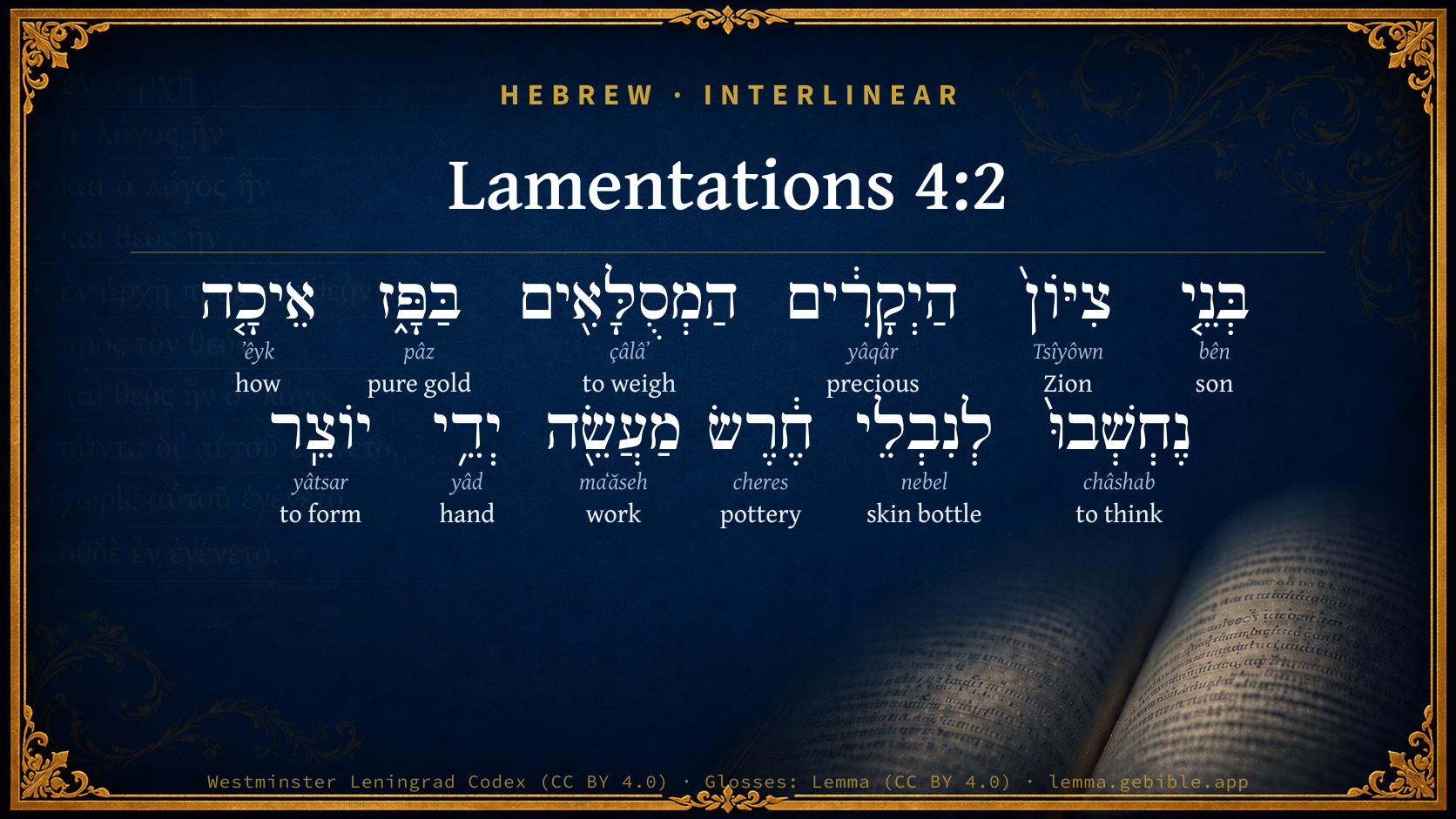
Hebrew (Westminster Leningrad Codex) Lamentations 4:2 appears in the Hebrew Old Testament. The text above is from the Westminster Leningrad Codex. Each word links to its Strong’s number, a concise gloss, and parsing drawn from the Open Scriptures Hebrew Bible morphology. Click any word for its full Brown-Driver-Briggs (BDB) entry.
Download image
Cite this verse

Lamentations 4:2 (World English Bible). Public Domain. Lemma interlinear Bible study tool, https://lemma.gebible.app/v/lamentations/4/2.

Show BibTeX & RIS
BibTeX
RIS
English Translation
The precious sons of Zion, comparable to fine gold, How are they esteemed as earthen pitchers, the work of the hands of the potter!
World English Bible · Public Domain
Highlights
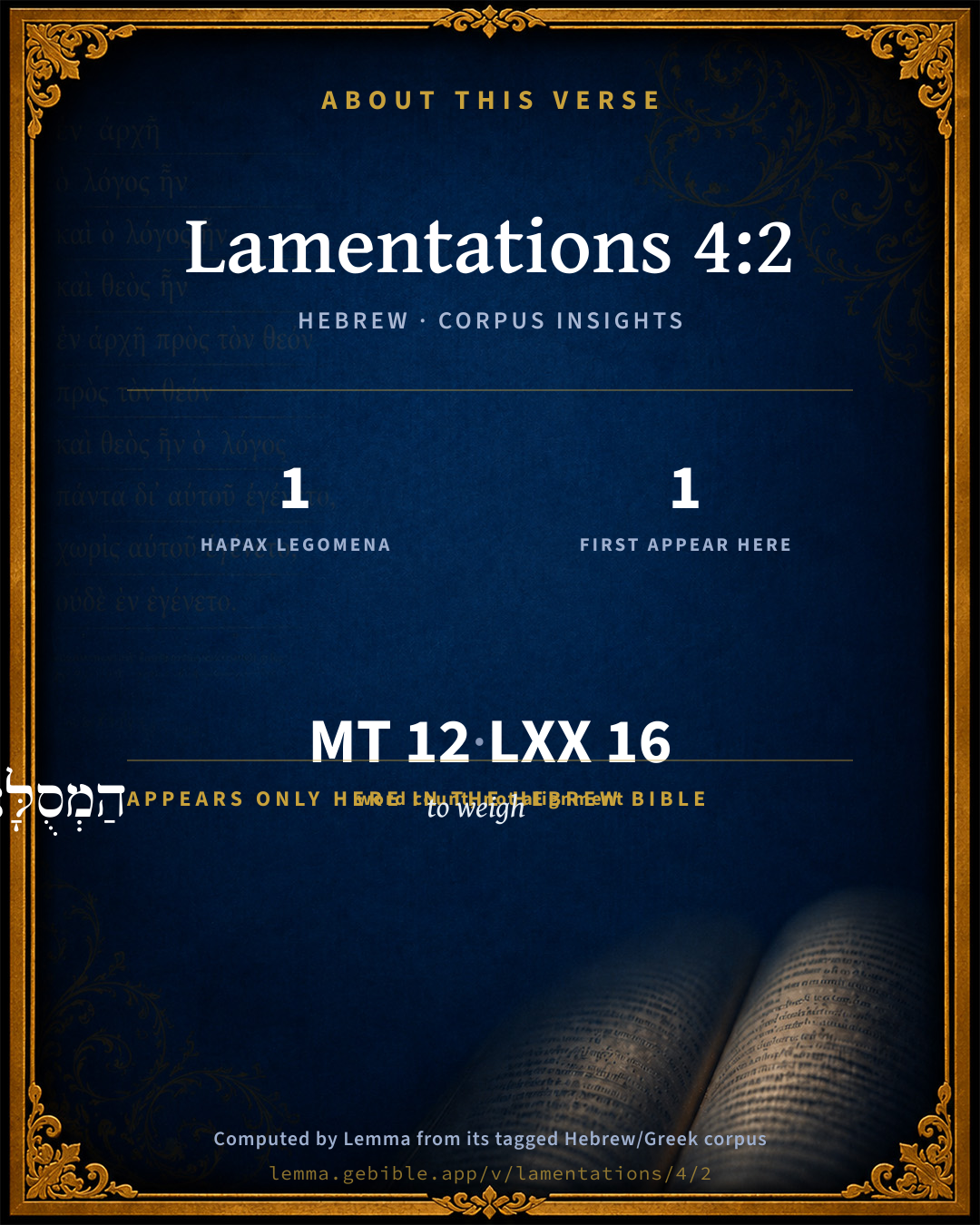
  • 1 hapax legomenon — only here in the Hebrew Bible
  • 1 first appearance in the Hebrew Bible
Full analysis ↓
Download a study sheet

One document with this verse’s original text, its word-by-word gloss line, the meaning frame, cross-references with their text, attributed commentary, and full source and license credits — printable, and it pastes into notes with its structure intact.

This verse Autodidact and up

Study sheet (.html) Plain text (.txt)

A passage Seminary Student

Up to 50 verses in one chapter. A passage sheet keeps up to 6 commentary sources and 12 cross-references per verse, in the order this page ranks them, and says so on the sheet whenever that leaves anything out. Ask for a single verse and you get the Autodidact verse sheet above.

Everything on this page stays free to read, with no account — the sheet is a download of what is already on screen, not access to it.

Want to remove ads? Support Godless Engineer
Compare translations 3

The same verse in 3 English versions, stacked beneath the original-language interlinear above. Click any original word for its lexicon entry.

Each is an independent rendering of the whole verse — the interlinear is not word-aligned to these translations.

Highlighted words mark where these versions differ — a whole-verse word diff, not a word-by-word alignment.

  • World English Bible Public Domain
    The precious sons of Zion, comparable to fine gold, How are they esteemed as earthen pitchers, the work of the hands of the potter!
  • King James Version Public Domain
    The precious sons of Zion, comparable to fine gold, how are they esteemed as earthen pitchers, the work of the hands of the potter!
  • unfoldingWord Literal Text CC BY-SA 4.0
    The precious sons of Zion, weighed against fine gold, how they are regarded as jars of clay, the work of the hands of a potter! GIMEL

unfoldingWord Literal Text — © unfoldingWord, licensed CC BY-SA 4.0. Word-aligned USFM3 via Door43 (git.door43.org/unfoldingWord/en_ult).

Versions to compare (up to 4)

3 of 4 selected

Show all 18 translations

Every available English version of this verse, each an independent rendering of the whole verse.

  • World English Bible Public Domain
    The precious sons of Zion, comparable to fine gold, How are they esteemed as earthen pitchers, the work of the hands of the potter!
  • Berean Standard Bible Public Domain
    How the precious sons of Zion, once worth their weight in pure gold, are now esteemed as jars of clay, the work of a potter’s hands!
  • Majority Standard Bible Public Domain
    How the precious sons of Zion, once worth their weight in pure gold, are now esteemed as jars of clay, the work of a potter’s hands!
  • King James Version Public Domain
    The precious sons of Zion, comparable to fine gold, how are they esteemed as earthen pitchers, the work of the hands of the potter!
  • American Standard Version (1901) Public Domain
    The precious sons of Zion, comparable to fine gold, How are they esteemed as earthen pitchers, the work of the hands of the potter!
  • Revised Version (1885) Public Domain
    The precious sons of Zion, comparable to fine gold, how are they esteemed as earthen pitchers, the work of the hands of the potter!
  • Geneva Bible (1599) Public Domain
    The noble men of Zion coparable to fine golde, howe are they esteemed as earthen pitchers, euen the worke of the handes of the potter!
  • Douay-Rheims (1899) Public Domain
    Beth. The noble sons of Sion, and they that were clothed with the best gold: how are they esteemed as earthen vessels, the work of the potter's hands?
  • Young's Literal Translation Public Domain
    The precious sons of Zion, Who are comparable with fine gold, How have they been reckoned earthen bottles, Work of the hands of a potter.
  • Literal Standard Version CC BY-SA 4.0
    The precious sons of Zion, || Who are comparable with fine gold, || How they have been reckoned earthen bottles, || Work of the hands of a potter.
  • Unlocked Literal Bible CC BY-SA 4.0
    The precious sons of Zion were worth their weight in pure gold, but now they are worth no more than clay jars, the work of the potter's hands!
  • unfoldingWord Literal Text CC BY-SA 4.0
    The precious sons of Zion, weighed against fine gold, how they are regarded as jars of clay, the work of the hands of a potter! GIMEL
  • Darby Bible Public Domain
    The sons of Zion, so precious, comparable to fine gold, how are they esteemed as earthen pitchers, the work of the hands of the potter!
  • World Messianic Bible Public Domain
    The precious sons of Zion, comparable to fine gold, how they are esteemed as earthen pitchers, the work of the hands of the potter!
  • Webster's Bible Public Domain
    The precious sons of Zion, comparable to fine gold, how are they esteemed as earthen pitchers, the work of the hands of the potter!
  • Free Bible Version CC BY-SA 4.0
    Look at how the precious people of Zion, worth their weight in gold, are now valued like cheap clay jars made by a potter!
  • Bible in Basic English Public Domain
    The valued sons of Zion, whose price was the best gold, are looked on as vessels of earth, the work of the hands of the potter!
  • JPS Tanakh (1917) Public Domain
    The precious sons of Zion, comparable to fine gold, how are they esteemed as earthen pitchers, the work of the hands of the potter!

Literal Standard Version (2020), Covenant Press — licensed CC BY-SA 4.0. Text via the HelloAO Bible API (eBible.org). Unlocked Literal Bible (unfoldingWord) — licensed CC BY-SA 4.0. Text via the HelloAO Bible API (eBible.org). unfoldingWord Literal Text — © unfoldingWord, licensed CC BY-SA 4.0. Word-aligned USFM3 via Door43 (git.door43.org/unfoldingWord/en_ult). Free Bible Version, Dr. Jonathan Gallagher — licensed CC BY-SA 4.0. Text via the HelloAO Bible API (eBible.org).

Word by word

More ways to search: Search by grammar → Find every occurrence → Compare this word →

Practice this passage: Drill this verse → Learn its vocabulary →

הַמְסֻלָּאִ֖ים
çâlâʼ
H5537
“the · weighed”
Particle, Definite Article + Verb, Pual, Participle Passive, Masculine, Plural, Absolute
Part of Speech
Particle + Verb
Stem
Pual
Form
Participle Passive
Gender
Masculine
Number
Plural
State
Absolute
Full BDB Definition

Origin: a primitive root

TWOT: 1500

to weigh, compare - (Pual) - to be weighed - weighed (participle)
  1. בְּנֵ֤י bên H1121 “sons of” Noun, Common, Masculine, Plural, Construct
  2. צִיּוֹן֙ Tsîyôwn H6726 “Zion” Noun, Proper
  3. הַיְקָרִ֔ים yâqâr H3368 “the · precious” Particle, Definite Article + Adjective, Adjective, Masculine, Plural, Absolute
  4. בַּפָּ֑ז pâz H6337 “in/at the · pure gold” Preposition, Determined + Noun, Common, Masculine, Singular, Absolute
  5. אֵיכָ֤ה ʼêyk H349 “how” Particle, Interrogative
  6. נֶחְשְׁבוּ֙ châshab H2803 “to think” Verb, Niphal, Perfect, 3rd Person, Common, Plural
  7. לְנִבְלֵי nebel H5035 “to/for · skin bottles of” Preposition + Noun, Common, Masculine, Plural, Construct
  8. חֶ֔רֶשׂ cheres H2789 “pottery” Noun, Common, Masculine, Singular, Absolute
  9. מַעֲשֵׂ֖ה maʻăseh H4639 “work of” Noun, Common, Masculine, Singular, Construct
  10. יְדֵ֥י yâd H3027 “hands of” Noun, Common, Both, Dual, Construct
  11. יוֹצֵֽר yâtsar H3335 “potter” Noun, Common, Masculine, Singular, Absolute

About this verse

These counts appear in no published source. They are computed here, from the morphology-tagged text and Lemma’s own curated glosses. What Lemma adds →

12
words
12
distinct lemmas
Prophets
section

Notable vocabulary

1 hapax legomenon — a word that appears only here in the entire Hebrew Bible:

  • הַמְסֻלָּאִ֖ים to weigh H5537

First appearance in Scripture

This word makes its first canonical appearance in the Hebrew Bible here:

  • הַמְסֻלָּאִ֖ים to weigh H5537

Shared distinctive vocabulary

בַּפָּ֑ז pure gold H6337 occurs in 9 verses of the Hebrew Bible. Also found in:

Grammatical profile

  • 2 verbs
  • 8 nouns
  • 1 adjective
  • 1 particle

Verb forms

  • הַמְסֻלָּאִ֖ים Pual · Participle Passive
  • נֶחְשְׁבוּ֙ Niphal · Perfect

Hebrew & Septuagint length

In English translation the verse runs 24 words from the Hebrew and 28 from the Septuagint (LXX English) — closely comparable.

A rough comparison of the two English renderings, which tokenize alike — not a word-level alignment.

Word counts can differ between the Hebrew and the Greek without any difference in meaning — e.g. the Hebrew direct-object marker אֵת has no separate Greek word, and Greek often adds the article ὁ.

In the original languages it is 12 Hebrew tokens and 16 Greek tokens — but the two are counted differently (Hebrew bundles its prefixes and suffixes into one token; the Greek is in lemma form), so that isn’t a like-for-like length.

Cross-references

10

Topical passages linked to Lamentations 4:2 in the Treasury of Scripture Knowledge — connected by theme and wording, ordered by reader-vote popularity; previews shown in the World English Bible.

  • Isaiah 30:14 He shall break it as a potter's vessel is broken, breaking it in pieces without sparing; so that there shall not be found among the pieces of it a broken piece with which to take fire from the hearth, or to dip up water out of the cistern."
  • Jeremiah 19:11 and shall tell them, Thus says Yahweh of Hosts: Even so will I break this people and this city, as one breaks a potter's vessel, that can't be made whole again; and they shall bury in Topheth, until there be no place to bury.
  • Romans 9:21–23 Or hasn't the potter a right over the clay, from the same lump to make one part a vessel for honor, and another for dishonor?
  • 2 Timothy 2:20 Now in a great house there are not only vessels of gold and of silver, but also of wood and of clay. Some are for honor, and some for dishonor.
  • 2 Corinthians 4:7 But we have this treasure in clay vessels, that the exceeding greatness of the power may be of God, and not from ourselves.
  • Isaiah 51:18 There is none to guide her among all the sons whom she has brought forth; neither is there any who takes her by the hand among all the sons who she has brought up.
  • Lamentations 5:12 Princes were hanged up by their hand: The faces of elders were not honored.
  • Zechariah 9:13 For indeed I bend Judah as a bow for me. I have filled the bow with Ephraim; And I will stir up your sons, Zion, Against your sons, Greece, And will make you like the sword of a mighty man.
  • Jeremiah 22:28 Is this man Coniah a despised broken vessel? is he a vessel in which none delights? why are they cast out, he and his seed, and are cast into the land which they don't know?
  • Lamentations 2:21 The youth and the old man lie on the ground in the streets; My virgins and my young men are fallen by the sword: You have killed them in the day of your anger; you have slaughtered, [and] not pitied.

Cross-references courtesy of OpenBible.info (CC BY 4.0).

Hebrew and Greek witnesses Masoretic Hebrew ↔ Greek Septuagint

The same verse in the two great witnesses to the Old Testament, shown verse-for-verse.

These are two independent witnesses, not word-aligned to each other, and the Septuagint is shown in lemma (dictionary) form.

Hebrew Lamentations 4:2 Masoretic · Westminster Leningrad Codex

בְּנֵ֤י צִיּוֹן֙ הַיְקָרִ֔ים הַמְסֻלָּאִ֖ים בַּפָּ֑ז אֵיכָ֤ה נֶחְשְׁבוּ֙ לְנִבְלֵי חֶ֔רֶשׂ מַעֲשֵׂ֖ה יְדֵ֥י יוֹצֵֽר

The precious sons of Zion, comparable to fine gold, How are they esteemed as earthen pitchers, the work of the hands of the potter!

World English Bible · Public Domain

Greek LXX Lamentations 4:2 Septuagint · lemma form

υἱός σιων ὁ τίμιος ὁ ἐπιαἴρω ἐν χρυσίον πῶς λογίζομαι εἰς ἀγγεῖον ὀστράκινος ἔργον χείρ κεραμεύς

BETH. The precious sons of Zion, who were equalled in value with gold, how are they counted as earthen vessels, the works of the hands of the potter!

LXX2012 (modern English Septuagint) · Public Domain

Hebrew: Westminster Leningrad Codex (CC BY 4.0). Greek: Septuagint (public domain); English from LXX2012 (modern English Septuagint) (Public Domain). How the Septuagint differs from the Hebrew →

Commentary

Notes on Lamentations 4:2 from classic Christian and Jewish commentators (each source and its license shown beneath its notes). The classic Christian expositions comment on the surrounding passage and are grouped to its opening verse, so a note may address several verses; the Jewish commentaries on the Tanakh (Rashi and others) are per-verse, so they appear only where the commentator wrote on this verse.

Lemma curates 59 commentaries, every one of them public domain or Creative Commons licensed, each selected and text-cleaned for this edition rather than reprinted as found. About our sources →

Trapp's Complete Commentary

John Trapp

Lam 4:2 The precious sons of Zion, comparable to fine gold, how are they esteemed as earthen pitchers, the work of the hands of the potter!

Ver. 2. The precious {a} sons of Zion.] Those porphyrogeniti, as the Greek emperor’s children were called, because born and bred up in a room made up of precious stones. Understand it of the Jews in general - God’s peculiar people, precious in his sight, and therefore honourable; {Isa 43:4} of Zedekiah’s sons in particular, who - as did also the rest of the Jewish nobility, if Josephus {b} may be believed - powdered their hair with gold dust, to the end that they might glitter and sparkle against the beams of the sun. The precious children of the Church are all glorious within by means of the graces of the Spirit, that golden oil, {Zec 4:12} and the blessings of God "out of Zion," {Psa 134:3} which are far beyond all other the blessings of heaven and of earth.

As earthen pitchers.] Weak and worthless.

{a} πιμιοι. - Sept.

{b} Antiq., lib. viii. cap. 7.

John Trapp, A Commentary or Exposition upon All the Books of the Old and New Testament (1647–1656) — public domain. Text from a community e-Sword module.

Geneva Bible (1599)

Geneva Bible translators

Or, sons.

Which are of small estimation, and have none honor.

Geneva Bible (1599) marginal notes — public domain. Text via Bolls.life.

Jamieson, Fausset & Brown

Robert Jamieson, A. R. Fausset & David Brown

comparable to . . . gold-- (Job 28:16, Job 28:19).

earthen pitchers-- (Isa 30:14; Jer 19:11).

Jamieson, Fausset & Brown — Commentary Critical and Explanatory on the Whole Bible (1871) — public domain (CC PDM 1.0). Text via the HelloAO Bible API.

Adam Clarke's Commentary

Verse 2. The precious sons of Zion] The Jewish priests and Jewish believers.

Comparable to fine gold] Who were of the pure standard of holiness; holy, because God who called them is holy; but now esteemed no better than earthen pitchers - vessels of dishonour in comparison of what they once were.

Adam Clarke's Commentary on the Bible (1810–1826) — public domain. Text from a community e-Sword/MySword module.

John Calvin's Commentaries

The Prophet comes now to the people, though he does not include the whole people, but brings forward those who were renowned, and excelled in honor and dignity. He then says, that they were become like earthen vessels and the work of the potter’s hands, which is very fitly added. Then by the sons of Sion, whom he calls precious or glorious, he means the chief men and the king’s counselors and those who were most eminent. And he seems to allude to that prophecy which we before explained’ for he had said that the people were like earthen vessels; and he went into the house of the potter, that he might see what was made there. When the potter made a vessel which did not please him, he remodeled it, and then it assumed another form; then God declared that the people were in his hand and at his will, as the clay was in the hand of the potter. (Jeremiah 18:2; 19:11.) When he now says, that the chief men were stripped of all dignity, and reduced to another form, so as to become like earthen vessels, he no doubt sets forth by this change the judgment of God, which the Jews had for a time disregarded.

And we must bear in mind the Prophet’s object: he described the ruin of the Temple and city, that he might remind the people of the punishment which had at length been inflicted; for we know that the people had not only been deaf, but had also scoffed at and derided all prophecies and threatenings. As, then, they had not believed the doctrine of Jeremiah, he now shews that what he had predicted was really fulfilled, and that the people were finding to their cost that God did not trifle with them when he had so often threatened what at length happened. And hence we may conclude, that there was then a superfluous splendor in garments, for we read that they had been clad or clothed in gold; surely it was a display too sumptuous. There is, however, no wonder, for we know that Orientals are far too much given to such trumperies.

Now, if the other reading, that the sons of Sion had been before compared to gold, be more approved, the passage must be extended to all their dignity and to all those gifts by which they had been favored and had become illustrious. I have already reminded you, that the work of the potter’s hands is here to be taken for the vessels or the earthen flagons; but it was the Prophet’s object to enlarge on that reproach, which ]lad been before incredible. It follows —

John Calvin's Commentaries (1540-1563) — public domain. Text from the Calvin Translation Society English edition (1840s-50s) via the Christian Classics Ethereal Library (ccel.org). Calvin's coverage is partial (roughly two-thirds of the Bible); uncommented books and verses are honest gaps, never fabricated. The 19th-century editor's footnotes and remarks are omitted so the notes are faithfully Calvin's own voice.

Ellicott's Commentary for English Readers

(2) The precious sons of Zion . . .—The adjective is applied not to a special class, priests, nobles, or the like, but to all the “sons of Zion” in their ideal character as a “kingdom of priests” (Exo_19:6). They had been “comparable to” (literally, weighed with), i.e., equal to their weight in, fine gold, the work of God. Now they had became as “earthen pitchers,” the work of the potter. We note the comparison as characteristic of the writer (Jer_18:1-6; Jer_19:1-10).

A Bible Commentary for English Readers, edited by Charles John Ellicott (1878–1897) — public domain. Text from a community e-Sword module.

The Cambridge Bible for Schools and Colleges

gen. ed. J. J. S. Perowne

2. work of the hands of the potter] as helpless as the earth which is moulded by him.

The Cambridge Bible for Schools and Colleges (gen. ed. J. J. S. Perowne; Cambridge University Press, 1878–1918) — public domain. Text from a community e-Sword module.

John Gill's Exposition

The precious sons of Zion, comparable to fine gold,.... This explains what is meant in Lam 4:1; by gold, fine gold, and stones of the sanctuary; not Josiah and his sons, as some Jewish interpreters; but all the sons of Zion, or children of God; not the inhabitants of Zion literally, but spiritually; see Zac 9:13. Zion is the church; her sons are her spiritual seed and offspring that are born of her, she being the mother of them all, and born in her, by means of the word; and brought up by her, through the ordinances, and so are regenerate persons; and these the sons of God: and who are "precious", not in themselves, being of the fallen race of Adam; of the earth, earthly, as he was; of the same mass and lump with the rest of mankind; in no wise better than others, by nature; and have no intrinsic worth and value in them, but what comes by and from the grace of God; nor are they precious in their own esteem, and much less in the esteem of the men of the world; but in the eye of God, and of his son Jesus Christ, and of the blessed Spirit, and in the opinion of other saints; see Psa 16:3; in what sense these are comparable to fine gold; see Gill on Lam 4:1;

how are they esteemed as earthen pitchers, the work of the hands of the potter! they are indeed earthen vessels with respect to their bodies, frail, weak, and mortal; but they are the work of God's hands, even as creatures, and particularly as new creatures, and are a curious piece of his workmanship, and so valuable, and especially by him, who is as tender and as careful of them as the apple of his eye; and yet these are greatly disesteemed by carnal men, are reckoned as the faith of the world, and the offscouring of all things; as earthen vessels, fit for no use but common or dishonourable ones, or to be broke in pieces, and rendered useless and contemptible: see Psa 31:12.

John Gill's Exposition of the Whole Bible (1746–1763) — public domain (CC PDM 1.0). Text via the HelloAO Bible API.

Albert Barnes' Notes on the Bible

The precious sons of Zion - The whole nation was consecrated to God, and formed “a kingdom of priests” Exo 19:6 : in this respect, a type of the Christian Church 1Pe 2:5.

Comparable to fine gold - literally, “weighed with” solid gold, and so equal to their weight in it. With this is contrasted the hollow pitcher easily broken, and made of materials of no intrinsic value.

Albert Barnes' Notes on the Bible (1834–1885) — public domain. Text from a community e-Sword/MySword module.

Haydock's Catholic Bible Commentary

Best. Hebrew, "gold of Phaz," in Colchis, Genesis ii. 11. (Calmet) --- In Solomon’s reign, they powdered their hair with gold dust. (Josephus, Antiquities viii. 7.) --- Vessels. Isaias xxx. 14.

George Leo Haydock (1774–1849), Haydock's Catholic Family Bible and Commentary, 1859 edition — public domain. Excludes Psalms (Douay-Rheims chapter numbering differs from Protestant) and Deuterocanonical books (Catholic canon only).

Matthew Poole's English Annotations

Either the nobles and great men, or the priests, or the good men amongst the Jews, that for their intrinsic worth and value may be compared to gold, are looked upon no better than earthen vessels, the workmanship of an ordinary potter. God carrying Jeremiah down to the potter’s house, Jer 18:2; 19:1, had taught them that they were no more in his hand; he now proveth it by his providence, they were indeed made so, and as miserably and irreparably broken in pieces.

Matthew Poole's English Annotations on the Holy Bible (1683–1685) — public domain. Text from a community e-Sword/MySword module.

Whedon's Commentary on the Bible

Daniel D. Whedon

2. The phrase precious sons of Zion includes all the chosen people, and not merely a single class of them. These are here described as not only “precious,” but comparable to fine gold, literally, weighed with solid gold, implying that every one of them had been “worth his weight in gold.”

But they have become worthless as the common potter’s vessel!

Daniel D. Whedon (gen. ed.), Commentary on the Old and New Testaments (1874–1909) — public domain. Text from a community e-Sword module.

The Pulpit Commentary

The precious sons of Zion; i.e. not merely the nobility, but the people of Judah in general. It is needless (as the literal interpreters of ver. 1 are compelled to do) to alter b"ne (sons) into batte (houses) or "abne (stones). The comparison of men to potters" vessels is familiar to the Hebrew writers. (comp. Isa_22:24 Isa_45:9) "Precious sons...fine gold,"...become "earthen pitchers.

The prophet"s appreciation of the proper dignity and value of his nation was naturally very exalted; in proportion were his sorrows and humiliation when his country rebelled against the Lord, and became, in consequence, a prey to the despised and hated foreigner. The reflections are applicable, not to Judah only, but to all the sinful and rebellious among men; for there is no escape from the action of the moral law, from the chastisement of the righteous Judge.

I THE TRUE VALUE AND PROPER DIGNITY OF MAN. Comparable to "fine gold" in beauty, preciousness, and use, is our humanity when in the state designed by the Creator, free from the corroding rust of sin, and minted and stamped with the image and superscription of the Most High.

II SIN INVOLVES CHASTISEMENT, AND CHASTISEMENT BRINGS DISGRACE. The striking contrast between gold, fine and solid, on the one hand, and "earthen pitchers" on the other hand, is a pictorial and effective representation of the change which took place in Judah. A holy nation, a kingdom of priests, the chosen of the Eternal, was reduced to the level of the poorest, meanest tribe vanquished and despoiled by an unsparing enemy. Here, as so often, the chosen nation was an emblem of humanity. For though man be by nature the sublimest of God"s creatures, when he is abandoned to sin and all its consequences he sinks below the level of the brutes.

APPLICATION. Only Divine grace and power can restore the beauty and dignity of which sin has robbed humanity. The gospel of Christ transforms the earthen pitcher into the fine gold of the sanctuary. T.

The Pulpit Commentary (1880–1919), ed. H.D.M. Spence-Jones & Joseph S. Exell — public domain. Text from a community e-Sword module.

John Wesley's Explanatory Notes

Earthen pitchers - The nobles, the priests, and the good men, are looked upon no better than earthen vessels, the workmanship of an ordinary potter.

John Wesley, Explanatory Notes Upon the Whole Bible (1754–1765) — public domain. Text via the GEBible commentary corpus.

Rashi

Rabbi Shlomo Yitzchaki (Rashi)

praised with gold who were praised and equated with gold. Whoever saw them said, “See, the complexion of these is like the appearance of gold,” and so, (Job 28:16): “It cannot be praised (תְסֻלֶה) with jewelry of Ophir”; (ibid. 19): “it cannot be praised (תְסֻלֶה) with jewelry of fine gold”; (Ps. 68: 5): “praise (סֹלוּ) Him Who rides in Aravoth”; these are expressions of praise and value.

earthen pitchers Heb. נִבְלֵי, earthen pitchers in which they pour wine, like wine flasks. (Jer. 48:12): “and they shall smash their jars (נִבְלֵיהֶם).”

Rashi on the Tanakh — English translations: “The Judaica Press complete Tanach with Rashi, translated by A. J. Rosenberg” (CC BY 4.0); “Pentateuch with Rashi's commentary by M. Rosenbaum and A.M. Silbermann, 1929-1934” (public domain); “The Metsudah Tanach series, Lakewood, N.J” (CC BY 4.0); and “The Book of Joshua, Metsudah Publications, 1997” (CC BY 4.0). Text via Sefaria.

Lesson kit

Teaching starters — assembled from the data on this page, not authored interpretation. Every prompt links to the verse data it draws on. Edit before teaching.

Lamentations, in the Prophets, opens this verse with 12 words (12 distinct Hebrew lemmas). Its most distinctive word is çâlâʼ (“to weigh”). A historical commentator’s framing appears above. Read the whole chapter for the surrounding context.

Discussion questions

  1. How does “to weigh” (çâlâʼ) shape what this verse is saying?
  2. 1 word here appears nowhere else in the Hebrew Bible. Why might the author reach for such rare wording?
  3. This is the first place “to weigh” appears in Scripture (first appears here). What does its debut here establish?
  4. How does Job 28:17, which shares the word «pure gold», read alongside this verse?
  5. These translations render this verse differently; the difference is in the English rendering, not the original. What questions does that raise?
  6. «הַמְסֻלָּאִ֖ים» is a Pual Participle Passive verb. How does that grammatical form shape the action described?
  7. Compare how Trapp's Complete Commentary and Geneva Bible (1599) read this verse. Where do they agree or differ?

Things to notice

Reading settings

Reading text

Shown beneath each verse's original-language words.

Old Testament
Old Testament edition

Read the OT as the Masoretic Hebrew (MT) or the Greek Septuagint (LXX).

English shown for the Greek Septuagint (in the Hebrew ↔ Greek comparison).

Comparing translations? Open the Compare panel on any verse page to stack up to four side by side.