
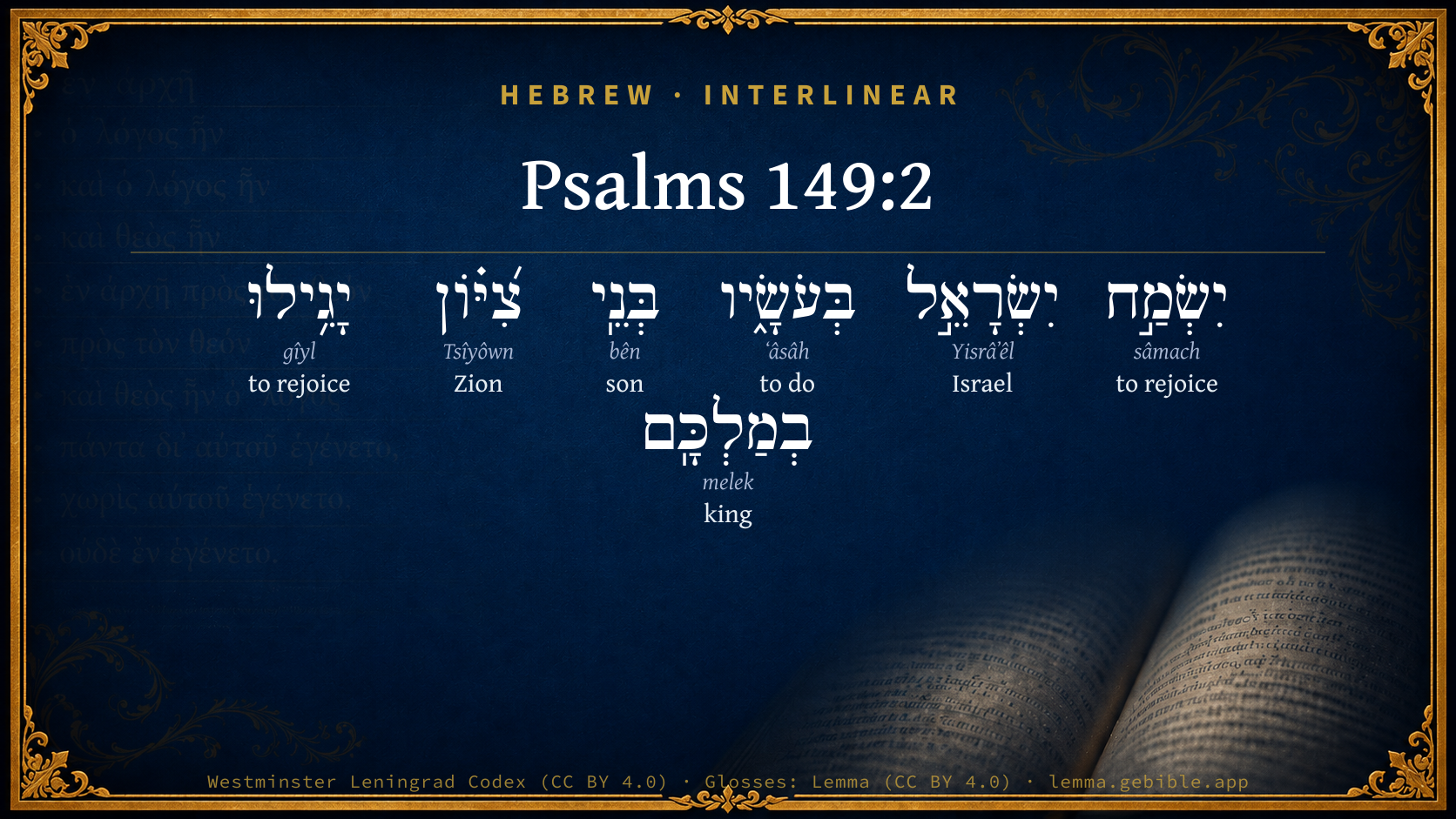
Psalms 149:2

Hebrew (Westminster Leningrad Codex) Psalms 149:2 appears in the Hebrew Old Testament. The text above is from the Westminster Leningrad Codex. Each word links to its Strong’s number, a concise gloss, and parsing drawn from the Open Scriptures Hebrew Bible morphology. Click any word for its full Brown-Driver-Briggs (BDB) entry.
Download image
Cite this verse

Psalms 149:2 (World English Bible). Public Domain. Lemma interlinear Bible study tool, https://lemma.gebible.app/v/psalms/149/2.

Show BibTeX & RIS
BibTeX
RIS
English Translation
Let Israel rejoice in him who made them. Let the children of Zion be joyful in their King.
World English Bible · Public Domain
Download a study sheet

One document with this verse’s original text, its word-by-word gloss line, the meaning frame, cross-references with their text, attributed commentary, and full source and license credits — printable, and it pastes into notes with its structure intact.

This verse Autodidact and up

Study sheet (.html) Plain text (.txt)

A passage Seminary Student

Up to 50 verses in one chapter. A passage sheet keeps up to 6 commentary sources and 12 cross-references per verse, in the order this page ranks them, and says so on the sheet whenever that leaves anything out. Ask for a single verse and you get the Autodidact verse sheet above.

Everything on this page stays free to read, with no account — the sheet is a download of what is already on screen, not access to it.

Want to remove ads? Support Godless Engineer
Compare translations 3

The same verse in 3 English versions, stacked beneath the original-language interlinear above. Click any original word for its lexicon entry.

Each is an independent rendering of the whole verse — the interlinear is not word-aligned to these translations.

Highlighted words mark where these versions differ — a whole-verse word diff, not a word-by-word alignment.

  • World English Bible Public Domain
    Let Israel rejoice in him who made them. Let the children of Zion be joyful in their King.
  • King James Version Public Domain
    Let Israel rejoice in him that made him: let the children of Zion be joyful in their King.
  • unfoldingWord Literal Text CC BY-SA 4.0
    Let Israel rejoice in his Maker; let the sons of Zion be glad in their king.

unfoldingWord Literal Text — © unfoldingWord, licensed CC BY-SA 4.0. Word-aligned USFM3 via Door43 (git.door43.org/unfoldingWord/en_ult).

Versions to compare (up to 4)

3 of 4 selected

Show all 17 translations

Every available English version of this verse, each an independent rendering of the whole verse.

  • World English Bible Public Domain
    Let Israel rejoice in him who made them. Let the children of Zion be joyful in their King.
  • Berean Standard Bible Public Domain
    Let Israel rejoice in their Maker; let the children of Zion rejoice in their King.
  • Majority Standard Bible Public Domain
    Let Israel rejoice in their Maker; let the children of Zion rejoice in their King.
  • King James Version Public Domain
    Let Israel rejoice in him that made him: let the children of Zion be joyful in their King.
  • American Standard Version (1901) Public Domain
    Let Israel rejoice in him that made him: Let the children of Zion be joyful in their King.
  • Revised Version (1885) Public Domain
    Let Israel rejoice in him that made him: let the children of Zion be joyful in their King.
  • Geneva Bible (1599) Public Domain
    Let Israel reioyce in him that made him, and let ye children of Zion reioyce in their King.
  • Young's Literal Translation Public Domain
    Israel doth rejoice in his Maker, Sons of Zion do joy in their king.
  • Literal Standard Version CC BY-SA 4.0
    Israel rejoices in his Maker, || Sons of Zion rejoice in their king.
  • Unlocked Literal Bible CC BY-SA 4.0
    Let Israel rejoice in the one who made them; let the people of Zion rejoice in their king.
  • unfoldingWord Literal Text CC BY-SA 4.0
    Let Israel rejoice in his Maker; let the sons of Zion be glad in their king.
  • Darby Bible Public Domain
    Let Israel rejoice in his Maker; let the sons of Zion be joyful in their King.
  • World Messianic Bible Public Domain
    Let Israel rejoice in him who made them. Let the children of Zion be joyful in their King.
  • Webster's Bible Public Domain
    Let Israel rejoice in him that made him: let the children of Zion be joyful in their King.
  • Free Bible Version CC BY-SA 4.0
    Let Israel celebrate their Creator; let the people of Zion be happy in their King.
  • Bible in Basic English Public Domain
    Let Israel have joy in his maker; let the children of Zion be glad in their King.
  • JPS Tanakh (1917) Public Domain
    Let Israel rejoice in his Maker; let the children of Zion be joyful in their King.

Literal Standard Version (2020), Covenant Press — licensed CC BY-SA 4.0. Text via the HelloAO Bible API (eBible.org). Unlocked Literal Bible (unfoldingWord) — licensed CC BY-SA 4.0. Text via the HelloAO Bible API (eBible.org). unfoldingWord Literal Text — © unfoldingWord, licensed CC BY-SA 4.0. Word-aligned USFM3 via Door43 (git.door43.org/unfoldingWord/en_ult). Free Bible Version, Dr. Jonathan Gallagher — licensed CC BY-SA 4.0. Text via the HelloAO Bible API (eBible.org).

Word by word

More ways to search: Search by grammar → Find every occurrence → Compare this word →

Practice this passage: Drill this verse → Learn its vocabulary →

About this verse

These counts appear in no published source. They are computed here, from the morphology-tagged text and Lemma’s own curated glosses. What Lemma adds →

7
words
7
distinct lemmas
Wisdom
section

Shared distinctive vocabulary

יָגִ֥ילוּ to rejoice H1523 occurs in 44 verses of the Hebrew Bible. Also found in:

Grammatical profile

  • 3 verbs
  • 4 nouns

Verb forms

  • יִשְׂמַ֣ח Qal · Imperfect
  • בְּעֹשָׂ֑יו Qal · Participle Active
  • יָגִ֥ילוּ Qal · Imperfect

Hebrew & Septuagint length

In English translation the verse runs 18 words from the Hebrew and 18 from the Septuagint (LXX English) — the same length.

A rough comparison of the two English renderings, which tokenize alike — not a word-level alignment.

Word counts can differ between the Hebrew and the Greek without any difference in meaning — e.g. the Hebrew direct-object marker אֵת has no separate Greek word, and Greek often adds the article ὁ.

Cross-references

21

Topical passages linked to Psalms 149:2 in the Treasury of Scripture Knowledge — connected by theme and wording, ordered by reader-vote popularity; previews shown in the World English Bible.

  • Psalms 95:6 Oh come, let's worship and bow down. Let's kneel before Yahweh, our Maker,
  • Psalms 100:1–3 Shout for joy to Yahweh, all you lands!
  • Isaiah 52:7 How beautiful on the mountains are the feet of him who brings good news, who publishes peace, who brings good news of good, who publishes salvation, who says to Zion, Your God reigns!
  • Isaiah 54:5 For your Maker is your husband; Yahweh of Hosts is his name: and the Holy One of Israel is your Redeemer; the God of the whole earth shall he be called.
  • Deuteronomy 7:6–7 For you are a holy people to Yahweh your God: Yahweh your God has chosen you to be a people for his own possession, above all peoples who are on the face of the earth.
  • Joel 2:23 "Be glad then, you children of Zion, And rejoice in Yahweh, your God; For he gives you the former rain in just measure, And he causes the rain to come down for you, The former rain and the latter rain, As before.
  • Job 35:10 But none says, 'Where is God my Maker, Who gives songs in the night,
  • Psalms 135:3–4 Praise Yah, for Yahweh is good. Sing praises to his name, for that is pleasant.
  • Zechariah 9:9 Rejoice greatly, daughter of Zion! Shout, daughter of Jerusalem! Behold, your king comes to you! He is righteous, and having salvation; Lowly, and riding on a donkey, Even on a colt, the foal of a donkey.
  • Luke 19:38 saying, "Blessed is the King who comes in the name of the Lord! Peace in heaven, and glory in the highest!"
  • Deuteronomy 12:7 and there you shall eat before Yahweh your God, and you shall rejoice in all that you put your hand to, you and your households, in which Yahweh your God has blessed you.
  • 1 Samuel 12:22 For Yahweh will not forsake his people for his great name's sake, because it has pleased Yahweh to make you a people to himself.
  • Psalms 47:6 Sing praise to God, sing praises. Sing praises to our King, sing praises.
  • John 19:19–22 Pilate wrote a title also, and put it on the cross. There was written, "JESUS OF NAZARETH, THE KING OF THE JEWS."
  • Isaiah 62:11–12 Behold, Yahweh has proclaimed to the end of the earth, Say you to the daughter of Zion, Behold, your salvation comes; behold, his reward is with him, and his recompense before him.
  • Matthew 25:34 Then the King will tell those on his right hand, 'Come, blessed of my Father, inherit the Kingdom prepared for you from the foundation of the world;
  • Luke 19:27 But bring those enemies of mine who didn't want me to reign over them here, and kill them before me.'"
  • John 19:15 They cried out, "Away with him! Away with him! Crucify him!" Pilate said to them, "Shall I crucify your King?" The chief priests answered, "We have no king but Caesar!"
  • Philippians 3:3 For we are the circumcision, who worship God in the Spirit, and rejoice in Christ Jesus, and have no confidence in the flesh;
  • Revelation 19:6 I heard something like the voice of a great multitude, and like the voice of many waters, and like the voice of mighty thunders, saying, "Hallelujah! For the Lord our God, the Almighty, reigns!
  • Matthew 21:5 "Tell the daughter of Zion, Behold, your King comes to you, Humble, and riding on a donkey, On a colt, the foal of a donkey."

Cross-references courtesy of OpenBible.info (CC BY 4.0).

Hebrew and Greek witnesses Masoretic Hebrew ↔ Greek Septuagint

The same verse in the two great witnesses to the Old Testament, shown verse-for-verse.

You’re reading Greek Psalm 149 (Hebrew Psalm 149). The Septuagint counts the superscription, so verse numbers can differ from the Hebrew — chapter-level alignment, not verse-by-verse. Numbering follows Rahlfs.

These are two independent witnesses, not word-aligned to each other, and the Septuagint is shown in lemma (dictionary) form.

Hebrew Psalms 149:2 Masoretic · Westminster Leningrad Codex

יִשְׂמַ֣ח יִשְׂרָאֵ֣ל בְּעֹשָׂ֑יו בְּנֵֽי צִ֝יּ֗וֹן יָגִ֥ילוּ בְמַלְכָּֽם

Let Israel rejoice in him who made them. Let the children of Zion be joyful in their King.

World English Bible · Public Domain

Greek LXX Greek Psalm 149:2 Septuagint · lemma form

εὐφραίνω ἰσραήλ ἐπί ὁ ποιέω αὐτός καί υἱός σιων ἀγαλλιάομαι ἐπί ὁ βασιλεύς αὐτός

Let Israel rejoice in him that made him; and let the children of Sion exult in their king.

LXX2012 (modern English Septuagint) · Public Domain

Hebrew: Westminster Leningrad Codex (CC BY 4.0). Greek: Septuagint (public domain); English from LXX2012 (modern English Septuagint) (Public Domain). How the Septuagint differs from the Hebrew →

Commentary

Notes on Psalms 149:2 from classic Christian and Jewish commentators (each source and its license shown beneath its notes). The classic Christian expositions comment on the surrounding passage and are grouped to its opening verse, so a note may address several verses; the Jewish commentaries on the Tanakh (Rashi and others) are per-verse, so they appear only where the commentator wrote on this verse.

Lemma curates 59 commentaries, every one of them public domain or Creative Commons licensed, each selected and text-cleaned for this edition rather than reprinted as found. About our sources →

Trapp's Complete Commentary

John Trapp

Psa 149:2 Let Israel rejoice in him that made him: let the children of Zion be joyful in their King.

Ver. 2. Let Israel rejoice in him that made him] And new made him, Eph 2:10, and thereby highly advanced him, as 1Sa 12:6. The Hebrew hath it, In his makers, to show the Trinity of persons concurring in the work both of creation and regeneration. So Gen 1:26 Job 35:10 Isa 54:5 Ecc 12:1. See Psa 100:3.

Be joyful in their King] i.e. In Christ, whose kingdom is such as should swallow up all discontents, and make us everlastingly merry, Mic 4:9. If Seneca could say to his friend, Polybius, Fas non est, salvo Caesare, de fortuna tua queri, Hoc incolumi salvi tibi sunt tui, &c., It is not fit for thee to complain of thine hard fortune so long as Caesar is alive, and well; how much more may it be said so to Christians, so long as Christ is alive, and reigns!

John Trapp, A Commentary or Exposition upon All the Books of the Old and New Testament (1647–1656) — public domain. Text from a community e-Sword module.

The Biblical Illustrator

Joseph S. Exell

Psa_149:2

Let the children of Zion be joyful in their King.

The children of Zion joyful in their King

I. Believers in their character as the children of Zion.

1. Zion is here used as the name of the kingdom of which all believers are the subjects.

2. But while believers are subjects they are also children.

(1) They entered the Kingdom by birth--born of God.

(2) Inherit it--brethren of Christ--sons of God--heirs of God--joint-heirs, etc.

(3) High place in the Kingdom--childrens interests and affection. Behold, what manner of love, etc.

II. Jesus Christ in His character and office of King of Zion.

1. Anointed. I set my King upon my holy hill of Zion.

2. A Legislator. The Lord is our Lawgiver.

3. An Administrator. Zion, Thy God reigneth.

4. He subdues to His laws.

(1) His people are under authority.

(2) None else can, without sin, be called the King of Zion.

(3) Believers must not yield obedience to any other in Zion.

(4) Submission to Christs officers is submission to Christ.

5. He defends His subjects (Gal_4:22).

III. The children of Zion joyful

1. Joy--a fruit of the Spirit--Reioice in the Lord.

2. Joy--a command--Be joyful.

3. Joy--a feeling, often beautifully expressed in the prophecies and songs of Zion.

4. This joy a most natural and proper feeling. They possess--

(1) Deliverance.

(2) Acquaintance.

(3) Safety.

IV. The children of Zion joyful in their King. They rejoice--

1. Because Jesus Christ the Lord reigneth.

2. Because of His greatness and glory.

(1) He is a Divine King--the Eternal God.

(2) He is a Kinsman and Brother.

(3) He is a Redeeming King.

3. Because of the blessings which He has and gives.

4. Because of the relations in which He stands to them.

5. Because of what He has done for His people--for them--in them.

6. Because of what He will still do for His people--

(1) For each of them.

(2) For the whole house.

(a) On earth.

(b) In Heaven--throughout eternity. (J. Stewart.)

The children of Zion joyful in their King

I. Believers are the children of Zion.

1. Zion is often used as an emblem of the Church of God (Psa_2:6; Isa_28:16; Rom_9:33; 1Pe_2:6).

(1) It was stable (Psa_125:1); so is the Church (Mat_16:18).

(2) It was secure (Psa_48:3; Psa_48:11-12); so is the Church (Eph_5:29).

(3) The situation of Zion was exceeding beautiful (Psa_48:2); so is that of the Church (Mat_5:14).

(4) Zion was a holy mountain; because on Mount Moriah, which joined it on the north-east, the temple of God was built (2Ch_3:1; Psa_48:1); the Church is holy (Eph_5:27).

(5) Mount Zion was peculiarly loved by God (Psa_88:2); so is the Church (Eph_5:25).

2. Believers are children of Zion by birth. Naturally we are all aliens from the commonwealth of Israel, and strangers to the covenants of promise (Eph_2:11-12).

3. Believers can continue children of Zion no longer than while they retain faith (Heb_10:38).

4. Zion is emblematic of heaven (Heb_12:22; Rev_14:1; 1Co_2:9; Rev_22:4; Rev_22:10-21).

5. Believers are children of Zion by a title to heaven (Act_26:18; Eph_1:18; Col_1:12; 1Pe_1:3-4).

II. Believers have a King.

1. Royalty is the centre of supremacy. A king is a supreme governor. God in this sense is the King of believers.

2. Royalty is the source of legislation. God is the Legislator of His people. His code is more pure than any ever conceived by the human mind for the perfection of human jurisprudence (Rom_7:12).

3. Royalty is the fountain of protection (Job_1:10; Psa_5:12; Psa_27:1; Psa_37:17; Psa_37:39; Psa_55:22; Psa_118:8-12; Psa_146:3-6).

III. Believers should be joyful in their King.

1. Because He is the most glorious and dignified of all beings.

(1) Consider His nature. He is the independent Jehovah.

(2) Consider His moral attributes.

2. Because by His charter they enjoy great privileges and immunities. He communicates to them through His Spirit an evidence of their acceptance (Rom_8:16); and through His Word exceeding great and precious promises (2Pe_1:4). They possess peace and joy (Rom_14:17; Rom_15:13).

3. Because the monuments of their great men are protected. The Bible is a record of the saints. In it are contained monuments of their patience, meekness, courage, faith and heavenly-mindedness, Here we are taught to admire their virtues, and excited to follow their example (Heb_6:12).

4. Because their enemies are totally inefficient to disturb His government (Deu_33:26-29; Psa_93:1).

5. Because His kingdom will ultimately be universal, and all opposing powers will be destroyed.

IV. Remarks.

1. How great and glorious is the moral elevation of a believer, and how insignificant does the honour of this world appear contrasted with the dignity of a Christian!

2. How great should be our solicitude to become subjects of the spiritual kingdom of Jehovah.

3. How indefatigable should we be in spreading the knowledge of God by personal instruction, by example, and by the dedication of property, talents and influence! (Sketches of Four Hundred Sermons.)

Believers joyful in their King

I. The Lord Jesus is our King.

1. He is in person and character pre-eminent-above all others even of the saintliest, and wisest, and noblest.

2. To each believer He is a King to be obeyed. When His blood cleanses us, His love rules us.

3. He is King in the midst of His Church. Secular courts have no authority in the Kingdom of Jesus.

4. He will be seen to be King in the day of His second advent.

II. His royal character.

1. Was there ever such a Prince as our Emmanuel, if we think of His person, His pedigree, His descent, His nature? This King of ours is not only the flower and crown of manhood, but He is also very God of very God. He is God over all, blessed for ever: the Son of the Highest.

2. His deeds of love to us.

3. His glorious achievements.

4. The principles of His government. They are fountains of peace and purity.

III. The benefits of His reign.

1. He is the Creator of His own empire. Each one of us must own for himself, and all of us together unitedly, that He hath made us, and not we ourselves; by His sovereign grace He has chosen, and redeemed, and called, and sanctified us, therefore will we be joyful in Him.

2. While our King has created His own kingdom, He has also sanctified and sustained that kingdom. Let the streams rejoice in the fountain, let the walls of the temple be joyful in the foundation.

3. It is He who has saved us and given us peace.

4. Is there anything that is needful which He has not given? Is there anything that is good that He has withheld? Have we any virtue? have we any praise? Then not unto us, not unto us, but unto His name be the glory. Nor is it alone in the past and in the present that we are debtors; we look forward to a future of obligations.

IV. Let us be joyful in the continuance of the Redeemers reign.

1. The ages past have not taken away from the length of His reign.

2. The age of our King has not enfeebled Him.

3. As to His Kingdom, there is no fear of its failing.

V. Let us obey Him with delight. Let us take into our hands a duty and a thanksgiving, a precept and a praise. Let us make up our whole life of the intertwisting of duty and delight. Let us be holy and happy. Let us turn obedience into gladness. That which else were drudgery we will exalt to a priestly sacrificing as we serve the Lord with gladness and rejoice before Him. (C. H. Spurgeon.)

Our King in joy

The Book of Psalms ends in a sacred tumult of joyous praise. He who ends this life with praising God will in like manner begin the next. Let us begin below the music which shall be prolonged through eternity. Like the birds let us welcome the break of day, which, when life is closing, faith discerns to be near. Concerning this joy, note--

I. It is peculiar to a certain people. Let the children of Zion be joyful, etc. No others can be. But ye children of Zion, be thus joyful--

1. Because of your loyalty. Ye delight to think that the Lord reigneth. But we are also--

2. Attached to His Person. It is not merely His throne, but Himself, that is dear to us. When any thus rejoice they sink themselves in Him, and this heightens our joy. And so does the admiration we feel for Him.

II. This joy has a most proper object. For we should rejoice to be ruled by Him, and that He is Lord of all, and that His power is so great, and His glory likewise. The old poem of one of our writers sings of the Man of Ross, and declares that every good thing in the town is owing to him and his benevolence. So that if you asked, Who built this fountain? or, Who founded yonder school? the one answer was, The Man of Ross. So surely if you ask us concerning our privileges, our hopes, yea, the vast all that we possess, our answer is, We owe them all to our King. Therefore let us be joyful in Him.

III. This joy is permanent in its source. Everything here below is uncertain. Many are the reasons for our disquietude. Nevertheless let us be joyful in our King. Yes, though ministers and Church members fall off from true doctrine; though there be many backsliding Christians, and so few zealous and really Christlike; though our own hearts be so cold, our prayers so unworthy, our work so scanty and our fruit so rare. Your bottle, like Hagars, may be dry, but yonder is the well of water which never can fail you. And when you come to die, then will he the time to be more than ever joyful in your King.

IV. This joy has certain occasions for its more especial display. When does a nation rejoice in its king? At his coronation. So, when Christ was crowned in our souls. At the royal marriage. So, when Christ united us to Himself. When peace is proclaimed after war. So, when peace was made in and for our souls. At victories. When He keeps His jubilee. On his levee days, when He receives His friends.

V. And this joy is sure to have practical results. An Eastern merchant of great wealth had in his employ a workman of great skill and genius in all works of art. But by some means this workman had fallen deeply into debt, and was sinking deeper day by day. He grew more and more depressed, and as he sank in spirit his old skill and power declined with it. Each product of his hand revealed less power. Meanwhile his creditor became more and more exacting, and at last threatened to sell the poor mans children as slaves, according to the law of the land, unless he was paid his debt. This weighed yet more heavily upon the poor mans soul, and his work was worse and worse. At length the merchant inquired of his steward how it was that this workman, once so renowned, was now producing nothing worthy of his former fame. No masterpieces come from him now, and our name suffers in the market and in the esteem of the merchants. How is all this? My lord, said the steward, he is daily of a sorrowful countenance and forgets to eat bread. He keeps a long and cruel fast, for he is drowned in debt and that to a cruel creditor, and his soul pines like the heath of the desert, and therefore his hand is slow as that of an herdsman, and his eye dull as that of the owl in sunlight. And this is why his hand hath forgot all its wonted cunning. Send for him, bring him hither, said his lord. He came. His lord told him that his debt should be all paid, and he and his set free. How that man worked afterwards! (C. H. Spurgeon.)

The Biblical Illustrator, edited by Joseph S. Exell (c. 1880s–1900s) — public domain. Text from a community e-Sword module.

J. A. Alexander on Psalms

Joseph Addison Alexander

2. (Psa 149:2) Let Israel rejoice in his Maker! Let the sons of Zion triumph in their King! Not merely the creator of individuals, but of the church and nation as such, and that not only at first, but by a kind of new creation, in the restoration of the people from captivity. They are summoned to rejoice in him, not only as their founder and restorer, but their sovereign. See above, on Psa 95:6; Psa 100:3; Psa 145:1, and compare Isa 43:1; Isa 44:2; Isa 45:13.

Joseph Addison Alexander, The Psalms Translated and Explained (1850) — public domain. Text from a community e-Sword module.

Geneva Bible (1599)

Geneva Bible translators

For God as he is the creator of the soul and body, so wills he that both … serve him and that his people be continually subject to him, as to their most lawful king.

In that they were preferred before all other nations, it was as a new creation, and therefore, Ps. 95:7, they were called the sheep of God’s hands.

Geneva Bible (1599) marginal notes — public domain. Text via Bolls.life.

Jamieson, Fausset & Brown

Robert Jamieson, A. R. Fausset & David Brown

God had signalized His relation as a sovereign, in restoring them to their land.

Jamieson, Fausset & Brown — Commentary Critical and Explanatory on the Whole Bible (1871) — public domain (CC PDM 1.0). Text via the HelloAO Bible API.

Adam Clarke's Commentary

Verse 2. In him that made him] Let them remember in their exultations to give all glory to the Lord; for he is the Author of their being and their blessings. And let them know that he is their King also; that they should submit to his authority, and be guided and regulated in their hearts and conduct by his laws.

Adam Clarke's Commentary on the Bible (1810–1826) — public domain. Text from a community e-Sword/MySword module.

John Calvin's Commentaries

2. Let Israel rejoice in his Maker. He insists upon the same point, that the Lord’s people should rest firmly persuaded that their family had not been chosen out in vain from the rest of the world, but that God would be mindful of his covenant, and not allow the mercies which he had extended to them to fail or become extinct. Although they had been temporarily deprived of the inheritance of the land of Canaan, which was the pledge of their adoption, the Psalmist calls God their Maker, and king of the sons of Zion, to remind them that when adopted to a pre-eminency above other nations, this was a species of new creation. So in Psalm 45:6, the Israelites are called “the work of God’s hands,” not merely because they were like other men created by him, but because he had formed them anew, and distinguished them with a new honor, that, of being separated front the whole human race. The name king has a wider signification, intimating that as this people was at first formed by God, so it was with the view of their being ever governed by his power. The musical instruments he mentions were peculiar to this infancy of the Church, nor should we foolishly imitate a practice which was intended only for God’s ancient people. But the Psalmist confirms what has been already mentioned, that their religious assemblies which had been for a time interrupted would soon be restored, and they would call upon the name of the Lord in the due order of his worship.

John Calvin's Commentaries (1540-1563) — public domain. Text from the Calvin Translation Society English edition (1840s-50s) via the Christian Classics Ethereal Library (ccel.org). Calvin's coverage is partial (roughly two-thirds of the Bible); uncommented books and verses are honest gaps, never fabricated. The 19th-century editor's footnotes and remarks are omitted so the notes are faithfully Calvin's own voice.

The Cambridge Bible for Schools and Colleges

gen. ed. J. J. S. Perowne

2. Jehovah is Israel’s Maker (Psa_95:6; Psa_100:3; Isa_44:2; Isa_51:13), for to Him it owes its original existence as a nation, and the present restoration of its national life; now that it has no earthly king, it acknowledges Him as its true King as in days of old (1Sa_8:7; 1Sa_12:12), and celebrates the glory of His kingdom, which is universal (Psa_145:1; Psa_145:11-13), yet in an especial sense has its seat in Zion (Isa_52:7).

The Cambridge Bible for Schools and Colleges (gen. ed. J. J. S. Perowne; Cambridge University Press, 1878–1918) — public domain. Text from a community e-Sword module.

John Gill's Exposition

Let Israel rejoice in him that made him,.... Or, "in his Makers" (i), Father, Son, and Spirit; as in Job 35:10; see also Ecc 12:1; for all three Persons had a concern in the creation of man at first, "let us make man", &c. Gen 1:26; and have in the formation of every individual man; of the Israelites as men, and of them as a body politic and ecclesiastic, being raised up, constituted, and formed by the Lord in their civil and church state, and therefore had reason to rejoice in him, Deu 32:6; and so have all the spiritual Israel of God, whom he has chosen, redeemed, and called; every Israelite indeed, all who are the workmanship of God, the people he has formed for himself, and to show forth his praise: these should rejoice in God the Father, who has chosen them in Christ, blessed them with all spiritual blessings in him, sent him to redeem them, has justified them by his righteousness, pardoned their sins through his blood, adopted them and made them heirs of glory; and in the Son of God their Redeemer, they should rejoice in his person, in his righteousness, sacrifice, and fulness; and in the Holy Spirit, who has regenerated and sanctified them, is their Comforter, and the earnest of their future glory;

let the children of Zion be joyful in their King: not in David, unless as a type, but in his Son, the King Messiah, who is King of Zion; and therefore the children of Zion, the church, who are born of her, the mother of us all, and born in her through the ministry of the word, and brought up there by means of the Gospel, and the ordinances of it; such as are regenerate persons, sons of God, and members of Gospel churches, should rejoice in Christ, the King of saints; that they have such a King over them, who is the greatest of Kings, the King of kings, and Lord of lords; so righteous in the administration of his government, so wise in making laws for them, so powerful to protect and defend them; and who must reign tilt all enemies are put under his feet, even for ever and ever. Every appearance of Christ's kingdom is matter of joy to saints; his first coming was as a King, though in a mean and lowly manner; yet joyful to Zion and her children, Zac 9:9; his ascension to heaven, when he was declared Lord and Christ; the pouring forth of his Spirit, and the success of his Gospel in the Gentile world, to the overthrow of Paganism in it, Rev 12:10; and especially it will be an occasion of great joy to his subjects, when he takes to himself his great power, and reigns, Rev 11:15.

(i) "in factoribus suis", Gejerus, Michaelis; so Ainsworth.

John Gill's Exposition of the Whole Bible (1746–1763) — public domain (CC PDM 1.0). Text via the HelloAO Bible API.

Albert Barnes' Notes on the Bible

Let Israel - The people of Israel; the Hebrew people; the people of God.

Rejoice in him that made him - Him, who has made the people what they are. All that they have and are is to be traced to him, as really as the universe of matter is to be traced to his power. Their condition is not one of development, or one which is the result of their own wisdom, grace, or power. See the notes at Psa 100:3 : “It is he that hath made us, and not we ourselves.” Compare Isa 54:5.

Let the children of Zion - Those who dwell in Zion or Jerusalem.

Be joyful in their King - In God as their king.

(a) That they have a king, or that there is one to rule over them;

(b) That they have such a king; one so wise, so powerful, so good;

(c) That he administers his government with so much efficiency, impartiality, equity, wisdom, goodness. Compare Psa 100:3-5.

Albert Barnes' Notes on the Bible (1834–1885) — public domain. Text from a community e-Sword/MySword module.

Matthew Poole's English Annotations

That made him; that made them not only his creatures, but, which is unspeakably greater, his people; or, that advanced and adorned them with singular privileges, as this word is used, 1Sa 12:6, and elsewhere.

Be joyful in their King; David and his posterity, and especially the chief of all of them, the Messiah. Let them rejoice and bless God that they have so potent, so wise, and so just a king.

Matthew Poole's English Annotations on the Holy Bible (1683–1685) — public domain. Text from a community e-Sword/MySword module.

The Treasury of David

Charles H. Spurgeon

Ver. 2. Let Israel rejoice in him that made him. Here is that new creation which calls for the new song. It was Jehovah who made Israel to be Israel, and the tribes to become a great nation: therefore let the Founder of the nation be had in perpetual honour. Joy and rejoicing are evidently to be the special characteristics of the new song. The religion of the dead in sin is more apt to chant dirges than to sing hallelujahs; but when we are made new in the spirit of our minds we joy and rejoice in him that made us. Our joy is in our God and King: we choose no lower delight.

Let the children of Zion be joyful in their King. Those who had seen the tribes formed into a settled kingdom as well as into a united nation should rejoice. Israel is the nation, Zion is the capital of the kingdom: Israel rejoices in her Maker, Zion in her King. In the case of our God we who believe in him are as glad of his Government as we are of his Creation: his reign is as truly the making of us as was his divine power. The children of Israel are happy to be made a people; the children of Zion are equally happy to be ruled as a people. In every character our God is the source of joy to us: this verse issues a permit to our joy, yea it lays an injunction upon us to be glad in the Lord.

Ver. 2. Let Israel rejoice, etc. Give us, oh, give us the man who sings at his work! Be his occupation what it may, he is equal to any of those who follow the same pursuit in silent sullenness. He will do more in the same timehe will do it betterhe will persevere longer. One is scarcely sensible of fatigue whilst he marches to music. The very stars are said to make harmony as they revolve in their spheres. Wondrous is the strength of cheerfulness, altogether past calculation its powers of endurance. Efforts to be permanently useful must be uniformly joyousa spiritual sunshinegraceful from very gladnessbeautiful because bright. Thomas Carlyle.

Ver. 2. Rejoice in him that made him; let the children of Zion be joyful. You are never right until you can be heartily merry in the Lord, nor until you can enjoy mirth in connection with holiness. Walter Marshall.

Ver. 2. Him that made him. Jehovah is called Maker, as one who formed Israel as a nation, and constituted the people a kingdom, though they had been a race of slaves. This is more than a general creation of men. Hermann Venema.

Ver. 2. Literally the Hebrew here brings forward the mystic doctrine of the Trinity, for it reads, "Let Israel rejoice in God his Makers." Simon de Muis.

Ver. 2. Joyful in their King. I beg the reader to remark with me, here is nothing said of Israel being joyful in what their king had done for them. These things, in their proper place, became sweet subjects of praise. But the subject of praise in which Israel is now to be engaged is Jesus himself. Reader, pause over this apparently small, but most important, distinction. The Lord is gracious in his gifts, gracious in his love, gracious in his salvation. Every thing he gives, it is from his mercy, and ever to be so acknowledged. But Jesus' gifts are not himself: I cannot be satisfied with his gifts, while I know that to others he gives his Person. It is Jesus himself I want. Though he give me all things that I need, yet if he be to me himself all things that I need, in him I have all things. Hence, therefore, let us see that Jesus not only gives us all, but that he is our all. Robert Hawker.

Ver. 2. The duty, reasonableness, and benefit of holy joy.

Ver. 2. A peculiar people, their peculiar God, and their peculiar joy in him.

Ver. 2. (second clause). Christ's people may well rejoice:

1. In the majesty of his person.

2. In the righteousness of his rule.

3. In the extent of his conquests.

4. In the protection they enjoy under him.

5. In the glory to which he will raise them. From "The Homiletical Library", 1882.

Ver. 2, 4. The cause given to God's Israel for Praise. Consider,

1. God's doings for them. They have reason to rejoice in God, and employ themselves in his service; for it is he that "made" them.

2. God's dominion over them. This follows upon the former: if he made them he is their King.

3. God's delight in them. He is a King that rules by love, and therefore to be praised.

4. God's designs concerning them. Besides the present complacency he hath in them, he hath prepared for their future glory. "He will beautify the meek", etc. Matthew Henry.

Psalms 149:3*

Charles H. Spurgeon's The Treasury of David (1869–1885) — public domain. Psalms only. Text from a community e-Sword/MySword module.

Whedon's Commentary on the Bible

Daniel D. Whedon

2. In him that made him—The Maker of Israel corresponds to King in the next member of the verse, and refers not so directly to the act of creation, as to Jehovah’s act of constituting, and now resuscitating, their national and Church organization and life. The Hebrew word “made,” (עשׂה,) though sometimes used interchangeably with the word create, here properly takes the sense of form, construct, constitute. The reconstruction of their civil and religious polity, however, was like a new creation.

Daniel D. Whedon (gen. ed.), Commentary on the Old and New Testaments (1874–1909) — public domain. Text from a community e-Sword module.

The Pulpit Commentary

Let Israel rejoice in him that made him; or, "in his Maker". (Psa_95:6) This ground of thankfulness Israel possesses in common with all the rest of mankind; but he has also another exclusive ground let the children of Zion be joyful in their King. (comp. Jud_1:8:23 1Sa_8:7 1Sa_10:19 1Sa_12:12, etc.) God, by covenant with Israel, had constituted himself in an especial way their King. (comp. Hos_13:10)

The Maker of nations.

The expression seems to refer rather to the selection and constitution of Israel as the people of Jehovah than to the act of creation. By the restoration from Babylon, Israel had been appropriated anew in this special character; made or constituted a nation. It was in the restored and renewed national life that the people so greatly rejoiced.

I GOD MAKES FAMILIES. It is well for us to see distinctly what is the Divine order for humanity. God made man in his image as a Father; gave him a helpmeet, through whom a family was to gather round him. That family was to be trained by Personal influence for an independent family life, into which its members would pass; and so families would reproduce families, and by means of families the whole earth would be peopled, and the moral perfection of the entire family of God attained. This, God"s ideal, man"s self will and passion have spoiled.

II MAN-MADE NATIONS. Cowper says, "God made the country, and man made the town." It is answering fact to say, "God made the family, and man made the nation." It is full of significance that the aggregation of men for mutual protection, out of which nations and civil governments have been evolved, was a device of the sons of Cain; i.e. of those who, in some sense, had been "driven out from the presence of the Lord." It is easy to see that, had God"s family idea been preserved, no schemes for mutual protection would have been necessary, no walled cities, no government, no army, no police; for brothers in a family would never think of injuring brothers, and the family feeling would also save the relations of families.

III GOD OVERRULES THE MAKING OF NATIONS. He, in a way, accepts as facts, and use s for his purposes, the conditions in which man has set himself. He lets man have what has been called a "free experiment;" and as it pleases man to create nations, God is pleased to deal with nations as such, using them for his purposes, even as he uses individuals. And nations really are aggregations of men in which personal individualities are sunk in order to construct a composite individuality. God deals with that individuality, and uses it. We call it the "national genius. R.T.

The Pulpit Commentary (1880–1919), ed. H.D.M. Spence-Jones & Joseph S. Exell — public domain. Text from a community e-Sword module.

unfoldingWord translationNotes

Door43 World Missions Community

rejoice in the one who made them

Possible meanings are 1) "rejoice because he made them" or 2) "rejoice because the one who made them is good."

rejoice in their king

The words "their king" is likely a reference to God. Possible meanings are 1) "rejoice because he is their king" or 2) "rejoice because their king is good."

praise his name

The word "name" is a metonym for Yahweh himself. AT: "praise him" or "tell people how great he is" (See: Metonymy)

tambourine

a musical instrument with a head like a drum that can be hit and with pieces of metal around the side that sound when the instrument is shaken (See: Translate Unknowns)

translationWords

Israel

joy

nation

people group

Zion

king

name

harp

unfoldingWord translationNotes — © Distant Shores Media and the Door43 World Missions Community, licensed CC BY-SA 4.0. Source: git.door43.org/Door43/en_tn.

Lesson kit

Teaching starters — assembled from the data on this page, not authored interpretation. Every prompt links to the verse data it draws on. Edit before teaching.

Psalms, in the Wisdom, opens this verse with 7 words (7 distinct Hebrew lemmas). Its most distinctive word is gîyl (“to rejoice”). A historical commentator’s framing appears above. Read the whole chapter for the surrounding context.

Discussion questions

  1. The word gîyl carries the sense “to rejoice.” How does it shape the verse?
  2. 1 Chronicles 16:31 shares the word «to rejoice» with this verse. How do the two illuminate each other?
  3. The translations on this page render this verse differently — a whole-verse word diff, not a word-by-word alignment. What might account for the different wordings?
  4. The verb «יִשְׂמַ֣ח» is Qal Imperfect. How does its form color the action?
  5. Reading how Trapp's Complete Commentary and The Biblical Illustrator read this verse, where do the two commentators agree and where do they part?

Things to notice

Reading settings

Reading text

Shown beneath each verse's original-language words.

Old Testament
Old Testament edition

Read the OT as the Masoretic Hebrew (MT) or the Greek Septuagint (LXX).

English shown for the Greek Septuagint (in the Hebrew ↔ Greek comparison).

Comparing translations? Open the Compare panel on any verse page to stack up to four side by side.