
Song of Solomon 3:11

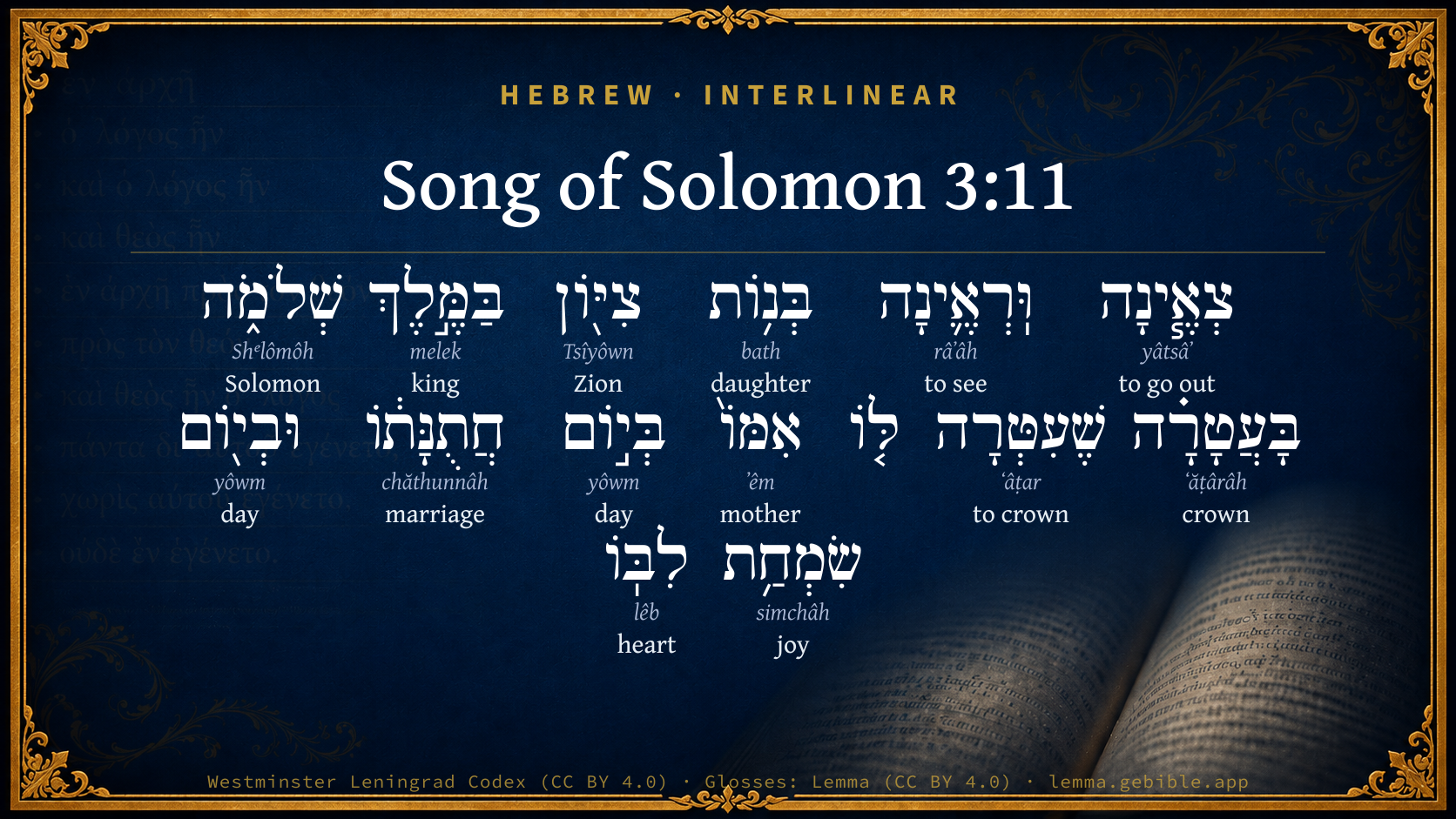
Hebrew (Westminster Leningrad Codex) Song of Solomon 3:11 appears in the Hebrew Old Testament. The text above is from the Westminster Leningrad Codex. Each word links to its Strong’s number, a concise gloss, and parsing drawn from the Open Scriptures Hebrew Bible morphology. Click any word for its full Brown-Driver-Briggs (BDB) entry.
Download image
Cite this verse

Song of Solomon 3:11 (World English Bible). Public Domain. Lemma interlinear Bible study tool, https://lemma.gebible.app/v/song-of-solomon/3/11.

Show BibTeX & RIS
BibTeX
RIS
English Translation
Go forth, you daughters of Zion, and see king Solomon, With the crown with which his mother has crowned him, In the day of his weddings, In the day of the gladness of his heart. Lover
World English Bible · Public Domain
Highlights
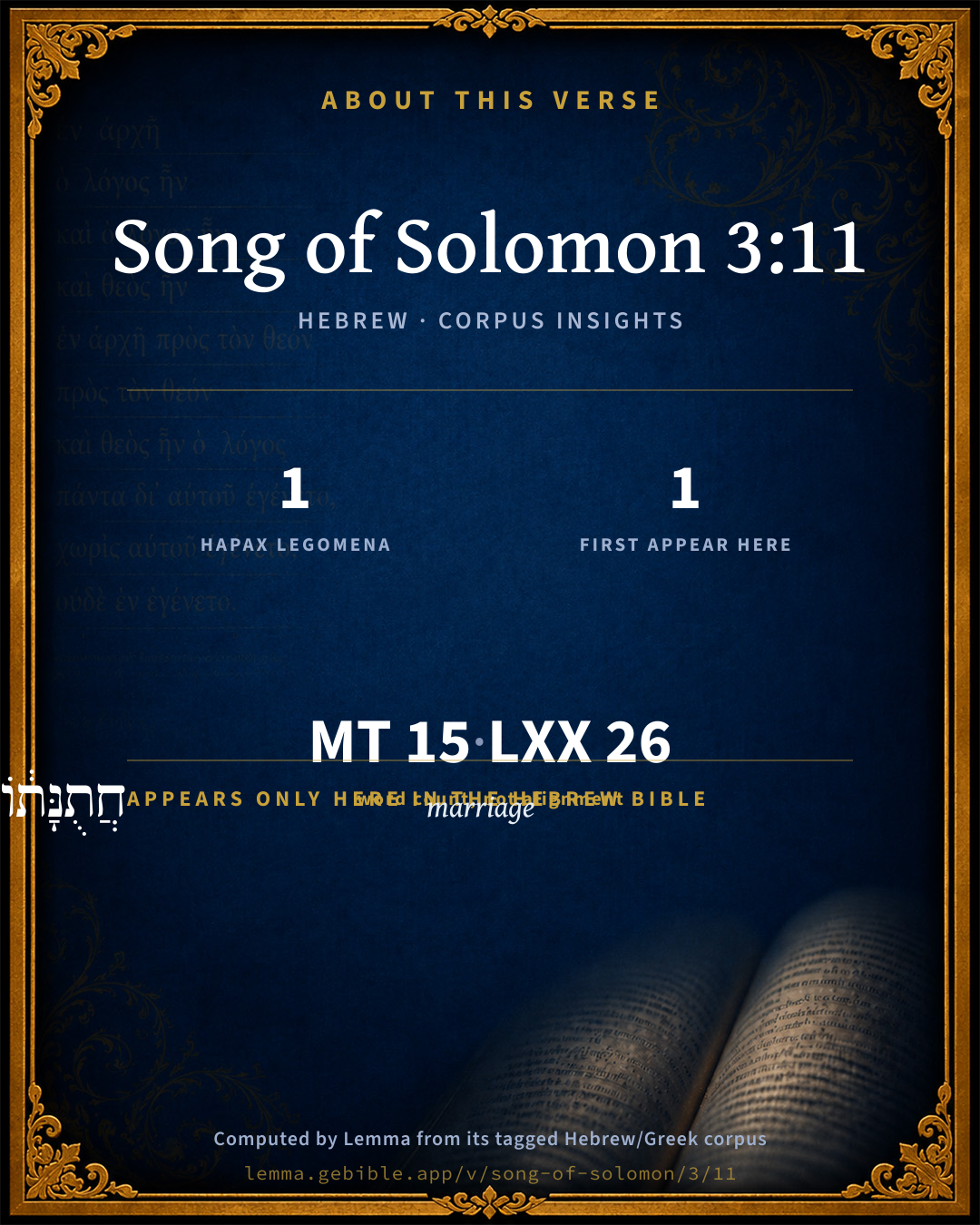
  • 1 hapax legomenon — only here in the Hebrew Bible
  • 1 first appearance in the Hebrew Bible
Full analysis ↓
Download a study sheet

One document with this verse’s original text, its word-by-word gloss line, the meaning frame, cross-references with their text, attributed commentary, and full source and license credits — printable, and it pastes into notes with its structure intact.

This verse Autodidact and up

Study sheet (.html) Plain text (.txt)

A passage Seminary Student

Up to 50 verses in one chapter. A passage sheet keeps up to 6 commentary sources and 12 cross-references per verse, in the order this page ranks them, and says so on the sheet whenever that leaves anything out. Ask for a single verse and you get the Autodidact verse sheet above.

Everything on this page stays free to read, with no account — the sheet is a download of what is already on screen, not access to it.

Want to remove ads? Support Godless Engineer
Compare translations 3

The same verse in 3 English versions, stacked beneath the original-language interlinear above. Click any original word for its lexicon entry.

Each is an independent rendering of the whole verse — the interlinear is not word-aligned to these translations.

Highlighted words mark where these versions differ — a whole-verse word diff, not a word-by-word alignment.

  • World English Bible Public Domain
    Go forth, you daughters of Zion, and see king Solomon, With the crown with which his mother has crowned him, In the day of his weddings, In the day of the gladness of his heart. Lover
  • King James Version Public Domain
    Go forth, O ye daughters of Zion, and behold king Solomon with the crown wherewith his mother crowned him in the day of his espousals, and in the day of the gladness of his heart.
  • unfoldingWord Literal Text CC BY-SA 4.0
    Go out and look, daughters of Zion, at King Solomon, at the crown with which his mother crowned him on the day of his wedding, on the day of the joy of his heart.

unfoldingWord Literal Text — © unfoldingWord, licensed CC BY-SA 4.0. Word-aligned USFM3 via Door43 (git.door43.org/unfoldingWord/en_ult).

Versions to compare (up to 4)

3 of 4 selected

Show all 18 translations

Every available English version of this verse, each an independent rendering of the whole verse.

  • World English Bible Public Domain
    Go forth, you daughters of Zion, and see king Solomon, With the crown with which his mother has crowned him, In the day of his weddings, In the day of the gladness of his heart. Lover
  • Berean Standard Bible Public Domain
    Come out, O daughters of Zion, and gaze at King Solomon, wearing the crown his mother bestowed on the day of his wedding—the day of his heart’s rejoicing.
  • Majority Standard Bible Public Domain
    Come out, O daughters of Zion, and gaze at King Solomon, wearing the crown with which his mother crowned him on the day of his wedding—the day of his heart’s rejoicing.
  • King James Version Public Domain
    Go forth, O ye daughters of Zion, and behold king Solomon with the crown wherewith his mother crowned him in the day of his espousals, and in the day of the gladness of his heart.
  • American Standard Version (1901) Public Domain
    Go forth, O ye daughters of Zion, and behold king Solomon, With the crown wherewith his mother hath crowned him In the day of his espousals, And in the day of the gladness of his heart.
  • Revised Version (1885) Public Domain
    Go forth, O ye daughters of Zion, and behold king Solomon, with the crown wherewith his mother hath crowned him in the day of his espousals, and in the day of the gladness of his heart.
  • Geneva Bible (1599) Public Domain
    Come forth, ye daughters of Zion, and behold the King Salomon with the crowne, wherewith his mother crowned him in ye day of his mariage, and in the day of the gladnes of his heart.
  • Douay-Rheims (1899) Public Domain
    Go forth, ye daughters of Sion, and see king Solomon in the diadem, wherewith his mother crowned him in the day of his espousals, and in the day of the joy of his heart.
  • Young's Literal Translation Public Domain
    Go forth, and look, ye daughters of Zion, On king Solomon, with the crown, With which his mother crowned him, In the day of his espousals, And in the day of the joy of his heart!
  • Literal Standard Version CC BY-SA 4.0
    Go forth, and look, you daughters of Zion, || On King Solomon, with the crown, || With which his mother crowned him, || In the day of his espousals, || And in the day of the joy of his heart!
  • Unlocked Literal Bible CC BY-SA 4.0
    Go out, daughters of Zion, and gaze on King Solomon, bearing the crown with which his mother crowned him on his wedding day, on the day of the joy of his heart.
  • unfoldingWord Literal Text CC BY-SA 4.0
    Go out and look, daughters of Zion, at King Solomon, at the crown with which his mother crowned him on the day of his wedding, on the day of the joy of his heart.
  • Darby Bible Public Domain
    Go forth, daughters of Zion, And behold king Solomon With the crown wherewith his mother crowned him In the day of his espousals, And in the day of the gladness of his heart.
  • World Messianic Bible Public Domain
    Go out, you daughters of Zion, and see King Solomon, with the crown with which his mother has crowned him, in the day of his weddings, in the day of the gladness of his heart.
  • Webster's Bible Public Domain
    Go forth, O ye daughters of Zion, and behold king Solomon with the crown with which his mother crowned him in the day of his espousals, and in the day of the gladness of his heart.
  • Free Bible Version CC BY-SA 4.0
    come out! Look, women of Zion! See King Solomon wearing the crown that his mother placed on his head on his wedding day, his happiest day.
  • Bible in Basic English Public Domain
    Go out, O daughters of Jerusalem, and see King Solomon, with the crown which his mother put on his head on the day when he was married, and on the day of the joy of his heart.
  • JPS Tanakh (1917) Public Domain
    Go forth, O ye daughters of Zion, and gaze upon king Solomon, even upon the crown wherewith his mother hath crowned him in the day of his espousals, and in the day of the gladness of his heart.

Literal Standard Version (2020), Covenant Press — licensed CC BY-SA 4.0. Text via the HelloAO Bible API (eBible.org). Unlocked Literal Bible (unfoldingWord) — licensed CC BY-SA 4.0. Text via the HelloAO Bible API (eBible.org). unfoldingWord Literal Text — © unfoldingWord, licensed CC BY-SA 4.0. Word-aligned USFM3 via Door43 (git.door43.org/unfoldingWord/en_ult). Free Bible Version, Dr. Jonathan Gallagher — licensed CC BY-SA 4.0. Text via the HelloAO Bible API (eBible.org).

Word by word

More ways to search: Search by grammar → Find every occurrence → Compare this word →

Practice this passage: Drill this verse → Learn its vocabulary →

חֲתֻנָּת֔וֹ
chăthunnâh
H2861
“marriage · his”
Noun, Common, Feminine, Singular, Construct + Suffix, Personal, 3rd Person, Masculine, Singular
Part of Speech
Noun
Type
Common
Gender
Feminine
Number
Singular
State
Construct
Full BDB Definition

Origin: from H2859

TWOT: 781d

wedding, marriage
  1. צְאֶ֧ינָה yâtsâʼ H3318 “go out” Verb, Qal, Imperative, 2nd Person, Feminine, Plural
  2. וּֽרְאֶ֛ינָה râʼâh H7200 “and · see” Conjunction + Verb, Qal, Imperative, 2nd Person, Feminine, Plural
  3. בְּנ֥וֹת bath H1323 “daughters of” Noun, Common, Feminine, Plural, Construct
  4. צִיּ֖וֹן Tsîyôwn H6726 “Zion” Noun, Proper
  5. בַּמֶּ֣לֶךְ melek H4428 “in/at the · king” Preposition, Determined + Noun, Common, Masculine, Singular, Absolute
  6. שְׁלֹמֹ֑ה Shᵉlômôh H8010 “Solomon” Noun, Proper
  7. בָּעֲטָרָ֗ה ʻăṭârâh H5850 “in/at the · crown” Preposition, Determined + Noun, Common, Feminine, Singular, Absolute
  8. שֶׁעִטְּרָה ʻâṭar H5849 “who/which · to crown” Particle, Relative + Verb, Piel, Perfect, 3rd Person, Feminine, Singular
  9. אִמּוֹ֙ ʼêm H517 “mother · his” Noun, Common, Feminine, Singular, Construct + Suffix, Personal, 3rd Person, Masculine, Singular
  10. בְּי֣וֹם yôwm H3117 “in/at · day of” Preposition + Noun, Common, Masculine, Singular, Construct
  11. וּבְי֖וֹם yôwm H3117 “and · in/at · day of” Conjunction + Preposition + Noun, Common, Masculine, Singular, Construct
  12. שִׂמְחַ֥ת simchâh H8057 “joy of” Noun, Common, Feminine, Singular, Construct
  13. לִבּֽוֹ lêb H3820 “heart · his” Noun, Common, Masculine, Singular, Construct + Suffix, Personal, 3rd Person, Masculine, Singular

About this verse

These counts appear in no published source. They are computed here, from the morphology-tagged text and Lemma’s own curated glosses. What Lemma adds →

15
words
13
distinct lemmas
Wisdom
section

Notable vocabulary

1 hapax legomenon — a word that appears only here in the entire Hebrew Bible:

  • חֲתֻנָּת֔וֹ marriage H2861

First appearance in Scripture

This word makes its first canonical appearance in the Hebrew Bible here:

  • חֲתֻנָּת֔וֹ marriage H2861

Shared distinctive vocabulary

שֶׁעִטְּרָה to crown H5849 occurs in 7 verses of the Hebrew Bible. Also found in:

Grammatical profile

  • 3 verbs
  • 11 nouns
  • 1 preposition

Verb forms

  • צְאֶ֧ינָה Qal · Imperative
  • וּֽרְאֶ֛ינָה Qal · Imperative
  • שֶׁעִטְּרָה Piel · Perfect

Repetition

A word recurs within this verse — often emphatic in Hebrew:

  • בְּי֣וֹם day H3117 ×2

Hebrew & Septuagint length

In English translation the verse runs 36 words from the Hebrew and 34 from the Septuagint (LXX English) — closely comparable.

A rough comparison of the two English renderings, which tokenize alike — not a word-level alignment.

Word counts can differ between the Hebrew and the Greek without any difference in meaning — e.g. the Hebrew direct-object marker אֵת has no separate Greek word, and Greek often adds the article ὁ.

In the original languages it is 15 Hebrew tokens and 26 Greek tokens — but the two are counted differently (Hebrew bundles its prefixes and suffixes into one token; the Greek is in lemma form), so that isn’t a like-for-like length.

Cross-references

30

Topical passages linked to Song of Solomon 3:11 in the Treasury of Scripture Knowledge — connected by theme and wording, ordered by reader-vote popularity; previews shown in the World English Bible.

  • Isaiah 62:5 For as a young man marries a virgin, so shall your sons marry you; and as the bridegroom rejoices over the bride, so shall your God rejoice over you.
  • Jeremiah 2:2 Go, and cry in the ears of Jerusalem, saying, Thus says Yahweh, I remember for you the kindness of your youth, the love of your weddings; how you went after me in the wilderness, in a land that was not sown.
  • Hosea 2:19–20 I will betroth you to me forever. Yes, I will betroth you to me in righteousness, in justice, in loving kindness, and in compassion.
  • Psalms 9:14 That I may show forth all your praise. In the gates of the daughter of Zion, I will rejoice in your salvation.
  • Zephaniah 3:17 Yahweh, your God, is in the midst of you, a mighty one who will save. He will rejoice over you with joy. He will rest in his love. He will rejoice over you with singing.
  • Matthew 12:42 The queen of the south will rise up in the judgment with this generation, and will condemn it, for she came from the ends of the earth to hear the wisdom of Solomon; and behold, someone greater than Solomon is here.
  • Hebrews 13:13 Let us therefore go forth to him outside of the camp, bearing his reproach.
  • Revelation 1:7 Behold, he is coming with the clouds, and every eye will see him, including those who pierced him. All the tribes of the earth will mourn over him. Even so, Amen.
  • Psalms 48:11 Let Mount Zion be glad! Let the daughters of Judah rejoice, Because of your judgments.
  • Song of Solomon 1:5 I am dark, but lovely, You daughters of Jerusalem, Like Kedar's tents, Like Solomon's curtains.
  • Song of Solomon 2:7 I adjure you, daughters of Jerusalem, By the roes, or by the hinds of the field, That you not stir up, nor awaken love, Until it so desires.
  • Song of Solomon 7:11 Come, my beloved, let us go forth into the field. Let us lodge in the villages.
  • Song of Solomon 8:5 Who is this who comes up from the wilderness, Leaning on her beloved? Under the apple tree I aroused you. There your mother conceived you. There she was in labor and bore you.
  • Isaiah 3:16–17 Moreover Yahweh said, "Because the daughters of Zion are haughty, And walk with outstretched necks and flirting eyes, Walking to trip as they go, Jingling ornaments on their feet;
  • Isaiah 4:4 when the Lord shall have washed away the filth of the daughters of Zion, and shall have purged the blood of Jerusalem from its midst, by the spirit of justice, and by the spirit of burning.
  • Isaiah 9:6 For to us a child is born, to us a son is given; and the government shall be on his shoulder: and his name shall be called Wonderful, Counselor, Mighty God, Everlasting Father, Prince of Peace.
  • Isaiah 53:11 He shall see of the travail of his soul, [and] shall be satisfied: by the knowledge of himself shall my righteous servant justify many; and he shall bear their iniquities.
  • Jeremiah 32:41 Yes, I will rejoice over them to do them good, and I will plant them in this land assuredly with my whole heart and with my whole soul.
  • Luke 15:6–7 When he comes home, he calls together his friends and his neighbors, saying to them, 'Rejoice with me, for I have found my sheep which was lost!'
  • Luke 15:23–24 Bring the fattened calf, kill it, and let us eat, and celebrate;
  • Luke 15:32 But it was appropriate to celebrate and be glad, for this, your brother, was dead, and is alive again. He was lost, and is found.'"
  • John 3:29 He who has the bride is the bridegroom; but the friend of the bridegroom, who stands and hears him, rejoices greatly because of the bridegroom's voice. This, my joy, therefore is made full.
  • John 15:11 I have spoken these things to you, that my joy may remain in you, and that your joy may be made full.
  • Philippians 2:9–11 Therefore God also highly exalted him, and gave to him the name which is above every name;
  • Colossians 1:18 He is the head of the body, the assembly, who is the beginning, the firstborn from the dead; that in all things he might have the preeminence.
  • Hebrews 2:9 But we see him who has been made a little lower than the angels, Jesus, because of the suffering of death crowned with glory and honor, that by the grace of God he should taste of death for everyone.
  • Revelation 5:9–10 They sang a new song, saying, "You are worthy to take the book, And to open its seals: For you were killed, And bought us for God with your blood, Out of every tribe, language, people, and nation,
  • Revelation 19:7 Let us rejoice and be exceedingly glad, and let us give the glory to him. For the marriage of the Lamb has come, and his wife has made herself ready."
  • Revelation 19:12 His eyes are a flame of fire, and on his head are many crowns. He has names written and a name written which no one knows but he himself.
  • Revelation 22:9–10 He said to me, "See you don't do it! I am a fellow bondservant with you and with your brothers, the prophets, and with those who keep the words of this book. Worship God."

Cross-references courtesy of OpenBible.info (CC BY 4.0).

Hebrew and Greek witnesses Masoretic Hebrew ↔ Greek Septuagint

The same verse in the two great witnesses to the Old Testament, shown verse-for-verse.

These are two independent witnesses, not word-aligned to each other, and the Septuagint is shown in lemma (dictionary) form.

Hebrew Song of Solomon 3:11 Masoretic · Westminster Leningrad Codex

צְאֶ֧ינָה וּֽרְאֶ֛ינָה בְּנ֥וֹת צִיּ֖וֹן בַּמֶּ֣לֶךְ שְׁלֹמֹ֑ה בָּעֲטָרָ֗ה שֶׁעִטְּרָה לּ֤וֹ אִמּוֹ֙ בְּי֣וֹם חֲתֻנָּת֔וֹ וּבְי֖וֹם שִׂמְחַ֥ת לִבּֽוֹ

Go forth, you daughters of Zion, and see king Solomon, With the crown with which his mother has crowned him, In the day of his weddings, In the day of the gladness of his heart. Lover

World English Bible · Public Domain

Greek LXX Song of Solomon 3:11 Septuagint · lemma form

ἐκέρχομαι καί ὁράω ἐν ὁ βασιλεύς σαλωμών ἐν ὁ στέφανος ὅς στεφάνω αὐτός ὁ μήτηρ αὐτός ἐν ἡμέρα νύμφευσις αὐτός καί ἐν ἡμέρα εὐφροσύνη καρδία αὐτός

Go forth, you⌃ daughters of Sion, and behold king Solomon, with the crown wherewith his mother crowned him, in the day of his espousals, and in the day of the gladness of his heart.

LXX2012 (modern English Septuagint) · Public Domain

Hebrew: Westminster Leningrad Codex (CC BY 4.0). Greek: Septuagint (public domain); English from LXX2012 (modern English Septuagint) (Public Domain). How the Septuagint differs from the Hebrew →

Commentary

Notes on Song of Solomon 3:11 from classic Christian and Jewish commentators (each source and its license shown beneath its notes). The classic Christian expositions comment on the surrounding passage and are grouped to its opening verse, so a note may address several verses; the Jewish commentaries on the Tanakh (Rashi and others) are per-verse, so they appear only where the commentator wrote on this verse.

Lemma curates 59 commentaries, every one of them public domain or Creative Commons licensed, each selected and text-cleaned for this edition rather than reprinted as found. About our sources →

Trapp's Complete Commentary

John Trapp

Son 3:11 Go forth, O ye daughters of Zion, and behold king Solomon with the crown wherewith his mother crowned him in the day of his espousals, and in the day of the gladness of his heart.

Ver. 11. Go forth, O ye daughters of Zion,] i.e., All ye faithful souls which follow the Lord Christ, the Lamb that stands upon Mount Zion. {Rev 14:1; Rev 14:4} Ye shall not need to go far - and yet far ye would go, I daresay, to see such a gallant sight as King Solomon in his royalty: the Queen of Sheba did - behold he is at hand, "Tell ye the daughters of Zion, Behold, thy King cometh," &c. {Mat 21:5} Go forth therefore, forth of yourselves, forth from your friends, means, all, as Abraham did, and the holy apostles, confessors, and martyrs, and as the Church is bid to do, "forget also thine own people, and thy father’s house." {Psa 45:10} Good Nazianzen was glad that he had something of value - to wit, his Athenian learning - to part with for Christ. Horreo quicquid de meo est, ut meus sim, saith Bernard. He that will come to me, must go utterly out of himself, saith our Saviour. All St Paul’s care was, that he might be found in Christ, but lost in himself. Ambula in timore et contemptu tui, et ora Christum, ut ipse tun omnia faciat, et tu nihil facias, sed sis sabbatum Christi, saith Luther, {a} Walk in the fear and contempt of thyself, and rest thy spirit in Christ; this is to go forth to see King Solomon crowned, yea, this is to set the crown upon Christ’s head. When Queen Elizabeth undertook the protection of the Netherlands against the Spaniard, all princes admired her fortitude; and the king of Sweden said, that she had now taken the diadem from her own head, and set it upon the doubtful chance of war. {b} He that forsakes all for Christ, and puts himself by faith under his protection, submitting to the sceptre of his kingdom, and "sending a lamb to this ruler of the land," {Isa 16:1} in token of homage and fealty, his "eyes shall see the King in his beauty"; and instead of a Vivat Rex, Let the king live, he shall break forth into this glorious acclamation, "The Lord is our judge, the Lord is our lawgiver; the Lord is our king, and he will save us." {Isa 33:17; Isa 33:22} It was St Augustine’s wish that he might see Romam in flore, Paulum in ore, et Christum in corpore, Rome, as of old, flourishing; Paul, as he did once, preaching; and Christ, as in the days of his flesh, going up and down doing good. There are those who hold, that by Solomon crowned here is meant Christ incarnated, taking flesh, as a crown, off his mother Mary; and that this was "the day of his espousals," when "the Word was made flesh," and "the day of the gladness of his heart," when he "rejoiced in the habitable part of God’s earth," - that is, in the human nature, wherein the fulness of the Godhead dwelt bodily - "and his delights were with the sons of men." {Pro 8:31} Some understand it to be the crown of thorns set upon him by his mother, the synagogue. Others, the resurrection, and that name above all names {Php 2:9} that he got by his death. I am of Mercer’s mind, who expounds it to be that glory which Christ hath when he is preached up as the sole and absolute Saviour, and so believed on in the world, {1Ti 3:16} that the obedience of faith is yielded unto him. When faith and obedience make a perfect pair of compasses, then Christ’s head is compassed with a crown. Faith, as the one foot, is pitched upon the crown of Christ’s head; while obedience, as the other, walks about in a perfect circle of good duties, "whereby he is made glad." {Psa 45:8}

{a} Epist. ad Gabr. Vydym.

{b} Camb. Elisab., Anno 1585.

John Trapp, A Commentary or Exposition upon All the Books of the Old and New Testament (1647–1656) — public domain. Text from a community e-Sword module.

The Biblical Illustrator

Joseph S. Exell

Son_3:11

Go forth, O ye daughters of Zion, and behold King Solomon with the crown wherewith his mother crowned him, in the day of his espousals.

The coronation of Jesus

Here we have, by the voice of the Holy Ghost, the account of the coronation of human nature in the person of the Incarnate Word. As the day of our Lords Resurrection is the day wherein the dignity of the everlasting priesthood was actually collated upon Him, so the day of His ascension, or placing at the right hand of God, is the day of His solemn enthronization, when the Lord sent forth the rod of His strength out of Zion. But the coronation of our Lord is not the quiet accession of the heir of a desired and long-descended line to the peaceful seat of his fathers: it is rather the final triumph of a mighty warrior who through blood hath waded to the throne. It is rather the eventual vindication of the true heir, who, as in many an Oriental land, has been debarred from His succession by the intrigues of His enemies, and has to obtain His own by the might of His holy arm. And who are they whom the triumphant Lord hath thus routed? I will not speak of those temporal enemies who now, or in times past, oppose and resist His will Rather will I speak of the spiritual enemies of this Monarch, whom He hath overthrown--Satan, sin and death: each a mighty potentate--Satan, the prince of this world; sin, that reigned unto death in our mortal bodies; death, that by one offence reigned from Adam till Moses. Now the royal work of our ascended Lord is to subdue and to destroy these; and because, though scotched and crippled, they still exist, so the royalty of our Lord is a present and potential act of conquering dominion. The demonstration of the eternal justice of God, and the probation of holy souls, require that still the powers of evil should be allowed; and therefore is the Eternal Son set down on the right hand of God, from henceforth expecting till His enemies be made His footstool. And yet the conquest is complete, so far as our condition of trial will allow. Satan subdued is now the unwilling servant of Divine justice in the case of the reprobate, while he has no power to hurt the elect of God. Sin still remains, in all its hideous mystery, as the measure of the love of the Cross, but has no power over the children of the kingdom; and even death itself, though still allowed to fill its place in the physical world, has now changed its conditions, and altered its position in the kingdom of grace, its realm being the ante-chamber of the New Jerusalem, and itself the harbinger of a joyous resurrection. But we must not confine our ideas of the royalty of Christ to a mighty warrior going forth conquering and to conquer. Our Heavenly Monarch is to His own no minister of God, a revenger to execute wrath upon him that doeth evil; but yielding to the deep necessities of the benevolence of His attributes, He doeth according to His will in the army of heaven, and among the inhabitants of the earth: and none can stay His hand, or say unto Him, What doest Thou? First, His reign is established in the kingdom of the physical world. This bursting springtime, when nature is at its freshest and loveliest, when the hidden powers of vegetable life, so lately dead and inert, have again put forth their might to the glory of God, and the green carpet of the earth, and the rich foliage of the trees and the flowers reflecting every hue of paradise on the earth below, all speak to the eye of faith, as the sweet birds song speaks to the ear, tells us not merely of a King, but of a King whose law shall not be broken, and who shows us, by the beauty of that inviolate law how bright would be His other kingdoms, did not the free will of man mar what He had made good, and defile what He had pronounced pure. And next, His reign is established in the kingdom of grace. Our blessed Saviour is King and Lord of His Mystical Body. That mighty organization is no mere fortuitous congeries of holy souls, unknown to men, known only to God, without discipline or order; but it is a well-grounded polity, of which by far the greater part is in heaven, obeying, loving, serving, adoring, and where here on earth the heart of man finds its truest happiness in perfect and unreserved submission. How it comforts one in the midst of the mysterious providences and spiritual trials, and strange dispensations which mark the course of the fortunes of the Church here below, to dwell upon that unswerving obedience which is paid Him by the glorious hierarchies above. The Lord is king, be the people never so impatient. He sitteth between the cherubim, be the nations never so unquiet. And more than this, He is the very King and Lord of holy souls. When we say, Thy kingdom come, what mighty thoughts are stirred up within us! May Thy reign be established within our hearts!--Thy kingdom which Thou hast said is within us. May every power and faculty be subdued to Thy gracious commandments! Be Thou the Master of our intellects, the Lord of our affections. Rule Thou, and so constrain our wills already subject to Thee, that even in this world we may anticipate the perfect conformity of heaven. Is the thought of our Lord s ascension as connected with His royalty exhausted? I trow not. The ascension of our Lord hath not terminated in Himself. It is our ascension also. The coronation of our Lord is not merely the assumption of royal state by our ascended Head, it is also the coronation of His body mystical. The nature of man in the Person of the Divine Word hath been seated upon the throne of God. Who shall now use unworthy words of the worthlessness of that which is thus united to God? Who shall now undervalue the exalted position of the true Christian? Who shall now dare to profane, either in body, soul or spirit, that which has attained to so high a destiny? (Bishop A. P. Forbes.)

.

The Biblical Illustrator, edited by Joseph S. Exell (c. 1880s–1900s) — public domain. Text from a community e-Sword module.

Joseph Benson's Commentary

Son 3:11. Go forth — The church bids particular believers go forth to see this sight. Behold, King Solomon — The Messiah, of whom Solomon was an illustrious type. With the crown — Which being applied to Solomon, may design that garland or crown which was usually worn in nuptial solemnities: but being applied to Christ, it denotes the honour that was given him, which, though principally done by his Father, yet is here ascribed to his mother, namely, the universal church, which, in respect to his humanity, may be called his mother, because he was born in and of her, and one of her members. In the day of his espousals — When the church is married to him, which is done when the covenant is confirmed between them, or when persons are converted to Christ, and more completely when they are received by Christ into his immediate fellowship in the kingdom of glory. And in the day of the gladness of his heart — When he rejoiceth over his bride.

Joseph Benson's Commentary on the Old and New Testaments (1811–1818) — public domain. Text from a community e-Sword module.

Tyndale Open Study Notes

Tyndale Open Resources

3:11 This is the only explicit mention of a wedding in the Song. The woman is called a “bride” in 4:8-12; 5:1.

Tyndale Open Study Notes — © Tyndale Open Resources, licensed CC BY-SA 4.0. Text via the HelloAO Bible API.

Geneva Bible (1599)

Geneva Bible translators

All ye that are of the number of the faithful.

Christ become man was crowned by the love of God with the glorious crown of his divinity.

Geneva Bible (1599) marginal notes — public domain. Text via Bolls.life.

Adam Clarke's Commentary

Verse 11. Go forth, O ye daughters of Zion] This is the exhortation of the companions of the bride to the females of the city to examine the superb appearance of the bridegroom, and especially the nuptial crown, which appears to have been made by Bathsheba, who it is supposed might have lived till the time of Solomon's marriage with the daughter of Pharaoh. It is conjectured that the prophet refers to a nuptial crown, Isa 61:10. But a crown, both on the bride and bridegroom, was common among most people on such occasions. The nuptial crown among the Greeks and Romans was only a chaplet or wreath of flowers.

In the day of the gladness of his heart.] The day in which all his wishes were crowned, by being united to that female whom beyond all others he loved.

Here the third day is supposed to end.

Adam Clarke's Commentary on the Bible (1810–1826) — public domain. Text from a community e-Sword/MySword module.

The Cambridge Bible for Schools and Colleges

gen. ed. J. J. S. Perowne

11. the day of his espousals] Either this day, or another, so that the meaning may be either that he was to be married on this day, or that he had been married formerly, and now was wearing the crown his mother then gave him. The latter is the more probable. Budde maintains that this verse proves that Solomon here means only the bridegroom, since an actual king was not crowned on his wedding-day, nor by his mother. But he gives no evidence for his opinion, and at king Solomon’s wedding the queen-mother may have played an important part. She may quite well have put a wedding crown on his head, for it is the custom at Jewish weddings now that the bridegroom should be crowned.

The Cambridge Bible for Schools and Colleges (gen. ed. J. J. S. Perowne; Cambridge University Press, 1878–1918) — public domain. Text from a community e-Sword module.

Haydock's Catholic Bible Commentary

Go. All are invited to come to Christ, who, in his sacred humanity, which he took of his mother, was crowned in heaven, after his passion. (Worthington) (St. Gregory) (Alcuin) --- The synagogue crowned him with thorns, and gave him the hard bed of the cross. (St. Bernard; St. Anselm, &c.) --- Bethsabee might live to see the marriage of her son, who owed the crown to her, 3 Kings i. 18., and Proverbs iv. 3. Both the parties were crowned, (Isaias lxi. 10.) and no doubt Solomon would display his usual magnificence. The diadem was a bandage, adorned with embroidery, and precious stones. (Calmet)

George Leo Haydock (1774–1849), Haydock's Catholic Family Bible and Commentary, 1859 edition — public domain. Excludes Psalms (Douay-Rheims chapter numbering differs from Protestant) and Deuterocanonical books (Catholic canon only).

Matthew Poole's English Annotations

Go forth; the bride, to wit, the church, bids particular believers go forth to see this sight; whereby is implied that Christians must go out of the world, to wit, in affection, and out of themselves, by denying themselves, and putting off the old man, their corrupt nature, if they desire to see and enjoy Christ.

Daughters of Zion; the same with daughters of Jerusalem; for Zion and Jerusalem are ofttimes promiscuously used in Scripture.

Behold king Solomon; looking in and through him upon the Messias, who is the King of peace, and of whom Solomon was an illustrious type.

The crown wherewith his mother crowned him; which being applied to Solomon, may design either,

1. The crown royal, wherewith his mother, Bathsheba, is said to have crowned him, because Solomon was crowned by David’s order upon her suggestion, and by virtue of his promise confirmed by an oath to her, 1Ki 1:16, &c. Or,

2. That garland or crown which was usually worn in nuptial solemnities, as may be gathered from Eze 16:12, and is expressly affirmed by divers ancient writers. But being applied to Christ, it notes that honour and glory which was given to him, which though principally done by his Father, yet is here ascribed to his mother, i.e. to the universal church, or congregation of believers, which in respect of his humanity may be called his mother, partly because he was born in and of her, and one of her members, and therefore was subject to her institutions, whence she is represented as a woman in travail, bringing forth a man child, to wit, Christ, Rev 12:1-5; and partly because in a spiritual sense she is said to conceive and bring forth Christ in particular believers, Gal 4:19. And this mother may be said to crown Christ, both because it is the great design and business of the church to advance Christ’s honour in the world, and because she brings forth believers, whom Christ esteems as his crown and glory, as God calls them, Isa 62:3. In the day of his espousals; when the church is betrothed or married to him, Jer 2:2; Hos 2:19; 2Co 11:2; which is done when the covenant is made or confirmed between them, or when faithful persons are converted and united to Christ, and more completely when they are received by Christ into his more full and immediate fellowship in the kingdom of glory.

In the day of the gladness of his heart; when he rejoineth over his bride, as the phrase is used, Isa 62:5. So this is the same thing expressed in other words. The conversion and salvation of sinners is the joy of Christ, as appears from Isa 53:11; Luk 15:32, and many other places of Scripture.

Matthew Poole's English Annotations on the Holy Bible (1683–1685) — public domain. Text from a community e-Sword/MySword module.

Whedon's Commentary on the Bible

Daniel D. Whedon

11. Go forth, etc. — The call, apparently, of a fourth speaker.

Crowned — Crowns in ancient times were not merely symbols of royalty, but were also expressive of joy and gladness. The Greeks and Romans wore them at banquets and carousals. The Jews formerly wore them at marriage feasts, as members of the Greek Church do still. Solomon arrayed in all his glory was a sight worthy of admiration even of those to whom he was no stranger. The term daughters of Zion, is clearly applied to the women of Jerusalem, but is more limited and noble than the phrase daughters of Jerusalem, to whom the Enamoured was lately speaking. It would be quite natural for the court ladies, when in the country, to be called “daughters of Jerusalem” by one who recognized them as having come from the city.

Zion was the royal abode.

The arrival of the royal train at Jerusalem causes the conversation of the following verses to take place in the king’s palace instead of the pavilion in the open country. As rehearsal characterized the first division of the Song, so this division is made up of direct and personal address, in which the Beloved gives his utmost from his heart in rapturous admiration, while the Enamoured, for the most part, listens in modest, but expressive, silence.

Daniel D. Whedon (gen. ed.), Commentary on the Old and New Testaments (1874–1909) — public domain. Text from a community e-Sword module.

The Pulpit Commentary

Go forth, O ye daughters of Zion, and behold King Solomon, with the crown wherewith his mother hath crowned him in the day of his espousals, and in the day of the gladness of his heart. This seems to be an appeal to a larger company of those who will rejoice in the bride and her happiness. The daughters of Zion are perhaps intended to represent the people generally as distinguished from the ladies of the court, i.e. let all the people rejoice in their king and in his royal bride. The mention of the royal mother seems to point to the beginning of Solomon"s reign as the time referred to. The crown, or chaplet, with which the proud mother adorned her son, was the fresh wreath round a young king"s head, a wedding coronet, no doubt made of gold and silver. It was not the crown placed on the head of Pharaoh"s daughter, which would not be so spoken of. According to the Talmud, the custom remained even to later times. There can be no doubt of Bathsheba"s special delight in Solomon. (see 1Ki_1:11 1Ki_2:13) We must not, of course, push too far the typical interpretation of such language, which may be taken as the poetical form rather than the spiritual substance. And yet there may be an allusion, in the joy and pride of Bathsheba in her son"s gladness, and the consummation of his nuptial bliss, to the Incarnation and the crowning glory of a Divine humanity, which is at once the essential fact of redemption, and the bright expectation which, on the head of the Saviour, lights up eternity to the faith of his people.

The Pulpit Commentary (1880–1919), ed. H.D.M. Spence-Jones & Joseph S. Exell — public domain. Text from a community e-Sword module.

John Wesley's Explanatory Notes

Go - The church bids particular believers go forth to see this sight. Solomon - The Messiah, of whom Solomon was an illustrious type. The crown - Which being applied to Solomon, may design that garland or crown which was usually worn in nuptial solemnities: but being applied to Christ, it denotes the honour that was given him, which though principally done by his Father, yet is here ascribed to his mother, the universal church, which in respect to his humanity may be called his mother, because he was born in, and of her, and one of her members. In the day - When the church is married to him, which is done when the covenant is confirmed between them, or when persons are converted to Christ, and more compleatly when they are received by Christ into his immediate fellowship in the kingdom of glory. Gladness - When he rejoiceth over his bride.

John Wesley, Explanatory Notes Upon the Whole Bible (1754–1765) — public domain. Text via the GEBible commentary corpus.

Rashi

Rabbi Shlomo Yitzchaki (Rashi)

daughters of Zion Heb. צִיוֹן. [This refers to] the sons, who are distinguished (מְצֻיָנִין) for Him with circumcision, phylacteries, and ritual fringes.

upon the crown with which his mother crowned him [This refers to] the Tent of Meeting, which is crowned with hues: blue, purple, and crimson. Rabbi Nehunia said: Rabbi Simeon bar Yohai asked Rabbi Eleazar the son of Rabbi Jose, “Perhaps you heard from your father what the meaning of ‘upon the crown with which his mother crowned him’ is?” He replied: “This is a parable of a king who had an only daughter of whom he was very fond. He could not stop loving her until he called her “my daughter,” as it is said (Ps. 45:11): “Hearken, daughter, and see.” He could not stop loving her until he called her “my sister,” as it is said (below 5: 2): “Open for me, my sister, my beloved.” He could not stop loving her until he called her “my mother,” as it is said (Isa. 51:4): “Hearken to Me, My people, and My nation (וּלְאוּמִי), bend your ears.” It is written: וּלְאֻמִי [which can be read as וּלְאִמִי, and to my mother]. Rabbi Simeon bar Yohai stood up and kissed him on his head, etc.

on the day of his nuptials the day of the giving of the Torah, when they crowned Him King for themselves and accepted His yoke.

and on the day of the joy of his heart This refers to the eighth day of the inauguration, when the Tabernacle in the desert was dedicated.

Rashi on the Tanakh — English translations: “The Judaica Press complete Tanach with Rashi, translated by A. J. Rosenberg” (CC BY 4.0); “Pentateuch with Rashi's commentary by M. Rosenbaum and A.M. Silbermann, 1929-1934” (public domain); “The Metsudah Tanach series, Lakewood, N.J” (CC BY 4.0); and “The Book of Joshua, Metsudah Publications, 1997” (CC BY 4.0). Text via Sefaria.

Lesson kit

Teaching starters — assembled from the data on this page, not authored interpretation. Every prompt links to the verse data it draws on. Edit before teaching.

Song of Solomon, in the Wisdom, opens this verse with 15 words (13 distinct Hebrew lemmas). Its most distinctive word is chăthunnâh (“marriage”). A historical commentator’s framing appears above. Read the whole chapter for the surrounding context.

Discussion questions

  1. The word chăthunnâh carries the sense “marriage.” How does it shape the verse?
  2. This verse holds 1 word here found nowhere else in the Hebrew Bible. What might the rare word draw attention to?
  3. The word “marriage” first appears here in Scripture. What is being introduced at this debut?
  4. 1 Samuel 23:26 shares the word «to crown» with this verse. How do the two illuminate each other?
  5. “day” occurs 2× in this one verse. What is the effect of the repetition?
  6. These translations render this verse differently. What is at stake in choosing one wording over another?
  7. The verb «צְאֶ֧ינָה» is Qal Imperative. How does its form color the action?
  8. Reading how Trapp's Complete Commentary and The Biblical Illustrator read this verse, where do the two commentators agree and where do they part?

Things to notice

  • 1 word in this verse appears nowhere else in the Hebrew Bible.
  • 1 word makes its first canonical appearance in Scripture here.
  • This verse counts 15 Hebrew ↔ 26 Greek words.
  • These translations choose different wording for 16 words in this verse.
  • “day” occurs 2× in this single verse.

Reading settings

Reading text

Shown beneath each verse's original-language words.

Old Testament
Old Testament edition

Read the OT as the Masoretic Hebrew (MT) or the Greek Septuagint (LXX).

English shown for the Greek Septuagint (in the Hebrew ↔ Greek comparison).

Comparing translations? Open the Compare panel on any verse page to stack up to four side by side.