
Joel 3:16

Hebrew (Westminster Leningrad Codex) Joel 3:16 appears in the Hebrew Old Testament. The text above is from the Westminster Leningrad Codex. Each word links to its Strong’s number, a concise gloss, and parsing drawn from the Open Scriptures Hebrew Bible morphology. Click any word for its full Brown-Driver-Briggs (BDB) entry.
Download image
Cite this verse

Joel 3:16 (World English Bible). Public Domain. Lemma interlinear Bible study tool, https://lemma.gebible.app/v/joel/3/16.

Show BibTeX & RIS
BibTeX
RIS
English Translation
Yahweh will roar from Zion, And thunder from Jerusalem; And the heavens and the earth will shake; But Yahweh will be a refuge to his people, And a stronghold to the children of Israel.
World English Bible · Public Domain
Download a study sheet

One document with this verse’s original text, its word-by-word gloss line, the meaning frame, cross-references with their text, attributed commentary, and full source and license credits — printable, and it pastes into notes with its structure intact.

This verse Autodidact and up

Study sheet (.html) Plain text (.txt)

A passage Seminary Student

Up to 50 verses in one chapter. A passage sheet keeps up to 6 commentary sources and 12 cross-references per verse, in the order this page ranks them, and says so on the sheet whenever that leaves anything out. Ask for a single verse and you get the Autodidact verse sheet above.

Everything on this page stays free to read, with no account — the sheet is a download of what is already on screen, not access to it.

Want to remove ads? Support Godless Engineer
Compare translations 3

The same verse in 3 English versions, stacked beneath the original-language interlinear above. Click any original word for its lexicon entry.

Each is an independent rendering of the whole verse — the interlinear is not word-aligned to these translations.

Highlighted words mark where these versions differ — a whole-verse word diff, not a word-by-word alignment.

  • World English Bible Public Domain
    Yahweh will roar from Zion, And thunder from Jerusalem; And the heavens and the earth will shake; But Yahweh will be a refuge to his people, And a stronghold to the children of Israel.
  • King James Version Public Domain
    The LORD also shall roar out of Zion, and utter his voice from Jerusalem; and the heavens and the earth shall shake: but the LORD will be the hope of his people, and the strength of the children of Israel.
  • unfoldingWord Literal Text CC BY-SA 4.0
    Yahweh will roar from Zion, and from Jerusalem he will utter his voice, and the heavens and the earth will shake. But Yahweh a shelter for his people and a stronghold for the sons of Israel.

unfoldingWord Literal Text — © unfoldingWord, licensed CC BY-SA 4.0. Word-aligned USFM3 via Door43 (git.door43.org/unfoldingWord/en_ult).

Versions to compare (up to 4)

3 of 4 selected

Show all 18 translations

Every available English version of this verse, each an independent rendering of the whole verse.

  • World English Bible Public Domain
    Yahweh will roar from Zion, And thunder from Jerusalem; And the heavens and the earth will shake; But Yahweh will be a refuge to his people, And a stronghold to the children of Israel.
  • Berean Standard Bible Public Domain
    The LORD will roar from Zion and raise His voice from Jerusalem; heaven and earth will tremble. But the LORD will be a refuge for His people, a stronghold for the people of Israel.
  • Majority Standard Bible Public Domain
    The LORD will roar from Zion and raise His voice from Jerusalem; heaven and earth will tremble. But the LORD will be a refuge for His people, a stronghold for the people of Israel.
  • King James Version Public Domain
    The LORD also shall roar out of Zion, and utter his voice from Jerusalem; and the heavens and the earth shall shake: but the LORD will be the hope of his people, and the strength of the children of Israel.
  • American Standard Version (1901) Public Domain
    And Jehovah will roar from Zion, and utter his voice from Jerusalem; and the heavens and the earth shall shake: but Jehovah will be a refuge unto his people, and a stronghold to the children of Israel.
  • Revised Version (1885) Public Domain
    And the LORD shall roar from Zion, and utter his voice from Jerusalem; and the heavens and the earth shall shake, but the LORD will be a refuge unto his people, and a strong hold to the children of Israel.
  • Geneva Bible (1599) Public Domain
    The Lord also shall roare out of Zion, and vtter his voyce from Ierusalem, and the heauens and the earth shall shake, but the Lord wil be the hope of his people, and the strength of the children of Israel.
  • Douay-Rheims (1899) Public Domain
    And the Lord shall roar out of Sion, and utter his voice from Jerusalem: and the heavens and the earth shall be moved, and the Lord shall be the hope of his people, and the strength of the children of Israel.
  • Young's Literal Translation Public Domain
    And Jehovah from Zion doth roar, And from Jerusalem giveth forth His voice, And shaken have the heavens and earth, And Jehovah `is' a refuge to his people, And a stronghold to sons of Israel.
  • Literal Standard Version CC BY-SA 4.0
    And YHWH roars from Zion, || And gives forth His voice from Jerusalem, || And the heavens and earth have shaken, || And YHWH [is] a refuge to His people, || And a stronghold to sons of Israel.
  • Unlocked Literal Bible CC BY-SA 4.0
    Yahweh will roar from Zion, and raise his voice from Jerusalem. The heavens and earth will shake, but Yahweh will be a shelter for his people, and a fortress for the people of Israel.
  • unfoldingWord Literal Text CC BY-SA 4.0
    Yahweh will roar from Zion, and from Jerusalem he will utter his voice, and the heavens and the earth will shake. But Yahweh a shelter for his people and a stronghold for the sons of Israel.
  • Darby Bible Public Domain
    And Jehovah will roar from Zion, and utter his voice from Jerusalem; and the heavens and the earth shall shake: and Jehovah will be a shelter for his people, and the refuge of the children of Israel.
  • World Messianic Bible Public Domain
    The LORD will roar from Zion, and thunder from Jerusalem; and the heavens and the earth will shake; but the LORD will be a refuge to his people, and a stronghold to the children of Israel.
  • Webster's Bible Public Domain
    \\3:11\\Assemble yourselves, and come, all ye heathen, and gather yourselves together around: thither cause thy mighty ones to come down, O LORD.
  • Free Bible Version CC BY-SA 4.0
    The Lord will roar from Zion, shouting in a loud voice from Jerusalem, shaking the heavens and the earth. But the Lord will shelter his people, protecting the people of Israel.
  • Bible in Basic English Public Domain
    Come quickly, all you nations round about, and get yourselves together there: make your strong ones come down, O Lord.
  • JPS Tanakh (1917) Public Domain
    (4-16) And the LORD shall roar from Zion, and utter His voice from Jerusalem, and the heavens and the earth shall shake; but the LORD will be a refuge unto His people, and a stronghold to the children of Israel.

Literal Standard Version (2020), Covenant Press — licensed CC BY-SA 4.0. Text via the HelloAO Bible API (eBible.org). Unlocked Literal Bible (unfoldingWord) — licensed CC BY-SA 4.0. Text via the HelloAO Bible API (eBible.org). unfoldingWord Literal Text — © unfoldingWord, licensed CC BY-SA 4.0. Word-aligned USFM3 via Door43 (git.door43.org/unfoldingWord/en_ult). Free Bible Version, Dr. Jonathan Gallagher — licensed CC BY-SA 4.0. Text via the HelloAO Bible API (eBible.org).

Word by word

More ways to search: Search by grammar → Find every occurrence → Compare this word →

Practice this passage: Drill this verse → Learn its vocabulary →

מַֽחֲסֶ֣ה
machăçeh
H4268
“refuge”
Noun, Common, Masculine, Singular, Absolute
Part of Speech
Noun
Type
Common
Gender
Masculine
Number
Singular
State
Absolute
Full BDB Definition

Origin: from H2620

TWOT: 700b

refuge, shelter - from rain or storm, from danger - of falsehood
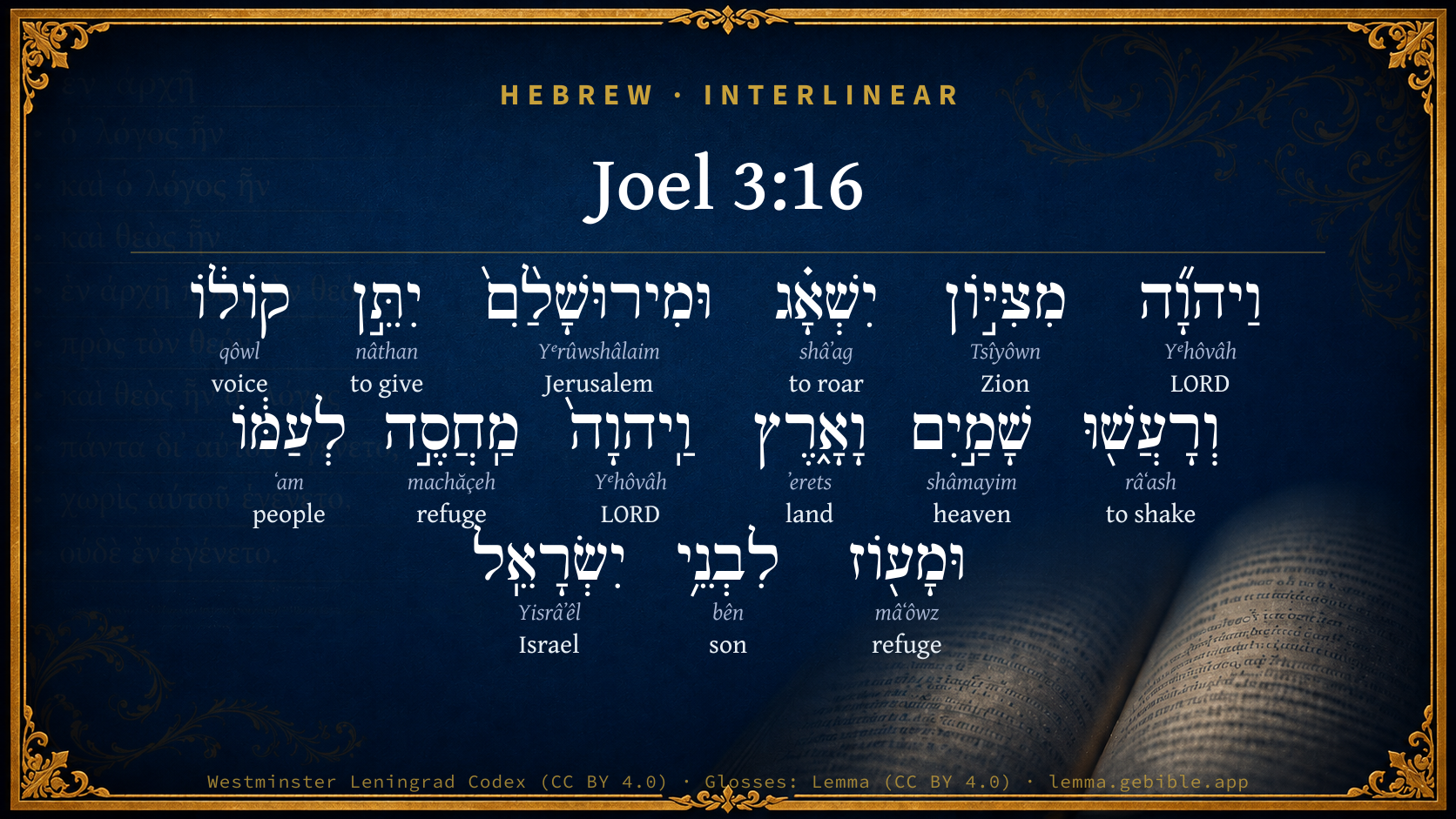
  1. וַיהוָ֞ה Yᵉhôvâh H3068 “and · LORD” Conjunction + Noun, Proper
  2. מִצִּיּ֣וֹן Tsîyôwn H6726 “from · Zion” Preposition + Noun, Proper
  3. יִשְׁאָ֗ג shâʼag H7580 “to roar” Verb, Qal, Imperfect, 3rd Person, Masculine, Singular
  4. וּמִירוּשָׁלִַ֨ם֙ Yᵉrûwshâlaim H3389 “and · from · Jerusalem” Conjunction + Preposition + Noun, Proper
  5. יִתֵּ֣ן nâthan H5414 “to give” Verb, Qal, Imperfect, 3rd Person, Masculine, Singular
  6. קוֹל֔וֹ qôwl H6963 “voice · his” Noun, Common, Masculine, Singular, Construct + Suffix, Personal, 3rd Person, Masculine, Singular
  7. וְרָעֲשׁ֖וּ râʻash H7493 “and · to shake” Conjunction + Verb, Qal, Sequential Perfect, 3rd Person, Common, Plural
  8. שָׁמַ֣יִם shâmayim H8064 “heaven(s)” Noun, Common, Masculine, Plural, Absolute
  9. וָאָ֑רֶץ ʼerets H776 “and · land” Conjunction + Noun, Common, Both, Singular, Absolute
  10. וַֽיהוָה֙ Yᵉhôvâh H3068 “and · LORD” Conjunction + Noun, Proper
  11. לְעַמּ֔וֹ ʻam H5971 “to/for · people · his” Preposition + Noun, Common, Masculine, Singular, Construct + Suffix, Personal, 3rd Person, Masculine, Singular
  12. וּמָע֖וֹז mâʻôwz H4581 “and · refuge” Conjunction + Noun, Common, Masculine, Singular, Absolute
  13. לִבְנֵ֥י bên H1121 “to/for · sons of” Preposition + Noun, Common, Masculine, Plural, Construct
  14. יִשְׂרָאֵֽל Yisrâʼêl H3478 “Israel” Noun, Proper

About this verse

These counts appear in no published source. They are computed here, from the morphology-tagged text and Lemma’s own curated glosses. What Lemma adds →

15
words
14
distinct lemmas
Prophets
section

Notable vocabulary

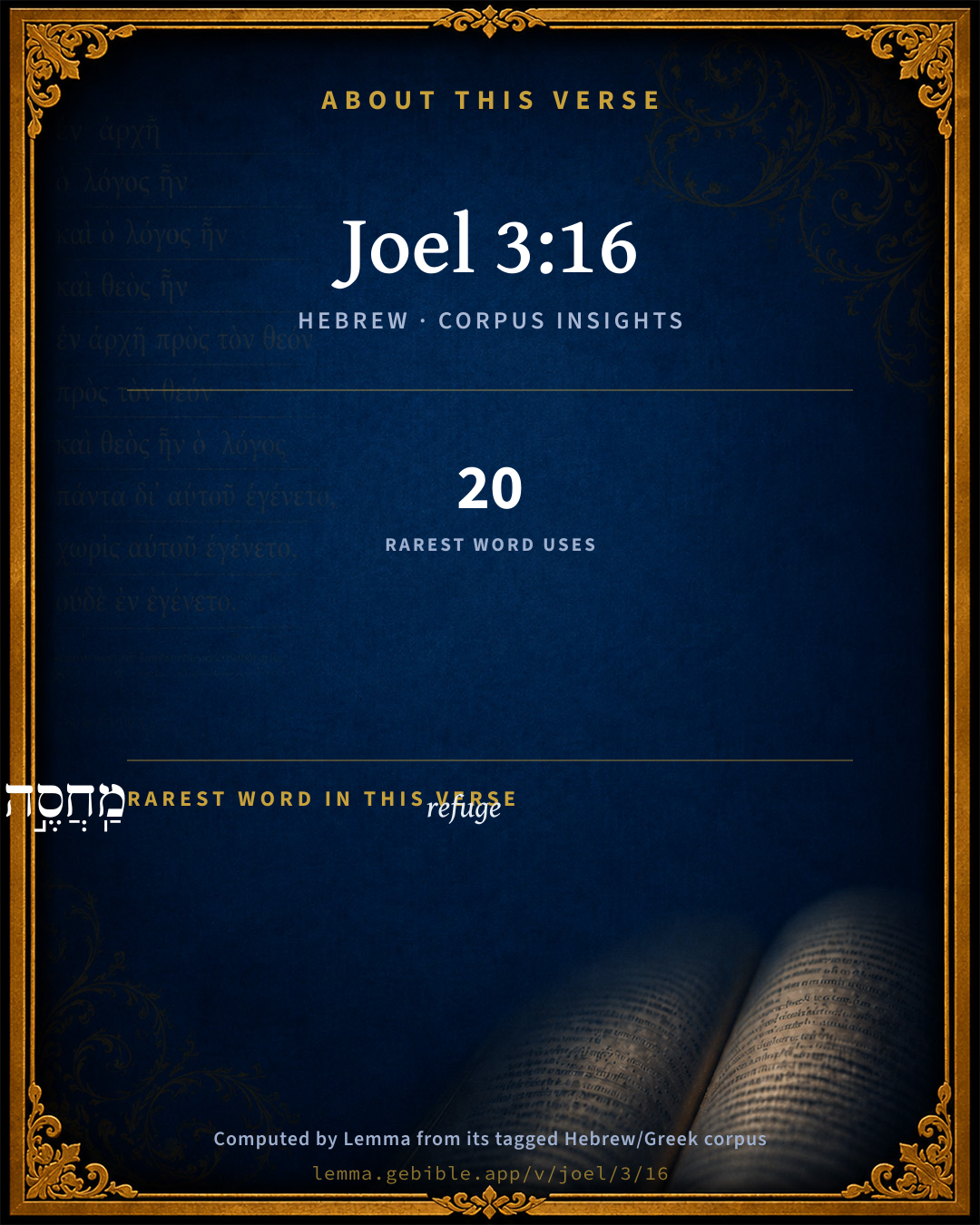
The rarest word here is מַֽחֲסֶ֣ה refuge H4268 — appearing just 20 times in the whole Hebrew Bible.

Shared distinctive vocabulary

מַֽחֲסֶ֣ה refuge H4268 occurs in 20 verses of the Hebrew Bible. Also found in:

Grammatical profile

  • 3 verbs
  • 12 nouns

Verb forms

  • יִשְׁאָ֗ג Qal · Imperfect
  • יִתֵּ֣ן Qal · Imperfect
  • וְרָעֲשׁ֖וּ Qal · Sequential Perfect

Repetition

A word recurs within this verse — often emphatic in Hebrew:

  • וַיהוָ֞ה LORD H3068 ×2

Hebrew & Septuagint length

In English translation the verse runs 34 words from the Hebrew and 38 from the Septuagint (LXX English) — closely comparable.

A rough comparison of the two English renderings, which tokenize alike — not a word-level alignment.

Word counts can differ between the Hebrew and the Greek without any difference in meaning — e.g. the Hebrew direct-object marker אֵת has no separate Greek word, and Greek often adds the article ὁ.

Cross-references

27

Topical passages linked to Joel 3:16 in the Treasury of Scripture Knowledge — connected by theme and wording, ordered by reader-vote popularity; previews shown in the World English Bible.

  • Joel 2:10–11 The earth quakes before them. The heavens tremble. The sun and the moon are darkened, And the stars withdraw their shining.
  • Amos 1:2 He said: "Yahweh will roar from Zion, And utter his voice from Jerusalem; And the pastures of the shepherds will mourn, And the top of Carmel will wither."
  • Jeremiah 25:30–31 Therefore prophesy you against them all these words, and tell them, Yahweh will roar from on high, and utter his voice from his holy habitation; he will mightily roar against his fold; he will give a shout, as those who tread [the grapes], against all the inhabitants of the earth.
  • Proverbs 18:10 The name of Yahweh is a strong tower: The righteous run to him, and are safe.
  • Isaiah 42:13 Yahweh will go forth as a mighty man; he will stir up [his] zeal like a man of war: he will cry, yes, he will shout aloud; he will do mightily against his enemies.
  • Jeremiah 16:19 Yahweh, my strength, and my stronghold, and my refuge in the day of affliction, to you shall the nations come from the ends of the earth, and shall say, Our fathers have inherited nothing but lies, [even] vanity and things in which there is no profit.
  • Haggai 2:6 For this is what Yahweh of Hosts says: 'Yet once, it is a little while, and I will shake the heavens, the earth, the sea, and the dry land;
  • Psalms 61:3 For you have been a refuge for me, A strong tower from the enemy.
  • Isaiah 51:16 I have put my words in your mouth, and have covered you in the shadow of my hand, that I may plant the heavens, and lay the foundations of the earth, and tell Zion, You are my people.
  • Ezekiel 38:19 For in my jealousy and in the fire of my wrath have I spoken, Surely in that day there shall be a great shaking in the land of Israel;
  • Psalms 18:2 Yahweh is my rock, my fortress, and my deliverer; My God, my rock, in whom I take refuge; My shield, and the horn of my salvation, my high tower.
  • Revelation 16:18 There were lightnings, sounds, and thunders; and there was a great earthquake, such as was not since there were men on the earth, so great an earthquake, so mighty.
  • 1 Samuel 15:29 Also the Strength of Israel will not lie nor repent; for he is not a man, that he should repent.
  • Psalms 29:11 Yahweh will give strength to his people. Yahweh will bless his people with peace.
  • Psalms 46:1–11 God is our refuge and strength, A very present help in trouble.
  • Psalms 91:1–2 He who dwells in the secret place of the Most High Will rest in the shadow of the Almighty.
  • Isaiah 33:16 He shall dwell on high; his place of defense shall be the munitions of rocks; his bread shall be given [him]; his waters shall be sure.
  • Isaiah 51:5–6 My righteousness is near, my salvation is gone forth, and my arms shall judge the peoples; the isles shall wait for me, and on my arm shall they trust.
  • Hosea 11:10 They will walk after Yahweh, Who will roar like a lion; For he will roar, and the children will come trembling from the west.
  • Amos 3:8 The lion has roared. Who will not fear? The Lord Yahweh has spoken. Who can but prophesy?
  • Zechariah 10:12 I will strengthen them in Yahweh; And they will walk up and down in his name," says Yahweh.
  • Hebrews 12:26 whose voice shook the earth, then, but now he has promised, saying, "Yet once more I will shake not only the earth, but also the heavens."
  • Revelation 11:13 In that day there was a great earthquake, and a tenth of the city fell. Seven thousand people were killed in the earthquake, and the rest were terrified, and gave glory to the God of heaven.
  • Revelation 11:19 God's temple that is in heaven was opened, and the ark of the Lord's covenant was seen in his temple. Lightnings, sounds, thunders, an earthquake, and great hail followed.
  • Isaiah 33:21 But there Yahweh will be with us in majesty, a place of broad rivers and streams, in which shall go no galley with oars, neither shall gallant ship pass thereby.
  • Zechariah 10:6 "I will strengthen the house of Judah, And I will save the house of Joseph, And I will bring them back; For I have mercy on them; And they will be as though I had not cast them off: For I am Yahweh their God, and I will hear them.
  • Zechariah 12:5–8 The chieftains of Judah will say in their heart, 'The inhabitants of Jerusalem are my strength in Yahweh of Hosts their God.'

Cross-references courtesy of OpenBible.info (CC BY 4.0).

Hebrew and Greek witnesses Masoretic Hebrew ↔ Greek Septuagint

The same verse in the two great witnesses to the Old Testament, shown verse-for-verse.

These are two independent witnesses, not word-aligned to each other, and the Septuagint is shown in lemma (dictionary) form.

Hebrew Joel 3:16 Masoretic · Westminster Leningrad Codex

וַיהוָ֞ה מִצִּיּ֣וֹן יִשְׁאָ֗ג וּמִירוּשָׁלִַ֨ם֙ יִתֵּ֣ן קוֹל֔וֹ וְרָעֲשׁ֖וּ שָׁמַ֣יִם וָאָ֑רֶץ וַֽיהוָה֙ מַֽחֲסֶ֣ה לְעַמּ֔וֹ וּמָע֖וֹז לִבְנֵ֥י יִשְׂרָאֵֽל

Yahweh will roar from Zion, And thunder from Jerusalem; And the heavens and the earth will shake; But Yahweh will be a refuge to his people, And a stronghold to the children of Israel.

World English Bible · Public Domain

Greek LXX Joel 3:16 Septuagint · lemma form
And the Lord shall cry out of Sion, and shall utter his voice from Jerusalem; and the heaven and the earth shall be shaken, but the Lord shall spare his people, and shall strengthen the children of Israel.

LXX2012 (modern English Septuagint) · Public Domain

Hebrew: Westminster Leningrad Codex (CC BY 4.0). Greek: Septuagint (public domain); English from LXX2012 (modern English Septuagint) (Public Domain). How the Septuagint differs from the Hebrew →

Commentary

Notes on Joel 3:16 from classic Christian and Jewish commentators (each source and its license shown beneath its notes). The classic Christian expositions comment on the surrounding passage and are grouped to its opening verse, so a note may address several verses; the Jewish commentaries on the Tanakh (Rashi and others) are per-verse, so they appear only where the commentator wrote on this verse.

Lemma curates 59 commentaries, every one of them public domain or Creative Commons licensed, each selected and text-cleaned for this edition rather than reprinted as found. About our sources →

Trapp's Complete Commentary

John Trapp

Joe 3:16 The LORD also shall roar out of Zion, and utter his voice from Jerusalem; and the heavens and the earth shall shake: but the LORD [will be] the hope of his people, and the strength of the children of Israel.

Ver. 16. The Lord also shall roar out of Zion] Out of his Church he shall terrify his enemies, as the lion doth the rest of the creatures by his dreadful roar; so that they are amazed thereat, and have no power to stir from the place. Lyra interpreteth it of that terrible Discedite, Go, ye cursed, that shall be uttered by Christ at the last day; a sentence that breatheth out nothing better than fire and brimstone, stings and sorrows, woe, and, alas! torments without end and past imagination.

And the heavens and the earth shall shake] The heavens with thunder, the earth with earthquake, to the terror of the wicked, but comfort of the godly, Hag 2:6.

For the Lord will be the hope (or, harbour) of his people] They shall have a good bush on their backs in the greatest tempest; they shall not be afraid, "though the earth be removed, and though the mountains be cast into the midst of the sea," Psa 46:2.

“ Si fractus illabatur orbis,

Impavidos ferient ruinae ”( Horat.).

O the force of a lively faith, and the privy armour of proof that believers have about their hearts! O the dignity and safety of God’s people in the worst of times! Hab 3:18-19. "Happy art thou, O Israel: who is like unto thee, O people saved by the Lord, the shield of thy help, the sword of thine excellency! and thine enemies shall be found liars unto thee; and thou shall tread upon their high places," Deu 33:29.

John Trapp, A Commentary or Exposition upon All the Books of the Old and New Testament (1647–1656) — public domain. Text from a community e-Sword module.

The Biblical Illustrator

Joseph S. Exell

Joe_3:16

But the Lord will be the hope of His people.

The haven of repair

The margin reads, The Lord will be a place of repair, or a harbour for His people. As a secluded, landlocked haven, where storm does not rock, is to a dismasted vessel, so will our God be to those who come in live spiritual need. He will be a haven of repair.

I. There are many experiences which cause us to need a place of repair. Who does not suffer through the fault of others? In every department of our existence we are eyes and hands and feet to each other, in the same body. What is true amongst the smaller things of lifes healthy competition is found also in that more important world, where hearts are wounded, where confidence is shaken, and where hopes are too often crushed. The world is rich in afflictions which are unintentionally caused. Who has not suffered from his own unwisdom? By lack of caution or by over-caution moral weakness is often induced. By hesitation or by impulsiveness we bring disaster upon ourselves. We need some kind of repairing very frequently, and, for the most part, it is on account of self-inflicted damage. The need of repair may come through some want of knowledge. We did not know the seas of life; did not expect a sudden storm; did not understand our own weak side. And so we spread full sail when caution should have counselled; we went right on when we should have sought the anchorage of prayer. But most vessels seek a haven of repair on account of the common wear and strain of voyaging. And so it is with human hearts. We know that we often need a refuge where there is the hope of refitting our shattered strength.

II. The Lord will be our haven of repair. He alone combines the knowledge, the ability, and the will which are needful. No need or danger can be unknown to Him whose eyes are in every place. No inability to do after His hearts desire can fetter Him who created all things by the breath of His mouth. His knowledge, His love, and His power, are the three mountains which enclose a haven of blessed security and peace for the sons of men. Storms of temptation should drive us to the refuge that is in God. The winds of intellectual difficulty should drive us to this Divine haven.

III. A harbour of repair equips for future voyages and service. Acceptance with God is not a fact which should be exclusively, or even chiefly, associated with the close of life. It is not lifes end, but the beginning of new effort towards a better life. If the truth has done anything in us to make us free, it is that we may go forth afresh to meet the rising storms, ourselves, perhaps, to be yet more beaten about and tried, but as a recompense to know that we help some to find the great salvation, to enter into His rest. There will always be Divine strength for Divine work. Let us remember in our religious joy, that the haven of refuge is a haven of repair, and that this always means more work for God. (W. H. Jackson.)

The strength of the children of Israel.--

Christ our strength

Few things have been more coveted by man than strength. But mans superiority to the brutes lies in something more than physical strength. Yet neither a big biceps nor a big brain makes the man in the likeness of God. The really strong men have often to be sought elsewhere than in the ranks of warriors and statesmen. Strength is not the less real for being spiritual. What and whence is such strength as this?

I. The stoic idea of mans spiritual power. Epictetus thus gives mans object in living. It is to know God perfectly, to love Him, to obey Him, to please Him, to overcome all vices, to acquire all virtues, and so to render ourselves holy and companions of God Then why did Stoicism fail? Because the Stoic philosopher claims that man has in himself every means of acquitting himself of all these obligations, and that the means are always within his own power. In man the mind is free to believe only what is true, and the will is free to follow only what is right.

II. The epicurean idea of mans spiritual power. This school claims that so far from the mind teaching us truth, there is nothing we can positively state as truth. And so far from our will being always for happiness, and in the right, it is generally likely to lead us into trouble.

III. The Christian idea. Christianity, steering between Hegelian and Calvinistic theories of human nature, teaches that the mind of man, perfectly informed, may possess right knowledge; and the will of man, perfectly established, may be capable of right conduct. But it recognises that man as yet is not thus perfect. His mind is struggling for light, his will for guidance. Christ is the strength of the people of God. In His presence mans pride must go, since he will recognise his incompleteness and weakness; and his idleness must go, since he will recognise the grace offered to honest effort. Laying hold on the strength of Christ, you are using the resources of Omnipotence. (H. H. Gowen.)

The Biblical Illustrator, edited by Joseph S. Exell (c. 1880s–1900s) — public domain. Text from a community e-Sword module.

Joseph Benson's Commentary

Joe 3:16. The Lord shall roar out of Zion — He shall strike the enemies of his people with astonishment, as the roaring of the lion astonishes the weaker beasts of the forest. And the heavens and the earth shall shake — The destruction shall be as certain and dreadful as though God’s enemies were destroyed by thunder and lightning from heaven. But the Lord will be the hope of his people — Though the heaven and the earth pass away, his word and promise, given to his servants, shall not pass away.

Joseph Benson's Commentary on the Old and New Testaments (1811–1818) — public domain. Text from a community e-Sword module.

Tyndale Open Study Notes

Tyndale Open Resources

3:16 The Lord’s voice, like that of a lion, would roar from Zion, shaking heaven and earth and terrifying sinners (see Amos 1:2). Yet this same ferocious lion is also a refuge for his people.

Tyndale Open Study Notes — © Tyndale Open Resources, licensed CC BY-SA 4.0. Text via the HelloAO Bible API.

Geneva Bible (1599)

Geneva Bible translators

God assureth his against all trouble, that when he destroyeth his enemies, his children shall be delivered.

Geneva Bible (1599) marginal notes — public domain. Text via Bolls.life.

Jamieson, Fausset & Brown

Robert Jamieson, A. R. Fausset & David Brown

(Compare Eze 38:18-22). The victories of the Jews over their cruel foe Antiochus, under the Maccabees, may be a reference of this prophecy; but the ultimate reference is to the last Antichrist, of whom Antiochus was the type. Jerusalem being the central seat of the theocracy (Psa 132:13), it is from thence that Jehovah discomfits the foe.

roar--as a lion (Jer 25:30; Amo 1:2; Amo 3:8). Compare as to Jehovah's voice thundering, Psa 18:13; Hab 3:10-11.

Lord . . . the hope of his people--or, "their refuge" (Psa 46:1).

Jamieson, Fausset & Brown — Commentary Critical and Explanatory on the Whole Bible (1871) — public domain (CC PDM 1.0). Text via the HelloAO Bible API.

Adam Clarke's Commentary

Verse 16. The Lord also shall roar out of Zion] His temple and worship shall be re-established there, and he will thence denounce his judgments against the nations. "The heavens and the earth shall shake." There shall be great commotions in powerful empires and their dependencies; but in all these things his own people shall be unmoved, for God shall be their hope and strength.

Adam Clarke's Commentary on the Bible (1810–1826) — public domain. Text from a community e-Sword/MySword module.

John Calvin's Commentaries

The Prophet explains here more clearly his object, or the end for which he had hitherto spoken of God’s judgment; for what we have heard served only to spread terror: but now the Prophet shows that his purpose was to console the faithful, and to give some relief to their troubles and sorrows. This is the reason why he introduces God as roaring from Zion and crying from Jerusalem. Roaring is ascribed to God, inasmuch as he compares himself in another place to a lion, when representing himself as the faithful protector of the salvation of his people: “I will be,” he says, “like the lion, who suffers not the prey to be taken from him, but boldly defends it with all the fierceness he possesses: so also will I do, I will not suffer my people to be taken from me.” In this sense does the Prophet now say, that God will roar from Zion. God had been for a time despised; for the nations had prevailed against his chosen people, and plundered them at their pleasure; and God then exercised not his power. Since God had been for a time still, the Prophet says now, that he will not always conceal himself, but that he will undertake the defense of his people, and be like a lion; for he will rise up in dreadful violence against all his enemies.

And tremble, he says, shall the heaven and the earth. As almost the whole world was opposed to his elect people, the Prophet carefully dwells on this point, that nothing might hinder the faithful from looking for the redemption promised to them: “Though the heaven and the earth,” he says, “raise oppositions God will yet prevail by his wonderful power. Tremble, he says, shall all the elements; what, then, will men do? Though they muster all their forces, and try all means, can they close up the way against the Lord, that he may not deliver his people?” We now understand the Prophet’s design in speaking of the shaking of heaven and earth.

He at last adds, God will be a hope to his people, and strength to the children of Israel. In this part he gives a sufficient proof of what I have stated, — that he denounces extreme vengeance on the nations for the sake of his Church; for the Lord will at length pity his people, though they may seem to have perished before he succors them. However past hope then the people may be in their own estimation and in that of all others, yet God will again raise up the expectation of all the godly, who shall remain, and will inspire them with new courage. He speaks in general of the children of Israel; but what he says belongs only to the remnant, of which the Prophet had lately spoken; for not all, we know, who derive their origin from the fathers according to the flesh, were true Israelites. The Prophet refers here to the true Church; and hence Israel ought to be taken for the genuine and legitimate children of Abraham; as Christ, in the person of Nathanael, calls those true Israelites who imitated the faith of their father Abraham. I shall to-day finish this Prophet; I do not therefore dwell much on every sentence. It now follows —

John Calvin's Commentaries (1540-1563) — public domain. Text from the Calvin Translation Society English edition (1840s-50s) via the Christian Classics Ethereal Library (ccel.org). Calvin's coverage is partial (roughly two-thirds of the Bible); uncommented books and verses are honest gaps, never fabricated. The 19th-century editor's footnotes and remarks are omitted so the notes are faithfully Calvin's own voice.

Ellicott's Commentary for English Readers

(16) The Lord also shall roar . . .—This is the key-note of the prophecy of Amos, who opens his appeal with these words. The majestic roar of the lion is transferred to express victorious utterance of the Lord’s judgment: it is irresistible. As St. Paul wrote, “The Lord Himself shall descend from heaven with a shout, with the voice of the archangel, and with the trump of God” (1Th_2:16). The temporal success of the Jews in their future conflict with their enemies is blended with the final triumph of the Lord in the judgment day.

A Bible Commentary for English Readers, edited by Charles John Ellicott (1878–1897) — public domain. Text from a community e-Sword module.

The Cambridge Bible for Schools and Colleges

gen. ed. J. J. S. Perowne

16. Jehovah draws near in a mighty storm; heaven and earth quake before Him: but His judgement lights only upon His foes; to His own people He proves Himself a stronghold and defence.

And Jehovah shall roar from Zion, and utter his voice from Jerusalem] Borrowed verbatim from Amo_1:2, where see the note. The figures of the lion’s roar, and of the noise of thunder, are combined. The details of the judgement are not described; but it must no doubt be imagined that in the storm, and the earthquake accompanying it (see the next words), the nations are struck down and destroyed (comp. for the figure Isa_28:2; Isa_29:6-8; Isa_30:30-31). The fact that Jehovah puts forth His power from Zion, His earthly abode, and the sacred capital of the theocracy, is naturally a favourable omen for His faithful people.

and the heavens and the earth shall quake] Cf. Joe_2:10.

but Jehovah will be a refuge unto his people, and a strong hold to the children of Israel] The terms used so often of Jehovah in the Psalms: see e.g. Psa_14:6; Psa_46:1; Psa_27:1; Psa_31:4; Psa_43:2.

The Cambridge Bible for Schools and Colleges (gen. ed. J. J. S. Perowne; Cambridge University Press, 1878–1918) — public domain. Text from a community e-Sword module.

John Gill's Exposition

The Lord also shall roar out of Zion, and utter his voice from Jerusalem,.... Christ, the Lamb, shall now appear as the Lion of the tribe of Judah, and utter his voice in his providence and judgments on the behalf of his church and people, signified by Zion and Jerusalem; and therefore said to roar, and utter his voice from thence; he will be heard far and near, and strike terror in the hearts of his enemies; see Jer 25:30;

and the heavens and the earth shall shake; great revolutions will be made in the world, both in church and state, among the antichristian powers; and such as will also make them shake and tremble, as well as alter the form and frame of things among them; see Rev 16:18; changes in government, civil and ecclesiastic, are sometimes signified by such phrases, Hag 2:6;

but the Lord will be the hope of his people; the object, author, ground, and foundation of their hope of salvation here and hereafter; in whom they may hope for and expect safety and security in the worst of times; since he will be their "refuge", or their "harbour" (q) as it may be rendered; to whom they may have recourse, to shelter and screen them from the rage and wrath of their enemies, and where they will be safe, till the indignation of God be over and past; and while calamities and judgments are upon the unchristian and ungodly world, they will have nothing to fear amidst these storms, being in a good harbour:

and the strength of the children of Israel; of the spiritual Israel; of all such who are Israelites indeed, the Lord's chosen, redeemed, and called people, both Jews and Gentiles; the author and giver of their spiritual strength, the strength of their lives and of their hearts, of their graces and of their salvation; by whom they are furnished with strength to do the duties of religion; to exercise grace; to wrestle with God in prayer; to withstand spiritual enemies; to bear afflictions patiently, and to persevere to the end: or he is their "fortress" (r); their strong hold and place of defence, where they are safe from every enemy, free from all distresses, enjoy solid peace and comfort, and have plenty of provisions, Isa 33:16.

(q) "refugium", Tigurine version, Burkius; "receptus", Tarnovius. (r) "prsesidium", Tarnovius; "arx", Cocceius.

John Gill's Exposition of the Whole Bible (1746–1763) — public domain (CC PDM 1.0). Text via the HelloAO Bible API.

Albert Barnes' Notes on the Bible

The Lord shall roar out of Zion - As in the destruction of Sennacherib, when he was now close upon his prey, and “shook his hand against the mount of the daughter of Zion, the hill of Jerusalem, the Lord of hosts lopped the bough with terror, and the high ones of stature were hewn down, and the haughty were humbled Isa 10:32-33, so at the end. It is foretold of antichrist, that his destruction shall be sudden, “Then shall that Wicked one be revealed, whom the Lord shall consume with the spirit of His mouth, and shall destroy with the brightness of His Coming” 2Th 2:8. And Isaiah saith of our Lord, “He shall smite the earth with the rod of His mouth, and with the breath of His lips shall He slay the wicked” Isa 11:4. When the multitudes of God’s enemies were thronged together, then would He speak with His Voice of terror. The terrible voice of God’s warnings is compared to the roaring of a lion. “The lion hath roared, who will not fear? the Lord hath spoken, who can but prophesy?” Amo 3:8. Much more, when those words of awe are fulfilled. Our Lord then, “The Lion of the tribe of Judah” Rev 5:5. Who is here entitled by the incommunicable Name of God, I am, shall utter His awful Voice, as it is said; “The Lord Himself shall descend from heaven with a shout, with the voice of the Archangel and with the Trump of God” 1Th 4:16; and He Himself says, “The hour is coming, in the which all that are in the graves shall hear His voice and shall come forth, they that have done good unto the Resurrection of life, and they that have done evil unto the resurrection of damnation” Joh 5:28-29.

And shall utter His voice from Jerusalem - that is, either from His Throne aloft “in the air” above the holy city, or from the heavenly Jerusalem, out of the midst of the tens of thousands of His holy angels Mat 16:27; Mat 25:31; Mar 8:38; 2Th 1:7, and saints Zec 14:5; Jud 1:14, who shall “come with Him.” So terrible shall that voice be, that “the heavens and the earth shall shake,” as it is said, “the heavens shall pass away with a great noise, and the elements shall melt with fervent heat, the earth also and the works that are therein shall be burned up” 2Pe 3:10; and “heaven shall open for the coming of the saints,” and ‘hell shall be moved at the coming’ Isa 14:9 of the evil. : “Nor shall it be a slight shaking of the earth at His Coming, but such that all the dead shall be roused, as it were from their sleep, yea, the very elect shall fear and tremble, but, even in their fear and trembling, shall retain a strong hope. This is what he saith immediately, ‘The Lord will be the hope (or place of refuge)’ of His ‘people, and the strength (or stronghold) of the children of Israel,’ i. e., of the true Israel, the whole people of the elect of God. All these He will then by that His Majesty at once wonderfully terrify and strengthen, because they ever hoped in God, not in themselves, and ever trusted in the strength of the Lord, never presumed on their own. Whereas contrariwise the false Israelites hope in themselves, while, ‘going about to establish their own righteousness, they submitted themselves not to the righteousness of God.’ Rom 10:3. The true Israel shall trust much more than ever before; yet none can trust then, who in life, had not trusted in Him Alone.

Albert Barnes' Notes on the Bible (1834–1885) — public domain. Text from a community e-Sword/MySword module.

Haydock's Catholic Bible Commentary

Roar, in thunder, Jeremias xxv. 30., and Amos i. 2. (Haydock)

George Leo Haydock (1774–1849), Haydock's Catholic Family Bible and Commentary, 1859 edition — public domain. Excludes Psalms (Douay-Rheims chapter numbering differs from Protestant) and Deuterocanonical books (Catholic canon only).

Matthew Poole's English Annotations

The Lord; who, Joe 2:27, is the Lord in the midst of Israel or in the midst of his church.

Shall roar; when he brings forth his mighty ones the men of war, and commands them to march out against his and his church’s enemies, he will strike the enemy with astonishment and fear, as the roaring of the lion doth astonish the weaker beasts of the forest. Fear shall surprise them when God shall speak against them.

Out of Zion; the place where God chooseth to dwell, emblem of his church, and of the kingdom of Christ.

And utter his voice, in wrath and indignation against those he will destroy, because they have destroyed his church.

From Jerusalem; typical, so God roared and uttered his voice against Sennacherib; mystical, so he hath often already, and still will further discover his displeasure against his enemies, and he will, as one who dwells in a place for the defence of it, rebuke and check those who assault it: so God dwells in his Jerusalem, as it is Joe 3:17.

The heavens; metaphorically the states and kingdoms, the great ones in those states.

The earth; the common sort of people, the inferior ranks of men; the foundations of those kingdoms shall be shaken and overthrown.

Shall shake, and fly as affrighted, so the word signifieth.

But the Lord; but at that time, and in the midst of all those commotions, the eternal and almighty God, who fills the enemy with fears and astonishment,

will be the hope; shall be the object of his people’s expectation, they shall look for good from him by all these troubles: and so God was to his after their return out of captivity, through the Medo-Persian reign, through the Grecian rule under Alexander, and under the times of Alexander’s successors.

Of his people; of them that believe his word and obey his law.

And the strength, strong defence and fortress, to his, here called the children of Israel, those that are Israelites indeed.

Matthew Poole's English Annotations on the Holy Bible (1683–1685) — public domain. Text from a community e-Sword/MySword module.

The Pulpit Commentary

Out of Zion. The presence of Jehovah is the immediate occasion of these terrors; and hence his voice proceeds from Jerusalem, or more particularly from Zion, where the visible symbol of his presence long dwelt. "For there," says Kimchi, "was his dwelling in Jerusalem; and as if from thence he roared and uttered his voice against them." Thus far the prophet pictures in very vivid, indeed terribly vivid, colours the frightful scene in the valley of decision: then stops short without describing the sad catastrophe resulting from the actual execution of the judgment. This he omits, either from revulsion of feeling from such misery. or the reader is left to imagine it himself. But the Lord will be the Hope of his people, and the Strength of the children of Israel. He shrinks, as we have seen, from describing the actual execution of judgment, and, breaking off with somewhat of abruptness, exhibits the bright side of the picture. With the destruction of his foes is joined, as usual, the deliverance of his friends. To his people he stands in the double relation of a Place of refuge (machseh) and a Place of strength (maoz), that is, not only a place to which they may flee for safety, but a place in which, as a stronghold, they shall be kept safe.

The Lord his people"s Hope and Strength.

The prospect of the day of the Lord is to the sinful fraught with dread and with dismay. To them the judgment brings the delayed condemnation, and therefore the very thought of it is associated with alarm. But the language of this verse reminds us how differently the Divine appearance and interposition are regarded by the true people of God.

I THE RIGHTEOUS LORD IS THE HARBOUR AND THE HOPE OF HIS PEOPLE.

1. They have need of a Divine and secure refuge and confidence.

2. They have received God"s revelation of himself, and are accordingly able to trust and rest in him.

3. And thus the expectation which brings to others consternation, brings to them a tranquil confidence.

II THE RIGHTEOUS LORD IS THE STRENGTH OF HIS PEOPLE.

1. This assurance supports them when conscious of their own feebleness.

2. And when convinced by experience of the comparative strength of their enemies.

3. To them the power of God is a welcome thought; for the irresistible might, which others fear because it ensures their defeat and destruction, will be exercised by a faithful God for the protection and preservation of all who trust in him. T.

The Pulpit Commentary (1880–1919), ed. H.D.M. Spence-Jones & Joseph S. Exell — public domain. Text from a community e-Sword module.

John Wesley's Explanatory Notes

Shall roar - He will strike the enemy with astonishment as the roaring of the lion astonishes the weaker beasts of the forest.

John Wesley, Explanatory Notes Upon the Whole Bible (1754–1765) — public domain. Text via the GEBible commentary corpus.

unfoldingWord translationNotes

Door43 World Missions Community

General Information:

Yahweh begins speaking in verse 17.

Yahweh will roar from Zion, and raise his voice from Jerusalem

Both phrases mean Yahweh will shout with a loud, clear and powerful voice from Jerusalem. If your language only has one word for speaking very loudly, this can be used as one phrase. AT: "Yahweh will shout from Jerusalem" (See: Parallelism)

Yahweh will roar

Possible meanings are 1) "Yahweh will roar like a lion" or 2) "Yahweh will roar like thunder." (See: Metaphor)

The heavens and earth will shake

Joel speaks of the heavens and earth as if they were people who are shaking with fear. This can be translated as either a hyperbole, that Yahweh's roar is so frightening that even things that are not alive are afraid, or as metonymy, that the heavens and earth are metonyms for the beings who live there. AT: "Everyone in the heavens and on the earth is very afraid" (See: Hyperbole and Generalization and Metonymy)

will shake

This word is the past form of the word translated "tremble" in Joel 2:10.

Yahweh will be a shelter for his people, and a fortress for the people of Israel

Both of these phrases mean Yahweh will protect his people. A fortress is a strong shelter used to protect people during war. AT: "Yahweh will be a strong fortress for his people, the people of Israel" (See: Metaphor and Parallelism)

So you will know

"When I do these things, you will know"

translationWords

Zion

Jerusalem

heaven

people of God

Israel

Yahweh

God

holy

unfoldingWord translationNotes — © Distant Shores Media and the Door43 World Missions Community, licensed CC BY-SA 4.0. Source: git.door43.org/Door43/en_tn.

Lesson kit

Teaching starters — assembled from the data on this page, not authored interpretation. Every prompt links to the verse data it draws on. Edit before teaching.

Joel, in the Prophets, opens this verse with 15 words (14 distinct Hebrew lemmas). Its most distinctive word is machăçeh (“refuge”). A historical commentator’s framing appears above. Read the whole chapter for the surrounding context.

Discussion questions

  1. What does “refuge” (machăçeh) contribute to the verse as a whole?
  2. Job 24:8 shares the word «refuge» with this verse. How do the two illuminate each other?
  3. “LORD” occurs 2× in this one verse. What is the effect of the repetition?
  4. These translations render this verse differently. What is at stake in choosing one wording over another?
  5. The verb «יִשְׁאָ֗ג» is Qal Imperfect. How does its form color the action?
  6. Reading how Trapp's Complete Commentary and The Biblical Illustrator read this verse, where do the two commentators agree and where do they part?

Things to notice

Reading settings

Reading text

Shown beneath each verse's original-language words.

Old Testament
Old Testament edition

Read the OT as the Masoretic Hebrew (MT) or the Greek Septuagint (LXX).

English shown for the Greek Septuagint (in the Hebrew ↔ Greek comparison).

Comparing translations? Open the Compare panel on any verse page to stack up to four side by side.