
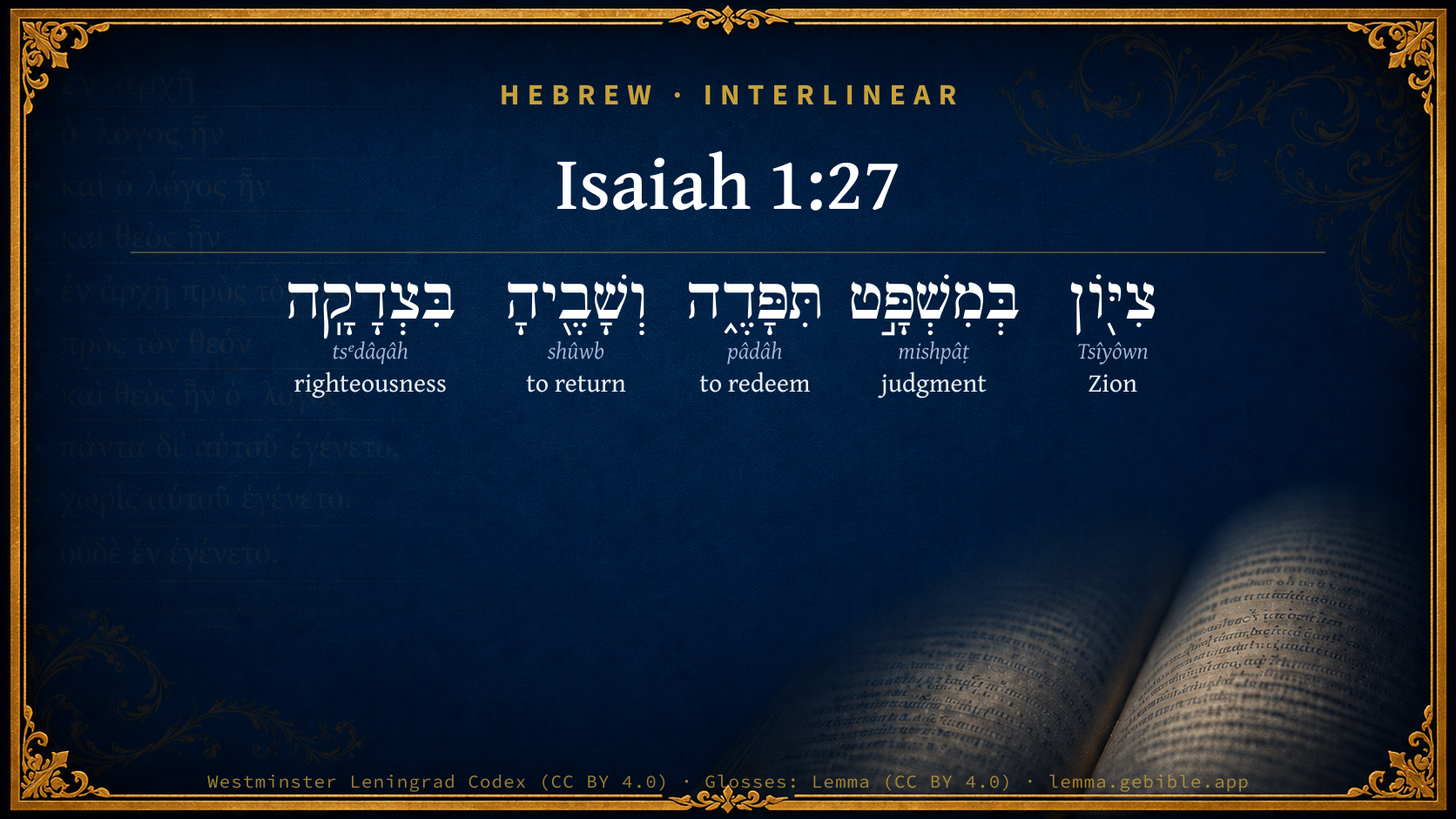
Isaiah 1:27

Hebrew (Westminster Leningrad Codex) Isaiah 1:27 appears in the Hebrew Old Testament. The text above is from the Westminster Leningrad Codex. Each word links to its Strong’s number, a concise gloss, and parsing drawn from the Open Scriptures Hebrew Bible morphology. Click any word for its full Brown-Driver-Briggs (BDB) entry.
Download image
Cite this verse

Isaiah 1:27 (World English Bible). Public Domain. Lemma interlinear Bible study tool, https://lemma.gebible.app/v/isaiah/1/27.

Show BibTeX & RIS
BibTeX
RIS
English Translation
Zion shall be redeemed with justice, And her converts with righteousness.
World English Bible · Public Domain
Download a study sheet

One document with this verse’s original text, its word-by-word gloss line, the meaning frame, cross-references with their text, attributed commentary, and full source and license credits — printable, and it pastes into notes with its structure intact.

This verse Autodidact and up

Study sheet (.html) Plain text (.txt)

A passage Seminary Student

Up to 50 verses in one chapter. A passage sheet keeps up to 6 commentary sources and 12 cross-references per verse, in the order this page ranks them, and says so on the sheet whenever that leaves anything out. Ask for a single verse and you get the Autodidact verse sheet above.

Everything on this page stays free to read, with no account — the sheet is a download of what is already on screen, not access to it.

Want to remove ads? Support Godless Engineer
Compare translations 3

The same verse in 3 English versions, stacked beneath the original-language interlinear above. Click any original word for its lexicon entry.

Each is an independent rendering of the whole verse — the interlinear is not word-aligned to these translations.

Highlighted words mark where these versions differ — a whole-verse word diff, not a word-by-word alignment.

  • World English Bible Public Domain
    Zion shall be redeemed with justice, And her converts with righteousness.
  • King James Version Public Domain
    Zion shall be redeemed with judgment, and her converts with righteousness.
  • unfoldingWord Literal Text CC BY-SA 4.0
    Zion will be redeemed with justice, and its repenting ones, with righteousness.

unfoldingWord Literal Text — © unfoldingWord, licensed CC BY-SA 4.0. Word-aligned USFM3 via Door43 (git.door43.org/unfoldingWord/en_ult).

Versions to compare (up to 4)

3 of 4 selected

Show all 18 translations

Every available English version of this verse, each an independent rendering of the whole verse.

  • World English Bible Public Domain
    Zion shall be redeemed with justice, And her converts with righteousness.
  • Berean Standard Bible Public Domain
    Zion will be redeemed with justice, her repentant ones with righteousness.
  • Majority Standard Bible Public Domain
    Zion will be redeemed with justice, her repentant ones with righteousness.
  • King James Version Public Domain
    Zion shall be redeemed with judgment, and her converts with righteousness.
  • American Standard Version (1901) Public Domain
    Zion shall be redeemed with justice, and her converts with righteousness.
  • Revised Version (1885) Public Domain
    Zion shall be redeemed with judgment, and her converts with righteousness.
  • Geneva Bible (1599) Public Domain
    Zion shall be redeemed in iudgement, and they that returne in her, in iustice.
  • Douay-Rheims (1899) Public Domain
    Sion shall be redeemed in judgment, and they shall bring her back in justice.
  • Young's Literal Translation Public Domain
    Zion in judgment is redeemed, And her captivity in righteousness.
  • Literal Standard Version CC BY-SA 4.0
    Zion is redeemed in judgment, || And her captivity in righteousness.
  • Unlocked Literal Bible CC BY-SA 4.0
    Zion will be redeemed by justice, and her repentant ones by righteousness.
  • unfoldingWord Literal Text CC BY-SA 4.0
    Zion will be redeemed with justice, and its repenting ones, with righteousness.
  • Darby Bible Public Domain
    Zion shall be redeemed with judgment, and they that return of her with righteousness.
  • World Messianic Bible Public Domain
    Zion shall be redeemed with justice, and her converts with righteousness.
  • Webster's Bible Public Domain
    Zion shall be redeemed with judgment, and her converts with righteousness.
  • Free Bible Version CC BY-SA 4.0
    Zion will be rescued by justice, those who repent by doing right.
  • Bible in Basic English Public Domain
    Upright acts will be the price of Zion's forgiveness, and by righteousness will men be living there.
  • JPS Tanakh (1917) Public Domain
    Zion shall be redeemed with justice, and they that return of her with righteousness.

Literal Standard Version (2020), Covenant Press — licensed CC BY-SA 4.0. Text via the HelloAO Bible API (eBible.org). Unlocked Literal Bible (unfoldingWord) — licensed CC BY-SA 4.0. Text via the HelloAO Bible API (eBible.org). unfoldingWord Literal Text — © unfoldingWord, licensed CC BY-SA 4.0. Word-aligned USFM3 via Door43 (git.door43.org/unfoldingWord/en_ult). Free Bible Version, Dr. Jonathan Gallagher — licensed CC BY-SA 4.0. Text via the HelloAO Bible API (eBible.org).

Word by word

More ways to search: Search by grammar → Find every occurrence → Compare this word →

Practice this passage: Drill this verse → Learn its vocabulary →

About this verse

These counts appear in no published source. They are computed here, from the morphology-tagged text and Lemma’s own curated glosses. What Lemma adds →

5
words
5
distinct lemmas
Prophets
section

Shared distinctive vocabulary

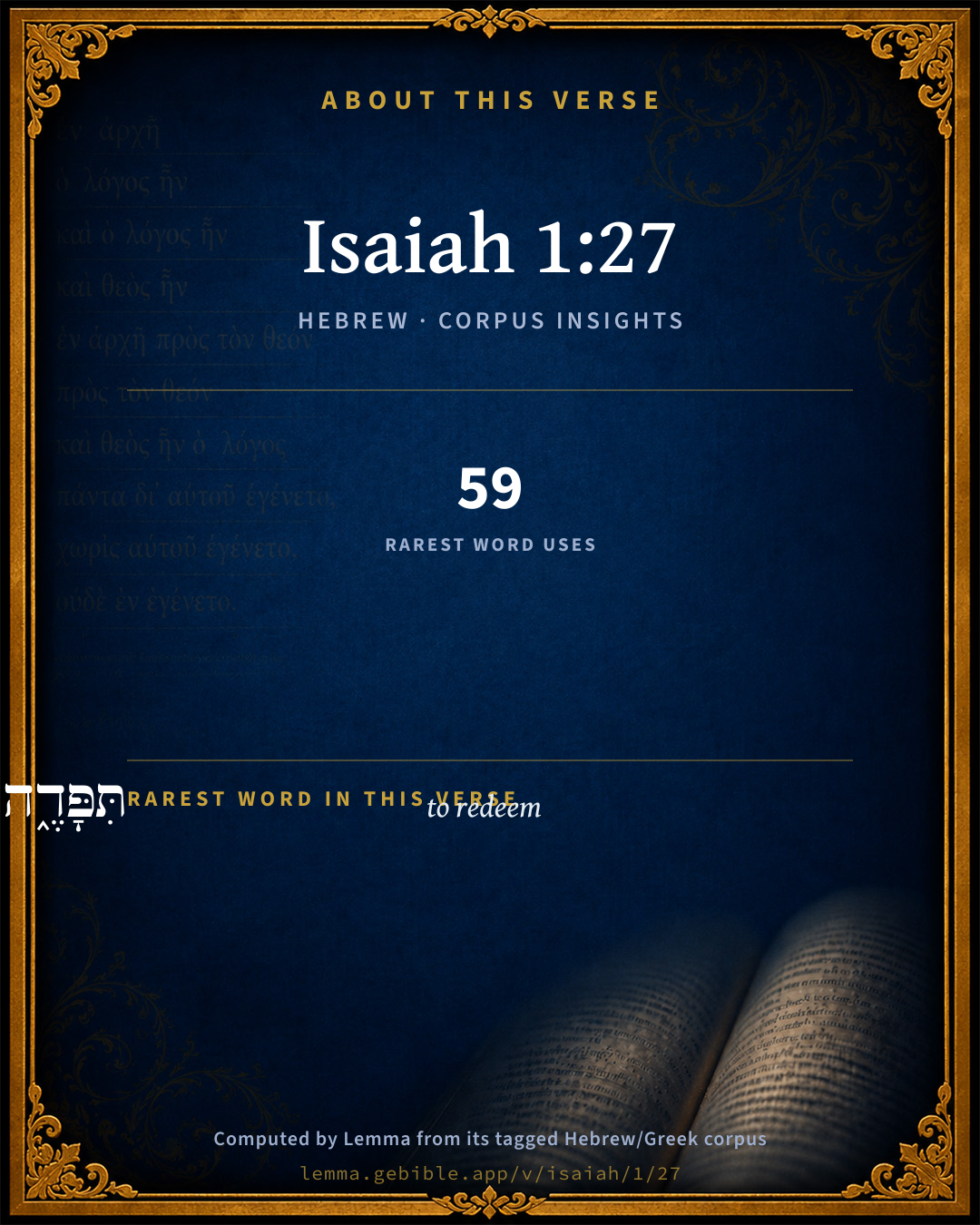
תִּפָּדֶ֑ה to redeem H6299 occurs in 48 verses of the Hebrew Bible. Also found in:

Grammatical profile

  • 2 verbs
  • 3 nouns

Verb forms

  • תִּפָּדֶ֑ה Niphal · Imperfect
  • וְשָׁבֶ֖יהָ Qal · Participle Active

Hebrew & Septuagint length

In English translation the verse runs 11 words from the Hebrew and 11 from the Septuagint (LXX English) — the same length.

A rough comparison of the two English renderings, which tokenize alike — not a word-level alignment.

Word counts can differ between the Hebrew and the Greek without any difference in meaning — e.g. the Hebrew direct-object marker אֵת has no separate Greek word, and Greek often adds the article ὁ.

Cross-references

11

Topical passages linked to Isaiah 1:27 in the Treasury of Scripture Knowledge — connected by theme and wording, ordered by reader-vote popularity; previews shown in the World English Bible.

  • Isaiah 62:12 They shall call them The holy people, The redeemed of Yahweh: and you shall be called Sought out, A city not forsaken.
  • Isaiah 5:16 But Yahweh of Hosts is exalted in justice, And God the Holy One is sanctified in righteousness.
  • Isaiah 45:21–25 Declare you, and bring [it] forth; yes, let them take counsel together: who has shown this from ancient time? who has declared it of old? Haven't I, Yahweh? and there is no God else besides me, a just God and a Savior; there is no one besides me.
  • Isaiah 63:4 For the day of vengeance was in my heart, and the year of my redeemed is come.
  • Romans 3:24–26 being justified freely by his grace through the redemption that is in Christ Jesus;
  • Romans 11:26–27 and so all Israel will be saved. Even as it is written, "There will come out of Zion the Deliverer, And he will turn away ungodliness from Jacob.
  • 1 Corinthians 1:30 But of him, you are in Christ Jesus, who was made to us wisdom from God, and righteousness and sanctification, and redemption:
  • 2 Corinthians 5:21 For him who knew no sin he made to be sin on our behalf; so that in him we might become the righteousness of God.
  • Ephesians 1:7–8 in whom we have our redemption through his blood, the forgiveness of our trespasses, according to the riches of his grace,
  • Titus 2:14 who gave himself for us, that he might redeem us from all iniquity, and purify for himself a people for his own possession, zealous for good works.
  • 1 Peter 1:18–19 knowing that you were redeemed, not with corruptible things, with silver or gold, from the useless way of life handed down from your fathers,

Cross-references courtesy of OpenBible.info (CC BY 4.0).

Hebrew and Greek witnesses Masoretic Hebrew ↔ Greek Septuagint

The same verse in the two great witnesses to the Old Testament, shown verse-for-verse.

These are two independent witnesses, not word-aligned to each other, and the Septuagint is shown in lemma (dictionary) form.

Hebrew Isaiah 1:27 Masoretic · Westminster Leningrad Codex

צִיּ֖וֹן בְּמִשְׁפָּ֣ט תִּפָּדֶ֑ה וְשָׁבֶ֖יהָ בִּצְדָקָֽה

Zion shall be redeemed with justice, And her converts with righteousness.

World English Bible · Public Domain

Greek LXX Isaiah 1:27 Septuagint · lemma form

μετά γάρ κρίμα σώζω ὁ αἰχμαλωσία αὐτός καί μετά ἐλεημοσύνη

For her captives shall be saved with judgment, and with mercy.

LXX2012 (modern English Septuagint) · Public Domain

On this verse, Albert Barnes' Notes on the Bible discusses the Septuagint’s reading. Read the note in Commentary ↓

Hebrew: Westminster Leningrad Codex (CC BY 4.0). Greek: Septuagint (public domain); English from LXX2012 (modern English Septuagint) (Public Domain). How the Septuagint differs from the Hebrew →

Targum (Aramaic paraphrase)

1

The Targum is the ancient Jewish Aramaic paraphrase of the Hebrew Scriptures — an interpretive translation, not the Hebrew text itself. Onkelos (literal) and Pseudo-Jonathan (expansive) render the Torah, and Jonathan the Prophets. Coverage is partial: where no permissively-licensed English translation exists for a verse, only the Aramaic is shown. This is verse-level text, not a word-by-word alignment to the Hebrew.

  1. Targum Jonathan Prophets (Joshua–Malachi)
    צִיוֹן כַּד יִתְעֲבֵד בָּהּ דִינָא תִתְפְּרוֹק וְדַעֲבָדוּ אוֹרַיְתָא יְתוּבוּן לָהּ בְּזָכוּ:

    As for Zion, when justice shall be practised in her, she shall be redeemed; and those that do the law shall return to her in righteousness.

    Targum Jonathan — Aramaic: “Mikraot Gedolot” (public domain). English: “Sefaria Community Translation” (CC0 1.0 (public-domain dedication)); “London "Chaldee Paraphrase," 1871” (public domain). Text via Sefaria.

Commentary

Notes on Isaiah 1:27 from classic Christian and Jewish commentators (each source and its license shown beneath its notes). The classic Christian expositions comment on the surrounding passage and are grouped to its opening verse, so a note may address several verses; the Jewish commentaries on the Tanakh (Rashi and others) are per-verse, so they appear only where the commentator wrote on this verse.

Lemma curates 59 commentaries, every one of them public domain or Creative Commons licensed, each selected and text-cleaned for this edition rather than reprinted as found. About our sources →

Trapp's Complete Commentary

John Trapp

Isa 1:27 Zion shall be redeemed with judgment, and her converts with righteousness.

Ver. 27. Zion shall be redeemed in judgment.] Or, By judgment executed on her enemies, who are also God’s enemies. {Isa 1:24}

And her converts.] Such as were Manasseh, made of a lion a lamb; Matthew, of a publican an evangelist; Paul, of a Pharisee an apostle; Justin, of a philosopher a martyr; Cyprian, of a rhetorician, and, as some think, a magician, a most famous bishop; Augustine, of a Manichee a champion of the Church; Petrus Paulus Vergerius, of the Pope’s Nuncio a zealous preacher at Zurich. That I speak not of Peter Martyr’s converts in Italy, Earl Martinens, Marquess Caracciolus, Lacisius, Tremellius, Zanchius, and other great divines. Bucer was first wrought upon by Luther’s sermon, preached before the emperor at Worms, and so from a Dominican became a famous Protestant. Bilney was converted by reading Erasmus’ translation of the New Testament, for the eloquence of it, and particularly by that sweet sentence, 1Ti 1:15. Latimer was converted by blessed Bilney, as he calleth him, from a stiff Papist to a stout professor of the truth; Julius Palmer the martyr by reading Calvin’s Institutions; Dr Sibbes by a sermon preached by Mr Paul Bains; Mr Whately by Mr Dod. {a}

In righteousness.] Or, By God’s faithfulness in fulfilling his promises, whereby they are made partakers of the divine nature, having escaped the corruption that is in the world through lust. {2Pe 1:4}

{a} Hist. of Modern Divines, by Lupton.

John Trapp, A Commentary or Exposition upon All the Books of the Old and New Testament (1647–1656) — public domain. Text from a community e-Sword module.

The Biblical Illustrator

Joseph S. Exell

Isa_1:27

Zion shall be redeemed with judgment

Evil in the Church

I.

WHAT ARE WE TO UNDERSTAND BY ZION. The word signifies a heap of stones--a monument--a sepulchre. This figuratively describes the literal Zion; and spiritually sets forth the visible and mystical Church. The true members of the Church of Christ are as lively stones, built up a spiritual house; and for their security God Himself has laid a foundation. (1Pe_2:5.) Every stone of this sacred building is hewn out of natures quarry, and when prepared by the transforming power of God the Holy Ghost is placed in that part of the spiritual edifice which it is appointed to occupy. And the building thus formed is, indeed, as the word Zion signifies, a monument--an everlasting monument of Gods grace; whilst a mere professing, but not a confessing, protesting, and believing Church may very properly be compared to a sepulchre. Hence Zion of old contained a church within a church; those who were circumcised outwardly in the flesh, and those whose circumcision was that of the heart. According to the New Testament we understand by Zion the Church visible and the Church mystical.

II. WHAT MAY BE CONSIDERED ZIONS TRANSGRESSION. If we look at Zion of old, we behold formality manifestly pervading the Church, and the most lofty and presumptuous hypocrisy characterising the outward worship of God. Now, turn your attention to the Church of God in her present state. Such an examination will bring to light many evils, which are serious hindrances to the spread of evangelical truth, and afford ground for sarcasm and opposition, to the enemies of the Church.

1. Pride.

2. Laodicean lukewarmness.

3. Abuse of doctrine and discipline.

III. ZIONS VISITATIONS AND CHASTISEMENTS. The history of the Church, as well as of nations, affords the most impressive evidence of the truth of that often fulfilled declaration, Be sure your sin will find you out. Rom_11:19-22; Eze_34:2-5; Eze_34:9-10; Rev_2:15; Rev_3:1-3; Rev_3:14-20.)

IV. ZIONS DELIVERANCE. In the exercise of justice, in the overthrow of the enemies of His Church and deliverance of His people, as well as by the faithful performance of His promises, God has engaged that Zion shall be redeemed with judgment and her converts (or those that return of her) with righteousness. (J. F. Witty.)

Redeemed with judgment

Jesus lived to die. It was a voluntary necessity. We are redeemed with judgment. The Judge has pronounced the sentence over the sacrifice: This is My beloved Son, in whom I am well pleased. The converted soul is redeemed with righteousness. Whom God hath set forth to be a propitiation through faith in His blood, etc. (T. Davies, M. A.)

The Biblical Illustrator, edited by Joseph S. Exell (c. 1880s–1900s) — public domain. Text from a community e-Sword module.

Joseph Benson's Commentary

Isa 1:27-28. Zion shall be redeemed — Shall be delivered from all their enemies and calamities; with judgment — By the exercise of God’s strict justice in destroying the obdurate; by purging out those wicked and incorrigible Jews, who, by their sins, hindered the deliverance of the people; and by punishing and destroying their unmerciful enemies who kept them in cruel bondage; and her converts — Hebrew, ושׁביה, her returners, those of them who shall come out of captivity into their own land; with righteousness — Or, by righteousness; either by God’s faithfulness, in keeping his promise of delivering them after seventy years, or by his goodness; for both these qualities come under the name of righteousness in the Scriptures. And, or rather, but, the destruction of the transgressors, &c., shall be together — Though I will deliver my people from the Babylonish captivity, yet those of them who shall still go on in their wickedness, shall not have the benefit of that mercy, but shall be reserved for a more dreadful and total destruction.

Joseph Benson's Commentary on the Old and New Testaments (1811–1818) — public domain. Text from a community e-Sword module.

The Preacher's Complete Homiletical Commentary

Joseph S. Exell (gen. ed.)

THE TWOFOLD EFFECT OF DIVINE JUDGMENTS

Isa_1:27-28. Zion shall be redeemed with judgment, and her converts with righteousness: and the destruction of the transgressors and of the sinners shall be together, and they that forsake the Lord shall be consumed.

These verses are closely and vitally connected: it is a mistake to separate them, as in the Authorised Version. Their meaning would be conveyed to the English reader, if they were translated—“Zion shall be redeemed with judgment, and her converts with righteousness; and thereby also the transgressors and sinners shall be destroyed, yea they that forsake the Lord shall be consumed” [463] By judgment is meant the doom which in the preceding verses had been threatened against guilty Jerusalem (e.g., Isa_1:18): this “judgment” would be a manifestation of God’s punitive righteousness, and the declaration is that the infliction of this “judgment” would have a twofold effect—it would redeem Zion and her converts, and it would destroy the transgressors and sinners.

[463] The word “together” does not mean that the transgressor shall be destroyed together with the sinner; but that the destruction of this one class, called both transgressors and sinners, shall come in close connection, “together with,” the salvation of the penitent who are brought back to God by correction, as is said in the previous verses. The same sort of infliction that reclaimed the “converts” (Isa_1:27), bardened and sealed over to ruin those who would still “forsake the Lord.”—Cowles.

The diverse effects of Divine judgments is a matter well worthy of our study.

I. One effect of those judgments by which God manifests His righteous indignation against sin is to redeem His people from their transgressions. A prolonged period of peace and prosperity such as the Jews enjoyed under Uzziah is always perilous to the vital religion of a nation. Formalism is apt to prevail. The lines of demarcation between the Church and the world are apt to be effaced; “Zion” is apt to become merged in “Jerusalem.” In love to His people, God is therefore compelled to send upon their nation great calamities. These lead to searchings of heart, and reformations of conduct and character. Men learn again to wait upon God, and reverently to regard His will (Isa_26:9). The Church shines once more with the glory of spiritual conformity to God, and the result is that she is increased by converts from the world: to these also the season of judgment is also the season of redemption. But,

II. Another effect of God’s judgments is to harden the obdurate. His chastisements lead some men to further acts of rebellion against Him (Isa_1:5). Like Pharaoh, they harden themselves more and more as God sends plague after plague upon them (Exo_8:19; Exo_8:32, &c.) Hence seasons of public calamity (such as that of the plague in London, &c.) have always been seasons of public crime. Transgressors madly dare Omnipotence to a trial of strength, and the result is their utter destruction.

Our subject as thus unfolded gives rise to the following practical reflections—

1. In a season of national or individual prosperity we should be especially watchful and prayerful against conformity to the world [466]

2. We should not regard judgments that come upon our nation or ourselves merely as calamities: they may be God’s angels sent in truest mercy, and they bring with them to the people of God great moral and spiritual compensations.

3. Judgments, when they come upon us, afford us an admirable test of our real character: if we be indeed the people of God, they will lead us to submission and to more earnest strivings after holiness; but if they awaken within us a spirit of murmuring, of repining, of resentment against God, we have good cause to suspect that our religion has never been the work of God in our hearts [469]

4. In the season of judgment we really have only one alternative before us—to turn or burn. No stoutness of heart will enable us to resist God’s consuming wrath against iniquity (Mal_4:1).

[466] How often does worldly prosperity tend to this lapsing of the soul from God! How often do our very outward mercies and blessings superinduce this spiritual languor and decay! It is with believers individually as with the Church collectively—they are never in a condition less favourable to spiritual health and advancement than when they have no trial or cross to brace their energies and invigorate their graces. The soldier gets supine after battle. History tells us how the bravest veterans of the great Carthaginian general got demoralised and degenerate when, victory over, they sat down to rejoicing and revelry, before the gates of Capua; they never were the same heroes again.—Macduff.

[469] As it is easy to know a piece of gold from a piece of brass when they come both to the anvil and be stricken with the hammer, for brass will not be handled, but when it cometh to the beating breaketh and maketh a sharp din and irksome, but gold soundeth sweetly, and is pliable; so when the hypocrite cometh between the anvil and the hammer of affliction, he breaketh with impatience, and lamenteth in blasphemies against God; whereas a faithful Christian praiseth God, and layeth out his heart, submitting himself willingly under the Lord’s hand that striketh him.—Cawdray, 1598–1684.

FORSAKING THE LORD

Isa_1:28. They that forsake the Lord shall be consumed.

I. The guilt of forsaking the service of the Lord.

1. Man is bound by the law of his nature to obey that Almighty Being by whom he was made an intelligent and immortal creature. Every discovery which reason opens to him of the transcendant perfections of the Lord of the universe urges the duty of offering to this great and glorious Being the homage of his heart and life. Every day’s preservation increases his obligation to serve his gracious Preserver.

2. Many in forsaking the Lord violate their own express and solemn engagements (Heb_10:29).

II. The folly of forsaking, &c. If we do so, we shall

(1) incur the reproaches of our own mind;

(2) forfeit the esteem and confidence of all good men;

(3) forfeit the favour and incur the wrath of God. And for what are all those tremendous sacrifices made? For “the pleasures of sin,” which are but “for a season”!

III. The danger of forsaking, &c.—“shall be consumed.” The threatened doom is

(1) awful;

(2) certain.—J. H. Hobart, D.D., Posthumous Works, ii 220–229.

The Preacher's Complete Homiletical Commentary (gen. ed. Joseph S. Exell; Funk & Wagnalls, c. 1892) — public domain (pre-1929). A full-Bible homiletical/sermon-outline anthology covering 65 of 66 books (2 John is absent from the source module). Text from a community e-Sword module.

Keil & Delitzsch

C. F. Keil & F. Delitzsch

Isa 1:27 presents it in a brief and concise form: "Sion will be redeemed through judgment, and her returning ones through righteousness." Mishpat and tzedâkâh are used elsewhere for divine gifts (Isa 33:5; Isa 28:6), for such conduct as is pleasing to God (Isa 1:21; Isa 32:16), and for royal Messianic virtues (Isa 9:6; Isa 11:3-5; Isa 16:5; Isa 32:1). Here, however, where we are helped by the context, they are to be interpreted according to such parallel passages as Isa 4:4; Isa 5:16; Isa 28:17, as signifying God's right and righteousness in their primarily judicious self-fulfilment. A judgment, on the part of God the righteous One, would be the means by which Zion itself, so far as it had remained faithful to Jehovah, and those who were converted in the midst of the judgment, would be redeemed - a judgment upon sinners and sin, by which the power that had held in bondage the divine nature of Zion, so far as it still continued to exist, would be broken, and in consequence of which those who turned to Jehovah would be incorporated into His true church. Whilst, therefore, God was revealing Himself in His punitive righteousness; He was working out a righteousness which would be bestowed as a gift of grace upon those who escaped the former. The notion of "righteousness" is now following a New Testament track. In front it has the fire of the law; behind, the love of the gospel. Love is concealed behind the wrath, like the sun behind the thunder-clouds. Zion, so far as it truly is or is becoming Zion, is redeemed, and none but the ungodly are destroyed. But, as is added in the next verse, the latter takes place without mercy.

Keil & Delitzsch — Biblical Commentary on the Old Testament (1861–1891) — public domain (CC PDM 1.0). Text via the HelloAO Bible API. (Old Testament only.)

Tyndale Open Study Notes

Tyndale Open Resources

1:27 Here, Zion refers to the remnant community. Only those who repent would receive God’s salvation and purification and would dwell in his presence. Zion was required to be the bastion of justice and righteousness, for God loves righteousness. God expected the covenant community to reflect the holy standards he cares about.

Tyndale Open Study Notes — © Tyndale Open Resources, licensed CC BY-SA 4.0. Text via the HelloAO Bible API.

Geneva Bible (1599)

Geneva Bible translators

By justice is meant God’s faithful promise, which is the cause of the deliverance of his Church.

Geneva Bible (1599) marginal notes — public domain. Text via Bolls.life.

Jamieson, Fausset & Brown

Robert Jamieson, A. R. Fausset & David Brown

redeemed--temporarily, civilly, and morally; type of the spiritual redemption by the price of Jesus Christ's blood (Pe1 1:18-19), the foundation of "judgment" and "righteousness," and so of pardon. The judgment and righteousness are God's first (Isa 42:21; Rom 3:26); so they become man's when "converted" (Rom 8:3-4); typified in the display of God's "justice," then exhibited in delivering His covenant-people, whereby justice or "righteousness" was produced in them.

converts--so MAURER. But Margin, "they that return of her," namely the remnant that return from captivity. However, as Isaiah had not yet expressly foretold the Babylonian captivity, the English Version is better.

Jamieson, Fausset & Brown — Commentary Critical and Explanatory on the Whole Bible (1871) — public domain (CC PDM 1.0). Text via the HelloAO Bible API.

Adam Clarke's Commentary

Verse 27. With judgment - "In judgment"] By the exercise of God's strict justice in destroying the obdurate, (see Isa 1:28,) and delivering the penitent in righteousness; by the truth and faithfulness of God in performing his promises."

Adam Clarke's Commentary on the Bible (1810–1826) — public domain. Text from a community e-Sword/MySword module.

Ellicott's Commentary for English Readers

(27) Zion shall be redeemed with judgment . . .—Better, through justice. The condition of the redemption which primarily proceeds from the compassion of Jehovah is found in the renewed righteousness of man to man described in the preceding verse. Without that no redemption was possible, for that was of its very essence.

Her converts.—Literally, those that turn. The conversion implied is obviously not that of Gentiles to the faith of Israel, but of Israelites who had gone astray. The word is the same as that which meets us in the name of Shear-jashub (the remnant shall return), and is prominent in the teaching of Jeremiah, “Turn ye, and live” (Isa_3:12; Isa_3:14; Isa_4:1, et al.).

A Bible Commentary for English Readers, edited by Charles John Ellicott (1878–1897) — public domain. Text from a community e-Sword module.

John Gill's Exposition

Zion shall be redeemed with judgment,.... The blessing of redemption by Christ is the source and foundation of the other blessings of grace, before mentioned, the little remnant are favoured with, as justification, pardon of sin, and conversion, Isa 1:18, Isa 1:25 it is of a spiritual nature; the redemption of the soul is a deliverance from the captivity of sin, Satan, and the law, and is plenteous and eternal; the objects of redeeming grace are "Zion"

and her converts; not the world, but the church is redeemed by Christ; for by Zion is meant, not a place, but people, even the church and people of God, who frequently bear the name of Zion in this prophecy, and in other passages of Scripture, both of the Old and of the New Testament; see Isa 49:14 compared to Mount Zion for its height and holiness; for being the object of God's love, the instance of his choice, the place of his habitation; where his worship is, he grants his presence, and distributes his blessings; for its being a perfection of beauty, the joy of the whole earth, well fortified and immovable: and the redemption of the church by Christ is

with judgment; with the judgment and vengeance of God on Christ, and through the condemnation of him as her Head and representative; with the judgment of God, which is according to truth, in whose judgment she is truly redeemed by the blood of Christ, and really delivered from her bondage, according to his justice and holiness, which are glorified by it: but here the redemption of Zion seems to mean a more glorious state of the church, a restoration of her to her former glory, or to a greater, which will be in the latter day, and may be discerned as drawing near by the signs of the times fulfilling, Luk 21:28 whereby the truth and faithfulness of God, in his promises concerning it, will be honoured, and he will appear to be a God of judgment:

and her converts with righteousness; so called, not because converted by the church, for conversion is God's work, and not man's; no man can effect his own conversion, he is passive in it; nor can any others, not their nearest friends and relations; they can only pray for it, as Abraham did for Ishmael, and bring them under the means; nor are ministers sufficient, only instruments of conversion neither Zion's ministers nor members can convert one sinner: but they are so called, either because converted "in" her, through the ministry of the word as a means, preached in the midst of her, Psa 87:5 or because converted "to" her, Isa 60:5 being made to submit to the ordinances of the church, and to join themselves to it. "Converts" are the objects of redemption by Christ; all that are redeemed are, sooner or later, converted; and all that are converted are redeemed; and the redemption of them by his blood is consistent "with" the "righteousness" of God; for hereby sin is fully condemned and punished; the justice of God has all its demands, and the law is completely fulfilled; and so the end of God is answered, which is to declare his righteousness by it. Moreover, in the latter day, when there, will be a redemption and deliverance or the church out of all her troubles and distresses, her converts will manifestly appear to be all righteous, being justified with the spotless righteousness of Christ, Isa 60:21.

John Gill's Exposition of the Whole Bible (1746–1763) — public domain (CC PDM 1.0). Text via the HelloAO Bible API.

Albert Barnes' Notes on the Bible

Zion - See the note at Isa 1:8. The word Zion here is used to designate the whole Jewish people to whom the prophet had reference; that is, the inhabitants of Judah and Jerusalem, Isa 1:1.

Shall be redeemed - The word used here - פדה pâdâh - is employed in two senses in the Scriptures. It implies always the idea of deliverance, as from captivity, danger, punishment, slavery, sin. But this idea occurs:

(1) sometimes without any reference to a price paid, but simply denoting to deliver, or to set at liberty; and

(2) in other instances the price is specified, and then the word occurs under the strict and proper sense of redeem; that is, to rescue, or deliver, by a ransom price.

Instances of the former general sense occur often; as e. q., to deliver from slavery without mere ion of a price; Deu 7:8 : ‘The Loan loved you, and redeemed you out of the house of bondmen.’ See also Jer 15:21; Jer 31:11. The idea of delivering in any way from danger occurs often; Job 5:20 : ‘In famine he shall redeem thee from death, and in war from the power of the sword;’ 1Ki 1:29 : ‘As Jehovah liveth, that hath redeemed my soul out of all distress.’ 1Sa 4:9. But the word often occurs in connection with the mention of the price, and in this sense the words rendered redeem are commonly used in the New Testament; see Exo 13:13; Num 18:15-17; compare Gal 3:13; 1Pe 1:18; Rev 5:9; Eph 1:17. Mat 20:28; 1Ti 2:6. In these last places, the blood of Christ, or his atoning sacrifice, is mentioned as the price, or the valuable consideration, by which deliverance from sin is effected; compare the note at Isa 43:3. In the case now before us, however, the word is used in the general sense, to denote that God would rescue and save his people from the calamities and judgments to which they were to be subjected on account of their sins. Though they were to be taken captive for their sins, yet they should again be delivered and restored to their land. The Septuagint evidently so understands it: ‘Her captivity shall be saved with judgment and with mercy.’ The Chaldee Paraphrase renders it in a manner somewhat similar: ‘But Zion, when judgment shall have been accomplished in her, shall be redeemed; and they who keep the law shall be returned to it in righteousness.’

With judgment - In a righteous, just manner. That is, God shall evince his justice in doing it; his justice to a people to whom so many promises had been made, and his justice in delivering them from long and grievous oppression. All this would be attended with the displays of judgment, in effecting their deliverance. This might be evinced

(1) in keeping his promises made to their fathers;

(2) in delivering an oppressed people from bondage; and

(3) in the displays of judgment on the nations necessary in accomplishing the deliverance of the Jews. This is the common interpretation.

It may be, however, that the expression does not refer to the character of God, which is not at all the subject of discourse, but to the character of the people that should be redeemed. Before, the nation was corrupt; after the captivity, they would be just. Zion should be redeemed; and the effect of that redemption would be, that the people would be reformed, and holy, and just. This does not refer, properly, to redemption by the Lord Jesus, though it is equally true that that will be accomplished with justice, that is, in entire consistency with the character of a just and holy God.

Her converts - This is an unhappy translation. The Hebrew here means simply, ‘they that return of her’ (margin); that is, those who return from captivity. It is implied that all would not return - which was true - but those who did return, would come back in righteousness.

With righteousness - This refers to the character of those who shall return. The prediction is, that the character of the nation would be reformed Isa 1:26; that it would be done by means of this very captivity; and that they who returned would come back with a different character from the nation at the time that Isaiah wrote. They would be a reformed, righteous people. The character of the nation was greatly improved after the captivity. Their propensity to idolatry, in a particular manner, was effectually restrained; and probably the character of the people after the captivity, for morals and religion, was not inferior to the best periods of their history before.

Albert Barnes' Notes on the Bible (1834–1885) — public domain. Text from a community e-Sword/MySword module.

Matthew Poole's English Annotations

Zion, the Jews that live in or near Zion, and worship God in Zion,

shall be redeemed, shall be delivered from all their enemies and calamities,

with judgment; or, by judgment, i.e. by God’s righteous judgment, purging out those wicked and incorrigible Jews, who by their sins hindered the deliverance of the people, and punishing and destroying their unmerciful enemies, who kept them in cruel bondage, as he did to the Babylonians, whereby he made the way open for their deliverance.

Her converts, Heb. her returners, those of them who shall come out of captivity into their own land,

with righteousness; or, by righteousness, i.e. either by my faithfulness, in keeping my promise of delivering them after seventy years; or by my goodness; for both these come under the name of righteousness in Scripture use.

Matthew Poole's English Annotations on the Holy Bible (1683–1685) — public domain. Text from a community e-Sword/MySword module.

The Pulpit Commentary

Redeemed with judgment; rather, delivered through judgment; i.e. God"s judgment shall have the effect of delivering" a remnant, who shall build up Zion once more, and dwell in it. Her converts; i.e. those of her children who turn to God, shall be delivered through God"s righteousness, i.e. through the righteous vengeance which he executes upon the unfaithful nation. Some, however, understand both clauses to mean that the penitent remnant shall "deliver their own souls by their righteousness". (comp. Eze_14:14, 20 18:27, etc.)

The Pulpit Commentary (1880–1919), ed. H.D.M. Spence-Jones & Joseph S. Exell — public domain. Text from a community e-Sword module.

John Wesley's Explanatory Notes

Redeemed - Shall be delivered from all their enemies and calamities. With - Or, by judgment, that is, by God's righteous judgment, purging out those wicked and incorrigible Jews, and destroying their unmerciful enemies. Converts - Hebrew. her returners, those of them who shall come out of captivity into their own land. Righteousness - Or, by righteousness, either by my faithfulness, in keeping my promise, or by my goodness.

John Wesley, Explanatory Notes Upon the Whole Bible (1754–1765) — public domain. Text via the GEBible commentary corpus.

J. A. Alexander on Isaiah

Joseph Addison Alexander

Thus far the promise to God’s faithful people and the threatening to His enemies among them had been intermingled, or so expressed as to involve each other. Thus the promise of purification to the silver involved a threatening of destruction to the dross. But now the two elements of the prediction are exhibited distinctly, and first the promise to the church “Zion”, the chosen people, as a whole, here considered as consisting of believers only, “shall be redeemed,” delivered from destruction, “in judgment,” (i.e., in the exercise of justice upon God’s part), and her converts, those of her who return to God by true repentance, in righteousness, here used as an equivalent to justice. The verse means that the very same events, by which the divine justice was to manifest itself in the destruction of the wicked, should be the occasion and the means of deliverance to Zion or the true people of God.

Joseph Addison Alexander, The Prophecies of Isaiah (1846–1847; New York: Scribner, 1870–1878) — public domain. Text from a community e-Sword module.

unfoldingWord translationNotes

Door43 World Missions Community

General Information:

Isaiah speaks Yahweh's words to the people of Judah in the form of a poem. (See: Parallelism)

Zion will be redeemed by justice, and her repentant ones by righteousness

This can be stated in active form. The full meaning of this statement can be made clear. Possible meanings are 1) "Yahweh will redeem Zion because the people there do what is just, and he will redeem those who repent because they do what Yahweh says is right" or 2) "Yahweh will redeem Zion because he is just, and he will redeem those who repent because he is righteous" (See: Active or Passive and Ellipsis)

Zion

This is a metonym for the people who live on Mount Zion. (See: Metonymy)

Rebels and sinners will be crushed together

This can be stated in active form. AT: "God will destroy those who rebel and sin against him" (See: Active or Passive)

those who abandon Yahweh will be done away with

This can be stated in active form. AT: "and Yahweh will completely do away with those who turn away from him" or "and Yahweh will kill all who reject him" (See: Active or Passive)

translationWords

Zion

redeem

just

repent

righteous

rebel

sin

Yahweh

unfoldingWord translationNotes — © Distant Shores Media and the Door43 World Missions Community, licensed CC BY-SA 4.0. Source: git.door43.org/Door43/en_tn.

Rashi

Rabbi Shlomo Yitzchaki (Rashi)

shall be redeemed through justice Since there will be in it people who practice justice.

shall be redeemed from her iniquities.

and her penitent those penitent among them. (through righteousness through those who make themselves righteousthrough justice and through righteousness—that are in her midst [or,] among them.)

Rashi on the Tanakh — English translations: “The Judaica Press complete Tanach with Rashi, translated by A. J. Rosenberg” (CC BY 4.0); “Pentateuch with Rashi's commentary by M. Rosenbaum and A.M. Silbermann, 1929-1934” (public domain); “The Metsudah Tanach series, Lakewood, N.J” (CC BY 4.0); and “The Book of Joshua, Metsudah Publications, 1997” (CC BY 4.0). Text via Sefaria.

Ibn Ezra

Rabbi Abraham ibn Ezra

Zion shall be redeemed, etc. Zion will, in consequence of her justice, be redeemed out of the hand of Sennacherib.

And her returning people. The people that will repent. Supply יפדו will be redeemed.

Ibn Ezra on the Tanakh — English translations: “Sefaria Community Translation” (CC0 1.0 (public-domain dedication)); “Yalkut, Sifsei Chachomim Chumash, Metsudah Publications, 2009” (CC BY 4.0); and “Commentary of Ibn Ezra on Isaiah - trans. by M. Friedlander, 1873” (public domain). Text via Sefaria.

Lesson kit

Teaching starters — assembled from the data on this page, not authored interpretation. Every prompt links to the verse data it draws on. Edit before teaching.

Isaiah, in the Prophets, opens this verse with 5 words (5 distinct Hebrew lemmas). Its most distinctive word is pâdâh (“to redeem”). A historical commentator’s framing appears above. Read the whole chapter for the surrounding context.

Discussion questions

  1. What does “to redeem” (pâdâh) contribute to the verse as a whole?
  2. How does Exodus 13:13, which shares the word «to redeem», read alongside this verse?
  3. These translations render this verse differently. What is at stake in choosing one wording over another?
  4. «תִּפָּדֶ֑ה» is a Niphal Imperfect verb. How does that grammatical form shape the action described?
  5. Compare how Trapp's Complete Commentary and The Biblical Illustrator read this verse. Where do they agree or differ?

Things to notice

Reading settings

Reading text

Shown beneath each verse's original-language words.

Old Testament
Old Testament edition

Read the OT as the Masoretic Hebrew (MT) or the Greek Septuagint (LXX).

English shown for the Greek Septuagint (in the Hebrew ↔ Greek comparison).

Comparing translations? Open the Compare panel on any verse page to stack up to four side by side.