
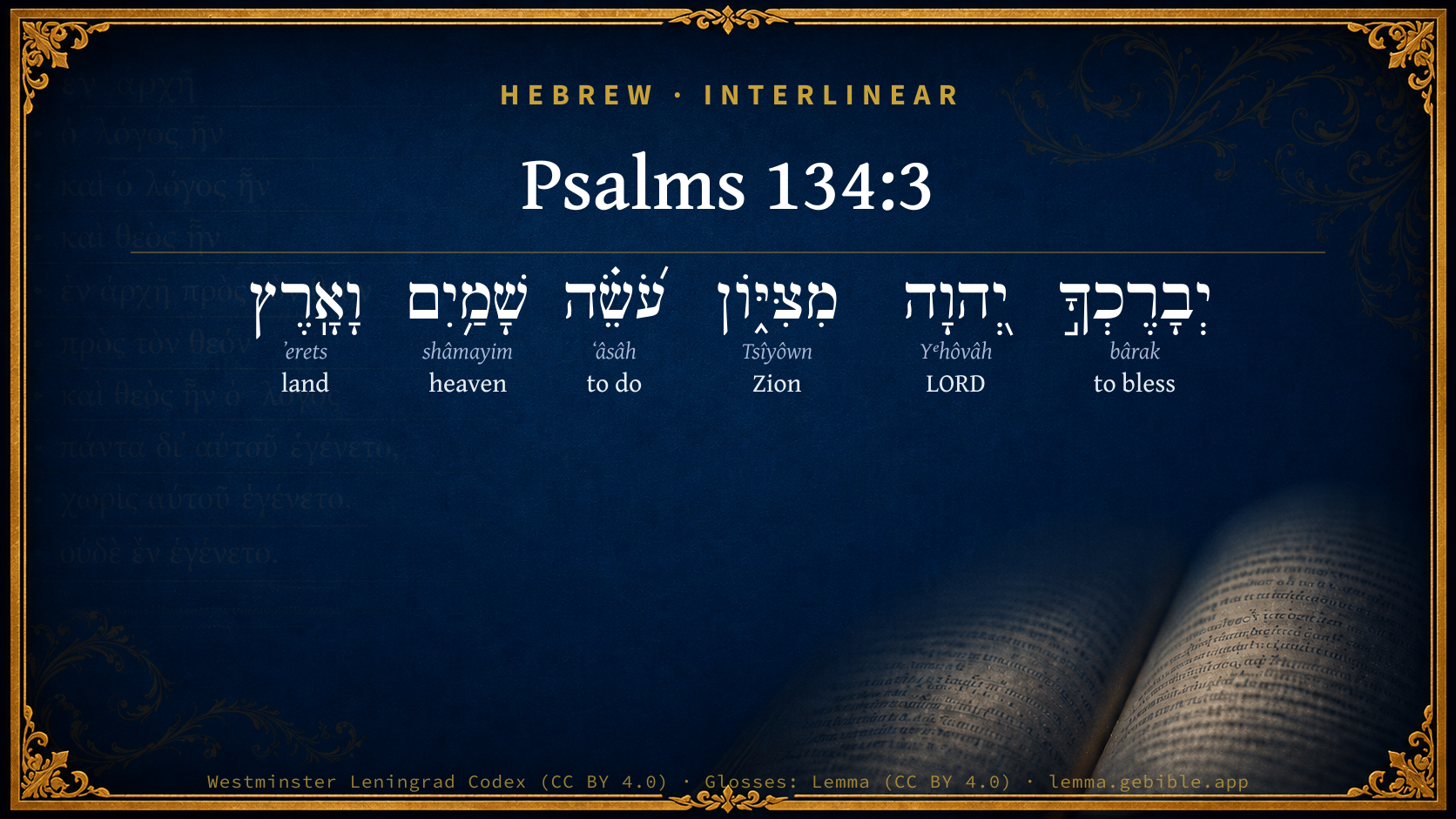
Psalms 134:3

Hebrew (Westminster Leningrad Codex) Psalms 134:3 appears in the Hebrew Old Testament. The text above is from the Westminster Leningrad Codex. Each word links to its Strong’s number, a concise gloss, and parsing drawn from the Open Scriptures Hebrew Bible morphology. Click any word for its full Brown-Driver-Briggs (BDB) entry.
Download image
Cite this verse

Psalms 134:3 (World English Bible). Public Domain. Lemma interlinear Bible study tool, https://lemma.gebible.app/v/psalms/134/3.

Show BibTeX & RIS
BibTeX
RIS
English Translation
May Yahweh bless you from Zion; Even he who made heaven and earth.
World English Bible · Public Domain
Download a study sheet

One document with this verse’s original text, its word-by-word gloss line, the meaning frame, cross-references with their text, attributed commentary, and full source and license credits — printable, and it pastes into notes with its structure intact.

This verse Autodidact and up

Study sheet (.html) Plain text (.txt)

A passage Seminary Student

Up to 50 verses in one chapter. A passage sheet keeps up to 6 commentary sources and 12 cross-references per verse, in the order this page ranks them, and says so on the sheet whenever that leaves anything out. Ask for a single verse and you get the Autodidact verse sheet above.

Everything on this page stays free to read, with no account — the sheet is a download of what is already on screen, not access to it.

Want to remove ads? Support Godless Engineer
Compare translations 3

The same verse in 3 English versions, stacked beneath the original-language interlinear above. Click any original word for its lexicon entry.

Each is an independent rendering of the whole verse — the interlinear is not word-aligned to these translations.

Highlighted words mark where these versions differ — a whole-verse word diff, not a word-by-word alignment.

  • World English Bible Public Domain
    May Yahweh bless you from Zion; Even he who made heaven and earth.
  • King James Version Public Domain
    The LORD that made heaven and earth bless thee out of Zion.
  • unfoldingWord Literal Text CC BY-SA 4.0
    May Yahweh bless you from Zion, the maker of heaven and earth.

unfoldingWord Literal Text — © unfoldingWord, licensed CC BY-SA 4.0. Word-aligned USFM3 via Door43 (git.door43.org/unfoldingWord/en_ult).

Versions to compare (up to 4)

3 of 4 selected

Show all 18 translations

Every available English version of this verse, each an independent rendering of the whole verse.

  • World English Bible Public Domain
    May Yahweh bless you from Zion; Even he who made heaven and earth.
  • Berean Standard Bible Public Domain
    May the LORD, the Maker of heaven and earth, bless you from Zion.
  • Majority Standard Bible Public Domain
    May the LORD, the Maker of heaven and earth, bless you from Zion.
  • King James Version Public Domain
    The LORD that made heaven and earth bless thee out of Zion.
  • American Standard Version (1901) Public Domain
    Jehovah bless thee out of Zion; Even he that made heaven and earth.
  • Revised Version (1885) Public Domain
    The LORD bless thee out of Zion; even he that made heaven and earth.
  • Geneva Bible (1599) Public Domain
    The Lord, that hath made heauen and earth, blesse thee out of Zion.
  • Douay-Rheims (1899) Public Domain
    as the dew of Hermon, which descendeth upon mount Sion. For there the Lord hath commandeth blessing, and life for evermore.
  • Young's Literal Translation Public Domain
    Jehovah doth bless thee out of Zion, The maker of the heavens and earth!
  • Literal Standard Version CC BY-SA 4.0
    YHWH blesses you out of Zion, || The Maker of the heavens and earth!
  • Unlocked Literal Bible CC BY-SA 4.0
    May Yahweh bless you from Zion, he who made heaven and earth.
  • unfoldingWord Literal Text CC BY-SA 4.0
    May Yahweh bless you from Zion, the maker of heaven and earth.
  • Darby Bible Public Domain
    Jehovah, the maker of heavens and earth, bless thee out of Zion.
  • World Messianic Bible Public Domain
    May the LORD bless you from Zion, even he who made heaven and earth.
  • Webster's Bible Public Domain
    The LORD that made heaven and earth bless thee out of Zion.
  • Free Bible Version CC BY-SA 4.0
    May the Lord bless you from Zion, he who made the heavens and the earth.
  • Bible in Basic English Public Domain
    May the Lord, who made heaven and earth, send you blessing out of Zion,
  • JPS Tanakh (1917) Public Domain
    The LORD bless thee out of Zion; even He that made heaven and earth.

Literal Standard Version (2020), Covenant Press — licensed CC BY-SA 4.0. Text via the HelloAO Bible API (eBible.org). Unlocked Literal Bible (unfoldingWord) — licensed CC BY-SA 4.0. Text via the HelloAO Bible API (eBible.org). unfoldingWord Literal Text — © unfoldingWord, licensed CC BY-SA 4.0. Word-aligned USFM3 via Door43 (git.door43.org/unfoldingWord/en_ult). Free Bible Version, Dr. Jonathan Gallagher — licensed CC BY-SA 4.0. Text via the HelloAO Bible API (eBible.org).

Word by word

More ways to search: Search by grammar → Find every occurrence → Compare this word →

Practice this passage: Drill this verse → Learn its vocabulary →

About this verse

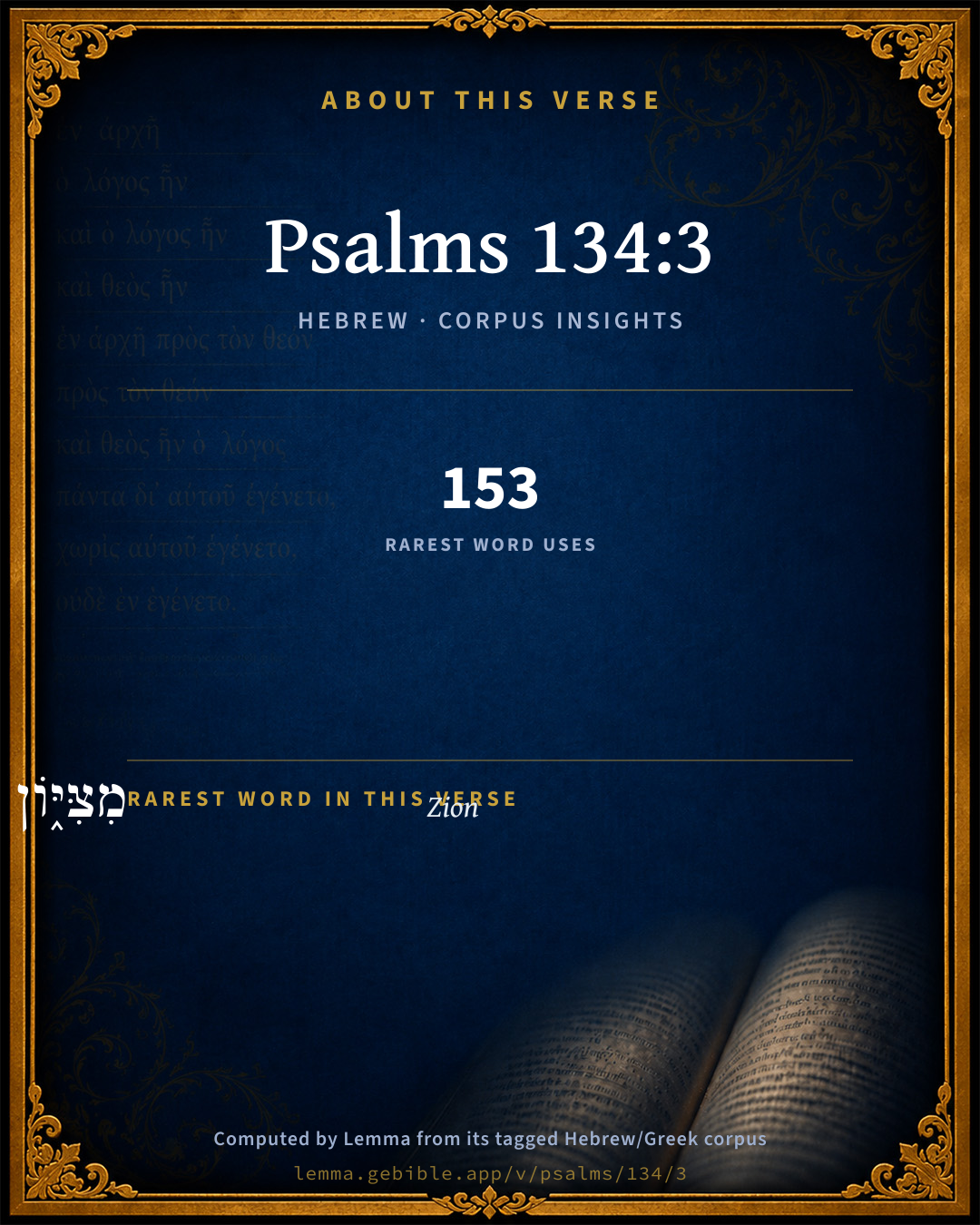
These counts appear in no published source. They are computed here, from the morphology-tagged text and Lemma’s own curated glosses. What Lemma adds →

6
words
6
distinct lemmas
Wisdom
section

Grammatical profile

  • 2 verbs
  • 4 nouns

Verb forms

  • יְבָרֶכְךָ֣ Piel · Imperfect
  • עֹ֝שֵׂ֗ה Qal · Participle Active

Hebrew & Septuagint length

In English translation the verse runs 13 words from the Hebrew and 13 from the Septuagint (LXX English) — the same length.

A rough comparison of the two English renderings, which tokenize alike — not a word-level alignment.

Word counts can differ between the Hebrew and the Greek without any difference in meaning — e.g. the Hebrew direct-object marker אֵת has no separate Greek word, and Greek often adds the article ὁ.

Cross-references

8

Topical passages linked to Psalms 134:3 in the Treasury of Scripture Knowledge — connected by theme and wording, ordered by reader-vote popularity; previews shown in the World English Bible.

  • Psalms 128:5 May Yahweh bless you out of Zion, And may you see the good of Jerusalem all the days of your life.
  • Psalms 20:2 Send you help from the sanctuary, Grant you support from Zion,
  • Psalms 124:8 Our help is in the name of Yahweh, Who made heaven and earth.
  • Psalms 135:21 Blessed be Yahweh from Zion, Who dwells at Jerusalem. Praise Yah!
  • Psalms 146:5–6 Happy is he who has the God of Jacob for his help, Whose hope is in Yahweh, his God:
  • Romans 11:26 and so all Israel will be saved. Even as it is written, "There will come out of Zion the Deliverer, And he will turn away ungodliness from Jacob.
  • Psalms 110:2 Yahweh will send forth the rod of your strength out of Zion. Rule in the midst of your enemies.
  • Psalms 14:7 Oh that the salvation of Israel would come out of Zion! When Yahweh restores the fortunes of his people, Then Jacob shall rejoice, and Israel shall be glad.

Cross-references courtesy of OpenBible.info (CC BY 4.0).

Hebrew and Greek witnesses Masoretic Hebrew ↔ Greek Septuagint

The same verse in the two great witnesses to the Old Testament, shown verse-for-verse.

You’re reading Greek Psalm 133 (Hebrew Psalm 134). The Septuagint counts the superscription, so verse numbers can differ from the Hebrew — chapter-level alignment, not verse-by-verse. Numbering follows Rahlfs.

These are two independent witnesses, not word-aligned to each other, and the Septuagint is shown in lemma (dictionary) form.

Hebrew Psalms 134:3 Masoretic · Westminster Leningrad Codex

יְבָרֶכְךָ֣ יְ֭הוָה מִצִּיּ֑וֹן עֹ֝שֵׂ֗ה שָׁמַ֥יִם וָאָֽרֶץ

May Yahweh bless you from Zion; Even he who made heaven and earth.

World English Bible · Public Domain

Greek LXX Greek Psalm 133:3 Septuagint · lemma form

εὐλογέω σύ κύριος ἐκ σιων ὁ ποιέω ὁ οὐρανός καί ὁ γῆ

May the Lord, who made heaven and earth, bless you out of Sion.

LXX2012 (modern English Septuagint) · Public Domain

Hebrew: Westminster Leningrad Codex (CC BY 4.0). Greek: Septuagint (public domain); English from LXX2012 (modern English Septuagint) (Public Domain). How the Septuagint differs from the Hebrew →

Commentary

Notes on Psalms 134:3 from classic Christian and Jewish commentators (each source and its license shown beneath its notes). The classic Christian expositions comment on the surrounding passage and are grouped to its opening verse, so a note may address several verses; the Jewish commentaries on the Tanakh (Rashi and others) are per-verse, so they appear only where the commentator wrote on this verse.

Lemma curates 59 commentaries, every one of them public domain or Creative Commons licensed, each selected and text-cleaned for this edition rather than reprinted as found. About our sources →

Trapp's Complete Commentary

John Trapp

Psa 134:3 The LORD that made heaven and earth bless thee out of Zion.

Ver. 3. The Lord that made heaven and earth] And therefore hath the blessings of both lives in his hand to bestow. See Num 6:24.

Bless thee out of Zion] They are blessings indeed that come out of Zion; choice, peculiar blessings, even above any that come out of heaven and earth. Compare Psa 128:5, and the promise, Exo 20:24, In all places where I put the memory of my name I will come unto thee and bless thee.

John Trapp, A Commentary or Exposition upon All the Books of the Old and New Testament (1647–1656) — public domain. Text from a community e-Sword module.

The Biblical Illustrator

Joseph S. Exell

Psa_134:3

The Lord that made heaven and earth bless thee out of Zion.

Mutual benediction

We may suppose these words to be addressed to the sacred sentinels by the head of their course, or by the captain of the guard, or even by the high priest. We can imagine the captain of the guard coming in during the night watches, and saying to the priests who were guarding the temple (verse 1). Or we could imagine the high priest, when the watch was set for the first part of the alight, going to the priests who were under his control, and addressing to them these same soul-stirring words. Now our text is the response of these sacred sentinels. As they listened to the captain of the guard, or to the high priest, telling them to worship by night in the courts of the Lord--to lift up their hands in the sanctuary, and bless the Lord--they answered him, The Lord that made heaven and earth bless thee out of Zion. So that here you have brought before you the interesting and instructive subject of mutual benediction--the saints blessing each other.

I. Jehovah--the fountain of blessing. There is in the Divine nature an infinite and everlasting disposition to do us good; and connected with that infinite and everlasting disposition to do us good are all power, all knowledge, all wisdom, absolute independence and eternity of being. And we find actual blessings on Gods part according to that capacity. He does not bless as His creatures bless--often unwisely, often insufficiently, often half-heartedly--but when God blesses, He blesses with all that is within Him; with all that can be employed in that particular act and work of blessing.

II. The heavens and the earth, evidence of Divine capacity to bless. While we, of course, look chiefly and supremely to the manifestation of Gods goodness in our Lord and Saviour, we ought not to overlook the expressions of His care and kindness which we find in the grass of the field, and in the very dust which we tread beneath our feet.

III. The Church a channel of blessing. The Church is the conservator of Divine revelation,--the Church is the offerer on earth of true worship--it consists of a company of priests, a royal priesthood, part of whose mission is to offer up spiritual sacrifices acceptable to God by Jesus Christ. The Church is the heritor of the covenants. Gods covenants are made with His Church, and His promises are addressed chiefly to His Church. The Church is the scene of special Divine ministrations, God shows Himself to His Church as He does not to that which is called the world. It is also the scene of special heavenly influences: and in a sense next to that in which God is said to reside in heaven, the Church is the dwelling-place of the Most High. Now, what is it to be blessed out of Zion? It is surely to be blessed with Zions blessings, and to have Zions endowments and gifts rendered sources of advantage and profit to us.

IV. The saints as the means of spreading the blessing, and that, too, by the spirit of blessing. The Lord that made heaven and earth bless thee out of Zion. Bless thee! You know where this was first said, and when. The Fountain of Blessing first said it. He said it in Paradise to our first father and mother when, beautiful in holiness, and glorious in uprightness and goodness, they came fresh from His hand. As their Creator, He said to them both, Bless thee; and we have learned to say, Bless thee, from our Father in heaven, the Fountain of Blessing. We never should have said to each other, Bless thee, had not God taught us; and when we say it, we but echo His voice. Bless you, said the Son of God to the multitude around Him. And, Bless you, said He emphatically to His apostles when He was about to leave them--when He was about to ascend from Olivet, and depart out of their sight. He lifted up His hands, and blessed them. Bless you, said the apostles to the Churches. How full of benedictions are these glorious epistles! Grace, mercy, and peace be with all who love the Lord Jesus Christ in sincerity. The grace of our Lord Jesus Christ be with you all. And what has this to do with spreading the Divine blessing? Much every way. Such benediction, when sincere, and when not a mere form of words, is prayer. And every promise that is made to prayer is made to benediction. So that he who is possessed by the spirit of blessing, and who expresses it in his behaviour, and in his deportment, is constantly supplicating the throne of the heavenly grace on behalf of others.

V. The riches involved in the Divine benediction. It means, The Lord speak comfortably to thee. It means, The Lord keep thee; the Lord be thy shepherd; the Lord restore thy soul when thy spirit wanders; the Lord keep thee in the paths of righteousness for His names sake; the Lord hold up thy goings in His paths, that thy footsteps slip not; the Lord be thy light and thy salvation; God be thy refuge and strength, thy present help in trouble. May morning follow the night, and the night be driven away by the lifting up of the light of the countenance of the loving God--by expressions of His love adapted to the time of sorrow, and to the state of depression and despondency. The Lord give thee peace,--that is, prosperity, well-being, health in the soul, comfort in the heart, rest, joy, quiet in the spirit. (S. Martin.)

The universe

I. The universe had an origin. The heaven and the earth are not eternal, they had a beginning (Gen_1:1).

II. The originator of the universe was One. The Lord. He created it alone. There was no one to instruct Him in planning it, no one to aid Him in building it up.

III. The One Originator of the universe is the object for universal praise. Bless the Lord. True worship should be, therefore--

1. Unaided. There is no one to share the praise.

2. Enthusiastic. This One Being should be the all-in-all of the soul.

3. Incessant. He is ever-present, ever-giving, ever-sustaining, ever-inspiring. (David Thomas, D. D.)

God, more than His gifts

At a camp at Goshen, N.Y., a minister was shouting to inquirers to persevere in seeking the blessing, when Rev. Dr. Inskip, the master spirit, cried out, Get the blessing! Hump! Get the Blessert Says Monod: You cannot separate any one gift of Christ from Himself, from His person. He that hath the Son hath life. (E. P. Thwing.)

.

Psa_135:1-21

The Biblical Illustrator, edited by Joseph S. Exell (c. 1880s–1900s) — public domain. Text from a community e-Sword module.

The Treasury of David

Charles H. Spurgeon

Ver. 3. The Divine Benediction.

1. From the Creator: ample, new, varied, boundless, enduringall illustrated by his making heaven and earth.

2. From the Redeemer: blessings most needful, rich, effectual, abiding, all illustrated and guaranteed by his dwelling among men, purchasing a church, building an abode, revealing his glory, reigning on his throne.

Psalms 134:3*

Ver. 3. This last verse is the answer from the temple to the pilgrims preparing to depart as the day breaks. It is the ancient blessing of the high priest condensed, and poured forth upon each individual pilgrim.

The LORD that made heaven and earth bless thee out of Zion. Ye are scattering and going to your homes one by one; may the benediction come upon you one by one. You have been up to Jehovah's city and temple at his bidding; return each one with such a benediction as only he can givedivine, infinite, effectual, eternal. You are not going away from Jehovah's works or glories, for he made the heaven above you and the earth on which you dwell. He is your Creator, and he can bless you with untold mercies; he can create joy and peace in your hearts, and make for you a new heaven and a new earth. May the Maker of all things make you to abound in blessings.

The benediction comes from the City of the Great King, from his appointed ministers, by virtue of his covenant, and so it is said to be "out of Zion." To this day the Lord blesses each one of his people through his church, his gospel, and the ordinances of his house. It is in communion with the saints that we receive untold benisons. May each one of us obtain yet more of the blessing which cometh from the Lord alone. Zion cannot bless us; the holiest ministers can only wish us a blessing; but Jehovah can and will bless each one of his waiting people. So may it be at this good hour. Do we desire it? Let us then bless the Lord ourselves. Let us do it a second time. Then we may confidently hope that the third time we think of blessing we shall find ourselves conscious receivers of it from the Ever blessed One. Amen.

Ver. 3. The LORD that made heaven and earth bless thee out of Zion. He doth not say, the Lord that made the earth bless thee out of heaven; nor, the Lord that made heaven bless thee out of heaven; but "bless thee out of Zion." As if he would teach us that all blessings come as immediately and primarily from heaven, so mediately and secondarily from Zion, where the Temple stood. If ever, therefore, we would have blessings outward, inward, private, public, secular, spiritual; if ever we would have blessing in our estate, blessing in our land, blessing in our souls, we must pray for it, and pray for it here, in Zion, in God's house: for from the piety there exercised all blessings flow, as from a fountain that can never be drawn dry. Abraham Wright.

Ver. 3. The LORD that made heaven and earth, etc. The priestly benediction brings God before us in a twofold character. He is described first as the Creator of the universe. He is described, in the second place, as dwelling "in Zion." In the first aspect, he is represented as the God of nature; in the second, as the God of grace. When I contemplate him as the Creator of the universe, there is abundant proof that he can bless me. When I contemplate him as dwelling in the Church, there is abundant proof that he will bless me. Both of these elements are essential to our faith. N. M`michael.

Ver. 3. The LORD that made heaven and earth, etc. As the priests were called upon to bless God in behalf of the people, so here they bless the people in behalf of God. Between the verses we may suppose the previous request to be complied with. The priests, having blessed God, turn and bless the people. The obvious allusion to the sacerdotal blessing (Nu 6:23-27), favours the optative construction of this verse, which really includes a predictionthe Lord will bless thee. Joseph Addison Alexander.

Ver. 3. The LORD bless thee. All men lie under the curse, till God brings them into the fellowship of his church, and pronounce them blessed by his word, as "The LORD bless thee" doth import. David Dickson.

Ver. 3. The LORD bless thee out of Zion. The Church is the conservator of Divine revelation; the Church is the offerer on earth of true worship; it consists of a company of priests, a royal priesthood, part of whose mission is "to offer up spiritual sacrifices acceptable to God by Jesus Christ." The Church is the heritor of the covenants. God's covenants are made with his Church, and his promises are addressed chiefly to his Church. The Church is the scene of special Divine ministrations, God shows himself to his Church as he does not to that which is called the world. It is also the scene of special heavenly influences: and in a sense next to that in which God is said to reside in heaven, the Church is the dwellingplace of the Most High. Now, what is it to be blessed out of Zion? It is surely to be blessed with Zion's blessings, and to have Zion's endowments and gifts rendered sources of advantage and profit to us. Samuel Martin.

Ver. 3. Bless thee. The singular instead of the plural "bless you", because the words are taken from the form used by the High Priest in blessing the people. Nu 6:24. J.J. Stewart Perowne.

Ver. 3. Bless thee. It is addressed to the church as one person, and to each individual in this united, unit like church. Franz Delitzsch.

Charles H. Spurgeon's The Treasury of David (1869–1885) — public domain. Psalms only. Text from a community e-Sword/MySword module.

Joseph Benson's Commentary

Psa 134:3. The Lord that made heaven and earth — And therefore has all the blessings of both at his disposal, those of the upper and those of the nether springs; bless thee — O priest, who dost engage and encourage us in this blessed work; out of Zion — Where he dwells, and from whence he hears the prayers of his people, and gives them the blessings which they need.

Joseph Benson's Commentary on the Old and New Testaments (1811–1818) — public domain. Text from a community e-Sword module.

J. A. Alexander on Psalms

Joseph Addison Alexander

3. (Psa 134:3) Jehovah bless thee out of Zion, Maker of heaven and earth. As the priests were called upon to bless God in behalf of the people, so here they bless the people in behalf of God. Between the verses we may suppose the previous request to be complied with. The priests, having blessed God, turn and bless the people. The obvious allusion to the sacerdotal blessing, Num 6:23-27, favours the optative construction of this verse, which really includes a prediction (the Lord will bless thee). Out of Zion, as in Psa 128:5. Maker of heaven and earth, and therefore infinitely able to fulfil this prayer. See above, on Psa 115:15; Psa 121:2; Psa 124:8.

Joseph Addison Alexander, The Psalms Translated and Explained (1850) — public domain. Text from a community e-Sword module.

Geneva Bible (1599)

Geneva Bible translators

And therefore hath all power, bless thee with his Fatherly love declared in Zion. Thus the Levites used to praise the Lord, and bless the people.

Geneva Bible (1599) marginal notes — public domain. Text via Bolls.life.

Adam Clarke's Commentary

Verse 3. The Lord that made heaven and earth] Who governs and possesses all things; and who can give you every spiritual and earthly blessing.

Bless thee out of Zion.] As if they had said, "We will attend to your orders; go in peace, and may God shower down his blessings upon you!" The blessing pronounced by the priests was the following: "The Lord bless thee and keep thee! The Lord make his face shine upon thee, and he gracious unto thee! The Lord lift up his countenance upon thee, and give thee peace!" Nu 6:24-26.

ANALYSIS OF THE HUNDRED AND THIRTY FOURTH PSALM

In this Psalm the prophet -

I. Exhorts the Levites and ministers of religion to attend the appointed hours of prayer.

II. Then the ministers bless the people.

1. 1. "Behold, bless ye the Lord."

2. Yet principally, "all ye servants of the Lord:" Choose out of the people to this service.

3. "Which by night stand in the house of the Lord," c.: In the temple ye ought not to be sleepy, or forget your duty.

4. Therefore, "lift up your hands," c., before the ark of the covenant which was the symbol of his presence.

5. "Bless the Lord," &c.

II. The other part of your office is to bless the people let not that be forgotten, but say, -

1. "The Lord bless thee:" Let them know from whom the blessing comes.

2. "Out of Zion:" So long as they remain in the unity of the Church there was none to be expected out of Zion.

3. "The Lord that made:" c. He that hath power to bless hath given, and must give, his blessing to all creatures, without which they will not be blessed to thee therefore, bless him.

Adam Clarke's Commentary on the Bible (1810–1826) — public domain. Text from a community e-Sword/MySword module.

John Calvin's Commentaries

3. Jehovah bless thee out of Zion! We have conclusive proof in my opinion from this verse that the Psalm is to be considered as referring to the priests and Levites only, for to them it properly belonged under the law to bless the people. (Numbers 6:23.) The Psalmist had first told them to bless God; now he tells them to bless the people in his name. Not that God meant by any such injunction that the people might themselves indulge in a life of carnal security — an opinion prevalent among the Papists, who think that if the monks chant in the temples, this is all the worship necessary on the part of the whole body of the people. What God intended was, that the priests should lead the way in divine service, and the people take example by what was done in the temple, and practice it individually in their private houses. The duty of blessing the people was enjoined upon the priests, as representing Christ’s person. Express mention is intentionally made of two things, which are in themselves distinct, when the God who blessed them out of Zion is said to be also the Creator of heaven and earth. Mention is made of his title as Creator to set forth his power, and convince believers there is nothing that may not be hoped from God. For what is the world but a mirror in which we see his boundless power? And those must be senseless persons indeed, that are not satisfied with the favor of Him who is recognized by them as having all dominion and all riches in his hand. Since many, however, are apt, when they hear God spoken of as Creator, to conceive of him as standing at a distance from them, and doubt their access to him, the Psalmist makes mention also of that which was a symbol of God’s nearness to his people — and this that they might be encouraged to approach him with the freedom and unrestrained confidence of persons who are invited to come to the bosom of a Father. By looking to the heavens, then, they were to discover the power of God — by looking to Zion, his dwelling-place, they were to recognize his fatherly love.

John Calvin's Commentaries (1540-1563) — public domain. Text from the Calvin Translation Society English edition (1840s-50s) via the Christian Classics Ethereal Library (ccel.org). Calvin's coverage is partial (roughly two-thirds of the Bible); uncommented books and verses are honest gaps, never fabricated. The 19th-century editor's footnotes and remarks are omitted so the notes are faithfully Calvin's own voice.

Ellicott's Commentary for English Readers

(3) Made heaven and earth.—For this style, as frequent in this group of psalms, see Psa_121:2.

A Bible Commentary for English Readers, edited by Charles John Ellicott (1878–1897) — public domain. Text from a community e-Sword module.

The Cambridge Bible for Schools and Colleges

gen. ed. J. J. S. Perowne

3. The response of the priests,

Jehovah bless thee out of Zion,

Even the maker of heaven and earth.

The first line is taken from the priestly blessing in Num_6:24, with the addition of out of Zion (Psa_128:5). The singular thee may denote the congregation as a whole or each individual in it. The attribute Maker of heaven and earth implies Jehovah’s power to bless. Cp. Psa_115:15, note.

The Cambridge Bible for Schools and Colleges (gen. ed. J. J. S. Perowne; Cambridge University Press, 1878–1918) — public domain. Text from a community e-Sword module.

John Gill's Exposition

The Lord, that made heaven and earth, bless thee out of Zion. These are not the words of the priests blessing the people in this form, as some; but rather, as others, the wish of the servants of the Lord, that he would bless him that exhorted them to this service; whether one of the priests, or the captain of the temple, or the psalmist: though, according to Kimchi, and which seems agreeable, they are the words of the psalmist, promising a blessing from the Lord to those that blessed him; as an encouragement to them, to everyone of them, to be constant and diligent in this service. For so it may be rendered, "the Lord shall bless thee" (f); all blessings come from the Lord, whether spiritual or temporal; and are to be asked of him, and expected from him: and the blessings here promised or asked for are blessings out of Zion, the church, where God blesses his people with his word and ordinances, with his presence, and with communion with himself. Wherefore it is good to be there waiting on him and worshipping him, praying to him and praising of him; and he that made heaven and earth is able to bless both with heavenly and earthly things: and this description of the Lord is no doubt given to encourage faith in him; for, what is it he cannot do?

(f) "benedicet tibi", Junius & Tremellius, Cocceius, Gejerus, Michaelis.

Next: Psalms Chapter 135

John Gill's Exposition of the Whole Bible (1746–1763) — public domain (CC PDM 1.0). Text via the HelloAO Bible API.

Albert Barnes' Notes on the Bible

The Lord that made heaven and earth - The great Creator of all things. This is probably the language of those who were thus employed in the service of the Lord at night; their response to the address in the first two verses.

Bless thee out of Zion - That is, bless those who thus approached the sanctuary, and called on those within to praise the Lord. This is the answer. Let the blessing of God rest on you. It is language showing that they appreciated the kind and encouraging salutation, and that they reciprocated the feelings and the good wishes of those who came to worship. In the name of the Lord whom they served, therefore, and appealing to him, they pronounced a blessing on those who thus approached the sanctuary. People do not come near the house of God - the place of public worship - with kind and sympathizing feelings without a blessing from the sanctuary, without a response that welcomes them, and that meets all their aspirations. There is always in Zion - in the church - a voice, by day and night, which pronounces a blessing on those who wish it well, who seek its good, and who desire to partake of the favor of God.

Out of Zion - That is, may God speak to you out of Zion; may he confer on you such blessings as properly go out of Zion; or such as Zion (or his church) can furnish. Go not away unblessed; go not without a token of divine favor - for God will bless you.

Albert Barnes' Notes on the Bible (1834–1885) — public domain. Text from a community e-Sword/MySword module.

Matthew Poole's English Annotations

Thee; either,

1. Thee, whosoever thou art, who dost faithfully perform the duty here commanded. Or,

2. Thee, O king, or priest, who dost engage and encourage us in this blessed work.

Out of Zion; where God dwells, and from whence he heareth the prayers of his people, and giveth them the blessings which they desire and need.

Matthew Poole's English Annotations on the Holy Bible (1683–1685) — public domain. Text from a community e-Sword/MySword module.

Whedon's Commentary on the Bible

Daniel D. Whedon

3. This verse is the response of the priests within to the call of Psa_134:1-2, from the people without.

The Lord that made heaven and earth—A common formula for designating the majesty and glory of God and exalting him above all beings. Psa_115:5; Psa_121:2; Psa_146:6; Isa_37:16.

Bless thee out of Zion—It was, as we have said, the priests’ special function to bless the people. The blessing must come from God out of Zion, or through the Church. God ordinarily channels his grace in the ordinances of his house. See Psa_128:5. The verb should be taken optatively, as in Num_6:24 : may he bless, not he shall bless.

Daniel D. Whedon (gen. ed.), Commentary on the Old and New Testaments (1874–1909) — public domain. Text from a community e-Sword module.

The Pulpit Commentary

The Lord that made heaven and earth. (comp. Gen_1:1 Psa_115:15 Psa_121:2 Psa_124:8 Psa_146:6) Bless thee out of Zion. God was regarded as dwelling in Zion, and therefore as giving his blessings out of Zion. (comp. Psa_20:2 Psa_53:6 Psa_128:5)

The Pulpit Commentary (1880–1919), ed. H.D.M. Spence-Jones & Joseph S. Exell — public domain. Text from a community e-Sword module.

John Wesley's Explanatory Notes

Thee - Thee whosoever thou art who dost faithfully perform the duty here commanded.

John Wesley, Explanatory Notes Upon the Whole Bible (1754–1765) — public domain. Text via the GEBible commentary corpus.

Keil & Delitzsch

C. F. Keil & F. Delitzsch

Calling thus up to the Temple-hill, the church receives from above the benedictory counter-greeting: Jahve bless thee out of Zion (as in Psa 128:5), the Creator of heaven and earth (as in Psa 115:15; Psa 121:2; Psa 124:8). From the time of Num 6:24 jebaréchja is the ground-form of the priestly benediction. It is addressed to the church as one person, and to each individual in this united, unit-like church.

Keil & Delitzsch — Biblical Commentary on the Old Testament (1861–1891) — public domain (CC PDM 1.0). Text via the HelloAO Bible API. (Old Testament only.)

unfoldingWord translationNotes

Door43 World Missions Community

heaven and earth

The phrase "heaven and earth" here represents all things. AT: "everything in heaven and earth" (See: Merism)

translationWords

Zion

heaven

earth

unfoldingWord translationNotes — © Distant Shores Media and the Door43 World Missions Community, licensed CC BY-SA 4.0. Source: git.door43.org/Door43/en_tn.

Lesson kit

Teaching starters — assembled from the data on this page, not authored interpretation. Every prompt links to the verse data it draws on. Edit before teaching.

Psalms, in the Wisdom, opens this verse with 6 words (6 distinct Hebrew lemmas). Its most distinctive word is Tsîyôwn (“Zion”). A historical commentator’s framing appears above. Read the whole chapter for the surrounding context.

Discussion questions

  1. The word Tsîyôwn carries the sense “Zion.” How does it shape the verse?
  2. How does Psalms 128:5, which shares this passage’s theme, read alongside this verse?
  3. These translations render this verse differently; the difference is in the English rendering, not the original. What questions does that raise?
  4. «יְבָרֶכְךָ֣» is a Piel Imperfect verb. How does that grammatical form shape the action described?
  5. Compare how Trapp's Complete Commentary and The Biblical Illustrator read this verse. Where do they agree or differ?

Things to notice

Reading settings

Reading text

Shown beneath each verse's original-language words.

Old Testament
Old Testament edition

Read the OT as the Masoretic Hebrew (MT) or the Greek Septuagint (LXX).

English shown for the Greek Septuagint (in the Hebrew ↔ Greek comparison).

Comparing translations? Open the Compare panel on any verse page to stack up to four side by side.