Isaiah 8:18

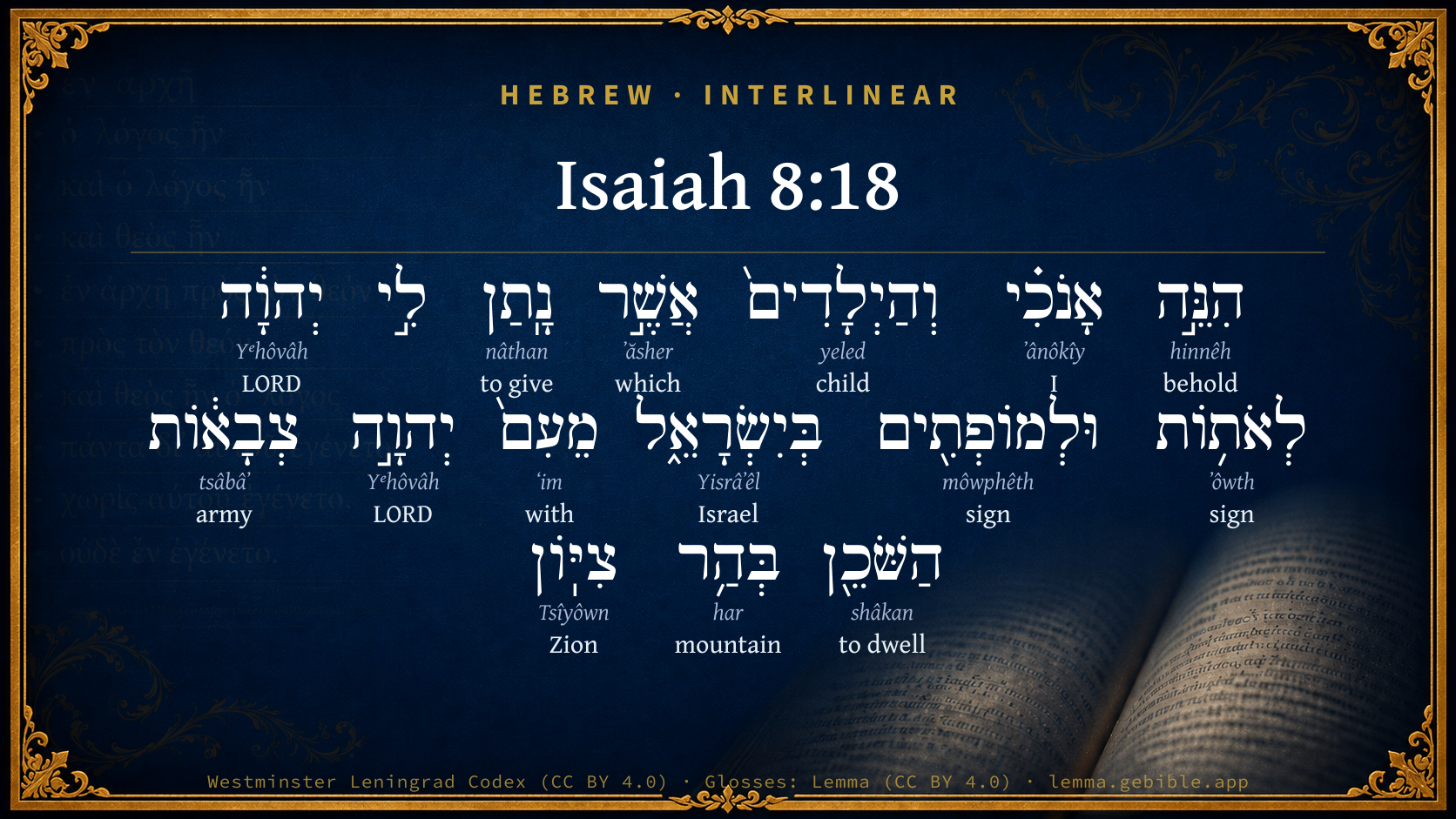
Hebrew (Westminster Leningrad Codex) Isaiah 8:18 appears in the Hebrew Old Testament. The text above is from the Westminster Leningrad Codex. Each word links to its Strong’s number, a concise gloss, and parsing drawn from the Open Scriptures Hebrew Bible morphology. Click any word for its full Brown-Driver-Briggs (BDB) entry.
Download image
Cite this verse

Isaiah 8:18 (World English Bible). Public Domain. Lemma interlinear Bible study tool, https://lemma.gebible.app/v/isaiah/8/18.

Show BibTeX & RIS
BibTeX
RIS
English Translation
Behold, I and the children whom Yahweh has given me are for signs and for wonders in Israel from Yahweh of Hosts, who dwells in Mount Zion.
World English Bible · Public Domain
Download a study sheet

One document with this verse’s original text, its word-by-word gloss line, the meaning frame, cross-references with their text, attributed commentary, and full source and license credits — printable, and it pastes into notes with its structure intact.

This verse Autodidact and up

Study sheet (.html) Plain text (.txt)

A passage Seminary Student

Up to 50 verses in one chapter. A passage sheet keeps up to 6 commentary sources and 12 cross-references per verse, in the order this page ranks them, and says so on the sheet whenever that leaves anything out. Ask for a single verse and you get the Autodidact verse sheet above.

Everything on this page stays free to read, with no account — the sheet is a download of what is already on screen, not access to it.

Want to remove ads? Support Godless Engineer
Compare translations 3

The same verse in 3 English versions, stacked beneath the original-language interlinear above. Click any original word for its lexicon entry.

Each is an independent rendering of the whole verse — the interlinear is not word-aligned to these translations.

Highlighted words mark where these versions differ — a whole-verse word diff, not a word-by-word alignment.

  • World English Bible Public Domain
    Behold, I and the children whom Yahweh has given me are for signs and for wonders in Israel from Yahweh of Hosts, who dwells in Mount Zion.
  • King James Version Public Domain
    Behold, I and the children whom the LORD hath given me are for signs and for wonders in Israel from the LORD of hosts, which dwelleth in mount Zion.
  • unfoldingWord Literal Text CC BY-SA 4.0
    Behold, I and the children whom Yahweh has given to me for signs and for wonders in Israel, from Yahweh of hosts, the one dwelling on Mount Zion.

unfoldingWord Literal Text — © unfoldingWord, licensed CC BY-SA 4.0. Word-aligned USFM3 via Door43 (git.door43.org/unfoldingWord/en_ult).

Versions to compare (up to 4)

3 of 4 selected

Show all 18 translations

Every available English version of this verse, each an independent rendering of the whole verse.

  • World English Bible Public Domain
    Behold, I and the children whom Yahweh has given me are for signs and for wonders in Israel from Yahweh of Hosts, who dwells in Mount Zion.
  • Berean Standard Bible Public Domain
    Here am I, and the children the LORD has given me as signs and symbols in Israel from the LORD of Hosts, who dwells on Mount Zion.
  • Majority Standard Bible Public Domain
    Here am I, and the children the LORD has given me as signs and symbols in Israel from the LORD of Hosts, who dwells on Mount Zion.
  • King James Version Public Domain
    Behold, I and the children whom the LORD hath given me are for signs and for wonders in Israel from the LORD of hosts, which dwelleth in mount Zion.
  • American Standard Version (1901) Public Domain
    Behold, I and the children whom Jehovah hath given me are for signs and for wonders in Israel from Jehovah of hosts, who dwelleth in mount Zion.
  • Revised Version (1885) Public Domain
    Behold, I and the children whom the LORD hath given me are for signs and for wonders in Israel from the LORD of hosts, which dwelleth in mount Zion.
  • Geneva Bible (1599) Public Domain
    Beholde, I and the children whome the Lord hath giuen me, are as signes and as wonders in Israel, by the Lord of hostes, which dwelleth in mount Zion.
  • Douay-Rheims (1899) Public Domain
    Behold I and my children, whom the Lord hath given me for a sign, and for a wonder in Israel from the Lord of hosts, who dwelleth in mount Sion.
  • Young's Literal Translation Public Domain
    Lo, I, and the children whom Jehovah hath given to me, `Are' for signs and for wonders in Israel, From Jehovah of Hosts, who is dwelling in Mount Zion.
  • Literal Standard Version CC BY-SA 4.0
    Behold, I, and the children whom YHWH has given to me, || [Are] for signs and for wonders in Israel, || From YHWH of Hosts, who is dwelling in Mount Zion.
  • Unlocked Literal Bible CC BY-SA 4.0
    See, I and the sons whom Yahweh has given me are for signs and for wonders in Israel from Yahweh of hosts, who lives on Mount Zion.
  • unfoldingWord Literal Text CC BY-SA 4.0
    Behold, I and the children whom Yahweh has given to me for signs and for wonders in Israel, from Yahweh of hosts, the one dwelling on Mount Zion.
  • Darby Bible Public Domain
    Behold, I and the children that Jehovah hath given me are for signs and for wonders in Israel, from Jehovah of hosts, who dwelleth in mount Zion.
  • World Messianic Bible Public Domain
    Behold, I and the children whom the LORD has given me are for signs and for wonders in Israel from the LORD of Hosts, who dwells in Mount Zion.
  • Webster's Bible Public Domain
    Behold, I and the children whom the LORD hath given me are for signs and for wonders in Israel from the LORD of hosts, who dwelleth in mount Zion.
  • Free Bible Version CC BY-SA 4.0
    Look, I'm here, together with the children the Lord has given me. They are signs and wonders in Israel from the Lord Almighty, who lives on Mount Zion.
  • Bible in Basic English Public Domain
    See, I and the children whom the Lord has given me, are for signs and for wonders in Israel from the Lord of armies, whose resting-place is in Mount Zion.
  • JPS Tanakh (1917) Public Domain
    Behold, I and the children whom the LORD hath given me shall be for signs and for wonders in Israel from the LORD of hosts, who dwelleth in mount Zion.

Literal Standard Version (2020), Covenant Press — licensed CC BY-SA 4.0. Text via the HelloAO Bible API (eBible.org). Unlocked Literal Bible (unfoldingWord) — licensed CC BY-SA 4.0. Text via the HelloAO Bible API (eBible.org). unfoldingWord Literal Text — © unfoldingWord, licensed CC BY-SA 4.0. Word-aligned USFM3 via Door43 (git.door43.org/unfoldingWord/en_ult). Free Bible Version, Dr. Jonathan Gallagher — licensed CC BY-SA 4.0. Text via the HelloAO Bible API (eBible.org).

Word by word

More ways to search: Search by grammar → Find every occurrence → Compare this word →

Practice this passage: Drill this verse → Learn its vocabulary →

וּלְמוֹפְתִ֖ים
môwphêth
H4159
“and · to/for · signs”
Conjunction + Preposition + Noun, Common, Masculine, Plural, Absolute
Part of Speech
Conjunction + Preposition + Noun
Type
Common
Gender
Masculine
Number
Plural
State
Absolute
Full BDB Definition

Origin: from H3302 in the sense of conspicuousness

TWOT: 152a

wonder, sign, miracle, portent - wonder (as a special display of God's power) - sign, token (of future event)
  1. הִנֵּ֣ה hinnêh H2009 “behold” Particle, Demonstrative
  2. אָנֹכִ֗י ʼânôkîy H595 “I” Pronoun, Personal, 1st Person, Common, Singular
  3. וְהַיְלָדִים֙ yeled H3206 “and · the · children” Conjunction + Particle, Definite Article + Noun, Common, Masculine, Plural, Absolute
  4. אֲשֶׁ֣ר ʼăsher H834 “which” Particle, Relative
  5. נָֽתַן nâthan H5414 “to give” Verb, Qal, Perfect, 3rd Person, Masculine, Singular
  6. יְהוָ֔ה Yᵉhôvâh H3068 “LORD” Noun, Proper
  7. לְאֹת֥וֹת ʼôwth H226 “to/for · signs” Preposition + Noun, Common, Both, Plural, Absolute
  8. בְּיִשְׂרָאֵ֑ל Yisrâʼêl H3478 “in/at · Israel” Preposition + Noun, Proper
  9. מֵעִם֙ ʻim H5973 “from · with” Preposition + Preposition
  10. יְהוָ֣ה Yᵉhôvâh H3068 “LORD” Noun, Proper
  11. צְבָא֔וֹת tsâbâʼ H6635 “armies” Noun, Common, Both, Plural, Absolute
  12. הַשֹּׁכֵ֖ן shâkan H7931 “the · dwelling” Particle, Definite Article + Verb, Qal, Participle Active, Masculine, Singular, Absolute
  13. בְּהַ֥ר har H2022 “in/at · mountain of” Preposition + Noun, Common, Masculine, Singular, Construct
  14. צִיּֽוֹן Tsîyôwn H6726 “Zion” Noun, Proper

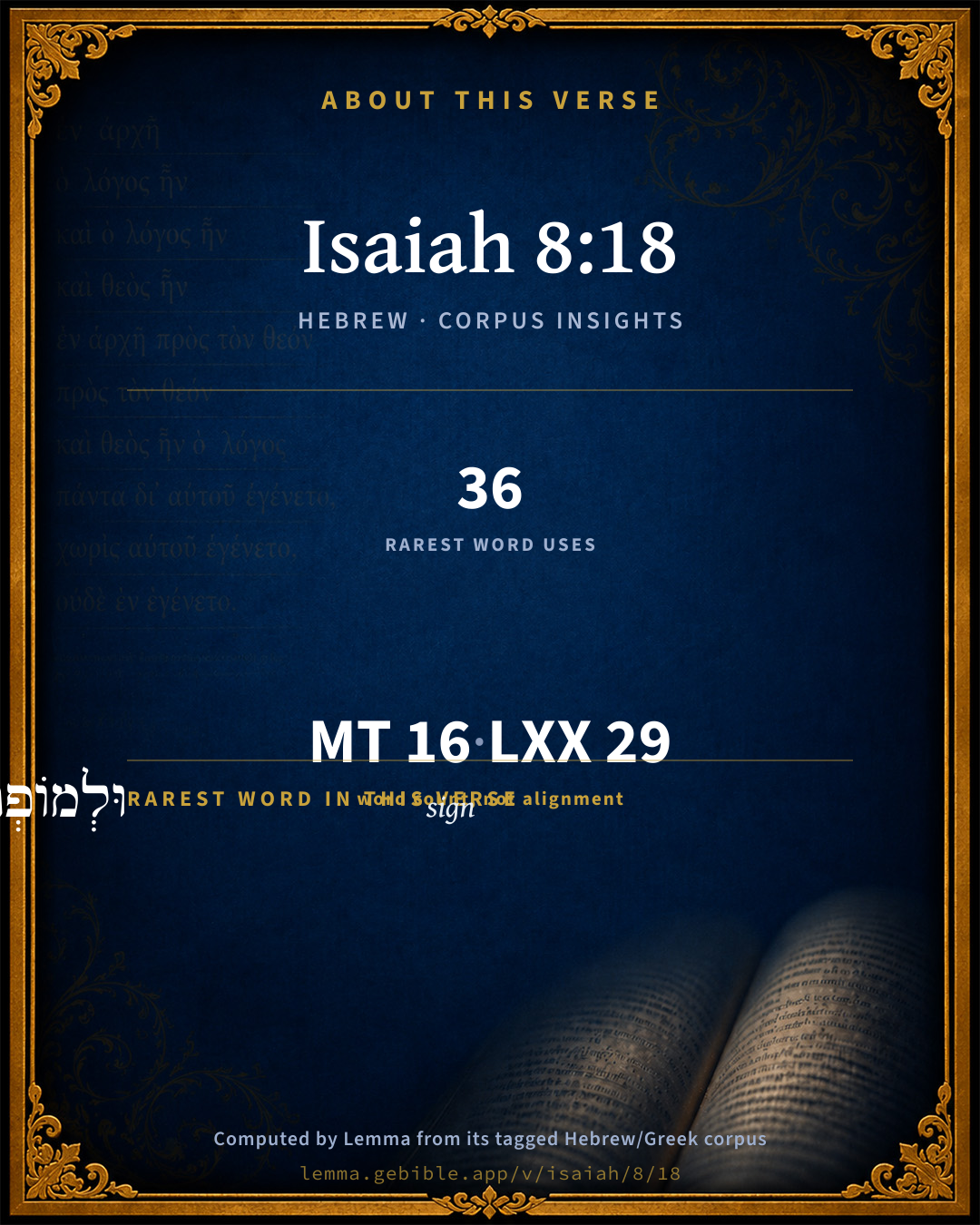
About this verse

These counts appear in no published source. They are computed here, from the morphology-tagged text and Lemma’s own curated glosses. What Lemma adds →

16
words
14
distinct lemmas
Prophets
section

Shared distinctive vocabulary

וּלְמוֹפְתִ֖ים sign H4159 occurs in 35 verses of the Hebrew Bible. Also found in:

Grammatical profile

  • 2 verbs
  • 9 nouns
  • 1 pronoun
  • 2 prepositions
  • 2 particles

Verb forms

  • נָֽתַן Qal · Perfect
  • הַשֹּׁכֵ֖ן Qal · Participle Active

Repetition

A word recurs within this verse — often emphatic in Hebrew:

  • יְהוָ֔ה LORD H3068 ×2

Hebrew & Septuagint length

In English translation the verse runs 27 words from the Hebrew and 33 from the Septuagint (LXX English) — closely comparable.

A rough comparison of the two English renderings, which tokenize alike — not a word-level alignment.

Word counts can differ between the Hebrew and the Greek without any difference in meaning — e.g. the Hebrew direct-object marker אֵת has no separate Greek word, and Greek often adds the article ὁ.

In the original languages it is 16 Hebrew tokens and 29 Greek tokens — but the two are counted differently (Hebrew bundles its prefixes and suffixes into one token; the Greek is in lemma form), so that isn’t a like-for-like length.

Cross-references

18

Topical passages linked to Isaiah 8:18 in the Treasury of Scripture Knowledge — connected by theme and wording, ordered by reader-vote popularity; previews shown in the World English Bible.

  • Hebrews 2:13–14 Again, "I will put my trust in him." Again, "Behold, here am I and the children whom God has given me."
  • Luke 2:34 and Simeon blessed them, and said to Mary, his mother, "Behold, this child is set for the falling and the rising of many in Israel, and for a sign which is spoken against.
  • Zechariah 8:3 Thus says Yahweh: "I have returned to Zion, and will dwell in the midst of Jerusalem. Jerusalem shall be called 'The City of Truth;' and the mountain of Yahweh of Hosts, 'The Holy Mountain.'"
  • Psalms 71:7 I am a marvel to many, But you are my strong refuge.
  • Isaiah 53:10 Yet it pleased Yahweh to bruise him; he has put him to grief: when you shall make his soul an offering for sin, he shall see [his] seed, he shall prolong his days, and the pleasure of Yahweh shall prosper in his hand.
  • Hebrews 12:22 But you have come to Mount Zion, and to the city of the living God, the heavenly Jerusalem, and to innumerable hosts of angels,
  • 1 Chronicles 23:25 For David said, Yahweh, the God of Israel, has given rest to his people; and he dwells in Jerusalem forever:
  • Psalms 9:11 Sing praises to Yahweh, who dwells in Zion, And declare among the people what he has done.
  • Psalms 22:30 Posterity shall serve him. Future generations shall be told about the Lord.
  • Isaiah 24:23 Then the moon shall be confounded, and the sun ashamed; for Yahweh of Hosts will reign on Mount Zion, and in Jerusalem; and before his elders shall be glory.
  • Zechariah 3:8 Hear now, Joshua the high priest, you and your fellows who sit before you; for they are men who are a sign: for, behold, I will bring forth my servant, the Branch.
  • Isaiah 12:6 Cry aloud and shout, you inhabitant of Zion; for great in the midst of you is the Holy One of Israel!"
  • Isaiah 14:32 What then shall one answer the messengers of the nation? That Yahweh has founded Zion, and in her shall the afflicted of his people take refuge.
  • Isaiah 7:3 Then Yahweh said to Isaiah, "Go out now to meet Ahaz, you, and Shearjashub your son, at the end of the conduit of the upper pool, on the highway of the fuller's field.
  • Isaiah 7:16 For before the child knows to refuse the evil, and choose the good, the land whose two kings you abhor shall be forsaken.
  • Hebrews 10:33 partly, being exposed to both reproaches and oppressions; and partly, becoming partakers with those who were treated so.
  • Isaiah 8:3 I went to the prophetess; and she conceived, and bore a son. Then said Yahweh to me, Call his name Maher Shalal Hash Baz.
  • 1 Corinthians 4:9–13 For, I think that God has displayed us, the apostles, last of all, like men sentenced to death. For we are made a spectacle to the world, both to angels and men.

Cross-references courtesy of OpenBible.info (CC BY 4.0).

Hebrew and Greek witnesses Masoretic Hebrew ↔ Greek Septuagint

The same verse in the two great witnesses to the Old Testament, shown verse-for-verse.

These are two independent witnesses, not word-aligned to each other, and the Septuagint is shown in lemma (dictionary) form.

Hebrew Isaiah 8:18 Masoretic · Westminster Leningrad Codex

הִנֵּ֣ה אָנֹכִ֗י וְהַיְלָדִים֙ אֲשֶׁ֣ר נָֽתַן לִ֣י יְהוָ֔ה לְאֹת֥וֹת וּלְמוֹפְתִ֖ים בְּיִשְׂרָאֵ֑ל מֵעִם֙ יְהוָ֣ה צְבָא֔וֹת הַשֹּׁכֵ֖ן בְּהַ֥ר צִיּֽוֹן

Behold, I and the children whom Yahweh has given me are for signs and for wonders in Israel from Yahweh of Hosts, who dwells in Mount Zion.

World English Bible · Public Domain

Greek LXX Isaiah 8:18 Septuagint · lemma form

ἰδού ἐγώ καί ὁ παιδεία ὅς ἐγώ δίδωμι ὁ θεός καί εἰμί εἰς σημεῖον καί τέρας ἐν ὁ οἶκος ἰσραήλ παρά κύριος σαβαωθ ὅς καταοἰκέω ἐν ὁ ὄρος σιων

Behold I and the children which God has given me: and they shall be for signs and wonders in the house of Israel from the Lord of hosts, who dwells in mount Sion.

LXX2012 (modern English Septuagint) · Public Domain

Hebrew: Westminster Leningrad Codex (CC BY 4.0). Greek: Septuagint (public domain); English from LXX2012 (modern English Septuagint) (Public Domain). How the Septuagint differs from the Hebrew →

Targum (Aramaic paraphrase)

1

The Targum is the ancient Jewish Aramaic paraphrase of the Hebrew Scriptures — an interpretive translation, not the Hebrew text itself. Onkelos (literal) and Pseudo-Jonathan (expansive) render the Torah, and Jonathan the Prophets. Coverage is partial: where no permissively-licensed English translation exists for a verse, only the Aramaic is shown. This is verse-level text, not a word-by-word alignment to the Hebrew.

  1. Targum Jonathan Prophets (Joshua–Malachi)
    הָא עַד דַאֲנָא קַיֵם וְעוּלֵימַיָא דִיהַב לִי יְיָ יִתְקַיְמוּן בָּנָא אָתִין וּמוֹפְתִין דַאֲמִירָן לְמֵיתֵי עַל יִשְׂרָאֵל דְאִם יֶחֱזוּן וִיתוּבוּן תִּבָטֵיל גְזֵירְתָּא דִי גְזָרָא עֲלֵיהוֹן דְיִגְלוּן מִלְאִתְחֲזָאָה קֳדָם יְיָ צְבָאוֹת דִי שְׁכִנְתֵּיהּ בְּטוּרָא דְצִיוֹן:

    Behold, whilst I live with the children, which the Lord has given me, the signs and the wonders, which are promised to come upon Israel shall be established among us. But if they would see and repent, the decree should be annulled, which He decreed against them, that they should go into, captivity, and that they should not appear before the Lord of hosts, whose Shekinah is in the mountain of Zion.

    Targum Jonathan — Aramaic: “Mikraot Gedolot” (public domain). English: “Sefaria Community Translation” (CC0 1.0 (public-domain dedication)); “London "Chaldee Paraphrase," 1871” (public domain). Text via Sefaria.

Commentary

Notes on Isaiah 8:18 from classic Christian and Jewish commentators (each source and its license shown beneath its notes). The classic Christian expositions comment on the surrounding passage and are grouped to its opening verse, so a note may address several verses; the Jewish commentaries on the Tanakh (Rashi and others) are per-verse, so they appear only where the commentator wrote on this verse.

Lemma curates 59 commentaries, every one of them public domain or Creative Commons licensed, each selected and text-cleaned for this edition rather than reprinted as found. About our sources →

Trapp's Complete Commentary

John Trapp

Isa 8:18 Behold, I and the children whom the LORD hath given me [are] for signs and for wonders in Israel from the LORD of hosts, which dwelleth in mount Zion.

Ver. 18. Behold, I and the children whom the Lord.] That is, my disciples and converts, who have the same conflict with me. {Php 1:30}

Are for signs and for wonders.] Hissed and hooted at as so many monsters by the mad world, even beside itself in point of salvation; and accounting the saints, as the Spaniards were wont to say of the Portuguese, Pocos et focos, few and foolish; and as the Turks count all fools to be saints, so the most count all saints to be fools. These shall one day cry, Nos insensati. We are fools.

John Trapp, A Commentary or Exposition upon All the Books of the Old and New Testament (1647–1656) — public domain. Text from a community e-Sword module.

The Biblical Illustrator

Joseph S. Exell

Isa_8:18

Behold, I and the children whom the Lord hath given me

Names as signs

The Hebrews, like most Eastern races, were very quick to see the omen in the nomen, the sign or portent in the name.

(Niger in Expositor.)

Isaiah and his children as signs

If one of these names implied judgment, three of them implied mercy. The omen in the name Speed-spoil Hasten-booty was doubtless full of terror; for the Assyrians were the most fierce and cruel race of ancient times, and would sweep through the land like a destructive storm; but, if this one name was so terribly ominous and suggestive, all the others speak of an untiring and inalienable compassion. Shear-jashub predicted that God would bring back a faithful remnant even from the cruel bondage of Assyria; Immanuel assured them that God would be with them in all their perils and reverses; while the name of Isaiah himself pointed to the end of all Jehovahs dealings with them--salvation from all evil. (Niger in Expositor.)

Christian nurture

There are some things which if we can give them place and power in our own lives, win lucre great influence in enabling us to carry through our work as parents to a blessed issue of success.

I. FAITHFULNESS. The meaning of this word is explained by the resolve of the Psalmist when he says: I will behave myself wisely in a perfect way; I will walk within my house with a perfect heart. Always when we try to do good to others we are thrown back upon ourselves; we are reminded that high work must have fit instruments, and that our influence is likely to be as our character is. As the man is so will be his strength. This is peculiarly the case as between us and our children. They know us much better than others, are much nearer to us, see us more clearly. For our childrens sakes we are bound to be the best we may. Nothing that we can say or do will have half the force of that invisible and almost irresistible power which comes right from our souls, and goes at once and straight into theirs. This power, issuing from the depths of our own being, is an involuntary thing on our part. We cannot make it this or that by an act of will. This sincerity on our part ought to take as one of its forms a firm, steady family rule--an exercise of wise parental authority. On the other hand, parents mar their own influence, hinder their prayers, and injure their children, although they are very far from meaning it, by over-indulgence. They never command--never rule calmly and firmly--all is softness, liberty, or even license. Such parents tell us in defence of their system: It is not for us to command; our best influence is, as has been said, that of personal character; if that be not right, commands from us will be of little use. On the same principle it might be said that God does not need to command; that He only needs to reveal to His creatures what He is, and they will love and serve Him. He has revealed Himself to us. And yet this same God, this Father of mercies, commands, legislates, and duly brings penalty upon those who do not obey. Law and love, these make the whole revelation of God.

II. TENDERNESS. A mothers tenderness! It is one of the continual wonders of the world. It is really a greater thing than a fathers constancy, a soldiers courage, or a patriots love. Yet the world is full of it.

III. Such feelings will lead to PRAYER. In prayer for our children we are putting ourselves in the line of Gods laws. Bring them up in the nurture and admonition of the Lord. It is not our nurture, it is His, and in prayer we cast it over on Him.

IV. We are thus naturally led to the last word--HOPEFULNESS. We ought to cherish a feeling of cheerful confidence in God as to the result of our endeavours for our childrens good. Discouragement, and despondency even, will come to us soon enough, and darkly enough, if we will permit them. (A. Raleigh, D. D.)

I and the children

Turn to the New Testament and the text will be no mystery to you; its key hangs on its proper nail (Heb_2:18). We have evidence that it is our Lord who speaks, and speaks of His people as His children. This clue we will follow. The context sets forth, as is most common throughout the whole of Scripture, the different results which follow from the appearance of the Saviour. He is rejected by many, and accepted by others.

I. Here is A REMARKABLE RELATIONSHIP. Jesus is called a Father. This is not according to precise theology, or according to the more formal doctrinal statements of Scripture.

1. Still, the title of Father is very applicable to our Lord Jesus Christ for many reasons.

(1) Because He is our federal Head. We speak correctly of father Adam, and Jesus is the second Adam who heads up our race anew, and is the representative man of redeemed mankind.

(2) Our Lord is also Father of the golden age of grace and glory.

(3) There is a sense in which Christ is our Father, because by His teaching we are born unto God. Just as the minister who brings a soul to Christ is said to be the spiritual parent to such a soul, and is, indeed, instrumentally so, so the Lord Jesus, as the author of our faith, is our spiritual Father in the family of God.

2. Now, let us see whether there is not much of teaching in this metaphor by which we are called children of the Lord Jesus. The expression denotes--

(1) That we derive our spiritual life from Him as children take their origin from their father.

(2) They have a likeness to His nature.

(3) The text has in it very clearly the idea of charge and responsibility. Children are a charge always; a comfort sometimes. Wherever conscience is lively, fatherhood is regarded as a solemn thing.

(4) In our relationship towards our children there is involved very often a great deal of care and grief.

(5) The possession of children involves a very near and dear love.

(6) Children, when they behave aright, bring to the heart of their parent sweet solace and dear delight.

II. A SPONTANEOUS AVOWAL Behold I, etc.

1. The Lord owns His children Sometimes they are ashamed to own Him; and He might always be ashamed to own them, but He never is.

2. He glories in them as being Gods gift to Him. Whom Thou hast given Me; as if they were something more than ordinary children.

3. He challenges inspection. Behold! look at them, for they are meant to be looked at; they are set for signs and wonders throughout all generations.

4. And do notice again--for it affects my mind much more powerfully than I can express, Behold, I and the children. I can understand a mother speaking thus about herself and children, but for Christ the Lord of glory to unite His glorious name with those of such poor worms of the dust is very wonderful. Now, if Jesus owns us so lovingly, let us always own Him: and if Christ takes us into partnership--I and the children--let us reply, Christ is all. Let Him stand first with us; and let our name be forever joined with His name.

III. A COMMON FUNCTION. Christ and His people are for signs and for wonders in Israel from the Lord of hosts which dwelleth in Mount Zion. Both Christ and His people are set for a purpose.

1. They are to be signs and wonders by way of testimony.

2. By way of marvel. Genuine Christians will generally be reckoned by the world to be singular people.

3. When the believers testimony for good becomes marvel, it is not wonderful if he afterwards becomes an object of contempt. Hold on, brother t and hold out to the end; be humbly and quietly faithful Do not try to be a wonder, but be a wonder. (C. H. Spurgeon.)

Children have a mission

Infancy is the perpetual Messiah which comes to the arms of men and pleads with them to return to Paradise. (R. W. Emerson.)

The Biblical Illustrator, edited by Joseph S. Exell (c. 1880s–1900s) — public domain. Text from a community e-Sword module.

Tyndale Open Study Notes

Tyndale Open Resources

8:18 I and the children the Lord has given me (see the application to Jesus Christ in Heb 2:13): The names of the prophet Isaiah and his children carried significance as signs and warnings. Shear-jashub (a remnant will return; 7:3) was a sign of God’s faithfulness to Judah. Maher-shalal-hash-baz (swift to plunder and quick to carry away) signified the destruction of Damascus and Samaria (8:1-4) and the desolation of faithless Judah (8:5-8). The name of Isaiah (Yahweh is salvation) itself signifies that salvation is from the Lord alone. These three names also represent major themes in the book: the remnant, the desolation of Judah, and salvation. Immanuel (God is with us) embodies all of these themes, along with the idea that Judah would be protected if only it would trust in the Lord.

Tyndale Open Study Notes — © Tyndale Open Resources, licensed CC BY-SA 4.0. Text via the HelloAO Bible API.

Geneva Bible (1599)

Geneva Bible translators

Meaning, them that were willing to hear and obey the word of God, whom the world hated, as though they were monsters and not worthy to live.

This was a consolation in their troubles, knowing that nothing could come unto them, but by the will of the Lord.

Geneva Bible (1599) marginal notes — public domain. Text via Bolls.life.

Jamieson, Fausset & Brown

Robert Jamieson, A. R. Fausset & David Brown

I and the children--Isaiah means "salvation of Jehovah"; His children's names, also (Isa 7:3, Isa 7:14; Isa 8:3), were "signs" suggestive of the coming and final deliverance.

wonders--that is, symbols of the future (Isa 20:3; Zac 3:8). "Behold I . . . me" is quoted in Heb 2:13 to prove the manhood of the Messiah. This is the main and ultimate fulfilment of the prophecy; its temporary meaning is applied to Ahaz' time. Isaiah typically, in Isa 8:17-18, personates Messiah, who is at once "Father" and "Son," Isaiah and Immanuel, "Child" and "Mighty God," and is therefore called here a "wonder," as in Isa 9:6, "Wonderful." Hence in Heb 2:13, believers are called His "children"; but in Isa 8:11-12, His "brethren." On "the Lord hath given me," see Joh 6:37, Joh 6:39; Joh 10:29; Joh 17:12.

which dwelleth in . . . Zion--and will therefore protect Jerusalem.

Jamieson, Fausset & Brown — Commentary Critical and Explanatory on the Whole Bible (1871) — public domain (CC PDM 1.0). Text via the HelloAO Bible API.

Adam Clarke's Commentary

Verse 18. Lord of hosts] One MS. reads אלהי צבאות Elohey tsebaoth, God of hosts.

Adam Clarke's Commentary on the Bible (1810–1826) — public domain. Text from a community e-Sword/MySword module.

Ellicott's Commentary for English Readers

(18) Behold, I and the children whom the Lord hath given me . . .—In the mystic significance of his own name (Isaiah—Salvation of Jehovah) and of the names of his sons: Remnant shall return. and Speed-plunder, Haste-spoil, possibly also in that of Immanuel, the prophet finds a sufficient revelation of the future. Each was a nomen et omen for those who had ears to hear. Could the disciples of Isaiah complain that they had no light thrown upon the future, when, so to say, they had those embodied prophecies? The children disappear from the scene, and we know nothing of their after-history, but all their life long, even with or without a special prophetic work, they must have been, by virtue of their names, witnesses to a later generation, of what Isaiah had predicted. In Isaiah’s own life, as including symbolic acts as well as prophetic words (Isa_20:2), we have a further development of the thought that he was “a sign and a wonder.” (Comp. Eze_12:11.) The citation of the words, “I and the children whom thou hast given me,” in Heb_2:13, is noticeable here chiefly as showing how little the writer of that Epistle cared in this and other quotations for the original meaning of the words as determined by the context. It was enough for him that the Christ, like the prophet, did not stand alone, but claimed a fellowship with the children whom the Father had given him (Joh_17:6; Joh_17:12), as being alike servants and children of God, called to do His will.

A Bible Commentary for English Readers, edited by Charles John Ellicott (1878–1897) — public domain. Text from a community e-Sword module.

The Cambridge Bible for Schools and Colleges

gen. ed. J. J. S. Perowne

18. I and the children whom the Lord hath given me] Like Hosea, Isaiah had been directed to embody leading ideas of his teaching in the names of at least two of his children, Shear-jashub and Maher-shalal-hash-baz. His own name, also, though not an uncommon one, expresses what we may regard as the most comprehensive idea of his theology—“Jehovah saves.” He and they are thus for signs and portents (cf. ch. Isa_20:3 and see on Isa_7:11) in Israel; the children especially cannot be seen or named without recalling to mind prophetic utterances of profound import.

which dwelleth in mount Zion] This conception seems to have first emerged in Isaiah’s teaching at the time of the Syro-Ephraimite war, when Jerusalem was threatened by a foreign army. We have here perhaps the earliest anticipation of what became afterwards a fixed element of his prophecy—the inviolability of Jerusalem, the earthly seat of Jehovah’s throne.

The Cambridge Bible for Schools and Colleges (gen. ed. J. J. S. Perowne; Cambridge University Press, 1878–1918) — public domain. Text from a community e-Sword module.

John Gill's Exposition

Behold, I, and the children whom the Lord hath given me,.... These are the words of Christ, as is clear from Heb 2:13 who, upon the prophet's declaring his resolution to look and wait for him, presents himself and his children to him, as if he was actually come, or else continues his discourse from the preceding verse; for these are not the words of the prophet, speaking of himself and his natural children, Shearjashub and Mahershalalhashbaz; nor of his spiritual children, his disciples, called sometimes the sons of the prophets; but of Christ, who has a seed, a spiritual offspring, to whom he stands in the relation of a father, Isa 9:6 and who are given him of God, in the covenant of grace; for whose sake he partook of flesh and blood, and died to gather them together, being scattered abroad; and redeemed them, that they might receive the adoption of children; and who, being regenerated, believe in him: these were from eternity given unto him, to be his seed and offspring, his spouse, his sheep, his portion, and inheritance; in virtue of which they are brought unto him, and received by him in time in effectual calling; which gift of them to Christ is an instance of the Father's love to him, and of distinguishing grace to them.

Are for signs and wonders in Israel; not the prophet and his natural children; though it is true that he himself was for a sign and wonder upon Egypt and Ethiopia, Isa 20:3 and his children, Shearjashub and Mahershalalhashbaz, were signs in their very names, as well as actions, of the future deliverance of Judah from its enemies; but Christ and his spiritual children: Christ the Immanuel, the son of the virgin, is "for a sign", given by the Lord himself, even of the same deliverance, Isa 7:14 and a sign of the love of God to his people, and of his care of them, and regard unto them; and a sign that should be spoken against, as he was in his person, office, doctrines, and miracles, by the unbelieving Jews, Luk 2:34.

and for wonders: his name being wonderful; his person, as God man, wonderful; his love to his people wonderful; his works and actions, doctrines and miracles, life and death, being wonderful; See Gill on Isa 9:6 and so his children and people are "for signs and wonders"; they are like Joshua's fellows, men wondered at; see Gill on Zac 3:8; they are a wonder to themselves, that such sinful and unworthy creatures should partake of so much grace; they are a wonder to angels, that they should be chosen, redeemed, and called; and they are a wonder to Christ, who admires his own grace in them; and they are a wonder to the men of the world, a spectacle, a gazingstock to them, and are reproached by them; and all this is

from the Lord of hosts, which dwelleth in Mount Zion; Christ, as man and Mediator, is from him, and all that befall him is according to his determination, will, and pleasure; his children, and their being children, and given to him; and whatsoever they have, and whatsoever they meet with, and befall them, is all from the Lord; and this may serve to comfort them, that "the Lord of hosts", of armies in heaven and in earth, is for them, and on their side, and therefore need not fear any that shall be against them; and that he "dwelleth in Mount Zion", the church, which he has chosen for his rest, and where he will dwell for ever, and so will never leave nor forsake his people.

John Gill's Exposition of the Whole Bible (1746–1763) — public domain (CC PDM 1.0). Text via the HelloAO Bible API.

Albert Barnes' Notes on the Bible

Behold, I... - By ‘signs and wonders,’ here, it is meant that they, by the names given them, were intended to teach important lessons to the Jewish people. Their names were significant, and were designed to illustrate some important truth; and especially the prophet here intimates that they were to inculcate the truth in regard to the presence and protection of God, to induce the people to look to him. Thus the name immanuel, ‘God with us,’ Isa 7:14; and Shear-jashub, ‘the remnant shall return,’ Isa 7:3, were both significant of the fact that none but God could be the protector of the nation. And in like manner, it is possible that his own name, signifying the salvation of Jehovah, had been given him with such a reference. But at all events, it was a name which would remind them of the truth that he was now inculcating, that salvation was to be found in Yahweh, and that they should look to him. Names of children were often thus emblematic (see Hos 1:1-11); and the prophets themselves were regarded as signs of important events; Eze 24:24; compare the note at Isa 20:3. This passage is quoted with reference to the Messiah in Heb 2:13.

Which dwelleth in mount Zion - Mount Zion was the residence of the house of David, or of the court, and it was often used to signify Jerusalem itself. The sense here is, that God was the protector of Jerusalem, or regarded that as his home; see the note at Isa 1:8.

Albert Barnes' Notes on the Bible (1834–1885) — public domain. Text from a community e-Sword/MySword module.

Haydock's Catholic Bible Commentary

I and my two children. Chap. vii. 3., and viii. 4. (Haydock) --- The actions of some were prophetical, chap. xx. 2., and Osee xii. 10. (Calmet) --- God announces what will happen, by the names of my children, (Haydock) and by their age, as well as by my mouth. (Calmet)

George Leo Haydock (1774–1849), Haydock's Catholic Family Bible and Commentary, 1859 edition — public domain. Excludes Psalms (Douay-Rheims chapter numbering differs from Protestant) and Deuterocanonical books (Catholic canon only).

Matthew Poole's English Annotations

Behold; it is worthy of your observation and admiration. These words are literally spoken by Isaiah concerning himself, but withal mystically concerning Christ, of whom he speaks more frequently and fully than any other prophet, and of whom he was an evident type; and therefore they are fitly applied to Christ, Heb 2:13.

Children; either,

1. His natural children, whose very names were prophetical, and signs of future events, Isa 7:3; 8:3,4; or,

2. His spiritual children, whom he had either begotten or brought up by his ministry. For the prophets were called fathers not only with respect to the young prophets, who were commonly called the sons of the prophets, but also in relation to others, as 2Ki 2:12; 13:14. And this sense seems more probable than the former, because it agrees best,

1. With the following words, which seem to be too lofty and emphatical to be used concerning his natural children; for their prophetical names, which, if they were signs, could not properly be called

wonders.

2. With the context and scope of the place, which is to set forth the incredulity of the Israelites, and their contempt and rejection of Christ, and of all his faithful messengers, both the prophets, who were sent as harbingers before his coming, and the apostles, who were witnesses of his coming.

3. With Heb 2:13, where they are expounded of spiritual children.

Are for signs and for wonders in Israel; are a gazingstock to and admired by them, for our folly in believing God’s promises. For so the believing Jews now were to Ahaz and the generality of the people, who thought it their wisdom and interest to procure aid from Assyria, and esteemed those fools who, upon pretence of relying upon God, would neglect so great an advantage. And so the prophet foretells that they should be when the Messiah did come; which is the mystical, as the other is the literal sense; and so both of them may be meant in this place.

In Israel; even amongst the Israelites, who have been taught and do profess better things.

From the Lord of hosts; which come to pass by the wise counsel and providence of God, in which I willingly acquiesce.

Which dwelleth in Mount Zion; where the temple now was, and where the Messiah was to set up his kingdom.

Matthew Poole's English Annotations on the Holy Bible (1683–1685) — public domain. Text from a community e-Sword/MySword module.

Whedon's Commentary on the Bible

Daniel D. Whedon

18. The prophet points to himself and family as signs of the rightfulness of relying on Jehovah rather than looking to Assyria. The import of the name Isaiah is, Salvation of the Lord; and thus in his name the prophet becomes a type of Christ, and this accounts for Heb_2:13, where there is a blending of type and antitype, as the abstract meaning of both is the same.

Behold — A call to a momentous wonder.

I and the children — As expressed in their several names, (Isa_7:3; Isa_8:3-4;) signs predicting certain deliverance, already coming, and sure to continue to the last. These facts were wonders, and challenged the gravest attention and examination of Judah.

Whom the Lord hath given me — The Psalmist, the Evangelist John, and the Apostle Paul interpret this passage of the Christ and his spiritual progeny.

Dwelleth in… Zion — instead of Assyria’s gods, that dwelt in Nineveh. Isaiah’s exalted virtue, profound sincerity, and remarkable genius must have commanded respect and secretly exercised great restraining power. Ewald (in History of Israel,) vol. iv, p. 174,) says, “He was an absolutely immovable refuge in the tempest.” And again, (p. 202,) “At this crisis the eternal and glorified expectation of the kingdom of God was… placed in antagonism to all heathen dominion by violence, and nothing is more marvellous than the undaunted attitude of Isaiah in encountering the fury of the dreaded king [of Assyria] with the calmness of this blessed hope.”

“No adequate explanation of this wonder,” says Kay, “can be given except that which Isaiah himself assigns. It was the result of an express communication to him of a divine word, accompanied by a divine action upon his spirit.

Daniel D. Whedon (gen. ed.), Commentary on the Old and New Testaments (1874–1909) — public domain. Text from a community e-Sword module.

The Pulpit Commentary

I and the children... are for signs. Isaiah"s children seem to have been "for signs," especially in respect of their names. Shear-Jashub meant "A remnant shall return", (Isa_10:21) and thus held out twohopes; one that a remnant of Israel would return to God and become his true servants, another that a remnant would return from the captivity that had been prophesied. (Isa_5:13) Maher-shalal-hash-baz speeds, spoil hastens was a "sign" of a different kind. Primarily, his name referred to the spoiling of Damascus and Samaria (vers. 3, 4); but it may further have indicated a time of general disturbance, plunder, and ravage. It is not quite clear in what respects Isaiah was a "sign." Perhaps he, too, in his name, which meant "(Our) salvation is Jehovah certainly also in his symbolical acts, (Isa_20:3) and possibly in the firmness of his faith, which never wavered. From the Lord of hosts; literally, from by the Lord of hosts an expression like the French de chez. God had supernaturally appointed the sign in one case (vers. 1-4), but in the other two had merely brought them about by the secret working of his providence. But the prophet treats all three as coming equally from him. Which dwelleth in Mount Zion. Hero, again, is encouragement. God has not quitted Zion. The Shechinah still rests between the cherubim in the holy of holies. While this is so, God is still with his people (Immanuel).

Ver. 18. Man every way God"s instrument.

"Behold, I and the children whom Jehovah hath given me are for signs and for omens in Israel from Jehovah Sabaoth, who dwelleth on Mount Zion" (Cheyne"s translation). The thought here is very simple and very familiar, and no more than the statement of divisions, for the ordering of thought, can be necessary. Take St. Paul"s figure of the "living sacrifice," as including body, soul, spirit, and relationships, all consecrated to God"s service, and illustrate

I How a man"s body may be consecrated to God.

II How a man"s health may be consecrated to God.

III How a man"s gifts may be consecrated to God.

IV How a man"s possessions may be consecrated to God.

V How a man"s personal friendships may be consecrated to God.

VI How a man"s family life may be consecrated to God.

VII How a man"s social influences may be consecrated to God. R.T.

The Pulpit Commentary (1880–1919), ed. H.D.M. Spence-Jones & Joseph S. Exell — public domain. Text from a community e-Sword module.

John Wesley's Explanatory Notes

Behold - These words are literally spoken by Isaiah concerning himself, but mystically concerning Christ; and therefore they are fitly ascribed to Christ, Heb. ii, 13. The children - His spiritual children, whom he had either begotten or brought up by his ministry. Wonders - Are a gazing flock, for our folly in believing God's promises. From the Lord - Which comes to pass by the wise providence of God. Zion - Where the temple now was, and where the Messiah was to set up his kingdom.

John Wesley, Explanatory Notes Upon the Whole Bible (1754–1765) — public domain. Text via the GEBible commentary corpus.

Keil & Delitzsch

C. F. Keil & F. Delitzsch

His home was the future, and to this he was subservient, even with all his house. "Behold, I and the children which Jehovah hath given me for signs and types in Israel, from Jehovah of hosts, who dwelleth upon Mount Zion." He presents himself to the Lord with his children, puts himself and them into His hands. They were Jehovah's gift, and that for a higher purpose than every-day family enjoyment. They subserved the purpose of signs and types in connection with the history of salvation. "Signs and types:" 'oth (sign) was an omen or prognostic (σημεῖον) in word and deed, which pointed to and was the pledge of something future (whether it were in itself miraculous or natural); mopheth was either something miraculous (τέρας) pointing back to a supernatural cause, or a type (τύπος, prodigium = porridigium) which pointed beyond itself to something future and concealed, literally twisted round, i.e., out of the ordinary course, paradoxical, striking, standing out (Arab. aft, ift, res mira, δεινόν τι), from אפת (related to הפך, אבך) = מאפת, like מוסר = מאסר. His children were signs and enigmatical symbols of the future, and that from Jehovah of hosts who dwelt on Zion. In accordance with His counsel (to which the עם in מעם points), He had selected these signs and types: He who could bring to pass the future, which they set forth, as surely as He was Jehovah of hosts, and who would bring it to pass as surely as He had chosen Mount Zion for the scene of His gracious presence upon earth. Shear-yashub and Mahershalal were indeed no less symbols of future wrath than of future grace; but the name of the father (Yesha'hâhu) was an assurance that all the future would issue from Jehovah's salvation, and end in the same. Isaiah and his children were figures and emblems of redemption, opening a way for itself through judgment. The Epistle to the Hebrews (Heb 2:13) quotes these words as the distinct words of Jesus, because the spirit of Jesus was in Isaiah - the spirit of Jesus, which in the midst of this holy family, bound together as it was only to the bands of "the shadow," pointed forward to that church of the New Testament which would be found together by the bands of the true substance. Isaiah, his children, and his wife, who is called "the prophetess" (nebi'ah) not only because she was the wife of the prophet but because she herself possessed the gift of prophecy, and all the believing disciples gathered round this family - these together formed the stock of the church of the Messianic future, on the foundation and soil of the existing massa perdita of Israel.

Keil & Delitzsch — Biblical Commentary on the Old Testament (1861–1891) — public domain (CC PDM 1.0). Text via the HelloAO Bible API. (Old Testament only.)

J. A. Alexander on Isaiah

Joseph Addison Alexander

“Behold, I and the children which Jehovah hath given me (are) for signs and for wonders in Israel from Jehovah of Hosts, the (One) dwelling in Mount Zion.” Of the whole verse there are two distinct interpretations.

According to some Isaiah is the speaker, and the children meant are his two sons Shear-jashub and Maher-shalal-hash-baz, to which some add Immanuel. As all these names, and that of the Prophet himself, are significant, it is supposed that for this reason he and his children are said to be signs and wonders, personified prophecies to Israel, from Jehovah, who had caused the names to be imposed.

According to many writers, these are the words of the Messiah, and the children are his spiritual seed, (Isa 53:10) whom the Father had given him (Joh 6:37; Joh 6:39; Joh 10:29; Joh 17:6-7; Joh 17:9; Joh 17:11-12). The great argument in favor of this last interpretation is the application of the verse to Christ by Paul (Heb 2:13) not as an illustration but an argument, a proof, that Christ partook of the same nature with the persons called his children and his brethren.

It is true that many who regard Isaiah as the speaker suppose him to have been a type of Christ in this transaction. But a double sense ought not to be assumed where a single one is perfectly consistent with the context, and sufficient to explain all apparent contradictions, as in this case, where admitting that the Messiah is the speaker, we have no ellipsis to supply, and no occasion to resort to the hypothesis either of a type or an accommodation. It is not necessary, however, to restrict the terms, to the period of the advent, and to our Savior’s personal followers. Even before He came in the flesh, He and His disciples, (i.e., all who looked for His appearing), were signs and wonders, objects of contemptuous astonishment, and at the same time pledges of the promise.

Joseph Addison Alexander, The Prophecies of Isaiah (1846–1847; New York: Scribner, 1870–1878) — public domain. Text from a community e-Sword module.

Scofield Reference Notes

C. I. Scofield

signs

The primary application here is to the two sons of Isaiah, Maher-shalal-hash-baz= "haste ye, haste ye to the spoil," a "sign" of the coming judgment of the captivity of Judah; Shear-jashub= "a remnant shall return," a "sign" of the return of a remnant of Judah at the end of the seventy years, Jer 25:11; Jer 25:12; Dan 9:2. The larger and final reference is to our Lord Heb 2:13; Heb 2:14.

The Scofield Reference Bible (1917 edition), notes by C. I. Scofield — public domain. Text from a community e-Sword module.

Rashi

Rabbi Shlomo Yitzchaki (Rashi)

Behold, I and the children...for signs For two signs: the disaster in store for Pekah, as the child was called Maher-shalal-hash-baz, and the salvation of the House of David, as the child was called Immanuel. This is the solution of the matter according to its simple meaning. According to Midrash Aggadah in Genesis Rabbah (4:2), however, [it deals with Ahaz, who locked (lit. held, אָחַז in Heb.)] the synagogues and the study-halls, lest the children of the schools study Torah. He said, “If there are kids, there are no bucks. If there are no bucks, there are no flocks. If there are no flocks, there is no Shepherd. I will cause Him to remove His presence.” The prophet said to him: “No matter how much you bind the testimony and seal the Torah to close it up, so that it shall not be found in Israel, it shall not avail you.”

[17] And I will wait for the Lord, Who hides His countenance... There is no harsher prophecy than that time when Moses said (Deut. 31:18): “And I will surely hide My countenance on that day.” And even on that very day, He promised them, “And this song shall testify before him as a witness, for it shall not be forgotten from the mouth of his seed” (ibid.).

[18] Behold, I and the children etc. They are the disciples, who are as dear to me as children; they shall be for signs and wonders that the Torah will survive [in Israel through them].

Rashi on the Tanakh — English translations: “The Judaica Press complete Tanach with Rashi, translated by A. J. Rosenberg” (CC BY 4.0); “Pentateuch with Rashi's commentary by M. Rosenbaum and A.M. Silbermann, 1929-1934” (public domain); “The Metsudah Tanach series, Lakewood, N.J” (CC BY 4.0); and “The Book of Joshua, Metsudah Publications, 1997” (CC BY 4.0). Text via Sefaria.

Ibn Ezra

Rabbi Abraham ibn Ezra

Behold, I and the children, etc. They may understand a part of the prophecy entrusted to me from my actions and from the names of my sons.

From the Lord of hosts, etc. These names were given by the Lord of hosts,

Who dwelleth on the mount of Zion, and loves His people exceedingly.

Ibn Ezra on the Tanakh — English translations: “Sefaria Community Translation” (CC0 1.0 (public-domain dedication)); “Yalkut, Sifsei Chachomim Chumash, Metsudah Publications, 2009” (CC BY 4.0); and “Commentary of Ibn Ezra on Isaiah - trans. by M. Friedlander, 1873” (public domain). Text via Sefaria.

Lesson kit

Teaching starters — assembled from the data on this page, not authored interpretation. Every prompt links to the verse data it draws on. Edit before teaching.

Isaiah, in the Prophets, opens this verse with 16 words (14 distinct Hebrew lemmas). Its most distinctive word is môwphêth (“sign”). A historical commentator’s framing appears above. Read the whole chapter for the surrounding context.

Discussion questions

  1. What does “sign” (môwphêth) contribute to the verse as a whole?
  2. Exodus 4:21 shares the word «sign» with this verse. How do the two illuminate each other?
  3. “LORD” occurs 2× in this one verse. What is the effect of the repetition?
  4. The translations on this page render this verse differently — a whole-verse word diff, not a word-by-word alignment. What might account for the different wordings?
  5. The verb «נָֽתַן» is Qal Perfect. How does its form color the action?
  6. Reading how Trapp's Complete Commentary and The Biblical Illustrator read this verse, where do the two commentators agree and where do they part?

Things to notice

Reading settings

Reading text

Shown beneath each verse's original-language words.

Old Testament
Old Testament edition

Read the OT as the Masoretic Hebrew (MT) or the Greek Septuagint (LXX).

English shown for the Greek Septuagint (in the Hebrew ↔ Greek comparison).

Comparing translations? Open the Compare panel on any verse page to stack up to four side by side.