Zechariah 8:2

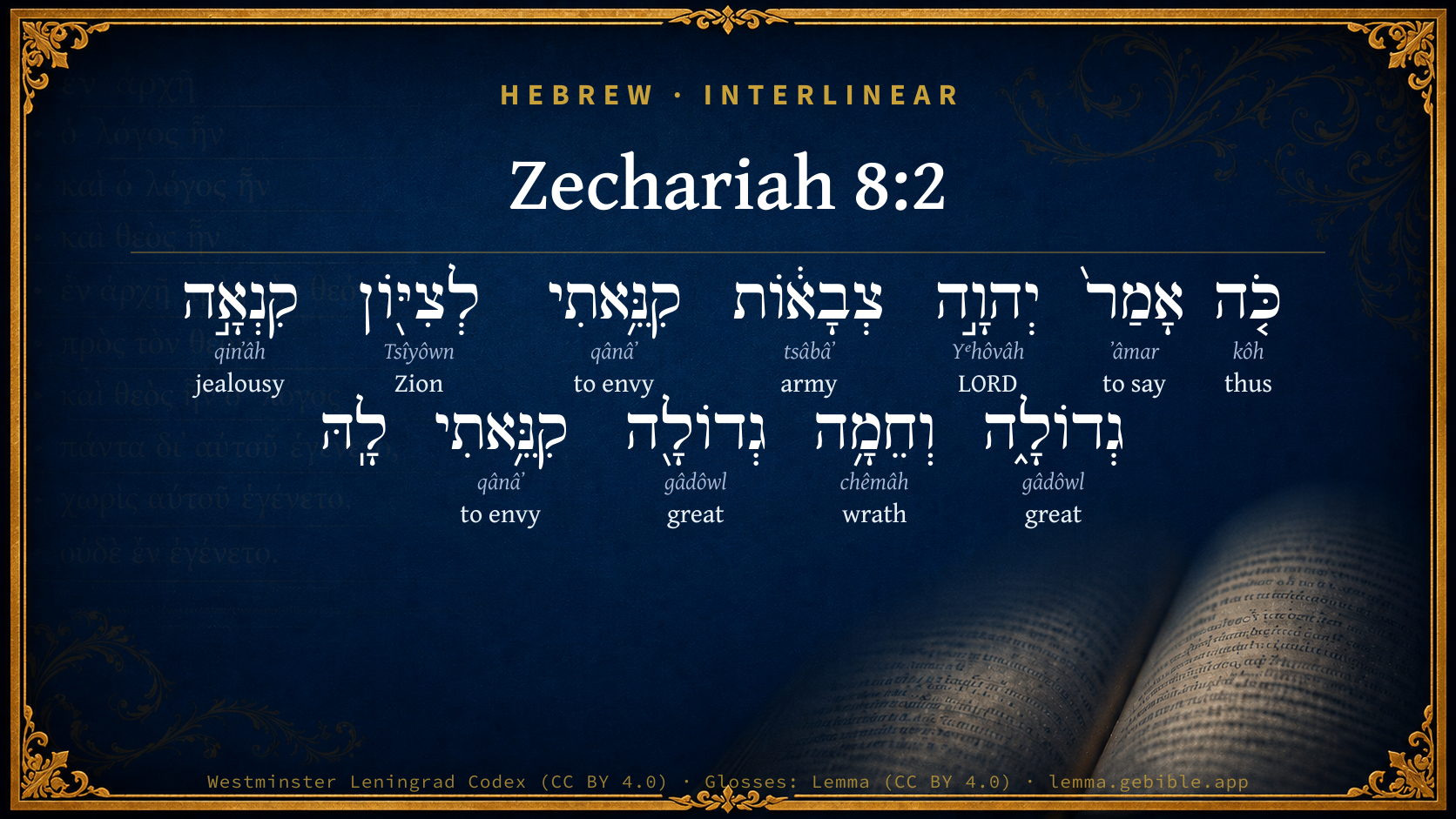
Hebrew (Westminster Leningrad Codex) Zechariah 8:2 appears in the Hebrew Old Testament. The text above is from the Westminster Leningrad Codex. Each word links to its Strong’s number, a concise gloss, and parsing drawn from the Open Scriptures Hebrew Bible morphology. Click any word for its full Brown-Driver-Briggs (BDB) entry.
Download image
Cite this verse

Zechariah 8:2 (World English Bible). Public Domain. Lemma interlinear Bible study tool, https://lemma.gebible.app/v/zechariah/8/2.

Show BibTeX & RIS
BibTeX
RIS
English Translation
Thus says Yahweh of Hosts: "I am jealous for Zion with great jealousy, and I am jealous for her with great wrath."
World English Bible · Public Domain
Download a study sheet

One document with this verse’s original text, its word-by-word gloss line, the meaning frame, cross-references with their text, attributed commentary, and full source and license credits — printable, and it pastes into notes with its structure intact.

This verse Autodidact and up

Study sheet (.html) Plain text (.txt)

A passage Seminary Student

Up to 50 verses in one chapter. A passage sheet keeps up to 6 commentary sources and 12 cross-references per verse, in the order this page ranks them, and says so on the sheet whenever that leaves anything out. Ask for a single verse and you get the Autodidact verse sheet above.

Everything on this page stays free to read, with no account — the sheet is a download of what is already on screen, not access to it.

Want to remove ads? Support Godless Engineer
Compare translations 3

The same verse in 3 English versions, stacked beneath the original-language interlinear above. Click any original word for its lexicon entry.

Each is an independent rendering of the whole verse — the interlinear is not word-aligned to these translations.

Highlighted words mark where these versions differ — a whole-verse word diff, not a word-by-word alignment.

  • World English Bible Public Domain
    Thus says Yahweh of Hosts: "I am jealous for Zion with great jealousy, and I am jealous for her with great wrath."
  • King James Version Public Domain
    Thus saith the LORD of hosts; I was jealous for Zion with great jealousy, and I was jealous for her with great fury.
  • unfoldingWord Literal Text CC BY-SA 4.0
    “Yahweh of hosts says this: I am passionate for Zion with great zeal and I am passionate for her with great anger!

unfoldingWord Literal Text — © unfoldingWord, licensed CC BY-SA 4.0. Word-aligned USFM3 via Door43 (git.door43.org/unfoldingWord/en_ult).

Versions to compare (up to 4)

3 of 4 selected

Show all 18 translations

Every available English version of this verse, each an independent rendering of the whole verse.

  • World English Bible Public Domain
    Thus says Yahweh of Hosts: "I am jealous for Zion with great jealousy, and I am jealous for her with great wrath."
  • Berean Standard Bible Public Domain
    This is what the LORD of Hosts says: “I am jealous for Zion with great zeal; I am jealous for her with great fervor.”
  • Majority Standard Bible Public Domain
    This is what the LORD of Hosts says: “I am jealous for Zion with great zeal; I am jealous for her with great fervor.”
  • King James Version Public Domain
    Thus saith the LORD of hosts; I was jealous for Zion with great jealousy, and I was jealous for her with great fury.
  • American Standard Version (1901) Public Domain
    Thus saith Jehovah of hosts: I am jealous for Zion with great jealousy, and I am jealous for her with great wrath.
  • Revised Version (1885) Public Domain
    Thus saith the LORD of hosts: I am jealous for Zion with great jealousy, and I am jealous for her with great fury.
  • Geneva Bible (1599) Public Domain
    Thus saith the Lord of hostes, I was ielous for Zion with great ielousie, and I was ielous for her with great wrath.
  • Douay-Rheims (1899) Public Domain
    Thus saith the Lord of hosts: I have been jealous for Sion with a great jealousy, and with a great indignation have I been jealous for her.
  • Young's Literal Translation Public Domain
    `Thus said Jehovah of Hosts: I have been zealous for Zion with great zeal, With great heat I have been zealous for her.
  • Literal Standard Version CC BY-SA 4.0
    “Thus said YHWH of Hosts: I have been zealous for Zion with great zeal, || With great heat I have been zealous for her.
  • Unlocked Literal Bible CC BY-SA 4.0
    “Yahweh of hosts says this: I am passionate for Zion with great zeal and I am passionate for her with great anger!
  • unfoldingWord Literal Text CC BY-SA 4.0
    “Yahweh of hosts says this: I am passionate for Zion with great zeal and I am passionate for her with great anger!
  • Darby Bible Public Domain
    Thus saith Jehovah of hosts: I am jealous for Zion with great jealousy, and I am jealous for her with great fury.
  • World Messianic Bible Public Domain
    The LORD of Hosts says: “I am jealous for Zion with great jealousy, and I am jealous for her with great wrath.”
  • Webster's Bible Public Domain
    Thus saith the LORD of hosts; I was jealous for Zion with great jealousy, and I was jealous for her with great fury.
  • Free Bible Version CC BY-SA 4.0
    This is what the Lord Almighty says. I am jealously protective of the people of Zion; I am extremely passionate about them.
  • Bible in Basic English Public Domain
    These are the words of the Lord of armies: I am angry about the fate of Zion, I am angry about her with great wrath.
  • JPS Tanakh (1917) Public Domain
    'Thus saith the LORD of hosts: I am jealous for Zion with great jealousy, and I am jealous for her with great fury.

Literal Standard Version (2020), Covenant Press — licensed CC BY-SA 4.0. Text via the HelloAO Bible API (eBible.org). Unlocked Literal Bible (unfoldingWord) — licensed CC BY-SA 4.0. Text via the HelloAO Bible API (eBible.org). unfoldingWord Literal Text — © unfoldingWord, licensed CC BY-SA 4.0. Word-aligned USFM3 via Door43 (git.door43.org/unfoldingWord/en_ult). Free Bible Version, Dr. Jonathan Gallagher — licensed CC BY-SA 4.0. Text via the HelloAO Bible API (eBible.org).

Word by word

More ways to search: Search by grammar → Find every occurrence → Compare this word →

Practice this passage: Drill this verse → Learn its vocabulary →

קִנֵּ֥אתִי
qânâʼ
H7065
“to envy”
Verb, Piel, Perfect, 1st Person, Common, Singular
Part of Speech
Verb
Stem
Piel
Form
Perfect
Person
1st Person
Gender
Common
Number
Singular
Full BDB Definition

Origin: a primitive root

TWOT: 2038

to envy, be jealous, be envious, be zealous - (Piel) - to be jealous of - to be envious of - to be zealous for - to excite to jealous anger - (Hiphil) to provoke to jealous anger, cause jealousy
  1. כֹּ֤ה kôh H3541 “thus” Adverb
  2. אָמַר֙ ʼâmar H559 “to say” Verb, Qal, Perfect, 3rd Person, Masculine, Singular
  3. יְהוָ֣ה Yᵉhôvâh H3068 “LORD” Noun, Proper
  4. צְבָא֔וֹת tsâbâʼ H6635 “armies” Noun, Common, Both, Plural, Absolute
  5. לְצִיּ֖וֹן Tsîyôwn H6726 “to/for · Zion” Preposition + Noun, Proper
  6. קִנְאָ֣ה qinʼâh H7068 “jealousy” Noun, Common, Feminine, Singular, Absolute
  7. גְדוֹלָ֑ה gâdôwl H1419 “great” Adjective, Adjective, Feminine, Singular, Absolute
  8. וְחֵמָ֥ה chêmâh H2534 “and · wrath” Conjunction + Noun, Common, Feminine, Singular, Absolute
  9. גְדוֹלָ֖ה gâdôwl H1419 “great” Adjective, Adjective, Feminine, Singular, Absolute
  10. קִנֵּ֥אתִי qânâʼ H7065 “to envy” Verb, Piel, Perfect, 1st Person, Common, Singular

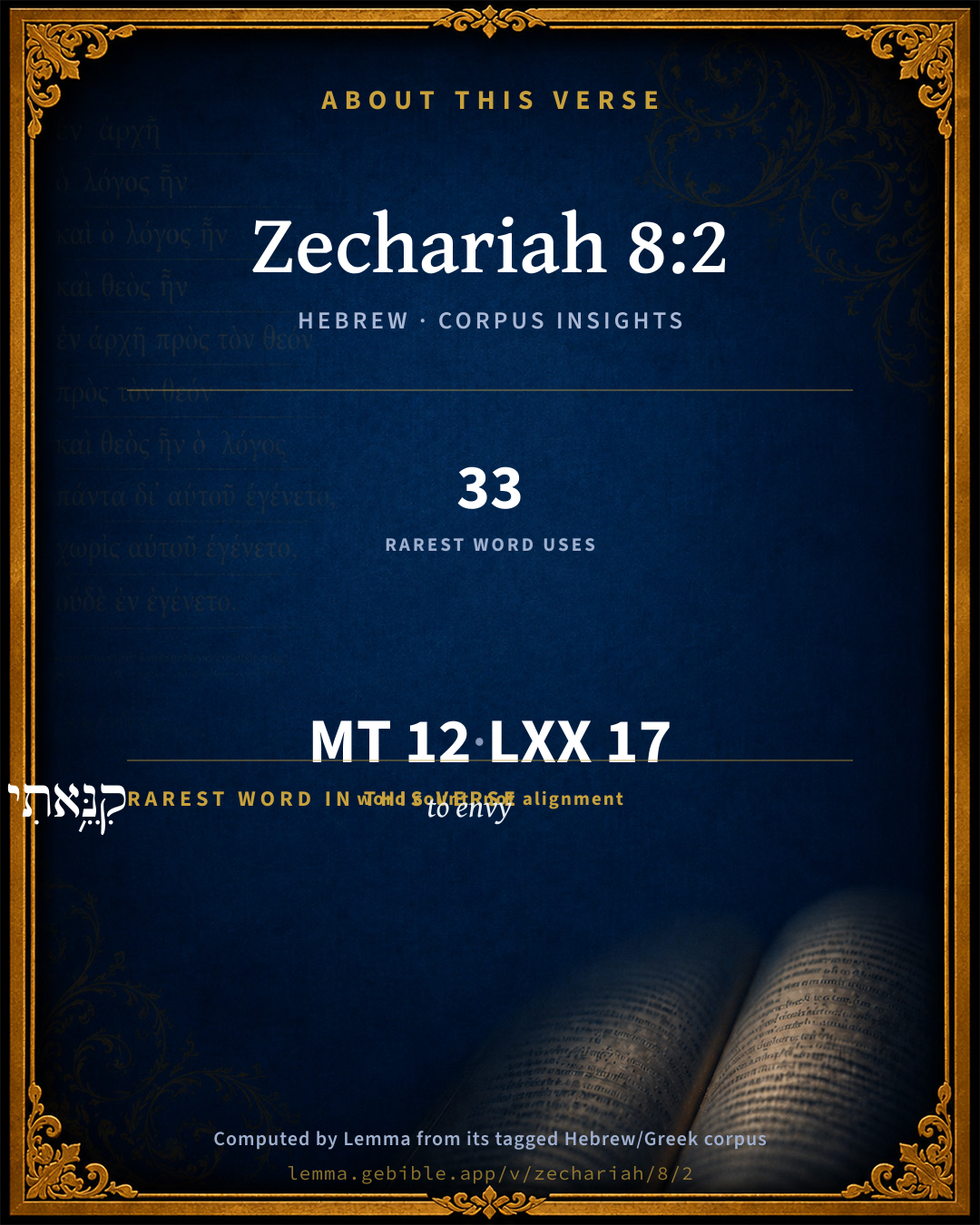
About this verse

These counts appear in no published source. They are computed here, from the morphology-tagged text and Lemma’s own curated glosses. What Lemma adds →

12
words
9
distinct lemmas
Prophets
section

Shared distinctive vocabulary

קִנֵּ֥אתִי to envy H7065 occurs in 28 verses of the Hebrew Bible. Also found in:

Grammatical profile

  • 3 verbs
  • 5 nouns
  • 2 adjectives
  • 1 preposition
  • 1 adverb

Verb forms

  • אָמַר֙ Qal · Perfect
  • קִנֵּ֥אתִי Piel · Perfect
  • קִנֵּ֥אתִי Piel · Perfect

Repetition

Words recur within this verse — often emphatic in Hebrew:

  • קִנֵּ֥אתִי to envy H7065 ×2
  • גְדוֹלָ֑ה great H1419 ×2

Hebrew & Septuagint length

In English translation the verse runs 22 words from the Hebrew and 27 from the Septuagint (LXX English) — closely comparable.

A rough comparison of the two English renderings, which tokenize alike — not a word-level alignment.

Word counts can differ between the Hebrew and the Greek without any difference in meaning — e.g. the Hebrew direct-object marker אֵת has no separate Greek word, and Greek often adds the article ὁ.

In the original languages it is 12 Hebrew tokens and 17 Greek tokens — but the two are counted differently (Hebrew bundles its prefixes and suffixes into one token; the Greek is in lemma form), so that isn’t a like-for-like length.

Cross-references

10

Topical passages linked to Zechariah 8:2 in the Treasury of Scripture Knowledge — connected by theme and wording, ordered by reader-vote popularity; previews shown in the World English Bible.

  • Joel 2:18 Then Yahweh was jealous for his land, And had pity on his people.
  • Psalms 78:58–59 For they provoked him to anger with their high places, And moved him to jealousy with their engraved images.
  • Zechariah 1:14–16 So the angel who talked with me said to me, "Proclaim, saying, 'Thus says Yahweh of Hosts: "I am jealous for Jerusalem and for Zion with a great jealousy.
  • Isaiah 42:13–14 Yahweh will go forth as a mighty man; he will stir up [his] zeal like a man of war: he will cry, yes, he will shout aloud; he will do mightily against his enemies.
  • Nahum 1:2 Yahweh is a jealous God and avenges. Yahweh avenges and is full of wrath. Yahweh takes vengeance on his adversaries, and he maintains wrath against his enemies.
  • Isaiah 59:17 He put on righteousness as a breastplate, and a helmet of salvation on his head; and he put on garments of vengeance for clothing, and was clad with zeal as a mantle.
  • Isaiah 63:4–6 For the day of vengeance was in my heart, and the year of my redeemed is come.
  • Isaiah 63:15 Look down from heaven, and see from the habitation of your holiness and of your glory: where are your zeal and your mighty acts? the yearning of your heart and your compassion is restrained toward me.
  • Ezekiel 36:5–6 therefore thus says the Lord Yahweh: Surely in the fire of my jealousy have I spoken against the residue of the nations, and against all Edom, that have appointed my land to themselves for a possession with the joy of all their heart, with despite of soul, to cast it out for a prey.
  • Nahum 1:6 Who can stand before his indignation? Who can endure the fierceness of his anger? His wrath is poured out like fire, and the rocks are broken apart by him.

Cross-references courtesy of OpenBible.info (CC BY 4.0).

Hebrew and Greek witnesses Masoretic Hebrew ↔ Greek Septuagint

The same verse in the two great witnesses to the Old Testament, shown verse-for-verse.

These are two independent witnesses, not word-aligned to each other, and the Septuagint is shown in lemma (dictionary) form.

Hebrew Zechariah 8:2 Masoretic · Westminster Leningrad Codex

כֹּ֤ה אָמַר֙ יְהוָ֣ה צְבָא֔וֹת קִנֵּ֥אתִי לְצִיּ֖וֹן קִנְאָ֣ה גְדוֹלָ֑ה וְחֵמָ֥ה גְדוֹלָ֖ה קִנֵּ֥אתִי לָֽהּ

Thus says Yahweh of Hosts: "I am jealous for Zion with great jealousy, and I am jealous for her with great wrath."

World English Bible · Public Domain

Greek LXX Zechariah 8:2 Septuagint · lemma form

ὅδε λέγω κύριος παντοκράτωρ ζηλόω ὁ ἰερουσαλήμ καί ὁ σιων ζῆλος μέγας καί θυμός μέγας ζηλόω αὐτός

Thus says the Lord Almighty; I have been jealous for Jerusalem and for Sion with great jealousy, and I have been jealous for her with great fury.

LXX2012 (modern English Septuagint) · Public Domain

Hebrew: Westminster Leningrad Codex (CC BY 4.0). Greek: Septuagint (public domain); English from LXX2012 (modern English Septuagint) (Public Domain). How the Septuagint differs from the Hebrew →

Targum (Aramaic paraphrase)

1

The Targum is the ancient Jewish Aramaic paraphrase of the Hebrew Scriptures — an interpretive translation, not the Hebrew text itself. Onkelos (literal) and Pseudo-Jonathan (expansive) render the Torah, and Jonathan the Prophets. Coverage is partial: where no permissively-licensed English translation exists for a verse, only the Aramaic is shown. This is verse-level text, not a word-by-word alignment to the Hebrew.

  1. Targum Jonathan Prophets (Joshua–Malachi)
    כִּדְנַן אֲמַר יְיָ צְבָאוֹת מִתְפְּרַע אֲנָא פּוּרְעֲנוּת צִיוֹן קִנְאָה רַבָּא וּרְגַז רַב מִן קָדָמַי עַל עַמְמַיָא דְאַקְנִיאוּה:

    (no public-domain English translation for this verse)

    Targum Jonathan — Aramaic: “Mikraot Gedolot” (public domain). English: “Sefaria Community Translation” (CC0 1.0 (public-domain dedication)); “London "Chaldee Paraphrase," 1871” (public domain). Text via Sefaria.

Commentary

Notes on Zechariah 8:2 from classic Christian and Jewish commentators (each source and its license shown beneath its notes). The classic Christian expositions comment on the surrounding passage and are grouped to its opening verse, so a note may address several verses; the Jewish commentaries on the Tanakh (Rashi and others) are per-verse, so they appear only where the commentator wrote on this verse.

Lemma curates 59 commentaries, every one of them public domain or Creative Commons licensed, each selected and text-cleaned for this edition rather than reprinted as found. About our sources →

Trapp's Complete Commentary

John Trapp

Zec 8:2 Thus saith the LORD of hosts; I was jealous for Zion with great jealousy, and I was jealous for her with great fury.

Ver. 2. I was jealous for Zion] {See Trapp on "Zec 1:14"} Jealous as a husband, zealous as a loving father; for, Non amat qui non zelat, He does not love who does not ardently low, saith Augustine; and a father being rebuked by some for his exceeding forwardness for his friend, answered, Ego aliter amare non didici, I know not how to love any otherwise than earnestly. God, therefore, to ascertain his people of the truth of the ensuing promises, and to cure their unbelief, lets them know that all this he will do for them of his free grace without their having deserved it. As at first he loved them merely because he loved them, Deu 7:7-8; so, out of the same love, he will bestow upon them all the good things here mentioned. See the like Isa 9:6-7, where, after a sweet description of Christ, his kingdom and benefits, he concludes all with "The zeal" (that is, the tender love and free grace) "of the Lord of hosts will perform this. Fear ye not." So 2Sa 7:21 "For thy word’s sake," that is, for thy Christ’s sake, "and according to thine own heart, hast thou done all these things" which thou hadst promised. "According to thine own heart," that is, ex mero motu, out of pure and unexcited love, or zeal, which is the top of all the affections and the heat of the heart.

John Trapp, A Commentary or Exposition upon All the Books of the Old and New Testament (1647–1656) — public domain. Text from a community e-Sword module.

Joseph Benson's Commentary

Zec 8:2. I was jealous for Zion with great jealousy — With great care that she should not, as formerly, sin against my love and her own welfare, and with a great desire to do her good, and rescue her from her enemies. Jealousy is properly the passion of a lover, or husband, made up of love, care, and anger, in their highest degrees, for his beloved, and against all that he thinks hurtful to her. Thus God had greatly loved Zion, had been careful of her honour and welfare, and displeased with her sins, which first hurt her, and then with the Chaldeans, who violated her. And I was jealous for her — Or toward, or against her, as להmay be rendered; with great fury — Hebrew, חמה, heat, or wrath, namely, for her sins. In a note on Zec 1:14, Blayney gives it as his opinion, that the jealousy there spoken of was God’s resentment against his people for their disloyalty and misbehaviour toward him. “In this opinion,” he here says, “I am confirmed by the present passage, where not the least mention is made of the persecuting nations. That God’s jealousy bespeaks wrath toward the object of it, needs no other proof than his own words, Num 25:11.”

Joseph Benson's Commentary on the Old and New Testaments (1811–1818) — public domain. Text from a community e-Sword module.

Tyndale Open Study Notes

Tyndale Open Resources

8:2 Passion (or jealousy, zeal) is a basic element of the Old Testament concept of God (see also 1:14). God’s passion identifies him as a personal deity, not an abstract natural force. God is passionate for his word and for the people of his covenant. His passion results in punishment for sin, restoration for repentance, and reward for the pursuit of righteousness.

Tyndale Open Study Notes — © Tyndale Open Resources, licensed CC BY-SA 4.0. Text via the HelloAO Bible API.

Geneva Bible (1599)

Geneva Bible translators

I loved my city with a singular love, so that I could not abide that any should do her any injury.

Geneva Bible (1599) marginal notes — public domain. Text via Bolls.life.

Adam Clarke's Commentary

Verse 2. I was jealous] Some refer this to the Jews themselves. They were as the spouse of Jehovah: but they were unfaithful, and God punished them as an injured husband might be expected to punish an unfaithful wife. Others apply it to the enemies of the Jews. Though I gave them a commission to afflict you, yet they exceeded their commission: I will therefore deal with them in fury - in vindictive justice.

Adam Clarke's Commentary on the Bible (1810–1826) — public domain. Text from a community e-Sword/MySword module.

John Calvin's Commentaries

He then says, that the word of Jehovah came to him; we hence learn, that this was a distinct prophecy. He adds, I have been zealous for Sion (for as we have said, the letter ל, lamed, is to be thus taken) with great zeal This was indeed an incredible change, for God had for a time restrained himself, while the ungodly at their pleasure harassed the Church, so that they thought that they could do so with impunity. As God then had for some time remained at rest, what the Prophet says here could not have been easily believed, that is, that God would, through a sudden jealousy, undertake the cause of the Church. Hence the indignation, immediately subjoined, must be regarded with reference to enemies, as though he had said, that all the ungodly would now perceive what they had by no means expected, — that God was the protector of Jerusalem. It now follows —

John Calvin's Commentaries (1540-1563) — public domain. Text from the Calvin Translation Society English edition (1840s-50s) via the Christian Classics Ethereal Library (ccel.org). Calvin's coverage is partial (roughly two-thirds of the Bible); uncommented books and verses are honest gaps, never fabricated. The 19th-century editor's footnotes and remarks are omitted so the notes are faithfully Calvin's own voice.

Ellicott's Commentary for English Readers

(2) I was.—Better, I am in both cases. Here God declares His determination to give expression to His burning love for Zion.

A Bible Commentary for English Readers, edited by Charles John Ellicott (1878–1897) — public domain. Text from a community e-Sword module.

The Cambridge Bible for Schools and Colleges

gen. ed. J. J. S. Perowne

2. Thus saith the Lord of hosts] “At each word and sentence, in which good things, for their greatness almost incredible, are promised, the prophet premises, Thus saith the Lord of hosts, as if he would say, Think not that what I pledge you are my own, and refuse me not credence as man. What I unfold are the promises of God.” Jerome, quoted by Pusey.

I was] Rather, I am. Comp. Zec_1:14, where the same tense is so rendered.

with great fury] i.e. against her enemies, as Zec_1:15.

The Cambridge Bible for Schools and Colleges (gen. ed. J. J. S. Perowne; Cambridge University Press, 1878–1918) — public domain. Text from a community e-Sword module.

John Gill's Exposition

Thus saith the Lord, I am returned to Zion,.... The temple being now building, and almost finished, and the worship of God restored in it. The Targum renders it, "I will return to Zion"; and it may refer to the time of Christ's incarnation, when the Redeemer came to Zion, Isa 59:20 or to the time of the conversion of the Jews in the latter day, of both which it is true; see Rom 11:26,

and will dwell in the midst of Jerusalem: or "cause my Shechinah to dwell there", as the Targum paraphrases it; which was fulfilled when the Word was made flesh, , "and dwelt" or "tabernacled" among the inhabitants of Judea and of Jerusalem, and taught his doctrines, and wrought his miracles, in the midst of them; and will be also when he shall dwell among them by his Spirit and grace in the latter day:

and Jerusalem shall be called a city of truth; when Christ, who is "truth" itself, was in it, and the truths of the Gospel were preached there by him and his apostles, and they were received and professed by many, though despised by others; and especially in the latter day, when the Jews shall generally and cordially embrace Christ and his Gospel, and shall worship God in spirit and in truth, and not in that shadowy, formal, and hypocritical way they do now; see Isa 1:26 and especially this will be true of the New Jerusalem, into which nothing shall enter that makes a lie, Rev 21:27,

the mountain of the Lord of hosts; which will be established upon the top of the mountains, and where the Lord will be seen and exalted in his glory, even the Lamb, with the hundred and forty four thousand with him, Isa 2:2,

the holy mountain; where the holy word of God will be preached, the holy ordinances administered, and holiness of life and conversation will be strictly attended to; yea, Holiness will be upon the bells of the horses, Zac 14:20.

John Gill's Exposition of the Whole Bible (1746–1763) — public domain (CC PDM 1.0). Text via the HelloAO Bible API.

Albert Barnes' Notes on the Bible

Thus saith the Lord of hosts - Jerome: “At each word and sentence, in which good things, for their greatness, almost incredible are promised, the prophet premises, “Thus saith the Lord of hosts,” as if he would say, Think not that what I pledge you are my own, and refuse me not credence as man. What I unfold are the promises of God.”

I was jealous - Literally, “I have been and am jealous for.” . He repeats in words slightly varied, but in the same rhythm, the declaration of tits tender love wherewith He opened the series of visions, thereby assuring beforehand that this was, like that, an answer of peace. The form of words shows, that this was a jealousy for, not with her; yet it was one and the same strong, yea infinite love, whereby God, as He says, “clave unto their fathers to love them and chose their seed after them out of all nations” Deu 10:15. His jealousy of their sins was part of that love, whereby, (Dionysius), “without disturbance of passion or of tranquillity, He inflicted rigorous punishment, as a man fearfully reproves a wife who sins.” They are two different forms of love according to two needs. Rup.: “The jealousy (Zelus) of God is good, to love people and hate the sins of people. Contrariwise the jealousy of the devil is evil, to hate people and love the sins of people.” Osorius: “Since God’s anger had its origin in the vehemence of His love (for this sort of jealousy arises from the greatness of love), there was hope that the anger might readily be appeased toward her.”

Albert Barnes' Notes on the Bible (1834–1885) — public domain. Text from a community e-Sword/MySword module.

Haydock's Catholic Bible Commentary

Jealous for her, treating her as a spouse, (Calmet) and not neglecting her as one incorrigible. (Haydock)

George Leo Haydock (1774–1849), Haydock's Catholic Family Bible and Commentary, 1859 edition — public domain. Excludes Psalms (Douay-Rheims chapter numbering differs from Protestant) and Deuterocanonical books (Catholic canon only).

Matthew Poole's English Annotations

I was; I have been in time past, in days of old before the captivity, and I have been so since the captivity for some years past.

Jealous for Zion: properly it is the passion of a lover or husband, mixed of love, care, and anger in their highest degrees for the beloved, and against all that is hurtful to it; so God had greatly loved Zion, had been careful of her honour and welfare, and displeased with her sins, which first hurt her, and then with the Chaldeans, which violated her.

With great jealousy; with great care that she should not, as formerly, sin against my love and her own welfare, and with a great love to do her good now, and to rescue her from her enemies.

I was jealous for her; on her behalf, and not as formerly against her, I am jealous in favour to her, as the Hebrew phrase importeth.

With great fury; with heat of anger against her enemies, as Zec 1:14,15, See Poole "Zec 1:14", See Poole "Zec 1:15".

Matthew Poole's English Annotations on the Holy Bible (1683–1685) — public domain. Text from a community e-Sword/MySword module.

The Pulpit Commentary

Thus saith the Lord of hosts. This formula occurs ten times in this chapter, thus enforcing the truth that all the promises made to Zion come from the Lord himself, and are therefore sure to be fulfilled. I was jealous; I am jealous, as Zec_1:14 (where see note). With great fury. Against her enemies. (Zec_1:15) "Zelus" is defined by Albertus Magnus: "amor boni cum indignatione contrarii." One side of God"s love for Zion is shown in the punishment of her enemies. Knabenbauer likens this zeal or jealousy of God to the pillar of fire at the Exodus light and protection to the Israelites, darkness and destruction to the Egyptians. (Exo_14:20)

The Pulpit Commentary (1880–1919), ed. H.D.M. Spence-Jones & Joseph S. Exell — public domain. Text from a community e-Sword module.

John Wesley's Explanatory Notes

Jealousy - With great care that she should not, as formerly, sin against my love, and her own welfare, and with a great desire to do her good, and to rescue her from her enemies. Fury - With heat of anger against her enemies.

John Wesley, Explanatory Notes Upon the Whole Bible (1754–1765) — public domain. Text via the GEBible commentary corpus.

Rashi

Rabbi Shlomo Yitzchaki (Rashi)

I am jealous for her For [not ‘to’] her. And you will not need to fast and to mourn. And so is the end of the chapter: “The fast of the fifth month, etc.”

Rashi on the Tanakh — English translations: “The Judaica Press complete Tanach with Rashi, translated by A. J. Rosenberg” (CC BY 4.0); “Pentateuch with Rashi's commentary by M. Rosenbaum and A.M. Silbermann, 1929-1934” (public domain); “The Metsudah Tanach series, Lakewood, N.J” (CC BY 4.0); and “The Book of Joshua, Metsudah Publications, 1997” (CC BY 4.0). Text via Sefaria.

Lesson kit

Teaching starters — assembled from the data on this page, not authored interpretation. Every prompt links to the verse data it draws on. Edit before teaching.

Zechariah, in the Prophets, opens this verse with 12 words (9 distinct Hebrew lemmas). Its most distinctive word is qânâʼ (“to envy”). A historical commentator’s framing appears above. Read the whole chapter for the surrounding context.

Discussion questions

  1. The word qânâʼ carries the sense “to envy.” How does it shape the verse?
  2. How does Genesis 26:14, which shares the word «to envy», read alongside this verse?
  3. What does the repetition of “to envy” (2× in this one verse) do in this verse?
  4. These translations render this verse differently. What is at stake in choosing one wording over another?
  5. «אָמַר֙» is a Qal Perfect verb. How does that grammatical form shape the action described?
  6. Compare how Trapp's Complete Commentary and Joseph Benson's Commentary read this verse. Where do they agree or differ?

Things to notice

Reading settings

Reading text

Shown beneath each verse's original-language words.

Old Testament
Old Testament edition

Read the OT as the Masoretic Hebrew (MT) or the Greek Septuagint (LXX).

English shown for the Greek Septuagint (in the Hebrew ↔ Greek comparison).

Comparing translations? Open the Compare panel on any verse page to stack up to four side by side.