
Isaiah 51:11

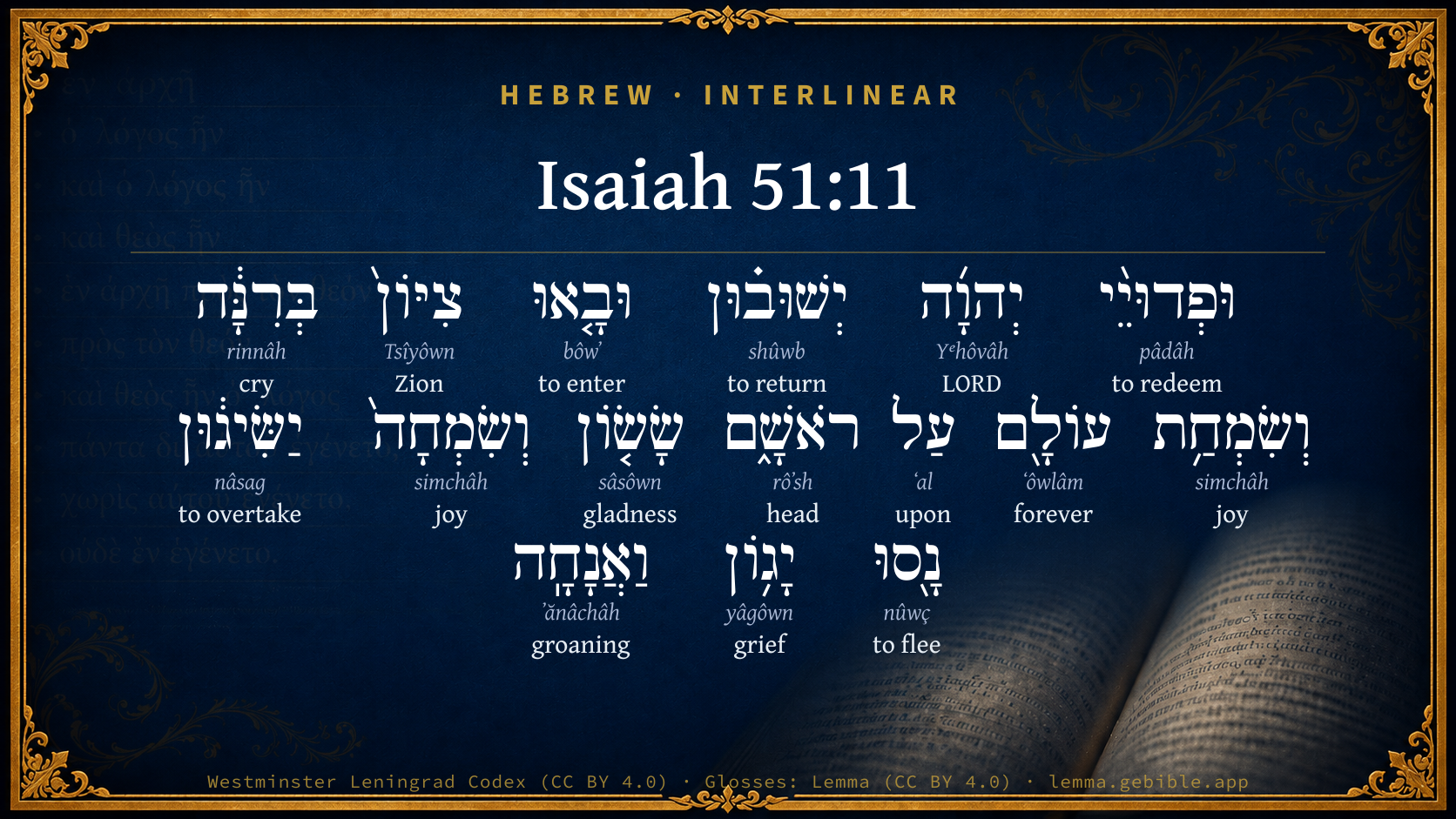
Hebrew (Westminster Leningrad Codex) Isaiah 51:11 appears in the Hebrew Old Testament. The text above is from the Westminster Leningrad Codex. Each word links to its Strong’s number, a concise gloss, and parsing drawn from the Open Scriptures Hebrew Bible morphology. Click any word for its full Brown-Driver-Briggs (BDB) entry.
Download image
Cite this verse

Isaiah 51:11 (World English Bible). Public Domain. Lemma interlinear Bible study tool, https://lemma.gebible.app/v/isaiah/51/11.

Show BibTeX & RIS
BibTeX
RIS
English Translation
The ransomed of Yahweh shall return, and come with singing to Zion; and everlasting joy shall be on their heads: they shall obtain gladness and joy; [and] sorrow and sighing shall flee away.
World English Bible · Public Domain
Download a study sheet

One document with this verse’s original text, its word-by-word gloss line, the meaning frame, cross-references with their text, attributed commentary, and full source and license credits — printable, and it pastes into notes with its structure intact.

This verse Autodidact and up

Study sheet (.html) Plain text (.txt)

A passage Seminary Student

Up to 50 verses in one chapter. A passage sheet keeps up to 6 commentary sources and 12 cross-references per verse, in the order this page ranks them, and says so on the sheet whenever that leaves anything out. Ask for a single verse and you get the Autodidact verse sheet above.

Everything on this page stays free to read, with no account — the sheet is a download of what is already on screen, not access to it.

Want to remove ads? Support Godless Engineer
Compare translations 3

The same verse in 3 English versions, stacked beneath the original-language interlinear above. Click any original word for its lexicon entry.

Each is an independent rendering of the whole verse — the interlinear is not word-aligned to these translations.

Highlighted words mark where these versions differ — a whole-verse word diff, not a word-by-word alignment.

  • World English Bible Public Domain
    The ransomed of Yahweh shall return, and come with singing to Zion; and everlasting joy shall be on their heads: they shall obtain gladness and joy; [and] sorrow and sighing shall flee away.
  • King James Version Public Domain
    Therefore the redeemed of the LORD shall return, and come with singing unto Zion; and everlasting joy shall be upon their head: they shall obtain gladness and joy; and sorrow and mourning shall flee away.
  • unfoldingWord Literal Text CC BY-SA 4.0
    And the ransomed of Yahweh will return and come Zion with singing, and joy of eternity on their heads. Gladness and joy will overtake; sorrow and sighing will flee.

unfoldingWord Literal Text — © unfoldingWord, licensed CC BY-SA 4.0. Word-aligned USFM3 via Door43 (git.door43.org/unfoldingWord/en_ult).

Versions to compare (up to 4)

3 of 4 selected

Show all 18 translations

Every available English version of this verse, each an independent rendering of the whole verse.

  • World English Bible Public Domain
    The ransomed of Yahweh shall return, and come with singing to Zion; and everlasting joy shall be on their heads: they shall obtain gladness and joy; [and] sorrow and sighing shall flee away.
  • Berean Standard Bible Public Domain
    So the redeemed of the LORD will return and enter Zion with singing, crowned with everlasting joy. Gladness and joy will overtake them, and sorrow and sighing will flee.
  • Majority Standard Bible Public Domain
    So the redeemed of the LORD will return and enter Zion with singing, crowned with everlasting joy. Gladness and joy will overtake them, and sorrow and sighing will flee.
  • King James Version Public Domain
    Therefore the redeemed of the LORD shall return, and come with singing unto Zion; and everlasting joy shall be upon their head: they shall obtain gladness and joy; and sorrow and mourning shall flee away.
  • American Standard Version (1901) Public Domain
    And the ransomed of Jehovah shall return, and come with singing unto Zion; and everlasting joy shall be upon their heads: they shall obtain gladness and joy; `and' sorrow and sighing shall flee away.
  • Revised Version (1885) Public Domain
    And the ransomed of the LORD shall return, and come with singing unto Zion; and everlasting joy shall be upon their heads: they shall obtain gladness and joy, and sorrow and sighing shall flee away.
  • Geneva Bible (1599) Public Domain
    Therefore the redeemed of the Lord shall returne, and come with ioy vnto Zion, and euerlasting ioy shalbe vpon their head: they shall obtaine ioy, and gladnesse: and sorow and mourning shall flee away.
  • Douay-Rheims (1899) Public Domain
    And now they that are redeemed by the Lord, shall return, and shall come into Sion singing praises, and joy everlasting shall be upon their heads, they shall obtain joy and gladness, sorrow and mourning shall flee away.
  • Young's Literal Translation Public Domain
    And the ransomed of Jehovah turn back, And they have come to Zion with singing, And joy age-during `is' on their head, Gladness and joy they attain, Fled away have sorrow and sighing,
  • Literal Standard Version CC BY-SA 4.0
    And the ransomed of YHWH return, || And they have come to Zion with singing, || And continuous joy [is] on their head, || They attain gladness and joy, || Sorrow and sighing have fled away,
  • Unlocked Literal Bible CC BY-SA 4.0
    The ransomed of Yahweh will return and come to Zion with cries of joy and with gladness forever on their heads; and gladness and joy will overtake them, and sorrow and mourning will flee away.
  • unfoldingWord Literal Text CC BY-SA 4.0
    And the ransomed of Yahweh will return and come Zion with singing, and joy of eternity on their heads. Gladness and joy will overtake; sorrow and sighing will flee.
  • Darby Bible Public Domain
    So the ransomed of Jehovah shall return, and come to Zion with singing; and everlasting joy shall be upon their heads: they shall obtain gladness and joy; sorrow and sighing shall flee away.
  • World Messianic Bible Public Domain
    Those ransomed by the LORD will return, and come with singing to Zion. Everlasting joy shall be on their heads. They will obtain gladness and joy. Sorrow and sighing shall flee away.
  • Webster's Bible Public Domain
    Therefore the redeemed of the LORD shall return, and come with singing to Zion; and everlasting joy shall be upon their head: they shall obtain gladness and joy; sorrow and mourning shall flee away.
  • Free Bible Version CC BY-SA 4.0
    Those the Lord has set free will return, singing as they enter Jerusalem, wearing crowns of everlasting joy. They are overcome with thankfulness and happiness; sorrow and sadness simply disappear.
  • Bible in Basic English Public Domain
    Those whom the Lord has made free will come back with songs to Zion; and on their heads will be eternal joy: delight and joy will be theirs, and sorrow and sounds of grief will be gone for ever.
  • JPS Tanakh (1917) Public Domain
    And the ransomed of the LORD shall return, and come with singing unto Zion, and everlasting joy shall be upon their heads; they shall obtain gladness and joy, and sorrow and sighing shall flee away.

Literal Standard Version (2020), Covenant Press — licensed CC BY-SA 4.0. Text via the HelloAO Bible API (eBible.org). Unlocked Literal Bible (unfoldingWord) — licensed CC BY-SA 4.0. Text via the HelloAO Bible API (eBible.org). unfoldingWord Literal Text — © unfoldingWord, licensed CC BY-SA 4.0. Word-aligned USFM3 via Door43 (git.door43.org/unfoldingWord/en_ult). Free Bible Version, Dr. Jonathan Gallagher — licensed CC BY-SA 4.0. Text via the HelloAO Bible API (eBible.org).

Word by word

More ways to search: Search by grammar → Find every occurrence → Compare this word →

Practice this passage: Drill this verse → Learn its vocabulary →

וַאֲנָחָֽה
ʼănâchâh
H585
“and · groaning”
Conjunction + Noun, Common, Feminine, Singular, Absolute
Part of Speech
Conjunction + Noun
Type
Common
Gender
Feminine
Number
Singular
State
Absolute
Full BDB Definition

Origin: from H585

TWOT: 127a

sighing, groaning (expression of grief or physical distress)
  1. וּפְדוּיֵ֨י pâdâh H6299 “and · redeemed” Conjunction + Verb, Qal, Participle Passive, Masculine, Plural, Construct
  2. יְהוָ֜ה Yᵉhôvâh H3068 “LORD” Noun, Proper
  3. יְשׁוּב֗וּן shûwb H7725 “to return” Verb, Qal, Imperfect, 3rd Person, Masculine, Plural + Suffix, n
  4. וּבָ֤אוּ bôwʼ H935 “and · to enter” Conjunction + Verb, Qal, Sequential Perfect, 3rd Person, Common, Plural
  5. צִיּוֹן֙ Tsîyôwn H6726 “Zion” Noun, Proper
  6. בְּרִנָּ֔ה rinnâh H7440 “in/at · cry” Preposition + Noun, Common, Feminine, Singular, Absolute
  7. וְשִׂמְחַ֥ת simchâh H8057 “and · joy of” Conjunction + Noun, Common, Feminine, Singular, Construct
  8. עוֹלָ֖ם ʻôwlâm H5769 “forever” Noun, Common, Masculine, Singular, Absolute
  9. עַל ʻal H5921 “upon” Preposition
  10. רֹאשָׁ֑ם rôʼsh H7218 “head · their” Noun, Common, Masculine, Singular, Construct + Suffix, Personal, 3rd Person, Masculine, Plural
  11. שָׂשׂ֤וֹן sâsôwn H8342 “gladness” Noun, Common, Masculine, Singular, Absolute
  12. וְשִׂמְחָה֙ simchâh H8057 “and · joy” Conjunction + Noun, Common, Feminine, Singular, Absolute
  13. יַשִּׂיג֔וּן nâsag H5381 “to overtake” Verb, Hiphil, Imperfect, 3rd Person, Masculine, Plural + Suffix, n
  14. נָ֖סוּ nûwç H5127 “to flee” Verb, Qal, Perfect, 3rd Person, Common, Plural
  15. יָג֥וֹן yâgôwn H3015 “grief” Noun, Common, Masculine, Singular, Absolute

About this verse

These counts appear in no published source. They are computed here, from the morphology-tagged text and Lemma’s own curated glosses. What Lemma adds →

16
words
15
distinct lemmas
Prophets
section

Notable vocabulary

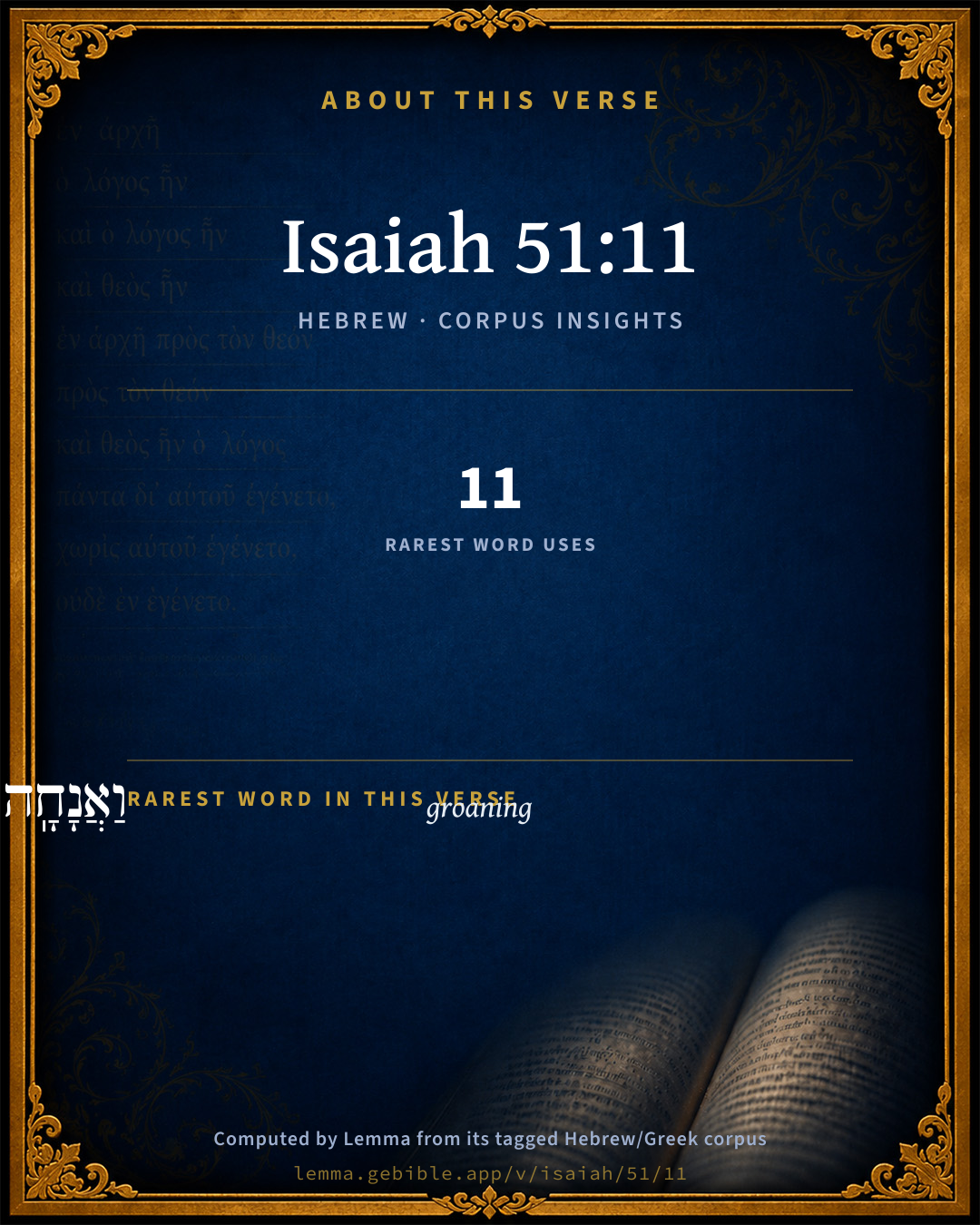
The rarest word here is וַאֲנָחָֽה groaning H585 — appearing just 11 times in the whole Hebrew Bible.

Shared distinctive vocabulary

וַאֲנָחָֽה groaning H585 occurs in 11 verses of the Hebrew Bible. Also found in:

Grammatical profile

  • 5 verbs
  • 10 nouns
  • 1 preposition

Verb forms

  • וּפְדוּיֵ֨י Qal · Participle Passive
  • יְשׁוּב֗וּן Qal · Imperfect
  • וּבָ֤אוּ Qal · Sequential Perfect
  • יַשִּׂיג֔וּן Hiphil · Imperfect
  • נָ֖סוּ Qal · Perfect

Repetition

A word recurs within this verse — often emphatic in Hebrew:

  • וְשִׂמְחַ֥ת joy H8057 ×2

Hebrew & Septuagint length

In English translation the verse runs 33 words from the Hebrew and 36 from the Septuagint (LXX English) — closely comparable.

A rough comparison of the two English renderings, which tokenize alike — not a word-level alignment.

Word counts can differ between the Hebrew and the Greek without any difference in meaning — e.g. the Hebrew direct-object marker אֵת has no separate Greek word, and Greek often adds the article ὁ.

Cross-references

23

Topical passages linked to Isaiah 51:11 in the Treasury of Scripture Knowledge — connected by theme and wording, ordered by reader-vote popularity; previews shown in the World English Bible.

  • Isaiah 25:8 He has swallowed up death forever; and the Lord Yahweh will wipe away tears from off all faces; and the reproach of his people will he take away from off all the earth: for Yahweh has spoken it.
  • Revelation 21:4 He will wipe away from them every tear from their eyes. Death will be no more; neither will there be mourning, nor crying, nor pain, any more. The first things have passed away."
  • Revelation 7:17 for the Lamb who is in the midst of the throne shepherds them, and leads them to springs of waters of life. And God will wipe away every tear from their eyes."
  • Isaiah 35:10 and the ransomed of Yahweh shall return, and come with singing to Zion; and everlasting joy shall be on their heads: they shall obtain gladness and joy, and sorrow and sighing shall flee away.
  • 2 Thessalonians 2:16 Now our Lord Jesus Christ himself, and God our Father, who loved us and gave us eternal comfort and good hope through grace,
  • Isaiah 61:7 Instead of your shame [you shall have] double; and instead of dishonor they shall rejoice in their portion: therefore in their land they shall possess double; everlasting joy shall be to them.
  • Jeremiah 33:11 the voice of joy and the voice of gladness, the voice of the bridegroom and the voice of the bride, the voice of those who say, Give thanks to Yahweh of Hosts, for Yahweh is good, for his loving kindness endures forever; [and of them] who bring [sacrifices of] thanksgiving into the house of Yahweh. For I will cause the captivity of the land to return as at the first, says Yahweh.
  • Isaiah 60:19–20 The sun shall be no more your light by day; neither for brightness shall the moon give light to you: but Yahweh will be to you an everlasting light, and your God your glory.
  • 2 Corinthians 4:17–18 For our light affliction, which is for the moment, works for us more and more exceedingly an eternal weight of glory;
  • Revelation 22:3 There will be no curse any more. The throne of God and of the Lamb will be in it, and his servants serve him.
  • Isaiah 65:19 I will rejoice in Jerusalem, and joy in my people; and there shall be heard in her no more the voice of weeping and the voice of crying.
  • Jude 1:24 Now to him who is able to keep them from stumbling, and to present you faultless before the presence of his glory in great joy,
  • Isaiah 44:23 Sing, you heavens, for Yahweh has done it; shout, you lower parts of the earth; break forth into singing, you mountains, O forest, and every tree therein: for Yahweh has redeemed Jacob, and will glorify himself in Israel.
  • Jeremiah 30:18–19 Thus says Yahweh: Behold, I will turn again the captivity of Jacob's tents, and have compassion on his dwelling-places; and the city shall be built on its own hill, and the palace shall be inhabited after its own manner.
  • Acts 2:41–47 Then those who gladly received his word were baptized. There were added that day about three thousand souls.
  • Revelation 19:1–7 After these things I heard something like a loud voice of a great multitude in heaven, saying, "Hallelujah! Salvation, power, and glory belong to our God:
  • Isaiah 48:20 Go you forth from Babylon, flee you from the Chaldeans; with a voice of singing declare you, tell this, utter it even to the end of the earth: say you, Yahweh has redeemed his servant Jacob.
  • Isaiah 49:13 Sing, heavens; and be joyful, earth; and break forth into singing, mountains: for Yahweh has comforted his people, and will have compassion on his afflicted.
  • Jeremiah 31:11–12 For Yahweh has ransomed Jacob, and redeemed him from the hand of him who was stronger than he.
  • Revelation 5:9–13 They sang a new song, saying, "You are worthy to take the book, And to open its seals: For you were killed, And bought us for God with your blood, Out of every tribe, language, people, and nation,
  • Revelation 7:9–10 After these things I looked, and behold, a great multitude, which no man could number, out of every nation and of all tribes, peoples, and languages, standing before the throne and before the Lamb, dressed in white robes, with palm branches in their hands.
  • Revelation 21:1 I saw a new heaven and a new earth: for the first heaven and the first earth have passed away, and the sea is no more.
  • Revelation 14:1–4 I saw, and behold, the Lamb standing on Mount Zion, and with him a number, one hundred forty-four thousand, having his name, and the name of his Father, written on their foreheads.

Cross-references courtesy of OpenBible.info (CC BY 4.0).

Hebrew and Greek witnesses Masoretic Hebrew ↔ Greek Septuagint

The same verse in the two great witnesses to the Old Testament, shown verse-for-verse.

These are two independent witnesses, not word-aligned to each other, and the Septuagint is shown in lemma (dictionary) form.

Hebrew Isaiah 51:11 Masoretic · Westminster Leningrad Codex

וּפְדוּיֵ֨י יְהוָ֜ה יְשׁוּב֗וּן וּבָ֤אוּ צִיּוֹן֙ בְּרִנָּ֔ה וְשִׂמְחַ֥ת עוֹלָ֖ם עַל רֹאשָׁ֑ם שָׂשׂ֤וֹן וְשִׂמְחָה֙ יַשִּׂיג֔וּן נָ֖סוּ יָג֥וֹן וַאֲנָחָֽה

The ransomed of Yahweh shall return, and come with singing to Zion; and everlasting joy shall be on their heads: they shall obtain gladness and joy; [and] sorrow and sighing shall flee away.

World English Bible · Public Domain

Greek LXX Isaiah 51:11 Septuagint · lemma form

καί λυτρόω ὑπό γάρ κύριος ἀποστρέφω καί ἥκω εἰς σιων μετά εὐφροσύνη καί ἀγαλλίαμα αἰώνιος ἐπί γάρ ὁ κεφαλή αὐτός ἀγαλλίασις καί αἴνεσις καί εὐφροσύνη καταλαμβάνω αὐτός ἀποδιδράσκω ὀδύνη καί λύπη καί στεναγμός

for by the help of the Lord they shall return, and come to Sion with joy and everlasting exultation, for praise and joy shall come upon their head: pain, and grief, and groaning, have fled away.

LXX2012 (modern English Septuagint) · Public Domain

Hebrew: Westminster Leningrad Codex (CC BY 4.0). Greek: Septuagint (public domain); English from LXX2012 (modern English Septuagint) (Public Domain). How the Septuagint differs from the Hebrew →

Targum (Aramaic paraphrase)

1

The Targum is the ancient Jewish Aramaic paraphrase of the Hebrew Scriptures — an interpretive translation, not the Hebrew text itself. Onkelos (literal) and Pseudo-Jonathan (expansive) render the Torah, and Jonathan the Prophets. Coverage is partial: where no permissively-licensed English translation exists for a verse, only the Aramaic is shown. This is verse-level text, not a word-by-word alignment to the Hebrew.

  1. Targum Jonathan Prophets (Joshua–Malachi)
    וּפְרִיקַיָא דַייָ יִתְכַּנְשׁוּן מִבֵּינֵי גַלְוַתְהוֹן וְיַעֲלוּן לְצִיוֹן בְּתוּשְׁבַּחְתָּא וְחֶדְוַת עֲלָם תְּהֵי לְהוֹן דְלָא פָסְקָה וַעֲנַן יְקַר יְהֵי מַטֵיל עַל רֵישֵׁיהוֹן בִּיעַ וְחֶדְוָה יִשְׁכְּחוּן וְיֵסוּף מִנְהוֹן מִבֵּית יִשְׂרָאֵל דָווֹנָא וְתֵינַחְתָּא:

    Thus the redeemed of the Lord shall be gathered together out of their captivity, and come to Zion with singing; and everlasting joy shall be theirs, which shall not cease: and a cloud of glory shall shadow over their heads; they shall find joy and gladness, and there shall be an end of sorrow and sighing for the house of Israel.

    Targum Jonathan — Aramaic: “Mikraot Gedolot” (public domain). English: “Sefaria Community Translation” (CC0 1.0 (public-domain dedication)); “London "Chaldee Paraphrase," 1871” (public domain). Text via Sefaria.

Commentary

Notes on Isaiah 51:11 from classic Christian and Jewish commentators (each source and its license shown beneath its notes). The classic Christian expositions comment on the surrounding passage and are grouped to its opening verse, so a note may address several verses; the Jewish commentaries on the Tanakh (Rashi and others) are per-verse, so they appear only where the commentator wrote on this verse.

Lemma curates 59 commentaries, every one of them public domain or Creative Commons licensed, each selected and text-cleaned for this edition rather than reprinted as found. About our sources →

Trapp's Complete Commentary

John Trapp

Isa 51:11 Therefore the redeemed of the LORD shall return, and come with singing unto Zion; and everlasting joy [shall be] upon their head: they shall obtain gladness and joy; [and] sorrow and mourning shall flee away.

Ver. 11. Therefore the redeemed of the Lord, &c.] This is God’s answer, as some; or the good people’s confidence, as others, that God would deliver them now, as he had done their forefathers from Pharaoh.

And everlasting joy.] As a fair and precious crown. {2Ti 4:8} Some make it a metaphor from those that carry heavy burdens on their heads; St Paul calleth it a "weight of glory."

They shall obtain joy.] See Isa 35:10.

John Trapp, A Commentary or Exposition upon All the Books of the Old and New Testament (1647–1656) — public domain. Text from a community e-Sword module.

The Biblical Illustrator

Joseph S. Exell

Isa_51:11

Therefore the redeemed of the Lord shall return

Great deliverances

The return of the light of morning after the darkness of the night; of a fine summer after a cold and cheerless winter; of health and strength after a season of sickness and pain, is refreshing and delightful, and demands the gratitude of the heart.

The deliverance of a nation from temporal slavery or subjection has often kindled a fire in the breast of the patriot, the painter, the poet and the historian; but what are all earthly blessings when compared with those which are spiritual and eternal? (New Irish Pulpit.)

The present and future joy of the redeemed of the Lord

There is the greatest harmony throughout the whole Bible, and its glowing descriptions of future events have always some relation to the spiritualizing effects of the Gospel of Christ.

1. Who can with such propriety be called the redeemed of the Lord, as they whom He has delivered from the power as well as penalty of sin?

2. Who again can with such propriety be ca]led the redeemed of the Lord, as they whom He ransoms from that all-conquering foe, who puts all things under his feet?

3. But must the soul lie insensible with the body until this general redemption? Must ages pass before the redeemed of the Lord enjoy a foretaste of their redemption? No! To-day shalt thou be with Me in paradise.

4. But are there not some considerations, to be taken by us into account on this subject? Is there not some blessing--a blessing beyond all other blessings, which makes these a matter of everlasting joy to the redeemed of the Lord? In bringing many sons to glory Jesus has been made perfect through sufferings; He has made reconciliation for sin. (W. M. Harte.)

The joy of the ransomed

No New Testament utterance could be more beautiful than this picturing of the return of the redeemed of the Lord to Zion.

1. It points, at the outset, to the grounds of their confidence and joy. They are ransomed travellers: they have found the righteousness and the salvation spoken of at the commencement of the chapter. They go, on their pilgrim way exulting in Him whose arm hath wounded the dragon--the Man of Gods right hand, who in His cross and passion hathdestroyed him that had the power of death, that is the devil, and delivered them who through fear of death were all their lifetime subject to bondage. They are more than conquerors through Him that loved them.

2. They are further here truthfully represented, even in the course of their journey through the wilderness, as filled with peace and joy in believing, abounding in hope. The Christian is a joyful man. Though it be a wilderness he treads, and though sorrow and mourning are also depicted as tracking his footsteps, yet he has elements of tranquil happiness within him which make the song, not the tear, the appropriate exponent of his thoughts and emotions. It were strange, indeed, were it otherwise. At peace with God; sin forgiven; the heart changed; the affections elevated; grace moulding, sustaining, quickening, sanctifying; and, rising above all, the assured hope of glory hereafter.

3. The words, too, seem to tell of an ever-augmenting joy. As the portals of glory draw nearer, the song,, deepens in melody and strength. They come to. Zion with singing; then everlasting joy is on their head. Then, they obtain a new anointing of gladness; and finally sorrow and mourning--these two companions of the wilderness-rise on their sombre, gloomy wings, and speed away for ever! (J. R. Macduff, D. D.)

Journey and song

I. A REDEEMED PEOPLE.

II. THE REDEEMED OF THE LORD AS TRAVELLERS.

III. THE REDEEMED OF THE LORD AS SINGERS. (J. M. Blackie, LL.B.)

The Biblical Illustrator, edited by Joseph S. Exell (c. 1880s–1900s) — public domain. Text from a community e-Sword module.

The Preacher's Complete Homiletical Commentary

Joseph S. Exell (gen. ed.)

THE GLAD HOME-GOING

Isa_51:11. Therefore the redeemed of the Lord shall return, &c. [1569]

[1569] See Outlines on Isa_35:8-10, in vol. i. pp. 409–413.

The words of the text, fulfilled in the history of the return from captivity, are in our case awaiting the richer, fuller interpretation of death.

I. THOSE WHO ARE DESTINED TO THIS GLORIOUS HOME-GOING. “The redeemed of the Lord.”

The expression is one which grows out of the Levitical law, and means one set free by the payment of a price. The precise signification of the word is that of substitution. A man redeemed his first-born by substituting an animal for him. The first-born were also freed by the substitution of a special offering of equal value, made for all classes. The sons of Levi rendered substituted service for all the tribes. These were types and shadows of another Substitute, who, bearing the sins of many, guiltless but treated as guilty, should deliver from the curse and power of sin.

The deliverance of humanity from wilfulness and its woes was costly to Almighty love. This law of substitution, and painful substitution, runs through all human history. You find it everywhere (H. E. I. 393–395.) We must live for others and die for others. God has placed Himself under the same law. “He hath borne our griefs and carried our sorrows.” By crucifixion of His own love; by self-sacrifice; by pain, and pang, and death, He breaks the bonds of moral slavery, condemns sin in the flesh, works a hatred of it which insures its extermination. What law could not do, God, sending His own Son in the flesh, did. The ransom was Himself. The redeemed compose “the Church of God, which He has purchased with His own blood.” Men who by faith have appropriated and rest upon this great wonder of suffering love, are placed in a new condition by means of it. The Redeemer is a ransom for all, to be testified in due time. The old Church was redeemed through Him. Nations unborn are included in the gracious purpose. The children, called to His embrace, share the benefit of His loving substitution, are numbered among the redeemed. Our loved ones who have tasted death, swell the gathering crowd of immortals redeemed. Bought with a price, faithful unto death, they escaped its sting and destructive energy, and are now triumphant, rejoicing spirits,—“the redeemed of the Lord.”

II. THEIR DESTINATION. “They shall return and come to Zion.”

After the woes and privations of the Captivity, a prosperous Church state was to be restored. Zion was the place of Divine, manifested grace. God recorded His name there. The Shekinah cloud rested there. There He met the people, and conferred the boons of His salvation.

The earthly Zion was a type of the heavenly. Two ideas are here suggested—nearness to God and holy association.

1. The redeemed on high are brought into nearer fellowship with God. There are easily conceivable visible manifestations of glory far beyond what are now possible. Emancipated from dependence upon sense, there will be a vast increase of spiritual capacity, and a corresponding enlargement of the means and opportunities of knowledge. Their acquaintance with the purposes and character of God, their feeling of His love, and grace, and tenderness, will be immeasurably greater and more intense than any known on earth. There is an infinite variety of Divine manifestations throughout the universe. There can be no dull uniformity in that higher life. No veil hides the eternal brightness. The beatific vision is face to face. The communications of the Divine mind are constant and familiar; the tokens of Divine grace are never withdrawn; the pledges of Divine fidelity are received and enjoyed without restriction. God is manifested in His highest glory, and humanity reaches its highest exaltation. Now in part—then, as also we are known.

2. The coming to Zion is expressive of personal association and fellowship. The return from the Captivity was that of a multitude. The words recall the joyous going up and assembling of the tribes to observe the solemn rites of their religion, and to enjoy social intercourse with each other. The heavenly state knows no loneliness. Every spirit forms one of a blissful company. Heaven is a social state. Lost loves are found, and broken relations are united, and interrupted fellowships are resumed. The mutual recognition of the faithful departed is one of the beliefs which nature suggests, and revelation implies and authenticates (P. D. 2926–2928). It does not so much rest upon single texts, as it is the keynote of the melody, and the uniting principle of the harmony of many. Every description implies it—every pictured scene discloses it. Love abides through death. Memory abides through death. We shall find what we have lost, and know we have found it. As the years pass how rich heaven becomes! Those who are there forbid the thought of it as a strange place (H. E. I. 470, 2739). It is our home—our Father’s house.

III. THEIR NEW CONDITIONS AND CIRCUMSTANCES. “Everlasting joy,” &c.

During the Captivity there were sore longings for freedom and home. The captives wept when they remembered Zion. They could not sing the Lord’s song in a strange land. Here all that is reversed. Inappeasable desire is gone. Heaven will contain much we have never imagined (H. E. I. 2714–2727).

There is, then, no loss in death. We are saved by hope. The future of the redeemed is assured by the Redeemer. Life is theirs. Death is theirs. Heaven is theirs. They shall go no more out for ever!—W. Hope Davison: The Preacher’s Monthly, vol. vii. pp. 25–27.

I. THE CHARACTER OF THE PEOPLE WHO ARE GOING HOME TO HEAVEN.

“The redeemed of the Lord.”

1. They were once captives. Of Satan (2Ti_2:16). Slaves to their own depraved affections and desires—“sold under sin” (Rom_7:23). Prisoners to the Divine law—owing a debt which they could not discharge, and exposed to the righteous penalty.

2. They could not redeem themselves. The price was too great for such insolvents to pay, &c. (see on Isa_52:3).

3. It was the work of an Almighty Saviour to ransom the captives. He alone could pay the price, and deliver them from the grasp of Satan and the thraldom of sin, &c. He is emphatically called the “Redeemer,” and His people “the redeemed” (Eph_1:7; Col_1:14; 1Co_6:19).

4. They are redeemed to be the Lord’s people. They are no longer slaves, but the Lord’s freemen—His property, servants, children, &c.; redeemed that they may share in the privileges and joys of the sons of God (Rom_14:9).

II. THE NATURE OF THEIR JOURNEY.

1. They are journeying heavenward. “Shall return and come to Zion.” Zion was the type of the heavenly city—one of its names (Heb_12:22; Rev_14:1; Psa_65:1; Psa_84:7). Heaven the place of perfect worship, fellowship, &c. The object of the Christian pilgrims’ highest hope, around which their best affections centre, &c. Can never be fully at rest till they reach their Father’s home on high, and repose on His paternal bosom.

2. They are journeying heavenward in dependence upon God. They feel themselves weak, &c., but they rely upon the promised strength, &c. In Christ they have perfect strength, for perfect weakness. The homeward journey may be trying; they may have to tread on thorns, to shiver in the keen winds, &c.; but notwithstanding all, they advance under the benediction of heaven. God in all the Omnipotence of His might is with them, and therefore, “through winds and stormy seas,” “they shall return to Zion.”

3. They journey joyfully. “They come to Zion with singing. As the ransomed captives would return from Babylon, and as travellers commonly do now in the East; as a bird got loose out of a cage. They gratefully sing the praises of their great Deliverer and Conductor; they confidently sing of His loving care, &c.; of their glorious prospects, and of their ultimate triumph, “and find it nearer while they sing.”

III. THE BLISSFUL TERMINATION OF THE JOURNEY.

1. They shall finish their course with triumphant joy. “Everlasting joy,” &c. They reach home with difficulty (1Pe_4:18), but certainly. Enemies conquered—beatific vision—exalted society, &c. What a blissful termination! What are other journeys compared with this? What sources of joy and gladness are here!

2. They shall receive an incorruptible crown. “Songs and everlasting joy upon their heads.” This may refer to the custom of wearing a wreath or chaplet of flowers in times of festivity, as is often done now, and as was commonly done among the ancients in triumphal processions.

3. They shall be eternally exempt from all that creates pain and uneasiness. “Sorrow and sighing shall flee away.” It must be so in the heavenly home (Rev_21:4). No sigh was ever heaved there, no head ever ached there, &c. “In this world of changes it is a short step from joy to sorrow, but in that world sorrow and mourning shall flee away, never to return or come in view again.” Eternal health, wealth, purity, security, happiness, light, &c. “Eternal life!” Life in its highest forms and manifestations. Life with Christ—eternal and ineffable, ever developing in all perfection of strength, and beauty, and joy!

CONCLUSION:

1. The value of Christianity. No other religion can furnish such consolation amid human woes; and no other religion is, therefore, adapted to humanity. We are under infinite obligations to Christ, for from Him we derive all our present and future bliss. Let the prospect of such a home hearten us under the trials and difficulties of life. Press nobly on with assured confidence and eager desire.

2. The heavenly home belongs to “the redeemed of the Lord.” But there are some of you who are the bond-slaves of Satan, &c. “Repent and believe the Gospel” of freedom. Come to Christ, trust Him for emancipation from the thraldom of sin and Satan, and then let your ransomed life be one of praise and devotion to your great Deliverer.—Alfred Tucker.

The Preacher's Complete Homiletical Commentary (gen. ed. Joseph S. Exell; Funk & Wagnalls, c. 1892) — public domain (pre-1929). A full-Bible homiletical/sermon-outline anthology covering 65 of 66 books (2 John is absent from the source module). Text from a community e-Sword module.

Geneva Bible (1599)

Geneva Bible translators

From Babylon.

Geneva Bible (1599) marginal notes — public domain. Text via Bolls.life.

Jamieson, Fausset & Brown

Robert Jamieson, A. R. Fausset & David Brown

(Isa 35:10).

Therefore--assurance of faith; or else the answer of Jehovah corresponding to their prayer. As surely as God redeemed Israel out of Egypt, He shall redeem them from Babylon, both the literal in the age following, and mystical in the last ages (Rev 18:20-21). There shall be a second exodus (Isa 11:11-16; Isa 27:12-13).

singing--image from the custom of singing on a journey when a caravan is passing along the extended plains in the East.

everlasting joy-- (Jde 1:24).

sorrow . . . flee away-- (Rev 21:4).

Jamieson, Fausset & Brown — Commentary Critical and Explanatory on the Whole Bible (1871) — public domain (CC PDM 1.0). Text via the HelloAO Bible API.

Adam Clarke's Commentary

Verse 11. They shall obtain gladness and joy; and sorrow and mourning shall flee away.] Nineteen MSS. and the two oldest editions have ישגו yasigu; and forty-six MSS. of Kennicott's and ten of De Rossi's, and the same two editions, and agreeably to them the Chaldee and Syriac, have ונסו venasu; and so both words are expressed, Isa 35:10, of which place this is a repetition. And from comparing both together it appears that the ו vau in this place is become by mistake in the present text final, nun of the preceding word.

Adam Clarke's Commentary on the Bible (1810–1826) — public domain. Text from a community e-Sword/MySword module.

Ellicott's Commentary for English Readers

(11) Therefore the redeemed.—Note worthy as being either a quotation by Isaiah from himself (Isa_35:10), or by the unknown writer of Isaiah from the earlier prophet. The assumption that it is an interpolation by a copyist rests on no adequate ground.

A Bible Commentary for English Readers, edited by Charles John Ellicott (1878–1897) — public domain. Text from a community e-Sword module.

The Cambridge Bible for Schools and Colleges

gen. ed. J. J. S. Perowne

11. For Therefore render as R.V. And. The verse is almost verbally identical with Isa_35:10, which is clearly its original setting. Here its connexion with what precedes is somewhat loose, and since ch. 35 is of more recent date than this prophecy, the verse must have been transferred by a copyist.

The Cambridge Bible for Schools and Colleges (gen. ed. J. J. S. Perowne; Cambridge University Press, 1878–1918) — public domain. Text from a community e-Sword module.

John Gill's Exposition

Therefore the redeemed of the Lord shall return,.... Or "and", or "so" (q). In like manner, and as sure as the Israelites had a way made for them through the sea to pass over, so sure shall all those that are redeemed by the blood of Christ from sin, Satan, the law, death, and hell, be gathered out of the nations of the world, and from the antichristian states, and shall be converted and turn to the Lord. Or these words are a continuation of the above prayer, as Jarchi, "let them return"; or rather are an answer to it, and a promise that they should:

and come with singing unto Zion; to the Gospel church, and join themselves to it, praising God for his grace in calling and converting them, adoring the riches of his distinguishing love, and singing the new song of redeeming grace; and hereafter they shall return from the grave, and come to Zion above, singing the song of Moses and of the Lamb:

and everlasting joy shall be upon their head; visible in the present state, more so hereafter, when there will be upon them an eternal weight of glory, a crown of life and righteousness:

they shall obtain joy and gladness; by having the presence of God, communion with him, views of interest in Christ, and the gracious influences of the blessed Spirit; all these they enjoy in the church now, but in full perfection hereafter:

and sorrow and mourning shall flee away: either for sin, having the discoveries and application of forgiving love; or on account of desertion, now enjoying the light of God's countenance; or by reason of persecution, which in the latter day glory will entirely cease. But all this will be most fully accomplished in the New Jerusalem church state, and ultimate glory, Rev 21:4. See Gill on Isa 35:10.

(q) "et nunc", V. L. "ita", Junius & Tremellius, Piscator. And Ben Melech observes, that "and", is in the room of "thus".

John Gill's Exposition of the Whole Bible (1746–1763) — public domain (CC PDM 1.0). Text via the HelloAO Bible API.

Albert Barnes' Notes on the Bible

Therefore the redeemed of the Lord - This is probably the language of Yahweh assuring them, in answer to their prayer, that his ransomed people should again return to Zion.

And everlasting joy shall be upon their head - This entire verse occurs also in Isa 35:10. See it explained in the note on that verse. The custom of singing alluded to here on a journey is now very common in the East. It is practiced to relieve the tediousness of a journey over extended plains, as well as to induce the camels in a caravan to move with greater rapidity. The idea here is, that the caravan that should return from Babylon to Jerusalem, across the extended plains, should make the journey amidst general exultation and joy - cheered on their way by songs, and relieving the tedium of their journey by notes of gladness and of praise.

Albert Barnes' Notes on the Bible (1834–1885) — public domain. Text from a community e-Sword/MySword module.

Matthew Poole's English Annotations

Therefore; or, So; Heb. And. This verse contains an answer to the prophet’s prayer. It is true, I did these great things, and I will do the like again.

Everlasting joy shall be upon their head, like a crown of glory. But for the accomplishment of this magnificent promise we must needs look beyond their return from Babylon into their own land, when they met with many discouragements, and troubles, and calamities, and extend it unto the coming of Christ, by whom these great things were procured and actually conferred upon his people.

Matthew Poole's English Annotations on the Holy Bible (1683–1685) — public domain. Text from a community e-Sword/MySword module.

The Pulpit Commentary

No sorrow nor mourning in the final kingdom of the Redeemer.

The promise here set forth with all brevity is graciously expanded in the revelation of St. John, and is inexpressibly comforting to grieved and harassed souls. "Behold, the tabernacle of God is with men," says the apostle, "and he will dwell with them, and they shall be his people, and God himself shall be with them, and be their God. And God shall wipe away all tears from their eyes; and there shall be no more death, neither sorrow nor crying, neither shall there be any more pain: for the former things are passed away". (Rev_21:3, Rev_21:4) It may be well to consider

I THE CAUSES OF THE CHANGE. The apostle notes two causes of the change.

1. There is no more death. The "first death" is past, and the second death" is not for those who have attained to the glories of the Redeemer"s final kingdom. They are secure of "life for evermore

2. There is no more pain. No bodily pain, since the resurrection-body shall not be liable to any of those pains and sufferings which cause our present body to be a burden to us here below. No mental pain, since the mind shall be at rest, securely stayed upon him who has given it life, and who is its Life. To these causes we may add two more:

3. There is no more parting: no more separation of loving souls, no more loss of friends, or parents, or children, or wife, or brother. or sister; no more tearing of heartstrings through such separation; no more giving or receiving of last adieus.

4. And there is no more sin. "Old things have passed away; all things have become new." New hearts have been given to the redeemed hearts that are "from sin set free;" hearts sprinkled with the blood of Christ, and so made clean and pure. The sense of sin is gone; shame is gone; remorse, regret, are gone; and so the worst of all the pains of which man is susceptible are fled away.

II THE GREATNESS OF THE CHANGE. This world is well called "a vale of tears." Pain and suffering cling to us throughout the whole course of our lives from our first breath to our last. We enter life with a cry. All the bodily functions are painful, till use dulls the pain. Life is little but "labour and sorrow," disappointment and illusion. Hunger, thirst, toil, weariness, cold, heat, desire, passion, accompany us through the whole of our worldly existence, and are all of them pains. All of us experience sickness at times, and many of us have chronic ailments which never quit us, and from which we suffer constantly, more or less. There is so much misery in life that numbers quit it voluntarily, at, d thousands more would do the same were they not restrained by a religious motive. Can a greater change be imagined than a transfer from "the miseries of this sinful world" to the glories of the heavenly kingdom? "There is a blessed home Beyond this hind of woe, Where trials never come, Nor tears of anguish flow; Where faith is lost in sight, And patient hope is crown"d, And everlasting light Its glory throws around. "Look up, ye saints of God, Nor fear to tread below The path your Saviour trod Of daily toil and woe. Wait but a little while In uncomplaining love, His own most gracious smile Shall welcome you above.

III THE BLESSEDNESS OF THE CHANGE. It is scarcely necessary to enlarge on this it is involved in all that has been said. On the one hand, pain, grief, labour, sickness, partings, tears, qualms of conscience, fear of coming evils, sense of sin; on the other, rest, peace, the sense of pardon, of security, of God"s favour, of God"s love; no more vicissitudes, no more partings, no more lapses into sin one constant, unending life of perfect peace and restful joy, in the midst of those we love, and in the continual presence and sight of him who so loved us as to die for us! "O Paradise, O Paradise, "Tis weary waiting here; We long to be where Jesus is, To feel and see him near Where loyal hearts and true Stand ever in the light, All rapture through and through, In God"s most holy sight.

Joy-song on the way to Zion.

There may be an allusion to the custom, so common in the East, of singing upon a journey, particularly with a view to quicken the pace of the camels. Isa_35:10. Bush writes, "We should not have passed this plain so rapidly, but for the common custom of the Arabs of urging on their camels by singing. The effect is very extraordinary; this musical excitement increases their pace at least one-fourth. First one camel-driver sings a verse, then the others answer in chorus. It reminded me somewhat of the Venetian gondoliers. I often asked the camel-drivers to sing, not only to hasten our progress, but also for the pleasure of hearing their simple melodies! Some of their best songs possess a plaintive sweetness that is almost as touching as the most exquisite European airs." And Pitts, in describing the order of the caravans, tells us, "Some of the camels have bells about their necks, and some about their legs, like those which our carders put about their fore-horses" necks, which, together with the servants (who belong to the camels and travel on foot) singing all night, make a pleasant noise, and the journey passes away delightfully." The picture is of the return of Israel from captivity to Jerusalem.]t is an ideal picture of what might have been, but the actual circumstances of the return came very far short of the pictured ideal. As an earlier homily has dealt with this verse, only a fresh line of thought need be suggested. It is that through all the Christian pilgrim-way there ought to be joy and song; the "joy of the Lord our Strength.

I THE JOY OF BEGINNING A CHRISTIAN LIFE, This is usually an intense joy, born of the freshness of our experience, the brightness of our newly kindled hope, and our ignorance of the conflict which the Christian life must witness. It is the joy of the ransomed. Illustrate from the freed slave. It is the joy of the delivered. Illustrate by song of Israel on the Red Sea shore. People usually set out on an expedition with much song and hope.

II JOY ON THE WAY IN CHRISTIAN LIVING. This is a calmer joy; found rather in what God"s grace proves able to do for us, than in any circumstances through which we pass; for the way itself is often rough and hard we can seldom sing about it.

III JOY AT THE END WHEN HOME IS WON. Illustrate by Moore"s "Paradise and the Peri"Joy, joy for ever! the work is done, The gate is passed, and heaven is won.

True joy, be it remembered, is not a fitful response to circumstances, but an ever-bubbling and upspringing soul-well R.T.

The Pulpit Commentary (1880–1919), ed. H.D.M. Spence-Jones & Joseph S. Exell — public domain. Text from a community e-Sword module.

John Wesley's Explanatory Notes

Therefore - This verse contains an answer to the prophet's prayer. I did these great things, and I will do the like again. Joy - Like a crown of glory.

John Wesley, Explanatory Notes Upon the Whole Bible (1754–1765) — public domain. Text via the GEBible commentary corpus.

J. A. Alexander on Isaiah

Joseph Addison Alexander

“And the ransomed of Jehovah shall return and come to Zion with shouting, and everlasting joy upon their heads; gladness and joy shall overtake (them), sorrow and sighing have fled away.” The same words occur in Isa 35:10.

Joseph Addison Alexander, The Prophecies of Isaiah (1846–1847; New York: Scribner, 1870–1878) — public domain. Text from a community e-Sword module.

unfoldingWord translationNotes

Door43 World Missions Community

General Information:

This is very similar to Isaiah 35:10.

The ransomed of Yahweh

To "ransom" means to "rescue." This refers to people whom Yahweh has rescued. AT: "Those whom Yahweh has rescued" (See: Nominal Adjectives)

with gladness forever on their heads

This uses a person's head to mean the person as a whole. AT: "they will be glad forever" (See: Synecdoche)

gladness and joy ... sorrow and mourning

The words "gladness" and "joy" mean basically the same thing, as do "sorrow" and "mourning." Together they emphasize the intensity of these emotions. (See: Doublet)

gladness and joy will overtake them

This speaks of the people being overwhelmed by gladness and joy by giving these emotions the human quality of being able to overtake someone. AT: "they will be overwhelmed by joy and gladness" or "they will be extremely glad and joyful" (See: Personification)

sorrow and mourning will flee away

This speaks of the people no longer being sorrowful and mourning by speaking of these emotions as if they could run away. AT: "they will no longer be sorrowful and mourning" (See: Personification)

translationWords

ransom

Yahweh

Zion

joy

eternity

mourn

unfoldingWord translationNotes — © Distant Shores Media and the Door43 World Missions Community, licensed CC BY-SA 4.0. Source: git.door43.org/Door43/en_tn.

Rashi

Rabbi Shlomo Yitzchaki (Rashi)

And the redeemed of the Lord shall return This is an expression of prayer, and it is connected to “Awaken, awaken.”

Rashi on the Tanakh — English translations: “The Judaica Press complete Tanach with Rashi, translated by A. J. Rosenberg” (CC BY 4.0); “Pentateuch with Rashi's commentary by M. Rosenbaum and A.M. Silbermann, 1929-1934” (public domain); “The Metsudah Tanach series, Lakewood, N.J” (CC BY 4.0); and “The Book of Joshua, Metsudah Publications, 1997” (CC BY 4.0). Text via Sefaria.

Ibn Ezra

Rabbi Abraham ibn Ezra

And the redeemed, etc. The connection between this and the preceding verses is: Awake, O arm, etc., and then, when this is the case, the redeemed of the Lord shall return. I have explained this already (35:10)

Ibn Ezra on the Tanakh — English translations: “Sefaria Community Translation” (CC0 1.0 (public-domain dedication)); “Yalkut, Sifsei Chachomim Chumash, Metsudah Publications, 2009” (CC BY 4.0); and “Commentary of Ibn Ezra on Isaiah - trans. by M. Friedlander, 1873” (public domain). Text via Sefaria.

Lesson kit

Teaching starters — assembled from the data on this page, not authored interpretation. Every prompt links to the verse data it draws on. Edit before teaching.

Isaiah, in the Prophets, opens this verse with 16 words (15 distinct Hebrew lemmas). Its most distinctive word is ʼănâchâh (“groaning”). A historical commentator’s framing appears above. Read the whole chapter for the surrounding context.

Discussion questions

  1. How does “groaning” (ʼănâchâh) shape what this verse is saying?
  2. How does Job 3:24, which shares the word «groaning», read alongside this verse?
  3. What does the repetition of “joy” (2× in this one verse) do in this verse?
  4. These translations render this verse differently. What is at stake in choosing one wording over another?
  5. «וּפְדוּיֵ֨י» is a Qal Participle Passive verb. How does that grammatical form shape the action described?
  6. Compare how Trapp's Complete Commentary and The Biblical Illustrator read this verse. Where do they agree or differ?

Things to notice

Reading settings

Reading text

Shown beneath each verse's original-language words.

Old Testament
Old Testament edition

Read the OT as the Masoretic Hebrew (MT) or the Greek Septuagint (LXX).

English shown for the Greek Septuagint (in the Hebrew ↔ Greek comparison).

Comparing translations? Open the Compare panel on any verse page to stack up to four side by side.