
Micah 4:13

Hebrew (Westminster Leningrad Codex) Micah 4:13 appears in the Hebrew Old Testament. The text above is from the Westminster Leningrad Codex. Each word links to its Strong’s number, a concise gloss, and parsing drawn from the Open Scriptures Hebrew Bible morphology. Click any word for its full Brown-Driver-Briggs (BDB) entry.
Download image
Cite this verse

Micah 4:13 (World English Bible). Public Domain. Lemma interlinear Bible study tool, https://lemma.gebible.app/v/micah/4/13.

Show BibTeX & RIS
BibTeX
RIS
English Translation
Arise and thresh, daughter of Zion; For I will make your horn iron, And I will make your hoofs brass; And you will beat in pieces many peoples: And I will devote their gain to Yahweh, And their substance to the Lord of the whole earth.
World English Bible · Public Domain
Download a study sheet

One document with this verse’s original text, its word-by-word gloss line, the meaning frame, cross-references with their text, attributed commentary, and full source and license credits — printable, and it pastes into notes with its structure intact.

This verse Autodidact and up

Study sheet (.html) Plain text (.txt)

A passage Seminary Student

Up to 50 verses in one chapter. A passage sheet keeps up to 6 commentary sources and 12 cross-references per verse, in the order this page ranks them, and says so on the sheet whenever that leaves anything out. Ask for a single verse and you get the Autodidact verse sheet above.

Everything on this page stays free to read, with no account — the sheet is a download of what is already on screen, not access to it.

Want to remove ads? Support Godless Engineer
Compare translations 3

The same verse in 3 English versions, stacked beneath the original-language interlinear above. Click any original word for its lexicon entry.

Each is an independent rendering of the whole verse — the interlinear is not word-aligned to these translations.

Highlighted words mark where these versions differ — a whole-verse word diff, not a word-by-word alignment.

  • World English Bible Public Domain
    Arise and thresh, daughter of Zion; For I will make your horn iron, And I will make your hoofs brass; And you will beat in pieces many peoples: And I will devote their gain to Yahweh, And their substance to the Lord of the whole earth.
  • King James Version Public Domain
    Arise and thresh, O daughter of Zion: for I will make thine horn iron, and I will make thy hoofs brass: and thou shalt beat in pieces many people: and I will consecrate their gain unto the LORD, and their substance unto the Lord of the whole earth.
  • unfoldingWord Literal Text CC BY-SA 4.0
    Arise and thresh, daughter Zion, for I will make your horn iron, and I will make your hooves bronze. So break into pieces many peoples and devote to Yahweh their plunder and their wealth to the Lord of all of the earth.”

unfoldingWord Literal Text — © unfoldingWord, licensed CC BY-SA 4.0. Word-aligned USFM3 via Door43 (git.door43.org/unfoldingWord/en_ult).

Versions to compare (up to 4)

3 of 4 selected

Show all 18 translations

Every available English version of this verse, each an independent rendering of the whole verse.

  • World English Bible Public Domain
    Arise and thresh, daughter of Zion; For I will make your horn iron, And I will make your hoofs brass; And you will beat in pieces many peoples: And I will devote their gain to Yahweh, And their substance to the Lord of the whole earth.
  • Berean Standard Bible Public Domain
    Rise and thresh, O Daughter of Zion, for I will give you horns of iron and hooves of bronze to break to pieces many peoples. Then you will devote their gain to the LORD, their wealth to the Lord of all the earth.
  • Majority Standard Bible Public Domain
    Rise and thresh, O Daughter of Zion, for I will give you horns of iron and hooves of bronze to break to pieces many peoples. Then you will devote their gain to the LORD, their wealth to the Lord of all the earth.
  • King James Version Public Domain
    Arise and thresh, O daughter of Zion: for I will make thine horn iron, and I will make thy hoofs brass: and thou shalt beat in pieces many people: and I will consecrate their gain unto the LORD, and their substance unto the Lord of the whole earth.
  • American Standard Version (1901) Public Domain
    Arise and thresh, O daughter of Zion; for I will make thy horn iron, and I will make thy hoofs brass; and thou shalt beat in pieces many peoples: and I will devote their gain unto Jehovah, and their substance unto the Lord of the whole earth.
  • Revised Version (1885) Public Domain
    Arise and thresh, O daughter of Zion: for I will make thine horn iron, and I will make thy hoofs brass: and thou shalt beat in pieces many peoples: and thou shalt devote their gain unto the LORD, and their substance unto the Lord of the whole earth.
  • Geneva Bible (1599) Public Domain
    Arise, and thresh, O daughter Zion: for I will make thine horne yron, and I will make thine hooues brasse, and thou shalt breake in pieces many people: and I will consecrate their riches vnto the Lord, and their substance vnto the ruler of the whole worlde.
  • Douay-Rheims (1899) Public Domain
    Arise, and tread, O daughter of Sion: for I will make thy horn iron, and thy hoofs I will make brass: and thou shalt beat in pieces many peoples, and shalt immolate the spoils of them to the Lord, and their strength to the Lord of the whole earth.
  • Young's Literal Translation Public Domain
    Arise, and thresh, O daughter of Zion, For thy horn I make iron, And thy hoofs I make brass, And thou hast beaten small many peoples, And I have devoted to Jehovah their gain, And their wealth to the Lord of the whole earth!
  • Literal Standard Version CC BY-SA 4.0
    Arise, and thresh, O daughter of Zion, || For I make your horn iron, || And I make your hooves bronze, || And you have beaten small many peoples, || And I have devoted to YHWH their gain, || And their wealth to the Lord of the whole earth!
  • Unlocked Literal Bible CC BY-SA 4.0
    Arise and thresh, daughter of Zion, for I will make your horn to be iron, and I will make your hooves to be bronze. You will crush many peoples and you will devote their unjust wealth to Yahweh, their wealth to the Lord of the whole earth.”
  • unfoldingWord Literal Text CC BY-SA 4.0
    Arise and thresh, daughter Zion, for I will make your horn iron, and I will make your hooves bronze. So break into pieces many peoples and devote to Yahweh their plunder and their wealth to the Lord of all of the earth.”
  • Darby Bible Public Domain
    Arise and thresh, daughter of Zion, for I will make thy horn iron, and I will make thy hoofs brass; and thou shalt beat in pieces many peoples; and I will devote their gain to Jehovah, and their substance to the Lord of the whole earth.
  • World Messianic Bible Public Domain
    Arise and thresh, daughter of Zion, for I will make your horn iron, and I will make your hoofs bronze. You will beat in pieces many peoples. I will devote their gain to the LORD, and their substance to the Lord of the whole earth.
  • Webster's Bible Public Domain
    Arise and thresh, O daughter of Zion: for I will make thy horn iron, and I will make thy hoofs brass: and thou shalt beat in pieces many people: and I will consecrate their gain to JEHOVAH, and their substance to the Lord of the whole earth.
  • Free Bible Version CC BY-SA 4.0
    People of Zion, get up and start threshing, for I will make for you iron horns and bronze hooves so you can break many nations into pieces. You will present their stolen plunder to the Lord, their wealth to the Lord of all the earth.
  • Bible in Basic English Public Domain
    Up! and let the grain be crushed, O daughter of Zion, for I will make your horn iron and your feet brass, and a number of peoples will be broken by you, and you will give up their increase to the Lord and their wealth to the Lord of all the earth.
  • JPS Tanakh (1917) Public Domain
    Arise and thresh, O daughter of Zion; for I will make thy horn iron, and I will make thy hoofs brass; and thou shalt beat in pieces many peoples; and thou shalt devote their gain unto the LORD, and their substance unto the Lord of the whole earth.

Literal Standard Version (2020), Covenant Press — licensed CC BY-SA 4.0. Text via the HelloAO Bible API (eBible.org). Unlocked Literal Bible (unfoldingWord) — licensed CC BY-SA 4.0. Text via the HelloAO Bible API (eBible.org). unfoldingWord Literal Text — © unfoldingWord, licensed CC BY-SA 4.0. Word-aligned USFM3 via Door43 (git.door43.org/unfoldingWord/en_ult). Free Bible Version, Dr. Jonathan Gallagher — licensed CC BY-SA 4.0. Text via the HelloAO Bible API (eBible.org).

Word by word

More ways to search: Search by grammar → Find every occurrence → Compare this word →

Practice this passage: Drill this verse → Learn its vocabulary →

נְחוּשָׁ֔ה
nᵉchûwshâh
H5154
“bronze”
Noun, Common, Feminine, Singular, Absolute
Part of Speech
Noun
Type
Common
Gender
Feminine
Number
Singular
State
Absolute
Full BDB Definition

Origin: from H5153

TWOT: 1349b

copper, bronze - copper (made from melting copper ore) - bronze (made from copper and alloy)
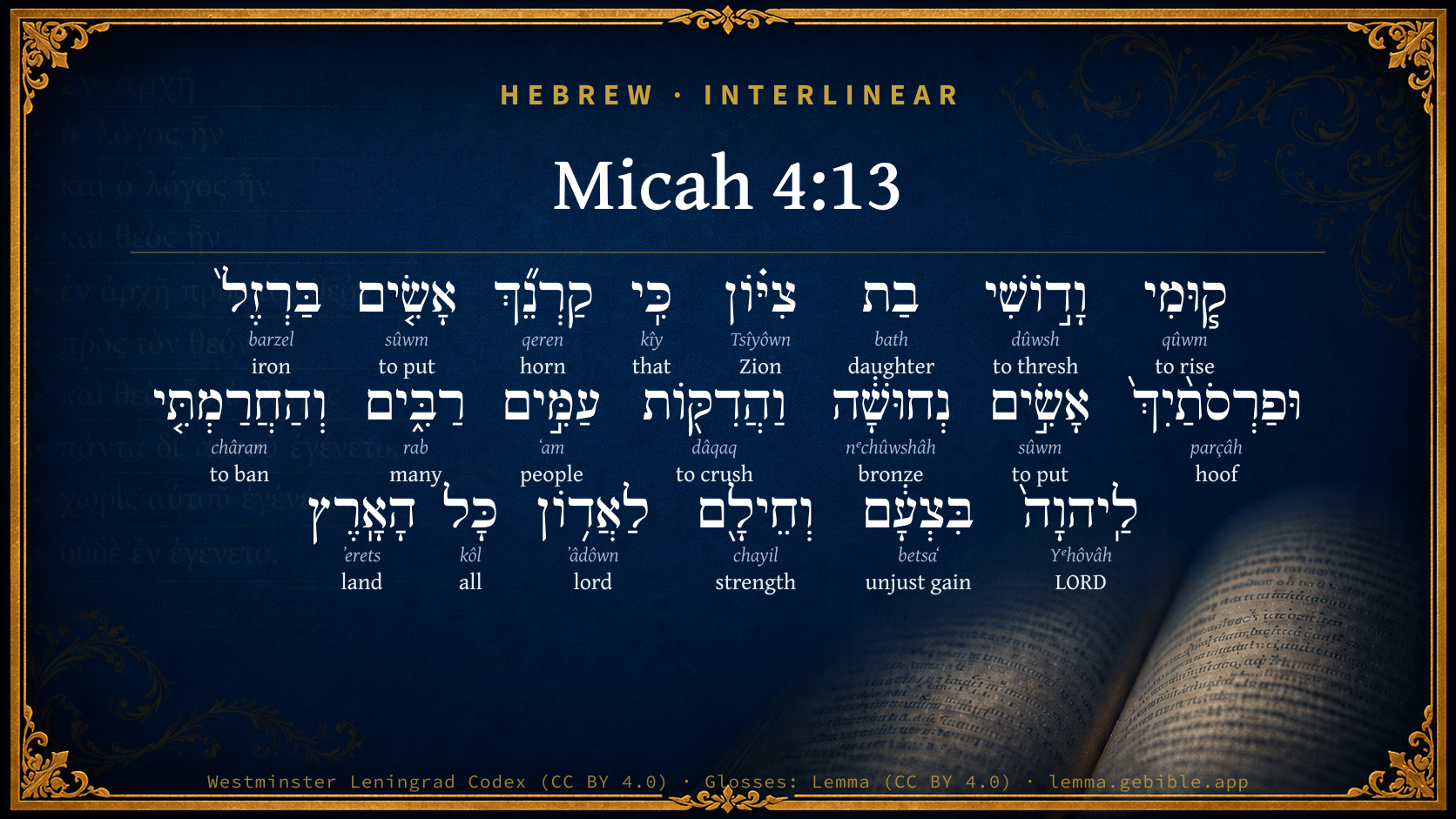
  1. ק֧וּמִי qûwm H6965 “rise” Verb, Qal, Imperative, 2nd Person, Feminine, Singular
  2. וָד֣וֹשִׁי dûwsh H1758 “and · thresh” Conjunction + Verb, Qal, Imperative, 2nd Person, Feminine, Singular
  3. בַת bath H1323 “daughter of” Noun, Common, Feminine, Singular, Construct
  4. צִיּ֗וֹן Tsîyôwn H6726 “Zion” Noun, Proper
  5. כִּֽי kîy H3588 “that” Conjunction
  6. קַרְנֵ֞ךְ qeren H7161 “horn · your” Noun, Common, Both, Singular, Construct + Suffix, Personal, 2nd Person, Feminine, Singular
  7. אָשִׂ֤ים sûwm H7760 “to put” Verb, Qal, Imperfect, 1st Person, Common, Singular
  8. בַּרְזֶל֙ barzel H1270 “iron” Noun, Common, Masculine, Singular, Absolute
  9. וּפַרְסֹתַ֨יִךְ֙ parçâh H6541 “and · hooves · your” Conjunction + Noun, Common, Feminine, Plural, Construct + Suffix, Personal, 2nd Person, Feminine, Singular
  10. אָשִׂ֣ים sûwm H7760 “to put” Verb, Qal, Imperfect, 1st Person, Common, Singular
  11. וַהֲדִקּ֖וֹת dâqaq H1854 “and · to crush” Conjunction + Verb, Hiphil, Sequential Perfect, 2nd Person, Feminine, Singular
  12. עַמִּ֣ים ʻam H5971 “peoples” Noun, Common, Masculine, Plural, Absolute
  13. רַבִּ֑ים rab H7227 “many” Adjective, Adjective, Masculine, Plural, Absolute
  14. וְהַחֲרַמְתִּ֤י châram H2763 “and · to ban” Conjunction + Verb, Hiphil, Sequential Perfect, 1st Person, Common, Singular
  15. לַֽיהוָה֙ Yᵉhôvâh H3068 “to/for · LORD” Preposition + Noun, Proper
  16. בִּצְעָ֔ם betsaʻ H1215 “unjust gain · their” Noun, Common, Masculine, Singular, Construct + Suffix, Personal, 3rd Person, Masculine, Plural
  17. וְחֵילָ֖ם chayil H2428 “and · strength · their” Conjunction + Noun, Common, Masculine, Singular, Construct + Suffix, Personal, 3rd Person, Masculine, Plural
  18. לַאֲד֥וֹן ʼâdôwn H113 “to/for · lord of” Preposition + Noun, Common, Masculine, Singular, Construct
  19. כָּל kôl H3605 “all of” Noun, Common, Masculine, Singular, Construct
  20. הָאָֽרֶץ ʼerets H776 “the · land” Particle, Definite Article + Noun, Common, Both, Singular, Absolute

About this verse

These counts appear in no published source. They are computed here, from the morphology-tagged text and Lemma’s own curated glosses. What Lemma adds →

21
words
20
distinct lemmas
Prophets
section

Notable vocabulary

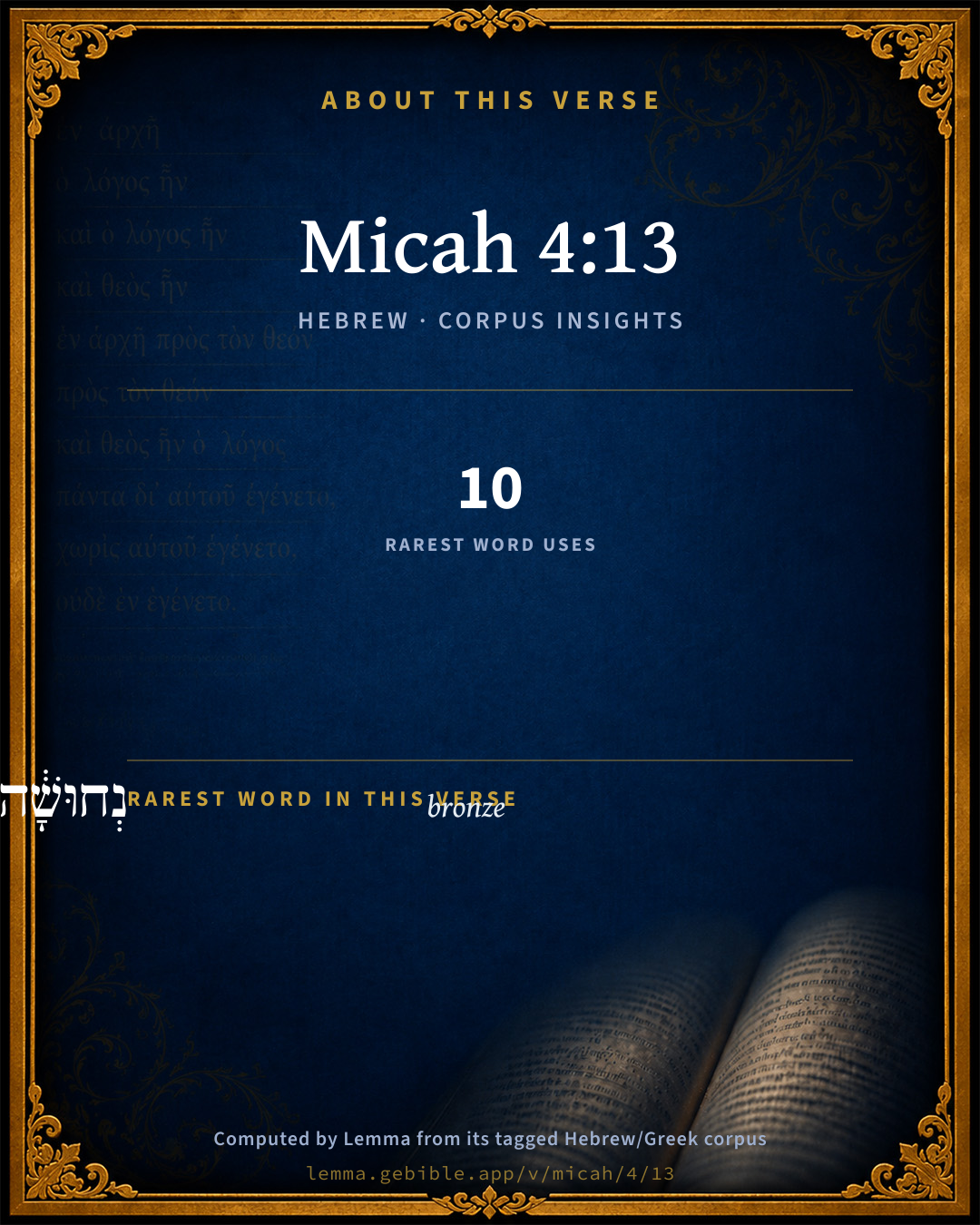
The rarest word here is נְחוּשָׁ֔ה bronze H5154 — appearing just 10 times in the whole Hebrew Bible.

Shared distinctive vocabulary

נְחוּשָׁ֔ה bronze H5154 occurs in 10 verses of the Hebrew Bible. Also found in:

Grammatical profile

  • 6 verbs
  • 13 nouns
  • 1 adjective
  • 1 conjunction

Verb forms

  • ק֧וּמִי Qal · Imperative
  • וָד֣וֹשִׁי Qal · Imperative
  • אָשִׂ֤ים Qal · Imperfect
  • אָשִׂ֣ים Qal · Imperfect
  • וַהֲדִקּ֖וֹת Hiphil · Sequential Perfect
  • וְהַחֲרַמְתִּ֤י Hiphil · Sequential Perfect

Repetition

A word recurs within this verse — often emphatic in Hebrew:

  • אָשִׂ֤ים to put H7760 ×2

Hebrew & Septuagint length

In English translation the verse runs 46 words from the Hebrew and 47 from the Septuagint (LXX English) — closely comparable.

A rough comparison of the two English renderings, which tokenize alike — not a word-level alignment.

Word counts can differ between the Hebrew and the Greek without any difference in meaning — e.g. the Hebrew direct-object marker אֵת has no separate Greek word, and Greek often adds the article ὁ.

Cross-references

20

Topical passages linked to Micah 4:13 in the Treasury of Scripture Knowledge — connected by theme and wording, ordered by reader-vote popularity; previews shown in the World English Bible.

  • Isaiah 41:15–16 Behold, I have made you [to be] a new sharp threshing instrument having teeth; you shall thresh the mountains, and beat them small, and shall make the hills as chaff.
  • Daniel 2:44 In the days of those kings shall the God of heaven set up a kingdom which shall never be destroyed, nor shall the sovereignty of it be left to another people; but it shall break in pieces and consume all these kingdoms, and it shall stand forever.
  • Zechariah 9:13–15 For indeed I bend Judah as a bow for me. I have filled the bow with Ephraim; And I will stir up your sons, Zion, Against your sons, Greece, And will make you like the sword of a mighty man.
  • Isaiah 18:7 In that time shall a present be brought to Yahweh of Hosts [from] a people tall and smooth, even from a people awesome from their beginning onward, a nation that measures out and treads down, whose land the rivers divide, to the place of the name of Yahweh of Hosts, Mount Zion.
  • Isaiah 23:18 Her merchandise and her hire shall be holiness to Yahweh: it shall not be treasured nor laid up; for her merchandise shall be for those who dwell before Yahweh, to eat sufficiently, and for durable clothing.
  • Zechariah 6:5 The angel answered me, "These are the four winds of the sky, which go forth from standing before the Lord of all the earth.
  • Romans 15:25–28 But now, I say, I am going to Jerusalem, serving the saints.
  • 1 Corinthians 16:2 On the first day of the week, let each one of you save, as he may prosper, that no collections be made when I come.
  • Revelation 2:26–27 He who overcomes, and he who keeps my works to the end, to him I will give authority over the nations.
  • Revelation 21:24–26 The nations will walk in its light. The kings of the earth bring the glory and honor of the nations into it.
  • Joshua 6:19 But all the silver, and gold, and vessels of brass and iron, are holy to Yahweh: they shall come into the treasury of Yahweh.
  • 2 Samuel 8:10–11 then Toi sent Joram his son to king David, to Greet him, and to bless him, because he had fought against Hadadezer and struck him: for Hadadezer had wars with Toi. [Joram] brought with him vessels of silver, and vessels of gold, and vessels of brass:
  • Psalms 68:29 Because of your temple at Jerusalem, Kings shall bring presents to you.
  • Psalms 72:10 The kings of Tarshish and of the isles will bring tribute. The kings of Sheba and Seba shall offer gifts.
  • Jeremiah 51:33 For thus says Yahweh of hosts, the God of Israel: The daughter of Babylon is like a threshing floor at the time when it is trodden; yet a little while, and the time of harvest shall come for her.
  • Micah 5:8–15 The remnant of Jacob will be among the nations, In the midst of many peoples, Like a lion among the animals of the forest, Like a young lion among the flocks of sheep; Who, if he goes through, treads down and tears in pieces, And there is no one to deliver.
  • Zechariah 4:14 Then he said, "These are the two anointed ones who stand by the Lord of the whole earth."
  • Deuteronomy 33:25 Your bars shall be iron and brass; As your days, so shall your strength be.
  • Isaiah 5:28 Whose arrows are sharp, And all their bows bent. Their horses' hoofs will be like flint, And their wheels like a whirlwind.
  • Isaiah 60:6–9 The multitude of camels shall cover you, the dromedaries of Midian and Ephah; all they from Sheba shall come; they shall bring gold and frankincense, and shall proclaim the praises of Yahweh.

Cross-references courtesy of OpenBible.info (CC BY 4.0).

Hebrew and Greek witnesses Masoretic Hebrew ↔ Greek Septuagint

The same verse in the two great witnesses to the Old Testament, shown verse-for-verse.

These are two independent witnesses, not word-aligned to each other, and the Septuagint is shown in lemma (dictionary) form.

Hebrew Micah 4:13 Masoretic · Westminster Leningrad Codex

ק֧וּמִי וָד֣וֹשִׁי בַת צִיּ֗וֹן כִּֽי קַרְנֵ֞ךְ אָשִׂ֤ים בַּרְזֶל֙ וּפַרְסֹתַ֨יִךְ֙ אָשִׂ֣ים נְחוּשָׁ֔ה וַהֲדִקּ֖וֹת עַמִּ֣ים רַבִּ֑ים וְהַחֲרַמְתִּ֤י לַֽיהוָה֙ בִּצְעָ֔ם וְחֵילָ֖ם לַאֲד֥וֹן כָּל הָאָֽרֶץ

Arise and thresh, daughter of Zion; For I will make your horn iron, And I will make your hoofs brass; And you will beat in pieces many peoples: And I will devote their gain to Yahweh, And their substance to the Lord of the whole earth.

World English Bible · Public Domain

Greek LXX Micah 4:13 Septuagint · lemma form

ἀναἵστημι καί ἀλοάω αὐτός θυγάτηρ σιων ὅτι ὁ κέρας σύ τίθημι σιδηροῦς καί ὁ ὁπλή σύ τίθημι χαλκοῦς καί κατατήκω ἐν αὐτός ἔθνος καί λεπτύνω λαός πολύς καί ἀνατίθημι ὁ κύριος ὁ πλῆθος αὐτός καί ὁ ἰσχύς αὐτός ὁ κύριος πᾶς ὁ γῆ

Arise, and thresh them, O daughter of Sion: for I will make your horns iron, and I will make your hoofs brass: and you shall utterly destroy many nations, and shall consecrate their abundance to the Lord, and their strength to the Lord of all the earth.

LXX2012 (modern English Septuagint) · Public Domain

On this verse, Ellicott's Commentary for English Readers discusses the Septuagint’s reading. Read the note in Commentary ↓

Hebrew: Westminster Leningrad Codex (CC BY 4.0). Greek: Septuagint (public domain); English from LXX2012 (modern English Septuagint) (Public Domain). How the Septuagint differs from the Hebrew →

Targum (Aramaic paraphrase)

1

The Targum is the ancient Jewish Aramaic paraphrase of the Hebrew Scriptures — an interpretive translation, not the Hebrew text itself. Onkelos (literal) and Pseudo-Jonathan (expansive) render the Torah, and Jonathan the Prophets. Coverage is partial: where no permissively-licensed English translation exists for a verse, only the Aramaic is shown. This is verse-level text, not a word-by-word alignment to the Hebrew.

  1. Targum Jonathan Prophets (Joshua–Malachi)
    קוּמִי וְקַטְלִי כְנִשְׁתָּא דְצִיוֹן אֲרֵי עַמָא דִי בִיךְ אֲשַׁוֵי תַקִיפִין כְּבַרְזְלָא וּשְׁאָרְהוֹן חֲסִינִין כִּנְחָשָׁא וּתְקַטְלִין עַמְמִין סַגִיאִין וּתְגַמְרִין קֳדָם יְיָ נִכְסֵיהוֹן וּמָמוֹן יְקָרְהוֹן קֳדָם רִבּוֹן כָּל עַלְמָא:

    (no public-domain English translation for this verse)

    Targum Jonathan — Aramaic: “Mikraot Gedolot” (public domain). English: “Sefaria Community Translation” (CC0 1.0 (public-domain dedication)); “London "Chaldee Paraphrase," 1871” (public domain). Text via Sefaria.

Commentary

Notes on Micah 4:13 from classic Christian and Jewish commentators (each source and its license shown beneath its notes). The classic Christian expositions comment on the surrounding passage and are grouped to its opening verse, so a note may address several verses; the Jewish commentaries on the Tanakh (Rashi and others) are per-verse, so they appear only where the commentator wrote on this verse.

Lemma curates 59 commentaries, every one of them public domain or Creative Commons licensed, each selected and text-cleaned for this edition rather than reprinted as found. About our sources →

Trapp's Complete Commentary

John Trapp

Mic 4:13 Arise and thresh, O daughter of Zion: for I will make thine horn iron, and I will make thy hoofs brass: and thou shalt beat in pieces many people: and I will consecrate their gain unto the LORD, and their substance unto the Lord of the whole earth.

Ver. 13. Arise and thresh, O daughter of Zion] "Go in this thy might" (wherewith thou so lustily threshest out thy wheat by the winepress, said the angel to Gideon, Jdg 6:14), and thresh the Midianites another while, "thou shalt smite them as one man," Jdg 6:16; thresh them as the sheaves of the floor, that lie ready for the flail, or, as the custom of those countries was, Deu 25:4 1Co 9:9 1Ti 5:18, for oxen to tread out, or the wheel to turn over, Isa 28:28.

For I will make thine horn iron, &c.] So that thou shalt do great exploits, by mine assistance, against Sennacherib, Antiochus, and other enemies subdued and threshed down to straw by the valiant Maccabees. Spiritualiter etiam hoc intelligendum, saith Sa. here; this is also spiritually to be understood of converting people to the faith, separata palea infidelitatis. This the apostles did vigorously and effectually, being furnished by Christ with horns of iron and hoofs of brass; with spiritual courage and mettle, whereby they did soon beat in pieces many people, and brought them to Christ by the obedience of faith, together with all their wealth and substance, which they cheerfully consecrate unto the Lord of the whole earth. This was typified of old by the tabernacle built with the spoils of the Egyptians; and by David’s dedicating to the Lord the gold and silver which in great abundance he had taken from the enemies, 2Sa 8:11. It is prophesied of Tyre, that being converted, she should find another manner of merchandise than formerly, viz. to feed and clothe God’s poor with durable clothing, Isa 23:18. The centurion, when once he became a proselyte, built the Jewish synagogues, that had been thrown down by Antiochus, Luk 7:5. Constantine the Great was bountiful to the Church above measure, insomuch as that he was by the heathens in scorn called Pupillus, orphan, as if he had wanted a guardian to overrule and order his expenses. Sed refriguit hoc studium hodie in magistratibus plerisque, as Gualther here complaineth, and not without cause. The Church is not only scanted, but spoiled of her revenues; and that which was piously consecrated is impiously converted to other uses, &c. Thus he.

John Trapp, A Commentary or Exposition upon All the Books of the Old and New Testament (1647–1656) — public domain. Text from a community e-Sword module.

Joseph Benson's Commentary

Mic 4:13. Arise and thrash, O daughter of Zion — The daughter of Zion means the Jewish people, whose power and victory over their enemies are here foretold. The expressions made use of are figurative, alluding to the manner of separating the corn from the chaff in Judea, which was done chiefly by treading it with the feet of oxen. The purport of the passage is, that the Jews are here called upon to arise and tread down their enemies. For I will make thy horn iron, and thy hoofs brass — Thou shalt be enabled to do this with ease and safety. And thou shalt beat in pieces — Or, shalt bruise, many people — This might be spoken of the victories which the Jewish people, some time after their return, were to gain over the neighbouring nations, especially under the Maccabees and their successors. But the prophecy does not appear to have had a full accomplishment in these victories: nor has any event yet occurred in the history of the Jewish people which fully answers to it. This consideration has induced some commentators to expound the passage in a spiritual sense, namely, of bringing the Gentiles into subjection to Christ and his gospel, and of the victory which the Christian Church should obtain over her persecuting enemies after the conversion of the Roman emperor Constantine to the faith of Christ. Thus Dr. Pocock, Lowth, and many others understand it. The nations thought to have ruined Christianity in its infancy, but it proved victorious over them; those that persisted in their enmity were broken to pieces, Mat 21:44; particularly the Jewish nation: but multitudes, by divine grace, were gained to the church, and, as is signified in the next clause, they and their substance were consecrated to the Lord Jesus, the Lord of the whole earth. We have reason to believe, however, that this prophecy will have a still more eminent and evident accomplishment, when all the enemies of the church shall be subdued, and the saints reigning with Christ shall have complete power over the nations, and shall rule the refractory with a rod of iron, Rev 2:26-27 : compare this text with Mic 5:8-15 of this prophecy, and with Isa 14:2; Isa 41:15; Isa 60:12; Isa 61:5; on which places see the notes.

Joseph Benson's Commentary on the Old and New Testaments (1811–1818) — public domain. Text from a community e-Sword module.

Tyndale Open Study Notes

Tyndale Open Resources

4:13 The horns and hooves of bulls and horses represent strength, as do both iron and bronze. Metal shoes may have been used on the feet of animals who trod out the grain. God will strengthen his peoples to defeat their enemies. • stolen riches: Many nations had accumulated wealth by unjust means (war, plunder, oppressive tributes, forced labor, and conscription). The Lord of all the earth owned all of this wealth to begin with (Exod 19:5). • You will present: The Hebrew term (kharam, “dedicate”) refers to military spoils of war that were dedicated, or set aside, as holy to the Lord (see Lev 27:28-29).

Tyndale Open Study Notes — © Tyndale Open Resources, licensed CC BY-SA 4.0. Text via the HelloAO Bible API.

Geneva Bible (1599)

Geneva Bible translators

God giveth his Church this victory, so oft as he overcometh their enemies: but the accomplishment thereof shall be at the last coming of Christ.

Geneva Bible (1599) marginal notes — public domain. Text via Bolls.life.

Jamieson, Fausset & Brown

Robert Jamieson, A. R. Fausset & David Brown

thresh--destroy thy foes "gathered" by Jehovah as "sheaves" (Isa 41:15-16).

thine horn--Zion being compared to an ox treading corn, and an ox's strength lying in the horns, her strength is implied by giving her a horn of iron (compare Kg1 22:11).

beat in pieces many-- (Dan 2:44).

I will consecrate their gain unto the Lord--God subjects the nations to Zion, not for her own selfish aggrandizement, but for His glory (Isa 60:6, Isa 60:9; Zac 14:20, with which compare Isa 23:18) and for their ultimate good; therefore He is here called, not merely God of Israel, but "Lord of the whole earth."

Next: Micah Chapter 5

Jamieson, Fausset & Brown — Commentary Critical and Explanatory on the Whole Bible (1871) — public domain (CC PDM 1.0). Text via the HelloAO Bible API.

Adam Clarke's Commentary

Verse 13. Arise and thresh, O daughter of Zion] This refers to the subject of the preceding verse. When God shall have gathered together all thy enemies, as into the threshing-floor, he will give thee commission and power to get a complete victory over them, and reduce them to servitude. And that thou mayest be able to do this, he will be on thy side as a powerful helper; here signified by the metaphors, iron horns, and brazen hoofs. Thou shalt have power, authority, and unconquerable strength; for thine enemies shall be no more against thee than the corn against oxen shod with brass, or a puny animal against the horn of a fierce bull tipped with iron.

I will consecrate their gain unto the Lord] What they have taken from thee in the way of spoil shall be restored; and again consecrated unto the service of him who will show himself to be the Lord, the Supreme Governor of the whole earth. Was not this prediction fulfilled when Cyrus gave the Jews permission to return to their own land, and gave them back the sacred vessels of the temple which Nebuchadnezzar had carried away? The Maccabees and their successors recovered much of the booty of which the neighbouring nations had deprived the Jews; and the treasure taken was devoted to Jehovah. The first verse of the next chapter should conclude this. Mic 5:1

Adam Clarke's Commentary on the Bible (1810–1826) — public domain. Text from a community e-Sword/MySword module.

John Calvin's Commentaries

Arise and thresh, daughter of Zion; for I have made thy horn iron, and thy hoofs brass. The Prophet here confirms what he had previously said: and he exhorts the daughter of Zion to arise; for it was necessary for her to have been cast down, so as to lie prostrate on the ground. God did not indeed restore at once his Church, but afflicted her for a time, so that she differed nothing from a dead man. As then a dead body lies on the ground without any feeling, so also did the Church of God lie prostrate. This is the reason why the Prophet now says, Arise, daughter of Zion; as though God, by his voice, roused the dead. We hence see, that the word קומי, kumi, is emphatical; for the Prophet reminds us, that there is no reason for the faithful wholly to despair, when they find themselves thus cast down, for their restoration is in the hand and power of God, as it is the peculiar office of God to raise the dead. And this same truth ought to be applied for our us, whenever we are so cast down, that no strength, no vigor, remains in us. How then can we rise again? By the power of God, who by his voice alone can restore us to life, which seemed to be wholly extinct.

He afterwards subjoins, Thresh, for I have made thy horn iron, and thy hoofs brass. A mode of thrashing, we know, was in use among the Jews the same with that in Italy and at this day in French Provence. We here thrash the corn with flails; but there by treading. The Prophet speaks here of this custom, and compares the Church of God to oxen; as though he said “The Jews shall be like oxen with iron horns and brazen hoofs that they may lay prostrate under them the whole strength of the nations. However much then the nations may now excel, I will subject them under the feet of my people, as if sheaves were thrashed by them.”

He then adds, And thou shalt separate or consecrate their wealth to Jehovah, and their substance to the Lord of the whole earth Here the Prophet specifies the end for which God had purposed to subject the heathen nations to his chosen people, — that he might be glorified. This is the meaning. But they have refined too much in allegories, who have thought that this prophecy ought to be confined to the time of Christ: for the Prophet no doubt meant to extend consolation to the whole kingdom of Christ, from the beginning to the end. Others, not more correctly, say, that this is to be referred to the Babylonian captivity because then Daniel and some others thrashed the people, when heathen kings were induced through their teaching to restore the temple, and also to offer some worship to the God of Israel. But on this point they are both mistaken, because they take the word thrashing in a different sense from the Prophet; for it commonly means that heathen nations are to be subjected to the Church of God: and this takes place, whenever God stretches forth his hand to the faithful, and suffers not the ungodly to exercise their cruelty as they wish; yea, when he makes them humbly to supplicate the faithful. This often happens in the world, as it is written of Christ, ‘thy enemies shall lick the earth,’ (Psalm 72:9.) But this prophecy shall not be fulfilled until the last coming of Christ. We indeed begin to tread on our enemies whenever God by his power destroys them, or at least causes them to tremble and to be cast down, as we find that they dread whenever any change takes place; and then they blandly profess that they desire to serve God. So at this day it has happened both in France and in Italy. How many hypocrites, for the sake of an earthly advantage, have submitted themselves to God? and how many such England produced when the Gospel flourished there? All the courtiers, and others who were unwilling to incur the displeasure of the king, professed themselves to be the very best lovers of religion. (optimos pietatis cultores, — the best observers of piety) But yet this is ever the case,

‘Aliens have been false to thee,’ (Psalm 18:44.)

We hence see what the prophet means when he speaks of thrashing: he intimates, that the Lord would often cause that the enemies of the Church should be bruised, though no one crushed them: but, as I have said, we must look forward to the last day, if we wish to see the complete fulfillment of this prophecy.

He afterwards adds, Thou shalt consecrate their wealth to Jehovah, and their substance to the Lord of the whole earth The Prophet shows here, that the dominion is not to be hoped for by the children of God, that they may abound in worldly pleasures, and appropriate every thing to themselves and also abuse their power, as ungodly men are wont to do; but that all is to be applied to the worship and the glory of God. For what purpose, then does God design his Church to become eminent? That he himself may alone shine forth, and that the faithful may rightly enjoy their honor, and not become thereby proud. There is, therefore nothing more alien to the power of the Church than pride, or cruelty, or avarice. This, then that is said ought to be carefully observed, their wealth thou shalt consecrate to Jehovah He had spoken before of power, “Thou shalt bind strong people, thou shalt thrash them, and thou shalt tread them under thy feet;” but lest the faithful should turn all this to a purpose the Lord had not designed, a most suitable correction is immediately added, and that is, that this power shall not be exercised according to the will of men, but according to the will of God: Thou shalt then consecrate, etc.; and he uses the word חרם, cherem, which means to make a thing an anathema or an offering; as though he said “God will raise his Church that it may rule over its enemies; but let the faithful at the same time take heed, that they rule not tyrannically; for God designs ever to reign alone: therefore the whole excellency, the whole dignity, the whole power of the Church ought to be applied for this end, — that all things may become subject to God, and every thing among the nations may be altogether sacred to him so that the worship of God may flourish among the conquerors, as well as among the conquered.” We now perceive the Prophet’s object in speaking of consecrating the wealth of the nations. Now follows —

John Calvin's Commentaries (1540-1563) — public domain. Text from the Calvin Translation Society English edition (1840s-50s) via the Christian Classics Ethereal Library (ccel.org). Calvin's coverage is partial (roughly two-thirds of the Bible); uncommented books and verses are honest gaps, never fabricated. The 19th-century editor's footnotes and remarks are omitted so the notes are faithfully Calvin's own voice.

Ellicott's Commentary for English Readers

(13) Arise and thresh.—Micah, having likened Israel to the sheaves safely gathered, pursues the metaphor by calling upon the daughter of Zion to thresh her enemies after the manner of oxen treading out the corn; and under the symbolism of the horn—the weapon of strength—he promises that God will strengthen her for the work

I will consecrate.—The better reading is that of the LXX., Vulg., and some ancient versions, which give the second person, Thou shalt consecrate their gain unto the Lord. The termination, indicating the first person in our Hebrew Version, may be a form of the old second person feminine, of which there are other examples.

A Bible Commentary for English Readers, edited by Charles John Ellicott (1878–1897) — public domain. Text from a community e-Sword module.

The Cambridge Bible for Schools and Colleges

gen. ed. J. J. S. Perowne

13. thresh] A figurative expression for ‘conquer’ (comp. Isa_41:15, Jer_51:33), based on the barbarous custom of torturing those who had been taken captives in war (2Sa_12:31, Amo_1:3). It may be called a phraseological ‘survival.

horn] Another figure for victorious might; comp. Deu_33:17.

hoofs] Alluding to the custom of employing oxen to tread out the corn; comp. Deu_25:4, 1Co_5:9. Sometimes however a machine was used (see above).

many people] Rather, many peoples.

I will consecrate] Rather, thou shalt (so the ancient versions rightly render, comp. Gesenius, Hebr. Gram. § 47, Rem. 5) devote. See Lev_27:28, “every devoted thing is most holy unto the Lord.” The term ‘devoted thing’ is applied sometimes to lifeless objects (e.g. Lev_27:21), and sometimes to living (e.g. 1Sa_15:21, 1Ki_20:42). In the latter case, devotion, strictly speaking, involved destruction, i.e. the restitution to the Lord of life of that breath which He for a time had granted.

The Cambridge Bible for Schools and Colleges (gen. ed. J. J. S. Perowne; Cambridge University Press, 1878–1918) — public domain. Text from a community e-Sword module.

John Gill's Exposition

Arise, and thresh, O daughter of Zion,.... The nations gathered against her, and now laid together on the floor as sheaves to be threshed. Here the people of God are aroused, and called out of a low and weak estate, and are animated and encouraged to exert themselves, and fall upon their enemies, and destroy them; alluding to the threshing of grain on the floor, the metaphor being here carried on from Mic 4:12. The Targum is,

"arise, and kill, O congregation of Zion;''

for I will make thine horn iron, and I will make thy hoofs brass; signifying that the Lord would give them strength sufficient to such work, and such power their enemies should not be able to resist and overcome; and that they should into their hands, and be crushed, trod, and trampled on by them, and utterly subdued. The allusion is to oxen that have horns and hoofs; and it suggests that they should be as strong as they; have horns like them, that is, power to push down their enemies and hoofs to trample upon them: or as these creatures have a horny substance on their feet, or hoofs, which are strong, and fit for the purposes of treading out corn, for which they were used in the eastern countries, drawing after them iron wheels, or planks stuck with flints; so horses and oxen that have strong feet, and hard hoofs, are said to have feet of brass (b); thus the Lord's people should have such courage, force, and power, as not only to withstand their enemies, but to obtain a conquest over them The Targum is,

"I will make the people in them strong as iron, and their remnant firm as brass;''

which was true of, and accomplished in, Judas Maccabeus and his brethren; and will be more clearly fulfilled in the Christian kings and princes in the latter day, when engaged with the antichristian states;

and thou shalt beat in pieces many people; as the Maccabees did subdue many people and nations, as all Palestine, Moab, Idumea, Samaria, and Iturea, as Josephus (c) relates; and as the Christian princes will beat in pieces, and utterly destroy, all the antichristian kings of the earth, their states and kingdoms, and bring them into subjection to them:

and I will consecrate their gain unto the Lord, and their substance unto the Lord of the whole earth; that is, to Christ, who in the last day will appear to be King and Lord of the whole earth; and all the riches of the antichristian nations, Pagan, Papal, and Mahometan, will be devolved to, and employed in, his interest and service; see Rev 21:24; these are the words of God the Father, with respect to his Son Jesus Christ; who will now have a dominion, glory, and kingdom given him, by the ancient of days, that so all people, nations, and languages, shall serve him, Dan 7:14; of which there might be some type and shadow in the times of the Maccabees.

(b) "aeripedes equos", Homer. Iliad. 8. v. 41. (c) Antiqu. l. 13. c. 15. sect. 4.

Next: Micah Chapter 5

John Gill's Exposition of the Whole Bible (1746–1763) — public domain (CC PDM 1.0). Text via the HelloAO Bible API.

Albert Barnes' Notes on the Bible

Arise - (It may be,) from the dust in which they were lying, “I will make thine horn iron, and I will make thy hoofs brass.” Threshing in the East is partly with oxen, partly with wheels of iron, or with planks set with sharp flints on an open place made hard to this end. The prophet joins another image, with this and represents Judah as being by God endued with strength, first as with a “horn of iron” 1Ki 22:11 to cast the enemy to the ground, and then with “hoofs of brass,” wherewith to trample them to dust, as the stubble and chaff. “And I will consecrate their gain unto the Lord,” that is, to Myself; the Lord gathered them into the floor by His Providence; the Lord gave His people strength to subdue them; and now, in His own Person, He says, I will complete My own work.

The very image of the “threshing” implies that this is no mere destruction. While the stubble is “beaten” or bruised to small pieces, and the chaff is far more than the wheat, and is carried out of the floor, there yet remains the seed-corn. So in the great judgments of God, while most is refuse, there yet remains over, what is severed from the lost heap and wholly “consecrated” to Him. Whatever things were the object of the חרם chêrem Lev 27:28 or “thing devoted to the Lord,” could not be redeemed, but must remain wholly the Lord’s. If it had life, it was to be put to death Lev. 29. And so the use of the word here may the rather shew, how those converted to God, and who became gain, hallowed to Him, were to pass through death to life, to die to themselves that they might live to Him: what was evil was to be slain in them, that they themselves might live.

The Israelites and God’s dealings with them are “ensamples of us upon whom the ends of the world are come” 1Co 10:11. And so the whole section fits wonderfully with the condition of the single soul. “She who halteth” (Rib.) “the soul, who would serve God, yet not so as wholly to give up the service of the world, which it had in Baptism renounced, who, after it had gone astray like a lost sheep, and been scattered amid the manifoldness of earthly things, was gathered again into the fold, to love One only, long for One only, give itself to One,” its Good Shepherd, and over it the Lord reigneth forever, if, taught by experience the deceitfulness of Satan’s promises, and stung by the sense of its own thanklessness and vileness, and conscious of the peril of self confidence, it abideth more closely than others with God. He shall gather her that is driven out, that is, , “He shall restore her, from whom He had, for the time, withdrawn His grace,” and her that was afflicted, trouble being God’s most effectual instrument, in recalling the soul to Himself. “For the Lord raiseth them that are bowed down” Psa 146:8.

And will make her that halteth, a remnant, placing her among the elect and holy, and her that was cast off strong; for Christ giveth oft to such souls great richness of divine graces, so that “where sin abounded, grace” should “much more abound” Rom 5:20. Rib.: “To it, when enlightened and purified by affliction and by repentance, it is promised, that its Lord, the Great King, shall come to it, and again reign in it, which is the great bliss of souls in grace. For then doth the soul really reign, when it submits wholly to Christ, whom to serve is to reign, and so, under Him, receives power to command its wrong desires, and rule itself;” that great and wonderful power which the Evangelist expresses in words so brief, “To them gave He power to become the sons of God” Joh 1:12. Thus He maketh it strong, so that “neither death, nor life, nor angels, nor principalities, nor powers, can separate it from the love of God which is in Christ Jesus our Lord” Rom 8:38-39.

Then, “he describes the condition of the soul fluctuating between good and evil, called one way by God through inward inspirations, and another way by the enticements and habits of sin. And, wishing to follow God, yet not to be without its sinful pleasures, and knowing this to be impossible, it is in anguish and hesitates. Her the prophet justly rebukes, ‘why thus cry aloud, as though thou must be led captive by the Devil, not knowing or unable to extricate thyself? Hast thou no King, aided by whose power, thou mayest fight against all enticements, habit, the flesh?’ Paul felt this and cried aloud, “I see another law in my members, warring against the law of my mind, and bringing me into captivity to the law of sin which is in my members. O wretched man that I am, who shall deliver me from the body of this death?” Rom 7:23-24. You see his grief. But he despairs not. He knows that he has a King. I thank God through Jesus Christ our Lord. Or why grievest thou, as if thou hadst no “counsellor,” by whose counsels to free thee from these snares? “Thy Counsellor” indeed “perished” on the Cross, but for thy sake, that thou mayest live.

He died, to destroy him who hath the power of death. But He rose the third day and is still with thee; at the Right Hand of the Father He still reigns Immortal forever. See how many counsels He has left thee in the Gospel, how many admonitions, whereby thou mayest lead a happy and tranquil life. Now “pain seizes thee like a woman in travail.” For such a soul travails, having conceived inspirations from God, which it wishes to obey, but that the flesh, overcome by concupiscence, resists, and so it never brings forth, nor experiences that joy, whereof the Lord speaketh, “When she is delivered of the child, she remembereth no more the anguish, for joy that a man is born into the world” Joh 16:21. Wherefore he adds; be in pain, for thou art indeed in travail; thou wilt not cease to be in pain, until thou bring forth. Thou wilt go forth, etc. “God, by a provision of His great mercy, allows lukewarm souls, who will be at no pains to gain grace, to fall into foulest sins, in order that, owning at last their misery, they may cease to be lukewarm, and with great ardor of soul may embrace virtue. For, warned by the result, they understand that they themselves emboldened the tempter, (for he chiefly attacks the lukewarm and remiss,) and they become ardent in the conflict and in well-doing.”

Wherefore he says, thou shalt go forth out of the city, that City of God, whereof He is the Builder and Maker Heb 11:10, which is gladdened by the river of His spirit; “and it dwells in the open field, unprotected, ready to be a prey, in the broad way of its own concupiscences, out of the narrow road which leadeth to life, and goeth even to Babylon, the city of ‘confusion,’ in tumult and din and unrest, and the distractions of this life.” Yet even there shall it be delivered, like the poor Prodigal, who came to himself in a far country, when worn out by its hard service. Even there it must not despair, but remember, with him, its Father’s house, its former home, the Heavenly Jerusalem. Its pains within or without, whereby it is brought back, are travail-pains. Though all is dark, it must not say, I have no Counsellor. For its Redeemer’s Name is “Counsellor” Isa 9:6, “one Counsellor of a thousand” (Ecclesiasticus 6:6). : “Thine Intercessor never dies.”

Out of the very depth of misery will the Divine Mercy draw thee. Though thou seem held by the strong hand of the enemy, and he seems to triumph over thee and to jeer thee, “There, there so would we have it, we have devoured him” Psa 35:25, and hosts of devils seek thy utter destruction, and thou seem to be “delivered over” 1Co 5:5 to them to the destruction of the flesh; yet is it only that the spirit may be saved in the Day of the Lord. Even Satan, when he is tormenting souls, knows not the thoughts of the Lord, nor understands His counsels, how, by the very pain which he inflicts, God is bidding: them, Rise and (Rib.) “look up to heaven and long for heavenly things and trample on all which they had hitherto foully served, honor or vain glory or covetousness or lust;” how He will exalt their horn in the Lord, make it strong as iron that they should do all things through Christ in strengthening them, and conquer all through the might of Christ; how He should bruise Satan under their feet shortly, and they consecrate wholly to God their whole strength, every power of soul and body which hitherto had been the adversary’s.

Albert Barnes' Notes on the Bible (1834–1885) — public domain. Text from a community e-Sword/MySword module.

Haydock's Catholic Bible Commentary

Brass. Fear nothing. The Jews did not attack the army of Cambyses, (Ezechiel xxxviii. 21., and xxxix. 10.; Calmet) at least at first. (Haydock) --- But what God did for them is attributed to them. (Calmet) --- Immolate. Septuagint, "devote to the Lord their multitude, and," &c. Protestants, "gain," (Haydock) or what spoils they have taken. (Calmet)

George Leo Haydock (1774–1849), Haydock's Catholic Family Bible and Commentary, 1859 edition — public domain. Excludes Psalms (Douay-Rheims chapter numbering differs from Protestant) and Deuterocanonical books (Catholic canon only).

Matthew Poole's English Annotations

Arise: this imperative may be read in the future tense, and so be an express promise; it is, however, an implicit promise made to the daughter of Zion, the Jewish church, type of the gospel catholic church, that she shall be raised out of a captive, low, and oppressed state, and this shall be by the reviving power of her God.

Thresh; so in a decorum to the metaphor, Mic 4:12, used to express the gathering of the enemy into the floor to be broken: the future strength of the church, employed successfully (more by the arm of her Redeemer than her own) in the subduing and breaking her enemies, is here foretold and promised, as it is also Isa 41:15. Christ will thus punish his enemies. So Babylon typical, as threatened Jer 2:33, was beat to pieces; and so shall antitypical Babylon in due time be broken as straw that is thrashed into smallest pieces like chaff.

I will make thine horn iron: some taking this for the horny part of the hoof of the ox which did tread out the corn, make it to be in sense the same with the hoofs made brass; but they that take it as our version doth, for the horn properly taken, with which the horned beasts do push and thrust down, break, or wound, do express the power and strength of the church firm as iron to beat down her enemies. I will make thy hoofs brass: by this figurative speech is the strength of Zion expressed, by which she treads under foot, and breaks the power of enemies into pieces that it shall never be repaired, as straw that is thrashed in the floor and broken like chaff.

Thou shalt beat in pieces; in the times after the rebuilding of Jerusalem the Jews grew to such strength, that in their wars they did, especially in the Maccabees’ time, break their enemies in pieces. But here is a mystical and spiritual sense of these words, as they refer to the Messiah’s kingdom, in which he will break hard hearts by the power of his word, and convert sinners to himself; and by the power of his almighty arm will defend and support his own subjects, whilst he doth by invincible strength throw down and trample into dust his and their enemies. And this power he hath sometimes evidently exercised already, in the various deliverances he hath wrought for his people, which stand recorded in the church histories. Of this strength you may truly say what is reported of the inscription in the cross appearing to Constantine, In this thou shalt conquer.

Many people; such as were enemies in disposition and carriage towards the Jews though neighbours in their situation; these were both many and mighty enemies: such Christ’s church hath to contest with, and such Christ will conqueror for his church, for he it is who goeth forth conquering and to conquer, Rev 6:2; and all his enemies shall be made his footstool, Psa 110:1.

I will consecrate: some refer this to the church, and so it may well enough be applied: the redeemed of the Lord should by their own act and deed become the Lord’s. Others refer it to the Lord, he will consecrate; this is best: but both together, the Lord will, and therefore the church will; God requires it, they consent to it.

Their gain; the spoils of their conquered enemies, what they get out of their hand. So the tabernacle was enriched with the spoils of Egypt, and the temple built with that which David did dedicate of the spoils of enemies; and Persian bounty built the second temple.

Unto the Lord; to the true God, for his honour and in his service.

Their substance; their power, glory, and wealth, all they have and are.

Unto the Lord of the whole earth; with humility and low thoughts of all we do, as done to him that doth not need it, being Lord of all.

Matthew Poole's English Annotations on the Holy Bible (1683–1685) — public domain. Text from a community e-Sword/MySword module.

The Pulpit Commentary

Arise. Shake off thy sorrow and fear and despair. And thresh. Tread thine enemies underfoot, now that they are gathered in the floor, as the oxen tread out the corn (Isa_41:15, etc.; Jer_51:33) Thine horn. The horn is an emblem of power and victory, as appertaining to the wild ox, the most powerful animal in Canaan (1Ki_22:11) The metaphor of threshing is dropped for the moment, but resumed in the next clause. Hoofs. In allusion to the mode of threshing mentioned above. (Deu_25:4 1Co_9:9) People; peoples. Israel shall crush all the nations that rise up against her. I (God) will consecrate. So the Masoretic text; but the second person, which the ancient versions give, is preferable. Septuagint, anayhseiv , "thou shalt dedicate;" Vulgate, interficies. Thou, Zion, shalt devote their gain unto the Lord. This consecration, or devotion, to the Lord in the case of living things involved death, the restitution to the Lord of the life which he had given. (see Lev_27:21, Lev_27:28, 29 Zec_14:21) Thus the spiritual Israel, purified by suffering, and redeemed, shall consecrate to the Lord the power of the world; and all the wealth and might of earth shall be subservient to the glory of the kingdom of God.

The Pulpit Commentary (1880–1919), ed. H.D.M. Spence-Jones & Joseph S. Exell — public domain. Text from a community e-Sword module.

John Wesley's Explanatory Notes

And thresh - The future strength of the church employed in subduing her enemies, is here foretold. Iron - This expresses the strength of the church firm as iron, to beat down her enemies. Brass - By this figurative speech, is the strength of Zion expressed, treading underfoot, and breaking the power of her enemies in pieces. And I - I, the church. Their gain - The spoils of my conquered enemies.

John Wesley, Explanatory Notes Upon the Whole Bible (1754–1765) — public domain. Text via the GEBible commentary corpus.

unfoldingWord translationNotes

Door43 World Missions Community

General Information:

Yahweh presents the imagery of the threshing floor. (See: Micah 4:12)

Arise and thresh, daughter of Zion ... your horn ... your hooves ... You will crush

All instances of "your" and "you," as well as the commands, refer to the "daughter of Zion" and so are singular and feminine. (See: Forms of You)

Arise and thresh, daughter of Zion, for I will make your horn to be iron, and I will make your hooves to be bronze

Yahweh speaks of the people of Zion as if they were strong oxen about to thresh wheat and their enemies were the wheat. (See: Metaphor and Translate Unknowns)

I will make your horn to be iron, and I will make your hooves to be bronze

If your reader is not familiar with oxen or iron or bronze, you can remove the metaphor. AT: "for I will make you able to defeat and destroy every enemy" (See: Metaphor and Translate Unknowns)

their unjust wealth

"the wealth they got by acting unjustly" or "the things they stole from other people"

their wealth

The abstract noun "wealth" can be translated as a verb. AT: "the things that they own" (See: Abstract Nouns)

translationWords

thresh

bronze

people group

just

Yahweh

lord

earth

unfoldingWord translationNotes — © Distant Shores Media and the Door43 World Missions Community, licensed CC BY-SA 4.0. Source: git.door43.org/Door43/en_tn.

Rashi

Rabbi Shlomo Yitzchaki (Rashi)

and I will devote Heb. וְהַחֲרַמְתִּי, an expression of hallowing.

their plunder—What they gathered from robbery and violence.

and their wealth—Their possessions.

Rashi on the Tanakh — English translations: “The Judaica Press complete Tanach with Rashi, translated by A. J. Rosenberg” (CC BY 4.0); “Pentateuch with Rashi's commentary by M. Rosenbaum and A.M. Silbermann, 1929-1934” (public domain); “The Metsudah Tanach series, Lakewood, N.J” (CC BY 4.0); and “The Book of Joshua, Metsudah Publications, 1997” (CC BY 4.0). Text via Sefaria.

Lesson kit

Teaching starters — assembled from the data on this page, not authored interpretation. Every prompt links to the verse data it draws on. Edit before teaching.

Micah, in the Prophets, opens this verse with 21 words (20 distinct Hebrew lemmas). Its most distinctive word is nᵉchûwshâh (“bronze”). A historical commentator’s framing appears above. Read the whole chapter for the surrounding context.

Discussion questions

  1. What does “bronze” (nᵉchûwshâh) contribute to the verse as a whole?
  2. Leviticus 26:19 shares the word «bronze» with this verse. How do the two illuminate each other?
  3. “to put” occurs 2× in this one verse. What is the effect of the repetition?
  4. These translations render this verse differently; the difference is in the English rendering, not the original. What questions does that raise?
  5. The verb «ק֧וּמִי» is Qal Imperative. How does its form color the action?
  6. Reading how Trapp's Complete Commentary and Joseph Benson's Commentary read this verse, where do the two commentators agree and where do they part?

Things to notice

Reading settings

Reading text

Shown beneath each verse's original-language words.

Old Testament
Old Testament edition

Read the OT as the Masoretic Hebrew (MT) or the Greek Septuagint (LXX).

English shown for the Greek Septuagint (in the Hebrew ↔ Greek comparison).

Comparing translations? Open the Compare panel on any verse page to stack up to four side by side.