
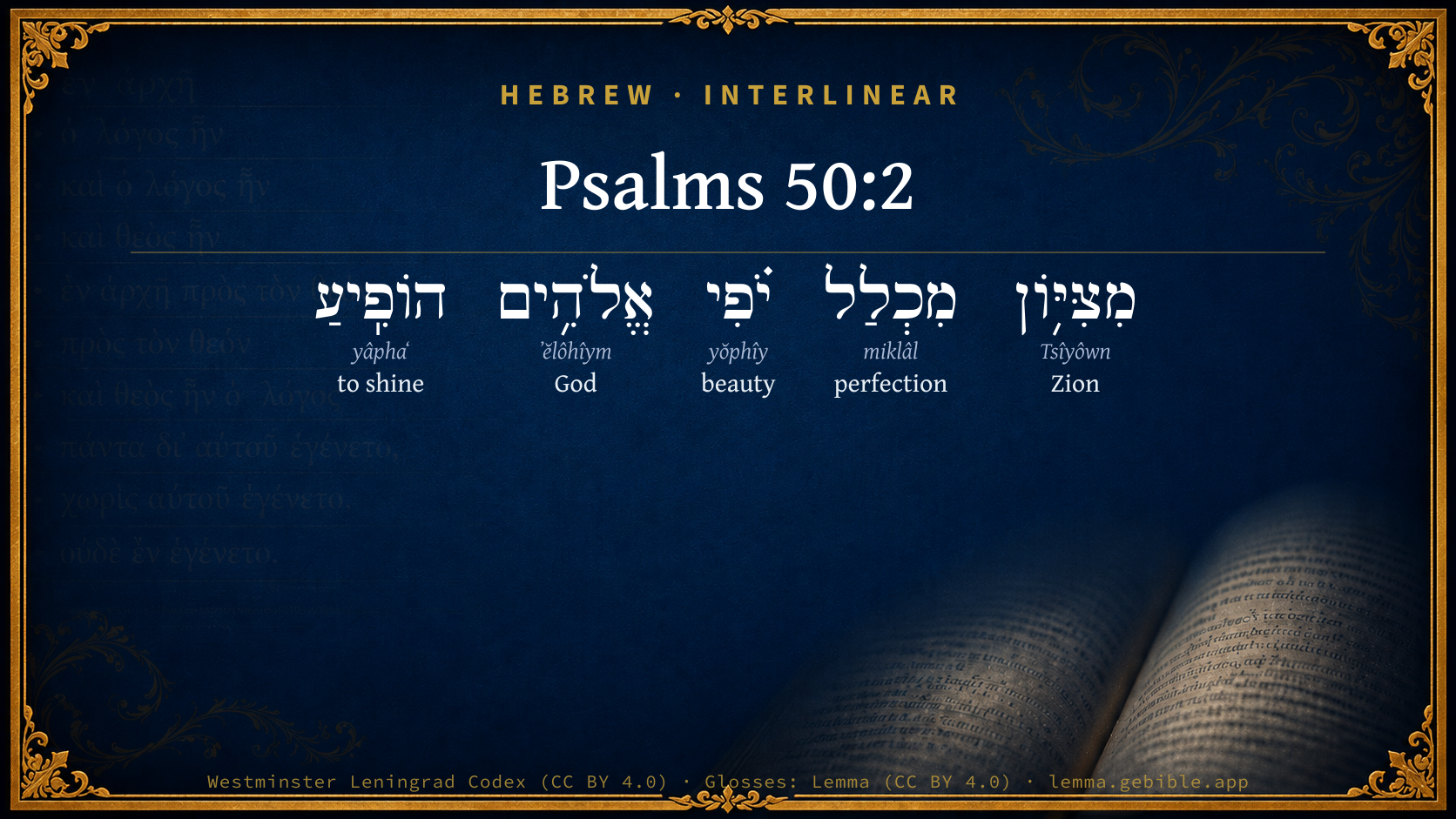
Psalms 50:2

Hebrew (Westminster Leningrad Codex) Psalms 50:2 appears in the Hebrew Old Testament. The text above is from the Westminster Leningrad Codex. Each word links to its Strong’s number, a concise gloss, and parsing drawn from the Open Scriptures Hebrew Bible morphology. Click any word for its full Brown-Driver-Briggs (BDB) entry.
Download image
Cite this verse

Psalms 50:2 (World English Bible). Public Domain. Lemma interlinear Bible study tool, https://lemma.gebible.app/v/psalms/50/2.

Show BibTeX & RIS
BibTeX
RIS
English Translation
Out of Zion, the perfection of beauty, God shines forth.
World English Bible · Public Domain
Highlights
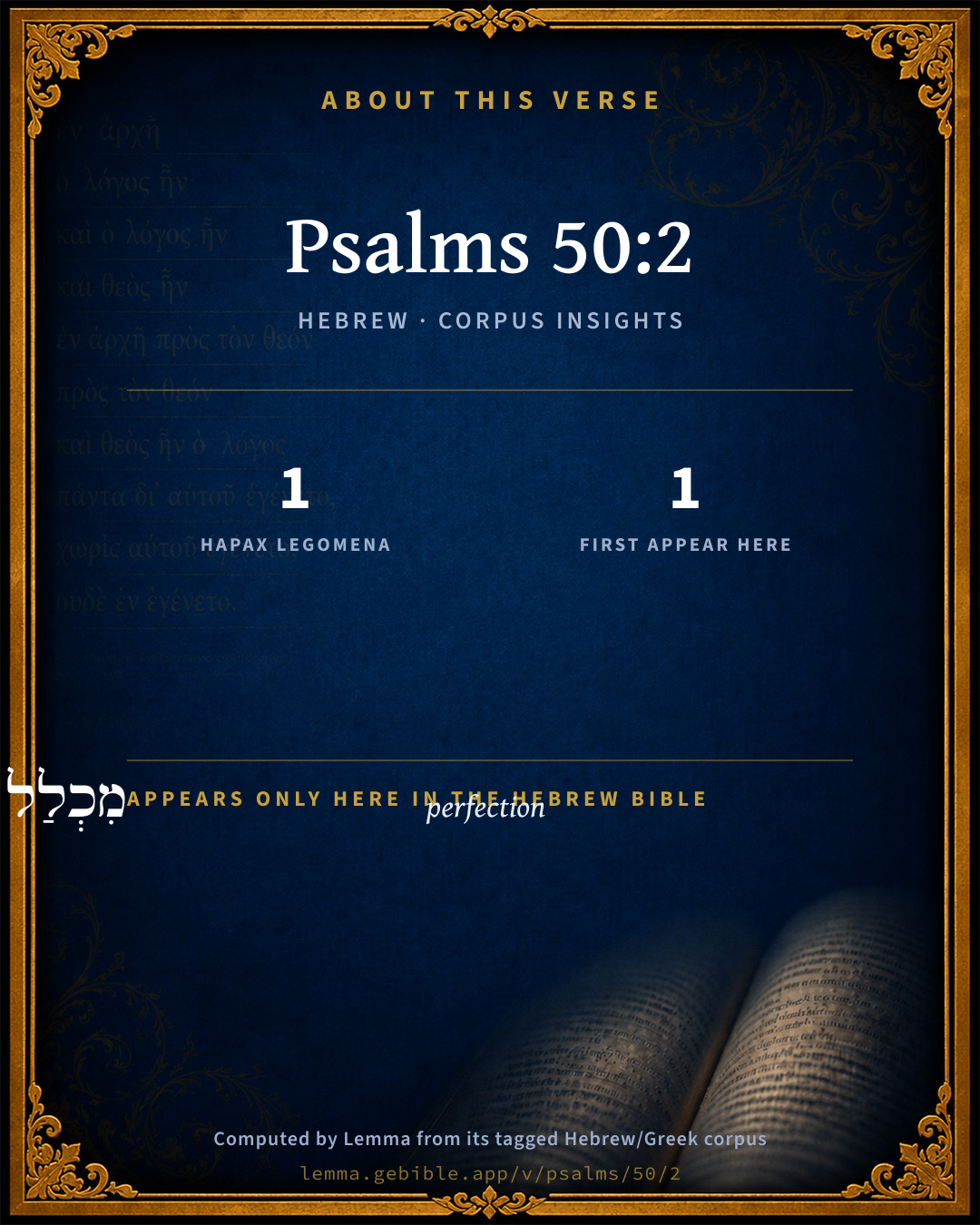
  • 1 hapax legomenon — only here in the Hebrew Bible
  • 1 first appearance in the Hebrew Bible
Full analysis ↓
Download a study sheet

One document with this verse’s original text, its word-by-word gloss line, the meaning frame, cross-references with their text, attributed commentary, and full source and license credits — printable, and it pastes into notes with its structure intact.

This verse Autodidact and up

Study sheet (.html) Plain text (.txt)

A passage Seminary Student

Up to 50 verses in one chapter. A passage sheet keeps up to 6 commentary sources and 12 cross-references per verse, in the order this page ranks them, and says so on the sheet whenever that leaves anything out. Ask for a single verse and you get the Autodidact verse sheet above.

Everything on this page stays free to read, with no account — the sheet is a download of what is already on screen, not access to it.

Want to remove ads? Support Godless Engineer
Compare translations 3

The same verse in 3 English versions, stacked beneath the original-language interlinear above. Click any original word for its lexicon entry.

Each is an independent rendering of the whole verse — the interlinear is not word-aligned to these translations.

Highlighted words mark where these versions differ — a whole-verse word diff, not a word-by-word alignment.

  • World English Bible Public Domain
    Out of Zion, the perfection of beauty, God shines forth.
  • King James Version Public Domain
    Out of Zion, the perfection of beauty, God hath shined.
  • unfoldingWord Literal Text CC BY-SA 4.0
    From Zion, the perfection of beauty, God has shined forth.

unfoldingWord Literal Text — © unfoldingWord, licensed CC BY-SA 4.0. Word-aligned USFM3 via Door43 (git.door43.org/unfoldingWord/en_ult).

Versions to compare (up to 4)

3 of 4 selected

Show all 18 translations

Every available English version of this verse, each an independent rendering of the whole verse.

  • World English Bible Public Domain
    Out of Zion, the perfection of beauty, God shines forth.
  • Berean Standard Bible Public Domain
    From Zion, perfect in beauty, God shines forth.
  • Majority Standard Bible Public Domain
    From Zion, perfect in beauty, God shines forth.
  • King James Version Public Domain
    Out of Zion, the perfection of beauty, God hath shined.
  • American Standard Version (1901) Public Domain
    Out of Zion, the perfection of beauty, God hath shined forth.
  • Revised Version (1885) Public Domain
    Out of Zion, the perfection of beauty, God hath shined forth.
  • Geneva Bible (1599) Public Domain
    Out of Zion, which is the perfection of beautie, hath God shined.
  • Douay-Rheims (1899) Public Domain
    out of Sion the loveliness of his beauty.
  • Young's Literal Translation Public Domain
    From Zion, the perfection of beauty, God shone.
  • Literal Standard Version CC BY-SA 4.0
    From Zion, the perfection of beauty, God shone.
  • Unlocked Literal Bible CC BY-SA 4.0
    Out of Zion, the perfection of beauty, God has shone.
  • unfoldingWord Literal Text CC BY-SA 4.0
    From Zion, the perfection of beauty, God has shined forth.
  • Darby Bible Public Domain
    Out of Zion, the perfection of beauty, God hath shined forth.
  • World Messianic Bible Public Domain
    Out of Zion, the perfection of beauty, God shines out.
  • Webster's Bible Public Domain
    Out of Zion, the perfection of beauty, God hath shined.
  • Free Bible Version CC BY-SA 4.0
    God shines out of Mount Zion, perfect in beauty.
  • Bible in Basic English Public Domain
    From Zion, most beautiful of places, God has sent out his light.
  • JPS Tanakh (1917) Public Domain
    Out of Zion, the perfection of beauty, God hath shined forth.

Literal Standard Version (2020), Covenant Press — licensed CC BY-SA 4.0. Text via the HelloAO Bible API (eBible.org). Unlocked Literal Bible (unfoldingWord) — licensed CC BY-SA 4.0. Text via the HelloAO Bible API (eBible.org). unfoldingWord Literal Text — © unfoldingWord, licensed CC BY-SA 4.0. Word-aligned USFM3 via Door43 (git.door43.org/unfoldingWord/en_ult). Free Bible Version, Dr. Jonathan Gallagher — licensed CC BY-SA 4.0. Text via the HelloAO Bible API (eBible.org).

Word by word

More ways to search: Search by grammar → Find every occurrence → Compare this word →

Practice this passage: Drill this verse → Learn its vocabulary →

About this verse

These counts appear in no published source. They are computed here, from the morphology-tagged text and Lemma’s own curated glosses. What Lemma adds →

5
words
5
distinct lemmas
Wisdom
section

Notable vocabulary

1 hapax legomenon — a word that appears only here in the entire Hebrew Bible:

  • מִכְלַל perfection H4359

First appearance in Scripture

This word makes its first canonical appearance in the Hebrew Bible here:

  • מִכְלַל perfection H4359

Shared distinctive vocabulary

הוֹפִֽיעַ to shine H3313 occurs in 8 verses of the Hebrew Bible. Also found in:

Grammatical profile

  • 1 verb
  • 4 nouns

Verb forms

  • הוֹפִֽיעַ Hiphil · Perfect

Hebrew & Septuagint length

In English translation the verse runs 10 words from the Hebrew and 9 from the Septuagint (LXX English) — closely comparable.

A rough comparison of the two English renderings, which tokenize alike — not a word-level alignment.

Word counts can differ between the Hebrew and the Greek without any difference in meaning — e.g. the Hebrew direct-object marker אֵת has no separate Greek word, and Greek often adds the article ὁ.

Cross-references

18

Topical passages linked to Psalms 50:2 in the Treasury of Scripture Knowledge — connected by theme and wording, ordered by reader-vote popularity; previews shown in the World English Bible.

  • Psalms 48:2 Beautiful in elevation, the joy of the whole earth, Is Mount Zion, on the north sides, The city of the great King.
  • Revelation 21:23 The city has no need for the sun, neither of the moon, to shine, for the very glory of God illuminated it, and its lamp is the Lamb.
  • Psalms 80:1 Hear us, Shepherd of Israel, You who lead Joseph like a flock, You who sit above the cherubim, shine forth.
  • Revelation 1:16 He had seven stars in his right hand. Out of his mouth proceeded a sharp two-edged sword. His face was like the sun shining at its brightest.
  • Deuteronomy 33:2 He said, Yahweh came from Sinai, Rose from Seir to them; He shined forth from Mount Paran, He came from the ten thousands of holy ones: At his right hand was a fiery law for them.
  • Habakkuk 3:3–4 God came from Teman, The Holy One from Mount Paran. Selah. His glory covered the heavens, And his praise filled the earth.
  • Psalms 94:1 Yahweh, you God to whom vengeance belongs, You God to whom vengeance belongs, shine forth.
  • Song of Solomon 5:16 His mouth is sweetness; Yes, he is altogether lovely. This is my beloved, and this is my friend, Daughters of Jerusalem. Friends
  • Isaiah 12:6 Cry aloud and shout, you inhabitant of Zion; for great in the midst of you is the Holy One of Israel!"
  • Lamentations 2:15 All that pass by clap their hands at you; They hiss and wag their head at the daughter of Jerusalem, [saying], Is this the city that men called The perfection of beauty, The joy of the whole earth?
  • Hosea 5:15 I will go and return to my place, until they acknowledge their offense, And seek my face. In their affliction they will seek me earnestly."
  • Habakkuk 2:20 But Yahweh is in his holy temple. Let all the earth be silent before him!"
  • Psalms 68:24 They have seen your processions, God, Even the processions of my God, my King, into the sanctuary.
  • Psalms 80:17 Let your hand be on the man of your right hand, On the son of man whom you made strong for yourself.
  • Psalms 87:2–3 Yahweh loves the gates of Zion more than all the dwellings of Jacob.
  • Isaiah 26:21 For, behold, Yahweh comes forth out of his place to punish the inhabitants of the earth for their iniquity: the earth also shall disclose her blood, and shall no more cover her slain.
  • Zechariah 9:17 For how great is his goodness, And how great is his beauty! Grain will make the young men flourish, And new wine the virgins.
  • Hebrews 12:22–26 But you have come to Mount Zion, and to the city of the living God, the heavenly Jerusalem, and to innumerable hosts of angels,

Cross-references courtesy of OpenBible.info (CC BY 4.0).

Hebrew and Greek witnesses Masoretic Hebrew ↔ Greek Septuagint

The same verse in the two great witnesses to the Old Testament, shown verse-for-verse.

You’re reading Greek Psalm 49 (Hebrew Psalm 50). The Septuagint counts the superscription, so verse numbers can differ from the Hebrew — chapter-level alignment, not verse-by-verse. Numbering follows Rahlfs.

These are two independent witnesses, not word-aligned to each other, and the Septuagint is shown in lemma (dictionary) form.

Hebrew Psalms 50:2 Masoretic · Westminster Leningrad Codex

מִצִּיּ֥וֹן מִכְלַל יֹ֗פִי אֱלֹהִ֥ים הוֹפִֽיעַ

Out of Zion, the perfection of beauty, God shines forth.

World English Bible · Public Domain

Greek LXX Greek Psalm 49:2 Septuagint · lemma form

ἐκ σιων ὁ εὐπρέπεια ὁ ὡραιότης αὐτός ὁ θεός ἐμφανῶς ἥκω

Out of Sion comes the excellence of his beauty.

LXX2012 (modern English Septuagint) · Public Domain

Hebrew: Westminster Leningrad Codex (CC BY 4.0). Greek: Septuagint (public domain); English from LXX2012 (modern English Septuagint) (Public Domain). How the Septuagint differs from the Hebrew →

Commentary

Notes on Psalms 50:2 from classic Christian and Jewish commentators (each source and its license shown beneath its notes). The classic Christian expositions comment on the surrounding passage and are grouped to its opening verse, so a note may address several verses; the Jewish commentaries on the Tanakh (Rashi and others) are per-verse, so they appear only where the commentator wrote on this verse.

Lemma curates 59 commentaries, every one of them public domain or Creative Commons licensed, each selected and text-cleaned for this edition rather than reprinted as found. About our sources →

Trapp's Complete Commentary

John Trapp

Psa 50:2 Out of Zion, the perfection of beauty, God hath shined.

Ver. 2. Out of Zion, the perfection of beauty] Heb. the whole perfection, or the universality of beauty, Perfectissimae pulchritudinis locus (Trem.); because there especially was God’s glory set forth in his holy ordinances, and more clearly manifested than in all his handiwork besides. See Psa 48:2.

God hath shined] Like the sun in his strength, sometimes for the comfort of his people, as Psa 80:1; sometimes for the terror of evildoers, as Psa 94:1, and here. But evermore God is terrible out of his holy places, Psa 68:35; Psa 89:7.

John Trapp, A Commentary or Exposition upon All the Books of the Old and New Testament (1647–1656) — public domain. Text from a community e-Sword module.

The Biblical Illustrator

Joseph S. Exell

Psa_50:2

Out of Zion, the perfection of beauty, God hath shined.

Zion the abode of God

I. That God dwells in the church.

1. In the congregation of the righteous.

2. In the hearts of His people.

II. That the church is the perfection of beauty only when God dwells in it. Otherwise the Church is as the world without the sun; an army in battle without its general; a ship in distress without the pilot.

III. That the church is Gods most beautiful dwelling-place.

1. Here His love is most of all shown, and--

2. His praises most celebrated. (W. Nicholson.)

The beauty and lustre of the Church

I. Justify and illustrate this designation of Zion.

1. Its nature, not alone natural, but yet more spiritual. And so in regard to any Church to-day. Its beauty is not in that which worldly men admire--riches, rank, etc., but in the deep spirituality of its members.

2. Its source--Divine grace.

3. Its medium--Christ.

4. How wrought--by the Holy Spirit.

5. Its contrast to the deformity all around.

II. In what sense God hath shined out of Zion.

1. There His nature and character are revealed.

2. Thence the blessings of salvation flow down to men.

3. In her midst Christ will judge the world.

III. Conclusion.

1. Value spiritual beauty beyond all else.

2. Such beauty is the glory of every Church.

3. Be concerned that God may shine out of the midst of the Church with which we are connected.

4. You unsaved ones, if God shines in the midst of the Church, what is to become of you who will not come to Him? (Joseph Davis.)

The perfection and beauty of Zion

I. The internal perfection and beauty of Zion.

1. It is because of the indwelling of the Divine presence that we have a Church.

2. Only as God dwells in us individually is it possible for Him to dwell in His Church as a body.

3. The Church of Christ is the aggregate of holy living; the aggregate of simple faith; the aggregate of personal consecration; the aggregate of personal devotion to God and to our fellow-men.

II. The external beauty and perfection of Zion, the Church of the redeemed, depends upon the shining forth or manifestation of this indwelling presence of God. Christs Church is not a dark lantern, but a chandelier with its lights trimmed and burning--a lighthouse. And what a responsibility this wonderful bequest to believers, this marvellous endowment of the Church, carries with it! (F. M. Ellis, D. D.)

The Biblical Illustrator, edited by Joseph S. Exell (c. 1880s–1900s) — public domain. Text from a community e-Sword module.

Joseph Benson's Commentary

Psa 50:2. Out of Zion — The place where he was supposed to reside, and where he would now sit in judgment; the perfection of beauty — The most amiable place of the whole world, because of the presence, and worship, and blessing of God; God hath shined — Hath manifested himself in a glorious manner; hath illustriously displayed his infinite and glorious perfections. Some versions read it, Out of Zion, with perfection of beauty, God hath shined, or will shine.

Joseph Benson's Commentary on the Old and New Testaments (1811–1818) — public domain. Text from a community e-Sword module.

J. A. Alexander on Psalms

Joseph Addison Alexander

2. (Psa 50:2) Out of Zion, the perfection of beauty, God hath shined. He comes forth, in a splendid and imposing manner, from his royal residence, the seat of the theocracy, which is described as perfectly beautiful, not only in a moral and spiritual sense, but in reference also to its lofty situation, celebrated in Psa 48:3 (2) above. The Hebrew verb is borrowed from the sublime theophany in Deu 33:2; see also Psa 80:2 (1), Psa 94:1.

Joseph Addison Alexander, The Psalms Translated and Explained (1850) — public domain. Text from a community e-Sword module.

Geneva Bible (1599)

Geneva Bible translators

Because God had chosen it to have his Name there called upon, and also his image shined there, in the doctrine of the Law.

Geneva Bible (1599) marginal notes — public domain. Text via Bolls.life.

Ellicott's Commentary for English Readers

(2) Perfection of beauty—i.e., Zion, because the Temple, the residence of Jehovah, was there. (Comp. Psa_48:2; Lam_2:15; 1Ma_2:12.)

Hath shined.—Comp. Psa_80:1; Deu_33:2. A natural figure of the Divine manifestation, whether taken from the dawn or from lighting.

A Bible Commentary for English Readers, edited by Charles John Ellicott (1878–1897) — public domain. Text from a community e-Sword module.

The Cambridge Bible for Schools and Colleges

gen. ed. J. J. S. Perowne

2. Out of Zion, the perfection of beauty] This rendering is certainly preferable to that of P.B.V., ‘Out of Zion hath God appeared in perfect beauty.” Cp. Psa_48:2; and Lam_2:15, which unites phrases taken from both Psalms. In 1Ma_2:12 the Temple is called “our beauty and our glory.” Zion is now the abode of Jehovah, where He sits enthroned upon the cherubim (Psa_80:1). From thence, as of old from Sinai, He hath shined forth (R.V.): a word specially used of that dazzling blaze of light which is the symbol of God’s Presence. Cp. Deu_33:2; Psa_80:1; Psa_94:1.

The Cambridge Bible for Schools and Colleges (gen. ed. J. J. S. Perowne; Cambridge University Press, 1878–1918) — public domain. Text from a community e-Sword module.

John Gill's Exposition

Out of Zion, the perfection of beauty, God hath shined. Or "shall shine" (p); the past for the future, as Kimchi observes; or "the perfection of the beauty of God hath shined out of Zion" (q); that is, Christ; he is the perfection of beauty; he is fairer than the children of men; he is more glorious than the angels in heaven: as Mediator, he is full of grace and truth, which makes him very lovely and amiable to his people: he is the express image of his Father's person; and the glory of all the divine perfections is conspicuous in his work of salvation, as well as in himself: now as he was to come out of Zion, Psa 14:7; that is, not from the fort of Zion, or city of Jerusalem; for he was to be born at Bethlehem; only he was to be of the Jews, and spring from them; so he shone out, or his appearance and manifestation in Israel was like the rising sun; see Mal 4:2; and the love and kindness of God in the mission and gift of him appeared and shone out in like manner, Tit 3:4; or else the Gospel may be meant, which has a beauty in it: it is a glorious Gospel, and holds forth the beauty and glory of Christ. All truth is lovely and amiable, especially evangelical truth: it has a divine beauty on it; it comes from God, and bears his impress; yea, it is a perfection of beauty: it contains a perfect plan of truth, and is able to make the man of God perfect; and this was to come out of Zion, Isa 2:3; and which great light first arose in Judea, and from thence shone out in the Gentile world, like the sun in all its lustre and glory, Tit 2:11; or, according to our version, "God hath shined out of Zion"; which, as Ben Melech on the text observes, is the perfection of beauty; see Lam 2:15; by which is meant the church under the Gospel dispensation, Heb 12:22; which, as in Gospel order, is exceeding beautiful; and as its members are adorned with the graces of the Spirit, by which they are all glorious within; and especially as they are clothed with the righteousness of Christ, and so are perfectly comely through the comeliness he hath put upon them and here it is that Christ, who is the great God, and our Saviour, shines forth upon his people, grants his gracious presence, and manifests himself in his ordinances, to their great joy and pleasure.

(p) "emicabit", Tigurine version; "vel effulgebit", Vatablus; "illucescet", Amama, Grotius. (q) So De Dieu.

John Gill's Exposition of the Whole Bible (1746–1763) — public domain (CC PDM 1.0). Text via the HelloAO Bible API.

Albert Barnes' Notes on the Bible

Out of Zion - The place where God was worshipped, and where he dwelt. Compare the notes at Isa 2:3.

The perfection of beauty - See the notes at Psa 48:2.

God hath shined - Has shined forth, or has caused light and splendor to appear. Compare Deu 33:2; Psa 80:2; Psa 94:1 (see the margin) The meaning here is, that the great principles which are to determine the destiny of mankind in the final judgment are those which proceed from Zion; or, those which are taught in the religion of Zion; they are those which are inculcated through the church of God. God has there made known his law; he has stated the principles on which he governs, and on which he will judge the world.

Albert Barnes' Notes on the Bible (1834–1885) — public domain. Text from a community e-Sword/MySword module.

Matthew Poole's English Annotations

The place where he was supposed to reside, and where he would now sit in judgment; or from whence he would come to a more public and conspicuous place, where all the world might see and hear the transactions.

The perfection of beauty; the most beautiful and amiable place of the whole world, because of the presence, and worship, and blessing of God, which was there, and there only. God hath shined, i.e. hath appeared or manifested himself in a glorious manner, as judges do when they come to the judgment-seat.

Matthew Poole's English Annotations on the Holy Bible (1683–1685) — public domain. Text from a community e-Sword/MySword module.

The Treasury of David

Charles H. Spurgeon

Ver. 2. Out of Zion, the perfection of beauty, God hath shined. The Lord is represented not only as speaking to the earth, but as coming forth to reveal the glory of his presence to an assembled universe. God of old dwelt in Zion among his chosen people, but here the beams of his splendour are described as shining forth upon all nations. The sun was spoken of in the first verse, but here is a far brighter sun. The majesty of God is most conspicuous among his own elect, but is not confined to them; the church is not a dark lantern, but a candlestick. God shines not only in Zion, but out of her. She is made perfect in beauty by his indwelling, and that beauty is seen by all observers when the Lord shines forth from her.

Observe how with trumpet voice and flaming ensign the infinite Jehovah summons the heavens and the earth to hearken to his word.

Ver. 2. Out of Zion, the perfection of God's beauty hath shined; or, God has caused the perfection of beauty to shine out of Zion. Martin Geier.

Ver. 2. God hath shined. Like the sun in his strength, sometimes for the comfort of his people, as Ps 80:1; sometimes for the terror of evil doers, as Ps 94:1, and here. But evermore God is terrible out of his holy places. Ps 68:35 89:7. John Trapp.

Ver. 2. God hath shined. The proper meaning of (epy) is to scatter rays from afar, and from a lofty place, and to glitter. It is a word of a grand sound, says Ch. Schultens, which is always used of a magnificent and flashing light...It is apparently used of the splendid symbol of God's presence, as in De 34:2, where he is said to scatter beams from Mount Paran. From which it is manifest that it may refer to the pillar of cloud and fire, the seat of the Divine Majesty conspicuous on Mount Sinai, or on the tabernacle, or the loftiest part of the temple. Hermann Venema.

Ver. 2.

1. The internal beauty of Zion.

1. Positive beauty of wisdomholinesslove.

2. Comparative with the beauty of Paradise and the heaven of angels.

3. Superlative all the perfections of God combined.

2. Its external glory. Out of it God hath shined.

1. On this world.

2. On gracious souls.

3. On angels who desire to look, etc.

4. On the universe. "All the creatures heard I, "etc.

Psalms 50:3*

Charles H. Spurgeon's The Treasury of David (1869–1885) — public domain. Psalms only. Text from a community e-Sword/MySword module.

Whedon's Commentary on the Bible

Daniel D. Whedon

2. Out of Zion—The seat and source of supreme authority.

Perfection of beauty—Not to be taken physically, but morally, as the abode of God. Psa_48:2

Daniel D. Whedon (gen. ed.), Commentary on the Old and New Testaments (1874–1909) — public domain. Text from a community e-Sword module.

The Pulpit Commentary

Out of Zion, the perfection of beauty. (comp. Psa_48:2 Lam_2:15 RAPC 1Ma 2:12) God hath shined; i.e. has shown himself in his dazzling radiance. The psalmist, however, does not mean to announce a material, but a spiritual, fact.

The Pulpit Commentary (1880–1919), ed. H.D.M. Spence-Jones & Joseph S. Exell — public domain. Text from a community e-Sword module.

John Wesley's Explanatory Notes

Zion - The place where he was supposed to reside, and where he would now sit in judgment. The perfection - The most amiable place of the whole world, because, of the presence and worship, and blessing of God. Shined - Hath manifested himself in a glorious manner.

John Wesley, Explanatory Notes Upon the Whole Bible (1754–1765) — public domain. Text via the GEBible commentary corpus.

Rashi

Rabbi Shlomo Yitzchaki (Rashi)

מִכְלַל is a noun, parement in Old French, adornment. He [Asaph] prophesies concerning the future redemption.

Rashi on the Tanakh — English translations: “The Judaica Press complete Tanach with Rashi, translated by A. J. Rosenberg” (CC BY 4.0); “Pentateuch with Rashi's commentary by M. Rosenbaum and A.M. Silbermann, 1929-1934” (public domain); “The Metsudah Tanach series, Lakewood, N.J” (CC BY 4.0); and “The Book of Joshua, Metsudah Publications, 1997” (CC BY 4.0). Text via Sefaria.

Lesson kit

Teaching starters — assembled from the data on this page, not authored interpretation. Every prompt links to the verse data it draws on. Edit before teaching.

Psalms, in the Wisdom, opens this verse with 5 words (5 distinct Hebrew lemmas). Its most distinctive word is miklâl (“perfection”). A historical commentator’s framing appears above. Read the whole chapter for the surrounding context.

Discussion questions

  1. The word miklâl carries the sense “perfection.” How does it shape the verse?
  2. 1 word here appears nowhere else in the Hebrew Bible. Why might the author reach for such rare wording?
  3. This is the first place “perfection” appears in Scripture (first appears here). What does its debut here establish?
  4. How does Deuteronomy 33:2, which shares the word «to shine», read alongside this verse?
  5. The translations on this page render this verse differently — a whole-verse word diff, not a word-by-word alignment. What might account for the different wordings?
  6. «הוֹפִֽיעַ» is a Hiphil Perfect verb. How does that grammatical form shape the action described?
  7. Compare how Trapp's Complete Commentary and The Biblical Illustrator read this verse. Where do they agree or differ?

Things to notice

  • 1 word in this verse appears nowhere else in the Hebrew Bible.
  • 1 word makes its first canonical appearance in Scripture here.
  • These translations choose different wording for 5 words in this verse.
  • 5 distinct Hebrew lemmas span 5 words in this verse.

Reading settings

Reading text

Shown beneath each verse's original-language words.

Old Testament
Old Testament edition

Read the OT as the Masoretic Hebrew (MT) or the Greek Septuagint (LXX).

English shown for the Greek Septuagint (in the Hebrew ↔ Greek comparison).

Comparing translations? Open the Compare panel on any verse page to stack up to four side by side.