
Micah 4:7

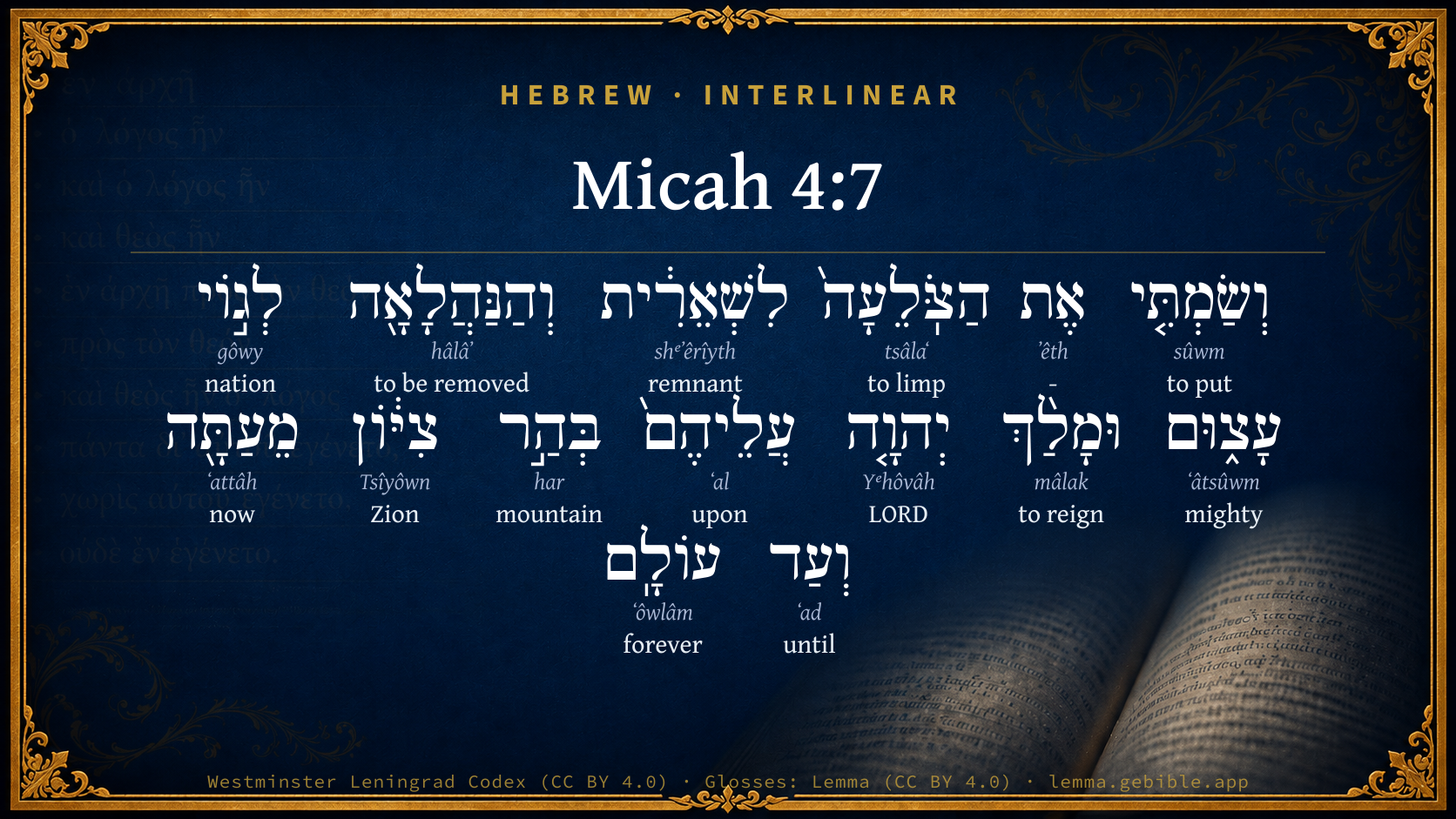
Hebrew (Westminster Leningrad Codex) Micah 4:7 appears in the Hebrew Old Testament. The text above is from the Westminster Leningrad Codex. Each word links to its Strong’s number, a concise gloss, and parsing drawn from the Open Scriptures Hebrew Bible morphology. Click any word for its full Brown-Driver-Briggs (BDB) entry.
Download image
Cite this verse

Micah 4:7 (World English Bible). Public Domain. Lemma interlinear Bible study tool, https://lemma.gebible.app/v/micah/4/7.

Show BibTeX & RIS
BibTeX
RIS
English Translation
And I will make that which was lame a remnant, And that which was cast far off a strong nation: And Yahweh will reign over them on Mount Zion from then on, even forever.
World English Bible · Public Domain
Highlights
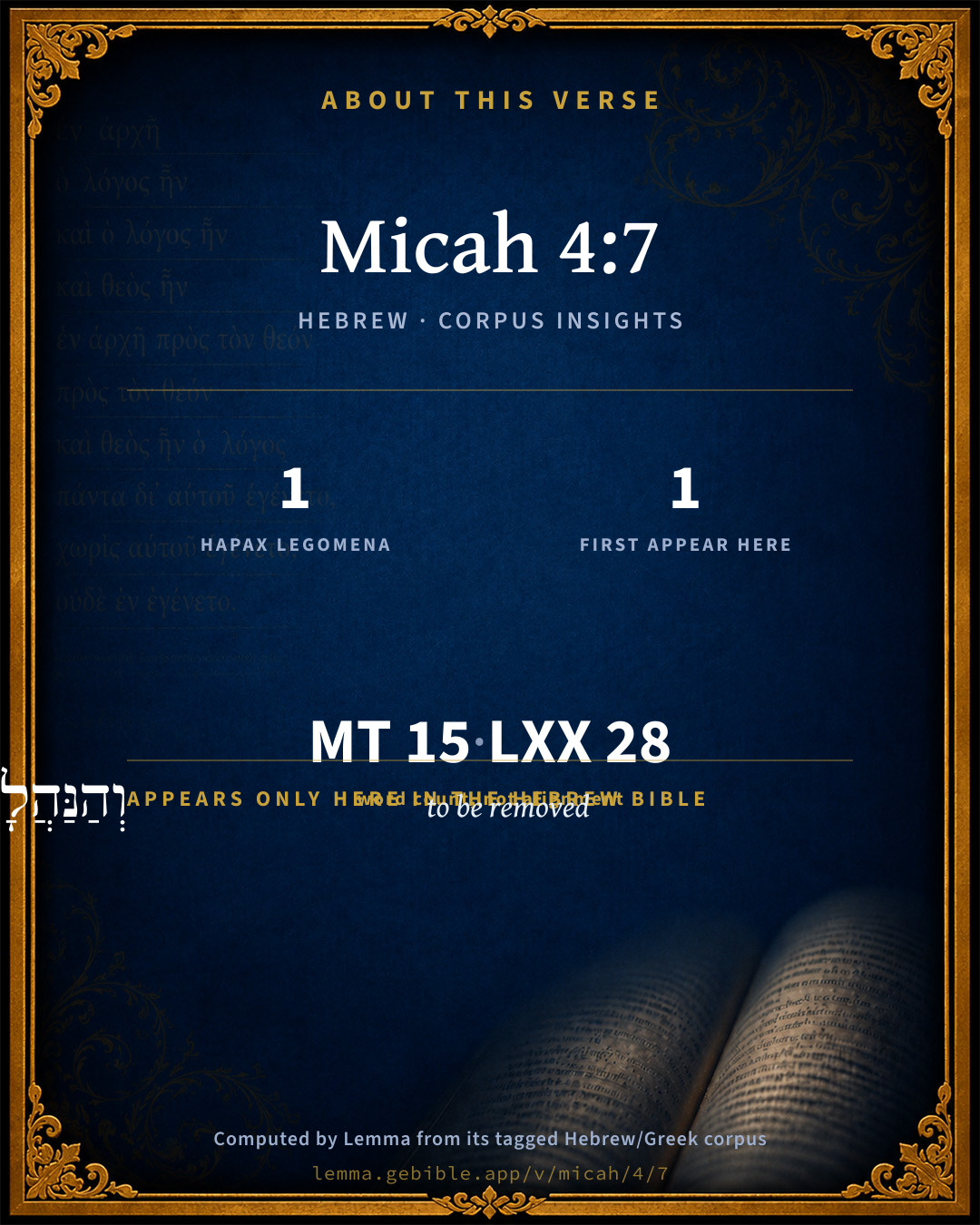
  • 1 hapax legomenon — only here in the Hebrew Bible
  • 1 first appearance in the Hebrew Bible
Full analysis ↓
Download a study sheet

One document with this verse’s original text, its word-by-word gloss line, the meaning frame, cross-references with their text, attributed commentary, and full source and license credits — printable, and it pastes into notes with its structure intact.

This verse Autodidact and up

Study sheet (.html) Plain text (.txt)

A passage Seminary Student

Up to 50 verses in one chapter. A passage sheet keeps up to 6 commentary sources and 12 cross-references per verse, in the order this page ranks them, and says so on the sheet whenever that leaves anything out. Ask for a single verse and you get the Autodidact verse sheet above.

Everything on this page stays free to read, with no account — the sheet is a download of what is already on screen, not access to it.

Want to remove ads? Support Godless Engineer
Compare translations 3

The same verse in 3 English versions, stacked beneath the original-language interlinear above. Click any original word for its lexicon entry.

Each is an independent rendering of the whole verse — the interlinear is not word-aligned to these translations.

Highlighted words mark where these versions differ — a whole-verse word diff, not a word-by-word alignment.

  • World English Bible Public Domain
    And I will make that which was lame a remnant, And that which was cast far off a strong nation: And Yahweh will reign over them on Mount Zion from then on, even forever.
  • King James Version Public Domain
    And I will make her that halted a remnant, and her that was cast far off a strong nation: and the LORD shall reign over them in mount Zion from henceforth, even for ever.
  • unfoldingWord Literal Text CC BY-SA 4.0
    And I will turn the lame into a remnant, and the ones driven away into a strong nation, and Yahweh will reign over them on Mount Zion, from now and until forever.

unfoldingWord Literal Text — © unfoldingWord, licensed CC BY-SA 4.0. Word-aligned USFM3 via Door43 (git.door43.org/unfoldingWord/en_ult).

Versions to compare (up to 4)

3 of 4 selected

Show all 18 translations

Every available English version of this verse, each an independent rendering of the whole verse.

  • World English Bible Public Domain
    And I will make that which was lame a remnant, And that which was cast far off a strong nation: And Yahweh will reign over them on Mount Zion from then on, even forever.
  • Berean Standard Bible Public Domain
    And I will make the lame into a remnant, and the outcast into a strong nation. Then the LORD will rule over them in Mount Zion from that day and forever.
  • Majority Standard Bible Public Domain
    And I will make the lame into a remnant, the outcast into a strong nation. Then the LORD will rule over them in Mount Zion from that day and forever.
  • King James Version Public Domain
    And I will make her that halted a remnant, and her that was cast far off a strong nation: and the LORD shall reign over them in mount Zion from henceforth, even for ever.
  • American Standard Version (1901) Public Domain
    and I will make that which was lame a remnant, and that which was cast far off a strong nation: and Jehovah will reign over them in mount Zion from henceforth even for ever.
  • Revised Version (1885) Public Domain
    and I will make her that halted a remnant, and her that was cast far off a strong nation: and the LORD shall reign over them in mount Zion from henceforth even for ever.
  • Geneva Bible (1599) Public Domain
    And I will make her that halted, a remnant, and her that was cast farre off, a mightie nation: and the Lord shall reigne ouer them in Mount Zion, from hence forth euen for euer.
  • Douay-Rheims (1899) Public Domain
    And I will make her that halted, a remnant: and her that hath been afflicted, a mighty nation: and the Lord will reign over them in mount Sion, from this time now and for ever.
  • Young's Literal Translation Public Domain
    And I have set the halting for a remnant, And the far-off for a mighty nation, And reigned hath Jehovah over them in mount Zion, From henceforth, and unto the age.
  • Literal Standard Version CC BY-SA 4.0
    And I have set the halting for a remnant, || And the far-off for a mighty nation, || And YHWH has reigned over them in Mount Zion, || From now on, and for all time.
  • Unlocked Literal Bible CC BY-SA 4.0
    I will turn the lame into a remnant, and the ones driven away into a strong nation, and I, Yahweh, will reign over them on Mount Zion, now and forever.
  • unfoldingWord Literal Text CC BY-SA 4.0
    And I will turn the lame into a remnant, and the ones driven away into a strong nation, and Yahweh will reign over them on Mount Zion, from now and until forever.
  • Darby Bible Public Domain
    and I will make her that halted a remnant, and her that was cast far off a strong nation; and Jehovah shall reign over them in mount Zion, from henceforth even for ever.
  • World Messianic Bible Public Domain
    and I will make that which was lame a remnant, and that which was cast far off a strong nation: and the LORD will reign over them on Mount Zion from then on, even forever.”
  • Webster's Bible Public Domain
    And I will make her that halted a remnant, and her that was cast far off a strong nation: and the LORD will reign over them in mount Zion from henceforth, even for ever.
  • Free Bible Version CC BY-SA 4.0
    I will make those who remain, crippled and driven far away, into a strong nation, and the Lord will rule them from Mount Zion forever and ever.
  • Bible in Basic English Public Domain
    And I will make her whose steps were uncertain a small band, and her who was feeble a strong nation: and the Lord will be their King in Mount Zion from now and for ever.
  • JPS Tanakh (1917) Public Domain
    And I will make her that halted a remnant, and her that was cast far off a mighty nation; and the LORD shall reign over them in mount Zion from thenceforth even for ever.

Literal Standard Version (2020), Covenant Press — licensed CC BY-SA 4.0. Text via the HelloAO Bible API (eBible.org). Unlocked Literal Bible (unfoldingWord) — licensed CC BY-SA 4.0. Text via the HelloAO Bible API (eBible.org). unfoldingWord Literal Text — © unfoldingWord, licensed CC BY-SA 4.0. Word-aligned USFM3 via Door43 (git.door43.org/unfoldingWord/en_ult). Free Bible Version, Dr. Jonathan Gallagher — licensed CC BY-SA 4.0. Text via the HelloAO Bible API (eBible.org).

Word by word

More ways to search: Search by grammar → Find every occurrence → Compare this word →

Practice this passage: Drill this verse → Learn its vocabulary →

וְהַנַּהֲלָאָ֖ה
hâlâʼ
H1972
“and · the · removed”
Conjunction + Particle, Definite Article + Verb, Niphal, Participle Passive, Feminine, Singular, Absolute
Part of Speech
Conjunction + Particle + Verb
Stem
Niphal
Form
Participle Passive
Gender
Feminine
Number
Singular
State
Absolute
Full BDB Definition

Origin: probably denominatively from H1973

TWOT: 496

(Niphal) to be removed far away, be removed far off
  1. וְשַׂמְתִּ֤י sûwm H7760 “and · to put” Conjunction + Verb, Qal, Sequential Perfect, 1st Person, Common, Singular
  2. אֶת ʼêth H853 “-” Particle, Direct Object
  3. הַצֹּֽלֵעָה֙ tsâlaʻ H6760 “the · limping” Particle, Definite Article + Verb, Qal, Participle Active, Feminine, Singular, Absolute
  4. לִשְׁאֵרִ֔ית shᵉʼêrîyth H7611 “to/for · remnant” Preposition + Noun, Common, Feminine, Singular, Absolute
  5. לְג֣וֹי gôwy H1471 “to/for · nation” Preposition + Noun, Common, Masculine, Singular, Absolute
  6. עָצ֑וּם ʻâtsûwm H6099 “mighty” Adjective, Adjective, Masculine, Singular, Absolute
  7. וּמָלַ֨ךְ mâlak H4427 “and · to reign” Conjunction + Verb, Qal, Sequential Perfect, 3rd Person, Masculine, Singular
  8. יְהוָ֤ה Yᵉhôvâh H3068 “LORD” Noun, Proper
  9. עֲלֵיהֶם֙ ʻal H5921 “upon · them” Preposition + Suffix, Personal, 3rd Person, Masculine, Plural
  10. בְּהַ֣ר har H2022 “in/at · mountain of” Preposition + Noun, Common, Masculine, Singular, Construct
  11. צִיּ֔וֹן Tsîyôwn H6726 “Zion” Noun, Proper
  12. מֵעַתָּ֖ה ʻattâh H6258 “from · now” Preposition + Adverb
  13. וְעַד ʻad H5704 “and · until” Conjunction + Preposition
  14. עוֹלָֽם ʻôwlâm H5769 “forever” Noun, Common, Masculine, Singular, Absolute

About this verse

These counts appear in no published source. They are computed here, from the morphology-tagged text and Lemma’s own curated glosses. What Lemma adds →

15
words
15
distinct lemmas
Prophets
section

Notable vocabulary

1 hapax legomenon — a word that appears only here in the entire Hebrew Bible:

  • וְהַנַּהֲלָאָ֖ה to be removed H1972

First appearance in Scripture

This word makes its first canonical appearance in the Hebrew Bible here:

  • וְהַנַּהֲלָאָ֖ה to be removed H1972

Shared distinctive vocabulary

הַצֹּֽלֵעָה֙ to limp H6760 occurs in 4 verses of the Hebrew Bible. Also found in:

Grammatical profile

  • 4 verbs
  • 6 nouns
  • 1 adjective
  • 2 prepositions
  • 1 adverb
  • 1 particle

Verb forms

  • וְשַׂמְתִּ֤י Qal · Sequential Perfect
  • הַצֹּֽלֵעָה֙ Qal · Participle Active
  • וְהַנַּהֲלָאָ֖ה Niphal · Participle Passive
  • וּמָלַ֨ךְ Qal · Sequential Perfect

Hebrew & Septuagint length

In English translation the verse runs 34 words from the Hebrew and 33 from the Septuagint (LXX English) — closely comparable.

A rough comparison of the two English renderings, which tokenize alike — not a word-level alignment.

Word counts can differ between the Hebrew and the Greek without any difference in meaning — e.g. the Hebrew direct-object marker אֵת has no separate Greek word, and Greek often adds the article ὁ.

In the original languages it is 15 Hebrew tokens and 28 Greek tokens — but the two are counted differently (Hebrew bundles its prefixes and suffixes into one token; the Greek is in lemma form), so that isn’t a like-for-like length.

Cross-references

23

Topical passages linked to Micah 4:7 in the Treasury of Scripture Knowledge — connected by theme and wording, ordered by reader-vote popularity; previews shown in the World English Bible.

  • Daniel 7:14 There was given him dominion, and glory, and a kingdom, that all the peoples, nations, and languages should serve him: his dominion is an everlasting dominion, which shall not pass away, and his kingdom that which shall not be destroyed.
  • Isaiah 24:23 Then the moon shall be confounded, and the sun ashamed; for Yahweh of Hosts will reign on Mount Zion, and in Jerusalem; and before his elders shall be glory.
  • Micah 2:12 I will surely assemble, Jacob, all of you; I will surely gather the remnant of Israel; I will put them together as the sheep of Bozrah, As a flock in the midst of their pasture; They will swarm with people.
  • Micah 5:7–8 The remnant of Jacob will be in the midst of many peoples, Like dew from Yahweh, Like showers on the grass, That don't wait for man, Nor wait for the sons of men.
  • Luke 1:33 and he will reign over the house of Jacob forever. There will be no end to his Kingdom."
  • Micah 7:18 Who is a God like you, who pardons iniquity, And passes over the disobedience of the remnant of his heritage? He doesn't retain his anger forever, Because he delights in loving kindness.
  • Isaiah 9:6–7 For to us a child is born, to us a son is given; and the government shall be on his shoulder: and his name shall be called Wonderful, Counselor, Mighty God, Everlasting Father, Prince of Peace.
  • Micah 5:3 Therefore he will abandon them until the time that she who is in labor gives birth. Then the rest of his brothers will return to the children of Israel.
  • Revelation 11:15 The seventh angel sounded, and great voices in heaven followed, saying, "The kingdom of the world has become the Kingdom of our Lord, and of his Christ. He will reign forever and ever!"
  • Psalms 2:6 "Yet I have set my king on my holy hill of Zion."
  • Isaiah 6:13 If there are yet a tenth in it, It also shall in turn be eaten up: As a terebinth, and as an oak, whose stock remains, when they are felled; So the holy seed is its stock."
  • Isaiah 10:21–22 A remnant shall return, [even] the remnant of Jacob, to the mighty God.
  • Isaiah 11:11–16 It shall happen in that day, that the Lord will set his hand again the second time to recover the remnant of his people, who shall remain, from Assyria, and from Egypt, and from Pathros, and from Cush, and from Elam, and from Shinar, and from Hamath, and from the islands of the sea.
  • Isaiah 49:21–23 Then shall you say in your heart, Who has conceived these for me, seeing I have been bereaved of my children, and am solitary, an exile, and wandering back and forth? and who has brought up these? Behold, I was left alone; these, where were they?
  • Isaiah 60:22 The little one shall become a thousand, and the small one a strong nation; I, Yahweh, will hasten it in its time.
  • Isaiah 66:8 Who has heard such a thing? who has seen such things? Shall a land be born in one day? shall a nation be brought forth at once? for as soon as Zion travailed, she brought forth her children.
  • Daniel 7:27 The kingdom and the dominion, and the greatness of the kingdoms under the whole the sky, shall be given to the people of the saints of the Most High: his kingdom is an everlasting kingdom, and all dominions shall serve and obey him.
  • Hosea 1:10 Yet the number of the children of Israel will be as the sand of the sea, which can't be measured nor numbered; and it will come to pass that, in the place where it was said to them, 'You are not my people,' they will be called 'sons of the living God.'
  • Joel 3:17 "So you will know that I am Yahweh, your God, Dwelling in Zion, my holy mountain. Then Jerusalem will be holy, And no strangers will pass through her any more.
  • Zechariah 9:13–17 For indeed I bend Judah as a bow for me. I have filled the bow with Ephraim; And I will stir up your sons, Zion, Against your sons, Greece, And will make you like the sword of a mighty man.
  • Zechariah 10:5–12 They shall be as mighty men, Treading down muddy streets in the battle; And they shall fight, because Yahweh is with them; And the riders on horses will be confounded.
  • Romans 11:5–6 Even so then at this present time also there is a remnant according to the election of grace.
  • Romans 11:25–27 For I don't desire, brothers, to have you ignorant of this mystery, so that you won't be wise in your own conceits, that a partial hardening has happened to Israel, until the fullness of the Gentiles has come in,

Cross-references courtesy of OpenBible.info (CC BY 4.0).

Hebrew and Greek witnesses Masoretic Hebrew ↔ Greek Septuagint

The same verse in the two great witnesses to the Old Testament, shown verse-for-verse.

These are two independent witnesses, not word-aligned to each other, and the Septuagint is shown in lemma (dictionary) form.

Hebrew Micah 4:7 Masoretic · Westminster Leningrad Codex

וְשַׂמְתִּ֤י אֶת הַצֹּֽלֵעָה֙ לִשְׁאֵרִ֔ית וְהַנַּהֲלָאָ֖ה לְג֣וֹי עָצ֑וּם וּמָלַ֨ךְ יְהוָ֤ה עֲלֵיהֶם֙ בְּהַ֣ר צִיּ֔וֹן מֵעַתָּ֖ה וְעַד עוֹלָֽם

And I will make that which was lame a remnant, And that which was cast far off a strong nation: And Yahweh will reign over them on Mount Zion from then on, even forever.

World English Bible · Public Domain

Greek LXX Micah 4:7 Septuagint · lemma form

καί τίθημι ὁ συντρίβω εἰς ὑπόλειμμα καί ὁ ἀποὠθέω εἰς ἔθνος ἰσχυρός καί βασιλεύω κύριος ἐπί αὐτός ἐν ὄρος σιων ἀπό ὁ νῦν καί ἕως εἰς ὁ αἰών

And I will make her that was bruised a remnant, and her that was rejected a mighty nation: and the Lord shall reign over them in mount Sion from henceforth, even for ever.

LXX2012 (modern English Septuagint) · Public Domain

On this verse, Haydock's Catholic Bible Commentary discusses the Septuagint’s reading. Read the note in Commentary ↓

Hebrew: Westminster Leningrad Codex (CC BY 4.0). Greek: Septuagint (public domain); English from LXX2012 (modern English Septuagint) (Public Domain). How the Septuagint differs from the Hebrew →

Targum (Aramaic paraphrase)

1

The Targum is the ancient Jewish Aramaic paraphrase of the Hebrew Scriptures — an interpretive translation, not the Hebrew text itself. Onkelos (literal) and Pseudo-Jonathan (expansive) render the Torah, and Jonathan the Prophets. Coverage is partial: where no permissively-licensed English translation exists for a verse, only the Aramaic is shown. This is verse-level text, not a word-by-word alignment to the Hebrew.

  1. Targum Jonathan Prophets (Joshua–Malachi)
    וַאֲשַׁוֵי יַת מְטַלְטְלַיָא לִשְׁאָרָא וּמְבַדְרַיָא לְעַם תַּקִיף וְתִתְגְלֵי מַלְכוּתָא דַייָ עֲלֵיהוֹן בְּטוּרָא דְצִיוֹן מִכְּעַן וְעַד עָלְמָא:

    (no public-domain English translation for this verse)

    Targum Jonathan — Aramaic: “Mikraot Gedolot” (public domain). English: “Sefaria Community Translation” (CC0 1.0 (public-domain dedication)); “London "Chaldee Paraphrase," 1871” (public domain). Text via Sefaria.

Commentary

Notes on Micah 4:7 from classic Christian and Jewish commentators (each source and its license shown beneath its notes). The classic Christian expositions comment on the surrounding passage and are grouped to its opening verse, so a note may address several verses; the Jewish commentaries on the Tanakh (Rashi and others) are per-verse, so they appear only where the commentator wrote on this verse.

Lemma curates 59 commentaries, every one of them public domain or Creative Commons licensed, each selected and text-cleaned for this edition rather than reprinted as found. About our sources →

Trapp's Complete Commentary

John Trapp

Mic 4:7 And I will make her that halted a remnant, and her that was cast far off a strong nation: and the LORD shall reign over them in mount Zion from henceforth, even for ever.

Ver. 7. And I will make her that halted a remnant] Yea, a renowned remnant, Zep 3:19. Not many Jews were converted in comparison to the Gentiles; hence they are called a remnant. They both killed the Lord Jesus and their own prophets; they have also persecuted us, saith the apostle, or cast us out, as by an ostracism; and they "please not God, and are contrary to all men, forbidding us to speak to the Gentiles," 1Th 2:15-16. Thus the generality of them then: and so to this day they continue cross, and cursing Christ and his followers thrice a day in their synagogues (Jerome in Isaiah. Buxtorf. Synag.). Howbeit at this present time, also, there is a "remnant according to the election of grace," Rom 11:5, and that remnant became the seminary of the Christian Church.

And her that was cast far off a strong nation] Numerous and valorous. Vide fidem et passionero martyrum, et de genre robusta non ambiges, saith Jerome here: Consider the faith and patience of the martyrs, and you will easily yield them to be a strong nation indeed. Christians have showed as glorious power in the faith of martyrdom as in the faith of miracles. They can do that which others cannot turn their hands to; they can suffer wrongs best of any; compel them to go a mile, they will be content to go two, yea, as far as the shoes of the preparation of the gospel of peace will carry them. There is nothing that they dare not undertake and undergo for the glory of their God. This courage in Christians heathens counted obstinace (Tertull. in Apolog.), but they knew not the power of the Spirit nor the privy armour of proof that the saints have about their hearts, which maketh them insuperable, more than conquerors.

And the Lord shall reign over them in mount Zion] i.e. In the Christian Church, out of which went the law, that is, the gospel, Mic 4:2. See Isa 40:9; Isa 52:7 Heb 12:22. There shall Christ reign, and so he did ever: but now he shall declare himself to be "Messiah the Prince," Dan 9:25, Lord and Christ, Act 2:36, Saviour and Sovereign. As King Heb 1:1-14. Of rebels makes them subjects, willing to be ruled by him; 2. He preserves them in that privilege by his Spirit; 3. He gives them laws far better than those of the twelve tables in Rome, which yet far exceeded (saith Cicero) all the learned libraries of the philosophers in worth and weight; 4. He sweetly inclineth their wills to yield universal obedience thereunto, and to cross themselves so they may please him; 5. He rewards them with comfort and peace here, and with life eternal hereafter; 6. He destroys all the enemies of his Church, and then at last delivers up the kingdom to his Father, 1Co 15:24, not his essential kingdom as God, but his economical kingdom as mediator.

John Trapp, A Commentary or Exposition upon All the Books of the Old and New Testament (1647–1656) — public domain. Text from a community e-Sword module.

Geneva Bible (1599)

Geneva Bible translators

I will cause that Israel, which is now as one lame and halting, and so almost destroyed, shall live again, and grow into a great people.

Geneva Bible (1599) marginal notes — public domain. Text via Bolls.life.

Jamieson, Fausset & Brown

Robert Jamieson, A. R. Fausset & David Brown

I will make her that halted a remnant--I will cause a remnant to remain which shall not perish.

Lord shall reign . . . in . . . Zion--David's kingdom shall be restored in the person of Messiah, who is the seed of David and at the same time Jehovah (Isa 24:23).

for ever-- (Isa 9:6-7; Dan 7:14, Dan 7:27; Luk 1:33; Rev 11:15).

Jamieson, Fausset & Brown — Commentary Critical and Explanatory on the Whole Bible (1871) — public domain (CC PDM 1.0). Text via the HelloAO Bible API.

Adam Clarke's Commentary

Verse 7. Her that halted a remnant] I will preserve them as a distinct people after their return from captivity, for the farther purposes of my grace and mercy.

And the Lord shall reign over them in Mount Zion] The Chaldee is remarkable here, and positively applies the words to the Messiah: "But thou, O Messiah, of Israel, who art hidden because of the sins of the congregation of Zion, the kingdom shall come unto thee."

Adam Clarke's Commentary on the Bible (1810–1826) — public domain. Text from a community e-Sword/MySword module.

John Calvin's Commentaries

He then adds, I will make the halting a remnant By remnant he understands the surviving Church. Hence the metaphor, halting, is extended even to destruction; as though he said, “Though the Jews for a time may differ nothing from dead men, I will yet cause them to rise again, that they may become again a new people.” It was difficult to believe this at the time of exile: no wonder, then, that the Prophet here promises that a posterity would be born from a people that were dead. For though Babylon was to them like the grave, yet God was able to do such a thing as to bring them forth as new men, as it really happened.

He afterwards subjoins And the driven afar off, a strong nation When the Jews were scattered here and there, how was it possible that God should from this miserable devastation form for himself a new people, and also a strong people? But the Prophet has put the contrary clauses in opposition to one another, that the Jews, amazed at their own evils, and astonished, might not cast away every consolation. As then he had dispersed them, he would again gather them, and would not only do this, but also make them a strong nation.

He then adds, Reign shall Jehovah over them on mount Zion, henceforth and for ever The Prophet no doubt promises here the new restoration of that kingdom which God himself had erected; for the salvation of the people was grounded on this — that the posterity of David should reign, as we shall hereafter see. And it is a common and usual thing with the prophets to set forth the kingdom of David, whenever they speak of the salvation of the Church. It was necessary then that the kingdom of David should be again established, in order that the Church might flourish and be secure. But Micah does not here name the posterity of David, but mentions Jehovah himself, not to exclude the kingdom of David, but to show that God would become openly the founder of that kingdom, yea, that he himself possessed the whole power. For though God governed the ancient people by the hand of David, by the hand of Josiah and of Hezekiah, there was yet, as it were, a shade intervening, so that God reigned not then visibly. The Prophet then mentions here some difference between that shadowy kingdom and the latter new kingdom, which, at the coming of the Messiah, God would openly set up. Jehovah himself shall then reign over them; as though he said, “Hitherto indeed, when the posterity of David held the government, as God himself created both David and his sons, and as they were anointed by his authority and command, it could not have been thought but that the kingdom was his, though he governed his people by the ministry and agency of men: but now God himself will ascend the throne in a conspicuous manner, so that no one may doubt but that he is the king of his people.” And this was really and actually fulfilled in the person of Christ. Though Christ was indeed the true seed of David, he was yet at the same time Jehovah, even God manifested in the flesh. We hence see, that the Prophet here in lofty terms extols the glory of Christ’s kingdom; as though he had said that it would not be a shadowy kingdom as it was under the Law. Jehovah then shall reign over you.

He then subjoins, on mount Zion. We know that the seat of the kingdom of Christ has not been continued on mount Zion; but this verse must be connected with the beginning of this chapter. The Prophet has previously said, From Zion shall go forth a law, and the word of Jehovah from Jerusalem. If then the interpretation of this place be asked, that is, how Jehovah showed himself the king of his people, and erected his throne on mount Zion, the answer is, that from thence the law went forth from that place, as from a fountain flowed the doctrine of salvation, to replenish the whole world. As then the Gospel, which God caused to be promulgated through the whole world, had its beginning on mount Zion, so the Prophet says that God would reign there. But we must at the same time observe, that through the defection and perfidy of the people it has happened that mount Zion is now only an insignificant corner of the earth, and not the most eminent in the world, as also the city Jerusalem, according to the prediction of Zechariah. Mount Zion then is now different from what it was formerly; for wherever the doctrine of the Gospel is preached, there is God really worshipped, there sacrifices are offered; in a word, there the spiritual temple exists. But yet the commencement of the Gospel must be taken to the account, if we would understand the real meaning of the Prophet, that is, that Christ, or God in the person of Christ, began to reign on mount Zion, when the doctrine of the Gospel from thence went forth to the extremities of the world. It now follows —

John Calvin's Commentaries (1540-1563) — public domain. Text from the Calvin Translation Society English edition (1840s-50s) via the Christian Classics Ethereal Library (ccel.org). Calvin's coverage is partial (roughly two-thirds of the Bible); uncommented books and verses are honest gaps, never fabricated. The 19th-century editor's footnotes and remarks are omitted so the notes are faithfully Calvin's own voice.

The Cambridge Bible for Schools and Colleges

gen. ed. J. J. S. Perowne

7. And I will make … a remnant] i.e. I will treat Israel, in spite of her ‘halting’ condition, as the ‘remnant’ to which the Messianic promises belong.

shall reign] Strictly, will have become king; i.e. will have assumed the royal functions, without the dubious intervention of a merely human representative. So Isa_24:23; Isa_52:7.

The Cambridge Bible for Schools and Colleges (gen. ed. J. J. S. Perowne; Cambridge University Press, 1878–1918) — public domain. Text from a community e-Sword module.

John Gill's Exposition

And I will make her that halted a remnant,.... That is, make a reserve of her, and not utterly cut her off for her halting or sinning; that there may be a seed, a posterity descending from her, that shall serve the Lord, and appear to be a remnant according to the election of grace; which will be the persons called and gathered in the latter day:

and her that was cast afar off a strong nation; Kimchi thinks this refers to the ten tribes that were carried far off into Media and other parts, Kg2 17:6; who shall now be a mighty and numerous people; and especially shall be strong in a spiritual sense in the Lord, and in the power of his might, in Christ and his grace, and in the faith of him; see Isa 60:22;

and the Lord shall reign over them in Mount Zion from henceforth, even for ever; that is, Christ, who is Jehovah our righteousness, shall reign over the converted Jews and Israelites in the church of God, often signified by Mount Zion; where they shall be assembled, and shall acknowledge him as their King, and be subject to his word and ordinances, and never more depart from him; nor will his government over them ever cease more, Luk 1:32. This shows that this prophecy refers not to the that times of the Gospel; for then the Jews would not have him to reign over them; but to times yet to come, the last days of the Gospel dispensation.

John Gill's Exposition of the Whole Bible (1746–1763) — public domain (CC PDM 1.0). Text via the HelloAO Bible API.

Albert Barnes' Notes on the Bible

And her that was cast off a strong nation - The prophecy, that there should be a remnant, was depressing. Yet what a remnant should it be! A remnant, which should multiply like the stars of heaven or the sand on the sea-shore. Israel had never been “a strong nation,” as a kingdom of this world. At its best estate, under David, it had subdued the petty nations around it, who were confederated to destroy it. It had never competed with the powers of this world, East or West, Egypt or Nineveh, although God had at times marvelously saved it from being swallowed up by them. Now, the remnant of Judah, which itself was but a remnant of the undivided people, was to become “a strong nation.” So Isaiah prophesied, “A little one shall become a thousand, and a small one a strong nation” Isa 60:22. Plainly not in temporal greatness, both because human strength was not, and could not be, its characteristic, and because the prophet had been speaking of spiritual restoration.

: “‘Strong’ are they, whom neither torture nor allurements can separate from the love of Christ.” “Strong are they, who are strong against themselves.” Strong were they who said,

“We ought to obey God rather than men Act 5:29, and, “who shall separate us from the love of Christ? shall tribulation, or distress, or persecution, or famine, or nakedness, or peril, or sword? Nay, in all these things we are more than conquerors through Him that loved us” Rom 8:35, Rom 8:37. God does not only restore in the Gospel; He multiplies exceedingly. Rup.: “I will so clothe her with the spirit of might, that, as she shall be fruitful in number, so shall she be glorious in victories, so that of her it shall be said, “who is she that looketh forth as the morning, fair as the moon, clear as the sun, terrible as an army with banners?” Son 6:10. For, not to name those, whose whole life is one warfare against invisible enemies and the evil desires of the flesh, who shall count the martyrs of Christ? We know that that “remnant” and “strong nation” owe wholly to grace all which they are, as they themselves in the Revelations give thanks; “Thou wast slain and hast redeemed us to God by Thy Blood, out of every kindred and tongue and people and nation, and hast made us unto our God kings and priests, and we shall reign on the earth” Rev 5:9-10; that same Lord, of whom it is here said,

The Lord shall reign over them in Zion from henceforth even forever - The visible kingdom of God in Judah was often obscured, kings, princes, priests, and false prophets combining to encourage one another in rebellion against God. In the captivity it even underwent an almost total eclipse by the over-shadowing of earthly power, save when the divine light flashed forth for an instant in the deeds or words of power and wisdom, related by Daniel. “Henceforth,” that is, from the time, when the law should go forth out of Zion, God should indeed reign, and that kingdom should have no end.

Albert Barnes' Notes on the Bible (1834–1885) — public domain. Text from a community e-Sword/MySword module.

Haydock's Catholic Bible Commentary

Remnant, or numerous progeny. --- Afflicted. Hebrew and Septuagint, "repudiated," (Calmet) or "cast off." (Haydock)

George Leo Haydock (1774–1849), Haydock's Catholic Family Bible and Commentary, 1859 edition — public domain. Excludes Psalms (Douay-Rheims chapter numbering differs from Protestant) and Deuterocanonical books (Catholic canon only).

Matthew Poole's English Annotations

Her that halted: see this phrase opened, Zep 3:19, and in this chapter, Mic 4:6.

A remnant; which, as they were preserved for a seed, so they should as fruitful seed take root and increase, and continue to the coming of the Messiah.

That was cast far off; that was cast off by God, and by the hands of Babylonians were carried away captives into remotest parts of the Babylonish kingdom.

A strong nation; so the Jews did grow up in multitudes and strength, as appears by the Jewish wars which were by them waged in the days of the Maccabees.

The Lord shall reign over them in Mount Zion; the true God, Lord of heaven and earth, shall be their God alone, him they shall obey in his worship, law, and temple in Jerusalem.

From henceforth, even for ever, i.e. to the end or period fixed for the Mosaic and legal institutions, for a very long time, not simply for ever. This was partly fulfilled to this people in their return, and reestablishment ill their own land arid in Jerusalem; but the final, full, and eternal accomplishment hereof is now fulfilling, and shall continue so, under the Messiah, till fulfilled in the gathering all the elect to Christ in grace on earth, and in glory in heaven.

Matthew Poole's English Annotations on the Holy Bible (1683–1685) — public domain. Text from a community e-Sword/MySword module.

Whedon's Commentary on the Bible

Daniel D. Whedon

7. A remnant — The nucleus of a new kingdom of God (see on Amo_5:15). The Messianic hopes all center around this remnant and the nation growing out of it. The lame and afflicted to whom the prophet promises restoration are such as have remained faithful in the face of affliction; these Jehovah will deliver from their affliction and constitute the “remnant,” and with it he will make a new beginning in his attempt to redeem the world.

A strong nation — In time, under the divine providence, the insignificant remnant will develop into a strong and powerful nation.

Jehovah shall reign — In the past incompetent and faithless rulers were responsible for much of the corruption and distress of the people; the new nation will not suffer from such leaders, for Jehovah himself will be the king, and his dominion will continue forever.

The center of the new kingdom will be Zion (see on Mic_4:1-5). With the promises made in Mic_4:6-7 fulfilled, the former royal splendor and prestige will be restored. The new promise is expressed in Mic_4:8, addressed directly to Jerusalem.

Tower of the flock — This does not allude to a tower (R.V., “of Eder”) near Beth-lehem (compare Gen_35:21), nor to a tower of the king’s castle (Neh_3:25), but denotes Jerusalem itself. Now it is a flourishing city, but soon it will be destroyed, and upon its ruins will be erected a watchtower, like those built for the better protection of the flocks roaming around the desert (2Ch_26:10). Already the prophet beholds the city in its reduced condition, and he selects the figure of the tower to make his address more forceful (compare Isa_29:1; Jer_21:13).

Stronghold [“hill”] of the daughter of Zion — In apposition to the preceding expression, also denoting the city of Jerusalem. Ophel is the name of the southeast spur of the temple mount, bounded on the east by the Kidron, on the west by the Tyropoeon valley, but here, as in other places (for example, 2Ki_5:24), the word is a common noun, meaning “hill.”

The first [“former”] dominion — The dominion enjoyed during the most flourishing period of Hebrew history, under David and Solomon, will be restored to Jerusalem during the Messianic era. The last clause, which is considered by some a late marginal gloss introduced into the text by accident, expresses the same thought.

Daniel D. Whedon (gen. ed.), Commentary on the Old and New Testaments (1874–1909) — public domain. Text from a community e-Sword module.

The Pulpit Commentary

I will make her that halted a remnant. The "remnant" is "the election," that portion of Israel which accepts the offered redemption; (Rom_9:27 Rom_11:5) and God declares that he will treat this section, now miserable and depressed, as sharers in the Messianic promises. (see note on Zep_3:19) As commonly, the restoration from captivity and the privileges of Messiah"s kingdom are combined in one foreshortened view. But this "remnant" shall be made into a strong nation, which no power shall overthrow. (Isa_11:14 Isa_55:2) The Lord shall reign over them. Not through an earthly representative, but by himself. (Isa_24:23 Isa_52:7 Oba_1:21 Zec_14:9) In Mount Zion. This prophecy does not necessarily point to any literal earthly fulfilment, but rather to the establishment of Christ"s spiritual kingdom, and the revelation of that new Jerusalem which St. John saw "descending out of heaven from God". (Rev_21:10)

The Pulpit Commentary (1880–1919), ed. H.D.M. Spence-Jones & Joseph S. Exell — public domain. Text from a community e-Sword module.

John Wesley's Explanatory Notes

A remnant - Which as they are preserved for a seed, so they take root and increase, and continue to the coming of the Messiah.

John Wesley, Explanatory Notes Upon the Whole Bible (1754–1765) — public domain. Text via the GEBible commentary corpus.

Lesson kit

Teaching starters — assembled from the data on this page, not authored interpretation. Every prompt links to the verse data it draws on. Edit before teaching.

Micah, in the Prophets, opens this verse with 15 words (15 distinct Hebrew lemmas). Its most distinctive word is hâlâʼ (“to be removed”). A historical commentator’s framing appears above. Read the whole chapter for the surrounding context.

Discussion questions

  1. How does “to be removed” (hâlâʼ) shape what this verse is saying?
  2. 1 word here appears nowhere else in the Hebrew Bible. Why might the author reach for such rare wording?
  3. This is the first place “to be removed” appears in Scripture (first appears here). What does its debut here establish?
  4. How does Genesis 32:31, which shares the word «to limp», read alongside this verse?
  5. These translations render this verse differently. What is at stake in choosing one wording over another?
  6. «וְשַׂמְתִּ֤י» is a Qal Sequential Perfect verb. How does that grammatical form shape the action described?
  7. Compare how Trapp's Complete Commentary and Geneva Bible (1599) read this verse. Where do they agree or differ?

Things to notice

Reading settings

Reading text

Shown beneath each verse's original-language words.

Old Testament
Old Testament edition

Read the OT as the Masoretic Hebrew (MT) or the Greek Septuagint (LXX).

English shown for the Greek Septuagint (in the Hebrew ↔ Greek comparison).

Comparing translations? Open the Compare panel on any verse page to stack up to four side by side.