
Zechariah 1:17

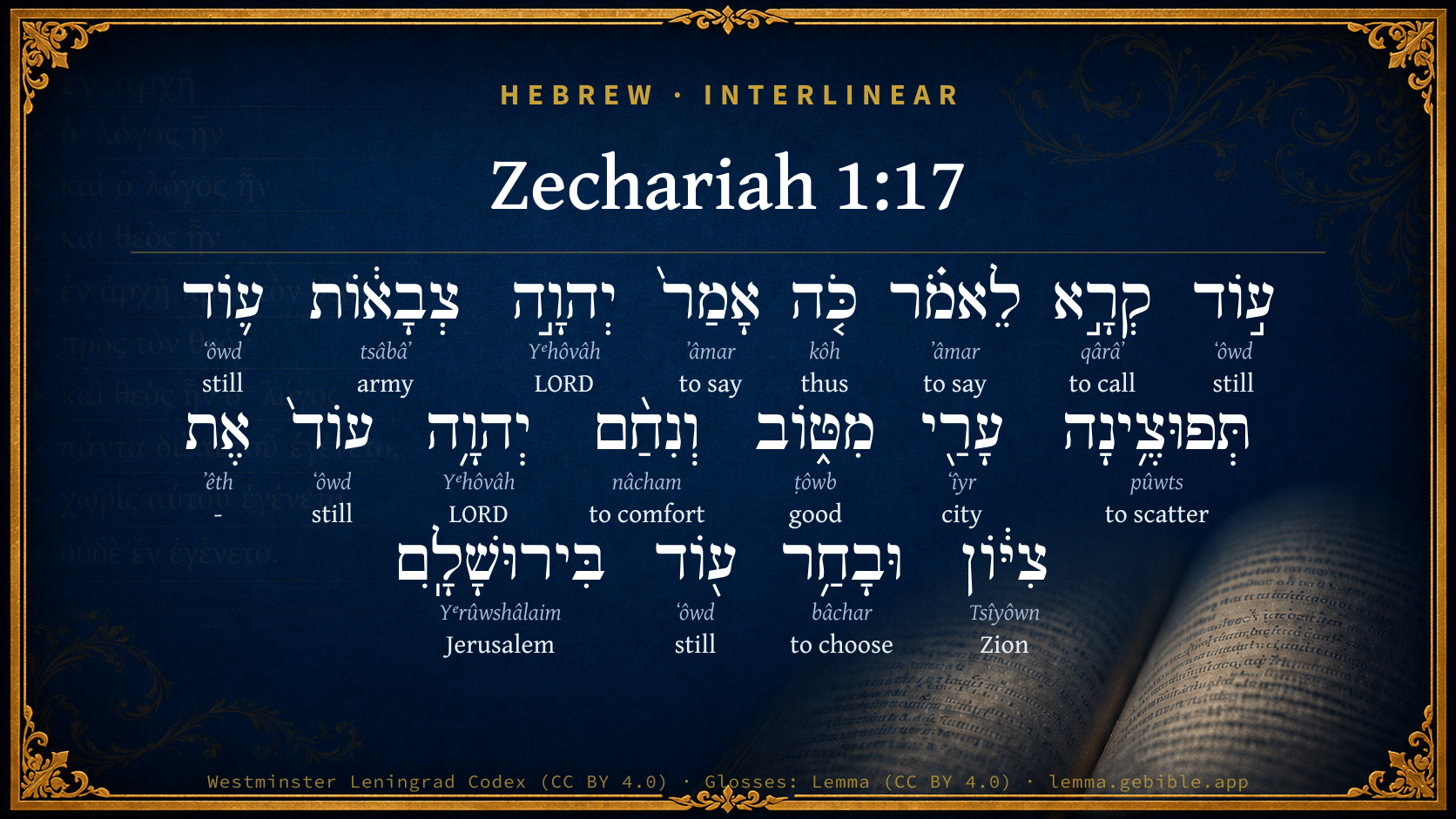
Hebrew (Westminster Leningrad Codex) Zechariah 1:17 appears in the Hebrew Old Testament. The text above is from the Westminster Leningrad Codex. Each word links to its Strong’s number, a concise gloss, and parsing drawn from the Open Scriptures Hebrew Bible morphology. Click any word for its full Brown-Driver-Briggs (BDB) entry.
Download image
Cite this verse

Zechariah 1:17 (World English Bible). Public Domain. Lemma interlinear Bible study tool, https://lemma.gebible.app/v/zechariah/1/17.

Show BibTeX & RIS
BibTeX
RIS
English Translation
"Proclaim further, saying, 'Thus says Yahweh of Hosts: "My cities will again overflow with prosperity, and Yahweh will again comfort Zion, and will again choose Jerusalem."'"
World English Bible · Public Domain
Download a study sheet

One document with this verse’s original text, its word-by-word gloss line, the meaning frame, cross-references with their text, attributed commentary, and full source and license credits — printable, and it pastes into notes with its structure intact.

This verse Autodidact and up

Study sheet (.html) Plain text (.txt)

A passage Seminary Student

Up to 50 verses in one chapter. A passage sheet keeps up to 6 commentary sources and 12 cross-references per verse, in the order this page ranks them, and says so on the sheet whenever that leaves anything out. Ask for a single verse and you get the Autodidact verse sheet above.

Everything on this page stays free to read, with no account — the sheet is a download of what is already on screen, not access to it.

Want to remove ads? Support Godless Engineer
Compare translations 3

The same verse in 3 English versions, stacked beneath the original-language interlinear above. Click any original word for its lexicon entry.

Each is an independent rendering of the whole verse — the interlinear is not word-aligned to these translations.

Highlighted words mark where these versions differ — a whole-verse word diff, not a word-by-word alignment.

  • World English Bible Public Domain
    "Proclaim further, saying, 'Thus says Yahweh of Hosts: "My cities will again overflow with prosperity, and Yahweh will again comfort Zion, and will again choose Jerusalem."'"
  • King James Version Public Domain
    Cry yet, saying, Thus saith the LORD of hosts; My cities through prosperity shall yet be spread abroad; and the LORD shall yet comfort Zion, and shall yet choose Jerusalem.
  • unfoldingWord Literal Text CC BY-SA 4.0
    Again, call out, saying, ‘Thus says Yahweh of Armies: “My cities will again overflow from goodness, and Yahweh will again comfort Zion, and he will again choose Jerusalem.’”

unfoldingWord Literal Text — © unfoldingWord, licensed CC BY-SA 4.0. Word-aligned USFM3 via Door43 (git.door43.org/unfoldingWord/en_ult).

Versions to compare (up to 4)

3 of 4 selected

Show all 18 translations

Every available English version of this verse, each an independent rendering of the whole verse.

  • World English Bible Public Domain
    "Proclaim further, saying, 'Thus says Yahweh of Hosts: "My cities will again overflow with prosperity, and Yahweh will again comfort Zion, and will again choose Jerusalem."'"
  • Berean Standard Bible Public Domain
    Proclaim further that this is what the LORD of Hosts says: ‘My cities will again overflow with prosperity; the LORD will again comfort Zion and choose Jerusalem.’”
  • Majority Standard Bible Public Domain
    Proclaim further that this is what the LORD of Hosts says: ‘My cities will again overflow with prosperity; the LORD will again comfort Zion and choose Jerusalem.’”
  • King James Version Public Domain
    Cry yet, saying, Thus saith the LORD of hosts; My cities through prosperity shall yet be spread abroad; and the LORD shall yet comfort Zion, and shall yet choose Jerusalem.
  • American Standard Version (1901) Public Domain
    Cry yet again, saying, Thus saith Jehovah of hosts: My cities shall yet overflow with prosperity; and Jehovah shall yet comfort Zion, and shall yet choose Jerusalem.
  • Revised Version (1885) Public Domain
    Cry yet again, saying, Thus saith the LORD of hosts: My cities through prosperity shall yet be spread abroad; and the LORD shall yet comfort Zion, and shall yet choose Jerusalem.
  • Geneva Bible (1599) Public Domain
    Cry yet, and speake, Thus saith the Lord of hostes, My cities shall yet be broken with plentie: the Lord shall yet comfort Zion, and shall yet chuse Ierusalem.
  • Douay-Rheims (1899) Public Domain
    Cry yet, saying: Thus saith the Lord of hosts: My cities shall yet flow with good things: and the Lord will yet comfort Sion, and he will yet choose Jerusalem.
  • Young's Literal Translation Public Domain
    Again call, saying: Thus said Jehovah of Hosts, Again do my cities overflow from good, And Jehovah hath again comforted Zion, And He hath fixed again on Jerusalem.'
  • Literal Standard Version CC BY-SA 4.0
    Again call, saying, || Thus said YHWH of Hosts: Again My cities overflow from good, || And YHWH has again comforted Zion, || And He has fixed again on Jerusalem.”
  • Unlocked Literal Bible CC BY-SA 4.0
    Again call out, saying, 'Yahweh of hosts says this: My cities will once again overflow with goodness, and Yahweh will again comfort Zion, and he will once again choose Jerusalem.'”
  • unfoldingWord Literal Text CC BY-SA 4.0
    Again, call out, saying, ‘Thus says Yahweh of Armies: “My cities will again overflow from goodness, and Yahweh will again comfort Zion, and he will again choose Jerusalem.’”
  • Darby Bible Public Domain
    Cry further, saying, Thus saith Jehovah of hosts: My cities shall yet overflow with prosperity, and Jehovah shall yet comfort Zion, and shall yet choose Jerusalem.
  • World Messianic Bible Public Domain
    “Proclaim further, saying, ‘The LORD of Hosts says: “My cities will again overflow with prosperity, and the LORD will again comfort Zion, and will again choose Jerusalem.”’”
  • Webster's Bible Public Domain
    Cry yet, saying, Thus saith the LORD of hosts; My cities through prosperity shall yet be spread abroad; and the LORD shall yet comfort Zion, and shall yet choose Jerusalem.
  • Free Bible Version CC BY-SA 4.0
    Announce this as well, says the Lord Almighty: Prosperity will flood out of my cities. I the Lord will comfort Zion, and Jerusalem will be my chosen city.”
  • Bible in Basic English Public Domain
    And again let your voice be loud and say, This is what the Lord of armies has said: My towns will again be overflowing with good things, and again the Lord will give comfort to Zion and take Jerusalem for himself.
  • JPS Tanakh (1917) Public Domain
    Again, proclaim, saying: Thus saith the LORD of hosts: My cities shall again overflow with prosperity; and the LORD shall yet comfort Zion, and shall yet choose Jerusalem.'

Literal Standard Version (2020), Covenant Press — licensed CC BY-SA 4.0. Text via the HelloAO Bible API (eBible.org). Unlocked Literal Bible (unfoldingWord) — licensed CC BY-SA 4.0. Text via the HelloAO Bible API (eBible.org). unfoldingWord Literal Text — © unfoldingWord, licensed CC BY-SA 4.0. Word-aligned USFM3 via Door43 (git.door43.org/unfoldingWord/en_ult). Free Bible Version, Dr. Jonathan Gallagher — licensed CC BY-SA 4.0. Text via the HelloAO Bible API (eBible.org).

Word by word

More ways to search: Search by grammar → Find every occurrence → Compare this word →

Practice this passage: Drill this verse → Learn its vocabulary →

תְּפוּצֶ֥ינָה
pûwts
H6327
“to scatter”
Verb, Qal, Imperfect, 3rd Person, Feminine, Plural
Part of Speech
Verb
Stem
Qal
Form
Imperfect
Person
3rd Person
Gender
Feminine
Number
Plural
Full BDB Definition

Origin: a primitive root

TWOT: 1745 , 1746 , 1800

to scatter, be dispersed, be scattered - (Qal) to be dispersed, be scattered - (Niphal) - to be scattered - to be spread abroad - (Hiphil) to scatter - Hithpael) scatter - (Qal) to flow, overflow - to break - (Polel) to shatter - (Pilpel) to dash to pieces
  1. ע֣וֹד ʻôwd H5750 “still” Adverb
  2. קְרָ֣א qârâʼ H7121 “call” Verb, Qal, Imperative, 2nd Person, Masculine, Singular
  3. לֵאמֹ֗ר ʼâmar H559 “to say” Preposition + Verb, Qal, Infinitive Construct
  4. כֹּ֤ה kôh H3541 “thus” Adverb
  5. אָמַר֙ ʼâmar H559 “to say” Verb, Qal, Perfect, 3rd Person, Masculine, Singular
  6. יְהוָ֣ה Yᵉhôvâh H3068 “LORD” Noun, Proper
  7. צְבָא֔וֹת tsâbâʼ H6635 “armies” Noun, Common, Both, Plural, Absolute
  8. ע֛וֹד ʻôwd H5750 “still” Adverb
  9. עָרַ֖י ʻîyr H5892 “cities · my” Noun, Common, Feminine, Plural, Construct + Suffix, Personal, 1st Person, Common, Singular
  10. מִטּ֑וֹב ṭôwb H2896 “from · good” Preposition + Adjective, Adjective, Masculine, Singular, Absolute
  11. וְנִחַ֨ם nâcham H5162 “and · to comfort” Conjunction + Verb, Piel, Sequential Perfect, 3rd Person, Masculine, Singular
  12. יְהוָ֥ה Yᵉhôvâh H3068 “LORD” Noun, Proper
  13. עוֹד֙ ʻôwd H5750 “still” Adverb
  14. אֶת ʼêth H853 “-” Particle, Direct Object
  15. צִיּ֔וֹן Tsîyôwn H6726 “Zion” Noun, Proper
  16. וּבָחַ֥ר bâchar H977 “and · to choose” Conjunction + Verb, Qal, Sequential Perfect, 3rd Person, Masculine, Singular
  17. ע֖וֹד ʻôwd H5750 “still” Adverb
  18. בִּירוּשָׁלִָֽם Yᵉrûwshâlaim H3389 “in/at · Jerusalem” Preposition + Noun, Proper

About this verse

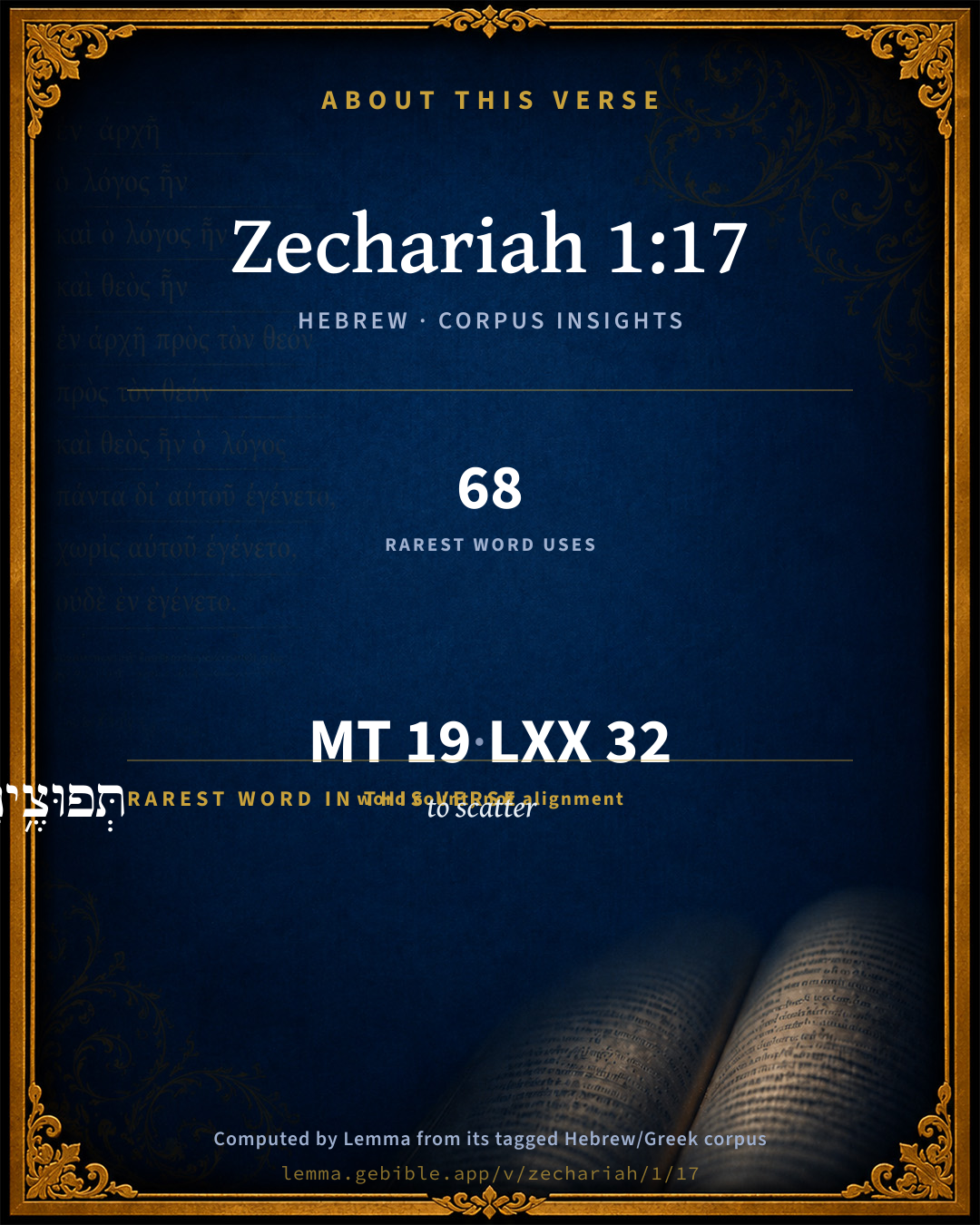
These counts appear in no published source. They are computed here, from the morphology-tagged text and Lemma’s own curated glosses. What Lemma adds →

19
words
14
distinct lemmas
Prophets
section

Grammatical profile

  • 6 verbs
  • 6 nouns
  • 1 adjective
  • 5 adverbs
  • 1 particle

Verb forms

  • קְרָ֣א Qal · Imperative
  • לֵאמֹ֗ר Qal · Infinitive Construct
  • אָמַר֙ Qal · Perfect
  • תְּפוּצֶ֥ינָה Qal · Imperfect
  • וְנִחַ֨ם Piel · Sequential Perfect
  • וּבָחַ֥ר Qal · Sequential Perfect

Repetition

Words recur within this verse — often emphatic in Hebrew:

  • ע֣וֹד still H5750 ×4
  • לֵאמֹ֗ר to say H559 ×2
  • יְהוָ֣ה LORD H3068 ×2

Hebrew & Septuagint length

In English translation the verse runs 26 words from the Hebrew and 40 from the Septuagint (LXX English) — the Septuagint runs noticeably longer here. See the side-by-side →

A rough comparison of the two English renderings, which tokenize alike — not a word-level alignment.

Word counts can differ between the Hebrew and the Greek without any difference in meaning — e.g. the Hebrew direct-object marker אֵת has no separate Greek word, and Greek often adds the article ὁ.

In the original languages it is 19 Hebrew tokens and 32 Greek tokens — but the two are counted differently (Hebrew bundles its prefixes and suffixes into one token; the Greek is in lemma form), so that isn’t a like-for-like length.

Cross-references

29

Topical passages linked to Zechariah 1:17 in the Treasury of Scripture Knowledge — connected by theme and wording, ordered by reader-vote popularity; previews shown in the World English Bible.

  • Isaiah 51:3 For Yahweh has comforted Zion; he has comforted all her waste places, and has made her wilderness like Eden, and her desert like the garden of Yahweh; joy and gladness shall be found therein, thanksgiving, and the voice of melody.
  • Zechariah 2:12 Yahweh will inherit Judah as his portion in the holy land, and will again choose Jerusalem.
  • 2 Chronicles 6:6 but I have chosen Jerusalem, that my name might be there; and have chosen David to be over my people Israel.
  • Psalms 69:35 For God will save Zion, and build the cities of Judah. They shall settle there, and own it.
  • Isaiah 14:1 For Yahweh will have compassion on Jacob, and will yet choose Israel, and set them in their own land: and the foreigner shall join himself with them, and they shall cleave to the house of Jacob.
  • Isaiah 44:26 who confirms the word of his servant, and performs the counsel of his messengers; who says of Jerusalem, She shall be inhabited; and of the cities of Judah, They shall be built, and I will raise up the waste places of it;
  • Isaiah 54:8 In overflowing wrath I hid my face from you for a moment; but with everlasting loving kindness will I have mercy on you, says Yahweh your Redeemer.
  • Isaiah 61:4–6 They shall build the old wastes, they shall raise up the former desolations, and they shall repair the waste cities, the desolations of many generations.
  • Isaiah 66:13 As one whom his mother comforts, so will I comfort you; and you shall be comforted in Jerusalem.
  • Jeremiah 32:43–44 Fields shall be bought in this land, about which you say, It is desolate, without man or animal; it is given into the hand of the Chaldeans.
  • Ezekiel 36:10–11 and I will multiply men on you, all the house of Israel, even all of it; and the cities shall be inhabited, and the waste places shall be built;
  • Zephaniah 3:15–17 Yahweh has taken away your judgments. He has thrown out your enemy. The King of Israel, Yahweh, is in the midst of you. You will not be afraid of evil any more.
  • Psalms 132:13–14 For Yahweh has chosen Zion. He has desired it for his habitation.
  • Isaiah 40:1–2 Comfort you, comfort you my people, says your God.
  • Isaiah 49:13 Sing, heavens; and be joyful, earth; and break forth into singing, mountains: for Yahweh has comforted his people, and will have compassion on his afflicted.
  • Isaiah 51:12 I, even I, am he who comforts you: who are you, that you are afraid of man who shall die, and of the son of man who shall be made as grass;
  • Jeremiah 31:13 Then shall the virgin rejoice in the dance, and the young men and the old together; for I will turn their mourning into joy, and will comfort them, and make them rejoice from their sorrow.
  • Jeremiah 31:23–24 Thus says Yahweh of Hosts, the God of Israel, Yet again shall they use this speech in the land of Judah and in the cities of it, when I shall bring again their captivity: Yahweh bless you, habitation of righteousness, mountain of holiness.
  • Jeremiah 33:13 In the cities of the hill-country, in the cities of the lowland, and in the cities of the South, and in the land of Benjamin, and in the places about Jerusalem, and in the cities of Judah, shall the flocks again pass under the hands of him who numbers them, says Yahweh.
  • Ezekiel 36:33 Thus says the Lord Yahweh: In the day that I cleanse you from all your iniquities, I will cause the cities to be inhabited, and the waste places shall be built.
  • Amos 9:14 I will bring back the captivity of my people Israel, And they will rebuild the ruined cities, and inhabit them; and they will plant vineyards, and drink wine from them. They shall also make gardens, And eat the fruit of them.
  • Obadiah 1:20 The captives of this host of the children of Israel, who are among the Canaanites, will possess even to Zarephath; and the captives of Jerusalem, who are in Sepharad, will possess the cities of the Negev.
  • Zechariah 3:2 Yahweh said to Satan, "Yahweh rebuke you, Satan! Yes, Yahweh who has chosen Jerusalem rebuke you! Isn't this a burning stick plucked out of the fire?"
  • Ephesians 1:4 even as he chose us in him before the foundation of the world, that we would be holy and without blemish before him in love;
  • Nehemiah 11:20 The residue of Israel, of the priests, the Levites, were in all the cities of Judah, everyone in his inheritance.
  • Isaiah 52:9 Break forth into joy, sing together, you waste places of Jerusalem; for Yahweh has comforted his people, he has redeemed Jerusalem.
  • Nehemiah 11:3 Now these are the chiefs of the province who lived in Jerusalem: but in the cities of Judah lived everyone in his possession in their cities, [to wit], Israel, the priests, and the Levites, and the Nethinim, and the children of Solomon's servants.
  • Isaiah 41:8–9 But you, Israel, my servant, Jacob whom I have chosen, the seed of Abraham my friend,
  • Romans 11:28–29 Concerning the Gospel, they are enemies for your sake. But concerning the election, they are beloved for the fathers' sake.

Cross-references courtesy of OpenBible.info (CC BY 4.0).

Hebrew and Greek witnesses Masoretic Hebrew ↔ Greek Septuagint

The same verse in the two great witnesses to the Old Testament, shown verse-for-verse.

Here the Septuagint runs noticeably longer than the Hebrew — LXX2012 (modern English Septuagint) 40 words vs World English Bible 26. A rough length comparison of the two English translations, not a word-level alignment — read both below.

These are two independent witnesses, not word-aligned to each other, and the Septuagint is shown in lemma (dictionary) form.

Hebrew Zechariah 1:17 Masoretic · Westminster Leningrad Codex

ע֣וֹד קְרָ֣א לֵאמֹ֗ר כֹּ֤ה אָמַר֙ יְהוָ֣ה צְבָא֔וֹת ע֛וֹד תְּפוּצֶ֥ינָה עָרַ֖י מִטּ֑וֹב וְנִחַ֨ם יְהוָ֥ה עוֹד֙ אֶת צִיּ֔וֹן וּבָחַ֥ר ע֖וֹד בִּירוּשָׁלִָֽם

"Proclaim further, saying, 'Thus says Yahweh of Hosts: "My cities will again overflow with prosperity, and Yahweh will again comfort Zion, and will again choose Jerusalem."'"

World English Bible · Public Domain

Greek LXX Zechariah 1:17 Septuagint · lemma form

καί εἶπον πρός ἐγώ ὁ ἄγγελος ὁ λαλέω ἐν ἐγώ ἀνακράζω λέγω ὅδε λέγω κύριος παντοκράτωρ ἔτι διαχέω πόλις ἐν ἀγαθός καί ἐλεέω κύριος ἔτι ὁ σιων καί αἱρετίζω ἔτι ὁ ἰερουσαλήμ

And the angel that spoke with me said to me, Cry yet, and say, Thus says the Lord Almighty; Yet shall cities be spread abroad through prosperity; and the Lord shall yet have mercy upon Sion, and shall choose Jerusalem.

LXX2012 (modern English Septuagint) · Public Domain

On this verse, Ellicott's Commentary for English Readers discusses the Septuagint’s reading. Read the note in Commentary ↓

Hebrew: Westminster Leningrad Codex (CC BY 4.0). Greek: Septuagint (public domain); English from LXX2012 (modern English Septuagint) (Public Domain). How the Septuagint differs from the Hebrew →

Targum (Aramaic paraphrase)

1

The Targum is the ancient Jewish Aramaic paraphrase of the Hebrew Scriptures — an interpretive translation, not the Hebrew text itself. Onkelos (literal) and Pseudo-Jonathan (expansive) render the Torah, and Jonathan the Prophets. Coverage is partial: where no permissively-licensed English translation exists for a verse, only the Aramaic is shown. This is verse-level text, not a word-by-word alignment to the Hebrew.

  1. Targum Jonathan Prophets (Joshua–Malachi)
    עוֹד אִתְנַבֵּי לְמֵימַר כִּדְנַן אֲמַר יְיָ צְבָאוֹת עוֹד יִתְמַלְיָן קִרְוֵי עַמִי טוּבָא וִינַחֵם יְיָ עוֹד יַת צִיוֹן וְיִתְרְעֵי עוֹד בִּירוּשְׁלֵם:

    (no public-domain English translation for this verse)

    Targum Jonathan — Aramaic: “Mikraot Gedolot” (public domain). English: “Sefaria Community Translation” (CC0 1.0 (public-domain dedication)); “London "Chaldee Paraphrase," 1871” (public domain). Text via Sefaria.

Commentary

Notes on Zechariah 1:17 from classic Christian and Jewish commentators (each source and its license shown beneath its notes). The classic Christian expositions comment on the surrounding passage and are grouped to its opening verse, so a note may address several verses; the Jewish commentaries on the Tanakh (Rashi and others) are per-verse, so they appear only where the commentator wrote on this verse.

Lemma curates 59 commentaries, every one of them public domain or Creative Commons licensed, each selected and text-cleaned for this edition rather than reprinted as found. About our sources →

The Cambridge Bible for Schools and Colleges

gen. ed. J. J. S. Perowne

17. be spread abroad] Some would render “overflow,” comparing Pro_5:16. But the more usual sense of the word, “spread abroad, or “disperse,” gives a good meaning. Not only shall the Temple be rebuilt, and the metropolis restored, but cities, owned and blessed by God (“my cities”), shall be scattered throughout the land.

The scope, then, of the first vision is clear. It conveys a distinct promise and prophecy of three future events. “My house shall be built,” Zec_1:16. This was accomplished four years later in the sixth year of Darius (Ezr_6:15). “A line shall be stretched forth upon Jerusalem,” Zec_1:16. This was done some seventy years later, when the city was rebuilt by Nehemiah (Neh_6:15). “My cities through prosperity shall yet be spread abroad,” Zec_1:17. The fulfilment of this is to be found in the history of the Jews under the Asmonean princes. Beyond this the first prophecy does not expressly go; though its concluding words, “The Lord shall yet comfort Zion, and shall yet choose Jerusalem,” are at least an implied promise of better things, than any which befell the Jews before the coming of Christ.

The Second Vision. The four horns and the four workmen. Zec_1:18-21. (Heb., 2:1–4.) The scene changes. The first vision had foretold as certain the punishment of the heathen, with which the prosperity of Israel was bound up. This vision takes a step in advance and depicts that punishment as already come. The prophet turns again to the field of view, which he had ceased to contemplate while he gave heed to the words of the interpreting angel, or pursued the thoughts which those words suggested. Looking up, he sees now before him four mighty horns. The beast, or beasts, which bear them are hidden from his view. The horns alone stand out from the surrounding gloom (Zec_1:18). In answer to the question, which he addresses to the interpreting angel, he is told that these horns represent the powers which have scattered his people (Zec_1:19). And now he sees, in the unfolding of this vision granted him by Jehovah, four artificers or smiths coming out to view, and proceeding one towards each of the four towering horns (Zec_1:20). In answer to a further question by the prophet, the interpreting angel tells him that these artificers are come to demolish and drive away these horns (Zec_1:21).

The Cambridge Bible for Schools and Colleges (gen. ed. J. J. S. Perowne; Cambridge University Press, 1878–1918) — public domain. Text from a community e-Sword module.

Trapp's Complete Commentary

John Trapp

Zec 1:17 Cry yet, saying, Thus saith the LORD of hosts; My cities through prosperity shall yet be spread abroad; and the LORD shall yet comfort Zion, and shall yet choose Jerusalem.

Ver. 17. Cry yet, saying, Thus saith the Lord of hosts; My cities] Here are four "yets" in this one verse, and all very gracious ones; to break their hard hearts, and to raise their faith in his promised mercies. For it is as if God should say, Though I was sore displeased with your fathers, and ye are risen up in their rooms a very race of rebels, so that I have had indignation against you full seventy years, Zec 1:12, yet I do you to know, and by my prophet I proclaim, with great earnestness and evidence of truth, that I do yet own you my cities, so that ye are not discovenanted, and will yet prosper you (so that it shall no more be said, This is Zion whom no man careth for, Jer 30:17; for you shall have plentiful increase of men, cattle, and all manner of fruits of the earth, as Zec 2:4), yea, you shall have a fulness of all things, not only repletive, but diffusive, not only of abundance, but of redundance too; your cup shall overflow into the lesser vessals of others.

My cities through prosperity shall yet be spread abroad] Diffundentur, diffiuent nut effluent. You shall have not for necessity only, but for lawful delight and honest affluence.

And the Lord shall yet comfort Zion] sc. With spiritual comforts, taking her into his winecellar, Cant. ii., yea, into the wilderness, and there speaking to her heart, Hos 2:13.

And shall yet choose Jerusalem] That is, settle her in the sound assurance of her election and adoption, whereof those outward blessings are both fruits and pledges. Hence David doubts not to conclude his spiritual good estate and hopes of eternal happiness frown his external enjoyments, Psa 23:5-6 "Thou preparest a table before me, thou anointest mine head, my cup runneth over." Hence he infers, "Surely goodness and mercy shall follow me all the days of my life; and I will dwell in the house of the Lord for ever." In all that is here said we may see that Scripture fully made good, Jer 51:5 "Israel hath not been forsaken, nor Judah of his God, of the Lord of hosts; though their land was filled with sin against the Holy One of Israel." And herein God dealt with his people according to his prerogative, and not according to his ordinary course. When the cursed Canaanites had filled their land from corner to corner with their uncleaunesses they were devoted to destruction, Ezr 9:11. When the Edomites grew insolent and ripe for ruin they were called the border of wickedness, and the people against whom the Lord had indignation for ever, Mal 1:4. {See Trapp on "Mal 1:4"}

John Trapp, A Commentary or Exposition upon All the Books of the Old and New Testament (1647–1656) — public domain. Text from a community e-Sword module.

The Biblical Illustrator

Joseph S. Exell

Zec_1:17

My cities through prosperity

Zions prosperity

Jehovahs tender care of His living Church seems to be a prominent topic with the prophet Zechariah.

Amid all the visitations Zion has experienced from her God in consequence of her departures, His heart has been set upon her eternal interests, and He never can change His mind concerning her.

I. The claim which Jehovah lays to His Churches, My cities. They are associated, or organised bodies, not promiscuous multitudes. Distinguished they may be from each other by a variety of names, and a variety of circumstances; but God says to them all, Ye are My cities. They are all chartered cities. Their charter is unchanging, covenant love. It is written, signed, sealed, and preserved by their covenant God. What is the wording of the charter? I will be their God, they shall be My people. Gods Churches are classified. Separated from one another, not only in their peculiar localities, and their peculiar features of discipline, but in minor points of order and regulation. Each one should know and keep his proper position. And they are all consecrated cities, from the highest to the lowest. Cities are generally noted for their liberties and privileges. And so if the Son make you free, you shall be free indeed. Our privileges are most valuable and innumerable. These cities were all designed and also founded by Jehovah, and He rules over them all.

II. Their prosperity--which must come from Himself. Shall yet be spread abroad. The prosperity of a city is seen in its population, its commerce, and the healthiness of its air. A sign of prosperity in a Church is found in the number of spiritual births.

III. Their comfort. The Lord shall yet comfort Zion. Her tranquillity is preserved in spite of all that sin and Satan can do; and her honourable associations are kept up and maintained. That will be comfort for Zion.

IV. The grand first cause of all, electing love. The Lord shall yet choose Jerusalem. (Joseph Irons.)

The Biblical Illustrator, edited by Joseph S. Exell (c. 1880s–1900s) — public domain. Text from a community e-Sword module.

Tyndale Open Study Notes

Tyndale Open Resources

1:17 The repetition of again (four times in Hebrew) emphasizes the certainty of God’s intention to restore Jerusalem.

Tyndale Open Study Notes — © Tyndale Open Resources, licensed CC BY-SA 4.0. Text via the HelloAO Bible API.

Geneva Bible (1599)

Geneva Bible translators

The abundance shall be so great, that the places of store shall not be able to contain these blessings that God will send, but shall even break for fullness.

Geneva Bible (1599) marginal notes — public domain. Text via Bolls.life.

Jamieson, Fausset & Brown

Robert Jamieson, A. R. Fausset & David Brown

yet--though heretofore lying in abject prostration.

My cities--not only Jerusalem, but the subordinate cities of Judah. God claims them all as peculiarly His, and therefore will restore them.

through prosperity . . . spread abroad--or overflow; metaphor from an overflowing vessel or fountain (compare Pro 5:16) [PEMBELLUS]. Abundance of fruits of the earth, corn and wine, and a large increase of citizens, are meant; also spiritual prosperity.

comfort Zion-- (Isa 40:1-2; Isa 51:3).

choose-- (Zac 2:12; Zac 3:2; Isa 14:1). Here meaning, "show by acts of loving-kindness that He has chosen." His immutable choice from everlasting is the fountain whence flow all such particular acts of love.

Jamieson, Fausset & Brown — Commentary Critical and Explanatory on the Whole Bible (1871) — public domain (CC PDM 1.0). Text via the HelloAO Bible API.

Adam Clarke's Commentary

Verse 17. My cities - shall yet be spread abroad] The whole land of Judea shall be inhabited, and the ruined cities restored.

Adam Clarke's Commentary on the Bible (1810–1826) — public domain. Text from a community e-Sword/MySword module.

John Calvin's Commentaries

I was not able in my last lecture fully to explain the verse in which the Prophet says that he was commanded by the angel to cry again, that God had returned to Jerusalem in mercies. The design of the words is this, — that though it was difficult to believe the restoration of Jerusalem, it was yet to be fully expected, for the Lord had so appointed. But he enlarges on what I have before stated; for the blessing of God is extended to the cities of Judah, though an express mention is made only of Jerusalem. Yet cities, he says, shall wear out through abundance of blessings; for so I think the verb תפוצנה, tephutzne, is to be taken, as futs means to spread, and also to wear out, and to break. Some elicit a forced meaning, that cities would spread themselves; others, that they would be separated, that is, that security would be so great, that cities, though distant from one another, would be in no danger or fear. But the meaning of the Prophet is clear, unless we designedly pervert it in a matter so manifest and easy. The cities, he says, shall be worn out or wearied through abundance of blessings, or as we say, elles seront entassees; for where there is a great heap, there is crushing. He therefore says, that so great and so full would be the abundance of all things, that the corn would press down itself, and that the vessels would hardly contain the vintage. We now perceive what the Prophet means, — that Jerusalem would yet be made complete, and also that other cities would be filled with all good things, because God would extend his favor to the whole people.

He then adds, Comfort Zion will yet Jehovah, and he will yet choose Jerusalem. The particle פוף, oud, yet, is repeated; for the suspension of favor, of which we have before spoken, might have somewhat prevented the faithful from realising the promise. As then God’s favor was for a time hid, the angel declares, that such would be the change, that God’s goodness and love towards his chosen people would again shine forth as in former days.

As to the word “chosen,” it must be observed, that it is applied, not in its strict sense, to the effect or the evidence of election; for God had chosen before the creation of the world whom he had designed to be his own. But he is said to choose whom he receives into favor, because their adoption seems obliterated in the eyes of men, when there appears no evidence of his paternal favor. As for instance, whenever we read that God had repudiated his own people, it is certain, as Paul says, that the calling of God is without repentance, (Romans 11:29:) nor does he declare this only of the secret election of each, but also of that general election, by which God had set apart the race of Abraham from the rest of the nations. At the same time many of Abraham’s children were reprobates, as he instances in the case of Esau and of others: yet the election of God was unchangeable; and hence it was that there remained still some hope as to that people, that God would at length gather to himself a Church from the Jews as well as from the Gentiles, so that those who were then separated might be hereafter united together. Since then the calling of God is without repentance, αμετα μελητος, how is it that the Lord is often said to choose, and is also said to reject his chosen? These expressions refer to the outward appearance of things. God therefore will secure his own election to the end; but as we cannot otherwise perceive but that we are rejected by God when he turns away his face from us, he is said to choose again those whom he has repudiated, that is, when he really and by a clear evidence proves that he has not forgotten their first adoption, but that he continues unchangeable in his purpose.

We now then understand what the Prophet means. I have more fully dwelt on this point, because it is necessary to understand this great truth, — that whatever blessings God confers on his own people proceed from eternal election, that this is a perpetual fountain, and yet that election is catachrestically applied to its evidences or effects, as also rejection is to be taken in the same sense for outward punishment, which seems at the first view to be an evidence of rejection, though it be not really so. Let us now proceed -

John Calvin's Commentaries (1540-1563) — public domain. Text from the Calvin Translation Society English edition (1840s-50s) via the Christian Classics Ethereal Library (ccel.org). Calvin's coverage is partial (roughly two-thirds of the Bible); uncommented books and verses are honest gaps, never fabricated. The 19th-century editor's footnotes and remarks are omitted so the notes are faithfully Calvin's own voice.

Ellicott's Commentary for English Readers

(17) Be spread abroad—i.e., be filled to overflowing; LXX. inserts “And the angel that spake in me said to me.” (Comp. Zec_2:4.) The same verb and conjugation is used in Zec_13:7 of “being scattered,” in a bad sense, and such is the ordinary use of the verb. But in another conjugation this verb is used in Gen_10:18 of “being spread,” not in a bad sense.

“Then let the world forbear their rage,

The Church renounce her fear;

Israel must live through every age,

And be the Almighty’s care.”

A Bible Commentary for English Readers, edited by Charles John Ellicott (1878–1897) — public domain. Text from a community e-Sword module.

John Gill's Exposition

Cry yet, saying,.... That is, "prophesy again", as the Targum paraphrases it; publish and declare openly before all:

Thus saith the Lord of hosts, My cities through prosperity shall yet be spread abroad; or, according to the Targum, "the cities of my people shall be yet filled with good"; and so the Septuagint and Vulgate Latin versions, "my cities shall yet flow with good things"; with all temporal prosperity and happiness; which was fulfilled in the times of Nehemiah, Zerubbabel, and the Maccabees; and especially in the times of the Messiah, when, in a spiritual sense, they were filled with good; with him who is goodness itself, and with all blessings of grace in him; and with the good news and glad tidings of the everlasting Gospel preached by him and his apostles; or, the meaning is, through the increase of men, and the affluence of all temporal mercies, not only the city of Jerusalem, but other cities of Judea, called the Lord's, because of his peculiar regard unto them, should be enlarged, and be spread here and there; or rather, abound with plenty of all good things, as the word in the Arabic (w) language signifies:

and the Lord shall yet comfort Zion, and shall yet choose Jerusalem; for his habitation, building again the city and temple in it: according to Capellus, though the temple was finished in the sixth year of Darius, Ezr 6:15 yet the rebuilding of Jerusalem was not till seventy years after; namely, in the twentieth year of Artaxerxes Longimanus, in which Nehemiah was sent to rebuild it, Neh 2:1 for Darius reigned thirty six years; Xerxes, who succeeded him, reigned twenty years; and in the twentieth of Artaxerxes the walls of Jerusalem were rebuilt by Nehemiah; so that from the finishing of the temple are to be reckoned thirty years of the remainder of the reign of Darius, twenty years of Xerxes, and as many of Artaxerxes; and he observes that the seventieth number thrice occurs in the restoration of the Jews, not without mystery, as it should seem: from the Babylonish captivity under Jeconiah, to the putting an end to it by Cyrus, were seventy years; from the taking of Jerusalem and the destruction of the temple under Zedekiah, to the rebuilding of it under Darius Hystaspis, were also seventy years; then from the rebuilding of the temple to the rebuilding of Jerusalem under Artaxerxes Longimanus were likewise seventy years; so that the walls of Jerusalem lay in ruins twice seventy years, that is, one hundred and forty years; and it may be further observed, that from the decree granted to Nehemiah in the twentieth year of Artaxerxes, seven weeks, or forty nine years, are allowed in Daniel's prophecy for the finishing that event; namely, the building again the walls and streets of Jerusalem in troublesome times, Dan 9:25 which carries the completion of this affair so many years further; which, when effected, would be a comfort to Zion, the inhabitants of it, and all that wished well unto it; and be a proof and evidence of God's choice of it for his worship and service; and, especially, this was fulfilled by bringing into Jerusalem, and the temple there, the messenger of the covenant, the Messiah, the Consolation of Israel; and this may have a further reference to the latter day, when the people of the Jews shall be converted, and all Israel shall be saved; which will be the consolation of them, and show that God has chosen them, and not cast them off.

(w) Vid. Schultens, Origines Hebr. l. 1. c. 4. sect. 4. p. 116.

John Gill's Exposition of the Whole Bible (1746–1763) — public domain (CC PDM 1.0). Text via the HelloAO Bible API.

Albert Barnes' Notes on the Bible

Cry yet - A further promise; not only should Jerusalem be rebuilt, but should as we say, overflow with good ; and God, who had seemed to cast off His people, should yet comfort her, and should show in act that He had chosen her. “love.” In all the cases, which Gesenius cites as meaning “love” Gen 6:2; 1Sa 20:30; 2Sa 15:15; Pro 1:29; Pro 3:31; Isa 1:29, the sense would be injured by rendering, “loved”) Zechariah thrice repeats the promise, given through Isaiah Isa 14:1 to Jerusalem, before her wasting by the Chaldaeans, reminding the people thereby, that the restoration, in the dawn whereof they lived, had been promised two centuries before. Yet, against all appearances. My cities shall overflow with good, as being God’s; yet would the Lord comfort Zion; yet would He choose Jerusalem.

Osorius: “What is the highest of all goods? what the sweetest solace in life? what the subject of joys? what the oblivion of past sorrow? That which the Son of God brought upon earth, when He illumined Jerusalem with the brightness of His light and heavenly discipline. For to that end was the city restored, that in it, by the ordinance of Christ, for calamity should abound bliss; for desolation, fullness; for sorrow, joy; for want, affluence of heavenly goods.”

This first vision having predicted the entire restoration, the details of that restoration are given in subsequent visions.

Albert Barnes' Notes on the Bible (1834–1885) — public domain. Text from a community e-Sword/MySword module.

Matthew Poole's English Annotations

Cry yet: the prophet’s commission is either enlarged, or more full instructions given to him, to raise the hope and stablish the faith of the people of God.

My cities: Jerusalem and the cities of Judah are mine, saith the Lord, and as mine I will build, beautify, enrich, fortify, defend, and enlarge them.

Through prosperity, through increase of families and persons, they shall send forth colonies, and plant new towns and cities; and through increase of wealth and cattle be able to build their cities, and stock their colonies.

Be spread abroad; swarm as bees, and send out their young ones.

The Lord, their God, shall yet comfort Zion, Zion his church, with comforts fit for a church.

Choose Jerusalem; type of the civil state as here joined with Zion; the kingdom shall be blest in itself, and be a blessing to others, much like that Hos 14:5; all this an effect of my choosing it, and dwelling in it.

Matthew Poole's English Annotations on the Holy Bible (1683–1685) — public domain. Text from a community e-Sword/MySword module.

The Pulpit Commentary

Cry yet, saying. This introduces the second part of the prophet"s message. The LXX begins the verse with the words, "And the angel that spake in me said unto me." My cities through prosperity shall yet be spread abroad. "Yet," in this verse, is better rendered again. God calls the cities his, to show his love for Judah; and he promises that they shall not only be reoccupied by returning immigrants, but increased in extent and number by reason of the enlarged population. So Josephus tells us that in later times Jerusalem had outgrown its walls, and that the fourth quarter, Bezetha, was added. ("Bell. Jud:," 5:4:2) But it seems" best to translate the clause thus: "My cities shall yet overflow with prosperity." Vulgate, Adhuc affluent civitates meae bonis; LXX, Eti diacuyhsontai poleiv en agayoiv . Shall yet comfort Zion, for all her afflictions. Shall yet choose Jerusalem. (Zec_2:12 Zec_3:2) God will show that the election of Israel remains unimpaired and secure. (comp. 2Ki_21:7 2Ch_6:5) The partial fulfilment of the items of this prophecy are to be found in the rebuilding of the temple, the restoration of Jerusalem by Nehemiah, and the prosperity of Judah under the Asmonean princes. A hint of further blessings is given in the final clause, but their nature is not expressly mentioned.

The Pulpit Commentary (1880–1919), ed. H.D.M. Spence-Jones & Joseph S. Exell — public domain. Text from a community e-Sword module.

John Wesley's Explanatory Notes

Through prosperity - Through increase of families, they shall send forth colonies, and plant new cities, and thro' increase of wealth, and cattle, be able to build their cities, and stock their colonies.

John Wesley, Explanatory Notes Upon the Whole Bible (1754–1765) — public domain. Text via the GEBible commentary corpus.

Lesson kit

Teaching starters — assembled from the data on this page, not authored interpretation. Every prompt links to the verse data it draws on. Edit before teaching.

Zechariah, in the Prophets, opens this verse with 19 words (14 distinct Hebrew lemmas). Its most distinctive word is pûwts (“to scatter”). The Greek Septuagint runs longer here. A historical commentator’s framing appears above. Read the whole chapter for the surrounding context.

Discussion questions

  1. What does “to scatter” (pûwts) contribute to the verse as a whole?
  2. Isaiah 51:3 shares this passage’s theme. How do the two illuminate each other?
  3. “still” occurs 4× in this one verse. What is the effect of the repetition?
  4. Compared with the Hebrew, the Septuagint runs longer here. What questions does that raise?
  5. These translations render this verse differently; the difference is in the English rendering, not the original. What questions does that raise?
  6. The verb «קְרָ֣א» is Qal Imperative. How does its form color the action?
  7. Reading how The Cambridge Bible for Schools and Colleges and Trapp's Complete Commentary read this verse, where do the two commentators agree and where do they part?

Things to notice

Reading settings

Reading text

Shown beneath each verse's original-language words.

Old Testament
Old Testament edition

Read the OT as the Masoretic Hebrew (MT) or the Greek Septuagint (LXX).

English shown for the Greek Septuagint (in the Hebrew ↔ Greek comparison).

Comparing translations? Open the Compare panel on any verse page to stack up to four side by side.