
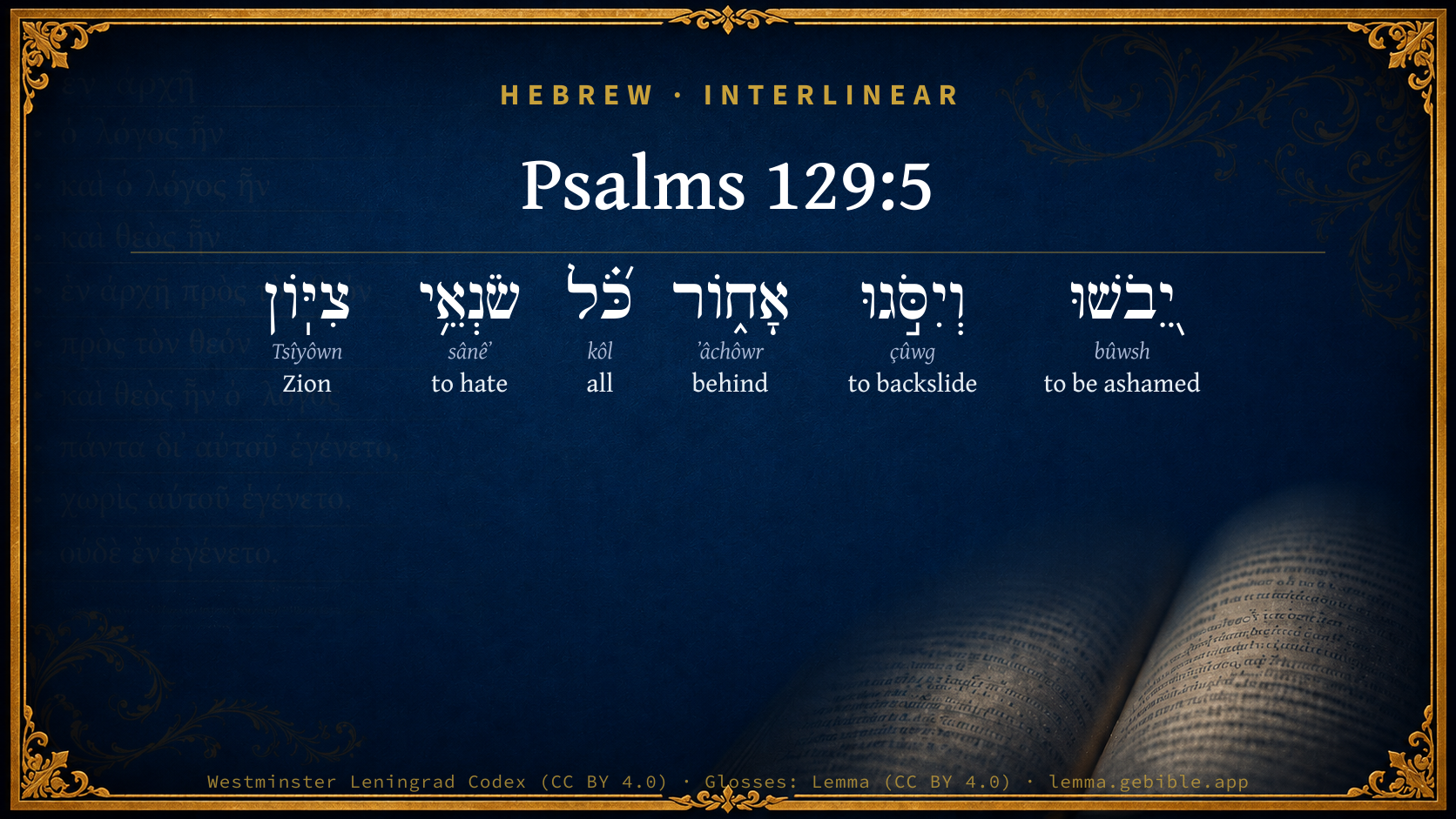
Psalms 129:5

Hebrew (Westminster Leningrad Codex) Psalms 129:5 appears in the Hebrew Old Testament. The text above is from the Westminster Leningrad Codex. Each word links to its Strong’s number, a concise gloss, and parsing drawn from the Open Scriptures Hebrew Bible morphology. Click any word for its full Brown-Driver-Briggs (BDB) entry.
Download image
Cite this verse

Psalms 129:5 (World English Bible). Public Domain. Lemma interlinear Bible study tool, https://lemma.gebible.app/v/psalms/129/5.

Show BibTeX & RIS
BibTeX
RIS
English Translation
Let them be disappointed and turned backward, All those who hate Zion.
World English Bible · Public Domain
Download a study sheet

One document with this verse’s original text, its word-by-word gloss line, the meaning frame, cross-references with their text, attributed commentary, and full source and license credits — printable, and it pastes into notes with its structure intact.

This verse Autodidact and up

Study sheet (.html) Plain text (.txt)

A passage Seminary Student

Up to 50 verses in one chapter. A passage sheet keeps up to 6 commentary sources and 12 cross-references per verse, in the order this page ranks them, and says so on the sheet whenever that leaves anything out. Ask for a single verse and you get the Autodidact verse sheet above.

Everything on this page stays free to read, with no account — the sheet is a download of what is already on screen, not access to it.

Want to remove ads? Support Godless Engineer
Compare translations 3

The same verse in 3 English versions, stacked beneath the original-language interlinear above. Click any original word for its lexicon entry.

Each is an independent rendering of the whole verse — the interlinear is not word-aligned to these translations.

Highlighted words mark where these versions differ — a whole-verse word diff, not a word-by-word alignment.

  • World English Bible Public Domain
    Let them be disappointed and turned backward, All those who hate Zion.
  • King James Version Public Domain
    Let them all be confounded and turned back that hate Zion.
  • unfoldingWord Literal Text CC BY-SA 4.0
    Let them have shame and withdraw backward, all the haters of Zion.

unfoldingWord Literal Text — © unfoldingWord, licensed CC BY-SA 4.0. Word-aligned USFM3 via Door43 (git.door43.org/unfoldingWord/en_ult).

Versions to compare (up to 4)

3 of 4 selected

Show all 18 translations

Every available English version of this verse, each an independent rendering of the whole verse.

  • World English Bible Public Domain
    Let them be disappointed and turned backward, All those who hate Zion.
  • Berean Standard Bible Public Domain
    May all who hate Zion be turned back in shame.
  • Majority Standard Bible Public Domain
    May all who hate Zion be turned back in shame.
  • King James Version Public Domain
    Let them all be confounded and turned back that hate Zion.
  • American Standard Version (1901) Public Domain
    Let them be put to shame and turned backward, All they that hate Zion.
  • Revised Version (1885) Public Domain
    Let them be ashamed and turned backward, all they that hate Zion.
  • Geneva Bible (1599) Public Domain
    They that hate Zion, shalbe all ashamed and turned backward.
  • Douay-Rheims (1899) Public Domain
    May the Lord bless thee out of Sion: and mayest thou see the good things of Jerusalem all the days of thy life.
  • Young's Literal Translation Public Domain
    Confounded and turn backward do all hating Zion.
  • Literal Standard Version CC BY-SA 4.0
    All hating Zion [are] confounded and turn backward.
  • Unlocked Literal Bible CC BY-SA 4.0
    May they all be put to shame and turned back, those who hate Zion.
  • unfoldingWord Literal Text CC BY-SA 4.0
    Let them have shame and withdraw backward, all the haters of Zion.
  • Darby Bible Public Domain
    Let them be ashamed and turned backward, all that hate Zion;
  • World Messianic Bible Public Domain
    Let them be disappointed and turned backward, all those who hate Zion.
  • Webster's Bible Public Domain
    Let them all be confounded and turned back that hate Zion.
  • Free Bible Version CC BY-SA 4.0
    May everyone who hates Zion be driven back in humiliating defeat.
  • Bible in Basic English Public Domain
    Let all the haters of Zion be shamed and turned back.
  • JPS Tanakh (1917) Public Domain
    Let them be ashamed and turned backward, all they that hate Zion.

Literal Standard Version (2020), Covenant Press — licensed CC BY-SA 4.0. Text via the HelloAO Bible API (eBible.org). Unlocked Literal Bible (unfoldingWord) — licensed CC BY-SA 4.0. Text via the HelloAO Bible API (eBible.org). unfoldingWord Literal Text — © unfoldingWord, licensed CC BY-SA 4.0. Word-aligned USFM3 via Door43 (git.door43.org/unfoldingWord/en_ult). Free Bible Version, Dr. Jonathan Gallagher — licensed CC BY-SA 4.0. Text via the HelloAO Bible API (eBible.org).

Word by word

More ways to search: Search by grammar → Find every occurrence → Compare this word →

Practice this passage: Drill this verse → Learn its vocabulary →

וְיִסֹּ֣גוּ
çûwg
H5472
“and · to backslide”
Conjunction + Verb, Niphal, Imperfect, 3rd Person, Masculine, Plural
Part of Speech
Conjunction + Verb
Stem
Niphal
Form
Imperfect
Person
3rd Person
Gender
Masculine
Number
Plural
Full BDB Definition

Origin: a primitive root

TWOT: 1469

to move, go, turn back, move away, backslide - (Qal) to backslide, prove recreant to - (Niphal) - to turn oneself away, turn back - to be turned or driven back, be repulsed
  1. יֵ֭בֹשׁוּ bûwsh H954 “to be ashamed” Verb, Qal, Imperfect, 3rd Person, Masculine, Plural
  2. אָח֑וֹר ʼâchôwr H268 “behind” Noun, Common, Masculine, Singular, Absolute
  3. כֹּ֝֗ל kôl H3605 “all of” Noun, Common, Masculine, Singular, Construct
  4. שֹׂנְאֵ֥י sânêʼ H8130 “hating” Verb, Qal, Participle Active, Masculine, Plural, Construct
  5. צִיּֽוֹן Tsîyôwn H6726 “Zion” Noun, Proper

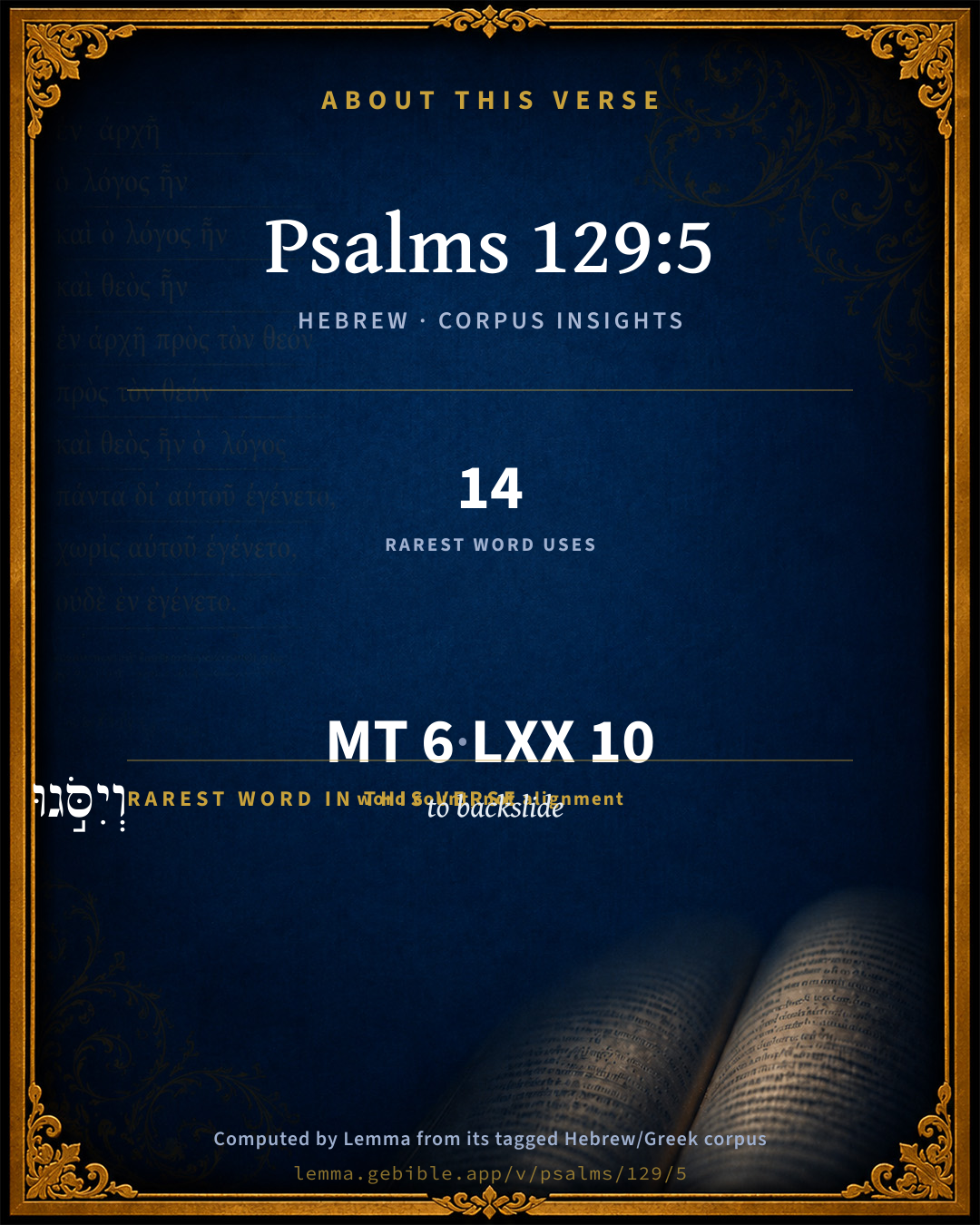
About this verse

These counts appear in no published source. They are computed here, from the morphology-tagged text and Lemma’s own curated glosses. What Lemma adds →

6
words
6
distinct lemmas
Wisdom
section

Notable vocabulary

The rarest word here is וְיִסֹּ֣גוּ to backslide H5472 — appearing just 14 times in the whole Hebrew Bible.

Shared distinctive vocabulary

וְיִסֹּ֣גוּ to backslide H5472 occurs in 14 verses of the Hebrew Bible. Also found in:

Grammatical profile

  • 3 verbs
  • 3 nouns

Verb forms

  • יֵ֭בֹשׁוּ Qal · Imperfect
  • וְיִסֹּ֣גוּ Niphal · Imperfect
  • שֹׂנְאֵ֥י Qal · Participle Active

Hebrew & Septuagint length

In English translation the verse runs 12 words from the Hebrew and 12 from the Septuagint (LXX English) — the same length.

A rough comparison of the two English renderings, which tokenize alike — not a word-level alignment.

Word counts can differ between the Hebrew and the Greek without any difference in meaning — e.g. the Hebrew direct-object marker אֵת has no separate Greek word, and Greek often adds the article ὁ.

In the original languages it is 6 Hebrew tokens and 10 Greek tokens — but the two are counted differently (Hebrew bundles its prefixes and suffixes into one token; the Greek is in lemma form), so that isn’t a like-for-like length.

Cross-references

14

Topical passages linked to Psalms 129:5 in the Treasury of Scripture Knowledge — connected by theme and wording, ordered by reader-vote popularity; previews shown in the World English Bible.

  • Psalms 71:13 Let my accusers be disappointed and consumed. Let them be covered with disgrace and scorn who want to harm me.
  • Isaiah 37:35 For I will defend this city to save it, for my own sake, and for my servant David's sake.
  • Esther 6:13 Haman recounted to Zeresh his wife and all his friends everything that had happened to him. Then his wise men and Zeresh his wife said to him, If Mordecai, before whom you have begun to fall, be of the seed of the Jews, you shall not prevail against him, but shall surely fall before him.
  • Psalms 83:4–11 "Come," they say, "and let's destroy them as a nation, That the name of Israel may be remembered no more."
  • Isaiah 10:12 Therefore it shall happen that, when the Lord has performed his whole work on Mount Zion and on Jerusalem, I will punish the fruit of the stout heart of the king of Assyria, and the glory of his high looks.
  • Isaiah 37:22 this is the word which Yahweh has spoken concerning him: The virgin daughter of Zion has despised you and ridiculed you; the daughter of Jerusalem has shaken her head at you.
  • Zechariah 12:3 It will happen in that day, that I will make Jerusalem a burdensome stone for all the peoples. All who burden themselves with it will be severely wounded, and all the nations of the earth will be gathered together against it.
  • Esther 9:5 The Jews struck all their enemies with the stroke of the sword, and with slaughter and destruction, and did what they would to those who hated them.
  • Psalms 122:6 Pray for the peace of Jerusalem. Those who love you will prosper.
  • Isaiah 37:28–29 But I know your sitting down, and your going out, and your coming in, and your raging against me.
  • Micah 4:11 Now many nations have assembled against you, that say, 'Let her be defiled, And let our eye gloat over Zion.'
  • Zechariah 1:14–17 So the angel who talked with me said to me, "Proclaim, saying, 'Thus says Yahweh of Hosts: "I am jealous for Jerusalem and for Zion with a great jealousy.
  • Zechariah 12:6 In that day I will make the chieftains of Judah like a pan of fire among wood, and like a flaming torch among sheaves; and they will devour all the surrounding peoples, on the right hand and on the left; and Jerusalem will yet again dwell in their own place, even in Jerusalem.
  • 1 Corinthians 16:22 If any man doesn't love the Lord Jesus Christ, let him be accursed. Come, Lord!

Cross-references courtesy of OpenBible.info (CC BY 4.0).

Hebrew and Greek witnesses Masoretic Hebrew ↔ Greek Septuagint

The same verse in the two great witnesses to the Old Testament, shown verse-for-verse.

You’re reading Greek Psalm 128 (Hebrew Psalm 129). The Septuagint counts the superscription, so verse numbers can differ from the Hebrew — chapter-level alignment, not verse-by-verse. Numbering follows Rahlfs.

These are two independent witnesses, not word-aligned to each other, and the Septuagint is shown in lemma (dictionary) form.

Hebrew Psalms 129:5 Masoretic · Westminster Leningrad Codex

יֵ֭בֹשׁוּ וְיִסֹּ֣גוּ אָח֑וֹר כֹּ֝֗ל שֹׂנְאֵ֥י צִיּֽוֹן

Let them be disappointed and turned backward, All those who hate Zion.

World English Bible · Public Domain

Greek LXX Greek Psalm 128:5 Septuagint · lemma form

αἰσχύνω καί ἀποστρέφω εἰς ὁ ὀπίσω πᾶς ὁ μισέω σιων

Let all that hate Sion be put to shame and turned back.

LXX2012 (modern English Septuagint) · Public Domain

On this verse, John Calvin's Commentaries discusses the Septuagint’s reading. Read the note in Commentary ↓

Hebrew: Westminster Leningrad Codex (CC BY 4.0). Greek: Septuagint (public domain); English from LXX2012 (modern English Septuagint) (Public Domain). How the Septuagint differs from the Hebrew →

Commentary

Notes on Psalms 129:5 from classic Christian and Jewish commentators (each source and its license shown beneath its notes). The classic Christian expositions comment on the surrounding passage and are grouped to its opening verse, so a note may address several verses; the Jewish commentaries on the Tanakh (Rashi and others) are per-verse, so they appear only where the commentator wrote on this verse.

Lemma curates 59 commentaries, every one of them public domain or Creative Commons licensed, each selected and text-cleaned for this edition rather than reprinted as found. About our sources →

Trapp's Complete Commentary

John Trapp

Psa 129:5 Let them all be confounded and turned back that hate Zion.

Ver. 5. Let them all be confounded, &c.] And if those that hate Zion, how much more those that hurt her with their virulent tongues or violent hands!

John Trapp, A Commentary or Exposition upon All the Books of the Old and New Testament (1647–1656) — public domain. Text from a community e-Sword module.

Joseph Benson's Commentary

Psa 129:5-8. Let them all be confounded, &c. — Hebrew, יבשׁו ויסגו אחור, they shall all be confounded, and turned back — Forced to retreat with shame and disappointment. And so in the next verse, instead of Let them be, read, They shall be as grass upon the house tops — Which there were flat, and therefore more capable of grass, or green corn, growing between the stones than ours are; which withereth, &c. — Which, having no deep root, never comes to maturity. And so all their designs shall be abortive. Thus the enemies of God’s church wither of themselves, and stay not till they are rooted out by the judgments of God. Neither do they which go by — According to the ancient and laudable custom of saluting and praying for the prosperity of harvest labours; say, The blessing of the Lord be upon you, &c. — Which was a usual salutation given by passengers to reapers, as we see Rth 2:4. If, in a similar way, we acknowledge God’s providence, testify our good-will to our neighbours, and commend their industry, our kind wishes will be accepted as pious ejaculations, if they come from devout and upright hearts. But religious expressions, being sacred things, must never be made use of in light and ludicrous actions. Mowing the grass on the house-top would be a jest, and therefore those that have a reverence for the name of God will not prostitute to such an action those forms of salutation which savour of devotion; for holy things must not be jested with.

Joseph Benson's Commentary on the Old and New Testaments (1811–1818) — public domain. Text from a community e-Sword module.

J. A. Alexander on Psalms

Joseph Addison Alexander

5. (Psa 129:5) Shamed and turned back are (and shall be) all haters of Zion. What Jehovah has already done for Zion, as recorded in ver. 4, creates and justifies the confident belief that he will do still more. This language was peculiarly appropriate to Israel at the Restoration, when the main deliverance had already been accomplished, but others were still needed to complete the happy revolution. With the first clause compare Psa 6:10; Psa 35:3; Psa 40:13.

Joseph Addison Alexander, The Psalms Translated and Explained (1850) — public domain. Text from a community e-Sword module.

Matthew Henry's Commentary

The psalmist, having triumphed in the defeat of the many designs that had been laid as deep as hell to ruin the church, here concludes his psalm as Deborah did her song, So let all thy enemies perish, O Lord! Jdg 5:31.

I. There are many that hate Zion, that hate Zion's God, his worship, and his worshippers, that have an antipathy to religion and religious people, that seek the ruin of both, and do what they can that God may not have a church in the world.

II. We ought to pray that all their attempts against the church may be frustrated, that in them they may be confounded and turned back with shame, as those that have not been able to bring to pass their enterprise and expectation: Let them all be confounded is as much as, They shall be all confounded. The confusion imprecated and predicted is illustrated by a similitude; while God's people shall flourish as the loaded palm-tree, or the green and fruitful olive, their enemies shall wither as the grass upon the house-top. As men they are not to be feared, for they shall be made as grass, Isa 51:12. But as they are enemies to Zion they are so certainly marked for ruin that they may be looked upon with as much contempt as the grass on the house-tops, which is little, and short, and sour, and good for nothing. 1. It perishes quickly: It withers before it grows up to any maturity, having no root; and the higher its place is, which perhaps is its pride, the more it is exposed to the scorching heat of the sun, and consequently the sooner does it wither. It withers before it is plucked up, so some read it. The enemies of God's church wither of themselves, and stay not till they are rooted out by the judgments of God. 2. It is of no use to any body; nor are they any thing but the unprofitable burdens of the earth, nor will their attempts against Zion ever ripen or come to any head, nor, whatever they promise themselves, will they get any more by them than the husbandman does by the grass on his house-top. Their harvest will be a heap in the day of grief, Isa 17:11.

III. No wise man will pray God to bless the mowers or reapers, Psa 129:8. Observe, 1. It has been an ancient and laudable custom not only to salute and wish a good day to strangers and travellers, but particularly to pray for the prosperity of harvest-labourers. Thus Boas prayed for his reapers. Rut 2:4, The Lord be with you. We must thus acknowledge God's providence, testify our good-will to our neighbours, and commend their industry, and it will be accepted of God as a pious ejaculation if it come from a devout and upright heart. 2. Religious expressions, being sacred things, must never be made use of in light and ludicrous actions. Mowing the grass on the house-top would be a jest, and therefore those that have a reverence for the name of God will not prostitute to it the usual forms of salutation, which savoured of devotion; for holy things must not be jested with. 3. It is a dangerous thing to let the church's enemies have our good wishes in their designs against the church. If we wish them God speed, we are partakers of their evil deeds, Jo2 1:11. When it is said, None will bless them, and show them respect, more is implied, namely, that all wise and good people will cry out shame on them, and beg of God to defeat them; and woe to those that have the prayers of the saints against them. I cursed his habitation, Job 5:3.

Matthew Henry's Commentary on the Whole Bible (1708–1710) — public domain (CC PDM 1.0). Text via the HelloAO Bible API.

Adam Clarke's Commentary

Verse 5. Let them all be confounded] They shall be confounded. They who hate Zion, the Church of God, hate God himself; and all such must be dealt with as enemies, and be utterly confounded.

Adam Clarke's Commentary on the Bible (1810–1826) — public domain. Text from a community e-Sword/MySword module.

John Calvin's Commentaries

5. All who hate Zion shall be confounded, and tutored backward. Whether we take this as a prayer or a promise, the Prophet has a respect to the time to come. Since all the verbs are in the future tense, it is certainly a very appropriate interpretation to understand him as deriving from times past instruction as to what is to be hoped for in future, even to the end. In whichever way we understand the passage, he declares that the faithful have no reason to be discouraged when they behold their enemies raised on high. The grass which grows upon the house-tops is not, on account of its higher situation, more valuable than the blade of corn which in the low ground is trampled under foot; for although it stands elevated above men’s heads, it is, in the first place, unprofitable; and secondly, it quickly withers away. “In Judea, the roofs of the houses are flat, and covered with cement. On this the grass would not uncommonly grow: but, being thin and weak, and its situation hot and exposed, it was speedily ‘dried up and withered.’ The same sort of architecture, and the same appearances, are common in the East at this day.” — Warner.

שלף differently interpreted. By the greater number of persons it is translated, to extract, to pull out; and thus it is used in Ruth 4:7, 8, and John 20:25, ‘Before any one extracts the grass it withereth.’ The Septuagint has πρὸ τοῦ εκσπασθὢναι, and the Vulgate, ‘priusquam evellatur.’ Our translators have rendered שקדמת שלף, ‘afore it groweth up,’ in which they are supported by Aquila and Symmachus. Theodoret observes that many MSS. of the Septuagint have ἐξανθὢναι for ἐκσπασθὢναι. In either case the sense is, that the haters of Zion shall be exterminated by the just and wonderful judgments of God, before they have time to accomplish their wicked intentions.” — Phillips. “Parkhurst adopts Harmer’s opinion, that the Hebrew verb in this place signifies, ‘to push out, unsheath, as corn its ear.’ It appears nowhere else but in the sense of ‘unsheathing a sword,’ or drawing off a shoe.’ The proper translation seems to be, ‘Which withereth before it unsheaths its ear.’ See Parkhurst on שלף.” — Mant.

John Calvin's Commentaries (1540-1563) — public domain. Text from the Calvin Translation Society English edition (1840s-50s) via the Christian Classics Ethereal Library (ccel.org). Calvin's coverage is partial (roughly two-thirds of the Bible); uncommented books and verses are honest gaps, never fabricated. The 19th-century editor's footnotes and remarks are omitted so the notes are faithfully Calvin's own voice.

The Cambridge Bible for Schools and Colleges

gen. ed. J. J. S. Perowne

5. Put to shame and turned backward

Shall be all that hate Zion.

It is difficult to decide whether these words are a prayer, as most Versions and commentators render them; or an expression of faith, that Israel’s enemies will be foiled and repulsed in the present crisis as they were in the past. On the whole the latter explanation seems best. Cp. Psa_6:10. The haters of Zion were such as Sanballat and Tobiah, who “were grieved exceedingly” when Nehemiah came “to seek the welfare of the children of Israel” (Neh_2:10), and all who joined them in endeavouring to prevent the restoration of Jerusalem.

5–8. The enemies of Zion shall be destroyed before their malicious schemes are matured.

The Cambridge Bible for Schools and Colleges (gen. ed. J. J. S. Perowne; Cambridge University Press, 1878–1918) — public domain. Text from a community e-Sword module.

John Gill's Exposition

Let them all be confounded,.... Or "ashamed": as all the enemies of God's people will be sooner or later, either in this world, or however when Christ shall come in the clouds of heaven; or let them be disappointed of their views, aims, and ends, when they will be confounded, as disappointed persons are;

and turned back; from pursuing their designs and accomplishing them; as the Assyrian monarch was, who had a hook put into his nose, and a bridle in his lips, and was turned back by the way he came, Isa 37:29;

that hate Zion; the inhabitants of Zion, who are called out of the world, and separated from the men of it, and therefore hated by them; the King of Zion, the Messiah, whom they will not have to reign over them; the doctrines of the Gospel, the word that comes out of Zion, to which they are utter enemies; and the laws and ordinances of Zion, the discipline of God's house, which they cannot bear to be under and submit unto.

John Gill's Exposition of the Whole Bible (1746–1763) — public domain (CC PDM 1.0). Text via the HelloAO Bible API.

Albert Barnes' Notes on the Bible

Let them all be confounded and turned back ... - This might be rendered in the indicative, “they are ashamed,” but the connection seems to require the rendering in our version. It is a prayer that God would now interpose as he had done in former times, and that he would cause all the haters of Zion to be put to shame as formerly.

Albert Barnes' Notes on the Bible (1834–1885) — public domain. Text from a community e-Sword/MySword module.

Matthew Poole's English Annotations

Forced to retreat with shame and disappointment.

Matthew Poole's English Annotations on the Holy Bible (1683–1685) — public domain. Text from a community e-Sword/MySword module.

The Treasury of David

Charles H. Spurgeon

Ver. 5. Let them all be confounded and turned back that hate Zion. And so say we right heartily: and in this case vox populi is vex Dei, for so it shall be. If this be an imprecation, let it stand; for our heart says "Amen" to it. It is but justice that those who hate, harass, and hurt the good should be brought to naught. Those who confound right and wrong ought to be confounded, and those who turn back from God ought to be turned back. Loyal subjects wish ill to those who plot against their king.

"Confound their politics,

Frustrate their knavish tricks",

is but a proper wish, and contains within it no trace of personal ill will. We desire their welfare as men, their downfall as traitors. Let their conspiracies be confounded, their policies be turned back. How can we wish prosperity to those who would destroy that which is dearest to our hearts? This present age is so flippant that if a man loves the Saviour he is styled a fanatic, and if he hates the powers of evil he is named a bigot. As for ourselves, despite all objectors, we join heartily in this commination; and would revive in our heart the old practice of Ebal and Gerizim, where those were blessed who bless God, and those were cursed who make themselves a curse to the righteous. We have heard men desire a thousand times that the gallows might be the reward of the assassins who murdered two inoffensive men in Dublin, and we could never censure the wish; for justice ought to he rendered to the evil as well as to the good. Besides, the church of God is so useful, so beautiful, so innocent of harm, so fraught with good, that those who do her wrong are wronging all mankind and deserve to be treated as the enemies of the human race. Study a chapter from the "Book of Martyrs", and see if you do not feel inclined to read an imprecatory Psalm over Bishop Bonner and Bloody Mary. It may be that some wretched nineteenth century sentimentalist will blame you: if so, read another over him.

Ver. 5. If any one be desirous to accept these words, Let them be confounded and turned backward, as they sound, he will devoutly explain the imprecation: that is to say, it may be an imprecation of good confusion, which leads to repentance, and of turning to God from sin: thus Bellarmine. There is a confounding by bringing grace, glory, and turning from the evil way. Thus some enemies and persecutors of the Christians have been holily confounded and turned to the faith of Christ; as St. Paul, who full of wrath and slaughter was going to Damascus that he might afflict the believers, but was graciously confounded on the road. Thomas Le Blanc.

Ver. 5. Let them all be confounded. Mr. Emerson told a convention of rationalists once, in this city, that the morality of the New Testament is scientific and perfect. But the morality of the New Testament is that of the Old. "Yes", you say; "but what of the imprecatory Psalms", A renowned professor, who, as Germany thinks, has done more for New England theology than any man since Jonathan Edwards, was once walking in this city with a clergyman of a radical faith, who objected to the doctrine that the Bible is inspired, and did so on the ground of the imprecatory Psalms. The replies of the usual kind were made; and it was presumed that David expressed the Divine purpose in praying that his enemies might be destroyed, and that he gave utterance only to the natural righteous indignation of conscience against unspeakable iniquity. But the doubter would not be satisfied. The two came at last to a newspaper bulletin, on which the words were written, "Baltimore to be shelled at twelve o'clock." "I am glad of it", said the radical preacher; "I am glad of it." "And so am I", said his companion, "but I hardly dare say so, for fear you should say that I am uttering an imprecatory Psalm." Joseph Cook, in Boston Monday Lectures. "Transcendentalism."

Ver. 5. And turned back; from pursuing their designs and accomplishing them; as the Assyrian monarch was, who had a hook put into his nose, and a bridle in his lips, and was turned back by the way he came: Isa 37:29. John Gill.

Ver. 5. All those who hate Zion. Note that he does not say, All who hate me;but "all who hate Zion." Thus the saints are not led to this from the desire of revenge, but from zeal for the people of God, so that they pray for the confusion and repression of the ungodly. Wolfgang Musculus.

Ver. 5.

1. An inexcusable hatred described: "hate Zion", God's church and cause. For,

a) Her people are righteous.

b) Her faith is a gospel.

c) Her mission is peace.

d) Her very existence is the world's preservation.

2. An inveterate sinfulness indicated: "Them that hate Zion." For, whatever moral virtues they may boast of, they must be,

a) Enemies to the human race.

b) In defiant opposition to God.

c) Perversely blind, as Saul, or radically vile.

d) Devil like.

3. An instinctive feeling of a good man expressed: "Let them all be", etc. Prompted by,

a) His love to God.

b) Love to man.

c) Love to righteousness. Hence, its existence is in itself a pledge that the righteous God will respect and comply with it. J. F.

Ver. 5-8.

1. The characters described.

a) They do not love Zion. They say not, "Lord, I have loved the habitation of thine house", etc.

b) They hate Zionboth its King and its subjects.

2. Their prosperity: "As the grass", etc.

3. Their end.

a) Shame: "Let them be confounded."

b) Loss: "Turned back."

c) Disappointment. No mowing; no reaping.

d) Dishonour. Unblessed by others as well as in themselves. G. R.

Psalms 129:6*

Charles H. Spurgeon's The Treasury of David (1869–1885) — public domain. Psalms only. Text from a community e-Sword/MySword module.

Whedon's Commentary on the Bible

Daniel D. Whedon

5. That hate Zion—This indicates that Zion still had living enemies, though their chief strength had been neutralized, and deliverance attained. See the introduction.

Daniel D. Whedon (gen. ed.), Commentary on the Old and New Testaments (1874–1909) — public domain. Text from a community e-Sword module.

The Pulpit Commentary

Let them all be confounded; or, "they shall all be confounded," or "put to shame." And turned back. Made to turn their backs upon their foes. That hate Zion. That have shown themselves enemies to Israel. The main verbs are in the future tense, but may be taken as expressive either of a wish or of a confident expectation.

The Pulpit Commentary (1880–1919), ed. H.D.M. Spence-Jones & Joseph S. Exell — public domain. Text from a community e-Sword module.

Lesson kit

Teaching starters — assembled from the data on this page, not authored interpretation. Every prompt links to the verse data it draws on. Edit before teaching.

Psalms, in the Wisdom, opens this verse with 6 words (6 distinct Hebrew lemmas). Its most distinctive word is çûwg (“to backslide”). A historical commentator’s framing appears above. Read the whole chapter for the surrounding context.

Discussion questions

  1. The word çûwg carries the sense “to backslide.” How does it shape the verse?
  2. How does Psalms 35:4, which shares the word «to backslide», read alongside this verse?
  3. These translations render this verse differently. What is at stake in choosing one wording over another?
  4. «יֵ֭בֹשׁוּ» is a Qal Imperfect verb. How does that grammatical form shape the action described?
  5. Compare how Trapp's Complete Commentary and Joseph Benson's Commentary read this verse. Where do they agree or differ?

Things to notice

Reading settings

Reading text

Shown beneath each verse's original-language words.

Old Testament
Old Testament edition

Read the OT as the Masoretic Hebrew (MT) or the Greek Septuagint (LXX).

English shown for the Greek Septuagint (in the Hebrew ↔ Greek comparison).

Comparing translations? Open the Compare panel on any verse page to stack up to four side by side.